What happened, what I learned, and what I would do differently next time.
My wife, who’s better at social graces than I, says that when you tell someone that a mutual friend is ill, you’re supposed to add immediately that they are okay, will be fine—if that is the case—before getting into the details. So let me say at outset that the big GS will be fine. It’s not a write-off but is being repaired by the best mechanic at the BMW Motorrad dealer here in Montreal.
Oh yeah, and I’m okay too.
It’s taken me a while to write about this because I was so upset after it happened—partly about damaging the bike, partly at myself for the mistakes I made. But I’m ready to tell the story now and pass on what I learned through the crash and, more importantly, after the crash.
The Causes
Most accidents are not the result of a single factor. Think of a goal scored in a football/soccer game. There are usually two or three players who can share the blame as well as a few on the scoring team who can take some credit. The same applies in analyzing the causes of a road accident. So here they are as I see them, itemized in chronological order.
1. Unfamiliarity With the Bike
The bike was new to me. I’d only had it a few months and hadn’t sufficiently familiarized myself with the controls. I’d read the manual but didn’t study it seated on the bike. I should have played around with the various settings before riding. This ride was my first off-road and, after the first climb on loose gravel, I stopped to turn off traction control. On the old GS, traction control and ABS are turned off with the same button: press once to turn off TC, twice to turn off ABS. I turned off both when I should have just turned off TC.
2. Unfamiliarity With the Road
We were on a road we’d been up many times but were detoured off it because of roadwork. I was unfamiliar not only with the bike but now also the road and a weird, dangerous intersection on it. Essentially there is a U-turn but at the apex of the turn coming from the other direction is an extension onto a dead-end road. There’s no warning or indication of this intersection; it looks like you’re just following a curve in the road, not approaching an intersection.
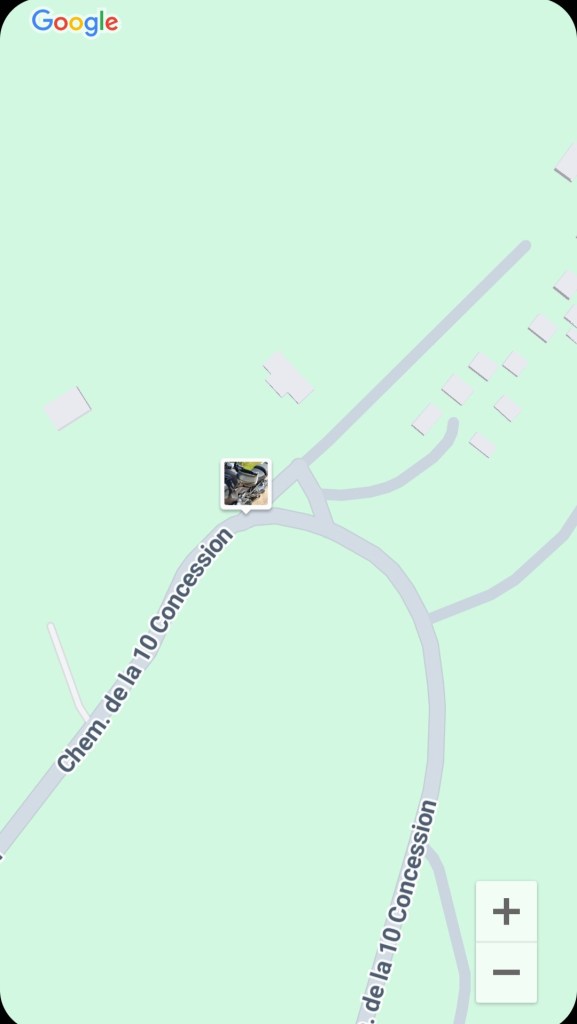
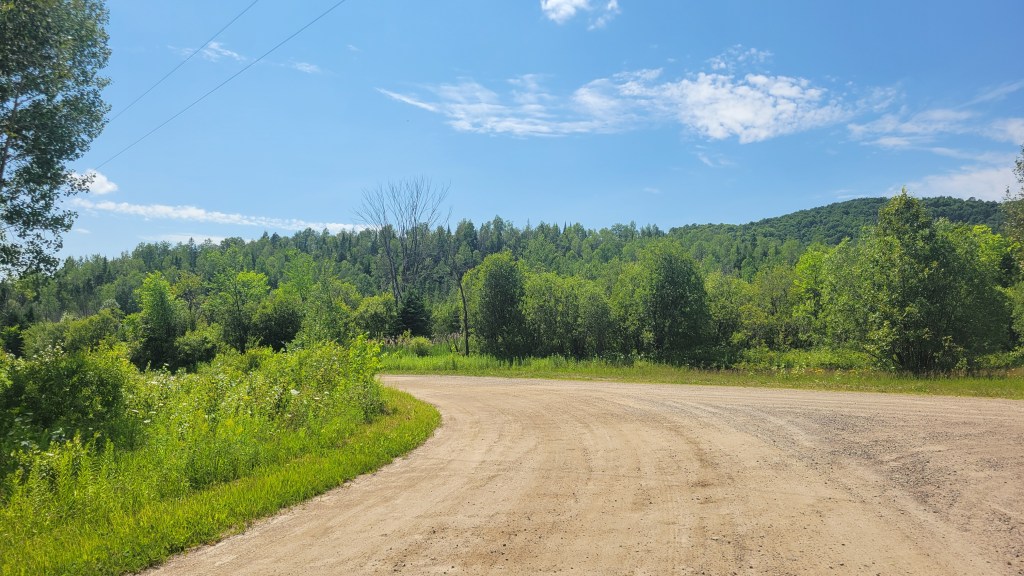
Click on the images above to see fullscreen. You really need to see the one on the right at fullscreen for the, well, full picture.
3. Vegetation at the Corner
There was a lot of vegetation on the inside of the corner at left. This prevented me from seeing an approaching vehicle. Municipal road crews must share some of the blame for not keeping on top of cutting, but then this is rural Quebec so what can I expect? The fault was mostly mine because I think I was in the middle of the road and not further right, where I could have seen deeper into the corner. Chris Birch talks about line choice in his Say No to Slow video series for just such a corner as this.
4. The Other Driver
I’m going to put the bulk of the blame on the driver of a truck travelling in the other direction. We are all familiar with drivers who drive down the middle of the road. We’ve come across them, maybe even at a corner like this, and they scare the crap out of us. That’s why we have to “Ride Right,” as the saying goes.
But this driver actually crossed the road in front of me as he was heading to the dead-end road that is the offshoot. He didn’t slow, and he was speeding. All I saw was a truck in front of me and instinctively grabbed my front brake. The bike instantly tucked and, before I knew it, the bike and I were sliding along the road.
At some point, I noticed that the truck had stopped just after the corner on the adjoining road. But in the aftermath, he continued on without getting out of his vehicle and speaking to any of us.
After the Accident
We righted the bike and pushed it to the side of the road to assess the damage. I was sick to my stomach, not from any injury but thinking my new dream bike was ruined. As I looked at the damage and started to make a calculation of costs in my head, it dawned on me that I would make an insurance claim. I’ve never made a claim, ever in my riding experience; I’ve always just replaced parts and done the labour myself for any damage caused in mishaps. In this case, I concluded the deductible would be a fraction of the full cost of parts.
There were a few more mistakes made, and they were arguably more crucial.
1. Take a Moment to Assess Your Own Well-Being
We were all so focused on damage to the bike, I forgot to assess my own well-being. I noticed some minor pain in my hip and that the sole of my boot had been torn off, but I didn’t take a moment to check in with my body and determine if I was more seriously injured. In the end, thankfully I wasn’t, but it often happens that more serious injuries surface after a few moments when the adrenaline wears off.
2. Get Information From Other Parties
The biggest mistake of all was not going to find the truck and its driver, who couldn’t have been far since he was headed to a dead-end street. When I eventually called my insurance company, they said they needed the licence number and insurance policy of the other driver. Without this information, they would have to report it as a single vehicle accident with me 100% responsible. I was annoyed about this and hope it doesn’t come back to haunt me when my policy is renewed. I returned the next day with a friend but it was too late; the truck was gone, although we saw its tire tracks and know which house it had visited.
3. Get a Police Report
I’ve since learned that even if we couldn’t find the other driver, I could have reported it as a hit-and-run if I’d made a police report. Again, I was so focused on damage to the bike that I neglected these important legal steps. Even if there is no direct contact with another vehicle, you can report it as a hit-and-run if someone else was involved and didn’t stop to provide their information. Apparently, the report should be done within 48 hours of the accident.
The Damage
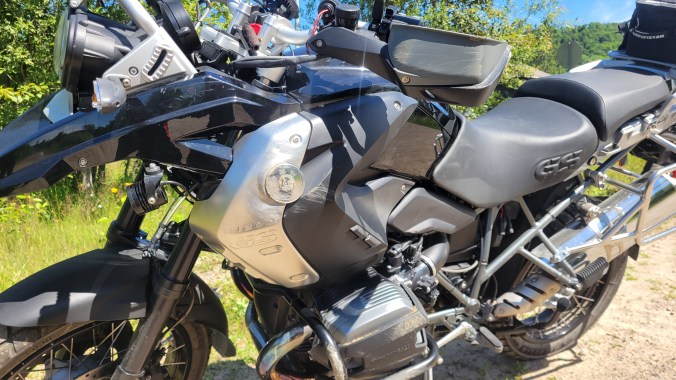
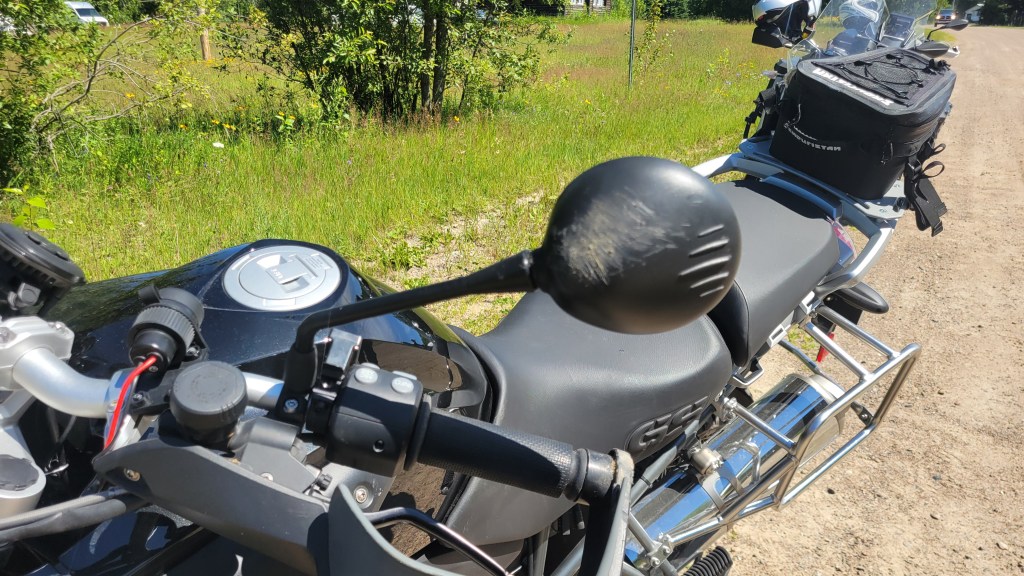
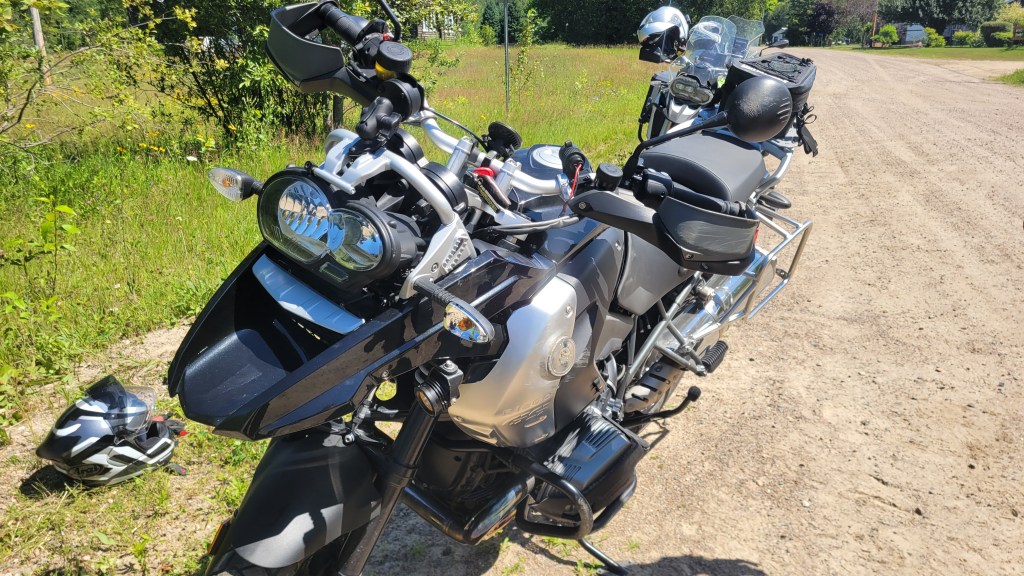
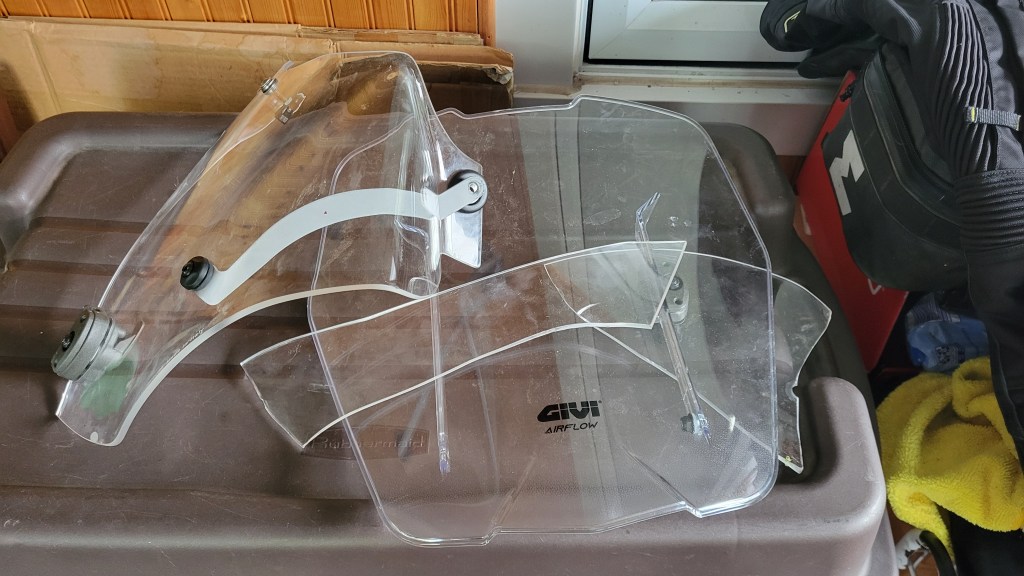
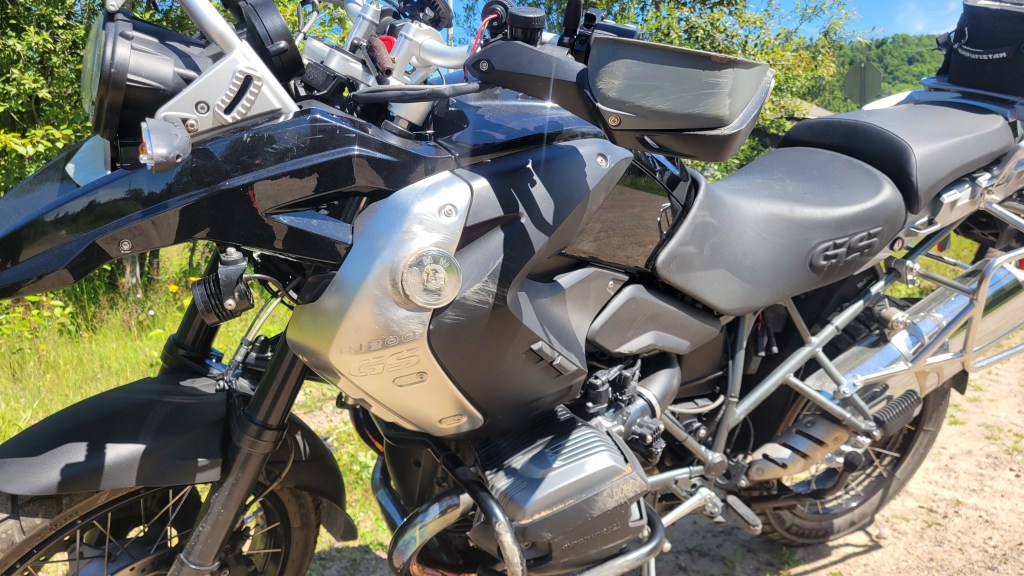
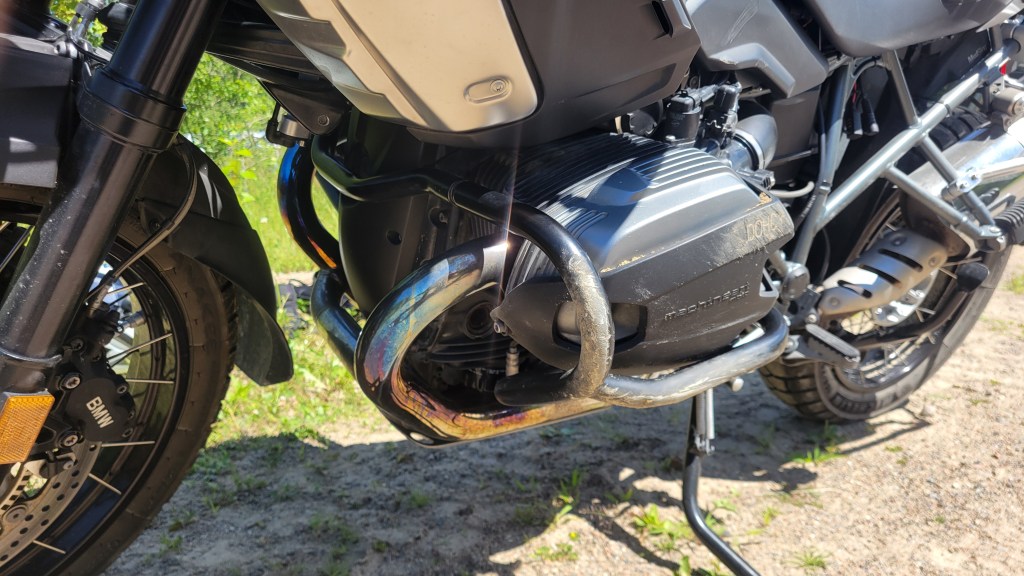
The new GIVI Airflow windscreen I’d put on the day before had shattered. There were scratches on the fairing, the mirror, the handguard, and the beak. The Hepco & Becker bars and MachineartMoto guard had done their jobs and protected the cylinder head, but both the bar and guard were badly damaged. The bar was not only scratched but also bent from impact. The BMW badge was torn off. The assessment came in at over $6,000 Canadian, plus labour. BMW parts are expensive, even for an old bike.
The Take-Aways
One of the biggest costs of the accident has been losing two months of the short riding season here in Canada. I’ve had a lot of time to think about my mistakes and what I’ve learned through the whole ordeal. Consider these as points of discussion and consideration rather than absolutes, but this is what I’ve arrived at:
- Never take a ride casually. I’d just come back from an off-road rally and went into this ride thinking it would be low-risk. I wasn’t mentally and physically prepared to ride. I almost didn’t put on my compression suit that morning, and I hadn’t replaced the hip armour in my pants after laundering them.
- Is it worth it to turn off ABS on a big bike like the 1200GS? If you are taking it onto terrain that requires you to turn off ABS, you’re probably on the wrong bike. ABS probably would have saved me in that panic situation.
- Avoid 80/20 “touring tires” if you go off asphalt. Even on dirt roads, they are pretty useless. I was surprised by how quickly the bike went down. In the future, if I’m going to be doing even “light off-roading,” I’m going to put on at least a 50/50 tire.
- Arguably, it’s more dangerous to ride rural dirt roads than trails. On trails, it’s relatively slow speed and there are no other vehicles except those in your group. People on rural roads drive like they are the only ones on the road. They drive down the middle of the road; they speed; they back out of their driveways without looking; they stop in the middle of the road after a blind corner to chat with a neighbour, etc. We need to be constantly vigilant in reminding ourselves that these are public roads and rural drivers are the worst!
- Beware of the unfamiliar. Different bike, different road—anything that takes you out of the normal, e.g. weather, riding buddies, time of day.
- ATGATT. The old acronym is true: all the gear all the time. You never know when you’ll need it.
- Get information from everyone who was directly or indirectly involved, including witnesses. Luckily I have a witness because I don’t have a police report.
- Do a police report for insurance purposes, preferably within 48 hours.
- Take a moment to assess yourself after adrenaline wears off, and err on the side of caution. If you aren’t sure you’re okay, go get checked. We had a rider in our street club who had an innocuous-looking accident, said he was okay, road home, but ended up later that night in the hospital. Take a moment to check in with your body as well as the bike after an accident.
- Take as many photographs as you can. I’m glad I took photos of the location and damage to the bike and my gear for insurance purposes.
- In some jurisdictions, you can claim for damaged gear (a damaged helmet is the common item). Here in Quebec, for example, riders have over $1,100 of coverage to replace clothing and riding gear.
- Acrylic windscreens are not appropriate for off-roading. They shatter in a minor crash. I’ve replaced the GIVI with the OEM and will add a Puig Multi-Adjustable Visor to help with airflow.
The information in this post may not pertain to the law in your country or state and may not reflect your specific insurance policy. I suggest you take some time to familiarize yourself with that information before you need it.
Conclusion
As the saying goes, all’s well that ends well, and the bike and I are fine. The dealer is just waiting for the beak to come back from the body shop and then I’ll have the bike again, just in time for autumn riding. I’ve seen the parts list, and although slow, Moto Gabriel here in Montreal are being very thorough, replacing even things like the handlebars, which I hadn’t noticed were damaged. I’m happy to pay the price in time if it means the bike returns looking good as new.
In the meantime, I’ve had a chance to bond with the new Honda 300 Rally. If you haven’t seen the video I edited on my ride of the TQT with Riley, check that out below. I’ve had some time to play with video editing and am thinking of growing the 650thumper YouTube channel as well as this blog. Toward that end, I’ve improved the logo. I’ll be getting some stickers made up and maybe even some merch, so look for some swag in the coming months. Retirement is pretty good, I must say.