Trans Québec Trail 2026: Magog to Mont-Saint-Pierre

The tour this year was not ambitious but had everything needed to satisfy the itch.

Last year I rode a section of the TQT solo but abandoned it after a week for a few reasons. For one, I found it a little lonely. The Austrian poet Rainer Maria Rilke advised his protégé Franz Kappus that he had to be comfortable “walking through hallways of solitude” if he wanted to become a good poet, and I’m pretty comfortable with my own company, but hours and hours of riding alone through forest did get a little boring. It’s also not that safe. It’s not advisable to ride solo off-road, particularly in remote areas. I also had a bike that wasn’t starting reliably, and it was also top-heavy and difficult to lift fully-loaded on my own. Added up, I was riding with a constant low-level stress detracting from the enjoyment of the tour.

This year I changed all the elements that were holding me back. I swapped the 500 lb. Tiger 800XC for a 330 lb. Honda CRF 300 Rally, and best of all, I was riding with a buddy; my friend Riley from The Awesome Players Off-Road Club was interested in doing some of the trail. He was on his Norden 901 Expedition, a bike 3x the size of my Honda, so we were looking a little like Laurel and Hardy as we headed off down Highway 10 toward Magog. We had decided to pick up the TQT there and ride it as far east as we could in the five days we had.

The trail east of Magog is easy concession roads passing through farmland, with horses and cattle grazing at the sides of the road and crops extending over rolling hills to mountains on the horizon. Just east of Stanstead, we dropped down and road along the Canada-US border for a few kilometres. The road was in Canada but the ditch was in the The States, and I couldn’t help thinking about the current tariff war that is dominating the news, and how our good relations with America have soured during President Trump’s current term. We are into a war of words now, but despite what the politicians and talking heads are saying in front of the cameras, most Canadians are united in staying the course and not capitulating to Trump’s demands by signing a deal under threat that isn’t good long-term for Canada.

The world’s longest undefended border. You can see the cement markers along the fence-line.

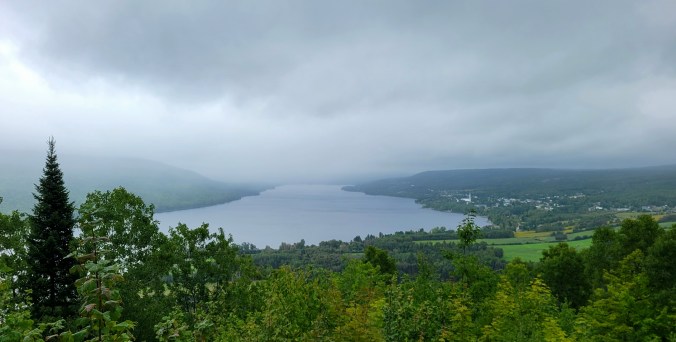
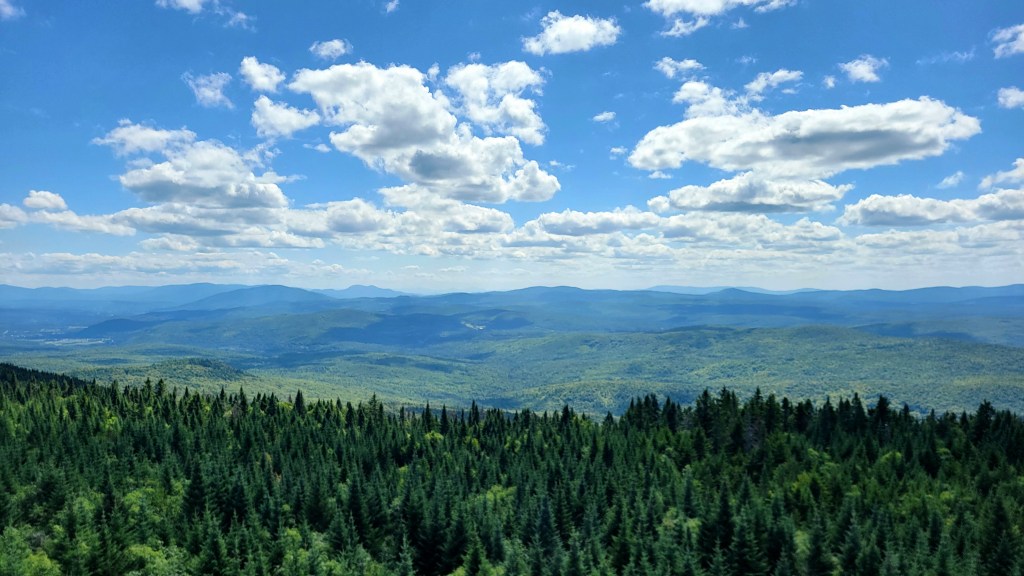
Soon we were ready for a break and took the diversion to the Mont Hereford Lookout, which now provided a view out over Quebec and south to Vermont and New Hampshire (banner image above). We were so high, we could almost spit or whiz onto US soil, not that we would ever want to do that!

Our next stop was at the Tim Horton’s in Lac Mégantic to borrow their WIFI and charge up with caffeine. After a quick stop at the memorial and site of the 2013 rail disaster, we continued on, determined to put as many miles as possible in before the light faded. The best riding of the day was during the golden hour that took us along the Chaudière River to 2 Rivers Campground.

2 Rivers is a classic RV park and not really my cup of tea, but when you’re putting in long days in the saddle, you’re just thankful for a site, and in my case, one with a couple of trees for my hammock. They tucked us in the tenting section, which predictably was empty so we had a lot of privacy to drink and listen to music. There was some competing music coming from somewhere and late in the evening we decided to take a walk up through the park, and as we approached a large tent I realized the music was live. I guess we caught the season-end party and the band was really good! Unfortunately, despite having a working knowledge of French (Riley’s is better than mine), neither of us could understand a word of the French vocals, making us feel like the minorities we were and just how separate the two solitudes of Quebec truly are.

The next day took us into our first ZEC and where I had split off the previous year, not feeling comfortable venturing into these regions alone. What is a ZEC? It’s a Zone d’Exploitation Contrôlée, poorly translated as a “controlled exploitation zone”—hunting, fishing, and other ways one can exploit nature. I’m sure there are more than a few environmentalists who cringe at this naming. These are “gated” regions requiring a permit to enter, even if you aren’t going to kill anything, and there isn’t much in them but animals to kill and the odd hunter. You wouldn’t think that nature reserves and motorsports go well together, but if you’re on an adventure bike, the trails and forest access roads that cross ZECs make for good riding.

Normally, you have to stop and pay an entrance fee for each ZEC or risk being fined $500, but this year Marc Chartrand of Ridaventure has managed to negotiate an agreement between the TQT and the ZECs. You buy a sticker at a cost of about $57 and it grants you unlimited access during the calendar year to the 25 ZECs the trail crosses. Not only is this a lot more convenient for riders but it’s also a pretty good deal because the individual entrance fees can be upwards of $40.
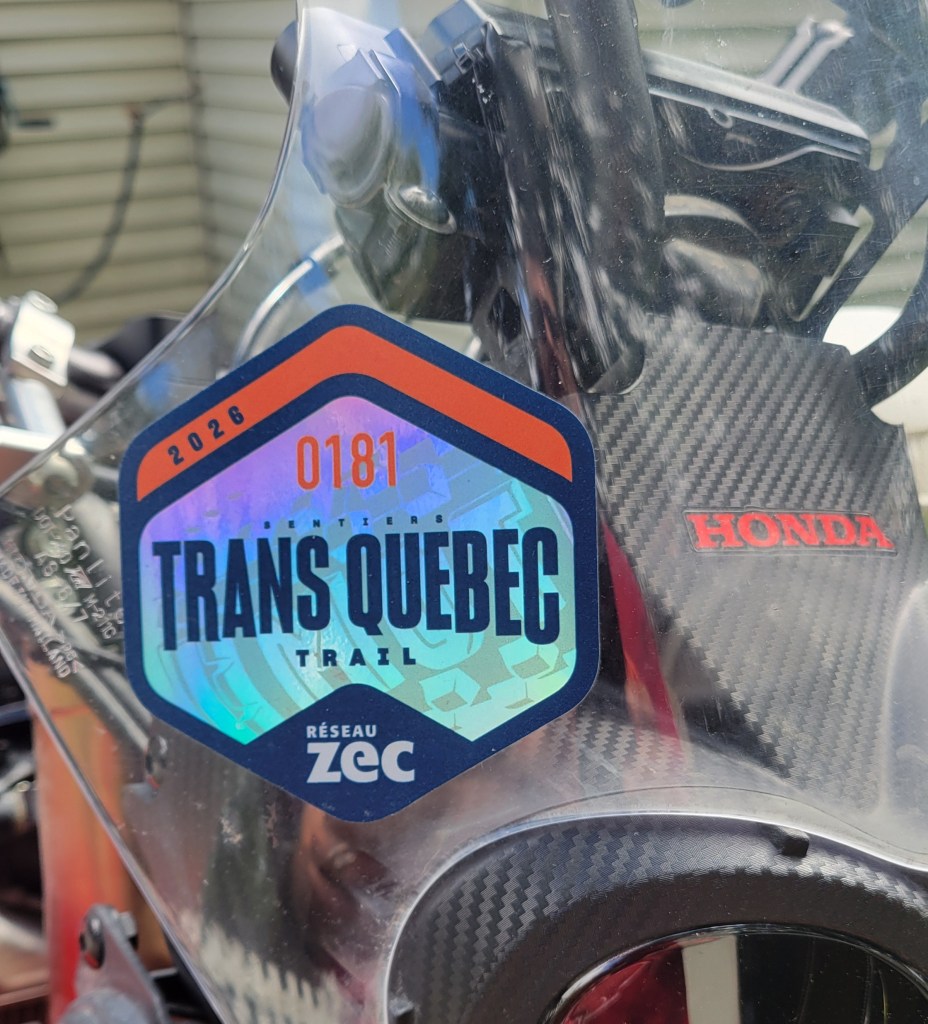
As you can see, we were among the first to use this new system, and let me just say that some of the wrinkles still need to be ironed out. We arrived at our first “gate,” which was an unstaffed electronic kiosk, and Riley spent 20 minutes filling out online forms, similar no doubt to the ones we filled out when we ordered the TQT sticker (i.e. name, address, make and model of bike, licence plate number), only to discover there was no option for Ridaventure, only other options with more charges. The cheapest of these had something to do with gathering (presumably berries, or such?), but since we were only gathering mud, that didn’t apply. We decided to risk it and, with stickers clearly visible, ventured bravely into the controlled zone. If this is sounding like the language of 1984, Logan’s Run, or some other dystopian story, that’s a little how it felt.

We emerged unhunted and rode into Pohénégamook, a place I have only now learned how to pronounce let alone spell. The name comes from the Indigenous Abenaki word ponegamikw, which translates to “winter camp.” Local First Nations set up camp around the lake in winter to . . . you guessed it, hunt. It’s geographically an odd little town nestled right on the Canada-US border right at the northernmost tip of where Maine juts up into Canada and near the New Brunswick border.
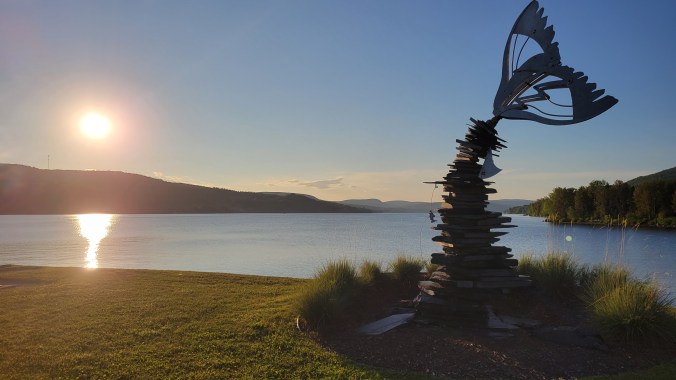
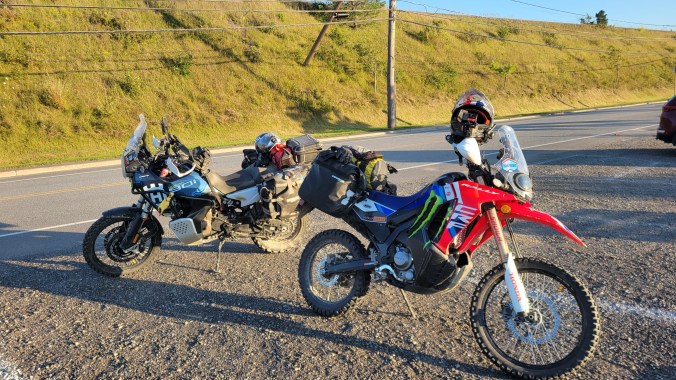
  • Looking north from the southern tip of the lake
  • Our loaded bikes
  • Montagne de la Croix Lookout

Unfortunately, the next day the weather turned on us. Riley was in an MSR Xplorer ADV Suit which kept him cozy and warm, but I had risked wearing my Klim Traverse jacket. I knew the Gore-Tex weatherproofing was vulnerable—I’d been caught in rain before while commuting—and it wasn’t long before I was soaked to the skin. My Carlsbad pants generally held up, but I have to contact Klim about the Gore-Tex lifetime warranty on the jacket. Hopefully they won’t say, as someone once joked, “you have outlived the warranty.”

Rain aside, the riding was great! We crossed two more ZECs, which offered more challenging riding. At times we were routed onto some 2-track snowmobile trails and I was happy to be on the little Honda, and another time two moose crossed the trail in front of us. I wasn’t filming at the time so didn’t catch much of them (watch until the end).

Sorry about the rain droplets on the camera; I have to remember to wipe it more often. We popped out at Amqui and found a site at the municipal campground there.
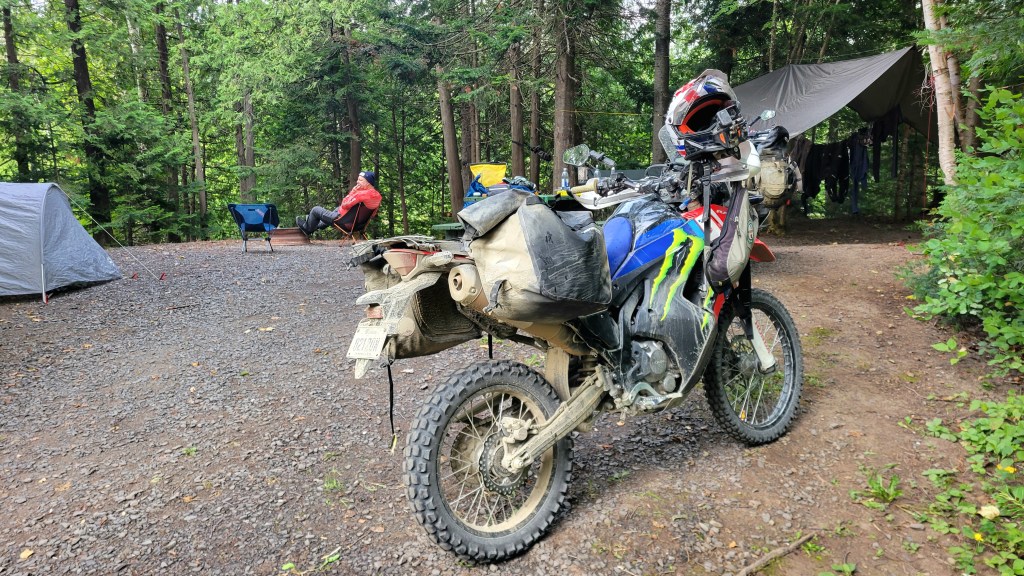
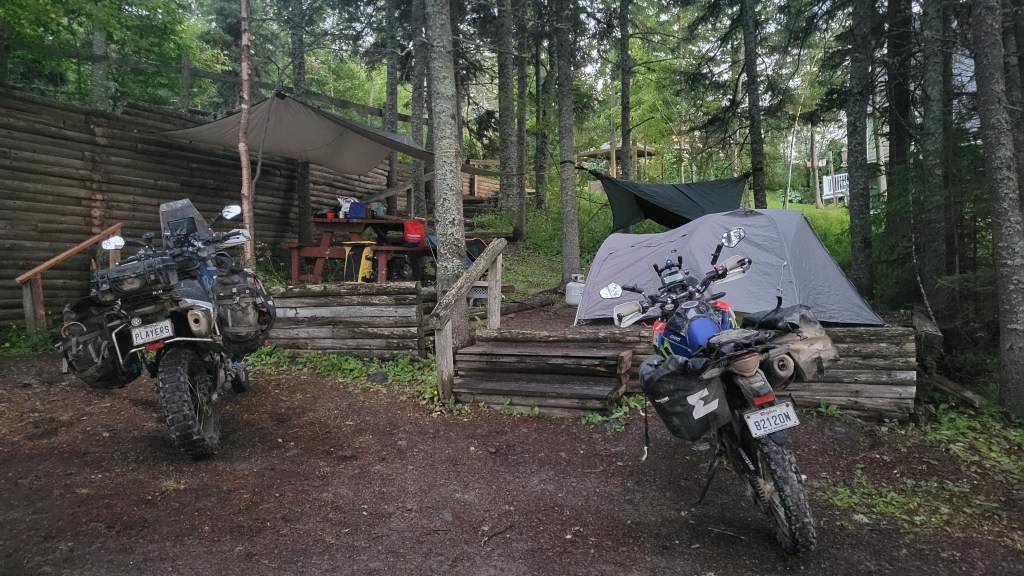
Set up for the night at Amqui Municipal Campground. My hammock is off-screen. Gear drying on the line under the tarp.

This was the first real tour on the Honda with the Enduristan Monsoon 3 bags, and overall I was very happy with them. I had to remove my passenger pegs and replace each with a fabricated nylon strap with grommets to use as a tie-down point. The built-in elasticated ROKstraps of the Monsoon 3s ensure the bags don’t flop around, and each bag takes 30L for a total of 60L. A little wet-dry bag on top was all I needed for all my camping gear, including a little food.
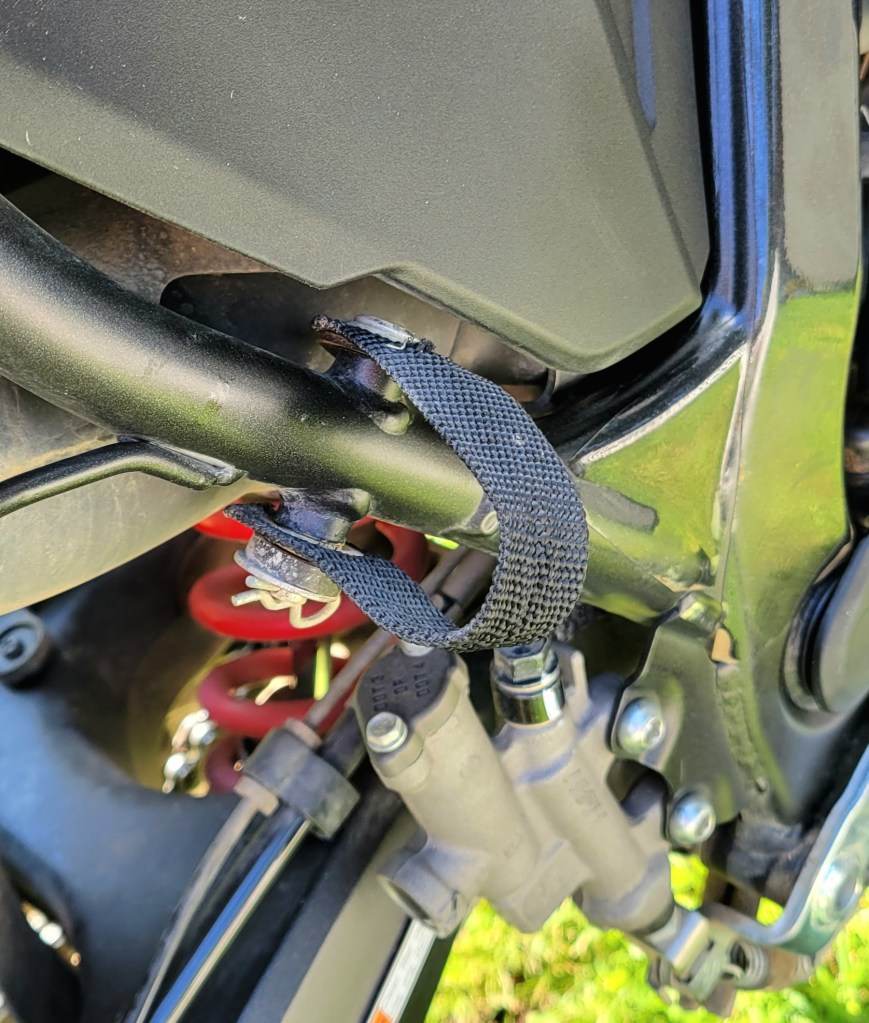
You can use original hardware from the pegs. I added a more robust cotter pin.

After nearly two full days off road, we were ready for some asphalt and headed up toward the coast. Riley had never ridden any of the 132 and I knew how awesome it is after riding it around the Gaspé peninsula en route to Newfoundland. We asked Kurviger to come up with an interesting route to the coast, and Kurviger never disappoints. My phone wasn’t charging from all the water of the preceding day, so Riley led with his wireless charger. It’s always a fun challenge trying to keep up with him, especially on the little Honda.

The Honda keeps up just fine in the corners but I have to downshift to 5th and wring its neck a bit on the climbs. That flashing white light on my display at 7,000 rpm is telling me to upshift but 6th is an overdrive gear that doesn’t do well climbing, especially with the bike fully loaded. I generally try not to go above 7,000 for prolonged periods of time but I do to pass other vehicles as needed. It’s all part of the trade-off of having a bike that weighs 330 lbs. This is not a bike for highway riding but trails and maybe some secondary highways. I can see taking this bike across Canada on the TCAT someday. I would have confidence doing that on it, knowing how capable it is off road, how light it is to lift, and how reliable it is as a Honda.

Suddenly as we crested a hill the air turned cool and I knew we were approaching the river, or as they like to call it along the gulf, la mer (the sea). That naming is mostly for tourist dollars but the river here looks like the sea and smells like the sea, and if you surrender to the idea it can feel like the sea. The mountains on the opposite side of the road are dramatic. The 132 never disappoints and I could ride it all day. In fact, that’s pretty much what we did. We didn’t want to stop and the views kept drawing us further east, although we knew that each kilometre further was another kilometre we’d have to ride to get back to Montreal the following day.

We were looking for food and, after an impromptu peanut-butter and syrup sandwich at the lighthouse, we found some fish & chips in Mont-Saint-Pierre. This was our turnaround point and, now powered up, we headed back along the 132, stopping for the night at Camping Chalet La Luciole in Sainte-Luce-Sur-Mer.
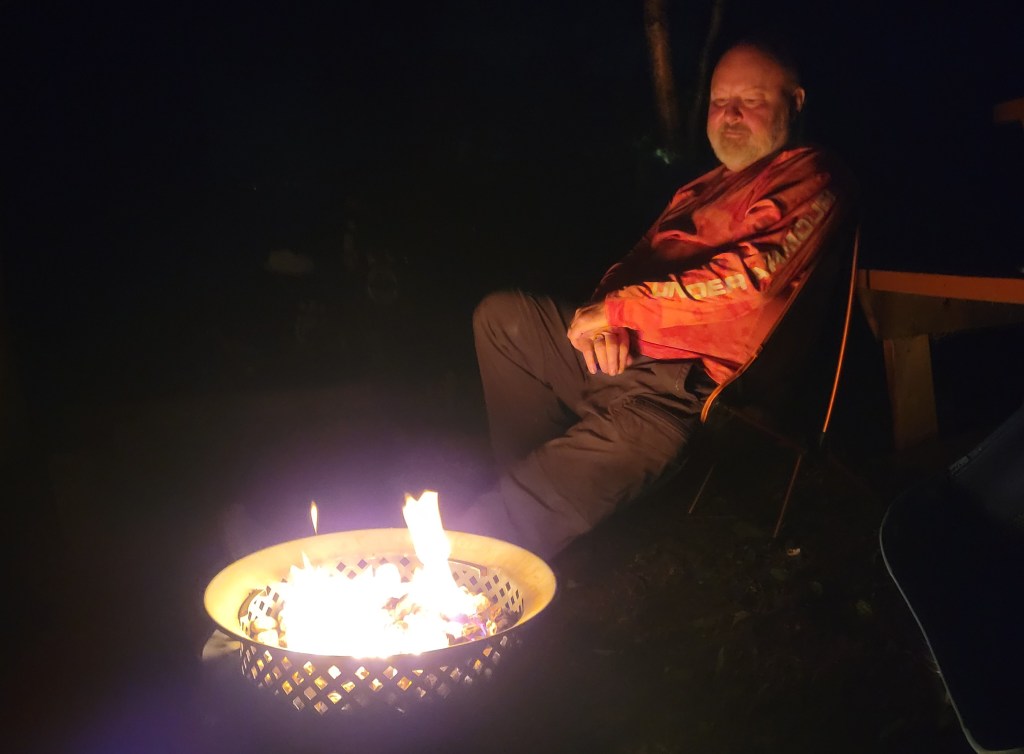
We weren’t permitted to have a wood fire but the campground has propane fire-pits to rent, which was a good alternative. The fire and the last of the Crown Royal warmed us from the cold air coming off the water. As the name suggests, Sainte-Luce is right on the sea, and we could hear waves breaking on the beach from our tents, no sleep app needed.
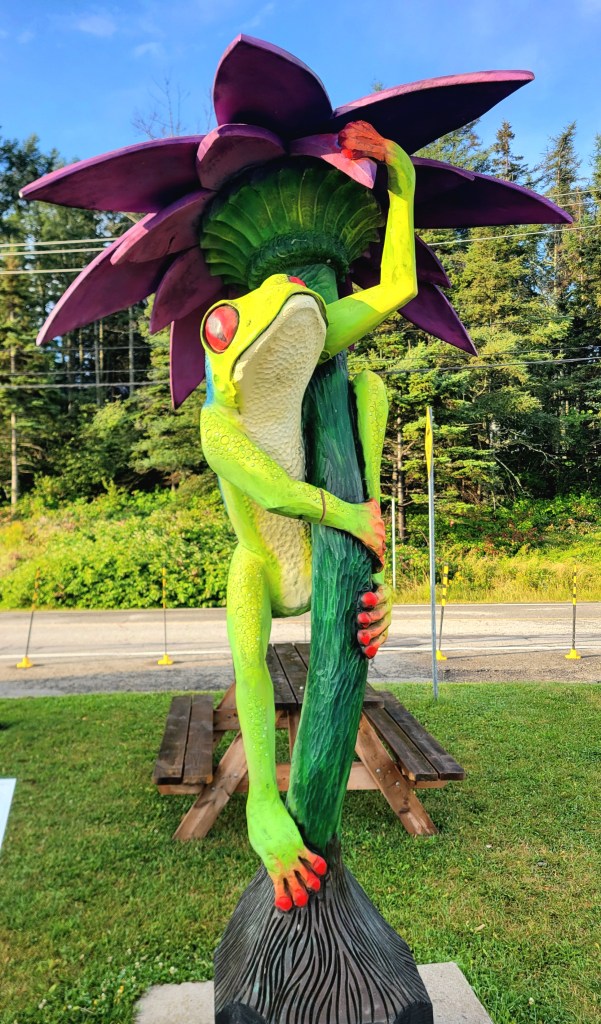
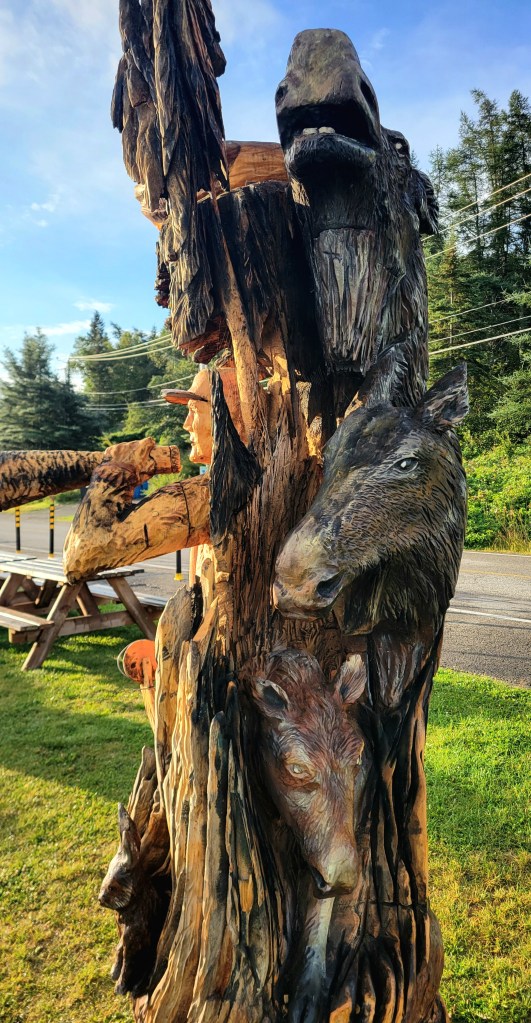
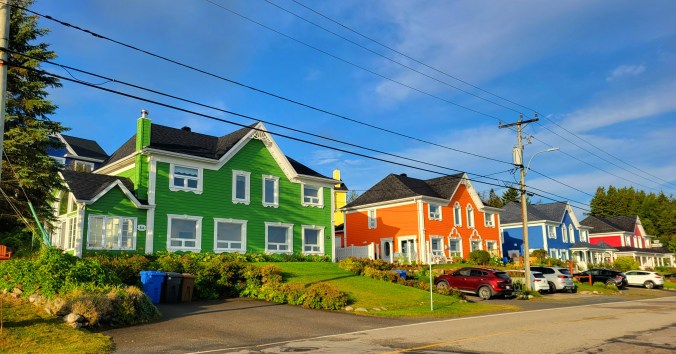
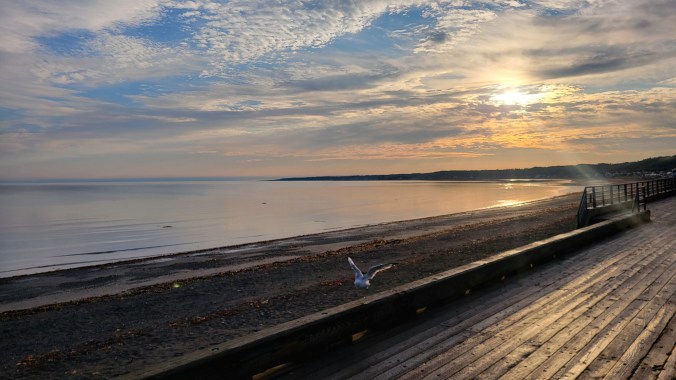
I slept like a baby in my hammock and was up at dawn. I went down to the boardwalk and took in the beach, the wood sculptures, and the colourful homes. Sainte-Luce-sur-Mer is a pretty little town worth a stop if you are passing through.
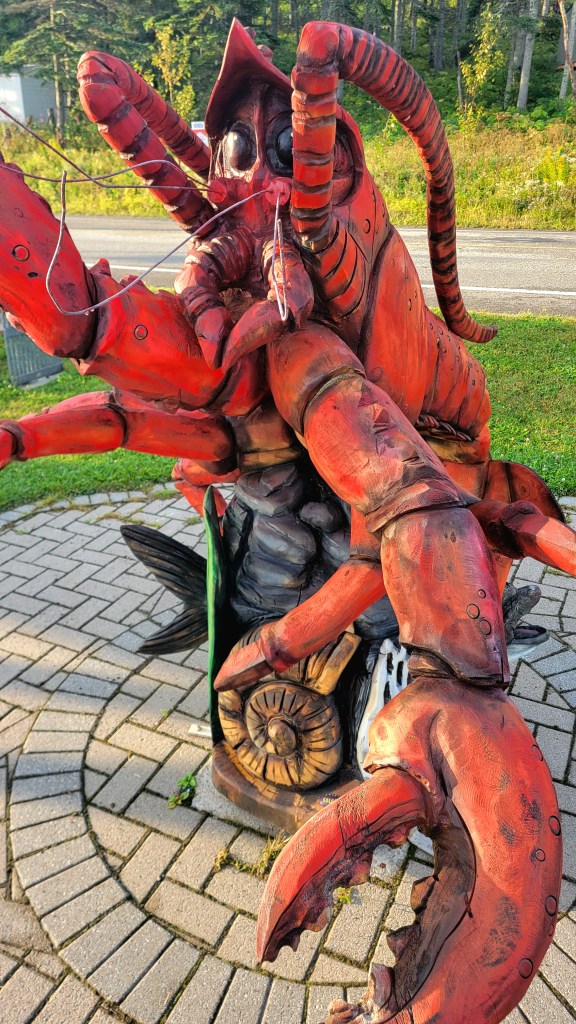
On our final day, we continued along the 132 as far as it was interesting, which is to say, until La Pocatière, stopping in Kamouraska for a coffee mid-afternoon before the big push. 4+ hours on the highway on the Honda was the price I paid for having a trail bike in the ZECs and riding into Gaspésie, but it was all worth it. As I pulled off the highway into my little village on the West Island of Montreal, I noticed people on the street with their phones out, photographing something behind me. Once I pulled into my driveway and turned off the bike, I saw it was a massive, brilliant, double rainbow. It was an appropriate ending to a short but colourful tour through south-eastern Quebec.
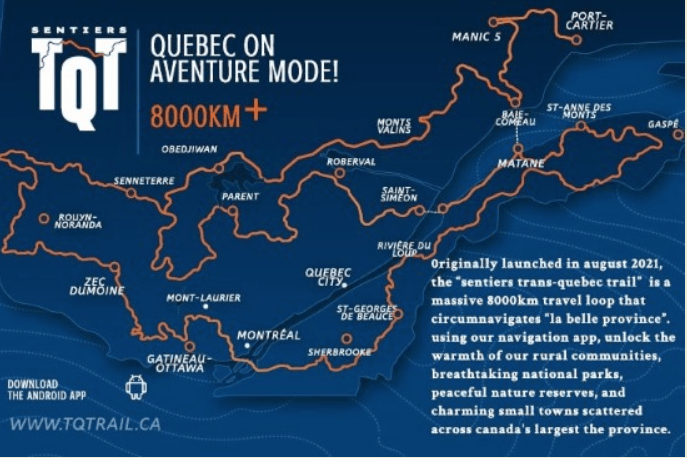
Image Credit: RidAventure.ca. We did roughly from Sherbrooke to St-Anne-Des-Monts.

The Wish List, 2022

It’s time to modify the Tiger for dirt.

There’s a balance between customizing a bike and over-modifying it. I remember an episode of Adventure Rider Radio in which Jim Martin talks with Warren Milner, who worked at Honda for 30 years in product planning and R & D. Warren warns against rashly modifying your bike, especially based on advice given on internet forums. For example, at one point in the interview, he talks about the exhaust system, describing how manufacturers spend hundreds of hours developing and testing it before the bike goes into production. That’s because today’s bikes use back-pressure from the exhaust as an integral part of the combustion process to optimize fuel efficiency and emissions, yet one of the first mods owners often do is to slap on an aftermarket exhaust. One can almost hear the collective groan of the engineers as they do.

At the same time, every bike that rolls off the assembly line is built for the average rider—average build, average riding (whatever that is), average skills, average goals. That’s why it’s important to customize it for your specific needs. Tall rider? You might want a taller windscreen to avoid buffeting, or add a wind-deflector. Long legged? You might want to lower your pegs or raise your seat. Or the opposite: you might want a lowering kit so you can flat-foot. Going off-road? You’ll need different tires, etc.. There are a lot of considerations, and fortunately, a lot of options available. The industry is healthy with aftermarket products.

I decided to ride the Tiger for a season pretty much as I bought it. I wanted to get a feel for it stock before making changes. I still have the stock front tire on that came with the bike. The only changes I made were in the realm of protection: crash guards and a beefier skid plate. I’d learned my lesson with the BMW, waiting to buy some upper protection and ending up buying a new radiator along with the guards when I eventually did. After studying the market, I went with Outback Motortek. The guards and plate set me back a cool Grand, but I think they’re the best on the market. The only other mods I’ve done to the Tiger so far were to add an AltRider rear brake extender and a wind deflector.

But with two big tours planned for 2023, it’s time to ask Santa for some items to get the bike ready. Here’s what’s on my wish list for 2023.

Panniers

The Tiger came with Triumph racks and cases. The system is fine for commuting and light touring, but those side-opening cases aren’t practical for moto-camping.

I deliberated (read, “agonized”) over this decision for a long time. I love my Touratech hard cases, but the Tiger has a high exhaust on the right side so I really should go with an asymmetrical system. When I had the 650GS on the market, I had offers just for the racks and cases, but I was reluctant to separate them from the sale of the bike. The new owner wanted to buy them too, but in the end, I decided I couldn’t separate from them either.

They are great cases and contain a ton of memories with all the stickers from where I’ve been. They are the original puck system, which you can’t get anymore, and I like that you can lock them. I’ll probably use these when I tour the East Coast with Marilyn because they are big and we need the space and I won’t be doing much dirt on that tour anyway. We’ll just have to pack them so the bike stays reasonably balanced.

However, I also plan to ride the NEBDR and MABDR next summer, and from what I’ve seen on YouTube, there are some challenging dirt sections of the NEBDR in particular for which I’ll need a smaller, soft-pannier system. (Soft panniers are generally considered safer for off-roading; there is less chance of breaking a leg.) I know everyone is getting the Mosko bags these days, and they are beautiful bags, but I decided to go with the Enduristan Monsoon Evo 34L/24L system.

I’m using the past tense because Santa took advantage of a Black Friday sale and got these 20% off. I picked up at the same time the matching bottle holster (for my stove fuel) and a can holster (for water, chain lube, or bear spray). One of the nice things about this system is that it’s modular, and I’ll probably be adding more to it as I figure out my needs.

Marilyn and I used the Enduristan pannier topper through the West Coast and loved it. Enduristan products are completely waterproof and designed by ADV riders to withstand the abuse of adventure touring. But the main reason I went with this system is the weight; they are the lightest panniers on the market, with no backing or mounting plates to worry about. This also means that the bags and cases will be easily interchangeable.

Racks

It’s Outback Motortek all the way. They put a lot of R & D into their products and back them up with some brave testing, dragging expensive bikes along the ground. Even though the bars do not come up as high as Heed’s and others, they are sufficient to keep the plastics and vital parts off the ground and protected. The bars look like crap afterward but have done their job and can be re-powder coated.

The rear racks offer protection for the silencer and rear of the bike, in addition to carrying the panniers, so again, I went with the strongest. These are a full 18mm + with the powder coating. In fact, they are industry leading in their size, so big that Dual Sport Plus, where I bought the Enduristan bags, includes a workaround kit of washers so the bags fit these bars.

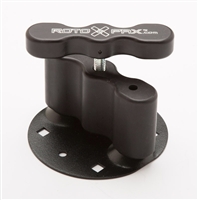
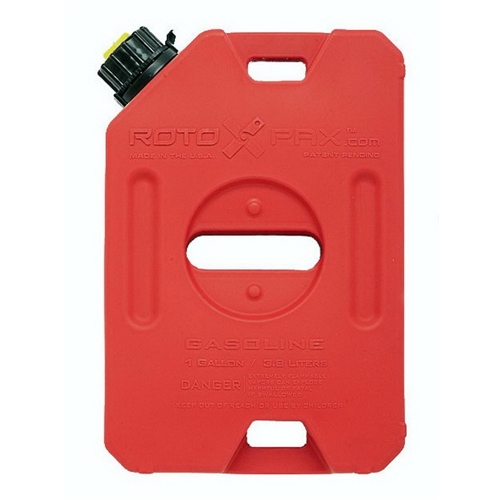
To these bars, I’m going to add on the left side an X-frame plate so I can mount a RotoPax 1G fuel container inside the bars. This will increase my range when remote riding and help balance the bike, especially when using the symmetrical TT cases. Clint at Dual Sport Plus has my exact planned set-up—racks, panniers, and RotoPax—seen here.

Hand and Lever Protection

The final bit of protection I’ll need before attempting those gnarly sections of the NEBDR is some protection for the levers. I considered going again with foldable levers but that would still leave the front brake reservoir and my hands unprotected. After looking at all my options, I decided to go with Barkbusters. They have a model that is made for my specific bike so the install is straightforward. And if I had any lingering doubts, they were quashed when I saw that BB make a plastic with my bike’s name on it. I know the Jet plastics don’t provide as much wind protection as the Storm and other plastics, but I think they suit the styling of the Tiger, and sometimes you just have to sacrifice a little practicality for vanity . . . I mean, aesthetics.

I’m not going to change my mirrors for now. I’m really not fond of the look of the double-take mirrors and am hoping the crash guards will sufficiently protect the OEM ones. And if they don’t, well, the decision will have been made for me.

Foot Pegs

What’s the most important part of the bike when off-roading? Given that I’ve posed this question in the subsection titled Foot Pegs, you’ve probably guessed correctly. If your body position while off-roading is correct, you really shouldn’t have much weight on the bars; you should be pretty much balanced on the pegs and steering the bike with your feet (i.e. peg-weighting). Of the four contact points with the bike (hands and feet), the pegs are the most important, so a good set of foot pegs is a must if you are going to do any technical riding.

The Triumph pegs aren’t small but they aren’t large either. I’ve heard that a large foot peg can make a big difference (sorry, bad pun), changing the entire feel of the bike and inspiring confidence. They will also save you resoling your boots quite as often. I looked at IMS, but they don’t make pegs for the Tiger. When I found that Fastway did and that there was a Canadian distributer, I jumped, Black Friday sale or not.

As you can see, at 2.25″ x 4.75,” these pegs are huge. They have adjustment for height and camber, and come with two lengths of cleats: 10mm and 12mm. I’ll probably start with the 10mm since my adventure boots already have a tread. They are expensive, but you only have to buy them once; Fastway sell bike-specific fit kits for mounting, so I will hold onto these babies when the time comes to sell the Tiger.

Honestly, I never thought I’d pay $300 for foot pegs, but I’ve been watching YouTube videos of guys doing, or trying to do, the Class 4 roads on the NEBDR and thought, “I’m going to need all the help I can get.”

Tail Plate

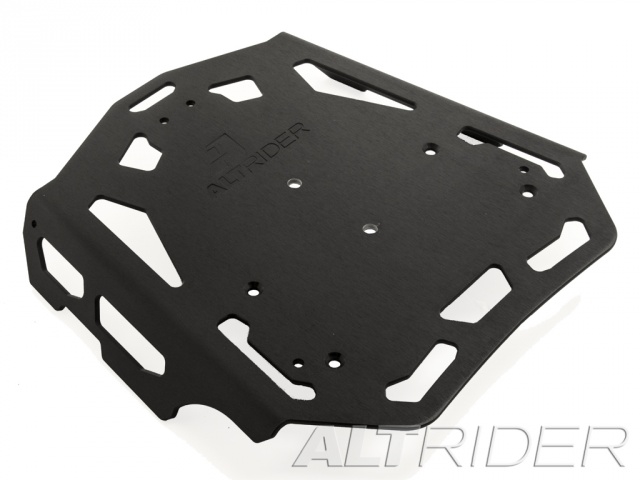
The OEM tail plate is too small for a duffle and has no good strapping points. It also shifts side to side as part of that Triumph system that shifts as you corner. I really like the AltRider tail plate, but at $260 for a piece of metal, I’m considering other options. You can get an eBay Special from China for 1/3 of that price, but will it be the same? Will the cut-outs be bevelled so they don’t cut into your straps? Will the powder coating begin to wear off after a season or two, as happened on my Kildala rack? AltRider make good stuff, and I like how this one projects out the back of the bike so there’s still plenty of room for Marilyn behind me. I might just watch and wait for this item to go on clearance somewhere, but I’ll definitely need a new tail rack before I tour.

Tires

I’ve had the Dunlop Trailmax Mission tire on the rear of the Tiger, and I had them on the GS when I took it to Vermont last summer. This 70/30 tire is a good choice if you are doing a lot of street with some dirt or gravel roads. That’s what I expect when Marilyn and I go through Gaspé, PEI, New Brunswick, Nova Scotia, and Newfoundland. So I’m going to put the matching tire on the front first thing in the spring before we head off.

For the tour in the US, that’s a little different and more complicated. I plan to start out on some BDRs (Backcountry Discovery Routes) that will take me from the Quebec border down to Pennsylvania, then I’ll be riding principally asphalt as I make my way over to the Outer Banks, including The Blue Ridge Parkway—a bucket list ride for me—and, why not, Tail of the Dragon while I’m in the area.

What do you do when faced with such diverse riding, everything from Class 4 (i.e. unmaintained) roads to the most renown section of twisties in The U.S.? Well, based on my experience, you have to go with the most aggressive tire required for your off-roading needs. You can ride a knobby on asphalt but if you try to take a street tire into mud and gnarly stuff, you can get yourself in trouble. Of course I could by-pass the gnarly stuff, but where’s the fun in that, and besides, I like a challenge!

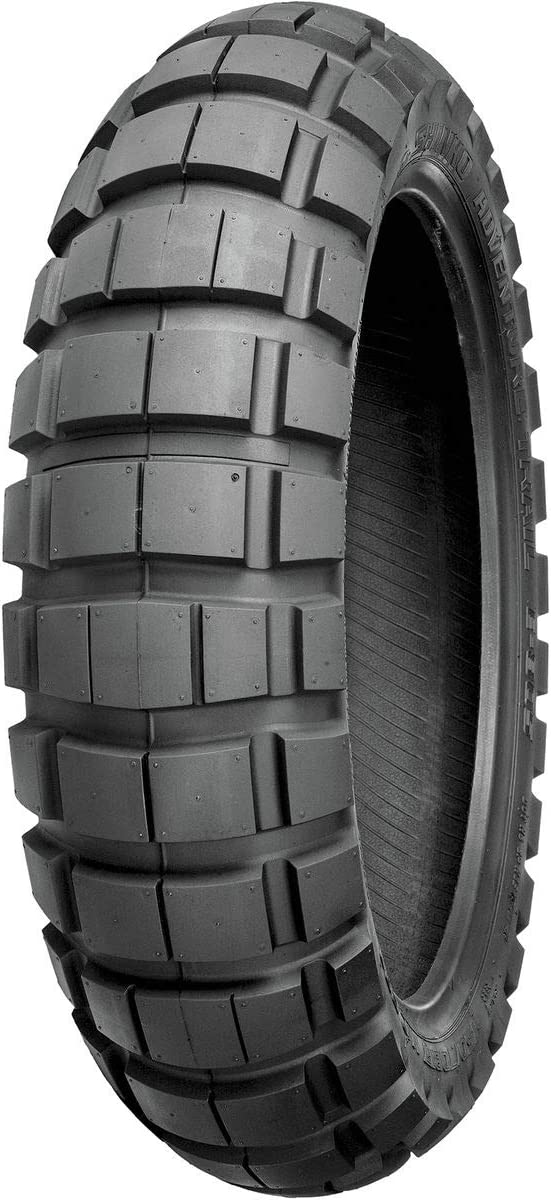
I’m currently deliberating between Shinko 804/805s and Michelin Anakee Wilds. I know the Shinkos are surprisingly quiet and smooth on the road, despite being a 40/60 road/off-road tire. However, they aren’t great with lateral stability. The Wilds are listed as a 50/50, but I have a sense they might be better in the dirt but louder on asphalt. (I’ve never ridden a set of these before.) I also like that the Anakees are a radial tire, so they will run cooler in the heat at speed. And for what it’s worth, Lyndon Poskitt just put a set of these on his Norden 901 for his tour of Iceland where he’ll be doing similar riding.

The Shinkos are about half the price of the Anakees, but for a tour like this, having the right tire is more important to me than a few hundred dollars. I have run the Shinkos before and they were great . . . until they weren’t. From one day to the next, they started skidding and sliding out on me.

What do you think? Anyone tried either of these tires?

Tools, More Tools . . .

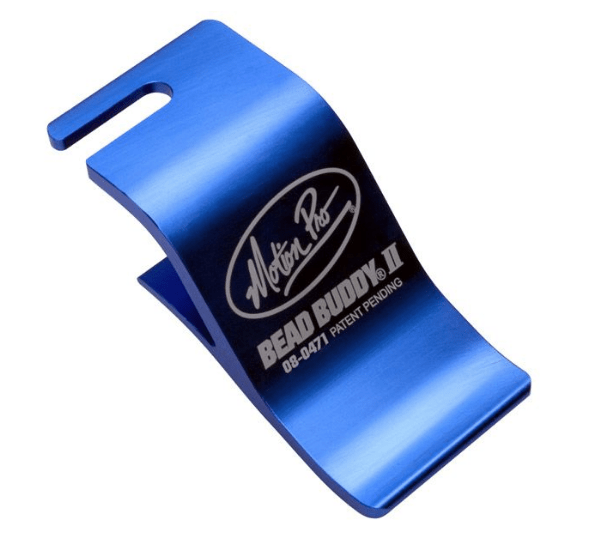
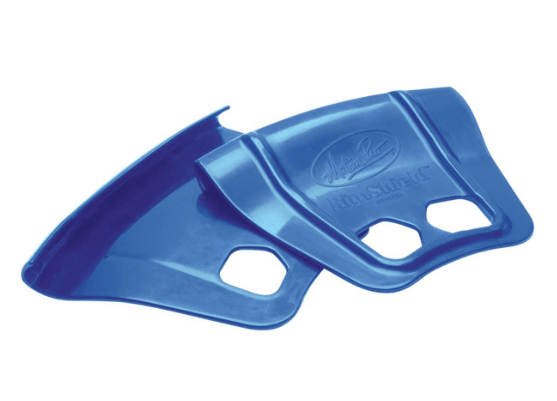
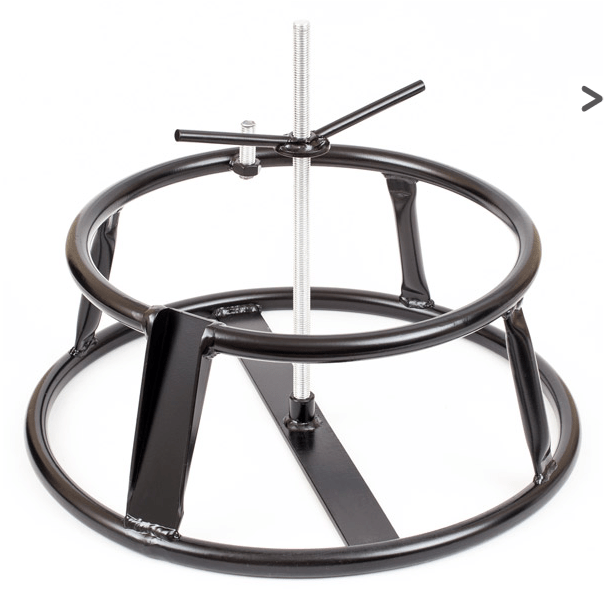
Finally on my wish list are some tools for helping me with these tire changes. I’ve always worked off the grass, but it’s not ideal; you’re grinding dirt into your bearings as you wrestle with the tire, and it’s hard to stabilize the wheel while levering. I think I’m going to ask Santa to get me a tire changing stand and some Motion Pro tools to facilitate this work and protect my rims.

The Tiger is basically a sport bike in adventure clothing; it rips, and I love how it handles through twisties. But I’ve yet to really test it off-road in technical terrain. Fully protected, with an aggressive knobby and soft panniers, Jet will be ready to hit the dirt and I’ll be eager to get back to exploring. Gros Morne National Park is a bucket list item for Marilyn and me, and I’m hoping we’ll be able to get deep into the park on the bike.

In the meantime, we’ve just received here in Montreal the first big snowfall of the winter. I’ve been shovelling the driveway for the past 24 hours, but I really don’t mind. It will be nice to have a white Christmas. I’ve just finished all my grading in my teaching work, and we are sufficiently stocked with holiday sweets and treats.

I was just remarking to Marilyn that, in many ways, I prefer the midwinter holiday to the summer one. While I can’t ride, being a bit house-bound provides an opportunity to step back from everyday life and reflect—a sort of retreat. And what comes to me this year as I do that is how incredibly blessed I am in so many ways. I and my loved ones are healthy, we have enough money, I have a fulfilling job . . . I could go on, but I’m thinking mostly of the people in Ukraine and other parts of the world who are less fortunate. In the immortal words of Ron MacLean, “count your blessings, not your presents.” It’s nice to dream and plan to buy stuff for what we are passionate about, but the most precious gifts cannot be bought.

I wish you and yours a healthy, happy holiday, and safe riding and travelling in 2023.