La Classique 2023

If you like dual sport riding, you’ll love La Classique.

La Classique, organized by RidAventure.ca and with close to 1000 riders, is the largest dual sport rally in Canada. It’s so popular that I’d never managed to get in. Registration fills in about 2 days—you blink and you miss it—and always seems to fall when I’m busiest at work grading mid-terms. I almost missed it again this year but snuck onto a team last minute.

It used to be you had to organize a team, and I could never find riders willing to join me. Now RidAventure has simplified the process and you can register as a single rider and join an existing team. That’s what I did and found myself on Les Amis de la Motorcyclette, a great group of Francophone guys. RidAventure has also separated the Saturday and Sunday rides to allow wider participation in the event. That’s a great idea because even if you aren’t riding, there are vendors and test rides available for a more relaxed day of hanging about.

I registered for the Saturday Classique Plus route, which is about in the middle of the skill level of rides. You have to be comfortable riding Level 2 Trails. I felt pretty good about that but was a little concerned about my tires. Organizers are clear that you need knobbies for anything Classique Plus and up, and because of the long-distance touring I’m doing this summer, I had on Dunlop Trailmax Mission tires, a street-biased 70/30 tire. In the end, I probably should have had a more aggressive tire, but I managed.

This rally falls nicely for me right at the end of the school year. I worked hard in the weeks prior to the rally, pushing to complete all my end-of-term grading so I could ride away with a clean conscience. In fact, I did so much intensive grading toward the end that I developed a mild case of carpal tunnel syndrome in my writing hand. Thankfully, it didn’t significantly affect my use of the throttle and front brake except in the most intensive sections.

Parts arrived from Dual Sport Plus just in time, and I spent the Friday of my departure adding hand guards and folding mirrors; I was worried about breaking a lever or a mirror in a crash, which is not uncommon in dirt riding. I was also worried about breaking my bones so geared up in my Knox Adventure Shirt, neck guard, and tucked some wrist braces into my bag. (Yeah, a little tip-over can cost you the better part of the season, so I’ve started using these if there is a chance of falling.) I left unfortunately at rush hour on a Friday, so after the requisite hour to get off the island, I was on my way.

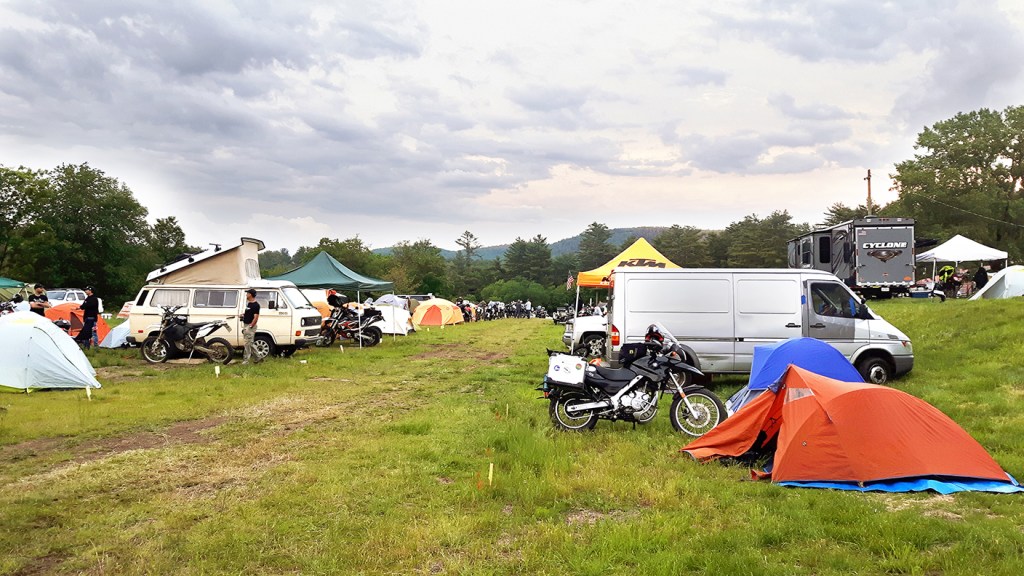
One nice thing about these rallies is that you can camp on site. The rally this year was in a new location in Saint-André-Avellin, north of Montebello, and there was a big open field for all the tents. RVs were parked in another area, and there were a lot of them!

Camping at La Classique 2023 in Saint-André-Avellin.

Now if there’s one thing I know about camping in Canada, it’s that you don’t want to do it before July. The bugs are bad! In my last minute haste, I forgot to pack bug spray (doh!), so the first order of business once I got my tent pitched was to find some. Then I checked in at registration, got my sticker and T-shirt, and spent the rest of the evening hanging with The Awesome Players at their camp. As you may remember, I did a few rides with them a while back, and they are a great bunch of welcoming guys. In fact, although I was on my own for the weekend, I never felt alone; there’s a strong sense of fellowship within the RidAventure community.

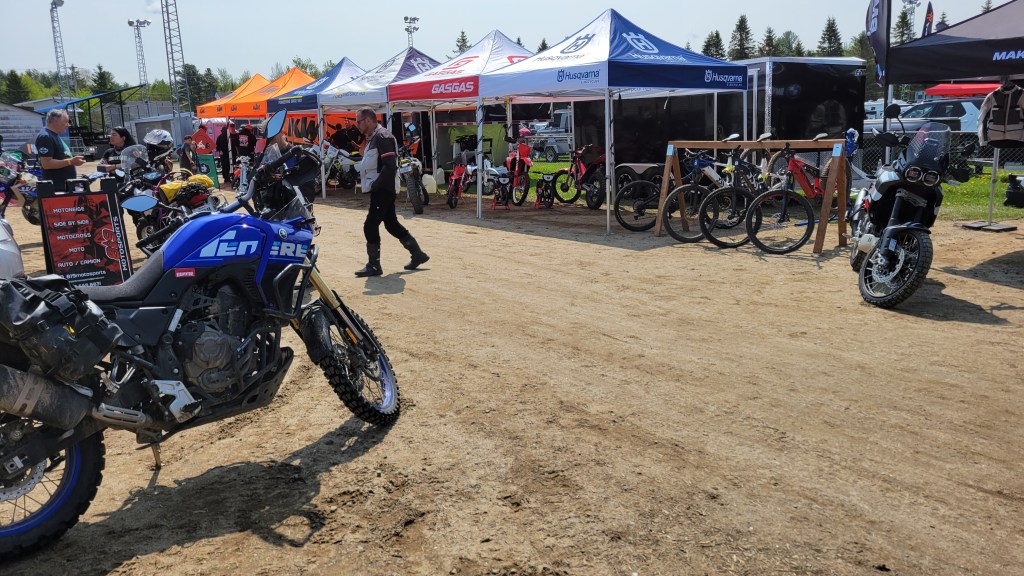
One of the things I like about these rallies is checking out all the bikes. The next morning, before forming up for my ride, I took a stroll along where the campers’ bikes were parked.

Better than the Montreal Moto Show.

Yes, that is an action camera I’m using. As I pondered in a previous post, I’ve decided to join the crowd of YouTube content creators, although I’m not a hero—as in, I didn’t get a GoPro. After much research, and heavily influenced by this video review by Dork in the Road of several action cameras, I decided to get an Insta360 One RS. I’m not interested in the 360 lens; I think that’s a gimmick that will quickly lose its appeal, and I don’t like how it makes every shot look unnatural, like through a fish-eye lens.

I got just the 4K boost lens and will be incorporating some short video footage into my posts in the future. I’m not interested in “competing” with full-on YouTube channels because that’s not my genre: I’m primarily a writer, not a videographer. I wouldn’t know my way around a massive video editing program like Final Cut Pro or Adobe Premiere, and I wouldn’t want the interruption in my rides of setting up a tripod for a ride-by shot or sending up a drone, although drones capture some amazing footage. So my footage will be minimal and serve to complement the written accounts of my rides. Anyway, we’ll start with that and see how it goes. All the videos I use will be available separately on my YouTube channel. Let me know in the comment section what you think of the new multi-media format.

Enough about that. After perusing the bikes, I had to get up to the start area and introduce myself to my adoptive team.

Marc Chartand giving the pre-ride talk.

The rally is extremely well organized. At registration check-in, your bike is inspected, you sign a waiver, then receive a wrist band and a sticker for your bike. The sticker indicates what group you are in, and there is a corresponding marker to line up with your group. Here we all are, lined-up and waiting for the signal to pull out.

500 riders waiting to start.

I was a little nervous, being my first Classique and not knowing if I’d chosen the right level. You don’t want it boring, but then you also don’t want to slow the other boys down. In the end, it was the right choice, but I faced some challenging sections. My philosophy in riding and in life is that you want to push yourself slightly out of your comfort zone once in a while; that’s when growth occurs. My French and my off-roading skills got an injection this weekend.

Finally we got the signal to start our engines and pull out. We were on our way.

Starting out on the Classique Plus ride.

Right away you can tell that my bike is different from most other dual sports. You can hear the high-pitched induction whine of the Triumph triple instead of the growl of a parallel twin. But that’s what I love about this bike: it’s a sport bike engine shoe-horned into an adventure chassis. It’s smooth with a ton of torque and loves to be revved, and it handles through the twisties like a sport bike. Okay, it doesn’t have the tractor factor of a big thumper or a parallel twin, and that’s something I have to keep in mind when off-roading. I have to remember to keep the revs up or it will stall climbing hills or working through sand and mud.

Soon we left the asphalt and were enjoying the countryside on some easy dirt roads. No doubt the route planners considered this as warm-up for what was to come. The trees closed in and then we were snaking through the forest on a twisty dirt road, and lacking knobbies, I had to remember to weight the outside peg on each corner or risk low-siding.

Sorry about the wind noise. This was my first time using the camera and I’ve since discovered the audio setting for wind noise reduction. There’s an option in the Insta360 Studio application for post production noise reduction, but for some reason, this particular noise gets “reduced” to a sound similar to fingernails being dragged down a chalkboard.

Soon we turned off this road and entered Parc Papineau-Labelle, and that’s when things became a little more “interesting.” Our entrance was a rocky hill climb, and although it wasn’t super difficult, as anyone with a GoPro knows, the action cameras flatten out all hills and the image stabilization smoothens out the ride. In fact, my suspension was working hard, and it wasn’t long before the ABS on my bike sent an error code to the ECU.

Rocky hill climb into Réserve Faunique Papineau-Labelle.

To sit or stand? There’s an excellent podcast by Adventure Rider Radio (April 15, 2022) with an aerospace physicist and Chris Birch on this topic—well worth a listen—but one thing I remember from it is the simple maxim to sit when you can and stand when you have to. Some terrain requires that you stand so you can control the bike through the footpegs, but standing all day would be tiring, so sit when you can. You can see me stand when I enter a climb or a sharp corner. You can also see me glance down a few times to check what gear I’m in. Sometimes I’m concentrating so much on the terrain I forget and want to verify.

This was fairly easy dirt riding so I decided to keep my ABS on. I thought you really only have to turn it off if you’re doing steep descents in loose terrain where you might find yourself suddenly without brakes. But one thing I learned this weekend is that my bike is not happy with ABS on in even this degree of chatter. You can see in the following clip that I have a couple of warning lights on. They would turn out to be the check engine and ABS lights, so I put two and two together and figured it was an ABS/speed sensor error. (Later back home, I confirmed this using an OBDII scanner.) I got pretty good at navigating through the set-up menu on my dash to turn ABS off since it resets every time I turn off the bike. For short stops, however, I was able to use the kill switch but keep the ignition on and it didn’t reset.

I’m not sure which caused me more concern: the warning lights or that I was losing my sticker.

At one point, we came across a moose. I could see something running up ahead in the road and thought at first it was a horse, but soon realized it was a moose. We backed off and let it run ahead until it could get off the road. In all my years of canoe camping, I’ve actually never seen one, so this was exciting.

Also exciting were the patches of sand that sent the bike snaking. You just gotta hold your nerve and let the bike sort itself out. Nobody went down that I’m aware of, although there were some close calls. Here, I’m watching the guy in front almost lose it on a sandy corner, and then when I reach up to turn off my camera (I had it on loop mode), my front slides out and I almost lose it.

Almost overcooked.

Finally, with the ABS turned off and a few hours of this, by lunchtime I was feeling more confident in the sand.

Finally feeling confident in the sand.

Unfortunately, that would be the final clip of the day. For some reason which I would only discover at lunch, my camera would not turn on and would not record anymore. When I could finally unmount the camera and have a look, it was displaying a message that an error had occurred in my last video and would I like to fix it. (I did but the above clip is missing metadata.) It had started to rain hard and I was feeling a bit stressed about keeping up and decided that perhaps this was not the best time to test and troubleshoot the new camera so I put it away. That’s unfortunate, in retrospect, because the real fun was about to begin.

Shortly after lunch we had a sandy hill to climb, and even the best riders in the group were having a hard time with it. This is where I really needed some knobbies. I was looking at the hill and thinking this isn’t going to go well, but what choice did I have? Go back to camp or go for it. So I went for it and surprised myself. It wasn’t pretty—I had to dab several times—but I got most of the way up. Having done the hard bit, the last part I did less well. Like I said, I have to keep the revs up on this bike or it will stall. But with some pushing from others, we all made it to the top and lived to ride the rest of the route.

Not me but someone else getting a push. You can see how deep the sand is. Photo credit: Jean-Charles Paquin

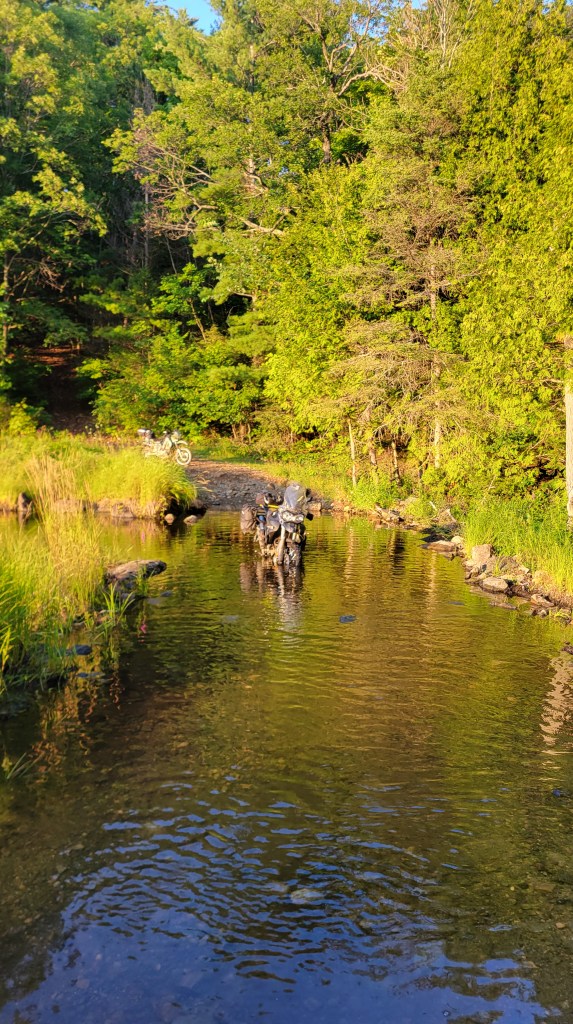
There were some easy water crossings but no other major obstacles and we were back at camp by 5, in time to clean up before dinner.


The next day I was going to head home early but decided to do some test rides. First up, just out of curiosity, was the new Harley Davidson Pan America. It was, shall I say, a little underwhelming. If you imagine what a Harley adventure bike might be, that’s pretty much it: a little loud and rough and brash. There was a lot of vibration up through the handlebars, which was surprising because they had street shoes on. The best part of the test ride was that the sun finally came out! It had rained hard through the afternoon and night and everything was soaked, so it was nice to see the sun and to know my tent would dry out before I had to pack it up.

Test riding the new Harley Davidson Pan America.

There’s definitely some interesting technology built into this bike. The suspension lowering feature when you stop is innovative and will open up the adventure market to those who struggle with the seat height of most adventure bikes. And hydraulic valves sound neat. I don’t know exactly how they work but the bottom line is apparently you never have to adjust the valves. There were some Pan America bikes at the rally so they are selling, but I don’t think this bike is going to cause a major splash like the Teneré 700 did or the BMW GS.

Speaking of the GS, I’ve always wanted to try the iconic bike. As followers of this blog will know, I had the single 650GS for years and loved it and always wondered what the big boxer would be like. Many said that the big cross-Canada trip I did would normally be done on the big bike, and I have to admit considering it when I decided to change my bike, but I’m nervous about taking a big bike like that off road into remote areas. It’s close to 600 lbs. and, with gear, that’s a lot to lift on your own if you dump it.

Anyway, this was my chance and so I did a test ride on a 1250GS. I have to admit, what everyone says about how it carries its weight is true. You can turn this bike easily at slow speed. But what I found most impressive—not exclusive to the GS—were the rider modes. I’ve never ridden a bike with rider modes before, and after 20 minutes in Enduro Pro mode, I was sliding this baby around corners. You can hear me making exclamations into my helmet.

Test riding a BMW 1250GS.

It’s very confidence-inspiring, but I couldn’t help thinking that I was cheating; it wasn’t me doing the powerslides but a computer. Call me a purist, call me a technophobe, call me a Luddite, or just call me poor, but I’m glad my 2013 bike doesn’t have rider modes. I know they’re the way of the future, but for now, I’m happy to have to learn throttle and clutch control and braking using manual inputs. Speaking of which, my throttle/clutch control sucks (!) and I’ll be targeting it with some practice in the coming weeks.

Upon reflecting on my ride of the day before, perhaps what I am most proud of is not that I kept up on the tires I had, but that I did it without any rider aids, including ABS. It was all me. I’m not a great rider, not yet anyway, but if I had a bike with that level of computer input, I wonder if I’d ever be. What are your feelings about rider modes? Greatest safety advancement in motorcycle technology in the recent past, or making us all lazy, unskilled riders?

Finally it was time to start heading home. I packed up and headed down the 321 to the lovely 418 East that took me into Grenville.

Heading along the beautiful 418 that hugs the north shore of the Ottawa River.

It had been a great weekend at my first Classique. The sun was out and I had the whole summer vacation ahead of me. I was feeling pretty bouyant, and since I was in an indulgent mood, there was only one more thing to do to make the moment perfect.

2023 NE USA Tour: Preliminary Plans

The second tour of the coming season will be down memory lane.

Jumping waves on the Outer Banks, NC, circa 1970.

When I was a boy, my parents used to take us down to Cape Hatteras on the Outer Banks of North Carolina for our family vacations. I was the physical barrier separating my two older sisters in the backseat of our Pontiac Strato-Chief. My dad had installed seat belts in our favourite colours according to this arrangement: red, blue, green. Or was it green, blue, red? I can’t remember, but I remember quite a lot about those vacations. They were among my happiest memories growing up, despite the backseat shenanigans.

Not my dad’s Strato-Chief but similar.

We went with another family, and apparently those vacations left an impression on them too, for one of the children named her future child after me. En route, we camped at Shenandoah National Park in the Blue Ridge Mountains. I still remember the nature hikes led by a ranger (who taught us to recognize a particular birdsong by its resemblance to “Drink your teeeeeea!”), the nighttime slide shows at the amphitheatre, walking back to our campsite afterwards, the fog so low you could bounce your flashlight off the underside of a cloud, and the rainstorms. The rainstorms! To this day, I love a good rainstorm from inside a good tent.

Since getting my licence in 2016, I’ve wanted to return and ride the Blue Ridge Parkway, and this summer I finally will.

We would drive much of the Blue Ridge Parkway before spending a day in Williamsburg, then head over to the coast and camp along the Outer Banks. The campground was so close to the ocean you only had to walk along a boardwalk over the dunes to the beach. I wasn’t a strong swimmer and the sea always frightened me, but I enjoyed playing along the shoreline. One year, we went to The Wright Brothers Memorial at Kitty Hawk, and I think my first ever book was a staple-bound biography of The Wright Brothers I purchased from the gift shop there with the few dollars we were given for “spending money.” That seed of interest later sprouted into a dream of being a pilot when I grew up, and although my career ultimately went in a different direction, it has combined with another interest of mine—poetry—to produce a collection of poems that explores the theme of flight. I might not be a pilot, but I can imagine being one; the opening section is in the voice of Wilbur Wright.

A postcard of this famous photo of the first flight sat on my desk and served as inspiration.

The last time I went down there I was 14. My sisters by this point were already doing their own thing and didn’t go, so I had the backseat all to myself and Supertramp playing on my cassette recorder. During one rest stop on the Blue Ridge Parkway, we came out just in time to watch three motorcyclists start up their bikes and roar off down the parkway. One was a woman on a BMW. I’d never heard of that manufacturer but my dad clearly had. “Did you see that young woman take off on that BMW?” he remarked to my mom.

Perhaps another seed was planted on that holiday because, since getting my licence in 2016, I’ve wanted to return and ride the Blue Ridge Parkway, and this summer I finally will on my Triumph Tiger 800 named Jet.

The trip so far is pretty sketchy, but that’s generally how I like to tour when I’m on my own. In the earlier trip planned for this coming summer, my wife and I are going to visit Newfoundland, and much of that trip has been scheduled. For this one, however, all I know so far is that I’ll ride The Blue Ridge Parkway and Skyline Drive at some point, camping at Shenandoah National Park. I also know that I’ll ride some dirt in the MABDR and NEBDR (Mid-Atlantic and North East Backcountry Discovery Routes respectively). The MABDR and Blue Ridge Parkway plus Skyline Drive cover similar geography, so it makes sense to do one down and one back. One is asphalt, the other primarily dirt.

I’m thinking I’d also like to get out to the Outer Banks and ride them too if I have the time. They are less than a day’s ride from the Blue Ridge Mountains. Lea of Got2Go recently rode them and titled her YouTube video “The BEST road trip of the USA East Coast?”

Got2Go Rides the Outer Banks

At the time of this writing, there are lots of unknowns. Will I be touring solo or with a few friends? I’m good either way, but it would be nice to ride the technical sections of at least the NEBDR with a few buddies, and I’ve put a few feelers out. If I get some takers, will they do the whole tour with me or only one or both of the BDRs? If they can only do the dirt with me, I might change the order of things and ride the BDRs down and the asphalt back, to accommodate them.

I also don’t have a precise route mapped out yet from the Canadian border to the top of Skyline Drive. I’ve got Google Maps, Kurviger, and Rever open in separate tabs of my browser with the “Avoid Highways” option selected and am studying their suggested routes. Depending on which router I’m looking at, it’s between 1000 and 1100 kilometres from my house to where the scenic drives begin. This is prime Civil War geography through Pennsylvania and I’ll be tempted to stop often at historic landmarks.

Will I ride Tail of the Dragon while I’m down there? I’ve heard from several people that it’s not worth it and, in fact, is a little dangerous with superbike and sports car idiots treating it like a track instead of a public road. There are apparently many roads in that area just as good or better and less populated. Do you have any suggestions? Let me know.

So there’s a lot still to decide about this one but one thing I do know is that I’ll be leaving sometime in the fourth week of July and will have a little under three weeks before I have to be back for work mid-August. That’s not a lot of time but my parents did it in three weeks, if memory serves me well, and they had three kids in tow.

I know a lot will have changed and I can’t expect everything to be as I nostalgically remember it. You can’t go back in time or relive your childhood, nor would I want to. But I suspect the mountains and the ocean won’t have changed much since I saw them last, and that’s what I’m going there to see. And this time, instead of being stuck between two sisters in the back seat of a car, I’ll be riding my Tiger 800XC, putting it through the full range of its abilities as I carve new memories through the Appalachian, Blue Ridge, and Great Smokey Mountain ranges.

ADV Riding as Thrill-Seeking

Is extreme remote riding simply gratuitous risk-taking?

Video credit: Troy R. Bennett

Recently a story was circulating about Eric Foster, a guy who crashed on the Trans-Taiga Highway. Perhaps you’ve seen it. He was riding solo and woke up eight hours later in a hospital in Montreal. It’s actually an old story from 2017 but was republished end of November and that’s when I saw it. It’s a pretty gripping story, as far as crash stories go. He was riding in perhaps the remotest area of North America when he crashed, breaking his back and a leg. Some trappers saw the smoke from his motorcycle on fire and came to his aid, but it took hours for first responders to get to him, and then hours to get him to a hospital. The story has a happy ending; he returns to the spot where he had the accident and finishes his trip, stopping to thank the trappers along the way who helped him.

I’d never heard of the Trans-Taiga, so the article got me looking. It’s a dirt road built by Hydro Quebec to service their dams, and it is indeed about as remote as you can get in Quebec. According to Wikipedia, it’s the “northernmost continuous road in Eastern North America,” snaking 582 kilometres (362 mi) through forest from James Bay Road to the Caniapiscau Reservoir. That’s right—that’s all there is at the end of a dangerous journey: a reservoir. Then you turn around and ride the same road back.

Why would someone want to do such a ride? Well, the answer is in the article. Eric Foster describes himself as “a challenge guy.” When asked why he wanted to ride the Trans-Taiga, he replied, “Just to say I did it,” then added, “I love a good challenge.” I’ve found myself saying the exact same words of that last sentence, and I’ve written about risk-taking in an earlier post when discussing my decision to try The Dempster, another dangerous highway. Quoting Jordan Peterson, I wrote at the time:

“When untrammeled—and encouraged—we prefer to live on the edge. There, we can still be both confident in our experience and confronting the chaos that helps us develop. We’re hard-wired, for that reason, to enjoy risk (some of us more than others). We feel invigorated and excited when we work to optimize our future performance, while playing in the present. Otherwise we lumber around, sloth-like, unconscious, unformed and careless. Overprotected, we will fail when something dangerous, unexpected and full of opportunity suddenly makes its appearance, as it inevitably will.”

12 Rules for Life

Research on the Trans-Taiga led me to looking at James Bay Road, a highway so remote that you have to sign in at a check point before riding it so officials can keep track of who’s up there. I watched a YouTube video of a group of guys who rode it to James Bay, including a few kilometres of the Trans-Taiga, “just to say they did.” And then the YouTube algorithm did its thing and showed me another series of videos of a father and son riding the Trans-Labrador Highway, which was right up my alley because I was considering riding it back from Newfoundland this summer after crossing to Blanc-Sablon.

Coincidentally, this series is also by Troy Bennett.

The Trans-Labrador Highway is one of those classic ADV rides you’ve apparently got to do to call yourself an ADV rider. It also snakes through some pretty remote territory, and until recently, was mostly gravel. (The final remaining section of dirt has recently been paved.) I watched the six-part series and the riders did have some adventure. They had a break-down and had to be saved by some locals, and they encountered some unseasonable weather and were held up for a few days by a late snow fall. There was some good bonding time, for sure, but in terms of the ride itself, it seemed like hours and hours of mind-numbing coniferous forest. No lakes, no mountains, no cliffs, no hill climbs, and as of last summer, no dirt.
Why would the Trans-Labrador be such a popular ADV ride? It has to be its remoteness, and if you live in the northeast of North America, the Trans-Lab is one of the few remaining truly remote roads.

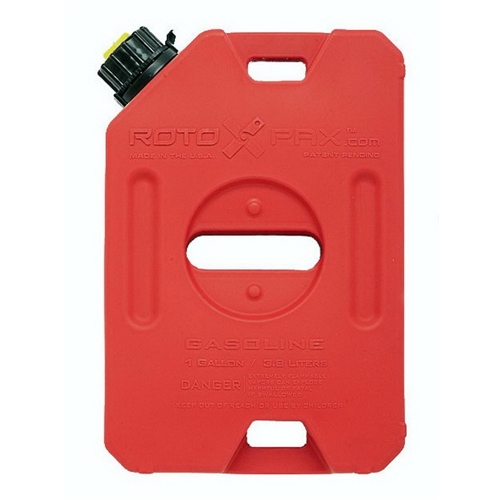
If you’re looking for a challenge, remoteness will provide it. For one, there is the not-so-little issue of fuel; you have to be able to cover upwards of 400 kms between fuel stops, which can be done by carrying extra fuel in a Rotopax or another fuel container. With remoteness usually comes some challenging riding too since no one wants to pave a road that has limited use. And if it rains, that challenge increases significantly, especially on roads like The Dempster or The Dalton that are sprayed with calcium chloride as it makes the mud greasy. Then there’s the danger of wildlife, whether it be an aggressive grizzly bear or, worse, the black flies.

Stuck in otherwise pretty safe lives, we seek danger in answer to an ancient call somewhere in the reptilian brain that harkens back to another era when we lived close to death.

But the real challenge of riding remote is simply the lack of assistance should you have a mechanical or medical problem. I won’t say you are on your own because even on these remote highways there are still trucks passing periodically, but parts and medical assistance become scarce. This is where you have to be prepared: know how to fix your bike, carry spare parts, bring a first-aid kit, and have on you a satellite tracker like the Garmin inReach units that are connected to emergency services.

Is it worth it? Well, to each his or her own, but for me, the risk itself is not enough. In fact, I’ve been wondering if riding remote for its own sake is really just a way for some people to feel alive again. Stuck in otherwise pretty safe lives, we seek danger in answer to an ancient call somewhere in the reptilian brain that harkens back to another era when we lived close to death. Some people skydive. Others bungee jump. Some climb mountains. And some race The Isle of Man TT in search of what Guy Martin calls “The Buzz,” that adrenaline hit you get when you are on the edge of life and death.

But watching these videos has led me to rethink my upcoming tour. I don’t think I’ll be coming back from Newfoundland via The Trans-Lab. It’s not because I’m scared of remote riding, but in my world, there has to be some pay-off for the risk, and bragging rights just isn’t enough. When I rode up The Dempster, every kilometre was worth the risk for the magnificent views the highway provided. I’d never seen geography like that before and likely won’t until I get up there again.

Golden Sides Lookout just north of Tombstone Territorial Park, Yukon.

But the Trans-Lab, the James Bay Road, and the Trans-Taiga don’t offer much beyond hours and hours of forest. From what I can determine, there aren’t even places to pull off safely for a rest or to camp. These are roads built exclusively for trucks to get from Point A to Point B, cutting a single line through otherwise impenetrable bush. I’ll leave it to the black flies.

For a challenge, I’ve decided instead to ride this summer the NEBDR and MABDR (North East and Mid Atlantic Backcountry Discovery Routes respectively) down to The Blue Ridge Parkway, and while there, I’ll probably do Tail of the Dragon, although riding a curvy section of road at the limit of my skill and the bike is not my preferred mode of challenge these days. Rather, I’m looking forward to testing my metal on those Class 4 roads of the NEBDR. I’ll take a rocky hill climb over speed or gratuitous remoteness any day; it’s what drew me to ADV riding in the first place. Off-roading provides a challenge that is relatively safe. That might sound like an oxymoron, but you don’t have to risk your life to get “The Buzz.” Successfully completing a technical section of road or trail will give you a hit too, and if you don’t make it and drop the bike, well, you live to try another day. And along the way, there are some pretty great views, villages, and campgrounds.

What do you think? If you ride a motorcycle, you’re familiar with managing risk. Is remote riding your thing, and if so, why do you do it? If not, what kind of riding gives you The Buzz? And if you don’t ride, what do you do to step outside your comfort zone and feel alive? Drop a comment below; I’m always interested in hearing from readers.

The Wish List, 2022

It’s time to modify the Tiger for dirt.

There’s a balance between customizing a bike and over-modifying it. I remember an episode of Adventure Rider Radio in which Jim Martin talks with Warren Milner, who worked at Honda for 30 years in product planning and R & D. Warren warns against rashly modifying your bike, especially based on advice given on internet forums. For example, at one point in the interview, he talks about the exhaust system, describing how manufacturers spend hundreds of hours developing and testing it before the bike goes into production. That’s because today’s bikes use back-pressure from the exhaust as an integral part of the combustion process to optimize fuel efficiency and emissions, yet one of the first mods owners often do is to slap on an aftermarket exhaust. One can almost hear the collective groan of the engineers as they do.

At the same time, every bike that rolls off the assembly line is built for the average rider—average build, average riding (whatever that is), average skills, average goals. That’s why it’s important to customize it for your specific needs. Tall rider? You might want a taller windscreen to avoid buffeting, or add a wind-deflector. Long legged? You might want to lower your pegs or raise your seat. Or the opposite: you might want a lowering kit so you can flat-foot. Going off-road? You’ll need different tires, etc.. There are a lot of considerations, and fortunately, a lot of options available. The industry is healthy with aftermarket products.

I decided to ride the Tiger for a season pretty much as I bought it. I wanted to get a feel for it stock before making changes. I still have the stock front tire on that came with the bike. The only changes I made were in the realm of protection: crash guards and a beefier skid plate. I’d learned my lesson with the BMW, waiting to buy some upper protection and ending up buying a new radiator along with the guards when I eventually did. After studying the market, I went with Outback Motortek. The guards and plate set me back a cool Grand, but I think they’re the best on the market. The only other mods I’ve done to the Tiger so far were to add an AltRider rear brake extender and a wind deflector.

But with two big tours planned for 2023, it’s time to ask Santa for some items to get the bike ready. Here’s what’s on my wish list for 2023.

Panniers

The Tiger came with Triumph racks and cases. The system is fine for commuting and light touring, but those side-opening cases aren’t practical for moto-camping.

I deliberated (read, “agonized”) over this decision for a long time. I love my Touratech hard cases, but the Tiger has a high exhaust on the right side so I really should go with an asymmetrical system. When I had the 650GS on the market, I had offers just for the racks and cases, but I was reluctant to separate them from the sale of the bike. The new owner wanted to buy them too, but in the end, I decided I couldn’t separate from them either.

They are great cases and contain a ton of memories with all the stickers from where I’ve been. They are the original puck system, which you can’t get anymore, and I like that you can lock them. I’ll probably use these when I tour the East Coast with Marilyn because they are big and we need the space and I won’t be doing much dirt on that tour anyway. We’ll just have to pack them so the bike stays reasonably balanced.

However, I also plan to ride the NEBDR and MABDR next summer, and from what I’ve seen on YouTube, there are some challenging dirt sections of the NEBDR in particular for which I’ll need a smaller, soft-pannier system. (Soft panniers are generally considered safer for off-roading; there is less chance of breaking a leg.) I know everyone is getting the Mosko bags these days, and they are beautiful bags, but I decided to go with the Enduristan Monsoon Evo 34L/24L system.

I’m using the past tense because Santa took advantage of a Black Friday sale and got these 20% off. I picked up at the same time the matching bottle holster (for my stove fuel) and a can holster (for water, chain lube, or bear spray). One of the nice things about this system is that it’s modular, and I’ll probably be adding more to it as I figure out my needs.

Marilyn and I used the Enduristan pannier topper through the West Coast and loved it. Enduristan products are completely waterproof and designed by ADV riders to withstand the abuse of adventure touring. But the main reason I went with this system is the weight; they are the lightest panniers on the market, with no backing or mounting plates to worry about. This also means that the bags and cases will be easily interchangeable.

Racks

It’s Outback Motortek all the way. They put a lot of R & D into their products and back them up with some brave testing, dragging expensive bikes along the ground. Even though the bars do not come up as high as Heed’s and others, they are sufficient to keep the plastics and vital parts off the ground and protected. The bars look like crap afterward but have done their job and can be re-powder coated.

The rear racks offer protection for the silencer and rear of the bike, in addition to carrying the panniers, so again, I went with the strongest. These are a full 18mm + with the powder coating. In fact, they are industry leading in their size, so big that Dual Sport Plus, where I bought the Enduristan bags, includes a workaround kit of washers so the bags fit these bars.

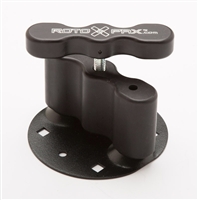
To these bars, I’m going to add on the left side an X-frame plate so I can mount a RotoPax 1G fuel container inside the bars. This will increase my range when remote riding and help balance the bike, especially when using the symmetrical TT cases. Clint at Dual Sport Plus has my exact planned set-up—racks, panniers, and RotoPax—seen here.

Hand and Lever Protection

The final bit of protection I’ll need before attempting those gnarly sections of the NEBDR is some protection for the levers. I considered going again with foldable levers but that would still leave the front brake reservoir and my hands unprotected. After looking at all my options, I decided to go with Barkbusters. They have a model that is made for my specific bike so the install is straightforward. And if I had any lingering doubts, they were quashed when I saw that BB make a plastic with my bike’s name on it. I know the Jet plastics don’t provide as much wind protection as the Storm and other plastics, but I think they suit the styling of the Tiger, and sometimes you just have to sacrifice a little practicality for vanity . . . I mean, aesthetics.

I’m not going to change my mirrors for now. I’m really not fond of the look of the double-take mirrors and am hoping the crash guards will sufficiently protect the OEM ones. And if they don’t, well, the decision will have been made for me.

Foot Pegs

What’s the most important part of the bike when off-roading? Given that I’ve posed this question in the subsection titled Foot Pegs, you’ve probably guessed correctly. If your body position while off-roading is correct, you really shouldn’t have much weight on the bars; you should be pretty much balanced on the pegs and steering the bike with your feet (i.e. peg-weighting). Of the four contact points with the bike (hands and feet), the pegs are the most important, so a good set of foot pegs is a must if you are going to do any technical riding.

The Triumph pegs aren’t small but they aren’t large either. I’ve heard that a large foot peg can make a big difference (sorry, bad pun), changing the entire feel of the bike and inspiring confidence. They will also save you resoling your boots quite as often. I looked at IMS, but they don’t make pegs for the Tiger. When I found that Fastway did and that there was a Canadian distributer, I jumped, Black Friday sale or not.

As you can see, at 2.25″ x 4.75,” these pegs are huge. They have adjustment for height and camber, and come with two lengths of cleats: 10mm and 12mm. I’ll probably start with the 10mm since my adventure boots already have a tread. They are expensive, but you only have to buy them once; Fastway sell bike-specific fit kits for mounting, so I will hold onto these babies when the time comes to sell the Tiger.

Honestly, I never thought I’d pay $300 for foot pegs, but I’ve been watching YouTube videos of guys doing, or trying to do, the Class 4 roads on the NEBDR and thought, “I’m going to need all the help I can get.”

Tail Plate

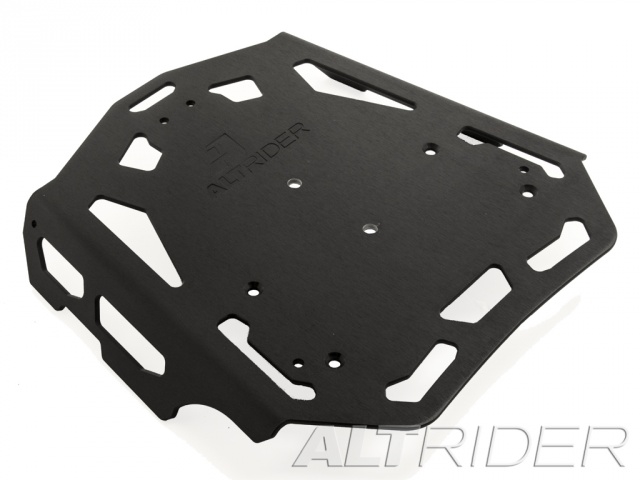
The OEM tail plate is too small for a duffle and has no good strapping points. It also shifts side to side as part of that Triumph system that shifts as you corner. I really like the AltRider tail plate, but at $260 for a piece of metal, I’m considering other options. You can get an eBay Special from China for 1/3 of that price, but will it be the same? Will the cut-outs be bevelled so they don’t cut into your straps? Will the powder coating begin to wear off after a season or two, as happened on my Kildala rack? AltRider make good stuff, and I like how this one projects out the back of the bike so there’s still plenty of room for Marilyn behind me. I might just watch and wait for this item to go on clearance somewhere, but I’ll definitely need a new tail rack before I tour.

Tires

I’ve had the Dunlop Trailmax Mission tire on the rear of the Tiger, and I had them on the GS when I took it to Vermont last summer. This 70/30 tire is a good choice if you are doing a lot of street with some dirt or gravel roads. That’s what I expect when Marilyn and I go through Gaspé, PEI, New Brunswick, Nova Scotia, and Newfoundland. So I’m going to put the matching tire on the front first thing in the spring before we head off.

For the tour in the US, that’s a little different and more complicated. I plan to start out on some BDRs (Backcountry Discovery Routes) that will take me from the Quebec border down to Pennsylvania, then I’ll be riding principally asphalt as I make my way over to the Outer Banks, including The Blue Ridge Parkway—a bucket list ride for me—and, why not, Tail of the Dragon while I’m in the area.

What do you do when faced with such diverse riding, everything from Class 4 (i.e. unmaintained) roads to the most renown section of twisties in The U.S.? Well, based on my experience, you have to go with the most aggressive tire required for your off-roading needs. You can ride a knobby on asphalt but if you try to take a street tire into mud and gnarly stuff, you can get yourself in trouble. Of course I could by-pass the gnarly stuff, but where’s the fun in that, and besides, I like a challenge!

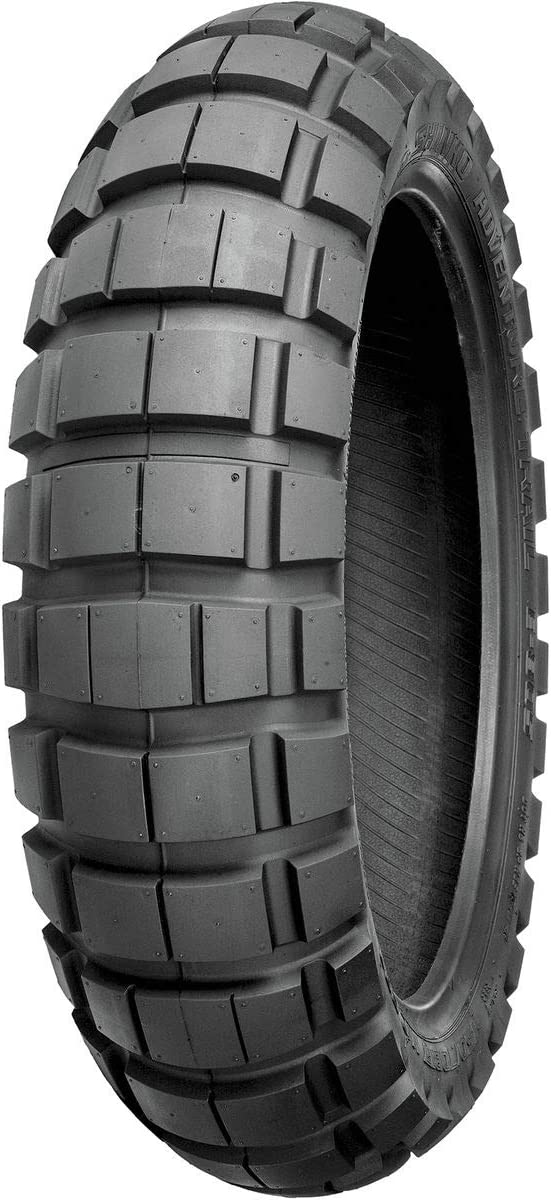
I’m currently deliberating between Shinko 804/805s and Michelin Anakee Wilds. I know the Shinkos are surprisingly quiet and smooth on the road, despite being a 40/60 road/off-road tire. However, they aren’t great with lateral stability. The Wilds are listed as a 50/50, but I have a sense they might be better in the dirt but louder on asphalt. (I’ve never ridden a set of these before.) I also like that the Anakees are a radial tire, so they will run cooler in the heat at speed. And for what it’s worth, Lyndon Poskitt just put a set of these on his Norden 901 for his tour of Iceland where he’ll be doing similar riding.

The Shinkos are about half the price of the Anakees, but for a tour like this, having the right tire is more important to me than a few hundred dollars. I have run the Shinkos before and they were great . . . until they weren’t. From one day to the next, they started skidding and sliding out on me.

What do you think? Anyone tried either of these tires?

Tools, More Tools . . .

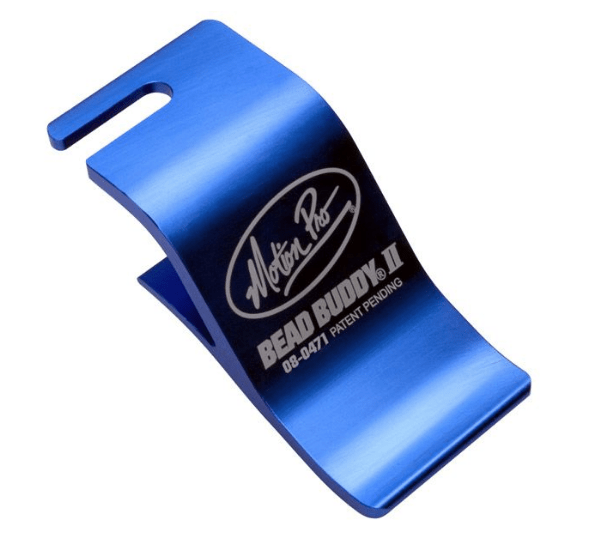
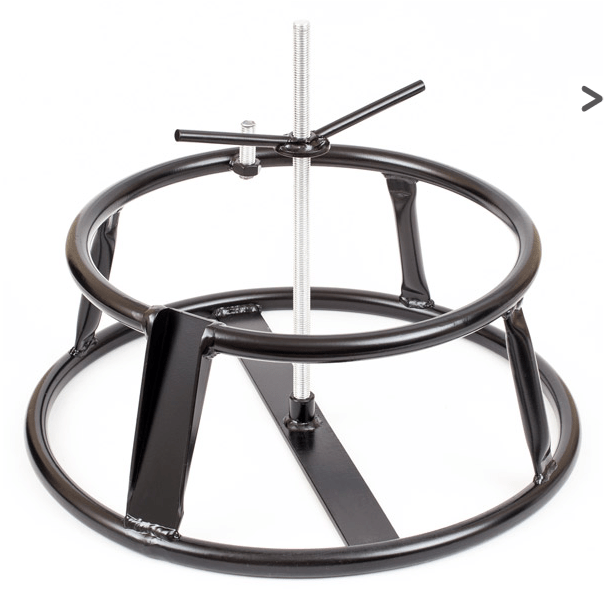
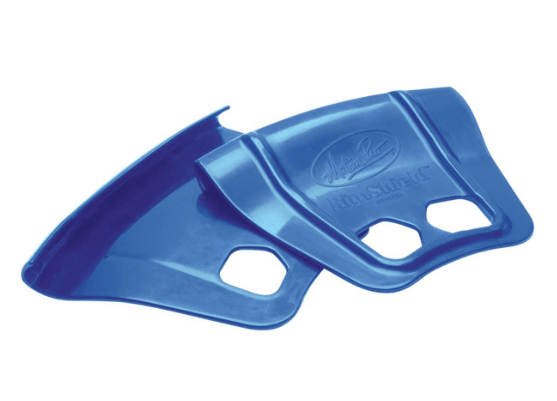
Finally on my wish list are some tools for helping me with these tire changes. I’ve always worked off the grass, but it’s not ideal; you’re grinding dirt into your bearings as you wrestle with the tire, and it’s hard to stabilize the wheel while levering. I think I’m going to ask Santa to get me a tire changing stand and some Motion Pro tools to facilitate this work and protect my rims.

The Tiger is basically a sport bike in adventure clothing; it rips, and I love how it handles through twisties. But I’ve yet to really test it off-road in technical terrain. Fully protected, with an aggressive knobby and soft panniers, Jet will be ready to hit the dirt and I’ll be eager to get back to exploring. Gros Morne National Park is a bucket list item for Marilyn and me, and I’m hoping we’ll be able to get deep into the park on the bike.

In the meantime, we’ve just received here in Montreal the first big snowfall of the winter. I’ve been shovelling the driveway for the past 24 hours, but I really don’t mind. It will be nice to have a white Christmas. I’ve just finished all my grading in my teaching work, and we are sufficiently stocked with holiday sweets and treats.

I was just remarking to Marilyn that, in many ways, I prefer the midwinter holiday to the summer one. While I can’t ride, being a bit house-bound provides an opportunity to step back from everyday life and reflect—a sort of retreat. And what comes to me this year as I do that is how incredibly blessed I am in so many ways. I and my loved ones are healthy, we have enough money, I have a fulfilling job . . . I could go on, but I’m thinking mostly of the people in Ukraine and other parts of the world who are less fortunate. In the immortal words of Ron MacLean, “count your blessings, not your presents.” It’s nice to dream and plan to buy stuff for what we are passionate about, but the most precious gifts cannot be bought.

I wish you and yours a healthy, happy holiday, and safe riding and travelling in 2023.

You Can’t Get There From Here: Navigation Apps

In this final post in a series on gear, I discuss the navigation apps I use when touring.

Old-School Navigation. I still like to tour with a map on my tank bag.

“I learn by going where I have to go,” Theodore Roethke says in the refrain of his famous villanelle “The Waking.” That may be a good philosophy in life, but when motorcycle touring, it’s downright dangerous. There’s nothing worse than not knowing where you’re going and fumbling with a GPS in traffic while riding. Yeah, I’m all for exploration and adventure when you don’t have to be somewhere, but when the light is fading and you still don’t know where you are pitching camp, or when your fuel gauge is on one bar and you don’t know where the next gas station is, that’s a problem.

Charging

I learnt early in my touring experience that navigation is huge, maybe because I had so many problems keeping my phone charged. If the USB port detects moisture, the phone stops charging, and it doesn’t take long for a GPS app to drain your battery. And then there’s the cord. If your phone isn’t charging and the port isn’t wet, it’s probably the cord. They make them so cheap these days that the internal wires break. I once had to ride from the Cabot Trail over to the Best Buy in Sydney, NS, just to buy a new cord to get me home. What a pain!

So let me say at outset that if you don’t yet have wireless charging on your bike, you should. It’s a game changer. It avoids 90% of the issues you are going to face on tour. For years I worked around the charging problem by using the type of cord that has magnetic adapters. I siliconed the appropriate adapter into the port of my phone, then just attached the USB cord via the magnet to charge the battery. Rain didn’t affect the charging. The cord was still liable to break, but they are cheap and you can buy, like, a 4-pack on Amazon for $20 so can carry several.

The problem with this set-up is that the magnetic adapters are fine for charging, but most can’t transfer data, so now your phone is limited off the bike. Maybe you don’t want to silicone an adapter into your $1,100 iPhone 14. I worked around this by buying off eBay a cheap, used, military grade phone that I dedicated for bike navigation. It didn’t have a SIM card in it and was locked, but it didn’t matter: I used it in Flight Mode. That’s right, I don’t have a huge data plan and I ride in places that often don’t have cell service, so I download all my maps before leaving.

Navigation

The main app I use to navigate is OsmAnd+ because it is open source and includes free maps to be used offline. This is also great when I travel in The States because I don’t get hit with roaming charges. Last I looked, OsmAnd+ was about $20. I bought the Plus (paid) version because it imports GPX tracks, which I need for leading club rides, but the free version works perfectly well for navigation, if that’s all you need. OsmAnd also includes contour lines and hillshades layers. When I venture off-road, it’s nice to know how steep the mountain is going to be. There is also a Points of Interest (POI) layer so I can see gas stations, restaurants, healthcare, parking, and convenience stores and supermarkets on the map (configurable), and a Wikipedia layer, so I can see what significant landmarks I’m riding past or near. It’s a great little app, available for both Android and iOS.

OsmAnd Screenshots

I’ve tried maps.me, Gaia, Locus Map (Pro and Classic), Scenic, Eat Sleep Ride, and others, but I always come back to OsmAnd. It’s easy to use yet full-featured, a rare combination. It does what I need it to do and no more. Do I really need to know how far over I leaned the bike on my latest ride? Do I really need crash detection? Does my wife prefer to hear that I’ve crashed from an app or a person? But the main reason I like OsmAnd is for the free maps. I started using Locus Map Pro but maps are $1 per country. That sounds cheap—$1 for all of Canada—but for some reason they consider each state in the US a country, so that can add up fast. I still have these other apps on my phone as back-ups but I don’t really use them.

The other main app I use to navigate is Google Maps, now called just Maps. (I guess Google figures it’s so ubiquitous we no longer need the brand name.) Maps handles addresses better than any other app, thanks to Google’s AI. Need to know where a specific place is but you don’t know the address? Just Google it, then press the navigation arrow icon and it loads in Maps and guides you there. Easy peasy. As much as I like OsmAnd, you need a specific address for it to find your destination. (You can, however, press and hold on the map to choose a specific point of destination.)

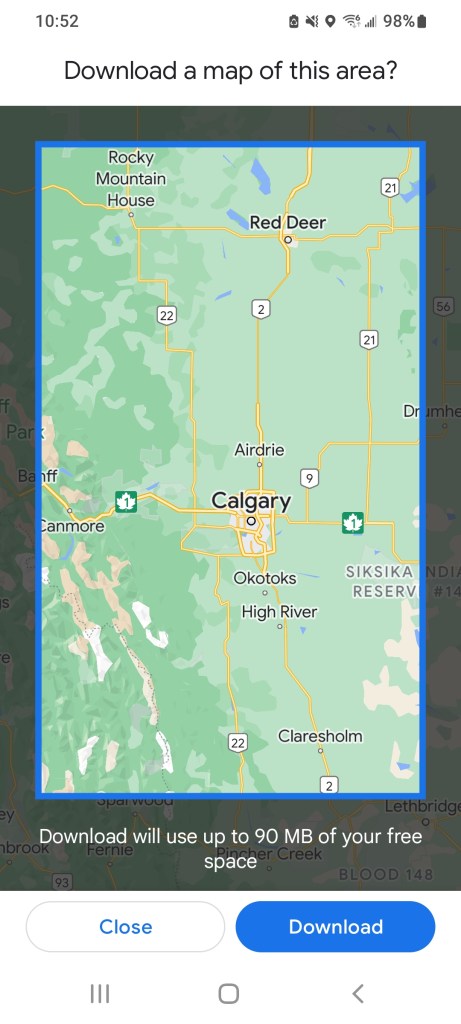
You can use Maps also offline, but like OsmAnd, you have to download offline maps before leaving home. (The search feature, however, does require cell service.) In the upper right hand corner, press your identity icon, then select Offline Maps from the menu. Press “Select Your Own Map,” zoom and position the frame using two fingers to select the area you want, then press Download. I name each map so I can keep track of them. They will expire if left unused for a certain amount of time, but you can update them all quickly and easily every once in a while when you are in a Wi-Fi zone. I downloaded maps for all the provinces I planned to tour before heading across the country. I didn’t need the northern part of most provinces, but I grabbed everything where I thought I might be riding. This was important since I was often not in a region with cell service.

The only other navigation app I use is Waze, and I only ever use it around town, frankly. That’s because it shows where the cops are. Nice! (Not that I ever speed.)

Route Planning

For route planning, I use the web-based Kurviger. Forget BaseCamp. Kurviger is intuitive and full-featured. I choose the type of route (highway, straight, curvy, very curvy; one-way or round trip), the origin and destination, and Kurviger comes up with an interesting route. I then drop in shaping and waypoints to shape the route exactly how I want it, flipping back and forth between Kurviger and Maps in street view to check the quality of the road. (Drag the little yellow man, ur, person, icon onto the map to see a street view.) When I’ve got the route exactly how I want it, I export it to a gpx file. Kurviger can generate a QR code for the file or hyperlink to share, or send it directly to Scenic, if that’s your preferred navigation app. I usually email the gpx file to myself then open it on my phone, which knows to open gpx files in OsmAnd.

Screenshot of the web-based Kurviger route planning app.

I have Kurviger Pro on my phone as well, and it uses BRouter to do the routing. BRouter takes some setting up; like the offline maps in Googe Maps, you have to download in sections the areas you need first, but the upside is that you can use Kurviger Pro in the field. For example, say you’re riding with some friends and you’re looking for a good route to a specific place but nobody wants to pour over a map to make those decisions. Just open Kurviger Pro on your phone (it will load a map at your current location), press and hold on your destination, and it will generate a route—again, to the degree of curviness you want. You can even share the route with your friends.

Screenshot of Kurviger Pro. All roads lead to Lachute.

Non-Navigation Apps

There are some other apps I use, not for navigation, strictly speaking, although they can be used for that. If you’ve followed Itchy Boots as she makes her way across the Americas, you will have heard of iOverlander. Noraly uses it to find her accommodations. I’m rarely sleeping with a roof over my head when I tour, but iOverlander is equally useful for finding campgrounds and even wild camping locations (i.e. places on crown land where you can camp for free). The app is user-based, and users submit descriptions and photos of the sites they’ve stayed at. This is helpful because there are a lot of people boondocking with campers and vans, and their needs are different than those who are tenting. So a safe gravel parking lot might be good if you have an RV, but not so nice if you are tenting. I wish iOverlander made this distinction, perhaps using a different symbol for each type of wild camping.

iOverlander screenshot. Tent icons are campgrounds; crescent moon icons are wild camping spots. Clicking on the icon brings up a window with user-based descriptions and photos.

Last spring, a friend and I planned to camp at a state campground in Vermont, only when we got there it was closed. In fact, we were too early and all the state campgrounds were still closed for the off-season. (Doh!) So I opened iOverlander and it showed a wild camping spot a short distance away. We ended up at lovely site next to a river with a few other campers nearby for security and even a drop toilet to boot!

I also use weather and radar apps, of course, to monitor the weather. They are pretty straightforward so I won’t spend any time on them. But for the record, my preferred apps in this department are WeatherCAN and MyRadar. I like WeatherCAN because it’s generated by Environment Canada. I reluctantly open Weather Network only when I need a 14-day forecast, steeling myself for the clickbait.

The Best Riding App on my Phone

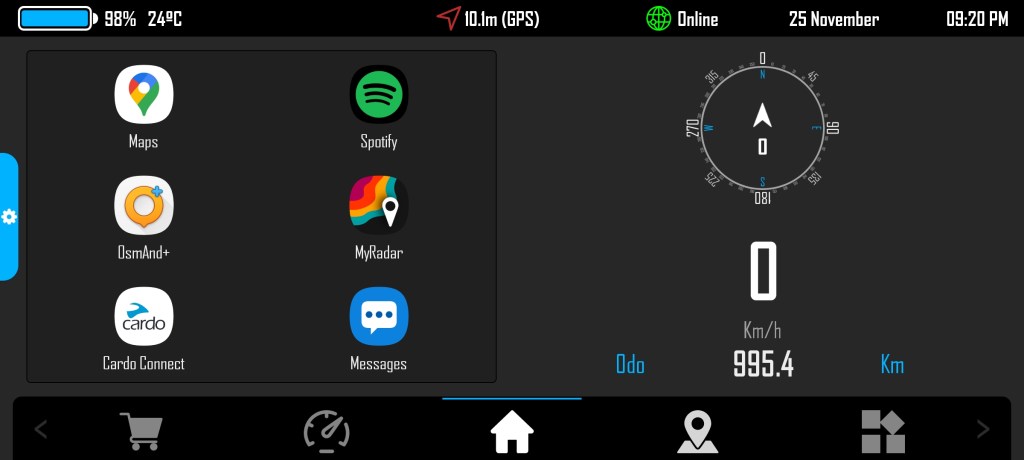
I’ve saved the best for last. There is one app that I have come to love, to love I say, so much so that it’s become almost indispensable. It’s an app like no other since it is an overlay on the Android system and replaces the usual interface. It’s called Drive Mode Dashboard, by Thork Racing.

This is what I see when I launch DMD. (This is Version 2.0.) Instead of my usual desktop and app icons and widgets, I see this. It’s fully configurable but this is how I’ve set mine up—with a set of most-commonly-used apps on the left and a compass, digital speedometer, and odometer on the right. There’s more info along the top, as you can see. Along the bottom are icons for a map, my full list of apps, settings, even a digital rally book. Pretty cool.

Rally Book Mode. Ready for the Dakar.

But where this app really comes to life is in conjunction with Carpe Iter Controller, a bluetooth controller that mounts to my handlebar. With this controller and DMD, I can navigate throughout my phone—open any app, open and control media in Spotify, change the volume in my helmet, the brightness of my screen, and more. Where I use it most is to zoom in and out and pan around in maps. I think I could even tune my ECU while riding if I wanted to. About the only thing it can’t do is stop Microsoft Office Update from reminding me to check for updates every time I open Word! (Can Bill Gates avoid this?)

I see Thork Racing have a new unit out now with three buttons and a toggle and it can connect directly to 12V. My 1st generation controller has a rechargeable battery that lasts about a week with full-time use. There wasn’t room on the Beemer’s handlebar to mount it vertically so I made up a bracket and mounted it horizontally on the mirror stem. I have it mounted vertically on the Tiger, and yes, you configure the orientation in the driver software so the toggle switch pans your maps accordingly. Needless to say, with this set-up, if my eyes are not always on the road, at least my hands are on the handlebars. The controller is a little pricey but it’s a very nice modification.

Final Words

Despite finally getting my phone set up to be my primary means of navigation, I ended up buying a used Garmin Montana 600 for the big trip. I was nervous after having so many tours tainted by navigation issues and wanted a reliable back-up. The Montana has a WAAS-enabled GPS receiver and HotFix® satellite prediction. No, that’s not a dating service but the latest technology to ensure your connection to satellites is never dropped. The Rugged Mount is waterproof and robust enough for off-roading, and while I’m not positive, I think the Montana has a more comprehensive off-road mapping system than the phone apps. The Google Car made all the way up to Tuktoyaktuk, apparently, but it can’t go on single track or some of the ATV trails I do.

When all electronic devices fail, I rely on that thing called a paper map. No batteries needed! My Wolfman tank bag has a nice big clear plastic sleeve on top for them. It’s easy to lose sight of the big picture, so to speak, after staring into a 6″ x 3″ screen all day. I’ve recently discovered Butler maps, made for motorcyclists, and they are not only water resistant but also contain routes suggested by other motorcyclists and a ton of other information on the flip-side. I bought the one for The Maritimes and it currently hangs in my upstairs hallway outside my study, as did the one of North America I used to plan my cross-Canada trip. So a paper map serves multiple purposes: it’s great in the field, but it also serves to navigate me through the dark winter months of the off-season.

Ready for my sticky dots.

What are your preferred navigation apps and devices? Are there some I haven’t mentioned? Drop a comment below. I always like to hear from readers.

End of an Era

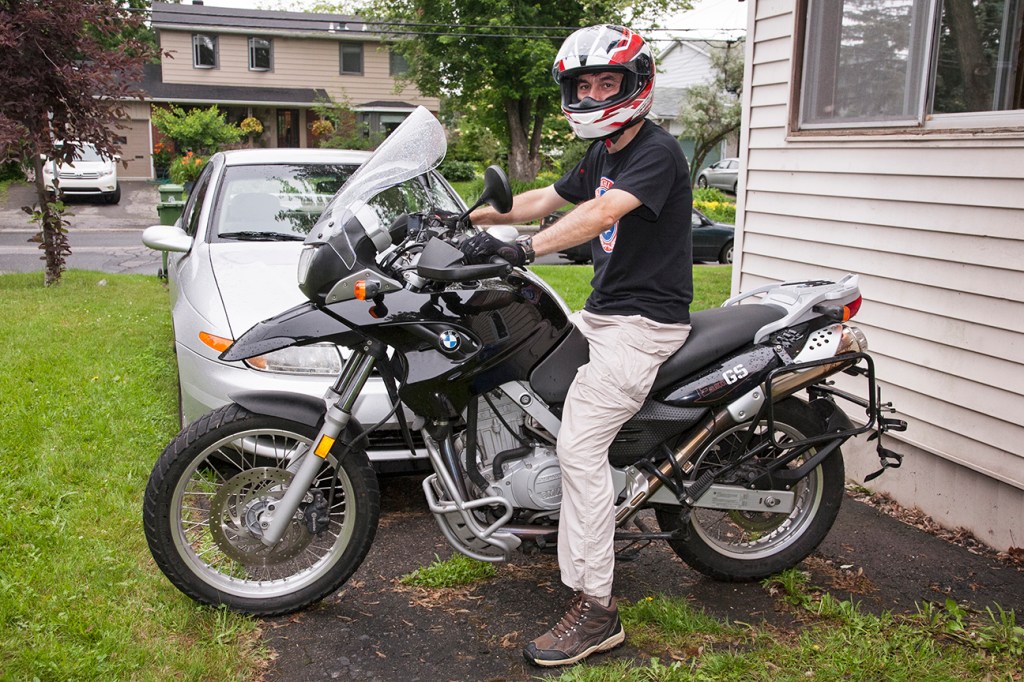
After 8 years and almost 100,000 kilometres, I pass Bigby on to new owners.

Saying good-bye to Bigby. A final chain lube and I handed over the keys.

The first night of my motorcycle training class, the teacher asked: “Okay, what do we have here? Who wants a sport bike? A cruiser? A tourer? An adventure bike?” Students put up their hands accordingly. I didn’t even know what an adventure bike was yet, but I knew I wanted something that would allow me to explore, and I didn’t want to be limited by pavement. The places I wanted to explore likely wouldn’t have any pavement.

At the end of the evening, I approached the teacher to ask about helmets. What would he recommend, full face or modular? At some point, I must have mentioned that my dream was to travel across Canada by bike. “You’re going to get a BMW, aren’t you?” he said. I guess he knew enough about ADV culture to know that is the most popular ADV brand, thanks to Ewen and Charlie, and KTM’s big mistake in doubting them. And in the end, he was right. After a little research online, I zeroed in on the f650GS as a perfect starting bike—low seat height, not too much power, well balanced, reliable, and easy to ride and maintain.

A quick search on Kijiji turned up one for sale near me on the West Island. It even had hard luggage and a touring screen, all set for cross-country touring. It seemed destined to be mine, and within a few days, it was. Getting that bike has been one of the best decisions of my adult life. It has connected me to friends, to readers, to a country, and to aspects of myself I didn’t know existed.

The first photo of me on the bike, June 2015. Lots of comments on Facebook about my lack of gear, but little did they know I didn’t yet have my licence.

It almost didn’t happen. The bike doesn’t have ABS, and I’ve grown accustomed to ABS in the car during winter when the roads are icy. I thought it would be essential for a new rider and not having ABS was almost a deal-breaker for me. But fortunately, the few people I consulted about my decision were not fans. One distinctly said, “You have to learn how to brake properly without it.”

So I did. I’ve heard of people who use only rear brake. Apparently, Honda mechanics discovered that the rear brake pads of Gold Wings were wearing out faster, much faster, than the front pads, which doesn’t make sense since most of the braking happens with the front. They concluded that Gold Wing riders weren’t using the front brakes, so they developed integrated braking—both front and rear come on, even if you only apply the rear. Smart. Honda engineers outsmarted the riders for their own safety.

My bike didn’t have integrated braking or ABS, so I had to learn how to brake properly. Mostly this meant squeezing the front lever, not grabbing, to load the front contact patch before pulling harder, and using just a little rear to stabilize the bike. I did this every time I stopped, even when cruising along the Lakeshore, at every stop sign and every light, front and rear in correct proportion, so it became muscle memory. Then in emergency situations, which I had, I didn’t have to think about it; the technique came “naturally” and I thankfully never tucked the front end, even once at speed in heavy rain on Heidenau tires in Northern Ontario when I rounded a corner to find someone backing up on the two lane Highway 101.

My first adventure bike rally, Dirt Daze in Lake Luzerne, NY. June 2017.

I knew I also needed to develop my off-road skills to become an ADV rider. I took a course at SMART Riding Adventures in Barrie, and another with Jimmy Lewis at the Dirt Daze adventure bike rally in New York. I joined Moto Trail Aventure mostly for the Rémise en Forme with a certified GS instructor, and the BMW Club of Québec for the same reason. (I actually planned to do rides with both clubs too but that never materialized.) This instruction set the perfect foundation for off-roading, and then it was just a matter of practice.

You don’t even need any dirt to practice off-road skills. I go up to my local church parking lot and do slow speed maneuvers. As Jimmy said, off-roading is all about balance and traction control, so I practiced the balance stuff on Bigby regularly. I also practiced the traction when I could, getting out of the city up onto the dirt roads and ATV trails in the Hawkesbury area. Bigby is a GS, which means Gelände/Straße (off-road/on-road), but I soon learned the limits of the bike. I never learned it street limits; I could lean that bike over and scrape the pedals, even with knobbies on, but I discovered its limits on the trails. The clearance was the biggest limitation, and the front suspension with the 19″ front wheel. It took some superficial damage for these lessons, but I also learnt not to lament the scratches. A fellow rider at my first Dirt Daze rally saw me brooding on my first scratch and said, “You can’t worry about that. It’s a bike.” The matter-of-fact way he put it set me straight.

I also had to learn my way around the engine. Knowing I would be riding into remote areas, I had to know the basics and how to fix problems. As I had with car mechanics, I started with an oil change, then coolant, brake pads, and brake fluid. I bought the bike with 35,000 kilometres on it, so it wasn’t long before I had to do the valves. That service was $1000 at the dealer, just to check them, so necessity was the mother of invention and with my trusty Haynes service manual, I did the valves myself in the shed. (I don’t have a garage, and my poor workspace has been the biggest obstacle to overcome. I’ve lost and found a lot of hardware on the driveway and in the grass!)

Problems at the 2018 Dirt Daze rally. A broken water pump left me stranded for much of the rally. MaxBMW shipped a new pump “overnight” which, due to the remote location, took most of the weekend to arrive, but I got home okay.

The Achilles heel on this bike is the water pump, and I’ve changed that a few times, including once at a rally because I hadn’t done it correctly the first time. (A plastic impeller gear wasn’t installed properly and rattled loose while off-roading.) That was the only time I considered selling the bike early, until I discovered the error was mine and not a fault of the bike. Once done correctly, the pump lasted another 40,000 K until I preemptively changed it before going across Canada.

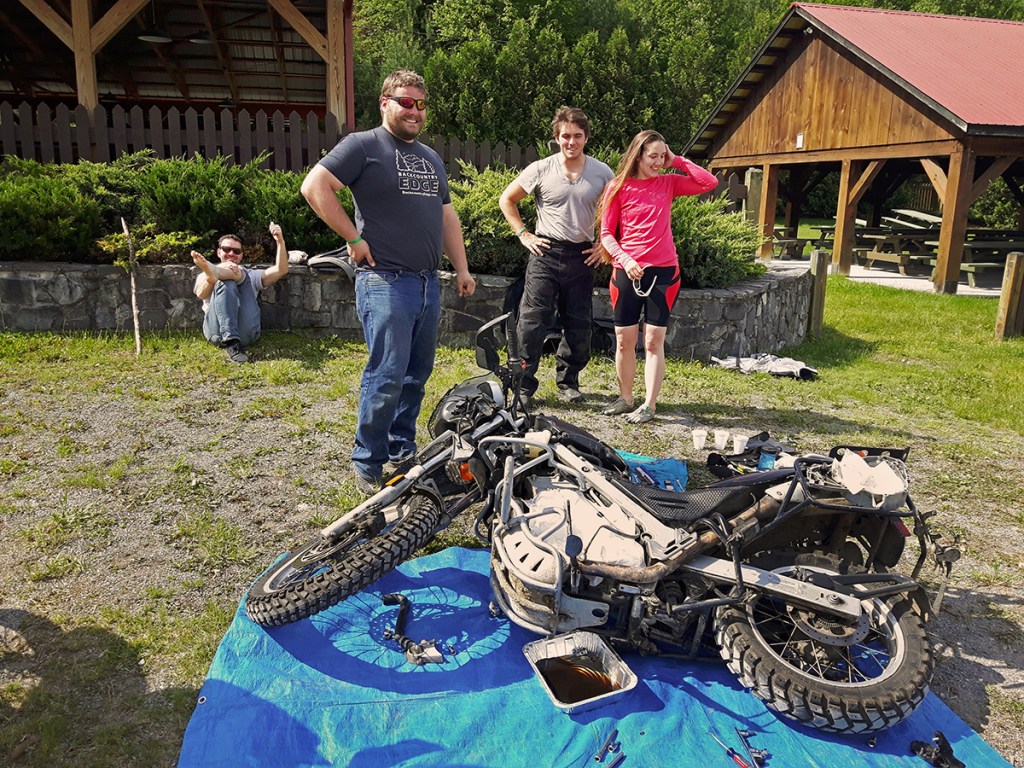
The other big job was changing the swingarm bearings. That required removing the gas tank and subframe, so basically the entire back half of the bike. The pivot bolt was badly corroded and stuck, and it took two days of troubleshooting and, in the end, two hammers—a ball pane as punch, and a sledge hammer to drive—one on top the other, to get it out. But it eventually surrendered. Yes, I have cursed and praised this bike in equal measure over the years.

Success! Pivot bolt and swingarm removed for servicing. September 2019. Under the tarp at right is the gas tank and subframe. Headphones are for all the whacking needed to get it out.

I changed those bearings as well as all wheel bearings, clutch plates, the shock, rebuilt the forks, re-lubed the steering head bearings (which were in surprisingly good shape so didn’t need to be changed), and have had the dash assembly apart. And in the end, I restored those scratched body panels to make the bike look good as new.

My first trip on this bike was back to Ontario to show it to my dad, who used to ride. I left the day after getting my full licence. The next month I did my first moto-camp down at Loon Mountain in New Hampshire for their highland games. The following year, my first year with full licence, I went to Nova Scotia to ride the Cabot Trail, passing through Maine, Deer Island, and New Brunswick en route. I’ve also toured Northern Ontario, and these tours have led to some paid writing for northernontario.travel. So the bike has become for me more than a past-time. It has taken my writing in a new direction, and that of course refers to this blog too. I’ve made connections and friendships with people online, and met some of them in person during my travels. I hope to meet more of you in the future.
Off-Roading in Cape Breton, July 2017.

I have also met new friends locally in club riding. When I began, learners couldn’t ride without an experienced rider accompanying them, so I joined The West Island Moto Club, and some of these members have become my closest friends. I’ve done some touring with the club, but mostly I do day rides with them, and it wasn’t long before, with the right mentorship, I was leading rides.

One of the first club rides that I led. This was to Ottawa via Gatineau for the Tulip Festival. May 2018.

Some of my favourite riding on this bike has been in the northeastern states like Vermont, New York, and New Hampshire. I’ve ridden the Puppy Dog Ride on it a few times, and some of the Hamster Ride in New Hampshire, and Bayley-Hazen military road. The 650 GS is perfect for this type of light off-roading. I had a 15-tooth counter-sprocket on it for years, which gave it more low-end torque, and there’s nothing like feeling the pull of the big thumper as you climb a steep hill, or sliding out the back end as you round a corner.

Finally crossing Canada, July 2021.

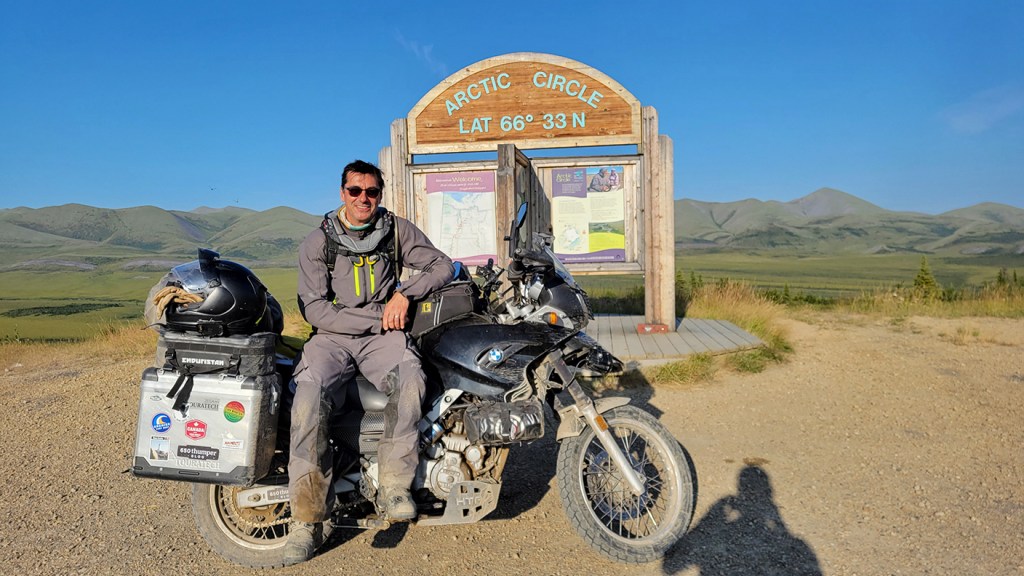
Finally, after developing these riding and mechanical skills, modifying the bike to what was perfect for me, and waiting for Covid generally to be over, I completed my dream of crossing the country, and this bike, 15 years old and with over 100,000 kilometres on it, got me there and back. Ironically, the only issue I had was with a new battery I’d just installed for the trip. But the bike, fully loaded, pulled my wife and me over The Rocky Mountains, and took me up north of the Arctic Circle into some truly remote territory. The bike fulfilled its purpose for me—to learn about motorcycling, develop the skills necessary for adventure touring, and get me over the dangerous first few years of riding. It has been the best first bike I could have had, and now it’s time to pass it on to another new rider. Like me, the new owner has bought the bike before obtaining her licence. I’m sure it will be as good a beginner bike for her as it was for me. The engine is still strong, and I wish them both many safe and happy adventures in the future.

At the Arctic Circle, August 2021

My new bike is a 2013 Triumph Tiger 800XC. The XC stands for cross country, so it’s also capable of light off-roading, and I’ll be taking it on BDRs and other adventure tours. It does has ABS, but being a 2013, it doesn’t have any rider aids, and as I read about the new bikes with throttle control, wheelie control, slipper clutches, and other traction aids, I can’t help thinking about what riders of those bikes aren’t learning. I’m happy to be learning how to control the power of this 94 HP engine properly, just as I learnt to brake properly on the GS. It’s going to take my riding skills to the next level. The blog will be keeping its URL and name in tribute to the bike that got me started and to which I owe so much.

Next season I will complete my cross-country tour by riding the East Coast. I plan to visit Gaspé, New Brunswick, Prince Edward Island, Nova Scotia and Cape Breton, Newfoundland, Labrador, and the north shore of Quebec including the Saguenay. I might try to ride solo up to Fort George on James Bay “on my way home.” This would allow me at least to set foot in Nunavut. I also plan to ride the Mid-Atlantic and North-East BDRs next summer, if I can get it all to fit. So stay tuned, my friends. The journey continues.

At the Awesome Players sandpit, Hawkesbury 2020

Let’s Talk About Off-Road Gear

In this post, I describe the off-road gear that’s worked for me.

In an earlier post, I discussed my touring gear. In this one, I’ll cover the gear I use for off-road riding. As before, I’ll move from head to toe.

Helmet

I didn’t want to spend a lot of money on a secondary helmet I use only occasionally, so the LS2 Pioneer was in the right range at about $230. It’s also a long oval, so the right head shape for me. In fact, it might be a bit tight even for me; towards the end of a long day, I wish it were a little wider. But it has excellent ventilation, and this is the helmet I reach for on stinking hot days even for street riding. It has a large eye port that accommodates goggles, a drop-down sun visor, and most importantly, looks really cool!

LS2 Pioneer Quarterback

Upper Body

The foundation, literally, of my off-road gear is the Knox Venture Shirt. I decided to go with a soft compression suit for comfort and safety. I know many will say I should have gotten a roost protector or some hard-shell armour, but for the kind of riding I do, which is not motocross but trail riding, I thought that would be overkill.

The nice thing about the compression suit is that I can wear it under an off-road jersey on really hot days. Also, unlike a jacket, the armour stays in place when you have an off. Because I live about 45 minutes from dirt, I like to wear my jacket to the trail, then swap it for the jersey. This means I need to carry a tail bag or knapsack, but I just don’t feel entirely comfortable riding asphalt without a jacket; it’s like how I don’t feel comfortable driving without a seat belt on.

This product wasn’t available in Canada and I had to order it at Revzilla. It’s since been discontinued but you can still get a similar zip-up armoured shirt from Knox or Bohn. It uses the latest D30 (Knox calls it Microtek) technology in the armour, which is pliable when wearing and stiffens upon impact. I upgraded the back protector to the Dianese Pro G2 because I found the Knox pad did not provide enough ventilation.

Pro-Armor G2

I wear over that either an off-road jersey, as I said, or my Klim Traverse jacket.

Klim Traverse

The Traverse is just a shell, and it doesn’t come with any armour. It’s very light and comfortable, and it has big zipper vents under the arms. It’s Gore-Tex, which makes it a little hot, but I also use it for street riding when there’s risk of rain. And because it’s going to get muddy, it’s got to be black. This is my go-to does-it-all jacket, and I love it!

Lower Body

Klim Dakar Over the Boot Pants

For pants, I use the tried and true Klim Dakar pants, over the boot model. These aren’t waterproof, and the first time I toured in them I got caught in a shower and soon learned that. They just aren’t designed for that purpose. Instead, they have a dense, tough mesh that provides some airflow yet resists snags when you’re riding through brambles and thorny branches. There are also elastic accordion panels in key areas that provide a lot of stretch. Big zipper vents front and back enhance airflow, and there are the usual Klim angled zippered pockets for wallet and phone.

If you are going to be doing some serious off-roading—and that involves a lot of movement on the bike—these pants are designed for that. There are also some nice touches like the leather inseams on the lower pant leg where you are gripping the bike. A very durable, ventilated, stretchy pant for off-road riding. And of course, they come with Klim’s D30 armour in hips and knees.

If I’m going to be doing some technical riding, I pull on the Forcefield Sport Tube Knee Armour. Forcefield, like Knox, is also a company dedicated to just armour, so they do it right, and like the Knox shirt, these tubes, although a little uncomfortable, ensure that the armour stays in place when I go down.

Forcefield Sport Tube, the most comfortable knee armour I’ve found.

If I did more off-roading, I’d probably invest the big bucks in some knee braces. I’ve ridden with the Awesome Players Off-Road Club and Mark did some major damage to his knee a few years ago that got me and others thinking about that possibility. So far I’ve been lucky, but there might be knee braces in my future. For now, these knee pads are the best I’ve found. They won’t prevent torsional damage, but they will help with direct impact.

I use my SIDI Adventure 2 boots when off-roading. They are not motocross boots, but have adequate protection should you get a foot caught under the bike.

One piece of armour I’ve recently started using is wrist braces. I broke my thumb off-roading, and I’ve seen a few riding friends break their wrists recently, which got me wondering why riders don’t wear what skateboarders and snowboarders wear to prevent broken wrists. Apparently, it’s the most common snowboarding injury, for obvious reasons; it’s instinctive to put out your hand to break a fall.
Recently I started wearing EVS Wrist Braces. They are comfortable, and once I have them on, I forget I’m wearing them. Honestly. Okay, maybe you have to be off-roading to forget you have them on, but really, they do not encumber your movement on the bike, your grip on the handlebars, or your control of the levers. I had a friend break his wrist in a silly tip over when his hand hit a rock. It doesn’t take much with this fragile part of the body. They say the extremities are the most vulnerable, so if you off-road, consider picking up something like this and avoid losing six weeks of your season.

EVS Wrist Braces

Gloves

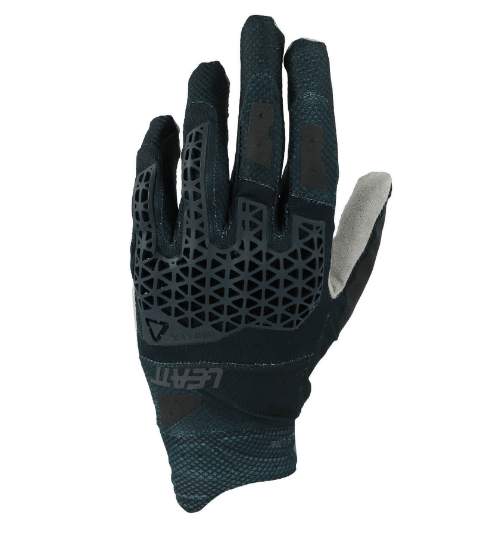
I took a tip from The Awesome Players and use a cheap pair of Mechanix gloves bought at Canadian Tire. You generally want a thin leather for the upmost feel on the controls, and mechanic’s gloves provide that dexterity, depending on the weight you choose. They also often have D30 on the back (for when that wrench slips and you were pushing instead of pulling) and are a fraction of the cost of dedicated motorcycle gloves. Go around Father’s Day and you will often see them on sale.

Mechanix Wear M-Pact Gloves. The motorcyclist in me likes these gloves; the English teacher hates the name.

Finally, the only other bit of gear that I use on but particularly off road is my Klim water bladder, or fuel cell, or hydration system, or Camelbak, or whatever you call it. It’s kind of a pain to carry water on your back. It’s heavy and hot, preventing airflow, but I’ve found that on hot days these inconveniences are worth avoiding the two-day headache I get if I don’t drink enough. When you are working hard in the heat, a sip from a water bottle every few hours during a rest stop is not enough. But if it’s cool and I can get away with it, I’ll put a Nalgene bottle of water in one of those canister holders on the back and ride unencumbered.

Klim Fuel Pak

This one is now discontinued and there are tons of others to choose from, including some with room for tools and first aid, if you want to get everything off the bike. Ryan F9 just did a good video comparing some backpacks that he particularly likes, and an upgrade might be in my future if I were to do a lot more off-roading than I currently do.

Summary

So as you can see, I’m pretty much a Klim guy. Their gear is expensive, but I’ve already said, you can get it on sale if you’re willing to watch and wait. I trust the quality of the materials and workmanship and the thought that’s gone into the design. Some will say I’m getting fooled by marketing and there is comparable gear available for a fraction of the cost, and they may be right. But with the fuel pak, for example, Klim’s is unusual in that the seams of the bladder are radio frequency sealed, so you can turn it completely inside-out to clean and dry. It’s for qualities such as that I’m willing to pay a premium price. And when the mouthpiece split and started to leak, Klim sent me a new one. Again, I am not sponsored by Klim; it’s just my go-to brand for gear.

One of the pains with dual sport riding is that you have to buy two sets of gear, one for road and one for off-road. It’s a significant investment up front, and buying all this stuff almost broke my marriage as well as the bank account. But take your time, get a little at a time, prioritizing, and look for discontinued and end-of-season sales. There are sports that are more expensive, I like to remind my wife, and there are more frivolous things to buy than protective gear.

Off-roading is not a dangerous sport. In fact, I got into it because I felt it is a way to challenge myself safely. There’s only so fast you can go on the street before it’s not safe, and the stakes there are a lot higher. Off roading does not involve high speeds—not the trail and dirt-road riding I do—but you can still get hurt playing in low-traction terrain with a 450 lb. bike. Investing in some good gear minimizes the risks and therefore increases the enjoyment of the ride.

This is what I use and have found works for me. What do you use? I’m a gear weenie so I’d love to hear what works for you. Please leave a comment or send me an email. In the next post, I’ll talk about the camping gear I use. If you are interested in moto-camping, click the Follow button and you’ll be notified of new posts.

Klondike Days

Continuing north, I explore Dawson City, then venture up The Dempster Highway.

When I was at Grasslands National Park in Saskatchewan, a neighbouring camper wandered over to examine the stickers on my panniers. He had a box on the back of his camper and also collected stickers, so we struck up a conversation about the places we’d been. He told me that he and his wife had been all over Canada and their two favourite places were Newfoundland and Yukon. I’d never been north, as in North, and I had a bucket list item to see Canadian tundra, so I was especially excited about entering Yukon. The trip so far had been amazing, but in many ways this felt like the climax of the tour.

I left Boya Provincial Park and soon entered Yukon. I was expecting the 3rd degree but in the end didn’t even need to show my vaccination passport. There was a roadside check and I had to fill out some paperwork but was soon on my way.

Nisutlin Bay Bridge

The Klondike Highway (2) is long and under considerable construction, so there were delays and some tricky deep dirt and mud in the bypasses that was warm-up for The Dempster later. Apparently they’ve been working on this road for longer than Transport Quebec has been rebuilding the Turcot Interchange, but I suspect the mafia aren’t behind these delays. It led to a long hot day in the saddle. The heat was following me all the way north and it was 32 degrees Celsius in Dawson City when I arrived late afternoon.

Fortunately, there was ice cream.

The first thing you notice about Dawson City are the colours. I suspect it has something to do with there being little light for major portions of the year, like putting up Christmas lights midwinter. Or perhaps residents know that tourism is a major part of their economy so why not make the buildings look nice. Lord Elgin High School, built in the 70s in my hometown of Burlington, Ontario, with its purple and orange colour scheme has nothing on this school in Dawson City.

Robert Service School in Dawson City

I crossed the mighty Yukon River on the free 24-hour ferry and set up camp right on the river at Yukon River Campground. I love the Territorial campgrounds! They are $12/night including firewood. Like the recreation sites in BC, they work on an honour system, with envelopes and a secure deposit box at the gate.

The forecast was clear so I decided to try sleeping in my hammock. That would turn out to be not a good idea. My sleeping bag is good down to 7 degrees Celsius plus I have a silk liner, but I was still cold. The relentless heat that had been following me across the country was finally abated at night in the Yukon. I also found it very difficult to get in and out of both bags (liner inside of bag) in the pitch dark for those nighttime bathroom breaks. I wish I had a video of me trying to climb back in. I tried climbing into the hammock and then inserting legs; I tried standing and pulling the sleeping bag up first and then climbing in. Both were comical, and I felt like I was in a Charlie Chaplin movie. The next night I slept comfortably in my little warm tent.

The next day I took a guided tour of Dawson City. Yukon Tourism provides tours with a guide in period garb and you get access to buildings that are normally locked to the public. We went into the local bank (one of the first in the region), the post office, the saloon, but for some reason not the brothel. I was surprised to find the same BC fir on the ceiling of the post office that is in my 1934-era home in Quebec. I guess that wood was freighted right across this country.

After the tour, I wandered up to Writers Lane, which contains the homes of three major Canadian writers—poet Robert Service, Pierre Berton, and Jack London—all a stone’s throw from each other.

I don’t know what is in the water in these parts, but there is some major literary talent up here. In fact, Maria Rainer Rilke and other writers like Robert Bly have written that the main ingredient for good writing is solitude, and there’s certainly plenty of that up here. There is also some pretty dramatic history that makes for good fiction.

The next day I pulled up stakes and headed up The Dempster Highway. I write that casually but in fact the decision of whether to try any of The Dempster had been on my mind the entire tour as I was traversing the country. My original plan, as anyone who has been following this blog knows, was to reach the Arctic Ocean at Tuktoyaktuk. I knew I didn’t have the right tires (Michelin Anakee Adventures) but thought I’d be okay at least for the bottom 70K into Tombstone Territorial Park if it was dry. Only once I was on The Dempster, all that was on my mind was “This isn’t so bad . . . I can do this . . . I wonder if it’s all like this? . . . I don’t want to have regrets that I didn’t try . . . you won’t be here again for some time . . . don’t be a wuss,” etc., looping through my brain like the daredevil “friend” who always gets you into trouble.

So when I got to Tombstone, the first thing I did was ask at the the Interpretive Centre if The Dempster is like this all the way up. The nice young ladies at the centre replied, “Have you received permission to enter Northwest Territories?” What now? I had been following the Covid restrictions on the Yukon border all winter because it was closed for much of it, but hadn’t checked NWT! Turns out strictly residents and people doing business were allowed in. The staff did encourage me, however, to go to Eagle Plains, about halfway, and from there I could ride another 45 minutes for the photo-op at the Arctic Circle sign.

Hmm . . . I had the rest of the day to mull that over, looking closely at the forecast. (If there were any rain, I’d be stuck and would have to wait for the highway to dry out, which could be days.) In the meantime, I decided to do a hike just north of the Interpretive Centre on Golden Sides Mountain. A short ride got me to a horse trail that leads to this spectacular view of four valleys—three in front, and one behind.

Feeling like I’m on top of the world.

That night in my tent I did the mileage calculations over and over again in my head. You need to have a range of at least 370 kilometres to get to Eagle Plains. Although I had not planned to go up The Dempster, I fortunately filled up at the base of it first. (One gets gas when one can in these parts.) My bike has a 17-litre tank and I have another couple of litres in bottles on the back, only one of those bottles was half full because I use it for my stove. So I had about 18.5 L and my bike gets 20-25 K/L, depending on the riding, so I calculated my worst case scenario and concluded it would be tight but I had enough to get me there. And in the end, I did. I cruised at 80 K/hr. and my fuel light came on about 60 K from Eagle Plains but I made it.

Click on any image to enlarge.

Once there, I treated myself to a steak at the restaurant at the lodge. I guess dining etiquette is a little relaxed in these parts because you can apparently play ball with your dog in the dining room here, and why not? I think you should be able to play ball with your dog in any dining room!

Eagle Plains Lodge. I like how the server casually steps over the rope toy.

There I met Mountain Man Mike. Mike is an avid outdoorsman with his own YouTube channel about his adventures in his truck-top camper. He told me about Rock River Campground just south of the NWT border so I decided I’d follow him up there for the night.

I headed up to the Arctic Circle sign. Mike was already there doing some filming and took the requisite photo. Thanks Mike!

I set up camp next to Mike and we had a nice campfire through the evening. At one point, about 10 o’clock at night, he was chopping wood and it was LOUD! I asked, “Isn’t it a bit late to be chopping wood?” He paused for a second, thought about it, then said simply, “It’s expected.” Well, it’s not like Security is going to come tell you it’s quiet time.

Washing my cookware the next morning in the turquoise Rock River. Strange to see the water flowing north.

Now there are a few places on Earth where you especially don’t want your bike not to start, and halfway up The Dempster is one of them. I had put 20W/50 oil in this bike in North Van when the heat had been relentless, but now it was about 2 degrees Celsius and my bike wouldn’t start. It doesn’t like 20W/50 in cold weather; the flywheel is just too big to crank over fast enough.

Mike could hear what was going on and wasn’t surprised when I slunk over to ask him for a push. He’s fortunately over 200 lbs. and very fit, but it even took him a few tries to get me going. Thanks again, Mike. You were a Godsend!

It was drizzling as I pulled out of Rock River so I high-tailed it down into lower climate where there was sun. A quick gas stop in Eagle Plains and I was on my way again.

I saw Mike only one more time, somewhere down The Dempster. He’d stopped to take some drone footage. After saying our good-byes, I pushed on and was soon back at Yukon River Campground for one night, exhausted but happy that I’d made it as far as legally possible. I didn’t make it to the Arctic Ocean, but it’s not going anywhere soon, and I’ll return to complete The Dempster when the time is right.

I’m glad I risked it. The geography up there is nothing like I’d ever experienced. The area is vast, remote, and pristine, untouched and unblemished by humans. And in that rawness is a natural beauty that is unparalleled by any park or nature reserve I’ve visited. There are very few places on Earth like it, and those are quickly dwindling. I hope that when I return, it will be as I remember it.

This marked the turnaround point of my tour and now I started heading back home. I had to be in Montreal in a little over a week for work. But first Bigby needed an oil change, so I went to Whitehorse, where I knew there is a Canadian Tire. Unfortunately, the large and excellent Robert Service Campground was closed so I ended up at High Country RV Park.

Note scavenged box underneath with plastic liner to catch the oil. You gotta do what ya gotta do. The dirty oil did end up back in containers and dropped off at the local Can Tire.

I found a private corner of the crowded camp and did an oil change. Now Bigby was ready to make the big sprint home across the country.

Restoration

Making an old motorcycle look good as new.

The first time I took my bike to a rally, I dropped it three times. It was my first time off-roading and I had street tires on. That’s not a good combination. Back at camp, I was lamenting a scratch I’d put in one of the body panels when another rider set me straight: “Ah, you can’t worry about that. It’s a bike.” Obviously, his conception of a motorcycle is different from many others who keep their bikes spit clean and polished to a gleam. I know one rider who scratched his bike in a tip-over at a red light so he sold it and bought a new one.

My f650GS is my learner’s bike. That’s the one you make all your mistakes on, so it shows all the wear and tear of your learning curve. It’s seen plenty of tip-overs and a few crashes—thankfully none on asphalt—and has plenty of “honour badges” to show for it. It’s also now 15 years old. So after completing my cross Canada tour last year, which included an excursion up The Dempster Destroyer, I decided to restore it and retire it from trail riding. It’s a great adventure bike and I’ll continue to use it for that, but I’ll no longer try to push it where it ought not to go. I hope to get a different bike eventually for more technical riding.

My friend Mike painted his Africa Twin a few years ago and did a great job. His company, Renomac Renovations, specializes in quality home improvements, but he’s just really experienced in all things mechanical and technical and knows paint. So I asked him to give me a hand restoring the panels of my bike.

I used a bumper repair kit to fix a chip in the beak, and bondo to fill some deep scratches. Lots of sanding with 320 and 400 wet-dry sandpaper and then we primed, painted, and clear-coated the panels. I had found on eBay a centre panel to replace the original that had been cracked by the buckle of my tank bag harness, so all panels are looking pretty good. I even had OEM look-alike stickers printed.

You have to have a loving wife to tolerate this use of the front porch.

While those are hardening in my front porch, I also cleaned up my exhaust using hydrochloric acid in toilet bowl cleaner. It works like a charm and eats through the rust pretty quickly. It even did a pretty good job on the staining of my chrome exhaust that happens through heat cycles. Just use a toothbrush and plenty of water to rinse afterwards or the acid will continue to eat the metal. I actually mixed up a mild solution of baking soda and water to be sure to neutralize the acid, then rinsed. A little Blue Job (no typo here) afterwards had them gleaming like new again.

Last fall, I replaced my cracked and scratched windscreen with a new one. I had the 12″ National Cycle VStream screen on before, but I decided to go slightly taller this time with the 15″. The shorter screen was best for off-roading, but this one, with the Puig wind deflector on top, should be best for touring at speed.

The Michelin Anakee Adventure Tires I used last year were great for touring. I put 20,000K on them and there’s still tread left, but with the bike looking this good, I guess it’s time for a new set of shoes. I thought I’d try those new Dunlop Trailmax Mission tires everyone has been raving about. They are listed as a 50/50 tire, which is the kind of riding I do, but they look like street tires. Dunlop claim that they give “knobby-like performance” in the dirt while having a round profile for smooth asphalt riding and cornering. We’ll see about that. They were a full two years in development and have some new technology built into them, including sidewall ribbing and a stepped tread. And if that were not enough, you are supposed to get 8,000 miles (or 13,000 K) from a set, so they apparently wear really well.

A new set of tires and tubes to complete the bike. Let’s see how these bad boys are.

I’ve got a set of Kenda Big Blocks with a lot of tread left on them sitting in the shed, but I think I’ll save those for my next rally. I was looking for a long-life 50/50 tire for adventure touring. I’ve tried Heidenau K60 Scouts on this bike and while the front was great, the back flattened pretty quickly. I’ll post later how these are. In fact, I think a tire review of what I’ve tried so far is in order.

The only thing I’m still waiting on before getting back on the road is the circuit board from my dash assembly. Last fall, the clock started showing nonsense and partial numbers. According to Wayne’s excellent website crossroadz, the plastic cover of the display can wear away the copper in the circuit board and disrupt the signal. Thankfully, there is an electronics technician at the bottom of my road who does excellent work at a fair price because I don’t have the confidence to practice The Dark Arts myself. He’s going to take off the display and rebuild the pathways, whatever that means. It’s a relatively small thing, but I actually use that clock a lot when riding, and the bike will otherwise be good as new, despite the 130,000 kilometres on it. The engine still has good compression and is not burning oil.

These restoration projects have been taking some time, but the real reason this blog has been so quiet lately is that I’ve been organizing a reading tour for my recent collection of poems, Invisible Sea, published by DC Books here in Montreal. So aside from proofreading and doing final edits on the manuscript, I’ve also been contacting bookstores and other possible venues to organize reading events. The collection explores the theme of flight and, in particular, early human flight.

I wanted to write something positive as a kind of antidote to the state of the world today, and decided to reach back to my childhood heroes, The Wright Brothers, for inspiration. So the opening section is in the voice of Wilbur Wright as he solves “the problem of flight,” as it was then known. The second section tells the stories of other early aeronauts, both legendary and real, from Icarus to Brother Eilmer of Malmsbury, The Flying Monk, to Chuck Yeager breaking the sound barrier, and John Glenn, orbiting Earth. The third section is an exploration of aerodynamics, musing on the major discoveries of air, beginning with Leonardo da Vinci’s study of streams, to something called The Compressibility Burble that happens at transonic flight. The final section is a celebration of birds, bats, boomerangs, Frisbees and all things that fly into our everyday lives.

So if you are an aviation enthusiast, you will enjoy this book. I’m marketing it to a popular audience since many of these poems are narrative and accessible to any reader, not just those who read poetry. I was inspired by the stories of these courageous men and women who risked their lives in leaps of faith, and if you ride a motorcycle, the closest thing to flight while remaining on the ground, you will connect with these poems. The collection is all of $20 and available through Amazon, Indigo, directly from my publisher, and elsewhere.

So if the blog has been a little quiet lately, it’s because I’ve been busy both with my paid work and in organizing reading events. I’m trying to put together a tour down through The United States to Kitty Hawk on the Outer Banks of North Carolina. As most of you probably know, that’s where the Wrights first flew, and I’d like to visit The Wright Brothers National Memorial there. That would allow me to ride The Blue Ridge Parkway—a bucket list ride of mine—as well as Tail of the Dragon. Then I will head over to Dayton, where the Wrights grew up, to the Dayton Aviation Heritage Museum, and back through Dearborn, Michigan, where Henry Ford has moved the Wright family home and bicycle shop as spectacles in his historical park. If all goes to plans, I’ll be able to combine in a short tour my love of riding with my love of aviation history.

Other than that, it will be a quiet summer in and around Montreal. I have to postpone my plans to tour the East Coast of Canada, including Newfoundland and Labrador, because our new dog, a rescue, still suffers from some vestigial anxiety and doesn’t travel well. He’ll need another year to settle in, so the bookend tour to the west coast one last year will have to wait another year.

What are your plans for the season? April is always an exciting time to be a biker in Canada. And are you doing any mods or restoration work to your bike? Let me know in the comment section below. I’ll be finishing writing up the remainder of last summer’s tour in the coming days, then looking only forward to another exciting season of riding on a bike that, if not new, looks good as new.

Muncho Lake, BC. I’ll be writing up the final segments of last year’s tour in the coming days.

The Prairies

I blast through Manitoba but savour Saskatchewan.

Many thanks to my talented and skilled wife, Marilyn Gillespie, for the retouching of all images used.

Of all the geographical regions in Canada, I was most excited to experience the Prairies. That probably sounds strange to many. Before leaving on this trip, I’d heard others say that prairie roads are flat and straight and mind-numbingly boring. But the Prairies were not only the one Canadian region I hadn’t yet visited in my lifetime, but they are also Big Sky Country, and I’m a Gemini, an air sign, so I like the sky. No wonder I’m also a flight enthusiast.

Provincial Covid restrictions meant I couldn’t stop in Manitoba except for food and gas, and with that in mind, I didn’t even stop in Kenora on my way out for the requisite photo-op with Husky the Muskie. That would have to wait for the return leg of my tour. I hit the highway, brought the bike up to 120 km/hr, activated my Kaoko throttle lock, and didn’t stop for hours on end. It’s not the Prairies that are mind-numbing, but the super-slab highway.

I discovered a few favourite positions on the bike to cover these miles. My favourite and go-to position was right hand on the throttle and left elbow on the tank bag. This “lean-in” look not only made me look distinguished on the bike but also saved my back as well as cut down on wind noise. There was also left hand on the left grip and right arm anywhere but on the throttle, usually dangling down by my side. Even with my throttle lock, I developed tingling in my right hand from the hours of vibration transmitted up through the handlebars, and this position gave it some relief. It’s not just the mind that goes numb on a big thumper with adventure tires. And when my legs needed a stretch, there was the Harley cruiser position. I would lift my legs up and rest them on the little Giant Loop Possibles Pouches strapped horizontally to my crash bars. Those bags became my highway pegs. 6 hours of 5000-rpm riding is not really touring but moving the bike from Point A to Point B, which was exactly the intent of Manitoba’s Covid restrictions.

Halfway to my destination.

The only relief came at Winnipeg on the ring-road, Highway 101. For some reason, my GPS decided that, enough was enough, and it would mercifully divert me, 3/4-way through the ring, off onto Highway 221 and then the 26. What a difference the secondary highway makes! It meant a few stretches of gravel road, but the tank-slapper I received on one section (a result of my bent rim, I would discover later) was preferable to another kilometre of the Trans Canada. I was closer to the land and passing through small towns with history. On one “roadside break,” I discovered this old caboose and wandered back through a field to find more quintessential prairie artifacts.

Shortly before Poplar Point, I noticed a sign stating something like “Celebrating 100 Years of Hockey” and then a historical marker. I naturally had to go explore and arrived at this historic hockey rink.

Soon I was routed back onto the Trans Canada and the rest of the day was more of the same. The only thing that made it bearable was knowing there would be a TV and bed waiting for me just over the Saskatchewan border; I had decided to take a hotel room in Moosomin—a rare luxury when I travel. After a long hot day of highway riding, a cool shower, hamburger, and more mind-numbing TV in bed would be just the thing.

En route to the beer store.

The only time my bike burns oil is at high revs, so after the kind of day of riding it had been, I thought I should check it. Unfortunately, checking the oil level on this bike is not as simple as letting it settle in the sump and pulling the dipstick. That’s because the crafty German engineers gave it a dry sump system, so oil level is a product of a) amount of oil in the bike [duh!], b) temperature of oil, c) ambient temperature, d) temperature of engine, e) altitude, f) lunar cycle, and g) bike’s direction relative to True North. It was hot, and the engine was hot, and so was the oil, so I let the bike sit for a bit while I checked in at the hotel. That only took a few minutes, but when I checked the level, it was missing about 3/4 of a quart! Yipes! I thought that was a lot, and a bit concerning, but I added it nonetheless from the quart I was carrying.

The next morning at my first rest stop I checked it again and now it was high—really high. Damn! I guess the bike did not burn as much oil as I’d thought, or perhaps I waited too long before checking it at the hotel. Guessing aside, I knew I had to get oil out of it now or risk damaging the seals. What was there to do but parking-lot maintenance. Out came the tools and off came the body panels. I was at a gas station with adjoining convenience store, so I ransacked the washroom for paper towels and dug an empty windshield washer fluid container out of a garbage bin, then drained some oil out of the upper holding tank. I did my best guess and took out about half a quart. The level was now within range and I put everything back on the bike and rode on in search of somewhere to deposit the used oil. Fortunately, in these parts, the ubiquitous Co-op gas stations have oil drop-off containers.

Now I was ready to ride, and what a ride it was! I was headed to Grasslands National Park (East Block entrance) and my GPS routed me along Highway 13, which is a different world from the Trans Canada. What a joy finally to be seeing some of Saskatchewan. While passing through Ogema along the 13 I saw a sign for Deep South Pioneer Museum. Always curious to learn something about the history of the places I’m riding through, I decided to take a look. Of course it was closed for the usual reason, but I was able to walk through the grounds and check out some pretty old machines.

Further west along the 13 I saw a sign for Horizon, and from the little bit of research I’d done, I knew there were some dilapidated grain elevators there so decided to make a detour. When driving back out to the 13, I passed this quaint little chapel. They are everywhere in Saskatchewan—spartan clapboard churches that are very different from the heavy stone exteriors and ornate architecture of Quebec churches. I could suggest that’s indicative of the difference between prairie folk and Quebecers . . . but won’t.

So tempted to give this a nudge.

The riding got better once I turned south onto 36 and even better on the 18. By now it was the golden hour, and the twisty road rose and dipped over the amber, grassy hills. Who says Saskatchewan is flat? It seemed like I had the road to myself except for mule deer that scurried away across the barren fields and a coyote that froze and glared as I passed. Was I in heaven? No, actually just in southwest Saskatchewan. I fell in love with this region. It was one of the discoveries of the entire tour and I’m looking forward to going back as soon as I have the chance.

The only thing I didn’t like about Saskatchewan was the gravel used on their secondary roads. They use small brown stones similar in shape, size, and rolling behaviour as marbles. It’s fine as long as you stay in the tire tracks, but if you get into the deeper stuff that collects between those tracks, you are in for a treat. I didn’t have the best tires for this stuff, and it didn’t help that my front wheel had a wobble, so there were a few times when I thought I was going down. In such cases, the old adage “If in doubt, throttle out” was not going to help me. And with the bike fully loaded, getting my weight back did not lighten the front end one bit. I found I just had to clutch in, coast, let the bike go where it wants to go, and hope for the best.

When I arrived at the park, I mentioned my dislike of those stones to the young lady at registration.

“Yeah, I know what you mean,” she said. “When I first moved here, I ended up in the ditch.”

“Oh, you ride too?” I asked.

“No, it was in my car.”

Riding down to the campground in the valley.

But don’t let me put you off visiting the park. It is very remote, as you can see from the photo above, and you get the sensation of what it must have felt like to travel by wagon across the prairies. You are completely exposed, and I could hear the coyotes yelping in the distance at night. The wind is fierce and relentless, so cooking is a challenge, but the badlands are spectacular, especially at sunset. There is a 20 kilometre single-lane loop along the top and I was lucky enough to do it at sunset. It doesn’t get any better than that.

The Badlands at sunset.

The next morning I decided to head on over to the other side of the park. I’d heard that the west entrance at Val Marie is very different so worth a stop. Now what do you do when road signs point one way and Google Maps tells you another? It’s not that I have an abiding faith in modern technology, but I decided to follow my GPS because it showed a route through the park, and I thought it would be much more interesting than going back out to the 13 and riding asphalt.

Crossing the park by dirt. It looks easy enough.

The road looked pretty doable at first and I enjoyed the true adventure riding. Four stags crossed the road in front of me and, one by one, in what seemed slow-motion, leapt the bordering fence and headed majestically across the open countryside. That kind of sighting was the reward, but the cost was more of the infamous gravel and, then worse, sand—deep sand. It’s not fun riding a fully loaded bike through sand, but I was committed now, and to make matters worse, my fuel light was on and I didn’t think I had enough gas to get me back out the other way, even if I wanted to bail. I pursued on and the sand in the valleys turned to two-track dirt on the hills. The road deteriorated further, I was told to turn off that “road,” and I found myself facing a gate. Like I said, adventure riding is about facing each challenge as you encounter it. Now I was in the middle of a vast, remote park; I hadn’t seen a soul in about an hour of riding; I was almost out of gas; and I was facing a closed gate.

I got off the bike and untied the gate, which thankfully wasn’t locked. I swung it open, rode through, stopped, closed and tied it again, then rode on. But as I pulled away, I heard a terrible grating, scratching sound like metal on metal. I’d ridden through barbed wire! Someone had strung barbed wire across the road on the other side of the gate! Clearly I was not where I was supposed to be but had no choice now but to continue. I untangled myself and the bike from the wire and rode on, half expecting to hear gunshots. It was lucky I hadn’t received a puncture from the barbs.

Just when things couldn’t have looked worse, my GPS announced, “In 8 kilometres, turn left.” Ugh! But it’s always darkest before the dawn, and just when I thought I was riding myself into serious trouble, there was another chapel in the middle of nowhere—a good sign—and then the road got better and resembled more a road, and before I knew it I was back out on the 18 again. It was asphalt from here on.

I popped out at McCord and filled up at the local gas station there. Across the street were these old pumps next to a local museum which was . . . well, you know.

There is a Visitor Information Centre at the West Block and I learned some interesting information about the region. For example, I discovered that they get an average annual rainfall of only 30-35 cm, half of it in the summer in thunderstorms in June and July, and about a third in snowfall. This really is a desert climate! I also discovered that rattlesnakes are common and that you can hike up the nearby Eagle Butte. Normally those two clauses would be incompatible but I had adventure riding boots on so decided to do it, just for the view. A sign at the trailhead said the buzzing sound you often hear along the trail are rattlesnakes, but the grasshoppers in this region make a similar buzzing sound by slapping their wings together in flight, just to mess with you. The whole experience—climbing a desert mountain mid-summer wearing adventure boots amid rattlesnakes and flying, buzzing insects—is highly recommended. Once at the top, the view was worth it all, but not captured very well by the camera.

From the summit of Eagle Butte, looking west.

By now it was mid-morning. I wanted to stay and explore this fascinating geography some more but still had seven hours of riding to get to my destination, Calgary. Marilyn had reserved an AirBNB for us and I was looking forward to seeing her and sleeping in a bed. I hit the highway again and before long I was at the provincial border.

Goodbye Prairies. Hello Rockies.

Now I had a few days to rest the body, do laundry, eat and drink well, and socialize with friends and family before we would hit the road together on the next leg of the trip.