Setting Off

Gillespie_photo_bikeIt’s been over a month since my last post and only the third really this season. Yes, I’ve been a bit lazy lately as a writer but only because I’ve been hard-working as a rider. Ideally I like to write about my time on the bike as soon as possible afterwards, but this year a few commitments got in the way. One in fact was some writing for Ontario Tourism’s Ride the North website. I enjoyed that writing, but it’s for a different audience, and I had to do a lot of editing to shape it for that audience. I’ve been looking forward to writing a more extensive treatment of my travels here.

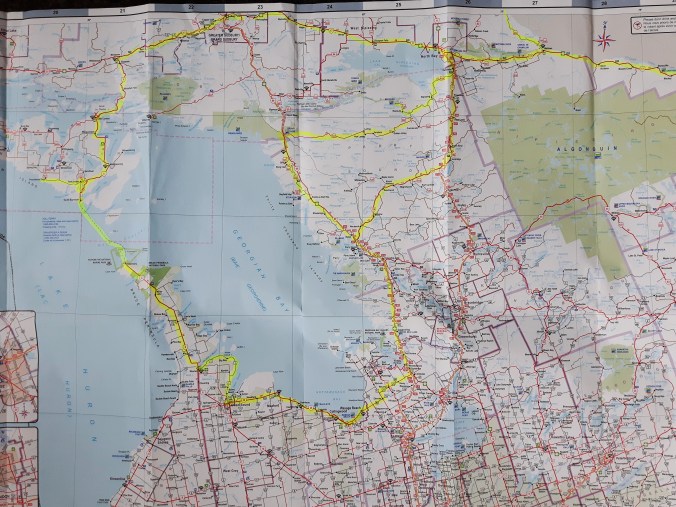
Readers who read my last post on trip planning know that this year I tried something different: my wife and I travelled together—she in the car, and me on the bike. We then separated and I had a short solo trip for another four nights. We decided to circle Georgian Bay counter-clockwise starting at North Bay, spending time on Manitoulin Island, which neither of us had visited before. Now you can take the 401 to Toronto and then head north on the 400 . . . if you are a sucker for pain and like sitting in stop-and-go traffic . . . or you can take the 417 into Ottawa where it turns into the 17 and takes you all the way to North Bay. I’d read about this route in Neil Peart’s book Ghostrider and knew immediately I wanted to do it. So at 10 o’clock—the time my wife and I always seem to depart on road trips, regardless of all other factors—we pulled out of the driveway and headed, of course, to Herb’s Travel Plaza. With a name like that you’d think it was from another century. Certainly the single-engine airplanes in various stages of disrepair and decay at the side of the “plaza” as decoration are. But its quirkiness is part of its charm. Herb’s is the best gas bar the other side of the Ontario border and our designated meeting spot should we get separated in traffic.

After both vehicles were filled we bombed through Ottawa and on to The Little Coffee Shop in Cobden for lunch. Now what do you do when you have packed a lunch but want to buy a coffee and a snack? Do you eat the sandwich in the restaurant with your coffee or eat it before going in, out of respect for the owner? This is always a dilemma for me. Once in Austria, I think it was, I was asked to leave a McDonald’s—a McDONALD’S! of all places, because I pulled out my prepared lunch while my friends ate their Big Macs. That was 30 years ago but the trauma remains today so I usually eat first. There were a few tables outside on the sidewalk and I thought sitting there, as opposed to in the cafe, would be a good compromise. I put my sandwich down and went inside to order, only once inside it was so casual and the owner, who serves behind the counter, so friendly I just asked and before she could answer she said I’d better go rescue my sandwich because a seagull was trying to get through the cellophane. That seemed to settle the matter.

I don’t remember much of the ride into North Bay except that it was hot and long and I was tired and later hungry and that’s probably why I don’t remember much. I was in that auto-pilot “just-get-me-there” mode. Our destination was Restoule Provincial Park, only because it was (suspiciously) the only park not completely booked when we did our planning. When you are camping in the Muskokas, you have to book your campsite six months in advance. Yes, six months! And not just the campground but the specific site! We heard stories during our trip of families strategically getting each family member on a separate computer at the same time, exactly six months prior to the desired date, because that is the earliest you can try, and everyone simultaneously trying to reserve a site. It’s like trying to get concert tickets to Led Zeppelin’s single reunion concert through Ticketmaster. I don’t know if I’m going to be alive six months from now so Restoule it would have to be.

By the time we arrived I had only one thing on my mind: dinner. But as luck would have it, the stove would not light. I’ve had this stove for about three years. I bought it when I bought the bike with moto-camping in mind. And I remember at the time I had a choice between the Optimus Nova+ or the MSR Dragonfly stoves. They are basically the same, or so the salesperson told me, using essentially the same design to burn a variety of liquid fuels (naphtha/white, kerosene, unleaded gas, diesel).


And looking at the two, you’d think they are pretty much the same. I bought the Optimus because it looked a little sturdier and packed up slightly smaller. I have to admit it was the wrong choice. Of all the gear I’ve bought for my camping, this stove is the only regrettable choice I’ve made. Aside from a stretch of 12 days during my tour last summer, this stove has acted up in a variety of ways. One repeated way is that the valve gets stuck closed. Then you have to twist the feeder line so much you’re sure it’s going to break until it gives and releases. This time it would not give so it broke instead, which is to say I had to use pliers to open it and stripped the internal brass threads in the process. In the meantime I missed the sunset that my wife was enjoying down at the beach.

Restoule

Sunset on the beach at Restoule Provincial Park

I can’t remember what we had for dinner that night but my wife worked some magic from the food bag. Lying in the tent later, I used the last ounce of energy to search on my phone for an outdoor store in North Bay or Sudbury. It was the first night of a two-week camping trip and I didn’t have a functional stove. The adventure begins.

Day1-Mtl to Restoule

Day One route: Montreal to Restoule Provincial Park

Trip Planning

MapHow much planning do you do before heading off on a tour? Do you have your entire route determined with accommodations booked, or do you leave a little to chance and exploration? Is your trip fixed in asphalt or is it flexible, able to change when the spirit moves you or weather or some other factor meddles with your plans? There is security in knowing where you’re going and that there’s a reserved room waiting for you at the end of a long day of riding, but there’s risk and excitement in leaving some room for chance; sometimes the most memorable moments are gained through the unexpected.

The answers to these questions lie in your aversion to risk. No one likes risk, but it’s the price we have to pay for adventure. When used as an adjective, as in “adventure motorcycling,” adventure is defined as “designating a type of tourism to exotic, esp. wilderness destinations usu. combined with hiking, canoeing, etc.” (OED). And right after that definition is another, more foreboding definition: “a daring enterprise; a hazardous activity.” My wife thinks I’m crazy going where I want to go, which says a lot about her aversion to risk, although she did marry me, which in itself is risky, and she condones my riding. But generally I think I have a higher threshold for risk, so when we decided to travel together to Manitoulin Island this year, our trip planning itself was an adventure.

We solved the problem in a simple but ingenious way: we’ll travel together for part of the trip—she in the car, me on the bike—with a fairly clear route and campsites reserved for each night. Then I’m going to split off and head further north on my own with no reservations made and Lady Fortune riding pillion. I have a general idea of where I’m going (i.e. north) but having no reservations means I’ll be able to follow my nose or recommendations from locals, explore dirt roads, go at a pace determined by conditions (weather, fatigue, terrain, etc.) and, most of all, live in the moment. I live my life on a schedule 51 weeks of the year; I reserve one for me and the moment.

That doesn’t mean I don’t have any planning to do. I have lots. In fact, because my solo adventure involves some risk, I need to be prepared as well as possible to minimize it.

Packing

Because I’ll be heading into some remote areas, I have to carry everything I might need for possible problems. For me, that starts with my tools. Worst case scenario is getting stuck in the bush somewhere and having to hike it out, or worse, not being able to hike it out. So the bike has to be reliable and I have to be able to fix anything that might break on it. This year I’ve been conscientiously putting together a tool roll and some spare parts and other items that might be needed.

Tools

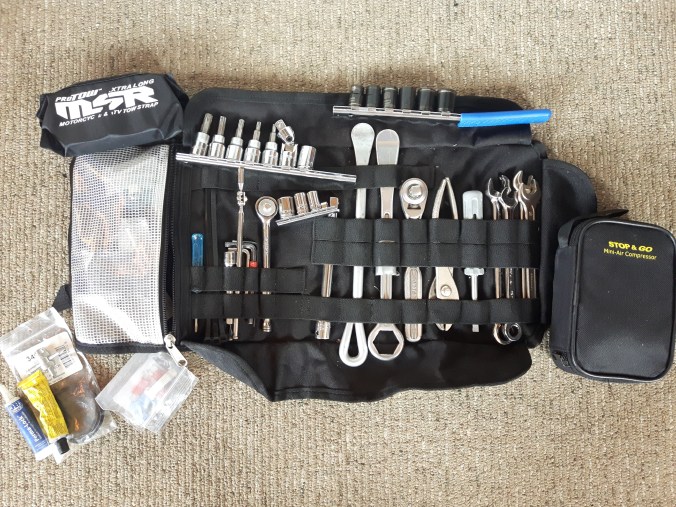
Primary Tool Roll

I use the Kriega tool roll. I like the extra pocket for doo-dads like fuses, Locktite, tube patches and cement, valve stem tool, etc. I also carry a full set of Torx sockets because my bike is a BMW, almost a full metric set of 3/8″ hex, and a few 1/4″ particular to my bike. I’ve been trying to do all repairs on my bike using these tools so I know I’ve got everything I need. If I have to grab something out of my tool chest that isn’t here, I consider adding it to this set. I also have a Stop & Go electric pump so I can drop and add air to my tires when I do some off-roading or for if I get a puncture. It runs off the bike’s electrical system using a SAE connector.

I have a secondary set of tools, spare parts and materials that stay in the tail compartment. I don’t use these as often, but it’s nice to know they’re there should I need them.

Tools2

Secondary Tool Roll

Tire pressure gauge, spark plug remover, small crescent wrench, Torx multi-tool, stubby Phillips for the battery terminals (it’s the only way to get in there to tighten them), wire-cutters, some extra hardware, an extra hose clamp, safety wire, epoxy putty, extra electrical wire, and a pipe cleaner. Pipe cleaners are incredibly useful. I really should have a few of those. Fortunately, I smoke a pipe so I have a few in my pipe bag.

Not shown, but I will take, is a D.I.D chain-breaker tool, some BIG box wrenches for that (unfortunately, it requires 27mm and 19mm box wrenches, which lie in the bottom of my pannier), a small length of extra chain, and a spare spark plug. I’ve changed my headlamp from the OEM halogen to the Cyclops LED which should be good for the life of the bike, otherwise I would carry an extra bulb. I will also take an extra water pump since that’s the vulnerable part on this bike. I’ve written recently about those issues and know that some guys with the 650GS and its cousins just take an extra pump when touring.

First Aid

First aid might be bracing a broken leg or removing a splinter. You have to be ready for everything. I considered picking up one of those pre-made kits you can get at a pharmacy or outdoor store but decided to put together a personalized one using a Dollar Store pencil case.

FirstAid

First Aid Kit

It contains compression elastic, various cotton bandages, alcohol swabs, two types of medical tape, anti-bacterial cream, arnica montana, Band-Aids, some NSAIDs, tweezers, nail snips, antihistamines, and a few items particular to me: Robax, because I have a vulnerable lower back, and some ear drops, because I’m prone to ear infections. I think I get them when I’ve been wearing the ear plug, which irritates the ear canal, and then I go swimming in less than pure water. So I take Buro-sol, which prevents the infections, and Auralgan, which is the only over-the-counter medication I’ve found that can treat an infection once it gets a grip. I also keep in my tank bag a small tube of Aleve, my weapon of choice these days for headaches. If I don’t drink enough water on hot days, I’m prone to getting a headache, so I like to keep these at hand.

Clothing

Think you’re travelling light? Cut your items in half, then cut in half again. You’re probably close to what I can take on a motoadventure. I need one pannier for food and one for cooking and camping items, so that leaves one 30L wet-dry bag for my clothing and personal items. One advantage of travelling with my wife this year is that I’ll be able to take a few extras for the first part of the trip, then leave them with her when we part. For example, I normally do not take hiking boots. I ride in my adventure boots and change into running shoes at camp that double for, well, running, since I try to keep up my fitness even when touring. What could be better than a short run in fresh air surrounded by pristine wilderness?

Because I have to be so efficient with my packing, I LOVE merino wool. It is the Swiss army knife of fabrics, able to keep you warm when cold and breathe and wick when hot. I usually take one merino T-shirt and one or two synthetic athletic shirts for when it’s really hot. If it’s cold at night, I might wear my merino all day and all night. Ew! you say? Merino also has antibacterial properties. Those New Zealand sheep shall inherit the earth, I think.

I take two pairs of riding pants: kevlar jeans and Klim Dakar off-road pants. I also pack one pair of those thin, nylon outdoor pants. They are cool, keep the bugs off at camp, and I can zip off the lower leg portion to convert them to shorts. Versatile is the name of the game. The same goes for my riding jacket. I’ve considered wearing my Klim Traverse off-road jacket because it’s Gore-Tex so doubles as rain gear, but I’ve decided to wear my Joe Rocket touring jacket just because it has that zip-in liner for when it’s cold. Temperatures can fluctuate dramatically on a bike during the day and my jacket is my only climate control. It also has adequate venting for when it gets hot; I’ve ridden in that jacket when it’s been over 30 degrees Celsius and, although it’s got leather on the important areas, there’s enough textile and venting for hot weather. I’ve also recently upgraded the armour to the best CE2 protection on the market. The only downside is that it’s not waterproof, so I’ll also have to take rain gear. Even with the zip-in liner, I’ll also take a polar fleece sweater which doubles as my pillow when folded. The only other specific riding gear I take (besides my helmet—Doh!) are my two pairs of gloves, one for hot weather and a rainproof gauntlet.

Navigation

My trip-planning began during another trip, about a month ago, to Guelph to visit my parents. I was at an En Route, the Ontario government rest stop cartel, and wandered over from the Horny Tim’s/Bugger King side to the Ontario Tourism side. I asked what they had specifically for motorcycle tourism and was given a few documents. One outlined several circuits in the region, making it easy to decide on a basic plan from which to build a more personalized route. There’s a Manitoulin Island Circle Tour, Georgian Bay Coastal Route (both self-explanatory), and the Great Legends Circle Tour, which brings you as far north as Driftwood, just west of Cochrane. I decided to do all three.

We’ll be camping the whole way, and since the Bruce Peninsula is a popular vacation area for the hoards of Torontonians, we decided to reserve a site for each night. When I head north, I’m expecting the demand to be less so I haven’t made reservations for that section of my trip. In fact, I’m going to try wild camping, which I’ve never done before. You basically find a discrete spot off the main road and pitch there for the night. No fire, no potable water, but I have my stove and purification systems. I also have my bear spray.

I’ve been experimenting with a couple of GPS apps, namely Maps.me and Sygic Car Navigation, but seriously, they are so far not as convenient as GoogleMaps. GoogleMaps just works. You look up a campsite in Chrome, click “directions” and GoogleMaps opens up and guides you there. And if you’ve downloaded that area in an offline map beforehand, it doesn’t require data to calculate the route and guide you there. Traffic information uses data, but I’m not anticipating much of that in Near Northern Ontario. I’ll probably use GoogleMaps for most of my navigation with a paper map in my tank bag for literally the big picture.

If I happen to slip out of cell service, I carry an old, cheap, Garmin car GPS inherited from my parents. Yeah, in an ideal world I’d have a Zumo or Montana, but neither the world nor my bank accounts are ideal, so the hammy-down GPS will have to suffice this season. It’s not like I’m navigating The Great Trail or anything. That’s next year.

Final Prep

So we have our accommodations set for the first part of the trip. I’ll GoogleMap the distances and make sure they are viable, research some tourist attractions in the area, although I’m more into wilderness than attractions. Still, I like knowing the history the area and what unusual landforms I might be riding past. You wouldn’t want to cruise through Thunder Bay, for example, without noticing Sleeping Giant or stopping by the Terry Fox Memorial.

Then I hold my breath and check the weather forecast. I can’t do anything about it, but it’s nice to know what the highs and lows will be to ensure I’m packing right. If it’s going to be below 10 at night, I might add a woollen hat.

I’m going to save the topic of my moto-camping gear for another blog so I won’t get in to that now. But I lay all the items out on the floor where I can see them to ensure I don’t forget anything essential. It’s much the same as my canoe-camping gear, and it pretty much stays together in storage, but we’ve all been there: you get out in the bush and go to have your tuna pasta and realize you’ve forgotten the can opener. So I lay it out and I make lists. I’ve made so many lists, jotted on the backs of grading rubrics as I think for when I’m free, that I decided finally to do a digital version for perpetuity.

Finally, I make sure the bike is ready. It’s been running great lately so I’m going to leave it alone now except to check all fluid levels and do an oil change. I’m only a few thousand kilometres into my latest oil but I know from last year’s tour to start with fresh oil and avoid having to do it on the road.

Let’s see how this unfolds. Look for a series of blogs in the coming weeks about our adventures. Oh, one essential item I forgot to mention is a digital recorder, at least if you’re interested in keeping a record of sorts. At the end of the day I’m too tired to write so I spend a few minutes in my sleeping bag recounting the highlights of the day, which can lead to some interesting entries. Last year in one such entry I started narrating the dream I was slipping into. If nothing else, it’s nice to listen to those recordings midwinter and relive the ultimate freedom that moto-camping offers.


Blemishes or Character Marks?

“I want a poem I can grow old in,” writes Eavan Boland at the start of her essay “The Politics of Eroticism.” She goes on to explain that she wants a poetry in which she is subjected to the effects of time, not an object frozen in time. You might not think that’s very erotic, but that’s not her point. Her point is that she wants poetry that celebrates real women, creatures of time, not illusory women, sprung from the imaginations of male writers.

Why am I thinking of this now? Because my mistress has a wrinkle and I’m not sure whether I want her to get cosmetic surgery. I’m speaking of my bike, of course. Last year, as a result of a few offs in mud, one of the side panels got scratched. This was before I bought my upper crash bars. Now that I’m about to install them, I thought maybe I’d do a little bodywork first to make her good as new. I posted a query on my forum requesting tips. I’ve done bodywork on an old car with aluminum panels before but never worked with plastic. Someone replied with a lot of information for me, but someone else wrote “I kind of like my ‘character marks’  . . . makes it look like I actually use my bike in places other than Tim’s or Buckie’s.” That got me thinking. Are scratches blemishes or “character marks?”

I know a club member who sold his bike because it had a scratch and got a new one. Why he didn’t just get the scratch fixed I don’t know. Perhaps he was ready for a change anyway. But for some riders, the bike’s pristine appearance is an important part of the experience of riding. They spend hours polishing it on weekends, prepping for the club ride. I’m thinking also of the Americade parade I witnessed en route to an off-road rally last June, when all the Harley’s were lined up at the side of the road on display. I get it: the aesthetics of machines. I’ll be one of the first to admit that each bike has a personality, and a good engineer will take into consideration form and function.

On the other hand, aside from “character marks,” I’ve heard scratches referred to as “honour badges.” What’s so honourable about dropping your bike, you ask? I guess, the theory goes, that if you aren’t dropping it once in a while, you aren’t riding it hard enough. You aren’t pushing your limits. There’s growing derision for folks who buy a big 1200GS with luggage, maybe spend $2,000 on a Klim Badlands suit, but never venture off the asphalt. Posers. I’m not knocking anyone who doesn’t want to ride off-road, just those who don’t but buy an off-road bike and gear. And if you’re going to go off road, you’re going to drop the bike. Maybe not if you’re only doing dirt roads, but once you get into mud or trail riding, sooner or later, some rut or rock or lapse of concentration is going to get the better of you. And your bike. There’s just no avoiding it indefinitely.

So why not embrace it? If you ride around fearing a little mishap that might blemish your Precious, you’re not going to have much fun. And you did buy the bike to have fun, right? To ride it, take it places you can’t take other bikes, challenge yourself with a rocky hill climb or water crossing, try some single-track, where tree branches or underbrush might jut out onto the trail, slide the back end around a corner, and yes, show off your mud-splatter and scratches at the local coffee shop.

It’s the first beautiful day of the year here in Montreal. Hard to believe we had freezing rain a week ago. It feels like the unofficial start of the season. Enjoy your ride, whatever kind of ride you do.


The BMW f650GS. It’s not just a starter bike.

P1000195

2006 BMW f650 GS twin spark. 

The BMW thumper is an iconic bike with a huge following for good reason. 

I’ve been reluctant to do a bike review of Bigby. For one, I still consider myself a novice. In fact, aside from a few bikes at my training school, Bigby is the only bike I’ve ever ridden, so I don’t have much to compare it to. Doing a review, I thought, would inevitably lead to the faulty comparison, a logical fallacy I warn my students to avoid. (i.e. “Gets your clothes cleaner!” Ugh, cleaner than what?) Second, I’m still learning about the bike. Although I’ve owned it for almost three years, I’m still finding my way around the engine and mechanics and still discovering its potential. Passing judgment now would be like bailing out of a relationship after the second date. It would be, in the literal sense of the word, prejudice.

So why have I decided to do it? Well, after watching a lot of reviews online, I’ve come to realize that most are not very good, so the bar is set pretty low. They are usually more product descriptions than reviews, and Ryan at Fort Nine has blown the whistle on the nepotism of corporate reviews, how they are always positive because the big bike companies offer a lot of treats to the reviewers, like paid vacations in exotic locations. And those reviewers ride the bike for, what, a day, a couple of days, max, so at least I can say that after three years with Bigby, I know more about this bike than they ever will. So with my concerns made explicit, let’s jump in.

* * *

The three things I like the most about the f650GS are three things I noticed within the first five minutes of riding it: ergonomics, suspension, and balance. Okay maybe you don’t need to have ridden a bike for long before you discover its essence. Let’s look at each in turn and then move on to other stuff.

Ergonomics: At the school, we’d learnt on cruisers—Suzuki Boulevards and Honda Shadows. The ergonomics of the GS are very different. Being a dual-sport bike, it’s capable of going off road, and you need the pegs beneath you in order to stand. This placement also results in your weight being distributed evenly between the seat and pegs, with knees bent at roughly 90 degrees. It’s the ideal sitting position and how every office chair should be set up, thus making the GS also a very capable touring bike. The dual-sport, according to its name, involves compromise, but there’s no compromise when it comes to ergonomics: the GS provides the perfect sitting position, and the capability to stand when you leave the asphalt.

The other thing I like about the ergonomics is that you can flat foot this bike. The standard seat height is 30.9 inches, so super low. This is confidence inspiring once you take it off road; I know I can easily dab a foot if needed. In fact, since I am rather long-legged, the seat was a bit too low; my knees were bent more than 90 degrees and I felt a bit cramped after several hours in the saddle. So when I upgraded my seat (more on this later), I went for the high version to allow a bit more room, and that has made all the difference. If you are long-limbed, you might want to look at the Dakar version, which has a 34.3 inch seat height, or swap the saddle for a taller one. Despite these issues in my lower half, I haven’t had to add bar risers, and when I stand, the grips fall perfectly to where I need them, maintaining my standing posture.

Suspension: As I rode off on my first ride, the second thing I noticed was the suspension. This bike is smoooth, at least compared to those cruisers. And what better place to test a bike’s suspension than Montreal roads! Of course it makes sense that a dual-sport bike would have very capable suspension; it’s designed to be able to handle some pretty bumpy terrain. But just before I went for my riding test, I hired a private instructor for a class. He rode behind me and commented on things he saw. Now here is someone who has a lot of experience with bikes and has seen a wide variety from behind. Ironically, the first thing he remarked when we first stopped had nothing to do with my riding but how impressed he was with the rear suspension of my bike. “I wish you could see what I see from behind,” he said. “It’s amazing!”

In fact, I’ve wondered if the suspension is a little mushy. I’ve only bottomed out a few times while off-roading, and the front end dives a bit under hard braking. I’ve considered upgrading the suspension, but frankly, at only 140 lbs, I’m actually underweight for this bike. Front suspension travel is 170 mm and rear is 165 mm.  Since ideal SAG is roughly 30% of total travel, SAG for the 650GS is 49.5 mm.. Even with the pre-load completely backed off, all of my 140 lbs is putting a little more than 45 mm on the suspension. Which brings me to another plus of this bike: the pre-load adjuster. Okay, it’s not electronically controlled like the new Beemer’s, but the ability to adjust with the turn of a knob when you are two-up or have gear on the back is a nice feature.

Balance: The thing I like most about the 650GS is its balance. This is accomplished mainly due to the gas tank being under the seat instead of high on the bike where it normally is. Where this is most noticeable is in how the bike corners. At the school, we were taught to countersteer to initiate a turn and to accelerate at the end to straighten up, and this was necessary with those cruisers. But I quickly discovered that on the GS you can manage an entire sweeping curve simply by leaning in and out. It’s hard to describe, but the bike feels like it straightens up itself with the subtlest weight shift.

The balance also shows when riding at slow speed, like in parking lots or technical sections off road. I’ll challenge anyone to a slow race any day! The bike is easy to move around by hand and to turn in tight spaces. With a little practice, I was riding figure-eights full lock. You can add all the accessories you like to a bike, but getting the balance right is something that happens at the design stage. BMW got it right on this one, which is why I was surprised to hear that they’ve moved the tank to the traditional location in the hump on the 2018 750s and 850s.

* * *

The engine is a Rotax, 652 cc single-cylinder, water-cooled, DOHC with twin spark plugs and four valves. It provides 50 HP @ 6,500 rpm and 44 lb/ft torque @ 5000 rpm. What these numbers mean is that it’s not the gutsiest engine. I’m up for a slow race but I won’t be challenging anyone to a drag soon. When I did my research, I kept hearing how this bike is a good beginner bike. There’s not a lot of power to manage, and you don’t have to worry about losing the back end by getting on the throttle too hard. On the other hand, it’s got lots of torque down low in the first two gears for hill climbs off road, and still some roll on in 5th gear at 120 km/hr. I’ve never maxed it out, but I’ve had it up to 140 km/hr and that’s fast enough for my purposes. And since we’re talking about gearing, 3rd and 4th are wide enough to enable me to navigate a twisty piece of road pretty much in one gear, depending on the type of road: roll off going into a corner, roll on coming out.

Single-cylinder engines have their advantages and disadvantages. One advantage is this wide gearing. My dad often talks about how he loved this aspect of his 350 Matchless. In heavy traffic, you can stay in 2nd and just ease the clutch back out when traffic picks up again. He once road his brother’s parallel twin and said it was horrible in stop-and-go traffic; you had to work twice as hard to prevent the engine from bogging. I suspect it’s this same quality that allows you to maintain your gear through a twisty section of road with slight variations in speed.

Another advantage of singles, I’ve recently discovered in this article in Cycle World, is that they offer a kind of traction control. As Kevin Cameron argues, “no other design produces such forgiving power delivery under conditions of compromised traction without elaborate software.” This is due to the millisecond duration of the exhaust stroke with big-bore engines, when there is relatively little power delivered to the tire, allowing it to regain traction if it begins to break loose. It’s like anti-lock brakes, the theory goes, but in reverse. Compare that to the constant power delivery of multi-cylinder engines, which makes managing power and traction more challenging.

A disadvantage of single-cylinders is the vibration. The Rotax engine is about a smooth as a single comes, I’ve heard, but it can still make your throttle hand go numb, especially if it’s cold, so you might want to invest in a throttle assist or throttle lock. I have the Kaoko and it works great. Unfortunately, the Rox Anti-Vibration Risers don’t fit my particular bike due to the configuration of the triple-clamp, but then I’ve heard those can make the steering mushy, which can be unnerving when riding off road. And it might be my imagination, but it seems that there are less vibrations when using the BMW oil. It certainly seems that the engine runs quieter and smoother, perhaps not surprising given that BMW design and test the oil specifically for their engines. Speaking of oil, the Rotax engines do not burn oil. Ever. Don’t believe me, go ask the inmates at The Chain Gang, a user forum devoted to the BMW 650s.

On the other hand, it’s a major pain in the ass to do an oil change on this bike. Because the engine uses a dry sump system, there’s an oil tank on the left side of the hump where a gas tank normally would be (an airbox is on the right side), so draining the oil involves removing the left body panel and draining that holding tank, plus draining the pan by removing the sump plug at the very bottom of the engine. If you have a bash plate, as I do, you have to remove that too, which, if it’s attached to the crash cage . . . and so on, until you’ve stripped the bike halfway down. Or you can drill a hole in your bash plate as I did, which makes that job a lot easier. You’re still going to get some oil on the plate, and you’re going to get some on the engine when you remove the oil filter due to its recessed placement, so just have plenty of shop towels on hand.

My 2006 650GS does not have rider modes and sophisticated electronics. It doesn’t even have anti-lock brakes. At first I was concerned about this and it was almost a deal-breaker for this newbie. But I spoke to a few experienced riders and they all agreed: better to learn how to control traction and perform emergency braking using proper technique than rely on electronics. Since I’m rather a purist in most things, I understand that. If you learn to emergency brake by grabbing a handful of brake lever and letting ABS do its thing, you aren’t going to develop the feel needed to control sliding in off-road situations. And not having all that sophisticated electronics makes the bike easier to maintain.

The 650GS is fuel-injected so there is an ECU. A 911 diagnostic code reader is available to help you troubleshoot the electronics, but it’s expensive. One advantage of fuel injected bikes is that there is no choke to deal with, and the ECU adjusts the fuel-air mixture according to altitude, meaning you can literally scale any mountain without having to change the jets of a carburetor or risk running your engine hot. The downside is that the throttle can be a little choppy so easy on the roll-off.

Two areas where the 650GS is lacking are the saddle and the windscreen. The saddle is hard and slopes downward, so you always feel like the boys are jammed up against the airbox. If you plan on using your GS for long day trips, you’ll want to upgrade the saddle. There are many aftermarket models available, including BMW’s own Comfort Seat, but I decided to go with Seat Concepts which, for about $250 CAF, they will send you the foam and cover and you reupholster it yourself using your original seat pan. I’ve done a blog on this job so won’t repeat myself here.

One issue with this era GS is the windscreen. The OEM screen is so small it barely covers the instrument dash. There are many aftermarket screens available, but finding the right one is a difficult matter of trial and error. The windscreen issues on this bike are well documented, and if you have sadistic leanings, just search at f650.com for aftermarket windscreens, sit back, and enjoy. The reading is almost as entertaining as a good oil thread. In my own experience, the bike came with a 19″ National Cycle touring windscreen, which was a bit high for off roading and was directing loud air buffeting directly onto my helmet. I swapped it for a 15″ but that too was loud, so I added a wind deflector and that solved the buffeting but I thought ruined the bike’s aesthetic, so I ultimately landed on a 12″ sport screen by National Cycle that protects my torso but keeps my helmet in clean air. The problem is the shape of the front cowling that the screen screws into. It angles the screen too much directly toward the rider’s helmet, instead of the recent bikes that have the screen more upright. The quietest screen on the aftermarket is the Madstad screen. It has an adjustable bracket that attaches to the cowling, allowing you to adjust the angle of the screen. It also has that crucial gap at the bottom of the screen, preventing a low pressure area that causes the buffeting developing behind the screen. Unfortunately, it’s a little pricey, but the real deal-breaker for me is that Madstad use acrylic, and acrylic screens don’t stand up to the abuse of off-road riding. National Cycle screens are polycarbonate.

Aesthetics: I love the aesthetics of this bike! Even ugly babies are adored by their parents, but sometimes I’ll look at a more modern luxury touring bike with the engine completely covered in plastic and I’m glad my bike has its guts hanging out like a proper bike. And I like that it has spoked wheels, which are stronger for off roading and have a more traditional look. Someone once said to me, “I love your old-fashioned bike.” Hmm . . . I hadn’t thought of it as old-fashioned but didn’t mind the comment. There definitely is a raw, real motorcycle quality to the bike, yet has refinements like heated grips and the quality control and reliability you’d expect from BMW. It is the ultimate hybrid dual-sport: part dirt bike, part luxury tourer.

In conclusion: The f650GS is a confidence-inspiring little bike that is perfect for not only beginners but also anyone who prefers a smaller, lighter bike. There’s a movement these days toward smaller bikes, with many people looking at the big adventure bikes with derision for their impracticality off road. I say it really depends on the type of riding you want to do and where you plan to take the bike. Due to its size and weight, the 650GS can go some places that the larger bikes can’t, but the cost is in vibration and rpms at speed on a highway. If you’ve got large areas to traverse but want the capacity to go on dirt roads when needed, then yeah, go for the big 1200GS that is so popular. But if you’ve got time and want to explore deeper into those remote areas, then the 650GS is an excellent choice. I plan on keeping mine as long as possible.

* * *

Pros:

Ergonomics for dirt and touring; smooth suspension; very well balanced; reliable Rotax engine; sufficient hp and torque for light off-roading; fuel injected intake has automatic temperature and altitude adjustment; classic aesthetics

Cons:

Cost (upfront and maintenance; even parts are expensive for DIYs); saddle is hard and uncomfortable; windscreen is useless, hard to find a good aftermarket replacement; engine can be vibey; only 5 gears

* * *

Modifications:

With the help of my son, I’ve created two walkaround videos describing the modifications I’ve done to the bike for dirt riding and street riding. 


Walkaround Mods for Dirt
Walkaround Mods for Street

How’d I do with my first review? Please comment and click the Follow button if you liked this post.

Montreal Moto Show 2018

GoldWing_Header

It’s no coincidence that the Montreal Moto Show falls at the end of February. The sky has been overcast for months, there’s still a mound of snow 8’ high on your front lawn (and dirty, brownish-grey snow everywhere else) and, despite your magical thinking, wearing your spring jacket without gloves is not bringing any warmer weather. To add insult to injury, potholes begin to emerge on the still half-frozen streets, making driving treacherous. In short, if you’re a motorcyclist, the February blues still have a good grip on you, and any light at the end of the winter tunnel comes from the LED Christmas lights you still haven’t taken down.

So just walking around a showroom with our moto-buddies is therapeutic. It gets you over the hump and into March, which is really just a month away from the month when we can start to get our bikes out. Some people go to the show with chequebook in hand, ready to buy a bike, and the ample salespeople who circulate around the bikes know this. One guy at Honda I spoke with said, when I expressed an interest in the Africa Twin, that he could knock $500 off the price this weekend only. That’s $500 I could put towards the divorce lawyer, I replied, if I came home with a new bike. But it’s still nice to dream, touch the bikes, heck, sit on them and imagine what you would do if you had an extra $13,000 floating around.

This year I went looking for gear, having still to get some body armor to complete my off-road ensemble. But I had in mind also the possibility that my son might be in the market sometime in the not-too-distant future. He’s talked about doing the course this summer, and the Quebec government is dropping the stupid regulation for learners to ride accompanied, so in theory he could be on the road this summer. That’s a thought that brings mixed feelings for me, as any parent can imagine. I’m trying to steer him away from the street and onto the dirt, at least for now. There are so many crappy drivers in Quebec, especially downtown Montreal, where he lives, that unless you have a lot of experience with defensive driving, you’re going inevitably to have an accident, and better to have it in a cage than on a bike. The first time someone drifts into your lane, or starts backing into you, or cuts you off, or turns left in front of you, you’re going to be surprised and incredulous and angry and quite possibly injured, God-forbid seriously. So my preference, if I have any say in the matter, is that he ride off-road with me and on-road in a car. But I digress. We are at the Moto Show considering which bike to get.

He’s always been attracted to naked bikes. Yeah, they’re nice, fun, practical, fast. But they can’t go to Purdue Bay, and an adventure bike is not much different from a naked, right? Both have reduced fairings; both have a small windscreen; both have an upright position; both come in a starter 650cc size; both look really cool to attract the chicks, which is important when you’re 23. Oh yeah, and both get good mileage, because you want that when you’re two-up on a student budget. But first dad gets to look at his dream bike, the Africa Twin. AfricaTwin1I’ve always said I love my little thumper, but if it’s done one thing for me it’s to get the off-road hook sunk deep. My first two years of riding have been a slow gravitation toward off-roading simply because the challenge and possibilities are endless. It’s also pretty exhilarating when you slide out the back end going around a corner on a gravel road, or charge up a rocky hill climb, or feel the bike slide around beneath you through some mud. The Africa Twin is the off-roader’s adventure bike. I sat on the Triumph Tiger 1200 and you know what? I wouldn’t want to be taking that beast off-road. Tiger_1200I imagine the BMW 1200 is the same. There’s just no room for error with all the weight. And don’t try to tell me you don’t feel the weight because it’s so nicely balanced. The first time you and the bike get kicked sideways off a large rock that rolls away from under you, you’ll feel the weight, all 580 lbs. of it as you lift it up. The Africa Twin, on the other hand, is 507 lbs., a full 73 lbs. lighter thanks to it’s smaller 999cc engine—more than enough to get you to the Timmies of your choice. But where the Africa Twin really shows its off-road colours is with the wheel size: 21” front and 18” rear. Compare that to 19” front and 17” rear in the R1200GSA and you know why the ground clearance is 9.8” compared to 8.5”. As far as I’m concerned, the 12000GSA is the bike for long adventures in remote areas, but I wouldn’t want to take it anywhere more remote than a dirt road. The 800GS is the true BMW adventure bike.f800GS

But back to the Africa Twin for a moment. The graphics on it will attract a few chicks to dad, too. While I’m intrigued by the dual-clutch system and have heard it significantly improves your ability (since you don’t have to think about gearing and can devote you’re entire attention to other stuff), once I sat on it and tried to imagine that left lever as anything but a clutch lever, I knew I could never do it. Besides, I’ve read, as good as the dual-clutch system is, it falters in certain scenarios. And then there’s the traditional argument that half the fun is controlling the power transmission from the engine. I still prefer to drive the snot out of my wife’s old manual Corolla than cruise in my less-old automatic Saturn.

While we were at Honda, we checked out the 250 Rally. 250RallyOnly 250cc., you say? This easily does 120 km/hr. on the highway and tops out at 140, but if you’re riding a 250 you probably aren’t riding the highway anyway. Only as much as necessary. You can put a tail rack on this baby, some soft panniers, and hit the Trans-Am Trail, or The Great Trail in Canada, for that matter. 250Rally_backThis little bike is a dirt-bike on steroids, capable of adventure too if you’re not in a hurry. And at only 235 lbs., it would be a fun and safe starter bike. The other option at Honda is the “adventure styled” CB500X. CB500XWith cast wheels and a lowish ground clearance, this is clearly a street bike. But with the Rally-Raid Products additions, including larger, spoked wheels and a new rear shock with an extra 2” of travel and adjustable damping, you can create a kind of “Africa Twin Lite.” The final option if you’re interested in a small displacement adventure bike from Honda is the XR650L. I’ve just discovered this bike online at Cycle World, but unfortunately they didn’t have any at the show.

Three other bikes they didn’t have, much to my disappointment, where the new BMW 750GS, the 850GS, and the new for 2018 Royal Enfield Himalayan. The new Beamers get an extra 50cc, the old 800 clearly feeling the market pinch of the Africa Twin. They’ve both been completely redesigned with the chain on the other side and a repositioning of the gas tank, although one of the things I love about my 650GS is the low centre of gravity with the tank under the seat. The new models move it to the traditional location in the hump. I guess they needed the room down low for that extra 50cc. I also didn’t see the 310GS, which would have been a contender. Come on BMW; get your sh*t together! The 310 has been out for over a year and the GS was supposed to follow a few months later. But then again, here in Canada, we always get treated second to our big brother south of the 49th parallel.

What did impress me at BMW is the R nineT. I remember the first time I saw one in the showroom on my way to the parts counter. It literally stopped me in my tracks. I’ve never been much interested in poser bikes, but if I were going to allow myself one, this would be it. BMW nailed the styling on this bike, especially the Scrambler with the gunmetal tank and brown leather saddle. RnineT_ScramblerBut then the silver, brushed metal tank is pretty cool too, harkening back to those old Norton tanks. RnineT_pureOr the one with black and gold highlights. RnineTBut my favourite, if we are posing, is the Racer with the retro colours and bubble cockpit. This would definitely turn some heads.


The cafe racer craze is still alive and well, according to BMW. Speaking of poser bikes, don’t get me started on the Triumph Bobber. BobberIt tries too hard. The whole secret of a poser bike is getting one that looks great but not too great, if you know what I mean. It’s a sign of desperation. Perhaps that’s why I’ve never been drawn to Harley Davidson, and you’ll notice there are no photos here of them. The only photos I took at the Harley display was of the entire display, complete with rock music, large-screen video, lots of leather, and Harley chicks in skimpy skirts. They are clearly selling a lifestyle. It’s a sight to behold. But if I were forced to chose another bike, less practical than my adventure bike, but that looks great, I’d be more inclined to go with something like the Triumph T100 or the Street Twin. Classic, classy, and modern, all in one package. Triumph_T100Triumph should be applauded for bringing back these classic bikes but seamlessly incorporating all the benefits of modern technology. And they get it right with the analog display, round headlight, and fork gaiters.

Next we headed over to Kawasaki and looked at the iconic KLR. If there’s one bike that epitomizes the starter adventure market it’s the KLR. Having said that, I’ll add that Bill Dutcher, founder of Americade and 50-year veteran of riding, was on a KLR when he lead our group at the Dirt Daze Rally last June. Okay, he’d geared it up, but still found it plenty capable for his needs, and he is no slow-poke, as I discovered. Gabriel sat on the KLR and immediately realized why it has been so popular over many years. KLRThe ergonomics are perfect and the seat is wide and comfy. Unlike BMW, Kawasaki have designed their way out of the comfort saddle aftermarket, to their credit. They know their clientele. Then he looked at the price: a little over $7,000. Compare that to the “comparable” 750GS at almost $11,000. That’s about $4,000 more, a lot of money when you are a student. Okay, the 310R, wherever it is, is $6,450, but has half the power and cast rather than spoke wheels. I’d take the KLR any day, but God-forbid not that ugly Camo version. What were they thinking? Are we in Maine? The only serious consideration with the KLR is the charging system, which is weak. So put some of that leftover 4G’s into a relay and be cognizant of how many accessories you add.

While there, we had to cruise past the H2R because, well, it’s the H2R.


I’m not going to own this beast in this lifetime, not if I want to live a little longer, but one sure can marvel at the aesthetics of speed. Speaking of which, then we wandered back over to BMW to compare the track-only HP4. HP4Designed by a small, very specialized team, the bike is BMW’s pure-bred racer, and here was one of only 750 made. No wonder we were not allowed to sit on it. Back down on earth, we looped back around to Honda to look at the new Gold Wing.


The Gold Wing has been the, well, gold-standard superslab touring bike for a long time, but some of the guys in my club have said Honda has become complacent and the market has dwindled. The 2018 model is a massive redesign and meant to address that. But Honda wanted to get this right, so it’s been working on this for over four years instead of the usual two and a half year timeframe for new motorcycles at Honda. This is a slimmer, trimmer, lighter, and faster Gold Wing with a radically new front suspension and optional 7-speed DCT tranny. Don’t ask me about the new suspension because, even after reading about it in the latest Cycle World, I still can’t visualize it. All I know is that it involves an A-frame that pivots outward instead of the telescopic forks that compress downward. Apparently it’s silky smooth, even smoother, if that is possible, than a “normal” luxury touring bike. It also apparently prevents the front diving in braking that is found with telescopic suspension; instead, the front wheel travels perfectly up and down over bumps.

The engine and the rider have moved forward about an inch and a half, and since the rider is now closer to the fairing, the fairing can be smaller. According to Honda, the new fairing produces 11 percent less drag, which is significant because from what I know about the Gold Wing, its liability is that it’s a parachute in high winds. A buddy of mine got hit with a cross wind on his and was pushed all the way across the road onto the opposite shoulder. In fact, if there hadn’t by chance been a lookout there to pull off to, he would have been in trouble. His guardian angel was looking out for him that day. And less drag means more fuel efficiency, a full 20% better. Transmission is tweaked with a higher top-gear ratio enabling 2,500 rpm at 75 mph. By comparison, my thumper hits 5,500 rpm at that speed, or over twice the rpm’s. Of course I’m comparing apples and oranges, but it’s clear that the new Gold Wing is meant to traverse large distances comfortably. To Honda’s credit, the engine isn’t bigger, which bucks the trend. Why do all upgrades have to involve more power? They focused instead on rideability, producing a luxury tourer that, according to reviews, is flickable and fun. And yes, borrowing from it’s adventure bike market, Honda has offered a 7-speed dual-clutch option for a true luxury experience.

Finally, we headed over to the custom bikes. Here are a few favourites. customs

There was also an R90, beautifully restored. I love these old bikes and can see myself one day doing some restoration, although I have a lot to learn first.R90

And then there was this thing which, although not my cup of tea (see above re. trying too hard), I have to admit was pretty impressive in its craftsmanship.


We also checked out the Slingshot and a Timbersled, or Timbersled-inspired accessory.


Canadian winters are long, and it sure would be fun to be able to ride through those months. I don’t know if I would bother while living in Montreal. I’d have to trailer the bike to the mountains. But I can see perhaps getting one of these when I retire to the BC interior at the base of The Rockies. Yeah, dirt bike in the summer, Timbersled in the winter. No more February blues.

What bike are you excited about this year? What would you get if you traded up?

The season is just around the corner and I’ll be posting again more frequently, so click Follow if you’re interested in motorcycles, off-roading, adventure touring, gear, and other riding-related stuff.