Screw You!

20161127_121432

You’d think that my biggest frustration last week would have been when I accidentally broke my gas cap. It was the final fill-up before putting the bike into storage, more final than the fill-up which is part of my winterizing for storage. You see, I usually add the fuel stabilizer, then fill the tank, then go for a little ride to mix the stabilizer into the gas and work it down into the injectors, as well as heat the chain wax and oil. Then I top up again. It was on this final top up that I broke the cap. Jung would have something to say about this but I don’t, not about the breaking anyway. I’m going to write about the fixing.

Or you might think my biggest frustration would have been when I heard how much a replacement cap was going to cost. It’s a gas cap, right? How much can it cost? Okay, this is a BMW, so whatever figure you have in mind, triple it. Then triple it again. You’ll be pretty close. I wasn’t that surprised when the nice parts guy at BMW told me the amount and I said so. He missed the irony, but then maybe it was a language thing. Then he said, “You’re not surprised? Oh, then, actually it’s $ __________!” (tripled again). Big joke. (Laughing.) This time I missed the irony. Did I say he was a nice parts guy?

No, the biggest frustration of the week was in trying to remove one screw to replace this gas cap. After I had ordered it, received the call that it was in, gone and held my nose and paid for it, I figured the worst was over. But I was wrong.

The gas cap is all one unit, which is why it costs so much: the cap, the hinge, and the flange are all one piece, so while I just broke the hinge, I had to buy the whole shebang. The upside, or so I thought, was that swapping the old one out would be easy. Six screws. You undo the screws, you take the old unit off, you put the new unit on, you replace the screws. This is Motorcycle Mechanics 101. But what they don’t teach you in MM101 is that nothing, no job, never, ever, is simple.

Five screws came out like a charm. The sixth did not. At first I thought the screw must be stripped, so tried pulling up as I turned. Sometimes you can skip over the stripped thread and get the next one to catch and you are out of the woods. But I soon discovered that what the screw screws into was also spinning. Now normally when this happens, you simply get hold of the nut on the other side with another socket or wrench or, if necessary, vise-grips—whatever it takes—but you can usually stabilize one side and turn the other and, again, get out of the woods.

But what do you do when the fitting that the screw screws into is embedded in the side of your plastic gas tank and covered with a metal flange? You can’t get at what is spinning, not with a socket or a wrench or vise-grips or even pointed-nose pliers, not with a screwdriver (trying to jam it down and wedge it somehow enough for the screw to release), not with a pick, not with the bent-nose pliers you just bought hoping they might do, not with a chisel to cut off the damn thing since you are replacing it anyway, nope—not even the miracle tool advertised on late-night infomercials is going to get you out of these woods. “Are you fucking kidding me!” I bellowed at the top of my lungs, and since I was in my shed, the acoustics were such that the preschoolers across the park must have heard me. For sure my wife did, for she soon arrived, presenting herself and the dog as Cheering Party, offering tea and biscuits, and helpful advice like “Why don’t you phone Nice Parts Guy and ask if he has any ideas?” But I happen to know why Nice Parts Guy works in Parts and not Service. And I know that Service doesn’t give free advice; they say “Bring the bike in,” which in this case was not an option.

But then she said something brilliant, so brilliant that my grease-monkey brain had overlooked it. “Why don’t you take a break and look online?” Now it’s not like Siri is going to know how to remove a slipping screw from the side of the gas tank on an f650GS, but one of the “inmates” of The Chain Gang probably does! The Chain Gang—so-called because the 650 was the first chain-driven bike BMW made—is a user forum consisting of 11,493 members, all of whom own my bike or a close cousin. It is a veritable fount of knowledge on all things relating to my specific motorcycle. Whatever issue you might be having, someone else has already had it and solved it. What did people in my situation do before the internet? Oh yeah, they belonged to real user groups.

So I posted my problem and before the day was out another user replied, not with an answer but to say he’d encountered the same problem. Since his cap was merely rusted, not broken, he simply replaced the other five screws and lived with it. He said he was curious too if anyone had an answer. Then someone did. He suggested drilling off the head of the screw. My concern with this plan is that I’d still be left with now a head-less screw seized inside a still-spinning fitting, so it wouldn’t solve the problem. A little back-and-forth and soon we, yes now “we” because that’s the nature of a bike forum, had another plan: I could use a drill, not to drill the head off but burn the fitting out of its socket. With the other five screws out, I knew there was enough play to get my fingers under the ring and pull as I spun the screw and fitting. With time and patience, eventually the plastic would give and the fitting would release. Then I could grip the fitting with some pliers (or my teeth, perhaps, by that point might be preferable) and unscrew the screw, then glue the fitting back into the empty socket. That was the plan.

But first I needed this tool. All new jobs require one new tool.

20161127_132133

This allowed me to put any of my 3/8″ sockets on my cordless drill. I put the torx socket on, drilled (counter-clockwise) and pulled and in no time the fitting was out. Here is what it looks like out, next to the screws.

20161127_124347

It’s brass and the rounded end goes down into the plastic. It is “gripped” by surrounding plastic which had deteriorated and given way. The top is squared.

Here is a photo of the emptied cavity with the remaining five fittings.

20161127_124257

Yes, that is gasoline sloshing around inside.

The next part of the job was glueing the fitting back in. I decided to use epoxy glue since I’ve had good luck with it on plastic before. This is where I get to play artist, mixing the epoxy and hardener on my palette.

I’m sure others have their own methods for mixing epoxy but I use waxed paper and a nail. This particular brand fortunately ended up the exact shade of grey I needed.

20161127_175628.jpg

The first time I tried, I made the mistake of putting glue in the cavity and then trying to press the fitting back in, thinking the glue would squirt up into the vacant space at the sides and surround the fitting. But it didn’t, perhaps it was because it was 1 degree Celsius out and the epoxy was stiff, but the fitting sat too high. So I quickly cleaned the fitting and cavity before anything set and started again. The second time I put epoxy just around the “neck” of the fitting and none in the cavity. I guessed the quantity just right. The fitting bottomed out and the epoxy came just flush. I had just a little excess to clean away. Then since it was cold, I used a hairdryer to help it set. All in all, it looked pretty good.

20161127_131147

After that, it was just a “simple” matter of replacing the rubber seal, the metal flange, the new gas cap unit, and all six screws. I did not tighten the new one but will wait until the spring when I’m confident everything has set hard before completely tightening it. I’m now thinking I might put some anti-seize grease on it, just in case I have to remove it again in the future. That particular fitting seems to be especially tight.

I’m no expert but I’ve done quite a lot of mechanical work, including changing a clutch on my car this past summer. But this single screw sure had me stumped! It’s funny how sometimes the seemingly simplest jobs can be the hardest. Most jobs involve approximately 25% familiarity with tools, 25% understanding of basic mechanics, and 50% problem-solving. It’s one unforeseen snag after another, some bigger than others. You have to keep your cool, take your time, seek advice where you can, and persist. It also helps to have a partner who injects a little something foreign into the mix when needed.

Thanks to my wife Marilyn, and Phil (aka backonthesaddle) at The Chain Gang for getting me over some hurdles to the finish. The bike is now ready to ride first warm weather next spring.

20161127_141231


The Big Sleep

winterizing

It’s the saddest time of the year. The leaves are down, the birds have flown, and the bike is in storage. A part of us goes into hibernation, only to reawaken when crocuses push through the last of the melting snow.

I love living in this part of the world. The ability to experience all four seasons is actually restricted to relatively few people living in a narrow geographical band circling the earth, and I happen to be one of those lucky few. When it’s stinking hot in the summer, we long for the days of sweaters, tobogganing, outdoor ice hockey, and skiing. When the wind-chill factor makes snot freeze and there’s two feet of snow to clear from the driveway, we think of summer soccer, swimming at the cottage, and lounging with a good book in the backyard. There’s little that’s more spectacular than the natural beauty of autumn in a boreal forest (maybe the aurora borealis?), and you’d have to be a zombie not to have your heart quicken a beat in spring when everything comes back to life, including your sex life. Maybe even zombies come back to life in the spring; I’m not an expert.

I’m thinking of the seasons of the Canadian south because, as much as I like all four in their own particular ways, I wouldn’t mind being able to ride year-round. Winters in Europe, or most of Europe anyway, are like early spring here: cold, grey, drizzly. Okay, not very enjoyable but you can ride in that. And if I lived in southern United States, I could ride through the winter. In fact, some bikers migrate south for the winter, taking their tours in late fall and riding towards the heat, then shipping their bikes back in the spring. That’s not an option for a teacher so, this weekend, the bike went into storage.

Another thing I long for? A heated garage. My house is a converted summer cottage so no basement and no garage. It would be so, so nice simply to pull into a garage after the final ride and park the bike, pull down the door. Then everything I’m about to say I did with numb fingers on my driveway in the cold of late autumn I could do in a warm garage, plus more. I could putz and play, do those big maintenance jobs over the winter instead of cutting into valuable riding time during the summer.

The main purpose of winterizing the bike is to protect it from the effects of time and humidity. I change the oil so the engine is not sitting in dirty oil all winter. For my bike, which has a dry sump system, that’s a full afternoon job. I start by removing all the bodywork which allows me access to the upper oil tank, which is located where a “normal” bike’s gas tank is. There’s also a plug at the bottom of the engine on the oil pan, and that sump plug is covered by the engine guard. So the engine guard has to be removed as well as the bodywork. So I’m basically stripping down my bike just to change the oil.

But here’s where it gets interesting. I need to heat the oil before draining. Do I remove that stuff after the ride or before? I’ve become pretty quick at doing it but it still takes me long enough that I decided to remove it first, ride the bike, then drain the oil. Yeah, I could have just idled the bike on the driveway to heat the oil, and I’ve done that before, but the chain also has to be cleaned and lubed before storage, and I wanted to heat the chain too so the new lube works into the 0-ring seals. It’s these seals that must be prevented from drying and cracking, thus shortening the life of the chain. So with both the oil and the chain to be heated, I stripped the bike and went for a ride. Anyone seeing me riding along the 20 Ouest with no bodywork on the bike must have thought I had either lost my mind or my fairing.

Next I removed the battery, which cannot freeze, and brought it into my house. Then I removed a spark plug, squirted a little oil (about a tablespoon) into the cylinder, and rotated the engine a few times to coat the piston rings and cylinder lining. This prevents the rings from drying and the cylinder from rusting through the winter. Actually, I lie. I started to rotate the engine—putting the bike in top gear and rotating the back wheel by hand—but realized this way is too much work so put the battery back in and used the starter to rotate the engine. (Note to self for next year.) Since my bike has a kill-switch on the kickstand, a safety feature so I don’t ride off with it accidentally down, I used that to prevent the engine from firing.

Next I clean the engine. This year I discovered a fantastic new product called S100. Since I had the crash and engine guards off, I decided now was the time to give the underside of the bike a thorough cleaning. I was going to use an auto engine cleaner to cut through that grease and grime but was worried it might be too strong and would damage some of the components. I asked at my local shop and was told about S100. It’s amazing! You just spray it on and hose it off with a strong jet of water. For the real tough stuff, I used a soft-bristle brush, but really even that is not necessary with this product.

With the engine clean, I coated a rag with light motor oil and wiped it down, again as a rust-inhibitor. Last year I used another great product called ACF-50 that my cousin Mark told me about. It was tough to find here in Canada and I had to mail order it and didn’t get ahead of that this year, so used the light motor oil instead. ACF-50 though is much better. It stops corrosion on contact and coats and prevents future corrosion. It was designed for use in the aerospace industry and is safe for electronics, so you can spray it on indiscriminately without worry. It’s good for 12 months so I really should just apply it each year as part of my winterization. Ironically, ACF-50 is made in Canada, so you’d think it would be easier to find here. Last year as part of my effort to track some down I drove to some remote abandoned building east of Montreal on the promise that someone there had some. I tell you, it’s that good. Yes, this is like a hard drug for bikers and you have to speak easy to the right people to get some. When I got to the building I knocked and looked in the windows but no one answered the door. Then I saw the blinds in an upstairs window move and noticed bullet holes in said window and decided maybe it was best to buy online. This is the honest-to-God truth. ACF-50. It’s good stuff, man! The light motor oil pales in comparison.

I paid particular attention to the exposed steel of the front forks. I even squirted a drop of oil on the fork rings, then compressed the forks a few times to work the oil into the seals. This prevents them from drying during the winter. Next I replaced all the bodywork and gave it the full clean and wax treatment. I know, most of my panelling is plastic, but I still feel the wax helps protect against acidification and oxidation, especially since I live near an airport and it rains jet fuel around here. The last step in protecting against moisture was to spray a little WD-40 (why do all these products have some cryptic combination of letters and numbers, like an internet password?) in the exhaust pipes and cover each with a plastic bag tied off with a rubber band. I plugged the air intake ports too, preventing critters from making those cavities their winter home.

Finally I backed the bike into the shed, put it on the centre-stand, then used my new motorcycle jack to lift the front tire off the floor of the shed so both tires are suspended. This prevents flat spots from developing. I also dropped the air pressure in the tires a few pounds. I covered the bike to protect it from getting scratched should one of the garden tools fall on it. Then I hummed it a little lullaby but there was no kissing, and no tears. It’s a lot to remember, and I found this wikiHow document helpful to review so I didn’t forget something.

I won’t be posting as much through the off-season but watch for sporadic posts on book reviews, trip planning, and my current gear wish list.


What’s In a Name?

2013-09-king-dick-motorcycle

I’ve owned my motorcycle now for over 16 months and it still does not have a name. I don’t mean the name the manufacturer has given it—manufacturers like to come up with macho, threatening names, like Intruder, Rebel, Bandit, and Savage—but a personal name like how one names a pet, a horse, or a guitar. B. B. King named his guitar Lucille, and Stevie Ray Vaughan named his Lenny. Sylvia Plath named her childhood horse Ariel, which is a great name because it means Lion of God in Hebrew and is also the name of the spirit character in Shakespeare’s The Tempest. Wordsworth named the home that he and his sister Dorothy shared Dove Cottage, or perhaps it was already named that when they acquired it. At any rate, I’ve been thinking about the act of naming, and specifically about possible good names for my BMW f650GS. Don’t think I’m weird—not at least for desiring to name my bike—for it’s a common practice, and I’m remiss in not providing one these past 16 months.

Is naming the ultimate act of possession in imposing an identity upon an object, or a gesture of respect in attempting to recognize something’s essential character? We name our children, or most of us do. (Former U.S. alpine skier Picabo Street was reportedly allowed as a child to name herself. We can only guess what her favourite childhood game was.) The baby arrives, we take a look, we say, “It looks like a John” or “a Jane,” or we go searching through baby name books for something that “sounds right.” God forbid we name our child after a T.V. character, although I heard that Judy Collins’ character name Alexis spiked in popularity during Dynasty’s run as a hit series through the 1980’s. Shame on those parents! I feel sorry for all Alexis’s of the world.

But back to motorcycles. The worst name for a motorcycle I’ve ever heard was Matilda. Ugh! I’m not sure if the owner thought she was dancing while riding or there was some other significance. The best name I’ve heard is Bonnie. The bike is a Triumph Bonneville, which is already a pretty cool name, so called after the Bonneville salt flats, of course, but more, the owner is a bagpiper, and in Scots Bonnie means “beautiful.” It is a pretty good-looking bike too, with a burgundy racing stipe down the middle of a matte black gas tank. But despite all this ruminating, I’m still at a loss for a name for my bike.

You can’t name your bike some literary or mythical name like Rocinante or Pegasus without eliciting some eye-rolling. A good name for a bike is both brilliant and understated at the same time. Not understated enough and it’s pretentious; too understated and it’s mundane, not in a tongue-in-cheek sort of way like my pet turtle Doug but just boring! With this many qualifications to fill for a good name, is it any wonder I’m having a hard time?

Once I thought I had it. Late one night in an intoxicated state it came to me in a blinding epiphany: I could name the bike after the high-school girlfriend who was supposed to ride with me across the country 30-odd years ago. I thought it was perfect; it would be like travelling back in time to complete an unfulfilled dream. And what isn’t a motorcycle but some sort of time-travel machine? I wouldn’t use her first name because that would be too weird, too literal, and besides, Carol just isn’t a very good name for a bike. But her middle name, Shelby, might just work. (Her father was a huge car fanatic and you can probably guess who won the Indy 500 the year she was born.) Then I discovered that Shelby means “sweet and loyal,” and that was that—Shelby it would be. I even came across a reference to a derivative of it in Pirsig’s Zen and the Art of Motorcycle Maintenance. The universe seemed to be sending me a clear sign.

I know what you’re thinking: What did my wife think of this idea, and why didn’t I see the pitfall of this name at outset? Intoxicated, I said. As in “not thinking clearly.” No, this name clearly would not work, and besides, and more importantly, the few times I’d actually tried it on it just didn’t feel right. Naming is like writing poetry. You work by intuition and sense, not logic, and no matter how right a name might seem to the rational or intoxicated mind, if it doesn’t feel right in the clear sobriety of day, it’s not the right name. So I was back to square one.

Another thought I had was that the bike doesn’t have to be female. Why does it have to have a woman’s name? I’ve never referred to my bike or any other piece of machinery using the feminine pronoun. Giving the bike a gender does indicate something about the nature of my relationship with it, and the truth is, the relationship I have with my bike is not romantic. It’s not like I’m making love to my motorcycle, despite my wife’s suggestion from time to time to “Fuck the bike!” No, that relationship could equally be one of companionship, the perfect travel partner or riding buddy. But in the end, I decided that despite that logic, the intimacy and trust between a hot-blooded hetero man and his bike needs a female name, just not one of a former girlfriend if that man is married.

Sometimes a biker names a bike by playing on the manufacturer’s name, like the Bonnie example above. Ted Bishop has named his Italian-made Ducati Monster “Il Monstro.” Thinking along these lines, I thought of the GS of my bike and Giselle immediately came to mind—a good sign. It derives from the Germanic word “gisil,” meaning “pledge,” so a name my wife could get behind. It has French connotations—a nod to my home province—and best of all, is soft, suiting the 650 single, which is such a forgiving bike. If you can think of a better name, please send your suggestions or leave a comment, but for now, Giselle is the working name and starting to stick.

Valves!

img_0476

Last autumn when my bike was having trouble starting in the cold, I took it to BMW for a check-up. It was my first experience servicing the bike. When I explained the symptoms and said the mileage was 38,000 km., the response was, “So you’ve got your 40,000 km. tune-up coming. It’s probably the valves.”

Valves. Those things that let fuel in to and exhaust out of the combustion chamber. The very word sends shivers down the spine of most. We associate valves with $. Whatever the problem is with the valves—and I had no idea at the time what could be wrong with mine—we just know it’s going to  be expensive. Just to get at the damn things you have to rip half the engine apart. When I innocently inquired what the 40,000 km. tune-up would cost, I was told $500. I gulped. My mind is not so capable in math as it once was, but I immediately recognized that sum as about 1/10 the value of my bike! So this is the infamous BMW service costs, huh? My second mathematical thought was “I’ve got 2000 km. to figure out how to do it myself.”

So I hit the internet over the winter months and relied on my trusty Chain Gang to point me in the right direction. What I discovered is that when people say “valves,” what they mean is “valve clearances.” That’s the space between the valves and the cams that open and close the valves. Over time and use, these clearances either shrink or grow, and the valves go “out of spec,” meaning they are outside a recommended range. If the intake clearance is too big, the valve might not be completely closing upon combustion, or if it’s too small, the valve might not be letting in enough air-fuel mixture. Similarly, if the exhaust valves are out of spec, the chamber might not be sealing or exhausting completely, and the engine just doesn’t run right.

You adjust clearances on my bike by swapping out tiny shims located under the “follower,” a metal cup that rests on top of the valve. It’s actually the space between the follower and the cam we are adjusting, but we adjust it by either raising or lowering the follower by adding a bigger or smaller shim underneath. We are talking hundredths of a millimetre (.05 mm) here, so you need a good set of feeler gauges. A good calliper is also handy for checking the actual size of the shim you are removing.

If you find this rather boring, all you need to know for added dramatic tension is that if you mess up this job you can do some serious damage to your engine. That’s right: you have to put your engine at TDC (top dead centre) and remove the cams to get at the valves, and if you put the cams back even slightly wrong, you’re going to hear a great gnashing of metal when you try to start the engine again, which is the sound of your valves getting destroyed. So I wanted to get this right. No wonder it’s $500 just to check them!

On my bike, there are a few things I had to remove to get to the valves:

  1. all the faring
  2. the battery
  3. the upper oil tank
  4. the air filter housing
  5. the throttle cable
  6. the throttle body
  7. the starter relay
  8. the electrical tray cover
  9. the battery tray
  10. the heat shield
  11. the ignition coils
  12. the coolant reservoir
  13. the coil holder
  14. and then, ta-da! the valve cover

Now I was able to check the clearances and, as expected, one intake and one exhaust valve (there are two of each) were out of spec. I had mixed feelings about this. Part of me was secretly hoping they were all good and I would avoid having to remove the cams, but part of me was hoping I would find the source of my problem. Now at least I knew I had to pull the cams.

Next I had to do the maths and here’s a confession: before I became an English scholar, I failed out of Maths at U of T. Okay, I didn’t really fail out; I just realized at mid-term I was not going to excel in this field so did the Honourable Disappearance. This wasn’t linear algebra, but you do have to have a head for numbers and some spacial reasoning (e.g. If my clearance is 0.16 and my shim is 2.85 mm thick, how big a shim do I need to get roughly 0.07 mm clearance? Sometimes in life, you really do need to find x!).  For my bike, the specifications for the intake valve clearance are 0.03 to 0.11 mm. So I figured the ideal clearance would be halfway between the two, or 0.07. For the exhaust, the clearance has to be between 0.25 and 0.33 mm. I sharpened a pencil and got to work.

With the calculations done, the cams off, the shims out, I headed off to BMW to get my new shims. I showed the dude the sizes I need. “C’est quoi ça?” he asked. Apparently I had used a standard calliper to measure the thickness of the shims, so was working partly in metric and partly in imperial and the whole thing didn’t make sense. Doh! Like I said: mid-terms only.

Fortunately, because I’ve spent enough of my life doubling back and forth from home to auto parts stores, I had the foresight to bring the shims and my calculations, so the nice gentleman borrowed a calliper from service and measured them for me, redid my maths, and sold me the shims. By this time it was getting late and I had to be somewhere, so I had only enough time to get home, put the new shims in, put the cams back in place, replace the cam holder, measure the new clearances, and discover that while one was perfect, the other was worse than before! The nice gentleman at BMW had mismeasured one of my shims and sold me one that made the clearance worse. So the following day I had to remove the cover, holder, and cams again and essentially do two valve jobs. I was seriously beginning to wonder if I should have spent the $500.

What is particularly stressful about this job—aside from the risk of shifting the timing and destroying your engine—is that you’ll drop a screw or shim down in the engine. My shop manual suggests stuffing a rag or paper towels in the engine to catch any of the eight cam holder screws that might do just that. The YouTube videos I’d seen had alluded to that possibility in a vague sort of way that caused me considerable concern, such as “that would not be good,” or “you really don’t want that to happen,” and while I’m still unsure of what that would mean, I imagine it would cost me a lot of either time or money. So I worked carefully and slowly, and as I started each of the eight screws, I felt like I was a child playing Operation again. It was right at the height of this stage of the procedure that my wife walked out to the shed where I was working to ask me one of those questions all husbands love, like what shall we have for dinner, or would I take this call because somebody’s doing a survey.

In one YouTube video I’d seen, someone shows how you can use zip ties to fasten the cam chain to the sprockets. This way you ensure your cams don’t shift relative to the chain, messing up your timing and damaging your valves. But when I tried this, I couldn’t get the cams back in; the chain was too tight and prevented me from putting them back in their holders. So I held my breath and cut the ties. (I held the ties too, lest they fall into the engine.) Fortunately, I’d noted, even photographed, exactly where the hashmarks on the sprockets must be at TDC. A couple of rotations of the engine ensured the timing was spot on and everything was opening and closing as it should and there was no gnashing of metal. Still, once I’d put everything back together, I was a little nervous the first time I started the bike. It made one cough and fired, then hummed, as quietly as a thumper can hum.

All this was admittedly a few months ago, before I did my New Hampshire trip. I wanted to do this work obviously before that tour. Then just the other night I saw this video by Ari Henning from MC Garage on how to do your valves. He admits that the job gives most people the heebie-jeebies and is a major pain in the butt because of the risks involved. I admit, if I’d seen this video before doing the job, my confidence might have faltered. In the end, I think I did alright! Now I don’t have to think about my valves for another 40,000 km. and can put that $500 toward a new saddle next year.

Next up, prepping the bike for winter storage.


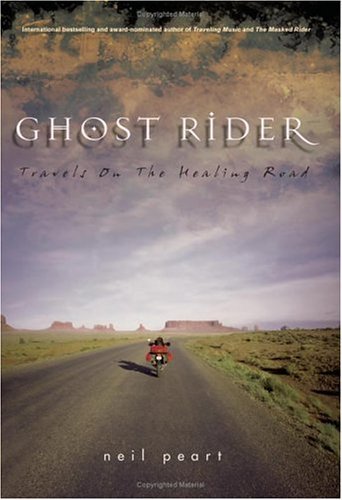
Riding pillion with Peart and Bishop: reviews of Neil Peart’s Ghost Rider and Ted Bishop’s Riding With Rilke

ghost_rider_bookridingwithrilke

The riding season is coming to a close here in Montreal and I’m already thinking of what I’ll read in the off-season. When you can’t ride for five months of the year, you need to have a few motorcycle-related books ready to carry you through those dark winter months. Last winter, two such books for me were Neil Peart’s Ghost Rider (2002, ecw press) and Ted Bishop’s Riding With Rilke (2005, Penguin).

I first came across Peart’s Ghost Rider while visiting the excellent Bookshelf Cafe in Guelph, Ontario, many years ago when the book was first published. It was on the display shelves just inside the door and I remember picking it up and never getting much deeper into the store. As a drummer, I knew of Peart. In fact, he was the hero of pretty much every snare drummer of the marching band I was in through my teens. He apparently even started drumming in a drum corps not far from Burlington, my home town, so it was almost like we were best buddies. We would air-drum to Moving Pictures at the back of the tour bus, pretending we actually knew how to do Swiss Army triplets on double bass drums or half the other stuff he does. But then that’s the advantage of air-drumming: no one can hear your mistakes.

I’d heard of the tragic loss of Peart’s daughter and wife, and of his decision to hit the road in search of a reason to continue living. All this was long before I started to ride, but the dream of riding and touring one day was alive and well, so the book grabbed me and held me there for some time. Eventually I began to imagine the staff thinking “Either sh*t or get off the pot!”

It is a compelling story. His daughter is killed in a single car accident en route to Toronto for first-year university; eight months later his wife is diagnosed with terminal cancer, an illness which he more accurately describes as “a broken heart.” Soon after, he finds himself alone and slipping deeper into isolationism and self-medication. The only way out, he decides, is literally to flee, not knowing exactly to where or why. Like the survival strategy at the heart of Peter Behrens’s The Law of Dreams, a book also about tragedy and loss, Peart intuitively decides “to keep moving.” All this is provided in the opening chapter and sets up the “travels on the healing road” westward on his BMW R1100GS.

We follow Peart across Canada, up into Inuvik, across to Alaska, then down into The United States to Las Vegas (which he hates) and around the southwest. But the travels are really just the subtext to the real “journey” (to use the most over-used word today) for him on the road of grief and recovery. Peart provides a strikingly candid view into his emotional life at its core. He is extremely self-aware and offers us insights into how he was able to inch his way out of the dark pit into which he’d fallen: his fears, his strategies, his discoveries, his small advances and set-backs (he describes the process as one step forward, one step back  . . . minus an inch).

The motorcycle is the key element in his recovery. It provides a distraction from the thoughts and feelings that plague him; riding is so consuming, it’s difficult to think of anything else but operating the vehicle while you’re on it. And he puts on the miles. (Section headings include dates, places, and mileage.) The bike also reawakens his senses which have been numbed by grief and intoxicants. One of the first signs of recovery occurs while riding twisties through the B.C. interior on Highway 99, “one of the great motorcycle roads in the world”:

The sky remained bright, the air cool and delicious, and the sinuous road coming toward me was so challenging and rewarding that I was tempted into the adrenaline zone. Turn by turn my pace increased until I was riding with a complete focus spiced by the ever-present danger and occasional thrill of fear, racing against physics and my own sense of caution in a sublime rhythm of shifting, braking, leaning deep into the tight corners, then accelerating out again and again. I felt a charge of excitement I hadn’t known for many months and found myself whooping out loud with the sheer existential thrill.

Another important element in his healing process is journalling. In one late-night entry, for example, he stumbles upon a subtle but important discovery—forgiveness—the need to forgive life for doing this to him, forgive others for being alive, even to forgive himself for remaining alive. And when he’s not journalling, he writes letters—yes, long-hand—to friends and confidantes, setting his thoughts and feelings onto paper where he can see them. Sections of the book are these letters printed verbatim.

Peart provides commentary on the people he meets and the places he visits. He prefers the peace of rural roads to the hustle and bustle of urban centres, not surprising for a man who is comfortable with solitude. He finds healing properties in nature, especially birding. Peart clearly considers himself a cultured man and does not suffer the uncultured easily. At times, he seems downright judgmental and misanthropic. This was perhaps the most surprising aspect of the book for me. But I guess he applies the same honesty in describing his thoughts of others as he does about himself. When he describes a friend of his as possessing “a blistering contempt for most of humanity,” I cannot help thinking he’s describing a part of himself as well. The next sentence begins, “We agreed on many things . . .”

I’ve fortunately never suffered such loss, but I found his examination of grief and grieving fascinating. I do feel that some of that material could have been condensed. The book is over 450 pages in length with, like I said, entire letters reproduced for long stretches of the book. I feel the book needed more editing, or better editing, with Peart forced to distill for us the musings in those letters down to the essential discoveries. No doubt this was a structural decision made by Peart and his editors, but I feel he took the easy way out. There’s also an awful lot in this book that simply isn’t that interesting. Do I really need or want to know what he eats at each meal, his wine choices, the birds he spots, the flora and fauna along the way? His encounter with a short-eared owl is an example of a meaningful reference to nature because it’s linked to the main theme of the book (i.e. the owl shrieks a cryptic message at him) but other references seem gratuitous.

Yet ironically, the end comes upon us rather suddenly and the book overall feels truncated. We learn in the final chapter of finding new love that is the final step in his recovery, if there ever can be a final step, and it comes in a matter of a few sentences literally a few pages from the end. Overall, I get the sense that this book was rushed to press by a deadline. It’s a good book, but it could have been a great book with more time and effort in that crucial revision and editing stage. Now I’m sounding like a teacher leaving feedback on a student paper, so I’ll move on.

Like Peart’s Ghost Rider, Ted Bishop’s Riding With Rilke (finalist for the Governor General’s Award for nonfiction, among other nominations and awards) opens with a tragedy: Bishop’s life-threatening crash. He’s riding his partner’s classic BMW and is encountering some high-speed wobble each time he creeps up to 130 km/hr.. Then he tries to pass a semi, only to find out halfway past it’s a double-semi, a van rounds the corner in front of him and . . . well, it doesn’t end well. Like Peart’s opening, this serves as a frame narrative for the musings that follow. And also like Ghost Rider, Bishop weaves two threads through his text, or two passions: motorcycles and literature.

Bishop is an English professor at The University of Alberta with a specialization in early modernism. Much of the book describes a ride down to the University of Texas in Austin to do research on Joyce, or is it Virginia Woolf? I’m not quite sure. The narrative jumps around quite a bit between different Special Collections rooms in several libraries and his office at U of A to conferences, but it doesn’t really matter since the academic work is just the pretext to the musings on literature and adventures on the road. Along the way we get anecdotes about D. H. Lawrence in Taos, Camus wanting to buy a motorcycle, the Woolfs declining to publish Ulysses, Ezra Pound as Bishop passes through Hailey, Idaho, Pound’s home town, and some lowbrow culture too, including Evil Kneivel’s attempt to jump the canyon. (Remember that one? It’s still an embarrassment to the locals there.)

I had come across Bishop’s writing earlier in Ian Brown’s What I Meant To Say. His essay “Just a Touch” is my favourite of that collection, so I was excited when I received this book as a gift from a writer friend. My expectations were happily fulfilled. Where Peart’s prose is often a bit wooden, Bishop’s is graceful, imaginative, and often funny. Here he provides one of the best descriptions of riding I’ve seen:

When I first put on a full-face helmet, I have a moment of claustrophobia. I can hear only my own breathing and I feel like one of those old-time deep-sea divers. . . . . When you hit the starter, your breath merges with the sound of the bike, and once you’re on the highway, the sound moves behind you, becoming a dull roar that merges with the wind noise, finally disappearing from consciousness altogether.

Even if you ride without a helmet, you ride in a cocoon of white noise. You get smells from the roadside, and you feel the coolness in the dips and the heat off a rock face, but you don’t get sound. On a bike, you feel both exposed and insulated. Try putting in earplugs: the world changes, you feel like a spacewalker. What I like best about motorcycle touring is that even if you have companions you can’t talk to them until the rest stop, when you’ll compare highlights of the ride. You may be right beside them, but you’re alone. It is an inward experience. Like reading.

In another section, Bishop’s sense of humour mixes with a cutting derision toward literary pretension, producing a description of an open-mic event in Taos that would make Peart giggle in sympathy:

Next up was Ron, the leather-jacketed poet from this afternoon. When his name was called he left the room and then came slouching in from the street wearing shades and sucking on a cigarette and carrying a little cassette recorder playing Thelonious Monk. This might have been cool, except that the efficient MC, thinking his poet had gone home, had already started making announcements about next week’s reading. So Ron had to stop, turn off the recorder, and go back outside. His friends cried, “No he’s here, he’s here!” The MC stopped, and Ron slouched in again with the same Thelonious Monk riff playing. He shouldered  his way through the group of three in the inner doorway, snapped off the cassette, whipped off his glasses (briefly snagging one ear), and looked up from his crumpled exercise book. “Why do I love you!?” he shouted.

Who cares!? I wanted to shout back, but I was a well-bred Canadian and this was not my town. Knowing this could only get worse, I slid out into the night. I understood now what Lawrence had feared in Taos.

What I especially enjoyed about Bishop’s writing is his ability to render scenes like this so vividly. I’ve been at poetry readings like this—heck, I might have participated in some—and they are as painful as he describes here. He had me squirming. His attention to descriptive detail (the slouching, the snagged sunglasses) and use of dialogue (the shouts of Ron’s friends)—fictional techniques—allow us to stand next to him, so to speak, at that poetry reading. No wonder he teaches a course on creative nonfiction and has received numerous awards and accolades for his travel writing.

In addition to the places he visits, Bishop also takes us into his world of academia. We sit in on his meetings with the department Chair, overhear the casual conversations at academic conferences, and look over his shoulder in the British Library’s Manuscript Room as he discovers he’s holding Virginia Woolf’s suicide note. We even lie beside him in the ditch as the emergency responders cut off his boots and jacket, and next to him in the hospital bed as he takes his first drink. (Okay, we’ll drop this line of thought now.) This is what good travel writing does: take us to places from the comfort of our reading chair.

And always at the centre of Bishop’s writing is an affable man with a sense of humour, important qualities in a travelling companion. We get the sense that Bishop would be a great guy to share a beer with and chat about literature, or bikes, or both, which is what Riding With Rilke is. In fact, I’d like to share a beer with either author, although with Peart it would more likely be a wee dram.

I enjoyed both books. When I went to Amazon to search for more like them, I discovered a whole genre I hadn’t known existed: motorcycle journalism. From Hunter S. Thompson to Che Guevara, Persig, and Ewan McGregor (one of these things is not like the other) there are now many good books about the personal experience of touring by bike as the adventure riding industry continues to grow. With my 6a licence now finally in my wallet, I only have one more winter to wait before I can hit the road myself and hopefully add my voice to the motorcycle travelogue market.

The King’s Highway

210px-ontario_2

I grew up in Burlington, Ontario, two blocks from Lakeshore Boulevard, or as it was then called, Highway 2. On Saturdays, we would hop the Go bus and follow that road into Hamilton to B.J.’s Skateboard Park (I know, you couldn’t get away with that name these days), a concrete sea housed in the former Hamilton Spectator building. Those excursions into the neighbouring city for the day were the first tastes of freedom and independence granted by our parents. The return trip would be sleepy and pensive after full day of adrenaline, the coach bus a tiny lit capsule submerged in dark, shuttling back along Highway 2 with glimpses of Lake Ontario on the right between mansions. I struggled to stay awake so as not to miss my stop.

Later I discovered another kind of freedom. My girlfriend lived in Aldershot, our homes connected by a 10 kilometre stretch of Highway 2. Sometimes late at night, after my parents were asleep, I’d slip my dad’s Plymouth Fury II into neutral and push it out onto the road where they wouldn’t hear me start it, then drive the 20 minutes west to the goodies waiting there. If they ever heard me leave or coast in pre-dawn, they never let on.

My paper route was along Highway 2, a section that spanned from Appleby Line to the Skyway Plaza. Usually I’d cycle it, but sometimes I’d skateboard, and since the shoulder was still gravel, that meant dropping the skateboard and dashing, paperbag slung over my shoulder, 100 feet or so between oncoming cars before jumping off onto the shoulder at the last possible moment. I must have unnerved more than a few drivers but I knew what I was doing. I spent a lot of time on that road. On the bad winter days, I’d don my ski goggles to get the route done. Other days I’d stop at the creek that emptied into the lake and play or nap. One windy day some miscreant lifted the rock off my stack of papers and I returned to find them blown down Highway 2, stopping traffic as they pasted across windshields and lifted into the trees. When I phoned for more newspapers, my manager said I had to take some garbage bags and go clean up while I waited for the delivery.

When my older sister flew the coup, she lived first in Toronto North. I followed and we lived together for a few years. When I moved to London to go to university, Highway 2 was waiting for me in the form of Dundas Street. My sister moved to Dundas Street E in Toronto, so we were kind of still connected. In fact, before Highway 401, Highway 2 was the only continuous East-West artery running from Windsor to the Quebec border. I preferred it to the major highway and would take it when returning to Burlington for holidays when I could. Although slower, it was more scenic. Instead of a bus, now it was a tiny car that shuttled through the dark countryside. I wrote a poem about encountering deer one snowy Christmas Eve outside of Woodstock. And when I didn’t have my parents’ car, the Greyhound milk-run passed through sections of Highway 2 between London, Woodstock, Paris, Brantford, and into Burlington.

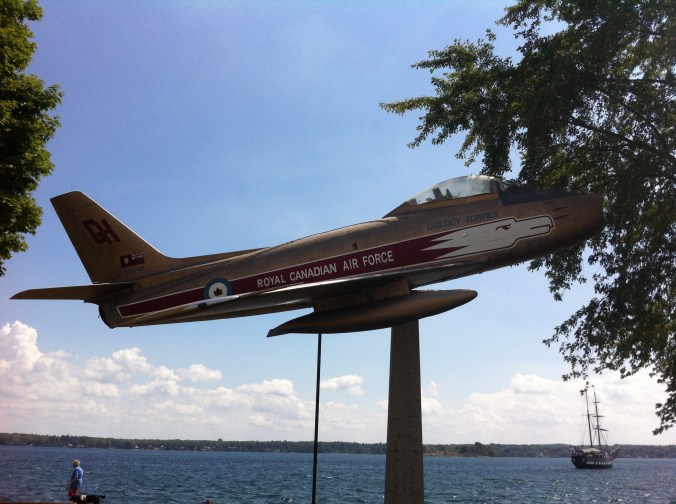
It seems that Highway 2 has been the major artery of my life connecting me with family and friends, so it’s not surprising that the morning after I got my motorcycle licence I hit the highway, so to speak, heading west along the 338 (formerly called Quebec Route 2), which turns into Highway 2 as it crosses the border. It’s a beautiful ride with the St. Lawrence River on one side and countryside on the other. It starts in Lancaster, then passes through Cornwall, Ingleside, Upper Canada Village (where the Black Creek Pioneer Village of elementary school field trips still exists), and quaint towns like Morrisburg, Prescott, and into downtown Brockville, which is actually very pretty and not at all like the commercial complex beside the 401. In fact, I used to associate Brockville with fast food joints and ubiquitous retail outlets until my motorcycle club had a ride that took us along Highway 2 into the old part of town. There you will find a marina and a park that has, among other attractions, a Canadair Sabre Golden Hawk of the Snowbirds squadron before it switched to the CT-114 Tutor.

tutor_highres

Sections of Highway 2 are based on trails that had been used by Indigenous peoples for hundreds of years before the colonization of Ontario, and that history is evident in places like Iroquois and Gananoque that is still passes through. In fact, a 1 km stretch at Gananoque is the only official stretch of Highway 2 remaining, according to Wikipedia. (In 1998, the highway was decommissioned and renamed, with that original section near Kingston, the King’s City, left as a token.) It connects the Thousand Islands Parkway (formerly the 2s) with the 401. If you take the Parkway (while the 2 swings north of the 401), you can pick up the 2 again at Gananoque and take it through Kingston, where it becomes Princess Street, then Napanee, Tyendinaga Mohawk Territory into Belleville and on to Trenton, Cobourg, and Port Hope. After that, the GTA behemoth  swallows it whole and spits it out again in Paris. If you hate studying early Canadian history from a textbook, just take a ride along Highway 2.

Why am I thinking of Highway 2 now? Well, as those of you who have been following my blog know, I rode Highway 2 recently in The States on my way back from Hampton Beach. Of course, it’s a different Highway 2 but was a familiar, reassuring signpost as the light faded on me in New Hampshire, still hundreds of miles from home. Yesterday I decided to make a trip to Burlington, Vermont, to buy a tank bag. Yes, we motorcyclists are willing to ride 360 kilometres for gear that’s not available in Canada. I still don’t have a GPS and didn’t want roaming charges on my phone so was looking for the easiest secondary highway that would get me there. I crossed the border at Rouses Point and picked up, you guessed it, Highway 2 which traverses Lake Champlain, slicing through North Hero, then South Hero, Sandbar State Park, taking me into North Burlington, then South Burlington and literally to the door of MotoVermont. The guys there were super nice and helpful, even helped me install the bag on my bike before I turned around and followed my favourite highway back home.

Crossing the Green Mountains with the sun setting over Lake Champlain to my left, I felt like a king.


Loon Mountain, NH

campThis is what I’ve been waiting for. When I took up riding, I knew I wasn’t interested in getting a sport bike and hanging it out in the twisties, or a Harley and hanging it out at the bar. I was looking for adventure—the chance to escape and explore, live in the moment, and go wherever my heart desired. The last time I had experienced that feeling was in my early 20s when I went to Europe with an International Hostel membership and a Eurorail pass. I remember looking at a map, choosing a spot, and wondering what it is like there. Then hopping on a train and finding out.
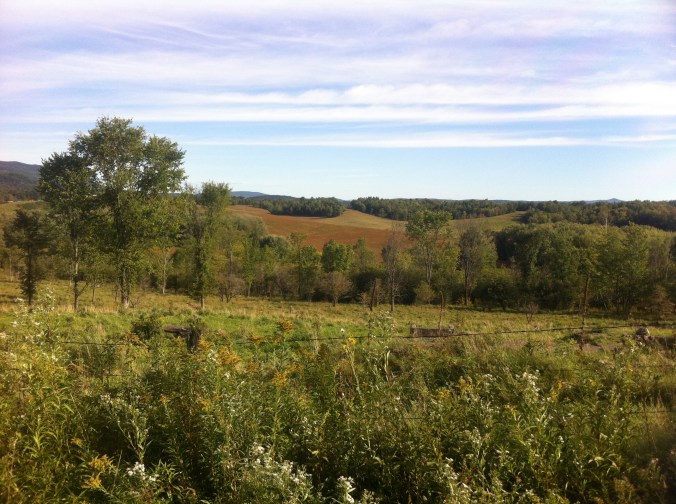
The destination for my first tour was Loon Mountain, New Hampshire, for the NH Highland Games. My old band competed there a few years ago and it was so beautiful in the fall my wife and I returned the following year for our anniversary. There is a road that cuts through the White Mountains, and I remember pulling over to let a biker pass, knowing I was holding him up. A thought flashed through my mind: wouldn’t it be nice.

Three years later and I was packed up and ready to go. I’d cut things a little close. My waterproof duffle bag arrived in the mail two days before leaving; I got the very last campsite at Lafayette Campground in Franconia Notch State Park. (I was suspicious: is it next to the crapper? Turns out it wasn’t and I was just lucky, I guess.)

I did a trial pack on the Wednesday when my bag arrived and found, much to my surprise, I had room to spare. One pannier for cooking gear, one for food. In the 70L duffle bag on top I put my sleeping bag, the tent I borrowed from my son, my Thermarest, and personal items, pillow-case style. Some Rok-straps ensured the whole thing stayed put, and my day bag went on the tank.

I’d recently heard an interview on Adventure Rider Radio with Bret Tkacs, in which he talks about manoeuvring the bike while not riding, including simply getting on and off the bike when it’s fully loaded, so I thought I’d try some of his suggestions. One was to use the foot-peg to get on the bike, instead of dragging a dirty boot across your seat. You can get on at either side but I was nervous about tipping the bike if I climbed on stand-side, so during my first day I got used to getting on the high side. It’s also a little unnerving as the bike leans away from the stand slightly as you climb on or off, but after the weekend, this was my preferred side.

After the usual delays, I was on my way. I wanted to stick to secondary highways as much as possible so took the Mercier Bridge, picked up the 132, and took the 104 all the way into the Eastern Townships, discovering towns along the way I promised I’d return to when I had to time to stop; Knowlton is picturesque. How have I lived in this province for 26 years and never discovered Knowlton? Some sections of the ride were so incredibly beautiful I was compelled to turn around and take a picture.

townships

I crossed the border at Highwater, my oranges confiscated for being honest. “No citrus fruits, sir.” (I was compensated later in Lincoln, NH, when a nice gentleman stocking the fruits section at Price Chopper introduced me to pluot, which he said he was careful not to say too quickly to Quebecers because it was rude. If someone can fill me in on this joke, please do.)

oldschool

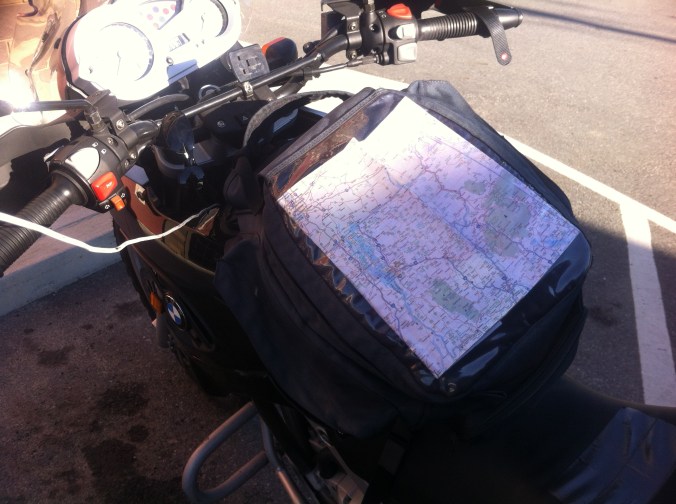
Once over the border, I had to navigate old-school style to avoid roaming charges. I picked up a couple of maps at a gas station, where I snapped this shot of a Victory from the future. It’s even more impressive from the back.

victory

The last time I was at Lafayette Campground, my wife and I were visited by a thieving black bear, so I was sure to ask if there had been any sitings. The attendant assured me that the normal cycle of young bears being trapped and escorted off the premises and older bears being shot had run its cycle and things were settling down for the hibernation season. My site turned out to be furtherest from the crapper as you can get, and I set up for two nights.

The next day were the Highland Games, and I know the Scots don’t like to do anything important before noon, so I had a chance to get most of my weekend work done at the site before going to the grounds. I was nervous about leaving my bike unattended at the parking, but used my Zena lock (which emits a 120 db scream if jostled) and padlocked my helmet to the pannier cage. Still, I’d have to carry my day bag around all day and wear my leather jacket—the price you pay, I guess, for not having a trunk. This was a learning experience for me.

massedbands

Massed bands, New Hampshire Highland Games; Loon Mountain, NH.

The games actually turned out to be a side-note to the ride. There aren’t any grade 1 or 2 bands at these games, and after you can hear the difference, grade 4 and 5 bands just don’t cut it. Still, I got my haggis and thumps, a sticker for my pannier, and inspiration to become a better drummer. By the time I got back to my bike I was itching for that ride across the mountains, so headed off east on the 112 at dusk—I know, not the best time to be riding (a theme I will return to). The ride was magnificent, and worth every minute of the wait over the preceding years, especially the hairpin turn that had a suggested speed of 20 mph. I rode as far as I dare until the light faded, turned around at a lookout, then did it all again to get back to my site, where I paid the price of making dinner in darkness.

The next day I had planned to make it to the coast, specifically Hampton Beach, where my wife and I had visited before. I packed up and loaded the bike, fired it up, went to do my turn but was caught off guard by the added weight and dropped the bike. Shit! Fortunately I was so late getting off that there was no one around to fuel my embarrassment but a staff member who was raking the sites. He looked up briefly but wasn’t inclined to come over and help me lift the bike. We had learned how to lift the bike in my course, positioning your back to the bike and lifting with your legs, but the wheels were higher than than the handlebars because of a slight grade in the site (no doubt what threw me) and I couldn’t lift it. Fortunately, I had seen a video about another method that uses the handlebars as leverage and was able to get the bike up using that technique. Thanks Clinton Smout for that tip! Thankfully, the pannier and crash guard took the brunt of the fall and the bike was unscathed. The lesson learned? Don’t pack your bike however it’s positioned and then attempt to make a sharp turn before your head’s in it. Position the bike and then pack it.

Hampton Beach was further than I remembered and it took me three hours on a toll interstate to get there, but I was thinking of the fresh fish and chips available there from roadside restaurants and the ride up the 1a, which has ocean on one side and Gatsbyesque mansions on the other. I arrived late for lunch but early for dinner, and was anxious about the miles I had to cover to get home.

hamptonbeach

Hampton Beach, NH

I stopped at Petey’s, where I was able to get a table overlooking my bike. This is another aspect of riding of which I’m unfamiliar. Do you leave your gear and helmet on the bike and hope no one steals it? It’s like leaving your dog outside a shop while you browse inside. How can you relax? peteysI found that people are generally respectful, even reverent, about the bike, and I was approached several times by folks who said “Bonjour” when they noticed the plate. I seemed to be living the life they never had, and one guy, who clearly had mobility issues, said he’d always wanted to ride. I said “It’s never too late” (thinking of my late start), to which he responded, quickly and sadly, “I think it is.”

Fully fed and with close to 500 km. ahead of me, I decided I had to put some road behind me. I wanted to head up the 1A that follows the coast but soon realized it wanders away from the coast and into small towns that would slow me down, so I picked up the 95N to Portland, where it turns into the 26 which turns into Highway 2 that would take me east right across Maine, New Hampshire, and into Vermont, where I planned to cross at Rouses Point. This ride took me right through the countryside of Robert Frost and John Irving, and I could see why they’d be inspired by the rolling hills and classic range fencing, small towns with businesses named after the owner’s first name, like Gary’s Auto Body and Bert’s Garage. By the time I caught the 2 it was dusk: a perfectly paved winding road with wisps of fog hanging on the surrounding countryside. There was no traffic, and I got into a rhythm through the curves, slowing only through small towns with restaurants strung with lighting. If a moose had walked out into the road and struck me dead in that instant I surely would not have gone to a prettier place!

But dusk soon turns to night, and the atmosphere quickly changed. Even if John Milton had not been blind, he could have written his ode to light that begins Book III of Paradise Lost. If you spend any time camping or exposed to the elements you learn quickly just how precious light is. Once it’s gone, you are vulnerable. It faded on me somewhere in north New Hampshire as I was crossing the White Mountains. The rest would have to be done in the dark.

I abandoned my plan of taking the 2 all the way to Rouses Point and picked up the 93 which led to the 91. It would be interstate freeway all the way from here. I figured at least the major highways are better lit than the secondary ones. My biggest concern was wildlife. I’d seen signs all through New Hampshire warning of moose crossing, and even a dignitary at the Games had joked that, despite all the warnings, he hadn’t seen a single damn moose! I thankfully did finally see one in Portland, NH.

moose

Soon after I picked up the 93, I hit road kill. I had entered a construction zone. The speed dropped from 65 mph to 55, then suddenly to 45. I glanced down at my speedometer and when I looked up it was maybe 6 feet in front of me, too late to do anything about it. It was a racoon, I think, and I clipped it as I passed. My front tire made a  sound, I’m not sure if it was the squelch of rubber or something else, and I’m still not sure what happened. I felt the handlebars move and I was passed, my heart racing.

I don’t know if hitting road kill is fairly common for motorcyclists, but it was a first for me and it scared the shit out of me. You generally don’t want to hit anything on the road at highway speed, but I just didn’t see it. The lesson on this one? I shouldn’t have been out there at night, not on the secondary highways, not on the interstate. I should have Googlemapped my planned ride before and seen it was too ambitious. I came up from the border on the 10 and there were no motorcyclists on the highway and for good reason! I gambled with my life and was lucky! I pulled into my driveway at midnight.

So now I sit, a day later, with four beers in my belly and reflect on what was and what could have been. I learnt a lot on that first solo ride and know what I would do differently. It certainly was an adventure, but they don’t call it adventure riding for nothing!

What are you afraid of?

Let’s talk about fear. I believe there is good fear and bad fear. Good fear keeps you safe; bad fear can kill you.

On the second day of my training course, we were shown how to change gears. Two cones were placed at either end of the parking lot, about 100 metres between them, and we were to ride down the straight, change into second, then brake, change back into first, then do the U-turn and head back the other way. Sounds basic, I know, but when you’re learning . . .  Anyway, the tough bit wasn’t changing gears. As you might guess, it was that U-turn, especially with a chain-link fence bordering the turn. The instructor said “Don’t look at the fence.” This would cause target fixation and make you steer into it. But of course, soon after we starting looping, one of the students got going too fast in second, panicked, froze, tried to do the turn, looked at the fence, and drove into it. This is an example of bad fear. 

The bike had cosmetic damage and the student went off to the hospital to have his shoulder checked. Turns out there was only minor damage there too but he had to pull out of our group and join another to complete the course. I asked after him later and the instructor said he was doing fine but “still thinking about it,” meaning he’d lost his confidence. Bad fear can hang around a long time and mess with your riding. 

For this reason, I’ve never watched those motorcycle crash compilations on YouTube. I don’t want to get spooked, and when you are a new rider you have fledgling confidence that needs to be protected and nurtured. Once when I was going through a roundabout, I felt the back end slide. Fortunately, I wasn’t going very fast. I immediately straightened up the bike and slowed to the side of the circle. I was thinking about that slide when I leaned the bike over later in the ride on an off ramp. It took me a day or two to regain my confidence in leaning the bike again. Before I did my road test, I did a private lesson to prepare. That instructor said I was a “natural rider.” When I asked what that means he said I lean with the bike. Many new riders get “crossed-up,” meaning they lean opposite to the angle of the bike because they are scared. 

But these incidents are minor. Low-side slides are the “easy” kind of accident to have. The bike slides out from under you and you and the bike slide it out. If you’ve got good gear on and don’t slide into traffic or an object, you can probably walk away from that accident with only a bruised ego. The real danger in riding are high-side accidents when you get launched over the bike, and the very real threat of landing in oncoming traffic or the back of a vehicle. Good fear helps avoid this by telling you when you’re pushing your limits. Jim Hyde of Rawhyde Adventure ures Off-Road Training says you should never ride at more than 80% of your limits. Leave a little buffer for the unexpected, he advises. Good fear will tell you when you’re approaching your limits. 

That said, I believe it’s important to get outside your comfort zone from time to time. I’ve put over 4000 kilometres on my bike this summer riding with the club, but I was still spooked by the prospect of riding at night and in the rain.  My first solo ride—the morning after I got my licence—began in torrential rain and ended with several hours of night-riding at highway speed. When I pulled into the driveway, I was a different rider. That doesn’t mean I will henceforth be mindless of the risk of hydroplaning or reduced vision at night, but a little more confident in those situations. And confidence is a good thing. It keeps bad fear at bay. 

Let’s admit it: some of the fun of riding comes from fear, that stomach-in-the-mouth feeling reminiscent of the fun-ride at the fair, but where the risk is real and not merely perceived. The goal is to ride that line of excitement but stay safe, or as safe as possible. Paramount is to have confidence in your bike. I knew my front tire was getting old so recently changed it. In the back of my mind was the thought of a blowout at highway speed or hydroplaning in rain. You also need to have confidence in your skills. This comes not just with road experience but targeted practice. When we were learning emergency braking, I got over-confident and grabbed rather than squeezed the front brake. Before I could say “Bob’s your uncle” the bike was under me with gas leaking onto the asphalt. (Fortunately it was the school’s bike which, by the looks of it, had been dropped more than a few times.) But I was still thinking of that incident when I did my closed circuit test and overshot the mark on the emergency brake test. I have since done some practice braking on my bike but need a partner to practice at higher speeds. That is on my list before the end of this season. Targeted practice develops muscle memory and muscle memory  supplants bad fear when there’s a real emergency. 

But all of this is rather grim to think about on such a beautiful sunny Saturday. I think I’ll hop on my bike and go for a little ride. If we thought too much about fear, we’d never swing a leg over the saddle. A little thought, however, can help keep us safe. 

Feel free to comment. The question in the title is genuine. 

Half the Fun

Me under Car

I’m a teacher and so, as everyone likes to remind me, I get my summers off. I often respond by saying that it’s a good thing I do or I’d burn out. By the time the term winds to a close, I don’t want to be anywhere near a desk. I’ll shovel scrap metal before I do anything bookish, at least for a good chunk of the summer. Usually this urge to do something physical takes the form of athletic training or home reno, but this summer I dove into a large mechanical job on the car. I also did some work on the bike. Here are five take-aways I learned from this work.

  1. Be Methodical: When I do a job, I get nervous. Almost every job I do is a first for me, so I’m heading into uncharted territory. I’m worried I will make a huge mistake along the way that will ruin my precious bike or cost me more money to fix than it would have cost to get a professional to do the job. (This is supposed to be cost-saving, right?) Or I’ll encounter an insurmountable snag that will stop me halfway through a job. I’ll have to call in the professionals, and in the case of auto and bike mechanics, that will involve a towing charge as well as the cost of the job. So I often rush. It’s stupid, I know, as a reaction to the situation, and I’ve become increasingly aware of my emotional state as I work and have been trying to slow myself down. This job was so big I knew I had to go slow. Fortunately I saw this video by Ari Henning from MC Garage before starting. In it, he gives three tips for being a better motorcycle mechanic. Take photos. Use zip-lock bags to label and store parts, and use a manual. I’ll add to that to lay parts out in the order they came off. (My front porch smelled like a garage for a good portion of the summer.) This forced me to go slow and methodically. It’s easy to undo bolts and rip the engine apart; the tough part is putting it all back together again. So I used my phone and took a picture of every item before it came out. I used sandwich bags and a sharpie to store and label bolts. I also used masking tape to label cables that were detached. I kept a list of items in the order that they were removed. And I bought and used the Haynes manual, which shows step-by-step how to do the job.
  2. When Things Go Wrong, Don’t Panic: Mechanical work is all about problem-solving. Nothing ever goes as planned or as described in the manual, especially if you’re working on an older machine. Sometimes it’s just a matter of figuring out how you are going to get a wrench in there, but sometimes, as in my case, it’s breaking an important bolt in the most inaccessible part of the engine. When this happens, probably the best thing to do is to take a break. Step back and give a little think on your options. Maybe go online and see what others have done. But if you let your emotions get the better of you, problems can compound quickly.
  3. Mechanical Work is a Workout: People keep telling me these days I look fit. My wife says I’ve bulked up. Okay, I’m never going to be bulky, but I do feel in pretty good shape. There were days when at the end I was physically exhausted. Mechanical work requires strength—not the weight-lifting kind but core and endurance strength, especially if you are working on your back on the driveway using hand tools. You constantly have your arms raised, you have to do a stomach crunch to reach something, just getting in and out from under the car every time you need a tool is tough. Same goes for working on a bike, whether you are wrestling a tire off the rim, or compressing the fork-spring to remove a retaining ring. And since mechanical work is physical, make sure you keep your body happy. Be sure to eat and drink regularly, just like an athlete or you’ll find yourself grumpy, working slowly, making mistakes, and wondering why.
  4. Have a Back-Up Vehicle: 3/4 of the job involves getting tools and parts when needed. I bought everything I thought would be needed before I started, but inevitably s**t happens and you need something. My parts supplier sold me 2 litres of gear oil and I discovered I needed 2.7. I broke a bolt, so had to go buy a tap plus a new bolt. I needed a socket extension, crow-feet socket set, more Liquid Wrench penetrating oil, hardware, etc.. And while I’m on this subject, never trust the parts salespeople; they can give you a bum-steer. Be sure you know your liquids and volumes (from the manual) and, when possible, take the original part that you are replacing. Often these guys (and they are almost always guys) are looking at an exploding diagram of your engine, trying to locate the exact thing you need, or worse, using a text-based database. And it perhaps goes without saying to keep all receipts in case a mistake is made.
  5. Get Dirty: I spent some time at the beginning of the summer reading Mark Zimmerman’s The Essential Guide to Motorcycle Maintenance. It’s a good book (review to come), but to learn you have to get in there and get dirty. Start small and simple, like an oil change, or coolant change. Then challenge yourself and try a bigger job. I did the brakes (actually not that hard) and that gave me the confidence to try replacing the clutch. The other day I changed the oil in my front forks—again, not hard. Most of the time these jobs aren’t that difficult but you just need to have the confidence to try, which comes from doing simple things first. I learned a lot from working on my bicycle when I was young. I used to buy bikes at police auctions, strip them down, then paint, clean, and re-lube everything, right down to the ball bearings. The more I work on my motorcycle, the more I see just how similar to a bike it is from an engineering standpoint, although it was the practical work on the bicycle that first gave me familiarity with tools, problem-solving, and observation of how mechanical things work. Later this fall I’m going to attempt to adjust the valve clearances. I’ve got 40,000 K on the bike now so it’s time. I’ve never done this before, but I’ll figure it out, using my manual and taking my time.

Last fall I did the first service on my bike by changing the oil and coolant to prepare it for winter storage. I phoned my dad to talk about how it went. He told me about when he stripped down the engine on his bike and had it rebored. Pirsig says you should work on your own bike because a lot of mechanics are hacks, which is probably true. No one’s going to care as much about your bike as you, and doing it yourself ensures it’s done right. Pirsig also seems to suggest a moral reason for doing your own maintenance. If the bike is you, it’s your responsibility to take care of yourself and your bike. But my dad had another reason for doing this dirty work. Just before he hung up he said, “I’m glad you’re doing your own maintenance. That’s half the fun of having a bike.”

Best accessory for under $100

I spend a lot of time browsing online motorcycle stores. A lot of time. Probably too much time, certainly given my budget. I convince myself that it’s research for when I have disposable income. So I’m pretty up on the accessories available that manufacturers promise will significantly enhance my riding experience. Recently I came across one that really did live up to its promise, although no promise was actually given because it’s something that cannot be found in a motorcycle store, real or online. It is under $100, has revolutionized my riding experience, and is protecting my health more than any other piece of gear or item in my day bag. Curious? It’s a custom ear plug.

Most bikers are well aware of the potential risk of permanently damaging your hearing through prolonged exposure to noise from the engine and the wind. Of the two, the wind is worse. Even the most expensive helmets, like mine, that are the product of extensive R & D time in the wind tunnel can do little to shut out Aeolus’s angry growl. Most bikers invest in cheap pharmacy bought foam plugs, the kind that are yellow or orange, that you twiddle between your index finger and thumb to compress into a narrow cone that expands once inside your ear. They aren’t bad, but they don’t compare to a custom plug. I know because I’ve tried both.

I’m also a drummer so I’m pretty familiar with ear plugs from that passion, and I’ve tried a variety. The waxy swimmer’s plug works well to cut out sound but is tricky to get in right, and if you’re riding in a group and the lead rider says “Let’s go!” you’ve got about 30 seconds to get earplugs, helmet, sunglasses, gloves, jacket (if it’s a hot day and you’ve taken it off) all back in or on, the bike started and in gear, and ready to pull out. You don’t want to be the doofus holding everyone up. So you want a earplug you can pop back in, no fuss, and know it’s going to work once you pull out and get up to highway speed.

I have a musician’s earplug, the kind with the filter running through the middle. It cost me about $250 bucks, but it doesn’t do squat to cut out wind. Wind must be the same frequency as human speech because the filter just lets it blast right through. I decided to invest in a full plug, and went to my audiologist to get it done. The appointment only took about half an hour. He made a mould of my ear canal and sent it off to the lab. Ten days later my plug was ready, in a colour that matches my jacket. (Bikers are extremely fashion conscious.) Because I’m completely deaf in one ear (the result of a mountain-climbing accident in my teens), I’m using the singular. The plug cost about $70, so double that if you’re not a freak like me. Companies like http://www.bigearinc.com/ probably offer custom plugs for less.

My first long ride with it last Saturday was down to Smuggler’s Notch in Vermont, a 550 km round trip, and it was heaven. Imagine driving 550 clicks in your car with your radio between stations and blasting loud static in your ears all day. That’s what it’s like without earplugs. Now imagine reaching out and pressing the button that turns off the radio leaving you in a cocoon of blissful silence. That’s like popping in custom ear plugs.

Suddenly your other senses, that have been deadened in a self-preservation sensory clench, come alive, especially the tactile sense. The sound of the engine is now just a slight buzz, so I have to feel the frequency of the engine more than hear it, and my butt tells me when to shift. Sight and smell are also heightened without the distraction of an all-encompassing noise. The absence of pain really is pleasure.

But beyond this immediate reward is the knowledge that my one good ear is safe. When it comes to safety, as you already know from a previous post, I throw machismo to the wind. Earplugs also reduce fatigue, which can lead to even more serious consequences. Custom ear plugs are comfortable, washable, reusable, and the most effective hearing protection available. If you ride, do yourself a favour and get yourself a pair.