Riding the NEBDR with some Awesome Players

It wasn’t the tour I planned for the summer, but it was eventful.

photo credit: Riley Harlton

The initial plan for my big tour of 2024 was to ride The Blueridge Parkway down to West Virginia and then come back on the MABDR and NEBDR. It would have taken me probably close to a month. But then those plans got kiboshed by unforeseen circumstances and for a while there it seemed I wouldn’t get away at all. In the end, I managed to spend four days in August touring Vermont with Riley and Marc from The Awesome Players Off-Road MC doing Sections 4 & 5 of the NEBDR.

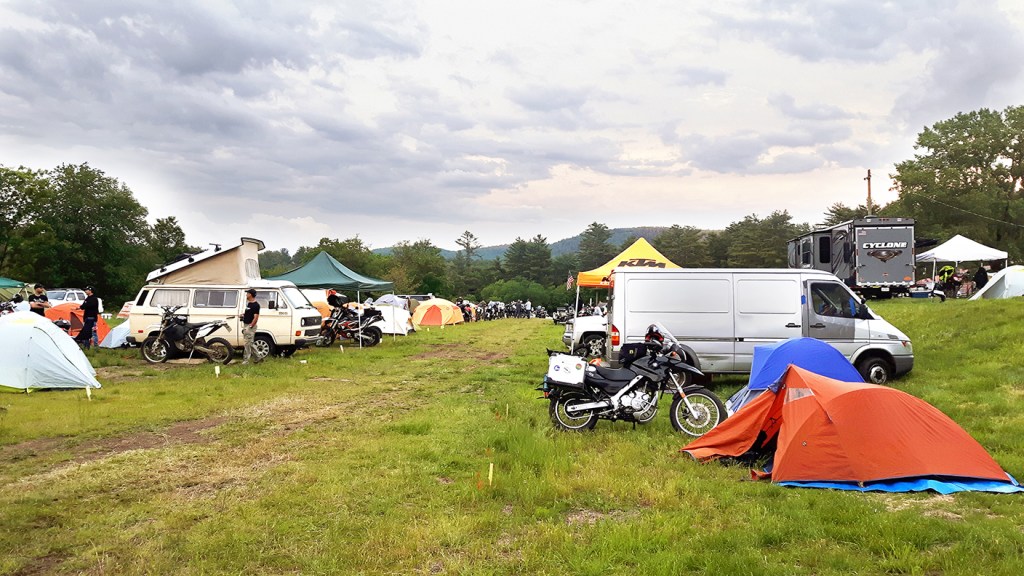
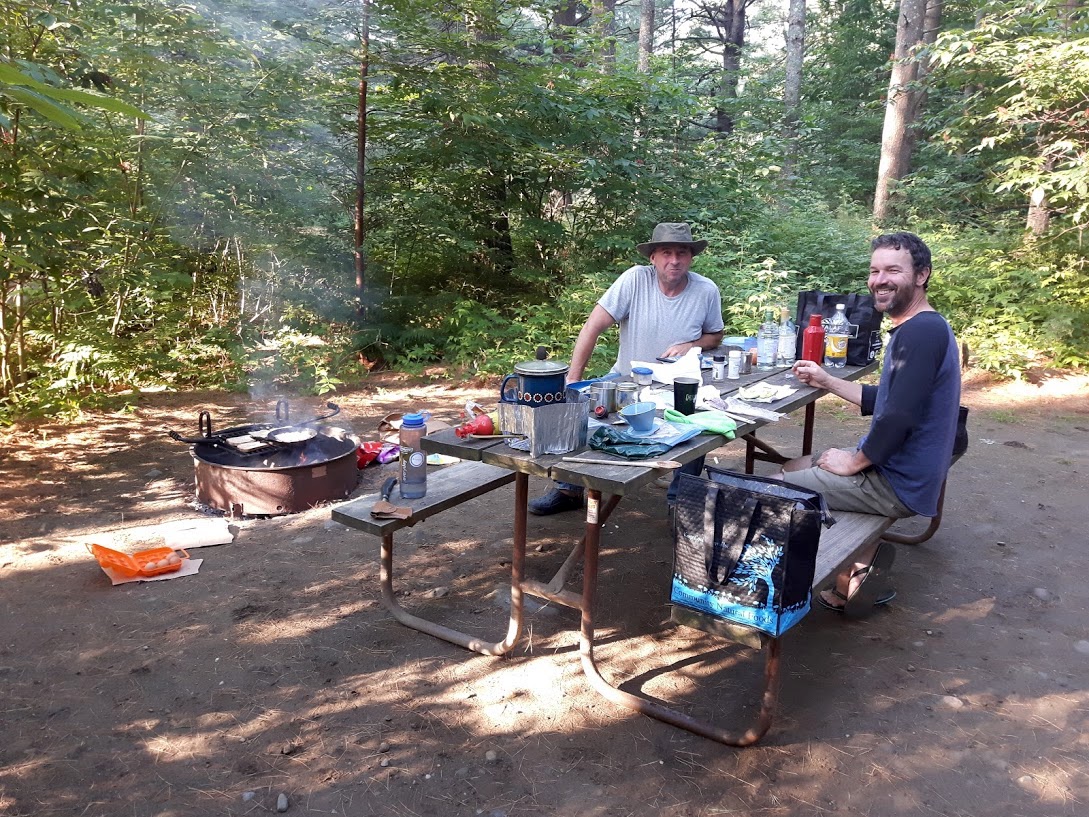
We decided to do a spoke-and-hub type trip, using Silver Lake State Park in Barnard, VT, as our home base. This meant not only that we didn’t have to move camp each day but also that we could ride for a few days without luggage. I’ve stayed at that campground several times and it never disappoints. The general store in Barnard has gas and makes a great breakfast sandwich.

We decided to ride Bailey-Hazen down. B-H is an old military road dating back to the war of independence (1776). It’s primarily dirt and gravel and runs from Montgomery Centre down through Lowell, Albany, Craftsbury, Greensboro, Walden, Peacham, and into East Ryegate. I’ve ridden it a few times but never the hero section. In fact, the last time I rode B-H, I attempted the hero section and had to turn around. It’s basically an ATV trail filled with babyheads, and I was alone and on street tires. It’s definitely a challenge.

So I was thinking of that section as we rode down toward the border and thinking of it some more as we approached Montgomery Centre. (The hero section is early in the track.) This time I had Michelin Anakee Wild tires on and there were three of us, but I was fully loaded with all the camping gear. Riley and Marc have a lot more off-road experience than me and the last time I rode with them it didn’t go well. You never want to be the guy holding everybody up.

We headed up the nasty little hill climb and I got loose a few times but kept it upright. Riley said later that he was thinking I must be happy not to be on the Beemer and I was. The Tiger is definitely more capable with the 21″ front wheel. There was a crew working on the trail and soon we hit some deep gravel they were spreading and that was interesting. But somehow I made it to the top without dropping the bike and felt pretty good about that. Unfortunately, things were about to take a turn for the worse.

For those unfamiliar with Awesome Players lingo, a douche rope is a fabricated rope with a steel karabiner on one end and loops along its length for handles. It’s used to pull out the douche who is stuck in mud or, in my case, whose bike is down a ravine. I don’t know why I was going so fast, except I guess because adrenaline was pumping through me and maybe I was over-confident, having just done the tough part. I think I also relaxed my concentration. You can see my front tire slip out on the muddy downhill corner which threw my balance, and then I was struggling to keep the bike on the trail. Riley thinks I hit a false neutral because you can hear the bike rev a few times but I think I just panicked. Fortunately, what I lack in riding skills I make up for in tree avoidance technique. When I saw it coming up fast, the bike went one way and I the other.

I’m breathing hard into my helmet because I was in some pain and thought at first I might have pulled an Itchy Boots and broken my collar bone. But in the end, it was just a separated shoulder and, a month later, I’m almost fully recovered. The tendons have healed and I’m just working on strengthening and stretching the scar tissue. It could have been much worse. If the bike had hit the tree, I imagine there would have been structural damage and it would have been a write off. In the end, it just made for a few uncomfortable days around camp and especially trying to sleep in my tiny tent.

I was pretty mad at myself, as you can hear. It was an auspicious start to the tour and I was living up to my reputation. But here’s the thing I’ve come to realize after reflecting on the crash over the past month: crashing is not only an inevitable part of off-roading but part of learning. In fact, Brett Tkacs lists dropping your bike as an indicator that you’re improving your riding skills, which at first seems counter-intuitive, but when you think about it, if you aren’t dropping your bike once in a while, you aren’t pushing beyond your limits where both sh*t and learning happens. I’m pretty familiar with riding on dirt and gravel roads but haven’t done much trail riding. By contrast, Riley and Marc have been doing trails for years, so I knew that riding with them would be a learning experience.

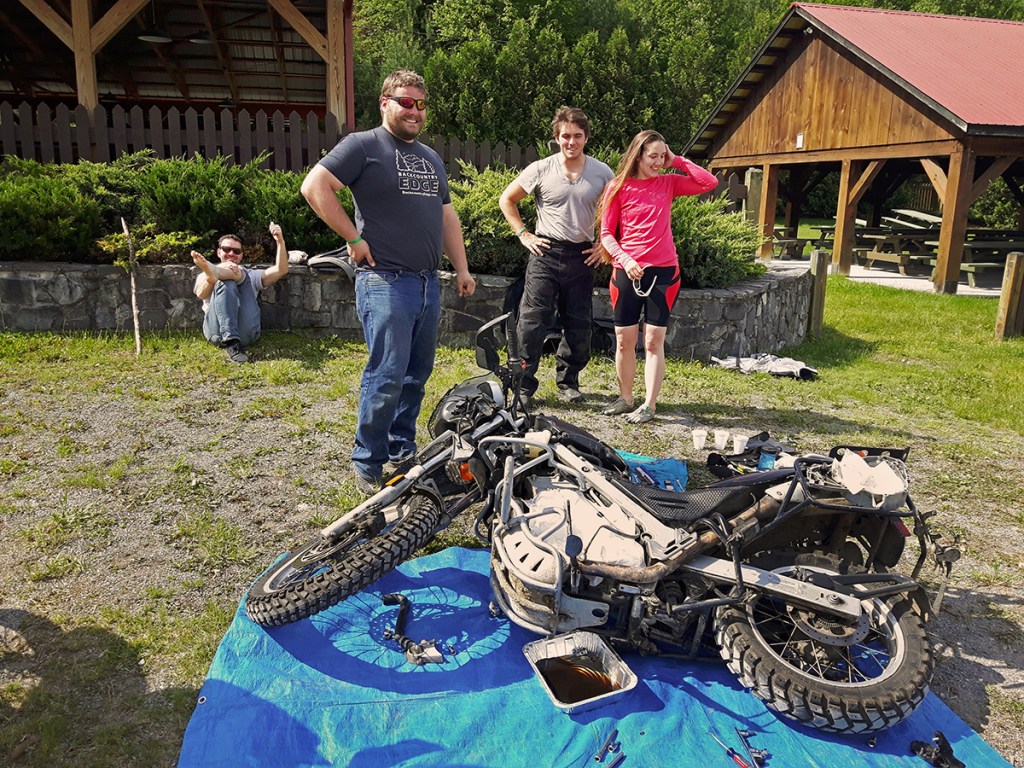
Their experience was essential to getting my bike back on the trail. They had the gear and know-how. Here’s Marc explaining the procedure.

video credit: Riley Harlton

Once the bike was taken care of, we had lunch and I took a bunch of meds for the pain. I wasn’t sure how it would go on the bike but it was surprisingly okay; the shoulder is relatively immobile while riding, and it was actually off the bike around camp that I felt the injury most.

When we headed off again, I decided to let Marc go first and went slower on the downhill.

That’s my windscreen rattling; I lost some hardware in the crash that I replaced at the next rest stop. Later, Riley lead and I followed his line.

Bailey-Hazen actually isn’t a technical road, aside from a few bits. This clip is more indicative of what most of it is like—hard-packed dirt lined by trees and periodically opening up to nice views of the surrounding hills. It’s a fun ride and appropriate for big bikes.

The next day we headed south on Section 4 of the NEBDR but not before the amazing breakfast sandwiches of the Barnard General Store. There we met Bethel, who was visiting from California and had rented a Ténéré 700 from MotoVermont. She was enamoured by the general stores and bucolic countryside of Vermont, and who wouldn’t be, especially if you live in Superslab City. (I might have this wrong, but I think she said she lives in Los Angeles.) We shared stories over breakfast of falling in mud puddles and down ravines. It’s always nice to meet fellow bikers; there’s definitely a bond between like-minded people enjoying the freedom and thrill of motorcycling. Unfortunately, she was heading north to return the bike in Burlington and we were heading south.

If you know anything about the NEBDR, you know that it’s one of the harder BDRs and that Sections 4 and 5 are the toughest sections, so we were expecting some challenging terrain. I was trying to figure out where the by-passes were because I’d already decided I would take them with my gimpy shoulder; I just couldn’t risk another fall. But to our surprise, the section was relatively tame, more of the same winding dirt and gravel roads. When we finally stopped for coffee and a pastry at Sweet Birch Coffee Roasters and Bakery in Wallingford and Marc got out his map—yes, his paper Butler NEBDR map—we realized we had done all the bypasses. It seems that the most recent gpx tracks (March 2024) had the bypasses as the default and you had to load the harder sections separately if you wanted them. When I downloaded the tracks, there was much description of flood damage, so I suspect the organizers decided to steer riders away from those Class 4 roads for now. It worked out for me, but I think Marc was disappointed.

Despite that, Section 4 has some very nice riding. One of my favourite roads was the Forest Service Rd. 30.

Lower Podunk Road is also sweet, as is Hale Hollow.

Sorry about the bad angle of the action cam. If it’s not the wind deflector that obstructs the view, as was the case with my Newfoundland footage, it’s the bad angle unbeknownst to me. I’ll eventually get it right.

We ended up in Readsboro before high-tailing it back up to Barnard on asphalt, stopping en route for groceries and beer.

The next day we headed north on Section 5 and decided to split up so Riley and Marc could get their Class 4 fix. Unfortunately, while doing the harder section north of Stockbridge that follows the White River, Marc suffered the same fate as me. He said it was an easy section but he got target fixated on a rut and was thrown violently off the bike, separating his shoulder too! Now there were two of us gimpy. Even before his accident, he had decided that he was going to head home a day early because camping was not agreeing with him. That’s a polite way of saying he’s a wimp. No, seriously, some people are campers and some are not, and to his credit, he at least gave it a try. He said he enjoyed the campfire and time around camp, but I think he wasn’t sleeping well.

Even experienced riders periodically take a tumble. We’ll blame this one on sleep deprivation. photo credit: Riley Harlton

So after riding the exhilarating Lincoln Gap Road, we said our good-byes and Marc headed north on the 100 back to the border. It was already mid-afternoon and rain was in the forecast, so Riley and I decided to call it a day too. We picked up steaks and potatoes and, being the final night, some port. As we rode back to Barnard the rain started and never really stopped the entire evening, but we strung a tarp over the picnic table so all was well.
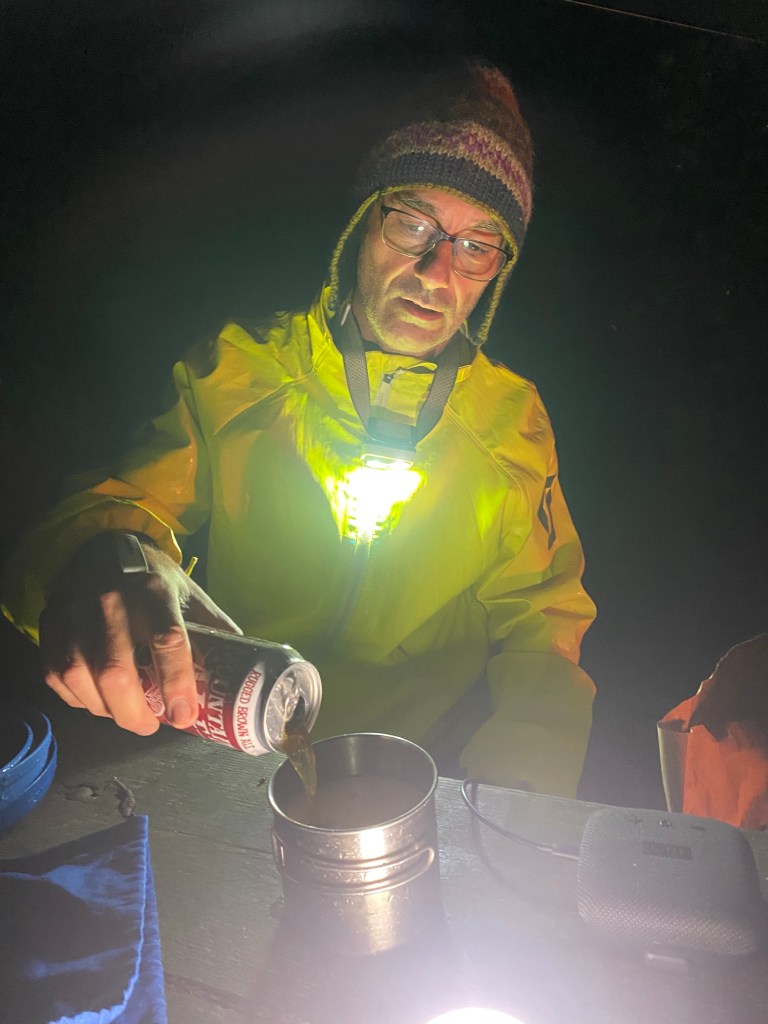
A tarp, woollen hat, Rugged Brown Ale, and bluetooth speaker. What more do you need? photo credit: Riley Harlton

For the ride home, we figured we’d ride the Puppy Dog Route, which passes through Barnard and goes right up to the border. I’ve ridden it a few times and it’s an easy dirt route, but I’d only ever done it when dry. After the heavy rain of the night before, it was greeasy! We were crawling along in 1st gear when I stopped and asked, “Do we really want to do this?” Riley agreed that it would take us forever, so after a few miles of that we hit asphalt and stayed on it, but the drama was not over yet.

As we rode toward the border, the rain got heavier and heavier. When we crossed the border, it became torrential, and as we came over the Mercier Bridge it was apparent that there was major flooding, including on the main highway. Traffic had come to a standstill, so we had to find another way home and that included some deep water.

154 mm of rain fell on Montreal on Aug. 9, shattering all records.

When I got in, Marilyn was none too pleased. She’d texted early in the day that we should just come straight home, but I didn’t know why since the rain wasn’t that bad in Vermont. Little did we know that Montreal was in the midst of more extreme weather and that many people were either stranded or had basement flooding. Apparently 80% of the basements in Dorval, the city next to where I live, were flooded.

A pretty hard crash, two, in fact, some challenging riding, extreme weather—this ride had it all and was the true adventure I needed before heading back to the doldrums of work. It also gave me a taste of the NEBDR and how difficult, maybe foolish, my original plan would have been to ride the entire thing alone, fully loaded, including the Class 4 roads “as a challenge.” The riding on the NEBDR is enjoyable and as challenging as you want it to be. We’ll see how I feel next summer but at the moment I’m feeling like I can skip the Class 4s if I’m alone.

The best part of this ride actually wasn’t part of the route at all but reconnecting with The Awesome Players. When I tried riding with them before, I just couldn’t keep up on the big GS when they were on smaller bikes. Now that I have the Tiger, I’m willing to try again. It’s the kind of riding I’ve wanted to do for some time but most of the riders I know don’t do dirt. I know I’ll be a little out of my comfort zone but in a good way, and there isn’t a better bunch of supportive, fun guys to ride with than them. You only have to watch a few of their videos to see what I mean.

But that will be probably next season, to be honest. Next week is the Ride for Dad to raise funds for prostate cancer research. It’s a great cause, and you can contribute to my team’s campaign here. Anything helps and is greatly appreciated.

After that, Marilyn and I are riding the Saguenay Fjord, which neither of us has seen, and I’ll be changing tires and windscreen for that tour so I don’t know if I’ll be back on the dirt until spring. Look for an upcoming post on Saguenay/Lac Saint-Jean, and a few more rides through the glorious fall season here in Canada when the leaves turn colour. Who knows: maybe I’ll even make it down to Vermont again before the snow flies.
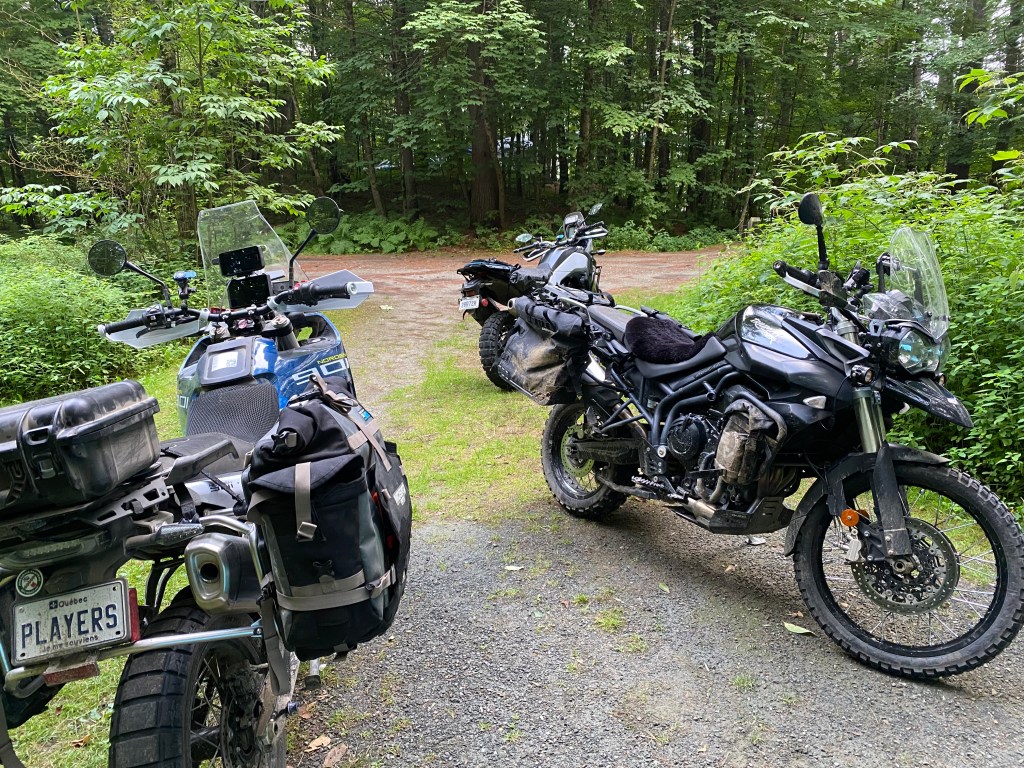
At Silver Lake State Park. Norden 901 Expedition, Tiger 800XC, and Yamaha T7.

The Homestretch

Marilyn and I got a kick out these signs. The NL potholes don’t compare to Montreal’s.

After a night crossing on the ferry from Newfoundland, I decide to ride The Cabot Trail, then stop at friends in Nova Scotia and Maine before the final push home.

The night crossing was terrible! I think it ranks up there as one of the most miserable nights of my life, such as once on a day trip in Germany when I missed the last train back to Munich with no cash in my pocket and too young to have a credit card so had to sleep on the street, or when I once slept in a trailer with a door that didn’t properly close, in June, in Canada, and got eaten alive all night by mosquitoes. The snoring was like a thousand mosquitoes entering my sleep to feast all night, or an over-sized dentist’s drill boring through my ear-plugs. I tried slumping in my chair, both sides, slouching, curling into a fetal position across two chairs (and an armrest), lying on the floor, trying a different floor . . . nothing worked. Eventually I gave up and went for breakfast in the dining hall.

This was the only enjoyable part of the entire crossing, during which I struck up a conversation with a young man at an adjacent table. He was from Cape Breton and had recently started working on an offshore oil rig. It was interesting to hear about that experience and life in Cape Breton. The story I kept hearing during my travels from him and other locals is that the Maritime winters are not what they used to be. Very little snow and many have sold their snowmobiles. Fishermen report of increased fog. Great White sharks have been spotted in the waters off Ingonish, etc. etc. Yeah, we know, you must be thinking—the planet is getting warmer. Duh! I only mention it because Marilyn has always said she wouldn’t retire to the Maritimes because she couldn’t take a Maritime winter. Thanks to global warming, the east might be back in the cards! (However, as I write this, it’s just received a record snowfall).

When I said I was headed to Baddeck on a bike, he suggested I take the 223, the Grand Narrows Highway that goes up through Iona. Nice tip! Here’s a taste.

It’s like that the whole way—twisty right along the shore of Bras D’Or Lake where it juts up into the Narrows. The pavement is a little broken but not bad. Keep in mind that I’m operating on one hour of sleep and that brush on the right that comes up close to the road is always a red flag for me, so I’m holding back. I would have my fun later in the day on the Cabot Trail.

After arriving at Baddeck Cabot Trail Campground, one of my favourite campgrounds and my second stay there this trip, I set up camp before hitting The Cabot Trail. Yes, the definite article deserves to be capitalized because The Cabot Trail is an iconic ride. I’ve done it before on my 650GS but wanted to do it again on the Tiger. So after a quick nap, I headed off.

I told myself, given my sleep debt, I’d just cruise it, but it wasn’t long before I was lured up into the adrenaline zone—until the bike twitched on a tar snake mid-corner. Never a pleasant feeling and I decided to cool it down.

The real fun was riding out to Meat Cove. The road is twisty and undulating and broken in spots, and then it turns to dirt. It started to rain, which made it more interesting. The dirt section had recently been graded so there weren’t any potholes or washboard to worry about.

This is exactly the kind of riding the Tiger is made for—twisty asphalt and light off-roading. I was having fun, once I got the damn ABS off. (I wish it were easier on the Tiger than having to navigate down through menus.) Unfortunately, I didn’t get footage of the best riding into the campground because the camera turned off for some unknown reason, but trust me, I was power-sliding the rear wheel out over the cliff-edge on those left-handers. 😉 Maybe it’s best that the wife doesn’t see that footage anyway.

I was pretty annoyed when I discovered the camera had stopped. To be honest, I’m not happy with much of the footage from the tour, so I’m definitely going to change how I work with the camera. Maybe I’ll use the phone app so I can see when and what I’m filming (or when I’m not filming), and maybe I’ll use the loop setting in which the camera constantly records over the same bit of memory card until I stop recording. The only issue with loop mode is it drains the battery fast. Voice commands don’t work with wind noise at speed, and I don’t want to be fumbling either with the camera or the phone, but I’ll experiment in the spring and come up with a better process. If you use an action camera, I’d be interested in hearing about your experience and set-up.

Anyway, back at Meat Cove, I arrived amid a torrential downpour, much to the amusement of hikers who were laughing at me while waiting it out in their SUVs. I didn’t care. A hormone concoction of endorphins, dopamine, adrenaline, and testosterone were coursing through my veins. It was time for a fresh lobster roll at the Clam Chowder Hut and the bragging rights photo.

Some bikes can’t make it in to Meat Cove but the Tiger sure can.

There’s a lot more of The Cabot Trail I could show but this is already going to be a long post, and there’s no shortage of footage available online. It’s always a great ride, and I’m glad I made the effort to do it again while I was near. I ended up doing the complete loop and was back at camp in time to enjoy a campfire and some of the bourbon I’d picked up earlier in the day.

My destination the following day was Urbania, Nova Scotia, just south of Truro, where some friends of mine live. I met Sharon in 1986 when I was an undergrad, so our friendship is long! I’ve admired her dedication to her writing career and teaching work and watched her fall in love and marry the man of her dreams, move out of the GTA (Greater Toronto Area) and into their dream home built largely by her equally talented husband, Kevin. If any of my older readers remember the Canadian 80’s band New Regime, well Kevin was the lead singer, among other accomplishments. This would be my first visit to their new place and I was looking forward to it. They have several acres of property that back out onto the Shubenacadie River.

The current was especially powerful after the rains the previous night.

The riding in Nova Scotia is excellent and probably worthy of a separate post, but I’ll just say here that Old Highway 4 from New Glasgow down to Bible Hill is about as good as it gets for a secondary highway through non-mountainous boreal forest. It was the original primary east-west highway until the Trans Canada was put in, and you can take it all the way to or from Sydney, Cape Breton. I followed it for much of the day and only jumped onto the Trans Can toward the end as I was racing against a system of precipitation that was moving into the area.

As I rode up the driveway to Sharon and Kevin’s, it started to rain. And it rained! There was a massive thunderstorm during the night and, in fact, major flooding in Halifax. We actually received an evacuation notice during the night because we were near a dam that was at risk of breaching. (Whatever . . .) My timing was lucky: I was happy to shelter in place under a solid roof with good friends. The extreme weather also got me thinking that you can’t escape climate change. Forest fires out west, ice storms in Montreal, flooding in the Maritimes—wherever Marilyn and I end up for our retirement, we’ll have to deal with some form of extreme weather.

The next day Sharon and I walked her property down to the river. One of the gems of their property is a tree they call Grandfather Ash. Unfortunately, since I visited, this magnificent tree was severely damaged in Hurricane Lee last September.

Despite the extreme weather, the visit was restful and restorative. The energy on their property is quiet and calm, and I hope my retirement home is as lovely. I keep talking about retirement because it’s very much on Marilyn’s and my minds these days. I’ll be teaching for another two years, until June 2026, and then we’ll be moving out of Quebec. I could write a lot about my frustrations with Quebec politics, economics, and sociology, but let’s stick to adventure touring. The short of it is we have to decide whether to move out west to where Marilyn has friends and family (good riding in The Rockies!) or out east to where we’d be closer to my friends and family. Either way, it’s going to be difficult leaving the friends we’ve made here, but I’m not going to think about that now. Thankfully, we have a few years to decide and emotionally to prepare.

After a few days visiting, I had to tear myself away and get back on the road. I had two more nights planned and wanted to get over the border into Maine the first night. I headed back to the Trans Canada on the beautiful, winding 236.

I had to get around the Bay of Fundy and took the highway as far as Sackville, then split off onto the 106 because I prefer secondary highways. Soon after crossing into New Brunswick, as I came through Dorchester, I saw a giant sandpiper at the side of the road.

“Shep” the sandpiper

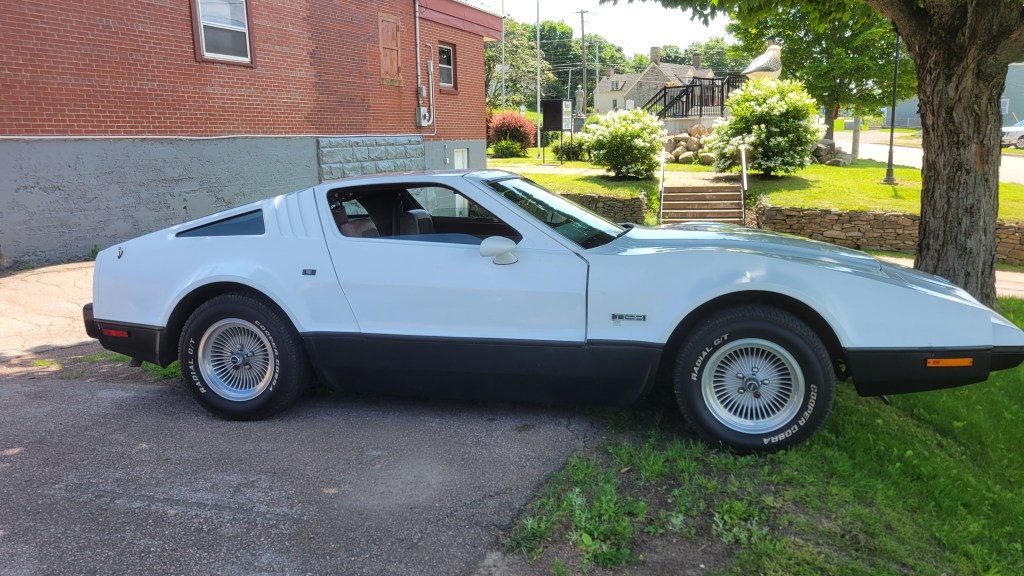
I’ve seen the giant goose in Wawa and Husky the Muskie in Kenora, so I thought I’d stop and take a closer look. Even more impressive was the Bricklin parked in the lot.

Bricklin was a Canadian car manufacturer located in Saint John, New Brunswick, in 1974-75. With the help of provincial funding, they built about 3,000 cars, but problems with reliability of the acrylic body panels and other issues drove the price up and the car company soon went bankrupt. The car has a Chrysler slant 6 engine, a Datsun tail, and other parts from Chevrolet and Opel. It’s crowning feature are the winged doors that open upwards. I got talking to a young lady out front and accidentally mistook it for a DeLorean, which must happen a lot. The DeLorean is another long-nosed, snub-tailed, winged car of yesteryear, made famous by the Back to the Future movies. This Bricklin’s in great shape, obviously without a spot of rust on it, and no blistering that plagued the early models.

I’ve said it before, this is what I love about solo touring. I can stop whenever something catches my eye, meet people, and explore. It turns out that I’d stumbled upon the Dorchester Jail, the second oldest jail in Canada and the only privately owned provincial jail and Canada. It’s also the only privately owned Death Row in Canada and was the location of the last double-hanging in New Brunswick—the Bannister Brothers. That reminds me of a skull I once saw at Eldon House in London, Ontario, that was from the first hanging in Canada. Actually, it was the first two hangings because the rope broke on the first try, which leads me to wonder if the executioner apologized to the murderer for having to put him through his execution twice. Hmm . . .

Dorchester Jail

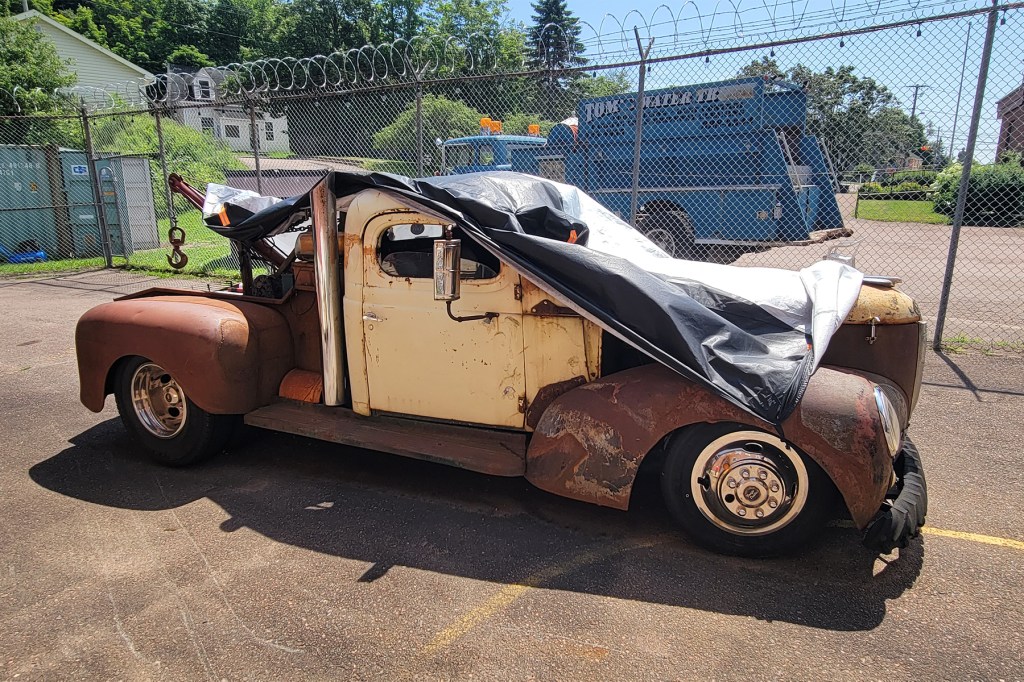
I’ve never spent a night in the clink but if I ever want to, I know where to go. The jail has been converted to an AirBNB and you can enjoy a night in a cell for a moderate price. I don’t know if that includes use of the courtyard during the day because there was at the time of my visit another interesting vehicle there beneath a cover.

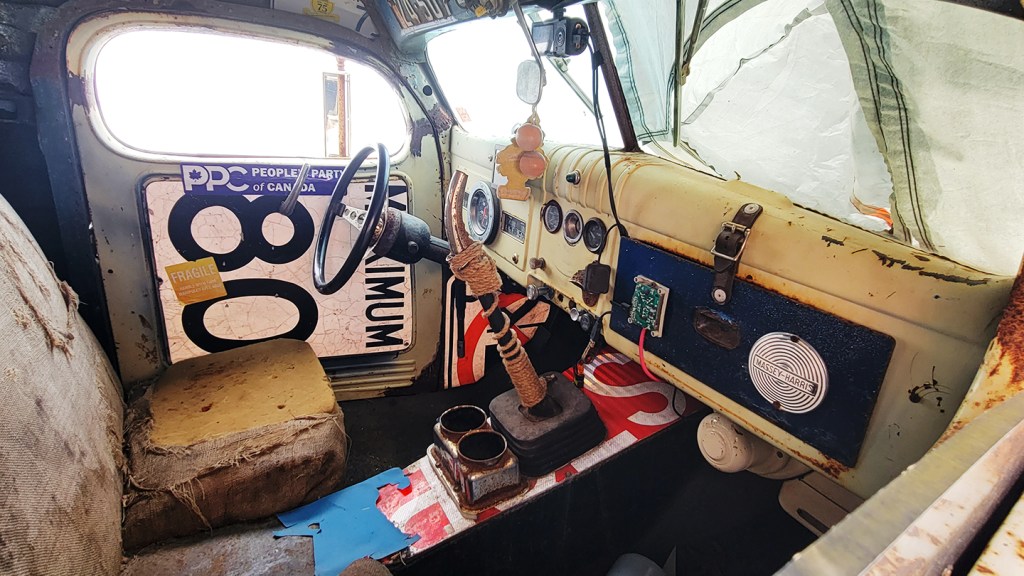
This bad girl (the truck, not the woman, who graciously lifted the cover to show me) had a bit more rust on her than the Bricklin. Love the tractor tire front bumper, almost as good as the Bricklin’s featured “energy-absorbing” bumpers.

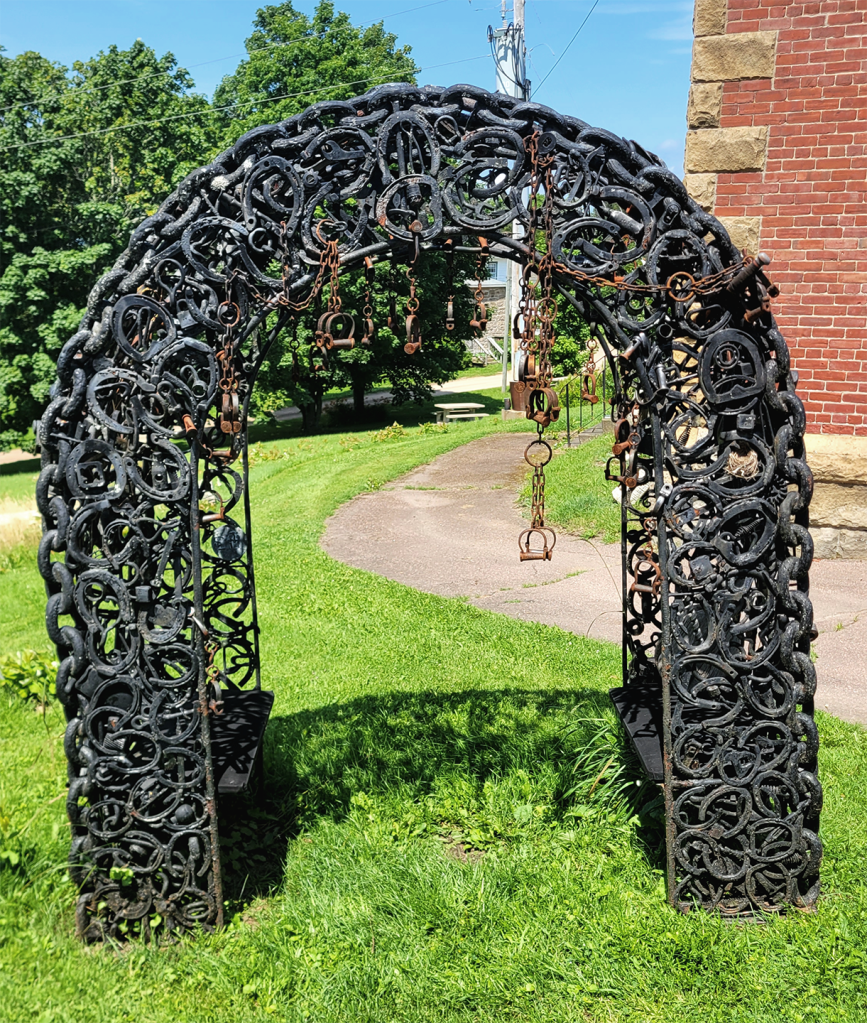
Also of interest was this metal arch that was constructed from horseshoes, locks, car parts, tools, chains, and prisoner shackles. And amid it all—I don’t know if built or placed—was a bird’s nest.

This place was a feast for eyes, but I had miles to go before I sleep so had to push on. I soon was passing through Saint John, NB (not to be confused with Saint John’s, NL), stopping only to fuel up and caffeinate up because it looked like it was going to be a late arrival at my destination, Cobscook Bay State Park in Maine. By the time I arrived at the border, it was already dusk.

Are you nervous when crossing borders? I’ve crossed the US-Canada one so many times I don’t get nervous anymore, but I’m always cautious about what I say because I know the power these officers have. I knew they were going to ask me the usual questions and was prepared. Our conversation went something like this:

Customs Officer: “Where do you live?”

Me: “Montreal.”

CBP Officer: “What is your purpose entering the US?

Me: “I’m on my way back from Newfoundland and just passing through.”

Officer: “Are you travelling with anyone?”

This is where things started to go sideways. I had pulled up alone so wasn’t expecting this.
Me: “Well, I was travelling with my wife, but she flew back early from Newfoundland for work and I’m riding back alone.”

Officer: “Are you meeting anyone in The United States?”

Another unexpected question. Now I should know better than to say more than is necessary, but I’m honest to a fault. I did, in fact, have plans to meet up with a reader of this blog who lives and rides in Portland, and we thought it would be fun to get in some riding together while I was passing through. So I answered honestly. I thought, better safe than sorry.

Me: “Actually, I’m meeting a fellow rider in Portland, and we’re going to go for a ride together. She’s a reader of my blog.”

This answer did not seem to help, and now I was beginning to feel more sorry than safe.

Officer: “What is your relationship with this person?”

He clearly wasn’t familiar with motorcycle culture. Or blogging.

Me: “I write a blog about my motorcycling. I’m meeting someone who is a reader of my blog. She lives in Portland and, since I will be passing through, we thought we’d meet up for a ride together.”

Officer: “So, it’s . . . like a date?”

I felt like I was digging myself in deeper. He clearly had missed the reference to my wife. Some jokes came to mind that might have lightened the moment, but I know enough never to joke with these guys. Sometimes I think that a lack of humour is a job requirement. I felt like I was at the door of a speakeasy and chose my words carefully.

Me: “No, I’m married. I’m meeting a fellow motorcyclist in Portland to go for a ride together. That’s all.”

I was tempted to enlighten him about the communal aspect of motorcycle culture, about blogging and the writer-reader relationship, or to provide a short romantic history of my marriage, but like I tell my composition students, sometimes less is more. The ball was in his court. By now the notorious Maine mosquitoes were out and finding their way up my nose. I looked him straight in the eye.

Officer: “Have a nice night,” he said, and handed me back my passport.

I felt like I’d just hit another tar snake and was happy I still had some of that bourbon in my pannier.

An hour later I had my tent set up, food on, bourbon poured, and a fire lit. That night I wandered down to the water to get out from under the trees of my campsite. The sky was huge and clear, and it was a perfect night for stargazing. I lay on my back and used a great little app called SkyView (Android and Apple) to pick out the constellations.


Highway 1 Maine is a secondary highway that follows the shoreline almost all the way into Portland, passing through quaint towns along the way. I took it west-east in 2017 when I did my first tour out to Cape Breton and The Cabot Trail and my plan was to do it again the other way this time, dropping down into Bar Harbour en route, which I’d heard a lot about. The cost of secondary highways is always time. It was very hot and the going was slow, slower than I remembered. Still, Google Maps was telling me that Bar Harbour is only about a 2-hour ride from Cobscook Bay, so I thought it would be perfect for a mid-morning coffee stop.

I took a short detour out to charming Lubec, ME.

I wouldn’t know because I never made it. As I was coming down Highway 3 south, I got stuck behind no less than four trucks—a hydro truck, a cement truck, a transport truck, and a dump truck—with no chance to pass. Volume got heavier and slower and it got hotter as morning developed into midday. At the same time, what I was seeing wasn’t particularly appealing—clam huts, lobster shacks, pirate-themed mini-putt, hotels, tour busses, hunting and fishing stores—and I began to wonder why I was there, crawling along in a wake of diesel fumes. There’s a national park there and I’m sure the coastline is impressive, if you can get to it, but whatever natural beauty might be drawing all these people to this region is so buried beneath layers of tourist development that I didn’t want to spend any more time trying to find it. As the traffic slowed to a crawl I said “Fuck it!,” pulled a U-turn, and got the hell out of there.

Now I was running late (am I never?) so had to abandon my plan to continue along Highway 1. Google Maps was saying the fastest way to Portland was the interstate, so that’s what I did. After the frustrations of the secondary highway, and given the heat, I was happy to ride at speed. I decided to get my coffee from a Dunkin’ Donuts at one of the exits and met there, by chance, Eric Foster, whom I had written about in a previous post. He’s the guy who crashed on the Trans-Taiga and was rescued by local trappers. On this day he was riding the newer Tiger 900 and had seen my 800 XC, the same as the one he crashed, so jumped off the highway when I did to have a chat. Small world. I’d never met him in person but it now made sense; I remember he lives in Maine. He told me Bar Harbour sucks during the tourist season. Good to know.

I was down to my final night of the tour and thankfully my friend, Berry, had something special planned for me. Berry and I started corresponding a few years ago. At the time, she also rode a 650GS, so found my blog that way. Soon our online conversations turned to other things like diet, politics, and literature, but motorcycles are the thing we usually talk about. When she decided to upgrade her bike, I was honoured that she sought my opinion on the Suzuki V-Strom 650, which of course I endorsed. So when I knew I’d be cutting back through Maine and passing close to Portland, we decided to try to meet and get in a ride. She went one step further and graciously offered to put me up the night in her beautiful house. This meant not only that I was spared setting up camp one last time but also that I could see a little of Portland. She took me on a tour of the old town out to a seaside restaurant where we could sit out and eat seafood while hearing the crashing surf from where it came. It was a fitting end to my Atlantic tour.

We did get in that ride. The next day, Berry followed me part of the way up toward the Canadian border, or rather, I followed her. I figured, let the local lead and choose the route. Here we are riding Highway 153 which, as you can see, is pretty nice.

Eventually, Berry split off at Conway and started heading back toward Portland. It was nice meeting her and putting a face to words, and I’m sure it won’t be the last time we meet. In fact, the NEBDR ends in Maine, so it may be sooner rather than later.

Berry and her new Suzuki V-Strom 650

There was one more good section of road remaining on this tour and it was The Kancamagus Highway (NH Rte 112) from Conway to Lincoln. Rever lists it as a G1 road, which is one of America’s Best Roads (Epic Incredible Roads)—their wording—and I would agree. After a rip over the mountain range, you get to decompress as the 112 winds its way parallel to the Pemigewasset River through the village of Loon Mountain, where I visited for the New Hampshire Highland Games for my very first overnight adventure tour, back in September 2016.

At a certain point of every tour, you ride back into familiar territory. It’s always a very noticeable sensation for me. After exploring for weeks and seeing everything for the first time, eventually, usually in that final day, you ride a road you’ve ridden before and remember the first time you rode it. You might even recollect your excitement or heightened attention at seeing it for the first time, and I guess that is why I like to travel. It’s that curiosity about the world that comes alive when you are experiencing the unfamiliar. Time slows, days are long and full, your senses fully alert, your mind constantly thinking, processing information, acquiring knowledge, keeping you safe. I can’t see myself spending vacation time at a resort; I think I’d get bored in two days.

The motorcycle is the perfect mode of travel for people like me who like to experience something new. And Newfoundland was certainly new (pun intended). I don’t think I could get bored with it, and I’m sure I’ll be back sometime in the future, God willing. In the meantime, it’s going to be very interesting to try a different type of touring altogether next summer when I do the BDRs (MA and NE, back to back). I’ve never done two weeks+ of constant off-roading, so there will be new technical and athletic challenges for me. At the same time, I’ll be exploring the Appalachian Mountain Range from West Virginia to the Canadian border. If you want to follow along, you know what to do.

What are your plans for the coming season? I always like to hear from readers so drop a comment below.

Lunch at The Blue Donkey and up through Smuggler’s Notch to the border. In total, I was on the road 25 days over just about 10,000 kilometres (6,000 miles) for an average of 400 kilometres per day.

End of an Era

After 8 years and almost 100,000 kilometres, I pass Bigby on to new owners.

Saying good-bye to Bigby. A final chain lube and I handed over the keys.

The first night of my motorcycle training class, the teacher asked: “Okay, what do we have here? Who wants a sport bike? A cruiser? A tourer? An adventure bike?” Students put up their hands accordingly. I didn’t even know what an adventure bike was yet, but I knew I wanted something that would allow me to explore, and I didn’t want to be limited by pavement. The places I wanted to explore likely wouldn’t have any pavement.

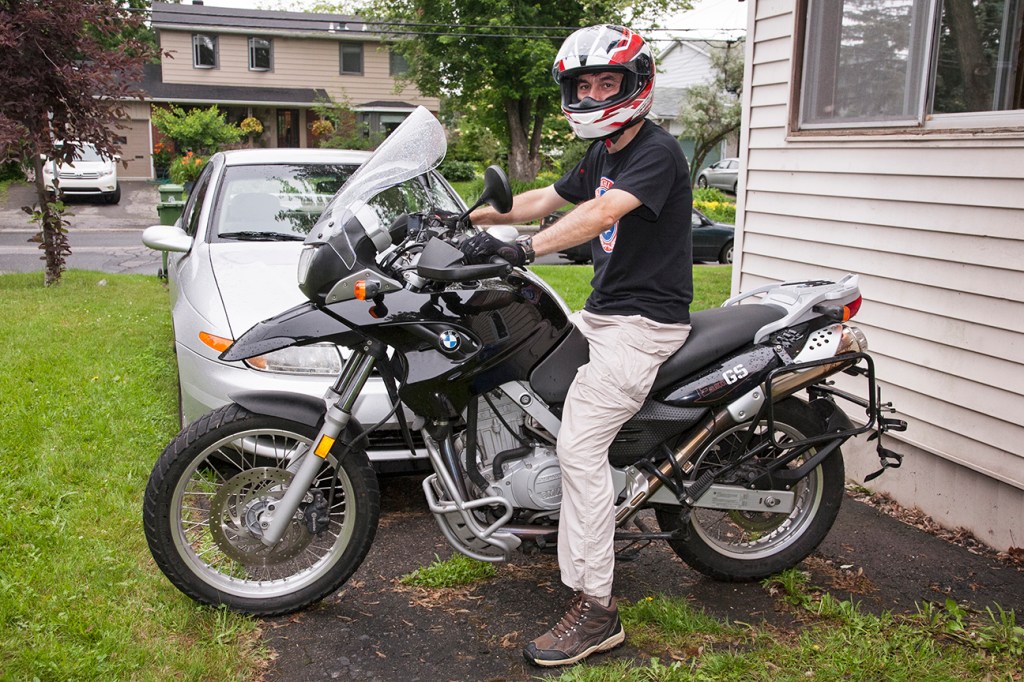
At the end of the evening, I approached the teacher to ask about helmets. What would he recommend, full face or modular? At some point, I must have mentioned that my dream was to travel across Canada by bike. “You’re going to get a BMW, aren’t you?” he said. I guess he knew enough about ADV culture to know that is the most popular ADV brand, thanks to Ewen and Charlie, and KTM’s big mistake in doubting them. And in the end, he was right. After a little research online, I zeroed in on the f650GS as a perfect starting bike—low seat height, not too much power, well balanced, reliable, and easy to ride and maintain.

A quick search on Kijiji turned up one for sale near me on the West Island. It even had hard luggage and a touring screen, all set for cross-country touring. It seemed destined to be mine, and within a few days, it was. Getting that bike has been one of the best decisions of my adult life. It has connected me to friends, to readers, to a country, and to aspects of myself I didn’t know existed.

The first photo of me on the bike, June 2015. Lots of comments on Facebook about my lack of gear, but little did they know I didn’t yet have my licence.

It almost didn’t happen. The bike doesn’t have ABS, and I’ve grown accustomed to ABS in the car during winter when the roads are icy. I thought it would be essential for a new rider and not having ABS was almost a deal-breaker for me. But fortunately, the few people I consulted about my decision were not fans. One distinctly said, “You have to learn how to brake properly without it.”

So I did. I’ve heard of people who use only rear brake. Apparently, Honda mechanics discovered that the rear brake pads of Gold Wings were wearing out faster, much faster, than the front pads, which doesn’t make sense since most of the braking happens with the front. They concluded that Gold Wing riders weren’t using the front brakes, so they developed integrated braking—both front and rear come on, even if you only apply the rear. Smart. Honda engineers outsmarted the riders for their own safety.

My bike didn’t have integrated braking or ABS, so I had to learn how to brake properly. Mostly this meant squeezing the front lever, not grabbing, to load the front contact patch before pulling harder, and using just a little rear to stabilize the bike. I did this every time I stopped, even when cruising along the Lakeshore, at every stop sign and every light, front and rear in correct proportion, so it became muscle memory. Then in emergency situations, which I had, I didn’t have to think about it; the technique came “naturally” and I thankfully never tucked the front end, even once at speed in heavy rain on Heidenau tires in Northern Ontario when I rounded a corner to find someone backing up on the two lane Highway 101.

My first adventure bike rally, Dirt Daze in Lake Luzerne, NY. June 2017.

I knew I also needed to develop my off-road skills to become an ADV rider. I took a course at SMART Riding Adventures in Barrie, and another with Jimmy Lewis at the Dirt Daze adventure bike rally in New York. I joined Moto Trail Aventure mostly for the Rémise en Forme with a certified GS instructor, and the BMW Club of Québec for the same reason. (I actually planned to do rides with both clubs too but that never materialized.) This instruction set the perfect foundation for off-roading, and then it was just a matter of practice.

You don’t even need any dirt to practice off-road skills. I go up to my local church parking lot and do slow speed maneuvers. As Jimmy said, off-roading is all about balance and traction control, so I practiced the balance stuff on Bigby regularly. I also practiced the traction when I could, getting out of the city up onto the dirt roads and ATV trails in the Hawkesbury area. Bigby is a GS, which means Gelände/Straße (off-road/on-road), but I soon learned the limits of the bike. I never learned it street limits; I could lean that bike over and scrape the pedals, even with knobbies on, but I discovered its limits on the trails. The clearance was the biggest limitation, and the front suspension with the 19″ front wheel. It took some superficial damage for these lessons, but I also learnt not to lament the scratches. A fellow rider at my first Dirt Daze rally saw me brooding on my first scratch and said, “You can’t worry about that. It’s a bike.” The matter-of-fact way he put it set me straight.

I also had to learn my way around the engine. Knowing I would be riding into remote areas, I had to know the basics and how to fix problems. As I had with car mechanics, I started with an oil change, then coolant, brake pads, and brake fluid. I bought the bike with 35,000 kilometres on it, so it wasn’t long before I had to do the valves. That service was $1000 at the dealer, just to check them, so necessity was the mother of invention and with my trusty Haynes service manual, I did the valves myself in the shed. (I don’t have a garage, and my poor workspace has been the biggest obstacle to overcome. I’ve lost and found a lot of hardware on the driveway and in the grass!)

Problems at the 2018 Dirt Daze rally. A broken water pump left me stranded for much of the rally. MaxBMW shipped a new pump “overnight” which, due to the remote location, took most of the weekend to arrive, but I got home okay.

The Achilles heel on this bike is the water pump, and I’ve changed that a few times, including once at a rally because I hadn’t done it correctly the first time. (A plastic impeller gear wasn’t installed properly and rattled loose while off-roading.) That was the only time I considered selling the bike early, until I discovered the error was mine and not a fault of the bike. Once done correctly, the pump lasted another 40,000 K until I preemptively changed it before going across Canada.

The other big job was changing the swingarm bearings. That required removing the gas tank and subframe, so basically the entire back half of the bike. The pivot bolt was badly corroded and stuck, and it took two days of troubleshooting and, in the end, two hammers—a ball pane as punch, and a sledge hammer to drive—one on top the other, to get it out. But it eventually surrendered. Yes, I have cursed and praised this bike in equal measure over the years.

Success! Pivot bolt and swingarm removed for servicing. September 2019. Under the tarp at right is the gas tank and subframe. Headphones are for all the whacking needed to get it out.

I changed those bearings as well as all wheel bearings, clutch plates, the shock, rebuilt the forks, re-lubed the steering head bearings (which were in surprisingly good shape so didn’t need to be changed), and have had the dash assembly apart. And in the end, I restored those scratched body panels to make the bike look good as new.

My first trip on this bike was back to Ontario to show it to my dad, who used to ride. I left the day after getting my full licence. The next month I did my first moto-camp down at Loon Mountain in New Hampshire for their highland games. The following year, my first year with full licence, I went to Nova Scotia to ride the Cabot Trail, passing through Maine, Deer Island, and New Brunswick en route. I’ve also toured Northern Ontario, and these tours have led to some paid writing for northernontario.travel. So the bike has become for me more than a past-time. It has taken my writing in a new direction, and that of course refers to this blog too. I’ve made connections and friendships with people online, and met some of them in person during my travels. I hope to meet more of you in the future.

Off-Roading in Cape Breton, July 2017.

I have also met new friends locally in club riding. When I began, learners couldn’t ride without an experienced rider accompanying them, so I joined The West Island Moto Club, and some of these members have become my closest friends. I’ve done some touring with the club, but mostly I do day rides with them, and it wasn’t long before, with the right mentorship, I was leading rides.

One of the first club rides that I led. This was to Ottawa via Gatineau for the Tulip Festival. May 2018.

Some of my favourite riding on this bike has been in the northeastern states like Vermont, New York, and New Hampshire. I’ve ridden the Puppy Dog Ride on it a few times, and some of the Hamster Ride in New Hampshire, and Bayley-Hazen military road. The 650 GS is perfect for this type of light off-roading. I had a 15-tooth counter-sprocket on it for years, which gave it more low-end torque, and there’s nothing like feeling the pull of the big thumper as you climb a steep hill, or sliding out the back end as you round a corner.

Finally crossing Canada, July 2021.

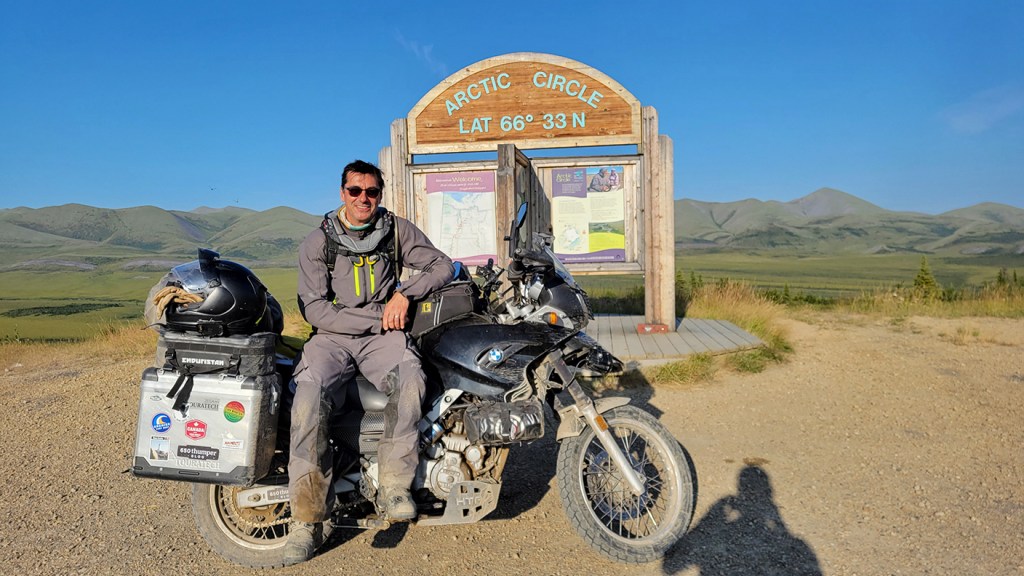
Finally, after developing these riding and mechanical skills, modifying the bike to what was perfect for me, and waiting for Covid generally to be over, I completed my dream of crossing the country, and this bike, 15 years old and with over 100,000 kilometres on it, got me there and back. Ironically, the only issue I had was with a new battery I’d just installed for the trip. But the bike, fully loaded, pulled my wife and me over The Rocky Mountains, and took me up north of the Arctic Circle into some truly remote territory. The bike fulfilled its purpose for me—to learn about motorcycling, develop the skills necessary for adventure touring, and get me over the dangerous first few years of riding. It has been the best first bike I could have had, and now it’s time to pass it on to another new rider. Like me, the new owner has bought the bike before obtaining her licence. I’m sure it will be as good a beginner bike for her as it was for me. The engine is still strong, and I wish them both many safe and happy adventures in the future.

At the Arctic Circle, August 2021

My new bike is a 2013 Triumph Tiger 800XC. The XC stands for cross country, so it’s also capable of light off-roading, and I’ll be taking it on BDRs and other adventure tours. It does has ABS, but being a 2013, it doesn’t have any rider aids, and as I read about the new bikes with throttle control, wheelie control, slipper clutches, and other traction aids, I can’t help thinking about what riders of those bikes aren’t learning. I’m happy to be learning how to control the power of this 94 HP engine properly, just as I learnt to brake properly on the GS. It’s going to take my riding skills to the next level. The blog will be keeping its URL and name in tribute to the bike that got me started and to which I owe so much.

Next season I will complete my cross-country tour by riding the East Coast. I plan to visit Gaspé, New Brunswick, Prince Edward Island, Nova Scotia and Cape Breton, Newfoundland, Labrador, and the north shore of Quebec including the Saguenay. I might try to ride solo up to Fort George on James Bay “on my way home.” This would allow me at least to set foot in Nunavut. I also plan to ride the Mid-Atlantic and North-East BDRs next summer, if I can get it all to fit. So stay tuned, my friends. The journey continues.

At the Awesome Players sandpit, Hawkesbury 2020

The Puppy Dog Trail, 2.0

Rest Stop

The first time I did The Puppy Dog Ride, I enjoyed it so much my recurring thought was that I should be sharing it with someone. “I should lead a ride down through here,” I kept thinking. “I should show others how amazing this is!” And so, when plans to tour northern Ontario with a couple of riding buddies fell through, I suggested we change the route to the beautiful dirt roads of Vermont.

Originally, the plan was to do a section of The Puppy Dog in Vermont and a section of The Hamster Ride in New Hampshire, working our way back toward the Canadian border. We also had plans to ride Bayley-Hazen, a military road that dates back to the American War of Independence. But we soon realized that our plans were a tad ambitious. Riding dirt all day in the heat of high summer is hard, so in the end we ended up doing sections of Puppy Dog with some asphalt mixed in to cool off and save time.

My riding buddies were Danny and Mike, whom I met at the 2018 Dirt Daze Rally in Lake Luzerne, NY. In truth, I only met Danny, who unfortunately had suffered an injury early in the weekend, as had my bike, so we were laid up together, so to speak. He and Mike had come down from Montreal, and while I never actually met Mike at the rally, the contact was made, and we ended up riding together later in the season.

I was happy to meet some off-roaders from the Montreal area. You shouldn’t really be riding off-road alone, partly because doing so is dangerous, but more importantly, because it’s a lot easier to lift your bike with the help of a buddy. Those who have been following my blog know about the trouble I’ve gotten myself into riding alone in remote areas. Mike works in the construction industry, so at the end of last July, during the constructor’s holiday, as it’s known here in Quebec, the three of us headed off for three nights of moto-camping in Vermont—Mike on his Honda Africa Twin, Danny on his new Triumph Scrambler 1200XE, and me, with half the power, on my BMW f650GS.

I had downloaded the GPS file for Bayley-Hazen into my phone and we picked it up soon after crossing the Canada-US border. We rode it for several kilometres and it was pretty amazing, but soon my GPS got confused and took us out to a highway. “This doesn’t look like an 18th-Century road,” I thought, so I pulled off to consult with the boys. My phone showed the snaking route for what we had just done, then suddenly a line straight as the crow flies to the destination. It was my first time using a GPS track downloaded from the internet, and I concluded that tracks only work in one direction. They are a series of turn-by-turn directions that take you from Point A to Point B but not Point B to Point A. And since the track I got was south to north, it didn’t work. If anyone knows a link to the north-south route of Bayley-Hazen, please drop me a line either in the comments section below or via the Contact page.

It was swelteringly hot—so hot that you really can’t stop moving—so a quick decision was made to abandon Bayley-Hazen and jump onto the Puppy Dog, which wasn’t far away. Soon we were back in the shade of those Vermont dirt roads. Now that we knew where we were going, we stopped for a break and to water the old growth trees lining the road. Danny noticed a vine as thick as a rope hanging from one of them. A little pruning off the end with a hatchet and we had a swing.

Vine Swing

Boys will be boys.

I don’t have the premium version of WordPress that supports embedded videos, so go here to see how this turned out.

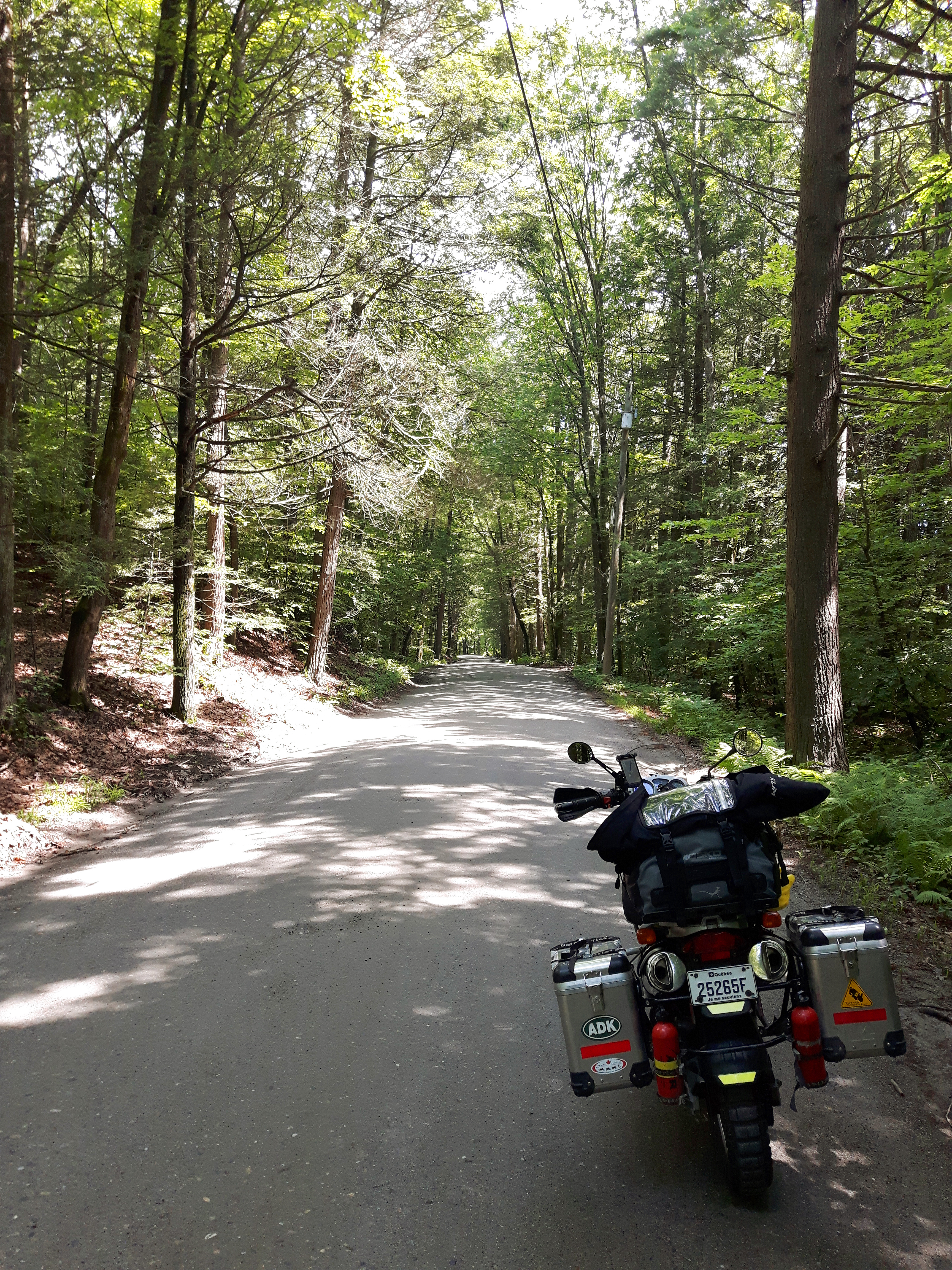
The ride is hard-parked dirt with a variety of forested rural roads, open valleys, switchbacks through dense forest, covered bridges, with some river and lake views as well. If that sounds pretty ideal, it is. You don’t really need an adventure bike to do this ride, but it helps. It’s nice to be able to stand up for some of the hill climbs, and there are some more technical sections that require the clearance of an ADV bike. But generally the ride is easy and undemanding. Danny and I rode it with 85/15 tires.

3 Bridges

The PDR takes you through four covered bridges, including this one in Guilford.

We love Vermont’s state parks almost as much as its dirt roads. They are well maintained, and the sites have lots of privacy, as you can see from the photo below. They are also not expensive compared to what I’ve paid in Ontario. Despite all this, we didn’t have much trouble finding a site even without a reservation on the weekend. Either they are the best kept secret or Vermont has more campgrounds per capita than Ontario and Quebec. The second night we made it down to Fort Drummer State Park near the southern border of Vermont and near the end of the route. For our third night, we stayed at Silver Lake State Park, which is about halfway up the state in Barnard. As a bonus, it is located on . . . you guessed it, Silver Lake, and it’s nice to go for a swim after a hot day of riding.

Mt Ascutney

Mount Ascutney State Park

Mike had said at outset that he likes general country stores, as do I, so as we passed one while riding Highway 100 in Weston, we pulled in. Little did we know what we were getting into. Walking into The Vermont Country Store is like walking into another century. This family-run business prides itself on stocking items dating back to when it first opened in 1946. Where else is checkers the game of the week and there’s a section labelled Apothecary? But the real fun is in the toy department. I saw games there that I did not think were still available, like Etch-a-Sketch, Kerplunk, Lite-Brite, and Operation. There were paddle-balls, which I had to try, and fail at, miserably, and Slinkys, and other hand toys too. The entire store is like a department store from the mid-20th-Century with clothing, candy, soaps, and “sundry items,” to borrow a phrase from that era. It was a blast from the past. I walked out with a “nightshirt,” a term I’ve only ever heard my dad say and Alistair Sim wear as Scrooge.

Apothecary

Apothecary section of The Vermont Country Store. Photo credit: Getty Images

Another fun rest stop was in Chelsea, just north of Silver Lake on the PDR. Okay, it doesn’t have The Vermont Country Store but it does have Will’s General Store, where you can pet the cat sleeping on top the fridge, rent a movie on something called a DVD, buy marbles and firecrackers, and then set off said firecrackers outside until the locals start peering through their front windows at you.

Wills Store

Will’s General Store in Chelsea, Vermont.

While we were disturbing the peace, another group of ADV riders came along. When they saw us they decided to take a break and introduce themselves. It turned out that they are Canadian too, from the Ottawa area, and were doing the PDR the other direction with the plan to complete it by the end of the day. And we thought we were being ambitious!

Chelsea Bikes

Lots of mighty KLRs in this group, and fellow blogger ADV Joe.

One of them flooded his KLR upon restarting, and while the motorcyclist’s code of honour is never to leave a motorcyclist stranded, we had to get going up toward the border; it was our last day and we wanted to get home before dark. He wasn’t alone, however, and Danny, who had a KLR for years, was confident that it would be running in no time. Those things are unbreakable. We decided, in the interests of time, to leave the PDR soon afterwards and ride up through Smuggler’s Notch, which is always nice and had been closed through the early season for maintenance.

Riding solo has its advantages, but so does group riding. The tricky part of group riding is finding the right fellow riders. You have to be compatible not only in riding but also in personality, which is not easy. Mike and Danny have been riding together for a while, so I was a little apprehensive going into this since I was the new kid on the block. There’s also that saying about two being company and three a crowd. Of course I can only speak for myself, but I think we are a good fit. I hope this is the first of many trips together.

GreenMtn View

View of the Green Mountains from the PDR south of Chelsea.

The PDR is luxury adventure touring. The riding provides a taste of dirt but is relatively easy. You are never far from amenities or asphalt, and can pop out anytime to refuel the bike or the body, or to cool off by riding Vermont’s equally enjoyable secondary highways and backroads. The campgrounds are great, and Americans are always friendly and helpful. The only thing it’s lacking is some more sustained technical terrain, and by the end of the weekend we were hankering for a rocky hill climb or water crossing. Perhaps next summer we will do that planned trip to northern Ontario or a section of The Trans-Canada Adventure Trail. With the mid-winter holiday over, it’s almost time to start planning for next season.

Silver Lake Camp

L to R at Silver Lake State Park: Mike and Danny.

The Puppy Dog Route: Part 1, Greenfield, MA to Silver Lake, VT

Trail and Bike

I’m a teacher, and toward the end of term, when stress levels reached their peak, I remember saying to myself, “When this term is over, I’m going to take off on my own for two nights.” I enjoy my work and I like giving to my students, but I also need once in a while to retreat and recenter. I imagined sitting by a fire at a campground and smoking my pipe and decompressing. I decided to try to ride the complete Puppy Dog Route.

The Puppy Dog Route is a series of connected dirt roads that take you from the Massachusetts border to the Canadian border, the entire length of the state of Vermont. I don’t know why it’s called the Puppy Dog Route. It was put together by the good folks of the BMW Motorcycle Owners of Vermont and revised and updated as recently as 2018. It’s about 90% dirt with just enough asphalt to connect the dirt roads. GPX files and turn-by-turn directions are available here.

After a few delays in early June, I finally headed off and rode down to Woodford State Park on Highway 9. It’s a quiet campground—so quiet it’s self-administered on an honour system; you put your $20 in an envelope and deposit it at the front gate. Nice!

It was hot ride down, so when I arrived the first thing I did was go for a glorious swim in the lake. Those swim classes through the winter paid off. Then I walked back to my site and sat and had a glass of the local porter I’d just bought at the general store in Bennington. I could hear some kids from a camp across the lake playing in the water, some small birds in the surrounding trees, a distant woodpecker, and then some geese flew into the lake, making a racket upon landing, as they do. I wrote in my journal at the picnic table and was blissfully happy for one, perfect moment. For an introverted nature lover, it doesn’t get any better than this.

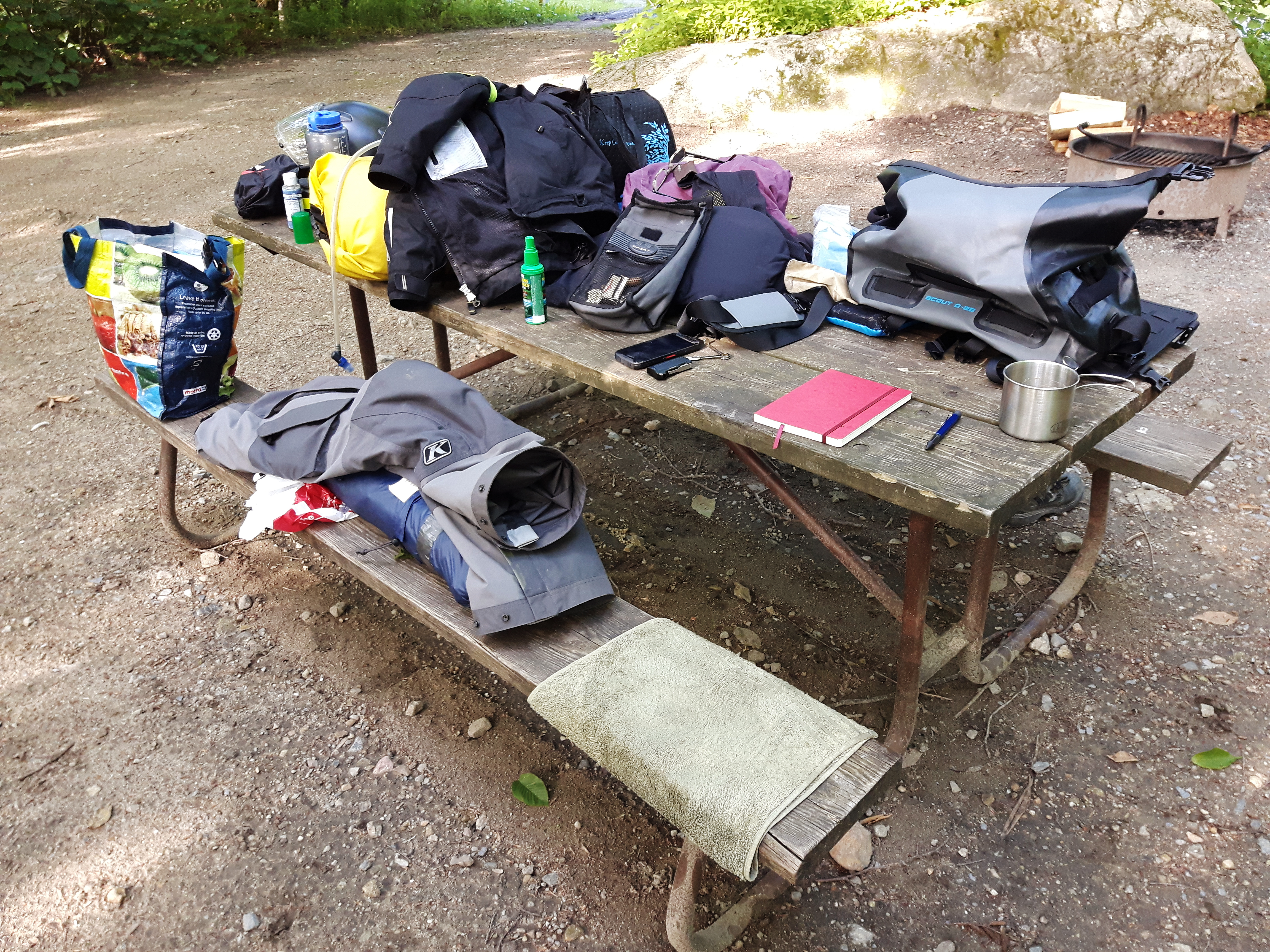
picnic table

(Almost) all of a man’s needs on one picnic table.

The next morning I packed up camp and rode the rest of Highway 9 east out to Interstate 91. Highway 9 is a fantastic road that takes you through the Green Mountain National Forest, with some breathtaking views.

Green Mountains

Lookout on Highway 9 to The Green Mountains

The PDR begins in Greenfield, MA. You turn off a main road onto a residential road and in about one kilometre is turns into dirt and the fun begins.

Starting Out

Starting out in Greenfield, MA.

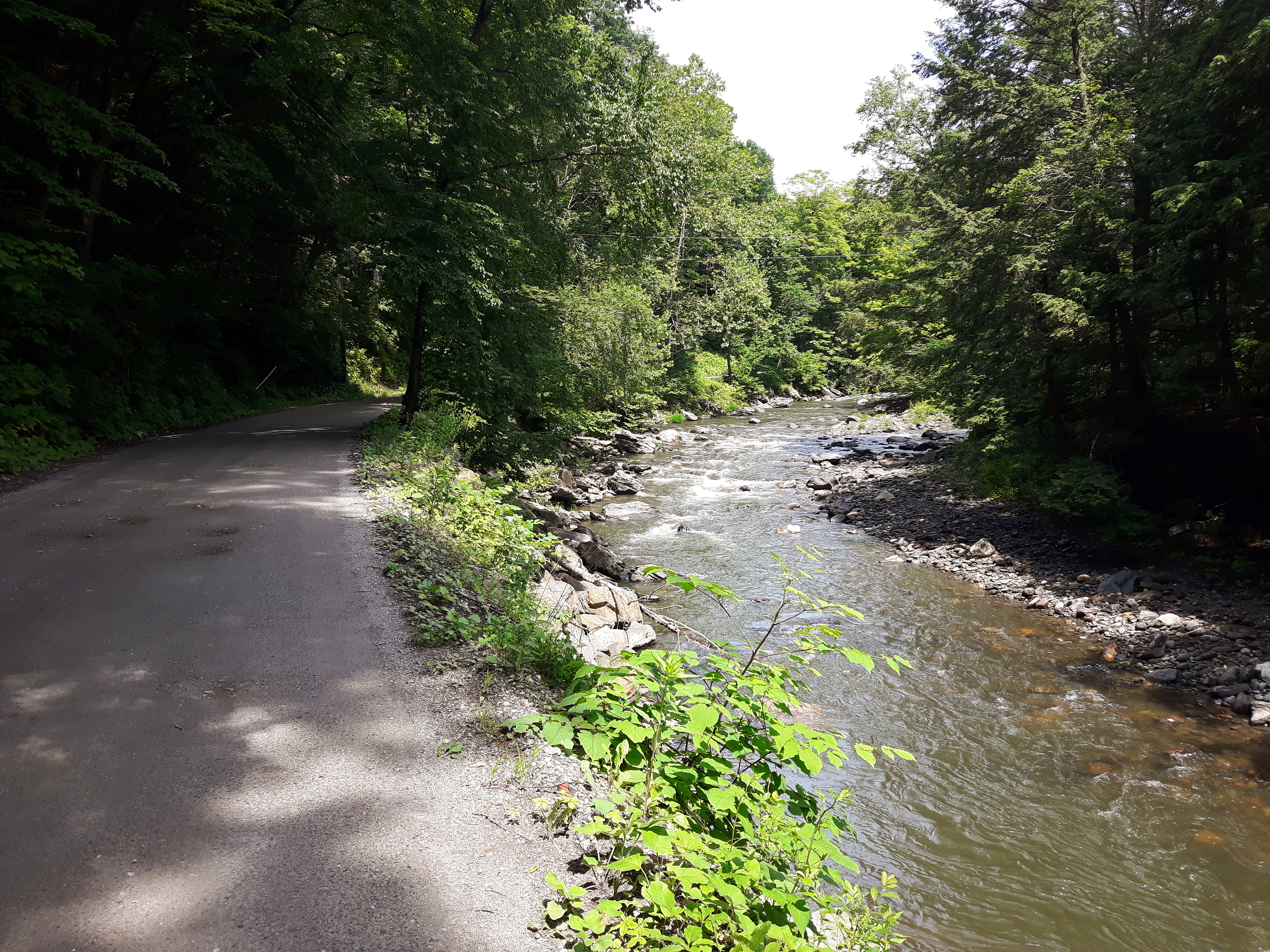
At the beginning, I was so enamoured I was stopping every few kilometres to take a photo. Then I realized at this pace I’d never make it back to my native country and had to be more selective. But it was beautiful! The surface was hard-packed and easy to ride on. Trees line the road with sunlight streaking through. The road follows a stream, and every once in a while there is a quintessential cedar shingle Colonial home. In my helmet, I exclaimed aloud “Oh my God,” then rounded a corner to a more beautiful view and said “OHH my God,” then rounded another corner and “ARE YOU KIDDING ME!”

I think I’ve found my ideal ride, at least at this time in my life. I like the twisties as much as the next rider, don’t get me wrong. And yeah, I like speed. I also like the challenge of a technical section of a trail, the pull of torque as you crack the throttle, feel the rear tire grab, and power up a steep hill. But I’m beginning to see the limitations of my bike for both technical terrain and speed. It doesn’t have the clearance or the suspension for serious off-roading, and it starts to buzz like its namesake (Bigby) over 110 km/hr, at 5,500 rpm.. What it seems best designed for is enjoying dirt roads where a Harley or Indian or crotch rocket fears to tread. It’s at home in either the Bavarian or Green Mountain forests.

I came to a covered bridge and decided that was a good place to take a break.

Covered BridgeSoon some more riders caught up to me with the same idea. I met Nigel and his dad and a few friends on their classic BMWs. Nigel has a 1977 R100 RS, and his dad has a 1980’s era BMW. Someone else in the group has the new Royal Enfield Himalayan.

Nigel

Nigel and his R100 RS. Just when I was beginning to think that my bike is old!

One of the things I like about riding solo is that people talk to you. Nigel is from Connecticut and this opening section of the PDR is part of their regular loop over from that state. I expressed my appreciation for these dirt roads and he said, “the state is full of them.” I wondered if I’d died back on Highway 9 and this was heaven.

I wasn’t even into Vermont yet so pressed on. Soon I was getting pretty familiar with cornering on dirt and was sliding out the back end. A whole day of riding on dirt and you understand the importance of getting your weight out over the contact patch so you don’t low-side. So when seated, that means leaning toward the opposite handle-grip of the corner (i.e. turning right? lean toward the left grip). The route just kept getting prettier.

Mass

Following the Stream

Picturesque views on the PDR

My destination for tonight was Silver Lake State Park. This is the midway point of the route and home of Cromag Campout each September. If you are doing the route over two days, as I was, I would advise to set off earlier than my 11:00 a.m. start in Greenfield because it’s a long ride. You are rarely out of 2nd gear, so although the distance isn’t far, it takes a good 8 hours. This is where perhaps the route itinerary is a bit off; I think it says 6+ hours to get to Silver Lake, but I was riding pretty hard all day with few breaks and pulled in around 8 p.m.. I had just enough time to pitch tent before the light faded. A nice neighbouring camper came over with some kindling to help me start my fire. I love campers, and I’ve never met an American who isn’t friendly.

I think the international perception of Americans is very different from the in-person reality. You have to visit to see what I mean. I pause, looking at my GPS, and an American is there, offering directions. The young sales clerk at the general store sees me staring into the beer fridge a little long and comes over to suggest his favourite local porter. I stop to eat an apple and a kid comes by on his pit bike to see if I’m okay. Even the state trooper bids me a good morning at the gas station.

Campsite

Silver Lake State Park

This belief would be confirmed in the most exciting way the next day with a chance encounter.