In the end, the infamous hot starter issue was an easy and obvious fix.
1st Gen (2010-14) Triumph Tiger 800’s have a known issue with the starter motor when the bike is hot. I read about it even before buying my bike but it didn’t put me off. Every bike has a couple of weak spots. The BMW f800GS, for example, the Tiger’s direct rival, has the cam chain tensioner issue, and my old Beemer, the f650GS, has a water pump that fails every 50K or so. It’s good to know the issues on your bike so you are prepared should they occur. That’s why I spend a stupid amount of hours reading about other people’s misfortunes and frustrations.
Like most issues, they appear to be on some bikes but not all, so you just have to hope you have one of the good ones. I thought I did. I rode the bike for a good, hard year before it started showing any signs. What usually happens is, you are riding and the engine is hot and you stall the bike in traffic (the Tiger is easy to stall) and when you hit the starter, it struggles, fails. This is not my bike but what it sounded like.
At first, all I had to do was cycle the ignition off and back on and that would fix it. Then it became progressively worse. I’d have to wait a second or two, then longer. After about two years and close to another 40,000K on the odometer, it was so bad I’d have to wait 10-15 minutes for the engine to cool before it would start again.
Discussions on online forums tend to look to replacing the starter as the first course of action. When I was doing my valves and had the bike stripped down, I decided to remove the starter and clean it up.
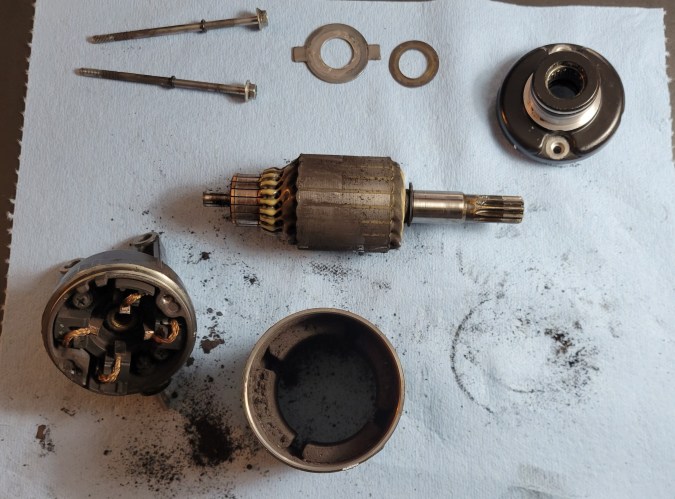
Yes, there was a lot of carbon dust inside and some tarnishing of the armature, but cleaning it all up didn’t fix the problem. I rode it for another year before it became bad enough to warrant some action.
Reading the forums, it’s clear that there’s a lot of mystery and frustration in diagnosing this problem. There’s one famous 70-page thread on ADVRider by a father and son team who never did get to the bottom of it on their bike, and apparently they are mechanics. So I knew I was in for a long diagnosis.
Triumph doesn’t recommend just changing the starter. It comes as a kit including a new Sprag clutch and costs a sweet $800+. One guy compared the original and new gears and discovered the new one is slightly larger with a few extra teeth, as if Triumph knew the starter needs a little more torque to help it out.
Before going that route, I decided to try a cheap Chinese starter off Amazon. $135 including shipping, all the way from the other side of the world, and what a strange world it is we live in. At that price, I couldn’t really go wrong and thought it was worth a try. The cost was really more in my time because getting to the starter requires removing all the plastics, lifting the tank, removing the airbox and the throttle bodies, so it’s several hours work for an experienced mechanic and a full day’s work for an amateur like me.
The Chinese imitation looked exactly the same as the Denso original. If the Chinese do anything well, it’s copying. When your entire culture, including its economic system, is based on uniformity and sameness, I guess you become very good at copying. The clever Chinese copied the original so well that it too was crapping out when hot.
One of the frustrations for me with this diagnosis was that the starter would work fine when tested on the driveway. I’d idle the bike until the engine was at operating temperature, turn it off, and it would spin up without any sign of hesitation. But after a test ride it would not. My friend Mike tipped me off that the two tests are not the same and the temperature gauge is a crude indicator: the heat when idling is top-end heat, but after a ride it’s crankcase and gearbox too. This was another indicator of the eventual source of the issue.
After the disappointment and frustration of the Chinese experiment, I decided to pull out all the stops and replace the starter with Rick’s and upgrade the battery, the two other popular courses of action.
At under $300, Rick’s starter is less than half the price of the Triumph replacement and by all accounts is superior in design, cranking power, and longevity. You can see right away that American culture is based on difference and individuality.

Rick’s is slightly larger and has a different terminal. The internals are different too, with a double-sealed and protected bearing. The larger-diameter casing apparently prevents the armature from shorting against the housing when it expands with heat. I don’t think that was what was happening in my case, but sometimes size does matter.
In most reported cases, swapping the OEM starter with Rick’s has fixed the problem, a sign that Rick’s is more powerful. However, in some cases, owners have reported problems starting to occur again after some time, even with Rick’s installed, a sign that the source of the problem is ultimately elsewhere.
Another possible fix is to replace the battery with a more powerful one. I unfortunately went the other way, which probably exacerbated the problem. When the OEM battery on my bike got old and weak after near draining it in my Calabogie Disaster, I replaced it with a cheaper and smaller battery. Yeah, part of what I learned through this troubleshooting are the high demands on the battery and the importance of replacing the OEM one with its equivalent or better.
In this case, I decided to go better. I bought a lithium battery with 315 CCA (the OEM Yuasa has 270). I’d owned a Shorai battery with my 650GS and was pleased with it, and since I already had the dedicated charger, I went with another Shorai. The charger plugs into a port on the battery and can run all sorts of diagnostics and reconditioning programs on the battery. And since May 2022, Shorais have an advanced Battery Management System that protects the battery from over discharge that can damage a lithium battery beyond repair.
When it came time to install the new parts, I went the further step of testing and cleaning up the starter circuit. I’d noticed a significant voltage drop upon starting the bike so knew something was up. Again, my friend Mike, who knows more about bikes than I ever will, told me that electrical resistance increases with heat so to look for frayed or corroded wires.
I started with the starter relay, located under the battery.
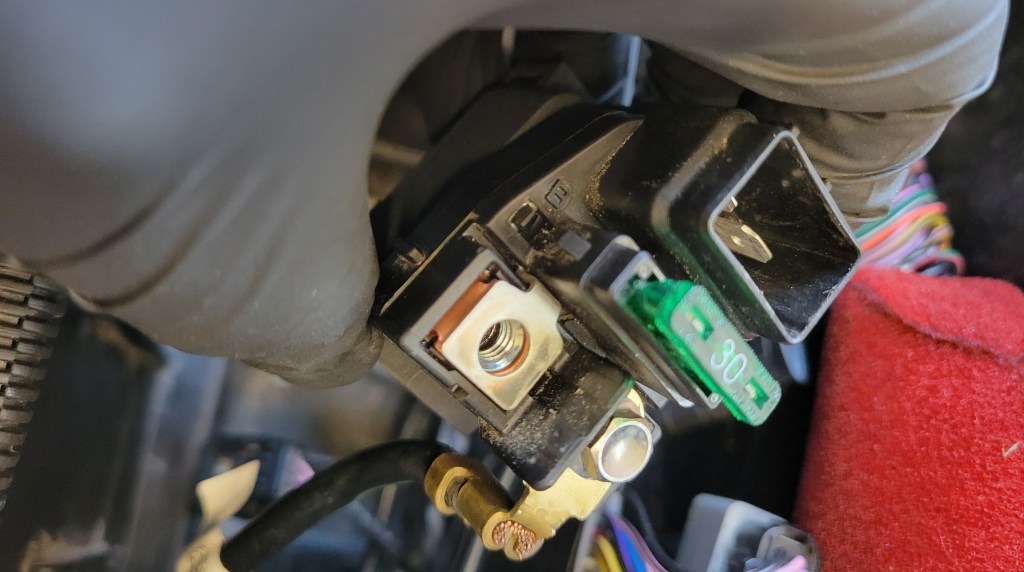
It looked pretty clean, but I polished the contacts nonetheless with some emery paper and added a smear of dielectric grease.
Next, I dug down to the main ground on the bike. It’s located under the airbox and is, significantly, on the top of the crankcase. It was grimy!

It clearly had never been cleaned. I was beginning to think this was the true source of the problem. It would explain a lot: the progressive nature of the issue, and the reason why it doesn’t happen with top-end heat. When the crankcase is hot, the resistance in this poor electrical connection would go up, causing a voltage drop, and resulting in the starter not getting enough power.
I tested the resistance from the negative battery terminal to the ground. It was .9 ohm!
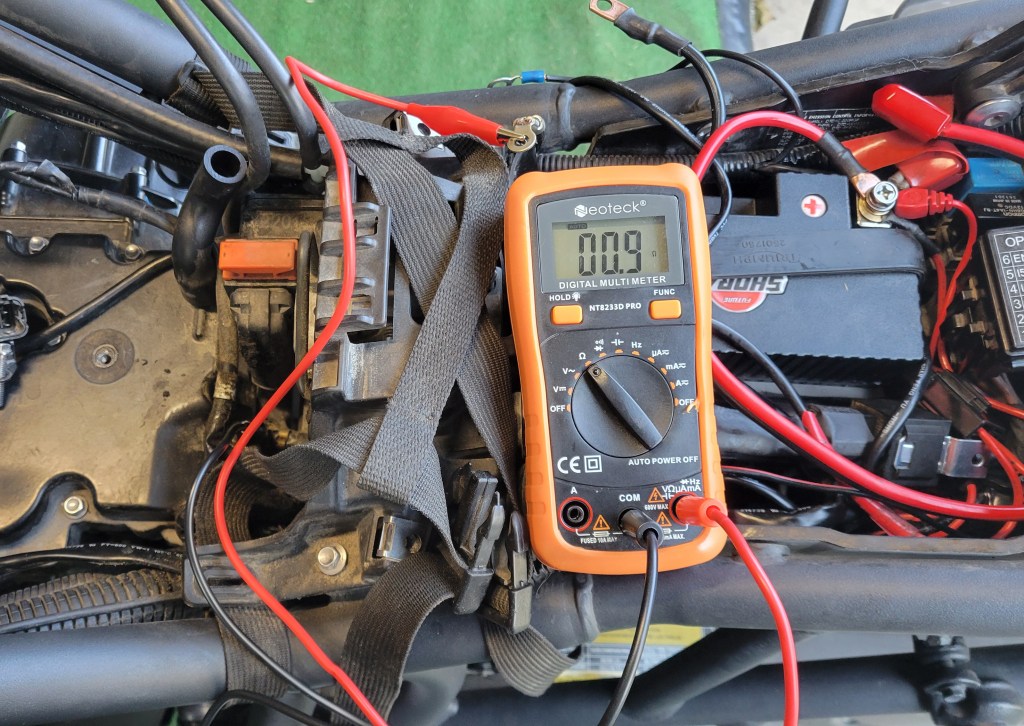
A quick Google search indicated that a circuit shouldn’t have more than .2 ohm resistance. I’d found the underlying source of the issue.
After cleaning up the ground and all terminals, the resistance dropped to .1 ohm.

And while I was at it, I added a smear of dielectric grease to the battery terminals too.
Since installing Rick’s starter, the Shorai battery, and cleaning up the circuit, the starter hasn’t had as much as a hiccup.
Whether or not the problem would have been solved by only cleaning the ground we will never know. But if you are having starter issues, I’d begin your diagnosis by looking there. Being under the airbox, it doesn’t get inspected very often, but I’m going to be keeping a closer eye on it from now on. In fact, I’ll probably do some preventative cleaning as part of my annual maintenance.
I don’t mind having Rick’s starter in the bike. The Denso is weak, and mine was 11 years old. I also don’t mind having the more powerful and much lighter Shorai battery in there as well. I could have avoided getting the cheap Chinese starter (now sitting in my workshop), but troubleshooting is a process and there are costs to be incurred and lessons learned along the way.
As I write this, it’s March 15th, a special day if you’re a biker in Quebec. It’s the official opening day of the season. (Yes, we are required by law to be off the roads Dec.1 – March 15.) There’s still a foot of snow blocking the doors to my shed where I store the bike over winter, so I won’t be riding today but soon! It’s been a unusually cold winter in Montreal, as it has been across North America, and we’ve broken a bunch of snowfall records. As far as I’m concerned, that makes this spring especially sweet, made all the sweeter because for the first time that can remember, my bike was put into winter storage running perfectly and not needing any maintenance whatsoever. We are finally into the plus Celsius weather (+32 F), and yesterday I heard the unmistakable sound of a woodpecker while walking the dog.
There’s nothing quite like hearing your bike fire to life the first time after four months of storage. It’s the unofficial sound of the start of a new season. This year my big summer tour will be a section of the TCAT (Trans Canada Adventure Trail) called The Forest that runs from Baie Comeau on the Quebec-Labrador border to Kenora on the Ontario-Manitoba border. This will include some of the most remote riding I’ve ever done, but one thing I know is that my bike will start when I need it to.
What are your plans for this season? A big tour? Rallies? Lots of smaller rides? Share the excitement and let me know. I’m always interested in hearing from readers.


 650thumper