The Book That Launched an Industry

A review of Ted Simon’s Jupiter’s Travels: Four Years on One Motorbike
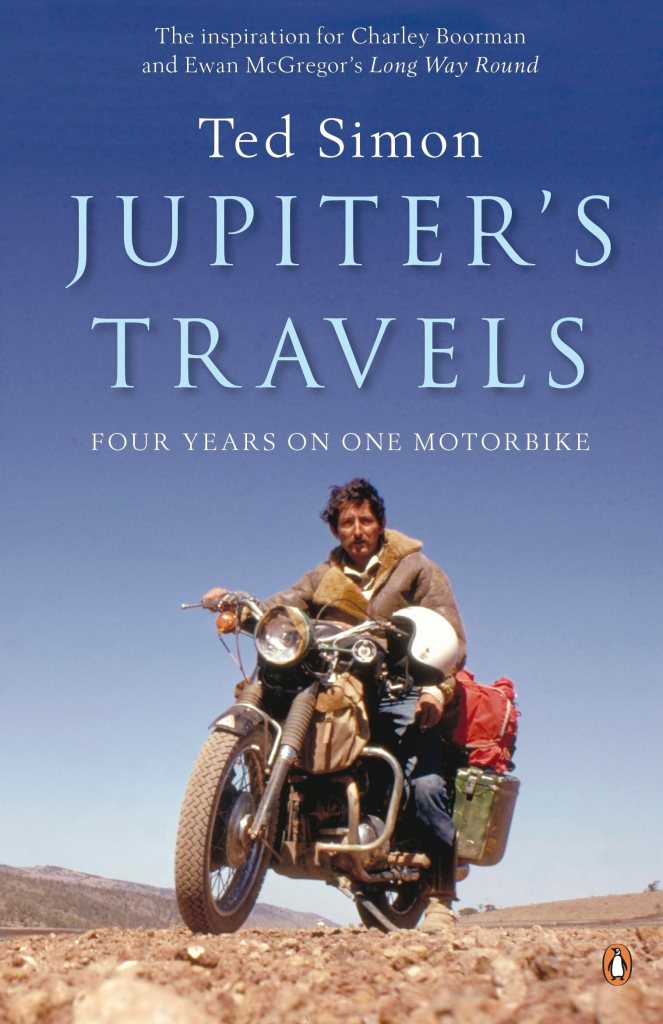
The book cover of the Penguin edition. © 1980

Before there was such a thing as an adventure bike, or the ADV industry, or a satellite tracker, or a cell phone, GPS, Google Maps, or even the internet, Ted Simon rode around the world. That was in 1973. At the time, he worked for The Sunday Times in England. They sponsored him and he wrote articles for them along the way, sending them back presumably by snail mail, before we called it snail mail. I would have been 10 years old at the time—a mere 50-odd years ago—and yet that world seems very distant now. The first thing I like about Simon’s book is that, like all classic literature, reading it takes you to another place and another time.

There are riders who can write, and there are writers who can ride. Simon is clearly of the latter. From the opening lines, he has us hooked, employing in medias res, a classical technique that dates back to Horace’s Ars Poetica (c. 13 BC) and means “into the middle of things.” We find Simon roadside and out of gas about fifteen miles outside Gaya, India, but by this point in his journey he’s discovered that he needn’t worry; things always find a way of working out. He’s already been on the road several years so has by this time learned what every experienced adventure rider knows: 1) to embrace the unexpected, and 2) to trust the goodwill of strangers. And so he waits . . . and in his waiting reflects on the years and miles behind him, and establishes for us the context. This writing may have started as an article for a newspaper, but Jupiter’s Travels is not a collection of articles. Simon knows how to structure a longer narrative.

He is rescued, of course, by two good samaritans on a Royal Enfield who accept nothing but a handshake and promptly take him to a Rajput wedding complete with dancing girls. If we weren’t already hooked, we are now. Simon’s description of one of them is so detailed, so lyrical, we know this is not going to be just about the ride.

The writing is like this throughout the 450 pages—observational, insightful, and eloquent—what travelogue ought to be. Ironically, sometimes it takes an outsider’s objective perspective to see into the heart of the matter. For instance, in The Triumph of Narrative, Canadian writer Robert Fulford makes the point that he can clearly see why the marriages of half a dozen of his friends failed but not his own; he’s too much on the inside. Similarly, as an outsider, the travelogue writer is sometimes able to see what others native to a culture cannot. Simon has this power of perception and we are its beneficiaries.

Sometimes, no insight is necessary when observational detail is so well captured. Like a moving picture without narrative or voice-over, Simon brings to life a streetscape by simply listing what he sees:

The listing of items without commentary or predication is called the cataloguing technique and can be traced back through Allen Ginsberg’s “Howl” (1956) to Walt Whitman’s “Song of Myself” (1855). It’s a poetic technique that has an effect comparable to montage in film. Used selectively, as it is in Jupiter’s Travels, it can be incredibly effective in conveying realism since, come to think of it, what is our lived experience but a series of images, impressions, and snippets of dialogue which we render into a narrative in constructing meaning. Simon’s technique presents us with the raw material of life, place, and story.

Another aspect of the writing I admired was its daring honesty. For example, while riding through Sudan, he runs out of gas and, after being handed from one local to another throughout the afternoon and evening, finds himself late at night waiting with an Arab for a bus that would take them to Atbara, where he can purchase more gas. Neither speaks the other’s language so they wait mostly in silence, smoking cigarettes. The bus is due to arrive at midnight, and in the stillness and solitude of the desert at night, he is propositioned by the Arab in a way that is unmistakable despite the language barrier.

Simon ends up declining, but the moment of reflection and self-awareness is revealing and could very easily have been edited from the manuscript once back in priggish England. Instead, Simon leaves it in as testament to the transformational power of travel. When exploring the world, we are not just discovering the world but previously unrevealed aspects of ourselves as well. Pushed out of our comfort zones and placed in unfamiliar and sometimes challenging situations, we broaden our inner as well as outer horizons.

Of course, his trip is not without drama. At one point, he loses his wallet containing his driving licences, vaccination certificates, credit cards, photographs, currency, and an all-important address book. In Brazil, he is arrested and incarcerated for weeks, convinced at times that he will be beaten or worse. He meets a woman named Carol at a commune in California and they live together for a blissful summer. They’re deeply in love and there’s a strong sense that Simon could have very easily abandoned the rest of his planned trip and spent the rest of his life with her. Perhaps it’s only his original commitment to the journey that pulls him away from her.

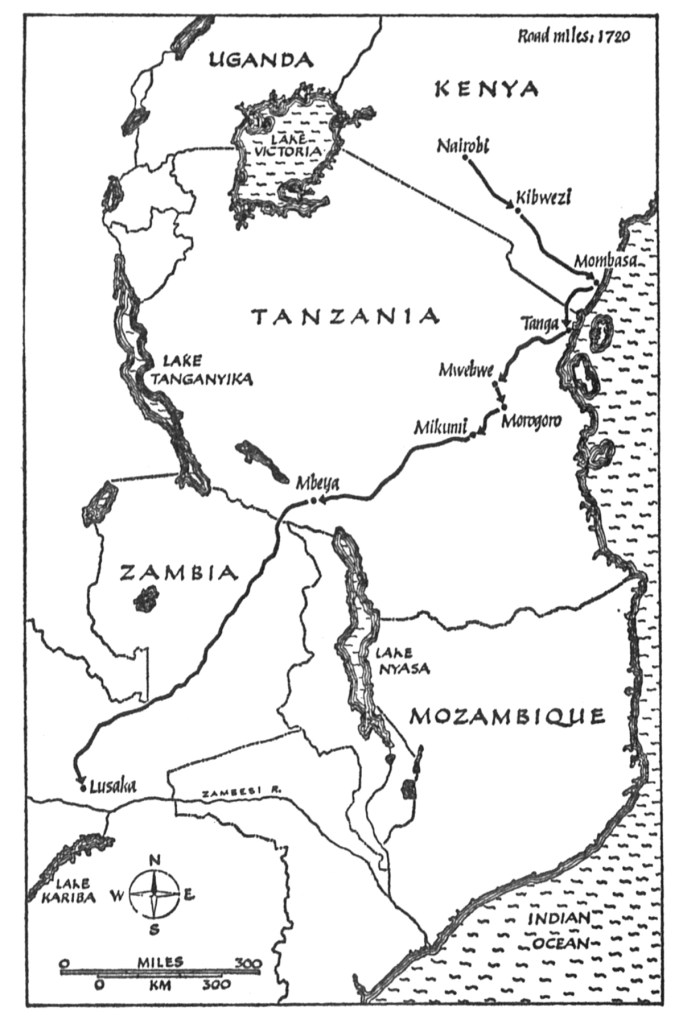
Simon’s tour is over 63,000 miles in 4 years and covers 54 countries on 5 continents. He begins in London, UK, and heads down through France, Italy, Sicily, and over to North Africa before heading east to Egypt. He then rides down the east coast of Africa to South Africa, crosses to Brazil, and rides up through South America to Los Angeles before crossing the Pacific Ocean to Australia. The final leg takes him through Thailand, Malaysia, then India, and across the Middle East back to England. Each section is headed by a simple black & white map showing his route, which seems appropriate for the book.
He rides a 1973 Triumph Tiger 100, which makes his accomplishment all the more admirable. To ride around the world on a motorbike is one thing, but to do it on a 1970’s era British motorbike is quite another; they were notorious for unreliability, and he has several breakdowns along the way. But in typical Pirsig fashion, he’s able to fix the bike and keep moving, although some parts are hard to come by and there are delays as he waits for parts to ship from England. In the end, we have to hand it to both Triumph and Simon: 60,000 miles of hard ADV riding on a bike of that era speaks for itself. The bike is now in The Coventry Transport Museum and appears in its original state as delivered by Simon upon his return to England in 1978.

Ted Simon’s Triumph Tiger 100 “Jupiter” // photo credit: David Merrett

The bulk of the book covers his travels in Africa and South America, with less detail in the rest of the trip. For this reason, my only criticism of the book is that it feels unbalanced and a bit truncated, as if the journey should have been covered in two books. Indeed, a sequel, titled Riding High, was published in 1998 and contains more stories that could not fit in Jupiter’s Travels. Perhaps it would have been better to plan the account over two books instead of rushing the ending of the first, but I understand the restrictions of book publishing and how the second probably grew organically out of the success of the first.

People often suggest to me that I should develop my YouTube channel and provide there full videos of my journeys, not just snippets to be embedded here in blog posts, and I’ve certainly considered it seriously. YouTube is where the money’s at these days, and I know from observing my students that reading is on the decline and video is ascending. Some of my more cynical colleagues say we are living in a post-literate society, and when I hear that youth today spend on average six hours a day on social media I can’t help thinking that there is some truth to that or there soon will be. But then I look at a book like Jupiter’s Travels and my confidence in the written word is reaffirmed. It’s the book that inspired Ewan and Charlie to do their Long Way Round tour in 2004, and the rest is history. It continues to inspire others to set out on their own adventures, whether big or small. According to Allied Market Research, the adventure motorcycle market was valued at $31.8B in 2022 and is projected to reach $64.5B by 2032.

But it’s not about the money. In Jupiter’s Travels, Ted Simon taps into something primal and lacking in our modern world, at least in western society. It would be too facile to say “freedom,” although that’s certainly part of it. He writes at one point that he would always rather be riding in heavy rain than sitting dry at home. Similarly, “risk” is attractive to those of us living rather staid, comfortable, cubicle lives, and there’s plenty of trials and tribulations for Simon during the four years. Some argue that risk is the essence of ADV riding (hence the jab about riding your BMW GS to Starbucks). But to understand the effect of a book like this we need to go deeper. What in it compelled Charlie and Ewan and countless others to break the pattern of their lives, sometimes at great personal and financial cost, and ride round the world (RTW), an act now so common it has its own acronym?

I think the answer to that question can be found in a word—adventure—the word that coined the industry. Stemming from the Middle English and Old French aventure, advent -ure, “adventure” has at its root “advent”—yes, that advent, the coming of Christ in the weeks leading up to his birth as Saviour of the World, but also ecclesiastically “his Second Coming as judge, and the Coming of the Holy Spirit” (Oxford English Dictionary). It’s the third of these that I think is the most relevant. What else would compel someone to endure the hardships and insecurity of long-distance travel on a motorcycle but to be in search of some sort of religious experience, to be fulfilled not by the creature comforts of consumerism but something else—a feeling, a spirit. I’m going to suggest that Jupiter’s Travels speaks to a hunger in the adventure rider, a desire to be connected to all things and everyone, even if we have to travel around the globe to find it. We may not be Sir Galahad in search of The Holy Grail, but our horses are made of metal and we are on a quest.

Click on any image for full size. Photo credits// top: Secrettrips.com; bottom L to R: ADVPulse & Overland Magazine

2013 Triumph Tiger 800XC Long Term Review

Spirited on road, capable off road, the Tiger 800XC is a great all-round middle-weight bike.

My review of the 650GS has been the most viewed page on this blog for years, so I thought I’d write one on the Tiger, which I’ve had now for three full seasons and over 45,000K. These are both old bikes, so I know most people reading the reviews already own the bike and want to see if they’ve made a mistake. You have not. Well, as always, it depends on the type of riding you do. But if you’re looking for a long-distance ADV touring bike, the Triumph Tiger 800XC is a good choice.

But I’m getting ahead of myself. As I did before, I’ll break down the review into components.

Engine

The heart of any bike is the engine and the Tiger’s is a gem. When I pulled into my driveway on the GS at the end of my 2021 cross-country trip, I knew I wanted a smoother bike. The big thumper got me to the Pacific Ocean and the Arctic Circle and back, but it wasn’t very comfortable, especially on those highway miles. When I test rode the Tiger, I knew I would buy it even before I was around the block; I couldn’t believe what I was feeling. This engine is SMOOOTH! I’d go as far as to say it’s the bike’s defining characteristic. This is the 800, so before Triumph moved to the T-plane crank and off-set firing order, so it’s about as smooth as a triple can be. If you’re coming from the nuts-numbing world of a big thumper, the inline triple with a 120 degree crank is a world apart and exactly what I was looking for.

Aside from being smooth, this engine has a ton of character. It has comparable torque to its rival, the BMW F800 GS (58 ft.lb @ 7850 rpm vs. 59 ft.lb @ 5750 respectively), but gets that torque much higher in the rev range. And it likes to rev! It spins up fast, so even pulling away from a stop light you find yourself pulled involuntarily into The Giggle Zone. Yet despite that high peak rpm, the torque on the Tiger is incredibly linear.

photo credit:// ADVMoto. 1st Gen Tiger 800 dyno results. Note the linear (flat) torque “curve” above 3000 rpm.

The gearbox is also smooth, both upshifting and downshifting. It’s so smooth, someone I swapped bikes with once asked if it has a slipper clutch. The high-revs, the smoothness of both engine and gearbox, combined with a wonderfully guttural exhaust note make the Tiger 800 a really fun bike to ride. It feels like Triumph has shoe-horned a sport bike engine into an adventure chassis, which I guess they have since the engine comes from the 660 Sport. I’m not afraid of the dirt but, to be honest, most of my adventure touring is on asphalt, and the Tiger makes crunching those miles enjoyable.

Where the engine does come up short is in slow-speed technical riding, a downside the T-plane crank of its successor, the Tiger 900, attempts to address. The 800 is happy when revved, but is prone to stalling at slow speed, especially in sticky mud or over obstacles—anything that requires careful clutch work in 1st gear. It has no tractor-factor, so if you like ATV and snowmobile trails, single-track and getting out into the woods, the Tiger is probably not for you. It can do it, but you have to keep the revs up and feather the clutch a lot, which can be tiring on your hand and the clutch.

Handling

The XC model I have has a 21″ front and a 17″ rear wheel—an unusual combination in the ADV world where an 18″ rear is the norm. Perhaps Triumph did that to compensate for the nose-heavy geometry of the big triple compared to a parallel twin. (It still has a stink bug stance.) They’ve also increased the rake on the front forks beyond the competitors’ to 23.9˚ (compare with 26˚ for the BMW 800). What this weird-ass geometry does is make the 21″ front wheel surprisingly easy to turn in yet planted through corners. For an ADV bike, the Tiger is surprisingly agile and confidence-inspiring through the twisties. That’s when it’s in its element, whether on asphalt, gravel, or dirt.

Lanark County Trail System on 70/30 tires.

The cost is a tendency for the front end to tuck in mud or sand, especially if you forget to steer with the pegs. My crash this past August was a direct result of that happening on a muddy downhill corner, although I think balance of the bike front to back was also a factor. (I was under sag.)

Front-end tuck on the Bailey-Hazen hero section.

The Tiger is also a little top heavy, despite its flat horseshoe-shaped gas tank. That’s probably a result of the tall and wide engine. (To get the 660cc Sport engine to 800, Triumph lengthened rather than widened the bore.) You don’t feel it once the bike is rolling, but again, it’s another characteristic that makes the Tiger a challenge off-roading at slow speed. What all this means is that if you want to ride hero sections on the Tiger, you’d better have skills.

Triumph says that the Tiger is for “light off-roading” and they don’t lie. The engine and balance of this bike are designed for 2nd gear and up. But the biggest indicator that this bike is not for serious off-roading is the placement of the spark plugs and air filter, both of which are under the tank. If you’re doing water crossings—and what serious off-roader isn’t—you’d better not swamp the bike or you’re going to be removing bodywork and lifting the tank trailside. Been there, done that. It’s not much fun. To lift the tank, you need first to remove the beak, radiator side panels, indicator panels, and trim. I’ve done this perhaps a dozen times now and have the whole process down to about 20 minutes. Needless to say, for an ADV bike, this is a major design flaw, or at least a serious limitation.

Suspension

The Showa suspension on the XC is a step up from the XR version. Rear travel is 215mm and front is 240mm. That’s more than what I’ll need because I’m not blasting down rocky trails as much as trying to thread my way through them. (The 650GS, for comparison, has 165mm rear and 170 front.) With the Outback Motortek skidplate, ground clearance on mine is about 9 1/4″ or 235mm. The shock has hydraulic preload and rebound adjustment. The forks are a beefy 45mm but with no adjustment. That’s a fairly basic system, but again, sufficient for ADV touring.

Like most ADV bikes off the production line, the Tiger 800 is set up for road use. The suspension is soft and cushy, making a plush ride around town (and during test rides, I should add). But if you want to use this bike for how it’s intended—ADV touring (the XC stands for cross country)—you’re going to have to stiffen the suspension.

The OEM shock has a spring rate of 9.7 kg/mm which, surprisingly, gives me a static sag of 18% (40mm). This means that under its own weight on the OEM spring, the bike is under sag. Rider sag for me is 35%, even with preload fully wound. (Note to newbies: static sag is unloaded with no rider and should be 10%; rider sag is loaded with rider and should be 30%.) At 150 lbs (177 in all my gear), I’m not a big guy, and with about 66 lbs of luggage (56 on the back, 10 on the front), I don’t think I’m overloaded, although I’ll be working over the off season to reduce that weight. Nevertheless, it’s clear to me that the OEM spring on the shock is too soft for anything but solo street riding.

I recently upgraded the suspension and will publish a separate post on that topic, so click Follow if you’re interested in what I’ve done.

Ergonomics and Comfort

The ergonomics on the Tiger are generally comfortable whether you are seated or standing. The wide handlebars are what you’d expect and want on a bike designed for the dirt, yet they don’t feel like ape-hangers when seated either. I haven’t added any bar risers because the bar mounts are already high, and when I stand the bars fall to the right place when I’m in the correct body position with hips slightly bent. (Most people who add risers are seeking comfort while standing erect.)

One unusual feature of the bike’s ergos is the distinct sensation of the fuel tank between your, uh, thighs. It was something I immediately noticed on that brief test ride and something others have commented on when we’ve swapped bikes. The tank is wide, and it forces your knees apart. (No bad jokes here). I find it actually reminds me to squeeze the bike, which is good practice whether riding on and especially off road.

The seat is generally comfortable for long days, although when touring I add a sheepskin pad to improve comfort and airflow. Triumph sell a comfort seat for this bike but I haven’t needed it. Similarly, Marilyn hasn’t complained about the seat on the back. The 1st generation Tigers do not have a heated seat option but subsequent ones do.

My knees sometimes complain over long days but I’m pretty long-legged, so they are bent slightly more than 90˚. I put my Fastway pegs in the low position and the adjustable seat in the high position and this set-up has been pretty good. With the bike now sitting even higher, I’m anticipating improved comfort for my ageing knees. In the raised position, seat height is 34.5″ or 885mm, which is comparable to its BMW competitor.

My biggest complaint about comfort is in the area of wind management. I’ll be doing a separate post on my search for a solution, but let me say here that the OEM windscreens for the Tiger suck! The stock screen is notorious, and the touring screen is little better. Maybe it’s too much to ask of a screen to allow airflow at slow speed when off-roading and a quiet ride at speed on the highway. The best solution I’ve found is the touring screen with a cheap clip-on wind deflector, which helps with the wind but ruins both the lines of the bike and video footage from my chin-mounted camera. Oh well.

Aesthetics

Canadian poet Robert Bringhurst has a collection titled The Beauty of the Weapons and I think the Tiger is a beautiful weapon, especially the all black model. I get a lot of compliments on the bike, even from other riders. You can see in the neoclassic bikes like the new Bonnevilles that Triumph pays a lot of attention to how a bike looks, and they’ve done a great job with the Tiger. Okay, you may say they’ve copied their competitor with the beak, but I think a bike without one looks weird. There are a lot of complimentary parallel angular lines on the bike that thankfully Outback Motortek has followed. Aesthetics is something not everyone is into, but I want a bike that makes me turn around and look at it as I walk away in the parking lot, and the Tiger does that.

Reliability

There are a few known issues with this bike, not surprising given that it’s a first generation model. The shifting mechanism is known to fail, and mine did, but not in the expected way of the return spring or the pin for the return spring breaking. No, it was the selector arm that failed at about 45,000K, so while I was in there behind the clutch, I decided to replace not only the selector arm but also the problematic spindle, the return spring, and the detent wheel, all of which have been redesigned. You can read about that work here. The bike also let me down once in the bush during a water crossing when somehow about 3-4L of water got in the tank. I still think the only viable theory is that water got sucked up through the tank breather tube and I’ve since redesigned the tube to avoid this happening again.

The other known issue with this bike is the starter motor. There are many accounts of it failing to restart the bike when the engine is hot. It was fine for me the first two years but then started to act up and got progressively worse. I’ll be doing a separate blog post on that too, but I’ll let the cat out of the bag here and say the problem was, at least in part, a dirty main ground on top of the engine block that was causing a voltage drop. If you have the dreaded starter motor issue on your Tiger, clean the main ground and contacts on the starter relay before changing the starter or battery.

That’s it. Clutch, stator, voltage rectifier, water pump, oil pump—all good—and no issues with any of the electronics. That’s not bad, in my opinion, for a bike with over 60,000K on it.

I adjusted the exhaust valves at 45,000K; the intakes were perfect but all the exhausts were tight. There are some reports of the engines, particularly on the 2nd gen Tigers, to start burning significant oil at about that mileage, but thankfully that has not been the case with mine. It burns a little oil now, particularly at high-revs on the highway, but nothing significant. I’ll come back from a tour of a few thousand kilometers and top up maybe 200mL. I’ve been using Castrol Power 1 4T and, more recently, Motul 7100, but when I mentioned my oil consumption to my dealer, he said they put Motul 300V in all the “high-revving bikes.” I thought it was only for racing bikes, but henceforth that’s what will be going in this bike.

I like that the 2011-14 Tigers are still relatively simple and easy to service on my own. There’s no ride-by-wire and rider modes or complicated electronics that require a computer to diagnose and repair, although I wish turning off ABS were easier than navigating menus. The 1st Gen Tigers that ran 2011-14 are at the tail end of an era before things got pretty complicated electronically. Build quality and fit-and-finish are excellent, and the bike is looking as good as new with no rust or corrosion on it anywhere, despite its age.

Summary

Pros

  • Fun, spirited engine
  • Smooth gearbox
  • Agile and planted through corners
  • Comfortable seat and ergonomics
  • Good looks
  • Aside from a few early-model issues, generally reliable
  • Relatively easy to service

Cons

  • No tractor-factor; stalls easily in 1st gear
  • A little top heavy
  • A tendency for the front end to tuck in low-traction terrain
  • Poor wind management
  • Shifting mechanism weak
  • Some reports of starter issues with OEM starter
  • Plugs and airbox under the tank
  • Vulnerability in water if the tank is rapidly cooled

Looking at the length of those two lists, you’d think I’m not happy with the bike, but I am. That’s because the main elements of the bike are good—the engine, the handling, the reliability. The bike has a few issues, like any bike, but they are overshadowed but just how much fun it is to ride, and isn’t that the main thing we want in a bike?

Conclusion

When I participated in La Classique Moto Fest here in Quebec a few years ago, I saw my bike in a long line of other bikes there for the rally. Maybe it was my subjective perspective, but it seemed slightly out of place. It occurred to me that most of the bikes there were set up for off-road riding whereas the Tiger, at least my Tiger, is more an adventure bike, and I was reminded of a comment made years ago on the ARR Raw podcast about this distinction. (I’ll link to the podcast but can’t remember the specific episode.) They were talking about tire choice, if I remember correctly, and one of the guests made the distinction between what they do as RTW riders and what weekend warriors do. He said he’d never attempt half the stuff some guys do off road because, when you’re touring halfway around the world, you can’t afford to break something on your bike and wait weeks, perhaps longer, for parts to arrive. In other words, they ride more conservatively, and that was reflected in his tire choice. I’ll add that it’s also reflected in your bike choice.

Off-road versus adventure bikes. An arbitrary distinction?

As we all know, the adventure bike is the ultimate compromise. It has to be good on road and off road, capable of crunching out miles on the highway as well as getting you down a logging road. It has to be quiet and comfortable for long days in the saddle, powerful enough to climb mountains and carry camping gear, maybe a pillion, yet small and light enough to pick up on your own in the middle of so-called nowhere. It has to be reliable, and simple enough to fix yourself, trailside if necessary, if something does break. With these considerations in mind, the middleweight Triumph Tiger 800XC is a great all-rounder and an excellent choice as a long-distance ADV touring bike. It has its drawbacks, for sure, and may be master of none, but it’s the best Jack of all trades I’ve been able to find.

Walkaround of the mods I’ve done on the bike.

The Essentials

In this fourth post on gear, I talk about the essential tools I carry on the bike.

Clockwise from top left: manufacturer’s toolkit with 17mm stubby hex drive and Motion Pro 3/8″ driver adapter, patch kit, Motion Pro Trail Tool, zip ties, Leatherman Wave+, rags, pump, siphon, jumper cables, latex gloves, Motion Pro Bead Breaker and spoon lever. Centre: OBD Link LX Bluetooth adapter, spare fuses and electrical joiners, MSR tow strap, Mastercrap allen key set.

It’s a constant balancing act: having enough tools to fix most problems but keeping it light. You don’t want to be burdened carrying around stuff you never use, but neither do you want to be stuck somewhere, knowing you’ve left the essential tool or part at home. And then there’s the question of what type of ride you are doing. If I’m riding with the club, I tend to take less, knowing there will be others with some tools and why double-up? If I’m riding solo into remote territory, I take the full works: my tool roll, bag of sockets and drivers, even a container of spare parts. But let’s begin with what is always on the bike, even if I’m just commuting to work 30 minutes along the highway. That’s what is shown in the above photo.

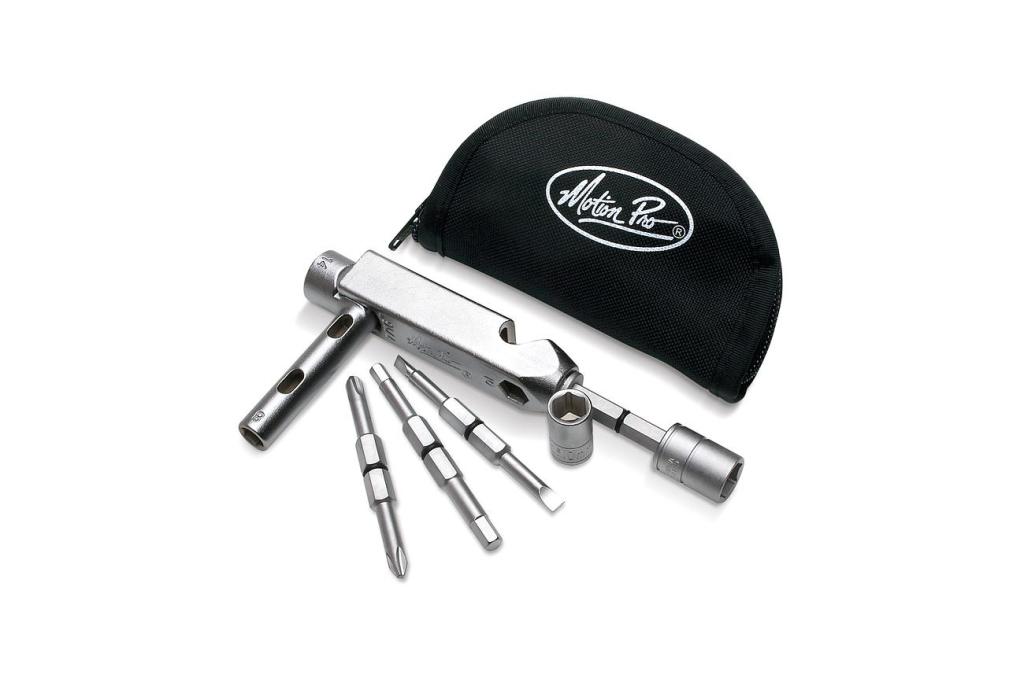
The most common problem you’re going to have is a flat tire, and with tubed tires, you have to be able to get both wheels off. So you’re going to need a big wrench of some kind. For the Beemer, I have the Motion Pro combo tire lever and 24mm socket. It’s a little small, but if you place it right on the nut so you can stand on it, you can remove even the rear lug nut at 73 ft/lbs torque. Into that I place the Motion Pro 3/8″ drive adapter, which enables the lever to drive 3/8″ sockets. For the Tiger, it’s the same set-up but Triumph have a 27mm rear lug nut. Fortunately, the manufacturer’s toolkit includes a wrench with integrated handle so I only needed to buy the corresponding drive adapter and a 19mm hex bit socket (to remove the Tiger’s front wheel).

The Tiger has a captive nut on the left side rear, but for the Beemer, you need a 19mm wrench, which is big and heavy, so I carry a crowfoot wrench for that which I can snap into a 3/8″ drive.

Apparently, the founder of Motion Pro was once asked what tool he would carry if he could only carry one, and he replied without hesitation the Trail Tool.

I carry the Motion Pro Bead Breaker and lever set. They’ve never let me down yet in breaking a bead, and double as levers. I know you can remove a tire with only two levers, but I indulge myself on this one and carry an extra, one of my favourite spoons from . . . you guessed it, Motion Pro.

As you can tell, I love Motion Pro tools. Apparently the founder of that company was once asked what tool he would carry if he could only carry one, and he replied without hesitation the Trail Tool. This thing is amazing. Best of all, it packs up so small, I tuck it under my seat. If you add a few bike specific sockets to it and eat your Wheaties, you can pretty much remove any fastener other than the wheel lug nuts.

I also carry a patch kit, of course, so I can repair the puncture once I get the tube out (Duh!).

Included in my essential toolkit is a Leatherman Wave+, just because THAT IS THE LAW if you are an ADV rider. I don’t use the saw tool to clear any trails, but it’s nice to have a good pair of pliers at all times, and the knives and screwdrivers are also handy in a pinch. I added the ratchet drive that came out a few years ago and a set of torx bits, since BMW are so crazy about torx bolts. Now that I’ve switched to the Tiger, I carry a cheap allen key set because Triumph are so crazy about hex bolts.

If a hand pump is good enough for Lyndon Poskitt to ride around the world for five years, it’s good enough for me.

Yes, that is a bicycle hand pump you see above. I owned the Stop & Go Mini Air Compressor that connects to your SAE battery lead, but it has a design flaw and broke. See RyanF9’s video about that; the nipple pulls out of the hose. Then I looked into the Cycle Pump by Best Rest Products, but at $145 US it would have been over 200 bawks with conversion and shipping! What now? For a pump?! I know it has a lifetime warranty, but at 59, I don’t have that long to live, so I go with the manual pump and muscles. If it’s good enough for Lyndon Poskitt to ride around the world for five years, it’s good enough for me. And beside the pump, you see some cut up socks that I use to protect my rims when I lever off a tire.

I carry a siphon hose, should I or someone else run out of gas, and little jumper cables. I did use these last week, as a matter of fact, on a club ride when someone had electrical problems, but honestly, the easiest way to start a bike with a dead battery is to push start it, assuming it doesn’t have a slipper clutch.

Something I’ve recently purchased is a Bluetooth ODB reader. If you are venturing into remote territory, you really should carry an ODB reader. This was never an option on the Beemer. The proprietary connector on it is round so doesn’t accept third-party readers, and the GS911 tool is something stupid like $900. But with the Tiger, I’ve bought ODB Link LX and use it with TuneECU, an app available for Windows (via USB cable) and Android. The entire kit came to about $150 and provides a lot of diagnostics, including error codes and info from all sensors. You can even use it to remap the ECU! I’ll be using it to balance my throttle body because it tells me that cylinder 3 is a little off. That might be why I was getting vibration in my throttle grip, although that has improved since replacing the air filter. Of course, I carry spare fuses and electrical connectors, and if all else fails, a tow strap.

You see everything above on a changing mat I also carry at all times. You may recognize the Cordura material from my previous post on camping gear in which I write about the bags I made. This is the leftover material and it provides a clean surface to work on while removing tires. You don’t really want to be grinding dirt into your bearings while you wrestle with the tire trailside.

With what is happening in Europe at the moment, those of us who enjoy the safety of civil society have all the more reason to be thankful.

On the Beemer, I use velcro straps to attach the levers and pump to the subframe, and the tow strap tucks in behind the ECU under the seat, with the jumpers and siphon tube on top in a Ziploc. The rest goes in the tail compartment. On the Tiger, there’s no compartment, but everything except the levers, changing mat, and rags goes under the seat. Unfortunately, try as I might, I haven’t found a way to make it all fit, so I have a small bag containing those remaining items in a side case. (Dollar Store pencil cases work well as cheap tool bags.) If I were doing any serious off-roading, which I’m not yet because I still have a road tire on the front, I’d carry those items in a knapsack and ride unencumbered without cases.

This is my set-up for day-to-day and club riding. In the next post, I’ll talk about what I carry when I tour, and then I’ll finish the series by talking about navigation apps. I know I had planned to do all in one, but this is getting long, so I’ll split the planned post up into three.

Am I missing something? How does your essential toolkit compare? Drop a comment below, and if you haven’t already, click Follow to receive word of new posts.

Here in Canada, it is Thanksgiving Monday, so I’ll wish my Canadian readers a happy Thanksgiving and everyone else happy riding and safe travels. With what is happening in Europe at the moment, those of us who enjoy the safety of civil society have all the more reason to be thankful.