
We complete our tour of Newfoundland with a few days in Saint John’s and ride part of The Irish Loop.
We arrived in Saint John’s late in the day and hungry, so after cleaning up we asked the staff at The Alt where we could get a meal at that hour. They naturally directed us further down Water Street. We’d heard of the lively Water and George Streets and were looking forward to taking in some of that Irish pub nightlife, only when we got there, we were disappointed.
As we sat on a sidewalk patio awaiting our food, I took a look around. We were definitely out of place. For one, we were married, and for two, were were sober. The scene reminded me of The Simpsons episode in which Marge asks Homer not to show up drunk at Lisa’s recital. “Irish drunk or American drunk?” Homer asks, just to be clear. I hadn’t seen this level of drunkenness since high school. The average age here was more like mid-twenties but they were clearly regressing. What was it George Bernard Shaw said about youth? It’s wasted on the young.
More disturbing were the greying and balding 50-year-old single males amongst them, leaning against lampposts and slurring directions to the next pub, which is all of a 100 feet further down the road, if they can make it that far. Well, to each his or her own, I guess. We just aren’t into that scene.
On the other side of the road were a group of homeless youth, or so they seemed to me. They had all the tell-tale signs of homelessness—unkempt hair and clothing, the tattered and filthy knapsack, and a certain loitering, lounging body language that indicated they had all the time in the world and no place else to go. There was also a certain solidarity among them, as if their immediate friends were all that mattered in the world, deaf and blind to the surrounding animal show. Or maybe it was they who were trying to be invisible. When you are the most vulnerable, you learn to be invisible should some violent drunk take a dislike to your presence. The drunken revelry and the sad homelessness were a strange juxtaposition, separated by 50 feet of blacktop.
Music emanated from the open window of the pub out onto the terrace where we sat and across the street. It was an Irish jig, and from the sounds of the cheering and clapping inside, the folks were really enjoying it. I might have been too but, alas, as a former side drummer of The Black Watch (RHR) Pipes & Drums, I know what a good jig sounds like, and this wasn’t it. I’m going to sound like a music snob, but it was sloppy. In “Two Ways of Seeing a River,” Mark Twain suggests that the steamboat pilot can no longer appreciate the beauty of the river after knowing of its dangers, and I guess I will say that knowing what good Irish music sounds like has made me unable to appreciate the beauty when it’s bad. We missed the genuine Newfoundland music on this tour, to our great disappointment, but that’s an extra reason to return.
Finally our food arrived and we soon retreated back to our hotel. Water Street was a huge disappointment. We have since heard it referred to as the New Orleans of the North. I’ve never been to New Orleans, and now I’m not sure I want to.
The next day I was hoping to meet up with a former professor from my undergrad days. We had lost touch over the years but recently reconnected when I asked him to write an endorsement for my new book. He was as gracious as ever in both agreeing to do it and for what he wrote. I gave him a call and suggested we meet for breakfast, but in true Newfoundland style, he invited us over for a homemade one.
The term “famous Canadian poet” is almost an oxymoron, but if one exists, it would be Don McKay. He has written over a dozen books of poetry, poetics, and philosophical musings, and edited countless others. He has twice won Canada’s highest literary award, the Governor General’s Award, and once the most lucrative prize, the Griffin Poetry Prize. In 2008, he was made a Member of The Order of Canada. I was lucky enough to have studied under him at The University of Western Ontario (renamed Western University) back in the 1980’s and his poetry has been a major influence on my own.
It was delightful to see him again, as modest and affable as ever, to introduce Marilyn, talk writing and, of course, get his advice as a local on where to visit. He suggested we hike up Signal Hill for a good view of the harbour, and later, to stop in at Running the Goat Press when passing through Tors Cove on The Irish Loop. Suddenly there was a knock at the door. It was another former student of his and, coincidentally, someone who spends part of the year in Guelph, Ontario, and is a friend of my brother-in-law! So now there were the four of us in Don’s kitchen and it was almost a party. All we needed was a fiddle and bodhrán to make it a complete Newfoundland moment.
Marilyn and I decided to do that hike so headed off, promising to stop in again in a few days and say good-bye before leaving Saint John’s. By this time I’d found an AirBNB, which enabled us to stay a few more days in town without taking out a second mortgage. I’m really glad we did. It would have been a shame to leave only with the impression of the night before. We were able to check in early, park the bike in the back, then head off on foot to explore the city.

The trail took us past The Battery as it snaked its way up the side of the mountain, the view of the harbour getting better with each laborious midsummer metre of elevation. It’s called Signal Hill because Guglielmo Marconi used it to receive the first trans Atlantic telegram and my legs were saying he chose wisely. Eventually we reached the top and had an excellent view not only of the harbour but over to the Cape Spear Lighthouse and east out to the open ocean. The surrounding cliffs and narrow passage provide excellent military defence for the harbour. No wonder Saint John’s developed where it is.
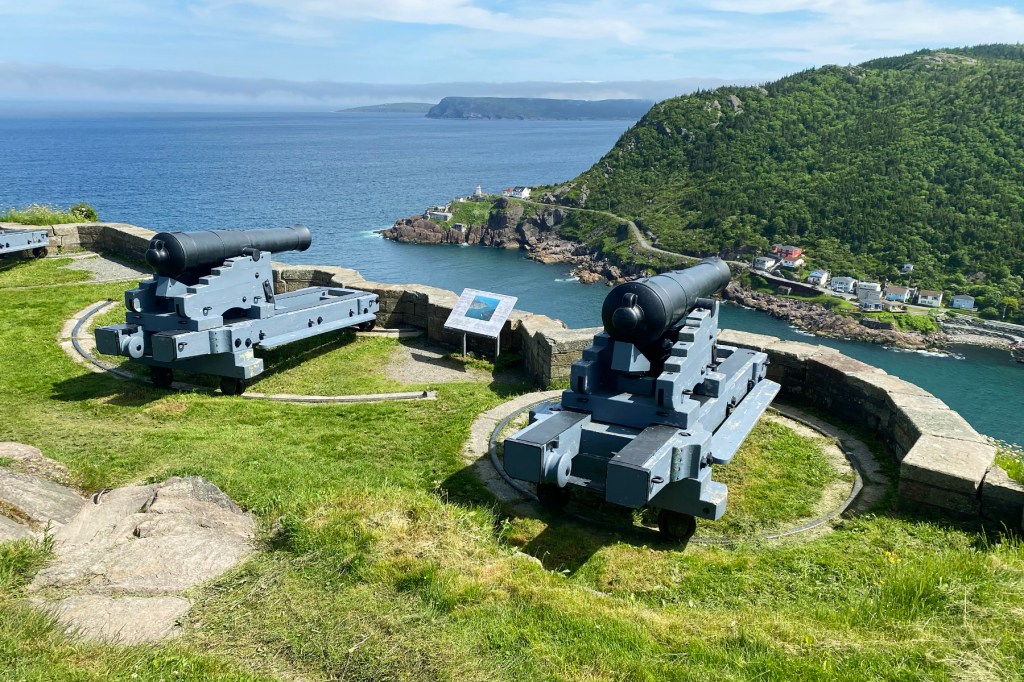
We had more friends to meet later in the day once we came back down. We had met Serge and Ang in 2021 on a ferry in British Columbia as we rode the Sunshine Coast and had kept in touch through the intervening years. By coincidence, now they were touring Newfoundland at the same time so we had to meet up and do some riding together. We met at The Battery Cafe to catch up and decide on a plan.

We decided to ride part of The Irish Loop, as far as possible in a day excursion. The next day we met at Cape Spear Lighthouse, the eastern-most point of Canada. Marilyn and I had waded into the Pacific Ocean in Tofino in 2021 and now wanted to do the same here, but there were a lot of warnings about going near the shoreline so, unfortunately, we had to remain up at the cafe enjoying the exquisite coffee and pastries.

We eventually headed off and our first stop was in Tors Cove and its bookstore Running the Goat Press, only about 50 kilometres south of the lighthouse. The press specializes in children’s literature and, according its website, “many of Running the Goat’s publications are letterpress printed at the print shop, using moveable lead type, and sewn by hand.” These books are labours of love, and if you are a bibliophile or just have some children in your life who like to read, be sure to stop by or check out their website. The owner, Marnie Parsons, is another old friend from undergrad days, and it was lovely to see her again and get a tour of the press. We bought some books for our great-nieces and Marnie was happy to ship them home for us.

After a packed lunch overlooking the bay, we continued further down to Ferryland, a region that dates back to the 17th Century as one of Canada’s first settlements. The name is an anglicized version of Forillion, the same name as the national park we stayed at in Gaspé. In my head I had been spelling it Fairyland and in many ways that would be a more appropriate spelling. There is something magical about its geography. We rode across a bridge and climbed a ridge-line on our adventure bikes (Serge and Ang have KTM 790s) up to a lookout. A fog drifted in and hung over the tiny islands strung across the bay and the view seemed like something out of Lord of the Rings.
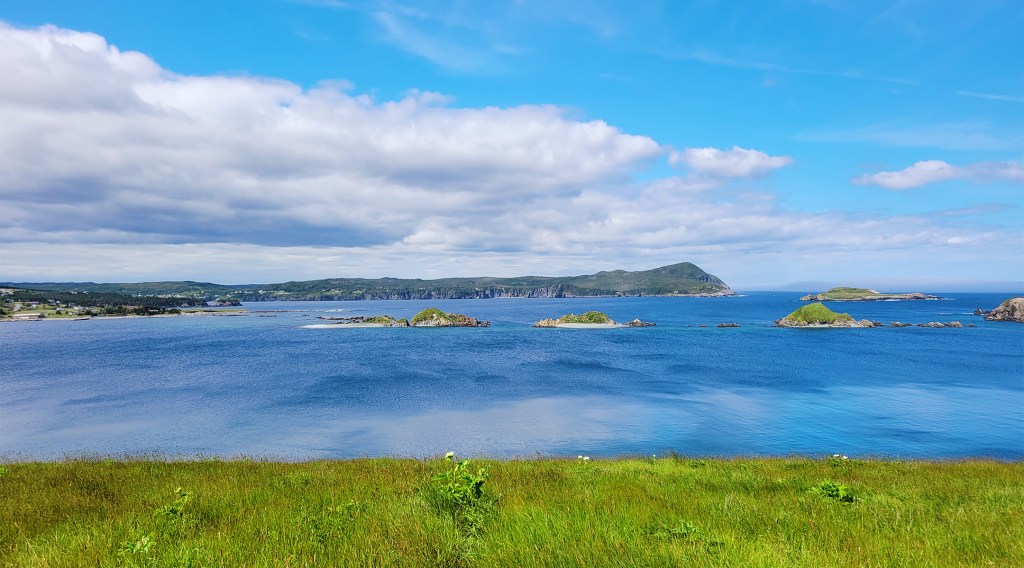
That was as far as we got on our slow-paced day. I didn’t mind. Truth is, I was in need of a few easy days. I’ve come to realize that adventure touring requires some recovery days off the bike. When I did the west coast tour, I stopped in Calgary for several days to visit family, and later, spent another few days in North Vancouver before touring the island. I love riding and can ride all day every day, but what my heart wants my body can’t always deliver. When I got home after this tour, I was tired and decided not to cram in that second tour in The States I had planned to do before going back to work. I needed some time on the couch in and around Montreal to recover and recharge.
For future tours, I’m going to build into my schedule local sightseeing and days lounging around camp, reading and writing. I’m pretty fit for my age, but I don’t even think it’s a matter of age. In a recent video, Runa of Off She Goes was candid about being tired after 40 straight days on the road and looking forward to being home. I think vloggers like Itchy Boots spend days off the bike doing video editing, but we never see those days and it seems like they are constantly travelling. Anyway, that was one of my discoveries this trip: schedule days off the bike to rest, recover, and recharge.
We said good-bye to our BC friends and wished them well on the rest of their tour of Newfoundland and in re-crossing the country to get home.
The next day we were on our own again and decided to visit Cape Saint Mary’s Ecological Reserve on the south-west tip of the Avalon Peninsula. The aptly-named Bird Rock is home to thousands of seabirds, particularly gulls and gannets. Newfoundland really is a bird-watchers paradise. As we rode onto the cape, fog drifted in as well, and we wondered if we’d chosen the wrong day to visit.
Thankfully, like most weather on the Atlantic, it was temporary. The hike along the cliffs is something in itself, but Bird Rock is special. As you approach, there’s a distinct smell in the air that I couldn’t quite place until we arrived at the tip: it’s bird excrement. But don’t let that put you off; you get used to it. The sight of thousands of birds in one place is memorable, but what struck me more immediately was the sense of being perched ourselves on the edge of a towering rock formation. It’s dizzying, and in fact, Marilyn wouldn’t approach the edge because she was experiencing some vertigo. I was able to sit near the edge and watch the birds soaring in the expanse just beyond.
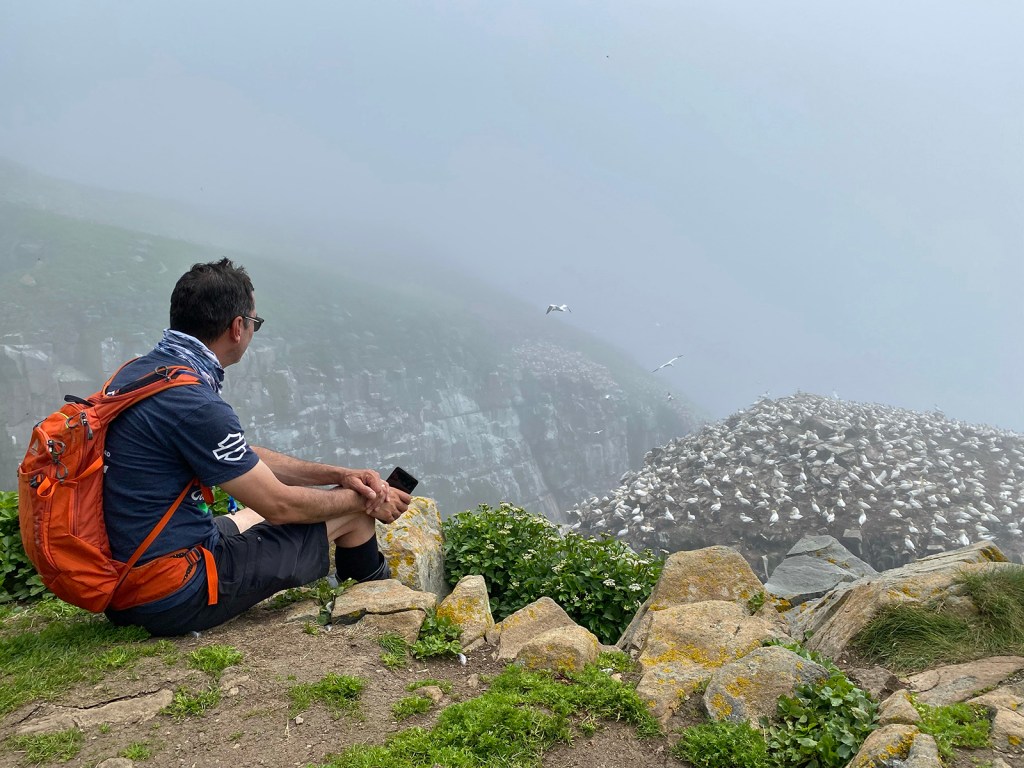
It was calming in a meditative sort of way, and I could hear the waves crashing in the cove hundreds, or was it thousands, of feet below. My perspective was distorted by the absence of anything familiar with which to judge distances.
The gannets are in trouble due to the Avian Bird Flu. Just a few years ago the rock was noticeably less populated, but it appears they have recovered to some degree, based on what we saw. The current Wikipedia page puts their numbers there at 24,000. The cape is a protected area and we’ll just have to hope that the bird flu, like our Covid, has passed through the community and numbers have stabilized.
Back in Saint John’s, it was our final evening together so we decided to treat ourselves to dinner out at Bannerman Brewing Co.. Later, we took another run at the pub night-life and met up with some new friends at The Ship for a drink. We’d met Mark and Mandy in Terra Nova National Park. They were two-up on an Africa Twin and we learnt they live in Bruce County, Ontario, where we had visited when we looped Georgian Bay. Mark is also a teacher so with two shared interests we immediately hit it off. Neither Mark nor I particularly wanted to talk about work, but I heard enough to know that the teachers in Ontario are facing similar budget cuts as teachers in Quebec. It’s sad to know that in a country as rich as ours, education is chronically under-valued and under-funded.
But it was summer and the start of semester was still a month away. The evening was warm and the ale assuaged any anxiety over the approach of autumn. It was a fitting way to end the tour. The Newfoundland geography had been everything we’d hoped it would be, and maybe some of that Newfoundland culture had rubbed off on us too—the connection with others, old friends and new. It’s a bit of a stereotype but Newfoundlanders are generally very down-to-earth and friendly. Maybe that has something to do with being so close to the elemental nature of the earth—rocks, cliffs, ocean, glaciers, grasslands, wildflowers, wildlife, and the ever-present, ever-changing climate.
People often ask me when I return from a tour like this for my favourite memory. In this case, it’s hard to isolate a single moment, although if I had to, it would be seeing the caribou at Point au Choix. But what I take away from the trip overall is a feeling, a mood, a style of living and life that is unlike any other with perhaps the exception of Dawson City, a similarly isolated community that pulls together against a harsh yet beautiful geography. I know Newfoundland is probably very different through the winter months than how we saw it, but I equally know that the people are just the same regardless of the season. We went looking for natural beauty and were not disappointed, but the discovery of the trip, at least for me, were the people. I can see how a place like this could get under your skin. We will definitely be back. As always, these trips are just a taste and leave one with an appetite for so much more.

The next morning, after saying our good-byes to Don, I dropped Marilyn off at the airport. I was now on my own and had given myself two days to cross the island again and get to the Port aux Basques ferry terminal. I still had a few things to see en route, like the airstrip where Amelia Earhart took off on her cross-Atlantic flight, the Gander airport, and the North Atlantic Aviation Museum. I was looking forward to riding The Cabot Trail, seeing good friends in Nova Scotia, and meeting a reader of 650thumper as I cut through Maine.
I’ll write about all this in my next and final post on this tour.


 650thumper