End of an Era

After 8 years and almost 100,000 kilometres, I pass Bigby on to new owners.

Saying good-bye to Bigby. A final chain lube and I handed over the keys.

The first night of my motorcycle training class, the teacher asked: “Okay, what do we have here? Who wants a sport bike? A cruiser? A tourer? An adventure bike?” Students put up their hands accordingly. I didn’t even know what an adventure bike was yet, but I knew I wanted something that would allow me to explore, and I didn’t want to be limited by pavement. The places I wanted to explore likely wouldn’t have any pavement.

At the end of the evening, I approached the teacher to ask about helmets. What would he recommend, full face or modular? At some point, I must have mentioned that my dream was to travel across Canada by bike. “You’re going to get a BMW, aren’t you?” he said. I guess he knew enough about ADV culture to know that is the most popular ADV brand, thanks to Ewen and Charlie, and KTM’s big mistake in doubting them. And in the end, he was right. After a little research online, I zeroed in on the f650GS as a perfect starting bike—low seat height, not too much power, well balanced, reliable, and easy to ride and maintain.

A quick search on Kijiji turned up one for sale near me on the West Island. It even had hard luggage and a touring screen, all set for cross-country touring. It seemed destined to be mine, and within a few days, it was. Getting that bike has been one of the best decisions of my adult life. It has connected me to friends, to readers, to a country, and to aspects of myself I didn’t know existed.
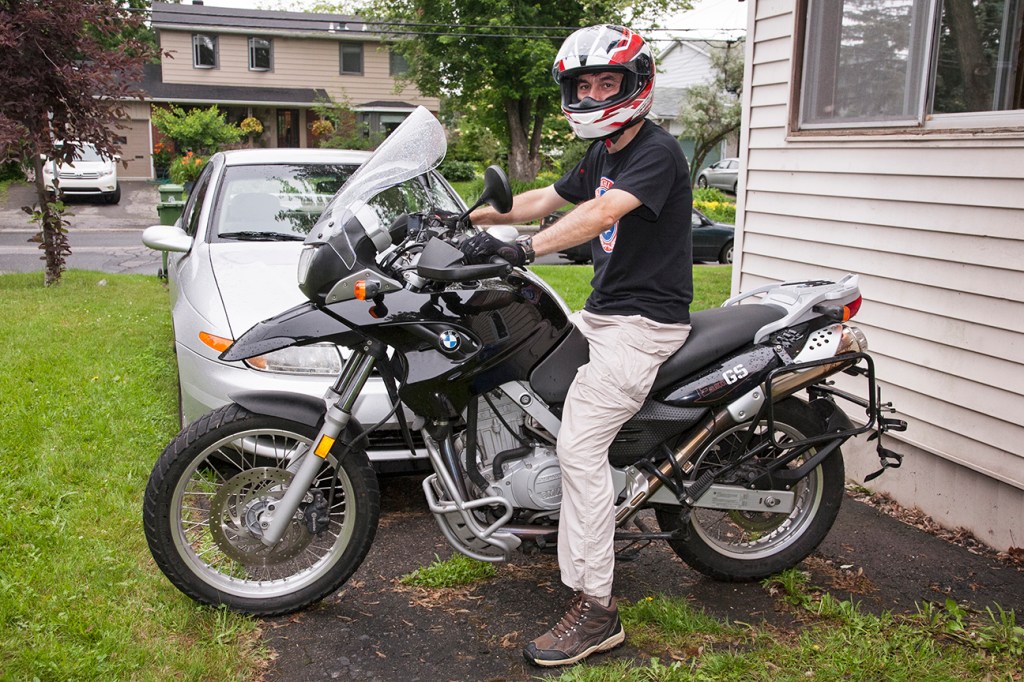
The first photo of me on the bike, June 2015. Lots of comments on Facebook about my lack of gear, but little did they know I didn’t yet have my licence.

It almost didn’t happen. The bike doesn’t have ABS, and I’ve grown accustomed to ABS in the car during winter when the roads are icy. I thought it would be essential for a new rider and not having ABS was almost a deal-breaker for me. But fortunately, the few people I consulted about my decision were not fans. One distinctly said, “You have to learn how to brake properly without it.”

So I did. I’ve heard of people who use only rear brake. Apparently, Honda mechanics discovered that the rear brake pads of Gold Wings were wearing out faster, much faster, than the front pads, which doesn’t make sense since most of the braking happens with the front. They concluded that Gold Wing riders weren’t using the front brakes, so they developed integrated braking—both front and rear come on, even if you only apply the rear. Smart. Honda engineers outsmarted the riders for their own safety.

My bike didn’t have integrated braking or ABS, so I had to learn how to brake properly. Mostly this meant squeezing the front lever, not grabbing, to load the front contact patch before pulling harder, and using just a little rear to stabilize the bike. I did this every time I stopped, even when cruising along the Lakeshore, at every stop sign and every light, front and rear in correct proportion, so it became muscle memory. Then in emergency situations, which I had, I didn’t have to think about it; the technique came “naturally” and I thankfully never tucked the front end, even once at speed in heavy rain on Heidenau tires in Northern Ontario when I rounded a corner to find someone backing up on the two lane Highway 101.
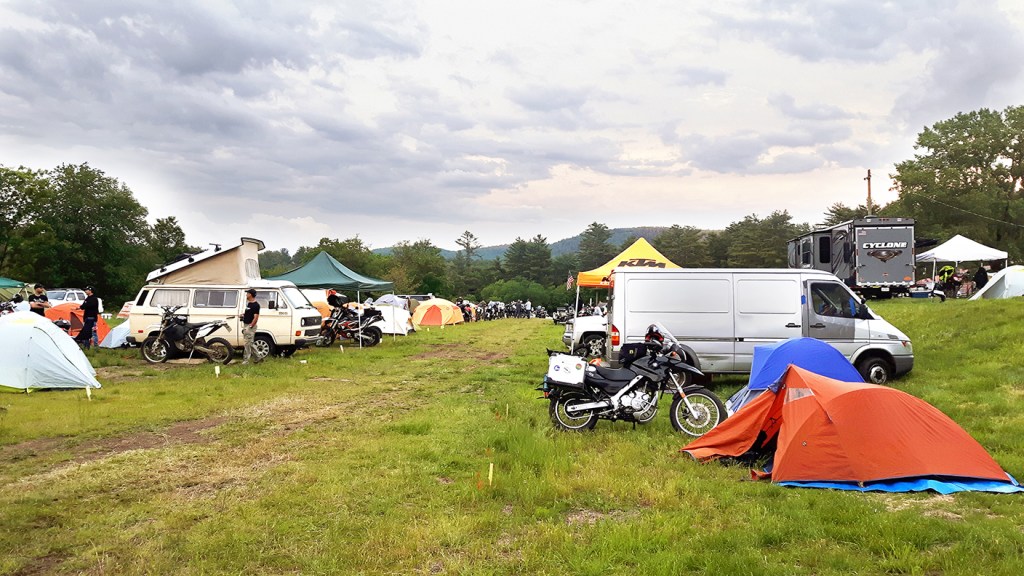
My first adventure bike rally, Dirt Daze in Lake Luzerne, NY. June 2017.

I knew I also needed to develop my off-road skills to become an ADV rider. I took a course at SMART Riding Adventures in Barrie, and another with Jimmy Lewis at the Dirt Daze adventure bike rally in New York. I joined Moto Trail Aventure mostly for the Rémise en Forme with a certified GS instructor, and the BMW Club of Québec for the same reason. (I actually planned to do rides with both clubs too but that never materialized.) This instruction set the perfect foundation for off-roading, and then it was just a matter of practice.

You don’t even need any dirt to practice off-road skills. I go up to my local church parking lot and do slow speed maneuvers. As Jimmy said, off-roading is all about balance and traction control, so I practiced the balance stuff on Bigby regularly. I also practiced the traction when I could, getting out of the city up onto the dirt roads and ATV trails in the Hawkesbury area. Bigby is a GS, which means Gelände/Straße (off-road/on-road), but I soon learned the limits of the bike. I never learned it street limits; I could lean that bike over and scrape the pedals, even with knobbies on, but I discovered its limits on the trails. The clearance was the biggest limitation, and the front suspension with the 19″ front wheel. It took some superficial damage for these lessons, but I also learnt not to lament the scratches. A fellow rider at my first Dirt Daze rally saw me brooding on my first scratch and said, “You can’t worry about that. It’s a bike.” The matter-of-fact way he put it set me straight.

I also had to learn my way around the engine. Knowing I would be riding into remote areas, I had to know the basics and how to fix problems. As I had with car mechanics, I started with an oil change, then coolant, brake pads, and brake fluid. I bought the bike with 35,000 kilometres on it, so it wasn’t long before I had to do the valves. That service was $1000 at the dealer, just to check them, so necessity was the mother of invention and with my trusty Haynes service manual, I did the valves myself in the shed. (I don’t have a garage, and my poor workspace has been the biggest obstacle to overcome. I’ve lost and found a lot of hardware on the driveway and in the grass!)
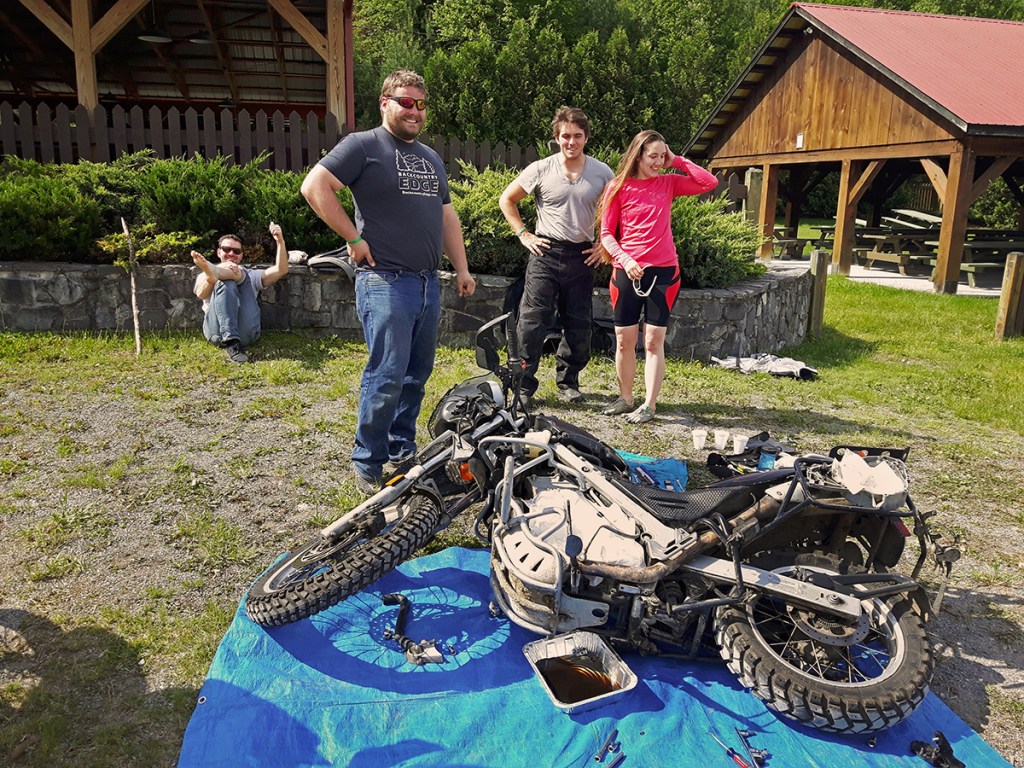
Problems at the 2018 Dirt Daze rally. A broken water pump left me stranded for much of the rally. MaxBMW shipped a new pump “overnight” which, due to the remote location, took most of the weekend to arrive, but I got home okay.

The Achilles heel on this bike is the water pump, and I’ve changed that a few times, including once at a rally because I hadn’t done it correctly the first time. (A plastic impeller gear wasn’t installed properly and rattled loose while off-roading.) That was the only time I considered selling the bike early, until I discovered the error was mine and not a fault of the bike. Once done correctly, the pump lasted another 40,000 K until I preemptively changed it before going across Canada.

The other big job was changing the swingarm bearings. That required removing the gas tank and subframe, so basically the entire back half of the bike. The pivot bolt was badly corroded and stuck, and it took two days of troubleshooting and, in the end, two hammers—a ball pane as punch, and a sledge hammer to drive—one on top the other, to get it out. But it eventually surrendered. Yes, I have cursed and praised this bike in equal measure over the years.

Success! Pivot bolt and swingarm removed for servicing. September 2019. Under the tarp at right is the gas tank and subframe. Headphones are for all the whacking needed to get it out.

I changed those bearings as well as all wheel bearings, clutch plates, the shock, rebuilt the forks, re-lubed the steering head bearings (which were in surprisingly good shape so didn’t need to be changed), and have had the dash assembly apart. And in the end, I restored those scratched body panels to make the bike look good as new.

My first trip on this bike was back to Ontario to show it to my dad, who used to ride. I left the day after getting my full licence. The next month I did my first moto-camp down at Loon Mountain in New Hampshire for their highland games. The following year, my first year with full licence, I went to Nova Scotia to ride the Cabot Trail, passing through Maine, Deer Island, and New Brunswick en route. I’ve also toured Northern Ontario, and these tours have led to some paid writing for northernontario.travel. So the bike has become for me more than a past-time. It has taken my writing in a new direction, and that of course refers to this blog too. I’ve made connections and friendships with people online, and met some of them in person during my travels. I hope to meet more of you in the future.

Off-Roading in Cape Breton, July 2017.

I have also met new friends locally in club riding. When I began, learners couldn’t ride without an experienced rider accompanying them, so I joined The West Island Moto Club, and some of these members have become my closest friends. I’ve done some touring with the club, but mostly I do day rides with them, and it wasn’t long before, with the right mentorship, I was leading rides.

One of the first club rides that I led. This was to Ottawa via Gatineau for the Tulip Festival. May 2018.

Some of my favourite riding on this bike has been in the northeastern states like Vermont, New York, and New Hampshire. I’ve ridden the Puppy Dog Ride on it a few times, and some of the Hamster Ride in New Hampshire, and Bayley-Hazen military road. The 650 GS is perfect for this type of light off-roading. I had a 15-tooth counter-sprocket on it for years, which gave it more low-end torque, and there’s nothing like feeling the pull of the big thumper as you climb a steep hill, or sliding out the back end as you round a corner.

Finally crossing Canada, July 2021.

Finally, after developing these riding and mechanical skills, modifying the bike to what was perfect for me, and waiting for Covid generally to be over, I completed my dream of crossing the country, and this bike, 15 years old and with over 100,000 kilometres on it, got me there and back. Ironically, the only issue I had was with a new battery I’d just installed for the trip. But the bike, fully loaded, pulled my wife and me over The Rocky Mountains, and took me up north of the Arctic Circle into some truly remote territory. The bike fulfilled its purpose for me—to learn about motorcycling, develop the skills necessary for adventure touring, and get me over the dangerous first few years of riding. It has been the best first bike I could have had, and now it’s time to pass it on to another new rider. Like me, the new owner has bought the bike before obtaining her licence. I’m sure it will be as good a beginner bike for her as it was for me. The engine is still strong, and I wish them both many safe and happy adventures in the future.
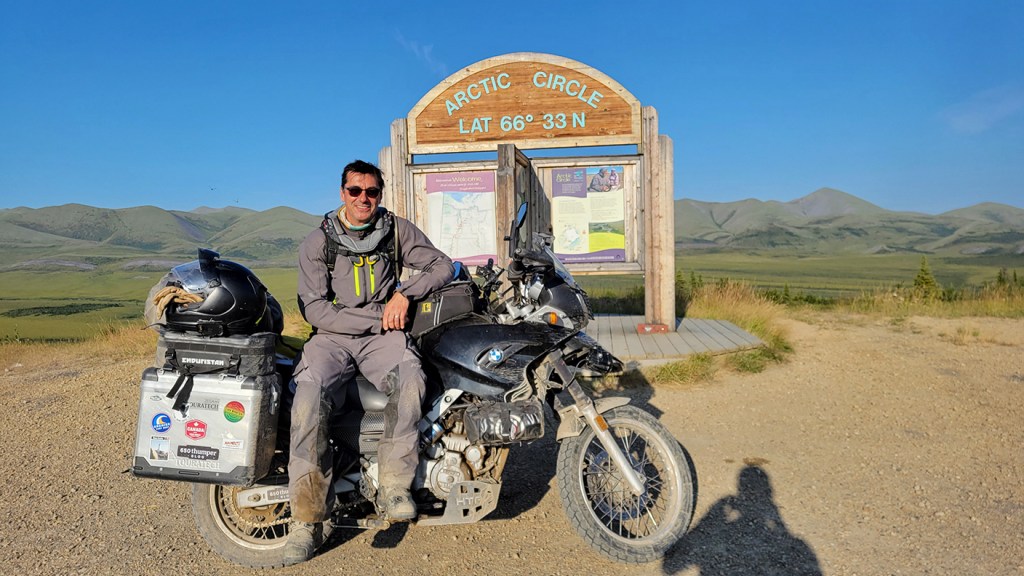
At the Arctic Circle, August 2021

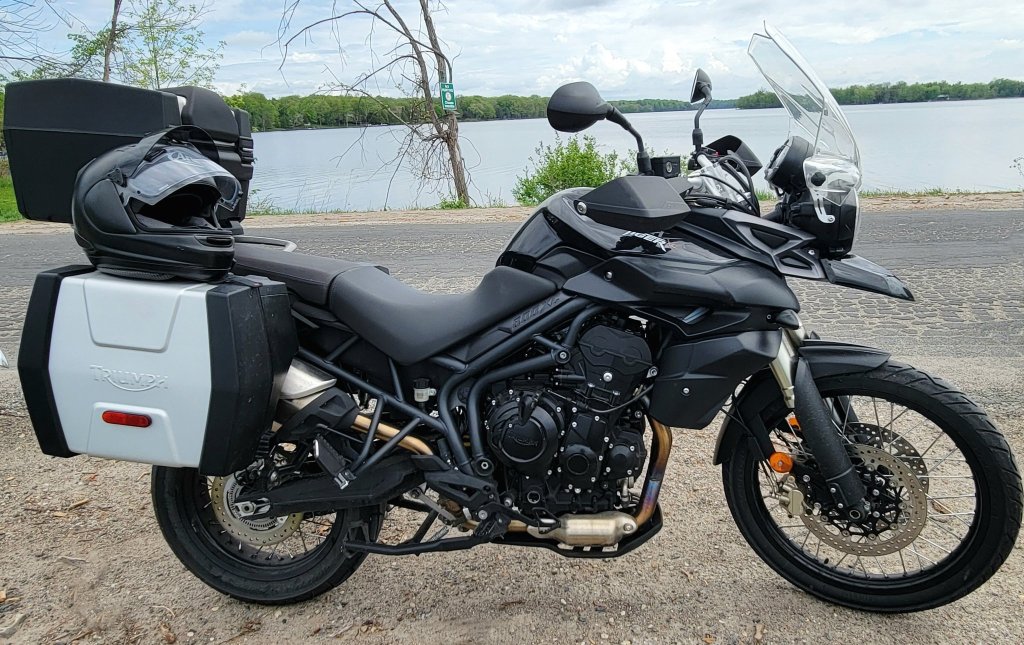
My new bike is a 2013 Triumph Tiger 800XC. The XC stands for cross country, so it’s also capable of light off-roading, and I’ll be taking it on BDRs and other adventure tours. It does has ABS, but being a 2013, it doesn’t have any rider aids, and as I read about the new bikes with throttle control, wheelie control, slipper clutches, and other traction aids, I can’t help thinking about what riders of those bikes aren’t learning. I’m happy to be learning how to control the power of this 94 HP engine properly, just as I learnt to brake properly on the GS. It’s going to take my riding skills to the next level. The blog will be keeping its URL and name in tribute to the bike that got me started and to which I owe so much.

Next season I will complete my cross-country tour by riding the East Coast. I plan to visit Gaspé, New Brunswick, Prince Edward Island, Nova Scotia and Cape Breton, Newfoundland, Labrador, and the north shore of Quebec including the Saguenay. I might try to ride solo up to Fort George on James Bay “on my way home.” This would allow me at least to set foot in Nunavut. I also plan to ride the Mid-Atlantic and North-East BDRs next summer, if I can get it all to fit. So stay tuned, my friends. The journey continues.

At the Awesome Players sandpit, Hawkesbury 2020

Afterword

The Great White North

Some observations on Canada and long-distance touring

Most mornings, Facebook shows me a memory from this time last year, so over the past few weeks, I’ve been reliving my trip across the country, day by day. I’ve also been thinking about it as I write up these blogs, and now that I’ve completed the individual blogs on each segment of the tour, I thought I’d write some more general observations as I step back and reflect on the trip and the country as a whole. Here are five observations, in no particular order.

1. Six weeks isn’t nearly enough time to explore this vast country.

Canada is huge and the distances are immense. Our days were jam-packed, staying just one or two nights maximum at each place before we had to “push on” (a refrain on this tour). Yes, I crossed the country, twice, but far too much of that riding was on the Trans Canada and other major highways than I would have liked. In fact, it was only once I got off the freeway that I was able to experience any geography, history, and culture at all. My need to cover distance was in constant conflict with my desire to slow down and see more of what I was passing. I felt that this trip was really only an overview of many more to come, and I’ll need to spend six weeks in each province to really have a sense of the depth and diversity of Canada. So I’m going to consider this trip as exploratory; a deeper discovery of the country will have to wait until my retirement.

2. One tire cannot do it all.

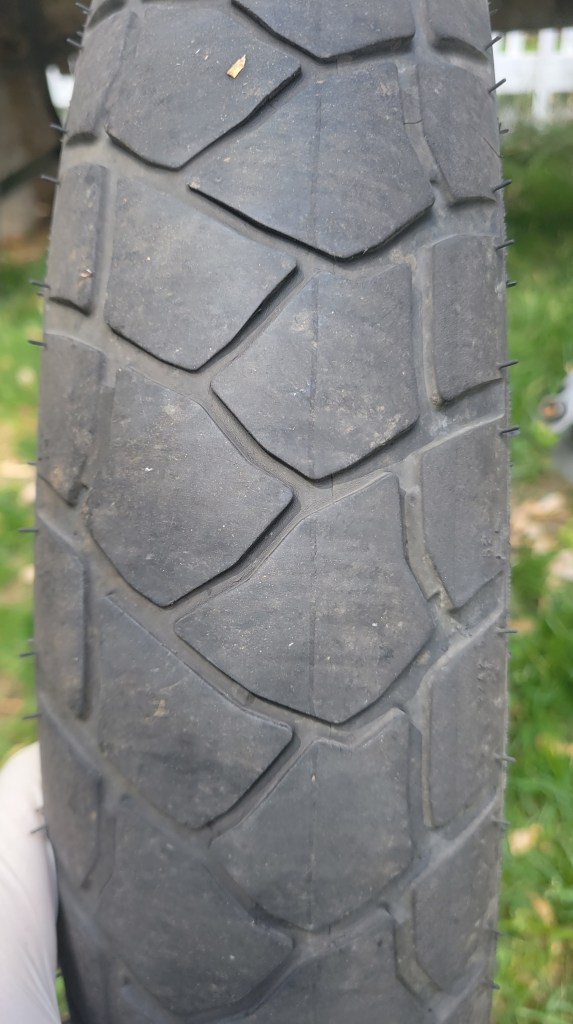
I decided to use Michelin Anakee Adventure tires, an 80/20 street/off-road tire, because I wanted something relatively smooth and long-lasting for all the asphalt I would be covering. In the end, I was able to do the entire tour without changing my tires—that’s all 20,000+ kilometres on the same tire. This is what the rear looked like shortly after my return.

As you can see, there’s still some good tread left in this tire. So if it’s longevity you are looking for, the Anakee Adventure is a good choice.

However, I was vulnerable when I went off road, particularly up The Dempster. If it had started to rain, the dirt would have turned into mud and I would have been in trouble. The problem is that there were actually two very distinct kinds of riding on this trip: largely asphalt to cover the miles, and sections of dirt or gravel when I could afford it. Ideally, I’d have shipped more aggressive off-road tires out to BC and put them on before heading north. This is exactly what many people do: ship TKC 80s to Dawson City and put them on before hitting The Dempster. A 50/50 tire like the Heidenau K60 Scout would have been another option, but the more aggressive tread on those tires is noisy on the road, despite the centre strip. (In fact, in the 650GS tire size, there is no centre strip, and the rear flattens quite quickly.) The next time I attempt The Dempster, I’ll be starting in BC and will use an off-road tire, even if it means burning through that rubber on the pavement.

Another problem with the Anakee Adventure tires is that they are quite vibey on asphalt. The hard compound down the middle of the tire results in long tire life but at the cost of vibrations. I used my Kaoko throttle lock whenever possible but my right hand still developed some numbness and tingling. I’m convinced that if this were my regular tire choice, I’d develop nerve damage. The long days, day after day, led to numbness that didn’t completely dissipate for months after my return, well into the off-season. In this respect, I might have been better off with a 90/10 tire like the Michelin Anakee 3 than the Adventure.

In sum, if I were to do it all again, with 5,000 kilometres to cover before I get to serious dirt, I’d go with a true street tire to get me across the country, then switch to a true off-road tire for playing in the dirt once I’m out there. Adventure riding is all about compromises, but when your safety is involved, there are no compromises: if you are doing any technical or remote dirt riding, use an aggressive dirt tire.

3. French and the Problem of Québec

Everywhere I went, I heard French. I sat in a diner in Smooth Rock Falls, Northern Ontario, and heard four older men in the booth next to me speaking French. I sat at the base of the Nisutlin Bay Bridge, Yukon, during a rest stop and had a conversation in French with a man who has been living in Yukon for over 20 years but whose native language is French. I walked into a supermarket in Whitehorse and heard two people in the produce section talking in fluent French. I heard French in every province, and I’ve heard it of course in Acadian Nova Scotia and elsewhere on the east coast. The French language seems to be surviving just fine outside of Québec, without any Bill 101, ridiculous sign laws, or punitive Office de la langue française.

I mention this because, last May, the Quebec government passed Bill 96, which essentially extends Bill 101 beyond high school to the college level. What this means, among other things, is that all students graduating from any college in Quebec will now have to pass a French language test. It’s really more than a test of basic competency; students have to analyze a piece of French literature and write an essay exhibiting that understanding with a minimum of expression errors. Errors are counted and, after a certain amount, the student automatically fails. It’s quite difficult, and many students who have been educated in French their entire lives struggle to pass this required exam. Now even anglophone and allophone students who have gone through an immersion program in which some, but not all, courses are taught in French will have to pass the same test. It’s not clear yet how they are going to do that, or what kind of resources will be available to help them.

The rationale stated by François Legault and his Quebec government for these Draconian measures is that French is disappearing, but to my knowledge they’ve never actually presented any specific data to support this claim. Many of my friends and colleagues—not all English Quebecers, I should add—think this bill has little to do with protecting the French language and everything to do with cultivating a victim mentality in Quebecers, perpetuating the idea that they are somehow besieged by a foreign power such as the Federal Government (the favourite scapegoat) or English North America (as if North America were all English). Some even theorize that restricting access to education in English—except for those who can afford to send their children to private school, where such restrictions do not exist—keeps working class Quebecers “in their place,” just as The Catholic Church did until the Quiet Revolution of the 1970s. Even if French is in trouble—and I’m questioning whether it is—forced unilingualism is not the answer. In Europe, learning multiple languages is the norm, not the exception, even in countries like Hungary, which is a linguistic minority within a larger demographic, comparable to Quebec. (Elementary students there have the option of Hungarian and either English or German. I know because my son did a year of school in Hungary when he was in Grade 3.) Learning French does not have to be at the expense of learning English. We can teach both languages effectively, if there is the political will.

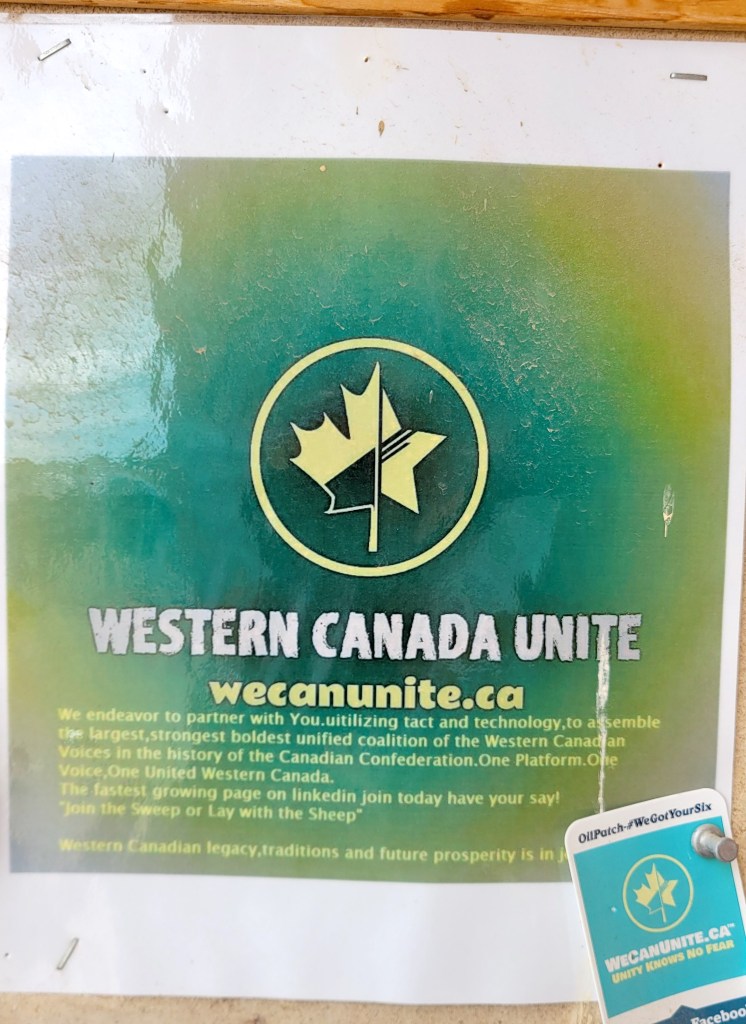
But the problem of Quebec extends beyond the issue of language. Quebec has managed to leverage the threat of separation successfully to entrench special privileges and special status within Canada. Many people might be surprised to know that Quebec gets more in equalization payments than all the other provinces combined. This is because, somehow, when those formulae were developed, Hydro Quebec was exempt from the calculations, making Quebec appear on paper like a have-not province. Removing Hydro Quebec, one of the province’s major employers, from Quebec’s calculations is like removing the oil and gas sector from Alberta’s. It’s time we opened up the equalization formulas and retooled them to make Quebec start pulling its weight in the confederation. There’s a lot of resentment out west towards the status quo, as evidenced by this poster seen outside an outdoor store in Northern BC.

The sense out west that Canada is run by Ontario and Quebec is nothing new. Remember that The Reform Party started out west, as did The Green Party. Quebec is not a have-not province and doesn’t deserve special status or extra money. It’s time that Quebec decides to be either an equal player in Canada or to get out and become the nation it clearly pretends to be by using language like “national” programs, “national” parks, and a “national” holiday.

And while I’m on this subject, I’ll add that I was upset that Montreal did not have a Canada Day parade (July 1st) this year, and rumour is that there won’t be a budget for it in the future either. The decision to cancel the parade had nothing to do with Covid, as there was a Ste. Jean Baptiste parade just a week earlier. I think that if the Quebec government thinks so poorly of its membership in Canada that celebrating Canada doesn’t warrant a parade once a year, perhaps it should give back some of the $11.7 billion it receives of the total $19 billion in federal funds transferred to provinces (latest available numbers). But of course it won’t. Under the current cozy situation, Quebec would be foolish to separate. It’s become dependent on the hand-outs to subsidize an inefficient economy.

When my wife was living in Alberta, if she got sick, she’d phone her doctor and get an appointment for later that day. In Quebec, you’re lucky if you have a doctor. Health care is a mess, our roads are a mess, and as a teacher, I see everyday the effects of chronic underfunding in our education system. Yet Quebec has the highest taxes in North America. Where is all that money going? The Quebec government has replaced The Church as the benevolent Big Brother taking care of “its people,” an argument developed more fully in a recent op-ed piece by Vanessa Sasson. I’ve put “its people” in quotation marks because 99% of the Quebec civil service is still white francophones, a statistic that hasn’t budged since the 1970’s. Corruption and a bloated, inefficient civil service are draining the public purse; there are simply too many people at the trough.

Another controversial bill recently passed here in Quebec, Bill 21, targets religious minorities. It prevents anyone in the public sector, including doctors and teachers, from wearing religious symbols, as if those items would somehow influence or prejudice their work. For Christians, this isn’t a significant problem, but for many Muslims, Sikhs, and Jews, they must choose between their religious garb or their careers. No one should have to make that choice, certainly no one in the Canada I know. The standard line given by Legault to defend Bill 21 is that “the majority of Quebecers support it,” an argument that has at its heart the logical fallacy known as Appeal to Popularity (sometimes called Appeal to Ignorance.) I teach this fallacy by reminding my students that at one time slavery was the popular economic model. The fact that it’s popular doesn’t make it right.

Here’s a confession: in the last provincial election, I voted for Legault’s CAQ party. I was tired of paying half of my wages to the government and still having unacceptable roads, health care, and education standards. I was tired of the corruption in the construction sector that has held Montrealers hostage for decades. I’d heard of scandal after scandal at all levels of government, and hoped that Legault, a co-founder and CEO of Air Transat before going into politics, would be a fiscal conservative with the strength of character to do some much-needed restructuring of the Quebec economy. But he hasn’t done anything of the sort. Instead, he’s focused almost exclusively on a social agenda to solidify his grip on power, playing to his rural base and exploiting the most repugnant racist and xenophobic aspects of Quebec society.

What has Prime Minister Trudeau done about this wave of racial nationalism gathering in Quebec? Nothing. Absolutely nothing. He needs the Quebec vote too much in order to cling onto his own weakening power. So while he talks a lot about values and morals and draws a hard line against those he claims hold “unacceptable views” in Canada, he allows the Legault government to crap all over the Charter of Rights and Freedoms his dad helped draft and ratify, unwilling to protect religious and linguistic minorities in his home province.

If he had reformed the electoral system, as promised, and made every vote count, regardless of where you live, he would not be so beholden to “the Quebec vote.” But of his three major election promises—reform the electoral process, reform the Senate, and legalize pot—he’s managed to legalize pot. The other two promises were dropped once he learned, after studying the matters carefully (at considerable expense to taxpayers), that they were not politically advantageous to him and his party. Prime Minister Trudeau talks a lot about social justice, equity, and protecting minorities, but he is essentially—we must remember—a drama teacher. He’s acting, and these days there isn’t much genuine coming out of his mouth.

I don’t usually get this political in my blog, and I don’t really want this place to become heavily politicized. But I love this country, and if I can’t get off my chest here, in a blog reflecting on Canada, what I think are some problems we are currently facing, then where can I? And I feel that, having lived in Quebec since 1990, I’m qualified to give some constructive criticism of it. No one else is. You don’t have to agree with my observations and comments, but like in my teaching, I say if we can’t have civil and open discussions about difficult issues, then our problems run deeper than the health of the French language or the status of Quebec in Canada. What do you think? Feel free to drop a respectful comment below.

4. The Orange Summer

At Cathedral Grove, Vancouver Island

All summer long I saw orange garments hanging randomly in trees, and church steps lined with children’s shoes and toys. Some people have referred to last summer as The Orange Summer, a time of reflection and reckoning in the hope of eventual reconciliation. We are very early in this process and much has still to be determined with regard to what a reconciliation would look like. I don’t really have any suggestions, nor is it really my place to make them. But I believe that all relationships are healed through communication, so let’s start there. I believe we will get further faster by talking than pulling down statues. What is clear is that there is an enormous amount of pain out there to be addressed. I thought it was à propos that on my final day of riding, as I rode the 417 down from Sault Ste. Marie, I passed on a stretch of that highway a small contingent in orange T-shirts walking with police escort at the side of the road. A sign on a support vehicle read “Walk of Shame.” I recently saw another roadside sign, this one in Kahnawake, indigenous territory on the south shore of Montreal. This one read, “Legault, hands off our children,” a clear reference to both Bill 96 and residential schools. Are we making the same mistakes again—an authoritative government who think they know best what is right for your children? Have we learnt anything through years of suffering?

Let’s hope that the indigenous peoples of Canada get an apology from Pope Francis when he visits next week. It’s long overdue and a crucial element in collective healing. Then we need a thorough investigation into what happened to those children and hold those to blame accountable. There’s much more to address—difficult work of hashing out treaties—but it seems to me that would be a good start.

5. Heat and the Big Thumper

The 650GS did great the entire tour. I really can’t complain. With over 100,000 kilometres on it and fully loaded, it pulled Marilyn and me over those Rocky Mountain passes in the heat, and it was hot! The battery let me down a few times, but the mechanics of the bike are sound. It’s a great little adventure bike.

Are you sensing a but, dear reader? The 650GS is happiest under 100-110 km/hr, and much of my riding on this tour had to be >120 km/hr, just to cover those distances. This is a bike for secondary highways, not freeways. It is a classic European touring bike, but all of Europe is about the same size as Canada. Those days crossing the prairies, 6+ hours at 5,500 rpm, were not fun, and as I’ve said, I developed some numbness in my throttle hand due to vibrations. By the time I rolled back into the driveway, I was ready for something a little more powerful and a lot smoother.

I also found it difficult to regulate oil level during this tour. It’s difficult with the dry sump system at the best of times, but the varying temperatures and types of riding on this tour made it all the more challenging. The extreme heat, and riding at high revs for hours, led at times to oil rising so high in the reservoir that it spilled into the air box, where it leaked down the side of the engine and baked onto the skid plate.

Shake and bake

It’s possible that I over-filled the bike, but rather, perhaps I was just asking it to do a little more than it was designed to do. I’ve been pushing this bike beyond its limits on and off road.

People have since told me that, for a tour like this, I should have used a 1200 or 1250GS. The big boxer cruises at 120 km/hr, and like its predecessor of another era, the Honda Gold Wing, it eats up the miles. I’ve considered getting a big GS, but I like the dirt too much, and my skills just aren’t capable of taking a 600 lb. bike off road. I’ve had my eye on the Yamaha Ténére 700 (T7) for some time, and the World Raid version looks just the thing for my long distance adventures. Unfortunately, once it gets to Canada, it will be probably close to $20G—a little beyond my budget for now.

I also considered an 800GS. This would be the obvious upgrade to the 650, with a similar Rotax engine and the fuel tank under the seat. But a parallel twin is also prone to vibrations at highway speeds; isn’t it basically a big thumper but with two cylinders? So I started looking at it’s main competitor, the Triumph Tiger 800. From everything I’ve read, the essential difference between the two bikes is that the BMW is better off road, the Triumph better on road. That inline triple has a lot of character and is silky smooth. With 94 hp, it has more than enough power for two-up touring. And if I am being completely honest, most of my riding is on road, even when touring.

So here is my big announcement. After a lot of research, I’ve bought a 2013 Triumph Tiger 800XC. It only had 14,500K on it, so looks and feels practically new. It has been maintained well with regular service and always stored in a heated garage. I’ve put over 7000K on it already this summer and love riding this bike! I can’t wait to do some long-distance touring on it.

Don’t worry: the blog is not changing its name. I will continue to write about my adventures here, having built a little following. I’ve ordered crash bars and a beefier skid plate and so the slow conversion to off-road riding has begun. But for this summer, I’m happy to ride it stock with street tires and just enjoy this engine. It looks, feels, and sounds like a jet, so that’s what I’ve named it.

As for Bigby, I’ll be selling it when the market heats up at the end of season. I know that many potential buyers will be nervous about buying a bike with that many kilometres on it, but anyone who knows the 650GS knows that the engine is bullet-proof and that these bikes are over-engineered. There’s still plenty of good riding and adventures to be had on Old Faithful.

As I write this, we are about halfway through the summer. I’ll be taking the Tiger on day trips and perhaps a few overnights, but mainly just getting familiar with it. I’m planning a similarly big east coast tour with it for next summer and so will be getting some stronger panniers and doing other mods to set it up for adventure touring. I’ve received some queries from readers about my gear, so I’ll also be writing some blogs about what has worked for me. I hope you will stay with me, regardless of what you ride, as we continue the journey.

Ride Safe

Don’t believe everything you hear: there’s a way you can ride safely.

If there’s one motorcycle expression I hate it’s “ride safe,” and not because I’m an English teacher. I know the sentiment expressed is of concern, just as I know the expression is grammatically incorrect, but I also know the risks every time I pull on my helmet and throw a leg over the saddle. Saying “ride safe” to a motorcyclist is like saying “Hey, you know you’re working on a no-hitter?” to a pitcher sometime around the bottom of the seventh. Don’t think he or she isn’t aware of it, and drawing attention to this fact is not really helping.

I delayed my dream of riding a motorcycle for decades because someone told me it’s irresponsible to ride if you’re a parent of young children. When I started riding, in my first year, I overheard a club member say, “It’s not a matter of when but how bad.” He was recounting an accident of another club member and it scared the s**t out of me. I resisted watching YouTube crashes for as long as my curiosity would let me. And when I politely tried explaining to a colleague who had expressed a similar dream of riding how he might be able to do it safely, he wrote me later, half-jokingly, “My wife says I’m not allowed to talk to you anymore about getting a motorcycle.”

Riding is not as dangerous you might think, provided you follow a few basic principles.

Trust me: we are aware of the risks. We face them in one form or another, whether in personal experience (“Phew! That was close.”) or public perception (“donorcycle,” and in Quebec, “mortocycle, ha ha). But I’m going to go out on a limb here and say that riding is not as dangerous you might think, provided you follow a few basic principles. I’m not going to argue that it’s as safe as driving a car, because it clearly isn’t, and stats don’t lie, despite what Mark Twain says. But if you do it the right way, you can minimize the risk significantly, lowering it to a reasonable probable return on investment instead of willed denial of your mortality.

As I see it, there are five key factors to staying alive.

1. Start the right way: do a good training course.

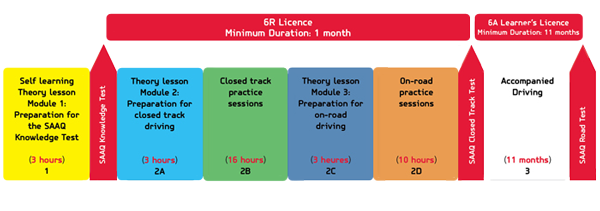
Riding is a skill, and like any skill, you can learn it either through trial and error or through some guided instruction. I say this is one you probably want to learn using the latter. I wish I’d taken a few classes at a pro shop before I took up golfing in my early teens; it would have saved me a lot of frustration and some fairways a few nasty divots. Surprisingly, or maybe not surprisingly, Quebec is the exception in Canada by making a certified skills course mandatory. I haven’t researched the licensing requirements of the various U.S. states, but if I know anything about the founding principles of that country, I suspect the term “mandatory” does not appear very often in their licensing documentation. This is such a shame because I learnt a ton from my skills course. It consisted of 6 hours of theory and 26 hours of practice, including 16 hours closed track and 10 hours guided road practice.

Doing a skills course apparently gains you the equivalent of about two years of riding experience.

We learnt everything from the correct way to get on and off the bike to throttle control, clutch control, counter-balancing, counter-steering, target fixation, emergency avoidance, emergency braking . . . everything except for how to wheelie, unless you forgot to lean forward when practicing emergency accelerating. And yes, we learnt, inevitably, how to pick up the bike correctly without damaging your back. By the time I did my road test, I was a pretty confident rider with a solid foundation in the basic skills with some developing muscle memory. Doing a course like this apparently gains you the equivalent of about two years of riding experience and, more importantly, gets you safely through that critical newbie period when the majority of accidents occur. It should be mandatory everywhere, and not taking one voluntarily is just stupid.

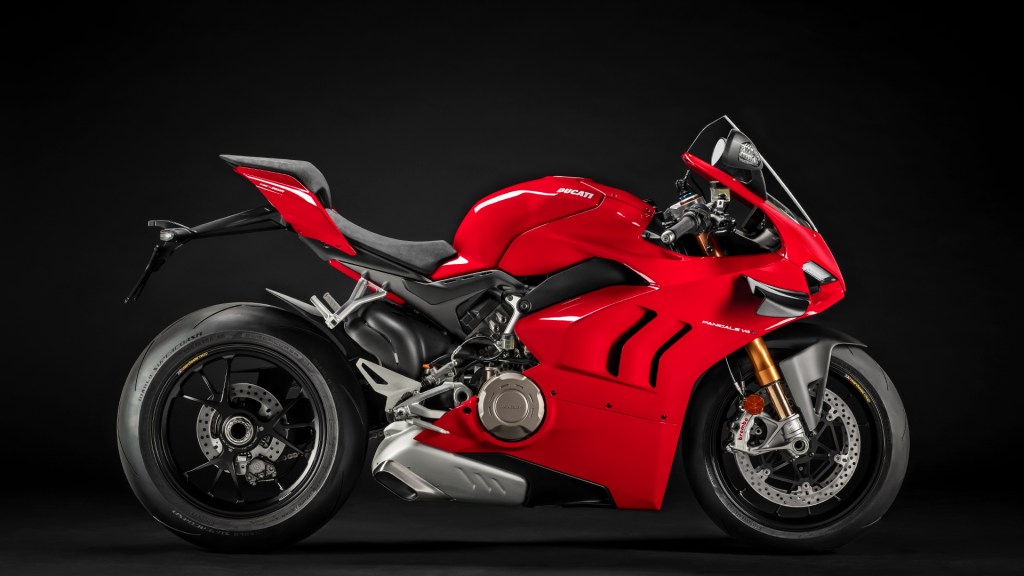
The 2021 Ducati Panigale

2. Choose the right bike

If you look at the mortality statistics, most deaths are young men. And if you are a young man and look at a Ducati Panigale and don’t feel a tingle of excitement in your nether-regions, see your doctor. Young men are looking for power these days and will find it in action movies, guns, games, or engines. Now imagine it’s 150 years ago, before the invention of automobiles, and Junior is about to learn how to drive the family wagon. He nervously climbs up onto the platform and takes the reins in trembling hands. Ahead of him are 214 horses harnessed together stretching up over the hill into the neighbouring farm. Does that make sense? The Panigale’s V4 delivers 214 hp at 13,000 rpm and 12.6 kgm of torque. That’s a lot of power to control your first time out.

I suggest starting on a bike no bigger than 650cc in size. Smaller is even better. There’s nothing wrong with a fun little 250 for your first few years of riding.

In Europe and some provinces in Canada, you have to start on a small bike and work up to a big one. For example, in the EU, if you are under 18 years old, you must start with an A1 license that allows you to ride a bike with up to 14.75 ponies. That’s a scooter, moped, or a “real” motorcycle up to approximately 125cc in size, so basically a sewing machine on wheels. (The size of the engine is less crucial than the power to weight ratio, but we’ll stick with cc numbers for simplicity’s sake.) If you are 18, you can start with an A2 Restricted license and a bike in the 250 to 500cc range. After two years, you can graduate to a full A1 license with no power restrictions. It’s a little more complicated than how I’ve summarized, but the essential idea is that you start on a small bike and after a certain amount of experience can ride a more powerful bike. This makes a lot of sense to me since it’s the weight and power that you have to learn how to control.

So if you are shopping for your first bike, despite the licensing in your region, do you really want to start on a litre bike? Don’t listen to the argument that you will “outgrow” a smaller bike. That’s the point: don’t die. I suggest starting on a bike no bigger than 650cc in size. Smaller is even better. There’s nothing wrong with a fun little 250 for your first few years of riding. In A Christmas Story, Ralphie finally gets his Red Ryder BB gun, but we suspect the story would have a different ending if it were an automatic rifle under the tree.

3. Ride with a club, at least for your first year

I’ve written about the benefits of club riding already. A key one is that you will be riding with experienced riders who know how fast to take a corner, how to adjust their riding in rain or after dark, when to take a break, and generally how to stay safe. It’s Darwin’s theory of natural selection in practice, only what is passed on here is not DNA but sound advice gained from lived experience. Again, here in Quebec, for your first 11 months of riding under a probationary license, you have to go out with “an escort.” (Pro Tip: if you are a married man, be sure to explain to your wife than an escort in this context is someone who has had a full license for at least two years.) A few years ago, the Quebec government scrapped this requirement, changing instead to the stipulation that beginners can ride only between sunrise and sunset. I guess that experiment didn’t go well because they’ve brought it back, much to the chagrin of newbies.

If you are starting to ride, go find a club to ride with. If you are a club that doesn’t accept newbies, shame on you.

When I started riding at the ripe old age of 52, I didn’t have any friends who rode, but I was fortunate to find a local club that accepts learners. It allowed me to ride that first season, putting in over 10,000 kilometers and gaining crucial muscle memory. According to the Hurt Report, the most comprehensive study yet on motorcycle fatalities, over half of accidents that occur happen within the first five months of riding, so my club got me through the most critical period of learning. Club riding is safe also because group riding is more visible to drivers than a solo motorcyclist. The most common type of accident is a car turning left in front of a bike at an intersection because the driver didn’t see the motorcycle. Ryan F9 has done an interesting video explaining the physiological reasons for this blindness. One can forgive the oversight of a single headlamp, but if you missed the dozen motorcycles coming at you through the intersection, put your phone away when driving.

There is some informal coaching that occurs off the bikes too, and as an added benefit, you develop friendships that last well beyond the probationary period (of your license, that is). So if you are starting to ride, go find a club to ride with. If you are a club that doesn’t accept newbies, shame on you.

At the Manic-5 dam on a club ride

4. Get the gear

Quick quiz: of the riders pictured above, which catch your eye first? Duh! I like what Clinton Smout says about this: it’s not loud pipes that save lives but loud colours. Don’t want to appear nerdy? I get it. It doesn’t take much to catch the eye. That’s why I’m wearing that single armband over my black jacket (far right, so to speak). You don’t need your jacket to be the equivalent of leaning on the horn when a little “beep-beep” will do to get attention.

Want to wear that classic black leather jacket? Go ahead, but consider some colour in your helmet. Want to wear a black helmet too? Get some auxiliary lighting to increase your visibility. A single headlight can get lost amid the many lights on the road today, but if you can arrange your aux lighting to form a triangle with your headlight, that will significantly increase your chances of being seen. Don’t want to get aux lighting because it cramps your style? At least flash your high-beam as you approach an intersection if you are not sure that driver turning left has seen you. When the majority of multi-vehicle accidents are caused by not being seen, anything you can do to increase your visibility will help.

According to data collected by Dietmar Otte and cited in Proficient Motorcycling (Hough 38), as much as one-third of impacts on the helmet are on the chin bar, so a full-face helmet provides significantly more protection than an open-face helmet, and significantly more protection than, uh, no helmet at all. New Hampshire is one of three states without a motorcycle helmet law, which might explain why their license plates read “Live Free or Die.” Perhaps they should say “Live Free and Die.” Seriously, I don’t want to sound preachy about any of this. What you wear on the bike is entirely your decision, but if you want to ride as safely as possible, get a good helmet, preferably a full-face with a Snell rating, which is the highest rating for safety.

When the majority of multi-vehicle accidents are caused by not being seen, anything you can do to increase your visibility will help.

Now that you’ve protected your head, you might consider protecting the next most vulnerable part of your body—your neck. Last year I started wearing a neck brace. It sits on my shoulders and obstructs the helmet on impact from being pushed beyond the limits of my neck. An independent study found that a neck brace significantly reduces the probability of serious neck trauma. It’s comfortable and once I put it on, I forget that it’s there. I’m confident that, in time, neck braces will become as common and perhaps even as required as helmets. If you want the ultimate protection, consider an air vest. This technology is developing rapidly today in terms of improved algorithms, ease of use, and cost. I suspect that they, too, will become the norm, as air bags have become required in all automobiles since 1998.

This is a big topic and I don’t want to loose sight of the forest for the trees. Let’s just say that there is a lot of excellent protective gear available today, incredible stuff like D30 that wasn’t around even a decade ago. A jacket and pants with good abrasion resistance, CE2 rated armor, a back protector, boots, and gloves complete your kit and are an important part of minimizing risk.

5. Have the right attitude

I’ve been driving a car for close to 40 years and have never had even a fender-bender. There’s more to this boast than skill. It’s mostly a product of awareness of my environment and the ability to anticipate problems before they occur. It’s also not pushing my limits in any dangerous way; you have to save a little buffer, say 15%, for the unexpected. Sometimes it’s listening to my body when it gets tired, and sometimes it’s listening to my gut when it knows I’m heading into danger. My dad used to say that his stomach tells him when he’s speeding before his eyes and the speedometer do. And sometimes it’s a faculty that can only be called intuition if not luck. Once he raced off towards Portsmouth, enjoying the speed, when some voice inside told him to take it easy, so he checked his speed. A little further down the road around a blind corner a pile of dirt had been dropped on the road, probably from a farmer’s cart. That would have been real trouble. Mulder and Scully never investigated any of this paranormal phenomena, but they would have made pretty safe motorcyclists, I imagine.

I know a guy who uses a mantra to get in the right frame of mind as he gets ready to ride. As he pulls on his helmet, he thinks to himself, “Everyone wants to kill me.” That’s pretty good, albeit a bit negative. I like to think of my helmet as an invisibility cloak, like Harry Potter’s. And that makes me think of my son.

My wife did a little riding with me this past summer. I don’t push it with her on the back, not only because of the, eh hem, extra weight that affects the bike’s dynamics, but also because I figure a pillion is already nervous; there’s no need to ride like an idiot to impress. And after one such easy ride, she said—referring to the whole safety thing—”I get it,” by which she meant it’s only as dangerous as you want to make it. You are in complete control of your risk. I’m not saying you can eliminate all risk—there’s always bad luck—but how much risk you want to take on a given day is literally in the palm of your (right) hand.

I know a guy who uses a mantra to get in the right frame of mind as he gets ready to ride. As he pulls on his helmet, he thinks to himself, “Everyone wants to kill me.”

There are books written on motorcycle safety, and websites and YouTube channels devoted to the technical details of the subject. But to simplify it all, there’s a clear pathway to entering the sport safely: do a course, get the right bike, join a club, buy the gear, and adopt the right attitude. I no longer believe that a crash is inevitable, although risk is certainly a part of riding that we have to manage.

Ironically, I’ve never written a post about safety, although it’s the first thing that comes to most people’s minds when you say you ride. “Isn’t that dangerous?” they ask. Yes, but then so is taking a dump. Think of Elvis. I was really good when I was young at postponing immediate gratification. I was a good boy and buckled down to put myself through university, then I postponed responsibly to raise a child. I oriented my life toward the big golden pot of retirement at the center of the cartoon maze. But when you get into your 50s, you begin to see friends, neighbours, acquaintances, perhaps even family who sadly never make it to the golden years. There’s risk in not doing what your heart desires too, whatever that may be.

So if you’ve always wanted to ride, don’t let your mind talk you out of what your heart is saying. Go ahead and get a bike, but do it right. Ride safe, yes, but more importantly, ride smart. I mean, smartly.

Have I missed something essential to staying safe? Please comment, follow, and share (not because I get any more money—the site is not monetized—but because I like an audience).

The 11-Month Itch

'How sweet, he's smiling.  He must be dreaming about me.' (Man is dreaming about a motorbike).

It’s been 11 days, 12 hours, and 13 minutes since I last rode my bike. It sits in the shed, and once in a while I take it out and poke about with it, then put it back. Yesterday I got as far as putting my biking pants on and fetching my helmet before prudence caught up to me at the front door. It was a beautiful day, perfect weather, and there was nothing wrong with my bike. Why, you ask? Because here in Quebec, for the first 11 months after obtaining a learner’s licence, you have to ride accompanied by someone with a full licence, and the few people I know who ride have been busy. I’m in biker purgatory, limbo-land, the 11-month itch.

Obtaining your motorcycle licence here in Quebec is a complicated and expensive process. There are three separate exams—theory, closed circuit, and road—and you must take a course with a certified training school. There are theory classes, closed circuit practice, road practice with an instructor, accompanied riding—the whole process takes at least 12 months before you catch sight of the holy grail. It looks something like this:

motorycleprogram2015-2

I’ve got no problem with the theory test or taking a course. Such courses have been around for some time but are usually optional. Apparently they give you the equivalent of two years of experience, and as a teacher, I’m all for learning from more experienced people. I found the course extremely helpful in developing both the skills and road awareness necessary to stay safe, and I believe it foolhardy for anyone to ride a motorcycle without taking such a course.

Motorcycles are powerful, dangerous machines. Search YouTube for “newbie motorcycle fail” and you’ll see videos of people climbing on sport bikes before they barely know how to change gears and heading off on the road. You just know that’s not going to end well. Having an instructor take you through that learning curve will save you a lot of road rash. But the 11 months of accompanied riding does not make sense and here’s why.

I understand the rationale. According to statistics, a rider is almost twice as likely to have an accident in the first six months of riding as someone with over four years of experience. And many fatal accidents result from someone coming into a corner too hot and swinging wide into oncoming traffic. An experienced rider knows how fast to take a corner and has a better awareness of road hazards. He or she rides in front and can alert the newbie to potential dangers, as best as one can from the seat of another bike.

But there are several problems with this aspect of Quebec’s motorcycle licensing law. For one, it assumes that your escort is responsible, which is not always the case. A newbie could be peer-pressured into keeping up with a group of canyon carvers, which could actually cause a crash, and often does. What if, like me, you don’t have any (or many) friends that ride? Then the bike sits in the garage and you don’t get in much practice while muscle memory deteriorates. Then when you do get on the bike you are even more at risk until you regain familiarity with the controls. And what about after the 11 month period? According to the same statistics, a rider with 2-3 years of experience is even more likely to crash than someone who’s been riding for less than 6 months. Who’s going to save the “newbie” then?

The law groups all motorcyclists into one camp, but I’m not an 18-year-old with little or no experience with defensive driving. I’ve been driving a car for 35 years without even a fender-bender. Sure, I did some joy-riding in my youth; who hasn’t driven country highways at 100 mph with ski goggles on? But that was a long time ago, before that thing called “the internet” existed and smoking was fashionable. I think that clean driving record of 35 years should count for something. Surely it shows I can anticipate potential accidents and avoid the risks of sharing the road with unaware and aggressive idiots.

My dad was self-taught. When he went to buy the bike, the owner basically showed him how to change gears and brake. He said he drove home practically the entire way in 2nd gear. Then in the evenings, when traffic on his road dropped off, he’d drive up and down practicing. For his test, he had to drive around the block. When he returned, the evaluator stepped off the curb in front of him to test his emergency braking. And that was that. The next day he and my mom set off for Cornwall.

He only came off once, when a boy ran out from between parked cars in front of him. While I wouldn’t recommend this method of learning as the norm, it shows I think that, after you master the technical aspect of riding—an aspect I don’t mean to belittle—the rest is a matter of maturity and attitude. The same could be said for learning to drive a car; the only difference is that on a bike, the consequences are higher.

As for the technical aspect, what makes most sense to me is the stepped system used in the EU, where licensing is restricted by age, experience, and engine size. Roughly speaking, 16-18 year-olds can ride mopeds and 125cc bikes; 18-20 year-olds 250-400cc bikes (technically speaking, it’s restricted by horse power and power-to-weight ratio); then after 2 years of experience, one can get a full-power bike. As I understand it, if you start riding over 20, you still have to ride the smaller bike for two years before you can graduate up to a full-power bike.

This makes sense since the real technical difficulty of riding is a factor of power and weight. You shouldn’t be allowed to have all that power at your fingertips until you’ve mastered how to control it. It’s not just a matter of speed but controlling the throttle on turns so you don’t slide out the back end, and weight of course affects stopping distance. I couldn’t believe my ears when one of my fellow students at the course said he was going to buy a 1,700 cc bike upon graduating. He’d just finished swinging his leg over the school’s Honda CB125. “Dude,” I thought, “all 1700cc’s?” That’s a bigger engine than my son’s Toyota Echo!

I’m glad to read that the SAAQ recommended back in 2013 that the 11-month probation period be scrapped. It’s not working. It’s not enforceable and not effective. There has been considerable interest in the news lately about motorcycle fatalities. Let’s hope the Couillard government acts quickly to bring Quebec’s motorcycle licensing up to date with most other jurisdictions. Such changes would not only save others like me this excruciating waiting period but, more importantly, also save lives.