End of an Era

After 8 years and almost 100,000 kilometres, I pass Bigby on to new owners.

Saying good-bye to Bigby. A final chain lube and I handed over the keys.

The first night of my motorcycle training class, the teacher asked: “Okay, what do we have here? Who wants a sport bike? A cruiser? A tourer? An adventure bike?” Students put up their hands accordingly. I didn’t even know what an adventure bike was yet, but I knew I wanted something that would allow me to explore, and I didn’t want to be limited by pavement. The places I wanted to explore likely wouldn’t have any pavement.

At the end of the evening, I approached the teacher to ask about helmets. What would he recommend, full face or modular? At some point, I must have mentioned that my dream was to travel across Canada by bike. “You’re going to get a BMW, aren’t you?” he said. I guess he knew enough about ADV culture to know that is the most popular ADV brand, thanks to Ewen and Charlie, and KTM’s big mistake in doubting them. And in the end, he was right. After a little research online, I zeroed in on the f650GS as a perfect starting bike—low seat height, not too much power, well balanced, reliable, and easy to ride and maintain.

A quick search on Kijiji turned up one for sale near me on the West Island. It even had hard luggage and a touring screen, all set for cross-country touring. It seemed destined to be mine, and within a few days, it was. Getting that bike has been one of the best decisions of my adult life. It has connected me to friends, to readers, to a country, and to aspects of myself I didn’t know existed.
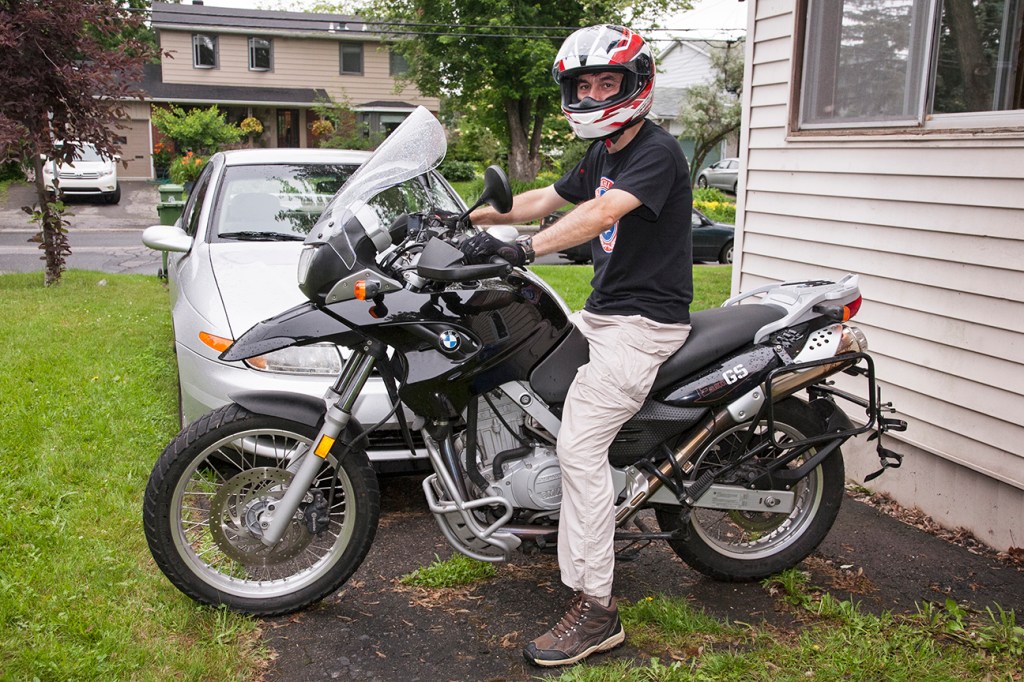
The first photo of me on the bike, June 2015. Lots of comments on Facebook about my lack of gear, but little did they know I didn’t yet have my licence.

It almost didn’t happen. The bike doesn’t have ABS, and I’ve grown accustomed to ABS in the car during winter when the roads are icy. I thought it would be essential for a new rider and not having ABS was almost a deal-breaker for me. But fortunately, the few people I consulted about my decision were not fans. One distinctly said, “You have to learn how to brake properly without it.”

So I did. I’ve heard of people who use only rear brake. Apparently, Honda mechanics discovered that the rear brake pads of Gold Wings were wearing out faster, much faster, than the front pads, which doesn’t make sense since most of the braking happens with the front. They concluded that Gold Wing riders weren’t using the front brakes, so they developed integrated braking—both front and rear come on, even if you only apply the rear. Smart. Honda engineers outsmarted the riders for their own safety.

My bike didn’t have integrated braking or ABS, so I had to learn how to brake properly. Mostly this meant squeezing the front lever, not grabbing, to load the front contact patch before pulling harder, and using just a little rear to stabilize the bike. I did this every time I stopped, even when cruising along the Lakeshore, at every stop sign and every light, front and rear in correct proportion, so it became muscle memory. Then in emergency situations, which I had, I didn’t have to think about it; the technique came “naturally” and I thankfully never tucked the front end, even once at speed in heavy rain on Heidenau tires in Northern Ontario when I rounded a corner to find someone backing up on the two lane Highway 101.
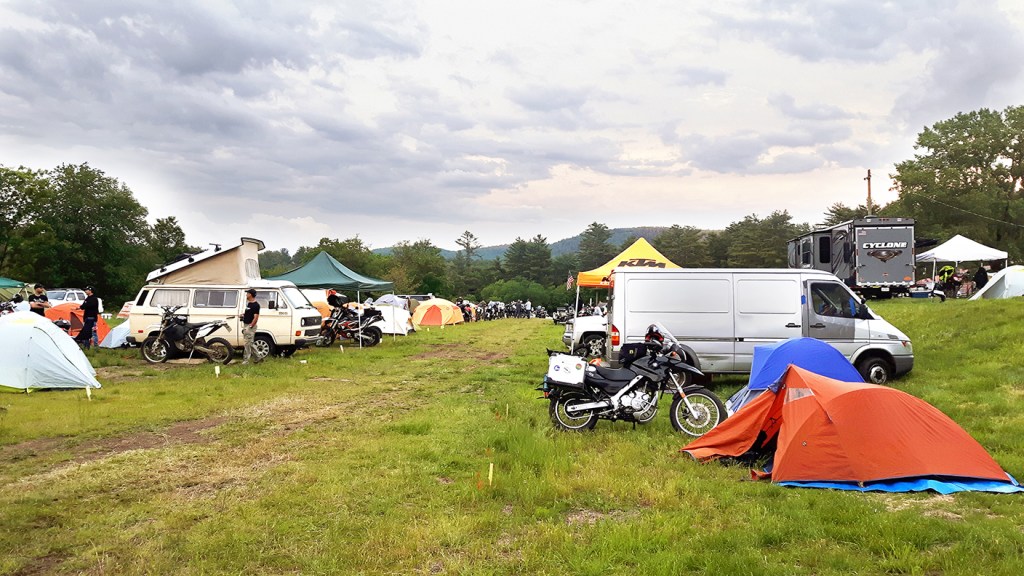
My first adventure bike rally, Dirt Daze in Lake Luzerne, NY. June 2017.

I knew I also needed to develop my off-road skills to become an ADV rider. I took a course at SMART Riding Adventures in Barrie, and another with Jimmy Lewis at the Dirt Daze adventure bike rally in New York. I joined Moto Trail Aventure mostly for the Rémise en Forme with a certified GS instructor, and the BMW Club of Québec for the same reason. (I actually planned to do rides with both clubs too but that never materialized.) This instruction set the perfect foundation for off-roading, and then it was just a matter of practice.

You don’t even need any dirt to practice off-road skills. I go up to my local church parking lot and do slow speed maneuvers. As Jimmy said, off-roading is all about balance and traction control, so I practiced the balance stuff on Bigby regularly. I also practiced the traction when I could, getting out of the city up onto the dirt roads and ATV trails in the Hawkesbury area. Bigby is a GS, which means Gelände/Straße (off-road/on-road), but I soon learned the limits of the bike. I never learned it street limits; I could lean that bike over and scrape the pedals, even with knobbies on, but I discovered its limits on the trails. The clearance was the biggest limitation, and the front suspension with the 19″ front wheel. It took some superficial damage for these lessons, but I also learnt not to lament the scratches. A fellow rider at my first Dirt Daze rally saw me brooding on my first scratch and said, “You can’t worry about that. It’s a bike.” The matter-of-fact way he put it set me straight.

I also had to learn my way around the engine. Knowing I would be riding into remote areas, I had to know the basics and how to fix problems. As I had with car mechanics, I started with an oil change, then coolant, brake pads, and brake fluid. I bought the bike with 35,000 kilometres on it, so it wasn’t long before I had to do the valves. That service was $1000 at the dealer, just to check them, so necessity was the mother of invention and with my trusty Haynes service manual, I did the valves myself in the shed. (I don’t have a garage, and my poor workspace has been the biggest obstacle to overcome. I’ve lost and found a lot of hardware on the driveway and in the grass!)
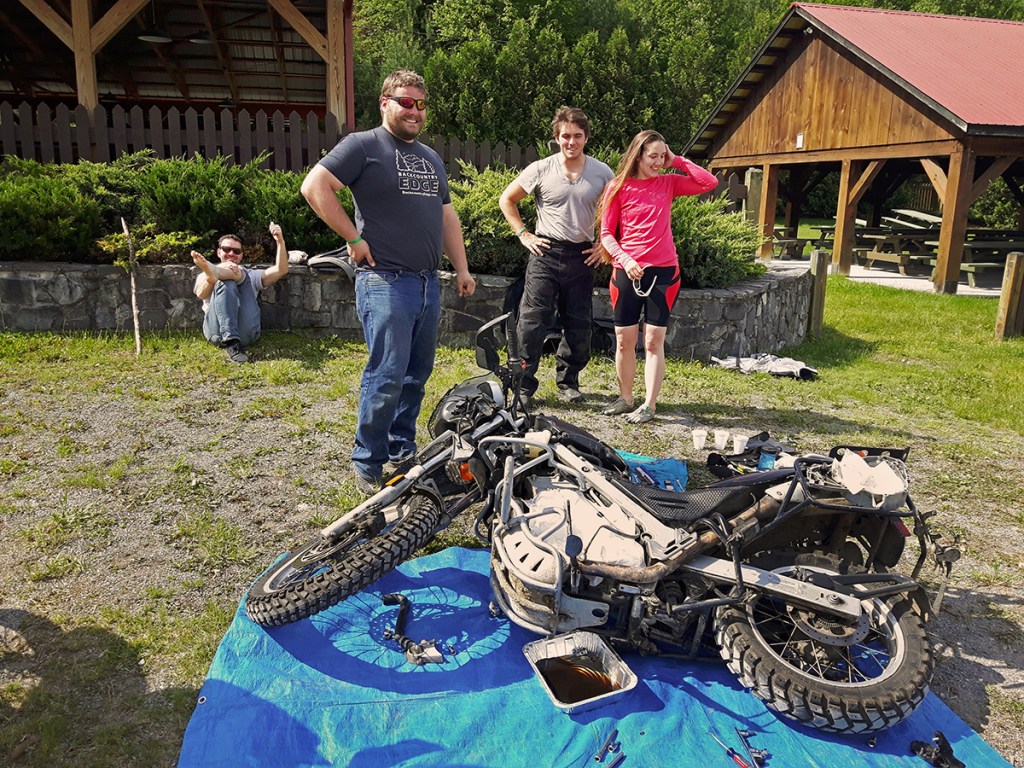
Problems at the 2018 Dirt Daze rally. A broken water pump left me stranded for much of the rally. MaxBMW shipped a new pump “overnight” which, due to the remote location, took most of the weekend to arrive, but I got home okay.

The Achilles heel on this bike is the water pump, and I’ve changed that a few times, including once at a rally because I hadn’t done it correctly the first time. (A plastic impeller gear wasn’t installed properly and rattled loose while off-roading.) That was the only time I considered selling the bike early, until I discovered the error was mine and not a fault of the bike. Once done correctly, the pump lasted another 40,000 K until I preemptively changed it before going across Canada.

The other big job was changing the swingarm bearings. That required removing the gas tank and subframe, so basically the entire back half of the bike. The pivot bolt was badly corroded and stuck, and it took two days of troubleshooting and, in the end, two hammers—a ball pane as punch, and a sledge hammer to drive—one on top the other, to get it out. But it eventually surrendered. Yes, I have cursed and praised this bike in equal measure over the years.

Success! Pivot bolt and swingarm removed for servicing. September 2019. Under the tarp at right is the gas tank and subframe. Headphones are for all the whacking needed to get it out.

I changed those bearings as well as all wheel bearings, clutch plates, the shock, rebuilt the forks, re-lubed the steering head bearings (which were in surprisingly good shape so didn’t need to be changed), and have had the dash assembly apart. And in the end, I restored those scratched body panels to make the bike look good as new.

My first trip on this bike was back to Ontario to show it to my dad, who used to ride. I left the day after getting my full licence. The next month I did my first moto-camp down at Loon Mountain in New Hampshire for their highland games. The following year, my first year with full licence, I went to Nova Scotia to ride the Cabot Trail, passing through Maine, Deer Island, and New Brunswick en route. I’ve also toured Northern Ontario, and these tours have led to some paid writing for northernontario.travel. So the bike has become for me more than a past-time. It has taken my writing in a new direction, and that of course refers to this blog too. I’ve made connections and friendships with people online, and met some of them in person during my travels. I hope to meet more of you in the future.

Off-Roading in Cape Breton, July 2017.

I have also met new friends locally in club riding. When I began, learners couldn’t ride without an experienced rider accompanying them, so I joined The West Island Moto Club, and some of these members have become my closest friends. I’ve done some touring with the club, but mostly I do day rides with them, and it wasn’t long before, with the right mentorship, I was leading rides.

One of the first club rides that I led. This was to Ottawa via Gatineau for the Tulip Festival. May 2018.

Some of my favourite riding on this bike has been in the northeastern states like Vermont, New York, and New Hampshire. I’ve ridden the Puppy Dog Ride on it a few times, and some of the Hamster Ride in New Hampshire, and Bayley-Hazen military road. The 650 GS is perfect for this type of light off-roading. I had a 15-tooth counter-sprocket on it for years, which gave it more low-end torque, and there’s nothing like feeling the pull of the big thumper as you climb a steep hill, or sliding out the back end as you round a corner.

Finally crossing Canada, July 2021.

Finally, after developing these riding and mechanical skills, modifying the bike to what was perfect for me, and waiting for Covid generally to be over, I completed my dream of crossing the country, and this bike, 15 years old and with over 100,000 kilometres on it, got me there and back. Ironically, the only issue I had was with a new battery I’d just installed for the trip. But the bike, fully loaded, pulled my wife and me over The Rocky Mountains, and took me up north of the Arctic Circle into some truly remote territory. The bike fulfilled its purpose for me—to learn about motorcycling, develop the skills necessary for adventure touring, and get me over the dangerous first few years of riding. It has been the best first bike I could have had, and now it’s time to pass it on to another new rider. Like me, the new owner has bought the bike before obtaining her licence. I’m sure it will be as good a beginner bike for her as it was for me. The engine is still strong, and I wish them both many safe and happy adventures in the future.
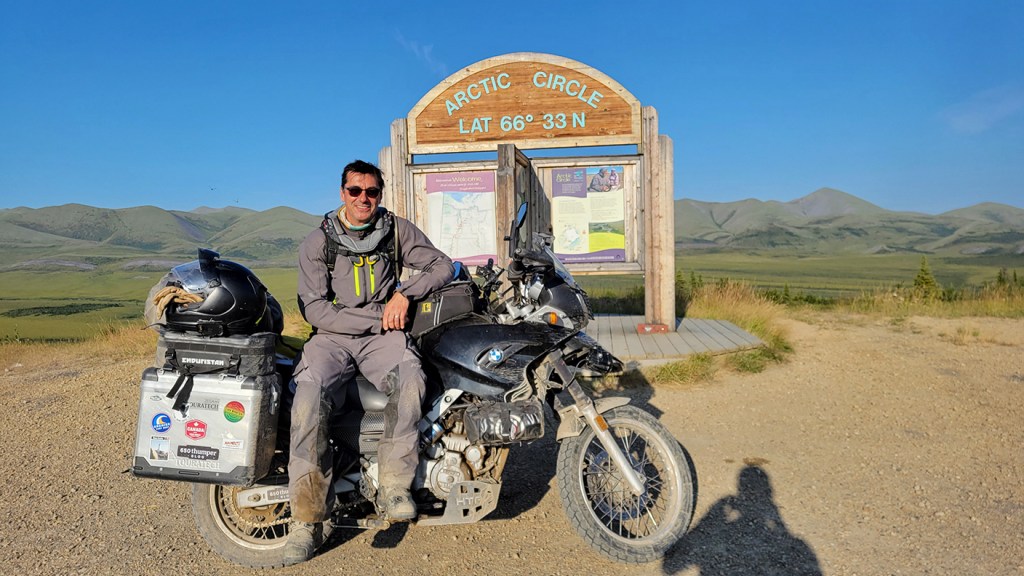
At the Arctic Circle, August 2021

My new bike is a 2013 Triumph Tiger 800XC. The XC stands for cross country, so it’s also capable of light off-roading, and I’ll be taking it on BDRs and other adventure tours. It does has ABS, but being a 2013, it doesn’t have any rider aids, and as I read about the new bikes with throttle control, wheelie control, slipper clutches, and other traction aids, I can’t help thinking about what riders of those bikes aren’t learning. I’m happy to be learning how to control the power of this 94 HP engine properly, just as I learnt to brake properly on the GS. It’s going to take my riding skills to the next level. The blog will be keeping its URL and name in tribute to the bike that got me started and to which I owe so much.

Next season I will complete my cross-country tour by riding the East Coast. I plan to visit Gaspé, New Brunswick, Prince Edward Island, Nova Scotia and Cape Breton, Newfoundland, Labrador, and the north shore of Quebec including the Saguenay. I might try to ride solo up to Fort George on James Bay “on my way home.” This would allow me at least to set foot in Nunavut. I also plan to ride the Mid-Atlantic and North-East BDRs next summer, if I can get it all to fit. So stay tuned, my friends. The journey continues.

At the Awesome Players sandpit, Hawkesbury 2020

Northwest Ontario

I leave Chutes Provincial Park and ride along the north shore of Lake Superior into Lake of the Woods.

You don’t realize how big Ontario is until you have to drive it. The people I know who’ve driven across Canada say getting through Ontario feels like half the journey. It’s made long in part by having to circumnavigate Lake Superior, but seriously, what better obstacle could there be? I’ve written about my love for the geography north of gichi-gami, aka The Great Sea, and in that article I said “you could drive from Sault Ste. Marie to Thunder Bay in eight hours, but why would you?” Well, if you had to be in Calgary in five days, that’s why.

I’ve driven in the car Highway 17 to Thunder Bay with my wife, and I’ve ridden on the bike Highway 11 as far as Kapuskasing, but this would be my first time riding the beautiful 17 on the bike. That was a large part of the reason for my smile upon waking at Chutes Provincial Park that morning: I knew the ride that lay ahead of me for the day.

Whether you have time to stop and savour the landscape or are on a tight timeline, the ride is amazing. The weather was cooperating and the bike was running great so I put on the miles and made it all the way to Pukaskwa National Park in time to set up camp, eat, and stroll the shoreline before losing the light.

Looking at views once painted by The Group of Seven

Upon leaving the park the next morning, I saw a sign indicating that there was a National Historic Site nearby, so naturally I followed the signs to The Pic, an important Aboriginal meeting place for thousands of years and the site of an important trading post during the height of the fur trade.

Today there is little evidence, aside from this marker, of the historical importance of this place.

I continued west, but was soon diverted by another sign marking Ausable Falls and Gorge.

Pretty spectacular view just off Highway 17 west of Terrace Bay at the head of Lake Superior

There’s a convenient parking lot right off the highway, and the short little hike down to the lookout makes a good rest stop. Best of all, there is no charge to get a view worth a million bucks.

Looking south out to the Slate Islands on the horizon

Okay, now it was time to avoid the distractions and pound out the miles. There are a number of spectacular lookouts along the north shore but I sadly had to blow past most of them or I’d never get to my destination just west of Thunder Bay by evening. It was hot, like 30+C (~90 F), and I was glad I’d purchased the Klim Marrakesh jacket specifically for the tour and days like this. It vents a ton of air, and my fuel pack meant I had plenty of water to keep me hydrated.

Still, I pulled off on one of the lookouts just to take a break in the heat and ran into two other riders, about my age, it seemed, maybe a little older, heading east on sport tourers. They had travelled from Victoria and said the heat bubble followed them for the first several days of their trip and was pretty unbearable. Their red, puffy faces showed the aftereffects, and I was glad I missed the worst of that. I experienced it on TV newscasts from the comfort of my air-conditioned living room. I would ride in heat the entire trip, but nothing like they experienced.

The heat got worse, and the stretch from Nipigon to Thunder Bay seemed endless! All I had on my mind was finding the first Tim Horton’s and getting a large Ice Cap, which I did. As I was standing outside savouring it (the A/C dining area still closed due to Covid), a Harley pulled in riding two-up. He was struggling in the heat to back his bike into a parking spot, so asked his wife to dismount first to make it easier. I thought, “He’s tired.” Turns out he’d been on the road since 4:30 a.m. and this was his first stop since leaving Sudbury. And I thought I was in a hurry.

“That was some heat coming down through those hills,” he said. And then, before I had slurped the last of my drink, they were back on the road again, apparently to Regina.

I thankfully had another small errand to run, happy to be in A/C for a little longer. I stopped in to the local grocery store to pick up something for my hosts that night who live in the Shebandowan area just west of Thunder Bay on Highway 11. This is a lovely cottage area with its own network of lakes. Marilyn and I stayed with her cousin last summer and did some water skiing there, which left me stiff for days but was exhilarating. This time there was none of that; I was happy to relax, see familiar faces, and meet more extended family.

The next morning I continued west along Highway 11 toward International Falls. The evening before, in conversation with a fellow biker, I was told that “the road is straight and remote, and you might be tempted to see what your bike can do, but be careful because OPP are along there.” I now saw what he meant so “sped responsibly.” I really couldn’t afford a whopping fine let alone having my licence suspended.

Somebody has a warped sense of humour

I was excited to experience Lake of the Woods, which I had never visited before but had only read about in researching an article on The Northwest Loop. But first I decided to explore Kay-Nah-Chi-Wah-Nung, or Manitou Mounds, another ancient Aboriginal meeting place of national significance that contains “the records of 8000+ years of recurring use or habitation” and “the largest group of burial mounds and associated village sites in Canada” (https://manitoumounds.com/history-culture/). It was about forty minutes out of my way but I decided to pay the price to learn first-hand about ancient Indigenous history and culture. Only once I had paid the price, not only in time but kilometres of dirt road, the only thing I learned was that it was . . . you guessed it, closed due to Covid. Nothing on the website indicated that, which would have been nice. (I could hear my wife’s voice in my head saying “You should have phoned first,” which is probably true and would have saved me the frustration.)

Now I was in the mood to see what my bike can do. I’ve never had it pinned and have always wondered. Okay, the bike was fully loaded, but it still hit 160 km/hr in a tuck, which is pretty good for a 650 that is 16 years old with over 100,000 kilometres. As luck would have it, soon after that little test, I passed an OPP sitting at the side of the road. Sometimes you get lucky.

Highway 71 lived up to its reputation, winding up through a mixture of forest and wetlands as it skirts the eastern border of Lake of the Woods. My wife who grew up in Winnipeg has talked about this region using similar tones that Torontonians use to talk about the Muskokas. It’s beautiful cottage country, for sure, and its remote location has saved it from the more obnoxious development that has altered the Muskoka region during my lifetime. The road north of Nestor Falls is twisty and hilly with views of lakes and wetland. I stopped at The Narrows Gift Shop and took a browse (I’m always on the prowl for pannier stickers). Beside is The Lazy Loon Restaurant. Okay, there’s some kitsch development here too, with fake inukshuks, fake totem poles, and mini-putt, but I forgave it all because THEY HAD ICE CREAM!

The final leg of the day and my ride across Ontario took me into Anicinabe RV Park and Campground in Kenora just as a thunderstorm broke. It had been a long, hot day, and the cooling rain was welcome relief. As it would turn out, it was one of only three showers I would experience in my six weeks on the road.

One of the last spots at Anicinabe Campground near the Manitoba border.

Have you been to any of these places? Drop a comment below. I love to hear from my readers.

Next up: Prevented from stopping in Manitoba due to Covid restrictions, I ride across in one day and spend the night in Moosomin, SK.

Bears, Mines, Batteries: Cochrane, Sudbury, Mattawa

Native Carving_web

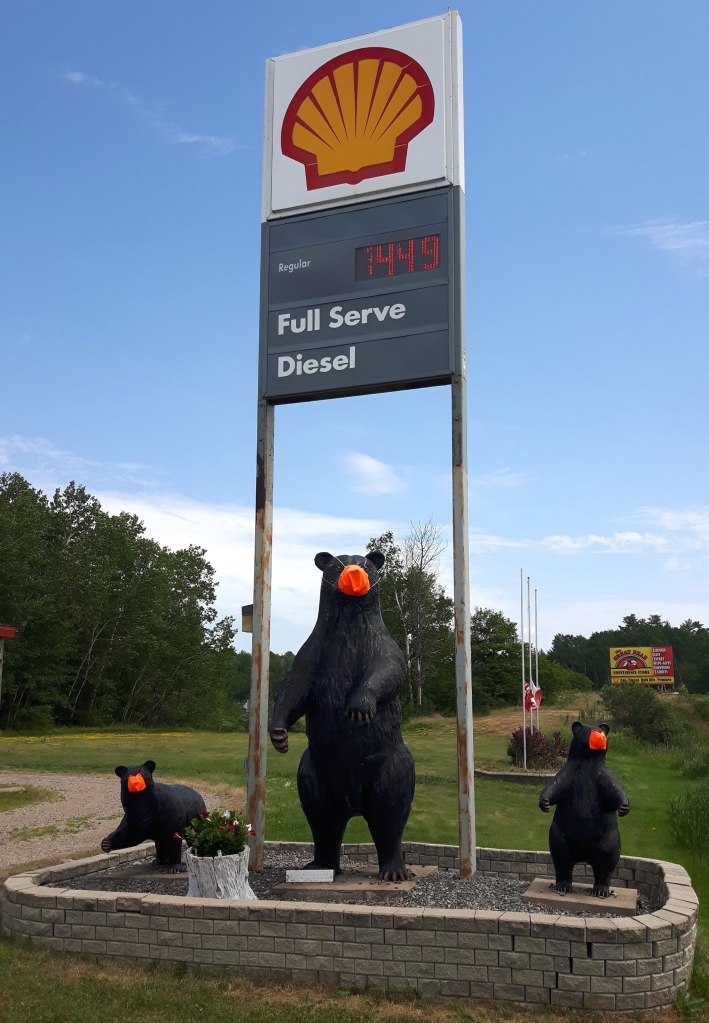
Street woodcarving in Mattawa, Ontario

After playing in the dirt around Moonbeam, I decided to head over to Cochrane to check out the Cochrane Polar Bear Habitat. It’s the world’s largest and only human care facility dedicated to polar bears. They are located on 7 hectares of natural terrain and currently have three resident polar bears. I’m not a fan of zoos but these bears can’t survive in the wild and require human care; they were all either born in captivity or orphaned. The Habitat also advocates and educates towards protecting polar bears and their natural spaces.

It was an easy ride east along Highway 11 from my campground in Moonbeam to Cochrane. I stopped at Smoothy’s in Smooth Rock Falls for gas and breakfast.

smoothy-s-restaurant

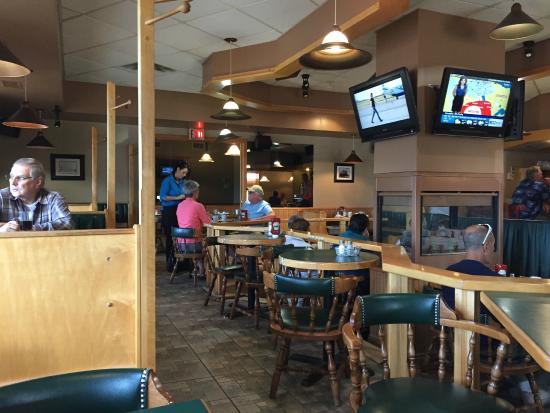
Smoothy’s Family Restaurant; Smooth Rock Falls, ON

Okay, they don’t win the award for most original name, but Smoothy’s was just what I was looking for: a classic diner where I could get an inexpensive bacon & egg breakfast with fried potatoes on the side. In the booth next to me were four retired men speaking French. In fact, pretty much all I’d heard this trip was French—in Iroquois Falls, in Moonbeam, in Kapuskasing. I’d never realized how big the Franco-Ontarian population is! A few Anglicisms had crept into their French, but I was surprised that the language and culture seems to be surviving just fine without any Bill 101 and its ridiculous sign laws or restricted access to education in English like we have in Quebec. Having said that, I must add that this past fall the new premier of Ontario decided to cut the French Commissioner position, a slap in the face of Franco-Ontarians and a sign of how vulnerable the French population is outside Quebec. Fortunately, Premier Ford reversed his decision a short time later, I don’t know whether due to pressure from Prime Minister Trudeau, public outcry, or common sense, once someone showed him the numbers and how such a decision would hurt him in the next election.

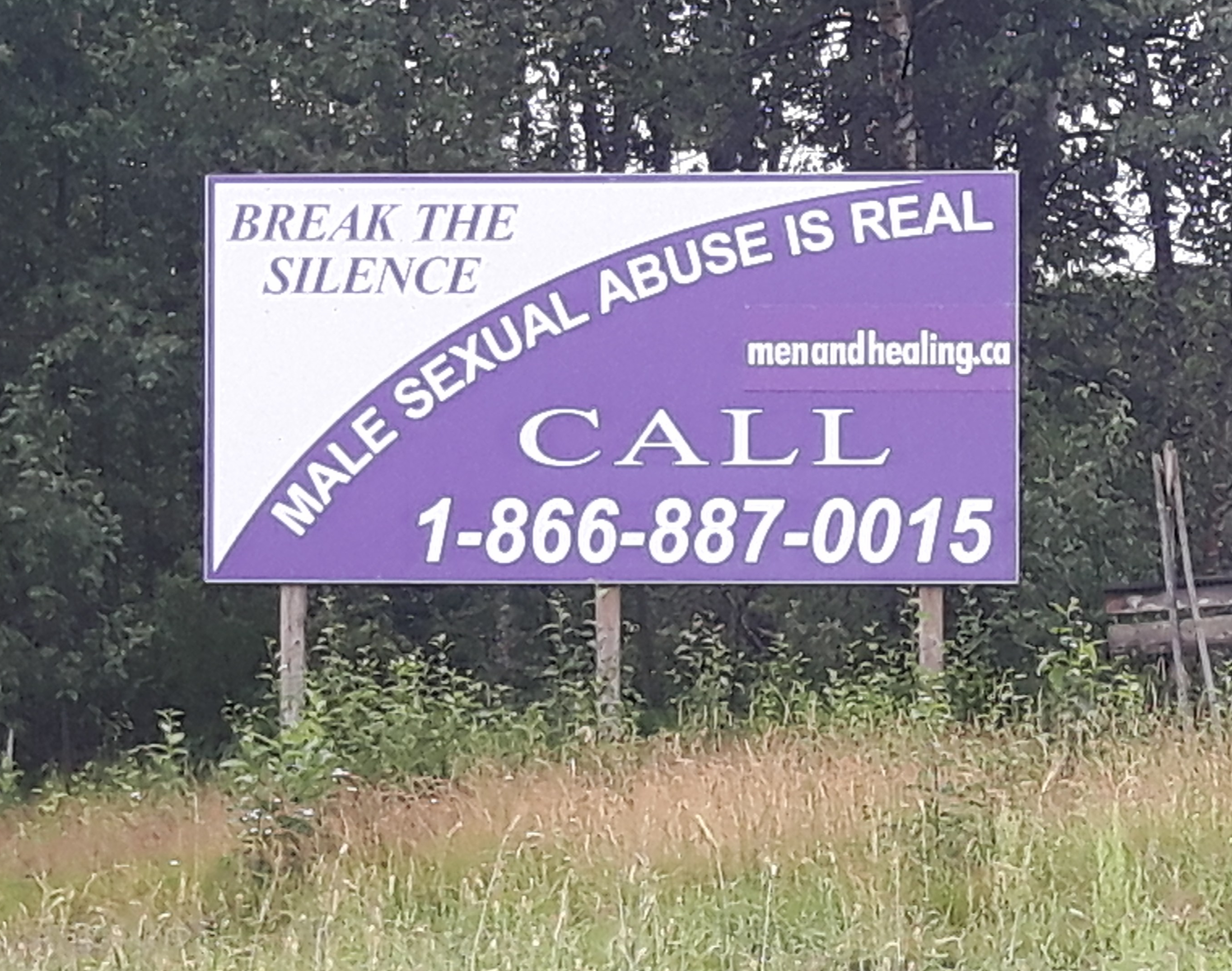
Another interesting cultural observation I had while up north was this billboard that I kept seeing.

20180726_125450

I’ve never seen anything like it around Montreal or southwestern Ontario. I’m not sure who the target population is, whether residential school survivors or men in general, but I think it’s high time we begin to discuss men’s issues, including sexual abuse.

With both bike and belly full, I pushed on to the Polar Bear Habitat in Cochrane. I arrived mid-morning and a tour had just started. “Run through to the first building and you can catch up to the group,” the lady at the entrance advised. So I did, only partway between buildings I was stopped in my tracks by the sight of two bears against the fence. They were huge! And exactly as you would expect with that distinctive long neck and pointed head, and not expect. Their fur is not so much white as golden, and their eyes and ears seem so small compared to their massive bodies, no doubt evolved to cope with blinding, blowing snow. I just stood there and watched them for a minute before heading in to catch up with the tour.

P1030294

The Habitat currently has three bears on location: Ganuk, Henry, and Inukshuk. Inukshuk, whose mother was shot when he was just four months old, is the father of Henry, bred when Inukshuk was at Zoo Sauvage in St Felicien, Quebec. Each bear has a unique personality and food favourites.

The facility is impressive, with natural and artificial areas, and a pool with a glass wall so you can see the bears swim underwater if they are in the mood. There are interactive learning stations for the kids and lots of information available on the walls and other exhibits for the studious, but really, everyone mostly just wants to look at the bears. They are magnificent!

Our guide reminded us that although they look cute and cuddly, the bears are dangerous and no one is ever alone with them on the inside of the fence which, we were told, is unbelievably more to keep people out than the bears in! They have had instances of people climbing in, I guess like the idiot videoed recently swimming nude with the sharks at Ripley’s Zoo in Toronto. Some people have the most warped sense of judgment when playing Truth or Dare after a few beers.

When the bears decided to head down to the natural pond, disappearing into the trees, I decided to step back in time a hundred years and headed over to Heritage Village. (Visitors to the Polar Bear Habitat also have access to Heritage Village and a snowmobile museum.) The village looks authentic and has been used for film sets. It includes a general store, butcher’s shop, doctor’s office, blacksmith’s shop, fire station, schoolhouse, and trapper’s cabin.

P1030303

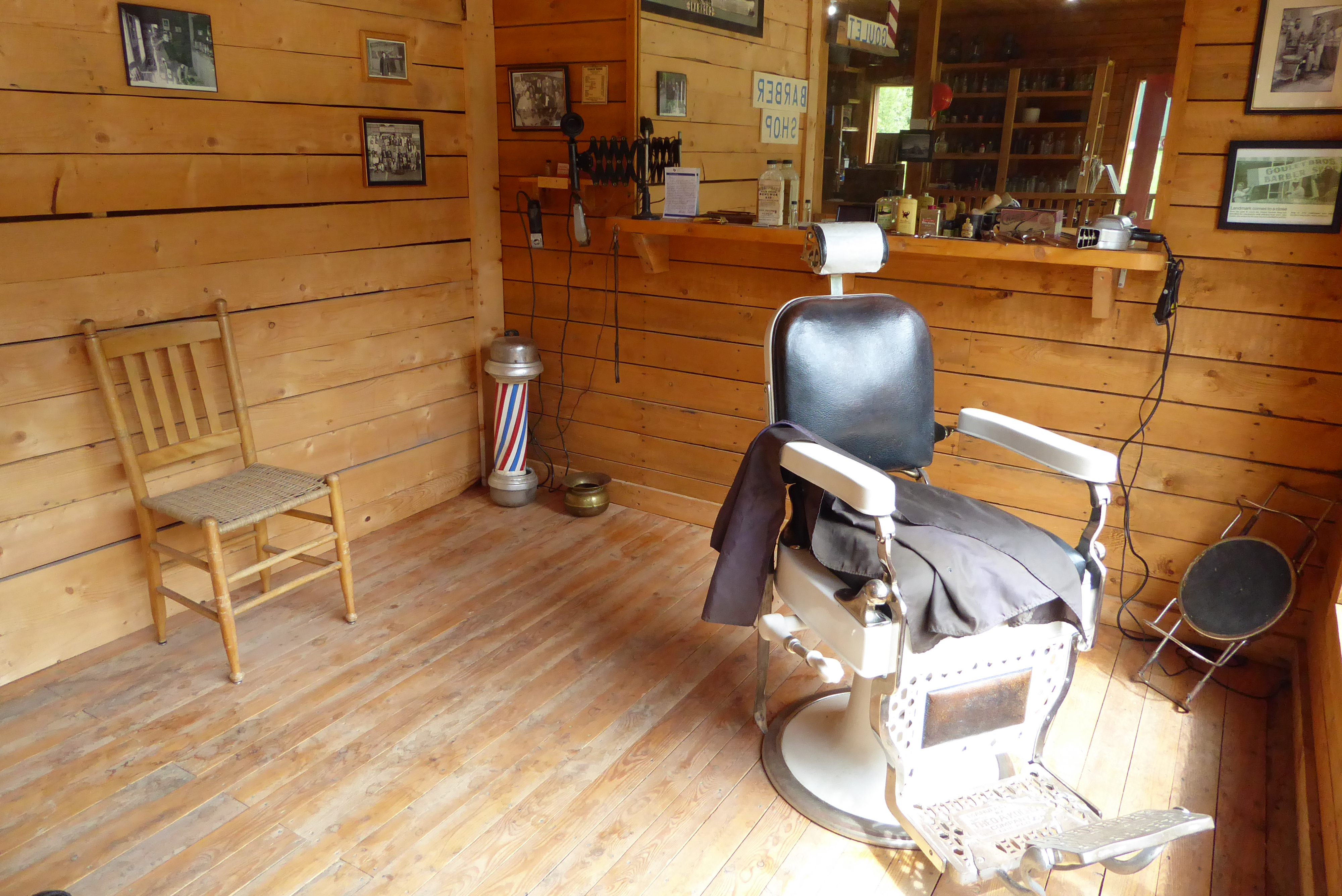
No rollerball razors here. You can almost smell the lather and tonic.

While not the impetus of my visit, the Heritage Museum was interesting. It’s one thing to learn about history from a textbook or historical movie and another to see the physical artifacts of another era and another way of life. The buildings have been authentically decorated to assist the imagination in conjuring an ordinary day in the life of early 20th-Century citizens. When I returned to the bears, one of them was being fed strawberries through the fence.

P1030305

Staff feed the bear while children watch on.

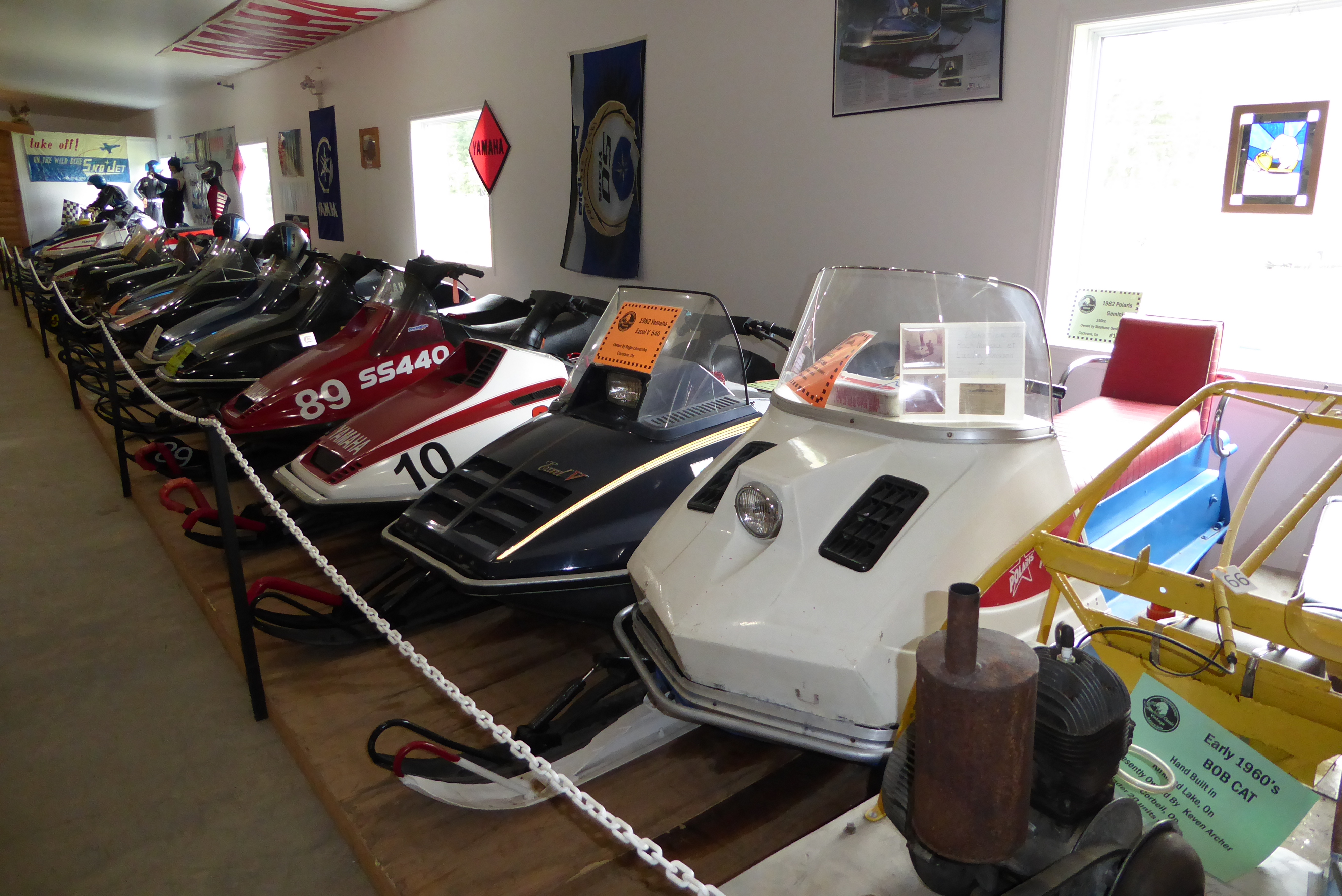
Before leaving, I wandered into the snowmobile museum. I imagine Cochrane has quite the snowmobile culture during the winter months, and it’s a good idea to preserve some of these machines here for posterity. Each is labelled with year, model, and owner name.

P1030316

Each represents the cutting-edge technology of its day.

I started back toward camp but this time, as I passed through Smooth Rock Falls, I saw a sign for Lookout Road. Assuming it led to its namesake, I pulled off and headed up a dirt road; it was the adventure bug again. At the fork in the road, I went left and the road slowly deteriorated into a trail.

Smooth Rock Trail1_web

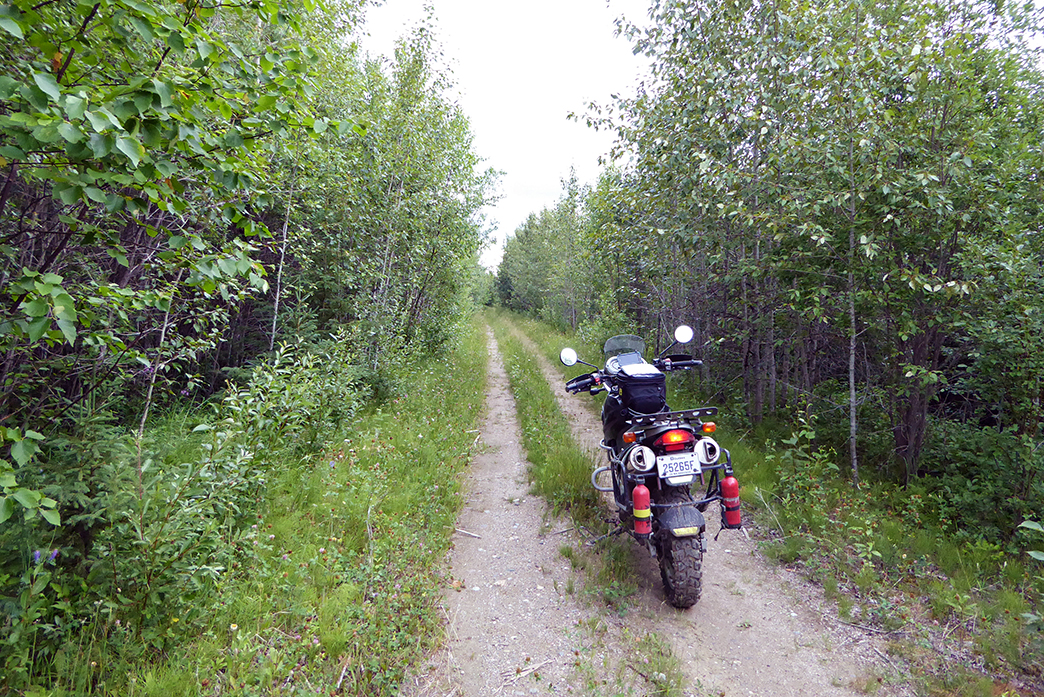
Another promising trail to follow. Would it lead to the lookout?

I was on my own and without a Spot device, so venturing along an unknown trail deeper into the bush was both exciting and unnerving. My worst fear was that I might find myself in a situation from which I couldn’t get back to the road, kind of like what almost happened when I had my off on the Lumberjack Trail, but hey, Lyndon Poskitt and many others are adventuring around the world solo so I figured I’d venture a little further along this trail. There were some muddy sections and some hills but my curiosity pulled me deeper, farther away from the road. The trail opened up into a meadow at one point, and then descended again into the trees, leading to this muddy puddle blocking the way.

Smooth Rock Trail2_web

End of the line for this solo rider.

I wasn’t so much worried about going down those logs into the water as getting back. If I hadn’t been on my own, I would have gone for it, but since discretion is the better part of valour, I decided to turn back here.

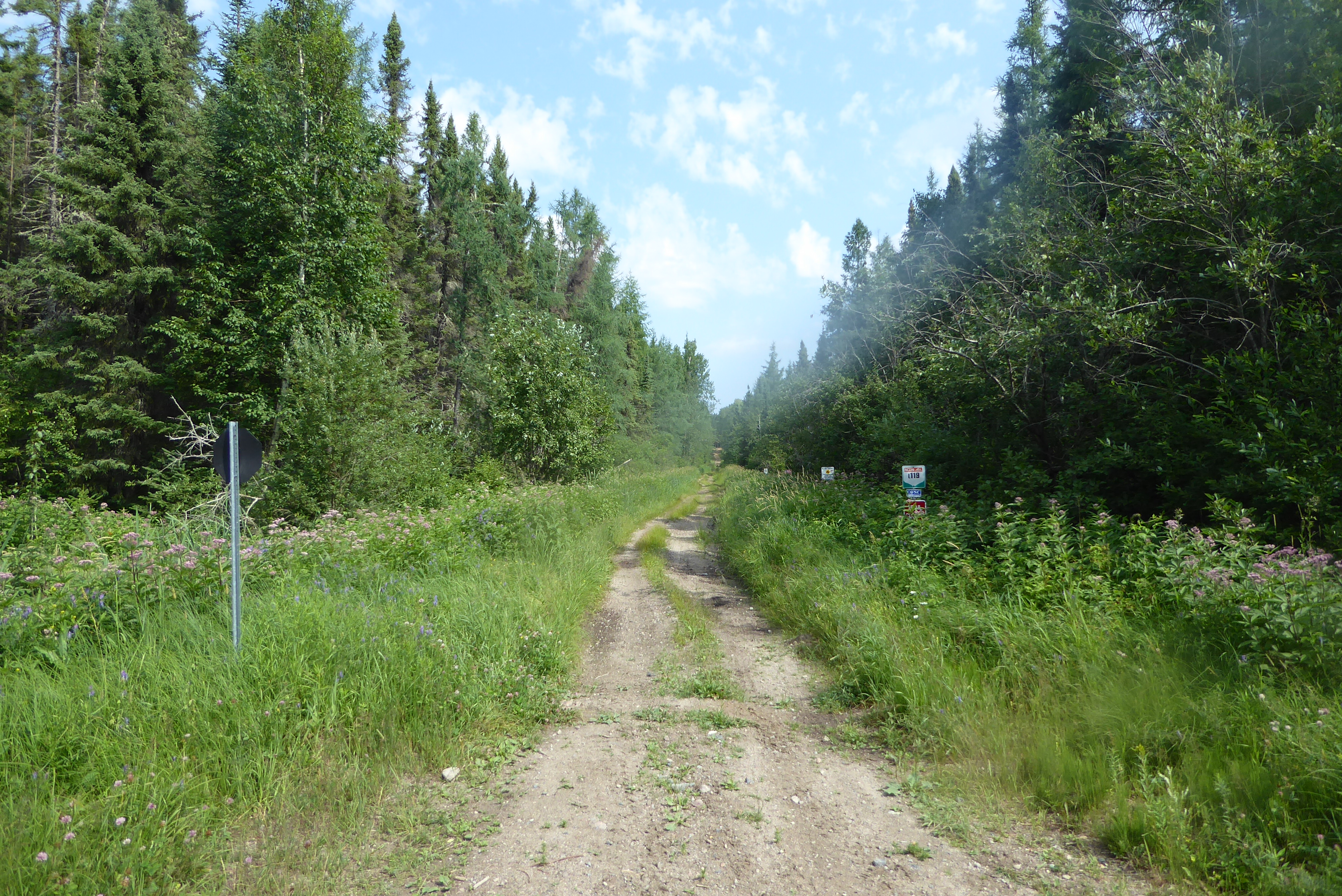
Once I got back to the Y in the road, I realized that the lookout was just a hundred yards further along to the right. Doh!

Smooth Rock Lookout_web

The view was worth every misdirected inch to reach it.

The next day I started home. I had about 1000 km to cover in two days. I took the 11 east to the 655 south, which took me into Timmons. Traffic through Timmons was stop and go but there was no time to stop because I was trying to reach Dynamic Earth before it closed. After my experience in the coal mine at Springfield, NS, I wanted to go down into another, and Dynamic Earth offers a tour into the nickel mine there.

A little jog along the 101 at Timmons and soon I was on the 144 south. The 144 is another of Ontario’s great roads to ride. It’s a two-lane highway that cuts through precambrian rock as it descends down toward Sudbury. There’s a mixture of straight sections but the real fun is with the large sweepers. The highway is immaculately maintained with no pot-holes or tar snakes to worry you, and surrounding scenery is pure bush, so enjoy but keep your eye out for wildlife.

I stopped at the Tim’s just outside of Sudbury. It had been raining and again my phone was not charging. I gave it a quick charge at Tim’s, but I had to keep it short if I was going to catch a tour. I didn’t want to do the tour the next morning since I had a long way still to reach my home in Montreal. As I pulled out of Tim’s and cracked the throttle, the bike lurched and the tachometer suddenly read twice what the bike was revving. It was up in the red! I’d only seen this once before and didn’t know what it meant but did what I had done that first time: I hit the kill switch, let the ECU sort itself out, and restarted. Everything was fine and I got to the mine in time to catch the last tour of the day.

P1030390

Big Nickel at Dynamic Earth

We were given hardhats and descended 7 stories underground where the temperature is about 13C (55F). The tour takes about 1 hour and 15 minutes and shows visitors what mining was like from the earliest days at the turn of the century to today.

P1030350

In the footsteps of Sudbury’s miners.

The young guide was knowledgeable and informative, and the tour was animated with video installations and mock explosions. I could see how technology has evolved over the century to create a safer and more efficient work environment. Canada also has evolved over the century and now its economy is more diversified than before, but the country is renowned for its natural resources. It was opened by the fur trade, with forestry and mining the other big resources that followed. I’m glad I experienced this important part of Canadian history while I was at one of the country’s largest mines. The Sudbury mine has over 5,000 kilometres of tunnels; placed end to end, you could drive from Sudbury to Vancouver underground!

When we returned above, it was late in the afternoon and I was tired from the race down from Moonbeam. Although Dynamic Earth has a lot more to offer than the mine, I decided that was enough for one day and headed to a campground I’d found online. While en route my bike did that lurching tachometer thing again, and then my phone finally died. Fortunately, I’d packed a car GPS as a backup and it got me there.

The next morning I left Sudbury and headed east along the 17, the Trans Canada Highway, into North Bay. I decided that the 533, although out of my way, was just too good to pass up, so I turned north onto the 63. As I did, I saw a woman rider by the side of the road on her phone. Naturally, I stopped to see if she needed some help. The chain had come off her Kawasaki 650 Ninja. She was trying to reach the local garage but no one there was answering. She told me her male friend did all the maintenance on the bike for her and she didn’t have a clue how to tighten the chain. I’m always surprised that some riders, male or female, don’t know how to do the basics. It just seems that you would always be so vulnerable, but then again, I guess the vast majority of drivers don’t know even how to jump-start a car, so perhaps I shouldn’t be surprised.

I tightened everything up for her and headed on my way, not knowing that soon I’d be in the same situation. As I was enjoying the 533 east, the bike surged and the tach jumped to double again. This time, rather than resetting the ECU with the kill switch, as I’d done before, I decided just to let the bike run as is; I knew the engine wasn’t revving that high—the tachometer was giving a false reading—so I kept going. The 533 is the twistiest piece of road I’ve ever ridden and a lot of fun, but I soon decided to take it easy since the bike was surging and lurching more and I couldn’t trust it. As I came down into Mattawa it stalled. I restarted it and drove another hundred yards and then it died again. As I rode the main strip in Mattawa, it died on me several more times and then I couldn’t restart it so I coasted in to a spot at the side of the road beside an entrance. As I did, I noticed a BMW 1200GS on the other side of the entrance, so we were the BMW bookends of this particular drive.

No sooner had I removed my top bag and dug out my tools than I heard a voice say “You’re missing a cylinder.” It was the owner of the 1200 and he introduced himself as John. He hadn’t seen me limp into town so I explained the situation. Being an ADV rider himself, he naturally said I could crash at his place in North Bay if needed and use his tools to fix the bike. He thought it might be the regulator. I thought it was a plugged fuel filter. I stripped the bike of the plastics and pulled the cover off the fuel supply, cleaned the filter and put everything back. The bike started and idled okay. Only before setting off, I had the voice of the Jack Nicholson character in the movie Bucket List in my head, “Never pass up a bathroom,” so I killed the engine and took care of business. When I returned to the bike, it wouldn’t start. Dead battery. Completely dead. Things were going from bad to worse.

I asked John for a push to bump start the bike. We must have been a sight heading up the main drag, me on the bike, he pushing from the back. The bike started but I couldn’t keep it running. As soon as the revs dropped to idle it died. Then we couldn’t start it at all. Fortunately my spot was still vacant so I coasted back, stripped the bike again, and removed the battery. John suggested I take it to the garage on the corner and get a quick charge on it.

20180728_131236

Curb-side maintenance on Bigby.

Now I had an hour to kill so I grabbed some poutine from the local chip stand and watched the lumberjack races. It was Voyageur Days in Mattawa.

20180728_112555

Audience participation at Voyageur Days

I wandered up to the local Tim’s and, while walking back, saw John as he was heading back to North Bay. He repeated his offer if I couldn’t solve my problems.

When I got to the garage, the owner-mechanic was gone.

“He went to the fights,” the young lady running the gas bar said.

“The what?”

“The fights. There are fights tonight.”

I was trying to imagine what kind of fights would be in Mattawa but eventually just helped myself to my battery, which was still on the charger. It was $10 for the charge.

I got back to my bike and installed the battery, replaced all the plastics and loaded the bike again. Now was the moment of truth. I turned the key and hit the starter: the bike made a grunt. Hmm . . . I guess I’m staying in North Bay tonight. Then I hit the starter again and it fired! It idled!

I know now what the problem was. I had been charging my phone off the battery throughout the trip, sometimes even when the bike wasn’t running because I needed it. I should have known that the battery is only for starting the bike, not a portable power supply. All that charging had boiled three of the cells dry. The morning of my problems, it was cold and I had the phone charging and the hand warmers on high. The charging system couldn’t keep up and the battery got further drained. When the battery dies, the instrument panel starts doing crazy things and the ECU acts up. The single source of my problems—the surging, the weird tach readings, the eventual non-starting—was a weak battery.

I now finally started heading home. At that time, I still wasn’t sure if the regulator was acting up and if the battery would drain while riding to Montreal. I kept a constant speed and didn’t ask much of the bike. I stopped only twice. Both times I kept the bike running because I wasn’t sure it would start again. I even kept the bike idling while filling it. Who’s going to stop me?

Just outside of Ottawa, I nipped into a convenience store to use the bathroom. When I came back outside, a brown liquid was pouring from underneath the bike. Problems on top of problems! My first thought was oil leak. I dipped my fingers into the puddle; it smelt like gasoline. Perhaps I overfilled it? Did it have something to do with not turning off the bike while filling? I wasn’t sure but now had extra incentive to get home. Fortunately, when I straightened the bike up off the side stand, the flow of brown liquid stopped. If I could keep the bike relatively upright, I could get home. I’ve never had such a stressful ride!

Again, I now know what was happening. Earlier in the summer, I’d had the bike on its side for the better part of a day. Oil had drained into the air box and the brownish liquid draining from beneath the bike was from the drain tube. I’m still not sure why it smelled like gas or why it was only draining now, but it was not coming from the engine.  It was draining from the air box.

I pressed onward, ever closer to home, keeping an eye on my instrument panel, half-expecting the oil light to come on. Each kilometre, I thought, was one less kilometre my wife would have to travel with a trailer to pick me and Bigby up. I was hoping to keep a steady speed all the way, but as luck would have it, the major highway passing through Ottawa was closed! It was stop and go traffic for miles as we were rerouted through downtown Ottawa, adding hours onto my trip. What a day!

Once back on the highway, it was smooth-riding. As I approached the border into Quebec, I could see lightening flashes in the distance ahead. Riding into a thunderstorm seemed the perfect climax to a stressful day, but thankfully it opened up just as I pulled into my driveway. My guardian angel had gotten me home again—and not a moment too soon.

Riding an old bike has its disadvantages, for sure, but I have to admit that the problems of the day were more my fault than the bike’s. I depleted the battery by using it to charge my phone, and I forgot to clean the airbox after the bike had been on its side. In the end, I was super lucky that Bigby conked out where he did, in Mattawa, with a mechanic on duty and John for support and advice, not on the 533 where there isn’t even cell service.

Each time I tour, I learn a little more about the bike and about riding. I’m building my knowledge in lower-risk places close to help. And each year I venture a little further off the asphalt. I’m already planning next year’s tour that will take me deeper into the bush and into more challenging terrain. Who knows where I might end up? I don’t know where I’m headed but I almost always enjoy the ride.

The Lumberjack Trail

20180728_112555

Voyageur Days. Mattawa, ON

What’s your ideal ride? For some, it’s a winding road like Tail of the Dragon; for others, it’s a single-track or ATV trail cutting through dense forest. Mine is some combination of both—a winding dirt road with some technical sections that challenge, like hill-climbs, mud, even the occasional water crossing. That’s what I was looking for when I decided to do some off-roading in Northern Ontario this summer.

I enjoyed looping Georgian Bay with my wife, and I enjoyed the rest stop in Kipawa, Quebec, at a cottage. I enjoyed the ride up to Moonbeam, albeit in the rain. But what I had really been looking forward to is a full day in the dirt, and this was the day I could finally do it.

The violent rainstorm of the night before had subsided by the time I crawled out of my tent. After my breakfast of champions, porridge, I geared up and headed to the park gate. I figured the attendant would be familiar with the area and able to direct me to the trailhead of The Lumberjack Trail, a 26 km. loop from Moonbeam to Kapuskasing I’d found online at an interactive trip planner.

Lumberjack Trail

Lumberjack Kapuskasing-Moonbeam Loop

I rode down to the gate, pulled a U-turn and parked. When I entered the kiosk, the young lady was staring into her phone. Our conversation went something like this:

Me: “Good morning. Do you know where I could pick up The Lumberjack Trail?”

Teenaged attendant: (looks up from phone) “The what?”

Me: “The Lumberjack Trail. It’s an off-road trail that goes from here to Kapuskasing. I saw it online.”

Teenaged attendant: (goes back to phone) “Ok Google, what’s The Lumberjack Trail?”

Me: “You don’t know it?”

Attendant: “There’s a lot of trails around here. Basically it’s the only thing to do. Me and my friends go on them on the weekends.”

Me: “Oh, so you ride off-road too?”

Attendant: “No we go in cars. Anything.”

Me: “Well, it’s supposed to go right past here.”

Attendant: “There’s a really pretty one. It’s a . . . a pépinière. Oh, how do you call it in English? Ok Google . . .”

Me: “A nursery.”

Attendant: “Yes. There are a lot of pine trees. But I don’t know how to find it. Try the Tourist Information.”

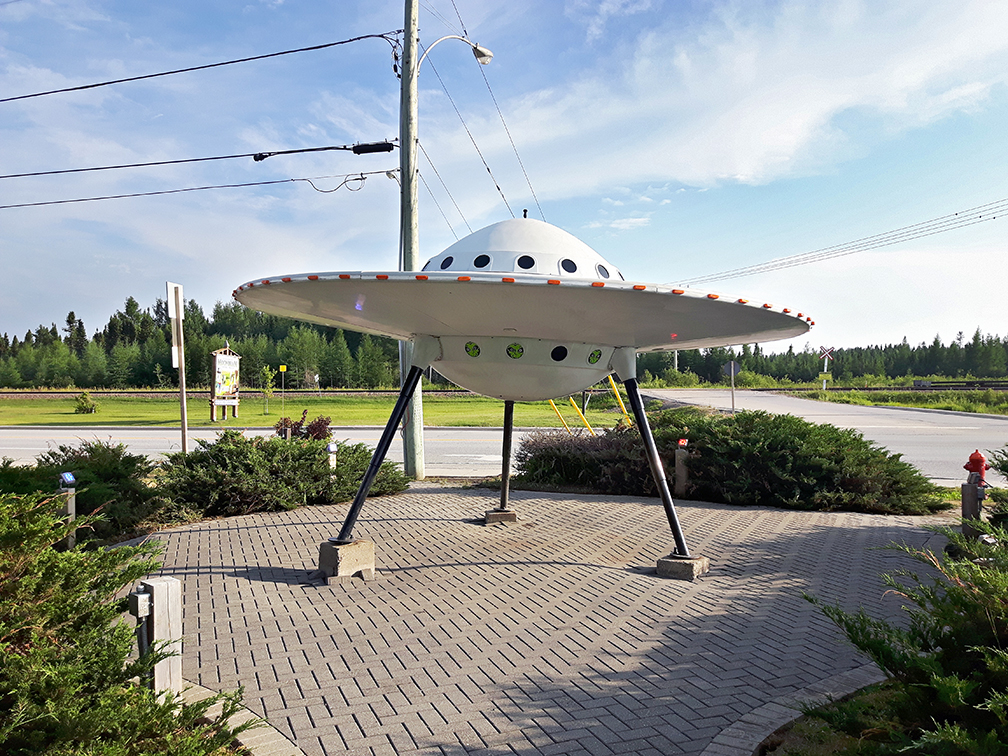
So off I rode, back to the flying saucer, pondering whether I should ask for directions to the Lumberjack Trail, the Pépinière Trail, the Nursery Trail, or a pine grove?

Once there, I was quickly directed to the trailhead. It turns out that you follow Nursery Road and it takes you straight there.

Nursury Trailhead

This looked promising

A short ways in, the trail became sandy and I found the pine trees.

Pepiniere Trail_web

The Nursery Trail

It was open and easy, but with sand and some small hills to make it a Goldilocks level of difficulty. Unfortunately, it ended too soon. I arrived at a T-junction to a gravel road. Knowing that left leads back to the main road, I turned right and found myself on an open, flat, fairly straight dirt road. Silt Road

The surroundings were pretty enough, but the riding was not very challenging. I was a bit disappointed. It was too easy. It’s actually hard to find a trail with just the right amount of challenge for your particular skill level, and where the Nursery Trail had at least some sand, this road was dry and hard-packed. I was bombing along in third gear, not even standing, thinking “This is too easy” when I hit a section still wet from the rainstorm the previous night. Everything suddenly went sideways—literally. A truck or larger vehicle of some kind had come through before me and left tire grooves. I started to lose the back end, went sideways, got cross-rutted, whiskey throttled towards the trees, and went down high-side, hard. It was my hardest fall yet.

My first thought as I lay on the ground was, “Well, the gear worked.” I had invested earlier in the season in some excellent protection specifically for off-roading. My Knox Venture Shirt, Forcefield Limb Tubes, and Klim D30 hip pads all did their job. I got up without even a bruise. My second thought was for the bike. If there was something broken, it was going to be difficult to get it out. I noticed that the folding levers I had also invested in had done their job. The clutch lever was folded up, saving the lever from breaking off. I lifted the bike and took a look. Nothing was broken or cracked; the crash bars had done their job too. There were some new scratches on the windscreen and front cowling near the headlamp, but nothing more. Oh well, new honour badges, I thought.

My concern now was getting the bike back on the road. I was lucky: if I’d gone a few feet further I might have lost it into a ditch and then would have needed a winch to get it out.

P1030223

Once I lifted the bike, I realized it was going to be difficult to get it back onto the road.

The front end was partially into the ditch and it would take some rocking and cursing to get it back a few feet to where I could carefully walk it back onto the road, making sure the front tire didn’t slide down.

I looked back at my skid marks and played amateur accident inspector.

P1030222

You can see where it all went wrong.

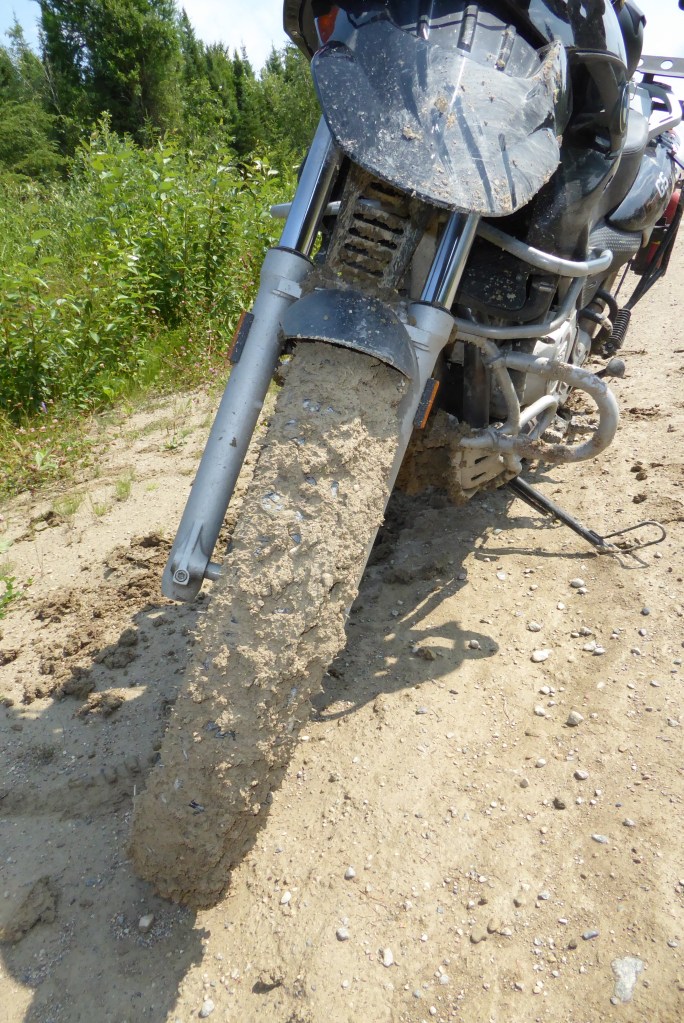
I tried to ride on but the silty dirt, when wet, is like glue and gums up the tires instantly. It was like riding on ball bearings, or rather, trying to ride on ball bearings.

P1030224

Slow-going in the wet silt

The ride now certainly wasn’t too easy. I basically had to do the Harley waddle, foot by foot, hoping it would get drier. I tried riding along the edge of the road in the long grass, thinking the grass would provide some grip, but the problem then was that I couldn’t see what I was riding over or where the ditch was. I dropped the bike a second time and began to wonder how I was going to get out of there. Would it be like this all the way to Kapuskasing?!

Then I had an idea: I knew that in sand you put your weight to the back to unweight the front tire. This helps prevent the front from washing out, which is when you go down. Maybe the same technique applied to all low-traction terrain, including mud. I tried and it worked! The front tire didn’t wash out as easily, even, to my surprise, climbed up out of some small ruts when needed. I had stumbled upon a new off-road skill.

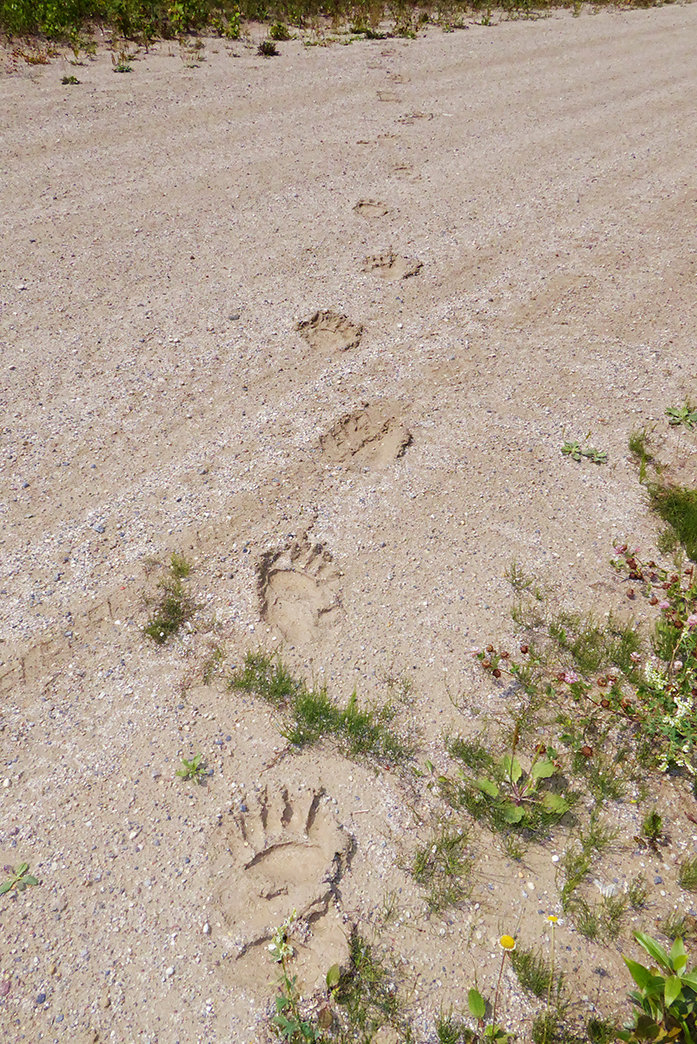
When the road dried out, I was able to sit down, but kept my butt well back, over the rear tire. It all suddenly made sense why those Dakar riders always sit so far back. Now I was able to go at a better pace. The rest of the road wasn’t as wet as that section and, although open and straight, turned out to be just challenging enough. I stopped a few times when I saw some interesting paw prints.

Bear Prints_web

Bear prints. I also saw wolf and hare tracks.

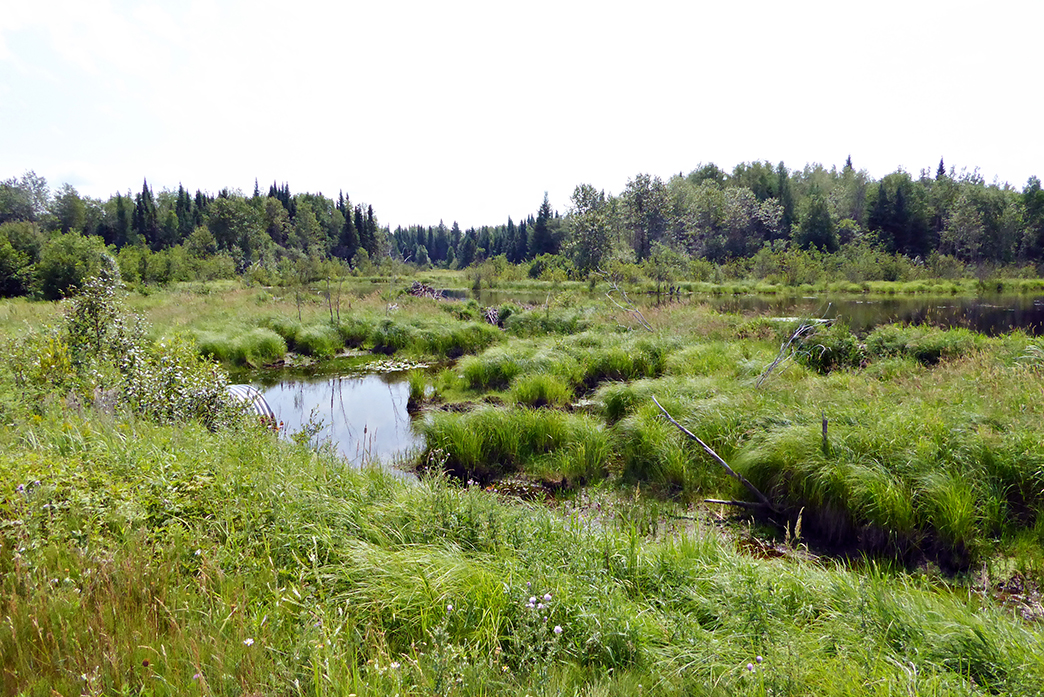
When I felt I was past the worst of it, I stopped for lunch and took in the surrounding wetlands.

Lumberjack Wetlands_web

Wetlands north of René Brunelle Provincial Park

I popped out in Kapuskasing next to the Shell station on Highway 11. Although there was a sense of incompletion in only doing one half of the loop, I decided that was enough excitement for one day and headed into town to find the LCBO and something to enjoy back at camp. I wanted to explore the town a bit and was glad I did. Kapuskasing has an iconic ring of Canadiana to it.

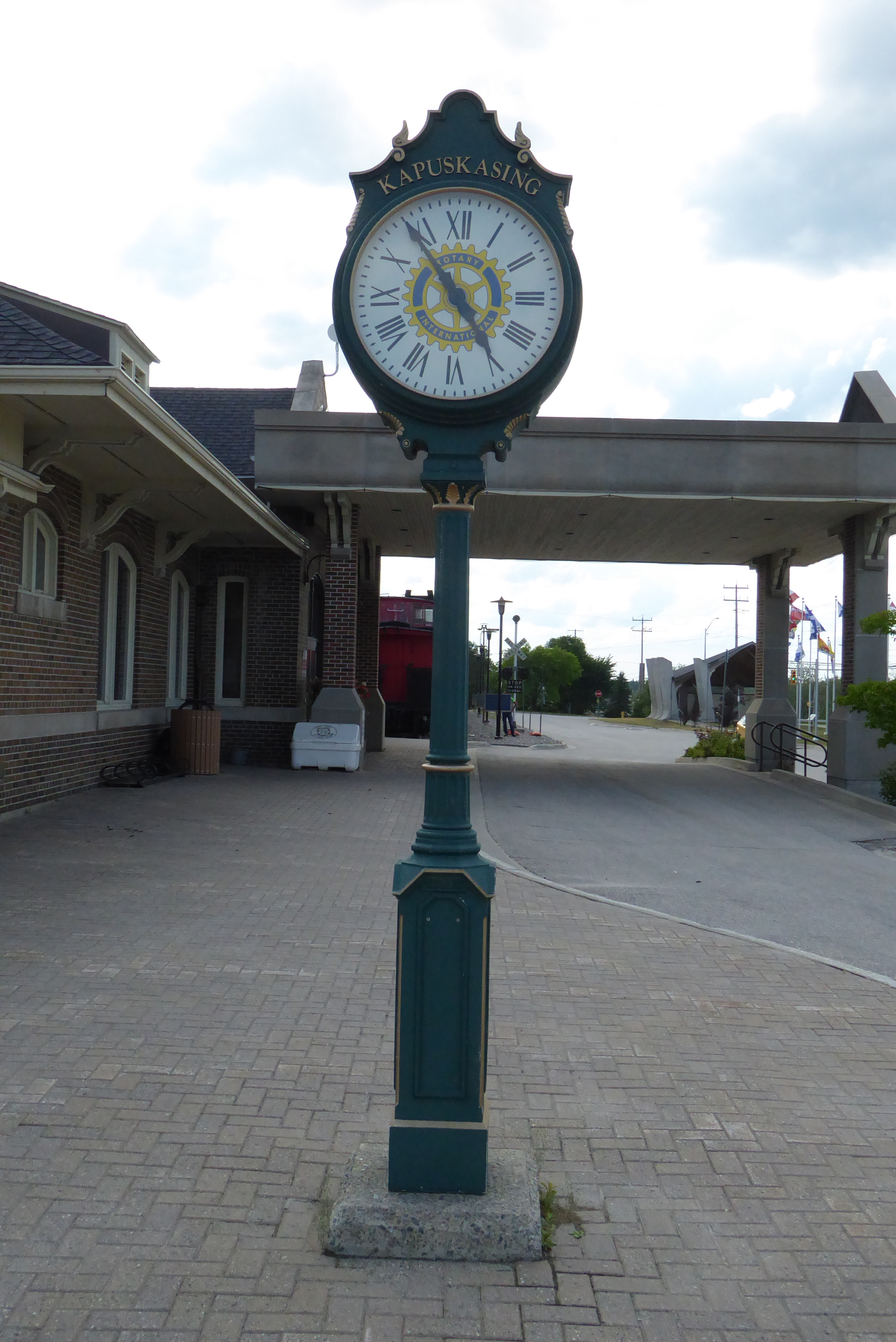
I had the impression that it was bigger than it is, but there isn’t much in these parts that is big. These one-industry towns in the north are built on mining or forestry and are pretty remote. I rode through the town centre, which is a roundabout, and landed at the train station, the heart of all Canadian towns.

P1030264Surrounding the station were archival photos of the town and area, and I discovered that Kapuskasing had been the site of an internment camp during WWI. Primarily Ukrainian immigrants were shamefully sent there to work in a government-run experimental farm studying the viability of farming on clay. Later in the war it was a POW camp.

Kap plaque_F

A plaque outside the train station commemorates the Kapuskasing Internment Camp, 1914-1920

I love Canada and am a proud Canadian, but every nation has its dirty little secrets hidden in untaught history classes. Currently in Quebec, some teachers have expressed serious concern that the role of minorities is overlooked in the current history curriculum. I believe that a little less Upper and Lower Canada and the harmonious relationship with Indigenous Peoples, and a little more on the Indian Residential Schools (IRS), the internment camps of law-abiding citizens during both world wars, and the not-so-quiet actions of the FLQ in the 70’s would go a long way toward real truth and reconciliation among its diverse peoples.

I left the station and rode to the City Hall, then parked and walked out to a gazebo overlooking the river and mill. I came across this plaque about the Garden City and Model Town, and it occurred to me how much promise and hope there must have been in Kapuskasing at one time.

Garden City

Maybe Kapuskasing is iconic. It could be symbolic of how the country seemed when Europeans began settling here—pristine, pure, wild—like the blank page awaiting our best intentions. But intentions are just a start. The real work happens after the first draft, when we see all our mistakes and how we can make it so much better.

Flying Solo

Moonbeam Saucer_web

The first time I travelled alone I was 21. The year was 1984. At that time, it was a thing, after finishing high school, to backpack across Europe with a Eurorail pass and international hostel membership card, “finding yourself” along the way. After spending some time with family in England, my uncle drove me to the docks at Portsmouth and I caught a ferry across the channel to start my month-long trek of the continent.

I hadn’t slept much the night before. Although this had been a plan for most of the preceding year, I was apprehensive about setting off on my own for the first time in my life, and my aunt, in the usual succinct manner of that side of my family, said “Your mind must have been active.” In reality, I was shitting bricks.

It was a night crossing and we docked the next morning in Le Havre. After getting some breakfast, I managed to figure out, without knowing a word of French, the correct train to Paris. Once in Paris, I started looking for my planned hostel. Even on that first day, I knew intuitively, as any animal does, that safety at night is the top priority. My anxiety grew through the afternoon as I failed to find not only the hostel but also a decent crapper. Armed only with my copy of Let’s Go Europe, I wandered the streets of Paris, asking passerby in English, to no avail. Parisians, I was discovering, have no time for tourists. I was getting worried. If I couldn’t find this hostel, how could I possibly find myself?

It was at that point that the guardian angel of travel, Saint Christopher, smiled on me in the form of a mute. He was a young man, barely a teenager, unable to speak a word of French or English, and the only Parisian with the patience to help me. In a series of completely intelligible gestures and grunts, he communicated that I had to get on not the metro, as I had mistakenly thought, but the commuter train and go three stops before getting off. What I had failed to understand was that the hostel was not in Paris at all but the suburbs on its outskirts. I think he even took me to the correct platform and indicated again the number three with his hand before waving goodbye. That was the only time during that month I felt in trouble, but I’ve never forgotten that young man nor the feeling of being in a bit of a fix while travelling alone.

There’s something unique about travelling solo. Of course there are practical advantages like being able to travel at your own pace, your own route, in your own company, especially if you’re an introvert. Locals are more likely to approach you and strike up a conversation. But the real advantage of travelling solo is that extra edge of danger in having no one to rely on but yourself. Problems with the bike? You’re on your own. Problems navigating? You’re on your own. Personal security? You’re on your own. That may not sound like very much fun, but as Claire Fisher in the pilot episode of Six Feet Under says about crystal meth, the risk of travelling solo makes everything “burn a little brighter.” It’s a drug one can get hooked on. And with the added risk and reward of motorcycle travel, it’s no wonder that today the thing is to find yourself selling everything and travelling solo around the world by bike. The ADV world is filled with folks doing exactly this, or dreaming about it.

There’s little chance of me packing up anytime soon. I love my little cottage-home in Quebec, my job, my wife, and my son. The solo tour for me this year was five days in Northern Ontario doing The Great Legends Tour, a loop from Mattawa to Kapuscasing via Tamiskaming Shores, then back down through Timmons, Sudbury, and North Bay. After a few days at a cottage in Kipawa, I loaded up the bike, said good-bye to my wife, sister, and a friend, and headed north up the 101.

It was a wet ride but the rain didn’t dampen my spirits; I was finally on my own and heading for adventure. The 101 is a two-lane highway that cuts through boreal forest on the Quebec side of the Ottawa River. Without any fencing at the sides, you have to stay alert. 101N Forest_webIt climbs as it heads north, opening up into farmland and views of the distant mountains.

101N Farm_web

After riding for a few hours, I took my first break at a rest stop in Ville-Marie.

P1030202

Shortly after lunch, just north of Saint-Bruno-de-Guigues, I spotted a sign indicating a covered bridge. I knew my destination was all the way up in Moonbeam, but the adventure bug was itching so I decided to venture off my planned route. A gravel road took me to Pont Dénommee—not the most picturesque covered bridge I’d seen, but not knowing what you’re going to get, like a handful of Bits And Bites, is part of the adventure.

Covered Bridge_web

After riding through, I went to pull a U-turn, but I swung too far right to set up, the road crumbled at the edge, and the front tire washed out. After a week of asphalt, I was out of practice off road. With the panniers on, the bike didn’t tip completely over and it was easy to lift again, even still loaded. But it would be a reminder to stay alert always when off roading and a harbinger of things to come.

With my excursion fulfilled, I returned to the 101 and soon crossed back into Ontario on the 65. The rain started and never really let up for the rest of the day. My Klim Dakar pants are not waterproof and sometime that afternoon I decided, before my next tour, I would invest in some waterproof Gore-Tex pants. I also decided I needed a proper motorcycle GPS. My Samsung S5 is water resistant and works okay with GoogleMaps as a crude GPS, but it does not charge whenever the port detects moisture, and a fully charged phone can deplete in a matter of hours when running a GPS app. The phone and the status of its battery would be a thorn in my side the entire trip and lead to a breakdown on my final day. (More on that later.) I’ve been such a good boy this year that Santa owes me, and if a Garmin Montana isn’t under the tree this Christmas, I’m breaking bad.

At Temiskaming Shores I filled up, then turned onto Highway 11N from the 65. There’s a Tim Horton’s there and it was a welcome stop to warm up if not dry off. From there, I headed north, but instead of angling north-west on the 11, the Great Legends Tour suggests continuing straight north on the 569, then the 624 just before Englehart, then the 672, north and north and north, so that when you finally catch up with the 101, this time on the Ontario side of the border, you’re way up near Matheson and the deciduous trees have disappeared. After a short stint west on 101, soon I was heading north again on the Transcanada Highway 11, but by this time I was happy to be on a major well-maintained highway to crack the throttle. I was keeping my eye out for wildlife, and while I wasn’t sure of the cops situation in these parts, I was watching out for them too. What I wasn’t expecting as I rounded a corner in driving rain was to find a car backing up on the highway! It just goes to show how you can never, ever be complacent on a motorcycle.

Many beginner riders, fearing front-end wash-out, get into the bad habit of using only the rear brake, which accounts for only 10% of stopping power. And many riders with ABS brakes never learn how to modulate the front using two fingers and a gentle initial squeeze until the load is transferred to the contact patch and sufficient friction prevents the tire from washing out. Without the benefit of ABS, I’ve always forced myself to brake properly, emergency or no emergency, to develop muscle memory specifically for the situation I now suddenly found myself in: an unexpected emergency stop on a wet surface at speed. It all might have gone horribly wrong if I hadn’t forced myself to be diligent and demanding with this skill in those early days. This was the payoff. The bike squatted and I quickly slowed without even a skid, then proceeded to gesticulate to the idiot driver in front, not so much a “Fuck you!” but a “What the fuck?” It appeared a construction vehicle had dropped some of its load in the oncoming lane, but to this day, I don’t know why the car in mine had stopped and was backing up. What I do know is I’m glad I learnt emergency braking technique. A lot of people say that motorcycles are dangerous and I won’t deny they are. But learning proper technique, whether with braking, accelerating, cornering, or just viewing the road, will keep you as safe as possible. Bad things happen to newbies who are unprepared.

It was getting on in the day and I still had to get through Cochrane, Driftwood, and Smooth Rock Falls to Moonbeam, angling northwest and now as far north as I’d ever been in my life. There’s not much up in these parts and I’d passed up the opportunity earlier in the day to pick up a little Northern Comfort at the liquor store to warm my belly upon arrival at camp. I regretted that decision now that I was cold and wet. The liquor store in Moonbeam would be closed by the time I arrive, so I chalked that one up as a lesson in poor forethought.

The local council in Moonbeam know how to exploit their name to attract tourism. I’m imagining the council meeting when someone suggests building a flying saucer and placing it at the side of Transcanada Highway to attract tourists. I wonder how that idea first went over? But build they did, and the saucer above is now a local landmark. I, for one, was grateful because Moonbeam is so small you can miss it if you blink. My destination was René Brunelle Provincial Campground just north of Moonbeam. My GPS didn’t say turn right at the flying saucer but it could have. Right on the 581 and soon I was on dirt and soon after at the park gate. The young lady at the gate said my site was one of the good ones, right on the water, and it was! I pitched the tent, had a little supper, then strung the food pannier because there was apparently a bear in the area.

RB Campsite_web

By now the rain had subsided but I still had a chill from the ride. Without any liquid warmth, I lit a pipe and took a walk through the campground. I didn’t have many good words to say about provincial campgrounds in my last post, but now I’m going to say you just have to get far enough away from Toronto and its resident douchebags for all that to change. The campground was lovely. Here are the unofficial rules, posted by one of the regulars.

RBrules

I looped around and as I came back along the lake side of the park I saw between the trees flashes of light in the night sky. Once back at my site, I climbed down to the water and looked across Remi Lake. Every few seconds the sky would light up a diffuse amber, and at first I thought I might be seeing the aurora borealis, or northern lights. It’s not uncommon to see them this far north. But then a bolt of lightening jabbed out from beneath the bank of clouds and I knew it was rather a lightening storm. Nevertheless, the light show was spectacular, and at times like these I don’t want to be alone but sharing the experience with my wife.

I knew what it meant though: more rain was coming. I climbed into my tent and into my sleeping bag, rolled up my sweater and placed it behind my head. As I lay in the dark, I heard the wind pick up and begin to rustle through the upper branches of the huge pines that surrounded me. The rustling grew louder and soon it was a roar and I wasn’t sure if I was hearing wind in the trees or rain on the lake. It was rain, and the storm was a big one, moving toward me. Just when I thought it couldn’t get any louder, the first few drops began to hit the tent.