Newfoundland’s Rich Aviation History

After dropping Marilyn off at the Saint John’s airport, I ride solo back across the island, stopping at some aviation landmarks along the way.

It had been a great 17 days together on the bike through Gaspé, PEI, New Brunswick, Nova Scotia, and Newfoundland, but Marilyn had to be back for work so off she flew. Now I was on my own again, and it took me a few hours to adjust; I’d become so accustomed to having her on the back as company.

I had to cross the island again back to Port aux Basque and, as some of you know, I’m an aviation enthusiast so decided to make some detours to historic landmarks en route. The first was the airfield in Harbour Grace where Amelia Earhart took off on her solo flight across the Atlantic in 1932. On the way there, for my mid-morning break, I stopped at the Tim’s in Bay Roberts for coffee and some minor maintenance.

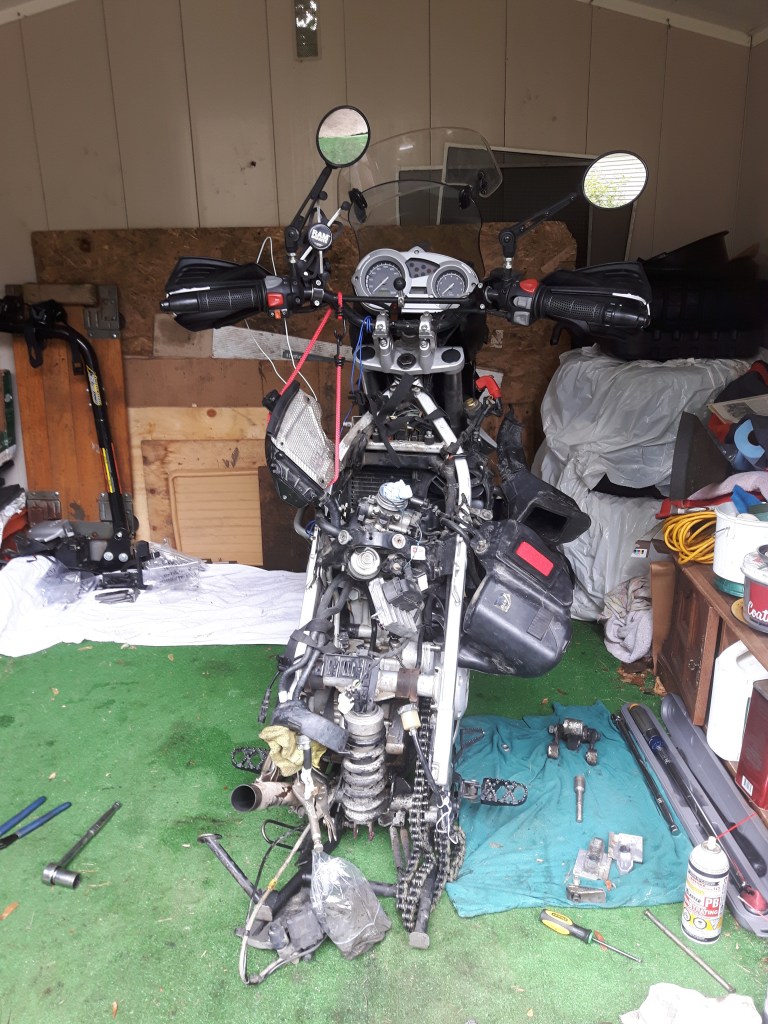
Earlier in the day, I’d noticed one of the Tiger’s two headlamps burnt out. I had a spare on hand and it was a quick fix in the parking lot. One of the things I like about the Triumph is that it doesn’t have all that fairing at the front like the old Beemer. Changing a light bulb on that machine requires removal of the windscreen, the headlight guard, the front flashers, the side panels, the instrument panel, and finally, the fairing. On the Tiger, you simply twist to remove the cover. Nice!

With that done, off I flew as well, until I realized I’d left my hydration knapsack hanging on the back of a chair at Tim’s. Doh! As I rode back toward it, I pondered the chances of it still being there in small-town Newfoundland compared to if I’d left it unattended in Montreal. It took me maybe 15 minutes to get back to the coffee shop and to my relief but not surprise the knapsack was still there. Phew! It had some valuables inside and I would have been very annoyed if I’d lost it.

The first thing you see upon entering Harbour Grace is a statue of Amelia next to a Douglas airplane named The Spirit of Harbour Grace (see banner image above). The donors don’t win the Pulitzer for the most original name. The park of the same unfortunate name contains other items of interest, such as a replica of the famous flight log. There’s also a tourist info centre and the nice young student employees directed me up to the famous airstrip, which was really the only reason I was there.

When you arrive, after a few kilometres of gravel, you see one of those signposts pointing distances to destinations, only this one denotes famous flights in and out of the airstrip. You can see Earhart’s 3,132 kilometre flight to Culmore, Ireland, in 1932. Apparently WWI American ace Eddie Rickenbacker also used the airfield in 1936. The unassuming little clearing slopes slightly downward heading west, as planes naturally would take off into the oncoming easterly wind. Earhart would have had to turn 180 degrees after take-off before heading out over the Atlantic toward Ireland.

By the time Amelia attempted to circumnavigate the world in 1937, her legacy was secure. When she disappeared under mysterious circumstances on June 2, she became a legend. Like the Titanic, she took on a mythical significance larger than her physical accomplishments, which were numerous. The fateful end became one of the great mysteries of the modern era, taking us into the realm of imagination and the great unknowns of life and death. The grainy, black and white video footage we have of her does not seem to match the iconic status of what she’s come to mean, but reminds us that she was, in the end, human just the same.

If you are reading this on your phone, use landscape orientation.

DEAR GEORGE: THE LOST LETTER

I’ll admit my big break came
from my looks. You said
when I walked into your office, you knew
you’d found your woman. Lucky,
I guess, how much I looked like Lindy,
although I never liked the nickname.
No woman likes to be compared
to a man. They said I even
moved like him, shared the same
DNA and fear of fame. I can’t complain,

but it wasn’t easy climbing into that plane
with a drunk, putting my life in his
trembling hands. I saw the bottle
tucked behind his seat and would have
thrown it out the hatch but knew
from Daddy how that ends. Instead,
I helped carry him to the dock, managed
our “personnel problem” as best I could.
They didn’t let me fly, just the easy
bit over land, and that’s why

when I did it myself, solo, it was
like a single finger held up to the world
as if to say, “Women can do this too.”
Nobody thought I could, even you.
And more. Records fell like ticker-tape,
didn’t they—altitude, distance, time
merely obstacles of the mind, my body
just another obstacle, an accident of sex,
not tomboy but woman who
only wants what’s fair and true.

Don’t patronize me! I said I wouldn’t
fly the derby if the girls and I
started east, the guys getting the harder route
over the mountains, and meant it. When
they kicked us out of the Bendix Trophy
I’d had enough; they could find another
to fly their starlet to the race. Even in marriage
I only ever asked for freedom. The note
I wrote on our wedding day said I’d never claim
anything from you and asked the same.

So, dear, if you’re reading this you know
I did not make it home. Maybe it’s for
the best; I was only ever afraid
of growing old, as most women will attest,
and preferred to go in my plane.
And since we’ve always been this honest,
there is one thing more: the rumours
that I was pregnant when I flew
round the earth’s belly are true, but
the baby wasn’t yours. I think you knew.

Love,

A.E.


© 2022 Kevin Bushell

There are many theories as to what happened to her, including that she and navigator Fred Noonan crash landed on Gardner Island, south of the intended Howland Island. Human bones and artifacts, including a sextant and a ladies compact, were found, but the bones, now lost, by some accounts did not match her dimensions. As I write this, there are reports that an American team has found her plane 100 miles south of Howland on the bottom of the Pacific, about 5000 meters down. All we have is sonar imagery resembling her plane, but it will be very interesting to follow these developments.

Back in Newfoundland, the famous airstrip was unused and abandoned on the day I visited. The only person around was an older gentleman named Austin, who has built a house on the property adjacent to the airstrip. Maybe it was because I was on my own for a change and knew only I would pay the price for delaying, but I indulged in a conversation with this unusual man.

He has built several airplanes which he stores in a hangar beside the airstrip but has never obtained his pilot’s licence. He said he never had the time to complete the licensing process. He also built the house, but never connected it to NL Hydro because, he says, they charge too much ($50,000, if I remember correctly). He had all the windows of his house open on the day I was there to help deal with some mold that had developed in the recent hot, humid weather. He has a large generator that he uses when needed but hasn’t installed A/C or, I guess, a dehumidifier. He also has, sitting beside his house, an ancient wheel loader which, he says, he bought for dealing with “Snowmageddon.” It had a fuel line leak and he was just about to deal with that.

I felt for this solitary, older man with the unused airplanes, the moldy house, and the leaky heavy machine, and was tempted to get out my tools and give him a hand, but all I had time for on this particular day was a brief conversation. Maybe I shouldn’t feel sorry for him; he’s clearly staying busy through his retirement. I suspect there are a lot of these brilliant eccentrics in Newfoundland, and I was happy to have been given a glimpse into his extraordinary and fiercely independent life. We parted, not before exchanging names and promising to meet again.

My next stop was Gander, which we missed coming the other way. I’d heard of the famous airport, and frankly, had become a little tired of hearing about it, if you want to know the truth. Okay, it’s remarkable that they managed to host all those unexpected guests during 9/11, but really . . . a broadway musical? To be honest, I was more interested in seeing the main lobby as a time capsule of another era. (They have managed to retain the original decor.) I was also interested in the idea of all those famous people like The Beatles, Marilyn Monroe, Elvis, and Frank Sinatra having set foot in there. Oh yeah, and the Queen. Now we can add the adventure boots of 650thumper to that list.

The coin parking meter out front was cute. What a contrast from the Montreal airport where you pay $8 for 20 minutes or get 30 seconds in the drop-off zone before security start yelling at you.

My third aviation stop of the day was The North Atlantic Aviation Museum, right across the street from the airport. By the time I got there, the museum was closed but that was okay; it was getting late and I only had time for a quick blow-through, so to speak, of the outdoor exhibits anyway.
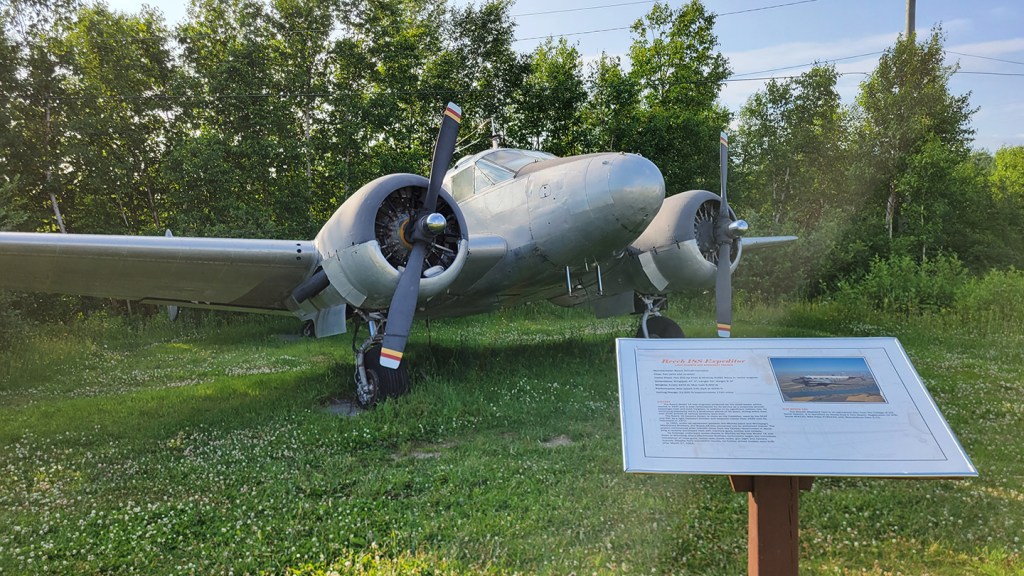
There’s a lot more aviation history in Newfoundland I would have liked to explore, such as where Alcock and Brown took off (somewhere in Saint John’s) for the first ever transatlantic flight, but that would have to wait for another time. Half an hour later I was in Notre Dame Provincial Park in time to go for a swim before setting up camp. It had been hot and the swimming there was a welcome relief at the end of a long day.

The next day I got an early start in an attempt to beat the heat. It was easy highway riding and I settled in to several hours and put over 300 kilometres behind me, stopping only at the Canadian Tire in Corner Brook to top up my oil. I’d ridden 6000 kilometres since my oil change, some of it high revs in heat, and the sight glass told me the oil was a little low, so I added 200 mL to get me home. While I was eating lunch, it started to rain, and it rained, and rained, sometimes hard, for the remainder of the day.

I’m not spooked about riding in rain. I have good rain gear and trust my tires. I was ahead of schedule and the prudent thing would have been to pull off somewhere warm and dry and enjoy a good book, or to get to the terminal early and wait in the warmth there. Instead, I decided to spend the remaining time exploring Cape St. George off the south-west corner of the island.

My friends and wife will attest that my motto in life, aside from Life Is An Adventure, is “Pack it in.” Maybe because I recognize that time and life are so precious, I feel that an idle moment is a wasted moment. It’s an affliction I’m working on. In this instance, I was less successful and decided, despite the rain, to try to loop the cape. It would be a good challenge, and I like a challenge.

The lady at the gas station in Stephenville said it takes about two hours, so that would leave me plenty of time with buffer to get the rest of the way to Port aux Basque for my night crossing. In the back of my mind was also the possibility that there might be some good ADV riding out there, and there was. I ventured off the pavement down to the water for a photo op.

I made it out to Boutte du Cap Park, but shortly after rounding the point and starting back on the west side, the road climbed into fog. Now I was forced to ride at 55 km/hr and was at risk of missing my ferry, not to mention hitting a moose, so I bailed. This will give you a sense of what I was seeing just before I pulled the U-turn.

And this will give you a sense of the cold, wet ride back along the coast to the ferry. I know these are boring so I’ve kept them short.

At the ferry terminal, I changed into dry clothes and couldn’t resist getting a hot coffee, a decision that would come back to haunt me later. I normally am not affected by caffeine, even late in the day, but that night, in unfamiliar surroundings, on my own, with distractions all around, I think I got about an hour of sleep. I’m a pretty solid sleeper, even in public places, but some A-hole front and centre of my section sounded like he was swallowing his tongue the entire night. I eventually got up and searched for another section, but each floor had several loud snorers. It really showed me how prevalent snoring and apnea are in our culture. I’ve recently been studying this through Andrew Huberman’s podcasts in which he talks about mouth breathers and diet and obesity and how these factors result in facial modification, sleep disturbances, and decreased quality of life. Something to consider.

It was a crappy way to end a wonderful first visit to The Rock. I was happy to dock and headed straight to Baddeck Cabot Trail Campground, set up camp, then took a power nap before hitting The Cabot Trail. But this is already pretty long, so I’ll save that iconic ride and the rest of my tour through Nova Scotia and Maine for another post.

Have you visited any of these sites? What is your connection to aviation, motorcycling, or Newfoundland. Feel free to comment below. I love hearing from readers.

Saint John’s and The Irish Loop

We complete our tour of Newfoundland with a few days in Saint John’s and ride part of The Irish Loop.

We arrived in Saint John’s late in the day and hungry, so after cleaning up we asked the staff at The Alt where we could get a meal at that hour. They naturally directed us further down Water Street. We’d heard of the lively Water and George Streets and were looking forward to taking in some of that Irish pub nightlife, only when we got there, we were disappointed.

As we sat on a sidewalk patio awaiting our food, I took a look around. We were definitely out of place. For one, we were married, and for two, were were sober. The scene reminded me of The Simpsons episode in which Marge asks Homer not to show up drunk at Lisa’s recital. “Irish drunk or American drunk?” Homer asks, just to be clear. I hadn’t seen this level of drunkenness since high school. The average age here was more like mid-twenties but they were clearly regressing. What was it George Bernard Shaw said about youth? It’s wasted on the young.

More disturbing were the greying and balding 50-year-old single males amongst them, leaning against lampposts and slurring directions to the next pub, which is all of a 100 feet further down the road, if they can make it that far. Well, to each his or her own, I guess. We just aren’t into that scene.

On the other side of the road were a group of homeless youth, or so they seemed to me. They had all the tell-tale signs of homelessness—unkempt hair and clothing, the tattered and filthy knapsack, and a certain loitering, lounging body language that indicated they had all the time in the world and no place else to go. There was also a certain solidarity among them, as if their immediate friends were all that mattered in the world, deaf and blind to the surrounding animal show. Or maybe it was they who were trying to be invisible. When you are the most vulnerable, you learn to be invisible should some violent drunk take a dislike to your presence. The drunken revelry and the sad homelessness were a strange juxtaposition, separated by 50 feet of blacktop.

Music emanated from the open window of the pub out onto the terrace where we sat and across the street. It was an Irish jig, and from the sounds of the cheering and clapping inside, the folks were really enjoying it. I might have been too but, alas, as a former side drummer of The Black Watch (RHR) Pipes & Drums, I know what a good jig sounds like, and this wasn’t it. I’m going to sound like a music snob, but it was sloppy. In “Two Ways of Seeing a River,” Mark Twain suggests that the steamboat pilot can no longer appreciate the beauty of the river after knowing of its dangers, and I guess I will say that knowing what good Irish music sounds like has made me unable to appreciate the beauty when it’s bad. We missed the genuine Newfoundland music on this tour, to our great disappointment, but that’s an extra reason to return.

Finally our food arrived and we soon retreated back to our hotel. Water Street was a huge disappointment. We have since heard it referred to as the New Orleans of the North. I’ve never been to New Orleans, and now I’m not sure I want to.

The next day I was hoping to meet up with a former professor from my undergrad days. We had lost touch over the years but recently reconnected when I asked him to write an endorsement for my new book. He was as gracious as ever in both agreeing to do it and for what he wrote. I gave him a call and suggested we meet for breakfast, but in true Newfoundland style, he invited us over for a homemade one.

The term “famous Canadian poet” is almost an oxymoron, but if one exists, it would be Don McKay. He has written over a dozen books of poetry, poetics, and philosophical musings, and edited countless others. He has twice won Canada’s highest literary award, the Governor General’s Award, and once the most lucrative prize, the Griffin Poetry Prize. In 2008, he was made a Member of The Order of Canada. I was lucky enough to have studied under him at The University of Western Ontario (renamed Western University) back in the 1980’s and his poetry has been a major influence on my own.

It was delightful to see him again, as modest and affable as ever, to introduce Marilyn, talk writing and, of course, get his advice as a local on where to visit. He suggested we hike up Signal Hill for a good view of the harbour, and later, to stop in at Running the Goat Press when passing through Tors Cove on The Irish Loop. Suddenly there was a knock at the door. It was another former student of his and, coincidentally, someone who spends part of the year in Guelph, Ontario, and is a friend of my brother-in-law! So now there were the four of us in Don’s kitchen and it was almost a party. All we needed was a fiddle and bodhrán to make it a complete Newfoundland moment.

Marilyn and I decided to do that hike so headed off, promising to stop in again in a few days and say good-bye before leaving Saint John’s. By this time I’d found an AirBNB, which enabled us to stay a few more days in town without taking out a second mortgage. I’m really glad we did. It would have been a shame to leave only with the impression of the night before. We were able to check in early, park the bike in the back, then head off on foot to explore the city.

Saint John’s Harbour

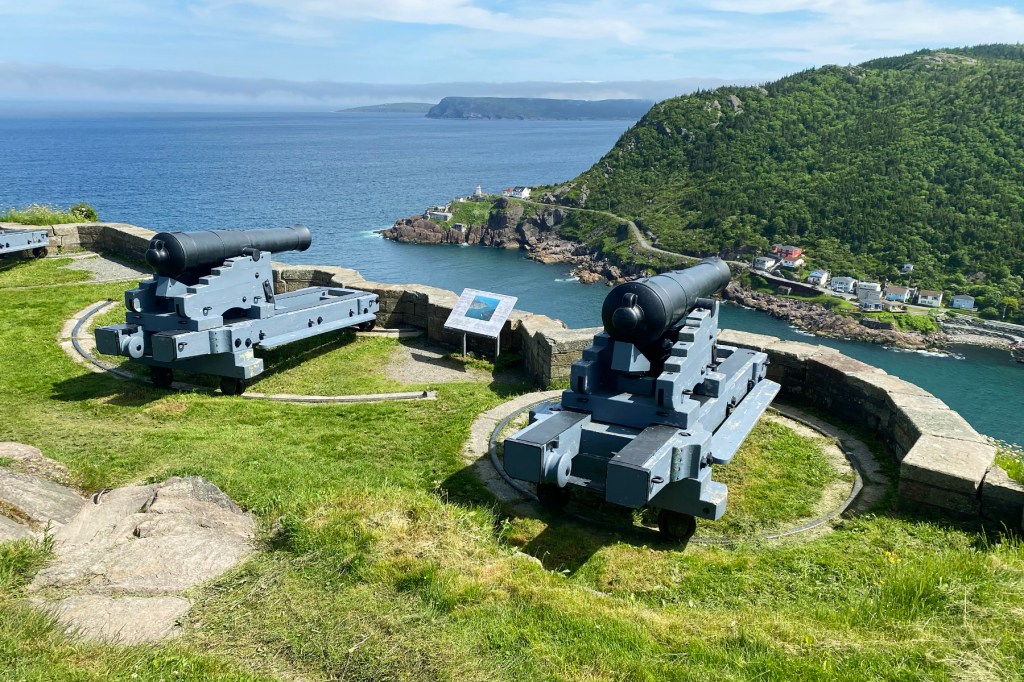
The trail took us past The Battery as it snaked its way up the side of the mountain, the view of the harbour getting better with each laborious midsummer metre of elevation. It’s called Signal Hill because Guglielmo Marconi used it to receive the first trans Atlantic telegram and my legs were saying he chose wisely. Eventually we reached the top and had an excellent view not only of the harbour but over to the Cape Spear Lighthouse and east out to the open ocean. The surrounding cliffs and narrow passage provide excellent military defence for the harbour. No wonder Saint John’s developed where it is.

Signal Hill Battlement

We had more friends to meet later in the day once we came back down. We had met Serge and Ang in 2021 on a ferry in British Columbia as we rode the Sunshine Coast and had kept in touch through the intervening years. By coincidence, now they were touring Newfoundland at the same time so we had to meet up and do some riding together. We met at The Battery Cafe to catch up and decide on a plan.

We decided to ride part of The Irish Loop, as far as possible in a day excursion. The next day we met at Cape Spear Lighthouse, the eastern-most point of Canada. Marilyn and I had waded into the Pacific Ocean in Tofino in 2021 and now wanted to do the same here, but there were a lot of warnings about going near the shoreline so, unfortunately, we had to remain up at the cafe enjoying the exquisite coffee and pastries.

We eventually headed off and our first stop was in Tors Cove and its bookstore Running the Goat Press, only about 50 kilometres south of the lighthouse. The press specializes in children’s literature and, according its website, “many of Running the Goat’s publications are letterpress printed at the print shop, using moveable lead type, and sewn by hand.” These books are labours of love, and if you are a bibliophile or just have some children in your life who like to read, be sure to stop by or check out their website. The owner, Marnie Parsons, is another old friend from undergrad days, and it was lovely to see her again and get a tour of the press. We bought some books for our great-nieces and Marnie was happy to ship them home for us.

Surveying Tors Cove. No whales on this day.

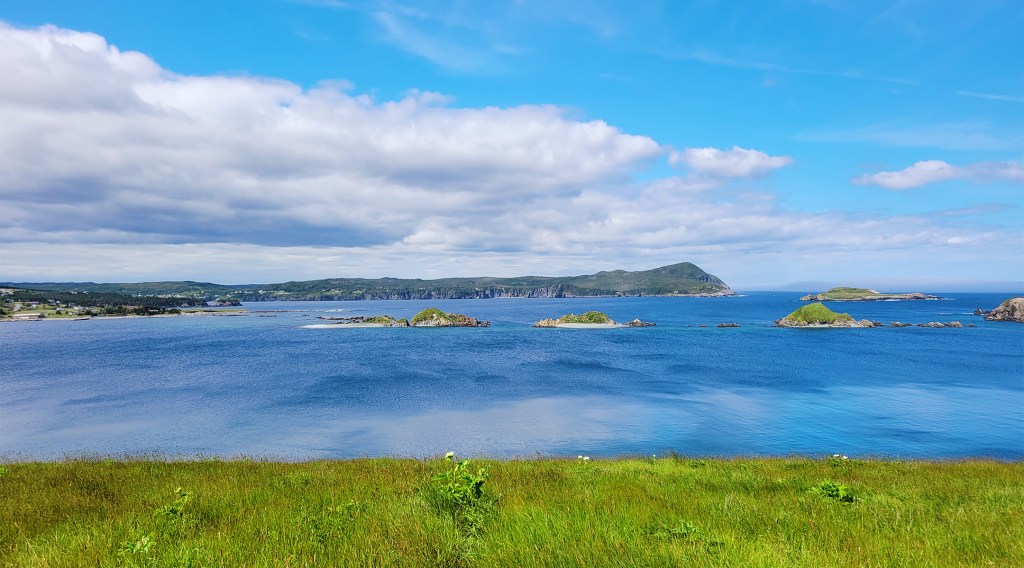
After a packed lunch overlooking the bay, we continued further down to Ferryland, a region that dates back to the 17th Century as one of Canada’s first settlements. The name is an anglicized version of Forillion, the same name as the national park we stayed at in Gaspé. In my head I had been spelling it Fairyland and in many ways that would be a more appropriate spelling. There is something magical about its geography. We rode across a bridge and climbed a ridge-line on our adventure bikes (Serge and Ang have KTM 790s) up to a lookout. A fog drifted in and hung over the tiny islands strung across the bay and the view seemed like something out of Lord of the Rings.

That was as far as we got on our slow-paced day. I didn’t mind. Truth is, I was in need of a few easy days. I’ve come to realize that adventure touring requires some recovery days off the bike. When I did the west coast tour, I stopped in Calgary for several days to visit family, and later, spent another few days in North Vancouver before touring the island. I love riding and can ride all day every day, but what my heart wants my body can’t always deliver. When I got home after this tour, I was tired and decided not to cram in that second tour in The States I had planned to do before going back to work. I needed some time on the couch in and around Montreal to recover and recharge.

For future tours, I’m going to build into my schedule local sightseeing and days lounging around camp, reading and writing. I’m pretty fit for my age, but I don’t even think it’s a matter of age. In a recent video, Runa of Off She Goes was candid about being tired after 40 straight days on the road and looking forward to being home. I think vloggers like Itchy Boots spend days off the bike doing video editing, but we never see those days and it seems like they are constantly travelling. Anyway, that was one of my discoveries this trip: schedule days off the bike to rest, recover, and recharge.

We said good-bye to our BC friends and wished them well on the rest of their tour of Newfoundland and in re-crossing the country to get home.

Heading down into Branch on the 92.

The next day we were on our own again and decided to visit Cape Saint Mary’s Ecological Reserve on the south-west tip of the Avalon Peninsula. The aptly-named Bird Rock is home to thousands of seabirds, particularly gulls and gannets. Newfoundland really is a bird-watchers paradise. As we rode onto the cape, fog drifted in as well, and we wondered if we’d chosen the wrong day to visit.

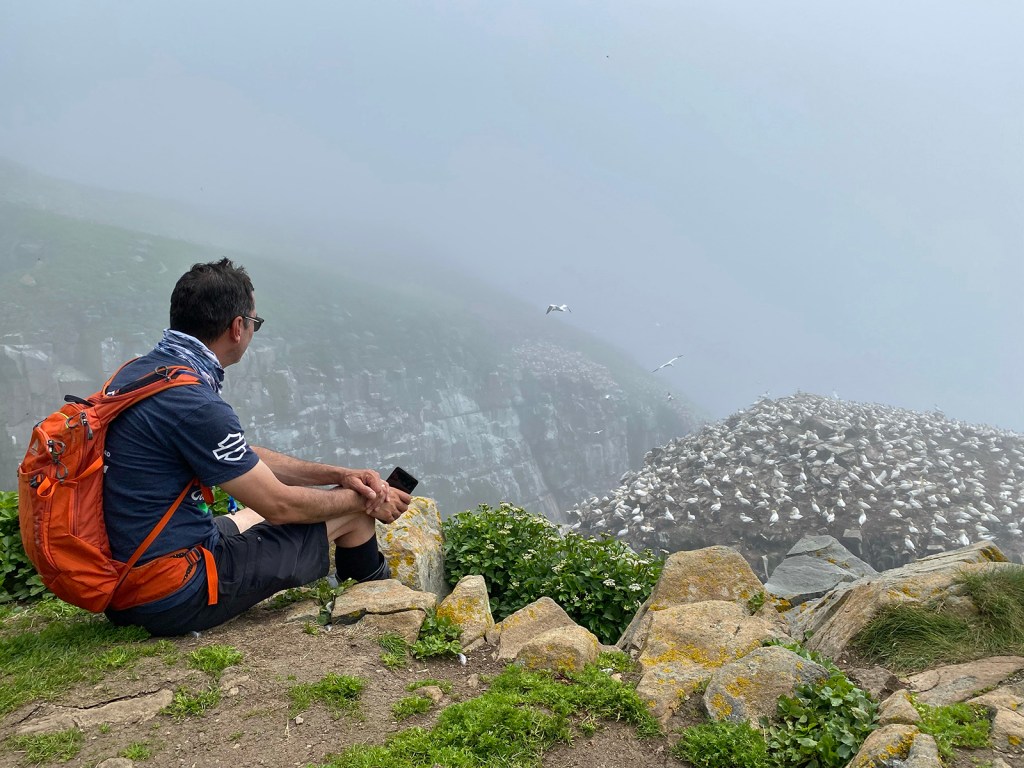
Thankfully, like most weather on the Atlantic, it was temporary. The hike along the cliffs is something in itself, but Bird Rock is special. As you approach, there’s a distinct smell in the air that I couldn’t quite place until we arrived at the tip: it’s bird excrement. But don’t let that put you off; you get used to it. The sight of thousands of birds in one place is memorable, but what struck me more immediately was the sense of being perched ourselves on the edge of a towering rock formation. It’s dizzying, and in fact, Marilyn wouldn’t approach the edge because she was experiencing some vertigo. I was able to sit near the edge and watch the birds soaring in the expanse just beyond.

It was calming in a meditative sort of way, and I could hear the waves crashing in the cove hundreds, or was it thousands, of feet below. My perspective was distorted by the absence of anything familiar with which to judge distances.

The gannets are in trouble due to the Avian Bird Flu. Just a few years ago the rock was noticeably less populated, but it appears they have recovered to some degree, based on what we saw. The current Wikipedia page puts their numbers there at 24,000. The cape is a protected area and we’ll just have to hope that the bird flu, like our Covid, has passed through the community and numbers have stabilized.

Back in Saint John’s, it was our final evening together so we decided to treat ourselves to dinner out at Bannerman Brewing Co.. Later, we took another run at the pub night-life and met up with some new friends at The Ship for a drink. We’d met Mark and Mandy in Terra Nova National Park. They were two-up on an Africa Twin and we learnt they live in Bruce County, Ontario, where we had visited when we looped Georgian Bay. Mark is also a teacher so with two shared interests we immediately hit it off. Neither Mark nor I particularly wanted to talk about work, but I heard enough to know that the teachers in Ontario are facing similar budget cuts as teachers in Quebec. It’s sad to know that in a country as rich as ours, education is chronically under-valued and under-funded.

But it was summer and the start of semester was still a month away. The evening was warm and the ale assuaged any anxiety over the approach of autumn. It was a fitting way to end the tour. The Newfoundland geography had been everything we’d hoped it would be, and maybe some of that Newfoundland culture had rubbed off on us too—the connection with others, old friends and new. It’s a bit of a stereotype but Newfoundlanders are generally very down-to-earth and friendly. Maybe that has something to do with being so close to the elemental nature of the earth—rocks, cliffs, ocean, glaciers, grasslands, wildflowers, wildlife, and the ever-present, ever-changing climate.

People often ask me when I return from a tour like this for my favourite memory. In this case, it’s hard to isolate a single moment, although if I had to, it would be seeing the caribou at Point au Choix. But what I take away from the trip overall is a feeling, a mood, a style of living and life that is unlike any other with perhaps the exception of Dawson City, a similarly isolated community that pulls together against a harsh yet beautiful geography. I know Newfoundland is probably very different through the winter months than how we saw it, but I equally know that the people are just the same regardless of the season. We went looking for natural beauty and were not disappointed, but the discovery of the trip, at least for me, were the people. I can see how a place like this could get under your skin. We will definitely be back. As always, these trips are just a taste and leave one with an appetite for so much more.

Quidi Vidi

The next morning, after saying our good-byes to Don, I dropped Marilyn off at the airport. I was now on my own and had given myself two days to cross the island again and get to the Port aux Basques ferry terminal. I still had a few things to see en route, like the airstrip where Amelia Earhart took off on her cross-Atlantic flight, the Gander airport, and the North Atlantic Aviation Museum. I was looking forward to riding The Cabot Trail, seeing good friends in Nova Scotia, and meeting a reader of 650thumper as I cut through Maine.

I’ll write about all this in my next and final post on this tour.

The Viking Trail

Marilyn and I begin our tour of Newfoundland by riding the west coast to L’Anse aux Meadows.

Newfoundland bound.

You know you’re headed to Newfoundland when the ferry staff call you “Hun.” In my profession (teaching), that’s tantamount to sexual harassment, but here it’s the term of endearment it’s clearly meant to be. We were directed to the front and side and found the tie-down straps. I hate ratcheting straps. I’ve been using them for years and still haven’t figured out how to work the damn things. There are YouTube videos and probably PhD programs as well on how the mechanism works, but using them for me usually ends up with cursing and a pinched finger. Thankfully, the tie-downs provided by the ferry were a simple single folding mechanism that even English teachers can operate.

It’s always a little unnerving leaving your bike and gear for a prolonged period of time, but only staff are allowed down in the hold once the ferry leaves port. Still, I locked the panniers and the helmets, and you can see in the photo above I’ve used a cable to secure the duffle bag as best as one can. I made this from materials purchased at Canadian Tire, the big-box hardware store here in . . . you guessed it, Canada. I bought a length of plastic-coated cable and made loops at both ends by crimping cable sleeves, then attached a simple brass waterproof lock. It’s not super secure but prevents the grab and run. My faith in a good samaritan reporting someone using cable cutters outweighs my cynicism toward thieves. I trust no one wants my smelly boots.

Catching up on sleep.

Once upstairs, we settled in and I promptly fell asleep. I’m an expert napper, even in public places, and use every opportunity to dig myself out of the sleep deficit I accumulate when adventure touring. Then we had dinner which, I have to say, was surprisingly good. I guess I was expecting airline food, but the fish & chips and cloth placemats and real utensils not to mention the Newfoundland friendly service was a treat. Marine Atlantic ferries gets a five star rating from me. It was nice just to sit at the window and look out over the mesmerizing water and watch a seagull follow us for miles, skimming the waves.

Marilyn in her naval attire.

We took the midday ferry because all the cabins for night crossing sell out early. We made our reservation mid-March (for an early July crossing) and they were already sold out. This meant that we lost a day of riding, but I’ve learned that rest days are required at my “advanced age,” so it was all for the best. It just meant that we needed to find accommodations close to Port-aux-Basques, where the ferry shores at 7:15 p.m., because we didn’t want to ride in the dark. Everyone—and I mean everyone—had warned us about the moose in Newfoundland. I suspect this is somewhat like the bear warnings tourists to Canada receive. I have to say, in all our travels across the island, we saw only two moose, midday at the side of the highway, but it’s still a good idea to get off the road at sundown, especially if you’re on a motorcycle.

We therefore had a reservation at JT Cheeseman Provincial Park, about 13 kilometers from the docks. It was a short stay as we were eager to get up into Gros Morne National Park, a bucket list destination for both of us. Our first impressions of The Rock were lovely, with low-hanging clouds above a shallow mountain range on the horizon, and a fog horn sounding in the distance throughout the night, reminding us we were not far from the sea.

My best Pee-Wee Herman hairdo.

The next day we rode north on the Trans Canada Highway through Corner Brook, then split off at Deer Lake onto the 430 and then the 431. As we pulled off at the lookout at Woody Point, I went to turn sharply to park the bike, only the handlebars locked partway and we lost our balance. Thankfully we were going very slowly and I just put my foot down to prevent a tip-over. Marilyn climbed off and I started inspecting the bike. The handlebars would definitely not go full lock but were blocked by something hard. It felt like metal on metal. Eventually, I saw the culprit: a screw from my wind deflector had come out and fallen down into the triple-T and was blocking the handlebar movement. What were the odds! We got lucky on several counts there, not only that I didn’t lose the screw but also that it didn’t obstruct a turn at a higher speed. I got out the tools and replaced the errant hardware, this time using thread locker.

Readers will be pleased to know that I’ve since removed the obnoxious wind deflector. I’ll pay the price of some buffeting for video footage with an unobstructed view.

We got a site at Trout River Campground, which was chosen for its proximity to The Tablelands, a rare phenomenon and one of only a few places in the world where the earth’s mantle is exposed. The peridotite rock turns orange as it oxidizes, resulting in a geography that appears like the surface of Mars, not that I have any direct experience with that. In truth, the geology is more like the centre of the earth than a distant planet. Jules Verne modelled his book Journey to the Centre of the Earth after Iceland’s geology, but he could have equally used The Tablelands as his inspiration.

Hiking The Tablelands.

We hiked up in the afternoon heat, and I was happy to have added a hydration backpack (I’m not calling it a bladder because that’s disgusting) to my kit. It meant that we could easily carry water on and off the bike as well as a few other items, like snacks and a selfie stick.

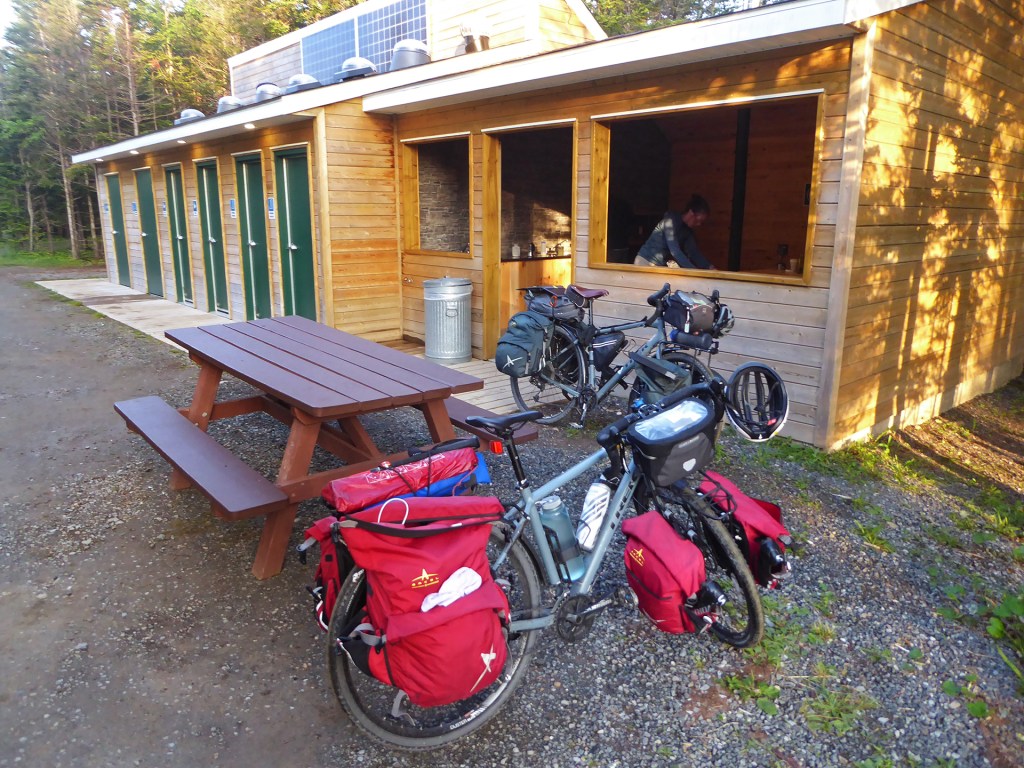
On our way out the next morning, we met some touring cyclists at “the facilities.” They were cooking their breakfast under the shelter there before hitting the road. Just when you start feeling pretty good about managing to fit everything on the motorcycle, you run into cyclists who are doing the same but on bicycles. Hard core. I wonder if bicyclists feel a similar sense of humility when they cross paths with backpackers, who have managed not only to fit everything into one bag but also to carry it to where they are going. At some point, such minimalism must have diminishing returns on investment and become more a penance for sins done, like the story of Cheryl Strayed in the movie Wild (directed by the late Jean-Marc Vallée and played by Reese Witherspoon), who clearly had a heavy burden to bear, so to speak. This line of thought leads me to the ultimate minimalist traveller, the migrant, who is fleeing on foot with little more than the clothes he or she is wearing, and that’s where my imagination has its limit. I can’t imagine doing such a thing, not unless my life depended on it, which I guess for many migrants, it does.

Travelling light.

I also chatted with another camper while waiting for Marilyn. He took an interest in my bike because it was a Triumph and he is English, or English-Canadian. He said he used to ride a Triumph in England and before that an AJS Matchless, which is the exact bike my dad rode before he immigrated, so we had a nostalgic chat and I gave the bike a few gratuitous revs as we parted so he could hear the sweet exhaust note of the Triumph triple. When I rode a BMW, Germans would approach me with their memories; now that I ride a Triumph, Brits chat me up. Once while doing some slow-speed exercises in a neighbourhood church parking lot, I struck up a conversation with the priest, who used to ride a Yamaha 250 in India. Everyone seems to have a story about their motorcycling days, and it occurs to me that motorcycles hold a special place in one’s identity, even if one has long since given up riding. I suspect they remind us of the freest years of our lives, which can be in youth, or in my case, at the age of 60. The motorcycle is the symbol of the best years of our lives, whenever that may be.

We headed back out to the 430 and then turned north. It was a special day because we had reservations for the Western Brook Pond boat tour just north of Rocky Harbour. The highway through Rocky Harbour is spectacular and led to one of only a few disagreements we had during the tour. I say “and” not “but” because it was the spectacular nature of the road that led to the disagreement. It’s twisty and undulating with fantastic views out over the ocean. I wanted to enjoy riding this section “at pace,” but Marilyn wanted me to slow down so she could photograph from the back. (She is by profession and vocation a photographer and carries her iPhone on a lanyard for this purpose.) We had a conflict of interests: my passion for riding versus her passion for photography.

Riding the 431 just south of Rocky Harbour.

I did what any smart husband would do: I acquiesced. Only as I write this she says “I overrided her,” so I guess we have differing memories of that part of the trip. I do remember trying to come to some sort of agreement later whereby if the views were good we would ride at her pace, but if the road were good (but nothing special about the view), we would ride at my pace. In the end, however, I never rode anywhere near the limits of the bike or my abilities. You have to ride to the comfort level of your pillion, especially if she is your wife. The answer, I’ve come to realize, is to separate the interests and have some tours 2-up and some solo. At least that’s the plan moving forward. It’s not really a compromise because it leads to double the riding.

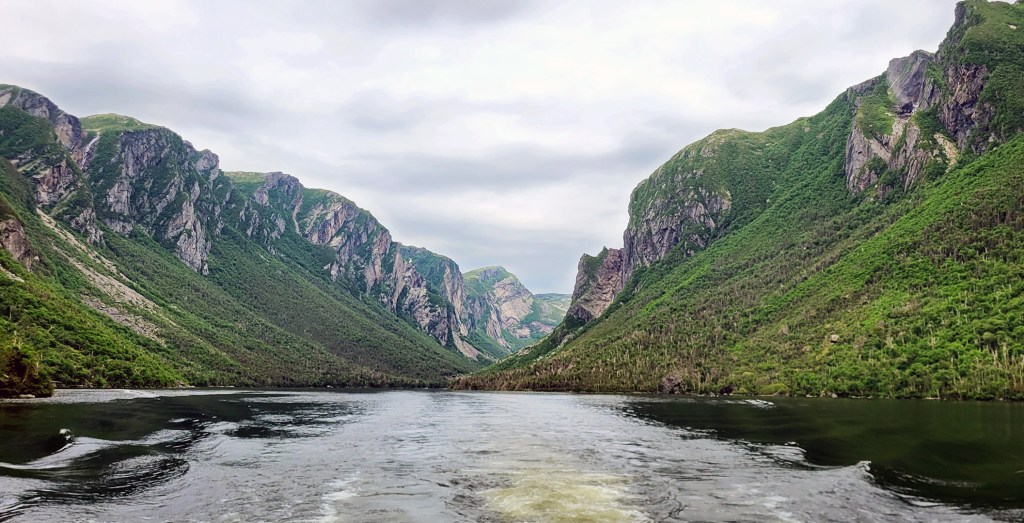
We arrived at the parking lot in plenty of time to hike the required 3 kilometres out to the boat. Western Brook Pond is actually an inland freshwater lake inaccessible by car. It looks like a fjord with steep cliffs on both sides carved by receeding glaciers, but is technically a gorge since, we were told, fjords are saltwater and gorges are freshwater. At one time it was a fjord, connected to the sea, but over time has become closed off and is now freshwater. At any rate, there was some water and some dramatic cliffs producing some stunning views. In fact, one of the views is the iconic shot used by Newfoundland tourism.

When we docked, Marilyn and I shared some clam chowder at the cafe, then hiked back to the bike, which was thankfully untouched. That night we stayed at Shallow Bay Campground near Cow Head. There are several campgrounds in Gros Morne and they are all different. Where Trout River was inland and wooded, Shallow Bay is on the ocean with a long, sandy beach. It’s a real treat, so be sure to stop there if you are passing through.

The next day was our trip up the remainder of the west coast to L’Anse aux Meadows, a National Historic and UNESCO World Heritage Site, where there are the remains of an 11th-century Viking settlement. It’s a long way to go to see some sod houses, but I like history and wanted to stand at the place where early human migration spreading west (Norse) and east (Indigenous) first met. That’s a pretty significant moment in the history of human civilization. I suspect both must have crapped their respective pants, or whatever 11th-century garment they were wearing at the time, upon seeing the other. The monument at L’Anse aux Meadows commemorating the encounter conveys the crapping quite well, I think.

Meeting of Two Worlds. Not a fan of modern representative sculpture.

According to the old Norse sagas, Newfoundland was discovered accidentally when Vikings from Greenland were blown off course in a violent storm. They saw the Labrador shoreline but didn’t dare land. However, after word spread about this mysterious land, a second group of explorers did shore and, during one excursion southward, happened upon a small band of Indigenous men. The Vikings, of course, did what Vikings do, and promptly slaughtered the lot, all except one, who either escaped or was spared in order to go spread the word about the badass Vikings. If the latter is the case, he did his job very well, for shortly afterward, a large war party returned and kicked the Vikings’ dirty butts back to Greenland. Thus is the first encounter of Europeans and Native Americans. A third Viking expedition did manage to settle for a time in L’Anse aux Meadows, but suspicion and distrust between the parties remained, and sometimes I swear we haven’t gotten any further than that.

Our camp that night was at Pistolet Bay Provincial Park at the very tip of the northern peninsula. The bugs were so bad that neither of us was willing to prepare food while being eaten, so we headed into Raleigh for dinner at the Burnt Cape Cafe. Someone there is clearly a hockey fan, and I enjoyed looking at the signed jerseys of Darryl Sittler, Bobby Hull, Sidney Crosby, and others that adorned the walls. Oh yeah, the food was pretty good too.

After dinner we went for a little ride along the shore. I wanted to get over to the lighthouse for the sunset, but the road through the ecological reserve is not maintained and the riding got quite “interesting.” Just when I felt I was finally doing some real adventure riding, the Tiger XC in its element, Marilyn got nervous so we turned around and went over to the other side of the bay. The payoff was that there we got our first glimpse of icebergs. They were in the distance but nevertheless had us giddy as schoolchildren. Little did we know what was to come.

If you want to follow us across The Rock to Saint John’s, click Follow.

2023 East Coast Tour: Preliminary Plans

Sketching out the next big adventure

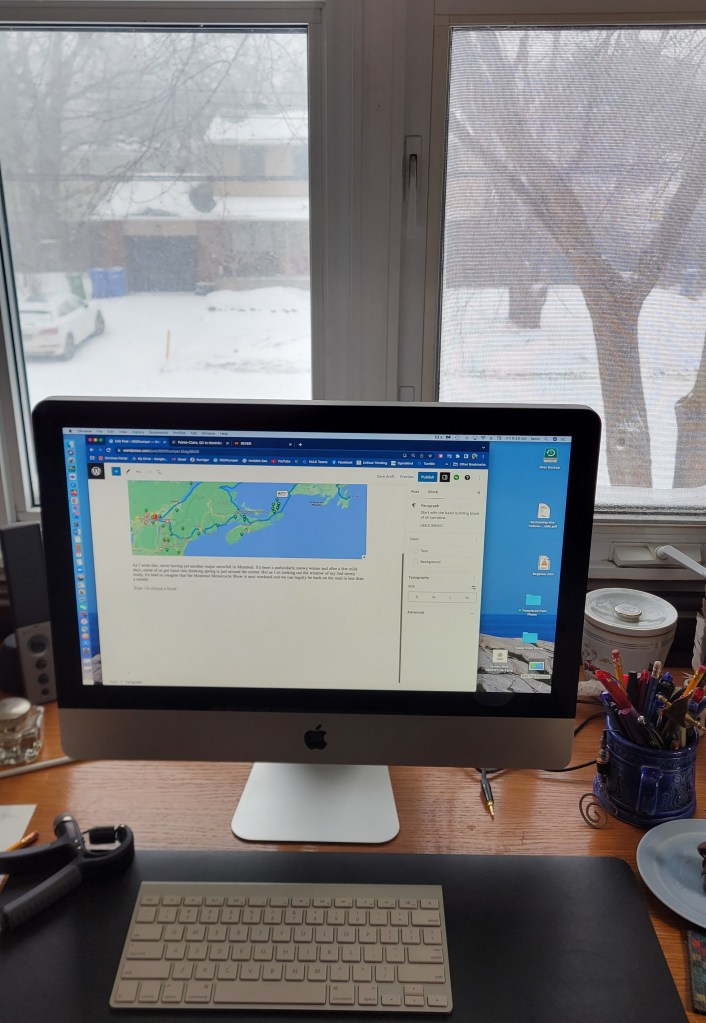
As I write this, we’re having yet another major snowfall in Montreal. It’s been a particularly snowy winter and after a few mild days, some of us got lured into thinking spring is just around the corner. But as I sit looking out the window of my 2nd-storey study, it’s hard to imagine that the Montreal Motorcycle Show is next weekend and we can legally be back on the road in less than a month.

My favourite way to avoid shoveling: write a blog post!

Still, I must continue making travel plans in a kind of blind faith in the power of nature. If I put on my cheap Dollar Store shades, all that white outside becomes a shade of green, and I can almost imagine it being June and setting off. With this trip, there are some reservations that have to be made, like booking the ferry on and off Newfoundland, so I have started to map out a rough outline of our planned exploration of the Canadian east coast. This will be the book-end tour of the west coast trip of 2021.

Learn from your mistakes

I’m trying to keep in mind what I learnt from that last one, specifically, sometimes less is more. That’s what I keep telling my students, anyway, who think they are clarifying their thesis statements by adding clause after clause. The last trip was spent too much on the Superslab in my need to cover distance in the time I had. I don’t want to make the same mistake so am trying to be realistic in what we can see in the time we have away from the dog and our jobs. Marilyn, the domestic accountant, likes to remind me about our budget too.

My first route planned included The Cabot Trail. It seems sacrilegious not to “do” The Cabot Trail if you are anywhere within 150 kilometres of it on a motorbike, and we will be passing through Cape Breton en route to Sydney, NS, where one catches the ferry to get to Newfoundland. But my practical wife reminded me that we have been to Nova Scotia several times and both ridden (at least, I did) and driven The Cabot Trail and maybe we should devote that time to Newfoundland and perhaps Prince Edward Island, which we haven’t visited. This is a classic case of idealism (i.e. “we can do it all”) versus realism (“we are only human”) so we’ll see in the coming months which ideology wins.

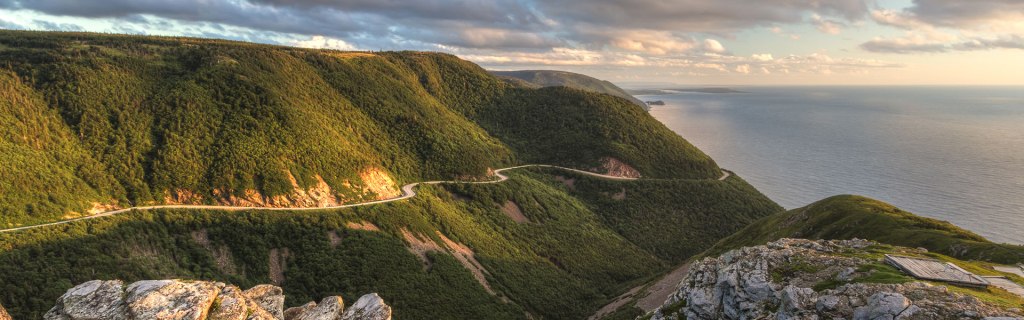
The Cabot Trail: an iconic ride

Gaspésie, PEI, Nova Scotia, Newfoundland

What we do agree on is that we’d like to ride the coast of the Gaspé Peninsula, or as they like to call it here in Québec, La Gaspésie. I’ve driven that before and it’s spectacular. Marilyn hasn’t seen the Roche Percé, and like the Butchart Gardens we visited on Vancouver Island, we will make a stop at the Reford Gardens in Matane, QC. Forillon National Park at the tip of the peninsula is pretty special too.

Another decision we have is whether or not to visit Prince Edward Island. Our Insight Guides book suggests a three-day 250-kilometre road trip that includes Charlottetown, Argyle Shore Provincial Park, Brackley Beach, and the West Point Lighthouse near Cedar Dunes Provincial Park. Hopefully, those provincial parks offer camping. Technically, I’ve been to PEI, but I was too young to remember much. If we can’t work it in this summer, we will definitely get out there next. Aside from NWT and Nunavut, PEI and Newfoundland are the only provinces or territories I haven’t visited, so I’m hoping we can devote a few days to get a taste of the island.

Should we take the day or night ferry to Newfoundland? There are pros and cons of each, as I see it. A day crossing might be time wasted, just looking out for 7+ hours over endless water. I know there might be the opportunity to do some whale watching, but I’m sure we’ll be doing some of that once on the island. A night crossing is more expensive if you buy a cabin and try to get some sleep. On the other hand, the cabin isn’t any more expensive than a motel room, which we’d have to get soon after landing from a day passage. I’m leaning toward a night crossing. I’ve never experienced sleeping on a boat like my parents did when they immigrated on the Queen Elizabeth II and I think it would be novel. If we cross during the day, we will camp at a favourite campground in Baddeck in order to get to the ferry in the morning; if we cross at night, there might be time to ride The Cabot Trail or stay at Meat Cove, which is an amazing campground off The Cabot Trail right at the eastern tip of Cape Breton Island.

If you’ve visited Newfoundland, what did you do and why? I’m open to advice. There is a growing sense of urgency to decide, especially if we want a cabin as they sell out early, so decisions have to be made soon.

Neither Marilyn nor I has visited Newfoundland before, so this is going to be a treat. Again, we can’t do it all, and we’ve decided to focus on the west coast. Gros Morne National Park is a bucket list item. Then we will continue up the coast on what’s called The Viking Trail because I like history and am interested in seeing the Viking settlement at L’Anse aux Meadows. Then we will cross the island to Saint John’s because, well, you can’t visit Newfoundland without strolling around Saint John’s, including “hydrating” at a pub on Water Street before climbing Signal Hill. I’ve heard and read about these places and look forward to exploring them in person.

Finally, we have to decide whether we have time to ride The Irish Loop, a 325 kilometre loop along the coastline south of Saint John’s. The name is intriguing since we both have some Irish blood. And anything along a shoreline is bound to please me on the bike. Our guidebook suggests 2-3 days for this, so it really depends on if we can fit it all in.

Maine, New Hampshire, Vermont

Currently, the plan is for Marilyn to fly out of Saint John’s back to Montreal like she did from Vancouver when we were out west, and I’ll continue on solo. And I’m pretty sure I’ll come back via The United States instead of my initial plan to return via Labrador and the north shore. Like the caribou during their migration, I’m detouring to avoid bugs. Besides, the riding through Maine and New Hampshire will be more interesting than through Labrador. I recently purchased a subscription to Rever, which classifies roads on a colour coding system, and there’s a cluster of G1 (Best) roads in the White Mountains of NH that is calling my name.

G1 Best roads to ride are in yellow. That cluster in the White Mountains looks interesting.

I might saunter my way back along the coast, checking out Bar Harbour and a few other places before cutting diagonally north-west through the White Mountains. Without the deadline of ferry crossings, this will be the unplanned, unscheduled segment of the trip, which is generally how I like to tour. Maybe I’ll stay an extra night in New Hampshire so I can ride those primo roads unladen with gear.

This trip is going to take me about three weeks—two weeks with Marilyn, and about a week solo to get back. After a short rest in which I’ll service the bike and change my tires to something more dirt-oriented, I’ll head off again, this time to ride some BDRs. It’s going to be a full and exciting summer on a new bike, and I’ll have lots to write about so click Follow if you want to follow along.