La Classique 2025

Rain, Rides, and Ribs—the unofficial season opener La Classique never disappoints.

My students were writing a final test when I got the missed call and then message: Riley had a spot on the Awesome Players team at this year’s Classique. I wasn’t planning on doing the rally this year but jumped at the opportunity to ride with them, which is always fun. I called him back at the break, got the details, and confirmed.

I’ve done this rally once before by jumping onto an open spot with another team. The way registration works is that teams are created by team captains and each team has 10 spots. Riders on a team preregister, and if there are any open spots, they can be filled during the open registration. Participants are asked a lot of questions during registration like riding experience, type of bike, number of years off-roading, etc. to ensure that team members are compatible. You’re even asked if you prefer a relaxed or sustained pace. It’s a good system that allows lone riders to join a team and participate in the rally.

The Awesome Players have been doing this kind of riding for many years and usually enter into one of the advanced rides. Maybe they are tired of pushing heavy bikes through mud while getting roosted, or maybe they just wanted an easier ride but they decided to do the Classique Plus this time, which suited me fine. I did that ride when I participated in 2023 and it was at my level—mostly dirt roads but with a little sand, rocks, and water in the mix to keep it interesting.

Our ride was Sunday but it’s fun to have a relaxed day at the rally to hang out and do demo rides. Many of the manufacturers were there, so I rode up Friday evening with Curtis, a fellow West Island Motorcycle Club member, who had recently bought a 2017 Tiger XCA and was going to try ADV riding. There’s camping available on site so we would camp two nights and do demo rides on the Saturday.

Demo Rides

Dealers are now reluctant to offer demos so you have to attend these events and get them straight from the manufacturers. I was lucky because I was able to demo two of my dream bikes: the Kove 450 Rally and the Aprilia Tuareg. I’m a year away from retiring so am scouting a potential new bike for the kind of riding I want to do in retirement.

Kove 450 Rally

Okay, maybe it was a little naïve of me, maybe a little romantic, but I had visions of slapping a little Mosko Moto 40L Reskless system on this bike and using it as a super-lightweight ADV bike capable of tackling anything Colorado or Utah could throw at me. One of my bucket list rides is The Continental Divide, a challenging ride technically, so what better bike to do it on than one that completed the Dakar. I also figured that if rally riders can ride it for long days on end, so could I, and with 8 gallons of fuel capacity, there would be no more fuel anxiety when remote riding.

The first thing I noticed when riding the Kove 450 is that it’s loud! I have to be careful with what hearing I have left so I’d have to change the pipe or get a baffle or something, but that’s an easy mod. The other thing I noticed is the significant head-shake I was getting at speed. I thought it might have something to do with the particular front tire on the bike, or maybe my body position, but a steering damper would take care of that too.

In the end, I think this would be a really fun bike for day rides, but the experience of riding one is so raw it would be tiring for a multi-day tour. The bike is, after all, a race bike. But it is a ton of fun to ride and when I get out into The Rockies, one might be in my garage.

Aprilia Tuareg 660
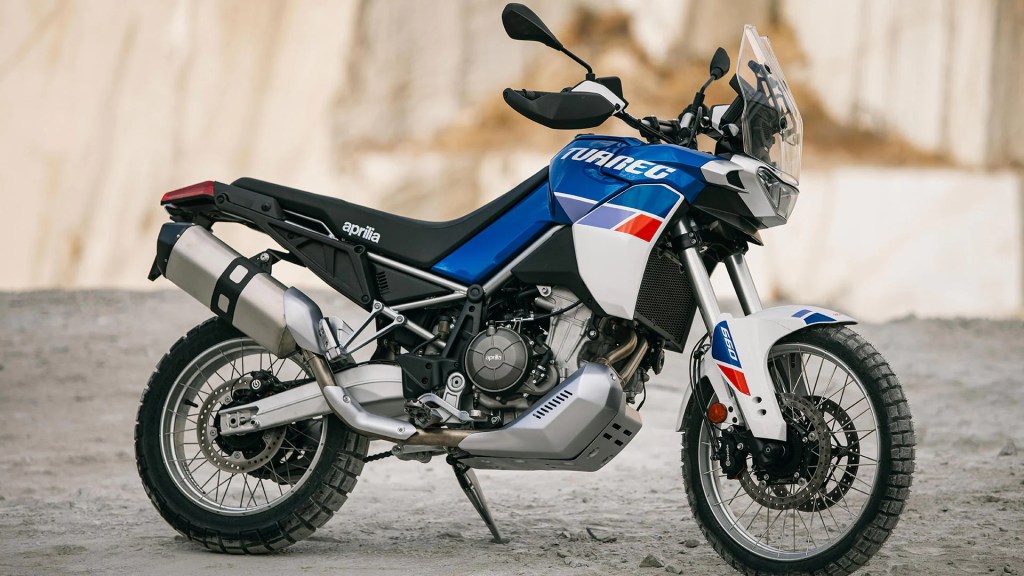
Photo credit:// https://storeusa.aprilia.com/tuareg660.aspx

This bike had just been released when I sold my BMW f650GS and decided to get something a little bigger. I didn’t give it a serious look because at only 10cc larger, I didn’t think it was different enough from the BMW. In fact, it’s closer to the Tiger 800 I have now in power than the 650, and that is why I probably won’t get one. I already have a good midsize bike for adventure touring, and if I were to get another bike, it would either be a bigger bike like a 1250 for crunching the miles 2-up across The United States and Canada or a smaller bike for playing in the mountains out West.

The Tuareg is getting excellent reviews and I’m sure it’s an excellent bike. Llel Pavey of Brake Magazine gave it a glowing review, and he’s normally very discerning in his reviews. He said everything about it—the engine, the suspension, the balance—was excellent and implied it is the perfect adventure bike. If I were in the market now for a midsize do-it-all bike, the Tuareg would be a good choice.

I wasn’t able to test this bike on anything but asphalt so I can’t judge what it’s like off-road. On road, I found a surprising amount of vibration in the handlebars and, again, it was loud. (Other reviewers have said the same about the noise.) Aprilia were clearly aiming for the off-road market and made the induction intake robust and guttural. I’m sure the Tuareg is better than the Tiger for technical riding, but on asphalt and I imagine on dirt and gravel roads, I have to say I prefer the Tiger for its smooth engine and exciting but not deafening exhaust note. It’s always nice when you walk away from a demo ride feeling that you already have the best bike for you, especially when that demo is of a dream bike.

CF Moto Ibex 450

The surprise of the demos was the CFMoto Ibex 450. Maybe it shouldn’t have been. People are saying that the Ibex is finally the unicorn bike everyone has been asking for but no one has been willing to make. It’s small and light but with plenty of power, a 270 degree crankshaft, slipper clutch, rider modes, KYB adjustable front and rear suspension, spoked tubeless wheels, a great exhaust note, radial brakes, 5″ display with Bluetooth connectivity . . . all for under $8,000! People at the rally were saying it’s going to be a KLR killer.

The fly in the ointment is that it’s Chinese made (as is Kove). Does that matter? To some it does; to others it doesn’t. CF Moto have been making bikes for KTM since 2017 and has competed in Moto 2 and has won Moto 3 and Rally Raid, so it’s not some Johnny-Come-Lately cheapo brand. In fact, the Ibex comes with a 5 year warranty. Maybe it’s time we stop generalizing to all Chinese manufacturers the stereotype about poor build quality.

Besides reliability, the other issue with buying from a Chinese company for some is that you are supporting the Chinese government and its authoritarian practises, human rights violations, and general bullying behaviour in Asian geopolitics. I can understand this. Currently there’s a “Buy Canadian” spirit happening in Canada as ordinary citizens exercise one of the few ways they have political agency—through their pocketbooks. When it comes to China, it’s especially hard to separate company from state, and many people are deciding today to purchase ethically. On the other hand, Capitalism has pulled more than 1 billion Chinese people out of extreme poverty since 1981, virtually eliminating extreme poverty in the country (World Bank Poverty and Inequality Platform (2024) – with major processing by Our World in Data). If you choose to boycott China when purchasing, are you hurting the Chinese government or the Chinese people? The ethics are not simple.

But back to bikes, unlike the Kove’s 450 single, the Ibex’s 450 twin is smooth. I also noticed that CF Moto have geared the first two or three gears with lots of torque for off-roading, with the other gear ratios spread out so that even at highway speed the little 450 is not straining. In sum, it’s a sweet little bike, and perhaps it will be an Ibex and not a Kove that I take over those Colorado mountain passes.

BMW

BMW’s luxury tourer.

Of course I had to spend some time at the BMW display. Yes, I still have a bit of sweet spot for the German brand that began my motorcycle life. I had in mind to try their flagship 1300GS, but it was fully booked. In fact, all the GS’s were booked in the remaining time slots so I tried a big K1600 GTL for a lark. This luxury tourer starts at $36,000. A demo is about the only opportunity I’ll have to ride one, so I thought, “Why not?” Marilyn would surely be riding in style and comfort on the back of one of these!

The experience was pretty interesting. I’ve ridden a Gold Wing before so am not unfamiliar with a big bike, but this big bike was something else. If the rawness of the Kove is at one end of a spectrum, the comfort of the GTL is at the other. I wouldn’t say it felt like I wasn’t riding a motorcycle, but it felt more like flying an airplane than riding a motorcycle. Quiet and smooth, it glided over the pavement and banked into turns like a jetliner on final approach. When it started to rain on the demo ride, I simply lifted the windscreen with the push of a button and stayed dry.

In the end, it was fun to demo, but even if I had that kind of money, I don’t think I’d buy a GTL. It would take all the fun out of riding, and what’s more, I couldn’t help thinking of what it would be like with Marilyn on the back and trying to navigate all the off-camber stop signs and slow speed corners of somewhere like Saint John’s, NL, on such a heavy machine. One tired touring mistake and . . . Again, the Tiger is about perfect in weight and power for touring, and I feel very comfortable navigating it at slow speed, even 2-up.

There was one last demo and it came unexpectedly. My buddy Steve was riding the 1300 GSA and when we stopped for a break halfway he offered to switch. What a great guy! He knew I wanted to try the big GS, so I rode that back to the rally while he tried the GTL. The boxer is a very distinctive engine and I had more fun on the GSA than the GTL. I also found it really nicely balanced, as all GS’s are. No wonder the GSA is one of the top 12 open-class ADV bikes of 2025, according to Cycle World.

After the demos, we all piled into a bus and headed into Lachute for dinner. It’s great that the rally organizes the shuttle because they know that most grown men don’t have the good sense not to ride after “just a few.” The dinner was a fitting rack of ribs and poutine, with door prizes and Cherry Bomb, a Joan Jett cover band for the night’s entertainment. There’s a ton of organization behind this rally!
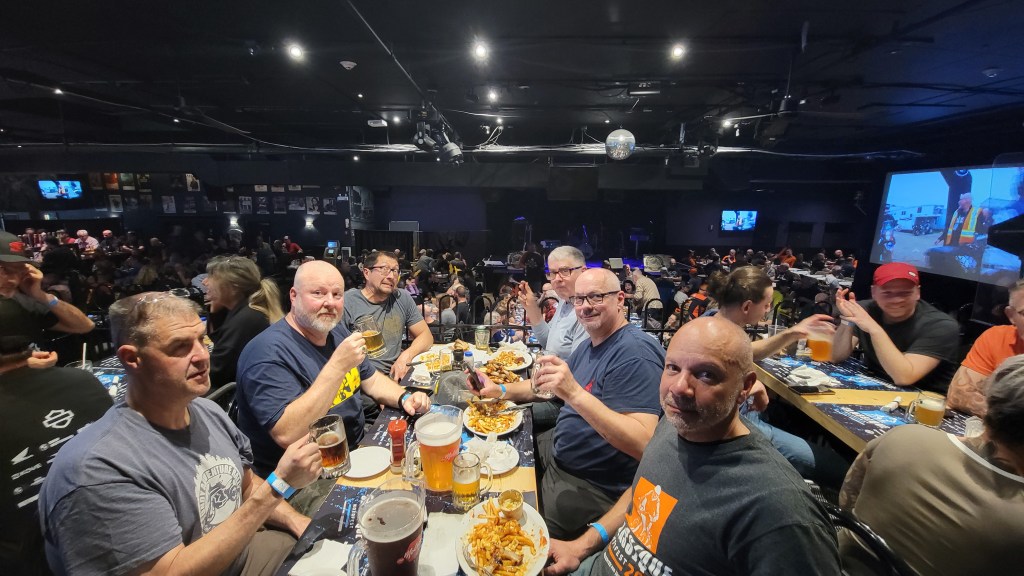
Chowing down with the boys. Clockwise: Pete, Riley, Ivan, Marc, Dave, and Curtis.

Classique Plus Ride

Sunday was our ride so I was up at 6:00 to be ready for an early start. Rally organizers provide coffee and muffins for breakfast so I didn’t even bother to bring my camp stove. I geared up and headed up to get the bike inspected, then slotted into line at the staging area. Shortly after 8:00, we headed off.

The Awesome Players use Sena and The West Island Moto Club uses Cardo. The previous evening we had overheard someone trying to connect a Sena with a Cardo and had a laugh about that. Good luck! Yeah, apparently in theory they can connect, but only if both are in Bluetooth mode and even then it’s pretty useless unless the other person is a pillion; anything further and you lose the connection. So Curtis and I could talk to each other—that is, until his battery crapped out. Maybe I’ll have to bite the bullet and get a Sena if I’m going to be riding more with these guys.

Like I said, this ride is mostly dirt and gravel roads and fairly mellow, but the road into lunch at Duhamel was a little more challenging with some mud, potholes, and rocks, but I didn’t get any video footage of it. My camera battery died early and I would need lunch to change it. After lunch, as we headed down a sandy trail, I turned on the camera just in time to catch the action.

Making a splash.

Does this look familiar? If you saw my crash in Vermont last August, it should. Again, the front end tucks but this time it’s me and not the bike that ends up off the road. I’ve watched this a dozen times and still don’t know what happened. I didn’t chop the throttle and I didn’t hit the front brake. The only thing I can think of is that I made the classic mistake of making an input on a low-traction surface with the handlebars instead of the pegs. The front tire dug in and sent me sideways. This rally is always the first ride of the season and I think I was just rusty. I was also just really surprised because so far there had been nothing in the ride that was particularly challenging or unexpected.

But the drama was not yet over. Shortly after setting off again, I had another two near falls with epic saves. I wasn’t the only one struggling in the deep sand but at the time I thought I was. On these ones, especially the second, I think my front tire gets rutted.

After the second, I started choosing my line more carefully, staying out of ruts as much as possible, and especially getting my weight back. That seemed to help. In retrospect, I realize I should have accelerated through the deep sand, but that’s the last thing you feel like doing after you’ve just fallen.

When we stopped for gas shortly thereafter, I had a moment to check my bike more thoroughly because it felt like the handlebars were not aligned. I probably torqued the front forks in the crash. The station had old-style pumps where you pay inside after filling and just as we were about to set off again I realized I’d forgotten to pay. Doh! I was a bit discombobulated.

Now it was time to ride some asphalt east of Namur on the fun Boileau Road. After the incidents in sand, I was happy to be back on asphalt where the Tiger is in its element.

Most of the ride through the afternoon was on hard-packed dirt roads snaking through pretty rural countryside, like this one.

Brookdale Rd. west of Boileau, QC.

I don’t know if it was the climax of the ride but certainly a highlight was riding Scotch Road with these guys who in no small part made that road famous and popular for off-road riders. It’s a Class 4 road north of Grenville that even Fort Nine videoed when he was still in Montreal. Unfortunately, the Bob and Margs have moved in, literally, and it’s slowly being converted to cottage country. The road is now quite graded and you can see as we pass the famous sand pit that someone has blocked off access. I’m curious to know who and if that land is owned or crown land. If you know what’s happening there, drop a comment below. Sadly, spaces for recreational off-road motorsports are disappearing, and one has to travel further and further out of the city to find them, a topic Ryan F9 addresses as he rides Chemin Scotch. (Incidentally, you can compare the road eight years ago and now, as well as the quality of the video stabilization.)

We made it back to camp wet, cold, and tired, but the weather didn’t really dampen any spirits. It had been a really fun weekend of beer, burgers, and bikes. Thanks again to Marc Chartrand and his team of volunteers for once again putting together another great rally, to Riley for being such a good host, to Ivan for setting a nice pace for us newbies, and to the rest of the boys for including me and making it so much fun.

Have you participated in La Classique in the past? Drop a comment below describing your experience or another rally you would recommend. Any thoughts on access to public lands for motorsports? Here in Quebec we have it pretty good with the FQMHR network and the TQT—more initiatives of Marc Chartrand. Any other comments?
Decarbon Your Top End

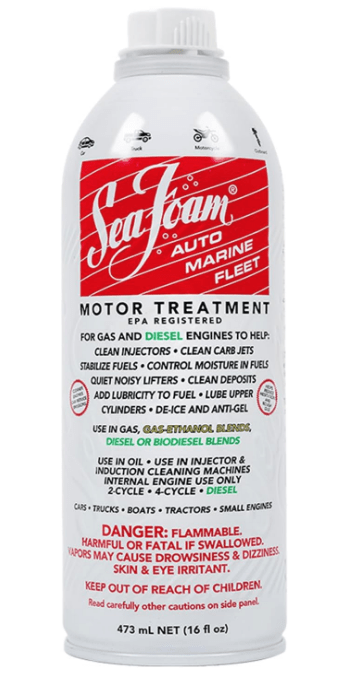
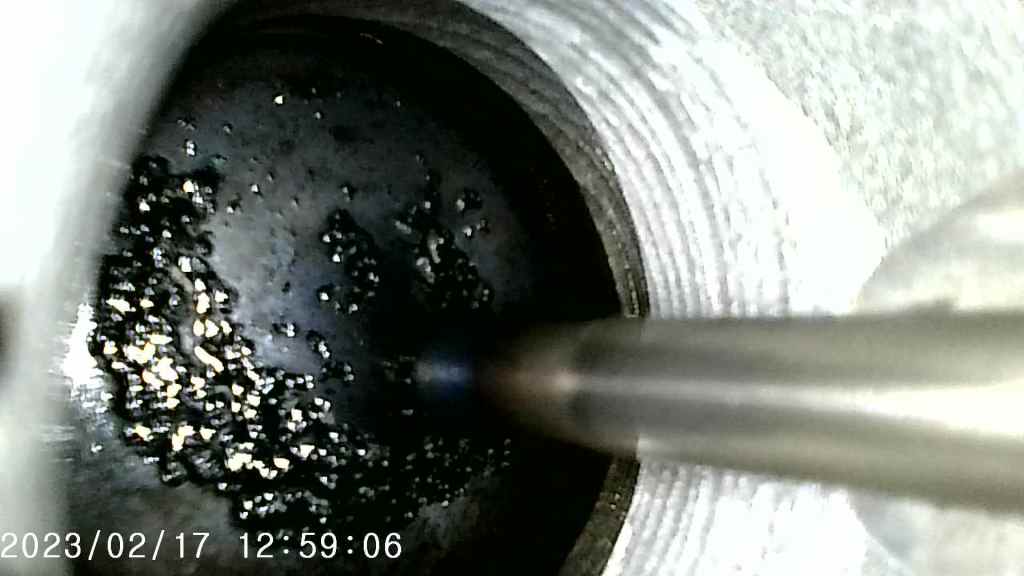
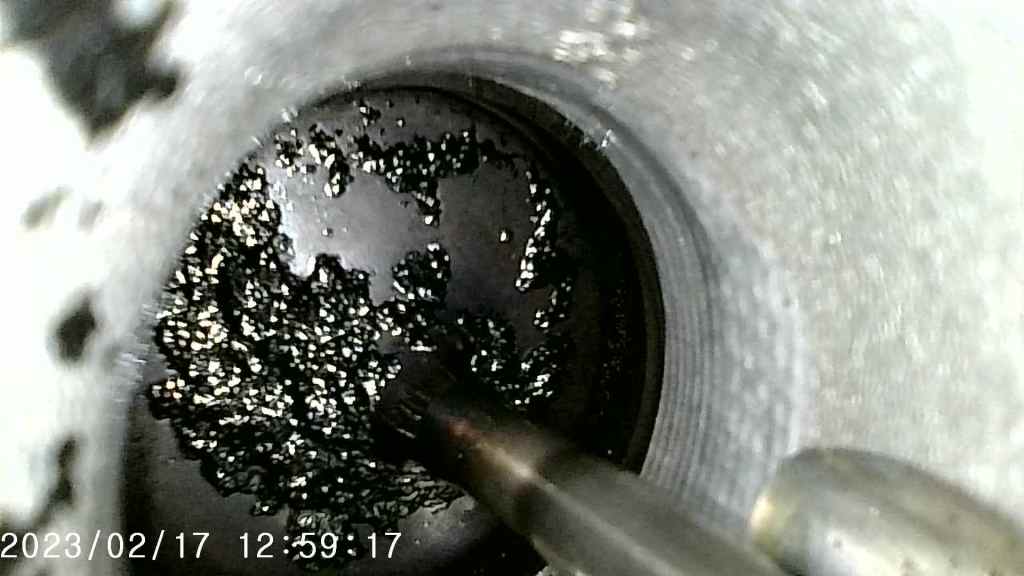
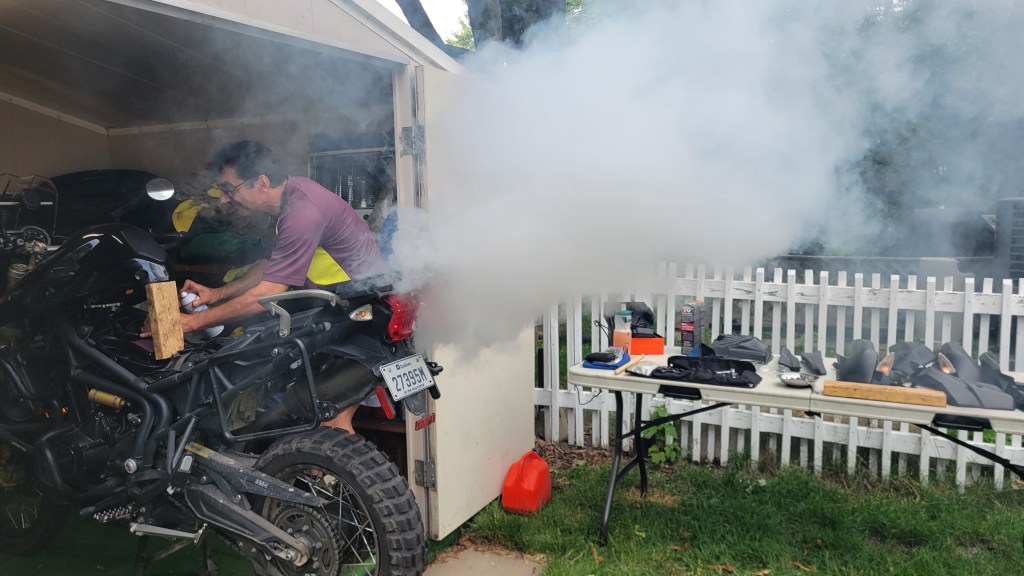
I used Seafoam to reduce the carbon build-up on my intake valves.

Last year when I had my trouble in the bush, I noticed a significant amount of carbon build-up inside the throttle bodies of my Triumph Tiger 800XC. My buddy and I were troubleshooting why the bike wouldn’t start, and we thought there might be water in the engine. Peering down into the throttle bodies, we could see something glistening inside. Was it water? We even dipped down there twisted pieces of paper to see if they came up wet. But in the end, with the use of a camera, we determined that what was sparkling was carbon.

This was mildly alarming. My BMW 650GS had absolutely no carbon build-up, and I hadn’t noticed it earlier when working on the Tiger. It prompted me to do my overdue valve adjustment, and as some of you know, all my exhaust valves were tight. I don’t know if that led to the carbon build-up, or how normal such build-up is in an engine. I’d heard of the Seafoam heat soak treatment and, being a little housebound at the moment and looking for a project with the bike, I decided to give it a try.

Preparation

Needless to say, the first thing you have to do is get down to the throttle bodies. For me, that means removing a lot of body panels, lifting the gas tank, and removing the airbox cover. You’ll need to keep all sensors plugged in or you’ll elicit an error code in the ECU, so that might involve unscrewing the sensor rather than unplugging it. If you have any vacuum hoses off, you’ll need to plug them with something of similar diameter.

All set to go with the fuel tank propped up with a piece of wood.

If you haven’t already done so, you’ll need to buy two cans of Seafoam—one of the SF-16 Motor Treatment and one of the SS-14 Cleaner and Lube Spray. (The latter comes with a tube applicator.)

Now you are ready to start the process.

Application

Start by adding the full can of Motor Treatment into your fuel tank.

Start your bike and let it warm up to operating temperature. I waited until I heard my fan kick in so I knew it was good and hot.

Bring your engine up an extra 1000 rpm beyond its normal idle and start spraying the Seafoam Top Engine Cleaner into the throttle bodies. You might need a helper to do this or, as I did, you could use a throttle lock to hold the engine just above idle. For a car, you would insert the tube where the air intake boot attaches to the throttle body, but because my bike doesn’t have a boot, I sprayed directly into each throttle body, alternating every 15-20 seconds and trying to spray an even amount into each. It’s normal to hear the rpm drop slightly as you spray, and you will see a plume of white smoke come out the exhaust. Be sure to do this in a well ventilated area!

Hold the tube down inside each horn and spray equal amounts until the can is done.

When the can is completely empty, turn off the bike and let the Seafoam heat soak for 10-15 minutes. Then restart your engine and give it a few good revs. You should see some white smoke still come out. When you get the bike all buttoned up again, go for a “spirited” ride (i.e. give it the ol’ Italian tune-up). The motor treatment you put in the tank will continue to remove loosened carbon and clean the injectors.

Conclusion

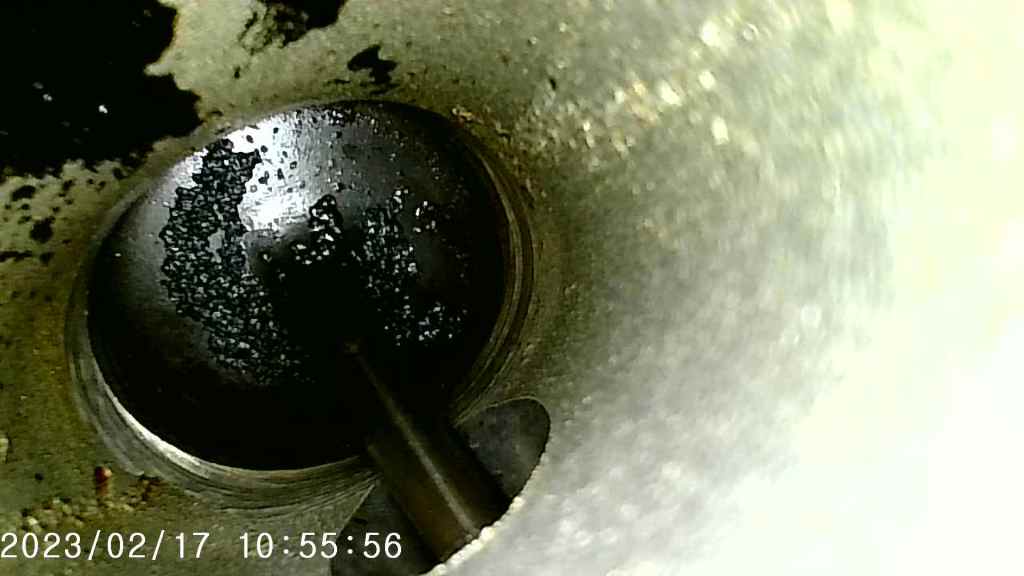
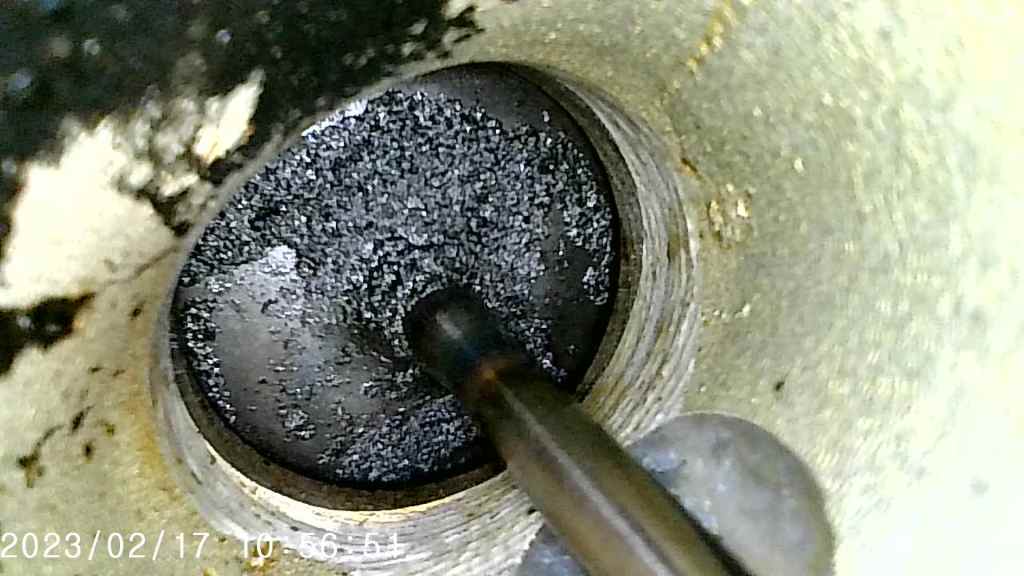
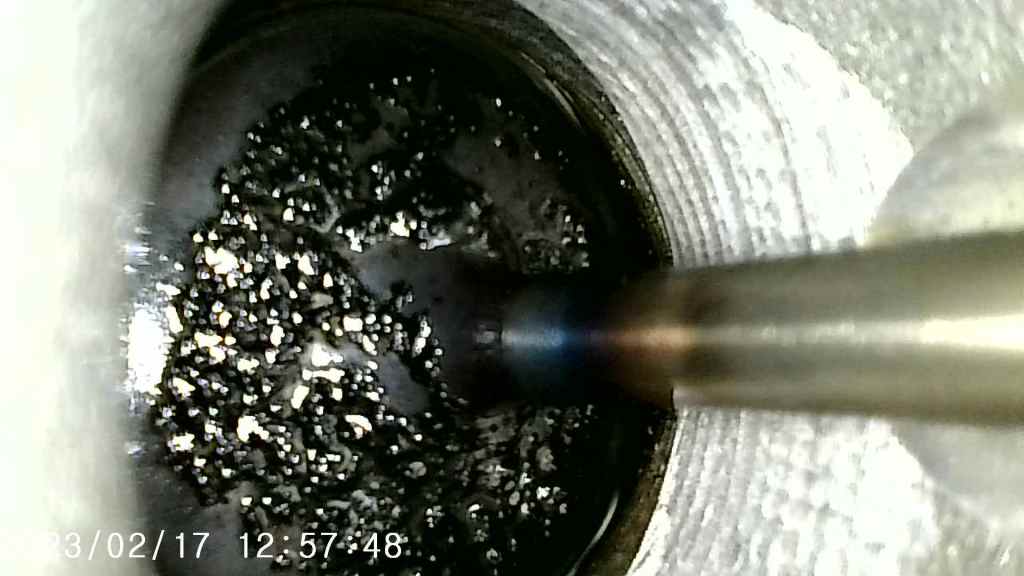
So by now you must be wondering if it did anything. Here are some before and after shots using my scope.

Is it my wishful thinking or do some of those valves look better after than before? Cylinder 2 for some reason had less carbon build-up to begin with so didn’t have much improvement, but there seems to be some reduction on the valves in cylinders 1 and 3, and definitely cleaner walls. And with the motor treatment in the fuel, hopefully there will be more reduction during the coming rides.

I dunno. It was worth a try, and harmless. According to the company, Seafoam is a petroleum based product and will not harm your engine. I’m not comfortable putting it in the crankcase because then you are thinning the oil, but this top-end treatment seems innocuous.

While I was down there, I lifted the airbox and resynchronized my throttle bodies, which I had done prior to my valve adjustment and Seafoam treatment but now needed a tweak. I also reset the ECU adaptations following all this.

The three cylinder pressures are listed on the left dial. Pressure is less after decarboning, which is to be expected.

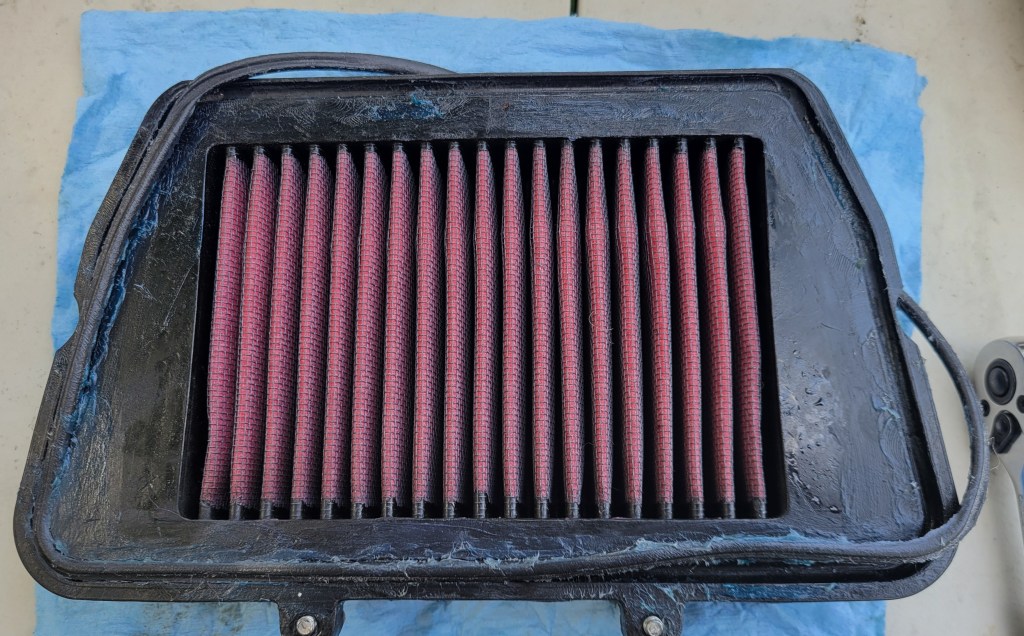
I also had the opportunity to check my K & N air filter and was happy to see it’s completely clean; the Unifilter prefilter I installed seems to be doing its job. I took the Unifilter out and gave it a clean and relube.

A clean bill of health

With the bike all back together, the Michelin Anakee Wild tires and the new lower windscreen on, the bike is ready for some dirt. Doggie is making good progress on his rehab so I’m holding some hope I’ll be able to get away for a short tour before it’s back to work.

Legal disclaimer: Any mechanical advice I provide here is offered merely as a description of what I did and a suggestion of what you may do with your bike. I am not a licensed mechanic. Any work done on your bike is at your own risk. The instructions above follow those provided by Seafoam.

The Major Service

Getting ready for the new season this year meant a little more than adding a few farkles.

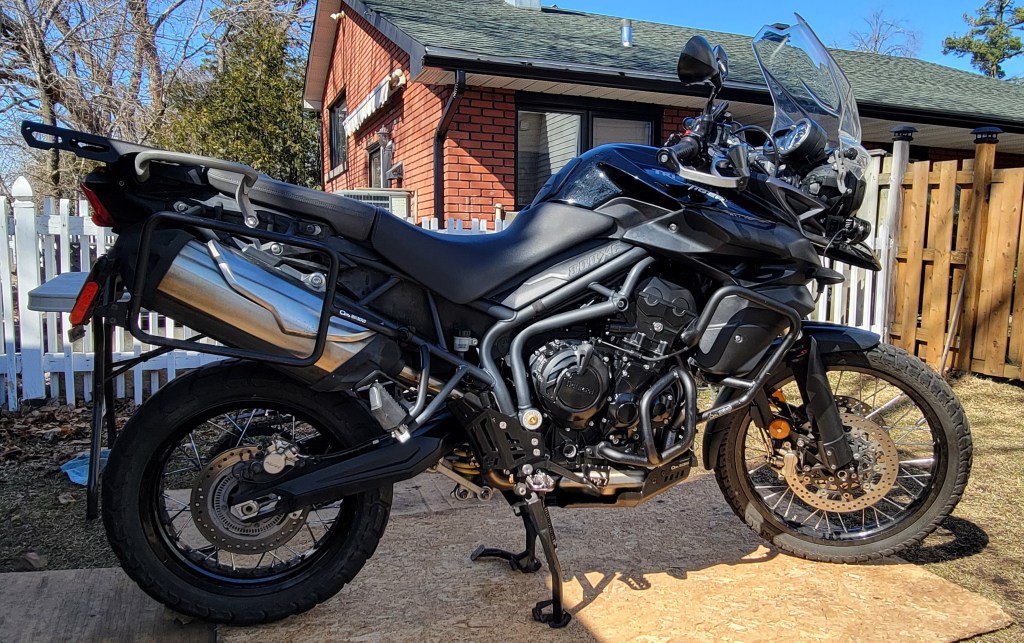
When I bought my 2013 Triumph Tiger 800XC in May 2022, it had only 14,500 kilometres on it, despite being nine years old. In the following two years, I’ve put another 34,000 on it. I’ve done basic service during that time, like changing the oil, coolant, brake fluid, and cleaning the air filter. I’ve also changed the plugs. But it was time for some major service.

Last fall I did the dreaded valves, swingarm and rear suspension bearings, and cleaned the starter motor. This spring I’ve fixed a problem with the shifting mechanism, cleaned and lubed the steering head bearings, overhauled the front forks, and made a few mods to get it ready for the BDRs. It’s been a long process, but it’s finally ready for the new season.

Valves

It’s the job everyone loves to avoid, and I did too. In fact, when I bought the bike, the dealer said they no longer recommend checking the valves at the manufacturer’s recommended 20,000K because, more often than not, when they get in there at that mileage, the valves are fine. I guess if you’re paying the dealer $1000+ to check them, it’s bittersweet when they don’t find anything out of spec. I was happy to wait. My buddy who rides a Triumph Scramber 1200 XE has never checked his and he’s got I think now over 78,000K on it. “If they’re slappy, they’re happy,” he said, although I always thought you don’t want to hear the valves. At any rate, with now over 48,000 kilometres on the Tiger, it was time to get in there and see how happy they are.

All the intakes were fine, but all the exhausts were tight, some significantly. Here are my calculations. Sorry about the grease.

Highlighted is the amount out of spec. I’m using metric.

As you can see, all the intakes were spot on at 0.15 (specs are 0.10 – 0.20). The exhaust specs are 0.325 – 0.375, so ideally you want them at 0.35. Some of mine were 0.20, so .15mm out of spec. I’m glad I didn’t wait any longer or I might have started causing damage to the valve seat. Live and learn: sometimes there’s reason behind the manufacturer’s recommendations.

An egg carton works well for keeping all the buckets and shims organized.

You want the same bucket to go back on the original valve, so keep any happy dogs with long tails out of your workspace. Nobody likes removing the cams, but just make sure you’ve got it locked at top dead centre and turn the engine over several times by hand once you get it back together to make sure you didn’t slip a tooth on the timing gear. I almost did because I didn’t put enough tension on the timing chain while torquing down the holder. (You have to remove the tensioner.) So you have to find a suitable wedge of some kind to manually tension the chain while tightening. The first two (2!) times I torqued down the holder the chain climbed a tooth.

Timing marks should line up parallel to the crankcase on the inside.

Thanks to MuddySump for his excellent videos. I was following my Haynes manual, but it’s always good to watch someone else do it first, especially when that person has the same bike as you and is a licensed Triumph mechanic! Once I got everything buttoned back up, I checked the valves again and they are now all spot on.

It’s always a little unnerving starting the bike back up again afterward, but it fired right up. I’m hoping the bike will run a little easier now with less tendency to stall.

Starter Motor

A known issue with the Tiger 800, at least the first gens, is a weak starter motor. There is a tendency when the engine is hot for the starter to fail. I’ve had it happen to me a few times. You stall the bike and the starter is reluctant. I’ve managed to fix it by keying off and on, but it was getting worse. Many guys swap out the starter with Rick’s and I considered it, but since I was already down to the throttle bodies, I figured I’d lift them to access the starter and give it a good clean.

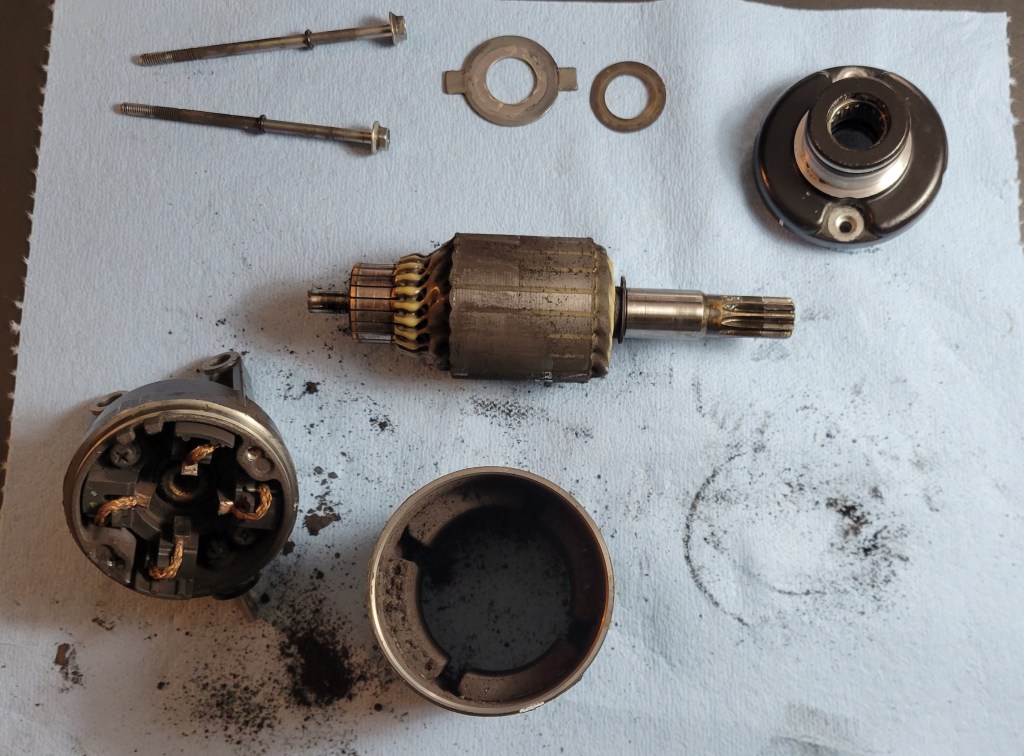
I took it apart and there was a lot of carbon dust in there, and some discolouration on the armature. Some 1000 grit emery paper cleaned everything up, including the shoes. The bearing was fine, and I’m hoping I’ve breathed another few years at least of life back into the OEM starter.

Swingarm and Suspension Linkage

The swingarm bearings take a lot of abuse down there right in front of the rear wheel. Even if you aren’t doing water crossings, they’re going to get water and grit and grime thrown up at them. And when there’s crud or corrosion, you won’t feel it as you will with steering head bearings. I remember when I finally did this job on the 650GS, one of the bearings was in very bad shape and I had a bugger of a time getting the pivot bolt out due to the corrosion. This is one you want to do on the recommended interval, and it’s one of the easier ones so why not? You aren’t opening up the engine, just taking the rear wheel off, unclipping all the wiring from the swingarm, then removing the pivot bolt.

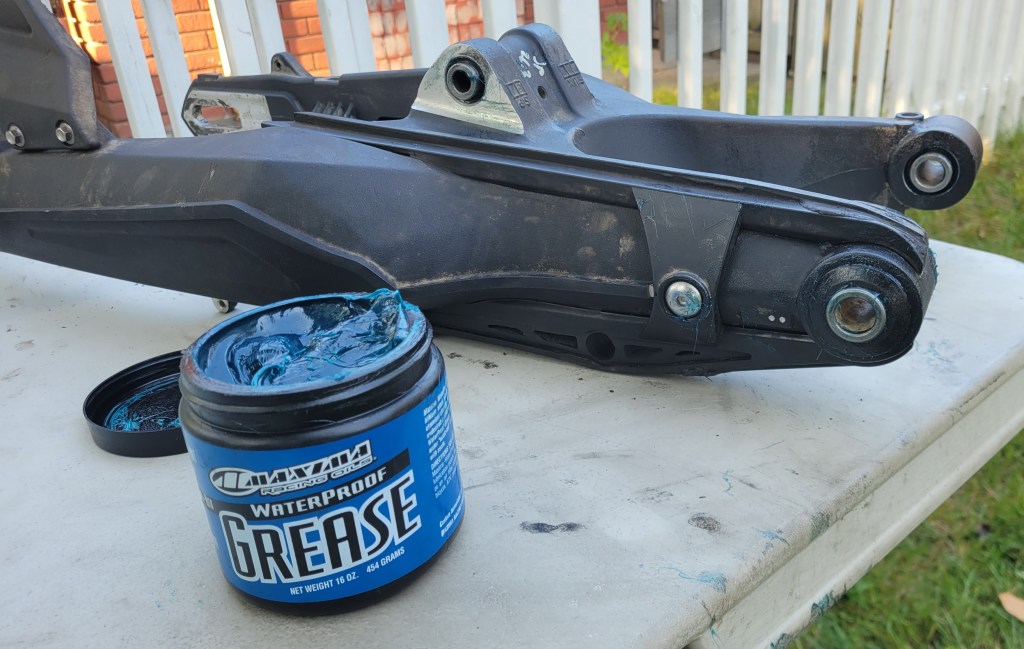
Thankfully, it wasn’t that bad this time, but I still left it a little too long. There was some discolouration on the bushings, but the bearings looked fine, albeit missing some grease. I cleaned everything up as best I could using 1000 grit emery paper and repacked the bearings with waterproof grease.

It’s always a good feeling when you restore these crucial components.

Shifting Mechanism

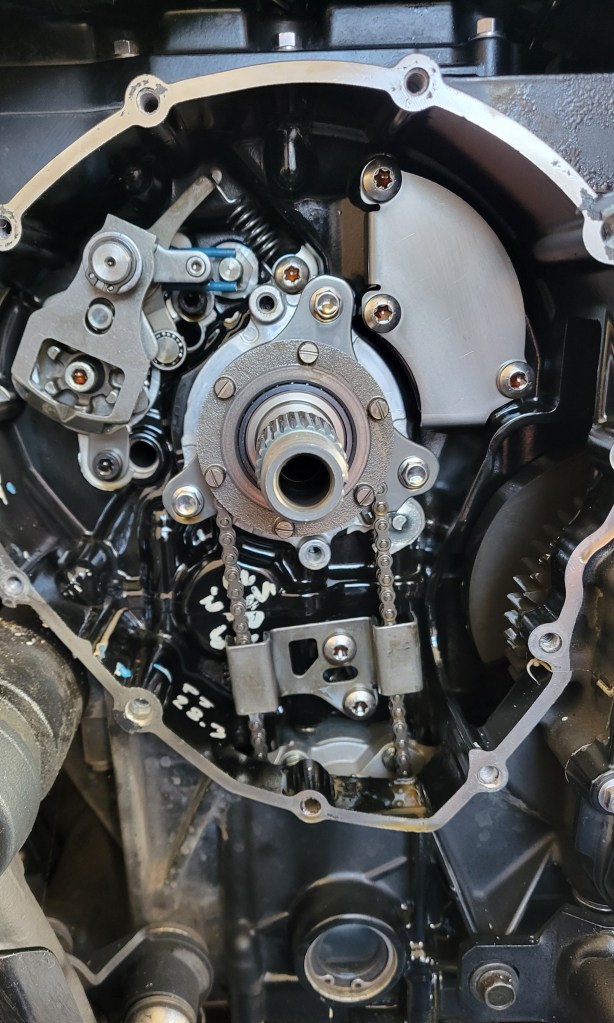
Problematic selector arm is top left. Centralizing spring is blue, indicating it’s been upgraded.

On the last ride of the season last year, the Tiger started being reluctant to downshift. I noticed it as I pulled away from the house and came to the first stop sign. I was heading to Vermont and would have turned around, except I was leading a club ride and there were people counting on me, so I continued.

My first thought was that the clutch cable needed adjustment. It’s normal for those to stretch over time and need to be tightened. But adjustment didn’t help, and as the day continued, the problem got worse. I somehow managed to finish the day, but coming up through Smuggler’s Notch wasn’t much fun and I was happy to get home. That was the final ride of the season. I decided I’d use the remaining nice weather to do maintenance but before I could get to this job the snow arrived, so it had to wait.

I store my bike in an unheated shed, so working on it over the winter wasn’t an option. As you can imagine, my curiosity nagged at me all winter. Was it the clutch, the shifting mechanism, the gearbox? Some research online revealed that there are some known issues with the shifting mechanism on this bike. There’s a pin on the shifter spindle that holds the centralizing spring and it’s known to break. When that happens, the shift lever doesn’t return to centre, ready for the next downshift, but flops down. You can still shift the bike, but you have to lift the lever first with your foot.

That didn’t appear to be my problem because, while there was a little play in the lever, it wasn’t flopping down. But I wondered if it was starting to break. Also, there was a recall to upgrade the centralizing spring, which is known to fail, and I didn’t know if my bike had the old or new spring. I also wondered if the problem was as simple as a worn clutch.

At the first warm day, I finally got in there to see what is happening. To get to the shifting mechanism, you need to remove the clutch. That was fairly straightforward, and the plates looked good. In fact, the stack measures 42.25mm and the tolerances are 41.54 to 42.54, so I’ve only burned .29mm of my clutch over 48,000 kilometres. I’m happy about that.

I had some trouble removing the bushing and bearing but with a friend’s help, we got them and the basket out. What we noticed is that on a downshift, the shifter arm slips off the pins of the detent wheel. A close inspection of the arm revealed wear on the respective pawl.

Wear in the corner of the pawl where it engages with the detent wheel pins. This arm is under tension from a spring (behind, out of view) and it’s also possible that the spring was fatigued.

There has been a redesign on this part as well as the detent wheel that engages with it. I decided to change the whole spindle because Triumph has also redesigned the problematic pin for the centralizing spring. Here are comparisons of the crucial parts, old (on top) versus new.

Dear reader, do you care? If you are a mechanical engineer or just a mechanical nerd like me, maybe you do. If you have a 1st gen Tiger 800, you should. These are the wrinkles that were ironed out sometime during production. I’m glad to have the stronger parts in my bike, and it’s shifting great again. Here in Canada, the spindle unit is under $200 and the detent wheel and selector arm come as a kit for under $100, so the hit wasn’t too bad.

Forks Overhaul

I don’t think the fork oil or seals have ever been changed on this bike. I’d never done inverted forks before. They are a little more difficult and require a seal driver. (You can’t use plumbing ABS pipe to drive the seals because the outer tube is in the way.) Figuring this would not be my last bike, I went with the adjustable kind that will work on a variety of bikes but are a little more trouble to use.

Everything came apart easily enough, once I bought a set of thin spanners. (Every job requires at least one trip to Canadian Tire.) There isn’t much room between the spacer tube and the top cap, and you have to get a wrench in there to hold the lock nut while you remove the cap. That was the only snag on the disassembly.

Laying everything out in the order it came off.

The bushings were discoloured with wear, but I didn’t want to wait for new parts so cleaned them up as best I could with fine grit emery paper. For the new seals, I decided to go with SKF because I’d read good things about them. Thanks to Triple Clamp in Toronto for stocking these. A neat trick I learnt from Tusk is, when using those tricky adjustable fork seal drivers, use safety wire to avoid driving your fingers instead of the seal. Nice!

The only weirdness of this job was that the amount of oil listed in my manual was way off. It said 619mL for the XC and 107mm from the top of the tube, but I had to pour out about 100mL to get the correct height. Yes, I drained all the old oil, and yes, I pumped the damper rod several times to dispel all the air when adding the new. I asked my dealer about this and he said they only use the height measurement. When I tipped the old oil into a measuring beaker, it was about 1L for the two forks, so with loss, 519mL sounds about right. Anyway, fresh oil, seals, and socks will help the front end this summer.

Steering Head Bearings

This one too had never been done. You can see in the image above that there isn’t much of the factory grease left in there. For this one, I didn’t use the waterproof general lithium grease but bearing grease. The only difficult aspect of this job was avoiding paying for the Triumph tool for accessing the head-stock. Instead, I used a C-spanner and Ryan F9’s tip on using a luggage scale to get the correct torque. The initial preload once you get everything back together is 40Nm, then you back it off and tighten the bearings to 10Nm, which is a little over 7ft/lbs. My C-spanner is about a foot long with a hole at the end of the handle, so all I had to do is convert Nm to ft/lbs.

After having the forks and triple-T out, I needed to align everything again. Thankfully, Delboy’s Garage just put out a video on how to do that.

Fuel Tank Breather Tube Fix

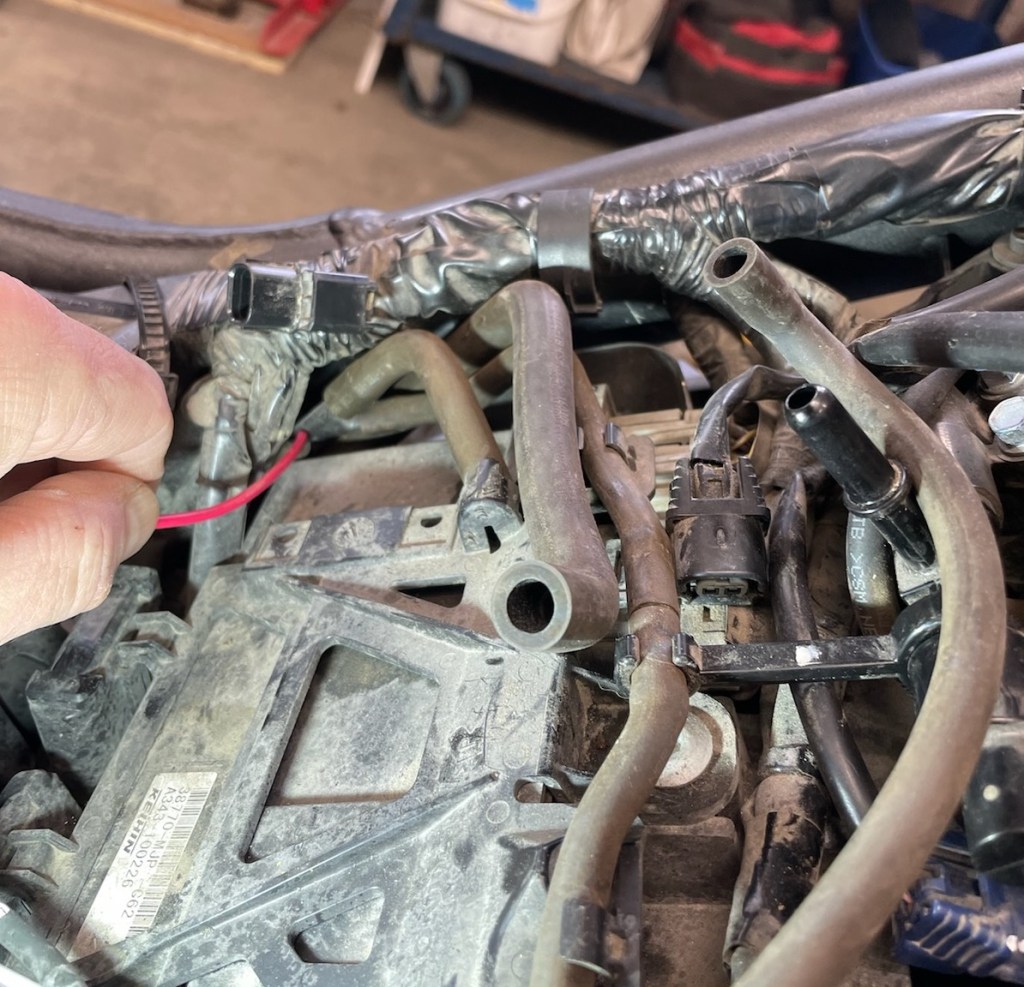
In my last post, I talked about how I ended up with about 3 litres of water in my fuel tank after a failed water crossing. In the post, I presented the theory that the water was sucked up from the tank breather hose when the tank had negative pressure. I considered rerouting the breather tube to keep it out of potential water, but my friend Mike came up with a better solution. While servicing his Africa Twin, he noticed that the tank breather on that bike has a Y-fitting with a length of hose staying high on the bike and the other draining down.

My buddy Mike’s Africa Twin. He’s pointing to the Y-joint with the piece of red wire. The short tube fits into that little cup, presumably to keep it clean. That’s the battery area.

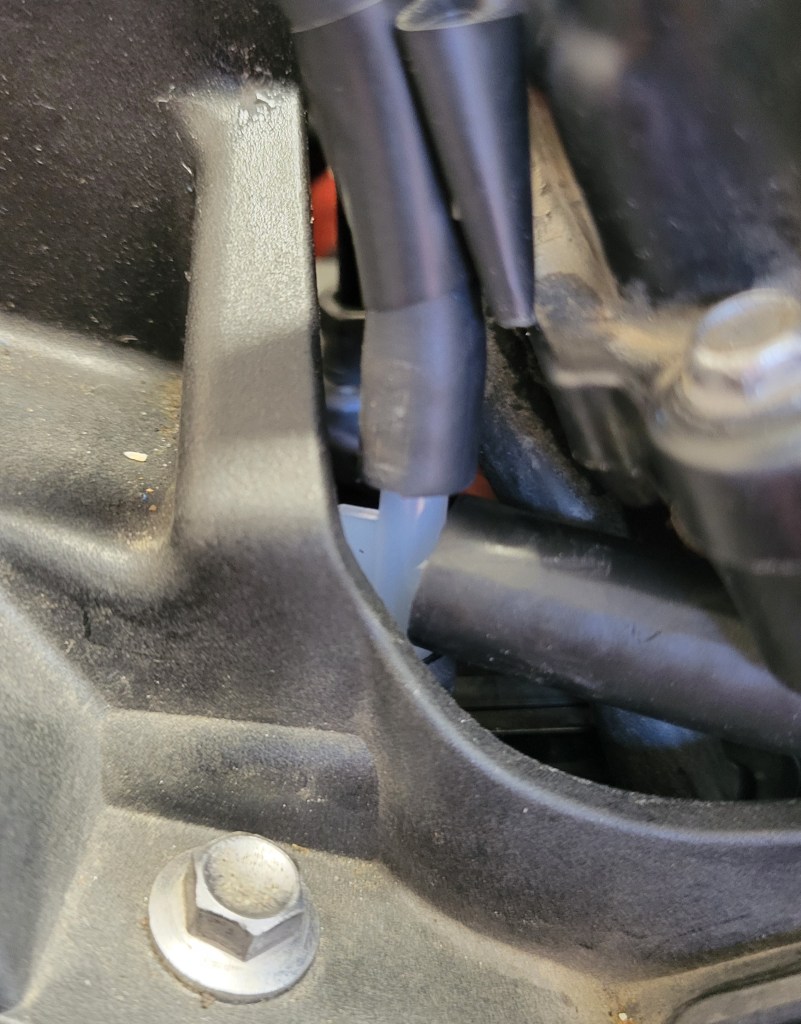
So I picked up a set of assorted vacuum T-connectors and a length of rubber tubing at Canadian Tire and did the same on the Tiger. I cut the tank breather tube and inserted the T-connector, then added the extra tubing. I haven’t decided yet where it will terminate but for now it comes up the siderail and loops across under the fuel tank and is tucked in the other siderail. I think I will shorten it and add a loose end cap like on the AT.

If you have a Tiger and want to do this mod, just be sure to cut the right hose. There are two leading out of the tank. One is the drain tube and one is the breather. The drain tube has a check valve on it so doesn’t allow water to come up. The breather tube is the larger of the two where they attach to the tank.

A Few Mods for Dirt

Fender Extender

I saw MotoBob add a front fender extender to his Triumph Tiger and thought it would be a good modification, given the dirt I plan to ride this summer. It keeps a lot of mud off the front header pipes and radiator, not to mention rain water off your pants. He used the Pyramid Plastics version, but my dealer, Montreal Moto, actually had a Triumph one in stock so I snapped it up.

Some extenders come with sticky pads, but I was advised to use silicone. I decided to make things easy for myself and remove the fender. Sounds reasonable, right? I could have done this mod just by removing the front wheel, but I decided to give myself some extra room and removed the fender. It was three bolts on each fork, so how hard can it be, right?

Little did I know that someone had used red threadlocker on the bolts, and one snapped off in the fork. Perhaps someone at Triumph can explain to me how a front fender is a permanent install?

So I lost a day there. I drilled it out and was retapping it when I got distracted and broke the tap inside the old bolt. Ugh! What a mess, going from bad to worse. I bought some carboy drill bits (after some research on what the hardest, sharpest drill type is), but even a carboy bit wouldn’t touch the tap. Fortunately, my friend Mike, whom I’ve already mentioned a few times, came to my rescue. (He was the guy who refinished the bodywork of my old GS.) He has a proper workbench on a cement floor and drove the tap out with a punch, and then we could re-tap. The thread was a little loose from the abuse it had taken, but he showed me a trick to strengthen it with some 5 minute epoxy. Apply the epoxy like threadlocker but coat the bolt in WD40 so it doesn’t glue inside. Thread it in and after a few minutes remove the bolt and let the epoxy harden to the old threads. Neat! When I reinstalled the fender, I used blue threadlocker.

Lowering Footpegs

My Fastway Adventure footpegs give you the option to mount them standard or lowered. I mounted them standard so I wouldn’t have to adjust my foot levers, but with the dirt coming up, I thought I’d swap to the lowered position. Fortunately, Fastway provide a tool to use to press the pin out. Then you simply press it back in from the other side—from the top of the peg.

Unlike the fender extender and most other jobs, this one went smoothly and I had the pegs back in again in no time. It was easy to adjust the height of my brake lever; just undo the lock nut and screw the adjuster into the master cylinder. Because I was screwing in, I didn’t even need to bleed the brake. And when I put the shift lever back on, I rotated it slightly from its previous position. This set-up lowers my pegs 8-10mm, which may not sound like much, but I suspect will be significant for knee comfort on long days and lowering centre of gravity when off-roading. The downside is that the pegs are a little closer to the road, but I don’t think I’ll be dragging them anytime soon. Or so we’ll see.

Before I reattached the brake lever.

Sidestand Extender

Another mod for the dirt. I’ve always gotten by without one of these, although it’s sometimes a pain to find a stone or stick to use instead when you are forced to stop in mud or soft grass. I went as far as to install a Touratech one on the GS once, but it lasted all of one ride. I got hung up on some rocks and when I got home I noticed I had an extender no more . . .

Needless to say, I was skeptical about buying another from Touratech, but different bike, different design. Besides, I got this one half price. One of the benefits of riding a discontinued bike is that if you keep your eye out you can sometimes snag accessories at discontinued prices. We’ll see how long this one lasts.

Now I remember what I don’t like about sidestand extenders: they interfere with the centre stand. Oh well, I’ll just have to put the sidestand down first before using the centre stand. No big deal, and maybe it will help stop my centre stand from rattling so much. Or maybe now there will be two stands rattling together. Anyway, I’m not wedded to this accessory and we’ll see how long it lasts.

Oil Filter Guard

The Outback Motortek skidplate for the Tiger 800 does not protect the oil filter. Some would say that’s a design flaw, but I suspect OM did it that way so you can change the oil without removing the guard. (They put a cutout in the guard for the sump plug.) But it does leave the oil filter a little vulnerable at the front of your engine. Triumph make a push on metal guard. It’s a simple design with indents that engage with the filter for an interference fit. Easy to remove when it’s time to change the filter, which I will do after running the bike a bit this spring. The engine’s been open for some time as I worked on everything, but with oil being so damn expensive (it costs me now over $80 for an oil change), I will just change the filter. Anything that might have strayed in will be captured in the filter.

It’s been a long haul but I think I’m ready now for another season and another 50,000K. I took the Tiger for a test ride yesterday and it’s shifting smooth again and the clutch feels great. The engine is running well, and I’m happy to be back on the road.

Here in Montreal, it’s Easter Monday and I think I can safely say we’ve had our last snowfall. Crocuses are pushing up and there are buds on the trees. Geese are returning and everywhere the signs of spring are upon us, including the sound of motorcycles back on the roads. For Canadian riders, it’s the best time of year. I wish everyone, wherever you are, a safe and enjoyable 2024 season.

Please leave below any comments you have and consider following. What mods and maintenance did you do in the off season? What are your plans for the coming season? I love hearing from readers, so drop me a line.

The Homestretch

Marilyn and I got a kick out these signs. The NL potholes don’t compare to Montreal’s.

After a night crossing on the ferry from Newfoundland, I decide to ride The Cabot Trail, then stop at friends in Nova Scotia and Maine before the final push home.

The night crossing was terrible! I think it ranks up there as one of the most miserable nights of my life, such as once on a day trip in Germany when I missed the last train back to Munich with no cash in my pocket and too young to have a credit card so had to sleep on the street, or when I once slept in a trailer with a door that didn’t properly close, in June, in Canada, and got eaten alive all night by mosquitoes. The snoring was like a thousand mosquitoes entering my sleep to feast all night, or an over-sized dentist’s drill boring through my ear-plugs. I tried slumping in my chair, both sides, slouching, curling into a fetal position across two chairs (and an armrest), lying on the floor, trying a different floor . . . nothing worked. Eventually I gave up and went for breakfast in the dining hall.

This was the only enjoyable part of the entire crossing, during which I struck up a conversation with a young man at an adjacent table. He was from Cape Breton and had recently started working on an offshore oil rig. It was interesting to hear about that experience and life in Cape Breton. The story I kept hearing during my travels from him and other locals is that the Maritime winters are not what they used to be. Very little snow and many have sold their snowmobiles. Fishermen report of increased fog. Great White sharks have been spotted in the waters off Ingonish, etc. etc. Yeah, we know, you must be thinking—the planet is getting warmer. Duh! I only mention it because Marilyn has always said she wouldn’t retire to the Maritimes because she couldn’t take a Maritime winter. Thanks to global warming, the east might be back in the cards! (However, as I write this, it’s just received a record snowfall).

When I said I was headed to Baddeck on a bike, he suggested I take the 223, the Grand Narrows Highway that goes up through Iona. Nice tip! Here’s a taste.

It’s like that the whole way—twisty right along the shore of Bras D’Or Lake where it juts up into the Narrows. The pavement is a little broken but not bad. Keep in mind that I’m operating on one hour of sleep and that brush on the right that comes up close to the road is always a red flag for me, so I’m holding back. I would have my fun later in the day on the Cabot Trail.

After arriving at Baddeck Cabot Trail Campground, one of my favourite campgrounds and my second stay there this trip, I set up camp before hitting The Cabot Trail. Yes, the definite article deserves to be capitalized because The Cabot Trail is an iconic ride. I’ve done it before on my 650GS but wanted to do it again on the Tiger. So after a quick nap, I headed off.

I told myself, given my sleep debt, I’d just cruise it, but it wasn’t long before I was lured up into the adrenaline zone—until the bike twitched on a tar snake mid-corner. Never a pleasant feeling and I decided to cool it down.

The real fun was riding out to Meat Cove. The road is twisty and undulating and broken in spots, and then it turns to dirt. It started to rain, which made it more interesting. The dirt section had recently been graded so there weren’t any potholes or washboard to worry about.

This is exactly the kind of riding the Tiger is made for—twisty asphalt and light off-roading. I was having fun, once I got the damn ABS off. (I wish it were easier on the Tiger than having to navigate down through menus.) Unfortunately, I didn’t get footage of the best riding into the campground because the camera turned off for some unknown reason, but trust me, I was power-sliding the rear wheel out over the cliff-edge on those left-handers. 😉 Maybe it’s best that the wife doesn’t see that footage anyway.

I was pretty annoyed when I discovered the camera had stopped. To be honest, I’m not happy with much of the footage from the tour, so I’m definitely going to change how I work with the camera. Maybe I’ll use the phone app so I can see when and what I’m filming (or when I’m not filming), and maybe I’ll use the loop setting in which the camera constantly records over the same bit of memory card until I stop recording. The only issue with loop mode is it drains the battery fast. Voice commands don’t work with wind noise at speed, and I don’t want to be fumbling either with the camera or the phone, but I’ll experiment in the spring and come up with a better process. If you use an action camera, I’d be interested in hearing about your experience and set-up.

Anyway, back at Meat Cove, I arrived amid a torrential downpour, much to the amusement of hikers who were laughing at me while waiting it out in their SUVs. I didn’t care. A hormone concoction of endorphins, dopamine, adrenaline, and testosterone were coursing through my veins. It was time for a fresh lobster roll at the Clam Chowder Hut and the bragging rights photo.

Some bikes can’t make it in to Meat Cove but the Tiger sure can.

There’s a lot more of The Cabot Trail I could show but this is already going to be a long post, and there’s no shortage of footage available online. It’s always a great ride, and I’m glad I made the effort to do it again while I was near. I ended up doing the complete loop and was back at camp in time to enjoy a campfire and some of the bourbon I’d picked up earlier in the day.

My destination the following day was Urbania, Nova Scotia, just south of Truro, where some friends of mine live. I met Sharon in 1986 when I was an undergrad, so our friendship is long! I’ve admired her dedication to her writing career and teaching work and watched her fall in love and marry the man of her dreams, move out of the GTA (Greater Toronto Area) and into their dream home built largely by her equally talented husband, Kevin. If any of my older readers remember the Canadian 80’s band New Regime, well Kevin was the lead singer, among other accomplishments. This would be my first visit to their new place and I was looking forward to it. They have several acres of property that back out onto the Shubenacadie River.

The current was especially powerful after the rains the previous night.

The riding in Nova Scotia is excellent and probably worthy of a separate post, but I’ll just say here that Old Highway 4 from New Glasgow down to Bible Hill is about as good as it gets for a secondary highway through non-mountainous boreal forest. It was the original primary east-west highway until the Trans Canada was put in, and you can take it all the way to or from Sydney, Cape Breton. I followed it for much of the day and only jumped onto the Trans Can toward the end as I was racing against a system of precipitation that was moving into the area.

As I rode up the driveway to Sharon and Kevin’s, it started to rain. And it rained! There was a massive thunderstorm during the night and, in fact, major flooding in Halifax. We actually received an evacuation notice during the night because we were near a dam that was at risk of breaching. (Whatever . . .) My timing was lucky: I was happy to shelter in place under a solid roof with good friends. The extreme weather also got me thinking that you can’t escape climate change. Forest fires out west, ice storms in Montreal, flooding in the Maritimes—wherever Marilyn and I end up for our retirement, we’ll have to deal with some form of extreme weather.

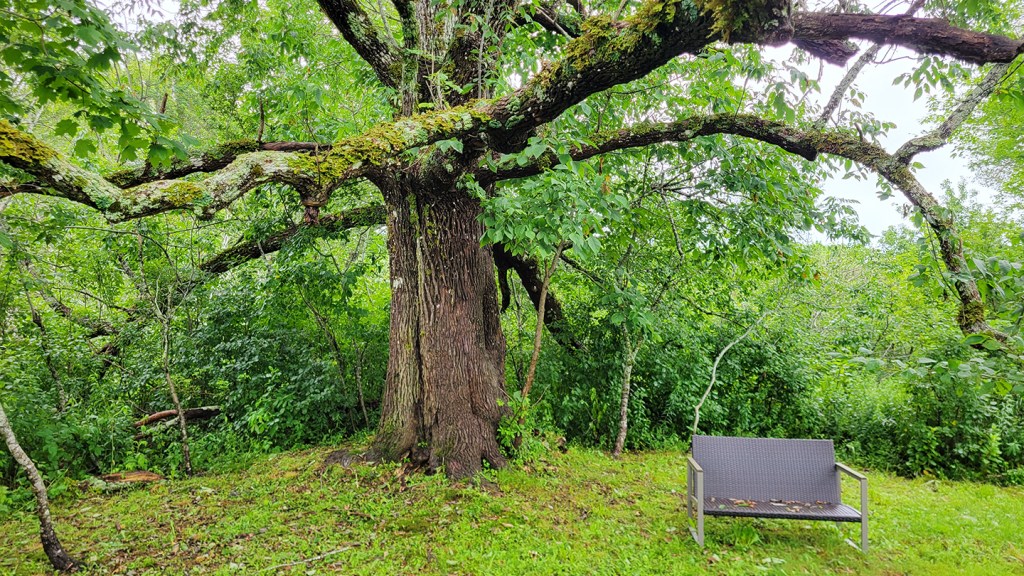
The next day Sharon and I walked her property down to the river. One of the gems of their property is a tree they call Grandfather Ash. Unfortunately, since I visited, this magnificent tree was severely damaged in Hurricane Lee last September.

Despite the extreme weather, the visit was restful and restorative. The energy on their property is quiet and calm, and I hope my retirement home is as lovely. I keep talking about retirement because it’s very much on Marilyn’s and my minds these days. I’ll be teaching for another two years, until June 2026, and then we’ll be moving out of Quebec. I could write a lot about my frustrations with Quebec politics, economics, and sociology, but let’s stick to adventure touring. The short of it is we have to decide whether to move out west to where Marilyn has friends and family (good riding in The Rockies!) or out east to where we’d be closer to my friends and family. Either way, it’s going to be difficult leaving the friends we’ve made here, but I’m not going to think about that now. Thankfully, we have a few years to decide and emotionally to prepare.

After a few days visiting, I had to tear myself away and get back on the road. I had two more nights planned and wanted to get over the border into Maine the first night. I headed back to the Trans Canada on the beautiful, winding 236.

I had to get around the Bay of Fundy and took the highway as far as Sackville, then split off onto the 106 because I prefer secondary highways. Soon after crossing into New Brunswick, as I came through Dorchester, I saw a giant sandpiper at the side of the road.

“Shep” the sandpiper

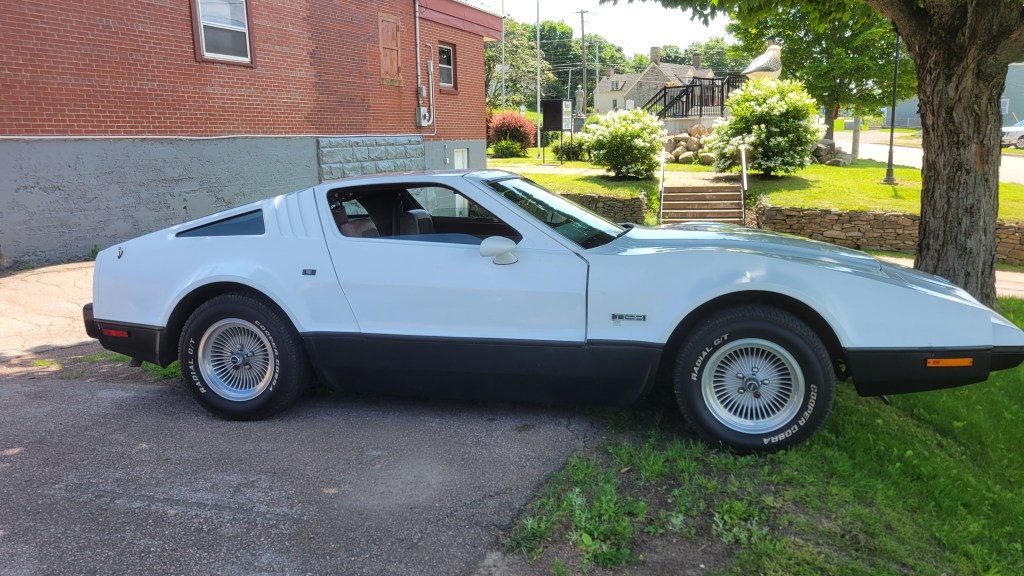
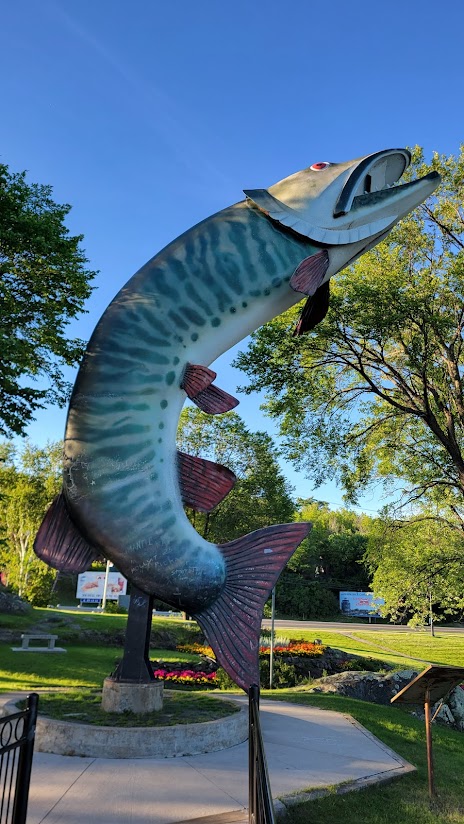
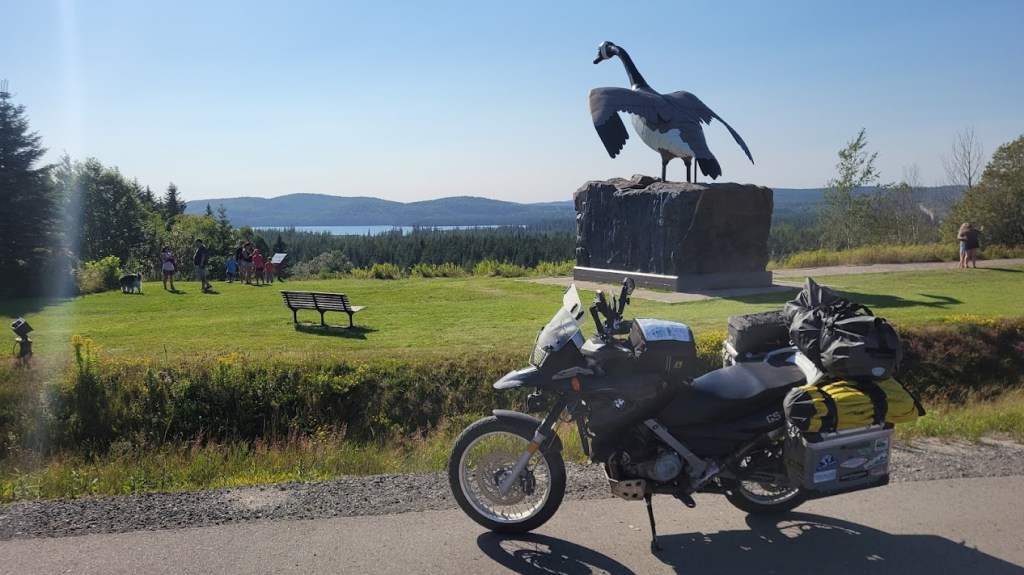
I’ve seen the giant goose in Wawa and Husky the Muskie in Kenora, so I thought I’d stop and take a closer look. Even more impressive was the Bricklin parked in the lot.

Bricklin was a Canadian car manufacturer located in Saint John, New Brunswick, in 1974-75. With the help of provincial funding, they built about 3,000 cars, but problems with reliability of the acrylic body panels and other issues drove the price up and the car company soon went bankrupt. The car has a Chrysler slant 6 engine, a Datsun tail, and other parts from Chevrolet and Opel. It’s crowning feature are the winged doors that open upwards. I got talking to a young lady out front and accidentally mistook it for a DeLorean, which must happen a lot. The DeLorean is another long-nosed, snub-tailed, winged car of yesteryear, made famous by the Back to the Future movies. This Bricklin’s in great shape, obviously without a spot of rust on it, and no blistering that plagued the early models.

I’ve said it before, this is what I love about solo touring. I can stop whenever something catches my eye, meet people, and explore. It turns out that I’d stumbled upon the Dorchester Jail, the second oldest jail in Canada and the only privately owned provincial jail and Canada. It’s also the only privately owned Death Row in Canada and was the location of the last double-hanging in New Brunswick—the Bannister Brothers. That reminds me of a skull I once saw at Eldon House in London, Ontario, that was from the first hanging in Canada. Actually, it was the first two hangings because the rope broke on the first try, which leads me to wonder if the executioner apologized to the murderer for having to put him through his execution twice. Hmm . . .

Dorchester Jail

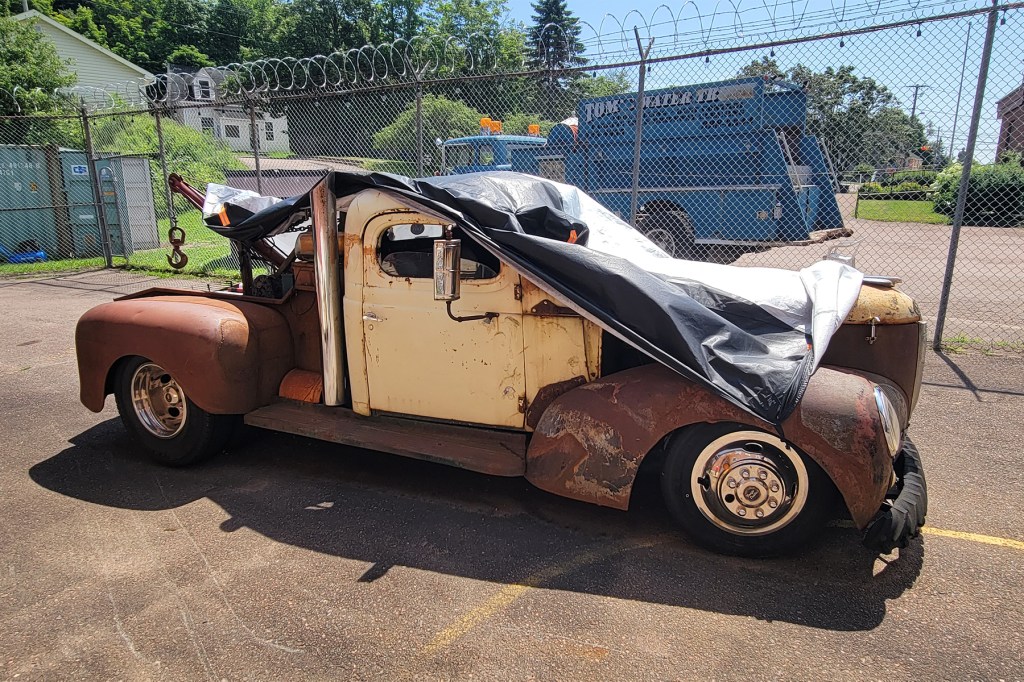
I’ve never spent a night in the clink but if I ever want to, I know where to go. The jail has been converted to an AirBNB and you can enjoy a night in a cell for a moderate price. I don’t know if that includes use of the courtyard during the day because there was at the time of my visit another interesting vehicle there beneath a cover.

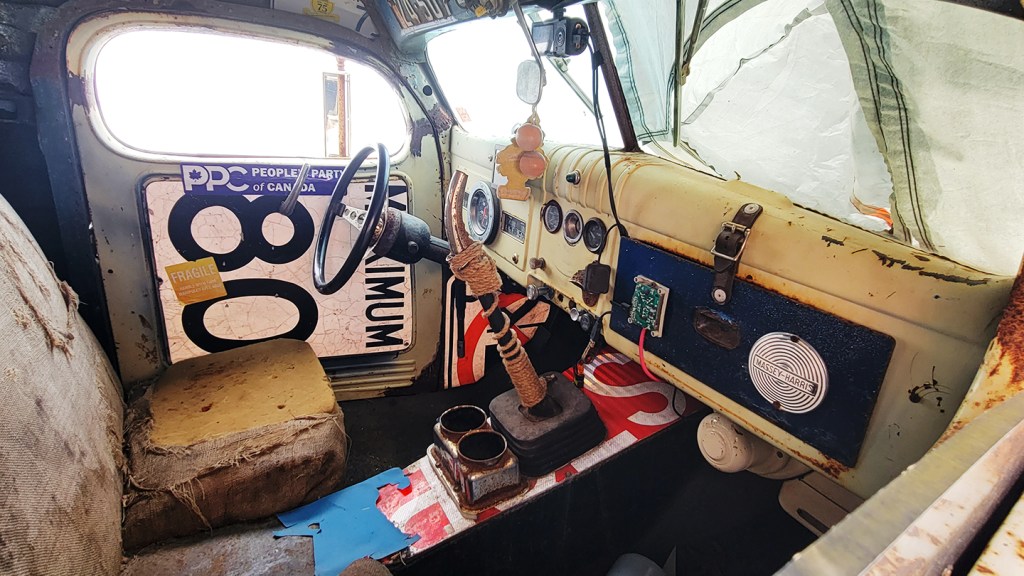
This bad girl (the truck, not the woman, who graciously lifted the cover to show me) had a bit more rust on her than the Bricklin. Love the tractor tire front bumper, almost as good as the Bricklin’s featured “energy-absorbing” bumpers.

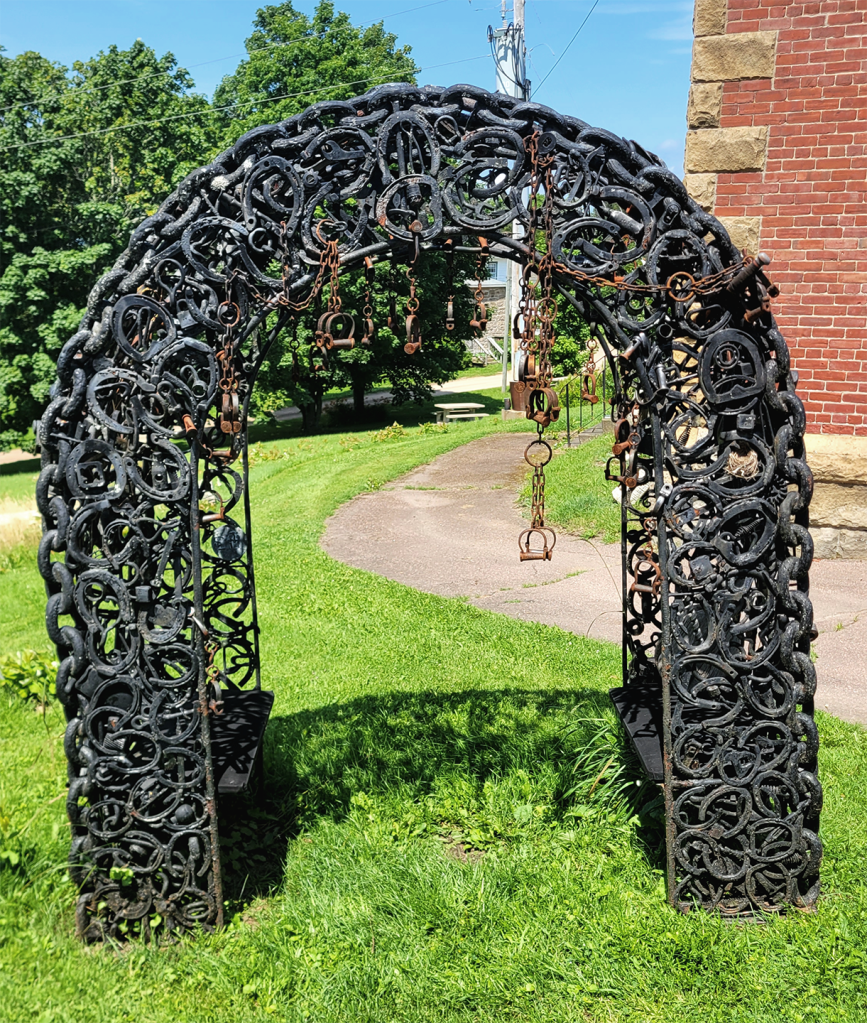
Also of interest was this metal arch that was constructed from horseshoes, locks, car parts, tools, chains, and prisoner shackles. And amid it all—I don’t know if built or placed—was a bird’s nest.

This place was a feast for eyes, but I had miles to go before I sleep so had to push on. I soon was passing through Saint John, NB (not to be confused with Saint John’s, NL), stopping only to fuel up and caffeinate up because it looked like it was going to be a late arrival at my destination, Cobscook Bay State Park in Maine. By the time I arrived at the border, it was already dusk.

Are you nervous when crossing borders? I’ve crossed the US-Canada one so many times I don’t get nervous anymore, but I’m always cautious about what I say because I know the power these officers have. I knew they were going to ask me the usual questions and was prepared. Our conversation went something like this:

Customs Officer: “Where do you live?”

Me: “Montreal.”

CBP Officer: “What is your purpose entering the US?

Me: “I’m on my way back from Newfoundland and just passing through.”

Officer: “Are you travelling with anyone?”

This is where things started to go sideways. I had pulled up alone so wasn’t expecting this.

Me: “Well, I was travelling with my wife, but she flew back early from Newfoundland for work and I’m riding back alone.”

Officer: “Are you meeting anyone in The United States?”

Another unexpected question. Now I should know better than to say more than is necessary, but I’m honest to a fault. I did, in fact, have plans to meet up with a reader of this blog who lives and rides in Portland, and we thought it would be fun to get in some riding together while I was passing through. So I answered honestly. I thought, better safe than sorry.

Me: “Actually, I’m meeting a fellow rider in Portland, and we’re going to go for a ride together. She’s a reader of my blog.”

This answer did not seem to help, and now I was beginning to feel more sorry than safe.

Officer: “What is your relationship with this person?”

He clearly wasn’t familiar with motorcycle culture. Or blogging.

Me: “I write a blog about my motorcycling. I’m meeting someone who is a reader of my blog. She lives in Portland and, since I will be passing through, we thought we’d meet up for a ride together.”

Officer: “So, it’s . . . like a date?”

I felt like I was digging myself in deeper. He clearly had missed the reference to my wife. Some jokes came to mind that might have lightened the moment, but I know enough never to joke with these guys. Sometimes I think that a lack of humour is a job requirement. I felt like I was at the door of a speakeasy and chose my words carefully.

Me: “No, I’m married. I’m meeting a fellow motorcyclist in Portland to go for a ride together. That’s all.”

I was tempted to enlighten him about the communal aspect of motorcycle culture, about blogging and the writer-reader relationship, or to provide a short romantic history of my marriage, but like I tell my composition students, sometimes less is more. The ball was in his court. By now the notorious Maine mosquitoes were out and finding their way up my nose. I looked him straight in the eye.

Officer: “Have a nice night,” he said, and handed me back my passport.

I felt like I’d just hit another tar snake and was happy I still had some of that bourbon in my pannier.

An hour later I had my tent set up, food on, bourbon poured, and a fire lit. That night I wandered down to the water to get out from under the trees of my campsite. The sky was huge and clear, and it was a perfect night for stargazing. I lay on my back and used a great little app called SkyView (Android and Apple) to pick out the constellations.


Highway 1 Maine is a secondary highway that follows the shoreline almost all the way into Portland, passing through quaint towns along the way. I took it west-east in 2017 when I did my first tour out to Cape Breton and The Cabot Trail and my plan was to do it again the other way this time, dropping down into Bar Harbour en route, which I’d heard a lot about. The cost of secondary highways is always time. It was very hot and the going was slow, slower than I remembered. Still, Google Maps was telling me that Bar Harbour is only about a 2-hour ride from Cobscook Bay, so I thought it would be perfect for a mid-morning coffee stop.

I took a short detour out to charming Lubec, ME.

I wouldn’t know because I never made it. As I was coming down Highway 3 south, I got stuck behind no less than four trucks—a hydro truck, a cement truck, a transport truck, and a dump truck—with no chance to pass. Volume got heavier and slower and it got hotter as morning developed into midday. At the same time, what I was seeing wasn’t particularly appealing—clam huts, lobster shacks, pirate-themed mini-putt, hotels, tour busses, hunting and fishing stores—and I began to wonder why I was there, crawling along in a wake of diesel fumes. There’s a national park there and I’m sure the coastline is impressive, if you can get to it, but whatever natural beauty might be drawing all these people to this region is so buried beneath layers of tourist development that I didn’t want to spend any more time trying to find it. As the traffic slowed to a crawl I said “Fuck it!,” pulled a U-turn, and got the hell out of there.

Now I was running late (am I never?) so had to abandon my plan to continue along Highway 1. Google Maps was saying the fastest way to Portland was the interstate, so that’s what I did. After the frustrations of the secondary highway, and given the heat, I was happy to ride at speed. I decided to get my coffee from a Dunkin’ Donuts at one of the exits and met there, by chance, Eric Foster, whom I had written about in a previous post. He’s the guy who crashed on the Trans-Taiga and was rescued by local trappers. On this day he was riding the newer Tiger 900 and had seen my 800 XC, the same as the one he crashed, so jumped off the highway when I did to have a chat. Small world. I’d never met him in person but it now made sense; I remember he lives in Maine. He told me Bar Harbour sucks during the tourist season. Good to know.

I was down to my final night of the tour and thankfully my friend, Berry, had something special planned for me. Berry and I started corresponding a few years ago. At the time, she also rode a 650GS, so found my blog that way. Soon our online conversations turned to other things like diet, politics, and literature, but motorcycles are the thing we usually talk about. When she decided to upgrade her bike, I was honoured that she sought my opinion on the Suzuki V-Strom 650, which of course I endorsed. So when I knew I’d be cutting back through Maine and passing close to Portland, we decided to try to meet and get in a ride. She went one step further and graciously offered to put me up the night in her beautiful house. This meant not only that I was spared setting up camp one last time but also that I could see a little of Portland. She took me on a tour of the old town out to a seaside restaurant where we could sit out and eat seafood while hearing the crashing surf from where it came. It was a fitting end to my Atlantic tour.

We did get in that ride. The next day, Berry followed me part of the way up toward the Canadian border, or rather, I followed her. I figured, let the local lead and choose the route. Here we are riding Highway 153 which, as you can see, is pretty nice.

Eventually, Berry split off at Conway and started heading back toward Portland. It was nice meeting her and putting a face to words, and I’m sure it won’t be the last time we meet. In fact, the NEBDR ends in Maine, so it may be sooner rather than later.

Berry and her new Suzuki V-Strom 650

There was one more good section of road remaining on this tour and it was The Kancamagus Highway (NH Rte 112) from Conway to Lincoln. Rever lists it as a G1 road, which is one of America’s Best Roads (Epic Incredible Roads)—their wording—and I would agree. After a rip over the mountain range, you get to decompress as the 112 winds its way parallel to the Pemigewasset River through the village of Loon Mountain, where I visited for the New Hampshire Highland Games for my very first overnight adventure tour, back in September 2016.

At a certain point of every tour, you ride back into familiar territory. It’s always a very noticeable sensation for me. After exploring for weeks and seeing everything for the first time, eventually, usually in that final day, you ride a road you’ve ridden before and remember the first time you rode it. You might even recollect your excitement or heightened attention at seeing it for the first time, and I guess that is why I like to travel. It’s that curiosity about the world that comes alive when you are experiencing the unfamiliar. Time slows, days are long and full, your senses fully alert, your mind constantly thinking, processing information, acquiring knowledge, keeping you safe. I can’t see myself spending vacation time at a resort; I think I’d get bored in two days.

The motorcycle is the perfect mode of travel for people like me who like to experience something new. And Newfoundland was certainly new (pun intended). I don’t think I could get bored with it, and I’m sure I’ll be back sometime in the future, God willing. In the meantime, it’s going to be very interesting to try a different type of touring altogether next summer when I do the BDRs (MA and NE, back to back). I’ve never done two weeks+ of constant off-roading, so there will be new technical and athletic challenges for me. At the same time, I’ll be exploring the Appalachian Mountain Range from West Virginia to the Canadian border. If you want to follow along, you know what to do.

What are your plans for the coming season? I always like to hear from readers so drop a comment below.

Lunch at The Blue Donkey and up through Smuggler’s Notch to the border. In total, I was on the road 25 days over just about 10,000 kilometres (6,000 miles) for an average of 400 kilometres per day.

Ready for Anything

In the penultimate post in a series on gear, I discuss what I carry when touring.

The Container of Last Resorts

The first major tour I did was to Cape Breton to ride the Cabot Trail. As you cross the border from New Brunswick to Nova Scotia, heading east, you see at the side of the highway a mini-lighthouse advertising Tourist Information. I naturally pulled off for maps and a rest. In the parking lot, I noticed a burley, bearded, rider on his back beneath his Harley, trying to tighten an oil filter with a pair of pliers.

“Hey, can I help in some way?,” I offered. None of his fellow riders seemed either able or willing.

“Not unless you have a 14mm socket,” was the reply that emanated from beneath the bike.

I rummaged to the bottom of a pannier and emerged with the requested item.

“Here you go,” I said, and handed it down to him.


Every touring group should include at least one ADV rider. Because we venture into remote areas, we have to be self-sufficient, and that means being prepared for anything. Anything. Mechanical problems, medical emergencies, security issues—we need to carry on the bike into the bush the tools, spare parts, first-aid materials, and safety items required to get us back out of the bush.

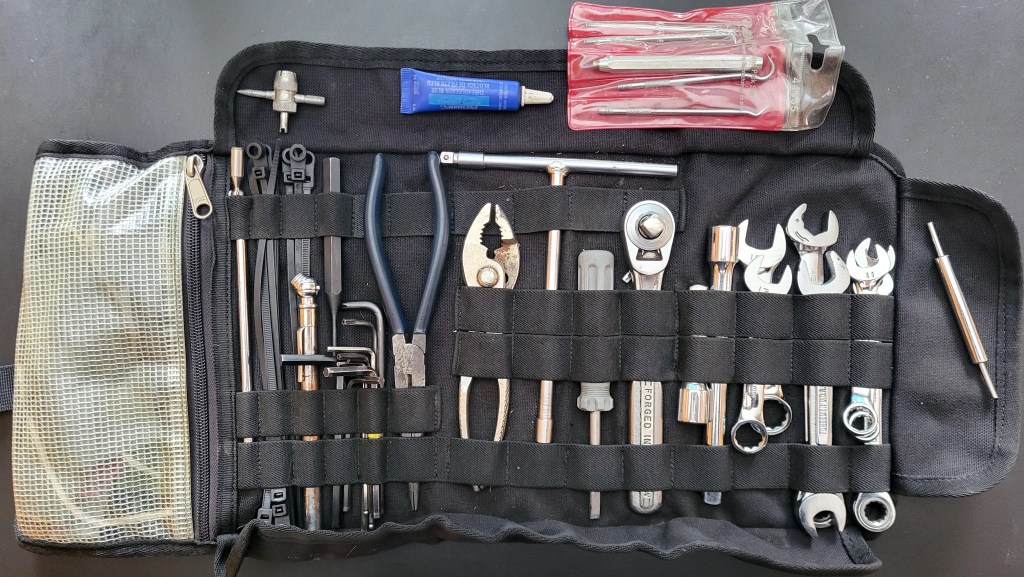
The basis of my touring kit is my tool roll. I use the Kriega roll because I like the little pouch at the side for all the odds and ends that don’t fit anywhere else.

Kriega Tool Roll

That includes an assortment of hardware and fuses, pipe cleaners, emery paper, safety wire, thread lock, a valve stem tool, picks, and a tool for removing pins from electrical connectors (viewed far right above). The latter contains two tubes of different diameters, one on each end; hopefully one is the perfect diameter to slide over the pin but inside the hole in the connector. The tool pushes the barbs of the pin in so the wire can be extracted out the back of the connector.

I once had a flasher that had a break in the wire inside the connector plug, so I couldn’t simply splice the wire. Every time I put on the flasher, I’d blow the fuse to the circuit that included my dash, so no speedometer, tachometer, and other instrumentation. The only way to fix it, other than getting a new connector and splicing wires, was to remove the pin from the connector using a tool like this. Since then, it’s become part of my toolkit.

Left to right above in my roll is a telescopic magnet, zip ties, various Allen keys particular to my bike, needle-nose pliers, slip-joint pliers, a 1/4″ T-handle, reversible screwdriver (standard/Phillips), 3/8″ ratchet, socket extensions, various wrenches. I like the stubby wrenches from Home Depot because they are lighter—not as light as titanium wrenches, but my wallet is heavier for it. I indulge myself with a ratcheting 10mm wrench.

Why the 1/4″ T-handle? Some of those sockets are 1/4″, but with the Motion Pro T6 adapter, I can use all my 3/8″ sockets on the T-handle.

Where are the vice-grips, you ask? They are in my other tool kit since they don’t fit in this one. As I’ve said elsewhere, I don’t use vice-grips very often when working, but they are handy in a pinch, so to speak (sorry).

Sockets, etc.

In a Dollar Store pencil case, I have my sockets, some hex bit sockets (3/8″ and 1/4″ stubbies), an elbow socket, spark plug socket, a couple of crowfoot sockets (again, particular to my bike), a spoke wrench, and said vice grips (aka locking pliers). I used to carry torx bits with the BMW, but since switching to Triumph, I now carry hex bits.

There’s some redundancy here, for sure. I probably don’t need both Allen keys and Allen sockets, but the keys don’t take up much space, and sometimes one tool is better than the other for a particular purpose.

I also carry:

  • Tubes. I know you can get by with one, the front, and cram it into the rear if needed, but I carry both a front and rear tube.
  • A chain breaker, spare links, and a master clip. I like the Motion Pro Chain breaker for on the road. It doesn’t do rivets like the DID one does, so I have both. I use the DID at home when changing my chain, but take the smaller Motion Pro one on the road with a clip master link.
  • A digital multimeter for troubleshooting electrical problems. Don’t ask me how to use it beyond the basics because I’m still learning The Dark Arts, but I take one nonetheless. I have the Neoteck NT8233D Pro, which is cheap enough to get wrecked while ADV riding but still decent enough quality and reasonable in size. I’ve considered getting a smart meter, but wondered if it would be reliable enough. Anyone have any experience with these?
  • An Arteck battery jumper.
Arteck battery jumper

Tools, sockets, tubes, multimeter, and chain tool all go in Giant Loop Possibles Pouches that attach to my crash bars at the front, helping to keep the bike balanced front to back.

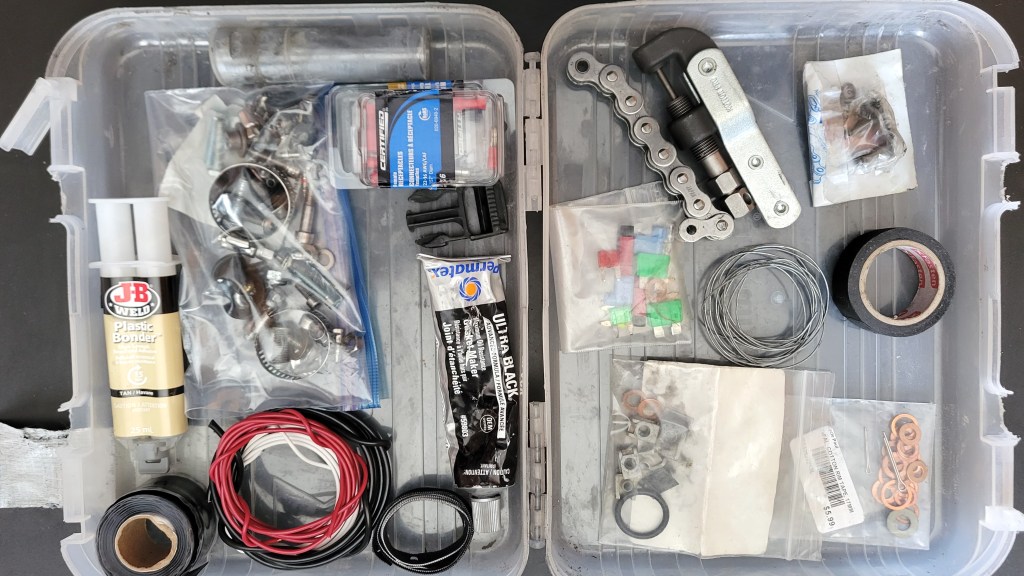
In one of my panniers, I carry a plastic box that contains other items and spare parts (see image at top). The spare parts have gone with the sold BMW so need to be replenished, but they were a spare clutch cable, spare levers, and a spare water pump. If I were doing a RTW tour, I’d carry more spare parts than this, but so far my tours have been in North America, where parts are readily available.

Also in that container:

  • JB Weld Steel Stick, for fixing engine casing.
  • JB Weld Plastic bonder. I’ve use this to fix body panels and broken mirrors.
  • Self-sealing tape. This stuff is amazing and can seal a high-pressure hose.
  • High-temperature electrical tape for wrapping electrical wires.
  • An assortment of electrical connectors, including Posi-Lock, and heat shrink.
  • More hardware, more fuses, assorted copper crush washers, cotter pins, O-rings, velcro.
  • Various gauge wire
  • Gasket maker
  • An extra buckle for my Wolfman tank bag.

Finally, to round out my emergency preparedness, I carry a first-aid kit and bear spray. The kit I put together myself. I took a look at what you get in those prepared kits and it didn’t look like much for the cost, so I bought another trusty Dollar Store pencil case and filled it myself. I won’t go through all that I have in there, but will say the few things you won’t get in those commercial kits:

  • Carbon capsules. Eaten something that doesn’t agree with you? Take two, wait half an hour, take a dump, job done.
  • Arnica Montana. Homeopathy for any trauma to the body.
  • Robax. I have a vulnerable back, which tends to go at the most unexpected times.
  • Antihistamines. These are great for any inflammation from bee stings or allergic reactions.
  • Triple Action Polysporin

These items, along with the essentials I always carry on the bike, round out my touring kit. They say an ounce of prevention is worth a pound of cure, and all this stuff adds up to a quite a few pounds, so I think I’m covered. The challenge is always to find the right balance between taking what you need while keeping the weight down. I’d rather sacrifice some creature comforts like a camp chair, but I rarely sacrifice when it comes to tools and other items needed to keep the bike running (although the camp chair would come in handy if stranded in the middle of nowhere).

I’ll add one more item this winter to my tools: a satellite communicator. I’ve been meaning to get one for a while, and it really is silly to travel into remote areas without one. I’ve considered them all and almost bought a Garmin inReach Mini, but I’m leaning toward getting a Zoleo at half the price. Any thoughts, anyone? I don’t see what the Garmin does that the Zoleo cannot. Am I missing something?

Have I missed anything in my touring kit? As always, your kit is personal to you, so let me know in a comment if there’s something you carry that I do not. Like I said, I’m a self-confessed gear weanie, so I’m always interested in learning about a tool I have to buy. Buying gear is one of the ways we riders in the North get through the off-season, and yesterday I put the Tiger into storage, so I’m all ears.

I’ll wrap up this series in my next post on the navigation apps I use. If that interests you, click Follow and you’ll be notified of it and future posts when they are published.

Where Has the Summer Gone, 2022 Edition

In the 100th post of 650Thumper, I reflect on a summer of forced relaxation.

Yesterday, the image above popped up as a Facebook memory of exactly one year ago, just to remind me that I once did something pretty remarkable. By contrast, this summer has been pretty tame, even by my standards.

To be fair, this was supposed to be a restful summer after the Epic Adventure of last year. I had eight months to recover, of course, but teaching is a pretty intensive profession, the workload of the semesters off-set by the summers of recovery, and this past year was especially draining as we continued to deal with masks and Covid protocols and the accompanying anxiety of a global pandemic. As a teacher, I am part pedagogue, part social worker, so found myself assuaging the anxiety of some students and standing firm against others who tried to take advantage of the situation. Deciding which is which is the hardest part of teaching, to be honest, and by the end of the semester, I and many of my colleagues were limping to the finish. “Boo-hoo!” I hear those in the medical and services professions saying. It’s true that I didn’t have to wear a mask 8-12 hours a day, but my experience has only heightening my respect for those who do.

But the real reason for a stay-at-home summer is that my wife and I got a new dog, and he was a rescue from a horrible situation. He doesn’t travel in the car without getting sick, and he has some triggers and in general is still settling, so we didn’t feel we could do our planned east coast trip this year. We’ll give him another year to get comfortable enough that we can leave him for even a few weeks so Marilyn can join me for part of that trip, as she did last year. We pledged to make the best of it, doing short day rides and maybe an overnight to test his limits.

Introducing Rusty to agility to build his confidence.

The summer started with a bang—buying a new bike and doing a series of short trips with friends in June while Marilyn did dog-sitting duty. First was a club ride to Westport, a small village on the Upper Rideau Lake, that took us along the Saint Laurence Seaway and up through the twisties of SE Ontario. I was on my new bike, purchased, registered, and insured the day before, so I was grinning the entire 700-kilometre, 2-day trip, except for when I watched in a local bar The Leafs lose Game 7, once again.

Narrows Lock Road, Rideau Lakes

I followed that with a trip to visit my sister and friend at a cottage in Denbigh, my first solo ride with the Triumph and a chance to put it through some paces on the winding highways of the Ontario Highlands. Then I did a little road trip (in a car) with a writer friend to Vermont in search of literary landmarks, followed by a return soon after with Mike and Danny, my riding buddies who did The Puppy Dog Route with me pre-Covid, but this time we finally did Bailey-Hazen, a military road dating back to the War of Independence. We also did some of the Hamster Ride, a similar dirt-route in New Hampshire, and road out to the ocean in Maine.

On the Bailey-Hazen Military Road, Vermont

I did another trip with Mike and another riding Buddy, Steve, to the VRRA races at Calabogie Motorsport Park on the July 2 weekend. And between those trips was a ride back to my hometown of Burlington, Ontario, for a reunion of The Burlington Teen Tour Band, a marching band I was in through my teens. So lots of short trips in June, when I usually rest on the couch watching a major football tournament, and by July, I was ready for that rest.

VRRA Summer Classic at Calabogie Motorsport Park

July is a bit of blur, to be honest, and the short day rides with Marilyn didn’t materialize. I did a few club rides, but to honest, I didn’t ride much in July. I think that had something to do with a good friend’s passing. I kind of fell into a funk, and didn’t feel like doing much of anything. I’m not sure where my time went, but I know I spent a lot of time on the couch. It’s true what they say about depression: it takes the incentive out of doing even the things that normally bring you joy.

Finally, with the end of summer looming, I decided to do a solo ride to Lake Placid, and that put a grin back on my face. I let Kurviger decide much of the route, and for some reason, part of it was a gnarly section of Class 4 road that had me wishing my Outback Motortek crash bars and skid plate weren’t back-ordered. At some point, I decided it was easier to keep going than turn back, and I managed to get back to asphalt without dropping the bike. I had on the front only the Pirelli Scorpion Trail II, the stock 90/10 tire, but we managed. I’ll be doing a comparative blog of the GS and Tiger, but one thing I can say now is that the front end on the Tiger is much better than the Beemer’s. That 21″ front wheel was rolling over stuff surprisingly well! I don’t think I’ll be doing trails with this bike, but it’s good to know what it’s capable of should my adventures take me through some technical riding.

Whiteface Mountain, Lake Placid

Marilyn and I did finally do a day trip yesterday, down to Smuggler’s Notch in Vermont. I’m back to work in a week so I said it was now or never. Unfortunately, now was 34C and it required all of our tenacity to get through the day, especially the border crossing that had us sitting in idling traffic for about an hour. Brutal.

The shape of things to come?

The silver lining to the end of summer always is that the best riding in Canada is in the fall, when the leaves have turned colour and the temperature has dropped. There will be some more club rides and day trips and maybe an overnight if my son is available to dog-sit. The Triumph Tiger is a blast to ride, and fingers crossed, so far there has been no indication that we’ll have to wear masks again in class, so my work will be relatively back to normal. I have a lot to be thankful for, and a big east coast trip to plan for next summer.

Homeward Bound

In the completion of my Epic Adventure, I cover 5,500 kilometres from Whitehorse to Montreal in seven days to be home in time for work.

In my last post, I rode up The Dempster Highway to Rock River Campground, just south of the NWT border, then went to Whitehorse and did an oil change to prepare for the final leg of my Epic Adventure Tour. I had a week to be back in Montreal, 5,500 kilometres away, so I knew there were going to be some long days in the saddle. I would have to let Google Maps do its thing and direct me there on the shortest, fastest route. It was beginning to feel like my tour was coming to an end, but I still had those seven days and lots to see and to experience as I crossed the country for a second time.

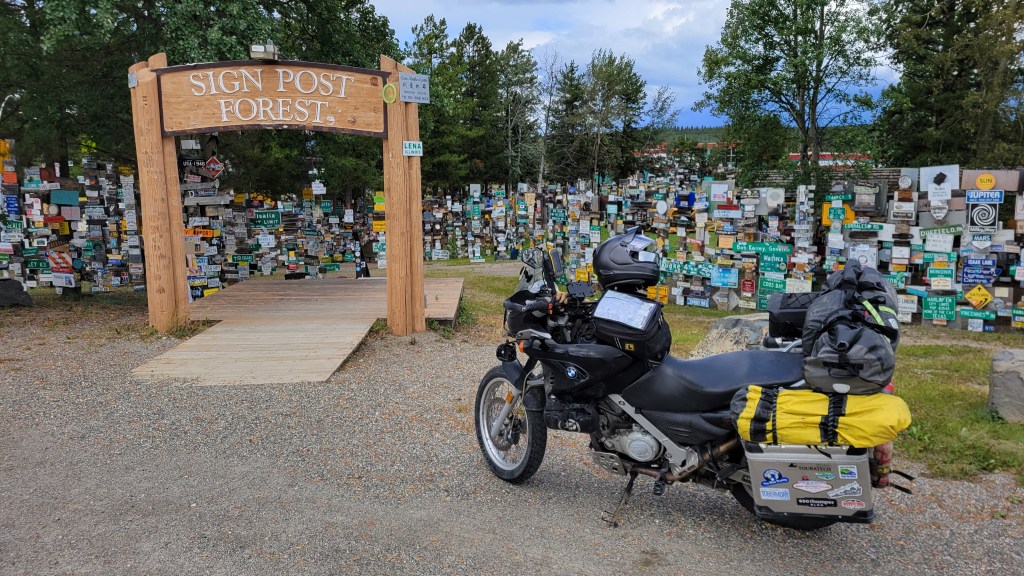
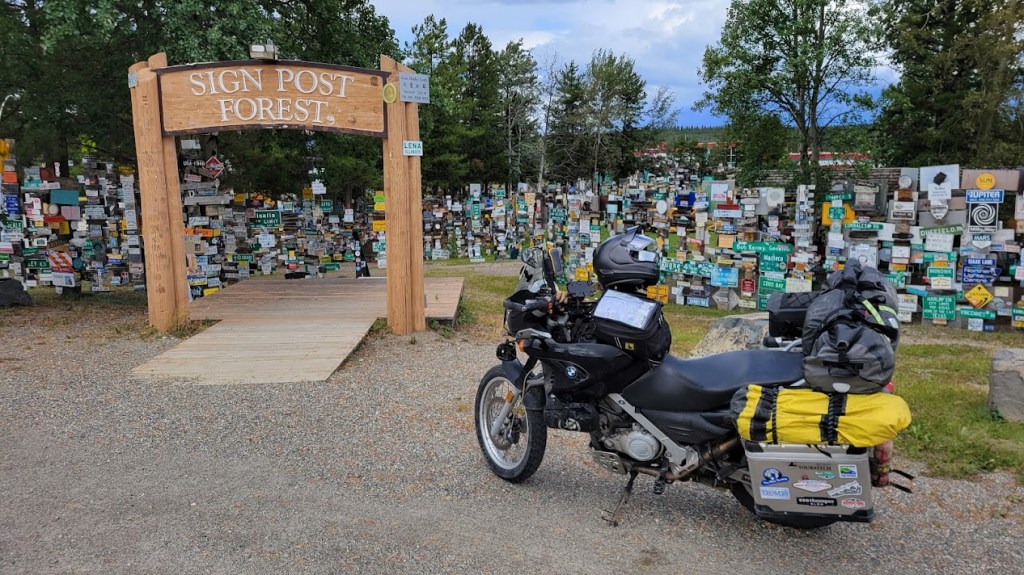
My first night was at the famous Liard Hotsprings Provincial Park, just outside of Yukon in northern BC on Highway 97, the Alaska Highway. I retraced my ride on the 1 back to Upper Liard, but instead of turning right and heading south down the 37 (Stewart-Cassiar Highway), as I had come up, I continued south-east to Watson Lake. My first rest stop was at Sign Post Forest.

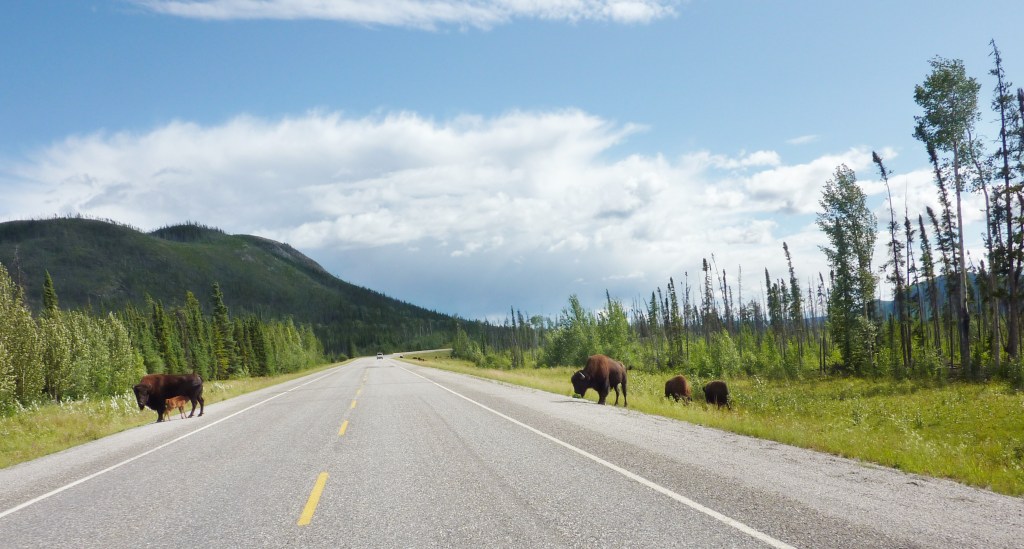
A quick peanut butter sandwich lunch and I was on my way again. Somewhere along the 97, heading into Liard, I encountered Bison on the road. I’d heard they are unpredictable and will charge a motorcycle, so I waited until the road was reasonably clear, then slowly passed, one hand on the throttle, one snapping photos.

I was especially nervous about passing this cow (left) while her calf was suckling.

I also came upon sections of burnt-out forest. All summer we had been dodging forest fires. Now I was seeing close-up the after-effects of one.

Looks like fire came through here a few years ago, based on the new growth.

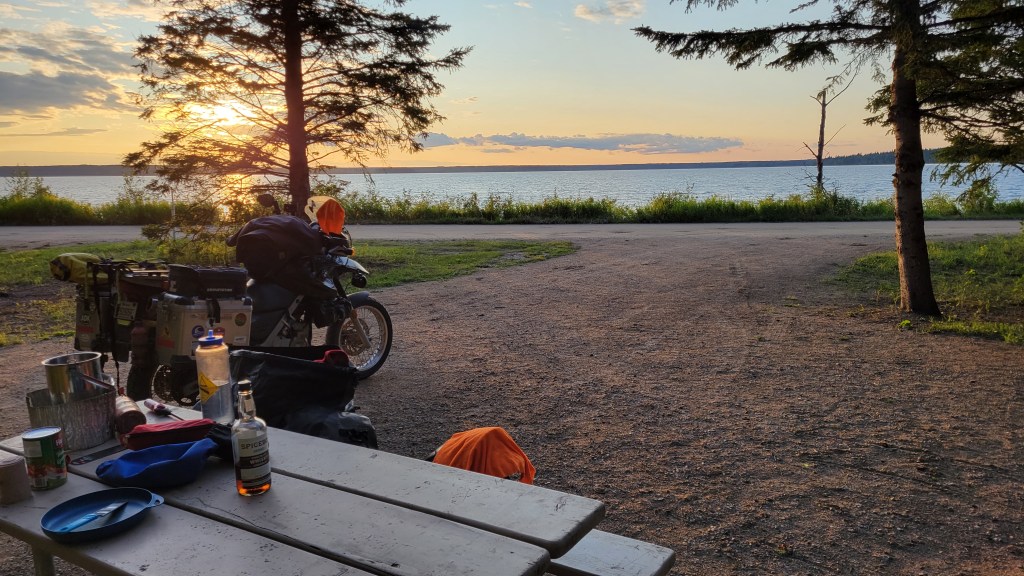
I’d been told you have to make reservations at the campground—it’s that popular—but I took my chances on a weekday and got lucky; there were lots of spots left. I pulled in late afternoon, pitched my tent, and headed to the hot springs.

There, I met a couple of other ADV riders, so we naturally struck up a conversation about our travels. When I mentioned a few details about my trip, one of them said, “Oh you’re that guy with the blog.” That was a bit of a surprise. I’ve been writing and publishing poetry for over 30 years but have never been recognized for my writing outside of a literary context, so it was an unusual experience. Hmm . . . might the universe be trying to tell me something? I’m proud of my poetry collection, Invisible Sea, but I think my next book will be something more like this, related to my motorcycle adventures, targeting a more popular audience.

Mike at Liard also rides a 650GS and lives in Powell River. He had sent me in a previous post before I left some tips for BC touring, including the possibility of buying a week-long pass for BC Ferries, which might end up being cheaper than buying tickets for individual crossings. Thanks, Mike. I hope to catch up with you later when I retire to BC. Perhaps we will do some touring together one day.

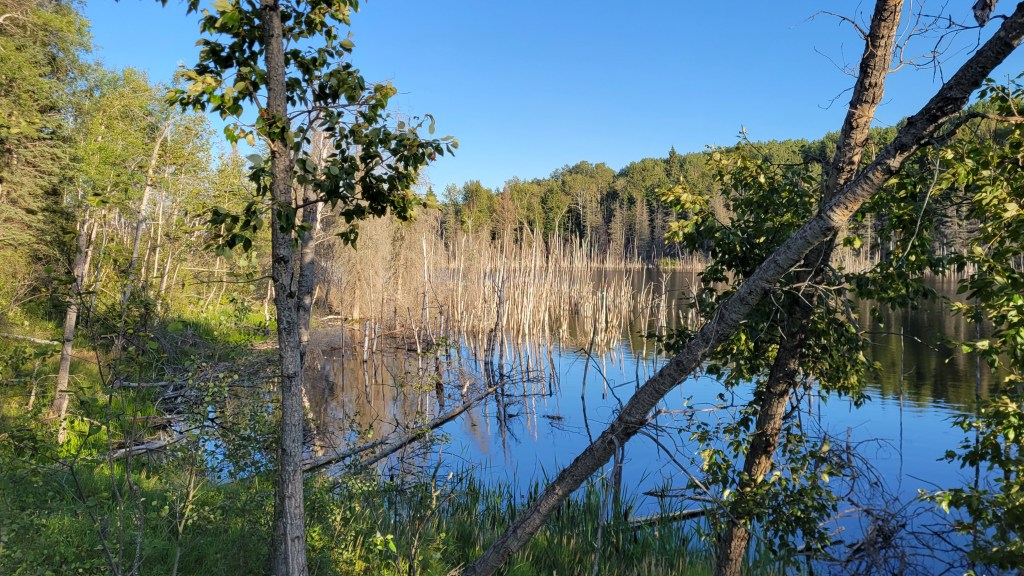
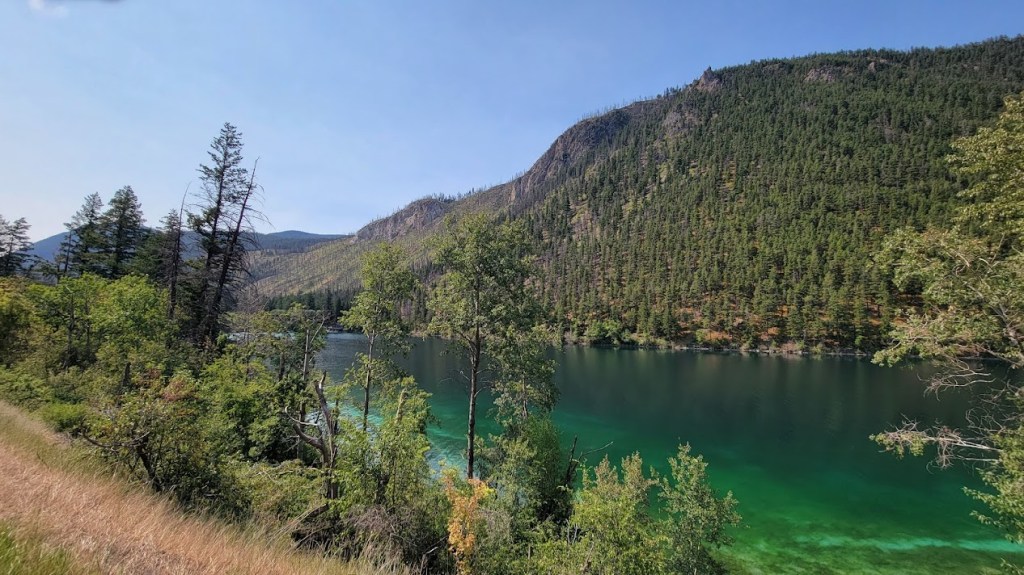
Muncho Lake

The next day was some great riding through the mountains of Northern BC, including passing Muncho Lake. At one point, I passed a couple of motorcyclists stopped at the side of the road, so I naturally pulled a U-turn to see if they needed any help. I recognized one of them from the hot springs the day before. They had a little problem but nothing serious and would soon be on their way. As I left, I pulled another U-turn to return southward. I had the entire lane to do it and knew I could without crossing into the oncoming lane, so foolishly didn’t even check over my shoulder to see if there were any vehicles coming behind me. I also had my ear-plugs in, so the 18-wheeler barrelling down on me was a bit of a surprise and for a moment I lost my nerve and almost dropped the bike, saved by a couple of heavy dabs. The poor truck driver must have crapped his pants as he swerved onto the shoulder. I looked back at my friends and one dropped his jaw. Yeah, it was close. A momentary lapse of judgment is all it takes. In the entire 20,000K of the tour, this was the closest I came to an accident.

I also experienced in Northern BC the third and final rain shower of the six-week tour, it was that hot and dry all summer. I did “only” 616 kilometres that day and found a spot for the night at Inga Lake Provincial Park. There I met Jeremy and Samoyed, Rory, travelling in a converted camper van. Like Mountain Man Mike I had met in Yukon, travelling by converted van or truck seems to be a very popular choice these days. Gas is cheaper than with a full RV, it’s easier to get around, and most have a small kitchenette and bed. Walter and I ended up sharing a drink and watching the meteor shower together that night.

The next day was the big push into Edmonton. My friends at Liard had tipped me off that hotels are super cheap in Edmonton for some reason, so I indulged myself.

The next day I did 651K into Prince Albert National Park. I was trying to hit all or most of the national parks en route. I followed my GPS that took me the back way in (see title image above), which was more interesting but got me there later than I would have liked and campsites were scarce. In fact, I rode through the park to a couple of the campgrounds before doubling back and finding a single spot right on the water.

The site showed that it was occupied for another few days, but before I rode off, a neighbouring camper kindly came over to say that I’d be fine. Apparently, there seemed to have been a domestic dispute and the family packed up early, not bothering to remove the reservation from their site. My guardian angel had done the deed, of course, and I felt a little guilty to be profiting from an argument. How anyone can be at conflict in such a beautiful location is hard to imagine, but then again, they say a good test of marital compatibility is to go camping.

The next day was another 700K and another national park, this time Riding Mountain National Park in Manitoba. Where Prince Albert is remote and beautiful, Riding Mountain is a camping suburb. There are 427 available campsites at RMNP, and reservations are highly recommended during peak season, which it was. I think 425 were already taken when I got there, and I found myself tucked into a tiny site at the far end of the campground. I guess the park serves the generally landlocked residents of eastern Manitoba and Winnipeg and provides a summer playground for the kids, but it’s too big. It was good for a night’s rest but I wouldn’t want to vacation there. The next day I rode down to the beach just to check it out, and along Wasagaming Drive in search of a coffee. It felt very touristy, with fake indigenous trinkets, souvenir T-shirts, and plastic sunglasses. It didn’t feel like a national park, or any park, for that matter, and I didn’t buy a sticker for my pannier before hitting the road.

Riding Mountain National Park

Okay, it does have a short beach, but with that many campsites and hotels in the area, I imagine it gets pretty crowded in the summer months. This was taken early morning. By afternoon, I suspect it looks more like this.

I started heading east on Highway 16 that took me through Neepawa. The name should have twigged but it didn’t until I saw a sign indicating that the former home of Canadian novelist Margaret Laurence was nearby. What an unexpected treat! I don’t do much research before touring but prefer to follow my nose, which generally serves me well. Her home is just a few blocks off the main road. If you like her novels, it’s worth a stop. Admission is a few dollars and you receive an audio tour through the house.

I knew that her novel The Stone Angel was inspired by a monument in a nearby cemetery and was directed there by the nice young man working at the house.

The Stone Angel

If you want to understand what it’s like to be inside the head of a failing old woman, read The Stone Angel by Margaret Laurence, set in the fictitious town of Manawaka, based on Neepawa. It should be required reading for students in Special Care Counselling who wish to work in elder care. I am always impressed by prose fiction that is not autobiographical. A mature writer is able to imagine characters and voice, not simply fictionalize his or her own experiences.

I pushed on, aiming for Kenora, just over the Manitoba-Ontario border. I was in such a hurry leaving Kenora westbound that I didn’t get the required photo-op with Husky the Muskie.

In truth, my only reason for stopping in Kenora was in search of food and campsite beer after another long, hot day on the bike. I arrived after the imaginatively-named The Beer Store had closed, but thankfully Lake of the Woods Brewing Company was still open and had cans for sale.

This delay meant that I arrived at Sioux Narrows Provincial Park at sundown, after the park had closed, but I had phoned ahead and reserved a site. The staff there were nice to not charge me a reservation fee and my reservation paperwork and a map of the park were waiting for me under a rock on the picnic table of my site when I arrived. The staff at this park get full marks.

I was now in Ontario and things were looking familiar again. I was retracing my ride westward from six weeks prior, including an overnight stay with extended family on Shebandowan Lake, just west of Thunder Bay. It was nice to see familiar faces again and sleep in a bed. I was getting pretty tired from all the riding and needed a good night’s sleep before the big push home.

The next day I rode my favourite highway, Highway 17, which I’ve written about for Ontario Tourism, including a stop for the other required photo-op in Wawa.

It was all business now and I pushed all the way to Sault Ste. Marie. I deliberated where to stay that night. I considered Pancake Bay Provincial Park, just west of Sault Ste. Marie, but I knew the next day was already going to be a very long day to get home. I considered pushing past the Sault but it was getting late and dark. I hate spending money on hotels but with miles to cover and being my last night, I splurged on a room at the Quality Inn there. Counter to Edmonton, though, hotels in the Sault are expensive. Perhaps it has something to do with being so close to the US border, just over the bridge (although the border was still closed due to Covid), or maybe it’s just a factor of pure supply and demand. At any rate, I paid through the nose but had a good night’s rest before the final push home.

The next day I rode further than I ever have, 1000 kilometres (968 to be exact), pulling into my driveway in the dark at around 10 o’clock after having successfully navigated the requisite construction detours and pylons welcoming you to Montreal. Thankfully, I didn’t have to function the next day, but I was back in town for my official availability at work. I’d have another full week to decompress, prepare for classes, and wrap my head around the culture shock of stepping into the classroom again. When I did, it seemed almost surreal that just a little over a week earlier I had been above the Arctic Circle.

The bike was a mess, an absolute disaster, and some of that week would be spent on a thorough cleaning and some much-needed maintenance. But I was home. I’d completed a dream over forty years old to cross Canada by motorcycle. It was the end of that dream, but the trip had firmly planted an adventure bug in my ear. I knew now that I was capable of more—the east coast, including Newfoundland and Labrador, the Trans America Trail (TAT), The Continental Divide, The Trans Canada Adventure Trail (TCAT), and more. I was sadly at the end of my tour, but in many ways, this was just a beginning.

In my next post, I’ll complete the blogs about the Epic Adventure with some general thoughts and reflections on the tour overall and make an exciting announcement.

The Sunshine Coast

We tour the Sunshine Coast from Powell River to Gibsons, then do a day trip on the Sea to Sky to Whistler before Marilyn flies back.

It’s been a busy semester so far, but I am on my March Break now so have a chance to complete our journey before the new season opens. In my last post, my wife and I crossed the Georgia Strait to Vancouver Island and spent a few days in Victoria and a few days in Tofino. Now we were heading back across the island to Comox, where we were going to catch the ferry over to Powell River. This plan was decided in Calgary in consultation with some friends who know the area better than we do. They said the ferries offer great sightseeing, motorcyclists get priority loading and are cheap, and the Sunshine Coast is lovely.

We arrived at Comox in good time but was surprised to find a single lane leading to the ticket kiosk. It was stop and go, literally, in the heat as we crept forward; the line was moving so slowly, I killed the engine and restarted a few times before we reached the kiosk. It was a bit stressful but we ended up buying our tickets with time to spare, then were directed over to the motorcycle lane where we pulled in behind a couple of grizzled ADV riders on KTMs. Yes, there’s a kind of competitiveness even among ADV riders, and their bikes, aside from being KTMs, had more mud than ours, knobbies, and soft luggage. You don’t want to stall your bike in front of them, I thought. Turns out that would not be possible because when we were signalled to board, the bike wouldn’t start.

The lithium battery was over-heating again. I guess all that idling in the heat, combined with the hot bath upon shutting off the bike once we were in position, had led to the overheating. The bikes behind me filed past, so when I turned around, I had a clear lane back for a push start. Marilyn knew the routine by now. Unfortunately, the loading area was flat and she couldn’t get me enough speed. We tried a few times, and just when I thought we would miss the ferry, a guy jumped out of his truck, and another even climbed over the high chainlink fence that separates the foot passenger area, and they helped Marilyn push. We began in 2nd gear, which is the standard practice. Several unsuccessful attempts left me crawling at the end of the lane, where I did a Hail Mary and kicked the bike into first and tried one last time. It fired!

Now I had to be careful to keep the revs up so the bike wouldn’t stall; I knew from experience that this bike doesn’t idle with a dead (or non-functioning) battery. I managed to do the U-turn, get back to the front of the lane where Marilyn remounted, gesture thanks to my helpers, then sneak onto the back of the ferry just as the ramp was lifted. It was like the James Bond movie chase scene with the lifting drawbridge, except we didn’t have to jump across any open water. Once on board, Marilyn was beside herself. A BC Ferries staff member took one look at her, doubled-over, red-faced, and gasping for air, and asked, “Are you okay?” “It’s just a hot-flash,” I replied, which didn’t earn me any points. I was red-faced too, but for different reasons.

Heading from Comox to Powell River

Now comes the big wait during the crossing when the only thing on your mind is whether the bike will start on the other side or if you’ll be the subject of more dramatic theatre there. You try not to think about it, and there’s no shortage of spectacular scenery to distract you, but your mind always pulls back to the bike sitting alone behind all the cars and trucks onboard, and the thought of pushing it up the ramp if necessary. By the time we shored an hour and half later, I’d located a glass mat (AGM) battery in stock at High Road Vancouver and planned to swap out the lithium before I headed north. Better still, it was under $100. I’d ship the lithium back to Anti-Gravity and sort out the warranty claim later.

The bike did start, thankfully, after cooling on the ferry, and the hotel where we stayed had a bar that was open with a courtyard. There was a whack of Harley riders staying there as well and yucking it up at another table, and soon all the stress from the ferry incident was washed away with Guiness.

The next day we had a short ride along the coast to Saltery Bay and another ferry crossing. There, we met our KTM friends again, and they asked what had happened to us. They hadn’t realized that our bike didn’t start. Serj and I struck up a long conversation during the crossing because they went to Tuktoyaktuk when the ice road first opened, and he had a lot of good advice for me, including not to try The Dempster on my current tires (Anakee Adventures). He said I’d be okay as long as it was dry, but if it rained, I’d be “all over the road” and would have to wait for the road to dry, which could be days. We landed before he could impart all his wisdom on the subject so we spoke on the phone later. He was really helpful, providing advice on specific routes and campgrounds up through northern BC and Yukon.

We followed them off the ferry from Earle’s Cove all the way down to Roberts Creek. Marilyn had a few rest stops in mind along the coast through that stretch but we were enjoying the ride so much that neither of us wanted to stop. The next thing we knew, we were in Roberts Creek, where we were staying for the night.

I’ve never understood the appeal of McMansions. So much house to clean, and so much stuff to manage! When I first started teaching, I used to use a short documentary in class on Voluntary Simplicity, a movement during the late 1990s and early 2000s when people were downsizing and realizing that they’d rather spend more time with family and friends and less time at work to subsidize a certain lifestyle. I think I was more interested in the concept than my students, but I hope I planted a bug in their ears.

Of all my early rental days, I was never happier than when I had what’s called here in Quebec a 1 1/2 apartment—one room plus a bathroom. I remember carrying box after box of stuff on my bicycle handlebars to the Salvation Army store as I downsized. I had a large Williamsburg faux colonial pottery mug that contained all my cutlery, no oven but just a hotplate, a kitchen table with fold-down leaves, and a wardrobe for all my clothes. I knew the precise location of every single item in my possession. Once when I loaned the apartment to some friends, they phoned me to inquire where something was. “Yeah, if you look under the sink to the right in a plastic container . . . ” Life was simple; I didn’t even have a TV then. So I get the appeal of a tiny house. My current house is not tiny but small, and my next house will be small too. As Ennis of Brokeback Mountain says, “If you got nothing, you don’t need nothing.” It was a joy to spend a night in a tiny house at Roberts Creek.

After we had settled and met our host, we walked down to the waterfront to the famous Gumboot Restaurant. I don’t know where the name comes from, but the owners clearly have a thing about getting something stuck on the bottom of your boot.

There we had a lovely vegetarian dinner in the garden, tempered only by a loud-talker at another table who was enjoying announcing his private issues to the entire restaurant. If only they had a sign about that: “If you talk loud enough about your personal life in a public space, do strangers give a shit about your divorce?” His mom forgot to teach him about indoor voice and outdoor voice. Okay, so we were outdoors, but his poop was casting a smell over my dinner. We then wandered down to the pier and watched the magnificent full Buck Moon rise out of the UBC campus on the horizon across the Strait.

The next day we had a very short ride into Gibsons to meet some family for lunch. The ride was so short, I was getting the Jones for more, but there would be plenty more to come in the weeks ahead. Marilyn’s niece Savannah and beau happened to be there visiting Brendan’s family, so we met them at Tapworks.

The terraces in Place Jacques Cartier in Old Montreal don’t have anything on this place.

Gibsons is known as the setting of the popular show The Beachcombers, which ran from 1972 to 1990 on CBC. I was never a big fan of the show, but felt obliged to stick my head in Molly’s Reach nevertheless. I don’t remember any plot-lines of the show, but knowing CBC, it was probably about how local working class folk solve crimes the police and local authorities are unable to solve themselves. I will give it credit for being among the first to have an indigenous character on cast.

Gibsons has a charm, but if you blink you’ll miss it. After lunch we rode the three blocks, then turned around and rode it again in case we missed something. The appeal of this show is the setting, no doubt, so we spent the afternoon at the shore having one long final drink of it before we had to leave. We were coming to the end of our west coast tour and we hadn’t yet managed to make it into the ocean, so the perfect way to cap this amazing tour was to go for a swim at Georgia Beach.

The ferry crossing from Langdale to Horseshoe Bay was thankfully uneventful, but I’ll remember to my dying day exiting the ferry with the 50-odd bikes that were with us. There were a lot of Harleys and the noise was deafening as we rode through the belly of the boat and up the ramp and though the network of terminal tunnels to Highway 1, which turns into 99. It felt like the first lap of MotoGP.

We had one final day left before Marilyn had to fly back to Montreal and decided to spend it riding the Sea to Sky Highway to Whistler with Savannah on her Honda 400. As far as motorcycle roads go, the 99 out of North Vancouver is about as good as it gets. Marilyn had bonded with the bike and motorcycle touring. It was the start of more adventures to come, but now I had to get used to riding solo again for the remaining three weeks. I loved having Marilyn riding pillion, but it seemed like the pinnacle of the tour—at least in terms of riding—was yet to come.

Starting Out

The most difficult part of any trip is leaving.

Imagine a trip across Canada by motorcycle. Imagine the problems you could face: dangerous wildlife, inclement weather, mechanical problems, security issues, fatigue . . . I faced all of these, but I can honestly say that the hardest part of the entire trip was leaving. Specifically, the biggest challenge came the weekend before my departure.

I had decided to change my clutch plates and water pump. The plates were the originals, with over 100,000K on them, and the water pump, which on my bike fails every 40,000-60,000K, had about 35,000 on it, so I didn’t want to risk it. I ordered all the parts at the beginning of June. I didn’t expect them to be in stock—they rarely are for my old bike—but two weeks to ship from Germany still left me plenty of time to do the required work before my July 1st departure.

I waited . . . and waited . . . and started bugging BMW sometime around mid-June. And waited . . . Perhaps because of Covid and the resulting supply change issues, or perhaps the shipping was slower than usual, but I actually got the new clutch springs and gaskets on the Friday before my Monday departure.

My wife, Marilyn, was stressed; I, concerned. Marilyn’s flight was booked so I was committed to getting to Calgary on the 7th for our leg of the trip together. I’ve had the clutch cover off this bike a few times, and knowing how to do a job is 3/4 of the job. It’s not difficult when you know what you’re doing. Everything was going pretty smoothly, which is something because there is almost inevitably a snag, until I went to put the clutch cover back on.

This is the most difficult part of the job. You have to turn the actuator so the splines are facing backwards to engage with the splines of the rod inside the cover, then carefully maneuver the cover on without either moving the actuator, which is on a bearing, or damaging the paper gasket, which has to line up on all the tabs on the crankcase. Since it would take at least two weeks to get anything new from Germany, there was no room for error.

Note what he says at 10:19

There’s a certain amount of tapping, knocking, shoving, wiggling, rocking, and general coercion that is required to get the cover on. It was not cooperating but one final thump with the heel of my hand and it snapped into place. I was home free! Then I noticed that the actuator was loose. It was more than loose: it wobbled. It was f’d! I’d f’d the bearing and it was an uncommon one that would be difficult, if not impossible, to find in Montreal.

There’s little that can overwhelm me, but this did. It put me flat on my back, literally. I’d been working on the bike in the backyard outside the shed and I lay back on the grass and gazed up into the sky, either to admonish or to plea to whichever god was messing with me. It was one of those moments when you can’t even think of your next move. You just have to breathe for a bit and let your emotions settle. The only other time I’ve been incapacitated like this in recent memory was when I broke a bolt trying to get a starter motor out from our old car. It was in the most inaccessible place on the engine and I knew, as I thought now, that I’d be set back weeks. I thought I’d ruined the entire holiday.

I’d been thinking of this trip since my teens, preparing for it since I bought the bike in 2015, and waiting an entire year when Covid kiboshed it last summer. Now everything hinged on whether I could get the bike running again, and I had 24 hours to do it.

What could I do but take the cover off and have a look. I managed to do that without damaging the paper gasket and saw that the bearing was okay; it had just been pushed out of the casing. I took everything up to my little workshop and drove the bearing back in. It was easy, actually. It must be a pretty loose fit, perhaps for hack mechanics like me; instead of damaging the splines, which clearly hadn’t lined up, it pushes out of the casing. I was back in business but still on a tight deadline.

More wrangling and I got the cover back on, this time with the splines aligned. I attached the clutch cable but a pull of the lever indicated now another problem. There was a ton of play! The clutch was not disengaging. Had I missed a clutch plate? Bought the wrong plates, which were not OEM? Was the clutch cable rerouted incorrectly? I put out an SOS on my user forum and went to bed. I had a pretty fitful sleep that night.

In the light of morning with a cooler head, I saw that I could tighten up all that free play with the adjuster on the lever. I had to back it out a lot, but there were still enough threads holding it firm. I was surprised that there was so much difference in height between the OEM stack and the aftermarket plates. If any adjustment were needed, I was expecting it to be tighter, not looser, as the old plates were worn. At any rate, the clutch seemed to be working now, and at 9 p.m., on the night before my departure, I took the bike for a test ride. To my great relief, everything was working well. I’d done a lot of other work leading up to this job, so maybe I’m not such a hack after all.

With the bike finally ready, “all” I had to do is pack. Marilyn was trying to stay out of it but couldn’t believe that I’d left packing for a six-week trip to the last minute. Fortunately, I’ve done this several times and pretty much know what I’m taking and how it all goes on the bike. The only snag was when I went to pack my top bag. I’d wanted to take my Mosko Scout 25L Duffle Bag but quickly discovered that my sleeping bag takes up about 1/2 of it, so I’d have to use my big Firstgear Torrent 70L Duffle. Damn! It extends out over my panniers and partially blocks me from opening them with the bag on. I think either a smaller down-filled sleeping bag or a midsize duffle or both is on my Christmas wish list this year. In the end, the only things I forgot were a wool toque and my down vest, which Marilyn was able to bring on the plane with her.

Final adjustments

It was a late night to bed and a late start in the morning, but at around noon, my wife and son met me on the driveway to see me off. As the bike was warming up, I cranked up the preload on my rear shock and tightened a few straps. I took out my pocket digital recorder and noted the mileage on the odometer. After final hugs and photos, I pulled out of the driveway and was off. The dream was becoming a reality.

If you want to follow along, click the Follow button.

The Epic Adventure: a preview

20,000 kilometres by motorcycle from Montreal to the Pacific Ocean, up to Yukon Territory, and back.

I’ve been home now for almost a month and I’m still feeling unsettled. Part of me is still in Dawson City, lying in my hammock next to the Yukon River. Part of me is still north of the Arctic Circle, washing my cookware in the Rocky River, just south of the Northwest Territories. Part of me is still in Northern British Columbia, lying in my tent at night listening to wolves howling in the distance.

My right thumb still has a slight tingle from some sort of neurological damage from the vibrations over thousands of kilometres, although I used my Kaoko throttle lock as much as possible. The bike hasn’t gone anywhere since I pulled into the driveway mid-August after riding 1,000 kilometres on the final day from Sault-Ste Marie to get home. After 19,500 kilometres, some of that in dirt up The Dempster Highway, it was a mess and in need of a lot of service and a thorough cleaning. Although I had the correct amount of oil in the bike, the heat and hours of riding at high-revs led to oil ending up in the airbox and, ultimately, down the side of the bike where it baked onto the engine. I’ve also changed the oil pressure switch that was acting up and changed the rear tire that was finished. But the big obstacle has been a frayed wire leading to an ignition coil that has left me waiting for OEM parts to arrive from Germany.

In the coming months, I’ll be writing about these memories and more. Here is a visual preview of what’s to come. If you want to follow along, click the Follow button and you’ll be notified of new posts. Join me as I relive this bucket-list tour across Canada and up into the Far North.