The Wish List, 2023

I interrupt the journey across Newfoundland for the annual holiday wish list.

It’s become a tradition on this blog—the annual Christmas wish list. It’s probably one of the least favourite posts of the year for readers, but it sure is fun to write. The season has recently come to an end, the long winter months still lay ahead, and all we have to propel us out of bed in the mornings are thoughts of spring and planned journeys. And part of that planning is dreaming of the mods we will do and the gear we will buy to help prepare for the adventures to come.

This year’s list is pretty short. Yes, inflation is hurting everyone, and we find ourselves buying the cheap tomatoes instead of the fancy vine ones (and regretting it later). Marilyn is paying tribute to her late father by scanning the grocery store flyers and clipping coupons. Even the dog has sacrificed his Greenies (and his breath is the price we all have to pay).

But honestly, the bike is pretty much done. It’s got the auxiliary lights on it now, the crash protection, skid plate, pannier racks, hand guards, off-road pegs, and tail rack. I got soft panniers last year and they have been great. So it’s pretty modded out. What the bike needed most was some maintenance, so I spent a chunk of time before I put it into storage doing the valves and servicing the starter motor, which was acting up. By the way, I’m now advocating checking your valves on the recommended service interval. I waited until the bike had 45,000K and all my exhaust valves were tight, some significantly.

Shorty Levers

The only thing it could use are some new levers. The stock levers are okay, but they are long and I’ve already bent the brake lever once. Actually twice, since I bent it back. I think I’m the only one in my club who rides two-fingered and I asked myself the other day why on earth haven’t I ever had shorty levers?

I looked at all the options and am undecided between Vortex and Pazzo. Both are top-quality levers that fit well without any slop, which is often the case with cheap Chinese aftermarket levers. At about $200, they are comparable in price.

Vortex V3 levers

The Pazzo levers have quite a swooped design to them, which brings the lever down close to the grip. I know there’s some adjustment but this still makes me nervous because I like to have a short clutch that completely disengages before the lever hits my knuckles of the remaining fingers wrapped around the hand grip. For this reason, I’m leaning towards the Vortex design. Is it just perception, or do they look straighter? My ideal lever would be a Pro Taper, but I don’t think they make one for the Tiger.

Pazzo also gives the option of a folding lever, but I don’t think I need that since I have the Barkbuster guards. It would have to be a very unfortunate fall for a rock to come up inside the guard and break a shorty lever. But I guess it could happen. My sense, however, is that folding levers are for true dirt bikes that have wimpy, folding hand guards. If you have any experience or thoughts on this, drop a comment below. I won’t be getting anything until the spring so I have some time to decide.

A new helmet

Honestly, that’s about it for the bike (my wife will be happy to know). But wait! My current lid is at least five years old, so I probably should get a new one soon, despite what Bret Tkacs has recently said about that 5-year limit being bogus. If I were forced to, I’d probably go with the Arai Tour-X5 or maybe find a deal on the now discontinued X4.

No, I’m not trying to emulate Itchy Boots. This would go well with my touring jacket that is grey with matching hi-viz accents.

I’ve been very happy with my Arai Signet-Q helmet. The brand speaks for itself and the shape fits my intermediate- to long-oval noggin well. This time, however, I’d go with the Tour X because I want a peak. There have been many times while riding into the sun when I wanted a peak. Sometimes I have to shade my eyes with my clutch hand, it can get that bad, even with the Pro Shade system.

Knee braces

To be honest, I’ll probably forego the helmet for another big-ticket item. I plan to do some pretty serious dirt riding next year, and the only thing that scares me about that is the potential to damage a knee if the bike falls on one. I’ve somehow managed to play 15 years of beer league soccer without any major damage to a knee, and I’d like to keep it that way so I can enjoy my retirement with full mobility. I therefore am adding to my wish list a pair of Pod knee braces.

Anyone who is serious about dirt riding should be wearing knee braces. I know, they are uncomfortable, but so is tearing tendons and surgery. I’ve heard The Awesome Players advocate the use of braces, and recently a video by Riemann convinced me I should just bite the bullet on a pair.

At $750 a set, these babies aren’t cheap, but money well spent if it prevents a serious knee injury, especially if you are riding solo as I do.

Dirt Gloves

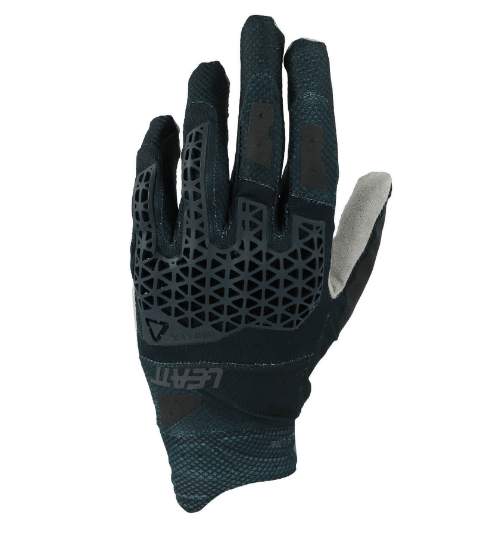
There’s one more piece of off-road gear I’d like before attempting the BDRs next summer. That’s a pair of light MX or rally gloves. I have a pair but Marilyn has appropriated them, so I’m in the market for another pair. When riding dirt, it’s important to have maximum feel on the levers so you can modulate both clutch and brake. It’s similar to how football (i.e. soccer) players are always looking for a boot that provides the most feel on the ball, for example one with kangaroo leather instead of cow hide.

That might be something like the Leatt Moto 4.5, a popular choice or, going even lighter, the 100 Percent Airmatic.
DOUBLETrak Multitool

Finally, what wish list would be complete without a tool of some kind on it? I came across a great little multitool in a video by Chris Birch on his favourite tools.
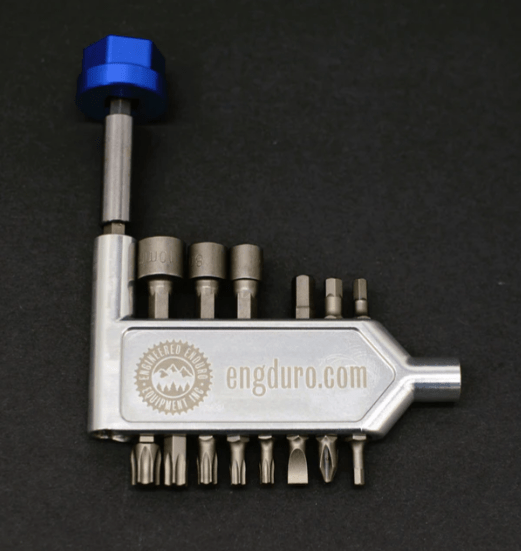
The DOUBLETrak multitool by engduro here in Canada consists of several hex, torx, Phillips, and flat head drivers, and 6, 8, and 10mm socket drives that fit into the handle itself and stay there by magnetic force until needed. There’s also a 1/4″ hex to 1/4″ square drive adapter. If you want a comprehensive review of this tool, check out this video in which Dude does an oil change using only the DOUBLETrak. Okay, I’m not going to be doing trailside oil changes, and this will not replace tools that are in my tool roll, as he suggests, but it’s a convenient tool to keep at hand for small adjustments or tightening something on your or someone else’s bike. Best of all, for a few dollars more, you can get a vanity engraving on it and tell yourself it’s to prevent theft.

That’s it. Like I said, a small list this year. That’s okay because we’re still paying off expenses from the Newfoundland trip last summer and I’ve got more ambitious plans for next summer. This time it will involve dirt and I’m both a little nervous and excited about taking the Tiger off road . . . like, really off road, not just gravel and dirt roads but trails and Class 4 roads, water crossings, mud, sand, rocky hill climbs . . . the works. It’s known as primarily a street bike that is capable of doing “light off-roading,” so I’ll be pushing it beyond its intended limits as I do the MABDR and NEBDR back to back. I’ll either die or bond with this bike in ways I haven’t yet.

What are your plans for next season? I’d love to hear them because the best wishing is not the accessories or gear we want to buy but the places we’d like to visit on our bikes, or even the roads we want to ride. We can’t all be Itchy Boots, but we can explore a little piece of paradise close to home, whatever your paradise might be. I wish you happy holidays, and happy dreaming of another season doing what makes our souls sing.

Let’s Talk About Gear

The first in a series of posts on my riding gear. In this one, I discuss my touring gear.

I’ve had a few queries about the gear I use, usually from someone about to set out on a similar long tour, so I’ll devote a few blogs to the subject. This one is on what I wear when touring. In the next, I’ll talk about my off-roading gear. I’ll then cover my camping gear, and round out the series on navigation apps and other equipment I carry on the bike.

Let’s move from head to toe.

Helmet

The first time I bought a helmet, I had no idea what I was doing so relied on the salesperson. Unfortunately, she put me in the wrong helmet. She would put a helmet on me, wriggle it from side to side, say “Too big,” then put on a smaller one. Eventually she had me in an XS which, yeah, fit side to side, but within half an hour at my first class had created a pressure point that felt like a nail was slowly being driven down though the crown of my skull.

I’m surprised that head shape is not emphasized more than it is. It’s the starting point of finding the right helmet, but rarely talked about in reviews or explicitly mentioned in product descriptions. I have a long-oval-shaped head, so after a little research, I bought an Arai Signet-X as my touring helmet. I know there are cheaper helmets, but when one’s brains are at stake, I don’t mind paying a little more. I need all of what’s left of mine. The Arai brand speaks for itself, but I like that the helmet is Snell rated and comes with a Pinlock visor; I’ve never had any issues with fogging. I replaced the original visor before my big tour with the pro-shade visor, which is great, but I still find myself shading my eyes with my hand when riding directly into low sun. My next helmet will probably be an ADV helmet with a peak like the Aria X4. I know the peak will create wind noise but I suspect it’s worth it for the speeds I usually do.

Arai Signet-X

Helmets are extremely personal, so the only advice I can provide is to get one that feels right for you. Just bear in mind that, according to The Hurt Report, 1/5 of all impacts on a helmet in an accident are on the chin. And if you don’t know if you are a round, intermediate oval, or long oval, ask someone to take a photo of the top of your head. It will narrow your search and potentially save you a mistake like mine.

Neck Brace

A lot of people, even motorcyclists, ask me what that thing is around my neck. The neck brace was designed by Dr. Chris Leatt after he saw one too many riders die or become paralyzed from the neck down. There is a great interview with him on Adventure Rider Radio, if you’re interested in the origins. Otherwise, all you need to do is look at this independent study to be convinced that neck braces make a significant difference in preventing cervical spine injury and even death. It does that by stopping your helmet from rotating beyond what your neck can withstand and by transferring those forces down through your skeletal structure. Once I have it on (and properly fitted), I forget that I’m wearing it; it doesn’t obstruct my head movements at all, such as when I check my blind spot.

What about an air vest, you ask? Doesn’t it do the same? Well, yes and no. According to Dr. Leatt, there is a difference in safety, and I’m not going to try to explain it but will refer you again to the ARR episode in which they cover this subject, also speaking to the head of safety at the Dakar Rally, which recently switched from mandatory neck braces to air vests. (Incidentally, many riders were not happy with the switch.) I’m not going to advocate against air vests. I think if you are wearing either a brace or a vest, you’re ahead of the crowd. I personally decided against a vest because it’s another layer in the heat. And do they all have to be the same colour as piss after you’ve taken your Vitamin B complex?! Let’s have some air vests that look a little more cool, please.

Leatt STX neck brace

I bought the Leatt STX; the wider scapula wings do not conflict with back armour or an aero hump if you’re rockin’ full leathers on track days. Yeah, neck braces are pricey. There’s a lot of R&D that goes into them and I guess they are still a niche market, but like most of my gear, I bought it significantly reduced (like 50% off) once the particular model became discontinued. I now make it part of my everyday gear, even when commuting to work. I’d hate to have some bad luck on the day I leave it sitting at home.

Upper body

After some trial and error, I decided to go with a layering system when touring. For one, I didn’t have $1,500 for a Klim Badlands Pro jacket, and two, it weighs a ton. At first I bought a Klim Traverse jacket and tried that. It’s Gore-Tex, which is great because you don’t have to watch the skies but can ride through rain or shine uninterrupted. But Gore-Tex is hot! Yes, it wicks sweat, but it doesn’t allow much air flow. I was imagining the stifling-hot days of midsummer and decided to buy the best mesh jacket money can buy, and in my opinion, that is the Klim Marrakesh.

Klim Marrakesh

I have to admit, the Marrakesh is nothing to look at. Plain Jane. For some, that might be part of its appeal. Who wants to look like a Transformer character in an action animation? But put one on, and you will not want to wear another jacket again. It is my most comfortable riding jacket. Perhaps it’s my most comfortable jacket, period. That’s because the Marrakesh is all about the fabric: a 1000 denier 4-way-stretch mesh that breathes, stretches, and protects. Just a little hi-viz is all that is needed, and it has D30 armour in shoulders, elbows, and back. Okay, the armour is Level 1, not 2, but I decided to sacrifice a little on safety for the sake of comfort, with the compromise of upgrading the back protector to Level 2. I was very happy that I went with this jacket when I got into the midsummer heat that followed me all the way up to Dawson City.

Okay, it’s not waterproof, so I had to carry a rain outer layer in my tank bag. (Klim says the material is “hydrophobic,” which does not mean afraid of the water but water repellent.) There are plenty of good light rain jackets to choose from and they will all do the trick fairly inexpensively. I bought the Scott Ergonomic Pro DP Rain Jacket. This outer layer was helpful not just in the rain, of which I didn’t get much, but also when I just wanted something to break the wind.

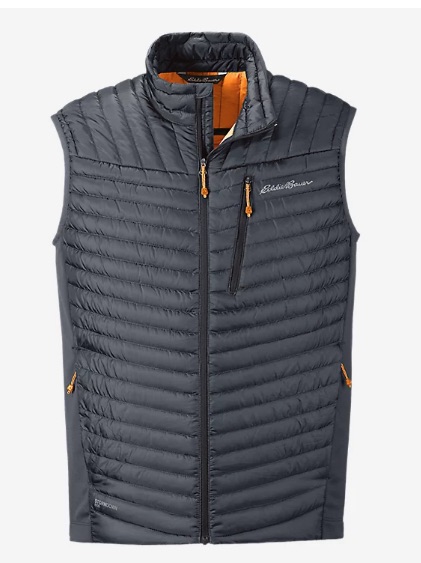
Underneath, I had either a light athletic shirt if it was hot, or a merino wool base layer if it wasn’t. I also kept in my tank bag, or somewhere quick at hand, a good quality (800 fill) down vest. It saved me many times on and off the bike. It packs down into the breast zippered pocket to about the size of a mini football (remember those?) and did just the trick when I needed a little something under the jacket in addition to the merino wool base layer or around camp when the sun went down. Doing without the sleeves meant it packed down smaller, and if you keep the main organs warm, the extremities will be too. The Microtherm 2.0 down vest from Eddie Bauer has become my favourite piece of touring gear.

I had one more layer, if needed—a good quality polar fleece jacket. This also doubled as my pillow at night when folded or rolled. So between the different base layers, the fleece, the vest, and the wind/rain breaker, I had lots of options for the varying conditions; I could ride from single digits to 35C, rain or shine.

Lower Body

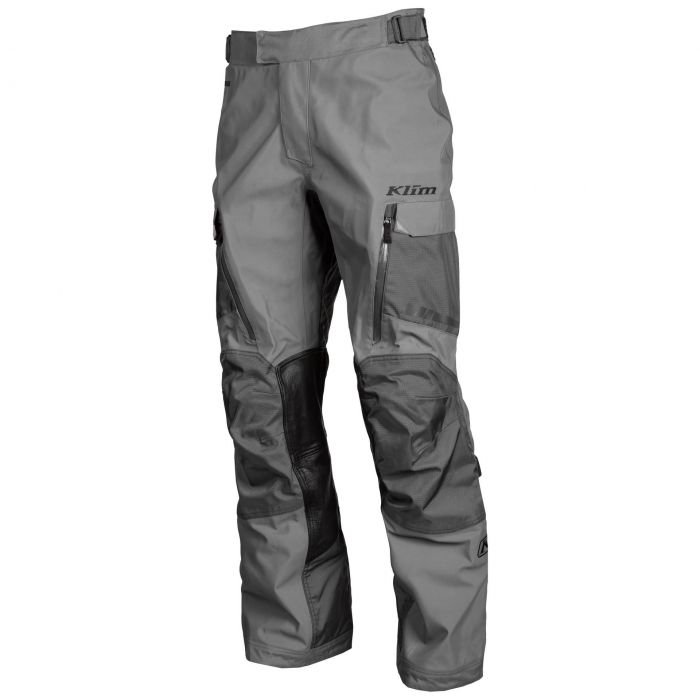
I decided to go with Klim Carlsbad pants, which are Gore-Tex, but you don’t get much airflow over the legs anyway, and who enjoys pulling on rain paints by the side of the road? It’s one thing to pull on a rain jacket and another to remove boots or deal with zippers halfway up your legs. The Carlsbad pants do have some decent venting, so when my nether regions feel a little hot, I just stand up on the bike for a few seconds to air them out, so to speak.

Klim Carlsbad pants

One of the reasons I like Klim is that the Gore-Tex is in the outer layer. With other brands, it may be an inner layer, so you may stay dry, but the clothing still gets soaked and, aside from being heavy, may take days to dry out completely. I also like the D30 armor (Level 2) in knees and hips (removable so you can wash the pants periodically), and the little Level 1 tail-bone protector.

Underneath, I wear soccer shorts with a mesh liner. They double as swimming trunks (to borrow vocabulary from my dad’s era), dry quickly, and, ah hem, provide some freedom for the boys. I never needed anything else, but I have worn thermal underwear (i.e. long johns) in early spring and late fall riding here in Canada.

So layering on top, vented Gore-Tex below. It was a good combination that worked for me.

I should add that I’m not sponsored by Klim (I wish!). I just find they make the best gear, and motorcycling is so important to me that I’m willing to pay a premium for their gear. But as I’ve said above, I never buy full price. I spend part of the off season researching and window shopping, and when the item I want goes on clearance, I pounce.

Boots

Like the pants, I went with Gore-Tex boots that I could ride in rain or shine. No dorky-looking overboots, no plastic bags inside the boots, no waterproof socks—just a really good pair of Gore-Tex adventure boots. For me, that is the SIDI Adventure 2 boots. These are amazing, and not just because they look so cool! (When I first showed them to my son, he said, “Dad, these are Batman boots.”)

SIDI Adventure 2 Gore-Tex Boots

Adventure riding is all about compromises, and a good quality adventure boot like these offers a balance of protection and comfort. I’ve had the bike come down on my foot in an off-roading off and literally walked away from it, and I’ve climbed mountains and walked for miles around town in relative comfort because they are hinged. I know some will say only a motocross boot provides adequate protection, but for touring, you need something you can walk in. You also need something with a good tread in case you have to push your bike out of mud. The buckle system of SIDI boots is unparalleled in the industry. If you have a particularly wide foot, you might want to look at the Alpinestar ADV boots; I know Lyndon Poskitt recently switched from SIDI to Alpinestar Toucans because he found his feet were a little cramped in the SIDIs. Like the helmet, boots are all about fitment, so not gear to buy online.

The SIDI Adventure 2’s are a premium item but will probably be the first and last pair I’ll ever buy; you can get the sole on these replaced by your local cobbler when they wear out.

Socks

While we are down here, let’s quickly talk about socks. I wore one pair pretty much the entire tour. They are actually not motorcycle gear, per se, but athletic compression socks from The Running Room here in Canada. Compression helps with blood circulation over those long days, and the height (over the calf) prevents chafing at the top of the boot. They are also anti-bacterial and wicking. There’s no point in wearing a Gore-Tex boot over a nylon sock.

For cold or wet weather, I have a pair of Pearly’s Knee-High Possum Socks. Possum, you ask? Yes, Pearly’s has managed to turn road-kill into a business. Each strand of possum fur apparently is hollow inside, creating a dead-air space that is unmatched for insulation and warmth with the exception of caribou hide, which shares the same property. If that were not enough, Pearly’s has woven it with merino wool, resulting in a wool that is pretty special. They are also a premium item and it took me a few years to pull the trigger on these babies, but there’s nothing more comfortable or warm for cold-weather riding.

Gloves

Finally, let’s move to the other extremity. It may surprise you, but I went minimalist with my gloves: only one pair for the entire tour. If a pair of deerskin gloves is good enough for Pirsig, who writes about them in Zen and the Art of Motorcycle Maintenance, they’re good enough for me. I have a pair of BMW Gore-Tex insulated gauntlet gloves for cold weather riding, and a short pair of Five Stunt gloves for summer riding, but for the Epic Adventure Tour, I took only a pair of Aerostitch Touchscreen Elkskin Ropers.

Aerostitch Elkskin Ropers

Why? Mostly for comfort. Like the Marrakesh jacket, once you put these on, you will know why. They are super soft and super comfortable, yet provide sufficient abrasion protection in an off. I have heated grips so rarely need an insulated glove, especially for summer touring, and Elkskin, unlike cowhide, can get wet without drying hard. In fact, on a hot day, if you wet them and wear them riding, they will shrink as they dry and mold to the shape of your hands on the grips. Neat.

Aerostitch do a good job with these gloves, still handmade in The USA. There’s touchscreen thread sewn into the thumb and fingertips of the first two fingers, and a visor squeegie on the thumb. They may feel a little bulky compared to the thin leather of other gloves, but the dexterity they provide is adequate for touring, and I suspect they will last for years and years. In fact, like wine and some women, they are one of those items that gets better with age.

Conclusion

Adventure touring requires that you be ready for all kinds of weather yet minimalist because you’ve only got so much room on the bike. This is what has worked for me. What are your preferences? Did I miss something? Let me know in a comment below what your favourite piece of touring gear is and why. I’m always ready to learn, and we Canadians need something to keep us occupied during the long off season.