Let’s Talk About BPH

Breaking the seal on a taboo topic.

There’s a great line in the movie The Bucket List, the 2007 film directed by Rob Reiner and starring Jack Nicholson and Morgan Freeman: “Three things to remember when you get older: never pass up a bathroom, never waste a hard-on, and never trust a fart.” Don’t worry, it’s the first one I’m going to discuss today.

I’ve found BPH to be kind of a taboo subject for men, and I was hesitant to write about it too. I think that’s because of a misconception that having BPH is a symptom of loss of virility, but it’s not. Let’s get that out of the way early. Maybe BPH is taboo also because it’s a sign of aging, and who likes to acknowledge that? Signs of BPH usually begin to appear in the 40’s. One easy statistic to remember is that 50% of 50-year-old men and up to 80% of 80-year-old men have it. It’s very common, so let’s start to normalize talk about it.

What is BPH?

Johns Hopkins Medicine defines BPH, or benign prostatic hyperplasia, as “a noncancerous enlargement of the prostate gland,” and says “it’s the most common benign tumour found in men.” Yikes! “Tumour” and even “noncancerous” in the same sentence sounds scary, so we’ll just describe it as an enlargement of the prostate. In fact, I’ve heard the “H” interpreted also as “hardening,” which is even less scary, especially at an age when we generally want things to be hard. I’m not a doctor and I’m not going to give medical advice, but I’ll talk a little about how this relates to motorcycling as I see it and what I’ve discovered so far that might help to minimize symptoms and not prevent you from riding.

BPH and motorcycling

I know riders, both men and women, who were wary about riding during those Covid years because of the lack of available bathrooms. Well, having BPH is kind of like having a chronic shortage of bathrooms and is something you have to manage while touring. If you are a guy and an adventure rider who spends a lot of time in rural areas and wilderness, there’s thankfully no shortage of available bathrooms, so to speak. It’s here that I will gladly recognize male privilege.

But I don’t really like urinating in public. Call me conservative, or old-fashioned, or a prude, but I find it a bit vulgar, so I always prefer to find a bathroom if I can. I don’t like urinating at the side of the road, or behind buildings, or really anywhere I might be seen. But here’s the first thing I’ve learned about BPH, or at least my experience of BPH as it relates to motorcycling: I don’t usually have the need to go while riding. I used to think this had something to do with vibration, either from the engine of the big thumper or the knobbies on the road—that it numbed a nerve or something—because I’d be fine for hours and hours as long as I was riding. The easy solution, then, seemed simply to keep riding.

But alas, eventually we have to stop for gas, and then I found I could barely get one tank full before I had to empty another. It got to a point where it was very predicable, so predictable that I came up with that theory about the vibration. I no longer think that, or I think there’s more to it than physiology, strictly speaking.

You know how you often need to go to the bathroom as soon as you get home from somewhere. You don’t even have to be motorcycling but running errands in the car, for example, or commuting home from work, or whatever. You get in the door and suddenly you are busting! That’s because your body—your bladder, to be specific—knows there is a bathroom near, so essentially sets off the alarm, telling your brain, “Okay, Joe, there’s a bathroom in the vicinity.” Or maybe it’s the brain telling the bladder; that would make more sense. I don’t know what kind of communication happens between the bladder and the brain or what language they’re speaking but I’m positing that there’s a psychological or at least a neurological component to how the system works.

Like a boss

This is important because it relates to the second thing I’ve learned about BPH, and my first suggestion on how you can minimize symptoms. You can train your bladder. Yes, like a dog. Reward good behaviour and you’ll get more of it; reward bad behaviour and you’ll get more of that. Running to the bathroom is rewarding bad behaviour and training your bladder to be the boss. Soon, it’s yanking your leash, so to speak, and leading you around. (Okay, I’ll drop that metaphor now.) Instead, my doctor reiterated what I’d heard online from Dr. Rena Malik, urologist and pelvic surgeon. You don’t want to get to the situation where everywhere you go you are urgently locating the bathrooms. Before you get to that state, he said, whenever you get the urge to go, don’t go. Wait, if you can, for the urge to go away, and it will always go away. (You need to keep this in mind during your darkest moments.) When it does, wait a few minutes longer, and then walk calmly to the bathroom. Good behaviour. Be the boss of your bladder.

By the same logic, Dr. Malik also suggests not doing “just in case” bathroom visits, or what is called “convenience voiding.” (No, that’s not a phrase to describe how Prime Minister Trudeau answers media questions; that’s called “convenience avoiding.”) I know this is counter-intuitive and counter to what your mother and grandmother and every preschool teacher says, and counter to what Edward Cole, the Jack Nicholson character, says above in his advice for the aging. Convenience voiding tells your bladder that it needs to empty before it’s full. Bad behaviour. No treats. So trust that you will be able to find one when the need arises and pass up that bathroom if you don’t need to go. You’re in it for the long game.

Kegels

Okay, so by now you’re probably thinking not only that I’m a sadist but also that you are going to have an accident. That’s a lot of waiting, or rather . . . holding. To help with this, you can do some Kegel exercises. Yes, there’s another muscle that needs to be exercised to avoid atrophying with age. I’d never heard of Kegel exercises until a few years ago, so if you haven’t either, you’re perfectly normal. A YouTube search will turn up lots to try, but here’s one that presents two good exercises to start with. You can easily find more.

They can be tricky to do properly at first, so if you’re really struggling with retention, you might want to invest in a professional pelvic physiotherapist for a few sessions to make sure you’re doing them right. You don’t want to waste your time exercising your butt muscles. 😳 It’s a bit like what I tell my students about oral presentations, since they often get up in front of the class and either read or recite instead of speak: if you’re in a singing contest, it doesn’t matter how well you dance. So spend a bit of time and possibly money to ensure you are strengthening the right muscles.

Water in, water out

Another piece of advice my doctor gave me was to try to moderate my fluid intake. I know, I know . . . we’re supposed to drink the equivalent of a small pond each day, according to The Kidney Foundation. Keep in mind that includes all liquids, like those in fruits, vegetables, coffee, tea, beer, hard liquor . . . not that anyone’s eating vegetables while riding. I definitely notice a difference in the frequency of my “rest stops” when I’m wearing my hydration knapsack as compared to when I carry a water bottle. I like to carry water on me so I don’t have to stop to drink, but the trick is to sip. Same for distance running. If you run long distances in the heat and use a hydration belt, you probably sip a bit every few kilometres rather than chug infrequently. Give your body only what it can process and you will cut down on your bathroom breaks.

Yes, it’s water in, water out, like calories. You have to regulate your water intake according to conditions, so if it’s hot and dry, you will be losing a lot of water in sweat and evaporation as air rushes through your mesh jacket, and if it’s cool or humid, less so. The last time I changed my roof, I worked beside the roofer. I was stripping old shingles; he was laying new ones. At one point, he needed the washroom but it was occupied. I was apologetic and suggested he could use our half bathroom upstairs but he said, “It’s okay, I’ll just sweat it out.” He had 30 years of experience managing his fluids.

Avoid Irritants

You know that line in the famous poem Desiderata about what to avoid?

“Avoid loud and aggressive persons; they are vexatious to the spirit.”

Well there are other irritants that should be avoided. Coffee, tea, alcohol. Yeah, this is one where the cure is worse than the disease, and I’ll be damned before I give up any of those. But again, perhaps moderation is the key, or at least knowingly drink these things with the price in mind. They are vexatious to your bladder and it won’t be long before nature is calling. It reminds me of that old joke, “What’s the difference between a beer and a piss?”

“About 15 minutes.”

Final Thoughts

I recognize that I haven’t spoken at all about the other way symptoms of BPH manifest, which is restriction of flow. I’ve only discussed the opposite problem: frequency and urgency. That’s because I think the other issue is a little more complicated and one which you should discuss with your doctor. There is medication and surgery as options, and I will just add that a friend of mine had the surgery and is a big advocate of it now. It’s really helped him out, so don’t suffer unnecessarily. Of course, if you live in Quebec, you have to find a doctor first, but that’s another issue particular to La Belle Province.

I’ve just scratched the surface on this topic. There’s a ton of information available online if you are interested in exploring it further. The bottom line on this, however, as far I’m concerned, is that BPH is a completely normal aspect of aging for many men and nothing to be embarrassed about. With a little attention to it in the form of training, fluid management, and avoiding irritants, it will not stop you from enjoying your bike well into the golden years. Just think of Ted Simon riding around the world at the age of 72 and still riding at 90! (I am making no claims about Ted Simon’s health, only his accomplishments.)

Ted Simon rode around the world in 1972 and again at the age of 72. His book, Jupiter’s Travels, documenting the first trip, was the inspiration for Ewan and Charlie’s Long Way Round and, arguably, the entire adventure motorcycling industry.

And while we’re on this topic, don’t forget to get tested regularly. We aren’t talking about cancer here, but it’s never a bad time to remind ourselves and others to get checked, since early detection, as with all cancers, is crucial. I’ll be doing the Ride for Dad September 14th. Follow the link to join in your area or to help fund research.
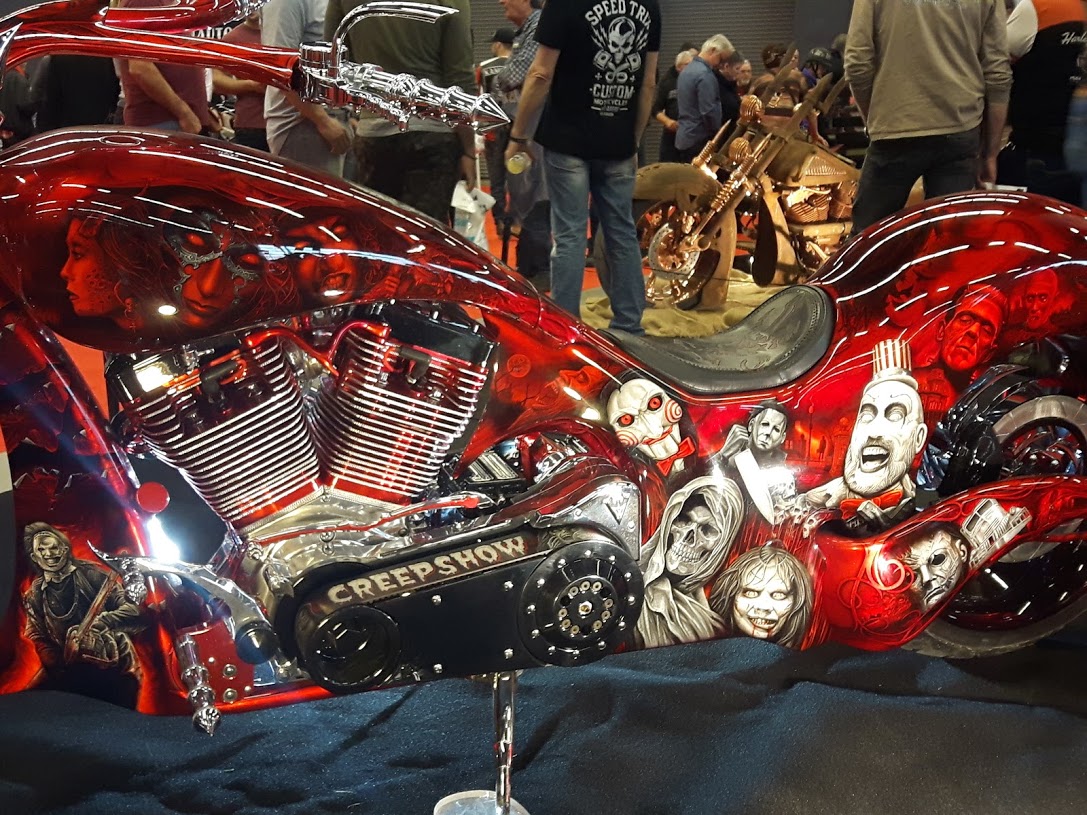
A Bike is a Body

creepshow

There comes a time in your life when you know you can no longer take your health for granted. Sometimes it’s not so much a revelation as a creeping recognition, but in my case, it was a specific moment. I was in my 40’s, in good health, when I walked to the curb to retrieve the recycling blue box. I bent over, picked it up, and bam! Back spasm that sent me to the ground.

“What the hell was that?” I wondered. A back massage helped work out the stiffness, but it would take five osteopath appointments and a regular routine of Pilates to put me back to health, so to speak. Since then, when I get away from doing the Pilates on a regular basis, like when I’m especially busy at work, I have a relapse. I’ve come to the conclusion that I’m going to have to do Pilates regularly for the rest of my life to keep my back healthy.

But it’s not just the back. I play soccer recreationally, and I have to keep training in the off season and between games to maintain my fitness and speed. As soon as I stop, even just for a few weeks, the muscles atrophy, including the most important one—the heart—and I struggle through that next run or game. At a certain point (I’m now in my 50’s), you have to do this training just to maintain what you’ve got! It’s diminishing returns with longer recovery times, but what’s the alternative? If you stop altogether, well . . . we won’t talk about that.

When we were young, we abused our bodies. We put chemicals through them, burnt the cilia from our windpipes with one puff of smoke, stayed up all night partying or studying, lay out unprotected in the direct sunlight for hours. We might have been involved in athletics, but few ever did any training. I ran a 16K road race when I was in my teens on the minimal preparation of a few runs in the weeks leading up to the race. I know someone who stayed up all night partying before a marathon. (Yes, he finished, but collapsed unconscious over his celebratory meal afterwards.)

I’m thinking of this now as I try to ramp up my training after a month or so hiatus. I’d like to carry a little momentum into the snowy winter months here in Montreal so I arrive in the spring fit for a new season of soccer and riding. And I’m thinking of it in relation to my motorcycle, which I’ve just winterized and stored away at the end of another riding season. Come to think of it, a bike is not unlike a body. It arrives on the showroom floor pristine and perfect. Then with age and use, a few things start to break, or wear out, and you have to work to get it back to health. It’s a constant struggle with diminishing returns to keep it in good working order.

Almost all the people I ride with have new motorcycles. They require very little maintenance beyond an oil change and a fresh coat of wax. My bike, on the other hand, is a 2006, and on a recent multi-day club tour, the running joke was that every time we stopped, I had to fix something. It’s true that on the five-day tour I fixed a helmet lock that had vibrated loose, a rear-view mirror that had cracked, and a persistent slow oil leak at the front of the engine.

I keep a pretty close eye on my bike. I have to. And not just an eye but an ear. I hear every new sound—every rattle, buzz, clunk, or ticking. I can tell when my oil is old from the sound of the engine. It’s just part of riding an older bike. You get used to doing a walk-around pretty regularly, and I’ve spotted on them a burnt taillight bulb, a cracked mudguard, missing hardware. Recently I learnt how to weld plastic using a soldering iron and zip tie to repair a cracked body panel and said mudguard. With age and UV rays, plastics atrophy and become brittle, fragile. And because I do some light off-roading with my ADV bike, there’s a lot of wear and tear, vibration from the single cylinder and from the terrain, drops, crashes. Every once in a while I’ll notice something else broken, and then I’ll have to either fix it or replace it to bring the bike back to 100%.

Fortunately, I can still obtain replacement parts. Okay, sometimes I have to wait two weeks for them to arrive from Germany, but when I recently lamented this to customer service of a large online parts distributor, the person replied, “Well, at least you can still get them. Good luck trying to get parts for a bike this old from one of those Japanese manufacturers.” I didn’t know, but apparently some companies just stop making the parts for older models. When Polaris bought Victory, they promised to support Victory bikes for ten years. When GM restructured and Saturn was killed, I knew it was only a matter of time before I’d have difficulty getting parts for my L100.

With a body it’s not so easy. You can’t easily swap out a broken part, which is why I’m a strong proponent of preventive health practices and signing my donor card. Keeping your organs after death is the epitome of selfishness. (Yeah, I know the joke about “donorcycles.”) But even with my bike, I know there will come a time when I won’t be able to get a part, and then I’ll have to make it. I was this past autumn at a vintage motorcycle race, and as I walked through the pits, I marvelled at the beautifully restored classic bikes. Many of these guys must have to make their own parts. That’s another whole level of skills beyond regular bike maintenance.

When I retire, I’m going to buy not only a house with a heated garage or workshop but also machining tools so I can make my own parts. The dream is to restore an old classic bike, something that tugs on my heart-strings like an old Triumph or Norton, thinking of my British ancestry. As my body begins to fail in ways I won’t be able to stop or fix, I’ll bring an old, rusty machine beautifully back to life. “Time and tide wait for no man,” Geoffrey Chaucer wrote in The Canterbury Tales. But then, he hadn’t met a motorcycle mechanic.

Motorcycle Fitness

'It's not an actual motorcycle. It's an exercise bike. I made it look like one so my husband would actually use it.'

How fit do you need to be to ride a motorcycle? You are, after all, just sitting on it and twisting a throttle, right? It’s not like you actually have to do any work, like pedal.

Competitive motocross and MotoGP riders are among the fittest athletes in any sport. That’s one extreme. Most of us are not competitive riders, and there is a large range of types of biking, from the physical demands of off roading to cruising on your Harley, each with its own set of fitness demands. You might be “just” a commuter, or a recreational, weekend rider, or someone who likes to tour. The answer to my question above is this: if you are physically unable to do what you’d like to do on a bike, then you have to up your fitness. It’s an easy test. If you find yourself unable to lift your bike, or push it out of mud; if you are nervous about committing to a long club ride in summer heat; or if you’re having trouble even getting on and off your bike, then it’s time to think about your fitness.

I’m no expert but, shall we say, an avid fitness enthusiast, more from my love of playing soccer than riding. Here are a few things I’ve learned over the years. But before I get started, since we are dealing with health, I feel the need to do the usual legal disclaimer and say you should check with your doctor or a medical professional before starting any fitness program. In other words, don’t blame me if you have a heart attack!

I believe there are three aspects of fitness and I’ll talk about each in turn: cardiovascular fitness, flexibility, and strength training.

Cardio

The foundation of fitness is cardio. That’s why I’m going to start with it. I annoy my son when we get talking about soccer training (I used to be his coach) because he says I’m fixated on cardio. Maybe I am. Here’s why.

Many people think of energy in economic terms, like a commodity. “I’ve only got so much energy to get me through the day and I’ve got to do x, y, and z today, so I’d better skip my workout.” That’s economic thinking. What those people don’t realize is that you get more energy by working out. Maybe not initially, but in the long run, so to speak. When your heart and lungs are strong, you will find yourself more productive in the evenings with energy to spare. Using the economic model, a cardio workout, then, is like advertising; you have to spend a little to get back a lot.

The other big benefit of boosting your cardio is that it’s calorie-burning, not just during the workout but between workouts! As you get more fit, you are actually changing your metabolic rate. This is, in part, where that extra energy comes from, aside from the fact that it’s easier for you to climb those five flights of stairs to your office several times a day. So if weight loss is one of your fitness goals, improving your cardio is key. Oh, and did I already say you’ll feel a whole lot better?

Probably most of you are already thinking, Yeah, I’ve tried to exercise but I just don’t have the time or discipline to keep at it. Here is the key: you have to find a time and an activity that works for you. I didn’t always work out. In fact, for years I abused my health until it caught up to me with lower back problems, something I still struggle with from time to time (I’ll come back to this later). But at about the age of 42 I started going to the gym. Let me say that again, at about the age of 42 I started going to the gym. I’d tried and failed earlier; the difference this time was that I discovered I could do my workout during lunch hour and eat my lunch at my desk. I’m not a morning person, so that time didn’t work for me; and I just couldn’t heave myself off the couch and out to the gym after dinner, despite my best intentions. But the lunch-hour workout stuck. For others, maybe early morning, before the demands of family and work enter, is the best time, or after the kids are put to sleep, at the end of the day. Experiment and see what works for you.

I also rediscovered my love of soccer, something I’d given up in my teens, and so I had a reason for going to the gym. Soccer is a pretty demanding sport, even at the recreational level, and I know it’s either pay now in the gym or pay later on the field. I also felt a certain commitment to my teammates. The connection between my training and my soccer is so strong that often when I’m running I’m imagining (or visualizing) soccer plays past or future. My wife doesn’t like running but loves biking. Some people like the social aspect of cross-fit; others like the solitary aspect of distance running. Contact vs non-contact, a racquet sport, swimming—it’s really a personal preference, but you have to find something that makes your soul sing. It will be a lot easier to stay motivated.

If you haven’t done much exercise in recent years, you probably should start with walking. (See disclaimer above.) Start with a normal walk for several weeks, then graduate to a brisk walk and build up to a light run. The goal is just to elevate your heart rate to the aerobic zone for 20 minutes, 3-4 times per week, according to most experts. You know you’re in the aerobic zone if you can still have a conversation comfortably but are exerting yourself enough to break a sweat. Worried about burning calories? You’re in luck. It takes the same amount of calories to walk a kilometre as it does to run a kilometre. When my dad once went for his company physical, the nurse thought he was a runner. In fact, the only exercise he did was walking around the industrial park for 45 minutes during his lunch hour.

Flexibility

I’ve always been really inflexible. Once when I went for a massage (back when my insurance paid for it), the masseuse was shocked at how stiff my legs were. “Are your legs always this stiff!?” she exclaimed, holding onto my ankle and shaking the leg back and forth to test its tightness. “Ugh, yeah. That’s pretty much how they always are.”

I’ve never been into yoga, although I know it would be excellent for me. There’s something about yoga types that rubs me the wrong way. There’s a certain sanctimonious, holier-than-thou “I’ve-got-my-life-completely-sorted-out-and-am-at-complete-inner-peace” sort of thing about them that makes me want to knock their seaweed salad all over them to prove them wrong. But maybe I’m being unfair.

Here’s what I do to help my flexibility. Each morning, preferably before my coffee, I do three sun salutations. That’s it. That’s all. Done. But it seems to do the trick. It stretches all the major muscles, gets my heart and lungs working, and clears the sinuses. If you don’t know what a sun salutation is, check this out.

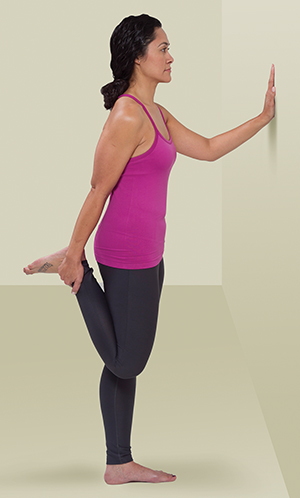
I also do some static stretches after a game, run, or strength workout. The muscles I focus on are the quads, the hamstrings, the glutes, and the lower back. There are lots of stretching exercises available online so I won’t go into specifics here. These stretches take 10 minutes and ensure my back doesn’t get pulled out of alignment. One issue with soccer players is that they develop very strong quads that can pull the back out, so I’m sure to do at least this one after pretty much every workout.

Person doing quad stretch exercise standing.

If you don’t have a wall handy, here’s a tip: holding the opposite ear-lobe from the leg being stretched will help you maintain your balance. Don’t ask me why.

Finally, I also use one of those foam rollers from time to time, as needed, to keep my legs loose. The woman in the link above seems to be having a good time but it actually hurts like hell. The more it hurts, the more you needed it. After a few days of regular use, though, it hurts a lot less, so I know it works. It’s basically a self-massage. I roll my quads, my hamstrings, my IT band (i.e. the outer side of the thigh), my calves, and my lower back.

Despite being naturally inclined toward tight muscles, I’ve actually never had a major pull, so I must be doing something right. I hope I’m not jinxing myself.


Strength Training

LS2_436

If you remember this ad, you are of my generation. It’s actually a brilliant piece that plays on most guys’ body insecurity and sexual desire. It also messed up my head for 30 years, making me think there was something wrong with me for being an ectomorph. Yes, I too was “a skinny 97-pound weakling” and desperately wanted to wear a leopard skin Speedo. Today, a lot of guys are turning to steroids to get “ripped,” sacrificing their fertility for looks, which seems like a pretty good trade-off until they actually bed the babe they’ve literally been busting their balls for and discover they can’t. In my Men & Masculinity course, we talk about this as a kind of reverse anorexia for boys, the social pressure to be “big,” which is really just a synonym for “powerful” in the broadest sense of the word.

I’m going to lay my cards on the table here and say if changing your body image is why you want to work out, that’s the wrong reason. Rather, if it’s to be healthy and strong, that’s the right reason. In terms of motorcycling, as I’ve said, it should be to allow you to do what you want to do on the bike. You don’t have to be physically big to do that. In fact, none of the MotoGP riders look like Charles Atlas. Last year’s MotoGP champion Marc Márquez weighs 59 kilograms, or 130 pounds. That said, the improved toning and shape you get from strength training is an additional reason to feel good about yourself for doing it.

As cardio is the foundation of fitness, I believe core strength is the foundation of strength training. There’s no point in bulking up if you can’t stand up. Core strength keeps you in alignment and prevents back problems. It also allows you sit in the saddle for long periods without slouching. (Remember, most of us don’t have a back-rest.) And nothing I know strengthens the core better than Pilates. I know a guy who developed back problems and his doctor sent him to a Pilates course. He worked out regularly at the gym and was built but lacked core strength. So when I developed back problems, I found a good Intro to Pilates DVD at my local library and did it religiously 3-4 times a week. It actually only took about 3 workouts until I felt a difference. They say you’ll feel better after 10 Pilates workouts, look better after 20, and have a completely different body after 30. Then you can go buy some leopard skin swimwear as a reward.

Once you have your core strength, you can move on to weight training. When I started weight training, someone set up a workout routine for me involving about 10 machines and exercising all the major muscles. That works. More recently, I came across Mark Ripptoe’s Practical Programming for Strength Training that makes the case that you really only need four exercises: deadlift, squat, bench press, and press. Those four cover everything, including core strengthening and areas you wouldn’t think they would, like abdominals. I’m still learning about weight training, but I’ve heard that more weight with less reps bulks you up, whereas less weight with more reps is better for endurance strength. So for motorcycling and soccer, I aim for 10-12 reps.

So how do you fit it all in? Cardio, Pilates, weights—while leaving time for the body to recover, which, at my age, is longer and longer. Something I’m just starting to look into is periodization. That’s where you break the year down into periods that focus on one area. It’s not like you don’t do the others, but the emphasis shifts. This year, coming off a bad ankle sprain that took me out for six months, I started with cardio and stretching, then core strengthening, and now am moving on to strength training. Just before the soccer season I’ll shift again to interval training and plyometrics.

If this sounds overwhelming, keep in mind that a regular program of cardio, stretching, and core strengthening should be sufficient for most types of motorcycling. That’s what the professional fitness trainer put Ewan and Charlie through in preparation for their Long Way Round adventure.

I’m still learning about all this so if I’ve written anything that is factually wrong, please let me know. If you disagree with something I’ve said or have advice I’ve missed, please leave a comment. Like I said, I’m an enthusiast, not an expert, so would be interested in hearing it, as I’m sure others would too.