Ready to Ride

What is your preseason prep?

Here in Montreal, the 2023 motorcycle season has officially begun. As of March 15th, we can legally be back on the road. The reality, however, is that no one is stupid enough to do so. I saw—or rather, heard—a scooter on the road yesterday, but I wouldn’t want to take a bigger bike out yet. In fact, I can’t get my bike out yet; there’s still several feet of snow blocking the doors to my shed.

Nevertheless, the air is filled with anticipation as it won’t be long now. Motorcyclists are scurrying about like squirrels uncovering nuts, or birds building nests. I’ve seen a few Facebook posts about preseason maintenance and, for the Harley riders, preseason cleaning and polishing. T. S. Eliot wrote that April is the cruelest month, but for motorcyclists in northern climates, it’s these last few weeks of March during The Big Melt (aka dog shit season) that are the most painful. To ease the pain, we undergo a ritual process of preparation for the season to come. Here is what I do to get ready to ride.

Bike Prep

The first thing I do is undo everything I did last fall to prepare the bike for storage. That involves removing whatever I’ve used to block the intake and exhaust ports, removing the wax I left on the bike to protect it through the cold winter months, replacing the battery and saddle, lowering the bike off the jack-stand, and topping up the tires. The bike is now ready to run, and I might start it up, just to hear its familiar exhaust note and reassure myself that all is well in the world.

Depending on the mileage, I change most of the fluids on the first warm day of spring. (I don’t have the luxury of a heated garage, so all maintenance is done outside.) I changed the oil before putting it into storage, but apparently oil ages even if unused, so I’ll do an early oil change, maybe not right away but soon. For this reason, some people put a cheap oil in the bike in the fall just for storage purposes, then change to the good stuff in the spring. I think that’s a little over-kill, so I put the same top quality synthetic oil in before and soon after storage. And no, I’m not going to start an oil thread by revealing what I use, as much as I always enjoy a good oil thread.

I change the coolant and brake fluid every two years or 20,000 kilometres, whichever comes first. I also remove the brake pads, clean them up with a wire brush, and clean and lube the callipers, paying special attention to the calliper pins. The brake cleaning might be over-kill too, but I like to know the pins are moving freely and generally to keep the brakes free of grit and grime. They’re just one of those essential moving parts that is exposed to road debris. If you’ve never done your brakes before, it really isn’t difficult.

I’m fortunate to have MuddySump’s channel to follow for routine maintenance. He’s an excellent mechanic and has the same bike as me.

I change the air filter, or in my case, because I use a K&N, clean and re-oil it. This year I’ll be adding a Uni pre-filter to my bike. On my Tiger 800XC, the OEM filter is under the tank, so adding a pre-filter will not only help protect the engine but also significantly cut down on the service intervals for the filter in the air box.

Then the fun begins: I add all the mods I’ve bought through the winter.

Gear Prep

If you didn’t launder your gear and wash your helmet liner in the fall, now might be a good time to do it. I also get out the leather conditioner and go a little crazy with it. First I do my leather jacket, then my gloves. Then while the rag is damp I do my satchel, my shoes, my wallet, my fountain pen cases, my belt . . . like I said, I go a little crazy. I do this once in the fall when I put my jackets away and once in the spring. We have baseboard heaters which pull all the moisture out of the air in the house, so I do this at least twice a year.

My favourite brand of leather conditioner? This might start a thread as long as an oil thread, but I’ll say that someone who works at the high-end store in Montreal where I bought my satchel once graciously confided that Armor All Leather Care Gel is just as good as the expensive stuff they sell. That was my brand until Canadian Tire stopped selling it. Then I switched to Simoniz, which I didn’t like as much, and lately it’s been Chemical Guys, although this year I’ve noticed that it’s leaving a white film on the leather once it dries. So after doing a little research, I’m going to try Cobbler’s Choice. Like I said, I’m a little obsessive about moisturizing my leather goods. The best moisturizer, however, is good ol’ beeswax, although it leaves the jacket sticky for a few days.

So with every leather item in my house sufficiently moisturized, my gear is almost ready for the season. I squirt a little WD40 on the buckles of my ADV boots, some Pledge on my helmet, wipe some silicone onto the rubber that seals the visor, and polish my visor with Plexus. Yeah, this stuff costs a lot, but Ryan F9 has done a video showing that it’s the best. If the visor is old and too badly scratched to restore, this is when I get a new one; there’s no sacrificing when it comes to vision on the bike.

I also get out my camping gear and give it some love. Last fall, I treated the tent with Kiwi Camp Dry Heavy Duty Waterproofing Spray. I like this stuff because it’s non-toxic and doesn’t leave an after-smell. I also clean my stove and make sure anything that needs replacing is replaced, because there’s nothing worse than a temperamental stove when on tour. The one that I use runs on liquid fuel and requires maintenance from time to time.

Body Prep

Touring for weeks on end and crawling in and out of tents, as I’ll be doing this summer, requires some fitness and flexibility. The long days in the saddle are easier if you have some cardio fitness, so I’ve been running fairly regularly. I do a 5K loop with the dog 2-3 times a week, and when I’m inspired, I run a little longer. Now that the warmer weather is almost here, I’ll be bumping that up and doing some 10K and even longer runs. Running has always been easy for me and it’s my go-to exercise for body and mind.

With all that running, I need to do stretching or my legs get tight and my back becomes prone to injury. This year I invested in some athletic therapy which gave me a set of stretches to do, and as Robert Frost said, that has made all the difference. I used to pull my back a few times a year, often at the worst possible time, laying me up for a week, but with this stretching, I haven’t had an incident in a while. I think I’ve found the answer to my back issues.

In addition to the cardio and stretching, I work on strengthening my core, so some Pilates, yoga, and generally, abdominal work. Sitting on the bike all day is like sitting on a stool with no backrest, so you need a strong core. When you start doing any off-roading, there are even bigger demands on your muscles. I’ve already done a blog about fitness and strengthening, so if you’re interested in the specific exercises I do, check that out. One thing I’ve added since making that post is to work on balance. You can do that with a wobble board, but a simple way to improve your balance skills is to stand on one foot . . . with your eyes closed. Try it. This develops all those nerves in the foot that are essential to good balance, and according to Jimmy Lewis, off road riding is all about balance.

This year, to account for the extra weight of the top-heavy Tiger, I started doing some strength training with kettle bells. I may be a natural runner, but I’ve always had the upper body of Pee-wee Herman. I really like kettle bells and I think they will become a regular part of taking care of myself. The main reason I like them is that you get cardio, strengthening, and core work all in the same workout. Because kettle bells are asymmetrical (unlike barbells), you’re always working your core, and if you string reps together EVOM (Every Minute On the Minute), you also get your cardio workout. Best of all, you really only need a couple of kettlebells to get started and can do it in a small space in the house. I’ve been doing kettlebelling for the past month or so and am loving it! I’m following Mark Wildman’s YouTube channel. He’s excellent and has a series of videos specifically for people like me just starting out.

If that sounds like a lot, it kind of is, and I’m trying to figure out how to fit it all in. At my age, recovery time is not what it used to be, if you know what I mean. At first, I tried staggering running and strengthening on alternating days, but that didn’t leave me any days off to recover. Currently I do a run after my long days at work to run off the stress, then a double workout of kettlebelling followed by a light run when I can, which wipes me out but then I take a full day off with just some stretching. In other words, I listen to my body and adjust accordingly, keeping in mind that you need to do an activity 3-4 times a week to see benefits.

Finally, the only other muscle I exercise is . . . eh, hem . . . not what you’re thinking but my clutch hand. I keep one of those spring grip devices on my desk all winter and pick it up from time to time. Works better than a stress ball and helps avoid arm pump when off roading.
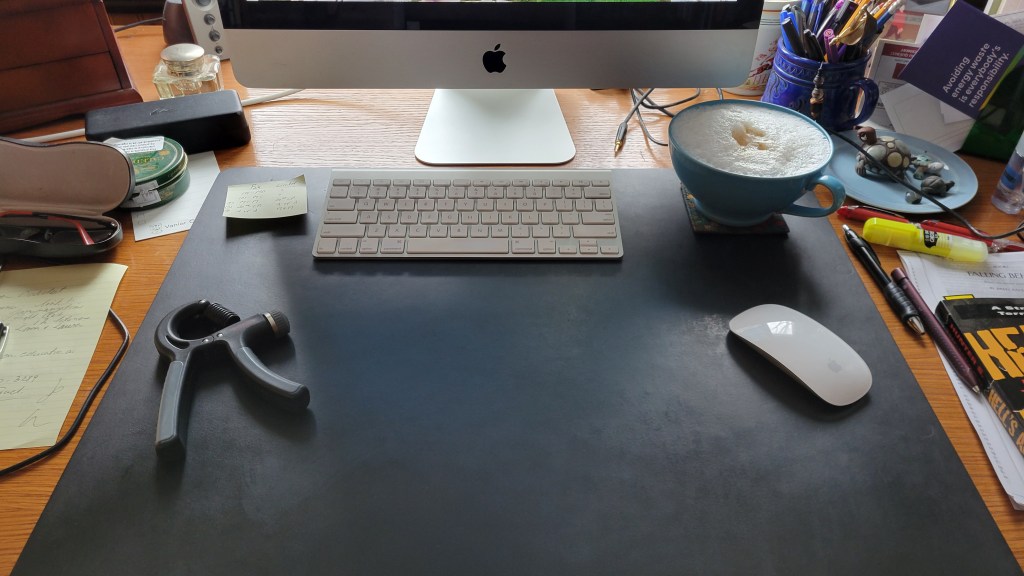
One hand on the mouse, one hand on the grip strengthener.

Eye on the Prize

It was the best of times, it was the worst of times . . . it was the spring of hope, it was the winter of despair. Charles Dickens wasn’t a motorcyclist, but in describing the Victorian era he caught something of the spirit of this intermediary period. As I come to the end of my March Break and head back to work tomorrow, I keep in mind that at least I’ll soon be able to commute by bike, and before I know it, the semester will be drawing to a close and we’ll be getting ready to leave for Newfoundland. Marilyn and I booked our ferry crossing the other night so that trip is a go! 18 days together on the bike camping through Gaspé, Gros Morne, and across The Rock. It’s going to be epic.

Keep your eye on the prize, folks, whatever that may be for you. Have a safe and enjoyable season.
A Bike is a Body

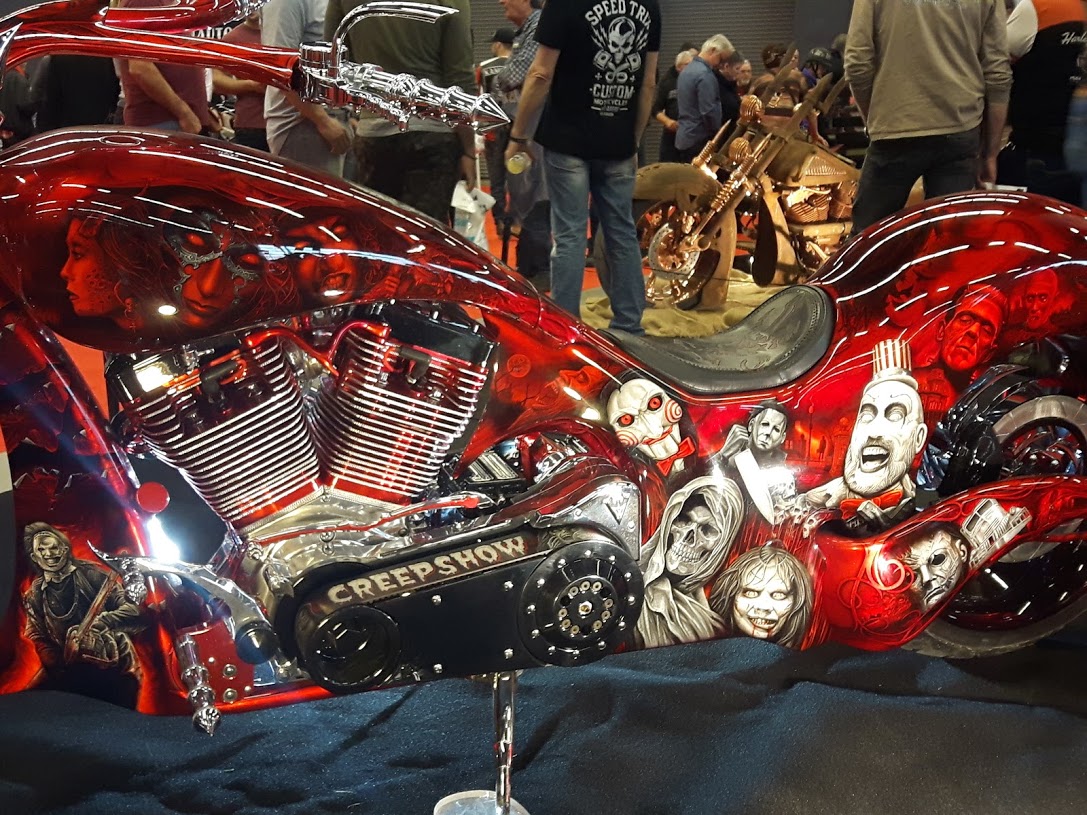
creepshow

There comes a time in your life when you know you can no longer take your health for granted. Sometimes it’s not so much a revelation as a creeping recognition, but in my case, it was a specific moment. I was in my 40’s, in good health, when I walked to the curb to retrieve the recycling blue box. I bent over, picked it up, and bam! Back spasm that sent me to the ground.

“What the hell was that?” I wondered. A back massage helped work out the stiffness, but it would take five osteopath appointments and a regular routine of Pilates to put me back to health, so to speak. Since then, when I get away from doing the Pilates on a regular basis, like when I’m especially busy at work, I have a relapse. I’ve come to the conclusion that I’m going to have to do Pilates regularly for the rest of my life to keep my back healthy.

But it’s not just the back. I play soccer recreationally, and I have to keep training in the off season and between games to maintain my fitness and speed. As soon as I stop, even just for a few weeks, the muscles atrophy, including the most important one—the heart—and I struggle through that next run or game. At a certain point (I’m now in my 50’s), you have to do this training just to maintain what you’ve got! It’s diminishing returns with longer recovery times, but what’s the alternative? If you stop altogether, well . . . we won’t talk about that.

When we were young, we abused our bodies. We put chemicals through them, burnt the cilia from our windpipes with one puff of smoke, stayed up all night partying or studying, lay out unprotected in the direct sunlight for hours. We might have been involved in athletics, but few ever did any training. I ran a 16K road race when I was in my teens on the minimal preparation of a few runs in the weeks leading up to the race. I know someone who stayed up all night partying before a marathon. (Yes, he finished, but collapsed unconscious over his celebratory meal afterwards.)

I’m thinking of this now as I try to ramp up my training after a month or so hiatus. I’d like to carry a little momentum into the snowy winter months here in Montreal so I arrive in the spring fit for a new season of soccer and riding. And I’m thinking of it in relation to my motorcycle, which I’ve just winterized and stored away at the end of another riding season. Come to think of it, a bike is not unlike a body. It arrives on the showroom floor pristine and perfect. Then with age and use, a few things start to break, or wear out, and you have to work to get it back to health. It’s a constant struggle with diminishing returns to keep it in good working order.

Almost all the people I ride with have new motorcycles. They require very little maintenance beyond an oil change and a fresh coat of wax. My bike, on the other hand, is a 2006, and on a recent multi-day club tour, the running joke was that every time we stopped, I had to fix something. It’s true that on the five-day tour I fixed a helmet lock that had vibrated loose, a rear-view mirror that had cracked, and a persistent slow oil leak at the front of the engine.

I keep a pretty close eye on my bike. I have to. And not just an eye but an ear. I hear every new sound—every rattle, buzz, clunk, or ticking. I can tell when my oil is old from the sound of the engine. It’s just part of riding an older bike. You get used to doing a walk-around pretty regularly, and I’ve spotted on them a burnt taillight bulb, a cracked mudguard, missing hardware. Recently I learnt how to weld plastic using a soldering iron and zip tie to repair a cracked body panel and said mudguard. With age and UV rays, plastics atrophy and become brittle, fragile. And because I do some light off-roading with my ADV bike, there’s a lot of wear and tear, vibration from the single cylinder and from the terrain, drops, crashes. Every once in a while I’ll notice something else broken, and then I’ll have to either fix it or replace it to bring the bike back to 100%.

Fortunately, I can still obtain replacement parts. Okay, sometimes I have to wait two weeks for them to arrive from Germany, but when I recently lamented this to customer service of a large online parts distributor, the person replied, “Well, at least you can still get them. Good luck trying to get parts for a bike this old from one of those Japanese manufacturers.” I didn’t know, but apparently some companies just stop making the parts for older models. When Polaris bought Victory, they promised to support Victory bikes for ten years. When GM restructured and Saturn was killed, I knew it was only a matter of time before I’d have difficulty getting parts for my L100.

With a body it’s not so easy. You can’t easily swap out a broken part, which is why I’m a strong proponent of preventive health practices and signing my donor card. Keeping your organs after death is the epitome of selfishness. (Yeah, I know the joke about “donorcycles.”) But even with my bike, I know there will come a time when I won’t be able to get a part, and then I’ll have to make it. I was this past autumn at a vintage motorcycle race, and as I walked through the pits, I marvelled at the beautifully restored classic bikes. Many of these guys must have to make their own parts. That’s another whole level of skills beyond regular bike maintenance.

When I retire, I’m going to buy not only a house with a heated garage or workshop but also machining tools so I can make my own parts. The dream is to restore an old classic bike, something that tugs on my heart-strings like an old Triumph or Norton, thinking of my British ancestry. As my body begins to fail in ways I won’t be able to stop or fix, I’ll bring an old, rusty machine beautifully back to life. “Time and tide wait for no man,” Geoffrey Chaucer wrote in The Canterbury Tales. But then, he hadn’t met a motorcycle mechanic.

Motorcycle Fitness

'It's not an actual motorcycle. It's an exercise bike. I made it look like one so my husband would actually use it.'

How fit do you need to be to ride a motorcycle? You are, after all, just sitting on it and twisting a throttle, right? It’s not like you actually have to do any work, like pedal.

Competitive motocross and MotoGP riders are among the fittest athletes in any sport. That’s one extreme. Most of us are not competitive riders, and there is a large range of types of biking, from the physical demands of off roading to cruising on your Harley, each with its own set of fitness demands. You might be “just” a commuter, or a recreational, weekend rider, or someone who likes to tour. The answer to my question above is this: if you are physically unable to do what you’d like to do on a bike, then you have to up your fitness. It’s an easy test. If you find yourself unable to lift your bike, or push it out of mud; if you are nervous about committing to a long club ride in summer heat; or if you’re having trouble even getting on and off your bike, then it’s time to think about your fitness.

I’m no expert but, shall we say, an avid fitness enthusiast, more from my love of playing soccer than riding. Here are a few things I’ve learned over the years. But before I get started, since we are dealing with health, I feel the need to do the usual legal disclaimer and say you should check with your doctor or a medical professional before starting any fitness program. In other words, don’t blame me if you have a heart attack!

I believe there are three aspects of fitness and I’ll talk about each in turn: cardiovascular fitness, flexibility, and strength training.

Cardio

The foundation of fitness is cardio. That’s why I’m going to start with it. I annoy my son when we get talking about soccer training (I used to be his coach) because he says I’m fixated on cardio. Maybe I am. Here’s why.

Many people think of energy in economic terms, like a commodity. “I’ve only got so much energy to get me through the day and I’ve got to do x, y, and z today, so I’d better skip my workout.” That’s economic thinking. What those people don’t realize is that you get more energy by working out. Maybe not initially, but in the long run, so to speak. When your heart and lungs are strong, you will find yourself more productive in the evenings with energy to spare. Using the economic model, a cardio workout, then, is like advertising; you have to spend a little to get back a lot.

The other big benefit of boosting your cardio is that it’s calorie-burning, not just during the workout but between workouts! As you get more fit, you are actually changing your metabolic rate. This is, in part, where that extra energy comes from, aside from the fact that it’s easier for you to climb those five flights of stairs to your office several times a day. So if weight loss is one of your fitness goals, improving your cardio is key. Oh, and did I already say you’ll feel a whole lot better?

Probably most of you are already thinking, Yeah, I’ve tried to exercise but I just don’t have the time or discipline to keep at it. Here is the key: you have to find a time and an activity that works for you. I didn’t always work out. In fact, for years I abused my health until it caught up to me with lower back problems, something I still struggle with from time to time (I’ll come back to this later). But at about the age of 42 I started going to the gym. Let me say that again, at about the age of 42 I started going to the gym. I’d tried and failed earlier; the difference this time was that I discovered I could do my workout during lunch hour and eat my lunch at my desk. I’m not a morning person, so that time didn’t work for me; and I just couldn’t heave myself off the couch and out to the gym after dinner, despite my best intentions. But the lunch-hour workout stuck. For others, maybe early morning, before the demands of family and work enter, is the best time, or after the kids are put to sleep, at the end of the day. Experiment and see what works for you.

I also rediscovered my love of soccer, something I’d given up in my teens, and so I had a reason for going to the gym. Soccer is a pretty demanding sport, even at the recreational level, and I know it’s either pay now in the gym or pay later on the field. I also felt a certain commitment to my teammates. The connection between my training and my soccer is so strong that often when I’m running I’m imagining (or visualizing) soccer plays past or future. My wife doesn’t like running but loves biking. Some people like the social aspect of cross-fit; others like the solitary aspect of distance running. Contact vs non-contact, a racquet sport, swimming—it’s really a personal preference, but you have to find something that makes your soul sing. It will be a lot easier to stay motivated.

If you haven’t done much exercise in recent years, you probably should start with walking. (See disclaimer above.) Start with a normal walk for several weeks, then graduate to a brisk walk and build up to a light run. The goal is just to elevate your heart rate to the aerobic zone for 20 minutes, 3-4 times per week, according to most experts. You know you’re in the aerobic zone if you can still have a conversation comfortably but are exerting yourself enough to break a sweat. Worried about burning calories? You’re in luck. It takes the same amount of calories to walk a kilometre as it does to run a kilometre. When my dad once went for his company physical, the nurse thought he was a runner. In fact, the only exercise he did was walking around the industrial park for 45 minutes during his lunch hour.

Flexibility

I’ve always been really inflexible. Once when I went for a massage (back when my insurance paid for it), the masseuse was shocked at how stiff my legs were. “Are your legs always this stiff!?” she exclaimed, holding onto my ankle and shaking the leg back and forth to test its tightness. “Ugh, yeah. That’s pretty much how they always are.”

I’ve never been into yoga, although I know it would be excellent for me. There’s something about yoga types that rubs me the wrong way. There’s a certain sanctimonious, holier-than-thou “I’ve-got-my-life-completely-sorted-out-and-am-at-complete-inner-peace” sort of thing about them that makes me want to knock their seaweed salad all over them to prove them wrong. But maybe I’m being unfair.

Here’s what I do to help my flexibility. Each morning, preferably before my coffee, I do three sun salutations. That’s it. That’s all. Done. But it seems to do the trick. It stretches all the major muscles, gets my heart and lungs working, and clears the sinuses. If you don’t know what a sun salutation is, check this out.

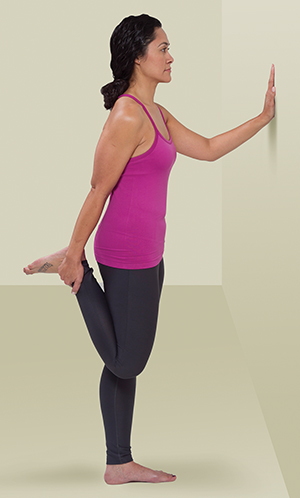
I also do some static stretches after a game, run, or strength workout. The muscles I focus on are the quads, the hamstrings, the glutes, and the lower back. There are lots of stretching exercises available online so I won’t go into specifics here. These stretches take 10 minutes and ensure my back doesn’t get pulled out of alignment. One issue with soccer players is that they develop very strong quads that can pull the back out, so I’m sure to do at least this one after pretty much every workout.

Person doing quad stretch exercise standing.

If you don’t have a wall handy, here’s a tip: holding the opposite ear-lobe from the leg being stretched will help you maintain your balance. Don’t ask me why.

Finally, I also use one of those foam rollers from time to time, as needed, to keep my legs loose. The woman in the link above seems to be having a good time but it actually hurts like hell. The more it hurts, the more you needed it. After a few days of regular use, though, it hurts a lot less, so I know it works. It’s basically a self-massage. I roll my quads, my hamstrings, my IT band (i.e. the outer side of the thigh), my calves, and my lower back.

Despite being naturally inclined toward tight muscles, I’ve actually never had a major pull, so I must be doing something right. I hope I’m not jinxing myself.


Strength Training

LS2_436

If you remember this ad, you are of my generation. It’s actually a brilliant piece that plays on most guys’ body insecurity and sexual desire. It also messed up my head for 30 years, making me think there was something wrong with me for being an ectomorph. Yes, I too was “a skinny 97-pound weakling” and desperately wanted to wear a leopard skin Speedo. Today, a lot of guys are turning to steroids to get “ripped,” sacrificing their fertility for looks, which seems like a pretty good trade-off until they actually bed the babe they’ve literally been busting their balls for and discover they can’t. In my Men & Masculinity course, we talk about this as a kind of reverse anorexia for boys, the social pressure to be “big,” which is really just a synonym for “powerful” in the broadest sense of the word.

I’m going to lay my cards on the table here and say if changing your body image is why you want to work out, that’s the wrong reason. Rather, if it’s to be healthy and strong, that’s the right reason. In terms of motorcycling, as I’ve said, it should be to allow you to do what you want to do on the bike. You don’t have to be physically big to do that. In fact, none of the MotoGP riders look like Charles Atlas. Last year’s MotoGP champion Marc Márquez weighs 59 kilograms, or 130 pounds. That said, the improved toning and shape you get from strength training is an additional reason to feel good about yourself for doing it.

As cardio is the foundation of fitness, I believe core strength is the foundation of strength training. There’s no point in bulking up if you can’t stand up. Core strength keeps you in alignment and prevents back problems. It also allows you sit in the saddle for long periods without slouching. (Remember, most of us don’t have a back-rest.) And nothing I know strengthens the core better than Pilates. I know a guy who developed back problems and his doctor sent him to a Pilates course. He worked out regularly at the gym and was built but lacked core strength. So when I developed back problems, I found a good Intro to Pilates DVD at my local library and did it religiously 3-4 times a week. It actually only took about 3 workouts until I felt a difference. They say you’ll feel better after 10 Pilates workouts, look better after 20, and have a completely different body after 30. Then you can go buy some leopard skin swimwear as a reward.

Once you have your core strength, you can move on to weight training. When I started weight training, someone set up a workout routine for me involving about 10 machines and exercising all the major muscles. That works. More recently, I came across Mark Ripptoe’s Practical Programming for Strength Training that makes the case that you really only need four exercises: deadlift, squat, bench press, and press. Those four cover everything, including core strengthening and areas you wouldn’t think they would, like abdominals. I’m still learning about weight training, but I’ve heard that more weight with less reps bulks you up, whereas less weight with more reps is better for endurance strength. So for motorcycling and soccer, I aim for 10-12 reps.

So how do you fit it all in? Cardio, Pilates, weights—while leaving time for the body to recover, which, at my age, is longer and longer. Something I’m just starting to look into is periodization. That’s where you break the year down into periods that focus on one area. It’s not like you don’t do the others, but the emphasis shifts. This year, coming off a bad ankle sprain that took me out for six months, I started with cardio and stretching, then core strengthening, and now am moving on to strength training. Just before the soccer season I’ll shift again to interval training and plyometrics.

If this sounds overwhelming, keep in mind that a regular program of cardio, stretching, and core strengthening should be sufficient for most types of motorcycling. That’s what the professional fitness trainer put Ewan and Charlie through in preparation for their Long Way Round adventure.

I’m still learning about all this so if I’ve written anything that is factually wrong, please let me know. If you disagree with something I’ve said or have advice I’ve missed, please leave a comment. Like I said, I’m an enthusiast, not an expert, so would be interested in hearing it, as I’m sure others would too.