
A great long distance adventure touring tire with one major flaw.
When Dunlop decided to design a new ADV tire, they smartly asked adventure riders what they wanted. Of course, we all want a tire that does everything well—excellent street performance with no compromises off-road. That’s not physically possible, but Dunlop claims to have come pretty close with the Trailmax Mission, saying it offers “knobby-like performance” off-road and “great ride quality” and “impressive grip” on the road. I ran the tire for 20,000 kilometres and it was a very good tire on the road but had limitations off-road. Aside from these limitations, I would hesitate to buy it again because of one major drawback.
On Road
Dunlop claims that the Trailmax Mission is a 60/40 tire. I’m glad they revised those numbers, because when the tire was launched they were calling it a 50/50. I think it’s more like a 70/30. You can see at a glance that it’s designed primarily for the street, with a rounded profile and not blocks but deep grooves. That results in a very comfortable street ride with easy turn in and relatively little vibration coming up into the handlebars.
One specific request many ADV riders had was longevity; we’re simply tired of having to change our tires every 5-6K. The Trailmax Mission tires have a very hard compound and you can expect to get 20,000K out of a set. I put a set of these on at the beginning of last season and rode them out to Newfoundland and back 2-up fully loaded. After 20,000K, there was plenty of tread left in the front and some left in the rear.


So apparently if you can see all of Lincoln’s head the tire is finished. The rear is pretty close to done, although I’m not quite down to the wear marks. The front has some life but wear is uneven (probably my fault with under-inflation). Despite that hardness, I never had any problems with the tire skidding in the rain, an issue some riders have reported with the Heidenau K60 Scout that has similar longevity.
So if you are going on a long tour that will be primarily asphalt, the Trailmax Mission would be a good choice.
Off Road
I used this tire in the Classique Plus ride on Class 2 roads. It handles well in hard-packed dirt, gravel, and even shallow sand. I also had it on my 650GS before I sold it for a final tour through the New England states that involved some fairly deep gravel, and I have to say, I was having an easier time than my riding buddies on Shinko 705s, a similar 70/30 tire. Yes, it slides out from time to time, but predictably, which actually makes it a fun tire to run on dirt and gravel if you’re into powersliding.
There are a couple of features of the Trailmax Mission that make it especially good in dirt, despite its round profile. One is the sidewall lugs, a technology borrowed from ATV tires that allows the tire to bite when sunk into deep sand or mud. Yes, it does surprisingly well. Dunlop also claim the lugs help prevent sidewall punctures from sharp rocks.
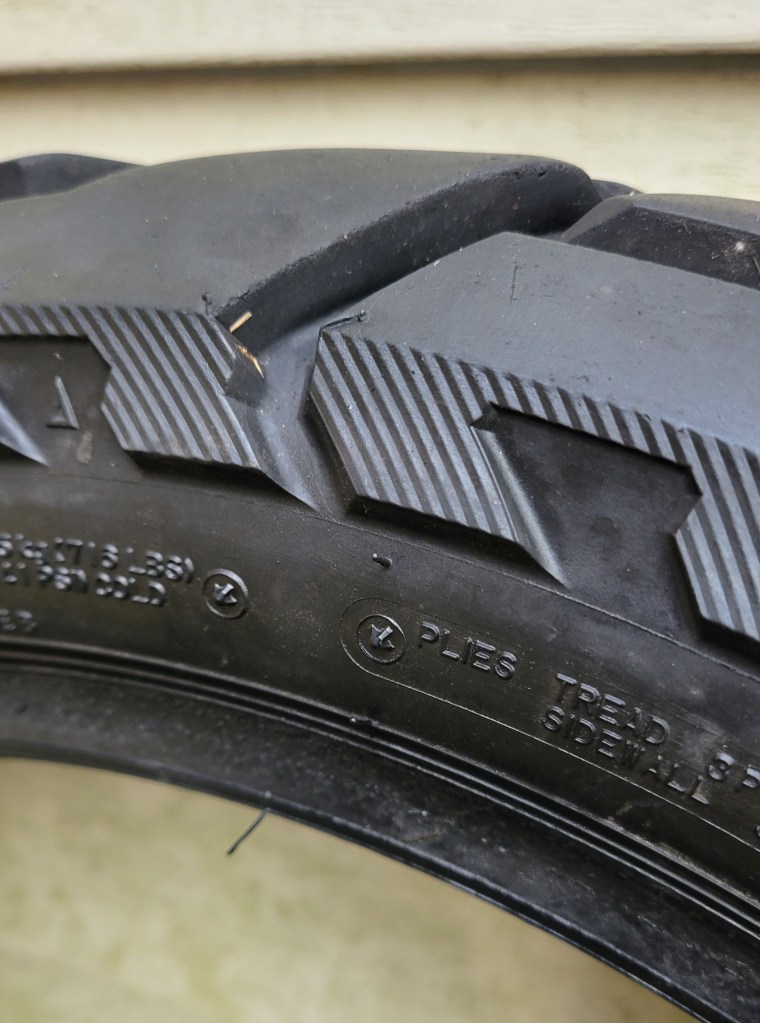
Another feature is the Staggered Step design. I can’t really say if these did anything but Dunlop claims they add rigidity in the contact patch for improved stability. The idea is that as one step wears down, there’s another ready to take over.

Obviously we are talking about stability on the sidewalls as you are leaning through a corner. I guess this is Dunlop’s attempt to reduce the “wandering” sensation some tires have when on the side blocks. Perhaps a Physicist reader will explain it to us because I’m a bit at a loss as to how these cut-outs are going to improve stability. That said, I never noticed the tire wandering, which is something I now feel on the Anakee Wilds I just put on.
“Knobby-like performance”?
Not really, although good enough for even deep sand if you are suicidal or mud if you are masochistic. It’s here where the tire has its limits. I found myself going through mud on the Rideau Trail north of Merrickville, and while the tires got me through the first few puddles, they soon caked up.
The problem is that, unlike a knobby, the mud does not evacuate from the grooves of the Trailmax Mission. You can spin the rear to clear it, but it’s the front that you need planted, and once it’s caked, you might as well be riding on ball bearings.
Yes, you can blame me for taking a tire like this into mud. It’s not meant for that. I’ve seen GS instructors take their 1200GS’s through a mud bath on Anakee 3s!, but I’m no GS instructor. So for the average rider, either stay out of the mud on these or put on a more aggressive tire.
Riders in the Quebec area will be familiar with Marc Chartrand. He is the founder of RidAventure.ca forum, La Classique Rally, and lead planner of the Trans Quebec Trail. Basically he’s The Man in Quebec and probably has more off-road experience exploring Quebec trails than anyone around here, so when he gives advice, I listen. I once read a reply of his to the ubiquitous question of “What tire should I put on my motorcycle?” His answer (I’m paraphrasing and translating) was basically that if you get, say, 6,000K out of a tire and “only” do about 10% off-road, that’s still 600K in the dirt. And that’s a lot of kilometres to be crapping your pants if you have on a street-biased tire. That’s why, he said, experienced ADV riders always put on aggressive tires.
I’m thinking of this advice in relation to the Trailmax Mission tire. If you are riding hard packed dirt, gravel, even some loose rock and shallow sand, these tires are great. But if you are going anywhere near deep sand or mud, you’re on the wrong tire.
The Major Flaw
Regardless of the tire’s off-road limitations, I’m not sure I’ll be putting these on my bike again. That’s because I do remote and long-distance riding and need to be able to change tires by hand. These tires are so tough it’s nearly impossible, and that’s not an option when you’re running tubes. Maybe some people can, but I couldn’t, and that’s what counts. Those 20,000K are the product of very tough rubber used in the manufacturing.
Now before you start saying “It’s all a matter of technique,” let me say that I’ve been spooning tires on and off my bikes for years. I’ve made it a matter of principle, thinking the more I struggle through the process the easier it will become when I have a puncture in the field. I’ve changed many different types of tires, including Metzler Tourance, Shinko 705 and 805, Pirelli Scorpion Trail II, Anakee Adventure, Kenda Big Blocks, and even the dreaded Heidenau K60 Scouts. But I could not change the Trailmax Mission tire.
Getting the tire on was not the problem; it was getting it off. I could get both beads off the rim, but couldn’t get the wheel out of the tire. Usually I put the big 15″ lever through and lever it off the same side, using my knee to press it the rest of the way off. You can watch Ari Henning do that here. But the tire he is changing has a minuscule sidewall, making it easy. The Trailmax Mission has a deep and very tough sidewall. There was no way it was coming off.
I eventually called in the support . . . but my wife was no help. I then texted my buddy Riley from Awesome Players Off-Road MC. He suggested another method of getting the tire off. Instead of same side, remove the other bead on the other side and drop the wheel down into the tire. For example, you can see this method done here. I tried this and got the wheel down into the tire just fine, but no matter how much I struggled with the tire fully lubed up and in the heat, I could not then get the wheel out of the tire. After much cursing, and sweat, and some blood, I got it half off, which is to say, I threw in the towel with the wheel stuck 45˚ relative to the tire. I took it to a shop which charged me $15 to get it off.
I’m not sure the Trailmax Missions are designed to be changed by hand, and I don’t blame Dunlop for abandoning those of us who still do this work. The vast majority of riders take their bikes to a shop for a tire change, and the vast majority of adventure riders aren’t going off-road and aren’t running tubes. Even the latest bikes with off-set spoked wheels don’t run tubes, so you can fix a flat using a plug. To compete in the longevity game, manufacturers are using tougher and tougher rubber. The industry is slowly abandoning those of us who still ride with tubes and need to remove our tires by hand.
I’ll admit, you can get a tube out to patch it without removing the tire, although even that will be difficult with a sidewall this tough. So I’ll step down from my soapbox now by just saying that the difficulty of changing the Trailmax Mission by hand is a consideration.

Conclusion
Dunlop has swung for the fence with the Trailmax Mission tire. It’s a premium tire at a premium price, with a 150/70 18″ (a common rear size) running for about $320 CAN and $250 USF. They listened to riders and studied the market, then came up with a tire capable of going long distances on the large adventure bikes of today. Apparently something like 80% of BMW 1200 (now 1250 and 1300) GS’s never see dirt, and that’s clearly the market Dunlop were aiming for with this tire. If that’s the type of riding you do, the Trailmax Mission is definitely worth a try. Like I said, I used it to ride out to Newfoundland, a tour which was primarily asphalt, but it was nice to know if the asphalt ran out (and it did a few times), we would not be in trouble. Overall, I was very happy with how the tire rode and how long it lasted, even fully loaded with a passenger through the heat of midsummer.
If you are looking for something beefier, capable of mud and sand, consider the Trailmax Raid, a 40/60 tire in the Dunlop line.






 650thumper