
After a night crossing on the ferry from Newfoundland, I decide to ride The Cabot Trail, then stop at friends in Nova Scotia and Maine before the final push home.
The night crossing was terrible! I think it ranks up there as one of the most miserable nights of my life, such as once on a day trip in Germany when I missed the last train back to Munich with no cash in my pocket and too young to have a credit card so had to sleep on the street, or when I once slept in a trailer with a door that didn’t properly close, in June, in Canada, and got eaten alive all night by mosquitoes. The snoring was like a thousand mosquitoes entering my sleep to feast all night, or an over-sized dentist’s drill boring through my ear-plugs. I tried slumping in my chair, both sides, slouching, curling into a fetal position across two chairs (and an armrest), lying on the floor, trying a different floor . . . nothing worked. Eventually I gave up and went for breakfast in the dining hall.
This was the only enjoyable part of the entire crossing, during which I struck up a conversation with a young man at an adjacent table. He was from Cape Breton and had recently started working on an offshore oil rig. It was interesting to hear about that experience and life in Cape Breton. The story I kept hearing during my travels from him and other locals is that the Maritime winters are not what they used to be. Very little snow and many have sold their snowmobiles. Fishermen report of increased fog. Great White sharks have been spotted in the waters off Ingonish, etc. etc. Yeah, we know, you must be thinking—the planet is getting warmer. Duh! I only mention it because Marilyn has always said she wouldn’t retire to the Maritimes because she couldn’t take a Maritime winter. Thanks to global warming, the east might be back in the cards! (However, as I write this, it’s just received a record snowfall).
When I said I was headed to Baddeck on a bike, he suggested I take the 223, the Grand Narrows Highway that goes up through Iona. Nice tip! Here’s a taste.
It’s like that the whole way—twisty right along the shore of Bras D’Or Lake where it juts up into the Narrows. The pavement is a little broken but not bad. Keep in mind that I’m operating on one hour of sleep and that brush on the right that comes up close to the road is always a red flag for me, so I’m holding back. I would have my fun later in the day on the Cabot Trail.
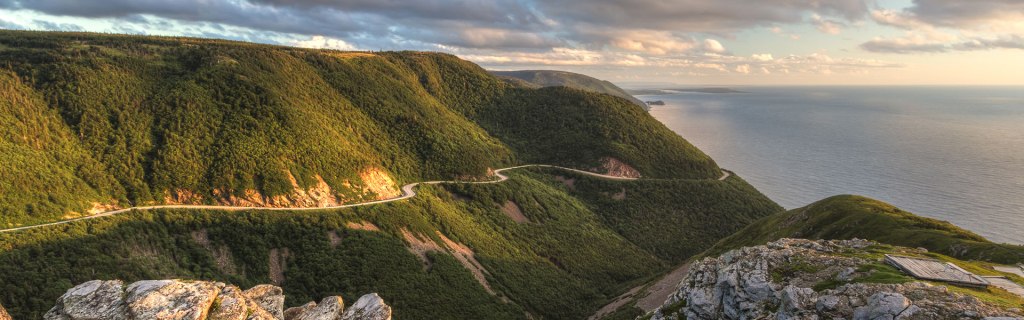
After arriving at Baddeck Cabot Trail Campground, one of my favourite campgrounds and my second stay there this trip, I set up camp before hitting The Cabot Trail. Yes, the definite article deserves to be capitalized because The Cabot Trail is an iconic ride. I’ve done it before on my 650GS but wanted to do it again on the Tiger. So after a quick nap, I headed off.
I told myself, given my sleep debt, I’d just cruise it, but it wasn’t long before I was lured up into the adrenaline zone—until the bike twitched on a tar snake mid-corner. Never a pleasant feeling and I decided to cool it down.
The real fun was riding out to Meat Cove. The road is twisty and undulating and broken in spots, and then it turns to dirt. It started to rain, which made it more interesting. The dirt section had recently been graded so there weren’t any potholes or washboard to worry about.
This is exactly the kind of riding the Tiger is made for—twisty asphalt and light off-roading. I was having fun, once I got the damn ABS off. (I wish it were easier on the Tiger than having to navigate down through menus.) Unfortunately, I didn’t get footage of the best riding into the campground because the camera turned off for some unknown reason, but trust me, I was power-sliding the rear wheel out over the cliff-edge on those left-handers. 😉 Maybe it’s best that the wife doesn’t see that footage anyway.
I was pretty annoyed when I discovered the camera had stopped. To be honest, I’m not happy with much of the footage from the tour, so I’m definitely going to change how I work with the camera. Maybe I’ll use the phone app so I can see when and what I’m filming (or when I’m not filming), and maybe I’ll use the loop setting in which the camera constantly records over the same bit of memory card until I stop recording. The only issue with loop mode is it drains the battery fast. Voice commands don’t work with wind noise at speed, and I don’t want to be fumbling either with the camera or the phone, but I’ll experiment in the spring and come up with a better process. If you use an action camera, I’d be interested in hearing about your experience and set-up.
Anyway, back at Meat Cove, I arrived amid a torrential downpour, much to the amusement of hikers who were laughing at me while waiting it out in their SUVs. I didn’t care. A hormone concoction of endorphins, dopamine, adrenaline, and testosterone were coursing through my veins. It was time for a fresh lobster roll at the Clam Chowder Hut and the bragging rights photo.

There’s a lot more of The Cabot Trail I could show but this is already going to be a long post, and there’s no shortage of footage available online. It’s always a great ride, and I’m glad I made the effort to do it again while I was near. I ended up doing the complete loop and was back at camp in time to enjoy a campfire and some of the bourbon I’d picked up earlier in the day.
My destination the following day was Urbania, Nova Scotia, just south of Truro, where some friends of mine live. I met Sharon in 1986 when I was an undergrad, so our friendship is long! I’ve admired her dedication to her writing career and teaching work and watched her fall in love and marry the man of her dreams, move out of the GTA (Greater Toronto Area) and into their dream home built largely by her equally talented husband, Kevin. If any of my older readers remember the Canadian 80’s band New Regime, well Kevin was the lead singer, among other accomplishments. This would be my first visit to their new place and I was looking forward to it. They have several acres of property that back out onto the Shubenacadie River.

The riding in Nova Scotia is excellent and probably worthy of a separate post, but I’ll just say here that Old Highway 4 from New Glasgow down to Bible Hill is about as good as it gets for a secondary highway through non-mountainous boreal forest. It was the original primary east-west highway until the Trans Canada was put in, and you can take it all the way to or from Sydney, Cape Breton. I followed it for much of the day and only jumped onto the Trans Can toward the end as I was racing against a system of precipitation that was moving into the area.
As I rode up the driveway to Sharon and Kevin’s, it started to rain. And it rained! There was a massive thunderstorm during the night and, in fact, major flooding in Halifax. We actually received an evacuation notice during the night because we were near a dam that was at risk of breaching. (Whatever . . .) My timing was lucky: I was happy to shelter in place under a solid roof with good friends. The extreme weather also got me thinking that you can’t escape climate change. Forest fires out west, ice storms in Montreal, flooding in the Maritimes—wherever Marilyn and I end up for our retirement, we’ll have to deal with some form of extreme weather.
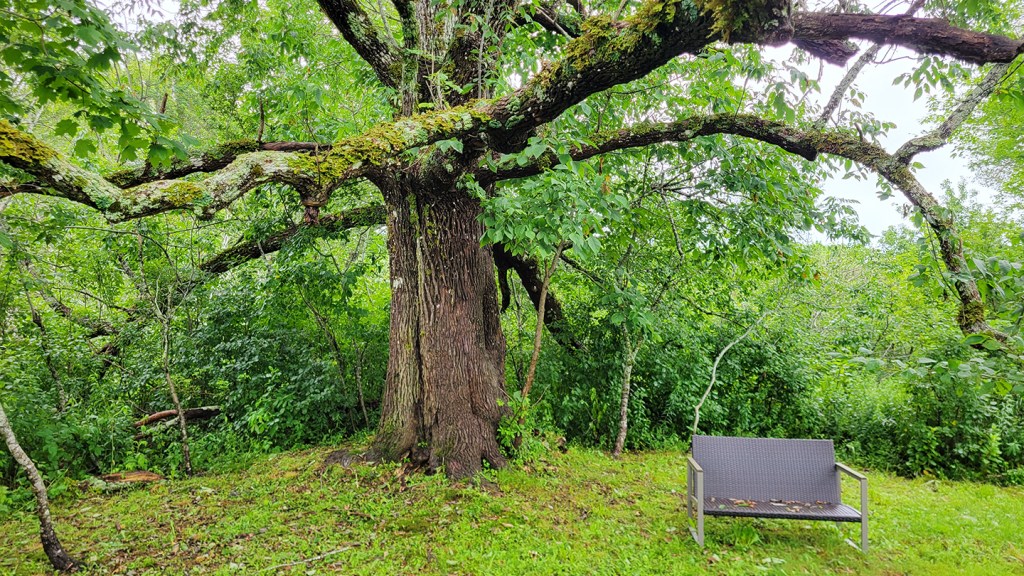
The next day Sharon and I walked her property down to the river. One of the gems of their property is a tree they call Grandfather Ash. Unfortunately, since I visited, this magnificent tree was severely damaged in Hurricane Lee last September.
Despite the extreme weather, the visit was restful and restorative. The energy on their property is quiet and calm, and I hope my retirement home is as lovely. I keep talking about retirement because it’s very much on Marilyn’s and my minds these days. I’ll be teaching for another two years, until June 2026, and then we’ll be moving out of Quebec. I could write a lot about my frustrations with Quebec politics, economics, and sociology, but let’s stick to adventure touring. The short of it is we have to decide whether to move out west to where Marilyn has friends and family (good riding in The Rockies!) or out east to where we’d be closer to my friends and family. Either way, it’s going to be difficult leaving the friends we’ve made here, but I’m not going to think about that now. Thankfully, we have a few years to decide and emotionally to prepare.
After a few days visiting, I had to tear myself away and get back on the road. I had two more nights planned and wanted to get over the border into Maine the first night. I headed back to the Trans Canada on the beautiful, winding 236.


I had to get around the Bay of Fundy and took the highway as far as Sackville, then split off onto the 106 because I prefer secondary highways. Soon after crossing into New Brunswick, as I came through Dorchester, I saw a giant sandpiper at the side of the road.

I’ve seen the giant goose in Wawa and Husky the Muskie in Kenora, so I thought I’d stop and take a closer look. Even more impressive was the Bricklin parked in the lot.
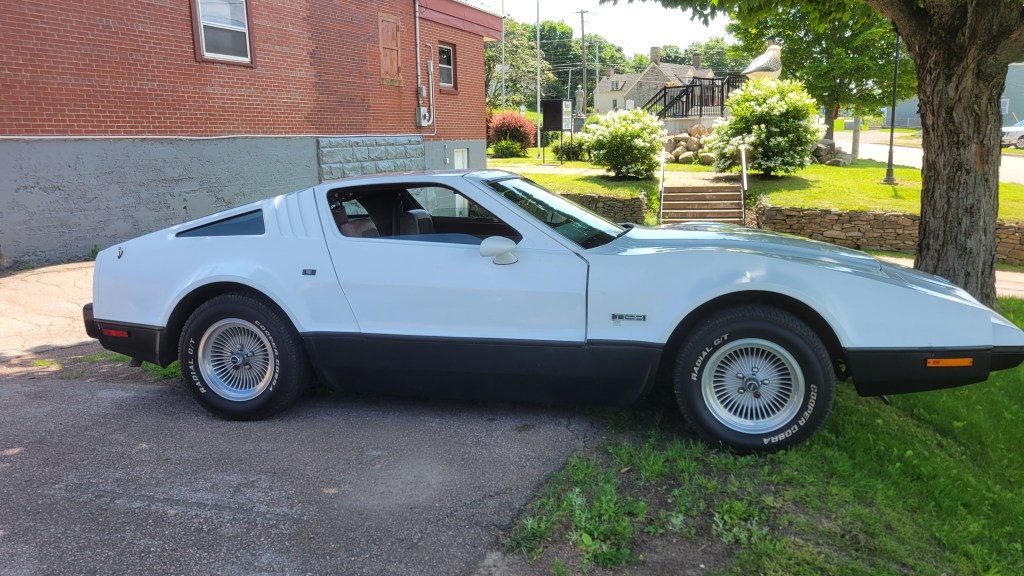
Bricklin was a Canadian car manufacturer located in Saint John, New Brunswick, in 1974-75. With the help of provincial funding, they built about 3,000 cars, but problems with reliability of the acrylic body panels and other issues drove the price up and the car company soon went bankrupt. The car has a Chrysler slant 6 engine, a Datsun tail, and other parts from Chevrolet and Opel. It’s crowning feature are the winged doors that open upwards. I got talking to a young lady out front and accidentally mistook it for a DeLorean, which must happen a lot. The DeLorean is another long-nosed, snub-tailed, winged car of yesteryear, made famous by the Back to the Future movies. This Bricklin’s in great shape, obviously without a spot of rust on it, and no blistering that plagued the early models.
I’ve said it before, this is what I love about solo touring. I can stop whenever something catches my eye, meet people, and explore. It turns out that I’d stumbled upon the Dorchester Jail, the second oldest jail in Canada and the only privately owned provincial jail and Canada. It’s also the only privately owned Death Row in Canada and was the location of the last double-hanging in New Brunswick—the Bannister Brothers. That reminds me of a skull I once saw at Eldon House in London, Ontario, that was from the first hanging in Canada. Actually, it was the first two hangings because the rope broke on the first try, which leads me to wonder if the executioner apologized to the murderer for having to put him through his execution twice. Hmm . . .

I’ve never spent a night in the clink but if I ever want to, I know where to go. The jail has been converted to an AirBNB and you can enjoy a night in a cell for a moderate price. I don’t know if that includes use of the courtyard during the day because there was at the time of my visit another interesting vehicle there beneath a cover.
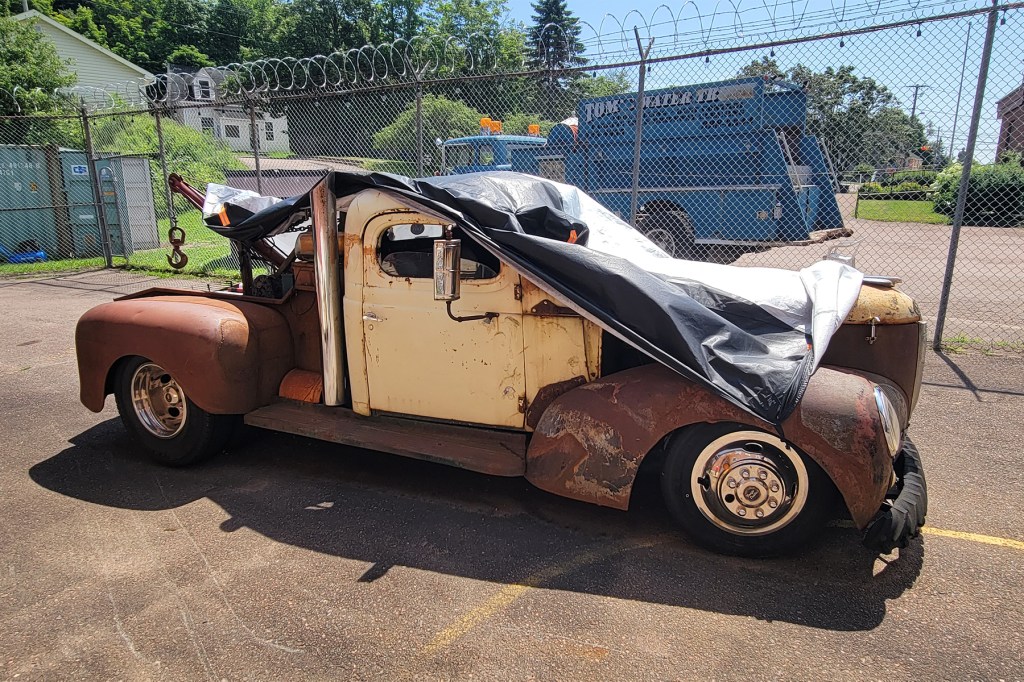
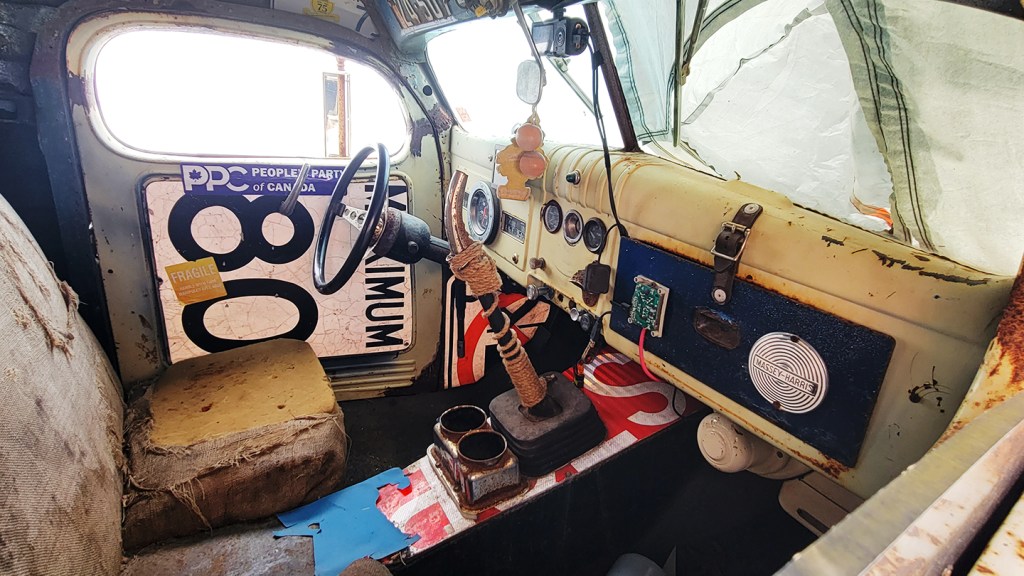

This bad girl (the truck, not the woman, who graciously lifted the cover to show me) had a bit more rust on her than the Bricklin. Love the tractor tire front bumper, almost as good as the Bricklin’s featured “energy-absorbing” bumpers.
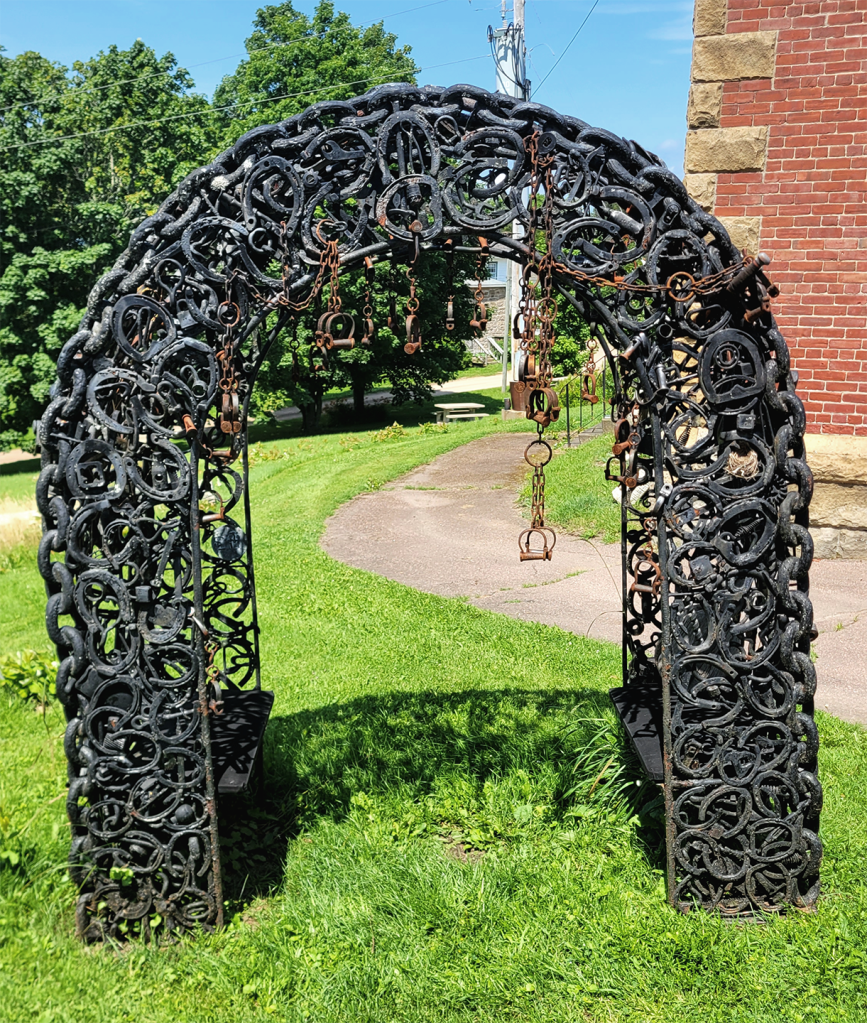
Also of interest was this metal arch that was constructed from horseshoes, locks, car parts, tools, chains, and prisoner shackles. And amid it all—I don’t know if built or placed—was a bird’s nest.

This place was a feast for eyes, but I had miles to go before I sleep so had to push on. I soon was passing through Saint John, NB (not to be confused with Saint John’s, NL), stopping only to fuel up and caffeinate up because it looked like it was going to be a late arrival at my destination, Cobscook Bay State Park in Maine. By the time I arrived at the border, it was already dusk.
Are you nervous when crossing borders? I’ve crossed the US-Canada one so many times I don’t get nervous anymore, but I’m always cautious about what I say because I know the power these officers have. I knew they were going to ask me the usual questions and was prepared. Our conversation went something like this:
Customs Officer: “Where do you live?”
Me: “Montreal.”
CBP Officer: “What is your purpose entering the US?
Me: “I’m on my way back from Newfoundland and just passing through.”
Officer: “Are you travelling with anyone?”
This is where things started to go sideways. I had pulled up alone so wasn’t expecting this.
Me: “Well, I was travelling with my wife, but she flew back early from Newfoundland for work and I’m riding back alone.”
Officer: “Are you meeting anyone in The United States?”
Another unexpected question. Now I should know better than to say more than is necessary, but I’m honest to a fault. I did, in fact, have plans to meet up with a reader of this blog who lives and rides in Portland, and we thought it would be fun to get in some riding together while I was passing through. So I answered honestly. I thought, better safe than sorry.
Me: “Actually, I’m meeting a fellow rider in Portland, and we’re going to go for a ride together. She’s a reader of my blog.”
This answer did not seem to help, and now I was beginning to feel more sorry than safe.
Officer: “What is your relationship with this person?”
He clearly wasn’t familiar with motorcycle culture. Or blogging.
Me: “I write a blog about my motorcycling. I’m meeting someone who is a reader of my blog. She lives in Portland and, since I will be passing through, we thought we’d meet up for a ride together.”
Officer: “So, it’s . . . like a date?”
I felt like I was digging myself in deeper. He clearly had missed the reference to my wife. Some jokes came to mind that might have lightened the moment, but I know enough never to joke with these guys. Sometimes I think that a lack of humour is a job requirement. I felt like I was at the door of a speakeasy and chose my words carefully.
Me: “No, I’m married. I’m meeting a fellow motorcyclist in Portland to go for a ride together. That’s all.”
I was tempted to enlighten him about the communal aspect of motorcycle culture, about blogging and the writer-reader relationship, or to provide a short romantic history of my marriage, but like I tell my composition students, sometimes less is more. The ball was in his court. By now the notorious Maine mosquitoes were out and finding their way up my nose. I looked him straight in the eye.
Officer: “Have a nice night,” he said, and handed me back my passport.
I felt like I’d just hit another tar snake and was happy I still had some of that bourbon in my pannier.
An hour later I had my tent set up, food on, bourbon poured, and a fire lit. That night I wandered down to the water to get out from under the trees of my campsite. The sky was huge and clear, and it was a perfect night for stargazing. I lay on my back and used a great little app called SkyView (Android and Apple) to pick out the constellations.
Highway 1 Maine is a secondary highway that follows the shoreline almost all the way into Portland, passing through quaint towns along the way. I took it west-east in 2017 when I did my first tour out to Cape Breton and The Cabot Trail and my plan was to do it again the other way this time, dropping down into Bar Harbour en route, which I’d heard a lot about. The cost of secondary highways is always time. It was very hot and the going was slow, slower than I remembered. Still, Google Maps was telling me that Bar Harbour is only about a 2-hour ride from Cobscook Bay, so I thought it would be perfect for a mid-morning coffee stop.
I wouldn’t know because I never made it. As I was coming down Highway 3 south, I got stuck behind no less than four trucks—a hydro truck, a cement truck, a transport truck, and a dump truck—with no chance to pass. Volume got heavier and slower and it got hotter as morning developed into midday. At the same time, what I was seeing wasn’t particularly appealing—clam huts, lobster shacks, pirate-themed mini-putt, hotels, tour busses, hunting and fishing stores—and I began to wonder why I was there, crawling along in a wake of diesel fumes. There’s a national park there and I’m sure the coastline is impressive, if you can get to it, but whatever natural beauty might be drawing all these people to this region is so buried beneath layers of tourist development that I didn’t want to spend any more time trying to find it. As the traffic slowed to a crawl I said “Fuck it!,” pulled a U-turn, and got the hell out of there.
Now I was running late (am I never?) so had to abandon my plan to continue along Highway 1. Google Maps was saying the fastest way to Portland was the interstate, so that’s what I did. After the frustrations of the secondary highway, and given the heat, I was happy to ride at speed. I decided to get my coffee from a Dunkin’ Donuts at one of the exits and met there, by chance, Eric Foster, whom I had written about in a previous post. He’s the guy who crashed on the Trans-Taiga and was rescued by local trappers. On this day he was riding the newer Tiger 900 and had seen my 800 XC, the same as the one he crashed, so jumped off the highway when I did to have a chat. Small world. I’d never met him in person but it now made sense; I remember he lives in Maine. He told me Bar Harbour sucks during the tourist season. Good to know.
I was down to my final night of the tour and thankfully my friend, Berry, had something special planned for me. Berry and I started corresponding a few years ago. At the time, she also rode a 650GS, so found my blog that way. Soon our online conversations turned to other things like diet, politics, and literature, but motorcycles are the thing we usually talk about. When she decided to upgrade her bike, I was honoured that she sought my opinion on the Suzuki V-Strom 650, which of course I endorsed. So when I knew I’d be cutting back through Maine and passing close to Portland, we decided to try to meet and get in a ride. She went one step further and graciously offered to put me up the night in her beautiful house. This meant not only that I was spared setting up camp one last time but also that I could see a little of Portland. She took me on a tour of the old town out to a seaside restaurant where we could sit out and eat seafood while hearing the crashing surf from where it came. It was a fitting end to my Atlantic tour.
We did get in that ride. The next day, Berry followed me part of the way up toward the Canadian border, or rather, I followed her. I figured, let the local lead and choose the route. Here we are riding Highway 153 which, as you can see, is pretty nice.
Eventually, Berry split off at Conway and started heading back toward Portland. It was nice meeting her and putting a face to words, and I’m sure it won’t be the last time we meet. In fact, the NEBDR ends in Maine, so it may be sooner rather than later.

There was one more good section of road remaining on this tour and it was The Kancamagus Highway (NH Rte 112) from Conway to Lincoln. Rever lists it as a G1 road, which is one of America’s Best Roads (Epic Incredible Roads)—their wording—and I would agree. After a rip over the mountain range, you get to decompress as the 112 winds its way parallel to the Pemigewasset River through the village of Loon Mountain, where I visited for the New Hampshire Highland Games for my very first overnight adventure tour, back in September 2016.
At a certain point of every tour, you ride back into familiar territory. It’s always a very noticeable sensation for me. After exploring for weeks and seeing everything for the first time, eventually, usually in that final day, you ride a road you’ve ridden before and remember the first time you rode it. You might even recollect your excitement or heightened attention at seeing it for the first time, and I guess that is why I like to travel. It’s that curiosity about the world that comes alive when you are experiencing the unfamiliar. Time slows, days are long and full, your senses fully alert, your mind constantly thinking, processing information, acquiring knowledge, keeping you safe. I can’t see myself spending vacation time at a resort; I think I’d get bored in two days.
The motorcycle is the perfect mode of travel for people like me who like to experience something new. And Newfoundland was certainly new (pun intended). I don’t think I could get bored with it, and I’m sure I’ll be back sometime in the future, God willing. In the meantime, it’s going to be very interesting to try a different type of touring altogether next summer when I do the BDRs (MA and NE, back to back). I’ve never done two weeks+ of constant off-roading, so there will be new technical and athletic challenges for me. At the same time, I’ll be exploring the Appalachian Mountain Range from West Virginia to the Canadian border. If you want to follow along, you know what to do.
What are your plans for the coming season? I always like to hear from readers so drop a comment below.












 650thumper