Canada’s 10 Best Roads

In celebration of Canada Day 2024, here are my 10 favourite roads to ride in Canada.

Canada is a huge country with over a million kilometres of roads. I can’t say I’ve ridden most of them, but I have ridden to both the east and west coasts and almost to the northern one, so I’ve done a good survey of the country. Here are my favourite roads in Canada, going from east to west.

Highway 430 (Newfoundland)
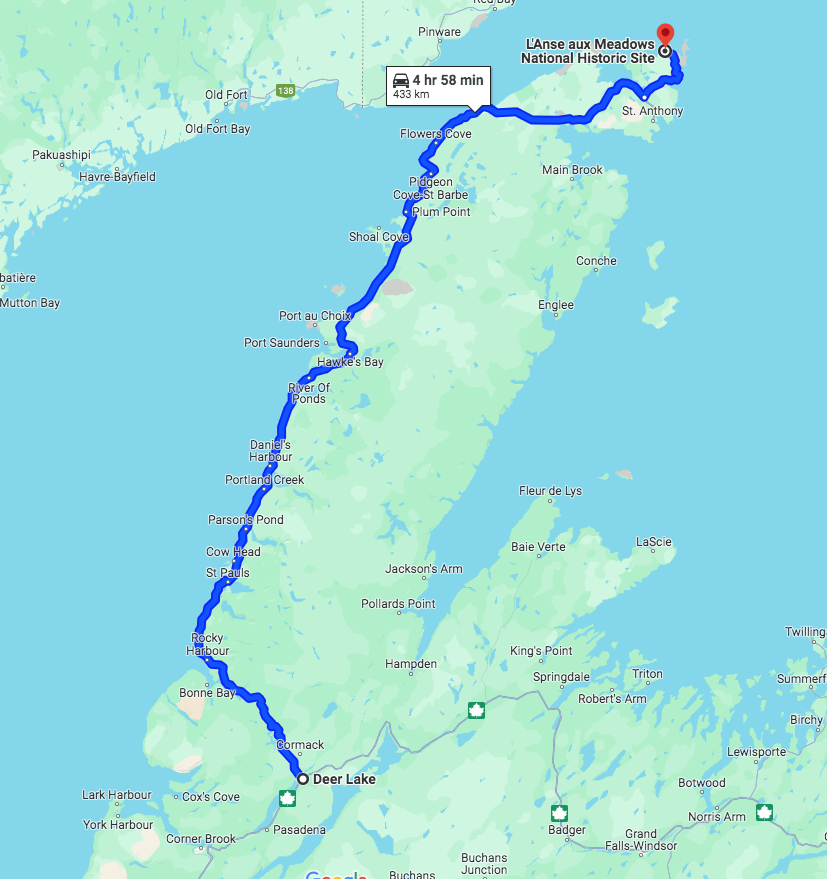
Also known as The Viking Trail, this highway begins at Deer Lake, where it splits off from the Trans Canada Highway and heads west and then north. It hugs the western shore of Newfoundland, offering hours and hours of spectacular ocean views and some of the most impressive geology in the country. Be sure to stop in Gros Morne National Park and hike The Tablelands Trail with its unusual orange rock, and camp at one of three campgrounds right on the beach. A highlight for riding is the section through Rocky Harbour, a mountainous region with changes in elevation and twists and turns and scenic lookouts that rival the iconic Cabot Trail in Cape Breton. Further north, the 430 levels out and follows the shoreline. You’ll feel the air temperature change rapidly when the wind blows off the ocean, so have a windbreaker on hand. Another highlight is Point-au-Choix, a national historic site where moose, caribou, and other wildlife can often be seen. If you make it all the way up to the northern tip of the highway, you’ll be rewarded with views of icebergs drifting southward from Greenland and L’anse Aux Meadows, the historic site of the first settlement of Europeans from which the trail takes its name.
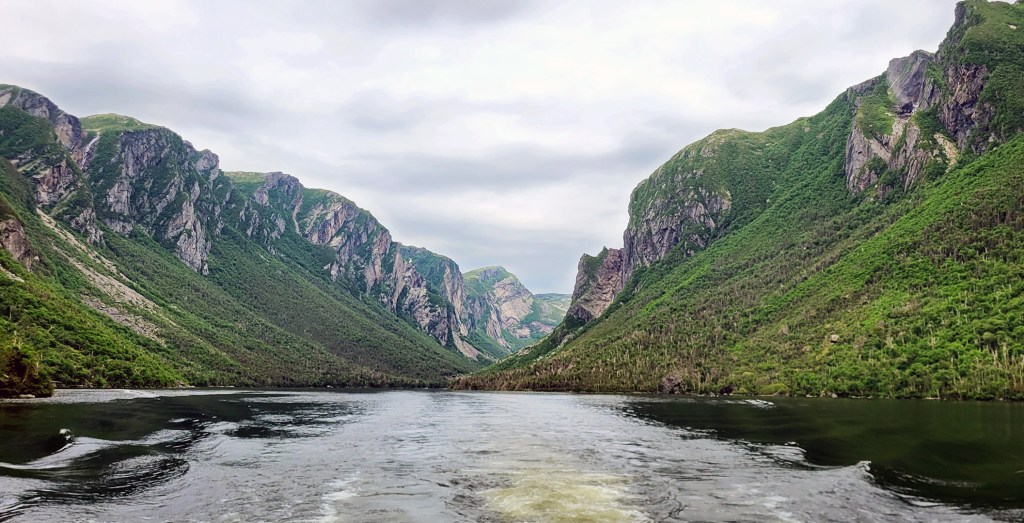
Western Brook Pond

Highway 4 (Nova Scotia)

You may be surprised that I didn’t choose The Cabot Trail as my favourite road in Nova Scotia. It’s a fun ride, no doubt, but for really getting a sense of interior Nova Scotia, I prefer Highway 4. Apparently it was the original Trans Canada Highway traversing the province and you can see that in the way it criss-crosses its replacement. You can also hear its history in some of the towns along the way. Travelling east, you pick it up just outside Oxford before it hooks south through Wentworth Valley, then east through Truro and Bible Hill, New Glasgow, and Antigonish before crossing onto Cape Breton, where it hugs the south shoreline of Bras d’Or Lake all the way to Sydney and, finally, Grace Bay at the shore of the Atlantic Ocean. It’s as long as its history and every bit as varied and interesting. It doesn’t contain the dramatic switchbacks of The Cabot Trail, but weaves its quiet way through rolling hills, countryside, lakes, and villages, never far from civilization but as if in another era. The two or three times I’ve ridden it, I enjoyed it so much I forgot to take a photo, so you’ll just have to get out there yourself to see why it’s one of my favourite roads.

Highway 132 (Quebec)

The 132 is Quebec’s longest and oldest highway. It begins in the west at the US border south of Montreal and follows the south shore of the St. Lawrence River all the way around the Gaspé peninsula. It’s best to pick it up at Rivière-du-Loup east of Quebec City, where it becomes picturesque with old clapboard houses and churches dating back to the origins of Quebec and, indeed, North America. East of Rimouski, the road narrows and mountains rise up on your right so that for hundreds of miles you are riding a narrow ribbon of asphalt strung between the Gulf on one side and dramatic cliffs on the other. And when the road turns inland to traverse the mountain range, the riding gets even better. Be sure to make a stop at Forillion National Park and the iconic Roche Percé (pierced rock), a biker mecca. But don’t stop there; keep riding around the peninsula to see sandy beaches as you pass through quaint fishing villages. When you reach the New Brunswick border, you can cut back across inland on the 299 for some technical riding.

Highway 2 (Ontario)

The first ride I ever did, the day after I got my licence, was along Highway 2 from the Quebec border to Kingston. It is another shoreline road, first in the east with the St. Lawerence River and opening up to Lake Ontario west of Brockville. It is also one of Canada’s oldest roads with a ton of history to explore, particularly Loyalist history. Be sure to check out the Lost Villages Museum, containing replicas of buildings flooded when the Long Sault dam was built, and the Long Sault Parkway, known as the Florida Keys of the north. (It’s actually a series of islands created by the flooding and strung together by bridges.) Windmill Point still contains the original windmill that was the focal point of the 1838 uprising, when Americans invaded across the river in a failed attempt to overthrow the fledging government. Just down the street in Prescott is Fort Wellington, an important early military location, and in Brockville you can walk the first train tunnel in Canada. And while we are on the road of firsts, once you get to Kingston, you can tour the first penitentiary and, a little further, the original milestone marking Highway 2 as the first asphalt highway in Canada. Riding Highway 2 is like riding back in time to the birth of Canada.

The Blue Church, 1845.

Highway 17, from Sault Ste. Marie to Thunder Bay (Ontario)

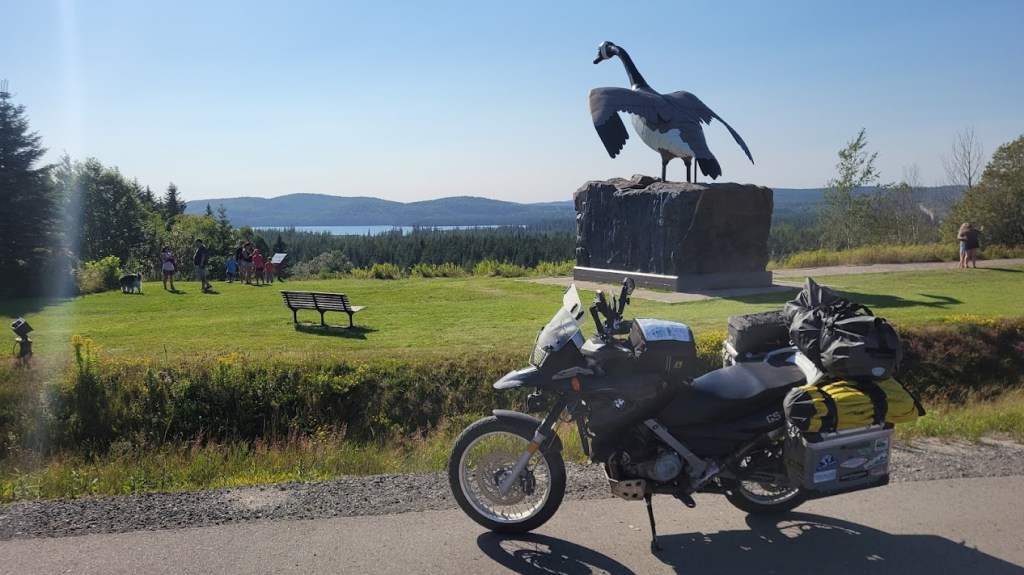
Highway 17 in the northwest of Ontario is far enough away from the urban sprawl of the GTA (Greater Toronto Area) to feel remote and pristine. Soon after leaving the Sault, you enter Lake Superior Provincial Park with several campgrounds, but regardless of whether you’re camping or not, be sure to pull off at Agawa Bay for the sandy beach and Agawa Rock containing ancient Ojibwe pictographs. When you leave the park travelling west, keep your eye out for the Wawa goose, and then settle in to miles and miles of excellent rolling tarmac with spectacular views of the The Great Sea. Although only two lanes, there are passing lanes on many hills so you can get past that RV and stretch your bike’s legs. At the end of the day, there’s Pukaskwa National Park to rest your head, get down to the shore, or hike inland to The White River Suspension Bridge. If you want a sense of northern Ontario, Highway 17 is it.

Highway 18 (Saskatchewan)
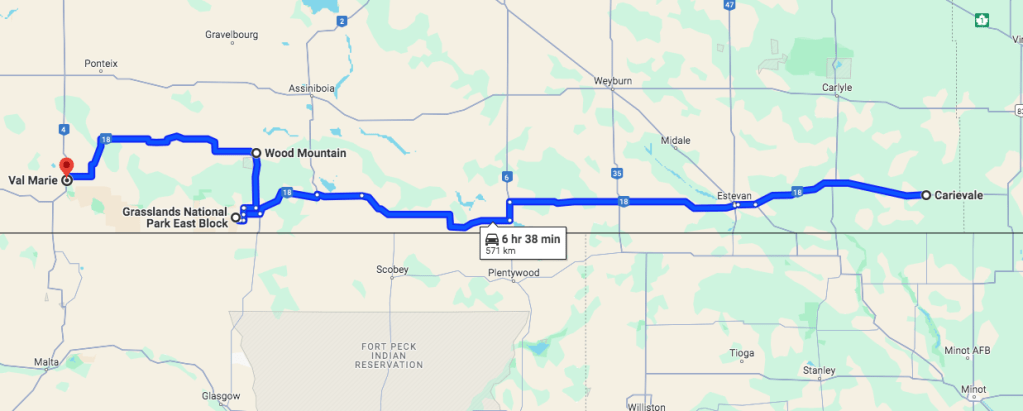
Think Saskatchewan is flat and boring? Think again. Highway 18 along the southern border strings together quaint towns, abandoned homes, historic grain elevators, rolling hills, and unblemished prairie. I rode Highway 18 west into Grasslands National Park East Block. It’s a fantastic national park with a very distinctive style of its own. Instead of the usual towering pines and lake views, Grasslands is in open prairie, and you can imagine what it would have been like to cross this formidable region by wagon in the 19th Century. Be sure to ride the single-lane loop along the top of the badlands, and the next morning, why not, continue on the 18 across the park to Val Marie. When I did it, I had the pleasure of watching four majestic elk cross the road in front of me and, one by one, as if in slow motion, leap the boundary fence before heading off across the open countryside. Grasslands NP and Highway 18 put you in touch with the prairie soil and grass and big sky like no other place I know.

Badlands at sunset, Grasslands NP

Highway 31 and 31A (British Columbia)

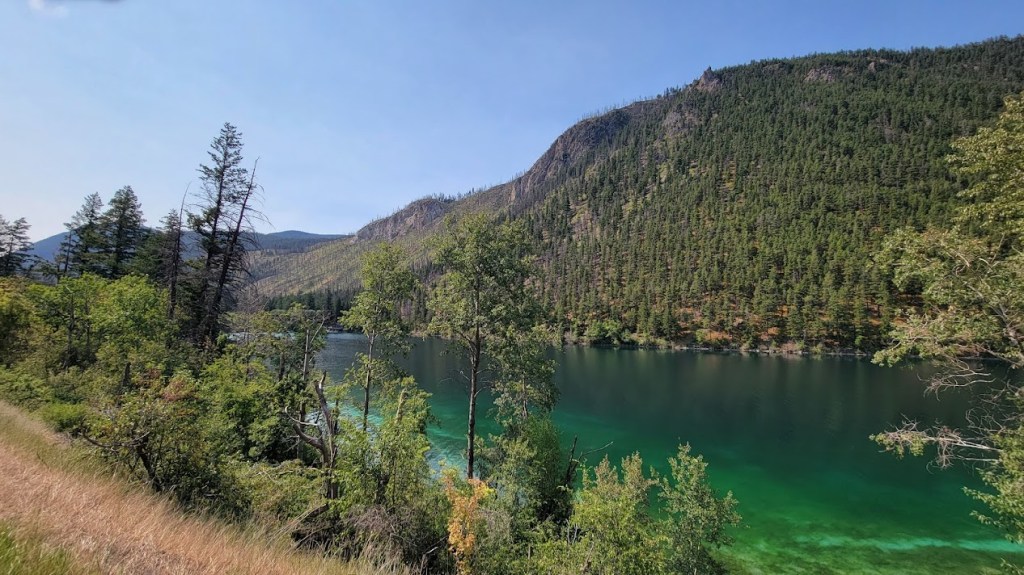
The 31 hugs Kootenay Lake from Balfour up to Kaslo, with the lake on one side and mountains on the other. Not bad. But it gets even better when you turn west and head along the 31A from Kaslo to New Denver. This road is listed in several “best of” articles and I’m going to include it in mine too because it’s pretty special. I don’t know how it compares to Tail of the Dragon for corners within a certain distance, but it has many, and one thing it has going for it that Tail does not is incredible scenery. You don’t really want to ride it fast or you’ll miss the view. There are towering mountains on either side and, for the eastern part at least, it follows the bubbling emerald green Kaslo River. At the end, although it needs no prize, is the quaint and secluded town of New Denver. I think I might just retire out there—if only to ride that road whenever I want.

Pausing on the 31A between Kaslo and New Denver

Highway 4 (British Columbia)

If you have to cross Vancouver Island, you have to take Highway 4. Good thing it’s a gem of a road, rising and falling through mountainous terrain with Cathedral Grove as a rest stop and the Pacific Ocean as the destination. As you approach Ucluelet, the road twists up into the mountains and you might find yourself in fog before it drops down again to the ocean. Once there, you’ll find Pacific Rim National Park, a magical place with long sandy beaches, crashing surf, and nothing between you and Asia but 19,000 kilometres of water.

The towering Douglas Firs of Cathedral Grove

Highway 37 (Northern British Columbia)
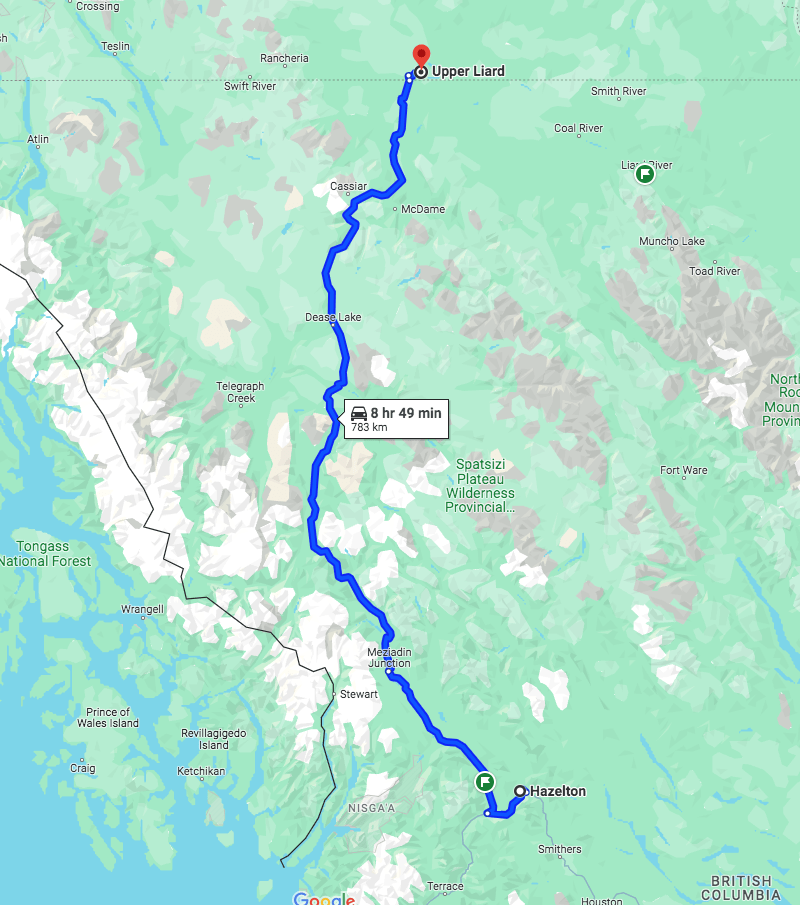
Technically further west than Highway 4 and Tofino is Highway 37, also know as The Stewart-Cassiar Highway. If you are going into Yukon, it’s one of only two roads going that far north, and I’ll go on record as saying it is preferable for riding to The Alaska Highway. Just north of Smithers and west of Hazelton, you turn right at Kitwanga and head north, 750 kilometres of twisting smooth two-lane blacktop with scenic views of rivers and lakes at the sides of the road and northern Rocky Mountains as backdrop to your ride. It’s pretty remote up there and you will ride for hours without seeing another vehicle, so be sure to have lots of gas and tools at hand, just in case. This is bear country, and you will see many on the road or at the sides, eating berries in the ditch. There might even be some grizzlies in these parts, but the remoteness, your exposure to the elements, and the lingering threat of danger is part of the energy and excitement of Highway 37. This is a road that pushes you out of your comfort zone and into the realm of risk and adventure.

The Dempster Highway (Yukon)

Not enough risk and adventure for you? There’s one highway that trumps all others in both. It’s the Dempster Highway, 886 kilometres of gravel that will eat your tires if not puncture them. When I was up there, I saw a camper rolled over at the side of the road and figured it was due to a puncture because the tire tracks went sideways. But unlike the Trans-Taiga in northern Quebec, you don’t ride this road for bragging rights. You do it for the astounding, majestic, magnificent views like no other in the country. That’s because you are above the tree-line for sections of the Dempster and the wide open vistas of subarctic tundra are worth every kilometre. If you just want a taste, head up about 80 kilometres to Tombstone Territorial Park, but bring bear spray and be sure to string your food. If you want to venture further, you’ll need to go at least 400 kilometres to get to Eagle Plains and the next fuel station, so depending on your bike, you might need to carry extra fuel. One other major consideration: don’t attempt this road on anything but knobby tires; it’s covered in calcium chloride and when it rains the road becomes so slippery you will be forced to wait for it to dry before you can get back down to Dawson City. All warnings aside, this is my favourite road in Canada if only for the geography it offers and the sense of remoteness.

North of Tombstone Territorial Park

I know I’ve missed a few provinces and a territory, but I’m blaming that on Covid. When I went across Canada the summer of ’21, I wasn’t allowed to stop in Manitoba, and the border to The Northwest Territories was closed. I also didn’t spend much time exploring Alberta but stayed mostly with friends and family in Calgary.

So what roads have I missed? Which of these have your ridden? Let me know your thoughts. I’m two years away from retiring and there’s a lot more of this beautiful country I want to see, so please drop a comment below and I’ll put it on my bucket list.

Here in Montreal, Canada Day is mired in the usual nationalist politics and anti-colonial sentiment, and I think that’s a shame. Surely it’s not the right time to highlight differences or mistakes made in our past, but to celebrate the many collective freedoms and opportunities the country offers as well as to recognize its complex history and natural beauty. All things considered, and certainly compared to many other countries around the world, it really is a pretty great country to live in, and an amazing one to ride. Happy Canada Day. Now tomorrow get out there and ride.

The Homestretch

Marilyn and I got a kick out these signs. The NL potholes don’t compare to Montreal’s.

After a night crossing on the ferry from Newfoundland, I decide to ride The Cabot Trail, then stop at friends in Nova Scotia and Maine before the final push home.

The night crossing was terrible! I think it ranks up there as one of the most miserable nights of my life, such as once on a day trip in Germany when I missed the last train back to Munich with no cash in my pocket and too young to have a credit card so had to sleep on the street, or when I once slept in a trailer with a door that didn’t properly close, in June, in Canada, and got eaten alive all night by mosquitoes. The snoring was like a thousand mosquitoes entering my sleep to feast all night, or an over-sized dentist’s drill boring through my ear-plugs. I tried slumping in my chair, both sides, slouching, curling into a fetal position across two chairs (and an armrest), lying on the floor, trying a different floor . . . nothing worked. Eventually I gave up and went for breakfast in the dining hall.

This was the only enjoyable part of the entire crossing, during which I struck up a conversation with a young man at an adjacent table. He was from Cape Breton and had recently started working on an offshore oil rig. It was interesting to hear about that experience and life in Cape Breton. The story I kept hearing during my travels from him and other locals is that the Maritime winters are not what they used to be. Very little snow and many have sold their snowmobiles. Fishermen report of increased fog. Great White sharks have been spotted in the waters off Ingonish, etc. etc. Yeah, we know, you must be thinking—the planet is getting warmer. Duh! I only mention it because Marilyn has always said she wouldn’t retire to the Maritimes because she couldn’t take a Maritime winter. Thanks to global warming, the east might be back in the cards! (However, as I write this, it’s just received a record snowfall).

When I said I was headed to Baddeck on a bike, he suggested I take the 223, the Grand Narrows Highway that goes up through Iona. Nice tip! Here’s a taste.

It’s like that the whole way—twisty right along the shore of Bras D’Or Lake where it juts up into the Narrows. The pavement is a little broken but not bad. Keep in mind that I’m operating on one hour of sleep and that brush on the right that comes up close to the road is always a red flag for me, so I’m holding back. I would have my fun later in the day on the Cabot Trail.

After arriving at Baddeck Cabot Trail Campground, one of my favourite campgrounds and my second stay there this trip, I set up camp before hitting The Cabot Trail. Yes, the definite article deserves to be capitalized because The Cabot Trail is an iconic ride. I’ve done it before on my 650GS but wanted to do it again on the Tiger. So after a quick nap, I headed off.

I told myself, given my sleep debt, I’d just cruise it, but it wasn’t long before I was lured up into the adrenaline zone—until the bike twitched on a tar snake mid-corner. Never a pleasant feeling and I decided to cool it down.

The real fun was riding out to Meat Cove. The road is twisty and undulating and broken in spots, and then it turns to dirt. It started to rain, which made it more interesting. The dirt section had recently been graded so there weren’t any potholes or washboard to worry about.

This is exactly the kind of riding the Tiger is made for—twisty asphalt and light off-roading. I was having fun, once I got the damn ABS off. (I wish it were easier on the Tiger than having to navigate down through menus.) Unfortunately, I didn’t get footage of the best riding into the campground because the camera turned off for some unknown reason, but trust me, I was power-sliding the rear wheel out over the cliff-edge on those left-handers. 😉 Maybe it’s best that the wife doesn’t see that footage anyway.

I was pretty annoyed when I discovered the camera had stopped. To be honest, I’m not happy with much of the footage from the tour, so I’m definitely going to change how I work with the camera. Maybe I’ll use the phone app so I can see when and what I’m filming (or when I’m not filming), and maybe I’ll use the loop setting in which the camera constantly records over the same bit of memory card until I stop recording. The only issue with loop mode is it drains the battery fast. Voice commands don’t work with wind noise at speed, and I don’t want to be fumbling either with the camera or the phone, but I’ll experiment in the spring and come up with a better process. If you use an action camera, I’d be interested in hearing about your experience and set-up.

Anyway, back at Meat Cove, I arrived amid a torrential downpour, much to the amusement of hikers who were laughing at me while waiting it out in their SUVs. I didn’t care. A hormone concoction of endorphins, dopamine, adrenaline, and testosterone were coursing through my veins. It was time for a fresh lobster roll at the Clam Chowder Hut and the bragging rights photo.

Some bikes can’t make it in to Meat Cove but the Tiger sure can.

There’s a lot more of The Cabot Trail I could show but this is already going to be a long post, and there’s no shortage of footage available online. It’s always a great ride, and I’m glad I made the effort to do it again while I was near. I ended up doing the complete loop and was back at camp in time to enjoy a campfire and some of the bourbon I’d picked up earlier in the day.

My destination the following day was Urbania, Nova Scotia, just south of Truro, where some friends of mine live. I met Sharon in 1986 when I was an undergrad, so our friendship is long! I’ve admired her dedication to her writing career and teaching work and watched her fall in love and marry the man of her dreams, move out of the GTA (Greater Toronto Area) and into their dream home built largely by her equally talented husband, Kevin. If any of my older readers remember the Canadian 80’s band New Regime, well Kevin was the lead singer, among other accomplishments. This would be my first visit to their new place and I was looking forward to it. They have several acres of property that back out onto the Shubenacadie River.

The current was especially powerful after the rains the previous night.

The riding in Nova Scotia is excellent and probably worthy of a separate post, but I’ll just say here that Old Highway 4 from New Glasgow down to Bible Hill is about as good as it gets for a secondary highway through non-mountainous boreal forest. It was the original primary east-west highway until the Trans Canada was put in, and you can take it all the way to or from Sydney, Cape Breton. I followed it for much of the day and only jumped onto the Trans Can toward the end as I was racing against a system of precipitation that was moving into the area.

As I rode up the driveway to Sharon and Kevin’s, it started to rain. And it rained! There was a massive thunderstorm during the night and, in fact, major flooding in Halifax. We actually received an evacuation notice during the night because we were near a dam that was at risk of breaching. (Whatever . . .) My timing was lucky: I was happy to shelter in place under a solid roof with good friends. The extreme weather also got me thinking that you can’t escape climate change. Forest fires out west, ice storms in Montreal, flooding in the Maritimes—wherever Marilyn and I end up for our retirement, we’ll have to deal with some form of extreme weather.

The next day Sharon and I walked her property down to the river. One of the gems of their property is a tree they call Grandfather Ash. Unfortunately, since I visited, this magnificent tree was severely damaged in Hurricane Lee last September.

Despite the extreme weather, the visit was restful and restorative. The energy on their property is quiet and calm, and I hope my retirement home is as lovely. I keep talking about retirement because it’s very much on Marilyn’s and my minds these days. I’ll be teaching for another two years, until June 2026, and then we’ll be moving out of Quebec. I could write a lot about my frustrations with Quebec politics, economics, and sociology, but let’s stick to adventure touring. The short of it is we have to decide whether to move out west to where Marilyn has friends and family (good riding in The Rockies!) or out east to where we’d be closer to my friends and family. Either way, it’s going to be difficult leaving the friends we’ve made here, but I’m not going to think about that now. Thankfully, we have a few years to decide and emotionally to prepare.

After a few days visiting, I had to tear myself away and get back on the road. I had two more nights planned and wanted to get over the border into Maine the first night. I headed back to the Trans Canada on the beautiful, winding 236.

I had to get around the Bay of Fundy and took the highway as far as Sackville, then split off onto the 106 because I prefer secondary highways. Soon after crossing into New Brunswick, as I came through Dorchester, I saw a giant sandpiper at the side of the road.

“Shep” the sandpiper

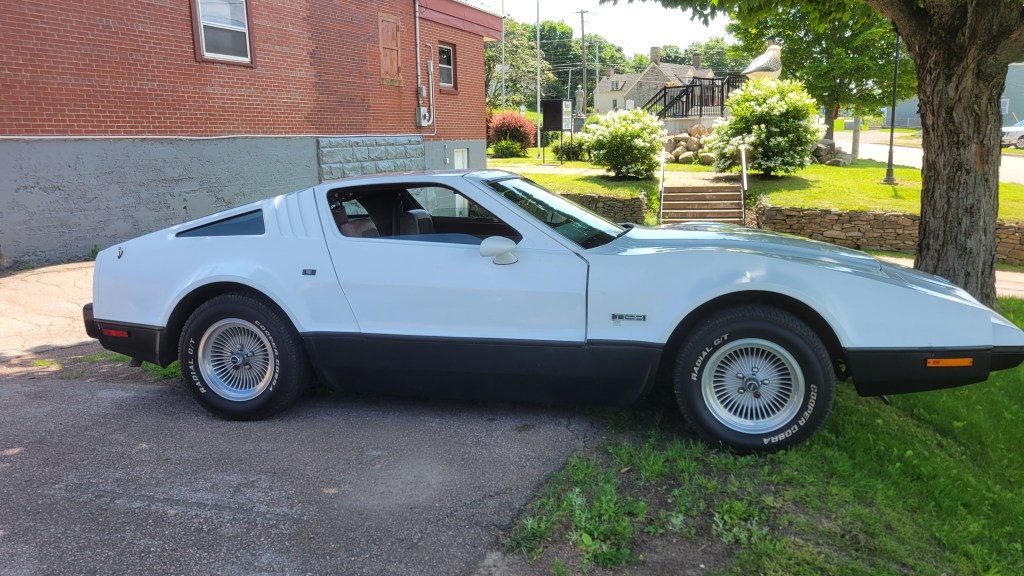
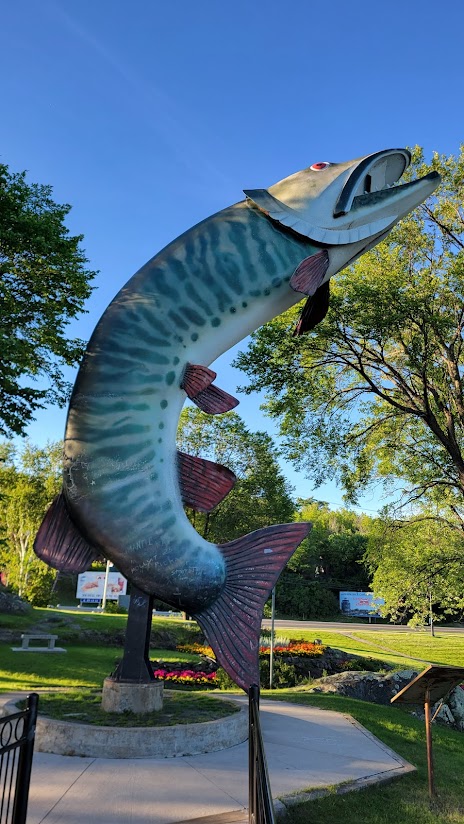
I’ve seen the giant goose in Wawa and Husky the Muskie in Kenora, so I thought I’d stop and take a closer look. Even more impressive was the Bricklin parked in the lot.

Bricklin was a Canadian car manufacturer located in Saint John, New Brunswick, in 1974-75. With the help of provincial funding, they built about 3,000 cars, but problems with reliability of the acrylic body panels and other issues drove the price up and the car company soon went bankrupt. The car has a Chrysler slant 6 engine, a Datsun tail, and other parts from Chevrolet and Opel. It’s crowning feature are the winged doors that open upwards. I got talking to a young lady out front and accidentally mistook it for a DeLorean, which must happen a lot. The DeLorean is another long-nosed, snub-tailed, winged car of yesteryear, made famous by the Back to the Future movies. This Bricklin’s in great shape, obviously without a spot of rust on it, and no blistering that plagued the early models.

I’ve said it before, this is what I love about solo touring. I can stop whenever something catches my eye, meet people, and explore. It turns out that I’d stumbled upon the Dorchester Jail, the second oldest jail in Canada and the only privately owned provincial jail and Canada. It’s also the only privately owned Death Row in Canada and was the location of the last double-hanging in New Brunswick—the Bannister Brothers. That reminds me of a skull I once saw at Eldon House in London, Ontario, that was from the first hanging in Canada. Actually, it was the first two hangings because the rope broke on the first try, which leads me to wonder if the executioner apologized to the murderer for having to put him through his execution twice. Hmm . . .

Dorchester Jail

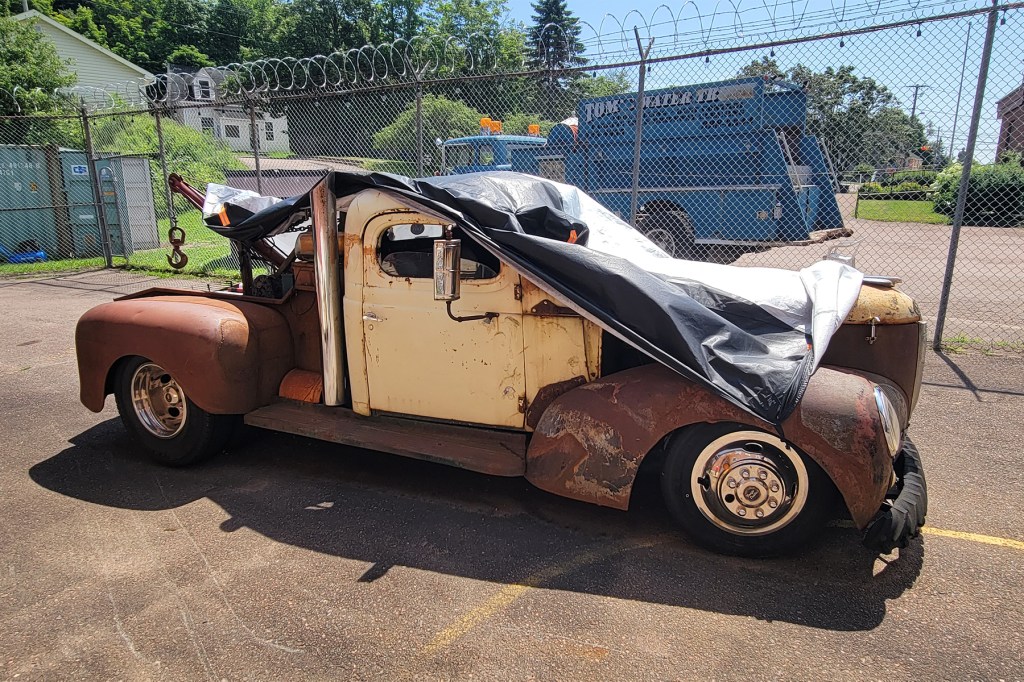
I’ve never spent a night in the clink but if I ever want to, I know where to go. The jail has been converted to an AirBNB and you can enjoy a night in a cell for a moderate price. I don’t know if that includes use of the courtyard during the day because there was at the time of my visit another interesting vehicle there beneath a cover.

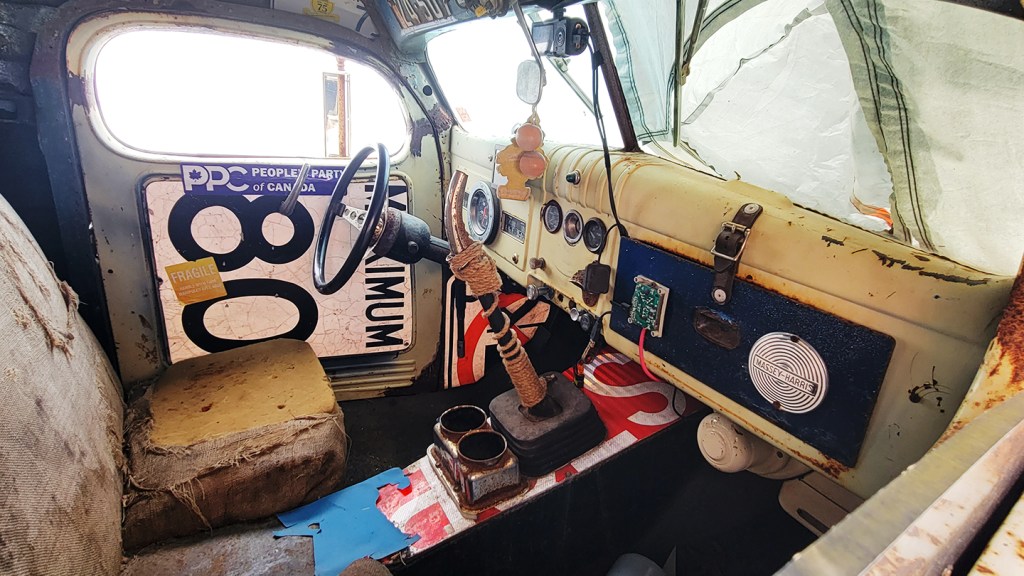
This bad girl (the truck, not the woman, who graciously lifted the cover to show me) had a bit more rust on her than the Bricklin. Love the tractor tire front bumper, almost as good as the Bricklin’s featured “energy-absorbing” bumpers.

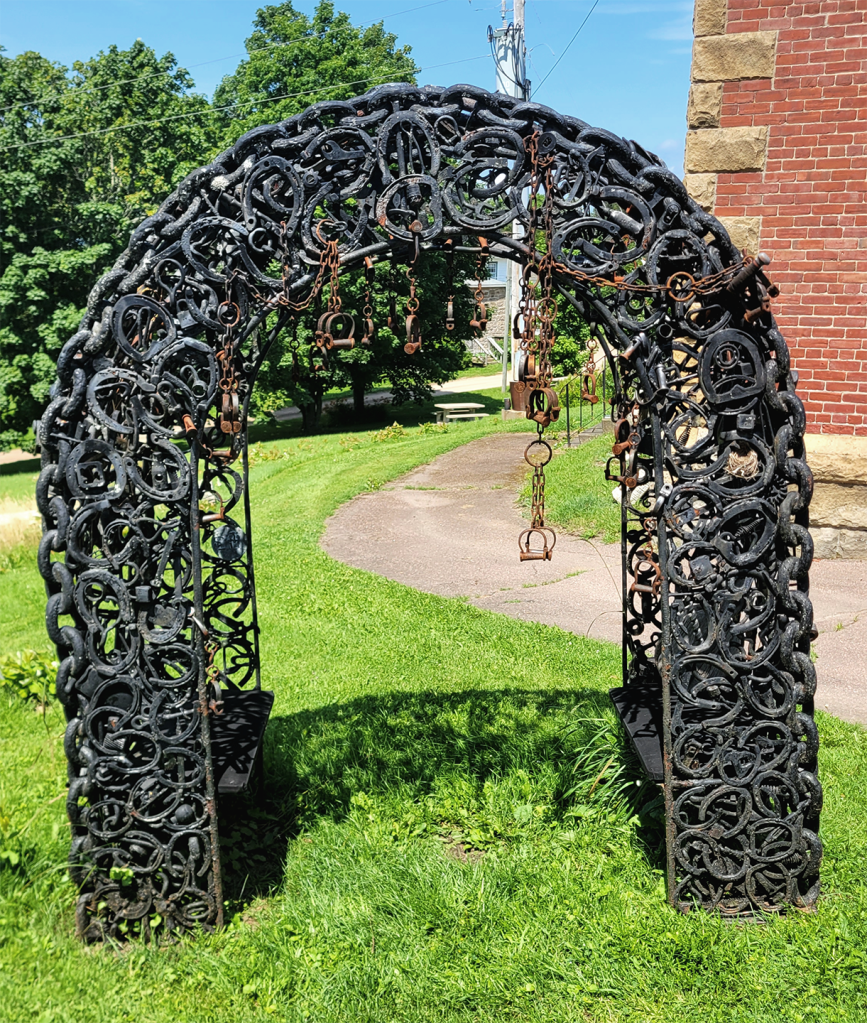
Also of interest was this metal arch that was constructed from horseshoes, locks, car parts, tools, chains, and prisoner shackles. And amid it all—I don’t know if built or placed—was a bird’s nest.

This place was a feast for eyes, but I had miles to go before I sleep so had to push on. I soon was passing through Saint John, NB (not to be confused with Saint John’s, NL), stopping only to fuel up and caffeinate up because it looked like it was going to be a late arrival at my destination, Cobscook Bay State Park in Maine. By the time I arrived at the border, it was already dusk.

Are you nervous when crossing borders? I’ve crossed the US-Canada one so many times I don’t get nervous anymore, but I’m always cautious about what I say because I know the power these officers have. I knew they were going to ask me the usual questions and was prepared. Our conversation went something like this:

Customs Officer: “Where do you live?”

Me: “Montreal.”

CBP Officer: “What is your purpose entering the US?

Me: “I’m on my way back from Newfoundland and just passing through.”

Officer: “Are you travelling with anyone?”

This is where things started to go sideways. I had pulled up alone so wasn’t expecting this.

Me: “Well, I was travelling with my wife, but she flew back early from Newfoundland for work and I’m riding back alone.”

Officer: “Are you meeting anyone in The United States?”

Another unexpected question. Now I should know better than to say more than is necessary, but I’m honest to a fault. I did, in fact, have plans to meet up with a reader of this blog who lives and rides in Portland, and we thought it would be fun to get in some riding together while I was passing through. So I answered honestly. I thought, better safe than sorry.

Me: “Actually, I’m meeting a fellow rider in Portland, and we’re going to go for a ride together. She’s a reader of my blog.”

This answer did not seem to help, and now I was beginning to feel more sorry than safe.

Officer: “What is your relationship with this person?”

He clearly wasn’t familiar with motorcycle culture. Or blogging.

Me: “I write a blog about my motorcycling. I’m meeting someone who is a reader of my blog. She lives in Portland and, since I will be passing through, we thought we’d meet up for a ride together.”

Officer: “So, it’s . . . like a date?”

I felt like I was digging myself in deeper. He clearly had missed the reference to my wife. Some jokes came to mind that might have lightened the moment, but I know enough never to joke with these guys. Sometimes I think that a lack of humour is a job requirement. I felt like I was at the door of a speakeasy and chose my words carefully.

Me: “No, I’m married. I’m meeting a fellow motorcyclist in Portland to go for a ride together. That’s all.”

I was tempted to enlighten him about the communal aspect of motorcycle culture, about blogging and the writer-reader relationship, or to provide a short romantic history of my marriage, but like I tell my composition students, sometimes less is more. The ball was in his court. By now the notorious Maine mosquitoes were out and finding their way up my nose. I looked him straight in the eye.

Officer: “Have a nice night,” he said, and handed me back my passport.

I felt like I’d just hit another tar snake and was happy I still had some of that bourbon in my pannier.

An hour later I had my tent set up, food on, bourbon poured, and a fire lit. That night I wandered down to the water to get out from under the trees of my campsite. The sky was huge and clear, and it was a perfect night for stargazing. I lay on my back and used a great little app called SkyView (Android and Apple) to pick out the constellations.


Highway 1 Maine is a secondary highway that follows the shoreline almost all the way into Portland, passing through quaint towns along the way. I took it west-east in 2017 when I did my first tour out to Cape Breton and The Cabot Trail and my plan was to do it again the other way this time, dropping down into Bar Harbour en route, which I’d heard a lot about. The cost of secondary highways is always time. It was very hot and the going was slow, slower than I remembered. Still, Google Maps was telling me that Bar Harbour is only about a 2-hour ride from Cobscook Bay, so I thought it would be perfect for a mid-morning coffee stop.

I took a short detour out to charming Lubec, ME.

I wouldn’t know because I never made it. As I was coming down Highway 3 south, I got stuck behind no less than four trucks—a hydro truck, a cement truck, a transport truck, and a dump truck—with no chance to pass. Volume got heavier and slower and it got hotter as morning developed into midday. At the same time, what I was seeing wasn’t particularly appealing—clam huts, lobster shacks, pirate-themed mini-putt, hotels, tour busses, hunting and fishing stores—and I began to wonder why I was there, crawling along in a wake of diesel fumes. There’s a national park there and I’m sure the coastline is impressive, if you can get to it, but whatever natural beauty might be drawing all these people to this region is so buried beneath layers of tourist development that I didn’t want to spend any more time trying to find it. As the traffic slowed to a crawl I said “Fuck it!,” pulled a U-turn, and got the hell out of there.

Now I was running late (am I never?) so had to abandon my plan to continue along Highway 1. Google Maps was saying the fastest way to Portland was the interstate, so that’s what I did. After the frustrations of the secondary highway, and given the heat, I was happy to ride at speed. I decided to get my coffee from a Dunkin’ Donuts at one of the exits and met there, by chance, Eric Foster, whom I had written about in a previous post. He’s the guy who crashed on the Trans-Taiga and was rescued by local trappers. On this day he was riding the newer Tiger 900 and had seen my 800 XC, the same as the one he crashed, so jumped off the highway when I did to have a chat. Small world. I’d never met him in person but it now made sense; I remember he lives in Maine. He told me Bar Harbour sucks during the tourist season. Good to know.

I was down to my final night of the tour and thankfully my friend, Berry, had something special planned for me. Berry and I started corresponding a few years ago. At the time, she also rode a 650GS, so found my blog that way. Soon our online conversations turned to other things like diet, politics, and literature, but motorcycles are the thing we usually talk about. When she decided to upgrade her bike, I was honoured that she sought my opinion on the Suzuki V-Strom 650, which of course I endorsed. So when I knew I’d be cutting back through Maine and passing close to Portland, we decided to try to meet and get in a ride. She went one step further and graciously offered to put me up the night in her beautiful house. This meant not only that I was spared setting up camp one last time but also that I could see a little of Portland. She took me on a tour of the old town out to a seaside restaurant where we could sit out and eat seafood while hearing the crashing surf from where it came. It was a fitting end to my Atlantic tour.

We did get in that ride. The next day, Berry followed me part of the way up toward the Canadian border, or rather, I followed her. I figured, let the local lead and choose the route. Here we are riding Highway 153 which, as you can see, is pretty nice.

Eventually, Berry split off at Conway and started heading back toward Portland. It was nice meeting her and putting a face to words, and I’m sure it won’t be the last time we meet. In fact, the NEBDR ends in Maine, so it may be sooner rather than later.

Berry and her new Suzuki V-Strom 650

There was one more good section of road remaining on this tour and it was The Kancamagus Highway (NH Rte 112) from Conway to Lincoln. Rever lists it as a G1 road, which is one of America’s Best Roads (Epic Incredible Roads)—their wording—and I would agree. After a rip over the mountain range, you get to decompress as the 112 winds its way parallel to the Pemigewasset River through the village of Loon Mountain, where I visited for the New Hampshire Highland Games for my very first overnight adventure tour, back in September 2016.

At a certain point of every tour, you ride back into familiar territory. It’s always a very noticeable sensation for me. After exploring for weeks and seeing everything for the first time, eventually, usually in that final day, you ride a road you’ve ridden before and remember the first time you rode it. You might even recollect your excitement or heightened attention at seeing it for the first time, and I guess that is why I like to travel. It’s that curiosity about the world that comes alive when you are experiencing the unfamiliar. Time slows, days are long and full, your senses fully alert, your mind constantly thinking, processing information, acquiring knowledge, keeping you safe. I can’t see myself spending vacation time at a resort; I think I’d get bored in two days.

The motorcycle is the perfect mode of travel for people like me who like to experience something new. And Newfoundland was certainly new (pun intended). I don’t think I could get bored with it, and I’m sure I’ll be back sometime in the future, God willing. In the meantime, it’s going to be very interesting to try a different type of touring altogether next summer when I do the BDRs (MA and NE, back to back). I’ve never done two weeks+ of constant off-roading, so there will be new technical and athletic challenges for me. At the same time, I’ll be exploring the Appalachian Mountain Range from West Virginia to the Canadian border. If you want to follow along, you know what to do.

What are your plans for the coming season? I always like to hear from readers so drop a comment below.

Lunch at The Blue Donkey and up through Smuggler’s Notch to the border. In total, I was on the road 25 days over just about 10,000 kilometres (6,000 miles) for an average of 400 kilometres per day.

Newfoundland’s Rich Aviation History

After dropping Marilyn off at the Saint John’s airport, I ride solo back across the island, stopping at some aviation landmarks along the way.

It had been a great 17 days together on the bike through Gaspé, PEI, New Brunswick, Nova Scotia, and Newfoundland, but Marilyn had to be back for work so off she flew. Now I was on my own again, and it took me a few hours to adjust; I’d become so accustomed to having her on the back as company.

I had to cross the island again back to Port aux Basque and, as some of you know, I’m an aviation enthusiast so decided to make some detours to historic landmarks en route. The first was the airfield in Harbour Grace where Amelia Earhart took off on her solo flight across the Atlantic in 1932. On the way there, for my mid-morning break, I stopped at the Tim’s in Bay Roberts for coffee and some minor maintenance.

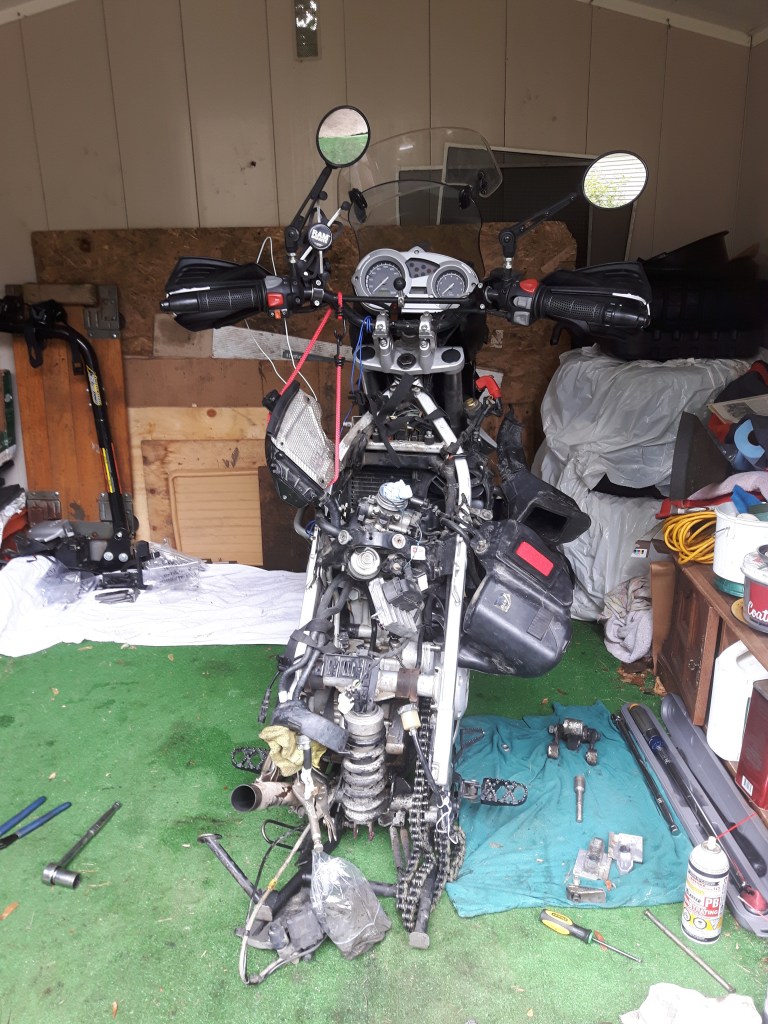
Earlier in the day, I’d noticed one of the Tiger’s two headlamps burnt out. I had a spare on hand and it was a quick fix in the parking lot. One of the things I like about the Triumph is that it doesn’t have all that fairing at the front like the old Beemer. Changing a light bulb on that machine requires removal of the windscreen, the headlight guard, the front flashers, the side panels, the instrument panel, and finally, the fairing. On the Tiger, you simply twist to remove the cover. Nice!

With that done, off I flew as well, until I realized I’d left my hydration knapsack hanging on the back of a chair at Tim’s. Doh! As I rode back toward it, I pondered the chances of it still being there in small-town Newfoundland compared to if I’d left it unattended in Montreal. It took me maybe 15 minutes to get back to the coffee shop and to my relief but not surprise the knapsack was still there. Phew! It had some valuables inside and I would have been very annoyed if I’d lost it.

The first thing you see upon entering Harbour Grace is a statue of Amelia next to a Douglas airplane named The Spirit of Harbour Grace (see banner image above). The donors don’t win the Pulitzer for the most original name. The park of the same unfortunate name contains other items of interest, such as a replica of the famous flight log. There’s also a tourist info centre and the nice young student employees directed me up to the famous airstrip, which was really the only reason I was there.

When you arrive, after a few kilometres of gravel, you see one of those signposts pointing distances to destinations, only this one denotes famous flights in and out of the airstrip. You can see Earhart’s 3,132 kilometre flight to Culmore, Ireland, in 1932. Apparently WWI American ace Eddie Rickenbacker also used the airfield in 1936. The unassuming little clearing slopes slightly downward heading west, as planes naturally would take off into the oncoming easterly wind. Earhart would have had to turn 180 degrees after take-off before heading out over the Atlantic toward Ireland.

By the time Amelia attempted to circumnavigate the world in 1937, her legacy was secure. When she disappeared under mysterious circumstances on June 2, she became a legend. Like the Titanic, she took on a mythical significance larger than her physical accomplishments, which were numerous. The fateful end became one of the great mysteries of the modern era, taking us into the realm of imagination and the great unknowns of life and death. The grainy, black and white video footage we have of her does not seem to match the iconic status of what she’s come to mean, but reminds us that she was, in the end, human just the same.

If you are reading this on your phone, use landscape orientation.

DEAR GEORGE: THE LOST LETTER

I’ll admit my big break came
from my looks. You said
when I walked into your office, you knew
you’d found your woman. Lucky,
I guess, how much I looked like Lindy,
although I never liked the nickname.
No woman likes to be compared
to a man. They said I even
moved like him, shared the same
DNA and fear of fame. I can’t complain,

but it wasn’t easy climbing into that plane
with a drunk, putting my life in his
trembling hands. I saw the bottle
tucked behind his seat and would have
thrown it out the hatch but knew
from Daddy how that ends. Instead,
I helped carry him to the dock, managed
our “personnel problem” as best I could.
They didn’t let me fly, just the easy
bit over land, and that’s why

when I did it myself, solo, it was
like a single finger held up to the world
as if to say, “Women can do this too.”
Nobody thought I could, even you.
And more. Records fell like ticker-tape,
didn’t they—altitude, distance, time
merely obstacles of the mind, my body
just another obstacle, an accident of sex,
not tomboy but woman who
only wants what’s fair and true.

Don’t patronize me! I said I wouldn’t
fly the derby if the girls and I
started east, the guys getting the harder route
over the mountains, and meant it. When
they kicked us out of the Bendix Trophy
I’d had enough; they could find another
to fly their starlet to the race. Even in marriage
I only ever asked for freedom. The note
I wrote on our wedding day said I’d never claim
anything from you and asked the same.

So, dear, if you’re reading this you know
I did not make it home. Maybe it’s for
the best; I was only ever afraid
of growing old, as most women will attest,
and preferred to go in my plane.
And since we’ve always been this honest,
there is one thing more: the rumours
that I was pregnant when I flew
round the earth’s belly are true, but
the baby wasn’t yours. I think you knew.

Love,

A.E.


© 2022 Kevin Bushell

There are many theories as to what happened to her, including that she and navigator Fred Noonan crash landed on Gardner Island, south of the intended Howland Island. Human bones and artifacts, including a sextant and a ladies compact, were found, but the bones, now lost, by some accounts did not match her dimensions. As I write this, there are reports that an American team has found her plane 100 miles south of Howland on the bottom of the Pacific, about 5000 meters down. All we have is sonar imagery resembling her plane, but it will be very interesting to follow these developments.

Back in Newfoundland, the famous airstrip was unused and abandoned on the day I visited. The only person around was an older gentleman named Austin, who has built a house on the property adjacent to the airstrip. Maybe it was because I was on my own for a change and knew only I would pay the price for delaying, but I indulged in a conversation with this unusual man.

He has built several airplanes which he stores in a hangar beside the airstrip but has never obtained his pilot’s licence. He said he never had the time to complete the licensing process. He also built the house, but never connected it to NL Hydro because, he says, they charge too much ($50,000, if I remember correctly). He had all the windows of his house open on the day I was there to help deal with some mold that had developed in the recent hot, humid weather. He has a large generator that he uses when needed but hasn’t installed A/C or, I guess, a dehumidifier. He also has, sitting beside his house, an ancient wheel loader which, he says, he bought for dealing with “Snowmageddon.” It had a fuel line leak and he was just about to deal with that.

I felt for this solitary, older man with the unused airplanes, the moldy house, and the leaky heavy machine, and was tempted to get out my tools and give him a hand, but all I had time for on this particular day was a brief conversation. Maybe I shouldn’t feel sorry for him; he’s clearly staying busy through his retirement. I suspect there are a lot of these brilliant eccentrics in Newfoundland, and I was happy to have been given a glimpse into his extraordinary and fiercely independent life. We parted, not before exchanging names and promising to meet again.

My next stop was Gander, which we missed coming the other way. I’d heard of the famous airport, and frankly, had become a little tired of hearing about it, if you want to know the truth. Okay, it’s remarkable that they managed to host all those unexpected guests during 9/11, but really . . . a broadway musical? To be honest, I was more interested in seeing the main lobby as a time capsule of another era. (They have managed to retain the original decor.) I was also interested in the idea of all those famous people like The Beatles, Marilyn Monroe, Elvis, and Frank Sinatra having set foot in there. Oh yeah, and the Queen. Now we can add the adventure boots of 650thumper to that list.

The coin parking meter out front was cute. What a contrast from the Montreal airport where you pay $8 for 20 minutes or get 30 seconds in the drop-off zone before security start yelling at you.

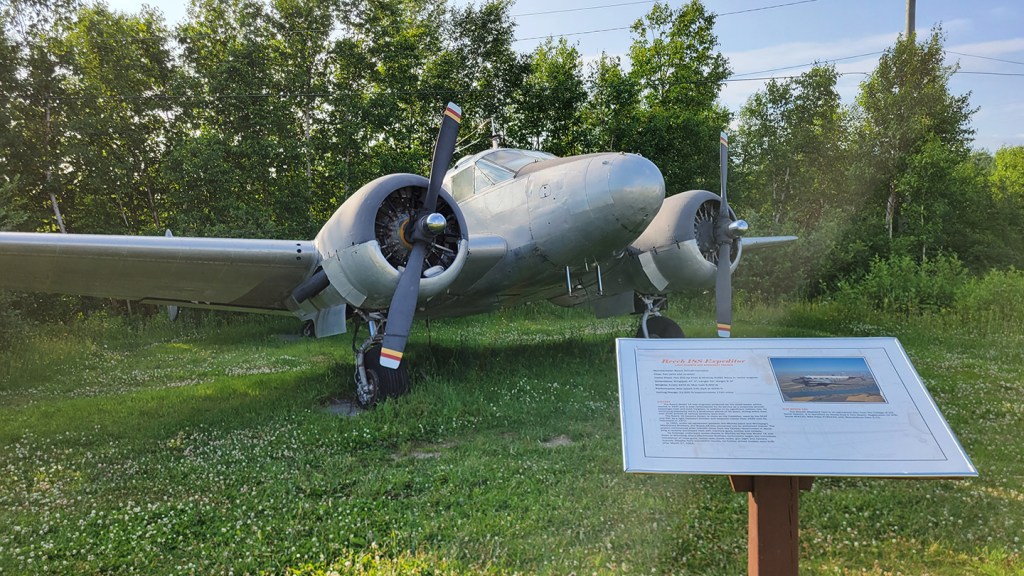
My third aviation stop of the day was The North Atlantic Aviation Museum, right across the street from the airport. By the time I got there, the museum was closed but that was okay; it was getting late and I only had time for a quick blow-through, so to speak, of the outdoor exhibits anyway.

There’s a lot more aviation history in Newfoundland I would have liked to explore, such as where Alcock and Brown took off (somewhere in Saint John’s) for the first ever transatlantic flight, but that would have to wait for another time. Half an hour later I was in Notre Dame Provincial Park in time to go for a swim before setting up camp. It had been hot and the swimming there was a welcome relief at the end of a long day.

The next day I got an early start in an attempt to beat the heat. It was easy highway riding and I settled in to several hours and put over 300 kilometres behind me, stopping only at the Canadian Tire in Corner Brook to top up my oil. I’d ridden 6000 kilometres since my oil change, some of it high revs in heat, and the sight glass told me the oil was a little low, so I added 200 mL to get me home. While I was eating lunch, it started to rain, and it rained, and rained, sometimes hard, for the remainder of the day.

I’m not spooked about riding in rain. I have good rain gear and trust my tires. I was ahead of schedule and the prudent thing would have been to pull off somewhere warm and dry and enjoy a good book, or to get to the terminal early and wait in the warmth there. Instead, I decided to spend the remaining time exploring Cape St. George off the south-west corner of the island.

My friends and wife will attest that my motto in life, aside from Life Is An Adventure, is “Pack it in.” Maybe because I recognize that time and life are so precious, I feel that an idle moment is a wasted moment. It’s an affliction I’m working on. In this instance, I was less successful and decided, despite the rain, to try to loop the cape. It would be a good challenge, and I like a challenge.

The lady at the gas station in Stephenville said it takes about two hours, so that would leave me plenty of time with buffer to get the rest of the way to Port aux Basque for my night crossing. In the back of my mind was also the possibility that there might be some good ADV riding out there, and there was. I ventured off the pavement down to the water for a photo op.

I made it out to Boutte du Cap Park, but shortly after rounding the point and starting back on the west side, the road climbed into fog. Now I was forced to ride at 55 km/hr and was at risk of missing my ferry, not to mention hitting a moose, so I bailed. This will give you a sense of what I was seeing just before I pulled the U-turn.

And this will give you a sense of the cold, wet ride back along the coast to the ferry. I know these are boring so I’ve kept them short.

At the ferry terminal, I changed into dry clothes and couldn’t resist getting a hot coffee, a decision that would come back to haunt me later. I normally am not affected by caffeine, even late in the day, but that night, in unfamiliar surroundings, on my own, with distractions all around, I think I got about an hour of sleep. I’m a pretty solid sleeper, even in public places, but some A-hole front and centre of my section sounded like he was swallowing his tongue the entire night. I eventually got up and searched for another section, but each floor had several loud snorers. It really showed me how prevalent snoring and apnea are in our culture. I’ve recently been studying this through Andrew Huberman’s podcasts in which he talks about mouth breathers and diet and obesity and how these factors result in facial modification, sleep disturbances, and decreased quality of life. Something to consider.

It was a crappy way to end a wonderful first visit to The Rock. I was happy to dock and headed straight to Baddeck Cabot Trail Campground, set up camp, then took a power nap before hitting The Cabot Trail. But this is already pretty long, so I’ll save that iconic ride and the rest of my tour through Nova Scotia and Maine for another post.

Have you visited any of these sites? What is your connection to aviation, motorcycling, or Newfoundland. Feel free to comment below. I love hearing from readers.

Afterword

The Great White North

Some observations on Canada and long-distance touring

Most mornings, Facebook shows me a memory from this time last year, so over the past few weeks, I’ve been reliving my trip across the country, day by day. I’ve also been thinking about it as I write up these blogs, and now that I’ve completed the individual blogs on each segment of the tour, I thought I’d write some more general observations as I step back and reflect on the trip and the country as a whole. Here are five observations, in no particular order.

1. Six weeks isn’t nearly enough time to explore this vast country.

Canada is huge and the distances are immense. Our days were jam-packed, staying just one or two nights maximum at each place before we had to “push on” (a refrain on this tour). Yes, I crossed the country, twice, but far too much of that riding was on the Trans Canada and other major highways than I would have liked. In fact, it was only once I got off the freeway that I was able to experience any geography, history, and culture at all. My need to cover distance was in constant conflict with my desire to slow down and see more of what I was passing. I felt that this trip was really only an overview of many more to come, and I’ll need to spend six weeks in each province to really have a sense of the depth and diversity of Canada. So I’m going to consider this trip as exploratory; a deeper discovery of the country will have to wait until my retirement.

2. One tire cannot do it all.

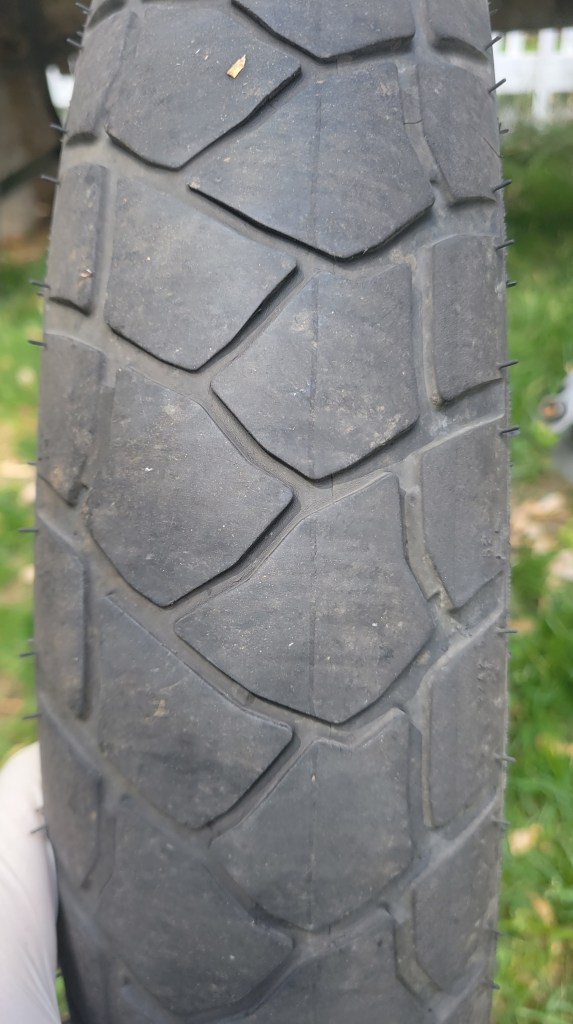
I decided to use Michelin Anakee Adventure tires, an 80/20 street/off-road tire, because I wanted something relatively smooth and long-lasting for all the asphalt I would be covering. In the end, I was able to do the entire tour without changing my tires—that’s all 20,000+ kilometres on the same tire. This is what the rear looked like shortly after my return.

As you can see, there’s still some good tread left in this tire. So if it’s longevity you are looking for, the Anakee Adventure is a good choice.

However, I was vulnerable when I went off road, particularly up The Dempster. If it had started to rain, the dirt would have turned into mud and I would have been in trouble. The problem is that there were actually two very distinct kinds of riding on this trip: largely asphalt to cover the miles, and sections of dirt or gravel when I could afford it. Ideally, I’d have shipped more aggressive off-road tires out to BC and put them on before heading north. This is exactly what many people do: ship TKC 80s to Dawson City and put them on before hitting The Dempster. A 50/50 tire like the Heidenau K60 Scout would have been another option, but the more aggressive tread on those tires is noisy on the road, despite the centre strip. (In fact, in the 650GS tire size, there is no centre strip, and the rear flattens quite quickly.) The next time I attempt The Dempster, I’ll be starting in BC and will use an off-road tire, even if it means burning through that rubber on the pavement.

Another problem with the Anakee Adventure tires is that they are quite vibey on asphalt. The hard compound down the middle of the tire results in long tire life but at the cost of vibrations. I used my Kaoko throttle lock whenever possible but my right hand still developed some numbness and tingling. I’m convinced that if this were my regular tire choice, I’d develop nerve damage. The long days, day after day, led to numbness that didn’t completely dissipate for months after my return, well into the off-season. In this respect, I might have been better off with a 90/10 tire like the Michelin Anakee 3 than the Adventure.

In sum, if I were to do it all again, with 5,000 kilometres to cover before I get to serious dirt, I’d go with a true street tire to get me across the country, then switch to a true off-road tire for playing in the dirt once I’m out there. Adventure riding is all about compromises, but when your safety is involved, there are no compromises: if you are doing any technical or remote dirt riding, use an aggressive dirt tire.

3. French and the Problem of Québec

Everywhere I went, I heard French. I sat in a diner in Smooth Rock Falls, Northern Ontario, and heard four older men in the booth next to me speaking French. I sat at the base of the Nisutlin Bay Bridge, Yukon, during a rest stop and had a conversation in French with a man who has been living in Yukon for over 20 years but whose native language is French. I walked into a supermarket in Whitehorse and heard two people in the produce section talking in fluent French. I heard French in every province, and I’ve heard it of course in Acadian Nova Scotia and elsewhere on the east coast. The French language seems to be surviving just fine outside of Québec, without any Bill 101, ridiculous sign laws, or punitive Office de la langue française.

I mention this because, last May, the Quebec government passed Bill 96, which essentially extends Bill 101 beyond high school to the college level. What this means, among other things, is that all students graduating from any college in Quebec will now have to pass a French language test. It’s really more than a test of basic competency; students have to analyze a piece of French literature and write an essay exhibiting that understanding with a minimum of expression errors. Errors are counted and, after a certain amount, the student automatically fails. It’s quite difficult, and many students who have been educated in French their entire lives struggle to pass this required exam. Now even anglophone and allophone students who have gone through an immersion program in which some, but not all, courses are taught in French will have to pass the same test. It’s not clear yet how they are going to do that, or what kind of resources will be available to help them.

The rationale stated by François Legault and his Quebec government for these Draconian measures is that French is disappearing, but to my knowledge they’ve never actually presented any specific data to support this claim. Many of my friends and colleagues—not all English Quebecers, I should add—think this bill has little to do with protecting the French language and everything to do with cultivating a victim mentality in Quebecers, perpetuating the idea that they are somehow besieged by a foreign power such as the Federal Government (the favourite scapegoat) or English North America (as if North America were all English). Some even theorize that restricting access to education in English—except for those who can afford to send their children to private school, where such restrictions do not exist—keeps working class Quebecers “in their place,” just as The Catholic Church did until the Quiet Revolution of the 1970s. Even if French is in trouble—and I’m questioning whether it is—forced unilingualism is not the answer. In Europe, learning multiple languages is the norm, not the exception, even in countries like Hungary, which is a linguistic minority within a larger demographic, comparable to Quebec. (Elementary students there have the option of Hungarian and either English or German. I know because my son did a year of school in Hungary when he was in Grade 3.) Learning French does not have to be at the expense of learning English. We can teach both languages effectively, if there is the political will.

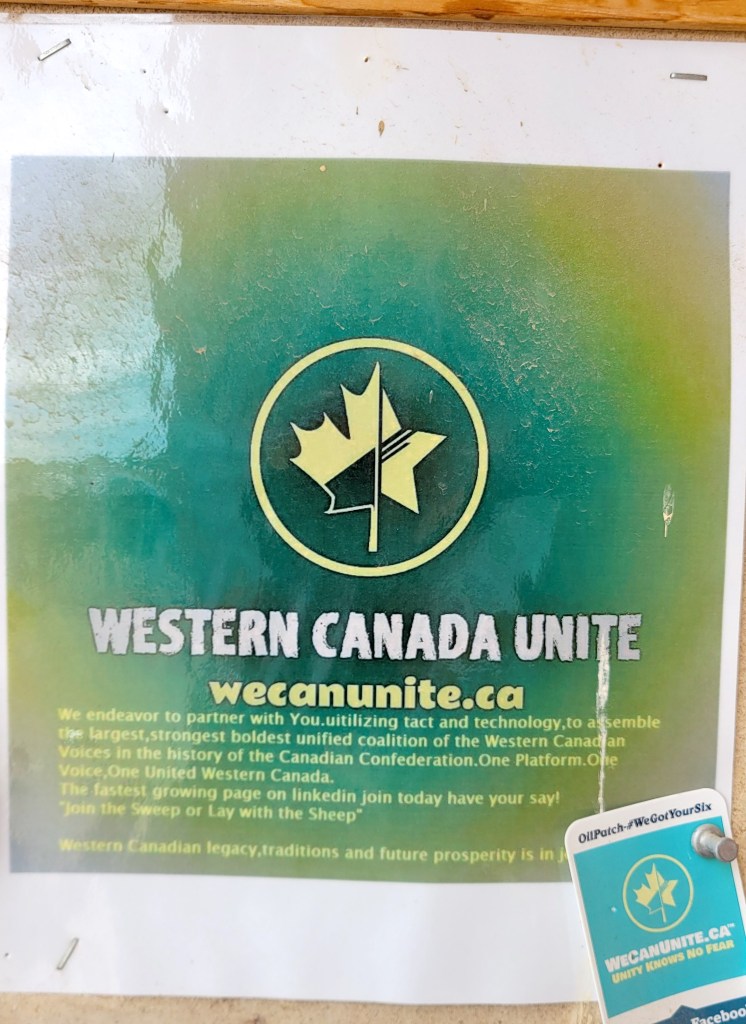
But the problem of Quebec extends beyond the issue of language. Quebec has managed to leverage the threat of separation successfully to entrench special privileges and special status within Canada. Many people might be surprised to know that Quebec gets more in equalization payments than all the other provinces combined. This is because, somehow, when those formulae were developed, Hydro Quebec was exempt from the calculations, making Quebec appear on paper like a have-not province. Removing Hydro Quebec, one of the province’s major employers, from Quebec’s calculations is like removing the oil and gas sector from Alberta’s. It’s time we opened up the equalization formulas and retooled them to make Quebec start pulling its weight in the confederation. There’s a lot of resentment out west towards the status quo, as evidenced by this poster seen outside an outdoor store in Northern BC.

The sense out west that Canada is run by Ontario and Quebec is nothing new. Remember that The Reform Party started out west, as did The Green Party. Quebec is not a have-not province and doesn’t deserve special status or extra money. It’s time that Quebec decides to be either an equal player in Canada or to get out and become the nation it clearly pretends to be by using language like “national” programs, “national” parks, and a “national” holiday.

And while I’m on this subject, I’ll add that I was upset that Montreal did not have a Canada Day parade (July 1st) this year, and rumour is that there won’t be a budget for it in the future either. The decision to cancel the parade had nothing to do with Covid, as there was a Ste. Jean Baptiste parade just a week earlier. I think that if the Quebec government thinks so poorly of its membership in Canada that celebrating Canada doesn’t warrant a parade once a year, perhaps it should give back some of the $11.7 billion it receives of the total $19 billion in federal funds transferred to provinces (latest available numbers). But of course it won’t. Under the current cozy situation, Quebec would be foolish to separate. It’s become dependent on the hand-outs to subsidize an inefficient economy.

When my wife was living in Alberta, if she got sick, she’d phone her doctor and get an appointment for later that day. In Quebec, you’re lucky if you have a doctor. Health care is a mess, our roads are a mess, and as a teacher, I see everyday the effects of chronic underfunding in our education system. Yet Quebec has the highest taxes in North America. Where is all that money going? The Quebec government has replaced The Church as the benevolent Big Brother taking care of “its people,” an argument developed more fully in a recent op-ed piece by Vanessa Sasson. I’ve put “its people” in quotation marks because 99% of the Quebec civil service is still white francophones, a statistic that hasn’t budged since the 1970’s. Corruption and a bloated, inefficient civil service are draining the public purse; there are simply too many people at the trough.

Another controversial bill recently passed here in Quebec, Bill 21, targets religious minorities. It prevents anyone in the public sector, including doctors and teachers, from wearing religious symbols, as if those items would somehow influence or prejudice their work. For Christians, this isn’t a significant problem, but for many Muslims, Sikhs, and Jews, they must choose between their religious garb or their careers. No one should have to make that choice, certainly no one in the Canada I know. The standard line given by Legault to defend Bill 21 is that “the majority of Quebecers support it,” an argument that has at its heart the logical fallacy known as Appeal to Popularity (sometimes called Appeal to Ignorance.) I teach this fallacy by reminding my students that at one time slavery was the popular economic model. The fact that it’s popular doesn’t make it right.

Here’s a confession: in the last provincial election, I voted for Legault’s CAQ party. I was tired of paying half of my wages to the government and still having unacceptable roads, health care, and education standards. I was tired of the corruption in the construction sector that has held Montrealers hostage for decades. I’d heard of scandal after scandal at all levels of government, and hoped that Legault, a co-founder and CEO of Air Transat before going into politics, would be a fiscal conservative with the strength of character to do some much-needed restructuring of the Quebec economy. But he hasn’t done anything of the sort. Instead, he’s focused almost exclusively on a social agenda to solidify his grip on power, playing to his rural base and exploiting the most repugnant racist and xenophobic aspects of Quebec society.

What has Prime Minister Trudeau done about this wave of racial nationalism gathering in Quebec? Nothing. Absolutely nothing. He needs the Quebec vote too much in order to cling onto his own weakening power. So while he talks a lot about values and morals and draws a hard line against those he claims hold “unacceptable views” in Canada, he allows the Legault government to crap all over the Charter of Rights and Freedoms his dad helped draft and ratify, unwilling to protect religious and linguistic minorities in his home province.

If he had reformed the electoral system, as promised, and made every vote count, regardless of where you live, he would not be so beholden to “the Quebec vote.” But of his three major election promises—reform the electoral process, reform the Senate, and legalize pot—he’s managed to legalize pot. The other two promises were dropped once he learned, after studying the matters carefully (at considerable expense to taxpayers), that they were not politically advantageous to him and his party. Prime Minister Trudeau talks a lot about social justice, equity, and protecting minorities, but he is essentially—we must remember—a drama teacher. He’s acting, and these days there isn’t much genuine coming out of his mouth.

I don’t usually get this political in my blog, and I don’t really want this place to become heavily politicized. But I love this country, and if I can’t get off my chest here, in a blog reflecting on Canada, what I think are some problems we are currently facing, then where can I? And I feel that, having lived in Quebec since 1990, I’m qualified to give some constructive criticism of it. No one else is. You don’t have to agree with my observations and comments, but like in my teaching, I say if we can’t have civil and open discussions about difficult issues, then our problems run deeper than the health of the French language or the status of Quebec in Canada. What do you think? Feel free to drop a respectful comment below.

4. The Orange Summer

At Cathedral Grove, Vancouver Island

All summer long I saw orange garments hanging randomly in trees, and church steps lined with children’s shoes and toys. Some people have referred to last summer as The Orange Summer, a time of reflection and reckoning in the hope of eventual reconciliation. We are very early in this process and much has still to be determined with regard to what a reconciliation would look like. I don’t really have any suggestions, nor is it really my place to make them. But I believe that all relationships are healed through communication, so let’s start there. I believe we will get further faster by talking than pulling down statues. What is clear is that there is an enormous amount of pain out there to be addressed. I thought it was à propos that on my final day of riding, as I rode the 417 down from Sault Ste. Marie, I passed on a stretch of that highway a small contingent in orange T-shirts walking with police escort at the side of the road. A sign on a support vehicle read “Walk of Shame.” I recently saw another roadside sign, this one in Kahnawake, indigenous territory on the south shore of Montreal. This one read, “Legault, hands off our children,” a clear reference to both Bill 96 and residential schools. Are we making the same mistakes again—an authoritative government who think they know best what is right for your children? Have we learnt anything through years of suffering?

Let’s hope that the indigenous peoples of Canada get an apology from Pope Francis when he visits next week. It’s long overdue and a crucial element in collective healing. Then we need a thorough investigation into what happened to those children and hold those to blame accountable. There’s much more to address—difficult work of hashing out treaties—but it seems to me that would be a good start.

5. Heat and the Big Thumper

The 650GS did great the entire tour. I really can’t complain. With over 100,000 kilometres on it and fully loaded, it pulled Marilyn and me over those Rocky Mountain passes in the heat, and it was hot! The battery let me down a few times, but the mechanics of the bike are sound. It’s a great little adventure bike.

Are you sensing a but, dear reader? The 650GS is happiest under 100-110 km/hr, and much of my riding on this tour had to be >120 km/hr, just to cover those distances. This is a bike for secondary highways, not freeways. It is a classic European touring bike, but all of Europe is about the same size as Canada. Those days crossing the prairies, 6+ hours at 5,500 rpm, were not fun, and as I’ve said, I developed some numbness in my throttle hand due to vibrations. By the time I rolled back into the driveway, I was ready for something a little more powerful and a lot smoother.

I also found it difficult to regulate oil level during this tour. It’s difficult with the dry sump system at the best of times, but the varying temperatures and types of riding on this tour made it all the more challenging. The extreme heat, and riding at high revs for hours, led at times to oil rising so high in the reservoir that it spilled into the air box, where it leaked down the side of the engine and baked onto the skid plate.

Shake and bake

It’s possible that I over-filled the bike, but rather, perhaps I was just asking it to do a little more than it was designed to do. I’ve been pushing this bike beyond its limits on and off road.

People have since told me that, for a tour like this, I should have used a 1200 or 1250GS. The big boxer cruises at 120 km/hr, and like its predecessor of another era, the Honda Gold Wing, it eats up the miles. I’ve considered getting a big GS, but I like the dirt too much, and my skills just aren’t capable of taking a 600 lb. bike off road. I’ve had my eye on the Yamaha Ténére 700 (T7) for some time, and the World Raid version looks just the thing for my long distance adventures. Unfortunately, once it gets to Canada, it will be probably close to $20G—a little beyond my budget for now.

I also considered an 800GS. This would be the obvious upgrade to the 650, with a similar Rotax engine and the fuel tank under the seat. But a parallel twin is also prone to vibrations at highway speeds; isn’t it basically a big thumper but with two cylinders? So I started looking at it’s main competitor, the Triumph Tiger 800. From everything I’ve read, the essential difference between the two bikes is that the BMW is better off road, the Triumph better on road. That inline triple has a lot of character and is silky smooth. With 94 hp, it has more than enough power for two-up touring. And if I am being completely honest, most of my riding is on road, even when touring.

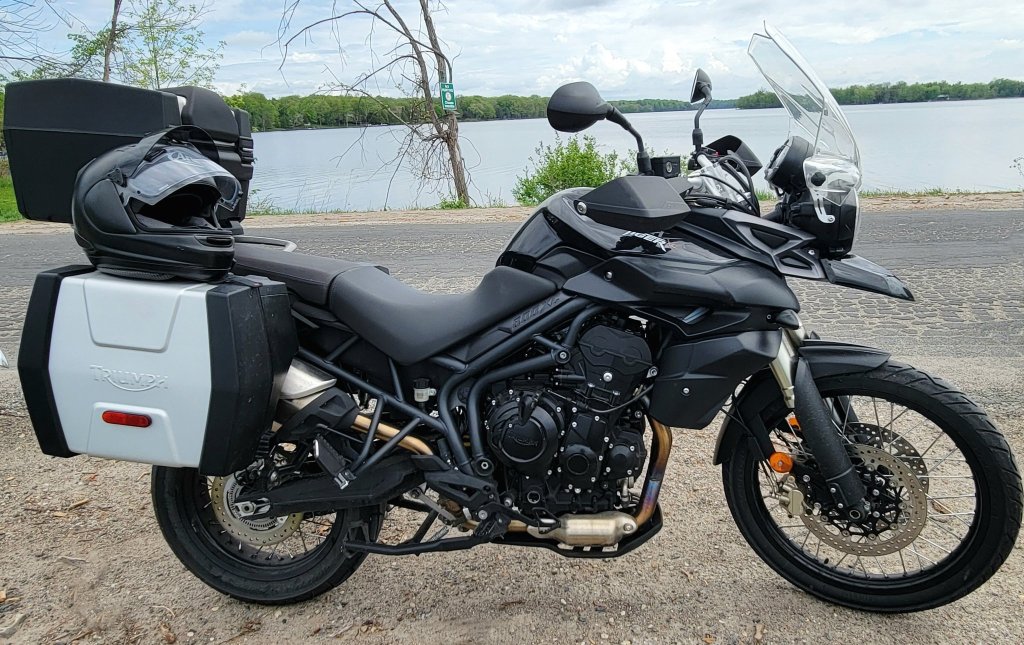
So here is my big announcement. After a lot of research, I’ve bought a 2013 Triumph Tiger 800XC. It only had 14,500K on it, so looks and feels practically new. It has been maintained well with regular service and always stored in a heated garage. I’ve put over 7000K on it already this summer and love riding this bike! I can’t wait to do some long-distance touring on it.

Don’t worry: the blog is not changing its name. I will continue to write about my adventures here, having built a little following. I’ve ordered crash bars and a beefier skid plate and so the slow conversion to off-road riding has begun. But for this summer, I’m happy to ride it stock with street tires and just enjoy this engine. It looks, feels, and sounds like a jet, so that’s what I’ve named it.

As for Bigby, I’ll be selling it when the market heats up at the end of season. I know that many potential buyers will be nervous about buying a bike with that many kilometres on it, but anyone who knows the 650GS knows that the engine is bullet-proof and that these bikes are over-engineered. There’s still plenty of good riding and adventures to be had on Old Faithful.

As I write this, we are about halfway through the summer. I’ll be taking the Tiger on day trips and perhaps a few overnights, but mainly just getting familiar with it. I’m planning a similarly big east coast tour with it for next summer and so will be getting some stronger panniers and doing other mods to set it up for adventure touring. I’ve received some queries from readers about my gear, so I’ll also be writing some blogs about what has worked for me. I hope you will stay with me, regardless of what you ride, as we continue the journey.

Starting Out

The most difficult part of any trip is leaving.

Imagine a trip across Canada by motorcycle. Imagine the problems you could face: dangerous wildlife, inclement weather, mechanical problems, security issues, fatigue . . . I faced all of these, but I can honestly say that the hardest part of the entire trip was leaving. Specifically, the biggest challenge came the weekend before my departure.

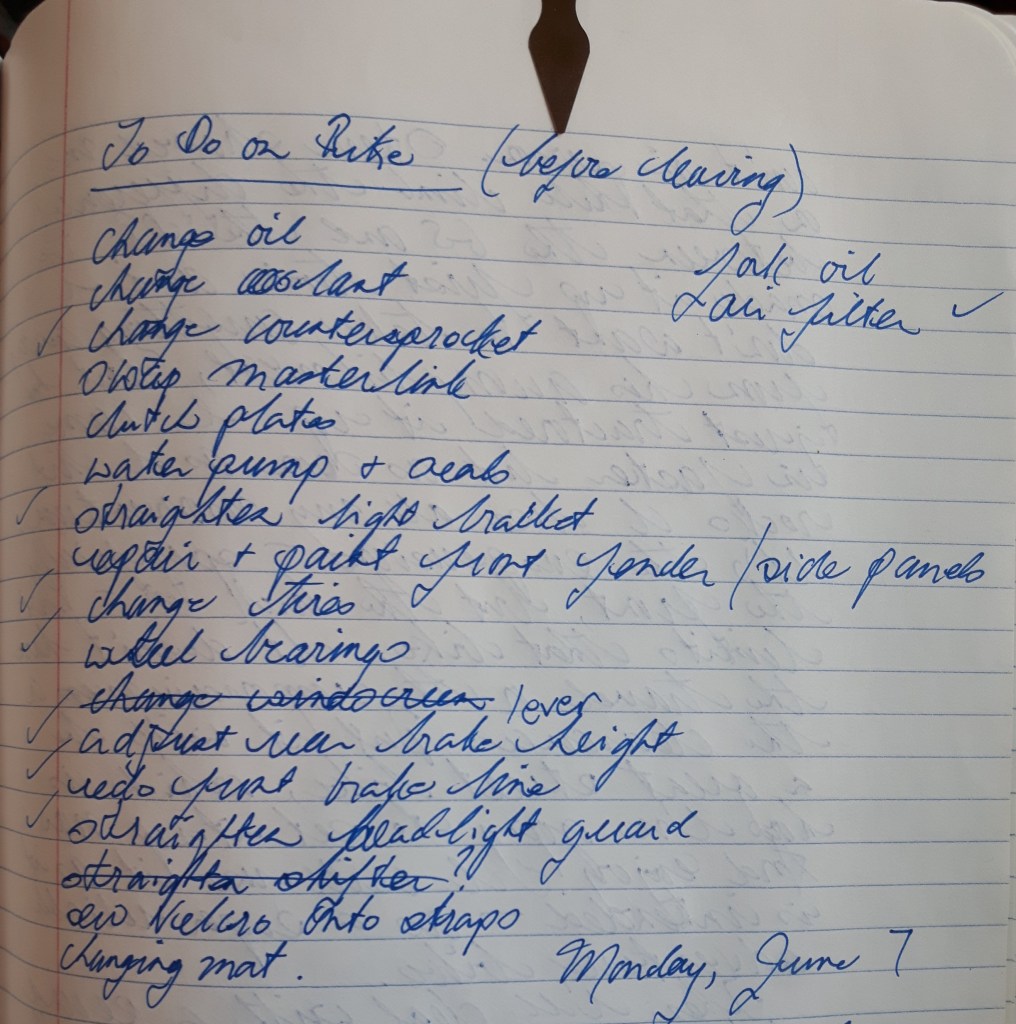
I had decided to change my clutch plates and water pump. The plates were the originals, with over 100,000K on them, and the water pump, which on my bike fails every 40,000-60,000K, had about 35,000 on it, so I didn’t want to risk it. I ordered all the parts at the beginning of June. I didn’t expect them to be in stock—they rarely are for my old bike—but two weeks to ship from Germany still left me plenty of time to do the required work before my July 1st departure.

I waited . . . and waited . . . and started bugging BMW sometime around mid-June. And waited . . . Perhaps because of Covid and the resulting supply change issues, or perhaps the shipping was slower than usual, but I actually got the new clutch springs and gaskets on the Friday before my Monday departure.

My wife, Marilyn, was stressed; I, concerned. Marilyn’s flight was booked so I was committed to getting to Calgary on the 7th for our leg of the trip together. I’ve had the clutch cover off this bike a few times, and knowing how to do a job is 3/4 of the job. It’s not difficult when you know what you’re doing. Everything was going pretty smoothly, which is something because there is almost inevitably a snag, until I went to put the clutch cover back on.

This is the most difficult part of the job. You have to turn the actuator so the splines are facing backwards to engage with the splines of the rod inside the cover, then carefully maneuver the cover on without either moving the actuator, which is on a bearing, or damaging the paper gasket, which has to line up on all the tabs on the crankcase. Since it would take at least two weeks to get anything new from Germany, there was no room for error.

Note what he says at 10:19

There’s a certain amount of tapping, knocking, shoving, wiggling, rocking, and general coercion that is required to get the cover on. It was not cooperating but one final thump with the heel of my hand and it snapped into place. I was home free! Then I noticed that the actuator was loose. It was more than loose: it wobbled. It was f’d! I’d f’d the bearing and it was an uncommon one that would be difficult, if not impossible, to find in Montreal.

There’s little that can overwhelm me, but this did. It put me flat on my back, literally. I’d been working on the bike in the backyard outside the shed and I lay back on the grass and gazed up into the sky, either to admonish or to plea to whichever god was messing with me. It was one of those moments when you can’t even think of your next move. You just have to breathe for a bit and let your emotions settle. The only other time I’ve been incapacitated like this in recent memory was when I broke a bolt trying to get a starter motor out from our old car. It was in the most inaccessible place on the engine and I knew, as I thought now, that I’d be set back weeks. I thought I’d ruined the entire holiday.

I’d been thinking of this trip since my teens, preparing for it since I bought the bike in 2015, and waiting an entire year when Covid kiboshed it last summer. Now everything hinged on whether I could get the bike running again, and I had 24 hours to do it.

What could I do but take the cover off and have a look. I managed to do that without damaging the paper gasket and saw that the bearing was okay; it had just been pushed out of the casing. I took everything up to my little workshop and drove the bearing back in. It was easy, actually. It must be a pretty loose fit, perhaps for hack mechanics like me; instead of damaging the splines, which clearly hadn’t lined up, it pushes out of the casing. I was back in business but still on a tight deadline.

More wrangling and I got the cover back on, this time with the splines aligned. I attached the clutch cable but a pull of the lever indicated now another problem. There was a ton of play! The clutch was not disengaging. Had I missed a clutch plate? Bought the wrong plates, which were not OEM? Was the clutch cable rerouted incorrectly? I put out an SOS on my user forum and went to bed. I had a pretty fitful sleep that night.

In the light of morning with a cooler head, I saw that I could tighten up all that free play with the adjuster on the lever. I had to back it out a lot, but there were still enough threads holding it firm. I was surprised that there was so much difference in height between the OEM stack and the aftermarket plates. If any adjustment were needed, I was expecting it to be tighter, not looser, as the old plates were worn. At any rate, the clutch seemed to be working now, and at 9 p.m., on the night before my departure, I took the bike for a test ride. To my great relief, everything was working well. I’d done a lot of other work leading up to this job, so maybe I’m not such a hack after all.

With the bike finally ready, “all” I had to do is pack. Marilyn was trying to stay out of it but couldn’t believe that I’d left packing for a six-week trip to the last minute. Fortunately, I’ve done this several times and pretty much know what I’m taking and how it all goes on the bike. The only snag was when I went to pack my top bag. I’d wanted to take my Mosko Scout 25L Duffle Bag but quickly discovered that my sleeping bag takes up about 1/2 of it, so I’d have to use my big Firstgear Torrent 70L Duffle. Damn! It extends out over my panniers and partially blocks me from opening them with the bag on. I think either a smaller down-filled sleeping bag or a midsize duffle or both is on my Christmas wish list this year. In the end, the only things I forgot were a wool toque and my down vest, which Marilyn was able to bring on the plane with her.

Final adjustments

It was a late night to bed and a late start in the morning, but at around noon, my wife and son met me on the driveway to see me off. As the bike was warming up, I cranked up the preload on my rear shock and tightened a few straps. I took out my pocket digital recorder and noted the mileage on the odometer. After final hugs and photos, I pulled out of the driveway and was off. The dream was becoming a reality.

If you want to follow along, click the Follow button.

The Epic Adventure: a preview

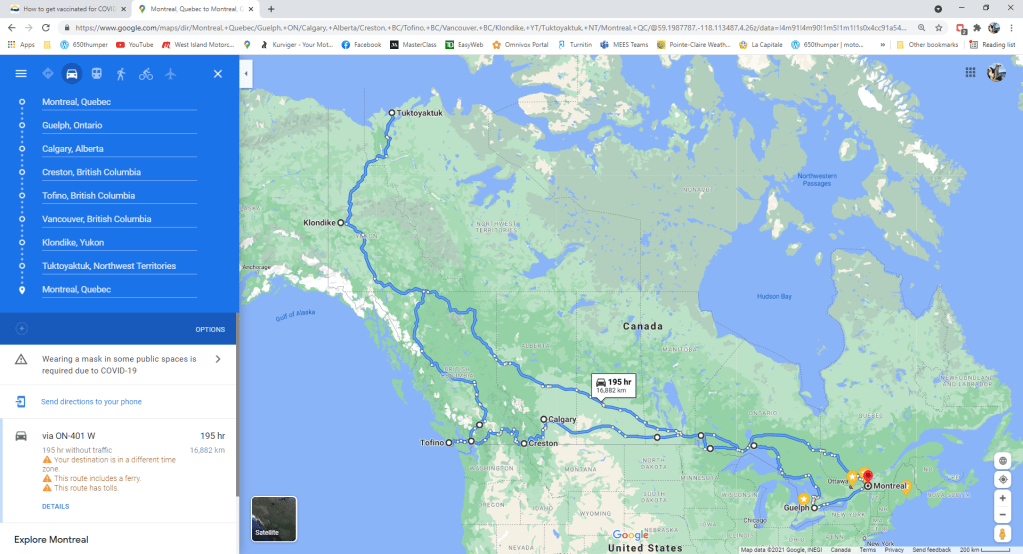
20,000 kilometres by motorcycle from Montreal to the Pacific Ocean, up to Yukon Territory, and back.

I’ve been home now for almost a month and I’m still feeling unsettled. Part of me is still in Dawson City, lying in my hammock next to the Yukon River. Part of me is still north of the Arctic Circle, washing my cookware in the Rocky River, just south of the Northwest Territories. Part of me is still in Northern British Columbia, lying in my tent at night listening to wolves howling in the distance.

My right thumb still has a slight tingle from some sort of neurological damage from the vibrations over thousands of kilometres, although I used my Kaoko throttle lock as much as possible. The bike hasn’t gone anywhere since I pulled into the driveway mid-August after riding 1,000 kilometres on the final day from Sault-Ste Marie to get home. After 19,500 kilometres, some of that in dirt up The Dempster Highway, it was a mess and in need of a lot of service and a thorough cleaning. Although I had the correct amount of oil in the bike, the heat and hours of riding at high-revs led to oil ending up in the airbox and, ultimately, down the side of the bike where it baked onto the engine. I’ve also changed the oil pressure switch that was acting up and changed the rear tire that was finished. But the big obstacle has been a frayed wire leading to an ignition coil that has left me waiting for OEM parts to arrive from Germany.

In the coming months, I’ll be writing about these memories and more. Here is a visual preview of what’s to come. If you want to follow along, click the Follow button and you’ll be notified of new posts. Join me as I relive this bucket-list tour across Canada and up into the Far North.