The Cabot Trail

Cabot Trail

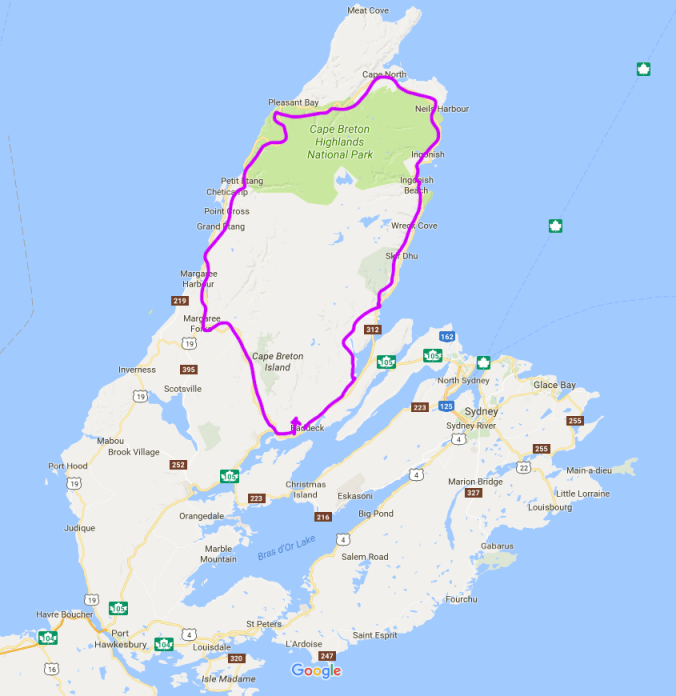
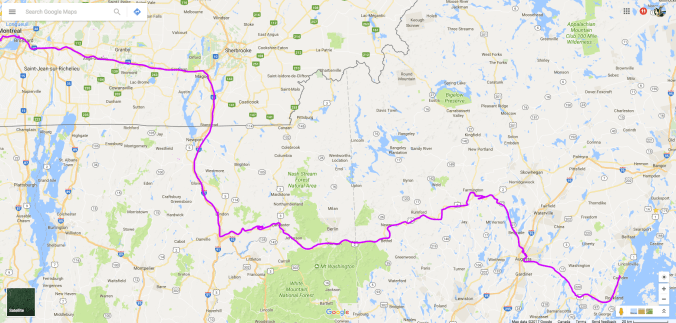
Imagine the perfect motorcycling road. What would it look like? It would have lots of twisties, of course, and probably some hills too. Curving hills, climbs and descents, to make it extra challenging. It might even have some switchbacks. And for scenery, it might have mountains, or some water, like an ocean. Well, the Cabot Trail has all of these, which is why it’s on every rider’s bucket list. 360 kilometres of climbing, snaking twisties with mountains on one side and spectacular ocean views on the other. It was my destination for this trip and worth every one of the 1,739 kilometres it took to get there.

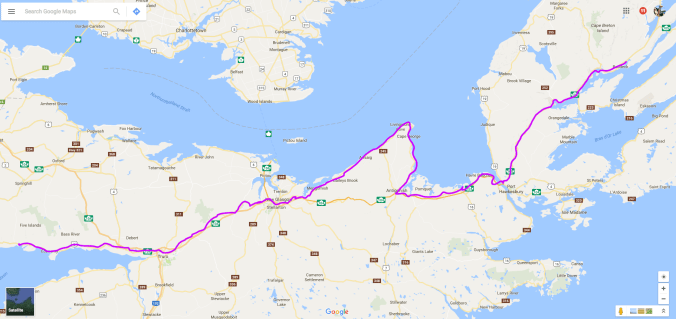
But I didn’t want to put all my eggs into one bucket, so to speak, so getting to the Cabot Trail was part of the fun. I left Deer Island at Lord’s Cove on the free ferry run by the New Brunswick provincial government and landed in L’Etete, NB. From there, I bombed through the drive-through province on the Transcanada and into Nova Scotia. I’d been reading Alistair MacLeod’s Island to get a sense of Cape Breton culture, and since almost every story has some reference to mining in it, I thought I should visit a mine. So my first stop in Nova Scotia was at Springhill, about 20 minutes past the border.

Springhill. The name is synonymous with disaster. There have been three major accidents at the mine: an explosion in 1891, another in 1956, and a bump in 1958. A bump is an earthquake that causes not the roofs of tunnels to collapse but the floors to rise up to the roofs. It results in overturned railway cars and crushed or trapped men. 75 men died in that last accident; 99 were rescued, including some who managed to stay alive for 8 1/2 days by drinking their urine before a rescue team broke through. The mine is now a museum; you can walk 400 feet into the shaft on a guided tour.

I found the tour moving, the place solemn, even sacred, and I didn’t take any photographs while underground; it just didn’t seem like something I ought to do. Besides, in this instance, a photo does not come close to reproducing the feeling of being down there. If you’re interested, there is always Wikipedia, which covers the three disasters well, with photos of the mine.

In a regular 8 1/2 hour shift, each miner had to extract and load 10 tonnes of coal. The coal is extracted largely by hand, with hand tools like a manual auger. The miner would press a steel plate strapped onto his sternum against the butt of the auger and turn, boring into the wall of stone in front of him. I’ve used a power auger to dig down into earth, and it’s hard enough, even with the advantage of leaning your weight into a softer substance. But to have to press into a wall of stone in front of you and turn by hand is almost unimaginable, and to do that for 8 1/2 hours is inhuman. Each miner has a lunch bucket and flask of water, both steel to prevent rats from eating the lunch, although they would still chew through the cork, dip their tail into the neck of the water jug, and get water that way. (Obviously no concern about double-dipping for them.) Despite these threats, the rats were appreciated by the men, and in fact were helpful in warning of disaster. On the day of the bump, the rats vacated the mine. Many of the experienced miners did not show up for work that day, but many younger ones did.

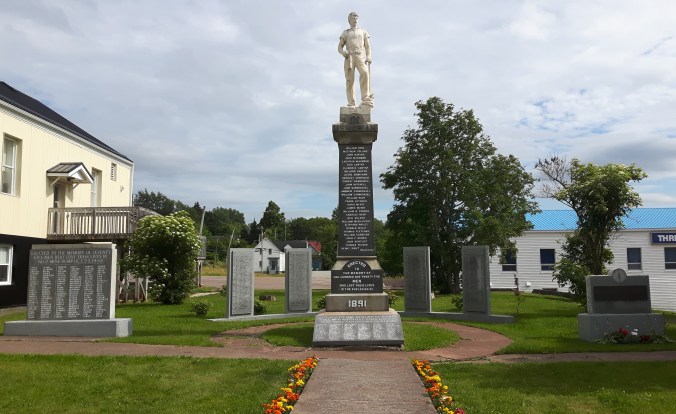
Given these working conditions, it’s not surprising that the first legalized trade union in Canada was formed in Springhill. I did take photos of the memorial in the centre of town, and a plaque commemorating the surreptitious meeting that established the union.

PWA


Miners Memorial

Those four tall memorials behind contain the names of “others who have lost their lives in individual accidents.” So while so much attention is placed on the three disasters, there were hundreds of other men who died in single incidents during a workday. Many men lost their lives from runaway railway cars; you’d have to jump out of the way or be crushed, and it was extremely dark down there. In fact, the guide turned out the lights for a few moments and it was unnerving. To be trapped down there in the dark would be horrific. He also showed the actual lighting conditions of the miners (the museum had added extra lighting for tourists), pre- and post-20th Century. Pre-century lighting was so poor you basically could only see the small section of wall in front of you on which you were working, nothing more. I’m glad I did this tour; it’s ironic that the most surprising and memorable moment of my trip was off the bike, down in that mine.

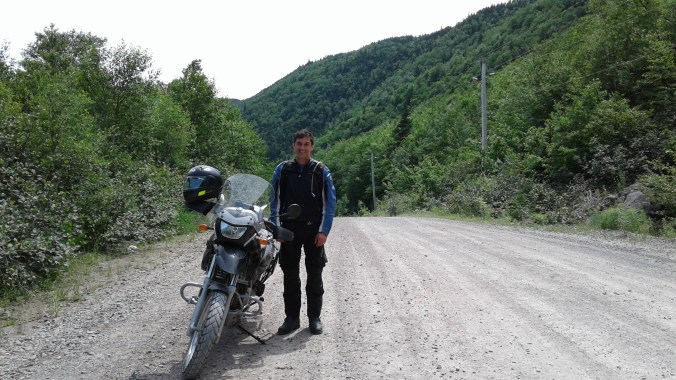
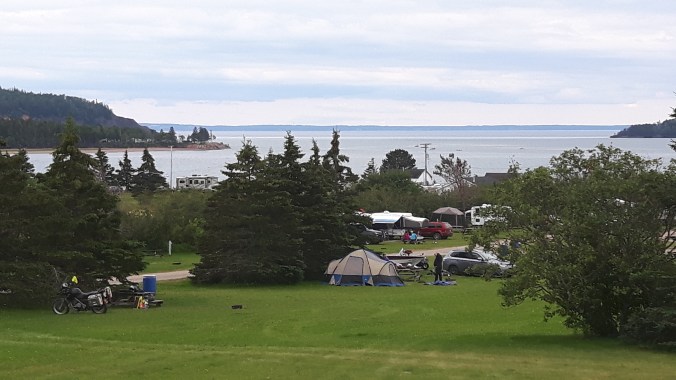
After that experience, the sensation of being on the bike was all the more liberating. Up in the sunshine, I sped to my next destination, which was 5 Islands RV and Campground. I say sped but, thanks to Googlemaps, which does not discern between a dirt or paved road, 16 kilometres of Highway 2 taking me there was gravel. But the view, once there, was worth every one of them.
5Islands Camp

If you look closely at the people beside me (in the centre of the photo), you’ll see a motorcycle parked behind that boat. I struck up a conversation with these nice people, a young couple travelling with their son. They live the other side of the bay, directly across that body of water, and told me of a nice route to get to Cape Breton. You go into Truro, then head to Bible Hill, where you can pick up Highway 4 (aka Old Highway 4) which snakes back and forth across the Transcanada Highway and is a lovely ride! I split off at the 245 instead of going through Antigonish and rode a section of the Sunrise Trail up to Cape George.

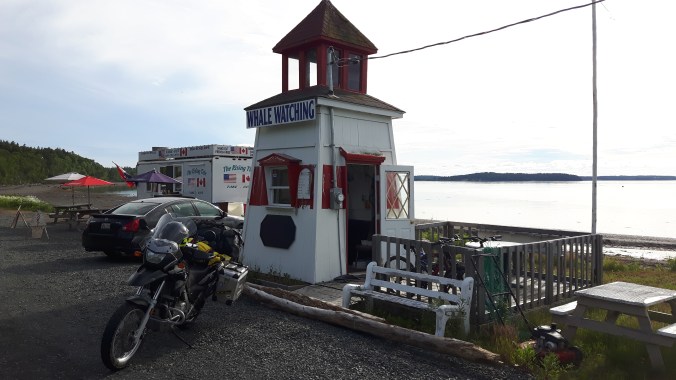
Cape GeorgeI’m not sure why it’s called the Sunrise Trail since it faces northwest, not east, but it’s pretty nonetheless. At one point, just west of Arisaig, I saw a dirt road leading off from the 245 and decided to go exploring. This is what I love about adventure riding and my bike—the ability to get off the asphalt when curiosity beckons. A short ride in led to a perfect lunch spot overlooking the ocean, complete with a picnic table to prepare my sandwich. Sunshine Coast Lunchspot

Like I said, with motorcycling, it’s not the destination but getting there that is the fun. But finally, I did cross the causeway and found my way to Baddeck Cabot Trail Campgound.

Baddeck CampI love this campground! My wife and I stayed here when we vacationed in Cape Breton two years ago, and she found it, so I can’t take any credit. It’s a very well run campground with wooded sites, clean washrooms, friendly service, a heated pool (nice after a long day of riding), free showers and, a personal favourite of mine, a campers’ lounge. I have to admit, I didn’t take to the lounge right away; it has a TV and seemed like what one tries to escape by camping. But this time round I was forced to sit there to charge my phone, and found it a pleasant place to write or read, especially on the evening it rained. I decided to stay an extra night at Baddeck.

The next day was it, the Cabot Trail. Now whether to ride it clockwise or counter-clockwise is a matter of some online debate, but to me it’s a no-brainer: doing it counter-clockwise means you have the ocean views, and hence the lookouts, on your right side. Doing it the other way would involve crossing traffic every time you want to pull off or continue. And there are some spectacular lookouts you don’t want to miss.CT Lookout

CT Lookout2

But I have to admit, I didn’t stop at many. To me, they seemed like a distraction to why I had come all that way, and stopping every 15 minutes would prevent me from finding a rhythm on the road. So I rode. Yes, it’s only 360 kilometres and will take you only an afternoon, but it’s pretty intense riding, requiring your full concentration if you are, like me, not interested in cruising. For me, part of the fun is challenging myself to really ride a road properly—not dangerously, I always leave 20% buffer—but on a piece of road like this, you don’t want to be poking along like on a Sunday drive. So yes, that involved some passing too on this two-lane road.

It’s a clinic in riding, and by the end of the day I felt a lot more adept at cornering and passing. Do any repetitive skill for a day and you will get it down. I remember learning to canoe properly. One day in the stern and you learn the J-stroke and the Power-stroke. One day in the bow and you are a pretty good navigator of nautical maps. The same for riding. Now I know why it’s so important to fully brake before a sharp turn. If you go into it at the speed you think you can take it, you don’t have any buffer should you have misjudged. But by braking into a corner, you can determine your speed through the turn using the throttle, not the brake, which might have disastrous consequences. And by accelerating through the turn, the torque of the bike is pressing the rear tire into the road, increasing traction and preventing lowsides.

I also discovered that my little pony really pulls! There were of course other bikes on the road and it kept up with anything out there. Okay, it doesn’t have the acceleration of a bigger bike, but its smaller weight more than compensates on a piece of twisty road like this. It climbed those switchbacks effortlessly, had no heating issues despite, I later discovered, being half a quart low on coolant, and gripped the road through those corners. I always knew my bike was easy to ride; the Cabot Trail showed me it’s also very capable.

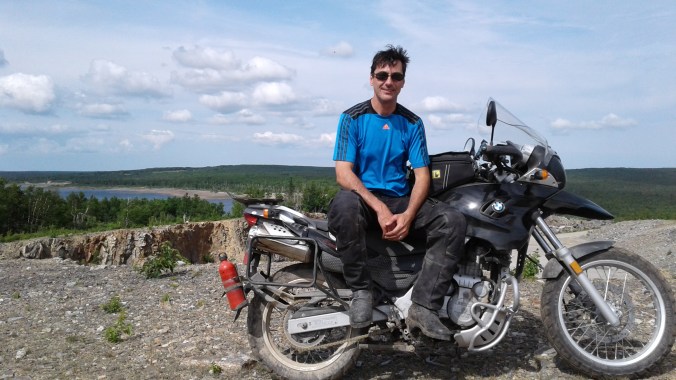
Finally through Chéticamp, I decided it was time to give both of us a rest. I pulled off at a rest site with a huge mountain lurking over us. The photo does not convey the dimensions and perspective. CT Lunchspot

As you can see, I left the panniers and top bags at camp. This is another reason why I decided to stay an extra night at Baddeck, so I could ride unencumbered. With the switchbacks and challenging section of road behind me, I took a slower pace to complete the loop and returned to camp mid-afternoon. The pool was just the thing after a such an intense, hot ride.

The Cabot Trail was everything I thought it would be. I’m glad I was riding alone and could do it at my pace. I have to add that there was a fair bit of road work happening across the top section, but thankfully it was a section of relatively straight road so was more of an annoyance than a major detraction from the ride. And I guess such an important road for Nova Scotia’s tourism does need to be well maintained. But if you’re not comfortable riding in those grooves or at all on gravel, check highway conditions before you decide to go. But just make sure you do go sometime because it’s a ride not to be missed.

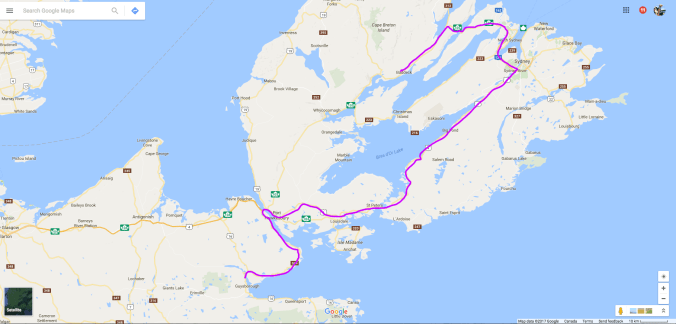
Next up, off-roading in Cape Breton.

Day 4

Day 5

Day 6

Deer Island, NB

Deer Island

After a stressful day of mechanical problems and then almost missing the ferry, I was happy to be on the ferry munching my fish & chips. This photo was taken off the bow and looks toward the campground, which is right on the southern tip of the island. It was a short crossing and soon we were landing.

I came to Deer Island on the suggestion of a retired colleague who teaches sea kayaking at Seascape Kayak Adventures, one of the small businesses on the island. It’s situated in the Bay of Fundy between Maine and the New Brunswick mainland. (Not to be confused with Deer Isle, which is in Maine.) It’s officially in New Brunswick. The adjacent island, Campobello Island, is famous for being the summer vacation spot of Franklin Roosevelt, and his estate is still open to the public to view.

But while Campobello is touristy, Deer Island is rustic! Remote. There’s no potable water at the campground, and they don’t accept credit or debit, so make sure you don’t make my mistake and arrive with little Canadian cash and have to pay mostly in USF. Ugh! I was mad about that one because I make it a practice to carry cash when travelling, but stopping at the bank was literally the last thing on my To Do list and I just didn’t get to it before crossing the border.

I was tired, and the ramp up from the shoreline is loose stones, but I managed them no problem. What I didn’t manage so well was the final turn of the day. I don’t like parking the bike facing in at a site because then I know I have to turn it around before I leave in the morning, so I always try to do that U-turn before parking the bike. I did the turn okay, but lost my concentration at the last moment on the uneven ground literally as I put my foot down. It was a fitting end to a long, difficult day.

Fallen Bigbea

It looks worse than it was. It was a gentle roll onto its side on grass. I removed the top bags and easily lifted the bike back up, and soon everything was right again in the world.

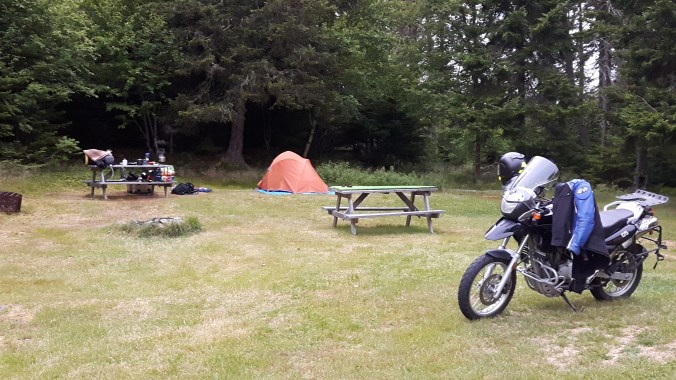
Deer Island Campsite

After two long days in the saddle, the next day was a planned day of rest, so I spent it putzing around the island and checking out The Old Sow. The Old Sow is the largest natural whirlpool in the Western Hemisphere. It forms just offshore from the campground, the product of three water systems converging in one spot. The waters rise about 10 feet and there are some serious currents happening in these waters. It’s called the Old Sow because the water will actually make a sucking sound. I went down at high tide, and while there was some swirling water, I didn’t see a whirlpool. I heard from someone later that the best time is actually three hours before high tide.

The island is quaint and fun to ride with the hilly twists and turns, but there are parts like this one where something has been left to rot. No one’s going to take care of this mess, it seems. (Yes that is a collapsed ramp in the foreground.)Lords Cove

Yet despite these eyesores, the island has a charm about it. It’s very quiet. You can sit and be still and listen to nothing but birds, and that is something increasingly rare these days. There’s one restaurant, and no ATM machine, or so I was told, only to come upon one at the general store during my exploring. Oh, my chance to get some Canadian cash, I thought, but discovered there was no money in it because the person who tends it (same person who runs the restaurant) has been too busy to fill it. That’s kind of how life is like on Deer Island. It’s pretty in the summer, but I imagine it’s pretty brutal in the wintertime.

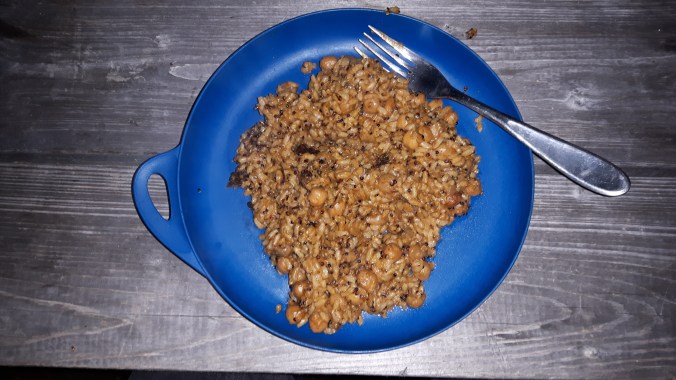
I was supposed to meet up with my ex-colleague and friends for dinner, but there was a problem with the ferries that delayed their return from a kayak excursion, so it was curried lentils for dinner. curried lentils

Not so swanky. I didn’t get many more photos of the island because I was mostly riding it. But this shot of the eastern shore at dawn will give you a good idea of how peaceful it is out there. I’m glad I visited and will go again when I’m out that way. There’s nothing quite like it.

Dawn at Deer Island


MotoMaine-Iah!

Moose Maine-ia

I’m going to start this series of blogs on my tour through the Maritimes in Maine since that’s where my trip began and ended. I decided to cut through The United States en route to my first destination, Deer Island, NB, just off the coast of Maine. I’d visited Maine before a few times and had fond memories of fish & chip shops, swimming in the ocean, and a pleasant ride through small coastal towns. Those associations with Maine were smashed this time round with ATVs, camo-fashion, RV “parks,” and crappy roads.

The first thing you need to know about Maine is that it’s a Gemini state, with the coastal areas very, very different from the interior. It’s only the coast I’d experienced before, and if that’s where you’re headed, I say “Go for it. Bon voyage!” There’s money on the coast, most of it probably not made there but imported from Boston or even New York. And when there isn’t money—the mansions that line Highway 1 in the Hamptons, for example—there’s at least the ocean and a certain quaintness that comes with colourful buoys strung up on the sides of buildings and decorative fishing nets in pubs, starfish decor sort-of-thing, and of course fish & chips, which makes everything look a little better.

The good folks at Camden Hills State Park seem to know this and charge $43 USF for a site and $7 for a bundle of wood. While I was registering, I heard some people on their way out say it’s the most expensive state park. (Is this in Maine or the US, or just the most expensive one they’ve stayed at? I wasn’t sure.) At any rate, with the dollar conversion, I paid about $65 to pitch my tent on gravel and warm my bones. I won’t be going back to Camden Hills State Park anytime soon. I only chose it because it’s close to Highway 1, my ride for the next day.

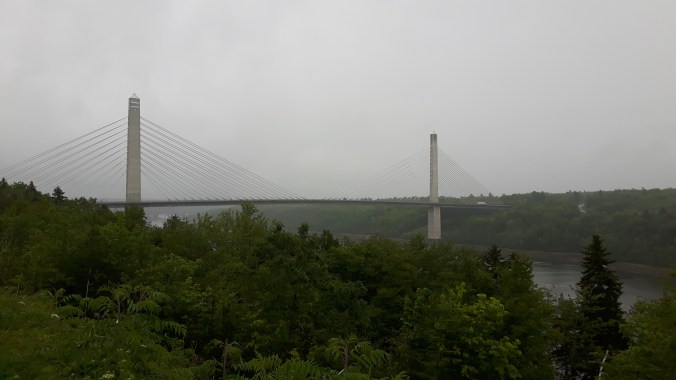
It did, however, have “free” showers. I didn’t really need a shower but wanted to get a little more out of my $43 so had one anyways. Turns out I paid a higher price because while in the shower it started to teem and the tent got soaked; it would have to be packed up wet. I donned my rain gear and hit the road, heading up Highway 1 toward the ferry crossing to Deer Island at Eastport. It was raining pretty hard and very humid, and I rode through patches of fog. Soon I came to Fort Knox and the Penboscot Narrows Bridge. It’s won some awards for engineering and is pretty impressive. There’s a lookout to stop and admire the bridge but I had only been on the road a short while so decided to blow past; only once I was riding across the bridge, I realized just how impressive it is and decided I had to turn around on the other side, ride back over, and stop at the lookout for a photo. This turned out to be one of those fateful and almost disastrous decisions.

Penobscot Narrows Observatory

When I got on the bike again, it wouldn’t start! It’s never done this before. Aside from that first fall when I had the wrong oil in the bike for the cold temperature, my bike starts reliably every time. Now it would turn over and fire once then immediately quit.

Because of the weather, I was thinking electrical. While I was trying to start it, a guy who had also stopped at the lookout said, “That’s a frustrating sound.” As it turned out, he has the twin cylinder 650GS (2012) and told me the only time it “conked out” on him was in wet weather. He said he’d been riding it in the rain and stopped at his house and it just wouldn’t start again. So he was confirming the electrical/humidity line of thought. He said a few more things that would prove to be extremely important and useful. He suggested I just wait it out because, as he put it, “You’ve only got so many cranks on the battery.” So that’s what I proceeded to do. I decided to have my lunch and wait. I had to force myself to be patient, although given the situation, with so much hanging in the balance, obviously I had an urge to find an immediate solution. So I started pacing, watching the sky and hoping for a break in the weather, which never came. I’d return to the bike periodically and try it, with the same result. I was worried and started considering what I would do if I couldn’t start it and the battery died. I didn’t have any clear idea, but with the costs involved, it would probably mean an early end to my tour.

Dude said something else that I pondered while pacing. He said it sounded like it wasn’t getting any gas, which is true. The bike was turning over okay, and firing, albeit once. It just wasn’t continuing to fire. My first thought when he said this was—and I think I even uttered this aloud—could it have anything to do with the angle that the bike is parked on? The parking at this lookout was such that the bike was tilted back. I knew I had about a third of a tank of gas remaining, but perhaps that remaining gas was sloshed to the back of the tank away from the fuel pump. Eventually I decided it couldn’t hurt and I pushed the bike in a semi-circle so it was tipped now slightly nose-down. I tried it again and it didn’t start. So much for that theory.

Then along came a cyclist who was touring. I recognized an accent and discovered he’s from Quebec City. We struck up a conversation which was a welcome distraction from my dilemma. 15 minutes into the conversation I tried the bike again and it started! He must have been my ange gardien! I was so relieved! After this little incident, I decided to keep the tank topped up the rest of the trip. It happened another time later in the tour when the bike was tipped back, with the solution again being just to straighten the bike. So now I know: my bike doesn’t like to start unless level.

I knew my battery now was low but, although I wanted to fill my tank, I had to ride another hour to charge the battery before I felt comfortable stopping, and even then, I chose a station not far from a garage, just in case. I’d lost some valuable time and the rest of the day would be tight for catching the ferry to my planned campground. I rode hard, stopping only briefly for short breaks and snacks, but knew I had until 6:00 at Eastport to catch the last ferry. I pulled in around 5:15 and saw a sign announcing that the ferry was permanently closed. Another dilemma.

So I did what I usually do when I’m in a fix: I struck up a conversation with a local. He told me there’s another ferry at Campobello Island just past Lubec. His daughter looked up the ferry times. The last one is at 7:00, but I had basically to do a loop around the bay, back to Pleasant Point, south on the 1, left on the 189 out to Lubec, cross through Canada Customs, blow through Roosevelt’s old estate to the ferry at Welshpool, all in less than an hour. I did it with time to spare for take-out fish & chips. 

Take-Out

That was the pleasant part of my experience in Maine. It got worse when I returned on my way back.

Day 1

Day 2

Learning the S.M.A.R.T. Way

There are two ways to learn how to do something: trial and error, and getting some instruction. When it comes to motorcycling, I’m in for the latter. I’ve seen vids on YouTube of guys heading out onto the trails with their adventure bikes without any training. They seem to spend more time picking up their bikes and getting them unstuck from mud puddles than they do riding. It doesn’t look that fun. Then I stumbled upon Clinton Smout’s instructional videos and knew I would visit his school as soon as I got my licence.

Horseshoe Riding Adventures is located in Barrie, Ontario. I recognized the location from my teen years of skiing at Horseshoe Valley. Since I now live in Quebec (and start time is 8:30 a.m.), I decided to ride out the day before and camp nearby. I looked up the KOA in Barrie and gulped when I saw they want over $50 for the privilege of sleeping on a patch of their ground. Then I saw Heidi’s Campground at $18.50 and booked for the night before my class.

I was blessed with good weather and had a glorious ride out—once I got going. Two minutes into my ride I discovered a crack in my windscreen radiating from one of the mounting holes, the byproduct of a close encounter with some mud at the Dirt Daze Rally the previous month. I decided to turn around and fortify it with some super glue and add a rubber washer to allow some movement of the screen. This required a stop at the Rona in Vaudreuil for longer hardware. When I finally hit the highway I also hit the mandatory lane closure, this one at Coteau-du-Lac because, well, this is Quebec, and that’s the law! I lost another 45 minutes there and couldn’t get out of Quebec fast enough. My gas light was on for the final 40 kilometres before I limped into the MacEwan in Lancaster. (I knew I was cutting it close but had extra fuel on the back of the bike. I put 13.4 litres in the bike and the tank is 13.6, so I was close!)

Finally with these stresses behind me, I settled in for an amazing ride up Highway 34 from Lancaster to Alexandria, then west along the 43 which turns into Highway 7 and takes you all the way to the shores of Lake Simcoe, where I turned north up 12 and over the top of the lake. This ride took me through the farmland, scrubgrass, and vacation area of SE Ontario (in that order). I noticed that the driving gets more aggressive as you approach Toronto, with people forcing their way past a line of vehicles on a two-lane road, only to encounter the same people in beachwear and flip-flops at the next gas station. I was several hours behind schedule so kept my breaks short, arriving at Heidi’s just in time to pitch in the last of the light.

But all this is precursor to the raison-d’être of my trip: the full day class of dual-sport instruction. Since I’m on teachers’ summer schedule (groans please), I was able to visit the school on a Tuesday so had a smaller class than what I expect they have on Saturdays. I was in a group with two other people: Cheryl, who wanted to get more comfortable on her 800GS, and Bruno, who rides a Harley but felt he needed a little something extra; yes, dirt riding makes you a better and safer rider on the road too. Our instructor for the morning was Graham, one of Clinton’s sons and who, by virtue of his good genes, had the best summer job of any of his classmates, I’m sure. We would be on Yamaha 230s for the morning part of the class. He had us start by just riding a few laps of a course laid out in what staff refer to as “the pit.” It’s a large, open area of dirt and some sand with a few jumps, surrounded by a grassy hill with trails cut into the bank to practice hill climbs. After assessing our abilities and needs, Graham started with the instruction.

I had a burning question going into this day, one that stemmed from my experience at Dirt Daze, and Graham provided the answer early on. While riding the back roads of New York, I’d experienced the front end sometimes slide out while peg-weighting and wondered how you prevent that. Graham demonstrated that you actually hold the bike up with your thigh while counterbalancing. So if you want to turn right, yes, you weight the right peg—I knew that much—but you lean your body to the left (as the bike tips to the right) and prevent the bike from low-siding by pressing your inner right thigh into the tank. Later during a water break, Clinton came by and suggested we try standing pigeon-toed on the pegs; this position presses the thighs into the tank and stabilizes the bike. But where YouTube, reading books, and listening to instruction is helpful, the real learning happens when you get to practice specific skills in a controlled and relatively safe environment. The little dirt bikes allowed us to try things without all the weight (and potential expense!) of our own bikes to deal with. We did some slalom in the dirt, some hill climbs, and different types of descents. Then the real fun started: we headed out onto the trails.

There’s little that I’ve experienced that’s more fun than riding a dirt bike on forested trails. I won’t make comparisons with sex, flying, writing poetry, scoring, or music—my other passions—because such comparisons would be impolite to some and unfair to others. But it’s really, really, (really) fun, and that’s before you get to the mud ruts. I went down in the mud a few times at Dirt Daze so was under-confident and nervous about riding in the mud. Horseshoe Adventures provided some “deep-end” opportunity to get over this fear quickly, again, in a controlled environment, on a smaller bike, and with the guidance of an instructor. We were given three options for getting through a huge mud rut. One was to paddle with our boots on either side as we ride through the rut; the other was to ride seated but feet up, and the third was standing. I was going to do the easiest, but once into the rut I felt comfortable enough to ride it out and didn’t paddle. The second time through I stood and made it through without dabbing! Okay, it was better than sex, maybe like sex in a mud puddle while watching the World Cup and listening to Sex Pistols.

Graham also had us practice tight turns, throttle control, log crossings, and some pretty big hill climbs and descents in both rocks and sand. This is where the practice in the pit really helped and I could see the application of skills learned there in the real world of trail-riding. After a full morning, it was time for lunch.

In the afternoon, I headed out with a new instructor, Emily, on my own bike. I was a bit nervous because of my 85/15 tires, but was assured they’d be okay for what we were doing. A few times around the course and I immediately began to see how the skills I’d learned in the morning on the dirt bike were applicable to my 650GS; it’s just more weight to manage. Emily took me to another network of trails and we began bombing through them on our dual-sports (she was on an 800GS), that is, until I misjudged a turn, drew on asphalt muscle memory, hit the front brake, then the dirt! Umph! Lesson number one: you can get away with that shit on a 230 dirt bike with knobbie tires, but not an a 650 with street tires. The next lesson, then, was emergency braking in the dirt. We went to a dirt road and Emily had me lock up the back brake, getting used to the back end fish-tailing; then she added a little front brake.  Her first question to me when I’d picked myself up off the dirt after my fall (after “Are you okay?”) was “How many fingers did you have on the brake lever?” I couldn’t remember but probably all of them except the thumb. A hand-full. Two fingers only, she advised. Graham had said the same about the clutch hand in the morning.

We also did some rocky descents, 2nd gear, a little front brake. Then back to the trails where I found my redemption when Emily took me through the same infamous corner that had bested me before. We also did some pretty big whoops at speed, some of them muddy, and some more climbs and descents but this time on the trails, not the road; each context changes the skill slightly. It’s like how they say a dog has only learned a command if it can reproduce the desired behaviour in five different contexts. This was made more evident in my next exercise, which was throttle control, doing figure eights in a small grassy area with uneven terrain. I’d practiced this fairly successfully in the gravel parking lot back at the pit, but doing it on uneven ground with a slight grade made me realize I’m more confident with my right turns than my left. I needed to reproduce the body position I felt comfortable doing on my rights—hanging out with my right calf against the bike holding me up—but with my left. Emily also spotted that I needed to twist my body more; small, subtle changes made all the difference, and soon I was turning both ways full lock.

Back at the pit, my final exercise was recovering from an unsuccessful hill climb. This is a skill for when you’re partway up and realize you’re just not going to make it and want to bail. You use the back brake, stall the bike, but let the clutch out and the engine will hold the bike. Then you turn the handlebars, feather the clutch to let the bike roll back in an arc until it’s perpendicular to the hill, all the while leaning the bike uphill and keeping your uphill foot down. Then rock the handlebars back and forth until the bike is positioned where you can safely pull in the clutch and roll down the hill. You can see Clinton demonstrate it here. Emily showed me how it’s done and it looked so easy-peasy I was overconfident when trying it. It’s actually a lot harder than it looks! You have to keep concentrating the whole time because if you lose your balance and want to plant that downhill foot, you’re in trouble. That’s what I did, and then muscle memory kicked in and I did what I always do when riding and get into trouble: I pulled in the clutch. Doh! Next thing I knew the bike was on its side and I was on my back. We couldn’t rotate the bike because the crash bar had dug in, so we grunted it up, and I finished the manoeuvre. Then I tried it again, and a third time, until I was confident I could do it when needed in the field.

My experience at Horseshoe Adventures was everything I’d hoped it would be and more. As it turned out, Emily is from Cape Breton, where I plan to tour next week, and she gave me some recommendations on restaurants and trails. There’s one called Highland Drive (of course) that traverses Cape Breton from Wreck Cove to Chéticamp, and another from Meat Cove, where I plan to spend a night. Of course I’ll do The Cabot Trail with the Harley boys, but then I’ll cut back through the bush and do it all again. I have a bike that is not restricted to pavement but my skills were holding me up. Now I feel I have the skills to ride these roads safely, which is exactly why I went to Clinton’s school.

I can’t praise the instructors at S.M.A.R.T. riding adventures enough. At lunch, Clinton and I got talking pedagogy, and he said they spend a lot of time choosing and training their instructors. It’s evident. Yet what makes this place special is not just the level of instruction and professionalism of staff but how you immediately feel like family. That sounds cheesy, I know, but there’s definitely a personal touch to this school. Clinton is always around, flitting in and out, asking how the day went and making sure all his clients are happy.

With my bike re-loaded and my head filled with new skills, I headed off toward Guelph, where I planned to spend a few days with my parents. There’s some beautiful geography between Barrie and Guelph, and my GPS took me through Creemore, Orangeville, and Fergus along county roads. Halfway towards Guelph, with the sun low and glowing across the farmers’ fields and massive wind turbines rotating in slow motion, I realized I was riding with two fingers on the clutch, two fingers on the brake.


Getting Dirty

Dirt_Daze

With the growing popularity of adventure biking, it was only a matter of time before someone organized a rally for adventure bikers. June 7-10 was the second annual Dirt Daze rally, held in Lake Luzerne, NY. I heard about it through a club friend and decided to head down from Montreal.

Dirt Daze is actually the off-road component of the big Americade rally held the same weekend in nearby Lake George, and my ride down on Highway 9 took me right through that other rally in the late afternoon. I felt a little out of place as I rode through on my GS with Touratech panniers. All the Harleys were lined up gleaming on both sides of the street, and it seemed to me that it was more about the bike than the riding. Guys were sitting shirtless on plastic chairs outside their motel rooms drinking beer out of the can. It didn’t seem much fun. I scooted through apologetically for ruining their parade and was soon at “my” rally in Lake Luzerne.

No sooner was I off the bike when an organizer said to me, “Welcome. Slow race in five minutes.” Now this is more like it! I was pretty pooched from my 5 1/2 hour ride down, but he was so enthusiastic and convincing it would be fun I decided to drop my big tail bag and participate. There were ten of us, and we were paired in heats of two. The course was a straight 50 feet, lined with cones. Last over the finish line wins and moves on, the other eliminated. In watching the first couple of heats, I saw that the start was crucial; if you get ahead over the first few feet, it’s difficult to make that distance up. When it was my turn, I was pretty nervous with everyone watching and a little too tentative off the start and stalled the bike. Doh! Damn! I was mad at myself but it was all for fun.

Then I rode back to the camping area with my tailpipe between my legs and chose a spot to pitch for three nights. We were pretty packed in, but it was nice to be able to camp on site and keep costs down.

camping

The rally is held at The Painted Pony ranch. It’s a great location with food and drink available at the saloon, showers, and lots of space for vendors and the four obstacle courses. And since it’s a ranch, there is livestock.

Cows

If you’re a light sleeper, you might want to camp at the nearby KOA campground. Between the lowing and the snoring and the 2-strokes firing up at 6 a.m. (all of which become indistinguishable after a while), you’re not going to get much sleep.

I’ve never had any off-road training, so I signed up for a two-hour beginner class on Friday morning with Jimmy Lewis. Jimmy and his wife, Heather, run an off-road school in Nevada and offer at Dirt Daze compressed versions of their full-day courses. Jimmy is an amazing rider. He was a podium finisher for the Dakar and overall winner of the Baja and Dubai rallies, among other accolades. His curriculum focuses on balance and traction. In all the exercises we did, we never got out of first gear. His exercises develop muscle memory for finding and maintaining that neutral point when the bike is in balance. He says if you come to an obstacle and you’re off balance, you’re going to get into trouble. As for traction, he says it doesn’t matter what they call your tire—60/40, 70/30, or 85/15, like mine—if you run your hand along the side of the tire and don’t feel sharp edges, you’re going to go down in the mud. More on this later. In fact, in their school in Nevada, they make 50/50 tires mandatory.

One of the nice things about Dirt Daze is the people you meet. I came alone but was never alone. A couple of us who did the morning class went for lunch together and then decided to do one of the self-guided rides in the afternoon. They had done a guided ride the day before, and when we got lost on our self-guided ride, we decided to return to a network of trails they knew of from their previous ride. I’ve never done single track trail riding, so I quickly got in over my head, especially with my “street tires,” as everyone kept referring to them. I actually did pretty well with the slow turns and descents, even the sandy hill climbs—the back end sliding all over the place—but when it came to mud, my skills and tires let me down—literally! I and the bike ended up in a deep mud puddle at the bottom of a hill, but I managed to get the bike back up and out using some of what I’d learnt in the morning class; Jimmy had showed us how to start in low-traction terrain without digging in. When I re-emerged from the woods and met up with the other guys, I must have been a sight. Someone said “I’ve got to get a photo of this.” When we got back to camp, I headed for the bike wash. “Why bother?” someone asked. “It’s just going to get dirty again.”

The next day was my planned “big ride”—a guided full-day ride through the Adirondacks with about 50% off road. It was led by veteran rider Bill Dutcher, founder of Americade (then Aspencade East) in 1983.BillI’d been warned about Bill: the “old man” hauls ass. There were twelve of us, and I decided to tuck in behind him so I could watch and learn. Soon after we pulled out of the ranch I found myself going 70 km/hr on a dirt road with a smattering of gravel. Shit, is it going to be like this all day? I was riding over my head but didn’t want to hold the group up. All was good for a few kilometres until we headed down a sweeping descent. Halfway down I knew I was in trouble. I knew if I braked and turned I would lowside, but fortunately I didn’t panic. I dropped my line and headed straight, gently squeezing the brake. For the first time in my short riding experience the thought that I might crash flashed through my mind, but fortunately I eased to a stop before I ran out of road. Someone behind slowed and gave me the thumbs up as a question. I nodded and looked back. No one was behind me, just empty road. I realized I needn’t have worried about holding the group up because they were all well behind. I had made the classic mistake of trying to keep up with a rider who had 49 years of riding experience on me.

I took that little incident as my warning and decided to drop back. As the day continued, the group settled into two groups, with three fast riders up front with Bill and the rest of us behind at a slower pace. They waited for us at each turn. It worked. I was still a little out of my comfort zone, but in a good way. I was able to practice the peg-weighting I’d learnt with Jimmy as we weaved through the Adirondack backroads. There were a few times when I hit sand and almost lost the bike (again, the street tires!) but at a much lower speed. At one point we hit deep gravel, what looked like 3/4 crushed stone, and that was interesting. Again, I had enough good sense or gods’ blessings to not panic but let the bike go where it wants to go and ride it out. When we got to the next rest stop, Bill asked if anyone had had trouble with that gravel, and reminded us that the technique for dealing with it is to get your weight back and, counter to what your intuition is telling you, get on the gas. It lifts the front end and the bike rides over the gravel instead of digging down in, which would be trouble. I was learning a lot.

We lunched at a classic mountain lodge with a beautiful view of the surrounding Adirondack mountains. Lunch

Other parts of the ride brought us to picturesque vistas.vista

We ended up again at that network of trails and I fell victim again to mud at a small water crossing. I crossed the stream okay, but once on the other side I was so focused, quite literally, on the mud under my tires I forgot to look beyond the obstacle further down the trail. Perhaps I tightened up too. Perhaps I got too much weight over the front tire. Before I could say “another classic mistake” the bike was on its side halfway up the bank. Despite the spills, the ride was exhilarating and I told Bill afterwards that it was so far the ride of my life.

Back at camp, we were treated to a demonstration by World Freestyle Champion Chris “Teach” McNeil. His nickname is Teach because he is a Latin teacher at a private school. Now as an English teacher at a CEGEP in Montreal, I thought I had the cool factor when I pull onto campus on my bike, but I’m pretty sure this guy is more popular with his students. Freestyle or stunt riding is not my thing, and I’ve seen videos online of guys doing nose-wheelies on litre bikes. But seeing it live is another whole experience. It’s pretty damn impressive to see the way the power and weight of his BMW S1000XR is a plaything in his hands.

After such a full day, I was ready to retreat to my tent. I lit a pipe and wandered through the camping area checking out the other bikes, then struck up a conversation with the guy next to me. I was lamenting a few scratches on my bike from the falls that day when he said, “Ah, you can’t worry about that shit. It’s a bike.” It reminded me of the comment earlier about not bothering to wash it, and I thought again about the gleaming Harleys just up the highway and just how different adventure biking is from that kind of riding. Adventure biking is about the adventure of not knowing what’s going to happen in the woods. It’s about helping others lift and fix their bikes on the trail, like when Bill helped me fix my engine guard with a zip tie and duct tape. It’s about escape, and risk, and skill—a lot of skill! What impressed me the most from the rally was not any particular bike but the skill-level of many of the participants.

It seemed à propos that one of the final events of the rally was the Ugliest Bike Contest. The bike that won was the one Jimmy Lewis borrowed to win the slow race.

Seat Concepts: 650GS Dakar Install

What’s the most important contact area in biking? Some say it’s the two patches of rubber, one on the front tire, one on the back, that touch the road. Some say it’s the four contact areas of control—two hands on the handle-grips, two feet on the pegs. I say the most important contact area is your butt on the saddle. I come to this conclusion after a season of riding with an OEM BMW seat. The Bavarian Motor Works, as the name suggests, are renown for their engines, not so much for their upholstery. The guys in my club know that after around 200 kilometres I start to squirm. By 300 I can’t take it any longer and stand up, even if we’re at highway speed. After my 800 km day last year, I had a new understanding of the term “saddle sores.”

There’s nothing worse than ruining a day’s ride by being uncomfortable on your bike. For that reason, on my Wish List last Christmas was a new seat. My old seat was not only uncomfortable but the vinyl had cracked with age. It was due to be changed. cracksThe only problem is that both BMW’s and Touratech’s comfort seats are about $700 CAN. My butt was telling me to spend with abandon, but my mind (and my wife) was reminding me of our budget. Then I heard about Seat Concepts, a company that ships you the foam and cover and you re-upholster the seat pan yourself at a fraction of the cost. For my bike, it was about $250, or close to 1/3 the price of the other comfort seat options.

Seat Concepts is an American company, so I ordered through MX1Canada in BC and let them handle all the cross-border issues. The standard foam is for people 160 lbs. and up, and since I’m 145 soaking wet, I custom ordered the foam to my weight. There are four options for the cover: gripper top/carbon sides, all carbon, embossed top/vinyl sides, and all vinyl. There’s also a swede option but that’s not practical in geographical areas that rain, which is pretty much everywhere except the desert. I was interested in the gripper top, but it’s not recommended for people who sometimes ride in jeans, including me, so I opted for the all carbon option, which is their second-most popular covering. I also decided to choose the Dakar height since I was feeling a little cramped on the bike. It all arrived in the mail this past spring and all I needed was a warm day to do the work, since they recommend placing the cover in warm sunlight to heat it up. That day finally came last Sunday, so I got to work. Here are the tools I used.

There are some excellent video tutorials offered by the folks at Seat Concepts, but here is how my install went.

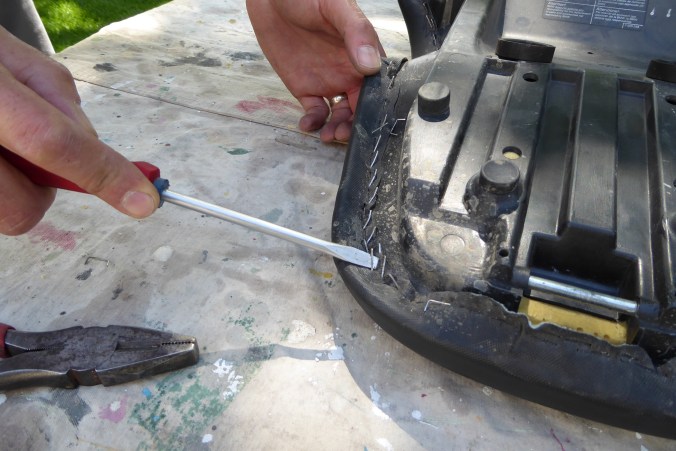
I started by removing the staples in the old seat. I used a flat-head screwdriver and dug them out. stapler_remove1

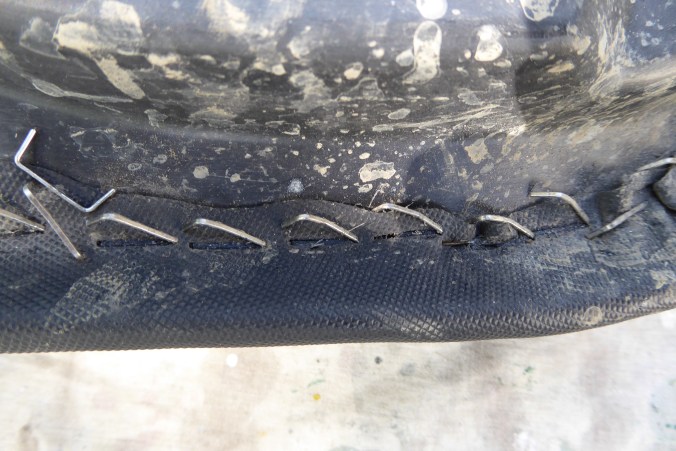
Don’t worry if only one side of the staple comes out . . .

staple_remove2

. . . because you are going to grab the staple and pull it out with blunt-nosed pliers.

pliers

Once all the staples are removed, you just peel back the old cover and separate the foam from the seat pan. On mine, it came off easily. Apparently on others, you have to coerce it a bit.

seat_pan

You will have a bunch of holes in your seat pan from the old staples. They have to be sanded down with a medium sandpaper or they might puncture your new seat cover.

sanding

Now you’e ready to glue your new foam to the pan. I used 3M’s Super 77 aerosol spray and it worked great—so great, I asked my wife to assist by separating the sides at the front while I positioned the back. The glue is tacky at this point, so you want to get one section straight and right before another touches. A second set of hands helps at this crucial stage. Note that I laid the foam upside-down on my workspace and placed the pan onto it; it was easier that way.

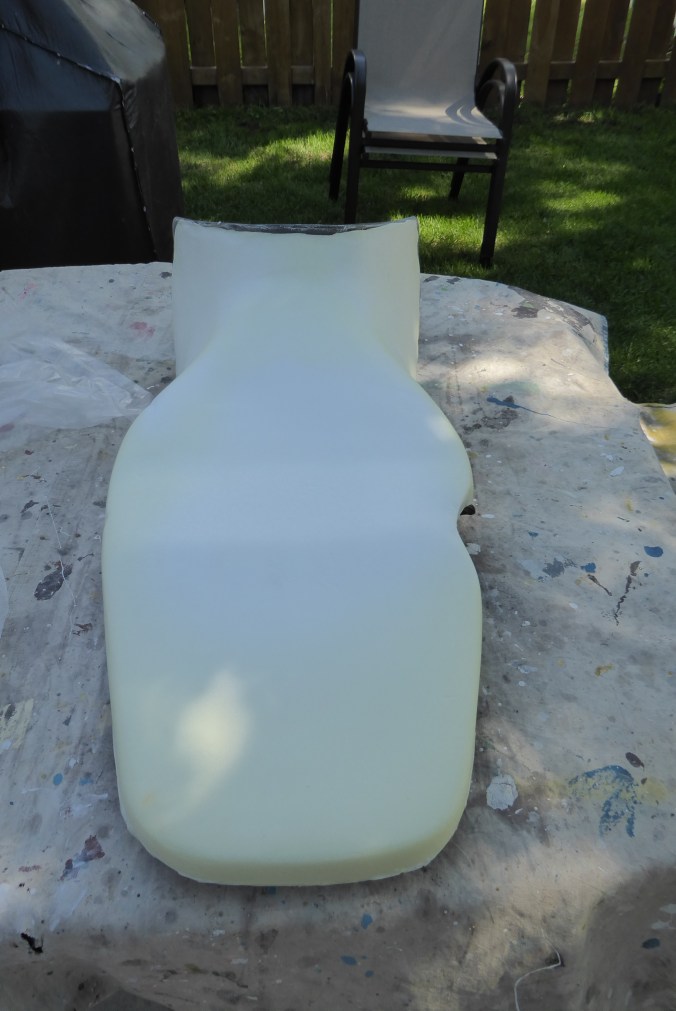
This is what the seat looks like before covering.

new_foam

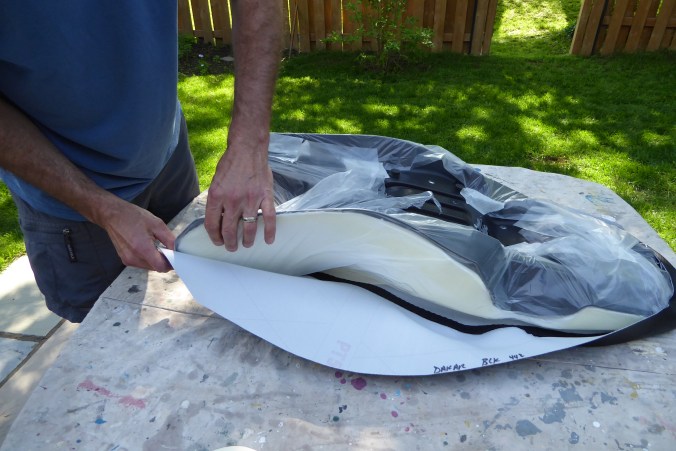
Meanwhile, like I said, your cover has been basking in the hot sun and is pliable. Heating it first also helps because when it cools it will shrink and tighten up. Seat Concepts provides some thin plastic to waterproof the foam. It’s recommended you use it under the cover. So I began by wrapping the seat and taping the plastic to the underside of the pan. (The tape is temporary and will be removed later after all the staples are in.) There were some small wrinkles in the plastic but it is impossible to not have any and I figured the plastic is so thin I’d never feel them under the cover.

Then I started the part that gives most people some stress. It actually was not hard at all. I started by putting two stables at the back and one or two in each corner at the front. Make sure the cover is centred by examining the seams closely. Then I just started wrapping and stapling the cover from the middle outward toward the front and back. I pulled the cover over the lip and stretched it just a little more and put in a staple. I worked both sides at the same time, ensuring the cover stayed centred and taut. cover_beginning

I borrowed an electric stapler from a friend, but as it turned out, my hand one was just as effective and I used it for tight spots in combination with the power stapler. I used 1/4 in. T50 staples. As with any stapling of this kind, it’s important to stabilize both the item being stapled and the stapler from recoil or the staples will not go in all the way. Any that did not, I tapped in fully later with a hammer. Yeah, a second set of hands is helpful at this stage too, but it doesn’t take long. cover_end

Then I just used an Olfa knife to trim the excess cover and plastic. The finished product looks great!done

Finally, I reinstalled the seat. It needed some coaxing because the Dakar seat is a little wider at the back than the standard, but well worth it if you can afford the extra height. I took measurements before and after and the Dakar is about 1.5 inches higher than the standard. It also has a flatter front shape with less sloping into the tank. Here are the two seats side-by-side, before and after pictures for comparison.

height_old

height_new

It’s surprising what that 1 1/2 inches does. Everything feels different. I feel more upright on the bike, seated on it rather than sliding into it. Controls feel different too. And while I can still flat-foot, I feel that extra height at each stop. Most importantly, my knees are now bent at 90 degrees, which is the best ergonomically, according to technician at my work who helped me set up my new office chair.

I haven’t done any long rides yet with the new seat, but I’ll follow up here with a comment once I do. Next weekend I’m going to a rally in NY State where I’ll be going on some day-long rides, but my early indication is that the seat is very comfortable. I’m also happy with the money I saved by doing it myself.

Adventurero Heroico: a review of The Motorcycle Diaries by Ernesto Guevara

chehigh

We’ve all seen it, the iconic photo of Che Guevara, silkscreened on the T-shirt of a slouching teenager as a sign of a budding ideology or subtle form of protest against The World as he or she has come to inherit it. It was snapped in 1960 by Alberto Korda while Guevara listened to Castro’s oration at the funeral service of 136 people killed in an act of naval sabotage. Even converted to duotone, the implacable and determined expression is remarkable, the eyes gazing off toward a distant point of revenge and justice.

I’d heard that Ernesto (Che) Guevara was radicalized while riding a motorcycle around South America, visiting up close, in a way that only a motorcycle can do, the poverty, hardship, and exploitation of its proletariat. His eight-month journey on a Norton 500 (affectionately named La Ponderosa II—The Powerful One) with Alberto Granado, a doctor and specialist in leprosy, is captured in The Motorcycle Diaries: A Journey Around South America, now turned into a major motion picture starring Gael García Bernal.

Guevara’s radicalization cannot be found in any specific moment but occurs over the trajectory of his journey. What is evident at outset is that he comes from a privileged life. At first, the two seem more interested in drinking and carousing than visiting leper colonies or talking to the working poor about their plight. In a typical scene, they get into trouble after drinking copious amounts of wine:

Chilean wine is very good and I was downing it at an amazing rate, so by the time we went on to the village dance I felt ready for anything. It was a very cosy evening and we kept filling our bellies and minds with wine. One of the mechanics from the garage, a particularly nice guy, asked me to dance with his wife because he’d been mixing his drinks and was the worse for wear. His wife was pretty randy and obviously in the mood, and I, full of Chilean wine, took her by the hand to lead her outside. She followed me docilely but then realized her husband was watching and changed her mind. I was in no state to listen to reason and we had a bit of a barney in the middle of the dance floor, resulting in me pulling her towards one of the doors with everybody watching. She tried to kick me and as I was pulling her she lost her balance and went crashing to the floor. As we were running towards the village, pursued by a swam of enraged dancers, Alberto lamented all the wine her husband might have bought us.

There are, however, moments when an innate sensitivity and political empathy toward the poor come through in the writing. Soon after that escapade, they meet and are invited to stay with a married couple, Chilean workers who are Communists, and Ernesto hears the man’s tragic story:

In the light of the candle, drinking maté and eating a piece of bread and cheese, the man’s shrunken features struck a mysterious, tragic note. In simple but expressive language he told us about his three months in prison, his starving wife who followed him with exemplary loyalty, his children left in the care of a kindly neighbour, his fruitless pilgrimage in search of work and his comrades who had mysteriously disappeared and were said to be somewhere at the bottom of the sea.

The experience leaves a deep impression on the young man. That night he gives a blanket to the couple and he and Alberto wrap themselves in their remaining blanket: “It was one of the coldest nights I’ve ever spent but also one which made me feel a little closer to this strange, for me anyway, human species.” Writing later about the couple, Ernesto makes clear his own budding political ideology:

It’s really upsetting to think they use repressive measures against people like these. Leaving aside the question of whether or not ‘Communist vermin’ are dangerous for a society’s health, what had burgeoned in him was nothing more than the natural desire for a better life, a protest against persistent hunger transformed into a love for this strange doctrine, whose real meaning he could never grasp but, translated into ‘bread for the poor,’ was something he understood and, more importantly, that filled him with hope.

Guevara is a good writer. I read the book in translation (trans. Ann Wright) but the strength of Guevara’s voice rings through. He is articulate, possessing a broad vocabulary, funny, and perceptive. His powers of observation—essential for any writer of travelogue—extend to the landscape as well as the people he meets. At times, the sentences are lyrical and poetic, such as in this passage, where he personifies the Chuquicamata mountain that has been industrialized into a copper mine:

The mountains, devoid of a single blade of grass in the nitrate soil, defenceless against the attack of wind and water, display their grey backbone, prematurely aged in the battle with the elements, their wrinkles belying their real geological age. And how many of the mountains surrounding their famous brother hide similar riches deep in their bowels, awaiting the arid arms of the mechanical shovels to devour their entrails, spiced with the inevitable human lives—the lives of the poor unsung heroes of this battle, who die miserable deaths in one of the thousand traps nature sets to defend its treasures, when all they want is to earn their daily bread.

Guevara’s critique of the exploitative power of Capitalism is expressed in the language of war and personal suffering, both of Nature and humans, in a telling indication of the major themes that would later occupy his political life. He sees Capitalism as a plague on Nature and human society, a force that devours if left unchecked.

His critical eye does not stop with economics. In another passage, he shows distain toward the Church that dominates Latin American society:

In a moment of boredom we went to the church to watch a local ceremony. The poor priest was trying to produce the three-hour sermon but by then—about ninety minutes into it—he had run out of platitudes. He gazed at his congregation with imploring eyes while he waved a shaking hand at some spot in the church. ‘Look, look, the Lord hath come, the Lord is with us, His spirit is guiding us.’ After a moment’s pause, the priest set off on his load of nonsense again and, just when he seemed about to dry up again, in a moment of high drama, he launched into a similar phrase. The fifth or sixth time poor Christ was announced, we got a fit of giggles and left in a hurry.

Always there is a tone of understatement, a dry irony that runs the risk of appearing sanctimonious, but I would rather have a strong, personal voice in a travelogue than a weak, objective one. He does not hold anything back, even when describing the hygiene habits of the Native Chileans:

The somewhat primitive idea the indians have of modesty and hygiene means that, regardless of sex or age, they do their business by the side of the road, the women wiping themselves with their skirts, the men not at all, and carry on as before. The petticoats of indian women with children are veritable warehouses of excrement, since they wipe the kids with them whenever they have a bowel movement.

As shocking as this is, the most surprising aspect of The Motorcycle Diaries is that they don’t travel by motorcycle for much of it. The bike dies a dramatic death on page 44 of my edition, and they spend the rest of the journey bumming rides from truckers, travelling by foot, raft, and boat when necessary. In this way, the book is like George Orwell’s Down and Out in Paris and London, which documents Orwell’s self-induced months of hunger and poverty while squatting in Paris and tramping across England. And perhaps like Orwell, there might have been a desire in Guevara to purge himself of the privileged lifestyle in which he was raised, or at least open his eyes to another strata of society of which he had had only a passing familiarity and a superficial understanding.

They do visit leper colonies and are regarded there as heroes, more for their humane treatment than their medical treatment of the lepers. Where others fear and shun these people, Alberto and Ernesto mingle amongst them for several days, drinking and playing music together, and when they leave they shake the lepers’ hands, a gesture that in itself is more healing than any medicine the doctors can offer.

This is the picture of Ernesto that we get by the end of their adventure—a caring and principled young man ready to take the hippocratic oath, not the Guerrillero Heroico of the later portrait, the fighter who was ready to kill to incite revolution. For that, he would have to meet and travel with another man, not the affable Alberto but the militant Fidel.

The Motorcycle Diaries is a fun and easy read at just over 150 pages. There’s a lot of local history woven into the storyline, including a political history of the Incas, and anyone who’s interested in the history of South America would get something from this book. Readers who are interested in the biography of Che Guevara or the germination of South American and Cuban Communism would also enjoy it. But the star of the book is South America itself, the land and its people. Readers will get a strong sense of the majesty of the mountains, the rugged terrain, the Latin American architecture, the friendly and welcoming people. My edition provides a map with the route of their journey, and chapters are titled after the places they visit. My ultimate ride is down into South America and this book has only piqued my interest all the more for that adventure.

Off Road, On Course

offroad

Photo Credit: Red Sky Adventures

When I was a kid, I would go to police auctions to buy my bikes and bike parts. These were auctions of the stolen, then recovered but unclaimed bikes. You could enter a large area before the auction where all the bikes were ticketed with a number and on display to inspect them before the auction began. Then noting the number of the bike you were interested in, you’d wait until it came up for auction. My outbidding with my paper route money some father always elicited some snickers in the crowd.

I always looked for a certain type of bike. Basic. Didn’t matter the colour, because I’d paint it later, always black. Didn’t matter the condition, because I’d strip it down to the ball bearings, clean and re-grease everything before putting it back together. A little steel wool and elbow grease removed any rust from the rims. Didn’t matter the handlebars or the tires because I would change them, putting on wide handlebars and knobby tires. I was making my own motocross bike.

Then we would go to the little forested park near my house and race them. We built berms and jumps. We also dug up a few suburban front lawns with our terrorizing of the neighbourhood. I learnt how to wheelie and we had competitions with that too. I could wheelie the entire street if I got a good one going. When Evel Kneivel attempted to jump the Snake Canyon in 1974, I was eleven. It didn’t matter that the jump itself was a disappointment. All the hype leading up to the jump led us to start jumping our bikes—really jumping. We built ramps by turning a municipal steel garbage can on its side, wedging rocks behind it to stop it rolling, and laying scavenged wood on top. I bent a few back wheels doing those jumps, but never broke a bone. No one ever wore a helmet in those days, but the Gods smiled on us. The worst of it was some serious road rash.

Eventually I gave up the custom 3-speeds and bought a 12-speed Supercycle mountain bike from Canadian Tire. I must have put half a million miles on that bike, especially the summer I was a bike courier in London, Ontario. That bike still lives, repainted black, of course, with red pin-striping from Canadian Tire down the side.

So when I went to buy a motorcycle, I knew I wanted a dual sport. Yes, I want to tour, but I also want to play. And it had to be black.

On Friday, going in to the long weekend, I decided to get my ya-yas out and go for a ride, my first full day ride since getting the bike out of storage. I headed toward Ontario, taking my favourite route out, which puts me in Lancaster. There’s a short story I know by Hugh Hood called “Getting to Williamstown” in which the narrator describes in detail a drive to Williamstown, ON, just north-west of Lancaster. The story was written in the 70’s. Would the road he describes still exist? The one-lane bridge? The gas station with ice-cream? I was curious.

What does any of this have to do with off-roading? By going to Williamstown, I stumbled into my first off-road ride. While exploring those concession roads, I saw a dirt road leading off of the main road. I turned around and studied the sign at the entrance. No cars, but to my surprise, snowmobiles, ATVs, and motorbikes allowed! It didn’t look that hard.

It wasn’t . . . for the first 100 metres. No sooner had I started when I came to a section completely washed out, a huge puddle of muddy water spanning the width of the trail. I knew enough from watching YouTube that you don’t try to skirt the puddle by sneaking around the side; that only leads to the tire sliding out sideways and you and the bike going down. You have to go through the centre, hoping it’s not too deep and that there are no big rocks or logs down there. I stopped and pondered. Turn back or risk forward? The trail looked clear ahead except for this puddle. I did the imprudent thing and went for it.

It’s hard to estimate how deep it was. In the moment, I was concentrating so hard I didn’t take note. But it’s an unnerving feeling heading into the centre of a puddle the depth of which you do not know. (If I had had my adventure boots on, I might have waded in to find out first.) I knew that if I’m going for it, there are no halfways and I didn’t want to be tentative. So I gave it some throttle and saw water plough up around the fairing—probably easy stuff for an experienced rider but not so easy for a newbie. Safely across, I whooped into my helmet.

The trail beyond was a mixture of dirt, gravel, with sections of larger rocks that were tricky. I found it difficult to operate the throttle smoothly from a standing position and shifting was awkward. This would take some getting used to. After a brief foray into 2nd gear, I decided to keep it in first. This was, after all, my first time off road. At one point, I passed a father and son going the other way on ATVs.

There were other sections washed out—not one big puddle as before but several muddy puddles to navigate through. I thought of shooting rapids and skiing moguls, how you have to look up ahead and select your best line through. I could feel the bike sliding around beneath me but kept my cool, my weight over the bike, and my hand off the brake. I was nervous but tried not to grip the handlebars tightly, letting them and the bike move around. And I understood why you’re supposed to steer the bike by weighting the pedals rather than turning the handlebars, because even at that speed, when it’s that slippery, turning the bars can lead to the front wheel washing out. It was exhilarating!

I’m convinced that during those sections when the bike was sliding around under me, I was drawing on muscle memory from those early years on my bicycle. It’s the same principles, just a lot more weight involved. I’m hoping this might be something I take to easily, even at this “advanced” age.

I probably shouldn’t have been doing that alone. When I spoke to my dad later in the day, he said the same. Even at that speed, anything can happen. If the bike lands on you, you could break a leg and then you’d be hooped. So I messaged my off-road partner and suggested we go back together. I also looked up on Google Maps the trail and discovered I only rode a small section of it; it continues in the other direction all the way into Quebec and ends near Saint Polycarpe. In June, I’m going to the DirtDaze Adventure Rally in Lake Luzerne, NY, where I’ll get some beginner’s instruction and go on some guided rides down there. I also plan to do the full day adult course at SMART Riding Adventures.

It’s going to be a fun summer.

Review of Total Control: High Performance Street Riding Techniques, by Lee Parks

TotalControl

Can you improve your riding from reading a book? No, but if you practice and apply some of the information presented in Parks’ book, you will. This book is less about road safety than riding technique, so if you’re looking to avoid a collision, see my review of David Hough’s Proficient Motorcycling, which deals with this subject. In fact, Hough cites Parks’ book, and the two have collaborated in the past. Where Hough leaves off, Parks picks up and takes you a step further.

Looking at the cover image, you’d think this book is for sport bike riders. It is, and it isn’t. Most of the techniques presented are definitely meant for the track but can be applied to any type of riding to improve safety and proficiency. It’s not all about safety. If you want to stay safe, stay at home. Sometimes you just want to get around a corner faster, or ride with more advanced riders. There are photos here showing guys dragging a knee on a Gold Wing or a V-Strom, getting air on a GS. It doesn’t matter what your ride is or what type of riding you do, Total Control will have something for you.

The book is nicely organized into sections on Chassis Dynamics, Mental Dynamics, Body Dynamics, Machine Setup, and Rider Setup, with chapters within those sections. I’d say the heart of the book is the section on Body Dynamics, which contains chapters on vision, line selection, throttle control, shifting, braking, body positioning, low-speed turns, and riding two up. Now before you say, “Yeah, we learnt all that in my training course,” let me say we are talking here about advanced techniques, so very subtle and technical aspects of those skills.

We all know about target fixation, but do you know it’s related to us being predators? We know about straightening a curve, but what about premature initiation? (No, this is not a sexual gaff.) How to handle a double apex curve? In the chapter on shifting, I learnt how to preload the shifter, and in my next ride I was shifting quicker and smoother. Another technique I found interesting is trail braking, a technique in which at a point in the corner you are braking and accelerating at the same time! The idea is essentially that since braking makes the bike nose-dive and accelerating lifts the front end, you can use these opposing forces to cancel each other out and stabilize the bike through the corner: “The technique has us simultaneously rolling off the throttle while applying the brakes going into a corner. Once in the corner we start to slowly roll on the throttle as we slowly trail off the brakes,” hence the term “trail braking.” Now before you scoff and dismiss, Parks says that “virtually every MotoGP and World Superbike racer—as well as every motor cop—now uses this technique: so try it before judging it.” And Parks would know. He was 2nd overall in the 1994 AMA Superbike Championship (125GP class) and won the 2001 WERA National Endurance Series Championship. He’s an accomplished rider and knows of what he speaks.

Another interesting bit of information I found in this book is the suggestion to try cornering with one hand. You’d think he was being foolhardy, but in fact he claims that often our two arms are fighting each other through a corner, and allowing one hand (presumably the throttle hand) to take full control actually improves steering. But be careful! Parks says the first time most people try this they oversteer. The book is filled with other such tidbits of useful information. I won’t give all the goods away.

Chapters at the back deal with riding gear and fitness. I’m excited to try a 6-10 minute high-intensity training program designed specifically for bikers by strength trainer Timothy Parravano. It involves only 4 exercises and the only equipment needed is a chin-up bar. In just 6 minutes, you get core strengthening and an anaerobic cardio workout.

The book is extremely technical but is well illustrated with diagrams and graphs. Still, I found some material more theoretical than my needs. For example, there’s an entire chapter on how suspension works from an engineering standpoint. Do I need to know this? I’m really only interested in setting up my suspension for the best ride possible, which comes in a separate chapter. And the chapter on aerodynamics? I’m not going to be tucking behind a tiny windscreen on any of my rides. This is where the book’s leaning toward sport bike racing shows. If you’re like me, you can skim those sections.

The book is now in its second edition and has become a classic. Anyone interested in improving their skills should pick it up. I liked the pep talk by Parks in the epilogue as he waxes philosophic, drawing on his interest in Buddhism. (Illustrative Buddhist aphorisms and parables are smattered throughout the book.) “In a special sense, the reason you are reading this is because your riding is a little bit “sick.” When you are sick, the doctor prescribes medicine. The problem is we get addicted to the medicine. But medicine is not food for a motorcyclist. Brilliant riding is food. The purpose of medicine is so that you don’t need the medicine. The purpose of a teacher is so that you don’t need a teacher. The purpose of method is so you ultimately don’t need a method. In Japan, if you have spent too much time with a particular master you are said to “stink” of Zen. You can think of Total Control as the medicine you need to overcome your sickness.”

Most people may not have the humility to think of their riding as “sick,” but if you’re like me—always interested in improving whatever you do—this book is for you.

Motorcycle Fitness

'It's not an actual motorcycle. It's an exercise bike. I made it look like one so my husband would actually use it.'

How fit do you need to be to ride a motorcycle? You are, after all, just sitting on it and twisting a throttle, right? It’s not like you actually have to do any work, like pedal.

Competitive motocross and MotoGP riders are among the fittest athletes in any sport. That’s one extreme. Most of us are not competitive riders, and there is a large range of types of biking, from the physical demands of off roading to cruising on your Harley, each with its own set of fitness demands. You might be “just” a commuter, or a recreational, weekend rider, or someone who likes to tour. The answer to my question above is this: if you are physically unable to do what you’d like to do on a bike, then you have to up your fitness. It’s an easy test. If you find yourself unable to lift your bike, or push it out of mud; if you are nervous about committing to a long club ride in summer heat; or if you’re having trouble even getting on and off your bike, then it’s time to think about your fitness.

I’m no expert but, shall we say, an avid fitness enthusiast, more from my love of playing soccer than riding. Here are a few things I’ve learned over the years. But before I get started, since we are dealing with health, I feel the need to do the usual legal disclaimer and say you should check with your doctor or a medical professional before starting any fitness program. In other words, don’t blame me if you have a heart attack!

I believe there are three aspects of fitness and I’ll talk about each in turn: cardiovascular fitness, flexibility, and strength training.

Cardio

The foundation of fitness is cardio. That’s why I’m going to start with it. I annoy my son when we get talking about soccer training (I used to be his coach) because he says I’m fixated on cardio. Maybe I am. Here’s why.

Many people think of energy in economic terms, like a commodity. “I’ve only got so much energy to get me through the day and I’ve got to do x, y, and z today, so I’d better skip my workout.” That’s economic thinking. What those people don’t realize is that you get more energy by working out. Maybe not initially, but in the long run, so to speak. When your heart and lungs are strong, you will find yourself more productive in the evenings with energy to spare. Using the economic model, a cardio workout, then, is like advertising; you have to spend a little to get back a lot.

The other big benefit of boosting your cardio is that it’s calorie-burning, not just during the workout but between workouts! As you get more fit, you are actually changing your metabolic rate. This is, in part, where that extra energy comes from, aside from the fact that it’s easier for you to climb those five flights of stairs to your office several times a day. So if weight loss is one of your fitness goals, improving your cardio is key. Oh, and did I already say you’ll feel a whole lot better?

Probably most of you are already thinking, Yeah, I’ve tried to exercise but I just don’t have the time or discipline to keep at it. Here is the key: you have to find a time and an activity that works for you. I didn’t always work out. In fact, for years I abused my health until it caught up to me with lower back problems, something I still struggle with from time to time (I’ll come back to this later). But at about the age of 42 I started going to the gym. Let me say that again, at about the age of 42 I started going to the gym. I’d tried and failed earlier; the difference this time was that I discovered I could do my workout during lunch hour and eat my lunch at my desk. I’m not a morning person, so that time didn’t work for me; and I just couldn’t heave myself off the couch and out to the gym after dinner, despite my best intentions. But the lunch-hour workout stuck. For others, maybe early morning, before the demands of family and work enter, is the best time, or after the kids are put to sleep, at the end of the day. Experiment and see what works for you.

I also rediscovered my love of soccer, something I’d given up in my teens, and so I had a reason for going to the gym. Soccer is a pretty demanding sport, even at the recreational level, and I know it’s either pay now in the gym or pay later on the field. I also felt a certain commitment to my teammates. The connection between my training and my soccer is so strong that often when I’m running I’m imagining (or visualizing) soccer plays past or future. My wife doesn’t like running but loves biking. Some people like the social aspect of cross-fit; others like the solitary aspect of distance running. Contact vs non-contact, a racquet sport, swimming—it’s really a personal preference, but you have to find something that makes your soul sing. It will be a lot easier to stay motivated.

If you haven’t done much exercise in recent years, you probably should start with walking. (See disclaimer above.) Start with a normal walk for several weeks, then graduate to a brisk walk and build up to a light run. The goal is just to elevate your heart rate to the aerobic zone for 20 minutes, 3-4 times per week, according to most experts. You know you’re in the aerobic zone if you can still have a conversation comfortably but are exerting yourself enough to break a sweat. Worried about burning calories? You’re in luck. It takes the same amount of calories to walk a kilometre as it does to run a kilometre. When my dad once went for his company physical, the nurse thought he was a runner. In fact, the only exercise he did was walking around the industrial park for 45 minutes during his lunch hour.

Flexibility

I’ve always been really inflexible. Once when I went for a massage (back when my insurance paid for it), the masseuse was shocked at how stiff my legs were. “Are your legs always this stiff!?” she exclaimed, holding onto my ankle and shaking the leg back and forth to test its tightness. “Ugh, yeah. That’s pretty much how they always are.”

I’ve never been into yoga, although I know it would be excellent for me. There’s something about yoga types that rubs me the wrong way. There’s a certain sanctimonious, holier-than-thou “I’ve-got-my-life-completely-sorted-out-and-am-at-complete-inner-peace” sort of thing about them that makes me want to knock their seaweed salad all over them to prove them wrong. But maybe I’m being unfair.

Here’s what I do to help my flexibility. Each morning, preferably before my coffee, I do three sun salutations. That’s it. That’s all. Done. But it seems to do the trick. It stretches all the major muscles, gets my heart and lungs working, and clears the sinuses. If you don’t know what a sun salutation is, check this out.

I also do some static stretches after a game, run, or strength workout. The muscles I focus on are the quads, the hamstrings, the glutes, and the lower back. There are lots of stretching exercises available online so I won’t go into specifics here. These stretches take 10 minutes and ensure my back doesn’t get pulled out of alignment. One issue with soccer players is that they develop very strong quads that can pull the back out, so I’m sure to do at least this one after pretty much every workout.

Person doing quad stretch exercise standing.

If you don’t have a wall handy, here’s a tip: holding the opposite ear-lobe from the leg being stretched will help you maintain your balance. Don’t ask me why.

Finally, I also use one of those foam rollers from time to time, as needed, to keep my legs loose. The woman in the link above seems to be having a good time but it actually hurts like hell. The more it hurts, the more you needed it. After a few days of regular use, though, it hurts a lot less, so I know it works. It’s basically a self-massage. I roll my quads, my hamstrings, my IT band (i.e. the outer side of the thigh), my calves, and my lower back.

Despite being naturally inclined toward tight muscles, I’ve actually never had a major pull, so I must be doing something right. I hope I’m not jinxing myself.


Strength Training

LS2_436

If you remember this ad, you are of my generation. It’s actually a brilliant piece that plays on most guys’ body insecurity and sexual desire. It also messed up my head for 30 years, making me think there was something wrong with me for being an ectomorph. Yes, I too was “a skinny 97-pound weakling” and desperately wanted to wear a leopard skin Speedo. Today, a lot of guys are turning to steroids to get “ripped,” sacrificing their fertility for looks, which seems like a pretty good trade-off until they actually bed the babe they’ve literally been busting their balls for and discover they can’t. In my Men & Masculinity course, we talk about this as a kind of reverse anorexia for boys, the social pressure to be “big,” which is really just a synonym for “powerful” in the broadest sense of the word.

I’m going to lay my cards on the table here and say if changing your body image is why you want to work out, that’s the wrong reason. Rather, if it’s to be healthy and strong, that’s the right reason. In terms of motorcycling, as I’ve said, it should be to allow you to do what you want to do on the bike. You don’t have to be physically big to do that. In fact, none of the MotoGP riders look like Charles Atlas. Last year’s MotoGP champion Marc Márquez weighs 59 kilograms, or 130 pounds. That said, the improved toning and shape you get from strength training is an additional reason to feel good about yourself for doing it.

As cardio is the foundation of fitness, I believe core strength is the foundation of strength training. There’s no point in bulking up if you can’t stand up. Core strength keeps you in alignment and prevents back problems. It also allows you sit in the saddle for long periods without slouching. (Remember, most of us don’t have a back-rest.) And nothing I know strengthens the core better than Pilates. I know a guy who developed back problems and his doctor sent him to a Pilates course. He worked out regularly at the gym and was built but lacked core strength. So when I developed back problems, I found a good Intro to Pilates DVD at my local library and did it religiously 3-4 times a week. It actually only took about 3 workouts until I felt a difference. They say you’ll feel better after 10 Pilates workouts, look better after 20, and have a completely different body after 30. Then you can go buy some leopard skin swimwear as a reward.

Once you have your core strength, you can move on to weight training. When I started weight training, someone set up a workout routine for me involving about 10 machines and exercising all the major muscles. That works. More recently, I came across Mark Ripptoe’s Practical Programming for Strength Training that makes the case that you really only need four exercises: deadlift, squat, bench press, and press. Those four cover everything, including core strengthening and areas you wouldn’t think they would, like abdominals. I’m still learning about weight training, but I’ve heard that more weight with less reps bulks you up, whereas less weight with more reps is better for endurance strength. So for motorcycling and soccer, I aim for 10-12 reps.

So how do you fit it all in? Cardio, Pilates, weights—while leaving time for the body to recover, which, at my age, is longer and longer. Something I’m just starting to look into is periodization. That’s where you break the year down into periods that focus on one area. It’s not like you don’t do the others, but the emphasis shifts. This year, coming off a bad ankle sprain that took me out for six months, I started with cardio and stretching, then core strengthening, and now am moving on to strength training. Just before the soccer season I’ll shift again to interval training and plyometrics.

If this sounds overwhelming, keep in mind that a regular program of cardio, stretching, and core strengthening should be sufficient for most types of motorcycling. That’s what the professional fitness trainer put Ewan and Charlie through in preparation for their Long Way Round adventure.

I’m still learning about all this so if I’ve written anything that is factually wrong, please let me know. If you disagree with something I’ve said or have advice I’ve missed, please leave a comment. Like I said, I’m an enthusiast, not an expert, so would be interested in hearing it, as I’m sure others would too.