Loon Mountain, NH

campThis is what I’ve been waiting for. When I took up riding, I knew I wasn’t interested in getting a sport bike and hanging it out in the twisties, or a Harley and hanging it out at the bar. I was looking for adventure—the chance to escape and explore, live in the moment, and go wherever my heart desired. The last time I had experienced that feeling was in my early 20s when I went to Europe with an International Hostel membership and a Eurorail pass. I remember looking at a map, choosing a spot, and wondering what it is like there. Then hopping on a train and finding out.

The destination for my first tour was Loon Mountain, New Hampshire, for the NH Highland Games. My old band competed there a few years ago and it was so beautiful in the fall my wife and I returned the following year for our anniversary. There is a road that cuts through the White Mountains, and I remember pulling over to let a biker pass, knowing I was holding him up. A thought flashed through my mind: wouldn’t it be nice.

Three years later and I was packed up and ready to go. I’d cut things a little close. My waterproof duffle bag arrived in the mail two days before leaving; I got the very last campsite at Lafayette Campground in Franconia Notch State Park. (I was suspicious: is it next to the crapper? Turns out it wasn’t and I was just lucky, I guess.)

I did a trial pack on the Wednesday when my bag arrived and found, much to my surprise, I had room to spare. One pannier for cooking gear, one for food. In the 70L duffle bag on top I put my sleeping bag, the tent I borrowed from my son, my Thermarest, and personal items, pillow-case style. Some Rok-straps ensured the whole thing stayed put, and my day bag went on the tank.

I’d recently heard an interview on Adventure Rider Radio with Bret Tkacs, in which he talks about manoeuvring the bike while not riding, including simply getting on and off the bike when it’s fully loaded, so I thought I’d try some of his suggestions. One was to use the foot-peg to get on the bike, instead of dragging a dirty boot across your seat. You can get on at either side but I was nervous about tipping the bike if I climbed on stand-side, so during my first day I got used to getting on the high side. It’s also a little unnerving as the bike leans away from the stand slightly as you climb on or off, but after the weekend, this was my preferred side.

After the usual delays, I was on my way. I wanted to stick to secondary highways as much as possible so took the Mercier Bridge, picked up the 132, and took the 104 all the way into the Eastern Townships, discovering towns along the way I promised I’d return to when I had to time to stop; Knowlton is picturesque. How have I lived in this province for 26 years and never discovered Knowlton? Some sections of the ride were so incredibly beautiful I was compelled to turn around and take a picture.
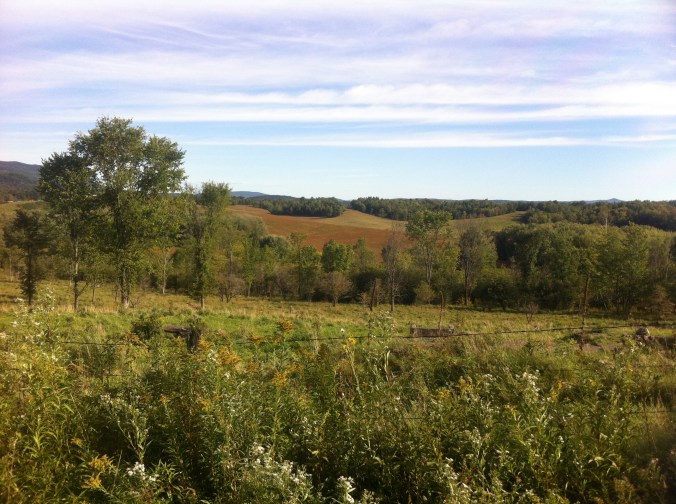
townships

I crossed the border at Highwater, my oranges confiscated for being honest. “No citrus fruits, sir.” (I was compensated later in Lincoln, NH, when a nice gentleman stocking the fruits section at Price Chopper introduced me to pluot, which he said he was careful not to say too quickly to Quebecers because it was rude. If someone can fill me in on this joke, please do.)
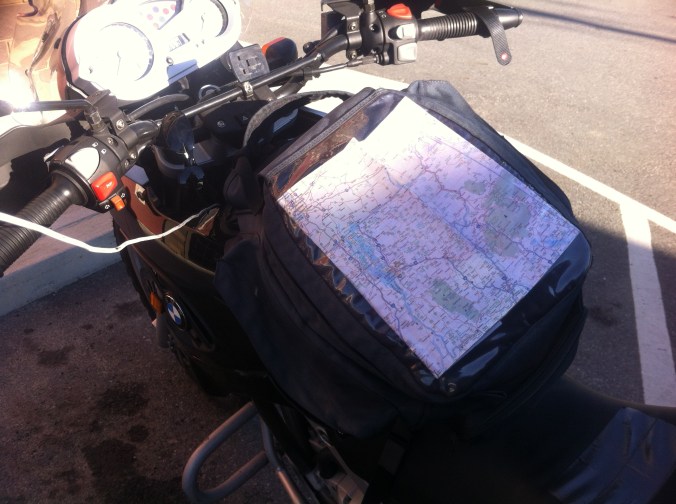
oldschool

Once over the border, I had to navigate old-school style to avoid roaming charges. I picked up a couple of maps at a gas station, where I snapped this shot of a Victory from the future. It’s even more impressive from the back.

victory

The last time I was at Lafayette Campground, my wife and I were visited by a thieving black bear, so I was sure to ask if there had been any sitings. The attendant assured me that the normal cycle of young bears being trapped and escorted off the premises and older bears being shot had run its cycle and things were settling down for the hibernation season. My site turned out to be furtherest from the crapper as you can get, and I set up for two nights.

The next day were the Highland Games, and I know the Scots don’t like to do anything important before noon, so I had a chance to get most of my weekend work done at the site before going to the grounds. I was nervous about leaving my bike unattended at the parking, but used my Zena lock (which emits a 120 db scream if jostled) and padlocked my helmet to the pannier cage. Still, I’d have to carry my day bag around all day and wear my leather jacket—the price you pay, I guess, for not having a trunk. This was a learning experience for me.

massedbands

Massed bands, New Hampshire Highland Games; Loon Mountain, NH.

The games actually turned out to be a side-note to the ride. There aren’t any grade 1 or 2 bands at these games, and after you can hear the difference, grade 4 and 5 bands just don’t cut it. Still, I got my haggis and thumps, a sticker for my pannier, and inspiration to become a better drummer. By the time I got back to my bike I was itching for that ride across the mountains, so headed off east on the 112 at dusk—I know, not the best time to be riding (a theme I will return to). The ride was magnificent, and worth every minute of the wait over the preceding years, especially the hairpin turn that had a suggested speed of 20 mph. I rode as far as I dare until the light faded, turned around at a lookout, then did it all again to get back to my site, where I paid the price of making dinner in darkness.

The next day I had planned to make it to the coast, specifically Hampton Beach, where my wife and I had visited before. I packed up and loaded the bike, fired it up, went to do my turn but was caught off guard by the added weight and dropped the bike. Shit! Fortunately I was so late getting off that there was no one around to fuel my embarrassment but a staff member who was raking the sites. He looked up briefly but wasn’t inclined to come over and help me lift the bike. We had learned how to lift the bike in my course, positioning your back to the bike and lifting with your legs, but the wheels were higher than than the handlebars because of a slight grade in the site (no doubt what threw me) and I couldn’t lift it. Fortunately, I had seen a video about another method that uses the handlebars as leverage and was able to get the bike up using that technique. Thanks Clinton Smout for that tip! Thankfully, the pannier and crash guard took the brunt of the fall and the bike was unscathed. The lesson learned? Don’t pack your bike however it’s positioned and then attempt to make a sharp turn before your head’s in it. Position the bike and then pack it.

Hampton Beach was further than I remembered and it took me three hours on a toll interstate to get there, but I was thinking of the fresh fish and chips available there from roadside restaurants and the ride up the 1a, which has ocean on one side and Gatsbyesque mansions on the other. I arrived late for lunch but early for dinner, and was anxious about the miles I had to cover to get home.

hamptonbeach

Hampton Beach, NH

I stopped at Petey’s, where I was able to get a table overlooking my bike. This is another aspect of riding of which I’m unfamiliar. Do you leave your gear and helmet on the bike and hope no one steals it? It’s like leaving your dog outside a shop while you browse inside. How can you relax? peteysI found that people are generally respectful, even reverent, about the bike, and I was approached several times by folks who said “Bonjour” when they noticed the plate. I seemed to be living the life they never had, and one guy, who clearly had mobility issues, said he’d always wanted to ride. I said “It’s never too late” (thinking of my late start), to which he responded, quickly and sadly, “I think it is.”

Fully fed and with close to 500 km. ahead of me, I decided I had to put some road behind me. I wanted to head up the 1A that follows the coast but soon realized it wanders away from the coast and into small towns that would slow me down, so I picked up the 95N to Portland, where it turns into the 26 which turns into Highway 2 that would take me east right across Maine, New Hampshire, and into Vermont, where I planned to cross at Rouses Point. This ride took me right through the countryside of Robert Frost and John Irving, and I could see why they’d be inspired by the rolling hills and classic range fencing, small towns with businesses named after the owner’s first name, like Gary’s Auto Body and Bert’s Garage. By the time I caught the 2 it was dusk: a perfectly paved winding road with wisps of fog hanging on the surrounding countryside. There was no traffic, and I got into a rhythm through the curves, slowing only through small towns with restaurants strung with lighting. If a moose had walked out into the road and struck me dead in that instant I surely would not have gone to a prettier place!

But dusk soon turns to night, and the atmosphere quickly changed. Even if John Milton had not been blind, he could have written his ode to light that begins Book III of Paradise Lost. If you spend any time camping or exposed to the elements you learn quickly just how precious light is. Once it’s gone, you are vulnerable. It faded on me somewhere in north New Hampshire as I was crossing the White Mountains. The rest would have to be done in the dark.

I abandoned my plan of taking the 2 all the way to Rouses Point and picked up the 93 which led to the 91. It would be interstate freeway all the way from here. I figured at least the major highways are better lit than the secondary ones. My biggest concern was wildlife. I’d seen signs all through New Hampshire warning of moose crossing, and even a dignitary at the Games had joked that, despite all the warnings, he hadn’t seen a single damn moose! I thankfully did finally see one in Portland, NH.

moose

Soon after I picked up the 93, I hit road kill. I had entered a construction zone. The speed dropped from 65 mph to 55, then suddenly to 45. I glanced down at my speedometer and when I looked up it was maybe 6 feet in front of me, too late to do anything about it. It was a racoon, I think, and I clipped it as I passed. My front tire made a  sound, I’m not sure if it was the squelch of rubber or something else, and I’m still not sure what happened. I felt the handlebars move and I was passed, my heart racing.

I don’t know if hitting road kill is fairly common for motorcyclists, but it was a first for me and it scared the shit out of me. You generally don’t want to hit anything on the road at highway speed, but I just didn’t see it. The lesson on this one? I shouldn’t have been out there at night, not on the secondary highways, not on the interstate. I should have Googlemapped my planned ride before and seen it was too ambitious. I came up from the border on the 10 and there were no motorcyclists on the highway and for good reason! I gambled with my life and was lucky! I pulled into my driveway at midnight.

So now I sit, a day later, with four beers in my belly and reflect on what was and what could have been. I learnt a lot on that first solo ride and know what I would do differently. It certainly was an adventure, but they don’t call it adventure riding for nothing!

What are you afraid of?

Let’s talk about fear. I believe there is good fear and bad fear. Good fear keeps you safe; bad fear can kill you.

On the second day of my training course, we were shown how to change gears. Two cones were placed at either end of the parking lot, about 100 metres between them, and we were to ride down the straight, change into second, then brake, change back into first, then do the U-turn and head back the other way. Sounds basic, I know, but when you’re learning . . .  Anyway, the tough bit wasn’t changing gears. As you might guess, it was that U-turn, especially with a chain-link fence bordering the turn. The instructor said “Don’t look at the fence.” This would cause target fixation and make you steer into it. But of course, soon after we starting looping, one of the students got going too fast in second, panicked, froze, tried to do the turn, looked at the fence, and drove into it. This is an example of bad fear. 

The bike had cosmetic damage and the student went off to the hospital to have his shoulder checked. Turns out there was only minor damage there too but he had to pull out of our group and join another to complete the course. I asked after him later and the instructor said he was doing fine but “still thinking about it,” meaning he’d lost his confidence. Bad fear can hang around a long time and mess with your riding. 

For this reason, I’ve never watched those motorcycle crash compilations on YouTube. I don’t want to get spooked, and when you are a new rider you have fledgling confidence that needs to be protected and nurtured. Once when I was going through a roundabout, I felt the back end slide. Fortunately, I wasn’t going very fast. I immediately straightened up the bike and slowed to the side of the circle. I was thinking about that slide when I leaned the bike over later in the ride on an off ramp. It took me a day or two to regain my confidence in leaning the bike again. Before I did my road test, I did a private lesson to prepare. That instructor said I was a “natural rider.” When I asked what that means he said I lean with the bike. Many new riders get “crossed-up,” meaning they lean opposite to the angle of the bike because they are scared. 

But these incidents are minor. Low-side slides are the “easy” kind of accident to have. The bike slides out from under you and you and the bike slide it out. If you’ve got good gear on and don’t slide into traffic or an object, you can probably walk away from that accident with only a bruised ego. The real danger in riding are high-side accidents when you get launched over the bike, and the very real threat of landing in oncoming traffic or the back of a vehicle. Good fear helps avoid this by telling you when you’re pushing your limits. Jim Hyde of Rawhyde Adventure ures Off-Road Training says you should never ride at more than 80% of your limits. Leave a little buffer for the unexpected, he advises. Good fear will tell you when you’re approaching your limits. 

That said, I believe it’s important to get outside your comfort zone from time to time. I’ve put over 4000 kilometres on my bike this summer riding with the club, but I was still spooked by the prospect of riding at night and in the rain.  My first solo ride—the morning after I got my licence—began in torrential rain and ended with several hours of night-riding at highway speed. When I pulled into the driveway, I was a different rider. That doesn’t mean I will henceforth be mindless of the risk of hydroplaning or reduced vision at night, but a little more confident in those situations. And confidence is a good thing. It keeps bad fear at bay. 

Let’s admit it: some of the fun of riding comes from fear, that stomach-in-the-mouth feeling reminiscent of the fun-ride at the fair, but where the risk is real and not merely perceived. The goal is to ride that line of excitement but stay safe, or as safe as possible. Paramount is to have confidence in your bike. I knew my front tire was getting old so recently changed it. In the back of my mind was the thought of a blowout at highway speed or hydroplaning in rain. You also need to have confidence in your skills. This comes not just with road experience but targeted practice. When we were learning emergency braking, I got over-confident and grabbed rather than squeezed the front brake. Before I could say “Bob’s your uncle” the bike was under me with gas leaking onto the asphalt. (Fortunately it was the school’s bike which, by the looks of it, had been dropped more than a few times.) But I was still thinking of that incident when I did my closed circuit test and overshot the mark on the emergency brake test. I have since done some practice braking on my bike but need a partner to practice at higher speeds. That is on my list before the end of this season. Targeted practice develops muscle memory and muscle memory  supplants bad fear when there’s a real emergency. 

But all of this is rather grim to think about on such a beautiful sunny Saturday. I think I’ll hop on my bike and go for a little ride. If we thought too much about fear, we’d never swing a leg over the saddle. A little thought, however, can help keep us safe. 

Feel free to comment. The question in the title is genuine. 

Half the Fun

Me under Car

I’m a teacher and so, as everyone likes to remind me, I get my summers off. I often respond by saying that it’s a good thing I do or I’d burn out. By the time the term winds to a close, I don’t want to be anywhere near a desk. I’ll shovel scrap metal before I do anything bookish, at least for a good chunk of the summer. Usually this urge to do something physical takes the form of athletic training or home reno, but this summer I dove into a large mechanical job on the car. I also did some work on the bike. Here are five take-aways I learned from this work.

  1. Be Methodical: When I do a job, I get nervous. Almost every job I do is a first for me, so I’m heading into uncharted territory. I’m worried I will make a huge mistake along the way that will ruin my precious bike or cost me more money to fix than it would have cost to get a professional to do the job. (This is supposed to be cost-saving, right?) Or I’ll encounter an insurmountable snag that will stop me halfway through a job. I’ll have to call in the professionals, and in the case of auto and bike mechanics, that will involve a towing charge as well as the cost of the job. So I often rush. It’s stupid, I know, as a reaction to the situation, and I’ve become increasingly aware of my emotional state as I work and have been trying to slow myself down. This job was so big I knew I had to go slow. Fortunately I saw this video by Ari Henning from MC Garage before starting. In it, he gives three tips for being a better motorcycle mechanic. Take photos. Use zip-lock bags to label and store parts, and use a manual. I’ll add to that to lay parts out in the order they came off. (My front porch smelled like a garage for a good portion of the summer.) This forced me to go slow and methodically. It’s easy to undo bolts and rip the engine apart; the tough part is putting it all back together again. So I used my phone and took a picture of every item before it came out. I used sandwich bags and a sharpie to store and label bolts. I also used masking tape to label cables that were detached. I kept a list of items in the order that they were removed. And I bought and used the Haynes manual, which shows step-by-step how to do the job.
  2. When Things Go Wrong, Don’t Panic: Mechanical work is all about problem-solving. Nothing ever goes as planned or as described in the manual, especially if you’re working on an older machine. Sometimes it’s just a matter of figuring out how you are going to get a wrench in there, but sometimes, as in my case, it’s breaking an important bolt in the most inaccessible part of the engine. When this happens, probably the best thing to do is to take a break. Step back and give a little think on your options. Maybe go online and see what others have done. But if you let your emotions get the better of you, problems can compound quickly.
  3. Mechanical Work is a Workout: People keep telling me these days I look fit. My wife says I’ve bulked up. Okay, I’m never going to be bulky, but I do feel in pretty good shape. There were days when at the end I was physically exhausted. Mechanical work requires strength—not the weight-lifting kind but core and endurance strength, especially if you are working on your back on the driveway using hand tools. You constantly have your arms raised, you have to do a stomach crunch to reach something, just getting in and out from under the car every time you need a tool is tough. Same goes for working on a bike, whether you are wrestling a tire off the rim, or compressing the fork-spring to remove a retaining ring. And since mechanical work is physical, make sure you keep your body happy. Be sure to eat and drink regularly, just like an athlete or you’ll find yourself grumpy, working slowly, making mistakes, and wondering why.
  4. Have a Back-Up Vehicle: 3/4 of the job involves getting tools and parts when needed. I bought everything I thought would be needed before I started, but inevitably s**t happens and you need something. My parts supplier sold me 2 litres of gear oil and I discovered I needed 2.7. I broke a bolt, so had to go buy a tap plus a new bolt. I needed a socket extension, crow-feet socket set, more Liquid Wrench penetrating oil, hardware, etc.. And while I’m on this subject, never trust the parts salespeople; they can give you a bum-steer. Be sure you know your liquids and volumes (from the manual) and, when possible, take the original part that you are replacing. Often these guys (and they are almost always guys) are looking at an exploding diagram of your engine, trying to locate the exact thing you need, or worse, using a text-based database. And it perhaps goes without saying to keep all receipts in case a mistake is made.
  5. Get Dirty: I spent some time at the beginning of the summer reading Mark Zimmerman’s The Essential Guide to Motorcycle Maintenance. It’s a good book (review to come), but to learn you have to get in there and get dirty. Start small and simple, like an oil change, or coolant change. Then challenge yourself and try a bigger job. I did the brakes (actually not that hard) and that gave me the confidence to try replacing the clutch. The other day I changed the oil in my front forks—again, not hard. Most of the time these jobs aren’t that difficult but you just need to have the confidence to try, which comes from doing simple things first. I learned a lot from working on my bicycle when I was young. I used to buy bikes at police auctions, strip them down, then paint, clean, and re-lube everything, right down to the ball bearings. The more I work on my motorcycle, the more I see just how similar to a bike it is from an engineering standpoint, although it was the practical work on the bicycle that first gave me familiarity with tools, problem-solving, and observation of how mechanical things work. Later this fall I’m going to attempt to adjust the valve clearances. I’ve got 40,000 K on the bike now so it’s time. I’ve never done this before, but I’ll figure it out, using my manual and taking my time.

Last fall I did the first service on my bike by changing the oil and coolant to prepare it for winter storage. I phoned my dad to talk about how it went. He told me about when he stripped down the engine on his bike and had it rebored. Pirsig says you should work on your own bike because a lot of mechanics are hacks, which is probably true. No one’s going to care as much about your bike as you, and doing it yourself ensures it’s done right. Pirsig also seems to suggest a moral reason for doing your own maintenance. If the bike is you, it’s your responsibility to take care of yourself and your bike. But my dad had another reason for doing this dirty work. Just before he hung up he said, “I’m glad you’re doing your own maintenance. That’s half the fun of having a bike.”

Best accessory for under $100

I spend a lot of time browsing online motorcycle stores. A lot of time. Probably too much time, certainly given my budget. I convince myself that it’s research for when I have disposable income. So I’m pretty up on the accessories available that manufacturers promise will significantly enhance my riding experience. Recently I came across one that really did live up to its promise, although no promise was actually given because it’s something that cannot be found in a motorcycle store, real or online. It is under $100, has revolutionized my riding experience, and is protecting my health more than any other piece of gear or item in my day bag. Curious? It’s a custom ear plug.

Most bikers are well aware of the potential risk of permanently damaging your hearing through prolonged exposure to noise from the engine and the wind. Of the two, the wind is worse. Even the most expensive helmets, like mine, that are the product of extensive R & D time in the wind tunnel can do little to shut out Aeolus’s angry growl. Most bikers invest in cheap pharmacy bought foam plugs, the kind that are yellow or orange, that you twiddle between your index finger and thumb to compress into a narrow cone that expands once inside your ear. They aren’t bad, but they don’t compare to a custom plug. I know because I’ve tried both.

I’m also a drummer so I’m pretty familiar with ear plugs from that passion, and I’ve tried a variety. The waxy swimmer’s plug works well to cut out sound but is tricky to get in right, and if you’re riding in a group and the lead rider says “Let’s go!” you’ve got about 30 seconds to get earplugs, helmet, sunglasses, gloves, jacket (if it’s a hot day and you’ve taken it off) all back in or on, the bike started and in gear, and ready to pull out. You don’t want to be the doofus holding everyone up. So you want a earplug you can pop back in, no fuss, and know it’s going to work once you pull out and get up to highway speed.

I have a musician’s earplug, the kind with the filter running through the middle. It cost me about $250 bucks, but it doesn’t do squat to cut out wind. Wind must be the same frequency as human speech because the filter just lets it blast right through. I decided to invest in a full plug, and went to my audiologist to get it done. The appointment only took about half an hour. He made a mould of my ear canal and sent it off to the lab. Ten days later my plug was ready, in a colour that matches my jacket. (Bikers are extremely fashion conscious.) Because I’m completely deaf in one ear (the result of a mountain-climbing accident in my teens), I’m using the singular. The plug cost about $70, so double that if you’re not a freak like me. Companies like http://www.bigearinc.com/ probably offer custom plugs for less.

My first long ride with it last Saturday was down to Smuggler’s Notch in Vermont, a 550 km round trip, and it was heaven. Imagine driving 550 clicks in your car with your radio between stations and blasting loud static in your ears all day. That’s what it’s like without earplugs. Now imagine reaching out and pressing the button that turns off the radio leaving you in a cocoon of blissful silence. That’s like popping in custom ear plugs.

Suddenly your other senses, that have been deadened in a self-preservation sensory clench, come alive, especially the tactile sense. The sound of the engine is now just a slight buzz, so I have to feel the frequency of the engine more than hear it, and my butt tells me when to shift. Sight and smell are also heightened without the distraction of an all-encompassing noise. The absence of pain really is pleasure.

But beyond this immediate reward is the knowledge that my one good ear is safe. When it comes to safety, as you already know from a previous post, I throw machismo to the wind. Earplugs also reduce fatigue, which can lead to even more serious consequences. Custom ear plugs are comfortable, washable, reusable, and the most effective hearing protection available. If you ride, do yourself a favour and get yourself a pair.

Review: Proficient Motorcyling by David L. Hough

ProficientM

I’m out of bookmarks. Now when I start a book, I have to go scrounging from my bookcase for one that remains in a book half-finished. When I started reading Proficient Motorcycling by David L. Hough, the one I happened to grab was a promotional one for Douglas Burnet Smith’s collection of poems titled The Killed. I almost swapped it for another, but didn’t. As disturbing as it was to keep using this one, I was reminded each time I came back to the book why I’m reading it. I’d counter that thought with The Bee Gees song in my head: “Staying alive, staying alive . . . Ha ha ha ha . . . staying alive, staying alive.” It’s a bit macabre to think about it, but that’s exactly what David Hough wants us to do.

Hough was one of the first, if not the first, to break the ice on the subject of motorcycle fatalities. As he says in the introduction, there’s a taboo on talking about the risks: “You won’t hear much about motorcycle fatalities from your local motorcycle dealerships or in mainstream motorcycle magazines. Discussing fatalities has long been a motorcycling taboo. If a rider survives the crash, the experience might provide some bragging rights. But talking about the fatalities tends to take all the fun out of the sport for riders, and for those in the industry it has a chilling effect on sales.” So in the 1970’s, Hough started writing about the risks in an obscure little magazine called Road Rider and then Motorcycle Consumer News. Proficient Motorcycling is the culmination of those articles in one book that has become the top-selling motorcycle book of the decade.

Chapter 1 looks directly at those fatalities, using the Hurt Report, a study of over 9,000 fatalities in the Greater Los Angeles area by Dr. Hugh Hurt. Hough (the other Hough) acknowledges that a regional study will be slanted, but there has been no other major study of this kind, a fact that points to the taboo and a dearth of reliable data on the subject. Hough walks us through the data, looking at types of accidents and when they occur in a rider’s career. For example, we would expect there to be a lot of accidents in the first six months of riding, but one statistic I found interesting is that there’s a spike in the 25-36 month period. We don’t know why, but perhaps over-confidence is to blame. After 36 months, the fatalities drop off dramatically and stay low. So the lesson is to be careful for at least three years and especially during the third year.

Hough also looks at types of accidents (angle collisions, left-turners, driver error, animal strikes, etc.) and their percentages, as well as percentages of impact areas on a helmet. If you’re considering an open-face helmet, note that almost 1/5 of all impacts are on the chin-bar. We learn of other factors such as engine size, age, alcohol, and training. Not surprisingly, you are three times more likely to have an accident if taught by a friend or family member than by a professional at a school. The chapter concludes with a risk assessment questionnaire which gives you a good idea of “how far you’re hanging it out,” as Hough puts it.

Chapter 2 examines the physics of motorcycling—all the forces interacting as you weave through the twisties. There were terms here I’d never heard before, like rake and trail, and others like gyroscopic and inertial stability, centre of gravity, and centrifugal force that I was familiar with but not in as much detail as applied to motorcycling as Hough explains. Fortunately, Hough is by profession a graphic designer, so there are a lot of illustrations and photographs to help the reader through some of this abstract material. The chapter also covers cornering, braking, ergonomics, and includes exercises to practice your cornering and emergency braking. In fact, each chapter includes practical homework to help you apply in your everyday riding the concepts presented in theory. The idea is to be prepared with muscle memory when there is no time to think.

Other chapters cover cornering in more detail, urban traffic survival, booby traps like surface hazards and dealing with deer and dogs among other animals, and a chapter on special situations, like riding in the rain or at night, in extreme heat or cold, and in gusting wind. Of course some of this I’d read about in preparing for my theory test, but Hough goes into much more detail than the SAAQ booklet, and Proficient Motorcycling contains many tips and techniques for dealing with these hazards. Hough draws on his extensive experience to provide concrete examples, and provides case scenarios to show how all this applies in real-life situations.

The final chapter covers riding in groups, which has its own set of risks, although I was happy to read that my particular club is doing everything right. For example, we do a pre-ride talk, take regular breaks, ride in formation, use hand signals, and keep less experienced riders near the front. In this chapter, Hough also examines the added issues of riding two-up, and how to load your bike properly for a longer trip. The chapter ends with a section on the merits and addiction of the side-car, something not seen much in North America, and the book concludes with a final section on additional resources and a glossary.

I couldn’t help thinking as I read this book that it should be mandatory reading for all bikers. Yeah, the SAAQ booklet and online sources are a fine start, but when it’s your life at stake, why wouldn’t you want to study a book like this? It can’t replace real-world experience, but it can prepare you better for that experience and the inevitable incidents that will occur. One reason I waited over thirty years to ride is because of the risk. But managing risk is a part of life, not just riding, and a book like this is invaluable in doing that. It’s no wonder there are so many accidents and fatalities when the status quo for years has been to hop on a bike ill-prepared for the risk that riding entails. Proficient Motorcycling will most certainly lower that risk significantly and should be on every rider’s summer reading list.

Safe vs. Cool. Where do you fall on the spectrum?

FoolCool

The first night of my rider training course, the instructor asked the class: “What colour helmet are you going to buy?” Three-quarters of the class said black. Then he said that’s the worst colour possible because it’s the same colour as asphalt. The most common thing a driver says to a motorcyclist lying on the road after being wiped out is “Sorry, man. I didn’t see you!” When the trick to staying alive is being visible, it would seem a no-brainer, so to speak, to get a colourful helmet.

What colour is the instructor’s helmet? Black, he admitted. What colour is mine? Black.

Yeah, it’s the Cool Factor that draws us to making stupid decisions, like smoking when we were teenagers, or donning no helmet at all when we hop on a bicycle. Something weird happens in the frontal lobe, the part of the brain that controls judgment, when we are presented with a safe vs. cool decision. It’s like the neuropathways short-circuit to cool, by-passing all the good reasons for choosing safe.

Let’s admit something. Motorcycles are cool. They’re fun, sure, but they are also pretty cool and part of the attraction of riding is that extra attention we get on the road. Drivers stare, pedestrians turn, dudes nod, kids wave. Suddenly we’re special, and all we had to do was buy and ride this dangerous machine. Now why would we want to pull the red carpet out from underneath our boots by sporting a hi-viz helmet?

But it’s not just about the helmet. On one of my first rides in road practice I saw cruise through my peripheral vision at 120 clicks what appeared to be two naked obese people on a Harley. I did a double-take and it turns out they were wearing swimwear, she rockin’ a string bikini. My imagination flashed to what all that flesh would look like if they ever went down. Don’t they know that the implement for removing gravel from under flesh is a wire brush? Not cool.

Or there are the guys on sport bikes with their T-shirts blowing half up their backs, riders with no gloves (even a tip-over at parking lot speed will take flesh down to the bone), passengers in flip-flops, bare arms, legs, etc. etc. Like being in the Canadian bush in June, any exposed skin is potential disaster. Why do we take such risks in the interests of being cool?

Why did I choose a black helmet? Honestly, because it was 30% off and all the store had in stock, and 30% of $800 is not nothing. I used the store credit to buy kevlar jeans which completed my gear (I already had jacket, gloves and boots) from fingertips to toes, so I know if I do go down I’m at least protected to some degree from road rash. Then I went looking online for hi-viz stickers I could add to the helmet. Not all reflective stickers are the same, I discovered, and the ones I bought comply with NFPA (i.e. firefighter) requirements; if they’re good enough to reflect in a dark and smoky building, they’re good enough to illuminate me in a dark tunnel. And being fluorescent yellow-green, they are pretty eye-catching even in daylight. No one is going to have the excuse they didn’t see me.

“You won’t find any stickers on my helmet,” one of the younger riders in my club said. Maybe you have to be over 40, already resigned to the loss of a good portion your coolness, before safety starts to make sense. Maybe it’s because you start to value the years you have left all the more that you want all of them and are willing to trade a little coolness to shift the odds that you will. Maybe it’s how you define “cool” that shifts.

When I see riders in shorts and T-shirts, I can’t help thinking “Amateur Hour”; serious riders wear ATGATT (All the Gear All the Time). Besides, my Joe Rocket leather jacket with its CE approved shoulder pads makes me look like the football player I never was, and the knuckle armor of my Five gloves turns me into James Caan in Rollerball. Now that’s cool!

Buzzed

coyote_vibrating

My bike is a single-cylinder, also known as “a thumper.” If you haven’t figured it out yet, that single piston fills a chamber 650 cc (652 to be exact) in size. There are pros and cons to a single-cylinder bike, but one downside is that, well . . . it thumps. But thumping is really a bit of a misnomer. The piston may thump at TDC (top dead centre) and BDC (bottom dead centre), despite its counter-weight, but at idle it gurgles, at 3,000 rpm is growls, and at 4,000-5,000, it buzzes. Thumpers are known to be a little buzzy in the handlebars.

Some are worse than others. I have it on good report that of all the single-cylinder bikes ever made, BMW’s Rotax engine is among the smoothest. (The KTM 640, by contrast, is known as The Paint Shaker.) But still, when I’m on the highway buzzing along at 100-120 km/hr, my throttle hand goes numb. It starts in the thumb and then travels into the other fingers, up the arm, splits at the shoulder, and disperses partly into my chest and downward (we won’t go there) and partly up into my cranium.

I imagine it like the Coyote when he’s flattened by a massive boulder then struck by the second falling rock or back-firing projectile he was aiming at the Roadrunner. In the cartoon, we see the wave of energy travel through his wafer-thin body. Only with me the wave is oscillating at 5000 rpm. The worst is when it moves into my nose and develops an itch deep inside my sinuses. It’s not like I can simply reach up and rub the bridge of my nose to dispel the itch, although that’s what I tried to do the first time this happened, only to be reminded that there’s this thing called a visor in the way. In a full-face helmet, your face is safely guarded inside its shell of carbon fibre and plastic from bugs, pavement, and probing fingers. Then I turn into Samantha on Bewitched, desperately issuing the anti-nose-itch spell over and over again.

Actually that’s not the worst. The worst is when it’s cold and my hand has another element making it go numb. Then I actually have to be careful because I need some feeling to  operate the brake lever properly when needed. I know someone who was sitting cross-legged at a party once and whose leg went to sleep without him knowing and when he got up to go get another beer he fell over and broke his leg! Of course, he might have simply had too much to drink but these kinds of things do happen when the tactile sense goes AWOL. Maybe that’s in part why my bike has heated hand-grips.

After a 350K ride, which is what my club has been doing on its day trips, my entire body is vibrating in sympathy with the engine. We have become one, synching our bodies in a kind of energetic dance akin to the pogo. I step off the bike and it’s like stepping onto land again after being at sea or in a canoe for a week; there is the sensation that I am static and the earth is moving, although in fact it’s the opposite. My vision is blurred and my thoughts are fuzzy. I have to leave the bike and sit with a beer (preferably on my lawn lounge chair that has a cushion) while the sensation subsides. I’m not very communicative (although this is also because I’m exhausted) and I can’t make any major decisions, such as what we could make for dinner. I stretch out and, if possible, close my eyes. It’s a total body stone that lasts for hours.

By now you might be wondering what the advantages are. For one, because the cylinder is so big (as opposed to two or several smaller ones), more power is transferred to the wheel with each stroke, so the bike has a lot of torque through low and mid-range. Okay, so it has a sucky top end, but when you are off-roading, who wants to be riding at 100-120+ km/h? Only folks who race in the Dakar, that’s who, (which, incidentally, a version of my bike, appropriately named the Dakar, won two consecutive years in 1999 and 2000). Through gears 1-4 I have tons of power to climb hills, sand dunes, fallen trees, and out of Montreal potholes.

The other big advantage is that I don’t have to shift gears as much; there’s a broader range of speed through those middle gears with lots of overlap. I can start from stand-still in 2nd gear if I want to (or if I forget to gear all the way down at a light (doh!)), and if I’m in stop-and-go traffic, I can slowly roll on the throttle and ease out the clutch when traffic picks up again instead of having to gear down and back up. But where my bike really excels, I’m beginning to learn, is “the twisties”—the stretches of secondary highway that contain lots of twists and turns, preferably with hills, that every motorcyclist lives for.

I can see the other guys in my club working like mad to prevent their bikes from either over-revving or lugging as our speed varies through the straights and turns. But with my bike, I can pretty much stay in one gear, usually 3rd or 4th, and simply roll off the throttle into the turn, then roll it back on with a growl on the way out. My dad calls it a “true European touring bike.” Yeah, the Honda Gold Wing might have been designed for the super slabs of North America, but my bike was built for twisting highways that cut through the Bavarian forest. And when I do get my full licence and start touring, you can bet I will be going on the straight-and-boring only as much as necessary. There are now motorcycle GPSs that have a setting to take you on Twisties, and you can be sure I’ll have my GPS set for that.

In the meantime, I’ve installed something called Grip Buddies (clearly a knock-off of Grip Puppies out of the UK). They are neoprene sleeves that wrap around the handle-grips and help alleviate the vibration, I think. This will help me on those sections of our club trips when we are forced to take the highway to get to where the ride really starts.

I’m also learning to enjoy the buzz.