The 2025 Season Begins

Photo credit://Sentier Trans-Québec Trail

Preparing for my most ambitious ADV tour yet.

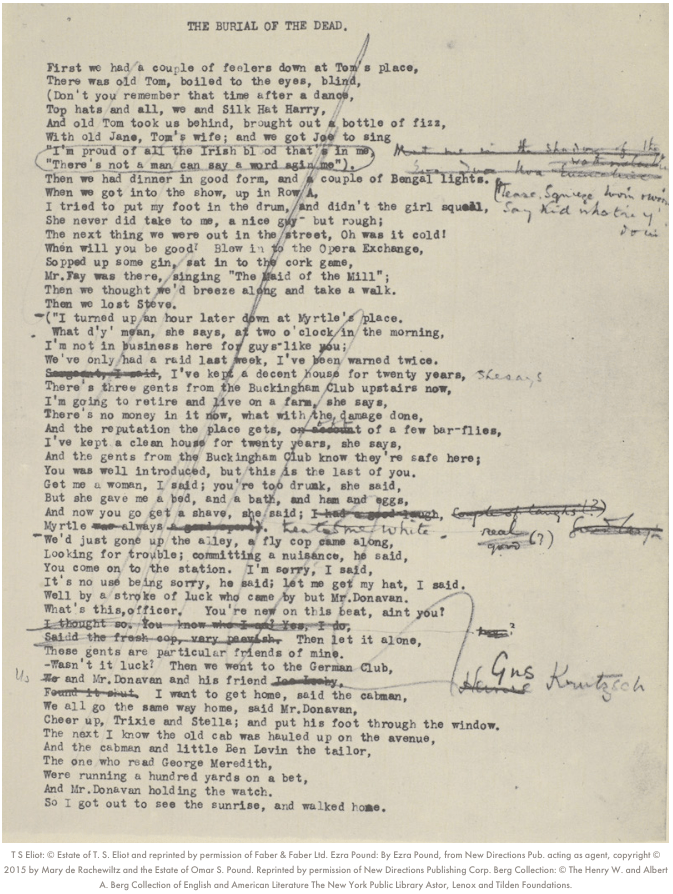
“April is the cruelest month,” T. S. Eliot wrote as the opening line of his iconic poem “The Wasteland” (1922). Clearly, he had never experienced a Canadian March. As I write this on March 25th, we are 10 days into the new riding season, yet no one is riding. It’s 2C (36F) and the sky is a slab of grey slate pissing cold rain that turns to ice in patches on the treacherous sidewalks. Brown, dirty snow still sits at the sides of the roads and in patches on lawns, slowly melting over weeks to expose winter garbage and dog shit lying underneath, and the grass, when it finally pokes through, isn’t really grass but mud and last year’s soggy, decaying leaves. Eliot’s poem captures postwar disillusionment and his nervous disorder, but it might equally describe the mood of Canadian bikers in late March.

Nevertheless, we continue to plan and prepare for the season to come in a kind of blind faith. Yesterday I did a practice pack of my gear. I’m trying a new gear set-up and have the ambitious plan of eliminating my tank bag, tail duffle bag, and hydration knapsack. I want to ride this year without the extra weight either on the bike or my back. To do that, I had to be as ruthless as Ezra Pound was to Eliot’s manuscript.
Gear

I replaced my tent and mattress with a hammock and bug net. I’ll be touring midsummer so I’m going without a hammock underquilt. I also swapped my MSR Dragonfly stove and 2L Billy pot for an Odoland isobutane stove and pot, but I’ve added to my kit a Bushbox twig stove. I’m not sure which will become my primary stove, but the idea is to use the twig stove when dry wood is readily available and the isobutane when it’s not. And as a back-up to the back-up, just for its simplicity and ease, I’ve also picked up a Trangia alcohol burner. This fits nicely inside the Bushbox and can burn isopropyl alcohol, available at any pharmacy. Can you tell I’m nervous about giving up my Dragonfly?

My camping mates will be happy to know that I finally retired my toy hardware store hatchet and bought a Gränsfors Bruk Wildlife Hatchet. I don’t know why I suffered as long as I did. I’ll be using this around camp to prepare firewood and split firewood into twigs for the Bushbox. I’ll be travelling solo so edited out of my kit the second plate, cup, and cutlery, resulting in my cookware now being considerably smaller and lighter.

When I did The Timber Trail at the very end of last season, I found my Wolfman Expedition tank bag too big and heavy, making the Tiger more top-heavy at slow speed than it already is. It also worked better on the 650GS with the fuel cap on the side of the bike and not under the bag. It would have been possible to move the essentials to my hydration knapsack, but I want to eliminate it too. Water is heavy and the knapsack restricts airflow through a jacket. Mine also interferes with my neck brace. (If it goes under the brace, the brace sits too high; if it goes over the brace, the brace digs into my shoulders from the extra weight.) Instead, I’m going to try a fanny bag with only a few essentials from the tank bag: aux port to USB adapter, some electrical cords, a Leatherman Wave, tire pressure gauge, 8mm socket and micro-ratchet for my pre-load adjuster, and my monocular. I think fanny bags are nerdy, especially if worn in the front (i.e. the scrotum bag), and I wouldn’t be caught dead in one anywhere but on the trail, but one might be the answer to staying cool and unencumbered on the bike. If they find me dead somewhere on a trail this summer, at least my reasons for wearing one are now known.

As for water, since I won’t be needing to bring a fuel bottle for the Dragonfly stove, my bottle holster is free. I’ve moved it from the back of a pannier to the front left side and will try the Simple Modern Insulated Tumbler with Straw and Lid for sips when I can. It’s only 28 mL so I’ll also be carrying an MSR 4L Dromedary to refill it as needed. Marilyn and I took the latter through Newfoundland but never used it much, so I was ready to retire it from my kit, but I’ll be doing some pretty remote riding midsummer so will strap the Dromedary onto the bike along with a 1G Giant Loop Armdillo bag to extend my range to around 400 km (~250 miles).
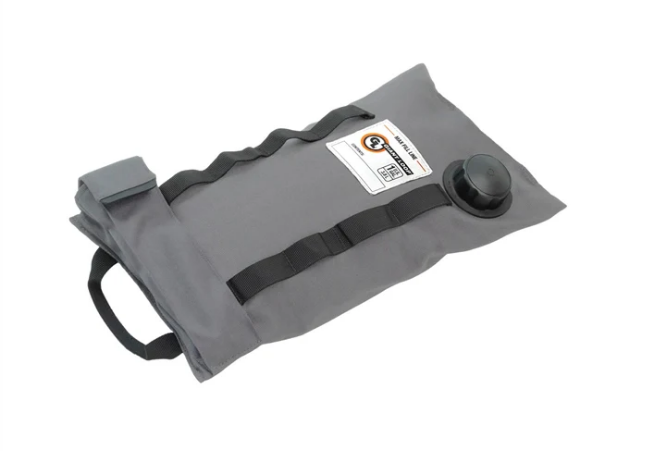
Giant Loop Armadillo Bag

After the practice pack last night, I can confidently say that almost everything fits into my Enduristan Monsoon Evo bags. I’ve added two Enduristan Fender Bags onto my panniers, into each fits perfectly a 10×10 Aquafest Safari Tarp. (I’ll be taking two—one for over the hammock, one for shelter.) My tools and tubes, as always, will go in two Giant Loop Possible Pouches that I strap to the crash bars at the front of the bike. I say “almost” because I will still have to have a small Enduristan tail bag on the rack at the back for my rain jacket, windbreaker, and down vest—my layering system to deal with temperature changes. I can live with that.

Finally, I’ve added to my gear to prepare for the risks of off-roading. I have a Knox compression suit and recently purchased the chest protector upgrade that doesn’t come standard with the shirt.

I swapped out Level 1 armour for Level 2. I also recently replaced my ageing Arai Signet-Q helmet with a Contour-X. I know, I know: why didn’t I get an XD-5 or similar adventure helmet? Well, I already have an adventure helmet, the LS2 Pioneer, and this will be my touring helmet. The peak causes wind noise and I was looking for the most comfortable, quietest, safest helmet on the market, and the Contour-X fits me like a glove.

Route
I’m sorry, my American friends, but I’ve decided that I can’t do this summer my planned ride of The Blue Ridge Parkway south and the BDR’s coming back. This will be the 3rd time I’ve postponed this ride, and I don’t do it lightly. I was looking forward to exploring the Appalachian Mountains and challenging myself on the MABDR and especially NEBDR, but after much deliberation, I’ve decided to join my fellow Canadians and stay north of the border this summer, that is, the “artificially drawn border.”

What makes this decision especially difficult is that I have always found Americans extremely friendly and helpful, and I recognize the difference between Americans and their government. But lately we Canadians have been hearing of visitors having their phones confiscated at the border and searched, and some Canadians detained, and even some anti-Canadian sentiment from certain states that shall remain unnamed, so I don’t feel entirely safe to visit while tensions are this high. I’ll be travelling solo in remote regions so am especially vulnerable. It’s really unfortunate that it’s come to this and I hope our good relationship can be restored quickly so I can complete that bucket list ride.

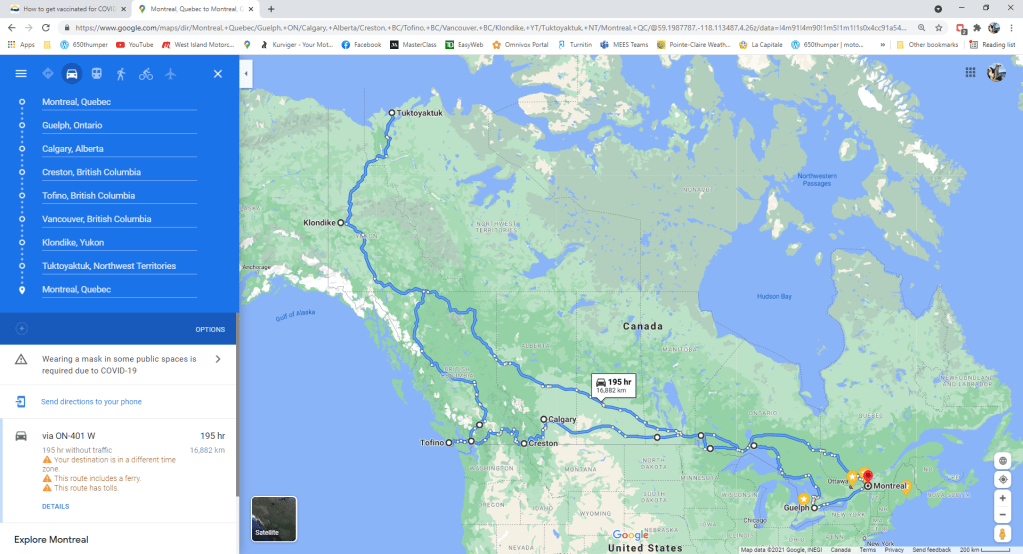
Instead, I’ve decided to do some of the Trans Quebec Trail. This is a system of trails throughout Quebec. Initially I was going to do a section of the TCAT (Trans Canada Adventure Trail) called The Forest that runs from Baie Comeau, Quebec, to Kenora, Ontario, but that gps track isn’t always kept up to date. My Calabogie Misadventure ride a few years ago was largely a result of the track not being kept current; my riding buddy and I didn’t know that a bridge was out and were forced back out onto a gnarly hydro line. The big benefit of the TQT is that there is an accompanying app that is user-submitted; if there’s a problem on the track, one can immediately report it with the press of a button. The app also shows campgrounds, gas, groceries, attractions and more, so I feel I can ride with a lot less stress and simply explore, as I like to do, finding the essentials when needed. Thanks to Marc Chartrand and his team for putting this route and app together.

I plan to pick up the track south of Montreal and follow it east to Rimouski and beyond, perhaps into the Gaspé interior. Then I’ll cross the St. Lawrence River (uh, by ferry) from Matane to Baie Comeau and come back by the north shore, up through northern Quebec with some of the most remote riding I’ve ever done. It loops over Lac Saint Jean, where Marilyn and I visited last fall, but on dirt roads this time. Apparently about 90% of the route is dirt and gravel. You can see the entire trail and photos at the STQT Facebook page. I don’t know how long this will take me and I don’t have a definite schedule, but that’s the kind of adventure riding I like. With the app and riding solo, I can play it by ear and simply explore at my own pace. Teachers’ benefits.

Training

To prepare for the off-road element of this tour, I’ve decided to do some more instruction this summer. When I got my licence in 2016, I did some classes to get a Level 1 foundation, but it’s been several years since and I’m ready to improve on those skills. I’m going to look into the Level 2 class with Académie Ridaventure. Their Level 2 class covers such things as water crossings, clearing obstacles (logs, large rocks), and brake slides. I think it’s always good to develop your skills, and I feel I’ve plateaued recently.

I hope to do a semi-private Level 2 class.

“Ah spring!”

There’s another poem I know about spring. Unlike Eliot’s 434-line masterpiece, this one contains two words: “Ah spring!” I know it by heart. It’s been a brutal winter with record snowfall in Montreal and frigid temperatures for months. No January thaw this year. But we’ve finally arrived at the cusp of spring and the riding season.

If there’s one positive of the off-season, it’s the opportunity to “reculer pour mieux sauter,” as D.H. Lawrence said, step back to jump forward. It’s a time to dream and plan for adventures to come. I’m ready; the bike is ready. It may not be the cross-country tour I did in 2021, but in many ways it feels like this tour will be my most ambitious and the one I’ve been working towards since I began riding in 2015. It’s the kind of ADV remote touring I wanted to do on the cross-Canada tour but didn’t have the time. I discovered then that this country is so large that you have to explore it one province at a time, and I guess I’ll start with the one I’ve called home now for 35 years.

What are your plans for the season? What changes have you made to your bike and kit to prepare? Drop a comment below. Whether you are an armchair adventurer or a seasoned traveller, despite what Nature presents us today, it really is a special time of year. Keep the faith, my motorcycle friends: we’re almost there.
The Best-Laid Plans

The 2024 riding season is looking very different.

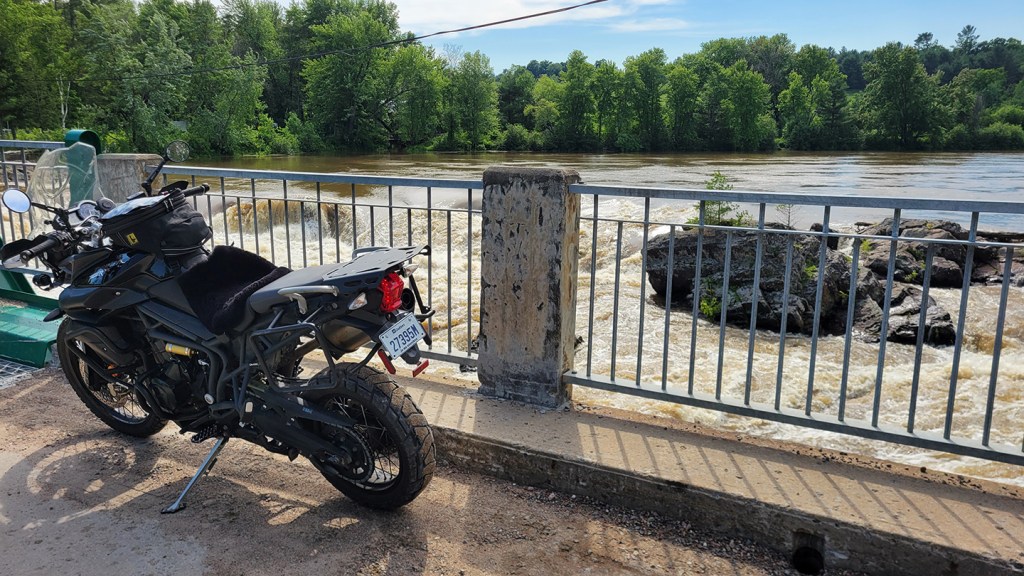
Avoca Bridge on the Rivière-Rouge, Quebec

I was playing pickle ball with a motorcycle friend when she caught her foot on the court and fell, breaking her wrist and messing up her plans for an upcoming tour through Greece. (She ended up going but as a pillion.)

Another riding buddy just bought a sweet 2022 1250GS and was all set to ship it to Las Vegas this fall and ride to Yosemite NP and back along the Pacific Coast Highway to San Diego. The other day while walking into his garage, he got his feet caught up in a hose and fell, breaking both his arms.

Both my friends are healing well but their stories remind me that sometimes “the best laid schemes o’ mice an’ men / Gang aft a-gley” (Robbie Burns, “The best laid plans of mice and men / Can go awry”).

I’m thinking of this in relation to my own summer plans. If you’ve been following this blog, you know I was due to leave July 1 to ride The Blue Ridge Parkway down to West Virginia, then ride the MABDR and NEBDR back to Quebec. The bike was ready; I was ready. Now that’s not going to happen, but for reasons less dramatic than what happened to my friends.

As some of you know, my wife and I rescued a dog in October 2021, near the end of the Covid crisis. He was in a bad situation through the first several years of his life and came to us with some pretty severe trauma. So I didn’t travel that first summer but let him settle into his new home. Last summer, Marilyn and I left him for three weeks while we toured the East Coast and Newfoundland, and ever since then, he’s shown signs of separation anxiety.

Recently while we were on a short trip out of province to visit family, he became severely ill. He lost about 20% of his weight and had to be hospitalized for 24 hours to receive intensive treatment. The official diagnosis was gastro, but I’ve come to learn that gastro is really just a generic term for any kind of digestive issue. The real cause, I’m quite certain, was stress.

The good news is that, physically, he has recovered after a week of antibiotics and gastro food. The bad news is that now his anxiety has worsened to the degree that we can no longer leave him alone, even to run short errands.

So instead of touring through July, I’ll be working with him to desensitize and recondition him, but this is going to take time. If he progresses quickly, there’s an outside chance I might be able to ride just the NEBDR in August. That’s my glimmer of hope. Otherwise, the Blue Ridge Parkway and BDR’s will have to wait another year.

Although disappointed, I can’t complain too loudly about this turn of events. Yes, I was looking forward to the ride after a tough winter, but I don’t have any broken bones, and Montreal’s West Island is very pleasant in the summertime. I’ll still be doing day rides when Marilyn is home, and I’ll still be posting about those rides and writing other content.

Speaking of which, the other day I rode an old favourite, Riviére Rouge up to Brookdale, then back down the 323 to Montebello before returning along the 148. Okay, it’s not The Blue Ridge Parkway, but the Tiger is always fun to ride.

The motto of this blog is “life is an adventure.” You never know what’s around the next corner.

Enjoy the ride, whatever it may bring.

2023 NE USA Tour: Preliminary Plans

The second tour of the coming season will be down memory lane.

Jumping waves on the Outer Banks, NC, circa 1970.

When I was a boy, my parents used to take us down to Cape Hatteras on the Outer Banks of North Carolina for our family vacations. I was the physical barrier separating my two older sisters in the backseat of our Pontiac Strato-Chief. My dad had installed seat belts in our favourite colours according to this arrangement: red, blue, green. Or was it green, blue, red? I can’t remember, but I remember quite a lot about those vacations. They were among my happiest memories growing up, despite the backseat shenanigans.

Not my dad’s Strato-Chief but similar.

We went with another family, and apparently those vacations left an impression on them too, for one of the children named her future child after me. En route, we camped at Shenandoah National Park in the Blue Ridge Mountains. I still remember the nature hikes led by a ranger (who taught us to recognize a particular birdsong by its resemblance to “Drink your teeeeeea!”), the nighttime slide shows at the amphitheatre, walking back to our campsite afterwards, the fog so low you could bounce your flashlight off the underside of a cloud, and the rainstorms. The rainstorms! To this day, I love a good rainstorm from inside a good tent.

Since getting my licence in 2016, I’ve wanted to return and ride the Blue Ridge Parkway, and this summer I finally will.

We would drive much of the Blue Ridge Parkway before spending a day in Williamsburg, then head over to the coast and camp along the Outer Banks. The campground was so close to the ocean you only had to walk along a boardwalk over the dunes to the beach. I wasn’t a strong swimmer and the sea always frightened me, but I enjoyed playing along the shoreline. One year, we went to The Wright Brothers Memorial at Kitty Hawk, and I think my first ever book was a staple-bound biography of The Wright Brothers I purchased from the gift shop there with the few dollars we were given for “spending money.” That seed of interest later sprouted into a dream of being a pilot when I grew up, and although my career ultimately went in a different direction, it has combined with another interest of mine—poetry—to produce a collection of poems that explores the theme of flight. I might not be a pilot, but I can imagine being one; the opening section is in the voice of Wilbur Wright.

A postcard of this famous photo of the first flight sat on my desk and served as inspiration.

The last time I went down there I was 14. My sisters by this point were already doing their own thing and didn’t go, so I had the backseat all to myself and Supertramp playing on my cassette recorder. During one rest stop on the Blue Ridge Parkway, we came out just in time to watch three motorcyclists start up their bikes and roar off down the parkway. One was a woman on a BMW. I’d never heard of that manufacturer but my dad clearly had. “Did you see that young woman take off on that BMW?” he remarked to my mom.

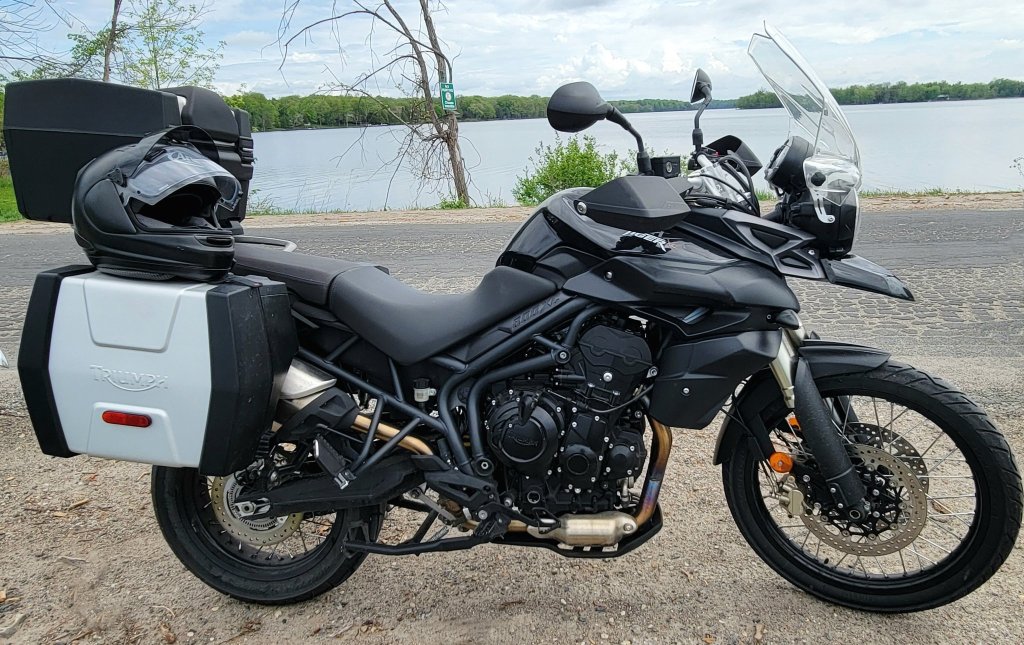
Perhaps another seed was planted on that holiday because, since getting my licence in 2016, I’ve wanted to return and ride the Blue Ridge Parkway, and this summer I finally will on my Triumph Tiger 800 named Jet.

The trip so far is pretty sketchy, but that’s generally how I like to tour when I’m on my own. In the earlier trip planned for this coming summer, my wife and I are going to visit Newfoundland, and much of that trip has been scheduled. For this one, however, all I know so far is that I’ll ride The Blue Ridge Parkway and Skyline Drive at some point, camping at Shenandoah National Park. I also know that I’ll ride some dirt in the MABDR and NEBDR (Mid-Atlantic and North East Backcountry Discovery Routes respectively). The MABDR and Blue Ridge Parkway plus Skyline Drive cover similar geography, so it makes sense to do one down and one back. One is asphalt, the other primarily dirt.

I’m thinking I’d also like to get out to the Outer Banks and ride them too if I have the time. They are less than a day’s ride from the Blue Ridge Mountains. Lea of Got2Go recently rode them and titled her YouTube video “The BEST road trip of the USA East Coast?”

Got2Go Rides the Outer Banks

At the time of this writing, there are lots of unknowns. Will I be touring solo or with a few friends? I’m good either way, but it would be nice to ride the technical sections of at least the NEBDR with a few buddies, and I’ve put a few feelers out. If I get some takers, will they do the whole tour with me or only one or both of the BDRs? If they can only do the dirt with me, I might change the order of things and ride the BDRs down and the asphalt back, to accommodate them.

I also don’t have a precise route mapped out yet from the Canadian border to the top of Skyline Drive. I’ve got Google Maps, Kurviger, and Rever open in separate tabs of my browser with the “Avoid Highways” option selected and am studying their suggested routes. Depending on which router I’m looking at, it’s between 1000 and 1100 kilometres from my house to where the scenic drives begin. This is prime Civil War geography through Pennsylvania and I’ll be tempted to stop often at historic landmarks.

Will I ride Tail of the Dragon while I’m down there? I’ve heard from several people that it’s not worth it and, in fact, is a little dangerous with superbike and sports car idiots treating it like a track instead of a public road. There are apparently many roads in that area just as good or better and less populated. Do you have any suggestions? Let me know.

So there’s a lot still to decide about this one but one thing I do know is that I’ll be leaving sometime in the fourth week of July and will have a little under three weeks before I have to be back for work mid-August. That’s not a lot of time but my parents did it in three weeks, if memory serves me well, and they had three kids in tow.

I know a lot will have changed and I can’t expect everything to be as I nostalgically remember it. You can’t go back in time or relive your childhood, nor would I want to. But I suspect the mountains and the ocean won’t have changed much since I saw them last, and that’s what I’m going there to see. And this time, instead of being stuck between two sisters in the back seat of a car, I’ll be riding my Tiger 800XC, putting it through the full range of its abilities as I carve new memories through the Appalachian, Blue Ridge, and Great Smokey Mountain ranges.

2023 East Coast Tour: Preliminary Plans

Sketching out the next big adventure

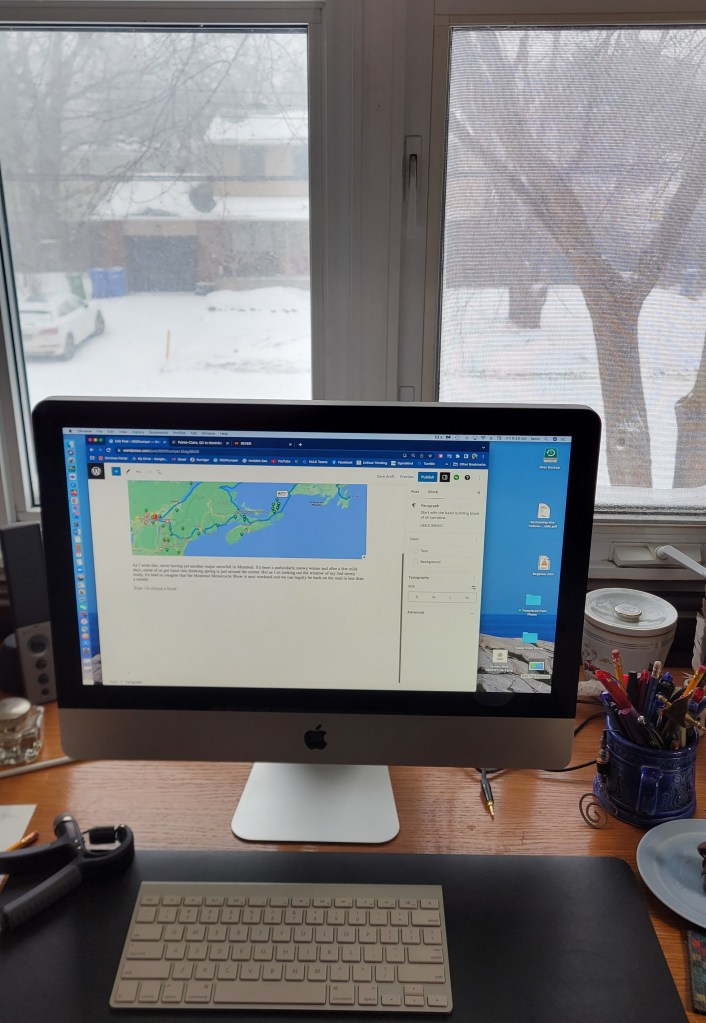
As I write this, we’re having yet another major snowfall in Montreal. It’s been a particularly snowy winter and after a few mild days, some of us got lured into thinking spring is just around the corner. But as I sit looking out the window of my 2nd-storey study, it’s hard to imagine that the Montreal Motorcycle Show is next weekend and we can legally be back on the road in less than a month.

My favourite way to avoid shoveling: write a blog post!

Still, I must continue making travel plans in a kind of blind faith in the power of nature. If I put on my cheap Dollar Store shades, all that white outside becomes a shade of green, and I can almost imagine it being June and setting off. With this trip, there are some reservations that have to be made, like booking the ferry on and off Newfoundland, so I have started to map out a rough outline of our planned exploration of the Canadian east coast. This will be the book-end tour of the west coast trip of 2021.

Learn from your mistakes

I’m trying to keep in mind what I learnt from that last one, specifically, sometimes less is more. That’s what I keep telling my students, anyway, who think they are clarifying their thesis statements by adding clause after clause. The last trip was spent too much on the Superslab in my need to cover distance in the time I had. I don’t want to make the same mistake so am trying to be realistic in what we can see in the time we have away from the dog and our jobs. Marilyn, the domestic accountant, likes to remind me about our budget too.

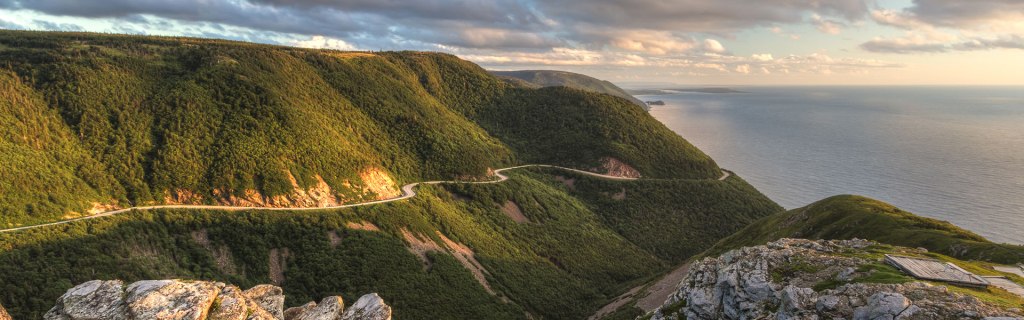
My first route planned included The Cabot Trail. It seems sacrilegious not to “do” The Cabot Trail if you are anywhere within 150 kilometres of it on a motorbike, and we will be passing through Cape Breton en route to Sydney, NS, where one catches the ferry to get to Newfoundland. But my practical wife reminded me that we have been to Nova Scotia several times and both ridden (at least, I did) and driven The Cabot Trail and maybe we should devote that time to Newfoundland and perhaps Prince Edward Island, which we haven’t visited. This is a classic case of idealism (i.e. “we can do it all”) versus realism (“we are only human”) so we’ll see in the coming months which ideology wins.

The Cabot Trail: an iconic ride

Gaspésie, PEI, Nova Scotia, Newfoundland

What we do agree on is that we’d like to ride the coast of the Gaspé Peninsula, or as they like to call it here in Québec, La Gaspésie. I’ve driven that before and it’s spectacular. Marilyn hasn’t seen the Roche Percé, and like the Butchart Gardens we visited on Vancouver Island, we will make a stop at the Reford Gardens in Matane, QC. Forillon National Park at the tip of the peninsula is pretty special too.

Another decision we have is whether or not to visit Prince Edward Island. Our Insight Guides book suggests a three-day 250-kilometre road trip that includes Charlottetown, Argyle Shore Provincial Park, Brackley Beach, and the West Point Lighthouse near Cedar Dunes Provincial Park. Hopefully, those provincial parks offer camping. Technically, I’ve been to PEI, but I was too young to remember much. If we can’t work it in this summer, we will definitely get out there next. Aside from NWT and Nunavut, PEI and Newfoundland are the only provinces or territories I haven’t visited, so I’m hoping we can devote a few days to get a taste of the island.

Should we take the day or night ferry to Newfoundland? There are pros and cons of each, as I see it. A day crossing might be time wasted, just looking out for 7+ hours over endless water. I know there might be the opportunity to do some whale watching, but I’m sure we’ll be doing some of that once on the island. A night crossing is more expensive if you buy a cabin and try to get some sleep. On the other hand, the cabin isn’t any more expensive than a motel room, which we’d have to get soon after landing from a day passage. I’m leaning toward a night crossing. I’ve never experienced sleeping on a boat like my parents did when they immigrated on the Queen Elizabeth II and I think it would be novel. If we cross during the day, we will camp at a favourite campground in Baddeck in order to get to the ferry in the morning; if we cross at night, there might be time to ride The Cabot Trail or stay at Meat Cove, which is an amazing campground off The Cabot Trail right at the eastern tip of Cape Breton Island.

If you’ve visited Newfoundland, what did you do and why? I’m open to advice. There is a growing sense of urgency to decide, especially if we want a cabin as they sell out early, so decisions have to be made soon.

Neither Marilyn nor I has visited Newfoundland before, so this is going to be a treat. Again, we can’t do it all, and we’ve decided to focus on the west coast. Gros Morne National Park is a bucket list item. Then we will continue up the coast on what’s called The Viking Trail because I like history and am interested in seeing the Viking settlement at L’Anse aux Meadows. Then we will cross the island to Saint John’s because, well, you can’t visit Newfoundland without strolling around Saint John’s, including “hydrating” at a pub on Water Street before climbing Signal Hill. I’ve heard and read about these places and look forward to exploring them in person.

Finally, we have to decide whether we have time to ride The Irish Loop, a 325 kilometre loop along the coastline south of Saint John’s. The name is intriguing since we both have some Irish blood. And anything along a shoreline is bound to please me on the bike. Our guidebook suggests 2-3 days for this, so it really depends on if we can fit it all in.

Maine, New Hampshire, Vermont

Currently, the plan is for Marilyn to fly out of Saint John’s back to Montreal like she did from Vancouver when we were out west, and I’ll continue on solo. And I’m pretty sure I’ll come back via The United States instead of my initial plan to return via Labrador and the north shore. Like the caribou during their migration, I’m detouring to avoid bugs. Besides, the riding through Maine and New Hampshire will be more interesting than through Labrador. I recently purchased a subscription to Rever, which classifies roads on a colour coding system, and there’s a cluster of G1 (Best) roads in the White Mountains of NH that is calling my name.

G1 Best roads to ride are in yellow. That cluster in the White Mountains looks interesting.

I might saunter my way back along the coast, checking out Bar Harbour and a few other places before cutting diagonally north-west through the White Mountains. Without the deadline of ferry crossings, this will be the unplanned, unscheduled segment of the trip, which is generally how I like to tour. Maybe I’ll stay an extra night in New Hampshire so I can ride those primo roads unladen with gear.

This trip is going to take me about three weeks—two weeks with Marilyn, and about a week solo to get back. After a short rest in which I’ll service the bike and change my tires to something more dirt-oriented, I’ll head off again, this time to ride some BDRs. It’s going to be a full and exciting summer on a new bike, and I’ll have lots to write about so click Follow if you want to follow along.

ADV Riding as Thrill-Seeking

Is extreme remote riding simply gratuitous risk-taking?

Video credit: Troy R. Bennett

Recently a story was circulating about Eric Foster, a guy who crashed on the Trans-Taiga Highway. Perhaps you’ve seen it. He was riding solo and woke up eight hours later in a hospital in Montreal. It’s actually an old story from 2017 but was republished end of November and that’s when I saw it. It’s a pretty gripping story, as far as crash stories go. He was riding in perhaps the remotest area of North America when he crashed, breaking his back and a leg. Some trappers saw the smoke from his motorcycle on fire and came to his aid, but it took hours for first responders to get to him, and then hours to get him to a hospital. The story has a happy ending; he returns to the spot where he had the accident and finishes his trip, stopping to thank the trappers along the way who helped him.

I’d never heard of the Trans-Taiga, so the article got me looking. It’s a dirt road built by Hydro Quebec to service their dams, and it is indeed about as remote as you can get in Quebec. According to Wikipedia, it’s the “northernmost continuous road in Eastern North America,” snaking 582 kilometres (362 mi) through forest from James Bay Road to the Caniapiscau Reservoir. That’s right—that’s all there is at the end of a dangerous journey: a reservoir. Then you turn around and ride the same road back.

Why would someone want to do such a ride? Well, the answer is in the article. Eric Foster describes himself as “a challenge guy.” When asked why he wanted to ride the Trans-Taiga, he replied, “Just to say I did it,” then added, “I love a good challenge.” I’ve found myself saying the exact same words of that last sentence, and I’ve written about risk-taking in an earlier post when discussing my decision to try The Dempster, another dangerous highway. Quoting Jordan Peterson, I wrote at the time:

“When untrammeled—and encouraged—we prefer to live on the edge. There, we can still be both confident in our experience and confronting the chaos that helps us develop. We’re hard-wired, for that reason, to enjoy risk (some of us more than others). We feel invigorated and excited when we work to optimize our future performance, while playing in the present. Otherwise we lumber around, sloth-like, unconscious, unformed and careless. Overprotected, we will fail when something dangerous, unexpected and full of opportunity suddenly makes its appearance, as it inevitably will.”

12 Rules for Life

Research on the Trans-Taiga led me to looking at James Bay Road, a highway so remote that you have to sign in at a check point before riding it so officials can keep track of who’s up there. I watched a YouTube video of a group of guys who rode it to James Bay, including a few kilometres of the Trans-Taiga, “just to say they did.” And then the YouTube algorithm did its thing and showed me another series of videos of a father and son riding the Trans-Labrador Highway, which was right up my alley because I was considering riding it back from Newfoundland this summer after crossing to Blanc-Sablon.

Coincidentally, this series is also by Troy Bennett.

The Trans-Labrador Highway is one of those classic ADV rides you’ve apparently got to do to call yourself an ADV rider. It also snakes through some pretty remote territory, and until recently, was mostly gravel. (The final remaining section of dirt has recently been paved.) I watched the six-part series and the riders did have some adventure. They had a break-down and had to be saved by some locals, and they encountered some unseasonable weather and were held up for a few days by a late snow fall. There was some good bonding time, for sure, but in terms of the ride itself, it seemed like hours and hours of mind-numbing coniferous forest. No lakes, no mountains, no cliffs, no hill climbs, and as of last summer, no dirt.

Why would the Trans-Labrador be such a popular ADV ride? It has to be its remoteness, and if you live in the northeast of North America, the Trans-Lab is one of the few remaining truly remote roads.

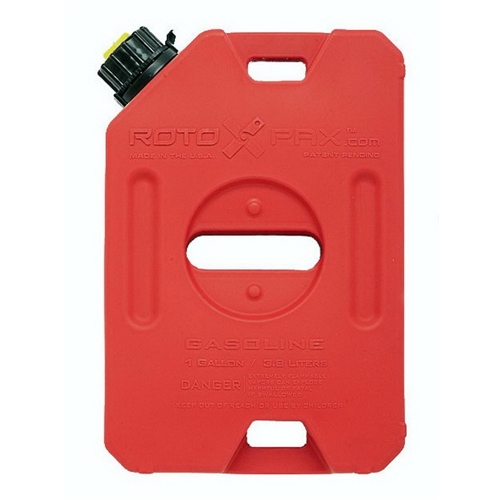
If you’re looking for a challenge, remoteness will provide it. For one, there is the not-so-little issue of fuel; you have to be able to cover upwards of 400 kms between fuel stops, which can be done by carrying extra fuel in a Rotopax or another fuel container. With remoteness usually comes some challenging riding too since no one wants to pave a road that has limited use. And if it rains, that challenge increases significantly, especially on roads like The Dempster or The Dalton that are sprayed with calcium chloride as it makes the mud greasy. Then there’s the danger of wildlife, whether it be an aggressive grizzly bear or, worse, the black flies.

Stuck in otherwise pretty safe lives, we seek danger in answer to an ancient call somewhere in the reptilian brain that harkens back to another era when we lived close to death.

But the real challenge of riding remote is simply the lack of assistance should you have a mechanical or medical problem. I won’t say you are on your own because even on these remote highways there are still trucks passing periodically, but parts and medical assistance become scarce. This is where you have to be prepared: know how to fix your bike, carry spare parts, bring a first-aid kit, and have on you a satellite tracker like the Garmin inReach units that are connected to emergency services.

Is it worth it? Well, to each his or her own, but for me, the risk itself is not enough. In fact, I’ve been wondering if riding remote for its own sake is really just a way for some people to feel alive again. Stuck in otherwise pretty safe lives, we seek danger in answer to an ancient call somewhere in the reptilian brain that harkens back to another era when we lived close to death. Some people skydive. Others bungee jump. Some climb mountains. And some race The Isle of Man TT in search of what Guy Martin calls “The Buzz,” that adrenaline hit you get when you are on the edge of life and death.

But watching these videos has led me to rethink my upcoming tour. I don’t think I’ll be coming back from Newfoundland via The Trans-Lab. It’s not because I’m scared of remote riding, but in my world, there has to be some pay-off for the risk, and bragging rights just isn’t enough. When I rode up The Dempster, every kilometre was worth the risk for the magnificent views the highway provided. I’d never seen geography like that before and likely won’t until I get up there again.

Golden Sides Lookout just north of Tombstone Territorial Park, Yukon.

But the Trans-Lab, the James Bay Road, and the Trans-Taiga don’t offer much beyond hours and hours of forest. From what I can determine, there aren’t even places to pull off safely for a rest or to camp. These are roads built exclusively for trucks to get from Point A to Point B, cutting a single line through otherwise impenetrable bush. I’ll leave it to the black flies.

For a challenge, I’ve decided instead to ride this summer the NEBDR and MABDR (North East and Mid Atlantic Backcountry Discovery Routes respectively) down to The Blue Ridge Parkway, and while there, I’ll probably do Tail of the Dragon, although riding a curvy section of road at the limit of my skill and the bike is not my preferred mode of challenge these days. Rather, I’m looking forward to testing my metal on those Class 4 roads of the NEBDR. I’ll take a rocky hill climb over speed or gratuitous remoteness any day; it’s what drew me to ADV riding in the first place. Off-roading provides a challenge that is relatively safe. That might sound like an oxymoron, but you don’t have to risk your life to get “The Buzz.” Successfully completing a technical section of road or trail will give you a hit too, and if you don’t make it and drop the bike, well, you live to try another day. And along the way, there are some pretty great views, villages, and campgrounds.

What do you think? If you ride a motorcycle, you’re familiar with managing risk. Is remote riding your thing, and if so, why do you do it? If not, what kind of riding gives you The Buzz? And if you don’t ride, what do you do to step outside your comfort zone and feel alive? Drop a comment below; I’m always interested in hearing from readers.

The Wish List, 2022

It’s time to modify the Tiger for dirt.

There’s a balance between customizing a bike and over-modifying it. I remember an episode of Adventure Rider Radio in which Jim Martin talks with Warren Milner, who worked at Honda for 30 years in product planning and R & D. Warren warns against rashly modifying your bike, especially based on advice given on internet forums. For example, at one point in the interview, he talks about the exhaust system, describing how manufacturers spend hundreds of hours developing and testing it before the bike goes into production. That’s because today’s bikes use back-pressure from the exhaust as an integral part of the combustion process to optimize fuel efficiency and emissions, yet one of the first mods owners often do is to slap on an aftermarket exhaust. One can almost hear the collective groan of the engineers as they do.

At the same time, every bike that rolls off the assembly line is built for the average rider—average build, average riding (whatever that is), average skills, average goals. That’s why it’s important to customize it for your specific needs. Tall rider? You might want a taller windscreen to avoid buffeting, or add a wind-deflector. Long legged? You might want to lower your pegs or raise your seat. Or the opposite: you might want a lowering kit so you can flat-foot. Going off-road? You’ll need different tires, etc.. There are a lot of considerations, and fortunately, a lot of options available. The industry is healthy with aftermarket products.

I decided to ride the Tiger for a season pretty much as I bought it. I wanted to get a feel for it stock before making changes. I still have the stock front tire on that came with the bike. The only changes I made were in the realm of protection: crash guards and a beefier skid plate. I’d learned my lesson with the BMW, waiting to buy some upper protection and ending up buying a new radiator along with the guards when I eventually did. After studying the market, I went with Outback Motortek. The guards and plate set me back a cool Grand, but I think they’re the best on the market. The only other mods I’ve done to the Tiger so far were to add an AltRider rear brake extender and a wind deflector.

But with two big tours planned for 2023, it’s time to ask Santa for some items to get the bike ready. Here’s what’s on my wish list for 2023.

Panniers

The Tiger came with Triumph racks and cases. The system is fine for commuting and light touring, but those side-opening cases aren’t practical for moto-camping.

I deliberated (read, “agonized”) over this decision for a long time. I love my Touratech hard cases, but the Tiger has a high exhaust on the right side so I really should go with an asymmetrical system. When I had the 650GS on the market, I had offers just for the racks and cases, but I was reluctant to separate them from the sale of the bike. The new owner wanted to buy them too, but in the end, I decided I couldn’t separate from them either.

They are great cases and contain a ton of memories with all the stickers from where I’ve been. They are the original puck system, which you can’t get anymore, and I like that you can lock them. I’ll probably use these when I tour the East Coast with Marilyn because they are big and we need the space and I won’t be doing much dirt on that tour anyway. We’ll just have to pack them so the bike stays reasonably balanced.

However, I also plan to ride the NEBDR and MABDR next summer, and from what I’ve seen on YouTube, there are some challenging dirt sections of the NEBDR in particular for which I’ll need a smaller, soft-pannier system. (Soft panniers are generally considered safer for off-roading; there is less chance of breaking a leg.) I know everyone is getting the Mosko bags these days, and they are beautiful bags, but I decided to go with the Enduristan Monsoon Evo 34L/24L system.

I’m using the past tense because Santa took advantage of a Black Friday sale and got these 20% off. I picked up at the same time the matching bottle holster (for my stove fuel) and a can holster (for water, chain lube, or bear spray). One of the nice things about this system is that it’s modular, and I’ll probably be adding more to it as I figure out my needs.

Marilyn and I used the Enduristan pannier topper through the West Coast and loved it. Enduristan products are completely waterproof and designed by ADV riders to withstand the abuse of adventure touring. But the main reason I went with this system is the weight; they are the lightest panniers on the market, with no backing or mounting plates to worry about. This also means that the bags and cases will be easily interchangeable.

Racks

It’s Outback Motortek all the way. They put a lot of R & D into their products and back them up with some brave testing, dragging expensive bikes along the ground. Even though the bars do not come up as high as Heed’s and others, they are sufficient to keep the plastics and vital parts off the ground and protected. The bars look like crap afterward but have done their job and can be re-powder coated.

The rear racks offer protection for the silencer and rear of the bike, in addition to carrying the panniers, so again, I went with the strongest. These are a full 18mm + with the powder coating. In fact, they are industry leading in their size, so big that Dual Sport Plus, where I bought the Enduristan bags, includes a workaround kit of washers so the bags fit these bars.

To these bars, I’m going to add on the left side an X-frame plate so I can mount a RotoPax 1G fuel container inside the bars. This will increase my range when remote riding and help balance the bike, especially when using the symmetrical TT cases. Clint at Dual Sport Plus has my exact planned set-up—racks, panniers, and RotoPax—seen here.

Hand and Lever Protection

The final bit of protection I’ll need before attempting those gnarly sections of the NEBDR is some protection for the levers. I considered going again with foldable levers but that would still leave the front brake reservoir and my hands unprotected. After looking at all my options, I decided to go with Barkbusters. They have a model that is made for my specific bike so the install is straightforward. And if I had any lingering doubts, they were quashed when I saw that BB make a plastic with my bike’s name on it. I know the Jet plastics don’t provide as much wind protection as the Storm and other plastics, but I think they suit the styling of the Tiger, and sometimes you just have to sacrifice a little practicality for vanity . . . I mean, aesthetics.

I’m not going to change my mirrors for now. I’m really not fond of the look of the double-take mirrors and am hoping the crash guards will sufficiently protect the OEM ones. And if they don’t, well, the decision will have been made for me.

Foot Pegs

What’s the most important part of the bike when off-roading? Given that I’ve posed this question in the subsection titled Foot Pegs, you’ve probably guessed correctly. If your body position while off-roading is correct, you really shouldn’t have much weight on the bars; you should be pretty much balanced on the pegs and steering the bike with your feet (i.e. peg-weighting). Of the four contact points with the bike (hands and feet), the pegs are the most important, so a good set of foot pegs is a must if you are going to do any technical riding.

The Triumph pegs aren’t small but they aren’t large either. I’ve heard that a large foot peg can make a big difference (sorry, bad pun), changing the entire feel of the bike and inspiring confidence. They will also save you resoling your boots quite as often. I looked at IMS, but they don’t make pegs for the Tiger. When I found that Fastway did and that there was a Canadian distributer, I jumped, Black Friday sale or not.

As you can see, at 2.25″ x 4.75,” these pegs are huge. They have adjustment for height and camber, and come with two lengths of cleats: 10mm and 12mm. I’ll probably start with the 10mm since my adventure boots already have a tread. They are expensive, but you only have to buy them once; Fastway sell bike-specific fit kits for mounting, so I will hold onto these babies when the time comes to sell the Tiger.

Honestly, I never thought I’d pay $300 for foot pegs, but I’ve been watching YouTube videos of guys doing, or trying to do, the Class 4 roads on the NEBDR and thought, “I’m going to need all the help I can get.”

Tail Plate

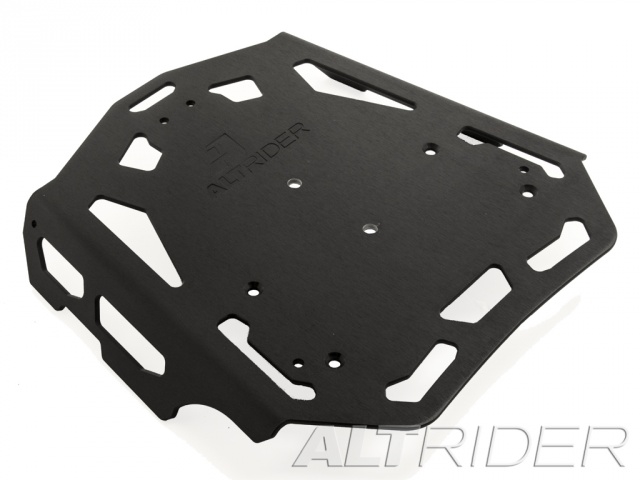
The OEM tail plate is too small for a duffle and has no good strapping points. It also shifts side to side as part of that Triumph system that shifts as you corner. I really like the AltRider tail plate, but at $260 for a piece of metal, I’m considering other options. You can get an eBay Special from China for 1/3 of that price, but will it be the same? Will the cut-outs be bevelled so they don’t cut into your straps? Will the powder coating begin to wear off after a season or two, as happened on my Kildala rack? AltRider make good stuff, and I like how this one projects out the back of the bike so there’s still plenty of room for Marilyn behind me. I might just watch and wait for this item to go on clearance somewhere, but I’ll definitely need a new tail rack before I tour.

Tires

I’ve had the Dunlop Trailmax Mission tire on the rear of the Tiger, and I had them on the GS when I took it to Vermont last summer. This 70/30 tire is a good choice if you are doing a lot of street with some dirt or gravel roads. That’s what I expect when Marilyn and I go through Gaspé, PEI, New Brunswick, Nova Scotia, and Newfoundland. So I’m going to put the matching tire on the front first thing in the spring before we head off.

For the tour in the US, that’s a little different and more complicated. I plan to start out on some BDRs (Backcountry Discovery Routes) that will take me from the Quebec border down to Pennsylvania, then I’ll be riding principally asphalt as I make my way over to the Outer Banks, including The Blue Ridge Parkway—a bucket list ride for me—and, why not, Tail of the Dragon while I’m in the area.

What do you do when faced with such diverse riding, everything from Class 4 (i.e. unmaintained) roads to the most renown section of twisties in The U.S.? Well, based on my experience, you have to go with the most aggressive tire required for your off-roading needs. You can ride a knobby on asphalt but if you try to take a street tire into mud and gnarly stuff, you can get yourself in trouble. Of course I could by-pass the gnarly stuff, but where’s the fun in that, and besides, I like a challenge!

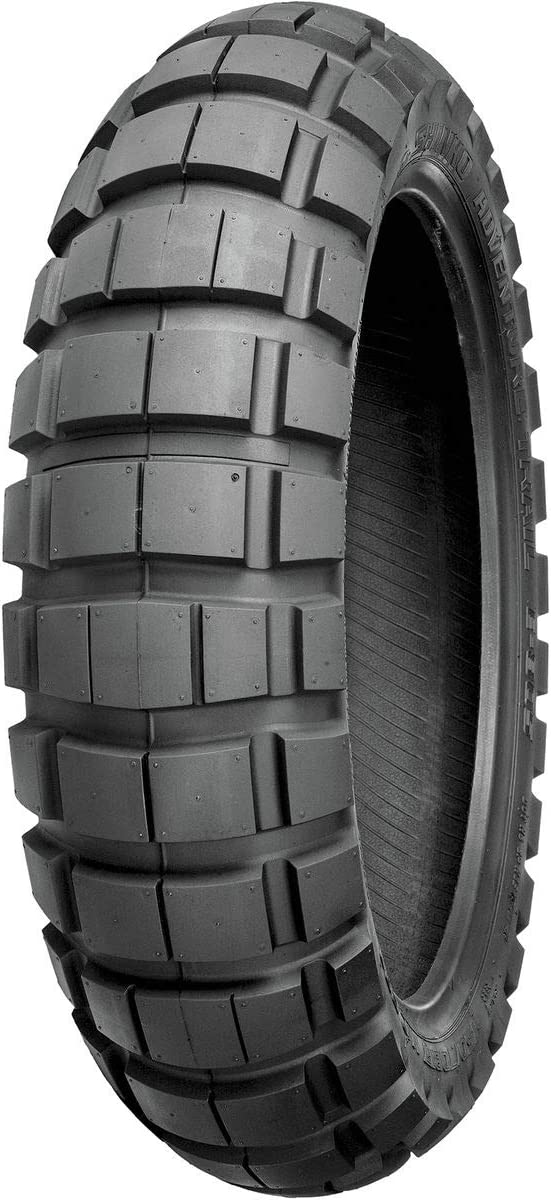
I’m currently deliberating between Shinko 804/805s and Michelin Anakee Wilds. I know the Shinkos are surprisingly quiet and smooth on the road, despite being a 40/60 road/off-road tire. However, they aren’t great with lateral stability. The Wilds are listed as a 50/50, but I have a sense they might be better in the dirt but louder on asphalt. (I’ve never ridden a set of these before.) I also like that the Anakees are a radial tire, so they will run cooler in the heat at speed. And for what it’s worth, Lyndon Poskitt just put a set of these on his Norden 901 for his tour of Iceland where he’ll be doing similar riding.

The Shinkos are about half the price of the Anakees, but for a tour like this, having the right tire is more important to me than a few hundred dollars. I have run the Shinkos before and they were great . . . until they weren’t. From one day to the next, they started skidding and sliding out on me.

What do you think? Anyone tried either of these tires?

Tools, More Tools . . .

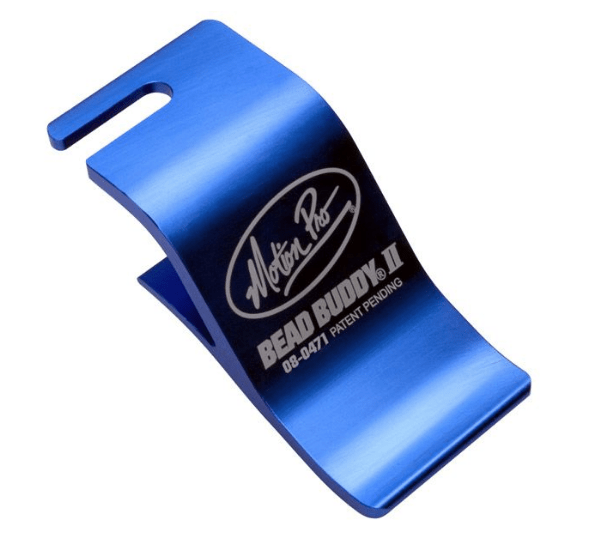
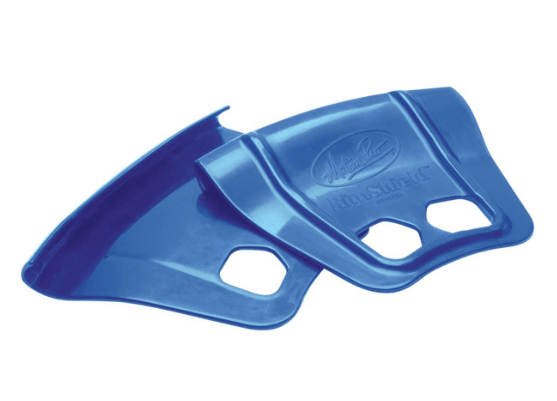
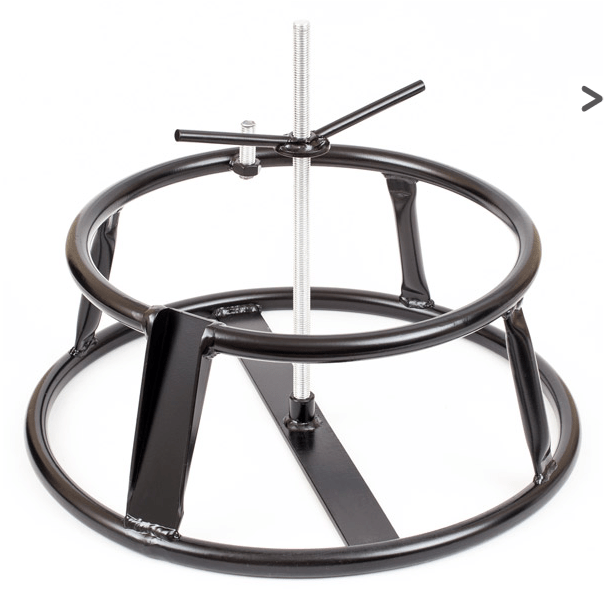
Finally on my wish list are some tools for helping me with these tire changes. I’ve always worked off the grass, but it’s not ideal; you’re grinding dirt into your bearings as you wrestle with the tire, and it’s hard to stabilize the wheel while levering. I think I’m going to ask Santa to get me a tire changing stand and some Motion Pro tools to facilitate this work and protect my rims.

The Tiger is basically a sport bike in adventure clothing; it rips, and I love how it handles through twisties. But I’ve yet to really test it off-road in technical terrain. Fully protected, with an aggressive knobby and soft panniers, Jet will be ready to hit the dirt and I’ll be eager to get back to exploring. Gros Morne National Park is a bucket list item for Marilyn and me, and I’m hoping we’ll be able to get deep into the park on the bike.

In the meantime, we’ve just received here in Montreal the first big snowfall of the winter. I’ve been shovelling the driveway for the past 24 hours, but I really don’t mind. It will be nice to have a white Christmas. I’ve just finished all my grading in my teaching work, and we are sufficiently stocked with holiday sweets and treats.

I was just remarking to Marilyn that, in many ways, I prefer the midwinter holiday to the summer one. While I can’t ride, being a bit house-bound provides an opportunity to step back from everyday life and reflect—a sort of retreat. And what comes to me this year as I do that is how incredibly blessed I am in so many ways. I and my loved ones are healthy, we have enough money, I have a fulfilling job . . . I could go on, but I’m thinking mostly of the people in Ukraine and other parts of the world who are less fortunate. In the immortal words of Ron MacLean, “count your blessings, not your presents.” It’s nice to dream and plan to buy stuff for what we are passionate about, but the most precious gifts cannot be bought.

I wish you and yours a healthy, happy holiday, and safe riding and travelling in 2023.

Where Has the Summer Gone, 2022 Edition

In the 100th post of 650Thumper, I reflect on a summer of forced relaxation.

Yesterday, the image above popped up as a Facebook memory of exactly one year ago, just to remind me that I once did something pretty remarkable. By contrast, this summer has been pretty tame, even by my standards.

To be fair, this was supposed to be a restful summer after the Epic Adventure of last year. I had eight months to recover, of course, but teaching is a pretty intensive profession, the workload of the semesters off-set by the summers of recovery, and this past year was especially draining as we continued to deal with masks and Covid protocols and the accompanying anxiety of a global pandemic. As a teacher, I am part pedagogue, part social worker, so found myself assuaging the anxiety of some students and standing firm against others who tried to take advantage of the situation. Deciding which is which is the hardest part of teaching, to be honest, and by the end of the semester, I and many of my colleagues were limping to the finish. “Boo-hoo!” I hear those in the medical and services professions saying. It’s true that I didn’t have to wear a mask 8-12 hours a day, but my experience has only heightening my respect for those who do.

But the real reason for a stay-at-home summer is that my wife and I got a new dog, and he was a rescue from a horrible situation. He doesn’t travel in the car without getting sick, and he has some triggers and in general is still settling, so we didn’t feel we could do our planned east coast trip this year. We’ll give him another year to get comfortable enough that we can leave him for even a few weeks so Marilyn can join me for part of that trip, as she did last year. We pledged to make the best of it, doing short day rides and maybe an overnight to test his limits.

Introducing Rusty to agility to build his confidence.

The summer started with a bang—buying a new bike and doing a series of short trips with friends in June while Marilyn did dog-sitting duty. First was a club ride to Westport, a small village on the Upper Rideau Lake, that took us along the Saint Laurence Seaway and up through the twisties of SE Ontario. I was on my new bike, purchased, registered, and insured the day before, so I was grinning the entire 700-kilometre, 2-day trip, except for when I watched in a local bar The Leafs lose Game 7, once again.

Narrows Lock Road, Rideau Lakes

I followed that with a trip to visit my sister and friend at a cottage in Denbigh, my first solo ride with the Triumph and a chance to put it through some paces on the winding highways of the Ontario Highlands. Then I did a little road trip (in a car) with a writer friend to Vermont in search of literary landmarks, followed by a return soon after with Mike and Danny, my riding buddies who did The Puppy Dog Route with me pre-Covid, but this time we finally did Bailey-Hazen, a military road dating back to the War of Independence. We also did some of the Hamster Ride, a similar dirt-route in New Hampshire, and road out to the ocean in Maine.

On the Bailey-Hazen Military Road, Vermont

I did another trip with Mike and another riding Buddy, Steve, to the VRRA races at Calabogie Motorsport Park on the July 2 weekend. And between those trips was a ride back to my hometown of Burlington, Ontario, for a reunion of The Burlington Teen Tour Band, a marching band I was in through my teens. So lots of short trips in June, when I usually rest on the couch watching a major football tournament, and by July, I was ready for that rest.

VRRA Summer Classic at Calabogie Motorsport Park

July is a bit of blur, to be honest, and the short day rides with Marilyn didn’t materialize. I did a few club rides, but to honest, I didn’t ride much in July. I think that had something to do with a good friend’s passing. I kind of fell into a funk, and didn’t feel like doing much of anything. I’m not sure where my time went, but I know I spent a lot of time on the couch. It’s true what they say about depression: it takes the incentive out of doing even the things that normally bring you joy.

Finally, with the end of summer looming, I decided to do a solo ride to Lake Placid, and that put a grin back on my face. I let Kurviger decide much of the route, and for some reason, part of it was a gnarly section of Class 4 road that had me wishing my Outback Motortek crash bars and skid plate weren’t back-ordered. At some point, I decided it was easier to keep going than turn back, and I managed to get back to asphalt without dropping the bike. I had on the front only the Pirelli Scorpion Trail II, the stock 90/10 tire, but we managed. I’ll be doing a comparative blog of the GS and Tiger, but one thing I can say now is that the front end on the Tiger is much better than the Beemer’s. That 21″ front wheel was rolling over stuff surprisingly well! I don’t think I’ll be doing trails with this bike, but it’s good to know what it’s capable of should my adventures take me through some technical riding.

Whiteface Mountain, Lake Placid

Marilyn and I did finally do a day trip yesterday, down to Smuggler’s Notch in Vermont. I’m back to work in a week so I said it was now or never. Unfortunately, now was 34C and it required all of our tenacity to get through the day, especially the border crossing that had us sitting in idling traffic for about an hour. Brutal.

The shape of things to come?

The silver lining to the end of summer always is that the best riding in Canada is in the fall, when the leaves have turned colour and the temperature has dropped. There will be some more club rides and day trips and maybe an overnight if my son is available to dog-sit. The Triumph Tiger is a blast to ride, and fingers crossed, so far there has been no indication that we’ll have to wear masks again in class, so my work will be relatively back to normal. I have a lot to be thankful for, and a big east coast trip to plan for next summer.

Let’s Talk About Gear

The first in a series of posts on my riding gear. In this one, I discuss my touring gear.

I’ve had a few queries about the gear I use, usually from someone about to set out on a similar long tour, so I’ll devote a few blogs to the subject. This one is on what I wear when touring. In the next, I’ll talk about my off-roading gear. I’ll then cover my camping gear, and round out the series on navigation apps and other equipment I carry on the bike.

Let’s move from head to toe.

Helmet

The first time I bought a helmet, I had no idea what I was doing so relied on the salesperson. Unfortunately, she put me in the wrong helmet. She would put a helmet on me, wriggle it from side to side, say “Too big,” then put on a smaller one. Eventually she had me in an XS which, yeah, fit side to side, but within half an hour at my first class had created a pressure point that felt like a nail was slowly being driven down though the crown of my skull.

I’m surprised that head shape is not emphasized more than it is. It’s the starting point of finding the right helmet, but rarely talked about in reviews or explicitly mentioned in product descriptions. I have a long-oval-shaped head, so after a little research, I bought an Arai Signet-X as my touring helmet. I know there are cheaper helmets, but when one’s brains are at stake, I don’t mind paying a little more. I need all of what’s left of mine. The Arai brand speaks for itself, but I like that the helmet is Snell rated and comes with a Pinlock visor; I’ve never had any issues with fogging. I replaced the original visor before my big tour with the pro-shade visor, which is great, but I still find myself shading my eyes with my hand when riding directly into low sun. My next helmet will probably be an ADV helmet with a peak like the Aria X4. I know the peak will create wind noise but I suspect it’s worth it for the speeds I usually do.

Arai Signet-X

Helmets are extremely personal, so the only advice I can provide is to get one that feels right for you. Just bear in mind that, according to The Hurt Report, 1/5 of all impacts on a helmet in an accident are on the chin. And if you don’t know if you are a round, intermediate oval, or long oval, ask someone to take a photo of the top of your head. It will narrow your search and potentially save you a mistake like mine.

Neck Brace

A lot of people, even motorcyclists, ask me what that thing is around my neck. The neck brace was designed by Dr. Chris Leatt after he saw one too many riders die or become paralyzed from the neck down. There is a great interview with him on Adventure Rider Radio, if you’re interested in the origins. Otherwise, all you need to do is look at this independent study to be convinced that neck braces make a significant difference in preventing cervical spine injury and even death. It does that by stopping your helmet from rotating beyond what your neck can withstand and by transferring those forces down through your skeletal structure. Once I have it on (and properly fitted), I forget that I’m wearing it; it doesn’t obstruct my head movements at all, such as when I check my blind spot.

What about an air vest, you ask? Doesn’t it do the same? Well, yes and no. According to Dr. Leatt, there is a difference in safety, and I’m not going to try to explain it but will refer you again to the ARR episode in which they cover this subject, also speaking to the head of safety at the Dakar Rally, which recently switched from mandatory neck braces to air vests. (Incidentally, many riders were not happy with the switch.) I’m not going to advocate against air vests. I think if you are wearing either a brace or a vest, you’re ahead of the crowd. I personally decided against a vest because it’s another layer in the heat. And do they all have to be the same colour as piss after you’ve taken your Vitamin B complex?! Let’s have some air vests that look a little more cool, please.

Leatt STX neck brace

I bought the Leatt STX; the wider scapula wings do not conflict with back armour or an aero hump if you’re rockin’ full leathers on track days. Yeah, neck braces are pricey. There’s a lot of R&D that goes into them and I guess they are still a niche market, but like most of my gear, I bought it significantly reduced (like 50% off) once the particular model became discontinued. I now make it part of my everyday gear, even when commuting to work. I’d hate to have some bad luck on the day I leave it sitting at home.

Upper body

After some trial and error, I decided to go with a layering system when touring. For one, I didn’t have $1,500 for a Klim Badlands Pro jacket, and two, it weighs a ton. At first I bought a Klim Traverse jacket and tried that. It’s Gore-Tex, which is great because you don’t have to watch the skies but can ride through rain or shine uninterrupted. But Gore-Tex is hot! Yes, it wicks sweat, but it doesn’t allow much air flow. I was imagining the stifling-hot days of midsummer and decided to buy the best mesh jacket money can buy, and in my opinion, that is the Klim Marrakesh.

Klim Marrakesh

I have to admit, the Marrakesh is nothing to look at. Plain Jane. For some, that might be part of its appeal. Who wants to look like a Transformer character in an action animation? But put one on, and you will not want to wear another jacket again. It is my most comfortable riding jacket. Perhaps it’s my most comfortable jacket, period. That’s because the Marrakesh is all about the fabric: a 1000 denier 4-way-stretch mesh that breathes, stretches, and protects. Just a little hi-viz is all that is needed, and it has D30 armour in shoulders, elbows, and back. Okay, the armour is Level 1, not 2, but I decided to sacrifice a little on safety for the sake of comfort, with the compromise of upgrading the back protector to Level 2. I was very happy that I went with this jacket when I got into the midsummer heat that followed me all the way up to Dawson City.

Okay, it’s not waterproof, so I had to carry a rain outer layer in my tank bag. (Klim says the material is “hydrophobic,” which does not mean afraid of the water but water repellent.) There are plenty of good light rain jackets to choose from and they will all do the trick fairly inexpensively. I bought the Scott Ergonomic Pro DP Rain Jacket. This outer layer was helpful not just in the rain, of which I didn’t get much, but also when I just wanted something to break the wind.

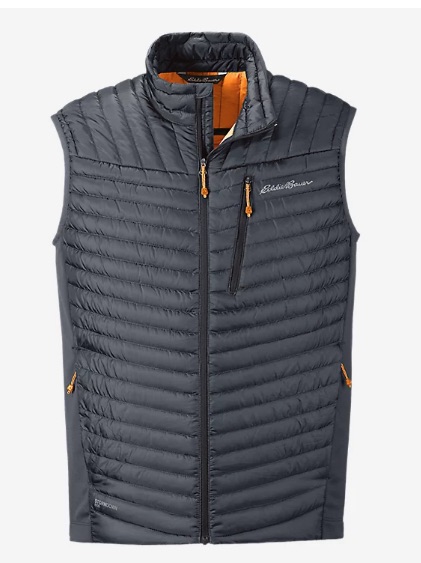
Underneath, I had either a light athletic shirt if it was hot, or a merino wool base layer if it wasn’t. I also kept in my tank bag, or somewhere quick at hand, a good quality (800 fill) down vest. It saved me many times on and off the bike. It packs down into the breast zippered pocket to about the size of a mini football (remember those?) and did just the trick when I needed a little something under the jacket in addition to the merino wool base layer or around camp when the sun went down. Doing without the sleeves meant it packed down smaller, and if you keep the main organs warm, the extremities will be too. The Microtherm 2.0 down vest from Eddie Bauer has become my favourite piece of touring gear.

I had one more layer, if needed—a good quality polar fleece jacket. This also doubled as my pillow at night when folded or rolled. So between the different base layers, the fleece, the vest, and the wind/rain breaker, I had lots of options for the varying conditions; I could ride from single digits to 35C, rain or shine.

Lower Body

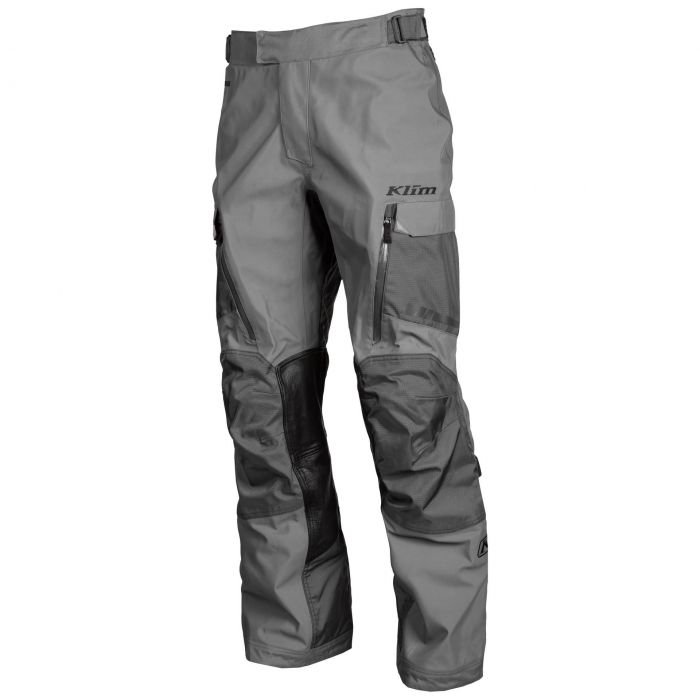
I decided to go with Klim Carlsbad pants, which are Gore-Tex, but you don’t get much airflow over the legs anyway, and who enjoys pulling on rain paints by the side of the road? It’s one thing to pull on a rain jacket and another to remove boots or deal with zippers halfway up your legs. The Carlsbad pants do have some decent venting, so when my nether regions feel a little hot, I just stand up on the bike for a few seconds to air them out, so to speak.

Klim Carlsbad pants

One of the reasons I like Klim is that the Gore-Tex is in the outer layer. With other brands, it may be an inner layer, so you may stay dry, but the clothing still gets soaked and, aside from being heavy, may take days to dry out completely. I also like the D30 armor (Level 2) in knees and hips (removable so you can wash the pants periodically), and the little Level 1 tail-bone protector.

Underneath, I wear soccer shorts with a mesh liner. They double as swimming trunks (to borrow vocabulary from my dad’s era), dry quickly, and, ah hem, provide some freedom for the boys. I never needed anything else, but I have worn thermal underwear (i.e. long johns) in early spring and late fall riding here in Canada.

So layering on top, vented Gore-Tex below. It was a good combination that worked for me.

I should add that I’m not sponsored by Klim (I wish!). I just find they make the best gear, and motorcycling is so important to me that I’m willing to pay a premium for their gear. But as I’ve said above, I never buy full price. I spend part of the off season researching and window shopping, and when the item I want goes on clearance, I pounce.

Boots

Like the pants, I went with Gore-Tex boots that I could ride in rain or shine. No dorky-looking overboots, no plastic bags inside the boots, no waterproof socks—just a really good pair of Gore-Tex adventure boots. For me, that is the SIDI Adventure 2 boots. These are amazing, and not just because they look so cool! (When I first showed them to my son, he said, “Dad, these are Batman boots.”)

SIDI Adventure 2 Gore-Tex Boots

Adventure riding is all about compromises, and a good quality adventure boot like these offers a balance of protection and comfort. I’ve had the bike come down on my foot in an off-roading off and literally walked away from it, and I’ve climbed mountains and walked for miles around town in relative comfort because they are hinged. I know some will say only a motocross boot provides adequate protection, but for touring, you need something you can walk in. You also need something with a good tread in case you have to push your bike out of mud. The buckle system of SIDI boots is unparalleled in the industry. If you have a particularly wide foot, you might want to look at the Alpinestar ADV boots; I know Lyndon Poskitt recently switched from SIDI to Alpinestar Toucans because he found his feet were a little cramped in the SIDIs. Like the helmet, boots are all about fitment, so not gear to buy online.

The SIDI Adventure 2’s are a premium item but will probably be the first and last pair I’ll ever buy; you can get the sole on these replaced by your local cobbler when they wear out.

Socks

While we are down here, let’s quickly talk about socks. I wore one pair pretty much the entire tour. They are actually not motorcycle gear, per se, but athletic compression socks from The Running Room here in Canada. Compression helps with blood circulation over those long days, and the height (over the calf) prevents chafing at the top of the boot. They are also anti-bacterial and wicking. There’s no point in wearing a Gore-Tex boot over a nylon sock.

For cold or wet weather, I have a pair of Pearly’s Knee-High Possum Socks. Possum, you ask? Yes, Pearly’s has managed to turn road-kill into a business. Each strand of possum fur apparently is hollow inside, creating a dead-air space that is unmatched for insulation and warmth with the exception of caribou hide, which shares the same property. If that were not enough, Pearly’s has woven it with merino wool, resulting in a wool that is pretty special. They are also a premium item and it took me a few years to pull the trigger on these babies, but there’s nothing more comfortable or warm for cold-weather riding.

Gloves

Finally, let’s move to the other extremity. It may surprise you, but I went minimalist with my gloves: only one pair for the entire tour. If a pair of deerskin gloves is good enough for Pirsig, who writes about them in Zen and the Art of Motorcycle Maintenance, they’re good enough for me. I have a pair of BMW Gore-Tex insulated gauntlet gloves for cold weather riding, and a short pair of Five Stunt gloves for summer riding, but for the Epic Adventure Tour, I took only a pair of Aerostitch Touchscreen Elkskin Ropers.

Aerostitch Elkskin Ropers

Why? Mostly for comfort. Like the Marrakesh jacket, once you put these on, you will know why. They are super soft and super comfortable, yet provide sufficient abrasion protection in an off. I have heated grips so rarely need an insulated glove, especially for summer touring, and Elkskin, unlike cowhide, can get wet without drying hard. In fact, on a hot day, if you wet them and wear them riding, they will shrink as they dry and mold to the shape of your hands on the grips. Neat.

Aerostitch do a good job with these gloves, still handmade in The USA. There’s touchscreen thread sewn into the thumb and fingertips of the first two fingers, and a visor squeegie on the thumb. They may feel a little bulky compared to the thin leather of other gloves, but the dexterity they provide is adequate for touring, and I suspect they will last for years and years. In fact, like wine and some women, they are one of those items that gets better with age.

Conclusion

Adventure touring requires that you be ready for all kinds of weather yet minimalist because you’ve only got so much room on the bike. This is what has worked for me. What are your preferences? Did I miss something? Let me know in a comment below what your favourite piece of touring gear is and why. I’m always ready to learn, and we Canadians need something to keep us occupied during the long off season.

Afterword

The Great White North

Some observations on Canada and long-distance touring

Most mornings, Facebook shows me a memory from this time last year, so over the past few weeks, I’ve been reliving my trip across the country, day by day. I’ve also been thinking about it as I write up these blogs, and now that I’ve completed the individual blogs on each segment of the tour, I thought I’d write some more general observations as I step back and reflect on the trip and the country as a whole. Here are five observations, in no particular order.

1. Six weeks isn’t nearly enough time to explore this vast country.

Canada is huge and the distances are immense. Our days were jam-packed, staying just one or two nights maximum at each place before we had to “push on” (a refrain on this tour). Yes, I crossed the country, twice, but far too much of that riding was on the Trans Canada and other major highways than I would have liked. In fact, it was only once I got off the freeway that I was able to experience any geography, history, and culture at all. My need to cover distance was in constant conflict with my desire to slow down and see more of what I was passing. I felt that this trip was really only an overview of many more to come, and I’ll need to spend six weeks in each province to really have a sense of the depth and diversity of Canada. So I’m going to consider this trip as exploratory; a deeper discovery of the country will have to wait until my retirement.

2. One tire cannot do it all.

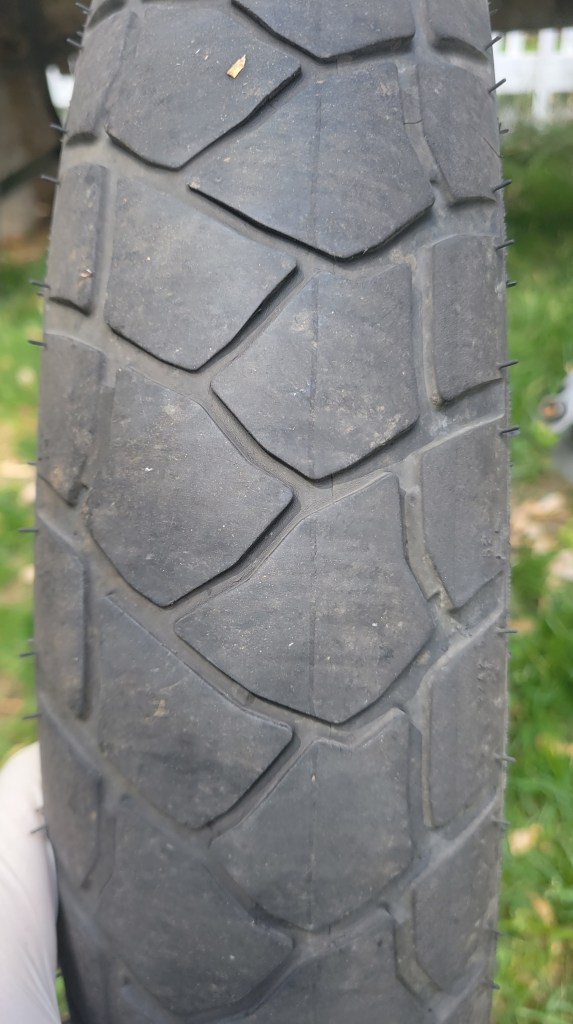
I decided to use Michelin Anakee Adventure tires, an 80/20 street/off-road tire, because I wanted something relatively smooth and long-lasting for all the asphalt I would be covering. In the end, I was able to do the entire tour without changing my tires—that’s all 20,000+ kilometres on the same tire. This is what the rear looked like shortly after my return.

As you can see, there’s still some good tread left in this tire. So if it’s longevity you are looking for, the Anakee Adventure is a good choice.

However, I was vulnerable when I went off road, particularly up The Dempster. If it had started to rain, the dirt would have turned into mud and I would have been in trouble. The problem is that there were actually two very distinct kinds of riding on this trip: largely asphalt to cover the miles, and sections of dirt or gravel when I could afford it. Ideally, I’d have shipped more aggressive off-road tires out to BC and put them on before heading north. This is exactly what many people do: ship TKC 80s to Dawson City and put them on before hitting The Dempster. A 50/50 tire like the Heidenau K60 Scout would have been another option, but the more aggressive tread on those tires is noisy on the road, despite the centre strip. (In fact, in the 650GS tire size, there is no centre strip, and the rear flattens quite quickly.) The next time I attempt The Dempster, I’ll be starting in BC and will use an off-road tire, even if it means burning through that rubber on the pavement.

Another problem with the Anakee Adventure tires is that they are quite vibey on asphalt. The hard compound down the middle of the tire results in long tire life but at the cost of vibrations. I used my Kaoko throttle lock whenever possible but my right hand still developed some numbness and tingling. I’m convinced that if this were my regular tire choice, I’d develop nerve damage. The long days, day after day, led to numbness that didn’t completely dissipate for months after my return, well into the off-season. In this respect, I might have been better off with a 90/10 tire like the Michelin Anakee 3 than the Adventure.

In sum, if I were to do it all again, with 5,000 kilometres to cover before I get to serious dirt, I’d go with a true street tire to get me across the country, then switch to a true off-road tire for playing in the dirt once I’m out there. Adventure riding is all about compromises, but when your safety is involved, there are no compromises: if you are doing any technical or remote dirt riding, use an aggressive dirt tire.

3. French and the Problem of Québec

Everywhere I went, I heard French. I sat in a diner in Smooth Rock Falls, Northern Ontario, and heard four older men in the booth next to me speaking French. I sat at the base of the Nisutlin Bay Bridge, Yukon, during a rest stop and had a conversation in French with a man who has been living in Yukon for over 20 years but whose native language is French. I walked into a supermarket in Whitehorse and heard two people in the produce section talking in fluent French. I heard French in every province, and I’ve heard it of course in Acadian Nova Scotia and elsewhere on the east coast. The French language seems to be surviving just fine outside of Québec, without any Bill 101, ridiculous sign laws, or punitive Office de la langue française.

I mention this because, last May, the Quebec government passed Bill 96, which essentially extends Bill 101 beyond high school to the college level. What this means, among other things, is that all students graduating from any college in Quebec will now have to pass a French language test. It’s really more than a test of basic competency; students have to analyze a piece of French literature and write an essay exhibiting that understanding with a minimum of expression errors. Errors are counted and, after a certain amount, the student automatically fails. It’s quite difficult, and many students who have been educated in French their entire lives struggle to pass this required exam. Now even anglophone and allophone students who have gone through an immersion program in which some, but not all, courses are taught in French will have to pass the same test. It’s not clear yet how they are going to do that, or what kind of resources will be available to help them.

The rationale stated by François Legault and his Quebec government for these Draconian measures is that French is disappearing, but to my knowledge they’ve never actually presented any specific data to support this claim. Many of my friends and colleagues—not all English Quebecers, I should add—think this bill has little to do with protecting the French language and everything to do with cultivating a victim mentality in Quebecers, perpetuating the idea that they are somehow besieged by a foreign power such as the Federal Government (the favourite scapegoat) or English North America (as if North America were all English). Some even theorize that restricting access to education in English—except for those who can afford to send their children to private school, where such restrictions do not exist—keeps working class Quebecers “in their place,” just as The Catholic Church did until the Quiet Revolution of the 1970s. Even if French is in trouble—and I’m questioning whether it is—forced unilingualism is not the answer. In Europe, learning multiple languages is the norm, not the exception, even in countries like Hungary, which is a linguistic minority within a larger demographic, comparable to Quebec. (Elementary students there have the option of Hungarian and either English or German. I know because my son did a year of school in Hungary when he was in Grade 3.) Learning French does not have to be at the expense of learning English. We can teach both languages effectively, if there is the political will.

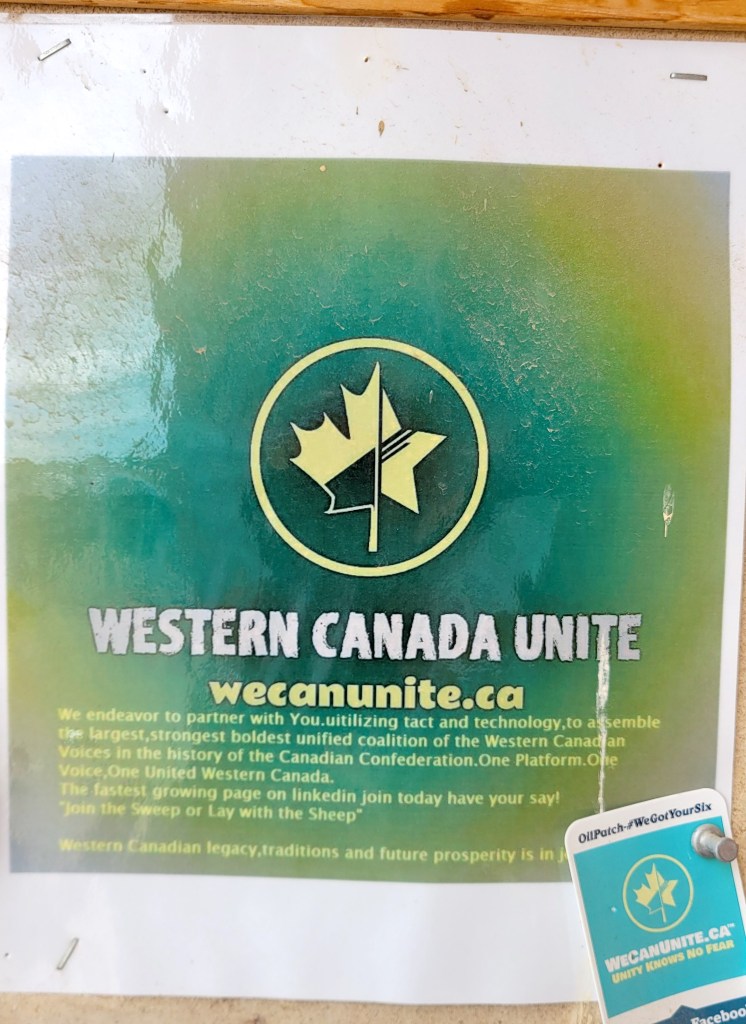
But the problem of Quebec extends beyond the issue of language. Quebec has managed to leverage the threat of separation successfully to entrench special privileges and special status within Canada. Many people might be surprised to know that Quebec gets more in equalization payments than all the other provinces combined. This is because, somehow, when those formulae were developed, Hydro Quebec was exempt from the calculations, making Quebec appear on paper like a have-not province. Removing Hydro Quebec, one of the province’s major employers, from Quebec’s calculations is like removing the oil and gas sector from Alberta’s. It’s time we opened up the equalization formulas and retooled them to make Quebec start pulling its weight in the confederation. There’s a lot of resentment out west towards the status quo, as evidenced by this poster seen outside an outdoor store in Northern BC.

The sense out west that Canada is run by Ontario and Quebec is nothing new. Remember that The Reform Party started out west, as did The Green Party. Quebec is not a have-not province and doesn’t deserve special status or extra money. It’s time that Quebec decides to be either an equal player in Canada or to get out and become the nation it clearly pretends to be by using language like “national” programs, “national” parks, and a “national” holiday.

And while I’m on this subject, I’ll add that I was upset that Montreal did not have a Canada Day parade (July 1st) this year, and rumour is that there won’t be a budget for it in the future either. The decision to cancel the parade had nothing to do with Covid, as there was a Ste. Jean Baptiste parade just a week earlier. I think that if the Quebec government thinks so poorly of its membership in Canada that celebrating Canada doesn’t warrant a parade once a year, perhaps it should give back some of the $11.7 billion it receives of the total $19 billion in federal funds transferred to provinces (latest available numbers). But of course it won’t. Under the current cozy situation, Quebec would be foolish to separate. It’s become dependent on the hand-outs to subsidize an inefficient economy.

When my wife was living in Alberta, if she got sick, she’d phone her doctor and get an appointment for later that day. In Quebec, you’re lucky if you have a doctor. Health care is a mess, our roads are a mess, and as a teacher, I see everyday the effects of chronic underfunding in our education system. Yet Quebec has the highest taxes in North America. Where is all that money going? The Quebec government has replaced The Church as the benevolent Big Brother taking care of “its people,” an argument developed more fully in a recent op-ed piece by Vanessa Sasson. I’ve put “its people” in quotation marks because 99% of the Quebec civil service is still white francophones, a statistic that hasn’t budged since the 1970’s. Corruption and a bloated, inefficient civil service are draining the public purse; there are simply too many people at the trough.

Another controversial bill recently passed here in Quebec, Bill 21, targets religious minorities. It prevents anyone in the public sector, including doctors and teachers, from wearing religious symbols, as if those items would somehow influence or prejudice their work. For Christians, this isn’t a significant problem, but for many Muslims, Sikhs, and Jews, they must choose between their religious garb or their careers. No one should have to make that choice, certainly no one in the Canada I know. The standard line given by Legault to defend Bill 21 is that “the majority of Quebecers support it,” an argument that has at its heart the logical fallacy known as Appeal to Popularity (sometimes called Appeal to Ignorance.) I teach this fallacy by reminding my students that at one time slavery was the popular economic model. The fact that it’s popular doesn’t make it right.

Here’s a confession: in the last provincial election, I voted for Legault’s CAQ party. I was tired of paying half of my wages to the government and still having unacceptable roads, health care, and education standards. I was tired of the corruption in the construction sector that has held Montrealers hostage for decades. I’d heard of scandal after scandal at all levels of government, and hoped that Legault, a co-founder and CEO of Air Transat before going into politics, would be a fiscal conservative with the strength of character to do some much-needed restructuring of the Quebec economy. But he hasn’t done anything of the sort. Instead, he’s focused almost exclusively on a social agenda to solidify his grip on power, playing to his rural base and exploiting the most repugnant racist and xenophobic aspects of Quebec society.

What has Prime Minister Trudeau done about this wave of racial nationalism gathering in Quebec? Nothing. Absolutely nothing. He needs the Quebec vote too much in order to cling onto his own weakening power. So while he talks a lot about values and morals and draws a hard line against those he claims hold “unacceptable views” in Canada, he allows the Legault government to crap all over the Charter of Rights and Freedoms his dad helped draft and ratify, unwilling to protect religious and linguistic minorities in his home province.

If he had reformed the electoral system, as promised, and made every vote count, regardless of where you live, he would not be so beholden to “the Quebec vote.” But of his three major election promises—reform the electoral process, reform the Senate, and legalize pot—he’s managed to legalize pot. The other two promises were dropped once he learned, after studying the matters carefully (at considerable expense to taxpayers), that they were not politically advantageous to him and his party. Prime Minister Trudeau talks a lot about social justice, equity, and protecting minorities, but he is essentially—we must remember—a drama teacher. He’s acting, and these days there isn’t much genuine coming out of his mouth.

I don’t usually get this political in my blog, and I don’t really want this place to become heavily politicized. But I love this country, and if I can’t get off my chest here, in a blog reflecting on Canada, what I think are some problems we are currently facing, then where can I? And I feel that, having lived in Quebec since 1990, I’m qualified to give some constructive criticism of it. No one else is. You don’t have to agree with my observations and comments, but like in my teaching, I say if we can’t have civil and open discussions about difficult issues, then our problems run deeper than the health of the French language or the status of Quebec in Canada. What do you think? Feel free to drop a respectful comment below.

4. The Orange Summer

At Cathedral Grove, Vancouver Island

All summer long I saw orange garments hanging randomly in trees, and church steps lined with children’s shoes and toys. Some people have referred to last summer as The Orange Summer, a time of reflection and reckoning in the hope of eventual reconciliation. We are very early in this process and much has still to be determined with regard to what a reconciliation would look like. I don’t really have any suggestions, nor is it really my place to make them. But I believe that all relationships are healed through communication, so let’s start there. I believe we will get further faster by talking than pulling down statues. What is clear is that there is an enormous amount of pain out there to be addressed. I thought it was à propos that on my final day of riding, as I rode the 417 down from Sault Ste. Marie, I passed on a stretch of that highway a small contingent in orange T-shirts walking with police escort at the side of the road. A sign on a support vehicle read “Walk of Shame.” I recently saw another roadside sign, this one in Kahnawake, indigenous territory on the south shore of Montreal. This one read, “Legault, hands off our children,” a clear reference to both Bill 96 and residential schools. Are we making the same mistakes again—an authoritative government who think they know best what is right for your children? Have we learnt anything through years of suffering?

Let’s hope that the indigenous peoples of Canada get an apology from Pope Francis when he visits next week. It’s long overdue and a crucial element in collective healing. Then we need a thorough investigation into what happened to those children and hold those to blame accountable. There’s much more to address—difficult work of hashing out treaties—but it seems to me that would be a good start.

5. Heat and the Big Thumper

The 650GS did great the entire tour. I really can’t complain. With over 100,000 kilometres on it and fully loaded, it pulled Marilyn and me over those Rocky Mountain passes in the heat, and it was hot! The battery let me down a few times, but the mechanics of the bike are sound. It’s a great little adventure bike.

Are you sensing a but, dear reader? The 650GS is happiest under 100-110 km/hr, and much of my riding on this tour had to be >120 km/hr, just to cover those distances. This is a bike for secondary highways, not freeways. It is a classic European touring bike, but all of Europe is about the same size as Canada. Those days crossing the prairies, 6+ hours at 5,500 rpm, were not fun, and as I’ve said, I developed some numbness in my throttle hand due to vibrations. By the time I rolled back into the driveway, I was ready for something a little more powerful and a lot smoother.

I also found it difficult to regulate oil level during this tour. It’s difficult with the dry sump system at the best of times, but the varying temperatures and types of riding on this tour made it all the more challenging. The extreme heat, and riding at high revs for hours, led at times to oil rising so high in the reservoir that it spilled into the air box, where it leaked down the side of the engine and baked onto the skid plate.

Shake and bake

It’s possible that I over-filled the bike, but rather, perhaps I was just asking it to do a little more than it was designed to do. I’ve been pushing this bike beyond its limits on and off road.

People have since told me that, for a tour like this, I should have used a 1200 or 1250GS. The big boxer cruises at 120 km/hr, and like its predecessor of another era, the Honda Gold Wing, it eats up the miles. I’ve considered getting a big GS, but I like the dirt too much, and my skills just aren’t capable of taking a 600 lb. bike off road. I’ve had my eye on the Yamaha Ténére 700 (T7) for some time, and the World Raid version looks just the thing for my long distance adventures. Unfortunately, once it gets to Canada, it will be probably close to $20G—a little beyond my budget for now.

I also considered an 800GS. This would be the obvious upgrade to the 650, with a similar Rotax engine and the fuel tank under the seat. But a parallel twin is also prone to vibrations at highway speeds; isn’t it basically a big thumper but with two cylinders? So I started looking at it’s main competitor, the Triumph Tiger 800. From everything I’ve read, the essential difference between the two bikes is that the BMW is better off road, the Triumph better on road. That inline triple has a lot of character and is silky smooth. With 94 hp, it has more than enough power for two-up touring. And if I am being completely honest, most of my riding is on road, even when touring.

So here is my big announcement. After a lot of research, I’ve bought a 2013 Triumph Tiger 800XC. It only had 14,500K on it, so looks and feels practically new. It has been maintained well with regular service and always stored in a heated garage. I’ve put over 7000K on it already this summer and love riding this bike! I can’t wait to do some long-distance touring on it.

Don’t worry: the blog is not changing its name. I will continue to write about my adventures here, having built a little following. I’ve ordered crash bars and a beefier skid plate and so the slow conversion to off-road riding has begun. But for this summer, I’m happy to ride it stock with street tires and just enjoy this engine. It looks, feels, and sounds like a jet, so that’s what I’ve named it.

As for Bigby, I’ll be selling it when the market heats up at the end of season. I know that many potential buyers will be nervous about buying a bike with that many kilometres on it, but anyone who knows the 650GS knows that the engine is bullet-proof and that these bikes are over-engineered. There’s still plenty of good riding and adventures to be had on Old Faithful.

As I write this, we are about halfway through the summer. I’ll be taking the Tiger on day trips and perhaps a few overnights, but mainly just getting familiar with it. I’m planning a similarly big east coast tour with it for next summer and so will be getting some stronger panniers and doing other mods to set it up for adventure touring. I’ve received some queries from readers about my gear, so I’ll also be writing some blogs about what has worked for me. I hope you will stay with me, regardless of what you ride, as we continue the journey.

Trip Planning: Final Prep

I’m down to just a few days before departure and not feeling very prepared. By the time I was free and clear of work, I had only two weeks to prepare the bike. That’s a lot, but not when parts take two weeks to arrive from Germany. So I’ve done what I can, as you can see from the list above. Today I remove the clutch cover to change the water pump and clutch plates. I actually have the pump—I’ve had it for a few years because you never know when it will fail on this bike—and I have the cork replacement plates for the clutch. What I don’t yet have are clutch springs and, if required, a replacement clutch cover gasket—that large paper one. These items and a few more were supposed to arrive last week, but it seems Covid is trying its best to sabotage the tour this year as well as last. Today is a holiday in Quebec so if the parts don’t arrive on Friday, I’ll have to make do. That might mean re-using old clutch springs or shimming them if they are out of spec. And hopefully I can get that clutch cover off without damaging the existing gasket. I only ordered a new one in case I can’t.

The good news is that the bike has all new wheel bearings, including the cush drive bearings, and new rubber. I did end up going with the Anakee Adventures in the end, mostly for their smoothness on asphalt. I don’t anticipate doing much off-roading on this tour, and they will be really nice through the twisties in The Rocky Mountains. I tried my best to balance the wheels using jack stands but I think I will get them checked professionally. The pros have computerized equipment that is more precise, and I thought I felt a bounce in the front. I also changed the front sprocket back to the stock 16-tooth, among other mods. My son helped me shoot a few videos of the mods I’ve made on the bike both for dirt and converting it back to street.

My wife, Marilyn, and I did a test ride last Saturday and the bike is running great. I remember now how that stock gearing is so much better on the highway; you have roll on at 120 km/hr.! And at 110 km/hr, which is a comfortable cruising speed for me on the highway, the revs sit right on the sweet spot of this bike at 4600 rpm. Even at 120 km/hr the revs aren’t over 5000. I’m glad I made that change, even though I know you’re not supposed to change a sprocket without changing the chain. Well, the chain has only 7K on it so it will be fine, and I’ll change everything when I’m back.

With all the attention on the bike, I have only just started laying out items to pack. Marilyn is having kittens about this because she can’t imagine starting so late for such a big trip, but I’ve done it before many times and I pretty much know what I’m taking. The only difference this time is that I have to consider two set-ups: one for when I’m solo, and one for when Marilyn is riding pillion. This means that I’ll have an empty pannier when alone. I will fill it with booze and tobacco until she joins me in Calgary.

The only tricky part of packing actually is deciding what spare parts to bring. I’ve done everything possible to prevent an issue on the road and I don’t have room to carry spare engine parts, but I’ll take an assortment of hardware, spare clutch cable and perhaps levers, gasket maker, JB Weld, self-fusing tape—that sort of thing. I’ll try to anticipate any issue that I might have, within reason.

I haven’t been able to research as well as I’d like, unfortunately. The book on Canadian geography I took out from the library sits unopened on my coffee table. I’ll have to do my research on the fly, so to speak. I’m pretty familiar with Ontario from previous travels and from writing a few articles for northernontario.travel, and I found a great video of tourist destinations in southwestern Saskatchewan, so I’m good for the first two provinces, I think. Marilyn is pretty familiar with Alberta, having lived there for 20 years, and we will explore BC together, so I’m not going to beat myself up for not getting more reading done. It’s not like I’ve been idle.

We have a few reservations booked on Vancouver Island and will stay with different friends as we make our way through the BC mainland. I am mostly concerned about when I’m alone and camping, since I’ve heard that campgrounds are all full. I’ll be using iOverlander to find wild camping spots and will have to wing it. This will be a first for me and I anticipate a few nights of searching for a suitable safe spot, but having watched Lyndon Poskitt wing it all over the world, I know it can be done.

The Yukon has dropped the requirement for travelers to self-isolate upon entering, but only if you are fully vaccinated, so I’ll be looking to get my second dose on the road somewhere so my planned trip up north is still on. Unfortunately, since I got the fist one after May 1st, I’m not eligible for the second until after I leave. Like so much about this tour, I will figure that out on route.

It hasn’t sunk in yet that I’m finally doing this. Perhaps I will grow into it, or it will hit me once I leave my first destination in Ontario. I’ll be staying with my sister for a few days and visiting my dad, so the trip proper begins July 1st, Canada Day, which seems appropriate. I won’t be posting while on the road so don’t expect any action on the blog until I’m back. I wish you all a safe and enjoyable summer!

Planned full trip. Am I crazy?