Adventurero Heroico: a review of The Motorcycle Diaries by Ernesto Guevara

chehigh

We’ve all seen it, the iconic photo of Che Guevara, silkscreened on the T-shirt of a slouching teenager as a sign of a budding ideology or subtle form of protest against The World as he or she has come to inherit it. It was snapped in 1960 by Alberto Korda while Guevara listened to Castro’s oration at the funeral service of 136 people killed in an act of naval sabotage. Even converted to duotone, the implacable and determined expression is remarkable, the eyes gazing off toward a distant point of revenge and justice.

I’d heard that Ernesto (Che) Guevara was radicalized while riding a motorcycle around South America, visiting up close, in a way that only a motorcycle can do, the poverty, hardship, and exploitation of its proletariat. His eight-month journey on a Norton 500 (affectionately named La Ponderosa II—The Powerful One) with Alberto Granado, a doctor and specialist in leprosy, is captured in The Motorcycle Diaries: A Journey Around South America, now turned into a major motion picture starring Gael García Bernal.

Guevara’s radicalization cannot be found in any specific moment but occurs over the trajectory of his journey. What is evident at outset is that he comes from a privileged life. At first, the two seem more interested in drinking and carousing than visiting leper colonies or talking to the working poor about their plight. In a typical scene, they get into trouble after drinking copious amounts of wine:

Chilean wine is very good and I was downing it at an amazing rate, so by the time we went on to the village dance I felt ready for anything. It was a very cosy evening and we kept filling our bellies and minds with wine. One of the mechanics from the garage, a particularly nice guy, asked me to dance with his wife because he’d been mixing his drinks and was the worse for wear. His wife was pretty randy and obviously in the mood, and I, full of Chilean wine, took her by the hand to lead her outside. She followed me docilely but then realized her husband was watching and changed her mind. I was in no state to listen to reason and we had a bit of a barney in the middle of the dance floor, resulting in me pulling her towards one of the doors with everybody watching. She tried to kick me and as I was pulling her she lost her balance and went crashing to the floor. As we were running towards the village, pursued by a swam of enraged dancers, Alberto lamented all the wine her husband might have bought us.

There are, however, moments when an innate sensitivity and political empathy toward the poor come through in the writing. Soon after that escapade, they meet and are invited to stay with a married couple, Chilean workers who are Communists, and Ernesto hears the man’s tragic story:

In the light of the candle, drinking maté and eating a piece of bread and cheese, the man’s shrunken features struck a mysterious, tragic note. In simple but expressive language he told us about his three months in prison, his starving wife who followed him with exemplary loyalty, his children left in the care of a kindly neighbour, his fruitless pilgrimage in search of work and his comrades who had mysteriously disappeared and were said to be somewhere at the bottom of the sea.

The experience leaves a deep impression on the young man. That night he gives a blanket to the couple and he and Alberto wrap themselves in their remaining blanket: “It was one of the coldest nights I’ve ever spent but also one which made me feel a little closer to this strange, for me anyway, human species.” Writing later about the couple, Ernesto makes clear his own budding political ideology:

It’s really upsetting to think they use repressive measures against people like these. Leaving aside the question of whether or not ‘Communist vermin’ are dangerous for a society’s health, what had burgeoned in him was nothing more than the natural desire for a better life, a protest against persistent hunger transformed into a love for this strange doctrine, whose real meaning he could never grasp but, translated into ‘bread for the poor,’ was something he understood and, more importantly, that filled him with hope.

Guevara is a good writer. I read the book in translation (trans. Ann Wright) but the strength of Guevara’s voice rings through. He is articulate, possessing a broad vocabulary, funny, and perceptive. His powers of observation—essential for any writer of travelogue—extend to the landscape as well as the people he meets. At times, the sentences are lyrical and poetic, such as in this passage, where he personifies the Chuquicamata mountain that has been industrialized into a copper mine:

The mountains, devoid of a single blade of grass in the nitrate soil, defenceless against the attack of wind and water, display their grey backbone, prematurely aged in the battle with the elements, their wrinkles belying their real geological age. And how many of the mountains surrounding their famous brother hide similar riches deep in their bowels, awaiting the arid arms of the mechanical shovels to devour their entrails, spiced with the inevitable human lives—the lives of the poor unsung heroes of this battle, who die miserable deaths in one of the thousand traps nature sets to defend its treasures, when all they want is to earn their daily bread.

Guevara’s critique of the exploitative power of Capitalism is expressed in the language of war and personal suffering, both of Nature and humans, in a telling indication of the major themes that would later occupy his political life. He sees Capitalism as a plague on Nature and human society, a force that devours if left unchecked.

His critical eye does not stop with economics. In another passage, he shows distain toward the Church that dominates Latin American society:

In a moment of boredom we went to the church to watch a local ceremony. The poor priest was trying to produce the three-hour sermon but by then—about ninety minutes into it—he had run out of platitudes. He gazed at his congregation with imploring eyes while he waved a shaking hand at some spot in the church. ‘Look, look, the Lord hath come, the Lord is with us, His spirit is guiding us.’ After a moment’s pause, the priest set off on his load of nonsense again and, just when he seemed about to dry up again, in a moment of high drama, he launched into a similar phrase. The fifth or sixth time poor Christ was announced, we got a fit of giggles and left in a hurry.

Always there is a tone of understatement, a dry irony that runs the risk of appearing sanctimonious, but I would rather have a strong, personal voice in a travelogue than a weak, objective one. He does not hold anything back, even when describing the hygiene habits of the Native Chileans:

The somewhat primitive idea the indians have of modesty and hygiene means that, regardless of sex or age, they do their business by the side of the road, the women wiping themselves with their skirts, the men not at all, and carry on as before. The petticoats of indian women with children are veritable warehouses of excrement, since they wipe the kids with them whenever they have a bowel movement.

As shocking as this is, the most surprising aspect of The Motorcycle Diaries is that they don’t travel by motorcycle for much of it. The bike dies a dramatic death on page 44 of my edition, and they spend the rest of the journey bumming rides from truckers, travelling by foot, raft, and boat when necessary. In this way, the book is like George Orwell’s Down and Out in Paris and London, which documents Orwell’s self-induced months of hunger and poverty while squatting in Paris and tramping across England. And perhaps like Orwell, there might have been a desire in Guevara to purge himself of the privileged lifestyle in which he was raised, or at least open his eyes to another strata of society of which he had had only a passing familiarity and a superficial understanding.

They do visit leper colonies and are regarded there as heroes, more for their humane treatment than their medical treatment of the lepers. Where others fear and shun these people, Alberto and Ernesto mingle amongst them for several days, drinking and playing music together, and when they leave they shake the lepers’ hands, a gesture that in itself is more healing than any medicine the doctors can offer.

This is the picture of Ernesto that we get by the end of their adventure—a caring and principled young man ready to take the hippocratic oath, not the Guerrillero Heroico of the later portrait, the fighter who was ready to kill to incite revolution. For that, he would have to meet and travel with another man, not the affable Alberto but the militant Fidel.

The Motorcycle Diaries is a fun and easy read at just over 150 pages. There’s a lot of local history woven into the storyline, including a political history of the Incas, and anyone who’s interested in the history of South America would get something from this book. Readers who are interested in the biography of Che Guevara or the germination of South American and Cuban Communism would also enjoy it. But the star of the book is South America itself, the land and its people. Readers will get a strong sense of the majesty of the mountains, the rugged terrain, the Latin American architecture, the friendly and welcoming people. My edition provides a map with the route of their journey, and chapters are titled after the places they visit. My ultimate ride is down into South America and this book has only piqued my interest all the more for that adventure.
Riding pillion with Peart and Bishop: reviews of Neil Peart’s Ghost Rider and Ted Bishop’s Riding With Rilke

ghost_rider_bookridingwithrilke

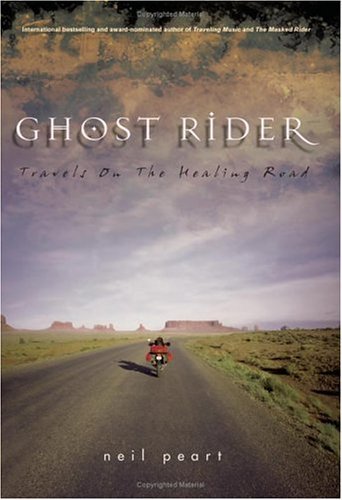
The riding season is coming to a close here in Montreal and I’m already thinking of what I’ll read in the off-season. When you can’t ride for five months of the year, you need to have a few motorcycle-related books ready to carry you through those dark winter months. Last winter, two such books for me were Neil Peart’s Ghost Rider (2002, ecw press) and Ted Bishop’s Riding With Rilke (2005, Penguin).

I first came across Peart’s Ghost Rider while visiting the excellent Bookshelf Cafe in Guelph, Ontario, many years ago when the book was first published. It was on the display shelves just inside the door and I remember picking it up and never getting much deeper into the store. As a drummer, I knew of Peart. In fact, he was the hero of pretty much every snare drummer of the marching band I was in through my teens. He apparently even started drumming in a drum corps not far from Burlington, my home town, so it was almost like we were best buddies. We would air-drum to Moving Pictures at the back of the tour bus, pretending we actually knew how to do Swiss Army triplets on double bass drums or half the other stuff he does. But then that’s the advantage of air-drumming: no one can hear your mistakes.

I’d heard of the tragic loss of Peart’s daughter and wife, and of his decision to hit the road in search of a reason to continue living. All this was long before I started to ride, but the dream of riding and touring one day was alive and well, so the book grabbed me and held me there for some time. Eventually I began to imagine the staff thinking “Either sh*t or get off the pot!”

It is a compelling story. His daughter is killed in a single car accident en route to Toronto for first-year university; eight months later his wife is diagnosed with terminal cancer, an illness which he more accurately describes as “a broken heart.” Soon after, he finds himself alone and slipping deeper into isolationism and self-medication. The only way out, he decides, is literally to flee, not knowing exactly to where or why. Like the survival strategy at the heart of Peter Behrens’s The Law of Dreams, a book also about tragedy and loss, Peart intuitively decides “to keep moving.” All this is provided in the opening chapter and sets up the “travels on the healing road” westward on his BMW R1100GS.

We follow Peart across Canada, up into Inuvik, across to Alaska, then down into The United States to Las Vegas (which he hates) and around the southwest. But the travels are really just the subtext to the real “journey” (to use the most over-used word today) for him on the road of grief and recovery. Peart provides a strikingly candid view into his emotional life at its core. He is extremely self-aware and offers us insights into how he was able to inch his way out of the dark pit into which he’d fallen: his fears, his strategies, his discoveries, his small advances and set-backs (he describes the process as one step forward, one step back  . . . minus an inch).

The motorcycle is the key element in his recovery. It provides a distraction from the thoughts and feelings that plague him; riding is so consuming, it’s difficult to think of anything else but operating the vehicle while you’re on it. And he puts on the miles. (Section headings include dates, places, and mileage.) The bike also reawakens his senses which have been numbed by grief and intoxicants. One of the first signs of recovery occurs while riding twisties through the B.C. interior on Highway 99, “one of the great motorcycle roads in the world”:

The sky remained bright, the air cool and delicious, and the sinuous road coming toward me was so challenging and rewarding that I was tempted into the adrenaline zone. Turn by turn my pace increased until I was riding with a complete focus spiced by the ever-present danger and occasional thrill of fear, racing against physics and my own sense of caution in a sublime rhythm of shifting, braking, leaning deep into the tight corners, then accelerating out again and again. I felt a charge of excitement I hadn’t known for many months and found myself whooping out loud with the sheer existential thrill.

Another important element in his healing process is journalling. In one late-night entry, for example, he stumbles upon a subtle but important discovery—forgiveness—the need to forgive life for doing this to him, forgive others for being alive, even to forgive himself for remaining alive. And when he’s not journalling, he writes letters—yes, long-hand—to friends and confidantes, setting his thoughts and feelings onto paper where he can see them. Sections of the book are these letters printed verbatim.

Peart provides commentary on the people he meets and the places he visits. He prefers the peace of rural roads to the hustle and bustle of urban centres, not surprising for a man who is comfortable with solitude. He finds healing properties in nature, especially birding. Peart clearly considers himself a cultured man and does not suffer the uncultured easily. At times, he seems downright judgmental and misanthropic. This was perhaps the most surprising aspect of the book for me. But I guess he applies the same honesty in describing his thoughts of others as he does about himself. When he describes a friend of his as possessing “a blistering contempt for most of humanity,” I cannot help thinking he’s describing a part of himself as well. The next sentence begins, “We agreed on many things . . .”

I’ve fortunately never suffered such loss, but I found his examination of grief and grieving fascinating. I do feel that some of that material could have been condensed. The book is over 450 pages in length with, like I said, entire letters reproduced for long stretches of the book. I feel the book needed more editing, or better editing, with Peart forced to distill for us the musings in those letters down to the essential discoveries. No doubt this was a structural decision made by Peart and his editors, but I feel he took the easy way out. There’s also an awful lot in this book that simply isn’t that interesting. Do I really need or want to know what he eats at each meal, his wine choices, the birds he spots, the flora and fauna along the way? His encounter with a short-eared owl is an example of a meaningful reference to nature because it’s linked to the main theme of the book (i.e. the owl shrieks a cryptic message at him) but other references seem gratuitous.

Yet ironically, the end comes upon us rather suddenly and the book overall feels truncated. We learn in the final chapter of finding new love that is the final step in his recovery, if there ever can be a final step, and it comes in a matter of a few sentences literally a few pages from the end. Overall, I get the sense that this book was rushed to press by a deadline. It’s a good book, but it could have been a great book with more time and effort in that crucial revision and editing stage. Now I’m sounding like a teacher leaving feedback on a student paper, so I’ll move on.

Like Peart’s Ghost Rider, Ted Bishop’s Riding With Rilke (finalist for the Governor General’s Award for nonfiction, among other nominations and awards) opens with a tragedy: Bishop’s life-threatening crash. He’s riding his partner’s classic BMW and is encountering some high-speed wobble each time he creeps up to 130 km/hr.. Then he tries to pass a semi, only to find out halfway past it’s a double-semi, a van rounds the corner in front of him and . . . well, it doesn’t end well. Like Peart’s opening, this serves as a frame narrative for the musings that follow. And also like Ghost Rider, Bishop weaves two threads through his text, or two passions: motorcycles and literature.

Bishop is an English professor at The University of Alberta with a specialization in early modernism. Much of the book describes a ride down to the University of Texas in Austin to do research on Joyce, or is it Virginia Woolf? I’m not quite sure. The narrative jumps around quite a bit between different Special Collections rooms in several libraries and his office at U of A to conferences, but it doesn’t really matter since the academic work is just the pretext to the musings on literature and adventures on the road. Along the way we get anecdotes about D. H. Lawrence in Taos, Camus wanting to buy a motorcycle, the Woolfs declining to publish Ulysses, Ezra Pound as Bishop passes through Hailey, Idaho, Pound’s home town, and some lowbrow culture too, including Evil Kneivel’s attempt to jump the canyon. (Remember that one? It’s still an embarrassment to the locals there.)

I had come across Bishop’s writing earlier in Ian Brown’s What I Meant To Say. His essay “Just a Touch” is my favourite of that collection, so I was excited when I received this book as a gift from a writer friend. My expectations were happily fulfilled. Where Peart’s prose is often a bit wooden, Bishop’s is graceful, imaginative, and often funny. Here he provides one of the best descriptions of riding I’ve seen:

When I first put on a full-face helmet, I have a moment of claustrophobia. I can hear only my own breathing and I feel like one of those old-time deep-sea divers. . . . . When you hit the starter, your breath merges with the sound of the bike, and once you’re on the highway, the sound moves behind you, becoming a dull roar that merges with the wind noise, finally disappearing from consciousness altogether.

Even if you ride without a helmet, you ride in a cocoon of white noise. You get smells from the roadside, and you feel the coolness in the dips and the heat off a rock face, but you don’t get sound. On a bike, you feel both exposed and insulated. Try putting in earplugs: the world changes, you feel like a spacewalker. What I like best about motorcycle touring is that even if you have companions you can’t talk to them until the rest stop, when you’ll compare highlights of the ride. You may be right beside them, but you’re alone. It is an inward experience. Like reading.

In another section, Bishop’s sense of humour mixes with a cutting derision toward literary pretension, producing a description of an open-mic event in Taos that would make Peart giggle in sympathy:

Next up was Ron, the leather-jacketed poet from this afternoon. When his name was called he left the room and then came slouching in from the street wearing shades and sucking on a cigarette and carrying a little cassette recorder playing Thelonious Monk. This might have been cool, except that the efficient MC, thinking his poet had gone home, had already started making announcements about next week’s reading. So Ron had to stop, turn off the recorder, and go back outside. His friends cried, “No he’s here, he’s here!” The MC stopped, and Ron slouched in again with the same Thelonious Monk riff playing. He shouldered  his way through the group of three in the inner doorway, snapped off the cassette, whipped off his glasses (briefly snagging one ear), and looked up from his crumpled exercise book. “Why do I love you!?” he shouted.

Who cares!? I wanted to shout back, but I was a well-bred Canadian and this was not my town. Knowing this could only get worse, I slid out into the night. I understood now what Lawrence had feared in Taos.

What I especially enjoyed about Bishop’s writing is his ability to render scenes like this so vividly. I’ve been at poetry readings like this—heck, I might have participated in some—and they are as painful as he describes here. He had me squirming. His attention to descriptive detail (the slouching, the snagged sunglasses) and use of dialogue (the shouts of Ron’s friends)—fictional techniques—allow us to stand next to him, so to speak, at that poetry reading. No wonder he teaches a course on creative nonfiction and has received numerous awards and accolades for his travel writing.

In addition to the places he visits, Bishop also takes us into his world of academia. We sit in on his meetings with the department Chair, overhear the casual conversations at academic conferences, and look over his shoulder in the British Library’s Manuscript Room as he discovers he’s holding Virginia Woolf’s suicide note. We even lie beside him in the ditch as the emergency responders cut off his boots and jacket, and next to him in the hospital bed as he takes his first drink. (Okay, we’ll drop this line of thought now.) This is what good travel writing does: take us to places from the comfort of our reading chair.

And always at the centre of Bishop’s writing is an affable man with a sense of humour, important qualities in a travelling companion. We get the sense that Bishop would be a great guy to share a beer with and chat about literature, or bikes, or both, which is what Riding With Rilke is. In fact, I’d like to share a beer with either author, although with Peart it would more likely be a wee dram.

I enjoyed both books. When I went to Amazon to search for more like them, I discovered a whole genre I hadn’t known existed: motorcycle journalism. From Hunter S. Thompson to Che Guevara, Persig, and Ewan McGregor (one of these things is not like the other) there are now many good books about the personal experience of touring by bike as the adventure riding industry continues to grow. With my 6a licence now finally in my wallet, I only have one more winter to wait before I can hit the road myself and hopefully add my voice to the motorcycle travelogue market.

The King’s Highway

210px-ontario_2

I grew up in Burlington, Ontario, two blocks from Lakeshore Boulevard, or as it was then called, Highway 2. On Saturdays, we would hop the Go bus and follow that road into Hamilton to B.J.’s Skateboard Park (I know, you couldn’t get away with that name these days), a concrete sea housed in the former Hamilton Spectator building. Those excursions into the neighbouring city for the day were the first tastes of freedom and independence granted by our parents. The return trip would be sleepy and pensive after full day of adrenaline, the coach bus a tiny lit capsule submerged in dark, shuttling back along Highway 2 with glimpses of Lake Ontario on the right between mansions. I struggled to stay awake so as not to miss my stop.

Later I discovered another kind of freedom. My girlfriend lived in Aldershot, our homes connected by a 10 kilometre stretch of Highway 2. Sometimes late at night, after my parents were asleep, I’d slip my dad’s Plymouth Fury II into neutral and push it out onto the road where they wouldn’t hear me start it, then drive the 20 minutes west to the goodies waiting there. If they ever heard me leave or coast in pre-dawn, they never let on.

My paper route was along Highway 2, a section that spanned from Appleby Line to the Skyway Plaza. Usually I’d cycle it, but sometimes I’d skateboard, and since the shoulder was still gravel, that meant dropping the skateboard and dashing, paperbag slung over my shoulder, 100 feet or so between oncoming cars before jumping off onto the shoulder at the last possible moment. I must have unnerved more than a few drivers but I knew what I was doing. I spent a lot of time on that road. On the bad winter days, I’d don my ski goggles to get the route done. Other days I’d stop at the creek that emptied into the lake and play or nap. One windy day some miscreant lifted the rock off my stack of papers and I returned to find them blown down Highway 2, stopping traffic as they pasted across windshields and lifted into the trees. When I phoned for more newspapers, my manager said I had to take some garbage bags and go clean up while I waited for the delivery.

When my older sister flew the coup, she lived first in Toronto North. I followed and we lived together for a few years. When I moved to London to go to university, Highway 2 was waiting for me in the form of Dundas Street. My sister moved to Dundas Street E in Toronto, so we were kind of still connected. In fact, before Highway 401, Highway 2 was the only continuous East-West artery running from Windsor to the Quebec border. I preferred it to the major highway and would take it when returning to Burlington for holidays when I could. Although slower, it was more scenic. Instead of a bus, now it was a tiny car that shuttled through the dark countryside. I wrote a poem about encountering deer one snowy Christmas Eve outside of Woodstock. And when I didn’t have my parents’ car, the Greyhound milk-run passed through sections of Highway 2 between London, Woodstock, Paris, Brantford, and into Burlington.

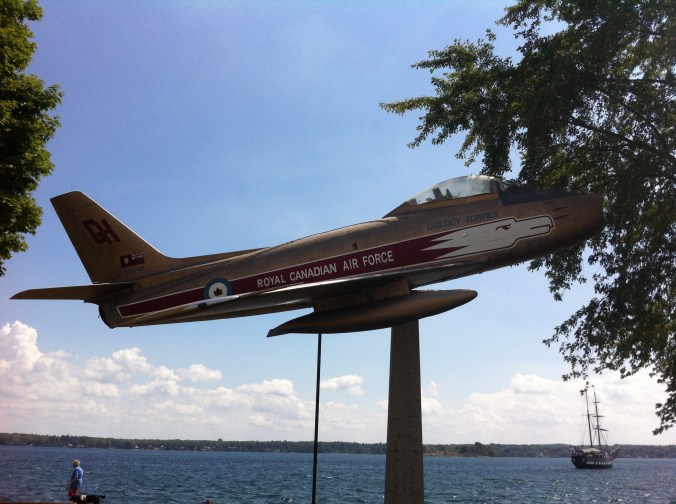
It seems that Highway 2 has been the major artery of my life connecting me with family and friends, so it’s not surprising that the morning after I got my motorcycle licence I hit the highway, so to speak, heading west along the 338 (formerly called Quebec Route 2), which turns into Highway 2 as it crosses the border. It’s a beautiful ride with the St. Lawrence River on one side and countryside on the other. It starts in Lancaster, then passes through Cornwall, Ingleside, Upper Canada Village (where the Black Creek Pioneer Village of elementary school field trips still exists), and quaint towns like Morrisburg, Prescott, and into downtown Brockville, which is actually very pretty and not at all like the commercial complex beside the 401. In fact, I used to associate Brockville with fast food joints and ubiquitous retail outlets until my motorcycle club had a ride that took us along Highway 2 into the old part of town. There you will find a marina and a park that has, among other attractions, a Canadair Sabre Golden Hawk of the Snowbirds squadron before it switched to the CT-114 Tutor.

tutor_highres

Sections of Highway 2 are based on trails that had been used by Indigenous peoples for hundreds of years before the colonization of Ontario, and that history is evident in places like Iroquois and Gananoque that is still passes through. In fact, a 1 km stretch at Gananoque is the only official stretch of Highway 2 remaining, according to Wikipedia. (In 1998, the highway was decommissioned and renamed, with that original section near Kingston, the King’s City, left as a token.) It connects the Thousand Islands Parkway (formerly the 2s) with the 401. If you take the Parkway (while the 2 swings north of the 401), you can pick up the 2 again at Gananoque and take it through Kingston, where it becomes Princess Street, then Napanee, Tyendinaga Mohawk Territory into Belleville and on to Trenton, Cobourg, and Port Hope. After that, the GTA behemoth  swallows it whole and spits it out again in Paris. If you hate studying early Canadian history from a textbook, just take a ride along Highway 2.

Why am I thinking of Highway 2 now? Well, as those of you who have been following my blog know, I rode Highway 2 recently in The States on my way back from Hampton Beach. Of course, it’s a different Highway 2 but was a familiar, reassuring signpost as the light faded on me in New Hampshire, still hundreds of miles from home. Yesterday I decided to make a trip to Burlington, Vermont, to buy a tank bag. Yes, we motorcyclists are willing to ride 360 kilometres for gear that’s not available in Canada. I still don’t have a GPS and didn’t want roaming charges on my phone so was looking for the easiest secondary highway that would get me there. I crossed the border at Rouses Point and picked up, you guessed it, Highway 2 which traverses Lake Champlain, slicing through North Hero, then South Hero, Sandbar State Park, taking me into North Burlington, then South Burlington and literally to the door of MotoVermont. The guys there were super nice and helpful, even helped me install the bag on my bike before I turned around and followed my favourite highway back home.

Crossing the Green Mountains with the sun setting over Lake Champlain to my left, I felt like a king.


Realizing a dream

When I was 19, I had a dream to ride across the country on a motorcycle with my girlfriend at the time. The girlfriend betrayed me but the dream stayed loyal, and now, 33 years later, I’m doing it.

What took me so long, you ask? Well, when many of my high school friends were getting bikes, I was saving my shekels to put myself through university. Once I finished grad school, I became a father, and there was another whole set of concerns—getting a job, starting a career, paying the mortgage, not orphaning my child—so buying a motorbike seemed like a crazy idea. But always I’d feel a little twinge of envy when I saw someone on a bike, especially if that person was around my age.

Now my son is 22 and is on his own, and things aren’t quite as financially tight as they once were, or so it seems (my wife would differ). Last spring I was texting with my cousin in England who rides a bike. It was a sunny Saturday morning, and I was sitting on my front porch drinking my morning café au lait. The conversation went something like this:

Cousin: “Rode through the New Forest this weekend to my folks. Here’s a photo of your dad’s 350 Matchless.”

Me: “I’ve always wanted to ride a bike. It’s in my blood.”

Cousin: “You should. Why don’t you?”

Me: “Hmm . . . ”

I got a referral to a good local motorcycle school and went to their website. You could sign up for a course online. Again, I was sitting on my front porch (I spend a lot of time there in the summer). My wife was inside watching TV. A pop-up menu showed June 15 as the starting date of the next course. And before my mind could stop my gut from doing what it wanted to do, I’d registered and committed to realizing this dream.

Little did I know the dream would take on a life of its own.

That was last summer. Since then, I’ve bought a bike, done the course, and obtained my Learner’s Permit (in that order). This summer I’m riding with a club. The date for my road test is set for August 11. (The rules governing obtaining a licence here in Quebec, Canada, are complex and will be a topic of a later post.) The Bike (as I’m sure my wife thinks of it) has quickly become a passion for me. When I can’t be riding, I spend hours online in forums reading about the particularities of my bike, researching affordable upgrades, watching helmet-cam vlogs, reading books about biking, skills development, maintenance, studying my Haynes repair manual, and working on the bike.

This blog will in part trace my planning, preparation and eventual ride across Canada and perhaps beyond, but it’s going to be much more. I want to make it relevant to all bikers and perhaps even non-bikers by sharing some of what I’m learning. The underlying premise is if a newbie can learn from an experienced rider, can an experienced rider learn something from a newbie? I hope so. You tell me. Please comment and let’s make this a dialogue, and exchange of knowledge.

This blog will change in appearance as it evolves. For now, I’m starting with the default formatting until I get more familiar with wordpress. I’ll update the banner image once I find or create a better one. For now, it actually looks quite similar to the beautiful orchards I was riding through last weekend in the Eastern Townships here in Quebec, except the apple trees were in full bloom.