The Wish List, 2016

santa_moto

My wife and I have a difference of opinion on gift-giving. In her family, it’s common to send out gift suggestions around birthdays and Christmastime. They come over the phone or via email from distant family, or they are dropped—maybe not an entire list but a single suggestion—into a conversation on a completely unrelated topic, seemingly innocuously, as if accidentally, usually with one’s back turned. I get it: you’re trying to help the other person out, who legitimately might have no idea of what you want. If this is a distant family member, that makes sense. But if it’s your spouse, well, you have to wonder how well your soulmate knows you.

I, on the other hand, love the element of surprise, and am willing to gamble my gift receiving in the hope of being pleasantly surprised. I also like giving gifts. I like the challenge of trying to think of that very thing someone has always wanted although he or she doesn’t realize it until the epiphany of opening my gift. My sister says I have gifting issues, but I say I’m just a kid at heart. The best part of Christmas is not the turkey dinner, the family visits, the work parties, the chocolates, sweets, egg nog, the smell of pine in the living room, the decorative lighting . . . no! It’s opening gifts, damnit! It’s getting to be both a kid again and Santa at the same time, if only for a morning.

It is therefore completely against my gifting policy to write this blog, which is a composite wish list of my most desired motorcycle gear. These are the things I would buy tomorrow if I happened upon about $4,000 and had my debts and mortgage paid and about three times what I actually have in my RRSP and child poverty worldwide was a thing of the past. It’s not meant so much as a wish list to my spouse or anyone else but a dream list to myself. Fortunately, I don’t need any of this stuff to fulfill my plans for next season, but they sure would make my journeys more enjoyable.

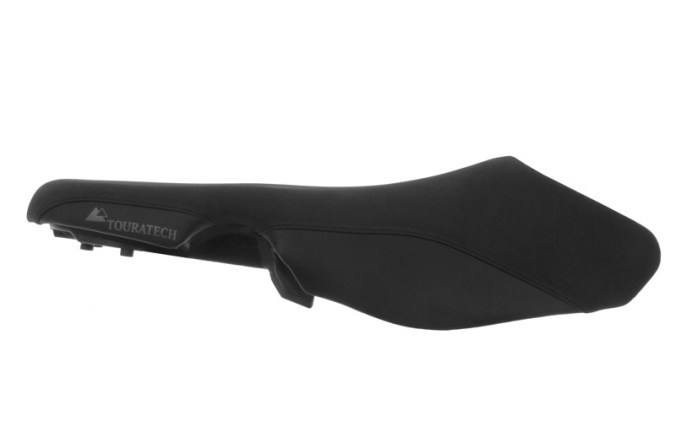
First up is a new seat. The BMW’s Rotax engine is the best thumper going, but their saddle sure does suck! I noticed it immediately upon going for my first ride. Well, what I noticed immediately is that the seat is sloped forward so it feels like the boyz are constantly crushed against the airbox. What took about another five or six hours on the seat to notice is that it’s not just the boyz that have complaint. After that first tour, when I put 800 kms. on the final day, I had a new tactile understanding of the term “saddle sores.” So if there’s one item I am somehow going to purchase at the beginning of next season, even if I have to sell body parts to get it, it’s the Touratech Comfort Seat, Extra High.
ttsaddle

Yeah, BMW has a comfort seat, but why reward them for putting a cheap seat on an otherwise excellent bike? I’m really happy with my Touratech panniers and I have a lot of confidence in this German company, which seems cut from the same cloth as BMW itself. I’m going to go with the extra high because I can easily afford another 2 inches on the height (my mom’s nickname for me is Longshanks), and it will change the ergonomics and make me less cramped. I would go with the FreshTouch version, which is covered in some technical material that somehow doesn’t retain heat as much as regular vinyl.

I plan to start some off-roading and I saw at the Simon Pavey school that motocross boots are mandatory for their courses, so a pair is on my list—not that I’m going to Pavey’s school in Wales, but I understand why he thinks they are necessary. The body parts most likely to be injured in a fall are your feet and lower legs, and when you are off-roading, especially learning to off-road, I imagine you fall a lot. The bike can fall on your leg or you can clip something like a trunk or rock when you plant a foot to corner. Now I don’t need a premium boot, not even an intermediate boot; an entry-level should do just fine and from the research I’ve done, Alpinestars is the brand. So on my wish list is a pair of Tech 1 AT’s.

tech1

If I were going higher end, I would probably get a pair of Sidi’s, but these are the only boots under $200 with a hinge/blade system for increased flexibility. I also like that they have a sewn sole, so you can have it replaced by your local cobbler when it wears out. The buckles are plastic but you can swap them out for the metal buckles found on the more expensive Tech 7’s if desired.

My next purchase will be an off-road helmet. I love my Arai Signet-Q touring helmet. It’s light, comfortable, really well ventilated, has the Pinlock anti-fog system, and SNELL certification, but . . . it was $800! I simply can’t afford another Aria helmet, even though the XD-4 is an amazing helmet. I went looking for something less expensive that wouldn’t be a huge sacrifice in quality and found a company named LS2 which makes quality lids at a fraction of the price of the big boys. The one I’ve got my eye on is the 436 Pioneer. It’s got a polycarbonate shell so it’s light, has a tonne of venting, an optically correct, fog-, UV- and scratch-resistant visor, a drop-down sun visor (great for touring), and is ECE rated. Best of all, it’s built for long-oval head shapes, which is what I have and right in line with the Signet-Q. I was so stoked about finding this helmet I almost bought one last summer but held back, hoping (praying?) they would release one in 2017 in a blue and white graphic to match my jacket. In writing this blog, I went to their site and lo and behold:

ls2_436

I’m a happy man.

Next up would be some auxilary lighting. That first tour to New Hampshire taught me that it’s not always possible to get to where you are going before sundown. Also that there are animals crossing the road at night. That road-kill incident sent me looking for secondary lighting and the Denali D4’s are on my wish list.

denali_d4s

These babies will send a beam almost 700 metres down the road in front of you. Better still, the combo beam and wide-angle lights also illuminate the surrounding roadside like it’s daytime. Because they are LED’s, they pull only 3 amps per pair. Wiring is easy, and you can wire them either into your high-beam switch or, as I might, a separate switch; I have an empty switch next to my four-ways that I could use or save for some fog lights. There is bike-specific mounting hardware so these will tuck in nicely at the top of my forks.

denali-mount

Okay, now we get into the practical stuff. Sleeping. If I’m going to camp while en route across the continent, I’m going to put the money I’m saving on motel costs toward the best inflatable mattress money can buy. My ultralight Thermarest is okay for 5 nights of canoe-camping, but for anything longer, especially when daytime concentration is essential to staying alive, I want a better mattress. I remember seeing one at La Cordée a few summers ago when I was buying a new mattress. It had a built-in pump, inflated I believe to about 4″ thick, was puncture resistant, and packed up smaller than a sleeping bag. Why, oh why, didn’t I buy it then? On my list is something like it. Suggestions, anyone?

Even more practical are tools for fixing a flat. So far I’ve been flirting with disaster. Anyone touring in remote areas has to carry sufficient tools to patch a puncture. Unfortunately, my bike uses tubed tires. The tubeless kind are so easy to fix with those plugs, but on a tubed tire you have to be able to remove the wheel, remove the tire, patch the hole, replace the tire, and re-inflate. The patching is the least of my worries. I’ve been patching bicycle tires practically since I was pre-verbal; it’s the other stuff that concerns me. I want to be able to break that bead and get the tire off and on without damaging the rim. On Adventure Rider Radio, I heard about BeadBrakR by BestRest Products. beadbrakrIt’s a series of tire irons that fit together to create a tool to leverage the tire off the rim. So you have your bead breaker and tire irons in one convenient pack. BestRest also produce the CyclePump to re-inflate the tire. Yes, you can use CO2 cartridges, but you only get one shot with them. The CyclePump is small enough to pack easily and runs on your 12V port, so if your patch isn’t perfect, or if for some reason you can’t patch the hole, you can use the pump repeatedly to get you to the nearest service centre or, if you’re really in the sticks, to phone service.

Speaking of safety, another little tool that I think would bring my wife peace of mind is the Spot Gen3. gen3_productIt’s a small, clip-on device that works with satellite technology to do a number of things. It can track your movement, so your wife will always know exactly where you are. Hmm . . . Okay, so don’t take it to your high school reunion then. Press another button and you can check-in with family to let them know you’re okay when out of cellphone range; it will send an email with GPS coordinates or a link to your location on GoogleMaps. This will be handy even on group rides to The States to avoid texting charges. Press another button to alert them you need help in non-life-theatening situations, and still another to hail the helicopter ambulance.  So if you’re planning a solo trip up to Deadhorse, AK, on the coast of the Beaufort Sea, as I am, this should be in your stocking.

Finally, we come to the most important items and the ones that, at about a thousand dollars apiece, will probably be on my list next Christmas too. I love my Joe Rocket leather jacket. I bought it as a starter jacket off eBay for a song and it’s been my one and only jacket so far. I zip the quilted liner in and out as needed, sometimes several times a day as temperature fluctuates, and throw a cheap rain jacket and pants over everything if the skies open up. But what I’d love, eventually, hopefully in this lifetime, is a Klim adventure jacket and matching pants.

Badlands.jpgKlim are the undisputed leaders in riding apparel and for good reason. They spend a lot of money on research and development, and all their products are premium quality. For example, the armour in their jackets is D30, which feels like soft, pliable rubber but molecularly stiffens upon impact; you can wrap this stuff like silly putty around your finger and then take a hammer and whack away to your heart’s content. And they’ve developed something called SuperFabric which is five times more abrasion resistant than leather with only half the weight. Gore-Tex means no need for an exterior waterproof jacket or zip-in liner. Warm in cold, wicking with vents in heat, this bad-boy is a one-jacket, climate control centre for four-season riding, and when the only thing separating you from the elements or the asphalt is your clothing, your jacket is the most important investment next to the bike itself. A Klim jacket will take me from Alaska to Tierra del Fuego in comfort and safety. I haven’t decided yet whether I want the Induction or, for a few hundred dollars more, the Badlands, but one thing I am sure of is that whichever model I eventually get, it will be in the hi-viz colour. When Marilyn and I drove the Cabot Trail a few summers ago, we definitely found the hi-viz jackets caught our eye at a distance. I don’t even think hi-viz comes at a coolness cost these days; rather, as I’ve claimed in a previous post, I think hi-viz is the new cool.

Most of these items are to set me up for the adventure riding I’m longing to try. Now I’ve got the bike and the licence, but if feels like those things are just a start. I remember during my first theory class in my licensing course, the instructor warned us that “this sport will latch onto your wallet worse than your ex-wife.” Having experienced the financial cost of one divorce, I almost fled the building. Now I see what he was talking about. But he continued by suggesting to pace ourselves, to “not go crazy” but slowly build up our gear. And to avoid a second divorce, that is what I’m going to do. In the meantime, a wish list is a fun way to dream and plan, research, and select, without the messy consequences of actually buying. Like window shopping.

No doubt your wish list is different from mine. What do you hope Santa leaves under the tree? Merry Christmas, and happy and safe travels in 2017.
Riding pillion with Peart and Bishop: reviews of Neil Peart’s Ghost Rider and Ted Bishop’s Riding With Rilke

ghost_rider_bookridingwithrilke

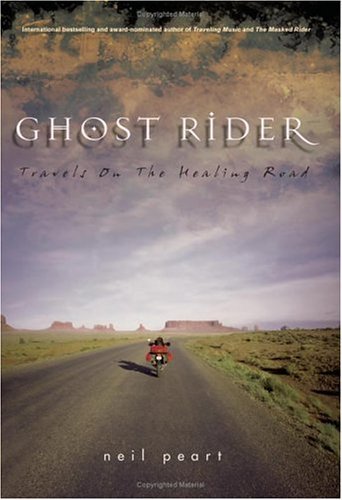
The riding season is coming to a close here in Montreal and I’m already thinking of what I’ll read in the off-season. When you can’t ride for five months of the year, you need to have a few motorcycle-related books ready to carry you through those dark winter months. Last winter, two such books for me were Neil Peart’s Ghost Rider (2002, ecw press) and Ted Bishop’s Riding With Rilke (2005, Penguin).

I first came across Peart’s Ghost Rider while visiting the excellent Bookshelf Cafe in Guelph, Ontario, many years ago when the book was first published. It was on the display shelves just inside the door and I remember picking it up and never getting much deeper into the store. As a drummer, I knew of Peart. In fact, he was the hero of pretty much every snare drummer of the marching band I was in through my teens. He apparently even started drumming in a drum corps not far from Burlington, my home town, so it was almost like we were best buddies. We would air-drum to Moving Pictures at the back of the tour bus, pretending we actually knew how to do Swiss Army triplets on double bass drums or half the other stuff he does. But then that’s the advantage of air-drumming: no one can hear your mistakes.

I’d heard of the tragic loss of Peart’s daughter and wife, and of his decision to hit the road in search of a reason to continue living. All this was long before I started to ride, but the dream of riding and touring one day was alive and well, so the book grabbed me and held me there for some time. Eventually I began to imagine the staff thinking “Either sh*t or get off the pot!”

It is a compelling story. His daughter is killed in a single car accident en route to Toronto for first-year university; eight months later his wife is diagnosed with terminal cancer, an illness which he more accurately describes as “a broken heart.” Soon after, he finds himself alone and slipping deeper into isolationism and self-medication. The only way out, he decides, is literally to flee, not knowing exactly to where or why. Like the survival strategy at the heart of Peter Behrens’s The Law of Dreams, a book also about tragedy and loss, Peart intuitively decides “to keep moving.” All this is provided in the opening chapter and sets up the “travels on the healing road” westward on his BMW R1100GS.

We follow Peart across Canada, up into Inuvik, across to Alaska, then down into The United States to Las Vegas (which he hates) and around the southwest. But the travels are really just the subtext to the real “journey” (to use the most over-used word today) for him on the road of grief and recovery. Peart provides a strikingly candid view into his emotional life at its core. He is extremely self-aware and offers us insights into how he was able to inch his way out of the dark pit into which he’d fallen: his fears, his strategies, his discoveries, his small advances and set-backs (he describes the process as one step forward, one step back  . . . minus an inch).

The motorcycle is the key element in his recovery. It provides a distraction from the thoughts and feelings that plague him; riding is so consuming, it’s difficult to think of anything else but operating the vehicle while you’re on it. And he puts on the miles. (Section headings include dates, places, and mileage.) The bike also reawakens his senses which have been numbed by grief and intoxicants. One of the first signs of recovery occurs while riding twisties through the B.C. interior on Highway 99, “one of the great motorcycle roads in the world”:

The sky remained bright, the air cool and delicious, and the sinuous road coming toward me was so challenging and rewarding that I was tempted into the adrenaline zone. Turn by turn my pace increased until I was riding with a complete focus spiced by the ever-present danger and occasional thrill of fear, racing against physics and my own sense of caution in a sublime rhythm of shifting, braking, leaning deep into the tight corners, then accelerating out again and again. I felt a charge of excitement I hadn’t known for many months and found myself whooping out loud with the sheer existential thrill.

Another important element in his healing process is journalling. In one late-night entry, for example, he stumbles upon a subtle but important discovery—forgiveness—the need to forgive life for doing this to him, forgive others for being alive, even to forgive himself for remaining alive. And when he’s not journalling, he writes letters—yes, long-hand—to friends and confidantes, setting his thoughts and feelings onto paper where he can see them. Sections of the book are these letters printed verbatim.

Peart provides commentary on the people he meets and the places he visits. He prefers the peace of rural roads to the hustle and bustle of urban centres, not surprising for a man who is comfortable with solitude. He finds healing properties in nature, especially birding. Peart clearly considers himself a cultured man and does not suffer the uncultured easily. At times, he seems downright judgmental and misanthropic. This was perhaps the most surprising aspect of the book for me. But I guess he applies the same honesty in describing his thoughts of others as he does about himself. When he describes a friend of his as possessing “a blistering contempt for most of humanity,” I cannot help thinking he’s describing a part of himself as well. The next sentence begins, “We agreed on many things . . .”

I’ve fortunately never suffered such loss, but I found his examination of grief and grieving fascinating. I do feel that some of that material could have been condensed. The book is over 450 pages in length with, like I said, entire letters reproduced for long stretches of the book. I feel the book needed more editing, or better editing, with Peart forced to distill for us the musings in those letters down to the essential discoveries. No doubt this was a structural decision made by Peart and his editors, but I feel he took the easy way out. There’s also an awful lot in this book that simply isn’t that interesting. Do I really need or want to know what he eats at each meal, his wine choices, the birds he spots, the flora and fauna along the way? His encounter with a short-eared owl is an example of a meaningful reference to nature because it’s linked to the main theme of the book (i.e. the owl shrieks a cryptic message at him) but other references seem gratuitous.

Yet ironically, the end comes upon us rather suddenly and the book overall feels truncated. We learn in the final chapter of finding new love that is the final step in his recovery, if there ever can be a final step, and it comes in a matter of a few sentences literally a few pages from the end. Overall, I get the sense that this book was rushed to press by a deadline. It’s a good book, but it could have been a great book with more time and effort in that crucial revision and editing stage. Now I’m sounding like a teacher leaving feedback on a student paper, so I’ll move on.

Like Peart’s Ghost Rider, Ted Bishop’s Riding With Rilke (finalist for the Governor General’s Award for nonfiction, among other nominations and awards) opens with a tragedy: Bishop’s life-threatening crash. He’s riding his partner’s classic BMW and is encountering some high-speed wobble each time he creeps up to 130 km/hr.. Then he tries to pass a semi, only to find out halfway past it’s a double-semi, a van rounds the corner in front of him and . . . well, it doesn’t end well. Like Peart’s opening, this serves as a frame narrative for the musings that follow. And also like Ghost Rider, Bishop weaves two threads through his text, or two passions: motorcycles and literature.

Bishop is an English professor at The University of Alberta with a specialization in early modernism. Much of the book describes a ride down to the University of Texas in Austin to do research on Joyce, or is it Virginia Woolf? I’m not quite sure. The narrative jumps around quite a bit between different Special Collections rooms in several libraries and his office at U of A to conferences, but it doesn’t really matter since the academic work is just the pretext to the musings on literature and adventures on the road. Along the way we get anecdotes about D. H. Lawrence in Taos, Camus wanting to buy a motorcycle, the Woolfs declining to publish Ulysses, Ezra Pound as Bishop passes through Hailey, Idaho, Pound’s home town, and some lowbrow culture too, including Evil Kneivel’s attempt to jump the canyon. (Remember that one? It’s still an embarrassment to the locals there.)

I had come across Bishop’s writing earlier in Ian Brown’s What I Meant To Say. His essay “Just a Touch” is my favourite of that collection, so I was excited when I received this book as a gift from a writer friend. My expectations were happily fulfilled. Where Peart’s prose is often a bit wooden, Bishop’s is graceful, imaginative, and often funny. Here he provides one of the best descriptions of riding I’ve seen:

When I first put on a full-face helmet, I have a moment of claustrophobia. I can hear only my own breathing and I feel like one of those old-time deep-sea divers. . . . . When you hit the starter, your breath merges with the sound of the bike, and once you’re on the highway, the sound moves behind you, becoming a dull roar that merges with the wind noise, finally disappearing from consciousness altogether.

Even if you ride without a helmet, you ride in a cocoon of white noise. You get smells from the roadside, and you feel the coolness in the dips and the heat off a rock face, but you don’t get sound. On a bike, you feel both exposed and insulated. Try putting in earplugs: the world changes, you feel like a spacewalker. What I like best about motorcycle touring is that even if you have companions you can’t talk to them until the rest stop, when you’ll compare highlights of the ride. You may be right beside them, but you’re alone. It is an inward experience. Like reading.

In another section, Bishop’s sense of humour mixes with a cutting derision toward literary pretension, producing a description of an open-mic event in Taos that would make Peart giggle in sympathy:

Next up was Ron, the leather-jacketed poet from this afternoon. When his name was called he left the room and then came slouching in from the street wearing shades and sucking on a cigarette and carrying a little cassette recorder playing Thelonious Monk. This might have been cool, except that the efficient MC, thinking his poet had gone home, had already started making announcements about next week’s reading. So Ron had to stop, turn off the recorder, and go back outside. His friends cried, “No he’s here, he’s here!” The MC stopped, and Ron slouched in again with the same Thelonious Monk riff playing. He shouldered  his way through the group of three in the inner doorway, snapped off the cassette, whipped off his glasses (briefly snagging one ear), and looked up from his crumpled exercise book. “Why do I love you!?” he shouted.

Who cares!? I wanted to shout back, but I was a well-bred Canadian and this was not my town. Knowing this could only get worse, I slid out into the night. I understood now what Lawrence had feared in Taos.

What I especially enjoyed about Bishop’s writing is his ability to render scenes like this so vividly. I’ve been at poetry readings like this—heck, I might have participated in some—and they are as painful as he describes here. He had me squirming. His attention to descriptive detail (the slouching, the snagged sunglasses) and use of dialogue (the shouts of Ron’s friends)—fictional techniques—allow us to stand next to him, so to speak, at that poetry reading. No wonder he teaches a course on creative nonfiction and has received numerous awards and accolades for his travel writing.

In addition to the places he visits, Bishop also takes us into his world of academia. We sit in on his meetings with the department Chair, overhear the casual conversations at academic conferences, and look over his shoulder in the British Library’s Manuscript Room as he discovers he’s holding Virginia Woolf’s suicide note. We even lie beside him in the ditch as the emergency responders cut off his boots and jacket, and next to him in the hospital bed as he takes his first drink. (Okay, we’ll drop this line of thought now.) This is what good travel writing does: take us to places from the comfort of our reading chair.

And always at the centre of Bishop’s writing is an affable man with a sense of humour, important qualities in a travelling companion. We get the sense that Bishop would be a great guy to share a beer with and chat about literature, or bikes, or both, which is what Riding With Rilke is. In fact, I’d like to share a beer with either author, although with Peart it would more likely be a wee dram.

I enjoyed both books. When I went to Amazon to search for more like them, I discovered a whole genre I hadn’t known existed: motorcycle journalism. From Hunter S. Thompson to Che Guevara, Persig, and Ewan McGregor (one of these things is not like the other) there are now many good books about the personal experience of touring by bike as the adventure riding industry continues to grow. With my 6a licence now finally in my wallet, I only have one more winter to wait before I can hit the road myself and hopefully add my voice to the motorcycle travelogue market.

The King’s Highway

210px-ontario_2

I grew up in Burlington, Ontario, two blocks from Lakeshore Boulevard, or as it was then called, Highway 2. On Saturdays, we would hop the Go bus and follow that road into Hamilton to B.J.’s Skateboard Park (I know, you couldn’t get away with that name these days), a concrete sea housed in the former Hamilton Spectator building. Those excursions into the neighbouring city for the day were the first tastes of freedom and independence granted by our parents. The return trip would be sleepy and pensive after full day of adrenaline, the coach bus a tiny lit capsule submerged in dark, shuttling back along Highway 2 with glimpses of Lake Ontario on the right between mansions. I struggled to stay awake so as not to miss my stop.

Later I discovered another kind of freedom. My girlfriend lived in Aldershot, our homes connected by a 10 kilometre stretch of Highway 2. Sometimes late at night, after my parents were asleep, I’d slip my dad’s Plymouth Fury II into neutral and push it out onto the road where they wouldn’t hear me start it, then drive the 20 minutes west to the goodies waiting there. If they ever heard me leave or coast in pre-dawn, they never let on.

My paper route was along Highway 2, a section that spanned from Appleby Line to the Skyway Plaza. Usually I’d cycle it, but sometimes I’d skateboard, and since the shoulder was still gravel, that meant dropping the skateboard and dashing, paperbag slung over my shoulder, 100 feet or so between oncoming cars before jumping off onto the shoulder at the last possible moment. I must have unnerved more than a few drivers but I knew what I was doing. I spent a lot of time on that road. On the bad winter days, I’d don my ski goggles to get the route done. Other days I’d stop at the creek that emptied into the lake and play or nap. One windy day some miscreant lifted the rock off my stack of papers and I returned to find them blown down Highway 2, stopping traffic as they pasted across windshields and lifted into the trees. When I phoned for more newspapers, my manager said I had to take some garbage bags and go clean up while I waited for the delivery.

When my older sister flew the coup, she lived first in Toronto North. I followed and we lived together for a few years. When I moved to London to go to university, Highway 2 was waiting for me in the form of Dundas Street. My sister moved to Dundas Street E in Toronto, so we were kind of still connected. In fact, before Highway 401, Highway 2 was the only continuous East-West artery running from Windsor to the Quebec border. I preferred it to the major highway and would take it when returning to Burlington for holidays when I could. Although slower, it was more scenic. Instead of a bus, now it was a tiny car that shuttled through the dark countryside. I wrote a poem about encountering deer one snowy Christmas Eve outside of Woodstock. And when I didn’t have my parents’ car, the Greyhound milk-run passed through sections of Highway 2 between London, Woodstock, Paris, Brantford, and into Burlington.

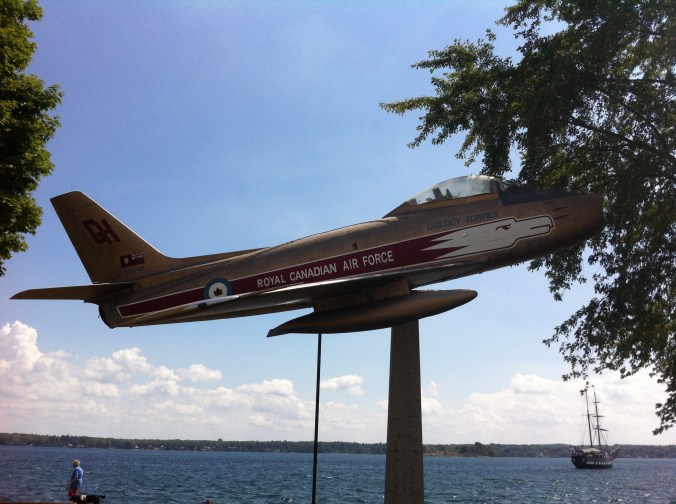
It seems that Highway 2 has been the major artery of my life connecting me with family and friends, so it’s not surprising that the morning after I got my motorcycle licence I hit the highway, so to speak, heading west along the 338 (formerly called Quebec Route 2), which turns into Highway 2 as it crosses the border. It’s a beautiful ride with the St. Lawrence River on one side and countryside on the other. It starts in Lancaster, then passes through Cornwall, Ingleside, Upper Canada Village (where the Black Creek Pioneer Village of elementary school field trips still exists), and quaint towns like Morrisburg, Prescott, and into downtown Brockville, which is actually very pretty and not at all like the commercial complex beside the 401. In fact, I used to associate Brockville with fast food joints and ubiquitous retail outlets until my motorcycle club had a ride that took us along Highway 2 into the old part of town. There you will find a marina and a park that has, among other attractions, a Canadair Sabre Golden Hawk of the Snowbirds squadron before it switched to the CT-114 Tutor.

tutor_highres

Sections of Highway 2 are based on trails that had been used by Indigenous peoples for hundreds of years before the colonization of Ontario, and that history is evident in places like Iroquois and Gananoque that is still passes through. In fact, a 1 km stretch at Gananoque is the only official stretch of Highway 2 remaining, according to Wikipedia. (In 1998, the highway was decommissioned and renamed, with that original section near Kingston, the King’s City, left as a token.) It connects the Thousand Islands Parkway (formerly the 2s) with the 401. If you take the Parkway (while the 2 swings north of the 401), you can pick up the 2 again at Gananoque and take it through Kingston, where it becomes Princess Street, then Napanee, Tyendinaga Mohawk Territory into Belleville and on to Trenton, Cobourg, and Port Hope. After that, the GTA behemoth  swallows it whole and spits it out again in Paris. If you hate studying early Canadian history from a textbook, just take a ride along Highway 2.

Why am I thinking of Highway 2 now? Well, as those of you who have been following my blog know, I rode Highway 2 recently in The States on my way back from Hampton Beach. Of course, it’s a different Highway 2 but was a familiar, reassuring signpost as the light faded on me in New Hampshire, still hundreds of miles from home. Yesterday I decided to make a trip to Burlington, Vermont, to buy a tank bag. Yes, we motorcyclists are willing to ride 360 kilometres for gear that’s not available in Canada. I still don’t have a GPS and didn’t want roaming charges on my phone so was looking for the easiest secondary highway that would get me there. I crossed the border at Rouses Point and picked up, you guessed it, Highway 2 which traverses Lake Champlain, slicing through North Hero, then South Hero, Sandbar State Park, taking me into North Burlington, then South Burlington and literally to the door of MotoVermont. The guys there were super nice and helpful, even helped me install the bag on my bike before I turned around and followed my favourite highway back home.

Crossing the Green Mountains with the sun setting over Lake Champlain to my left, I felt like a king.


Buzzed

coyote_vibrating

My bike is a single-cylinder, also known as “a thumper.” If you haven’t figured it out yet, that single piston fills a chamber 650 cc (652 to be exact) in size. There are pros and cons to a single-cylinder bike, but one downside is that, well . . . it thumps. But thumping is really a bit of a misnomer. The piston may thump at TDC (top dead centre) and BDC (bottom dead centre), despite its counter-weight, but at idle it gurgles, at 3,000 rpm is growls, and at 4,000-5,000, it buzzes. Thumpers are known to be a little buzzy in the handlebars.

Some are worse than others. I have it on good report that of all the single-cylinder bikes ever made, BMW’s Rotax engine is among the smoothest. (The KTM 640, by contrast, is known as The Paint Shaker.) But still, when I’m on the highway buzzing along at 100-120 km/hr, my throttle hand goes numb. It starts in the thumb and then travels into the other fingers, up the arm, splits at the shoulder, and disperses partly into my chest and downward (we won’t go there) and partly up into my cranium.

I imagine it like the Coyote when he’s flattened by a massive boulder then struck by the second falling rock or back-firing projectile he was aiming at the Roadrunner. In the cartoon, we see the wave of energy travel through his wafer-thin body. Only with me the wave is oscillating at 5000 rpm. The worst is when it moves into my nose and develops an itch deep inside my sinuses. It’s not like I can simply reach up and rub the bridge of my nose to dispel the itch, although that’s what I tried to do the first time this happened, only to be reminded that there’s this thing called a visor in the way. In a full-face helmet, your face is safely guarded inside its shell of carbon fibre and plastic from bugs, pavement, and probing fingers. Then I turn into Samantha on Bewitched, desperately issuing the anti-nose-itch spell over and over again.

Actually that’s not the worst. The worst is when it’s cold and my hand has another element making it go numb. Then I actually have to be careful because I need some feeling to  operate the brake lever properly when needed. I know someone who was sitting cross-legged at a party once and whose leg went to sleep without him knowing and when he got up to go get another beer he fell over and broke his leg! Of course, he might have simply had too much to drink but these kinds of things do happen when the tactile sense goes AWOL. Maybe that’s in part why my bike has heated hand-grips.

After a 350K ride, which is what my club has been doing on its day trips, my entire body is vibrating in sympathy with the engine. We have become one, synching our bodies in a kind of energetic dance akin to the pogo. I step off the bike and it’s like stepping onto land again after being at sea or in a canoe for a week; there is the sensation that I am static and the earth is moving, although in fact it’s the opposite. My vision is blurred and my thoughts are fuzzy. I have to leave the bike and sit with a beer (preferably on my lawn lounge chair that has a cushion) while the sensation subsides. I’m not very communicative (although this is also because I’m exhausted) and I can’t make any major decisions, such as what we could make for dinner. I stretch out and, if possible, close my eyes. It’s a total body stone that lasts for hours.

By now you might be wondering what the advantages are. For one, because the cylinder is so big (as opposed to two or several smaller ones), more power is transferred to the wheel with each stroke, so the bike has a lot of torque through low and mid-range. Okay, so it has a sucky top end, but when you are off-roading, who wants to be riding at 100-120+ km/h? Only folks who race in the Dakar, that’s who, (which, incidentally, a version of my bike, appropriately named the Dakar, won two consecutive years in 1999 and 2000). Through gears 1-4 I have tons of power to climb hills, sand dunes, fallen trees, and out of Montreal potholes.

The other big advantage is that I don’t have to shift gears as much; there’s a broader range of speed through those middle gears with lots of overlap. I can start from stand-still in 2nd gear if I want to (or if I forget to gear all the way down at a light (doh!)), and if I’m in stop-and-go traffic, I can slowly roll on the throttle and ease out the clutch when traffic picks up again instead of having to gear down and back up. But where my bike really excels, I’m beginning to learn, is “the twisties”—the stretches of secondary highway that contain lots of twists and turns, preferably with hills, that every motorcyclist lives for.

I can see the other guys in my club working like mad to prevent their bikes from either over-revving or lugging as our speed varies through the straights and turns. But with my bike, I can pretty much stay in one gear, usually 3rd or 4th, and simply roll off the throttle into the turn, then roll it back on with a growl on the way out. My dad calls it a “true European touring bike.” Yeah, the Honda Gold Wing might have been designed for the super slabs of North America, but my bike was built for twisting highways that cut through the Bavarian forest. And when I do get my full licence and start touring, you can bet I will be going on the straight-and-boring only as much as necessary. There are now motorcycle GPSs that have a setting to take you on Twisties, and you can be sure I’ll have my GPS set for that.

In the meantime, I’ve installed something called Grip Buddies (clearly a knock-off of Grip Puppies out of the UK). They are neoprene sleeves that wrap around the handle-grips and help alleviate the vibration, I think. This will help me on those sections of our club trips when we are forced to take the highway to get to where the ride really starts.

I’m also learning to enjoy the buzz.