The Triumph Tiger 800 Hot Starter Issue

In the end, the infamous hot starter issue was an easy and obvious fix.

1st Gen (2010-14) Triumph Tiger 800’s have a known issue with the starter motor when the bike is hot. I read about it even before buying my bike but it didn’t put me off. Every bike has a couple of weak spots. The BMW f800GS, for example, the Tiger’s direct rival, has the cam chain tensioner issue, and my old Beemer, the f650GS, has a water pump that fails every 50K or so. It’s good to know the issues on your bike so you are prepared should they occur. That’s why I spend a stupid amount of hours reading about other people’s misfortunes and frustrations.

Like most issues, they appear to be on some bikes but not all, so you just have to hope you have one of the good ones. I thought I did. I rode the bike for a good, hard year before it started showing any signs. What usually happens is, you are riding and the engine is hot and you stall the bike in traffic (the Tiger is easy to stall) and when you hit the starter, it struggles, fails. This is not my bike but what it sounded like.

Okay, Avi won’t be winning an Oscar anytime soon, but the video displays the issue well.

At first, all I had to do was cycle the ignition off and back on and that would fix it. Then it became progressively worse. I’d have to wait a second or two, then longer. After about two years and close to another 40,000K on the odometer, it was so bad I’d have to wait 10-15 minutes for the engine to cool before it would start again.

Discussions on online forums tend to look to replacing the starter as the first course of action. When I was doing my valves and had the bike stripped down, I decided to remove the starter and clean it up.
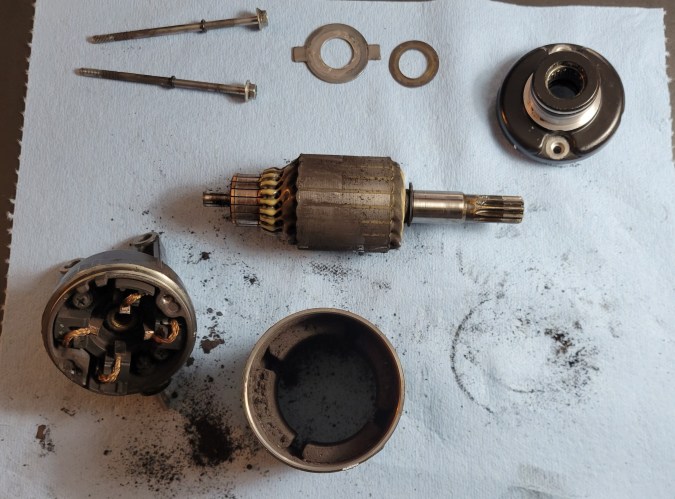
OEM starter innards, late 2023

Yes, there was a lot of carbon dust inside and some tarnishing of the armature, but cleaning it all up didn’t fix the problem. I rode it for another year before it became bad enough to warrant some action.

Reading the forums, it’s clear that there’s a lot of mystery and frustration in diagnosing this problem. There’s one famous 70-page thread on ADVRider by a father and son team who never did get to the bottom of it on their bike, and apparently they are mechanics. So I knew I was in for a long diagnosis.

Triumph doesn’t recommend just changing the starter. It comes as a kit including a new Sprag clutch and costs a sweet $800+. One guy compared the original and new gears and discovered the new one is slightly larger with a few extra teeth, as if Triumph knew the starter needs a little more torque to help it out.

Before going that route, I decided to try a cheap Chinese starter off Amazon. $135 including shipping, all the way from the other side of the world, and what a strange world it is we live in. At that price, I couldn’t really go wrong and thought it was worth a try. The cost was really more in my time because getting to the starter requires removing all the plastics, lifting the tank, removing the airbox and the throttle bodies, so it’s several hours work for an experienced mechanic and a full day’s work for an amateur like me.

The Chinese imitation looked exactly the same as the Denso original. If the Chinese do anything well, it’s copying. When your entire culture, including its economic system, is based on uniformity and sameness, I guess you become very good at copying. The clever Chinese copied the original so well that it too was crapping out when hot.

One of the frustrations for me with this diagnosis was that the starter would work fine when tested on the driveway. I’d idle the bike until the engine was at operating temperature, turn it off, and it would spin up without any sign of hesitation. But after a test ride it would not. My friend Mike tipped me off that the two tests are not the same and the temperature gauge is a crude indicator: the heat when idling is top-end heat, but after a ride it’s crankcase and gearbox too. This was another indicator of the eventual source of the issue.

After the disappointment and frustration of the Chinese experiment, I decided to pull out all the stops and replace the starter with Rick’s and upgrade the battery, the two other popular courses of action.

At under $300, Rick’s starter is less than half the price of the Triumph replacement and by all accounts is superior in design, cranking power, and longevity. You can see right away that American culture is based on difference and individuality.

Rick’s on left, original Denso (or is it the Chinese knock-off . . . ?) on right. The wrench is to stop them rolling.

Rick’s is slightly larger and has a different terminal. The internals are different too, with a double-sealed and protected bearing. The larger-diameter casing apparently prevents the armature from shorting against the housing when it expands with heat. I don’t think that was what was happening in my case, but sometimes size does matter.

In most reported cases, swapping the OEM starter with Rick’s has fixed the problem, a sign that Rick’s is more powerful. However, in some cases, owners have reported problems starting to occur again after some time, even with Rick’s installed, a sign that the source of the problem is ultimately elsewhere.

Another possible fix is to replace the battery with a more powerful one. I unfortunately went the other way, which probably exacerbated the problem. When the OEM battery on my bike got old and weak after near draining it in my Calabogie Disaster, I replaced it with a cheaper and smaller battery. Yeah, part of what I learned through this troubleshooting are the high demands on the battery and the importance of replacing the OEM one with its equivalent or better.

In this case, I decided to go better. I bought a lithium battery with 315 CCA (the OEM Yuasa has 270). I’d owned a Shorai battery with my 650GS and was pleased with it, and since I already had the dedicated charger, I went with another Shorai. The charger plugs into a port on the battery and can run all sorts of diagnostics and reconditioning programs on the battery. And since May 2022, Shorais have an advanced Battery Management System that protects the battery from over discharge that can damage a lithium battery beyond repair.

When it came time to install the new parts, I went the further step of testing and cleaning up the starter circuit. I’d noticed a significant voltage drop upon starting the bike so knew something was up. Again, my friend Mike, who knows more about bikes than I ever will, told me that electrical resistance increases with heat so to look for frayed or corroded wires.

I started with the starter relay, located under the battery.
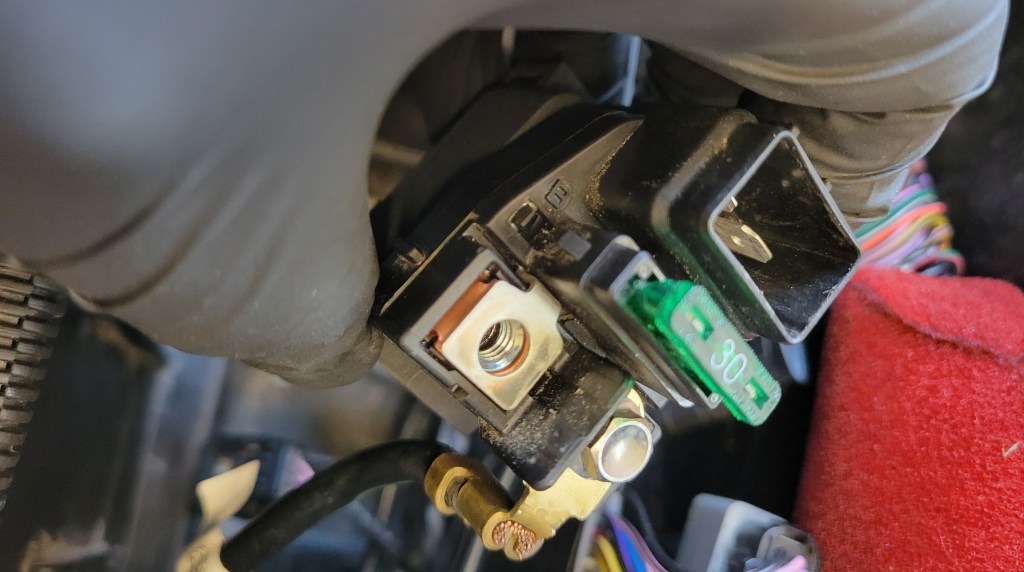
It looked pretty clean, but I polished the contacts nonetheless with some emery paper and added a smear of dielectric grease.

Next, I dug down to the main ground on the bike. It’s located under the airbox and is, significantly, on the top of the crankcase. It was grimy!

Oh boy! The main ground on the bike.

It clearly had never been cleaned. I was beginning to think this was the true source of the problem. It would explain a lot: the progressive nature of the issue, and the reason why it doesn’t happen with top-end heat. When the crankcase is hot, the resistance in this poor electrical connection would go up, causing a voltage drop, and resulting in the starter not getting enough power.

I tested the resistance from the negative battery terminal to the ground. It was .9 ohm!
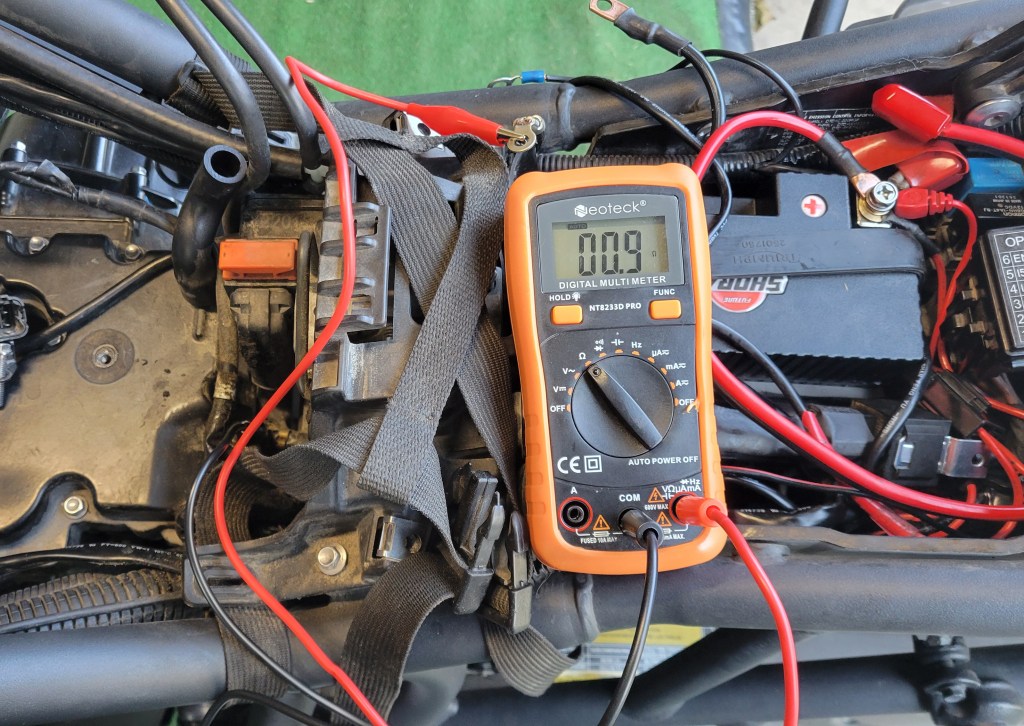
Before cleaning

A quick Google search indicated that a circuit shouldn’t have more than .2 ohm resistance. I’d found the underlying source of the issue.

After cleaning up the ground and all terminals, the resistance dropped to .1 ohm.

After cleaning

And while I was at it, I added a smear of dielectric grease to the battery terminals too.

Since installing Rick’s starter, the Shorai battery, and cleaning up the circuit, the starter hasn’t had as much as a hiccup.

Whether or not the problem would have been solved by only cleaning the ground we will never know. But if you are having starter issues, I’d begin your diagnosis by looking there. Being under the airbox, it doesn’t get inspected very often, but I’m going to be keeping a closer eye on it from now on. In fact, I’ll probably do some preventative cleaning as part of my annual maintenance.

I don’t mind having Rick’s starter in the bike. The Denso is weak, and mine was 11 years old. I also don’t mind having the more powerful and much lighter Shorai battery in there as well. I could have avoided getting the cheap Chinese starter (now sitting in my workshop), but troubleshooting is a process and there are costs to be incurred and lessons learned along the way.

As I write this, it’s March 15th, a special day if you’re a biker in Quebec. It’s the official opening day of the season. (Yes, we are required by law to be off the roads Dec.1 – March 15.) There’s still a foot of snow blocking the doors to my shed where I store the bike over winter, so I won’t be riding today but soon! It’s been a unusually cold winter in Montreal, as it has been across North America, and we’ve broken a bunch of snowfall records. As far as I’m concerned, that makes this spring especially sweet, made all the sweeter because for the first time that can remember, my bike was put into winter storage running perfectly and not needing any maintenance whatsoever. We are finally into the plus Celsius weather (+32 F), and yesterday I heard the unmistakable sound of a woodpecker while walking the dog.

There’s nothing quite like hearing your bike fire to life the first time after four months of storage. It’s the unofficial sound of the start of a new season. This year my big summer tour will be a section of the TCAT (Trans Canada Adventure Trail) called The Forest that runs from Baie Comeau on the Quebec-Labrador border to Kenora on the Ontario-Manitoba border. This will include some of the most remote riding I’ve ever done, but one thing I know is that my bike will start when I need it to.

What are your plans for this season? A big tour? Rallies? Lots of smaller rides? Share the excitement and let me know. I’m always interested in hearing from readers.

Ready to Ride

What is your preseason prep?

Here in Montreal, the 2023 motorcycle season has officially begun. As of March 15th, we can legally be back on the road. The reality, however, is that no one is stupid enough to do so. I saw—or rather, heard—a scooter on the road yesterday, but I wouldn’t want to take a bigger bike out yet. In fact, I can’t get my bike out yet; there’s still several feet of snow blocking the doors to my shed.

Nevertheless, the air is filled with anticipation as it won’t be long now. Motorcyclists are scurrying about like squirrels uncovering nuts, or birds building nests. I’ve seen a few Facebook posts about preseason maintenance and, for the Harley riders, preseason cleaning and polishing. T. S. Eliot wrote that April is the cruelest month, but for motorcyclists in northern climates, it’s these last few weeks of March during The Big Melt (aka dog shit season) that are the most painful. To ease the pain, we undergo a ritual process of preparation for the season to come. Here is what I do to get ready to ride.

Bike Prep

The first thing I do is undo everything I did last fall to prepare the bike for storage. That involves removing whatever I’ve used to block the intake and exhaust ports, removing the wax I left on the bike to protect it through the cold winter months, replacing the battery and saddle, lowering the bike off the jack-stand, and topping up the tires. The bike is now ready to run, and I might start it up, just to hear its familiar exhaust note and reassure myself that all is well in the world.

Depending on the mileage, I change most of the fluids on the first warm day of spring. (I don’t have the luxury of a heated garage, so all maintenance is done outside.) I changed the oil before putting it into storage, but apparently oil ages even if unused, so I’ll do an early oil change, maybe not right away but soon. For this reason, some people put a cheap oil in the bike in the fall just for storage purposes, then change to the good stuff in the spring. I think that’s a little over-kill, so I put the same top quality synthetic oil in before and soon after storage. And no, I’m not going to start an oil thread by revealing what I use, as much as I always enjoy a good oil thread.

I change the coolant and brake fluid every two years or 20,000 kilometres, whichever comes first. I also remove the brake pads, clean them up with a wire brush, and clean and lube the callipers, paying special attention to the calliper pins. The brake cleaning might be over-kill too, but I like to know the pins are moving freely and generally to keep the brakes free of grit and grime. They’re just one of those essential moving parts that is exposed to road debris. If you’ve never done your brakes before, it really isn’t difficult.

I’m fortunate to have MuddySump’s channel to follow for routine maintenance. He’s an excellent mechanic and has the same bike as me.

I change the air filter, or in my case, because I use a K&N, clean and re-oil it. This year I’ll be adding a Uni pre-filter to my bike. On my Tiger 800XC, the OEM filter is under the tank, so adding a pre-filter will not only help protect the engine but also significantly cut down on the service intervals for the filter in the air box.

Then the fun begins: I add all the mods I’ve bought through the winter.

Gear Prep

If you didn’t launder your gear and wash your helmet liner in the fall, now might be a good time to do it. I also get out the leather conditioner and go a little crazy with it. First I do my leather jacket, then my gloves. Then while the rag is damp I do my satchel, my shoes, my wallet, my fountain pen cases, my belt . . . like I said, I go a little crazy. I do this once in the fall when I put my jackets away and once in the spring. We have baseboard heaters which pull all the moisture out of the air in the house, so I do this at least twice a year.

My favourite brand of leather conditioner? This might start a thread as long as an oil thread, but I’ll say that someone who works at the high-end store in Montreal where I bought my satchel once graciously confided that Armor All Leather Care Gel is just as good as the expensive stuff they sell. That was my brand until Canadian Tire stopped selling it. Then I switched to Simoniz, which I didn’t like as much, and lately it’s been Chemical Guys, although this year I’ve noticed that it’s leaving a white film on the leather once it dries. So after doing a little research, I’m going to try Cobbler’s Choice. Like I said, I’m a little obsessive about moisturizing my leather goods. The best moisturizer, however, is good ol’ beeswax, although it leaves the jacket sticky for a few days.

So with every leather item in my house sufficiently moisturized, my gear is almost ready for the season. I squirt a little WD40 on the buckles of my ADV boots, some Pledge on my helmet, wipe some silicone onto the rubber that seals the visor, and polish my visor with Plexus. Yeah, this stuff costs a lot, but Ryan F9 has done a video showing that it’s the best. If the visor is old and too badly scratched to restore, this is when I get a new one; there’s no sacrificing when it comes to vision on the bike.

I also get out my camping gear and give it some love. Last fall, I treated the tent with Kiwi Camp Dry Heavy Duty Waterproofing Spray. I like this stuff because it’s non-toxic and doesn’t leave an after-smell. I also clean my stove and make sure anything that needs replacing is replaced, because there’s nothing worse than a temperamental stove when on tour. The one that I use runs on liquid fuel and requires maintenance from time to time.

Body Prep

Touring for weeks on end and crawling in and out of tents, as I’ll be doing this summer, requires some fitness and flexibility. The long days in the saddle are easier if you have some cardio fitness, so I’ve been running fairly regularly. I do a 5K loop with the dog 2-3 times a week, and when I’m inspired, I run a little longer. Now that the warmer weather is almost here, I’ll be bumping that up and doing some 10K and even longer runs. Running has always been easy for me and it’s my go-to exercise for body and mind.

With all that running, I need to do stretching or my legs get tight and my back becomes prone to injury. This year I invested in some athletic therapy which gave me a set of stretches to do, and as Robert Frost said, that has made all the difference. I used to pull my back a few times a year, often at the worst possible time, laying me up for a week, but with this stretching, I haven’t had an incident in a while. I think I’ve found the answer to my back issues.

In addition to the cardio and stretching, I work on strengthening my core, so some Pilates, yoga, and generally, abdominal work. Sitting on the bike all day is like sitting on a stool with no backrest, so you need a strong core. When you start doing any off-roading, there are even bigger demands on your muscles. I’ve already done a blog about fitness and strengthening, so if you’re interested in the specific exercises I do, check that out. One thing I’ve added since making that post is to work on balance. You can do that with a wobble board, but a simple way to improve your balance skills is to stand on one foot . . . with your eyes closed. Try it. This develops all those nerves in the foot that are essential to good balance, and according to Jimmy Lewis, off road riding is all about balance.

This year, to account for the extra weight of the top-heavy Tiger, I started doing some strength training with kettle bells. I may be a natural runner, but I’ve always had the upper body of Pee-wee Herman. I really like kettle bells and I think they will become a regular part of taking care of myself. The main reason I like them is that you get cardio, strengthening, and core work all in the same workout. Because kettle bells are asymmetrical (unlike barbells), you’re always working your core, and if you string reps together EVOM (Every Minute On the Minute), you also get your cardio workout. Best of all, you really only need a couple of kettlebells to get started and can do it in a small space in the house. I’ve been doing kettlebelling for the past month or so and am loving it! I’m following Mark Wildman’s YouTube channel. He’s excellent and has a series of videos specifically for people like me just starting out.

If that sounds like a lot, it kind of is, and I’m trying to figure out how to fit it all in. At my age, recovery time is not what it used to be, if you know what I mean. At first, I tried staggering running and strengthening on alternating days, but that didn’t leave me any days off to recover. Currently I do a run after my long days at work to run off the stress, then a double workout of kettlebelling followed by a light run when I can, which wipes me out but then I take a full day off with just some stretching. In other words, I listen to my body and adjust accordingly, keeping in mind that you need to do an activity 3-4 times a week to see benefits.

Finally, the only other muscle I exercise is . . . eh, hem . . . not what you’re thinking but my clutch hand. I keep one of those spring grip devices on my desk all winter and pick it up from time to time. Works better than a stress ball and helps avoid arm pump when off roading.

One hand on the mouse, one hand on the grip strengthener.

Eye on the Prize

It was the best of times, it was the worst of times . . . it was the spring of hope, it was the winter of despair. Charles Dickens wasn’t a motorcyclist, but in describing the Victorian era he caught something of the spirit of this intermediary period. As I come to the end of my March Break and head back to work tomorrow, I keep in mind that at least I’ll soon be able to commute by bike, and before I know it, the semester will be drawing to a close and we’ll be getting ready to leave for Newfoundland. Marilyn and I booked our ferry crossing the other night so that trip is a go! 18 days together on the bike camping through Gaspé, Gros Morne, and across The Rock. It’s going to be epic.

Keep your eye on the prize, folks, whatever that may be for you. Have a safe and enjoyable season.

First Ride

Lakeshore

What’s your first ride? I mean the first one of the year? Do you have a favourite go to ride you do when the bike first comes out of storage? I do.

My first road ride ever—when my group at the school finally left the lot and headed out onto the road—was down 55th Avenue in Lachine to Lakeshore Blvd. We’d been warned about the right turn onto Lakeshore and had been practising for it with counterbalancing turns winding through cones. But once on Lakeshore Blvd., it was a perfectly slow, easy ride, with lots of stops signs along the way to practice braking and gearing. It also happens to be pretty scenic too with a view out over Lac Saint Louis. At some point we headed up to the highway and zoomed back to the lot, but Lakeshore, with its signs that read “If you’re in a hurry, take the highway,” was a safe beginning.

Even before I had my road licence and was supposed to ride accompanied by someone with a full licence, I snuck out with my new bike. I headed down to Lakeshore Blvd. and took that all the way around the western tip of the Island of Montreal, going through Pointe-Claire, Beaconsfield, Beaurepaire, Baie D’Urfe, Sainte-Anne’s, through swanky Senneville and along Gouin a little. Then I went across the bridge to Ile Bizard and looped it before making my way back home.

It’s an easy, easy ride, and that’s what you want the first time out, when muscle memory is weak and you have to refamiliarize yourself with the controls. It doesn’t take long for it all to come back, but if you’re going to make a mistake, you want to make it at low speed, in second gear. I lost the last two months of last season waiting for parts, so last week, when I got the bike out of storage, I actually hadn’t ridden for six months. I’d just installed new brake lines so, before pulling out of the driveway, I pulled the front brake lever and tried to move the bike. It’s a simple test they make you do at the licensing bureau before you do the road test to ensure your brakes are working. The bike should nose-dive, but this time it didn’t. It rolled. “Damn, the brakes aren’t working!” I thought, “Why aren’t they working?” Then I realized I was pulling the clutch lever, not the brake. That’s why you want an easy, slow-speed ride for your first. 

There’s another reason you want a slow ride. Usually for me, getting the bike out of storage means doing some work on it. There’s already some work that I do to put it into storage, like change the oil and take out the battery; but getting it out of storage almost inevitably means adding something to it that I’ve bought over the winter. This year, like I said, it was some steel-braided brake lines, but also new pads, and some Rox handlebar risers. These are pretty easy mods, but there’s a chance I’ve overlooked something—a nut not completely tightened, or the controls affected by the risers (yes, I tested at idle full-lock both ways, but you can’t be too safe)—and you don’t want to discover at highway speeds that you forgot to tighten the wheel lug nut, now do you? I give my bike a good look over before I head off, but still . . . A friend recently forgot to tighten her oil cap completely after doing an oil change, so oil was dripping down onto her exhaust pipe and smoking. It’s simple mistake, but oil on the tires could be dangerous. Your easy first ride reduces the risk of those innocuous mistakes becoming disastrous.

Sticking close to home also helps should you encounter a problem with the bike. I’ve limped home from a short distance with my temperature light flicking on and off. As my confidence in the bike grows, so does my distance from home and my speeds. After I did my Lakeshore route last week, I headed off to Ontario on Sunday with a small group. Yeah, there’s safety in numbers too. Although my first ride has always been solo, it’s not a bad idea for it to be in a group.

It feels so good to be back on the road. Six months! It puts a sparkle in the eye and a spring in the step of every rider. As I write this from Montreal, Canada, a snowstorm has blown in, but it’s the last of the winter, I’m sure. The forecast for the next few weeks is above freezing so the riding season officially begins tomorrow. Have a safe season, and if you have a favourite first ride, tell me about it.