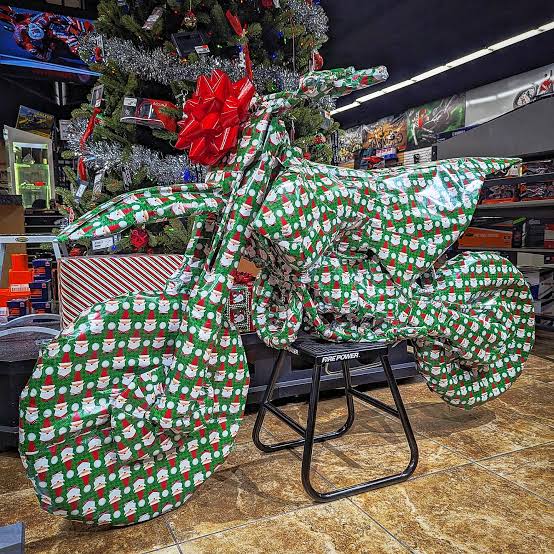
The Wish List, 2025

This year, my wish list is very short.

Once, while watching a VRRA race, I saw a guy pat his bike just after he crossed the finish line. It was a real nail-biter and he managed to squeak out the win in the last few meters of the race. I noticed the gesture—a double pat on the side of the fuel tank—because I sometimes do this to my bike, but privately, usually as we either head out on or return from a long adventure. It’s a gesture of kinship, or thanks. I guess I feel silly doing it, but at least now I know I’m not alone.

The pat is silly because, of course, machines don’t have feelings. Perhaps the gesture is only an acknowledgment of our own. If you work on your bike, and especially if it takes you on some adventures, you develop a bond, dare I say an intimacy, with the bike. You trust it with your life and return the favour of that loyalty by keeping it well maintained. And sometimes, I will publicly admit, I even talk to my bike, promising from inside my helmet some much needed maintenance as we cover the last few kilometres of a long tour. No wonder my wife sometimes feels second-best.

I mention all this because, yesterday, while browsing Facebook marketplace listings, I came across my old, first bike, the original Beemer after which this blog is named, the one that took me across Canada and up to the Arctic Circle and Marilyn and me over The Rockies. I put 100,000 kilometres on that bike and did all the maintenance myself, and now here it was, sitting in a stranger’s driveway.
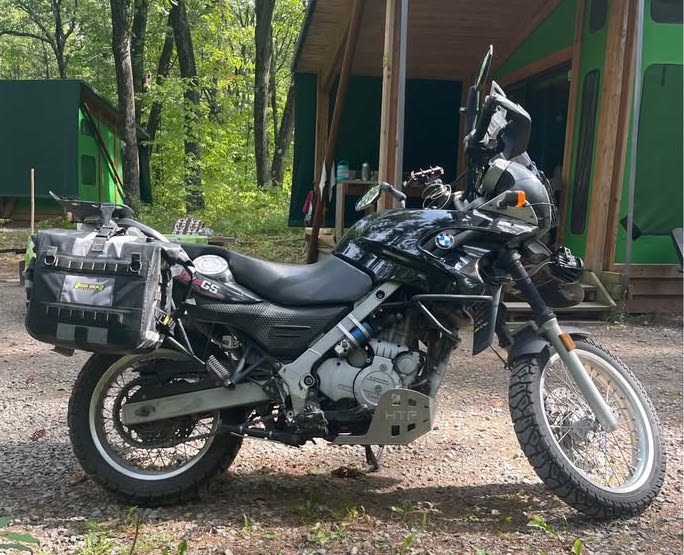
The original 650 Thumper. photo credit://Alain Thibault

I always wondered what had happened to it. Last I heard, the woman I sold it to didn’t keep it for long but sold it, I was told, to trade up to a bigger GS. Her loss, I thought, since she was a learner and it’s a perfect learner bike and more. Now that new owner is selling it, and for a moment I actually considered buying it back. But I’ve got other plans.

Next spring I’ll be buying a new bike, or new to me. I’m looking at the Honda CRF 300 Rally.

The 2021-24 model.

I’ve always wanted a little trail bike. As good as the 650 was as a starter bike, there really is some truth to the adage that you should start small. It’s a lot easier to develop off-road skills on a little dirt bike than on a big adventure bike, a point on which Clinton Smout has founded his SMART riding school and which Adam Reimann argues in a recent video.

The polemical Adam Reimann.

I will also throw some rackless saddlebags on it and use it as a light adventure tourer. I’ve already bought the Enduristan Monsoon 3’s in a Black Friday sale at Dual Sport Plus; now I just need the bike.

I know what’s coming, so let’s just get this out of the way early. Why doesn’t everyone who is reading this leave the comment, “That’s the same bike Itchy Boots used,” and I will henceforth become inert to the remark. But seriously, I’d rather you weigh in on another decision I’m making.

I’ve also decided to sell the Tiger and get an even better long distance touring bike, and yes, it will be a big GS because that’s the law. If you’re over 60 and into adventure street touring, you must get a big boxer. I’ve never owned a big GS but I rode one in a demo ride at La Classique a few years ago and was immediately hooked. If you don’t understand, you clearly haven’t ridden one.

But joking aside, hear me out. I’ve been trying to do it all—trail riding and touring—with a middle-weight bike, but that inevitably involves compromise both in the dirt and on the street. With retirement approaching fast, I think I’m ready for two bikes. The Tiger is a really fun bike, but it’s still a big bike for technical riding and a little small for long-distance touring. The GS carries its weight so low you can turn it on a dime, and where the 800 triple is straining a bit 2-up at 120 km/hr (70 mph), the 1200 GS is cruising in its element. There’s good reason that the GS is the best-selling adventure bike of all time.

I’ve considered getting a dedicated touring bike like a Gold Wing but wouldn’t want to go up The Dempster on one of those. I’ve also considered a sport touring bike like the discontinued Yamaha FJR but want the option of top-loading panniers for my camping gear. No, I knew a 1200GS was somewhere in my future; I just didn’t realize it would be this soon.

The BMW R1200 GS Adventure.

Why a 1200 and not a 1250 or even 1300? Mostly due to budget, but there are benefits to going with an older bike too. I like to work on my own bikes, so the simpler the better, without a lot of electronics, and there are literally thousands of old 1200 GS’s out there, so lots of choice. Ah, there’s the rub: I have choice paralysis.

What is the best era of the 1200? The simple, reliable, and relatively lightweight 04-12 1st Gen oil/air-cooled models; 2nd Gen 13-16 water-cooled models with more power and a wet clutch, electronic suspension, quickshifter, and rider modes with cruise control; or 3rd Gen 17-18 models with TFT display, dynamic (i.e. self-levelling) electronic suspension, cornering ABS, and finally a smooth transmission? There are incremental updates in each generation too so the decision gets complicated fast. Please let me know if you have a preferred year and why. I’ve got all winter and probably most of next season to decide, but I’m researching and narrowing down my decision now. I think I’ll probably go GS Adventure for the extra range and better wind protection if I can get my old Touratech panniers to go on it. (Do all GSA’s have the bent luggage rack on the muffler side?)

As for the Tiger, it’s been a really fun, sporty, adventure bike, and I will be sad to see it go, as I was when I sold the Beemer. We’ve had some good adventures together, and I’ll give it a few pats and parting words before the new owner rides it away. The only consolation for such loss is the promise of new adventures on new bikes. As Galway Kinnell writes of separation, “the need / for the new love is faithfulness to the old” (“Wait” 14-15).

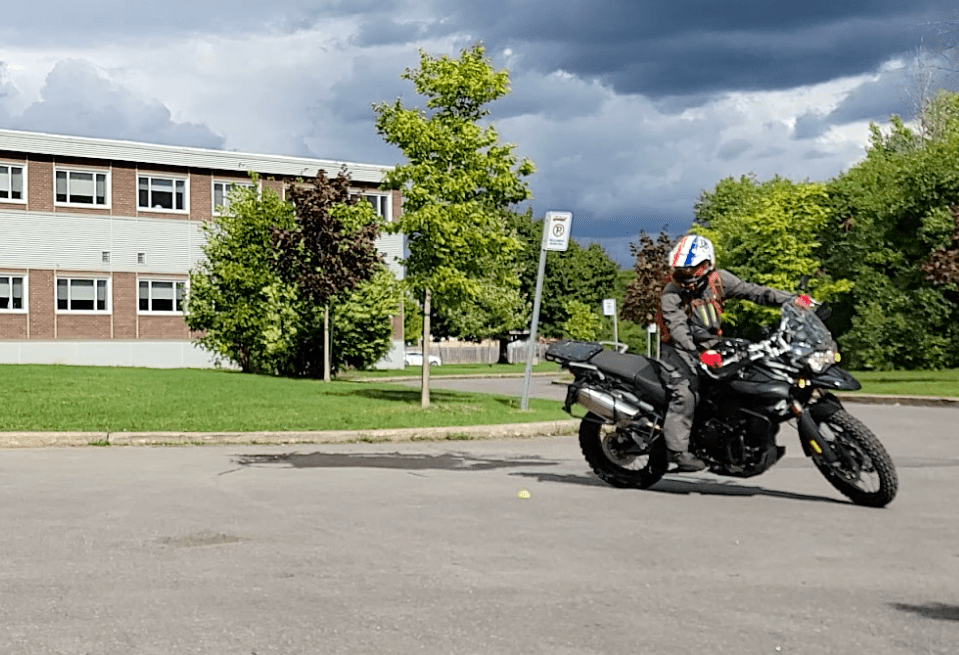
My 2013 Triumph Tiger 800XC, aka Jet.

5 Drills to Improve Your ADV Skills

Improve your street and off-road skills with these simple drills. No dirt needed.

The first instruction in off-road skills I received came from none other than Jimmy Lewis, the Dakar podium finisher in the 90’s who now runs an off-road school in his home state of Nevada. He was visiting the Dirt Daze Rally in NY and offering little 3 hour clinics to ADV riders. He began by stating that the coaching at his school focuses on two things: balance and traction. I think the traction skills come a little later, maybe in intermediate classes—how to find and break traction when needed. But I learnt a lot about balance, throttle, and clutch control from that short clinic, and I’ve added to it with some instruction at SMART Riding Adventures, Clinton Smout’s school in Barrie, Ontario, and a couple of Spring Refresher days with GS instructors at some clubs here in Quebec.

I’ve cobbled together five drills that I try to practice when I have an hour or so to spare. I recently heard Chris Birch say in an interview on Adventure Rider Radio that really what you learn at his weekend courses are exercises that everyone should then go out and practice after the weekend. No one is going to learn how to ride off road well in a weekend, but if you practice, like in any sport, you’ll improve.

These are five exercises I do to improve my skills.

Static Balance

Everything starts with balance, and the best exercise to dial in the neutral point when the bike is in perfect balance is static balance. Jimmy had us attempting this without any assistance and it was hard. No one could really balance for more than a second or two. I think the better way to do it is how the dirt bike guys do it, full lock and your front brake on. You can also move the tire side to side a bit to dig a little rut into the dirt for support. Alternatively, you can lower your front tire pressure or get the bike on a hill pointed down so the front suspension is compressed a bit, which makes it easier.

Okay, it’s not an asphalt but you can do it at the top of your driveway on the grass if your partner doesn’t mind the groove permanently dug into the lawn.

Touch and Go

This one I got from Brett Tkacs’ video on his asphalt drills. It teaches fine braking, clutch, throttle control, and balance. You simply come to a complete stop at each obstacle and touch it with your foot or hand. You can use anything available such as parking blocks, lamp standards, garbage cans, etc. All these drills are simple but not easy. This one is a particular challenge for me on the Tiger.

Sorry about the crappy framing at the beginning.

Figure 8

This one teaches counterbalancing in tight turns both seated and standing. It’s important be able to turn both ways so the figure 8 ensures this. Just place two markers about 6 meters apart as your centre-point of each turn. (A tennis ball cut in half works best.)

For seated turns, you want to shift your butt off the seat—the one cheek sneak—to shift your weight. It’s not enough to move your upper body; you have to move your hips, where most of your weight is, even if you are diminutive like me.

For standing turns, I concentrate on gripping the bike with my legs. For a left turn, for example, I hold myself from falling off the bike when leaning by planting my left calf and thigh against the engine and my right knee against the other side, just under the tank. Using leverage in this way, I’m “locked in.”

For both seated and standing turns, vision is crucial. You want to put your chin on your shoulder and look to where you want to be, the next cone, not the one you are turning around. Keep your revs up so you have power on hand should you feel the bike falling and can clutch out without stalling. The goal is full-lock turns both ways.

Circus Act

This exercise teaches you to move independently of the bike but stay in balance. Begin by standing and riding with one hand, both sides, then lifting a leg off each peg. Once you’re comfortable doing that, swing a leg over your seat and sit side-saddle long enough to place the opposite foot on the peg, so put the right leg on the left peg, and stand up. Then sit back down side-saddle, get your left foot back on the left foot-peg, swing both legs over so you are sitting side-saddle the other way and put your left foot on the ride foot-peg. You’ll find the bike wants to tip to the side all your weight is on so be ready and compensate by tipping the bike away from you. As long as both you and the bike together are in balance, you won’t fall.

I find this exercise helpful for when you get into sand and mud and rocks and the bike starts moving around underneath you. Your muscle memory will remember and you’ll shift your weight to the opposite side to compensate. Off-road riding requires a lot of movement side-to-side with your upper body to compensate when the bike becomes unbalanced.

Finally, I get back to normal seating and then dismount the bike while it’s still rolling. (This teaches clutch and throttle control again.) Walk beside the bike for a few meters then put your left foot on the left foot-peg and do a rolling mount. You’ll have to transfer you weight quickly over the centre line of the bike to avoid it falling toward you. It’s a bit of a step of faith (not quite a leap) so commit and keep the revs up and the bike rolling. Do the same on the other side. The rolling mount is good practice for fine clutch, throttle, and balance, but can be handy in some situations on the trail.

Friction Point Practice

Find a hill or incline (a loading ramp will do) and point your bike uphill. Slowly roll the bike up and back using only the throttle and clutch, no brakes. Try holding the bike stationary for a few seconds only using the throttle and clutch, then roll back and stop the roll, again, only using the throttle and clutch.

I learnt this skill from the IRC Tire guy and he says it teaches you to break the habit of trying to hold the bike on an unsuccessful hill climb with the front brake. Instead, you have to develop muscle memory to use the engine to brake when rolling back on a hill. It also dials you into the friction point of your clutch and helps develop traction on hill climbs. You don’t want to spin the rear tire and lose traction.

All these drills look simple and easy but they are far from easy. I like them though for their simplicity, allowing you to practice them anytime you have a few minutes or even at the start of each ride.

I’m no expert, so feel free to offer advice in the comments section; I won’t be offended. I’m always eager to learn.

Do you have some exercises you do regularly? Drop them in the comments section too. I’ve kept this to 5 so they can be done quickly, but I know there are a ton of excellent exercises out there, so pass on your favourite(s).