What Is Adventure Riding, Anyway?

photo credit://ADVPulse

The term “adventure” is so over-used today that it’s lost almost all meaning, but this is how I define it.

In a recent episode of Adventure Rider Radio RAW, host Jim Martin and guests tried to define the word “adventure.” It was a rather abstract discussion that quickly deteriorated into subjectivity and personal perspective, yet the poet and wordsmith in me was piqued. Since I use the term in my blog’s byline and hold the expression “life is an adventure” as a personal motto, I thought I should take a crack at defining it. Yes, the term means different things to different people, but here are the elements of adventure riding as I see it.

Exploration and Discovery

photo credit://History Channel/Shutterstock

There has to be an element of exploration and discovery. Adventure riding is going where you’ve never gone before. I suppose in this sense, all travel has an element of adventure, as it gets us out of our milieus. One of my favourite things is seeing something for the first time, and like the proverbial first step into the stream, we can only see something the first time once; it’s never quite the same again.

I’m a curious person, whether in the realm of ideas or things. Adventure riding allows me to follow that curiosity, leading me into the unknown. There’s a mystery at every geolocation in the world and all we have to do to solve it is go there and look. That’s why it’s important to go slow and stop when something catches your eye, because there’s no point on going somewhere if you aren’t looking.

Sometimes what there is to see is geography, sometimes people, sometimes architecture, art, or any number of things, and sometimes it’s an unknown aspect of ourselves.

Challenge and Risk

photo credit://@LifeofSmokey

At one point in the podcast, Jim Martin tries defining the term by finding something that it is not. (This is called Definition by Exclusion, i.e. A is not B.) He uses as his example the quintessential insult of every adventure rider—a trip to the local Starbucks. Surely a ride to Starbucks and back is not an adventure, he posits. But one of the guests argues that for someone suffering from social anxiety, maybe a trip to Starbucks is an adventure.

What this line of thinking suggests is that personal challenge or risk, even perceived risk or fear, is one element of adventure. We are moving out of our comfort zones, however large or small, where personal growth occurs. We are moving, as Jordan Peterson would say, from order into chaos.

I’ve written before about the thrill-seeking aspect of adventure riding, those people who seek danger by riding extremely remote roads like the Trans-Taiga, or dangerous parts of Mexico and South America. On this topic, I like what guest Michelle Lamphere said: the experience has to be meaningful. Risk for risk’s sake is merely being foolhardy, but risk in order to have a transformative experience is another element of adventure as I define it. That’s why I’ll probably never do the Trans-Taiga but surely will go back up The Dempster and complete my ride to Tuktoyaktuk. (I was prevented entry to NWT because of Covid restrictions.) The former is a lot of mind-numbing forest leading to a dam, but the latter is some of the most astounding geography I have ever been privileged to witness.

Risk in itself is not an adventure, but risk is often part of adventure because we need to risk in order to discover.

Off Road, En Route

Odysseus consults the soul of the prophet Tiresias in Hades. Allessandro Allori, 1580

I don’t think you have to go off road to have an adventure but it sure helps. That’s because when we go off road, we get away from the conceptual order of civilization. Canadian nature poet Don McKay refers to this geographical and epistemological space as “home,” and “wilderness,” by contrast, as “not just a set of endangered spaces, but the capacity of all things to elude the mind’s appropriations” (Vis à Vis 21). When we ride off road, we move from the realm of human to other. As the road deteriorates from asphalt to gravel, then dirt, trail, and bush, we shed the trappings of our everyday lives, where deep discovery can happen.

In Classical Literature, this journey is called Katabasis, the motif in which the hero descends into the underworld in search of valuable, hidden knowledge. Aeneas in The Aeneid does it, as does Odysseus in The Odyssey and Dante in The Inferno; they each make the dark journey through Hades in the hope of finding enlightenment. For Swiss psychologist Carl Jung, the route to personal growth involved a similar descent into what he called The Shadow, the unconscious.

I don’t think it’s coincidental that the archetypal symbol of the unconscious in literature across cultures is wilderness—the forest, the jungle, the sea—untamed geography untouched by human power. When we ride off road, we are riding figuratively into the unconscious. Guided by our GPSs and with the support of our satellite trackers, we face adversity in its most primordial form, and what we hope to find, somewhere at the nadir of this adventure, is a mental and physical toughness we never knew we had.

Sibyl leads Aeneas to the Underworld in The Aeneid

Spontaneity and the Unplanned

Do you make reservations ahead of time when you’re touring, or do you wait until mid-afternoon, then start looking for accommodations? I generally like to wait so I’m not committed to being somewhere by a certain time. It allows me flexibility so I can follow my nose and explore where it leads. Similarly, I often don’t have a set route. I have a general destination, but how I get there is a matter of choice. See an interesting dirt road—why not check it out? Once while riding along the Sunrise Trail in Nova Scotia, I noticed some 2-track leading off from the road toward Northumberland Strait. My curiosity got the better of me and so I followed it to a picnic table on the edge of the cliffs looking out over the water—a perfect lunch spot.

The old Beamer near Arisaig, NS.

For this reason, I also often tour solo, although lately my feelings around that are changing. Riding solo of course provides you with complete autonomy to determine the route, the pace, the accommodations, even what attractions to see. The downside, however, is that you have to be more conservative in what risks you take. This past summer I had the opportunity to ride through a ZEC, which is a nature reserve here in Quebec. I was at the gate paying the entry fee when the staff person mumbled something about “trois cents.” What now?! Three hundred kilometres of off-roading solo with no one around? He actually advised against it. There are a lot of moose in there, he said. So I changed my planned route. As I age, I’m less inclined to take risks. The best of both worlds is to find a riding partner or partners who are compatible in riding skills, personality, and philosophy.

If your route, your accommodations, your attractions are all determined before leaving home, if your entire trip is scheduled, you aren’t really on an adventure; you’re touring. That’s fine, if that’s what you’re into, but allowing something unexpected or unplanned to happen, again, provides greater opportunity for discovery. Perhaps what is essential in this aspect of adventure is that we relinquish control and, instead of acting upon the world, we allow something to happen to us.

An ADV Bike

My 2013 Triumph Tiger 800XC

This one is probably going to be the most controversial. Do you need to have an ADV bike to have an adventure? No. Certainly not. There are people riding around the world on postie bikes, 50cc mopeds, and at the other end of the scale, Gold Wings and Harley cruisers. But I’m going to ask the question, why? My dad always said use the right tool for the job, and I question whether these machines are the best choice. While it’s not a requirement, having an ADV bike will allow you to have an adventure a lot easier than on another machine. Here are the key elements of an ADV bike, IMHO.

It has to be off-road capable. That means good ground clearance and knobby tires. Missing one or the other is seriously going to limit where you can go.

It has to be comfortable, with a large seat (not a dirt bike seat), a windscreen and faring, and good ergonomics. ADV riding is not about crunching the miles, but having a bike that can do it gives you the option if needed. You’re going to be spending the entire day on the bike, so it must be comfortable.

It has to be light enough to pick up on your own. It’s ironic that the big GS, at 600 lbs., has become the iconic ADV bike. Can you lift this bike and gear on your own should you drop it in the middle of nowhere? Okay, it carries its weight low and can be lifted with the right technique, but do you need all that power? I think the ideal ADV bike is a middle-weight at 650-900cc, maybe even smaller—big enough to crunch the miles comfortably, but small enough to lift on your own.

It has to be reliable or fixable. One of the reasons the Ténéré 700 is so popular is that it has minimal tech and one of the most reliable engines in the industry. You also have to be able to source parts from remote places when there is a problem.

It should be able to carry some luggage. The adventure rider is going into remote areas so has to be self-sufficient. That means carrying tools and tubes, some spare parts, clothing, maybe a tent and cooking equipment. Itchy Boots has travelled extensively without driving a single tent stake, but carrying camping and cooking gear frees you from the burden of having to find shelter when the sun goes down.

What’s in a word?

No doubt I’ve pissed off a lot of readers with this post, but I’m open to alternate viewpoints. Yes, words and the phenomena they refer to are somewhat subjective, but if we’re trying to define a term, we have to be somewhat exclusive or the word loses precise meaning. When words get over-used, they tend to lose that quality, so this is my attempt to rescue the term “adventure” from marketing and corporate interests.

What would you add or subtract from my definition? Leave a comment below. I’m not an ADV snob, but I am rather careful with words. I agree with Flaubert that one must strive to find le mot juste (the right word), but that begins with having the word right.

In the end, even this poet will acknowledge the limits to language. Words are crude signs we use to point to phenomena but never perfectly convey their meaning, and definitions of words are yet another semantic step away from the actual thing. However, if you get yourself an adventure bike and head out with no definite route but guided by curiosity, pushing through fear into the unknown, you will discover that the word “adventure” means much more than the sum of its parts. It’s the closest thing I’ve found to complete freedom, something even resembling joy, but then these too are only words.

10 Good Things About 2020

I’m not a big believer in New Year’s resolutions. I saw a Facebook post this morning that said they are merely items on a To Do list for the first week of January. Cynicism aside, I do use the opportunity of New Year’s Eve to reflect on the year that’s been and make some plans for the year to come. And lately, out of that process of reflection and intention in my journal, I arrive at one central resolution, or as I prefer to call it, a personal goal.

This goal is not in the traditional sense of weight loss or exercise gain, but a slight shift in the way I want to look at the world, or behave. For example, one year the goal was to say Yes more often to opportunities that present themselves in my life. In another, it was to pay more attention to my posture. And this year, for 2021, I know already, my personal goal is to be more positive.

It’s been a trying year, to say the least. The Covid-19 pandemic has cost us all dearly, both personally and professionally, some more than others. We’ve had political and racial unrest in The United States, which inevitably spills over the border to here in Canada, and devastating forest fires in Australia and the US southwest. I’ve largely stopped watching news on TV because it’s all so negative and depressing, and snoozed a few Facebook friends who feel the need to remind us all of what is wrong in the world today.

This year, for 2021, my personal goal is to be more positive.

There’s certainly no shortage of negativity, if one wants to go there. I figure what is missing is positivity, and I’m going to do my best to add what is needed, not what is in oversupply. It’s not a denial of our problems—there’s no escaping them—but a conscientious attempt to view the glass as 1/3 full, instead of 2/3 empty. It is so easy to fall into cynicism and despair and become part of the problem, yet another source of darkness afflicting those around us. I know my wife is tired of my snide remarks while watching TV, which is really just a coping strategy, but not helpful nonetheless.

And with that shift in mindset as the goal, here are 10 things that were good about 2020, in no particular order. Most of these are not directly related to adventure motorcycling, and some are quite personal, so this will be a bit of a departure for the blog before we get back to discussing oil and tire choices and such.

1. The election is over!

I’m not going to say that the Good Guys won, because that would not be a positive thing to say to the 70M Americans who voted Republican. And I don’t think the political problems in America are going to be solved by an election, or in an election cycle. No, the good news here is simply that there is some peace, for now, relatively speaking. There have not been any major protests by the losing side, not at least of the violent kind, and whatever remains to be settled will thankfully be done in the courts and not the streets. Let’s hope the inauguration goes smoothly and President-Elect Biden makes good on his stated wishes to try to unite the country.

2. We survived online teaching

Many of my colleagues and I were looking toward the autumn semester with considerable trepidation. When Covid hit in March, we already had half a semester done and had established good relationships with our students. But starting from scratch in an online environment was another whole order. How do you remember names when your students don’t turn on their cameras? How do you engage students when there is a screen separating you? How do you do a pop quiz when that quiz can be shared online during the writing? How do you even raise your hand in a Zoom meeting? I’ve been teaching for 20+ years and am constantly revising my pedagogy, but this was re-inventing. I think some teachers, myself included, felt like it was the first day of kindergarten for us all over again. Well, the good news is, we survived. In fact, I think I nailed one of my standard courses better online than I ever have in person.

3. My dad survived major surgery at 91

I got the news during a club ride in the form of a text from my sister: my dad had cancer and would undergo emergency surgery that night. This was in August. It’s been a tough several months for him and my sisters, who have been at his side almost daily, nursing him back to health through companionship and gentle encouragement. The good news is that it seems he’s turned the corner and will be with us a little longer. His tenacity and the dedication of his healthcare workers are an inspiration to all.

4. Covid has brought my wife and me closer together

For some, Covid has wrecked havoc on their relationships, even in some cases, resulting in separation. For others, my wife and I included, it has brought people closer together. Lockdown and confinement stresses a relationship, and we’ve had our snippy moments, for sure, but generally we are extremely appreciative of our compatibility and the mutual support we offer. It’s easy to lose sight of these fundamentals of relationship. Covid and its resulting effects have reminded me of the ice storm of 1998 here, when Quebecers were forced to slow down and spend some time together away from electronic devices, reminding them of the benefits of staring into a fire. Similarly, Covid reminds us, whether through absence or omnipresence, that the real value and meaning in life is in our relationships.

5. Renovations instead of vacations

So my cross-country tour was put on hold another year, but I used that extra time and money to do some much-needed renovations on my house. I weatherproofed the garden fence and painted the exterior of our house. We finally lifted some old disgusting carpet up from the stairs and had a runner made to replace it. I painted the kitchen cabinets, only once I’d done that the countertop looked really shabby, so we had that replaced and I installed a new kitchen sink and faucet, giving the kitchen a face-lift if not a complete redo. Slowly, slowly, our little cabin on the bay is coming together nicely.

6. An epic road trip to Thunder Bay

Instead of The Big Tour, my wife and I vacationed along the north shore of Lake Superior. This was in July and the country was partially open, so we had the choice of drive-through Tim’s or drive-through Tim’s while on the road. But we camped the whole way and had an electric cooler, so we didn’t suffer much for the closures. Our destination was just west of Thunder Bay with some relatives at “camp,” as they call it there, where we ate and slept like a king and queen and I waterskied for the first time. I sold an article to Ontario Tourism about it, concluding that it was the best vacation I’d had in years.

7. Our Saturn survives another year

There wasn’t a lot of driving this year, permitting our old car to survive another year. It’s a 2002 and has now close to 250,000 kilometers on it. The back end has some noise from worn spindles, and while our mechanic says it’s safe, we figured we’d be in to a new car this year with the accompanying payments. The only big driving we did, aside from to the grocery store and back, was the trip to Thunder Bay, and once we were out of Montreal’s terrible roads, the back end was quiet. Somewhere between Wawa and Pukaskwa National Park, we hit some construction on Highway 17.

“How much further is this construction?” I asked the young flagman.

“Not much further,” he answered, and then, “How difficult is it to get parts for a Saturn?”

Covid has helped us avoid car payments another year.

8. The environment gets a respite

Speaking of which, Covid has had a number of environmental benefits, including a drastic reduction in CO2 and NO2. According to a recent article published in Heliyon, GHG (Greenhouse Gas) emissions were down as much as 50-70% over specific times during the lockdown, with an overall reduction of 17% annually and a resulting reduction in pulmonary diseases such as asthma. Water pollution, noise pollution, ecological devastation, all reduced. Dolphins have returned to the canals of Venice and the Bay of Bengal (Bangladesh), and the sea has changed colour due to a break in human activity.

9. Still healthy at 57

When many people our age are developing mobility issues, I’m all the more appreciative that my wife and I are still healthy. I don’t know if there’s another soccer season left in me, but I’m still able to run 5-8K a few times a week. When my dad fell ill in August, I spent some time in a ward surrounded by people with various body parts and organs cut out of them. Watching them and my dad struggle to get around afterwards, I decided to do a deep cell cleanse through a diet of intermittent fasting, restricted eating upon returning to Montreal, and my wife and I have been on that since, taking a hiatus only for the holidays. It really isn’t that hard—not as hard as it may seem. At any rate, I believe good health is never something to take for granted, especially as you get older, so I’m adding it to my list of things to be thankful for in 2020, or any other year for that matter.

Life is a story, and we construct our own reading based on what we choose to emphasize and deemphasize.

10. The vaccine arrives!

Perhaps the best thing about 2020 is that a vaccine was successfully developed for Covid-19. In fact, a few vaccines have been developed and approved in record time, with remarkable probability of success. So there is light at the end of the tunnel, and we can begin to start planning how we are going to spend our renewed freedom. I’m perusing the National Geographic Guides to the National Parks of Canada and The United States, and its Guide to Scenic Highways & Byways. I’ve got a big map of North America hanging in the upstairs hallway with sticky dots marking the places I will visit. I’m watching YouTube videos of BDR and TAT rides, trying to determine if I will attempt any sections of dirt solo. It seems I’d be stupid to not attempt some off-roading in Utah and Colorado, although I’ll be fully loaded. All going well, I’ll be spending the better part of next summer on the road with the bike. And when I won’t be touring, I’ll be riding with my club mates and playing in the dirt with the boys. I’ll be posting some blogs on my trip planning and prep in the coming months.

The power of positive thinking is more than a catchphrase for mystical delusion. Life is a story, and we construct our own reading based on what we choose to emphasize and deemphasize. If there’s one thing English Studies has taught me, it’s that the same text can be read any number of different ways, depending on your perspective. For 2021 and perhaps beyond, for as long as its needed, I’ll be looking at the world through rose-coloured glasses.

What was good about 2020 for you? I know it may be tough, but consider it an academic exercise, like when you were required to debate in school that dress codes should be mandatory. And like any mental muscle, the more you exercise it, the stronger it becomes. So state in the comment section below the best thing that happened to you in 2020. Positive thinking is contagious, and we could all use a little of that virus now.

Happy new year to you and yours. Best wishes for a happy and healthy 2021.

Life is an Adventure

The meaning of life in four simple words.

Recently I had one of those incidents of reflexive karma in which you go to help someone, only to have it come around and help you. It began when I wandered into my college’s bookstore co-op last spring. This is one of my favourite pastimes between classes, usually right before or after picking up a coffee. A book on display jumped out at me.

My son is a pretty good procrastinator and his birthday was coming up, so the book caught my eye. Not suffering particularly from this ailment myself, I bought the book then and there.

Then the Covid lockdown hit and so I ended up having the book longer than expected. Naturally, I started reading it, and I have to say, it’s an excellent book! It presents this complex and deep affliction in clear language and clever illustrations, using Buddhist metaphors and practical exercises to help readers stop procrastinating and start living life to the fullest. One such exercise is to make a Personal Vision Statement.

The authors claim that goal-setting does not work very well in motivating people and avoiding procrastination. That’s because the goal-posts are always moving. What happens when you achieve your goal? There may be a moment of elation, but then . . . what now? Another goal is set, and on it goes. You live in a perpetual state of striving, with very little celebration—not enough to keep you motivated. A better method is to find meaning or purpose to your life. This will fuel your efforts every day, not just at the milestones.

But coming up with a Personal Vision Statement is not easy! Try capturing your idea of The Meaning of Life in a few sentences. The book of course helps with this exercise and suggests a series of drafts. You can find the worksheets here but you’re better off just buying the book. Suffice to say that a good vision statement encapsulates your values. The authors also suggest you think a bit about what your legacy might be and to include what they call Ego 2.0 activities—contributions to others or society, since that’s where we find deeper meaning than in strictly self-serving acts.

Here is my first draft. It’s pretty lame: “Live each day as if it’s my last, but confident that I still have years ahead to experience my dreams. Those dreams are realized in small acts today, just as a marathon is run in thousands of sequential steps. Direct my efforts to giving to others, but don’t forget to give to myself. Enjoy all that the moment offers.”

Like I said, pretty lame. Kind of reads like Desiderata on valium with a dollop of schmaltz on top. There were a few more drafts—something added about listening to the opinion of others but trusting mine—and then, almost as an afterthought, “Keep in mind that life is an adventure not a destination.”

Live each day as if it’s my last, but confident that I still have years ahead to experience my dreams. Those dreams are realized in small acts today, just as a marathon is run in thousands of sequential steps. Direct my efforts to giving to others, but don’t forget to give to myself. Enjoy all that the moment offers.

I wrote all this in my journal, and when I recently finished that journal, I flipped back through the pages before putting it away for posterity. This is one of the things I like about journaling: you can see in those pages all you have been thinking and feeling in recent months. And when I came to the section where I was writing those drafts, it came to me—the perfect vision statement: simply, life is an adventure.

The authors say that a personal vision statement need not be long and complex, in fact can be one sentence, but you might be wondering how I could possibly capture the meaning of life in four words. Let me explain.

The first motorcycle tour I took was in 2017. I’d just gotten my full license the year before and, naturally, had to ride The Cabot Trail in Nova Scotia. I scheduled myself 10 days. I packed up my tent and camping gear, an assortment of tools and spare parts, an old car GPS, and lots of peanut butter and pasta. I had a general plan with reservations at a few campgrounds, but between those fixed points was a lot of room for flexibility. The idea was to explore.

Those were the fullest 10 days of my adult life. I remember sometime around Day 6, I texted my wife that I’d be heading home the next day to be there in two days. She said, “Don’t you have another four days planned?” It’s not that she wanted me to stay away longer, she was just genuinely confused; I’d said my trip would be ten days. Now I was confused too. I’d completely lost track of time and was two days ahead of myself.

“Wow, I’ve got an extra two days!” I texted back. Then I thought back to the beginning of the trip, a mere six days earlier. It seemed like weeks ago. My days were so full and yet I was so present in each moment, they were the longest days of my life.

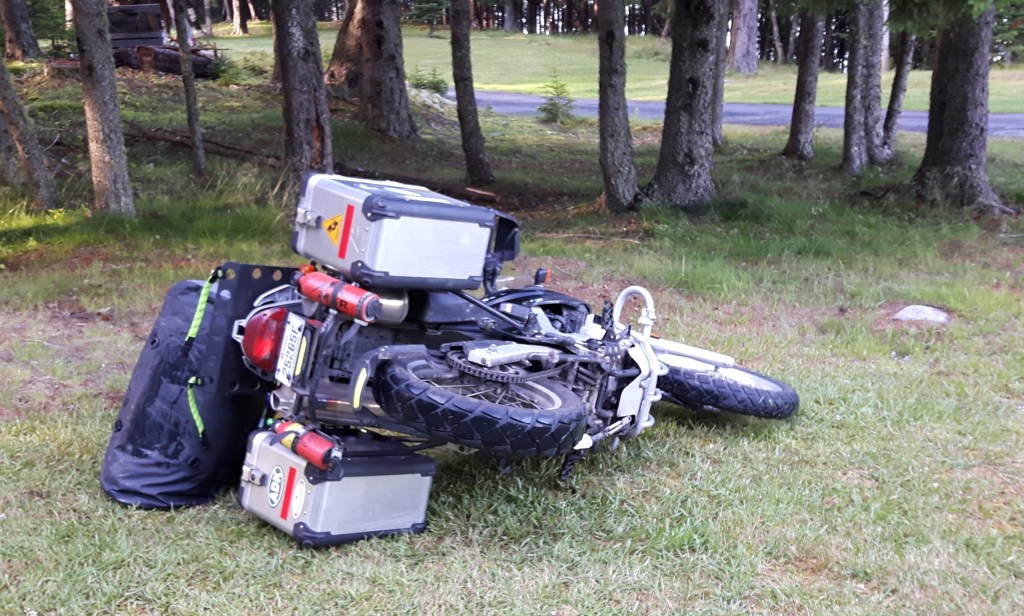
It’s not that it had all been easy and good. On Day 2 the bike wouldn’t start after one of my rest stops, and there was an ugly hour of anxiety trying to figure it out. Later I discovered that the ferry I had planned to take to Deer Island, NB, was permanently closed, leaving me to find another way to get there in the fading light or change my accommodation plans. There was driving rain, and stifling heat, dehydration headaches, a bee up the sleeve, phone charging issues, navigation problems, and an unexpected oil change. Oh yeah and I dropped the bike. Twice.

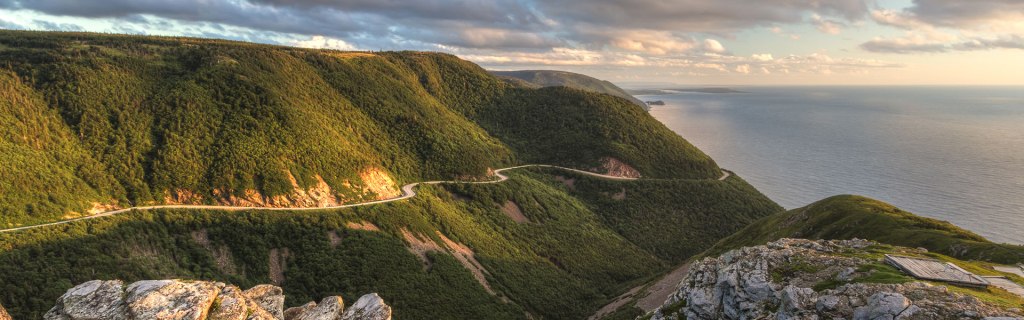
But there was also crossing the Penboscot Narrows Bridge, take-out fish & chips on the ferry to Deer Island, going down into the Springhill coal mine, off-roading in the Cape Breton interior, the switchbacks of The Cabot Trail, swimming in the North Atlantic Ocean at Port Shoreham Provincial Park, and Peggy’s Cove at dawn. There were the people I met along the way, from the guy who helped me when the bike wouldn’t start, the Quebecois cyclist on his own adventure through Maine, my ex-colleague Guy at Seascape Kayak Tours, Yannick my off-road buddy in Baddeck, and Walter, who wandered over to my campsite and offered me a cold beer after a wicked hot day of riding, not to forget the staff at Adrianne’s Cycle Service in Moncton.

Seal Island Bridge. Cape Breton Island, NS

But there is one moment in particular that stands out for me when I think back on that trip. It was at the end of Day 7, just when I was starting to get comfortable and confident with this adventure touring thing. I’d left Baddeck in the morning and ridden over the Seal Island Bridge into Sydney to buy a new phone cord at the Best Buy there. Then I picked up Old Highway 4 that took me along the shoreline and out to Port Hawkesbury and over the causeway, where I turned left onto the 344, the beginning of the spectacular Marine Drive that hugs the Atlantic shoreline.

He was singing Green Day’s “Good Riddance (Time of Your Life),” and it occurred to me that I was—having the time of my life.

Sometime in the afternoon, I saw a sign for a provincial park and decided to stop for lunch. It was a sandy beach, and I went for a swim to cool off in the heat. When I returned to the bike, I asked a woman in the parking lot if she knew of a campground nearby. She directed me not only to “the most beautiful campground in Nova Scotia” but also to “the best fish & chips” at a local microbrewery not much further down the highway. So I followed her advice and set up at Boyston Provincial Park, then rode into Guysborough to The Rare Bird pub. I sat out on the terrace that looked out onto the wharf, and as I waited for my dinner to arrive, I enjoyed the amber ale and the sound of a local musician singing and playing a guitar. He was singing Green Day’s “Good Riddance (Time of Your Life),” and it occurred to me that I was—having the time of my life.

I was in my element, living in the moment and exploring, seeing things I’d never seen before, meeting new people, enjoying my bike, trusting myself, and discovering what life presents me literally around each corner, whether good or bad. I have only experienced this feeling of freedom once before, when I backpacked through Europe for a month in my 20s. Similarly, I was exploring the world, and life was an adventure. If only life could always be like this, I thought.

And it is.