My Favourite Motovlogs

I didn’t know what a vlog was before I started riding. As a writer, I was more interested in blogs, and YouTube was a place where you could see your dear friend’s child act in the school play, a compilation of the sexiest ice-bucket challenges, or the footy game you missed last weekend (if you were willing to follow the sketchy link). Then GoPro entered the market and it changed everything. Suddenly you could get a rider’s-eye view in HD with sound that didn’t seem like the guy was riding underwater, or through Hurricane Katrina, or both. Companies also woke up to the idea of advertising for free under the guise of providing product reviews, and a generation of unemployed video editors found work. The video blog, or vlog, was born.

Perhaps I’m already thinking of those long winter months when the bike is up on a jack in the shed with a 40 watt bulb pointed at it. If you’re like me, product reviews midwinter is like a balm to a wind-chapped itch to ride, and a helmet-cam is the closest thing there is to throwing a leg over said motorcycle stored in the shed. I spend a lot of time during the winter on YouTube, learning stuff, buying stuff, or planning on buying stuff once spring hits. In prep for those regrettably not too distant months ahead, here are my favourite motorcycle vlogs and YouTube channels. Enjoy!

Because I subscribe to the free (i.e. cheap) version of WordPress, I can’t embed videos. You’ll have to click on each hyperlink to have a sample vlog open in a separate tab.

Weekly Rides With Rueben was my entrance into not only vlogging but also motorcyling in general. Before I even had my full licence, I went searching one day for tips for newbies, and after a few scattered hits, I stumbled upon Reuben’s vlogs. Reuben (I don’t know his last name) worked for Competition Accessories in North Carolina, and they decided his vlogs would be a good way to generate traffic to the store, I guess. A new video was uploaded every Wednesday and together they were, as he says at the beginning of each video, “a random collection of motorcycle adventures, life on two wheels, and product reviews.” If that sounds eerily familiar, I guess Reuben’s videos heavily influenced my thinking about this blog. Topics covered included riding in the rain, riding at night, avoiding obstacles, and preparing for fall riding, for examples. Then his store started partnering with a nearby dealership and he started doing bike reviews. Reuben also did product reviews from the store in front of the camera, but I think he was more comfortable behind the camera. He never seemed at a loss for words, and was articulate and knowledgeable. I learnt a lot from Reuben over his 74 posts. The posts abruptly stopped without notice because, as rumour has it, the store was bought out. A new guy from another location took over, but it was never the same. Hope you’re doing well, Reuben!

The ancient Roman poet Horace wrote that poetry should both “delight and instruct.” The same could be said for a good vlog, so while I might find it “delightful” to watch Rosie Gabrielle ride through Oman or Ottawa, if I want to learn how to ride, I go where the experienced riders are. Sorry Rosie! Zack and Ari, co-editors at Motorcyclist Magazine, have been riding together for a long time! (Like, since childhood.) They are good riders. In fact, I’ve watched Ari break a track record on a KTM 390, and Zack is no slouch either. Just watch his MC Commute, where he rides a different bike to work each day and gives a review en route. Their show On Two Wheels (again, a rip off from yours truly) is a lot of fun with their humour keeping things light but rarely stupid, and always the bikes are front and centre. One of my favourite episodes is the one on the BMW GS, yeah, the bike that opened up the adventure touring market and spawned my f650GS. But even more than On Two Wheels, I love MC Garage, where Ari walks us through some simple maintenance of our bikes. I have a lot of respect for people who are both good riders and good mechanics. I’ve used some of Ari’s tips to fix not only my bike but also my car. I think Horace would agree that instruction for a hungry audience is also a delight.

If Ari and Zack are good riders, Lyndon Poskitt is a great rider! How great? Dakar great. Podium finisher in Baja great. And he knows his way around a bike too. In fact, he built his bike from the frame up. In Races to Places, Lyndon travels around the world, stopping at various rally races like the Mongolian Rally, The Baja Rally, and of course the Dakar, to try his luck and skill. His key sponsor, Adventure Spec, put together the vlogs of his adventures. Production quality is high, which is especially impressive since Lyndon does all his own filming. I’ve done enough adventure riding to know that when times get tough, the last thing you want to do is stop for a photo (or cutaway, or take 20 minutes to set up a 20 second shot), but Lyndon is committed loyally to his project and followers. I’ve also learnt a lot about different countries vicariously from Lyndon. I’ve followed him across eastern Europe, down into Asia, and now over to Australia. I’ve really been enjoying this series, now starting its 7th season. I’m trying to savour them because I’m almost entirely caught up and will soon have to wait for each new episode.

If you are more into street riding, or rather street racing, you want to check out Lockk9 TT Racing’s channel. Nobody does video editing as well as this guy. I can’t get enough of this video: great editing, great music, not bad riding. It’s a shot of adrenaline on a cold mid-winter morning to get you out the door and to your job.

For product reviews, I go to two sources: Fort Nine and Revzilla. I love Fort Nine because the reviews are thorough and I know that whatever RyanF9 talks about I can get from this Canadian-based online store without the hassle of cross-border issues. I bought my 50/50 tire based on his rave review of the K60 Scout (i.e. “I’m not even going to say this is my favourite pick of the video because the K60 is my favourite tire on the motorcycling market right now”). He’s knowledgeable and funny, and tells it like he sees it, which is not always the case with product reviews. Usually they end up being positive, pointing out only the merits of a certain product. In fact, many so-called “reviews” are really just product descriptions, with very little if any evaluative comments thrown in. Ryan also does pretty good vlogs. In his vlog about how to legally ride off road in Canada (his split infinitive, not mine), I found out about Chemin Scotch north of Hawksbury, and checked it out, and had a blast. In a recent vlog, he talks about having a degree in Art History (Art History!) which really is evidence that what you study in school doesn’t have to be what you do in life. And no one does bike reviews like Fort Nine. They are creative works of art. Apparently Ryan writes the scripts and some guy named Steve handles the editing. Just check out this review for example, in rhyme, of the new BMW 310R. I’m so old I can’t say exactly what he’s parodying, but I think it’s hip hop videos. In another, he says he’s heading back west to BC to start a new chapter with Fort Nine. I hope that includes more vlogs.

For more in-depth product reviews, I go to Revzilla. I don’t know what Anthony drinks in the mornings but I know I want some. A 19′ review of the Klim Badlands jacket? Really? He strips that bad boy down inside and out. Meanwhile, world population has increased by 4,750 by the time he’s done. It’s thorough! How much do Klim pay him to represent their product? How long does it take him to learn all the details of that jacket? Because of the currency conversion and cross border brokerage (motorcycle gear is duty-free, however), Revzilla is not always the cheapest option for me, but I never buy a product without checking out the Revzilla review and user reviews there. Thanks guys! And just to show my appreciation, sometimes I do buy there and have it shipped to Burlington and ride down to pick it up. I especially like their Gear Guides, where they compare a number of select products in the same review. You can salivate all winter long, and drop Christmas hints to loved ones by sharing, or create a wish list of your own for when you’re stinking rich.

I’ve saved the best for last, but I’m going to cheat because it’s not even a vlog. It’s a podcast, but I’m including it because I’ve probably learnt more about the adventure touring experience from Adventure Rider Radio than from any other single source. Yeah, the show caters to adventure riders, but host Jim Martin is always careful not to exclude other types of riders and riding, and much of the information is relevant to motorcycling in general. I’ve learnt everything from the esoteric (e.g. the nitty gritty of motorcycle chains) to the mundane (how to prepare tasty meals in camp, or first aid). One of my favourite things to do during the winter is run a hot bath and listen to ARR on my iPad while I soak away the chills. I’m always keen to learn new skills, especially if it’s from the comfort of a hot bath, and one of my favourite segments is the rider skills segment with Bret Tkacs of PSSOR. The show functions on a donation and sponsor basis and it’s pretty impressive that Jim and his wife churn out a show every week. I’ve been meaning to send a token of my appreciation, and will, because while the show is obviously a labour of love, these kinds of shows don’t survive if not supported by those who enjoy and profit from them.

There are a few others I cruise past from time to time, but I’ll stop there. Drop a comment about your favourite motovlog or channel and I’ll check it out. Or let me know what you think of some of these. Happy fall riding, while it lasts.


Taking the High Road

Quarry

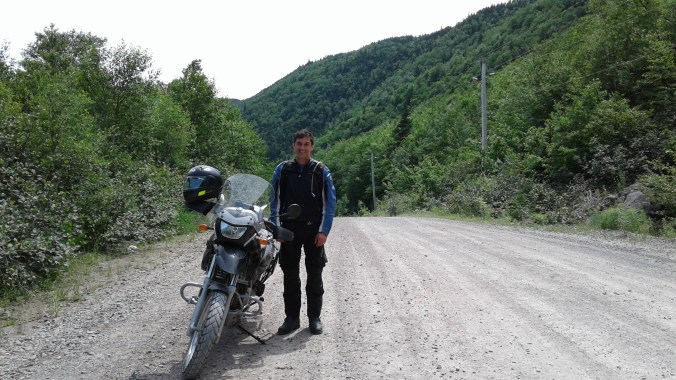
After riding the Cabot Trail, my plan was to stay in the area and explore a network of trails in the interior. My instructor, Emily, at S.M.A.R.T. Riding Adventures in Barrie had lived in Cape Breton for a few years and told me about them. Highland Road is a dirt road that joins the Cabot Trail near Wreck Cove and cuts across the island toward Cheticamp, opening up into a network of trails. There’s no one around for miles and there are no speed limits, little signage, and no asphalt. It’s an off-roader’s paradise.

But such riding should not be done alone. Fortunately, I spotted a 1200GS at the campground and struck up a conversation with the owner, Yannick. He is from Sherbrooke and was travelling with his wife and daughter with the bike in the back of their pick-up. It was a stroke of good luck! I don’t know whose second-language was worse but we managed. He decided to change his plans to ride the Cabot Trail that day in order to ride with me instead. His wife and daughter took a boat cruise in a tall-ship that was in port and Yannick and I headed off into the bush.

It took some sleuthing to find Highland Road and when we did, it was closed at the entrance due to some construction. Yannick used his Garmin Montana, an off-roading GPS that shows trails and topographical maps, to find a way around the construction and soon we were blasting along a gravel road . . . until we hit deep gravel. I almost lost the bike! We decided to stop and let air out of our tires. Looking up at the mountain before me and thinking of the recent near-accident, I have to admit, I was a little nervous about the riding ahead. But Yannick reminded me of a few basics that proved to be extremely helpful:

  • Don’t hesitate. If you hesitate and brake, you fall.
  • Braking off-road is opposite to on-road. Instead of 80/20 front/rear, it’s more like 20/80.

Once we headed off again, I immediately noticed a huge difference with the lower tire pressure. I no longer felt like I was riding on ball-bearings. The back end was squirmy, but the front held its line. I also found myself drawing on my training at S.M.A.R.T. earlier in the summer: peg-weighting to turn; squeeze the tank with your thighs; counterbalance on turns; feather the clutch (2 fingers) to regulate speed. But above all, I kept reminding myself of the rear braking lest muscle memory get the better of me.

By the time we made our first stop I was feeling more confident. Credit to Yannick for letting me go first and determine the pace. He took a lot of dust and stones for that! We discovered the reservoir for the area. There were some signs of warning, but thankfully everywhere was accessible. The network of trails was ours to explore.

Reservoir

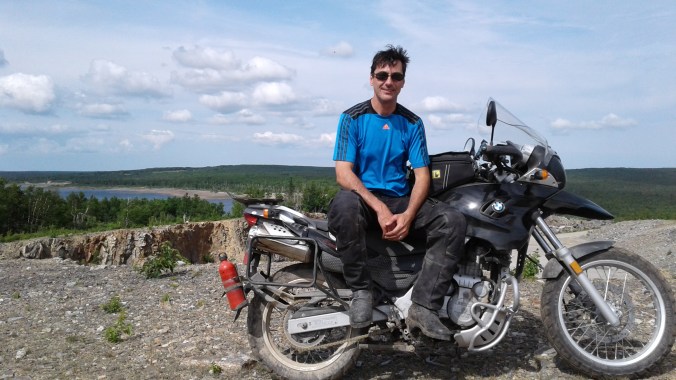
We decided to take a side road that we thought led back to the reservoir; we were looking for a nice lunch spot. But the road narrowed and narrowed, and got gnarlier and gnarlier, until it was a single-track ATV trail that challenged even our GS’s. I was going super slow over these huge rocks and bumps, feathering the clutch in first gear, but I still hit the skid plate several times on large rocks that jutted from the earth. It led to a rocky hill climb that took us to the precipice of a quarry. This is why the instructors at S.M.A.R.T. had said you coast to the top of a hill: you don’t know what’s on the other side. In this case, it was a 100-foot drop!

We had found our lunch spot and photo-op.

Bigbea and meYannick

After lunch we had 37 kilometres of dirt road to cover to complete the loop back to the Cabot Trail. We were cruising at 80 km/hr but in the straights sometimes hit 100. The Metezler Tourances, which Yannick had too, were fine for this sort of riding. My confidence was growing but I reminded myself not to get over-confident and make a mistake. In some of the curves, at 60 km/hr., I swear the back end was sliding out. I was getting the hang of this! Then to make sure I didn’t get too cocky, Yannick blasted by me on his 1200GS, spitting stones and leaving me literally in his dust.

Still, I was doing what I’d been preparing to do for the past year and what had been my ultimate goal for this tour: off-roading in Cape Breton. The winter reading, the training with Jimmy Lewis at Dirt Daze, the full-day course with S.M.A.R.T., the practice at a local sand pit and, not insignificantly, the investment in off-road gear, all culminated in this day of off-roading. It was even more exciting than the Cabot Trail and I wrote that evening in my journal that this trip just gets better and better.

GSsBreak

Next up, the Marine Drive to Peggy’s Cove.

Getting Dirty

Dirt_Daze

With the growing popularity of adventure biking, it was only a matter of time before someone organized a rally for adventure bikers. June 7-10 was the second annual Dirt Daze rally, held in Lake Luzerne, NY. I heard about it through a club friend and decided to head down from Montreal.

Dirt Daze is actually the off-road component of the big Americade rally held the same weekend in nearby Lake George, and my ride down on Highway 9 took me right through that other rally in the late afternoon. I felt a little out of place as I rode through on my GS with Touratech panniers. All the Harleys were lined up gleaming on both sides of the street, and it seemed to me that it was more about the bike than the riding. Guys were sitting shirtless on plastic chairs outside their motel rooms drinking beer out of the can. It didn’t seem much fun. I scooted through apologetically for ruining their parade and was soon at “my” rally in Lake Luzerne.

No sooner was I off the bike when an organizer said to me, “Welcome. Slow race in five minutes.” Now this is more like it! I was pretty pooched from my 5 1/2 hour ride down, but he was so enthusiastic and convincing it would be fun I decided to drop my big tail bag and participate. There were ten of us, and we were paired in heats of two. The course was a straight 50 feet, lined with cones. Last over the finish line wins and moves on, the other eliminated. In watching the first couple of heats, I saw that the start was crucial; if you get ahead over the first few feet, it’s difficult to make that distance up. When it was my turn, I was pretty nervous with everyone watching and a little too tentative off the start and stalled the bike. Doh! Damn! I was mad at myself but it was all for fun.

Then I rode back to the camping area with my tailpipe between my legs and chose a spot to pitch for three nights. We were pretty packed in, but it was nice to be able to camp on site and keep costs down.

camping

The rally is held at The Painted Pony ranch. It’s a great location with food and drink available at the saloon, showers, and lots of space for vendors and the four obstacle courses. And since it’s a ranch, there is livestock.

Cows

If you’re a light sleeper, you might want to camp at the nearby KOA campground. Between the lowing and the snoring and the 2-strokes firing up at 6 a.m. (all of which become indistinguishable after a while), you’re not going to get much sleep.

I’ve never had any off-road training, so I signed up for a two-hour beginner class on Friday morning with Jimmy Lewis. Jimmy and his wife, Heather, run an off-road school in Nevada and offer at Dirt Daze compressed versions of their full-day courses. Jimmy is an amazing rider. He was a podium finisher for the Dakar and overall winner of the Baja and Dubai rallies, among other accolades. His curriculum focuses on balance and traction. In all the exercises we did, we never got out of first gear. His exercises develop muscle memory for finding and maintaining that neutral point when the bike is in balance. He says if you come to an obstacle and you’re off balance, you’re going to get into trouble. As for traction, he says it doesn’t matter what they call your tire—60/40, 70/30, or 85/15, like mine—if you run your hand along the side of the tire and don’t feel sharp edges, you’re going to go down in the mud. More on this later. In fact, in their school in Nevada, they make 50/50 tires mandatory.

One of the nice things about Dirt Daze is the people you meet. I came alone but was never alone. A couple of us who did the morning class went for lunch together and then decided to do one of the self-guided rides in the afternoon. They had done a guided ride the day before, and when we got lost on our self-guided ride, we decided to return to a network of trails they knew of from their previous ride. I’ve never done single track trail riding, so I quickly got in over my head, especially with my “street tires,” as everyone kept referring to them. I actually did pretty well with the slow turns and descents, even the sandy hill climbs—the back end sliding all over the place—but when it came to mud, my skills and tires let me down—literally! I and the bike ended up in a deep mud puddle at the bottom of a hill, but I managed to get the bike back up and out using some of what I’d learnt in the morning class; Jimmy had showed us how to start in low-traction terrain without digging in. When I re-emerged from the woods and met up with the other guys, I must have been a sight. Someone said “I’ve got to get a photo of this.” When we got back to camp, I headed for the bike wash. “Why bother?” someone asked. “It’s just going to get dirty again.”

The next day was my planned “big ride”—a guided full-day ride through the Adirondacks with about 50% off road. It was led by veteran rider Bill Dutcher, founder of Americade (then Aspencade East) in 1983.BillI’d been warned about Bill: the “old man” hauls ass. There were twelve of us, and I decided to tuck in behind him so I could watch and learn. Soon after we pulled out of the ranch I found myself going 70 km/hr on a dirt road with a smattering of gravel. Shit, is it going to be like this all day? I was riding over my head but didn’t want to hold the group up. All was good for a few kilometres until we headed down a sweeping descent. Halfway down I knew I was in trouble. I knew if I braked and turned I would lowside, but fortunately I didn’t panic. I dropped my line and headed straight, gently squeezing the brake. For the first time in my short riding experience the thought that I might crash flashed through my mind, but fortunately I eased to a stop before I ran out of road. Someone behind slowed and gave me the thumbs up as a question. I nodded and looked back. No one was behind me, just empty road. I realized I needn’t have worried about holding the group up because they were all well behind. I had made the classic mistake of trying to keep up with a rider who had 49 years of riding experience on me.

I took that little incident as my warning and decided to drop back. As the day continued, the group settled into two groups, with three fast riders up front with Bill and the rest of us behind at a slower pace. They waited for us at each turn. It worked. I was still a little out of my comfort zone, but in a good way. I was able to practice the peg-weighting I’d learnt with Jimmy as we weaved through the Adirondack backroads. There were a few times when I hit sand and almost lost the bike (again, the street tires!) but at a much lower speed. At one point we hit deep gravel, what looked like 3/4 crushed stone, and that was interesting. Again, I had enough good sense or gods’ blessings to not panic but let the bike go where it wants to go and ride it out. When we got to the next rest stop, Bill asked if anyone had had trouble with that gravel, and reminded us that the technique for dealing with it is to get your weight back and, counter to what your intuition is telling you, get on the gas. It lifts the front end and the bike rides over the gravel instead of digging down in, which would be trouble. I was learning a lot.

We lunched at a classic mountain lodge with a beautiful view of the surrounding Adirondack mountains. Lunch

Other parts of the ride brought us to picturesque vistas.vista

We ended up again at that network of trails and I fell victim again to mud at a small water crossing. I crossed the stream okay, but once on the other side I was so focused, quite literally, on the mud under my tires I forgot to look beyond the obstacle further down the trail. Perhaps I tightened up too. Perhaps I got too much weight over the front tire. Before I could say “another classic mistake” the bike was on its side halfway up the bank. Despite the spills, the ride was exhilarating and I told Bill afterwards that it was so far the ride of my life.

Back at camp, we were treated to a demonstration by World Freestyle Champion Chris “Teach” McNeil. His nickname is Teach because he is a Latin teacher at a private school. Now as an English teacher at a CEGEP in Montreal, I thought I had the cool factor when I pull onto campus on my bike, but I’m pretty sure this guy is more popular with his students. Freestyle or stunt riding is not my thing, and I’ve seen videos online of guys doing nose-wheelies on litre bikes. But seeing it live is another whole experience. It’s pretty damn impressive to see the way the power and weight of his BMW S1000XR is a plaything in his hands.

After such a full day, I was ready to retreat to my tent. I lit a pipe and wandered through the camping area checking out the other bikes, then struck up a conversation with the guy next to me. I was lamenting a few scratches on my bike from the falls that day when he said, “Ah, you can’t worry about that shit. It’s a bike.” It reminded me of the comment earlier about not bothering to wash it, and I thought again about the gleaming Harleys just up the highway and just how different adventure biking is from that kind of riding. Adventure biking is about the adventure of not knowing what’s going to happen in the woods. It’s about helping others lift and fix their bikes on the trail, like when Bill helped me fix my engine guard with a zip tie and duct tape. It’s about escape, and risk, and skill—a lot of skill! What impressed me the most from the rally was not any particular bike but the skill-level of many of the participants.

It seemed à propos that one of the final events of the rally was the Ugliest Bike Contest. The bike that won was the one Jimmy Lewis borrowed to win the slow race.

Off Road, On Course

offroad

Photo Credit: Red Sky Adventures

When I was a kid, I would go to police auctions to buy my bikes and bike parts. These were auctions of the stolen, then recovered but unclaimed bikes. You could enter a large area before the auction where all the bikes were ticketed with a number and on display to inspect them before the auction began. Then noting the number of the bike you were interested in, you’d wait until it came up for auction. My outbidding with my paper route money some father always elicited some snickers in the crowd.

I always looked for a certain type of bike. Basic. Didn’t matter the colour, because I’d paint it later, always black. Didn’t matter the condition, because I’d strip it down to the ball bearings, clean and re-grease everything before putting it back together. A little steel wool and elbow grease removed any rust from the rims. Didn’t matter the handlebars or the tires because I would change them, putting on wide handlebars and knobby tires. I was making my own motocross bike.

Then we would go to the little forested park near my house and race them. We built berms and jumps. We also dug up a few suburban front lawns with our terrorizing of the neighbourhood. I learnt how to wheelie and we had competitions with that too. I could wheelie the entire street if I got a good one going. When Evel Kneivel attempted to jump the Snake Canyon in 1974, I was eleven. It didn’t matter that the jump itself was a disappointment. All the hype leading up to the jump led us to start jumping our bikes—really jumping. We built ramps by turning a municipal steel garbage can on its side, wedging rocks behind it to stop it rolling, and laying scavenged wood on top. I bent a few back wheels doing those jumps, but never broke a bone. No one ever wore a helmet in those days, but the Gods smiled on us. The worst of it was some serious road rash.

Eventually I gave up the custom 3-speeds and bought a 12-speed Supercycle mountain bike from Canadian Tire. I must have put half a million miles on that bike, especially the summer I was a bike courier in London, Ontario. That bike still lives, repainted black, of course, with red pin-striping from Canadian Tire down the side.

So when I went to buy a motorcycle, I knew I wanted a dual sport. Yes, I want to tour, but I also want to play. And it had to be black.

On Friday, going in to the long weekend, I decided to get my ya-yas out and go for a ride, my first full day ride since getting the bike out of storage. I headed toward Ontario, taking my favourite route out, which puts me in Lancaster. There’s a short story I know by Hugh Hood called “Getting to Williamstown” in which the narrator describes in detail a drive to Williamstown, ON, just north-west of Lancaster. The story was written in the 70’s. Would the road he describes still exist? The one-lane bridge? The gas station with ice-cream? I was curious.

What does any of this have to do with off-roading? By going to Williamstown, I stumbled into my first off-road ride. While exploring those concession roads, I saw a dirt road leading off of the main road. I turned around and studied the sign at the entrance. No cars, but to my surprise, snowmobiles, ATVs, and motorbikes allowed! It didn’t look that hard.

It wasn’t . . . for the first 100 metres. No sooner had I started when I came to a section completely washed out, a huge puddle of muddy water spanning the width of the trail. I knew enough from watching YouTube that you don’t try to skirt the puddle by sneaking around the side; that only leads to the tire sliding out sideways and you and the bike going down. You have to go through the centre, hoping it’s not too deep and that there are no big rocks or logs down there. I stopped and pondered. Turn back or risk forward? The trail looked clear ahead except for this puddle. I did the imprudent thing and went for it.

It’s hard to estimate how deep it was. In the moment, I was concentrating so hard I didn’t take note. But it’s an unnerving feeling heading into the centre of a puddle the depth of which you do not know. (If I had had my adventure boots on, I might have waded in to find out first.) I knew that if I’m going for it, there are no halfways and I didn’t want to be tentative. So I gave it some throttle and saw water plough up around the fairing—probably easy stuff for an experienced rider but not so easy for a newbie. Safely across, I whooped into my helmet.

The trail beyond was a mixture of dirt, gravel, with sections of larger rocks that were tricky. I found it difficult to operate the throttle smoothly from a standing position and shifting was awkward. This would take some getting used to. After a brief foray into 2nd gear, I decided to keep it in first. This was, after all, my first time off road. At one point, I passed a father and son going the other way on ATVs.

There were other sections washed out—not one big puddle as before but several muddy puddles to navigate through. I thought of shooting rapids and skiing moguls, how you have to look up ahead and select your best line through. I could feel the bike sliding around beneath me but kept my cool, my weight over the bike, and my hand off the brake. I was nervous but tried not to grip the handlebars tightly, letting them and the bike move around. And I understood why you’re supposed to steer the bike by weighting the pedals rather than turning the handlebars, because even at that speed, when it’s that slippery, turning the bars can lead to the front wheel washing out. It was exhilarating!

I’m convinced that during those sections when the bike was sliding around under me, I was drawing on muscle memory from those early years on my bicycle. It’s the same principles, just a lot more weight involved. I’m hoping this might be something I take to easily, even at this “advanced” age.

I probably shouldn’t have been doing that alone. When I spoke to my dad later in the day, he said the same. Even at that speed, anything can happen. If the bike lands on you, you could break a leg and then you’d be hooped. So I messaged my off-road partner and suggested we go back together. I also looked up on Google Maps the trail and discovered I only rode a small section of it; it continues in the other direction all the way into Quebec and ends near Saint Polycarpe. In June, I’m going to the DirtDaze Adventure Rally in Lake Luzerne, NY, where I’ll get some beginner’s instruction and go on some guided rides down there. I also plan to do the full day adult course at SMART Riding Adventures.

It’s going to be a fun summer.