Taking the High Road

Quarry

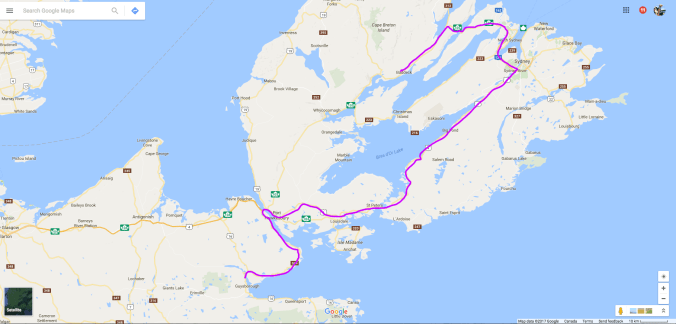
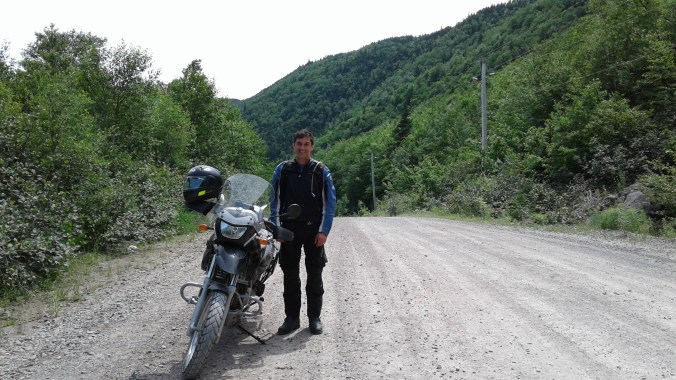
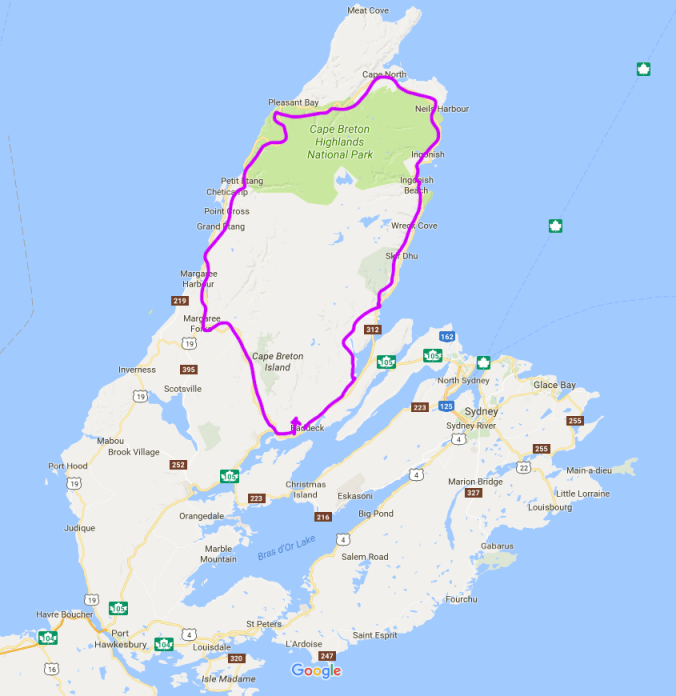
After riding the Cabot Trail, my plan was to stay in the area and explore a network of trails in the interior. My instructor, Emily, at S.M.A.R.T. Riding Adventures in Barrie had lived in Cape Breton for a few years and told me about them. Highland Road is a dirt road that joins the Cabot Trail near Wreck Cove and cuts across the island toward Cheticamp, opening up into a network of trails. There’s no one around for miles and there are no speed limits, little signage, and no asphalt. It’s an off-roader’s paradise.

But such riding should not be done alone. Fortunately, I spotted a 1200GS at the campground and struck up a conversation with the owner, Yannick. He is from Sherbrooke and was travelling with his wife and daughter with the bike in the back of their pick-up. It was a stroke of good luck! I don’t know whose second-language was worse but we managed. He decided to change his plans to ride the Cabot Trail that day in order to ride with me instead. His wife and daughter took a boat cruise in a tall-ship that was in port and Yannick and I headed off into the bush.

It took some sleuthing to find Highland Road and when we did, it was closed at the entrance due to some construction. Yannick used his Garmin Montana, an off-roading GPS that shows trails and topographical maps, to find a way around the construction and soon we were blasting along a gravel road . . . until we hit deep gravel. I almost lost the bike! We decided to stop and let air out of our tires. Looking up at the mountain before me and thinking of the recent near-accident, I have to admit, I was a little nervous about the riding ahead. But Yannick reminded me of a few basics that proved to be extremely helpful:

  • Don’t hesitate. If you hesitate and brake, you fall.
  • Braking off-road is opposite to on-road. Instead of 80/20 front/rear, it’s more like 20/80.

Once we headed off again, I immediately noticed a huge difference with the lower tire pressure. I no longer felt like I was riding on ball-bearings. The back end was squirmy, but the front held its line. I also found myself drawing on my training at S.M.A.R.T. earlier in the summer: peg-weighting to turn; squeeze the tank with your thighs; counterbalance on turns; feather the clutch (2 fingers) to regulate speed. But above all, I kept reminding myself of the rear braking lest muscle memory get the better of me.

By the time we made our first stop I was feeling more confident. Credit to Yannick for letting me go first and determine the pace. He took a lot of dust and stones for that! We discovered the reservoir for the area. There were some signs of warning, but thankfully everywhere was accessible. The network of trails was ours to explore.

Reservoir

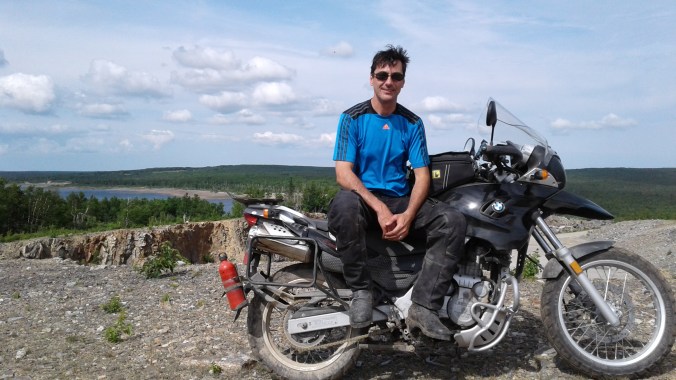
We decided to take a side road that we thought led back to the reservoir; we were looking for a nice lunch spot. But the road narrowed and narrowed, and got gnarlier and gnarlier, until it was a single-track ATV trail that challenged even our GS’s. I was going super slow over these huge rocks and bumps, feathering the clutch in first gear, but I still hit the skid plate several times on large rocks that jutted from the earth. It led to a rocky hill climb that took us to the precipice of a quarry. This is why the instructors at S.M.A.R.T. had said you coast to the top of a hill: you don’t know what’s on the other side. In this case, it was a 100-foot drop!

We had found our lunch spot and photo-op.

Bigbea and meYannick

After lunch we had 37 kilometres of dirt road to cover to complete the loop back to the Cabot Trail. We were cruising at 80 km/hr but in the straights sometimes hit 100. The Metezler Tourances, which Yannick had too, were fine for this sort of riding. My confidence was growing but I reminded myself not to get over-confident and make a mistake. In some of the curves, at 60 km/hr., I swear the back end was sliding out. I was getting the hang of this! Then to make sure I didn’t get too cocky, Yannick blasted by me on his 1200GS, spitting stones and leaving me literally in his dust.

Still, I was doing what I’d been preparing to do for the past year and what had been my ultimate goal for this tour: off-roading in Cape Breton. The winter reading, the training with Jimmy Lewis at Dirt Daze, the full-day course with S.M.A.R.T., the practice at a local sand pit and, not insignificantly, the investment in off-road gear, all culminated in this day of off-roading. It was even more exciting than the Cabot Trail and I wrote that evening in my journal that this trip just gets better and better.

GSsBreak

Next up, the Marine Drive to Peggy’s Cove.

The Cabot Trail

Cabot Trail

Imagine the perfect motorcycling road. What would it look like? It would have lots of twisties, of course, and probably some hills too. Curving hills, climbs and descents, to make it extra challenging. It might even have some switchbacks. And for scenery, it might have mountains, or some water, like an ocean. Well, the Cabot Trail has all of these, which is why it’s on every rider’s bucket list. 360 kilometres of climbing, snaking twisties with mountains on one side and spectacular ocean views on the other. It was my destination for this trip and worth every one of the 1,739 kilometres it took to get there.

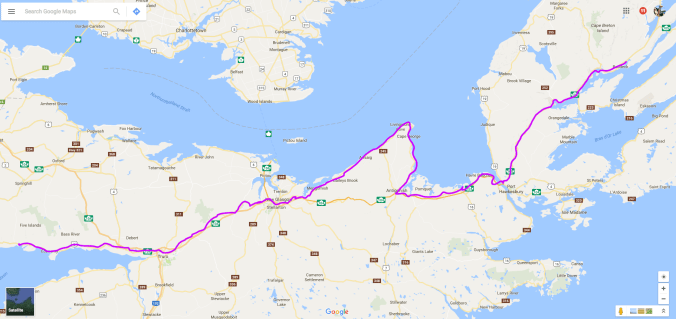
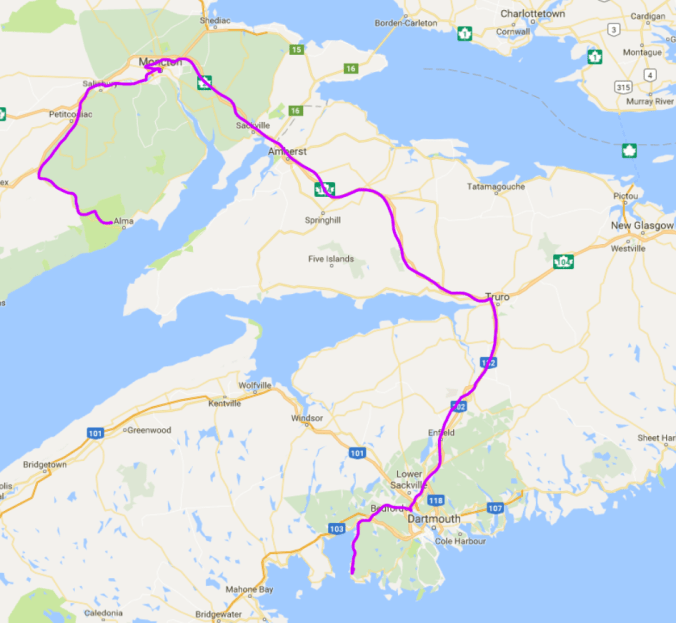
But I didn’t want to put all my eggs into one bucket, so to speak, so getting to the Cabot Trail was part of the fun. I left Deer Island at Lord’s Cove on the free ferry run by the New Brunswick provincial government and landed in L’Etete, NB. From there, I bombed through the drive-through province on the Transcanada and into Nova Scotia. I’d been reading Alistair MacLeod’s Island to get a sense of Cape Breton culture, and since almost every story has some reference to mining in it, I thought I should visit a mine. So my first stop in Nova Scotia was at Springhill, about 20 minutes past the border.

Springhill. The name is synonymous with disaster. There have been three major accidents at the mine: an explosion in 1891, another in 1956, and a bump in 1958. A bump is an earthquake that causes not the roofs of tunnels to collapse but the floors to rise up to the roofs. It results in overturned railway cars and crushed or trapped men. 75 men died in that last accident; 99 were rescued, including some who managed to stay alive for 8 1/2 days by drinking their urine before a rescue team broke through. The mine is now a museum; you can walk 400 feet into the shaft on a guided tour.

I found the tour moving, the place solemn, even sacred, and I didn’t take any photographs while underground; it just didn’t seem like something I ought to do. Besides, in this instance, a photo does not come close to reproducing the feeling of being down there. If you’re interested, there is always Wikipedia, which covers the three disasters well, with photos of the mine.

In a regular 8 1/2 hour shift, each miner had to extract and load 10 tonnes of coal. The coal is extracted largely by hand, with hand tools like a manual auger. The miner would press a steel plate strapped onto his sternum against the butt of the auger and turn, boring into the wall of stone in front of him. I’ve used a power auger to dig down into earth, and it’s hard enough, even with the advantage of leaning your weight into a softer substance. But to have to press into a wall of stone in front of you and turn by hand is almost unimaginable, and to do that for 8 1/2 hours is inhuman. Each miner has a lunch bucket and flask of water, both steel to prevent rats from eating the lunch, although they would still chew through the cork, dip their tail into the neck of the water jug, and get water that way. (Obviously no concern about double-dipping for them.) Despite these threats, the rats were appreciated by the men, and in fact were helpful in warning of disaster. On the day of the bump, the rats vacated the mine. Many of the experienced miners did not show up for work that day, but many younger ones did.

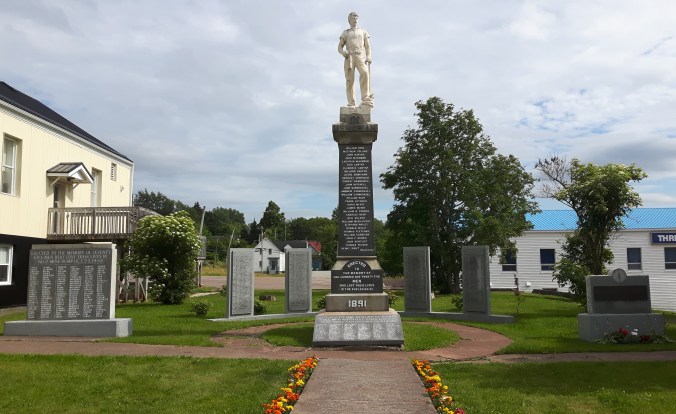
Given these working conditions, it’s not surprising that the first legalized trade union in Canada was formed in Springhill. I did take photos of the memorial in the centre of town, and a plaque commemorating the surreptitious meeting that established the union.

PWA


Miners Memorial

Those four tall memorials behind contain the names of “others who have lost their lives in individual accidents.” So while so much attention is placed on the three disasters, there were hundreds of other men who died in single incidents during a workday. Many men lost their lives from runaway railway cars; you’d have to jump out of the way or be crushed, and it was extremely dark down there. In fact, the guide turned out the lights for a few moments and it was unnerving. To be trapped down there in the dark would be horrific. He also showed the actual lighting conditions of the miners (the museum had added extra lighting for tourists), pre- and post-20th Century. Pre-century lighting was so poor you basically could only see the small section of wall in front of you on which you were working, nothing more. I’m glad I did this tour; it’s ironic that the most surprising and memorable moment of my trip was off the bike, down in that mine.

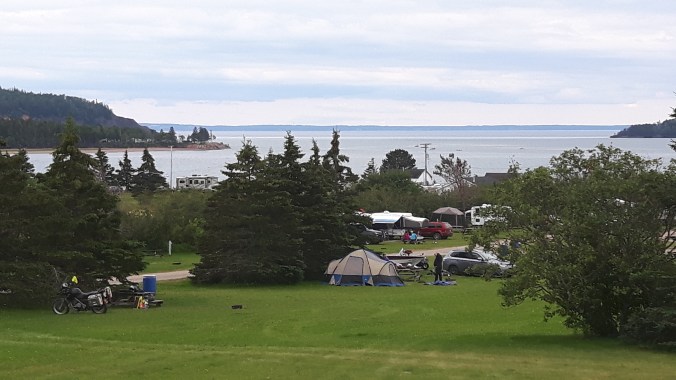
After that experience, the sensation of being on the bike was all the more liberating. Up in the sunshine, I sped to my next destination, which was 5 Islands RV and Campground. I say sped but, thanks to Googlemaps, which does not discern between a dirt or paved road, 16 kilometres of Highway 2 taking me there was gravel. But the view, once there, was worth every one of them.

5Islands Camp

If you look closely at the people beside me (in the centre of the photo), you’ll see a motorcycle parked behind that boat. I struck up a conversation with these nice people, a young couple travelling with their son. They live the other side of the bay, directly across that body of water, and told me of a nice route to get to Cape Breton. You go into Truro, then head to Bible Hill, where you can pick up Highway 4 (aka Old Highway 4) which snakes back and forth across the Transcanada Highway and is a lovely ride! I split off at the 245 instead of going through Antigonish and rode a section of the Sunrise Trail up to Cape George.

Cape GeorgeI’m not sure why it’s called the Sunrise Trail since it faces northwest, not east, but it’s pretty nonetheless. At one point, just west of Arisaig, I saw a dirt road leading off from the 245 and decided to go exploring. This is what I love about adventure riding and my bike—the ability to get off the asphalt when curiosity beckons. A short ride in led to a perfect lunch spot overlooking the ocean, complete with a picnic table to prepare my sandwich. Sunshine Coast Lunchspot

Like I said, with motorcycling, it’s not the destination but getting there that is the fun. But finally, I did cross the causeway and found my way to Baddeck Cabot Trail Campgound.

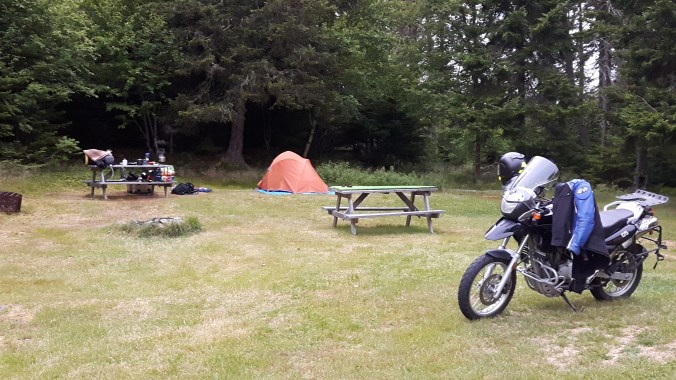
Baddeck CampI love this campground! My wife and I stayed here when we vacationed in Cape Breton two years ago, and she found it, so I can’t take any credit. It’s a very well run campground with wooded sites, clean washrooms, friendly service, a heated pool (nice after a long day of riding), free showers and, a personal favourite of mine, a campers’ lounge. I have to admit, I didn’t take to the lounge right away; it has a TV and seemed like what one tries to escape by camping. But this time round I was forced to sit there to charge my phone, and found it a pleasant place to write or read, especially on the evening it rained. I decided to stay an extra night at Baddeck.

The next day was it, the Cabot Trail. Now whether to ride it clockwise or counter-clockwise is a matter of some online debate, but to me it’s a no-brainer: doing it counter-clockwise means you have the ocean views, and hence the lookouts, on your right side. Doing it the other way would involve crossing traffic every time you want to pull off or continue. And there are some spectacular lookouts you don’t want to miss.CT Lookout

CT Lookout2

But I have to admit, I didn’t stop at many. To me, they seemed like a distraction to why I had come all that way, and stopping every 15 minutes would prevent me from finding a rhythm on the road. So I rode. Yes, it’s only 360 kilometres and will take you only an afternoon, but it’s pretty intense riding, requiring your full concentration if you are, like me, not interested in cruising. For me, part of the fun is challenging myself to really ride a road properly—not dangerously, I always leave 20% buffer—but on a piece of road like this, you don’t want to be poking along like on a Sunday drive. So yes, that involved some passing too on this two-lane road.

It’s a clinic in riding, and by the end of the day I felt a lot more adept at cornering and passing. Do any repetitive skill for a day and you will get it down. I remember learning to canoe properly. One day in the stern and you learn the J-stroke and the Power-stroke. One day in the bow and you are a pretty good navigator of nautical maps. The same for riding. Now I know why it’s so important to fully brake before a sharp turn. If you go into it at the speed you think you can take it, you don’t have any buffer should you have misjudged. But by braking into a corner, you can determine your speed through the turn using the throttle, not the brake, which might have disastrous consequences. And by accelerating through the turn, the torque of the bike is pressing the rear tire into the road, increasing traction and preventing lowsides.

I also discovered that my little pony really pulls! There were of course other bikes on the road and it kept up with anything out there. Okay, it doesn’t have the acceleration of a bigger bike, but its smaller weight more than compensates on a piece of twisty road like this. It climbed those switchbacks effortlessly, had no heating issues despite, I later discovered, being half a quart low on coolant, and gripped the road through those corners. I always knew my bike was easy to ride; the Cabot Trail showed me it’s also very capable.

Finally through Chéticamp, I decided it was time to give both of us a rest. I pulled off at a rest site with a huge mountain lurking over us. The photo does not convey the dimensions and perspective. CT Lunchspot

As you can see, I left the panniers and top bags at camp. This is another reason why I decided to stay an extra night at Baddeck, so I could ride unencumbered. With the switchbacks and challenging section of road behind me, I took a slower pace to complete the loop and returned to camp mid-afternoon. The pool was just the thing after a such an intense, hot ride.

The Cabot Trail was everything I thought it would be. I’m glad I was riding alone and could do it at my pace. I have to add that there was a fair bit of road work happening across the top section, but thankfully it was a section of relatively straight road so was more of an annoyance than a major detraction from the ride. And I guess such an important road for Nova Scotia’s tourism does need to be well maintained. But if you’re not comfortable riding in those grooves or at all on gravel, check highway conditions before you decide to go. But just make sure you do go sometime because it’s a ride not to be missed.

Next up, off-roading in Cape Breton.

Day 4

Day 5

Day 6

Deer Island, NB

Deer Island

After a stressful day of mechanical problems and then almost missing the ferry, I was happy to be on the ferry munching my fish & chips. This photo was taken off the bow and looks toward the campground, which is right on the southern tip of the island. It was a short crossing and soon we were landing.

I came to Deer Island on the suggestion of a retired colleague who teaches sea kayaking at Seascape Kayak Adventures, one of the small businesses on the island. It’s situated in the Bay of Fundy between Maine and the New Brunswick mainland. (Not to be confused with Deer Isle, which is in Maine.) It’s officially in New Brunswick. The adjacent island, Campobello Island, is famous for being the summer vacation spot of Franklin Roosevelt, and his estate is still open to the public to view.

But while Campobello is touristy, Deer Island is rustic! Remote. There’s no potable water at the campground, and they don’t accept credit or debit, so make sure you don’t make my mistake and arrive with little Canadian cash and have to pay mostly in USF. Ugh! I was mad about that one because I make it a practice to carry cash when travelling, but stopping at the bank was literally the last thing on my To Do list and I just didn’t get to it before crossing the border.

I was tired, and the ramp up from the shoreline is loose stones, but I managed them no problem. What I didn’t manage so well was the final turn of the day. I don’t like parking the bike facing in at a site because then I know I have to turn it around before I leave in the morning, so I always try to do that U-turn before parking the bike. I did the turn okay, but lost my concentration at the last moment on the uneven ground literally as I put my foot down. It was a fitting end to a long, difficult day.

Fallen Bigbea

It looks worse than it was. It was a gentle roll onto its side on grass. I removed the top bags and easily lifted the bike back up, and soon everything was right again in the world.

Deer Island Campsite

After two long days in the saddle, the next day was a planned day of rest, so I spent it putzing around the island and checking out The Old Sow. The Old Sow is the largest natural whirlpool in the Western Hemisphere. It forms just offshore from the campground, the product of three water systems converging in one spot. The waters rise about 10 feet and there are some serious currents happening in these waters. It’s called the Old Sow because the water will actually make a sucking sound. I went down at high tide, and while there was some swirling water, I didn’t see a whirlpool. I heard from someone later that the best time is actually three hours before high tide.

The island is quaint and fun to ride with the hilly twists and turns, but there are parts like this one where something has been left to rot. No one’s going to take care of this mess, it seems. (Yes that is a collapsed ramp in the foreground.)Lords Cove

Yet despite these eyesores, the island has a charm about it. It’s very quiet. You can sit and be still and listen to nothing but birds, and that is something increasingly rare these days. There’s one restaurant, and no ATM machine, or so I was told, only to come upon one at the general store during my exploring. Oh, my chance to get some Canadian cash, I thought, but discovered there was no money in it because the person who tends it (same person who runs the restaurant) has been too busy to fill it. That’s kind of how life is like on Deer Island. It’s pretty in the summer, but I imagine it’s pretty brutal in the wintertime.

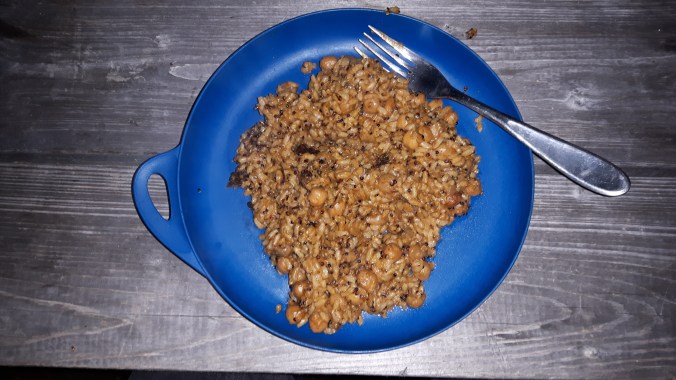
I was supposed to meet up with my ex-colleague and friends for dinner, but there was a problem with the ferries that delayed their return from a kayak excursion, so it was curried lentils for dinner. curried lentils

Not so swanky. I didn’t get many more photos of the island because I was mostly riding it. But this shot of the eastern shore at dawn will give you a good idea of how peaceful it is out there. I’m glad I visited and will go again when I’m out that way. There’s nothing quite like it.

Dawn at Deer Island


Learning the S.M.A.R.T. Way

There are two ways to learn how to do something: trial and error, and getting some instruction. When it comes to motorcycling, I’m in for the latter. I’ve seen vids on YouTube of guys heading out onto the trails with their adventure bikes without any training. They seem to spend more time picking up their bikes and getting them unstuck from mud puddles than they do riding. It doesn’t look that fun. Then I stumbled upon Clinton Smout’s instructional videos and knew I would visit his school as soon as I got my licence.

Horseshoe Riding Adventures is located in Barrie, Ontario. I recognized the location from my teen years of skiing at Horseshoe Valley. Since I now live in Quebec (and start time is 8:30 a.m.), I decided to ride out the day before and camp nearby. I looked up the KOA in Barrie and gulped when I saw they want over $50 for the privilege of sleeping on a patch of their ground. Then I saw Heidi’s Campground at $18.50 and booked for the night before my class.

I was blessed with good weather and had a glorious ride out—once I got going. Two minutes into my ride I discovered a crack in my windscreen radiating from one of the mounting holes, the byproduct of a close encounter with some mud at the Dirt Daze Rally the previous month. I decided to turn around and fortify it with some super glue and add a rubber washer to allow some movement of the screen. This required a stop at the Rona in Vaudreuil for longer hardware. When I finally hit the highway I also hit the mandatory lane closure, this one at Coteau-du-Lac because, well, this is Quebec, and that’s the law! I lost another 45 minutes there and couldn’t get out of Quebec fast enough. My gas light was on for the final 40 kilometres before I limped into the MacEwan in Lancaster. (I knew I was cutting it close but had extra fuel on the back of the bike. I put 13.4 litres in the bike and the tank is 13.6, so I was close!)

Finally with these stresses behind me, I settled in for an amazing ride up Highway 34 from Lancaster to Alexandria, then west along the 43 which turns into Highway 7 and takes you all the way to the shores of Lake Simcoe, where I turned north up 12 and over the top of the lake. This ride took me through the farmland, scrubgrass, and vacation area of SE Ontario (in that order). I noticed that the driving gets more aggressive as you approach Toronto, with people forcing their way past a line of vehicles on a two-lane road, only to encounter the same people in beachwear and flip-flops at the next gas station. I was several hours behind schedule so kept my breaks short, arriving at Heidi’s just in time to pitch in the last of the light.

But all this is precursor to the raison-d’être of my trip: the full day class of dual-sport instruction. Since I’m on teachers’ summer schedule (groans please), I was able to visit the school on a Tuesday so had a smaller class than what I expect they have on Saturdays. I was in a group with two other people: Cheryl, who wanted to get more comfortable on her 800GS, and Bruno, who rides a Harley but felt he needed a little something extra; yes, dirt riding makes you a better and safer rider on the road too. Our instructor for the morning was Graham, one of Clinton’s sons and who, by virtue of his good genes, had the best summer job of any of his classmates, I’m sure. We would be on Yamaha 230s for the morning part of the class. He had us start by just riding a few laps of a course laid out in what staff refer to as “the pit.” It’s a large, open area of dirt and some sand with a few jumps, surrounded by a grassy hill with trails cut into the bank to practice hill climbs. After assessing our abilities and needs, Graham started with the instruction.

I had a burning question going into this day, one that stemmed from my experience at Dirt Daze, and Graham provided the answer early on. While riding the back roads of New York, I’d experienced the front end sometimes slide out while peg-weighting and wondered how you prevent that. Graham demonstrated that you actually hold the bike up with your thigh while counterbalancing. So if you want to turn right, yes, you weight the right peg—I knew that much—but you lean your body to the left (as the bike tips to the right) and prevent the bike from low-siding by pressing your inner right thigh into the tank. Later during a water break, Clinton came by and suggested we try standing pigeon-toed on the pegs; this position presses the thighs into the tank and stabilizes the bike. But where YouTube, reading books, and listening to instruction is helpful, the real learning happens when you get to practice specific skills in a controlled and relatively safe environment. The little dirt bikes allowed us to try things without all the weight (and potential expense!) of our own bikes to deal with. We did some slalom in the dirt, some hill climbs, and different types of descents. Then the real fun started: we headed out onto the trails.

There’s little that I’ve experienced that’s more fun than riding a dirt bike on forested trails. I won’t make comparisons with sex, flying, writing poetry, scoring, or music—my other passions—because such comparisons would be impolite to some and unfair to others. But it’s really, really, (really) fun, and that’s before you get to the mud ruts. I went down in the mud a few times at Dirt Daze so was under-confident and nervous about riding in the mud. Horseshoe Adventures provided some “deep-end” opportunity to get over this fear quickly, again, in a controlled environment, on a smaller bike, and with the guidance of an instructor. We were given three options for getting through a huge mud rut. One was to paddle with our boots on either side as we ride through the rut; the other was to ride seated but feet up, and the third was standing. I was going to do the easiest, but once into the rut I felt comfortable enough to ride it out and didn’t paddle. The second time through I stood and made it through without dabbing! Okay, it was better than sex, maybe like sex in a mud puddle while watching the World Cup and listening to Sex Pistols.

Graham also had us practice tight turns, throttle control, log crossings, and some pretty big hill climbs and descents in both rocks and sand. This is where the practice in the pit really helped and I could see the application of skills learned there in the real world of trail-riding. After a full morning, it was time for lunch.

In the afternoon, I headed out with a new instructor, Emily, on my own bike. I was a bit nervous because of my 85/15 tires, but was assured they’d be okay for what we were doing. A few times around the course and I immediately began to see how the skills I’d learned in the morning on the dirt bike were applicable to my 650GS; it’s just more weight to manage. Emily took me to another network of trails and we began bombing through them on our dual-sports (she was on an 800GS), that is, until I misjudged a turn, drew on asphalt muscle memory, hit the front brake, then the dirt! Umph! Lesson number one: you can get away with that shit on a 230 dirt bike with knobbie tires, but not an a 650 with street tires. The next lesson, then, was emergency braking in the dirt. We went to a dirt road and Emily had me lock up the back brake, getting used to the back end fish-tailing; then she added a little front brake.  Her first question to me when I’d picked myself up off the dirt after my fall (after “Are you okay?”) was “How many fingers did you have on the brake lever?” I couldn’t remember but probably all of them except the thumb. A hand-full. Two fingers only, she advised. Graham had said the same about the clutch hand in the morning.

We also did some rocky descents, 2nd gear, a little front brake. Then back to the trails where I found my redemption when Emily took me through the same infamous corner that had bested me before. We also did some pretty big whoops at speed, some of them muddy, and some more climbs and descents but this time on the trails, not the road; each context changes the skill slightly. It’s like how they say a dog has only learned a command if it can reproduce the desired behaviour in five different contexts. This was made more evident in my next exercise, which was throttle control, doing figure eights in a small grassy area with uneven terrain. I’d practiced this fairly successfully in the gravel parking lot back at the pit, but doing it on uneven ground with a slight grade made me realize I’m more confident with my right turns than my left. I needed to reproduce the body position I felt comfortable doing on my rights—hanging out with my right calf against the bike holding me up—but with my left. Emily also spotted that I needed to twist my body more; small, subtle changes made all the difference, and soon I was turning both ways full lock.

Back at the pit, my final exercise was recovering from an unsuccessful hill climb. This is a skill for when you’re partway up and realize you’re just not going to make it and want to bail. You use the back brake, stall the bike, but let the clutch out and the engine will hold the bike. Then you turn the handlebars, feather the clutch to let the bike roll back in an arc until it’s perpendicular to the hill, all the while leaning the bike uphill and keeping your uphill foot down. Then rock the handlebars back and forth until the bike is positioned where you can safely pull in the clutch and roll down the hill. You can see Clinton demonstrate it here. Emily showed me how it’s done and it looked so easy-peasy I was overconfident when trying it. It’s actually a lot harder than it looks! You have to keep concentrating the whole time because if you lose your balance and want to plant that downhill foot, you’re in trouble. That’s what I did, and then muscle memory kicked in and I did what I always do when riding and get into trouble: I pulled in the clutch. Doh! Next thing I knew the bike was on its side and I was on my back. We couldn’t rotate the bike because the crash bar had dug in, so we grunted it up, and I finished the manoeuvre. Then I tried it again, and a third time, until I was confident I could do it when needed in the field.

My experience at Horseshoe Adventures was everything I’d hoped it would be and more. As it turned out, Emily is from Cape Breton, where I plan to tour next week, and she gave me some recommendations on restaurants and trails. There’s one called Highland Drive (of course) that traverses Cape Breton from Wreck Cove to Chéticamp, and another from Meat Cove, where I plan to spend a night. Of course I’ll do The Cabot Trail with the Harley boys, but then I’ll cut back through the bush and do it all again. I have a bike that is not restricted to pavement but my skills were holding me up. Now I feel I have the skills to ride these roads safely, which is exactly why I went to Clinton’s school.

I can’t praise the instructors at S.M.A.R.T. riding adventures enough. At lunch, Clinton and I got talking pedagogy, and he said they spend a lot of time choosing and training their instructors. It’s evident. Yet what makes this place special is not just the level of instruction and professionalism of staff but how you immediately feel like family. That sounds cheesy, I know, but there’s definitely a personal touch to this school. Clinton is always around, flitting in and out, asking how the day went and making sure all his clients are happy.

With my bike re-loaded and my head filled with new skills, I headed off toward Guelph, where I planned to spend a few days with my parents. There’s some beautiful geography between Barrie and Guelph, and my GPS took me through Creemore, Orangeville, and Fergus along county roads. Halfway towards Guelph, with the sun low and glowing across the farmers’ fields and massive wind turbines rotating in slow motion, I realized I was riding with two fingers on the clutch, two fingers on the brake.


Adventurero Heroico: a review of The Motorcycle Diaries by Ernesto Guevara

chehigh

We’ve all seen it, the iconic photo of Che Guevara, silkscreened on the T-shirt of a slouching teenager as a sign of a budding ideology or subtle form of protest against The World as he or she has come to inherit it. It was snapped in 1960 by Alberto Korda while Guevara listened to Castro’s oration at the funeral service of 136 people killed in an act of naval sabotage. Even converted to duotone, the implacable and determined expression is remarkable, the eyes gazing off toward a distant point of revenge and justice.

I’d heard that Ernesto (Che) Guevara was radicalized while riding a motorcycle around South America, visiting up close, in a way that only a motorcycle can do, the poverty, hardship, and exploitation of its proletariat. His eight-month journey on a Norton 500 (affectionately named La Ponderosa II—The Powerful One) with Alberto Granado, a doctor and specialist in leprosy, is captured in The Motorcycle Diaries: A Journey Around South America, now turned into a major motion picture starring Gael García Bernal.

Guevara’s radicalization cannot be found in any specific moment but occurs over the trajectory of his journey. What is evident at outset is that he comes from a privileged life. At first, the two seem more interested in drinking and carousing than visiting leper colonies or talking to the working poor about their plight. In a typical scene, they get into trouble after drinking copious amounts of wine:

Chilean wine is very good and I was downing it at an amazing rate, so by the time we went on to the village dance I felt ready for anything. It was a very cosy evening and we kept filling our bellies and minds with wine. One of the mechanics from the garage, a particularly nice guy, asked me to dance with his wife because he’d been mixing his drinks and was the worse for wear. His wife was pretty randy and obviously in the mood, and I, full of Chilean wine, took her by the hand to lead her outside. She followed me docilely but then realized her husband was watching and changed her mind. I was in no state to listen to reason and we had a bit of a barney in the middle of the dance floor, resulting in me pulling her towards one of the doors with everybody watching. She tried to kick me and as I was pulling her she lost her balance and went crashing to the floor. As we were running towards the village, pursued by a swam of enraged dancers, Alberto lamented all the wine her husband might have bought us.

There are, however, moments when an innate sensitivity and political empathy toward the poor come through in the writing. Soon after that escapade, they meet and are invited to stay with a married couple, Chilean workers who are Communists, and Ernesto hears the man’s tragic story:

In the light of the candle, drinking maté and eating a piece of bread and cheese, the man’s shrunken features struck a mysterious, tragic note. In simple but expressive language he told us about his three months in prison, his starving wife who followed him with exemplary loyalty, his children left in the care of a kindly neighbour, his fruitless pilgrimage in search of work and his comrades who had mysteriously disappeared and were said to be somewhere at the bottom of the sea.

The experience leaves a deep impression on the young man. That night he gives a blanket to the couple and he and Alberto wrap themselves in their remaining blanket: “It was one of the coldest nights I’ve ever spent but also one which made me feel a little closer to this strange, for me anyway, human species.” Writing later about the couple, Ernesto makes clear his own budding political ideology:

It’s really upsetting to think they use repressive measures against people like these. Leaving aside the question of whether or not ‘Communist vermin’ are dangerous for a society’s health, what had burgeoned in him was nothing more than the natural desire for a better life, a protest against persistent hunger transformed into a love for this strange doctrine, whose real meaning he could never grasp but, translated into ‘bread for the poor,’ was something he understood and, more importantly, that filled him with hope.

Guevara is a good writer. I read the book in translation (trans. Ann Wright) but the strength of Guevara’s voice rings through. He is articulate, possessing a broad vocabulary, funny, and perceptive. His powers of observation—essential for any writer of travelogue—extend to the landscape as well as the people he meets. At times, the sentences are lyrical and poetic, such as in this passage, where he personifies the Chuquicamata mountain that has been industrialized into a copper mine:

The mountains, devoid of a single blade of grass in the nitrate soil, defenceless against the attack of wind and water, display their grey backbone, prematurely aged in the battle with the elements, their wrinkles belying their real geological age. And how many of the mountains surrounding their famous brother hide similar riches deep in their bowels, awaiting the arid arms of the mechanical shovels to devour their entrails, spiced with the inevitable human lives—the lives of the poor unsung heroes of this battle, who die miserable deaths in one of the thousand traps nature sets to defend its treasures, when all they want is to earn their daily bread.

Guevara’s critique of the exploitative power of Capitalism is expressed in the language of war and personal suffering, both of Nature and humans, in a telling indication of the major themes that would later occupy his political life. He sees Capitalism as a plague on Nature and human society, a force that devours if left unchecked.

His critical eye does not stop with economics. In another passage, he shows distain toward the Church that dominates Latin American society:

In a moment of boredom we went to the church to watch a local ceremony. The poor priest was trying to produce the three-hour sermon but by then—about ninety minutes into it—he had run out of platitudes. He gazed at his congregation with imploring eyes while he waved a shaking hand at some spot in the church. ‘Look, look, the Lord hath come, the Lord is with us, His spirit is guiding us.’ After a moment’s pause, the priest set off on his load of nonsense again and, just when he seemed about to dry up again, in a moment of high drama, he launched into a similar phrase. The fifth or sixth time poor Christ was announced, we got a fit of giggles and left in a hurry.

Always there is a tone of understatement, a dry irony that runs the risk of appearing sanctimonious, but I would rather have a strong, personal voice in a travelogue than a weak, objective one. He does not hold anything back, even when describing the hygiene habits of the Native Chileans:

The somewhat primitive idea the indians have of modesty and hygiene means that, regardless of sex or age, they do their business by the side of the road, the women wiping themselves with their skirts, the men not at all, and carry on as before. The petticoats of indian women with children are veritable warehouses of excrement, since they wipe the kids with them whenever they have a bowel movement.

As shocking as this is, the most surprising aspect of The Motorcycle Diaries is that they don’t travel by motorcycle for much of it. The bike dies a dramatic death on page 44 of my edition, and they spend the rest of the journey bumming rides from truckers, travelling by foot, raft, and boat when necessary. In this way, the book is like George Orwell’s Down and Out in Paris and London, which documents Orwell’s self-induced months of hunger and poverty while squatting in Paris and tramping across England. And perhaps like Orwell, there might have been a desire in Guevara to purge himself of the privileged lifestyle in which he was raised, or at least open his eyes to another strata of society of which he had had only a passing familiarity and a superficial understanding.

They do visit leper colonies and are regarded there as heroes, more for their humane treatment than their medical treatment of the lepers. Where others fear and shun these people, Alberto and Ernesto mingle amongst them for several days, drinking and playing music together, and when they leave they shake the lepers’ hands, a gesture that in itself is more healing than any medicine the doctors can offer.

This is the picture of Ernesto that we get by the end of their adventure—a caring and principled young man ready to take the hippocratic oath, not the Guerrillero Heroico of the later portrait, the fighter who was ready to kill to incite revolution. For that, he would have to meet and travel with another man, not the affable Alberto but the militant Fidel.

The Motorcycle Diaries is a fun and easy read at just over 150 pages. There’s a lot of local history woven into the storyline, including a political history of the Incas, and anyone who’s interested in the history of South America would get something from this book. Readers who are interested in the biography of Che Guevara or the germination of South American and Cuban Communism would also enjoy it. But the star of the book is South America itself, the land and its people. Readers will get a strong sense of the majesty of the mountains, the rugged terrain, the Latin American architecture, the friendly and welcoming people. My edition provides a map with the route of their journey, and chapters are titled after the places they visit. My ultimate ride is down into South America and this book has only piqued my interest all the more for that adventure.

Off Road, On Course

offroad

Photo Credit: Red Sky Adventures

When I was a kid, I would go to police auctions to buy my bikes and bike parts. These were auctions of the stolen, then recovered but unclaimed bikes. You could enter a large area before the auction where all the bikes were ticketed with a number and on display to inspect them before the auction began. Then noting the number of the bike you were interested in, you’d wait until it came up for auction. My outbidding with my paper route money some father always elicited some snickers in the crowd.

I always looked for a certain type of bike. Basic. Didn’t matter the colour, because I’d paint it later, always black. Didn’t matter the condition, because I’d strip it down to the ball bearings, clean and re-grease everything before putting it back together. A little steel wool and elbow grease removed any rust from the rims. Didn’t matter the handlebars or the tires because I would change them, putting on wide handlebars and knobby tires. I was making my own motocross bike.

Then we would go to the little forested park near my house and race them. We built berms and jumps. We also dug up a few suburban front lawns with our terrorizing of the neighbourhood. I learnt how to wheelie and we had competitions with that too. I could wheelie the entire street if I got a good one going. When Evel Kneivel attempted to jump the Snake Canyon in 1974, I was eleven. It didn’t matter that the jump itself was a disappointment. All the hype leading up to the jump led us to start jumping our bikes—really jumping. We built ramps by turning a municipal steel garbage can on its side, wedging rocks behind it to stop it rolling, and laying scavenged wood on top. I bent a few back wheels doing those jumps, but never broke a bone. No one ever wore a helmet in those days, but the Gods smiled on us. The worst of it was some serious road rash.

Eventually I gave up the custom 3-speeds and bought a 12-speed Supercycle mountain bike from Canadian Tire. I must have put half a million miles on that bike, especially the summer I was a bike courier in London, Ontario. That bike still lives, repainted black, of course, with red pin-striping from Canadian Tire down the side.

So when I went to buy a motorcycle, I knew I wanted a dual sport. Yes, I want to tour, but I also want to play. And it had to be black.

On Friday, going in to the long weekend, I decided to get my ya-yas out and go for a ride, my first full day ride since getting the bike out of storage. I headed toward Ontario, taking my favourite route out, which puts me in Lancaster. There’s a short story I know by Hugh Hood called “Getting to Williamstown” in which the narrator describes in detail a drive to Williamstown, ON, just north-west of Lancaster. The story was written in the 70’s. Would the road he describes still exist? The one-lane bridge? The gas station with ice-cream? I was curious.

What does any of this have to do with off-roading? By going to Williamstown, I stumbled into my first off-road ride. While exploring those concession roads, I saw a dirt road leading off of the main road. I turned around and studied the sign at the entrance. No cars, but to my surprise, snowmobiles, ATVs, and motorbikes allowed! It didn’t look that hard.

It wasn’t . . . for the first 100 metres. No sooner had I started when I came to a section completely washed out, a huge puddle of muddy water spanning the width of the trail. I knew enough from watching YouTube that you don’t try to skirt the puddle by sneaking around the side; that only leads to the tire sliding out sideways and you and the bike going down. You have to go through the centre, hoping it’s not too deep and that there are no big rocks or logs down there. I stopped and pondered. Turn back or risk forward? The trail looked clear ahead except for this puddle. I did the imprudent thing and went for it.

It’s hard to estimate how deep it was. In the moment, I was concentrating so hard I didn’t take note. But it’s an unnerving feeling heading into the centre of a puddle the depth of which you do not know. (If I had had my adventure boots on, I might have waded in to find out first.) I knew that if I’m going for it, there are no halfways and I didn’t want to be tentative. So I gave it some throttle and saw water plough up around the fairing—probably easy stuff for an experienced rider but not so easy for a newbie. Safely across, I whooped into my helmet.

The trail beyond was a mixture of dirt, gravel, with sections of larger rocks that were tricky. I found it difficult to operate the throttle smoothly from a standing position and shifting was awkward. This would take some getting used to. After a brief foray into 2nd gear, I decided to keep it in first. This was, after all, my first time off road. At one point, I passed a father and son going the other way on ATVs.

There were other sections washed out—not one big puddle as before but several muddy puddles to navigate through. I thought of shooting rapids and skiing moguls, how you have to look up ahead and select your best line through. I could feel the bike sliding around beneath me but kept my cool, my weight over the bike, and my hand off the brake. I was nervous but tried not to grip the handlebars tightly, letting them and the bike move around. And I understood why you’re supposed to steer the bike by weighting the pedals rather than turning the handlebars, because even at that speed, when it’s that slippery, turning the bars can lead to the front wheel washing out. It was exhilarating!

I’m convinced that during those sections when the bike was sliding around under me, I was drawing on muscle memory from those early years on my bicycle. It’s the same principles, just a lot more weight involved. I’m hoping this might be something I take to easily, even at this “advanced” age.

I probably shouldn’t have been doing that alone. When I spoke to my dad later in the day, he said the same. Even at that speed, anything can happen. If the bike lands on you, you could break a leg and then you’d be hooped. So I messaged my off-road partner and suggested we go back together. I also looked up on Google Maps the trail and discovered I only rode a small section of it; it continues in the other direction all the way into Quebec and ends near Saint Polycarpe. In June, I’m going to the DirtDaze Adventure Rally in Lake Luzerne, NY, where I’ll get some beginner’s instruction and go on some guided rides down there. I also plan to do the full day adult course at SMART Riding Adventures.

It’s going to be a fun summer.

The Moto Show!

motoshowbig

There are a few signs here in Montreal that signal for me that the end of winter is nearing. They are like the conditioned stimuli that get me salivating for spring. I’m referring to the Saint Patrick’s Day Parade, the return of Canadian geese, and the Montreal Moto Show, or as it’s called here, the Salon de Moto. So far there have been no geese sightings, and the St. Patty’s Day parade is still three weeks away, but last weekend was the Moto Show, the first sign that things are about to change. People come out of hibernation, and if you’re a biker, your first stop is the Palais des congres.

Last year was my first time going to the show. I went with my son and after some initial apprehension we got into the spirit of it and started climbing on bikes. This year we went with some members of my club, so it was even more fun, but thank God we had phones because it’s really easy to get separated from a group in a crowded showroom! You get stuck staring at a bike and when you turn around five people have disappeared into thin air as if beamed onto another planet. “Where are you guys?” was the common text sent about every half an hour. Then bike manufacturers become place names: “We’re at Honda,” or “We’re heading toward Harley,” and you have to decide whether to catch up or go it alone for a while.

I didn’t have any particular agenda this year except to look for a deal on that LS2 Pioneer helmet on my wish list. As it turned out, I could get it at the show for a little cheaper, shipped to my door, than online at the big superstore, so took advantage of the opportunity. I was also interested in the new BMW G310 and some 250 enduro bikes because now my son is talking about taking a course and starting to ride. As a parent, I have mixed feelings about this: I know riding is dangerous, but I also know it’s really fun, and the time to learn riding skills is when you are young and the brain is still plastic.

I thought maybe we could start by doing some off-roading, which would develop those skills better than any other kind of riding and is a lot safer than road riding, but while he says he could get into rally racing (the navigational aspect appeals to him), he’s more interested in using a bike to get around town. My second choice is for him to start on a small bike. As I’ve written in a previous post, I’m a strong believer in the European stepping-stones regulation system in which beginners start with a bike restricted to 20 hp, then after two years graduate to a bike with up to about 47 hp, and finally after another two years have no restrictions. It’s a little more complicated than that (okay, a lot more complicated) because age and power-to-weight ratio are also factors, but generally the idea is to start small and work your way up to heavier and more powerful machines.

So I was steering him toward smaller displacement bikes. He seems to have a fancy for naked bikes, so I suggested he sit on this Honda CB300.

cb300

You can tell a lot about a bike just by sitting on it. Climb on a sport bike and reach down for the grips, you’re almost lying on the tank. You’re tucked in behind a tiny windscreen, your knees are bent 120 degrees and you just know that a few hours in this position is not going to be good for your back or sex life. But you are one with the machine, your knees tucked into the hollows of the tank and you are ready for speed. By contrast, throw a leg over a touring bike and you’re weight is evenly distributed between your bum and your feet, you are upright, staring down the horizon, and the handlebars reach for you instead of the other way around. Oh yeah, and there’s a cup holder. Each bike is designed for a specific purpose, and you feel it right away.

Then there are more subtle aspects of design. I don’t like a huge tank dominating the cockpit, and some bikes feel like there’s a wall of plastic in front of you. Others have a seat that slopes down into the tank, making you feel crowded. Wide handlebars or narrow, digital or analog instrumentation, the width of the faring, position of pipes, etc. are all aspects of a bike’s design and comfort, any one of which can be a deal-breaker. Once in a while you come across a Goldilocks bike. You sit on it and everything feels just right, like when you find your soulmate and know after the first night that this relationship is a biggie. One bike that did that for me this year was the Triumph Street Scrambler.

20170225_143346

It not only feels great but also looks really cool. Triumph have done a great job with their direction of putting out the modern classic bike, taking essentially the classic Bonneville design of the 60’s and building modern technology into it. Okay, the Bobber goes too far and is to my taste a bit pretentious, but this Scrambler looks like the quintessential motorcycle yet, according to reviews, for all intents and purposes rides like a modern bike. And with the rack on the back, you could tour with this, even do some light off-roading. I’m really happy with my 650GS, but if money were no object, I’d be heading to Triumph tomorrow.

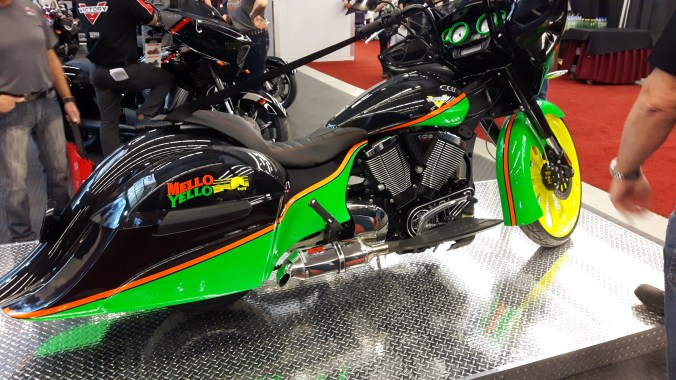
There are some bikes that are clearly built to get attention, and others where practicality is predominant. On one end of the scale is this Victory Mello Yello, which is anything but mellow in its appearance.

victory-mello-yellow1

Then there’s the Kawasaki H2, the most powerful motorcycle ever produced—and looks it.

h2

This beast has 998 cc of supercharged power, and I’m not using that term euphemistically. It actually has a supercharger with an impeller that turns at up to 130,000 rpm and compresses air 2.4x atmospheric pressure. It’s also got something called “the planetary gear.” If you think that sounds like something from outer space, you wouldn’t be far wrong. This gear system was designed by KHI’s aerospace division and is incredibly efficient at transferring power. Yes, we humans are amazing tool makers, and we’ve come a long way from that opening scene in 2001 Space Odyssey where a tibia bone becomes the first tool when used as a club. One look at this thing and you have a pretty clear picture of our incredible tool-making ability. Unfortunately, for all that ingenuity, we haven’t figured out how to stop killing each other and share power and wealth. Maybe we aren’t that far from the bone-as-weapon mentality? We are in essence still children in a sandbox, unwilling to share a bucket and spade, even when those toys have evolved to harness 326 hp.

But back to my dilemma about what bike I would feel comfortable my son riding. Not the H2, that’s for sure. The bike I was most interested in him seeing was the brand new BMW G310. It’s taken five years of development to get this bike off the line. Apparently, the biggest hurdle was getting the manufacturing, which is done in a new plant in India, up to BMW’s standards. The result is an entry-level bike that is under $5,000, has all the advantages of the German engineering we’ve come to expect from BMW and, according to initial reviews, is super fun to ride! It’s light and nimble, and despite being only 313cc (35 hp) in size, can keep up on the freeway thanks to a sixth gear, which even my 650GS does not have. Did I mention she’s a beaut? BMW are going to sell a lot of these. Apparently the plan is to bump their annual sales from 150,000 to 200,000 worldwide with this machine and introduce the BMW brand to a new generation of riders.

bmw-g310

It’s a single-cylinder, of course, liquid cooled, with ABS. Above is the R version, but an adventure GS model is coming in about six months. It would be fun to do some touring together and BMW says the 310GS is okay for light off-roading, so pretty much the same as my 650GS and would mean we would not be restricted to asphalt. They didn’t have the GS available at the show but here’s a photo of it grabbed off of Cycle World.

cw1116-2017-bmw-g-310-gs-image-01_0

It’s got the distinctive BMW beak, an extra couple of inches suspension clearance front and back over the R model, adjustable rear suspension preload, and ABS can be turned off when you leave the pavement. That’s a lot of bike for a little over $5,000! Cycle World is calling it a legitimate contender for the mini-ADV crown. It will take Gabriel a year or more to get his licence if he decides to go ahead with this, and hopefully by that time there will be some aftermarket accessories, like a more comfortable seat (are you hearing this, Seat Concepts?) because I know from personal experience that BMW do not put money into the seat.

In the end, I’m in the uncanny position I put my wife in when I announced I wanted to ride. To her credit, she didn’t freak out and threaten to divorce me, as some wives would do. She has told me she didn’t because she trusts me, trusts that I’m going to do everything right to minimize the risk, and I guess I’m going to have to do the same with my only child. He’s 23 this month, so there’s not much I can do about it anyway.


All Roads Lead to Pirsig: a review of Zen and the Art of Motorcycle Maintenance

pirsig

There’s a strange phenomenon that happens when you let on in conversation that you ride. Soon after you casually drop a reference to “the bike,” the conversation starts to steer toward Zen and the Art of Motorcycle Maintenance. It’s like how all roads lead to Rome; all conversations eventually lead to Pirsig.

First published in 1974, Zen has become a classic, selling over 5 million copies. It possesses that rare quality of being both popular and academic. It’s the one book everyone has heard of that contains the word “motorcycle” in its title, so naturally, once it’s known that you ride, you will have to give your opinion of it. Ironically, the book isn’t about motorcycling at all. It’s about technology and mental illness and the Cartesian Duality and the Romantic and Classical traditions of Western thought and fatherhood and a host of other things but not motorcycling. The riding is really just a trope, the frame narrative to contain the philosophical musings in the Eastern tradition Pirsig calls “Chautauquas.” It’s these Chautauquas that are the real journey in the book, a deepening exploration of the Metaphysics of Quality. They occur during a 17-day road trip from Minnesota to Northern California with Robert Pirsig’s 12-year-old son, Chris, riding pillion.

Much of the book is highly abstract, and when I want to torture my wife, I read a passage from the book’s middle section:

“Quality . . . you know what it is, yet you don’t know what it is. But that’s self-contradictory. But some things are better than others, that is , they have more quality. But when you try to say what the quality is, apart from the things that have it, it all goes poof! There’s nothing to talk about. But if you can’t say what Quality is, how do you know what it is, or how do you know that it even exists? If no one knows what it is, then for all practical purposes it doesn’t exist at all. But for all practical purposes it really does exist.”

“Stop, stop!” she screams, and I do, before Public Security shows up at my door.

I had been warned inadvertently about the middle section. I happened to overhear a conversation involving a colleague who had decided to teach the book for the first time. He was lamenting that middle section, wondering how he was going to keep 18-year-olds, whose attention span is limited to 500 words of celebrity gossip, to keep wading through that philosophical muck. So when I got to it, I started to skim the abstract stuff, which isn’t really necessary to understand the discoveries at the end. It helps to have some context, but you don’t have to touch every stone on the Yellow Brick Road to get to the Emerald City. And in the end, when Pirsig finally comes to the much anticipated answers to his questions, he does so in a paragraph that doesn’t require all the contextual trappings for us to understand. This is a major flaw in the book. Despite it being a classic, it very much needs some serious editing. No wonder it was rejected by 121 publishers before being picked up, more than any other best-selling book, according to the Guiness Book of Records.

Fortunately, there are some passages that bring us back to the concrete world, literally: “We bump along the beat-up concrete between the cattails and stretches of meadow and then more cattails and marsh grass. Here and there is a stretch of open water and if you look closely you can see wild ducks at the edge of the cattails. And turtles. . . . There’s a red-winged blackbird.” And at other times, Pirsig provides another level of abstraction with insights about the concrete world and our experience of it. Here he describes, better than anyone I’ve read, why we ride:

“You see things vacationing on a motorcycle in a way that is completely different from any other. In a car you’re always in a compartment, and because you’re used to it you don’t realize that through that car window everything you see is just more TV. You’re a passive observer and it is all moving by you boringly in a frame.

On a cycle the frame is gone. You’re completely in contact with it all. You’re in the scene, not just watching it anymore, and the sense of presence is overwhelming. That concrete whizzing by five inches below your foot is the real thing, the same stuff you walk on, it’s right there, so blurred you can’t focus on it, yet you can put your foot down and touch it anytime, and the whole thing, the whole experience, is never removed from immediate consciousness.”

This is Pirsig at his best, when he gets outside his mind and provides description of physical detail and insights glimpsed during the ride. I found myself invested more in the frame narrative and the lives of these “characters,” and became annoyed each time I was dragged away from this narrative to the philosophical musings.

At the heart of this book is the relationship between Pirsig and his son Chris, a relationship strained by some violent rupture in its past, and one gets the sense that the bike trip is in part an attempt to heal this wound. Pirsig’s relationship with his son is very different from mine with my son, and  I longed for Pirsig to find a way to speak more openly to his son about his feelings and fears. He never does, and this is another disappointment in the book. The most touching moment of writing comes in the afterword, if you have the Harper edition.

With so much going against it, what, you must be asking, makes this book so popular? Well, it was one of the first popular books to examine our relationship with technology. I remember a roommate in first year undergrad talking about it excitedly, mentioning the contrast between Pirsig and John and Sylvia Sutherland, the couple they ride with through the first 9 days of the trip. Pirsig is able to repair his bike when things go wrong; John and Sylvia cannot, but rather fear and avoid maintenance on the bike, a relationship that extends to technology in general. In an era dominated by technology, Zen is an opportunity to reflect on our own feelings about the world as we’ve made it. Pirsig’s position is clear: we must embrace technology or risk becoming enslaved by it, victims of third-rate motorcycle mechanics and their inflated costs. There’s a moral obligation, according to Pirsig, to learn how to fix your bike.

And while I’m not a philosopher, I think Zen was one of the first philosophical treatises to bring Eastern thought into the stream of the Western dialectic. Pirsig’s goal is ambitious: nothing less than to bridge the Cartesian subject/object divide that underlies Western thought. It was probably also ahead of its time in casting a spotlight on mental illness, a subject that only now, over 40 years later, we as a society are starting to acknowledge and discuss more openly.

Yes, the bike is you, and you must work on yourself like the bike. I’m a strong believer that everyone has to do some serious personal work at some time in his or her life; otherwise your shit catches up to you, like the skunk stripe of mud that gets flicked up your back. It can be a divorce, a series of failed relationships, or a deep depression. I spent the bulk of my 20’s reading Carl Jung and Robert Bly, journaling, and doing dream analysis. Pirsig has opened a conversation about mental illness as much as presented an inquiry into values. He folds Buddhist spirituality into social critique, and I believe it’s this combination of personal and social inquiry that has given the book its wide appeal through the decades. Despite my misgivings, I believe it’s an important read. Just skim the middle sections.

The Wish List, 2016

santa_moto

My wife and I have a difference of opinion on gift-giving. In her family, it’s common to send out gift suggestions around birthdays and Christmastime. They come over the phone or via email from distant family, or they are dropped—maybe not an entire list but a single suggestion—into a conversation on a completely unrelated topic, seemingly innocuously, as if accidentally, usually with one’s back turned. I get it: you’re trying to help the other person out, who legitimately might have no idea of what you want. If this is a distant family member, that makes sense. But if it’s your spouse, well, you have to wonder how well your soulmate knows you.

I, on the other hand, love the element of surprise, and am willing to gamble my gift receiving in the hope of being pleasantly surprised. I also like giving gifts. I like the challenge of trying to think of that very thing someone has always wanted although he or she doesn’t realize it until the epiphany of opening my gift. My sister says I have gifting issues, but I say I’m just a kid at heart. The best part of Christmas is not the turkey dinner, the family visits, the work parties, the chocolates, sweets, egg nog, the smell of pine in the living room, the decorative lighting . . . no! It’s opening gifts, damnit! It’s getting to be both a kid again and Santa at the same time, if only for a morning.

It is therefore completely against my gifting policy to write this blog, which is a composite wish list of my most desired motorcycle gear. These are the things I would buy tomorrow if I happened upon about $4,000 and had my debts and mortgage paid and about three times what I actually have in my RRSP and child poverty worldwide was a thing of the past. It’s not meant so much as a wish list to my spouse or anyone else but a dream list to myself. Fortunately, I don’t need any of this stuff to fulfill my plans for next season, but they sure would make my journeys more enjoyable.

First up is a new seat. The BMW’s Rotax engine is the best thumper going, but their saddle sure does suck! I noticed it immediately upon going for my first ride. Well, what I noticed immediately is that the seat is sloped forward so it feels like the boyz are constantly crushed against the airbox. What took about another five or six hours on the seat to notice is that it’s not just the boyz that have complaint. After that first tour, when I put 800 kms. on the final day, I had a new tactile understanding of the term “saddle sores.” So if there’s one item I am somehow going to purchase at the beginning of next season, even if I have to sell body parts to get it, it’s the Touratech Comfort Seat, Extra High.

ttsaddle

Yeah, BMW has a comfort seat, but why reward them for putting a cheap seat on an otherwise excellent bike? I’m really happy with my Touratech panniers and I have a lot of confidence in this German company, which seems cut from the same cloth as BMW itself. I’m going to go with the extra high because I can easily afford another 2 inches on the height (my mom’s nickname for me is Longshanks), and it will change the ergonomics and make me less cramped. I would go with the FreshTouch version, which is covered in some technical material that somehow doesn’t retain heat as much as regular vinyl.

I plan to start some off-roading and I saw at the Simon Pavey school that motocross boots are mandatory for their courses, so a pair is on my list—not that I’m going to Pavey’s school in Wales, but I understand why he thinks they are necessary. The body parts most likely to be injured in a fall are your feet and lower legs, and when you are off-roading, especially learning to off-road, I imagine you fall a lot. The bike can fall on your leg or you can clip something like a trunk or rock when you plant a foot to corner. Now I don’t need a premium boot, not even an intermediate boot; an entry-level should do just fine and from the research I’ve done, Alpinestars is the brand. So on my wish list is a pair of Tech 1 AT’s.

tech1

If I were going higher end, I would probably get a pair of Sidi’s, but these are the only boots under $200 with a hinge/blade system for increased flexibility. I also like that they have a sewn sole, so you can have it replaced by your local cobbler when it wears out. The buckles are plastic but you can swap them out for the metal buckles found on the more expensive Tech 7’s if desired.

My next purchase will be an off-road helmet. I love my Arai Signet-Q touring helmet. It’s light, comfortable, really well ventilated, has the Pinlock anti-fog system, and SNELL certification, but . . . it was $800! I simply can’t afford another Aria helmet, even though the XD-4 is an amazing helmet. I went looking for something less expensive that wouldn’t be a huge sacrifice in quality and found a company named LS2 which makes quality lids at a fraction of the price of the big boys. The one I’ve got my eye on is the 436 Pioneer. It’s got a polycarbonate shell so it’s light, has a tonne of venting, an optically correct, fog-, UV- and scratch-resistant visor, a drop-down sun visor (great for touring), and is ECE rated. Best of all, it’s built for long-oval head shapes, which is what I have and right in line with the Signet-Q. I was so stoked about finding this helmet I almost bought one last summer but held back, hoping (praying?) they would release one in 2017 in a blue and white graphic to match my jacket. In writing this blog, I went to their site and lo and behold:

ls2_436

I’m a happy man.

Next up would be some auxilary lighting. That first tour to New Hampshire taught me that it’s not always possible to get to where you are going before sundown. Also that there are animals crossing the road at night. That road-kill incident sent me looking for secondary lighting and the Denali D4’s are on my wish list.

denali_d4s

These babies will send a beam almost 700 metres down the road in front of you. Better still, the combo beam and wide-angle lights also illuminate the surrounding roadside like it’s daytime. Because they are LED’s, they pull only 3 amps per pair. Wiring is easy, and you can wire them either into your high-beam switch or, as I might, a separate switch; I have an empty switch next to my four-ways that I could use or save for some fog lights. There is bike-specific mounting hardware so these will tuck in nicely at the top of my forks.

denali-mount

Okay, now we get into the practical stuff. Sleeping. If I’m going to camp while en route across the continent, I’m going to put the money I’m saving on motel costs toward the best inflatable mattress money can buy. My ultralight Thermarest is okay for 5 nights of canoe-camping, but for anything longer, especially when daytime concentration is essential to staying alive, I want a better mattress. I remember seeing one at La Cordée a few summers ago when I was buying a new mattress. It had a built-in pump, inflated I believe to about 4″ thick, was puncture resistant, and packed up smaller than a sleeping bag. Why, oh why, didn’t I buy it then? On my list is something like it. Suggestions, anyone?

Even more practical are tools for fixing a flat. So far I’ve been flirting with disaster. Anyone touring in remote areas has to carry sufficient tools to patch a puncture. Unfortunately, my bike uses tubed tires. The tubeless kind are so easy to fix with those plugs, but on a tubed tire you have to be able to remove the wheel, remove the tire, patch the hole, replace the tire, and re-inflate. The patching is the least of my worries. I’ve been patching bicycle tires practically since I was pre-verbal; it’s the other stuff that concerns me. I want to be able to break that bead and get the tire off and on without damaging the rim. On Adventure Rider Radio, I heard about BeadBrakR by BestRest Products. beadbrakrIt’s a series of tire irons that fit together to create a tool to leverage the tire off the rim. So you have your bead breaker and tire irons in one convenient pack. BestRest also produce the CyclePump to re-inflate the tire. Yes, you can use CO2 cartridges, but you only get one shot with them. The CyclePump is small enough to pack easily and runs on your 12V port, so if your patch isn’t perfect, or if for some reason you can’t patch the hole, you can use the pump repeatedly to get you to the nearest service centre or, if you’re really in the sticks, to phone service.

Speaking of safety, another little tool that I think would bring my wife peace of mind is the Spot Gen3. gen3_productIt’s a small, clip-on device that works with satellite technology to do a number of things. It can track your movement, so your wife will always know exactly where you are. Hmm . . . Okay, so don’t take it to your high school reunion then. Press another button and you can check-in with family to let them know you’re okay when out of cellphone range; it will send an email with GPS coordinates or a link to your location on GoogleMaps. This will be handy even on group rides to The States to avoid texting charges. Press another button to alert them you need help in non-life-theatening situations, and still another to hail the helicopter ambulance.  So if you’re planning a solo trip up to Deadhorse, AK, on the coast of the Beaufort Sea, as I am, this should be in your stocking.

Finally, we come to the most important items and the ones that, at about a thousand dollars apiece, will probably be on my list next Christmas too. I love my Joe Rocket leather jacket. I bought it as a starter jacket off eBay for a song and it’s been my one and only jacket so far. I zip the quilted liner in and out as needed, sometimes several times a day as temperature fluctuates, and throw a cheap rain jacket and pants over everything if the skies open up. But what I’d love, eventually, hopefully in this lifetime, is a Klim adventure jacket and matching pants.

Badlands.jpgKlim are the undisputed leaders in riding apparel and for good reason. They spend a lot of money on research and development, and all their products are premium quality. For example, the armour in their jackets is D30, which feels like soft, pliable rubber but molecularly stiffens upon impact; you can wrap this stuff like silly putty around your finger and then take a hammer and whack away to your heart’s content. And they’ve developed something called SuperFabric which is five times more abrasion resistant than leather with only half the weight. Gore-Tex means no need for an exterior waterproof jacket or zip-in liner. Warm in cold, wicking with vents in heat, this bad-boy is a one-jacket, climate control centre for four-season riding, and when the only thing separating you from the elements or the asphalt is your clothing, your jacket is the most important investment next to the bike itself. A Klim jacket will take me from Alaska to Tierra del Fuego in comfort and safety. I haven’t decided yet whether I want the Induction or, for a few hundred dollars more, the Badlands, but one thing I am sure of is that whichever model I eventually get, it will be in the hi-viz colour. When Marilyn and I drove the Cabot Trail a few summers ago, we definitely found the hi-viz jackets caught our eye at a distance. I don’t even think hi-viz comes at a coolness cost these days; rather, as I’ve claimed in a previous post, I think hi-viz is the new cool.

Most of these items are to set me up for the adventure riding I’m longing to try. Now I’ve got the bike and the licence, but if feels like those things are just a start. I remember during my first theory class in my licensing course, the instructor warned us that “this sport will latch onto your wallet worse than your ex-wife.” Having experienced the financial cost of one divorce, I almost fled the building. Now I see what he was talking about. But he continued by suggesting to pace ourselves, to “not go crazy” but slowly build up our gear. And to avoid a second divorce, that is what I’m going to do. In the meantime, a wish list is a fun way to dream and plan, research, and select, without the messy consequences of actually buying. Like window shopping.

No doubt your wish list is different from mine. What do you hope Santa leaves under the tree? Merry Christmas, and happy and safe travels in 2017.

Screw You!

20161127_121432

You’d think that my biggest frustration last week would have been when I accidentally broke my gas cap. It was the final fill-up before putting the bike into storage, more final than the fill-up which is part of my winterizing for storage. You see, I usually add the fuel stabilizer, then fill the tank, then go for a little ride to mix the stabilizer into the gas and work it down into the injectors, as well as heat the chain wax and oil. Then I top up again. It was on this final top up that I broke the cap. Jung would have something to say about this but I don’t, not about the breaking anyway. I’m going to write about the fixing.

Or you might think my biggest frustration would have been when I heard how much a replacement cap was going to cost. It’s a gas cap, right? How much can it cost? Okay, this is a BMW, so whatever figure you have in mind, triple it. Then triple it again. You’ll be pretty close. I wasn’t that surprised when the nice parts guy at BMW told me the amount and I said so. He missed the irony, but then maybe it was a language thing. Then he said, “You’re not surprised? Oh, then, actually it’s $ __________!” (tripled again). Big joke. (Laughing.) This time I missed the irony. Did I say he was a nice parts guy?

No, the biggest frustration of the week was in trying to remove one screw to replace this gas cap. After I had ordered it, received the call that it was in, gone and held my nose and paid for it, I figured the worst was over. But I was wrong.

The gas cap is all one unit, which is why it costs so much: the cap, the hinge, and the flange are all one piece, so while I just broke the hinge, I had to buy the whole shebang. The upside, or so I thought, was that swapping the old one out would be easy. Six screws. You undo the screws, you take the old unit off, you put the new unit on, you replace the screws. This is Motorcycle Mechanics 101. But what they don’t teach you in MM101 is that nothing, no job, never, ever, is simple.

Five screws came out like a charm. The sixth did not. At first I thought the screw must be stripped, so tried pulling up as I turned. Sometimes you can skip over the stripped thread and get the next one to catch and you are out of the woods. But I soon discovered that what the screw screws into was also spinning. Now normally when this happens, you simply get hold of the nut on the other side with another socket or wrench or, if necessary, vise-grips—whatever it takes—but you can usually stabilize one side and turn the other and, again, get out of the woods.

But what do you do when the fitting that the screw screws into is embedded in the side of your plastic gas tank and covered with a metal flange? You can’t get at what is spinning, not with a socket or a wrench or vise-grips or even pointed-nose pliers, not with a screwdriver (trying to jam it down and wedge it somehow enough for the screw to release), not with a pick, not with the bent-nose pliers you just bought hoping they might do, not with a chisel to cut off the damn thing since you are replacing it anyway, nope—not even the miracle tool advertised on late-night infomercials is going to get you out of these woods. “Are you fucking kidding me!” I bellowed at the top of my lungs, and since I was in my shed, the acoustics were such that the preschoolers across the park must have heard me. For sure my wife did, for she soon arrived, presenting herself and the dog as Cheering Party, offering tea and biscuits, and helpful advice like “Why don’t you phone Nice Parts Guy and ask if he has any ideas?” But I happen to know why Nice Parts Guy works in Parts and not Service. And I know that Service doesn’t give free advice; they say “Bring the bike in,” which in this case was not an option.

But then she said something brilliant, so brilliant that my grease-monkey brain had overlooked it. “Why don’t you take a break and look online?” Now it’s not like Siri is going to know how to remove a slipping screw from the side of the gas tank on an f650GS, but one of the “inmates” of The Chain Gang probably does! The Chain Gang—so-called because the 650 was the first chain-driven bike BMW made—is a user forum consisting of 11,493 members, all of whom own my bike or a close cousin. It is a veritable fount of knowledge on all things relating to my specific motorcycle. Whatever issue you might be having, someone else has already had it and solved it. What did people in my situation do before the internet? Oh yeah, they belonged to real user groups.

So I posted my problem and before the day was out another user replied, not with an answer but to say he’d encountered the same problem. Since his cap was merely rusted, not broken, he simply replaced the other five screws and lived with it. He said he was curious too if anyone had an answer. Then someone did. He suggested drilling off the head of the screw. My concern with this plan is that I’d still be left with now a head-less screw seized inside a still-spinning fitting, so it wouldn’t solve the problem. A little back-and-forth and soon we, yes now “we” because that’s the nature of a bike forum, had another plan: I could use a drill, not to drill the head off but burn the fitting out of its socket. With the other five screws out, I knew there was enough play to get my fingers under the ring and pull as I spun the screw and fitting. With time and patience, eventually the plastic would give and the fitting would release. Then I could grip the fitting with some pliers (or my teeth, perhaps, by that point might be preferable) and unscrew the screw, then glue the fitting back into the empty socket. That was the plan.

But first I needed this tool. All new jobs require one new tool.

20161127_132133

This allowed me to put any of my 3/8″ sockets on my cordless drill. I put the torx socket on, drilled (counter-clockwise) and pulled and in no time the fitting was out. Here is what it looks like out, next to the screws.

20161127_124347

It’s brass and the rounded end goes down into the plastic. It is “gripped” by surrounding plastic which had deteriorated and given way. The top is squared.

Here is a photo of the emptied cavity with the remaining five fittings.

20161127_124257

Yes, that is gasoline sloshing around inside.

The next part of the job was glueing the fitting back in. I decided to use epoxy glue since I’ve had good luck with it on plastic before. This is where I get to play artist, mixing the epoxy and hardener on my palette.

I’m sure others have their own methods for mixing epoxy but I use waxed paper and a nail. This particular brand fortunately ended up the exact shade of grey I needed.

20161127_175628.jpg

The first time I tried, I made the mistake of putting glue in the cavity and then trying to press the fitting back in, thinking the glue would squirt up into the vacant space at the sides and surround the fitting. But it didn’t, perhaps it was because it was 1 degree Celsius out and the epoxy was stiff, but the fitting sat too high. So I quickly cleaned the fitting and cavity before anything set and started again. The second time I put epoxy just around the “neck” of the fitting and none in the cavity. I guessed the quantity just right. The fitting bottomed out and the epoxy came just flush. I had just a little excess to clean away. Then since it was cold, I used a hairdryer to help it set. All in all, it looked pretty good.

20161127_131147

After that, it was just a “simple” matter of replacing the rubber seal, the metal flange, the new gas cap unit, and all six screws. I did not tighten the new one but will wait until the spring when I’m confident everything has set hard before completely tightening it. I’m now thinking I might put some anti-seize grease on it, just in case I have to remove it again in the future. That particular fitting seems to be especially tight.

I’m no expert but I’ve done quite a lot of mechanical work, including changing a clutch on my car this past summer. But this single screw sure had me stumped! It’s funny how sometimes the seemingly simplest jobs can be the hardest. Most jobs involve approximately 25% familiarity with tools, 25% understanding of basic mechanics, and 50% problem-solving. It’s one unforeseen snag after another, some bigger than others. You have to keep your cool, take your time, seek advice where you can, and persist. It also helps to have a partner who injects a little something foreign into the mix when needed.

Thanks to my wife Marilyn, and Phil (aka backonthesaddle) at The Chain Gang for getting me over some hurdles to the finish. The bike is now ready to ride first warm weather next spring.

20161127_141231