Restoration

Making an old motorcycle look good as new.
The first time I took my bike to a rally, I dropped it three times. It was my first time off-roading and I had street tires on. That’s not a good combination. Back at camp, I was lamenting a scratch I’d put in one of the body panels when another rider set me straight: “Ah, you can’t worry about that. It’s a bike.” Obviously, his conception of a motorcycle is different from many others who keep their bikes spit clean and polished to a gleam. I know one rider who scratched his bike in a tip-over at a red light so he sold it and bought a new one.

My f650GS is my learner’s bike. That’s the one you make all your mistakes on, so it shows all the wear and tear of your learning curve. It’s seen plenty of tip-overs and a few crashes—thankfully none on asphalt—and has plenty of “honour badges” to show for it. It’s also now 15 years old. So after completing my cross Canada tour last year, which included an excursion up The Dempster Destroyer, I decided to restore it and retire it from trail riding. It’s a great adventure bike and I’ll continue to use it for that, but I’ll no longer try to push it where it ought not to go. I hope to get a different bike eventually for more technical riding.

My friend Mike painted his Africa Twin a few years ago and did a great job. His company, Renomac Renovations, specializes in quality home improvements, but he’s just really experienced in all things mechanical and technical and knows paint. So I asked him to give me a hand restoring the panels of my bike.

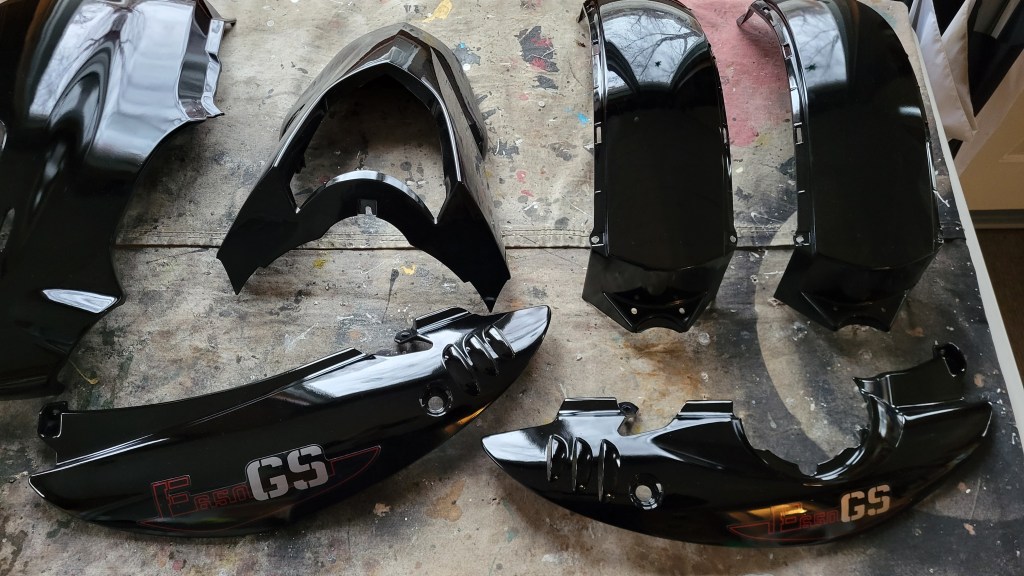
I used a bumper repair kit to fix a chip in the beak, and bondo to fill some deep scratches. Lots of sanding with 320 and 400 wet-dry sandpaper and then we primed, painted, and clear-coated the panels. I had found on eBay a centre panel to replace the original that had been cracked by the buckle of my tank bag harness, so all panels are looking pretty good. I even had OEM look-alike stickers printed.

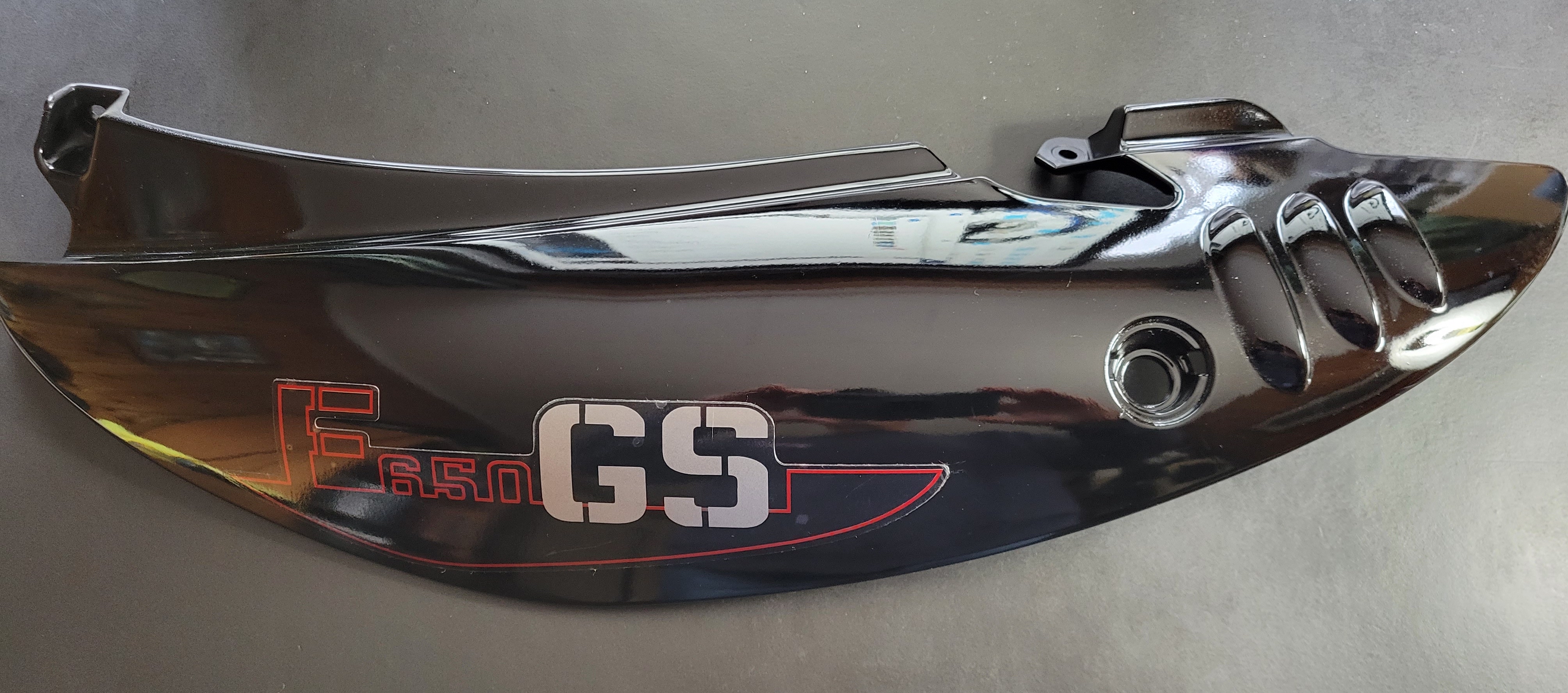
You have to have a loving wife to tolerate this use of the front porch.

While those are hardening in my front porch, I also cleaned up my exhaust using hydrochloric acid in toilet bowl cleaner. It works like a charm and eats through the rust pretty quickly. It even did a pretty good job on the staining of my chrome exhaust that happens through heat cycles. Just use a toothbrush and plenty of water to rinse afterwards or the acid will continue to eat the metal. I actually mixed up a mild solution of baking soda and water to be sure to neutralize the acid, then rinsed. A little Blue Job (no typo here) afterwards had them gleaming like new again.

Last fall, I replaced my cracked and scratched windscreen with a new one. I had the 12″ National Cycle VStream screen on before, but I decided to go slightly taller this time with the 15″. The shorter screen was best for off-roading, but this one, with the Puig wind deflector on top, should be best for touring at speed.

The Michelin Anakee Adventure Tires I used last year were great for touring. I put 20,000K on them and there’s still tread left, but with the bike looking this good, I guess it’s time for a new set of shoes. I thought I’d try those new Dunlop Trailmax Mission tires everyone has been raving about. They are listed as a 50/50 tire, which is the kind of riding I do, but they look like street tires. Dunlop claim that they give “knobby-like performance” in the dirt while having a round profile for smooth asphalt riding and cornering. We’ll see about that. They were a full two years in development and have some new technology built into them, including sidewall ribbing and a stepped tread. And if that were not enough, you are supposed to get 8,000 miles (or 13,000 K) from a set, so they apparently wear really well.

A new set of tires and tubes to complete the bike. Let’s see how these bad boys are.

I’ve got a set of Kenda Big Blocks with a lot of tread left on them sitting in the shed, but I think I’ll save those for my next rally. I was looking for a long-life 50/50 tire for adventure touring. I’ve tried Heidenau K60 Scouts on this bike and while the front was great, the back flattened pretty quickly. I’ll post later how these are. In fact, I think a tire review of what I’ve tried so far is in order.

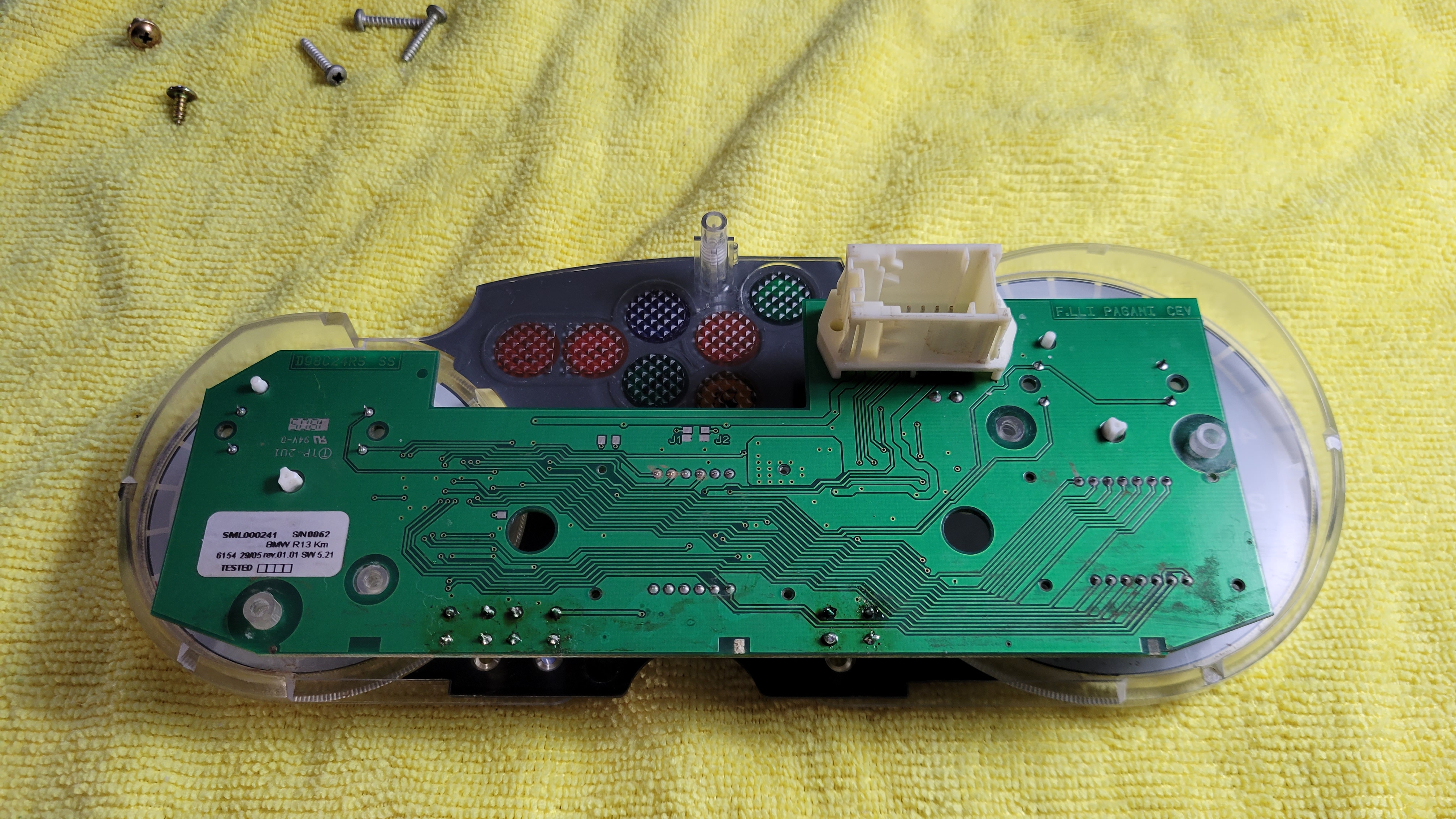
The only thing I’m still waiting on before getting back on the road is the circuit board from my dash assembly. Last fall, the clock started showing nonsense and partial numbers. According to Wayne’s excellent website crossroadz, the plastic cover of the display can wear away the copper in the circuit board and disrupt the signal. Thankfully, there is an electronics technician at the bottom of my road who does excellent work at a fair price because I don’t have the confidence to practice The Dark Arts myself. He’s going to take off the display and rebuild the pathways, whatever that means. It’s a relatively small thing, but I actually use that clock a lot when riding, and the bike will otherwise be good as new, despite the 130,000 kilometres on it. The engine still has good compression and is not burning oil.
These restoration projects have been taking some time, but the real reason this blog has been so quiet lately is that I’ve been organizing a reading tour for my recent collection of poems, Invisible Sea, published by DC Books here in Montreal. So aside from proofreading and doing final edits on the manuscript, I’ve also been contacting bookstores and other possible venues to organize reading events. The collection explores the theme of flight and, in particular, early human flight.

I wanted to write something positive as a kind of antidote to the state of the world today, and decided to reach back to my childhood heroes, The Wright Brothers, for inspiration. So the opening section is in the voice of Wilbur Wright as he solves “the problem of flight,” as it was then known. The second section tells the stories of other early aeronauts, both legendary and real, from Icarus to Brother Eilmer of Malmsbury, The Flying Monk, to Chuck Yeager breaking the sound barrier, and John Glenn, orbiting Earth. The third section is an exploration of aerodynamics, musing on the major discoveries of air, beginning with Leonardo da Vinci’s study of streams, to something called The Compressibility Burble that happens at transonic flight. The final section is a celebration of birds, bats, boomerangs, Frisbees and all things that fly into our everyday lives.

So if you are an aviation enthusiast, you will enjoy this book. I’m marketing it to a popular audience since many of these poems are narrative and accessible to any reader, not just those who read poetry. I was inspired by the stories of these courageous men and women who risked their lives in leaps of faith, and if you ride a motorcycle, the closest thing to flight while remaining on the ground, you will connect with these poems. The collection is all of $20 and available through Amazon, Indigo, directly from my publisher, and elsewhere.

So if the blog has been a little quiet lately, it’s because I’ve been busy both with my paid work and in organizing reading events. I’m trying to put together a tour down through The United States to Kitty Hawk on the Outer Banks of North Carolina. As most of you probably know, that’s where the Wrights first flew, and I’d like to visit The Wright Brothers National Memorial there. That would allow me to ride The Blue Ridge Parkway—a bucket list ride of mine—as well as Tail of the Dragon. Then I will head over to Dayton, where the Wrights grew up, to the Dayton Aviation Heritage Museum, and back through Dearborn, Michigan, where Henry Ford has moved the Wright family home and bicycle shop as spectacles in his historical park. If all goes to plans, I’ll be able to combine in a short tour my love of riding with my love of aviation history.

Other than that, it will be a quiet summer in and around Montreal. I have to postpone my plans to tour the East Coast of Canada, including Newfoundland and Labrador, because our new dog, a rescue, still suffers from some vestigial anxiety and doesn’t travel well. He’ll need another year to settle in, so the bookend tour to the west coast one last year will have to wait another year.

What are your plans for the season? April is always an exciting time to be a biker in Canada. And are you doing any mods or restoration work to your bike? Let me know in the comment section below. I’ll be finishing writing up the remainder of last summer’s tour in the coming days, then looking only forward to another exciting season of riding on a bike that, if not new, looks good as new.

Muncho Lake, BC. I’ll be writing up the final segments of last year’s tour in the coming days.

Trip Planning: Final Prep

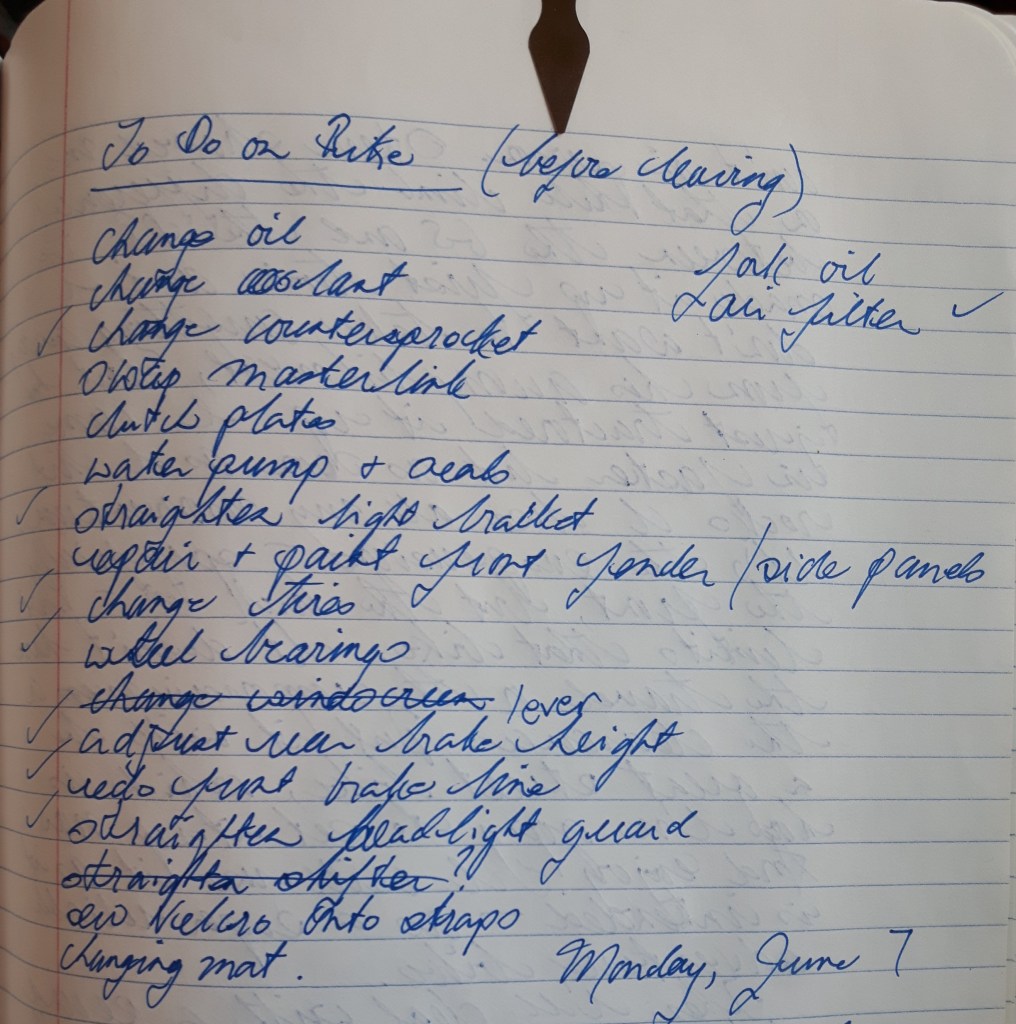
I’m down to just a few days before departure and not feeling very prepared. By the time I was free and clear of work, I had only two weeks to prepare the bike. That’s a lot, but not when parts take two weeks to arrive from Germany. So I’ve done what I can, as you can see from the list above. Today I remove the clutch cover to change the water pump and clutch plates. I actually have the pump—I’ve had it for a few years because you never know when it will fail on this bike—and I have the cork replacement plates for the clutch. What I don’t yet have are clutch springs and, if required, a replacement clutch cover gasket—that large paper one. These items and a few more were supposed to arrive last week, but it seems Covid is trying its best to sabotage the tour this year as well as last. Today is a holiday in Quebec so if the parts don’t arrive on Friday, I’ll have to make do. That might mean re-using old clutch springs or shimming them if they are out of spec. And hopefully I can get that clutch cover off without damaging the existing gasket. I only ordered a new one in case I can’t.

The good news is that the bike has all new wheel bearings, including the cush drive bearings, and new rubber. I did end up going with the Anakee Adventures in the end, mostly for their smoothness on asphalt. I don’t anticipate doing much off-roading on this tour, and they will be really nice through the twisties in The Rocky Mountains. I tried my best to balance the wheels using jack stands but I think I will get them checked professionally. The pros have computerized equipment that is more precise, and I thought I felt a bounce in the front. I also changed the front sprocket back to the stock 16-tooth, among other mods. My son helped me shoot a few videos of the mods I’ve made on the bike both for dirt and converting it back to street.

My wife, Marilyn, and I did a test ride last Saturday and the bike is running great. I remember now how that stock gearing is so much better on the highway; you have roll on at 120 km/hr.! And at 110 km/hr, which is a comfortable cruising speed for me on the highway, the revs sit right on the sweet spot of this bike at 4600 rpm. Even at 120 km/hr the revs aren’t over 5000. I’m glad I made that change, even though I know you’re not supposed to change a sprocket without changing the chain. Well, the chain has only 7K on it so it will be fine, and I’ll change everything when I’m back.

With all the attention on the bike, I have only just started laying out items to pack. Marilyn is having kittens about this because she can’t imagine starting so late for such a big trip, but I’ve done it before many times and I pretty much know what I’m taking. The only difference this time is that I have to consider two set-ups: one for when I’m solo, and one for when Marilyn is riding pillion. This means that I’ll have an empty pannier when alone. I will fill it with booze and tobacco until she joins me in Calgary.

The only tricky part of packing actually is deciding what spare parts to bring. I’ve done everything possible to prevent an issue on the road and I don’t have room to carry spare engine parts, but I’ll take an assortment of hardware, spare clutch cable and perhaps levers, gasket maker, JB Weld, self-fusing tape—that sort of thing. I’ll try to anticipate any issue that I might have, within reason.

I haven’t been able to research as well as I’d like, unfortunately. The book on Canadian geography I took out from the library sits unopened on my coffee table. I’ll have to do my research on the fly, so to speak. I’m pretty familiar with Ontario from previous travels and from writing a few articles for northernontario.travel, and I found a great video of tourist destinations in southwestern Saskatchewan, so I’m good for the first two provinces, I think. Marilyn is pretty familiar with Alberta, having lived there for 20 years, and we will explore BC together, so I’m not going to beat myself up for not getting more reading done. It’s not like I’ve been idle.

We have a few reservations booked on Vancouver Island and will stay with different friends as we make our way through the BC mainland. I am mostly concerned about when I’m alone and camping, since I’ve heard that campgrounds are all full. I’ll be using iOverlander to find wild camping spots and will have to wing it. This will be a first for me and I anticipate a few nights of searching for a suitable safe spot, but having watched Lyndon Poskitt wing it all over the world, I know it can be done.

The Yukon has dropped the requirement for travelers to self-isolate upon entering, but only if you are fully vaccinated, so I’ll be looking to get my second dose on the road somewhere so my planned trip up north is still on. Unfortunately, since I got the fist one after May 1st, I’m not eligible for the second until after I leave. Like so much about this tour, I will figure that out on route.

It hasn’t sunk in yet that I’m finally doing this. Perhaps I will grow into it, or it will hit me once I leave my first destination in Ontario. I’ll be staying with my sister for a few days and visiting my dad, so the trip proper begins July 1st, Canada Day, which seems appropriate. I won’t be posting while on the road so don’t expect any action on the blog until I’m back. I wish you all a safe and enjoyable summer!

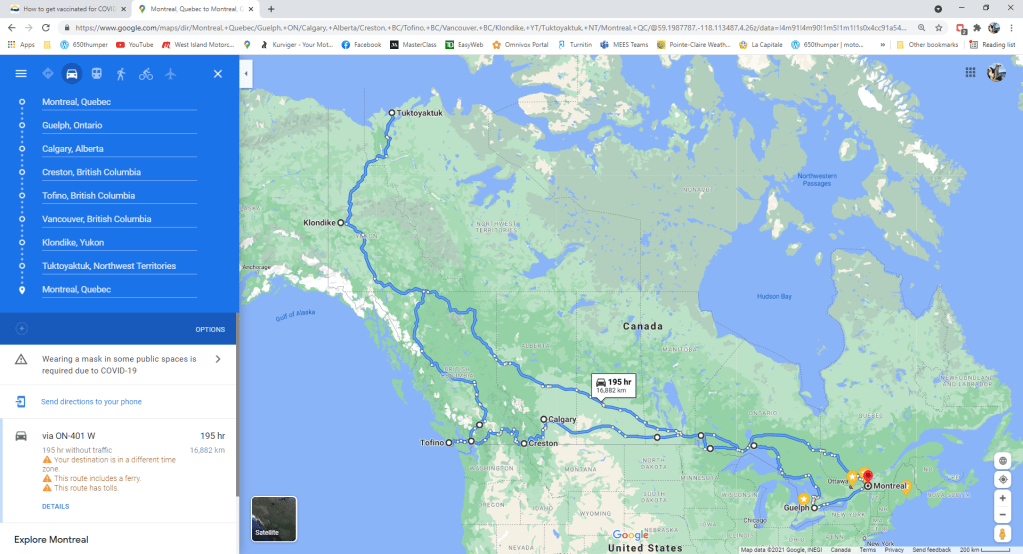
Planned full trip. Am I crazy?

Trip Planning: Secondary Decisions

Talus Lake, Tombstone National Park. Photo credit: Travel Yukon

In my first post on planning my big trip this summer, I discussed the essence of the route, some preliminary considerations regarding how much dirt to ride, and got some gear to help with navigation and heat. In this one, I make a significant change in the route, start getting fit for long days in the saddle, and prep the bike for the start of season.

Change of Plans

The initial plan was to ride from Montreal to Calgary, where I’d meet up with my wife, and then we’d ride together through southern BC, including Vancouver Island. After that, I was going to head off south solo down the west coast to California and make my way back through The United States. However, after watching Covid-19 numbers in The United States climb through the winter and political tensions cause rioting on both sides of the country, I decided that perhaps now is not the best time to be travelling in The States. As it turns out, our American friends are doing better now with their vaccination program than we are, and the political tensions have calmed, but I still have concerns about the sharp rise in violent crime rates in the US. The causes of that increase are currently being debated, but no one can deny the alarming spike.

I don’t like to get political here, but there’s nothing more political than personal safety. The Grand Canyon is not going anywhere soon, and besides, I keep hearing on Adventure Rider Radio that you don’t need to leave your home country to have an adventure, especially a country as big as Canada. So while our American friends are sorting out a few things, I’ll take the opportunity to explore and discover fully the country I’ve proudly called home my entire life. When I hit the Pacific Ocean, instead of turning south, I’m heading north. The Far North.

With the US no longer in the picture, the technical riding of the BDRs and TAT was out of the equation. Most of my trip would be on the pavement, so I went looking for a new goal to challenge myself and decided to try to make it up to Tuktoyaktuk, NWT, as my final destination. A solo trip up to the Arctic Ocean seems like a worthy goal.

I’ve been trying to figure out why it’s so important to me to have that kind of a crazy goal, as if crossing the country is not enough of a challenge. It’s hard to explain to my wife and others what would motivate me to ride solo into that remote wilderness. I didn’t even understand it myself, until I read recently something by Jordan Peterson that provided an answer. In his best-selling book 12 Rules for Life: An Antidote to Chaos, in the chapter on Rule 11, Do Not Bother Children When They Are Skateboarding, Peterson makes a case for allowing our children to risk pushing their limits, whether it’s athletically in play or otherwise. Early in the chapter, he writes:

“When untrammeled—and encouraged—we prefer to live on the edge. There, we can still be both confident in our experience and confronting the chaos that helps us develop. We’re hard-wired, for that reason, to enjoy risk (some of us more than others). We feel invigorated and excited when we work to optimize our future performance, while playing in the present. Otherwise we lumber around, sloth-like, unconscious, unformed and careless. Overprotected, we will fail when something dangerous, unexpected and full of opportunity suddenly makes its appearance, as it inevitably will” (287).

In other words, I like a challenge! Yes, there is risk involved, and I often find myself strangely reluctant to leave on one of these adventures because I am literally leaving the comfort of my home and increasing my stress level. There’s a mild anxiety that descends on me, and part of that stems from going solo. But anxiety is just another shade of excitement if you frame it differently, and once I’m on the road, that’s how it appears to me. (I’m referring to mild anxiety, to be clear, not the debilitating kind that afflicts some people.) It’s akin to the performance anxiety of a big game or a race; once the game or race has started, it’s all fun, even the tough bits. And I haven’t even mentioned yet the rewards of the ride, which in this case will include seeing the tundra, the northern lights, and the Yukon Mountain Ranges—all firsts for me. Who knows what else the trip will bring? 

Anxiety is just another shade of excitement if you frame it differently.

I have to add that this is not foolhardy behaviour. I’ve been preparing for this kind of trip since I started riding in 2015—developing technical riding skills, learning about my bike, and getting the right gear (which in this case includes bear spray). Heck, I’ve even been teaching myself this winter the 5 best knots to add to my bushcraft. Maybe Peterson could have simply said: the antidote to chaos is preparation.

Now I’m just waiting to see if the territorial borders will open. Currently, anyone crossing into the Yukon and the Northwest Territories has to self-isolate for two weeks. I haven’t had my first vaccination yet, but at 57 years old, I’m next in line, and our fair Prime Minister has promised that all Canadians will be vaccinated by July 1st, so I’m betting that they will open. This might be a game-time decision near the end of July, but I’ll ride up to northern British Columbia and see how far I can get.

Getting Fit

Sitting on a motorcycle all day is like sitting on a stool all day, unless you have a backrest (which my bike doesn’t) or have loaded the pillion seat with bags (which I can’t, leaving room for my wife when she joins me). Usually this time of year I’d be swimming and running and playing indoor soccer, but Covid has killed all that, leaving me pretty sedentary. I realized I had to get going again, so on March 1st my wife and I made a mutual pledge to do 30 minutes of exercise 5 days a week. So far it’s been working out (ha ha, bad pun) and we are starting to feel the effects.

For me, the key to exercising regularly is finding the right activity at the right time of day. Those two elements are the combination that unlocks the door to fitness. We decided that 10:30 a.m. was the best time for us. We’ve had our coffees and have done a little work at the computer and are ready for a break, especially one that involves moving. And since I’m mostly interested in core strength and cardio fitness, I’m alternating between Pilates and running every other day. This way, each muscle group gets a recovery day between workouts.

My wife alternates between Pilates and her stationary bike, so every other day we do Pilates together. There’s a saying in the Pilates world: do 10 workouts and you’ll feel better, 20 and you’ll look better, and 30 to have a completely new body. I’m not sure that last one is possible at our age but we certainly are feeling better after our first 10. We do a very simple routine using only a yoga mat. If you want to improve your core strength and flexibility, check out Pilates. It has cured my lower back issues and gives me better overall body awareness and posture.

I’ve had some foot issues so the running has been difficult, but a new, wider, pair of running shoes has fixed that and I’m literally on the road to improved cardio. Come April, I’ll move on to some strength training, particularly upper body, and I’m working hard to rehabilitate my thumb that was injured last fall in a little off.

Prepping the Bike

Our riding season here in Quebec officially kicked off on March 15th. I wasn’t on the road that day, but some unseasonably warm weather has allowed me to get out to the shed a little early and do what I needed to do to get the bike road-ready. This is the first year I haven’t done something major, like change my shock, chain, sprockets, brake lines, or even fluids, and it’s been nice! For once, a few little jobs and Bigby is ready to ride.

itcontroller

I mounted the Carpe Iter Controller. There wasn’t room on my handlebar for it so I had to make a little bracket that mounts on the mirror stem. I also upgraded my navigation software (OsmAnd, Locus Maps, Kurviger) to the pro versions and updated my maps. I added a little guard for my rear brake master cylinder (thanks Rick / Kildala), and flipped my auxiliary lights on the mounting bracket to get them a little lower and add separation from the main headlamp—all easy stuff and I went for my first ride last Tuesday. I even figured out a workaround for my tank bag harness that was damaging the plastics, and I’m really happy to have my Wolfman Explorer Lite tankbag back.

Also in that other post, I mentioned the product AT-205 Re-Seal I was going to add to my oil to recondition the engine seals. I’m always nervous about adding anything to the engine oil so thought I’d contact the company first, just to be sure. Good thing I did! Turns out they do not recommend it in applications that involve a wet clutch. I’ll have to make do with the bike as is, keeping an eye on the oil level throughout the tour, and switching to a 20W/50 once we get into the warmer weather.

Good to Go

I haven’t done much specific route planning yet, but with my departure date roughly three months away that is about to kick into high gear. I’m reading ride reports on ADVRider, but if you have recommendations, please let me know. In particular, I’m looking for good campgrounds, must-see attractions, must-ride roads, and good restaurants and accommodations through southern BC and Vancouver Island, since my wife and I will not be camping much while on the road. Feel free to drop them in the comments section below or send me an email through the Contact page.

Enjoy the spring riding.

The End of Summer

It’s Labour Day weekend, the unofficial end of summer here in Canada. I haven’t heard any geese migrating south yet, but it won’t be long before I do. Patches of yellow leaves have started to appear, and the temperature rarely climbs above the low-twenties. I’ve zipped the quilted liner into my riding jacket.

For me, fall is usually a bit melancholy, but this year it is especially so since my major summer riding plans remained unfulfilled. In my post 20-20 last May, filled with optimism and promise, I outlined my three major plans: to ride the Hamster Trail in New Hampshire, to ride across Canada and back through The United States, and to improve my off-road skills.

As I write this, the Canada-US border is still closed, so the Hamster Trail didn’t happen. There was no club riding in The States, no DirtDaze Rally in August (at least for Canadians), and there will be no Cromag Campout in September. I miss the beautiful dirt roads of Vermont, the state parks, and the good company of our American friends.

By early July, I knew the cross-country tour wasn’t going to happen either. It’s not that it would have been impossible—at least the Canadian leg—but it would have been tainted by the restrictions imposed by the Covid-19 pandemic. My wife and I did some travelling north of Lake Superior in early July and found Tim Horton’s drive through open, but not much else in the way of food on the road. (Not that I have anything against Tim’s! Their employees are heroes, as far as I’m concerned.) The country was still opening up and some things were open, others not, and I had plans to do research toward some travel writing. All things considered, I decided to postpone that dream another year. I’ve had it since I was a teen, so what’s another year, right?

As for the off-road skills, well, there’s still some time for that. Covid can’t stop me taking my bike outside of Montreal and hitting the trails. I did a ride with The Awesome Players in June, but broke my new shock in the process (doh!) and it took a couple of redesigns by Stadium Suspensions to get that fixed. Then my preload adjuster broke, but thanks to my buddy Phil in Ottawa (aka backonthesaddle), that was fixed. Finally the bike is riding well! It’s sitting higher than I ever remember it, even with the preload at base level, and tracking well over bumps and potholes. In fact, it feels better than ever.

My wife says, “Don’t do anything to it. Just ride it!” and I get her point. So I’ve been doing that, going easy on it with some street riding. I’ve been doing day rides with my street club, The West Island Motorcycle Club, including the Telus Ride for Dad, which raises funds for prostate cancer research. This weekend, riding buddy Ray and I scouted a light ADV club ride in the Eastern Townships, ending up at the summit of Mont Orford.

The summer hasn’t been a complete blow out. I’ve kept busy by doing quite a bit of home reno, including painting the exterior of the house and doing odd jobs not done in previous years because I was too busy riding.

If I’ve been quiet on the blog here it’s because there hasn’t been a whole lot to write about except frustration in trying to get the bike fixed and toward Covid. It’s hard, though, to sound off when my wife and I are safe and have stable income.

I’m tempted to take off for a little solo trip somewhere now that I can. I like to get at least one solo trip in each summer. It’s getting cold for camping, but last year I was brave and did a weekend at the end of September in Algonquin Park. We’ll see. For now, I’ve got a set of Kenda Big Blocks sitting in the shed ready to go on as soon as my wheel weights arrive, and I’ve just ordered a new chain and sprockets. My current set has an unbelievable 35,500 kilometres on it and looks like it could do more, so I’m sticking with the same set-up: a gold DID VX2 chain (which is now upgraded to VX3) and JT Sprockets front and back in 15/47 ratio, which provides more torque and higher revs in the low gears than the stock gearing.

Here in Montreal, we are on the road until December, unless we get early snow like last year. The fall presents some of the most pleasant, beautiful riding as the temperatures drop and the trees turn colour. I’ve never had 60/40 knobbies on this bike front and back, so it will be interesting to hit the trails with the new shock and tires and see how the bike handles. Let’s hope I don’t break anything! While the summer was a bit of a bust, the fall still contains some promise.

Suspension Upgrade

Life Cycle

If wheels are your legs, then suspension is your joints. Anyone with bad knees or hips will tell you how important healthy joint function is. If you want to make the single-most significant upgrade to your bike, consider looking at the suspension. An upgrade is not cheap, but it’s often well worth the investment.

In my review of the f650GS, I reserved glowing praise for its suspension. It’s good for street riding, but not for much more, and not even for Montreal streets. Since I’ve been doing adventure riding that takes me off-road, I’ve noticed its limitations. I’d often bottom out and bash the skidplate or engine guard, the kickstand, the centre-stand. The underside of the bike was taking a beating. I also found the front to brake-dive on the street and jumping rather than riding over large rocks on the trail. Knowing new suspension is much cheaper than a new bike, I recently decided to upgrade the front and rear suspension.

Front Suspension

Iniminators

Ricor Intiminator Valves

The front suspension on this bike is traditional (i.e. non-inverted) damper rod forks. There’s no adjustment other than changing the weight of the oil, and I’d tried thinner and heavier oils and was underwhelmed with both. Still, if you’re looking for a cheap mod, try a heavier oil. (Stock is 10W.) I guess you could also try playing around with preload by creating new spacers, but preload wasn’t the issue with the front end for me. (I’m only 145 lbs./65 kg.)

The other option is to change the springs to either a heavier spring or a progressive spring. Someone I know who installed progressive springs was also underwhelmed with the results and is now looking into other options. I think progressive springs are a bit like handlebar risers: modifications made popular by word-of-mouth and DIY ease than by the results. (After listening to GS instructors and Chris Birch, I decided to take my risers off.)

From what I’d read, the only way to improve the front significantly on this bike is to change to a valve system using either Race Tech Emulators or Ricor Intiminators. These valves essentially replace the damping rods, converting the suspension to something akin to cartridges. I say akin, because unlike cartridges, there isn’t any compression adjustment at the triple-T. Still, I was hoping to alleviate some of the brake dive and firm up the front end over potholes and rocks.

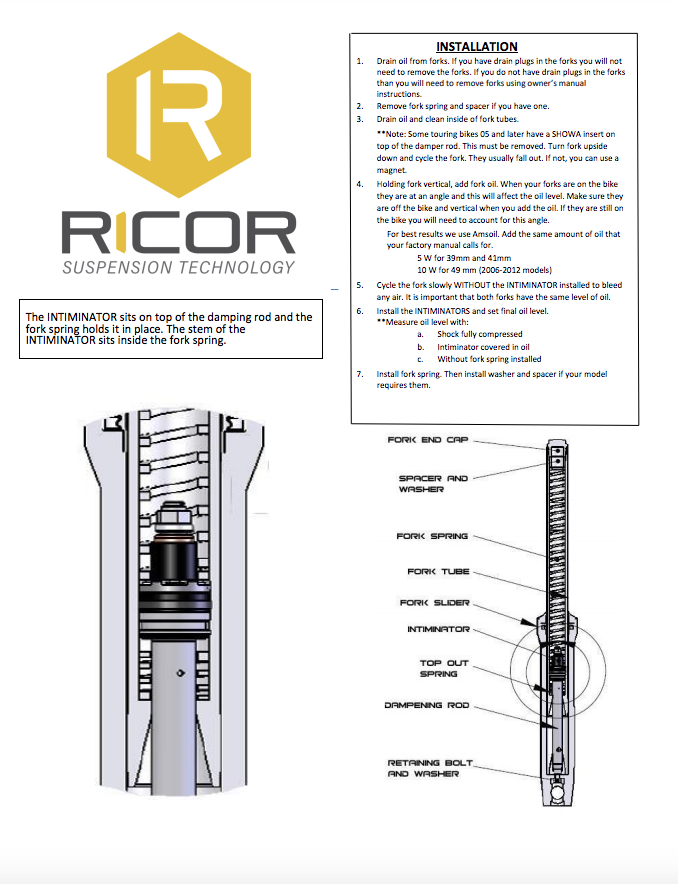
I decided to go with the Ricor Intiminators, mainly for the ease of installation. From what I’ve read, the technology is very similar. Ricor were unfortunately undergoing some restructuring and I had to wait months for my order to arrive, but it finally did last fall. (The company now has a new owner and is shipping again.) Installation was as easy as draining the oil, opening the forks, pulling out the springs, dropping the valves in, and replacing everything. Ricor suggest 5W oil, and strongly suggest Amsoil 5W oil. Little did I know that not all 5W oils have the same viscosity. Unfortunately, Amsoil is not easy to obtain in Canada, so I went with Bel-Ray.

Intiminator Instructions

At first, I was again underwhelmed. Ricor claims that the Intiminators can determine the difference between chassis movement (i.e. brake dive) and wheel movement (i.e. bumps and holes in the road). I imagine the former is much slower than the latter, so it seems possible from an engineering standpoint, but I still had some dive. To be fair, it might have had something to do with my braking. I basically went out on the street and hit the front brake a few times. Proper braking involves shifting your weight backwards and coordinating with the rear brake to get the bike to squat. I’ve since come to notice a difference in braking and an improvement in, if not the elimination of, brake dive.

But that is not the main reason for the upgrade. Once I got the bike up onto dirt roads, I noticed a huge difference in its handling. For once, I was taking corners in the dirt at speed, weighting the outside peg with the front end feeling planted. It’s almost like the valves work better at speed. I wonder also if the oil gets thinner as it heats, which is why Ricor suggests the thinner Amsoil. I decided from this one ride that it was time to buy a neck brace since I was now not poking along on dirt in 2nd gear.

Rear Suspension

OEMRearShock

OEM rear shock

My stock rear shock had over 92K on it and had never been serviced! You can’t service the OEM shock on this bike easily. That’s because there isn’t a valve to re-pressurize it. I found someone who could tap a valve, but that plus regular service would be $450. I also needed a stiffer spring since, with all my gear, I’m under recommended SAG by about 2 centimetres, even with the preload fully wound. A new spring is $230. All totalled, I was up close to the price of a new shock, and one that is much better.

740HR1

Stadium Suspensions HR1

I decided to go with Stadium Suspensions, a local manufacturer in Quebec that specializes in off-road suspensions. Going with a service instead of mail-order from one of the big manufacturers meant I could get the shock custom built. Thierry at Stadium was super helpful. He asked for me to weigh my gear, which I found was 70 lbs.! I guess that’s a lot compared to the minimalists, but that included one pannier full mostly of food and another with cooking gear, since that’s how I tour. A third large wet-dry duffle on the back and all my riding gear meant a lot of preload. One nice feature of Stadium is that they were able to incorporate my OEM preload adjuster into the new shock, which is a nice touch. No messing around under the bike with a wrench!

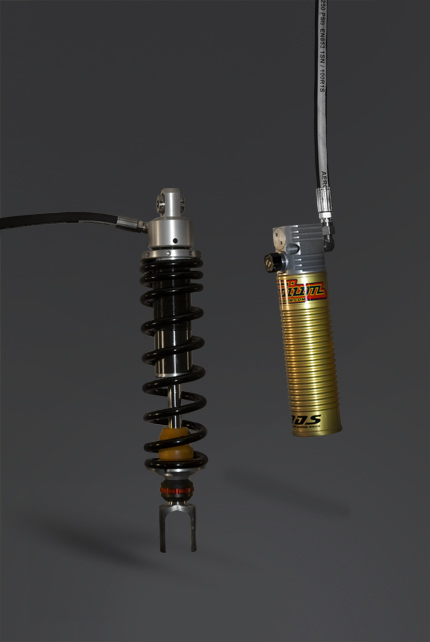
I went with their mid-level shock, the 740HR1. The big advantage of the HR1 over their base model (and my OEM) is the remote reservoir for the nitrogen gas. In a conventional shock with oil and nitrogen in the same compartment, when the shock is working hard all day, such as with off-roading, the oil can heat up to the point where it starts to mix with the gas and froths, creating compression fade. And because my bike shares the same frame with the Dakar version, which has a remote reservoir, there was already a cradle on my frame for easy installation.

20200624_183239

Reservoir with compression adjustment knob and, just above, the OEM preload adjuster knob.

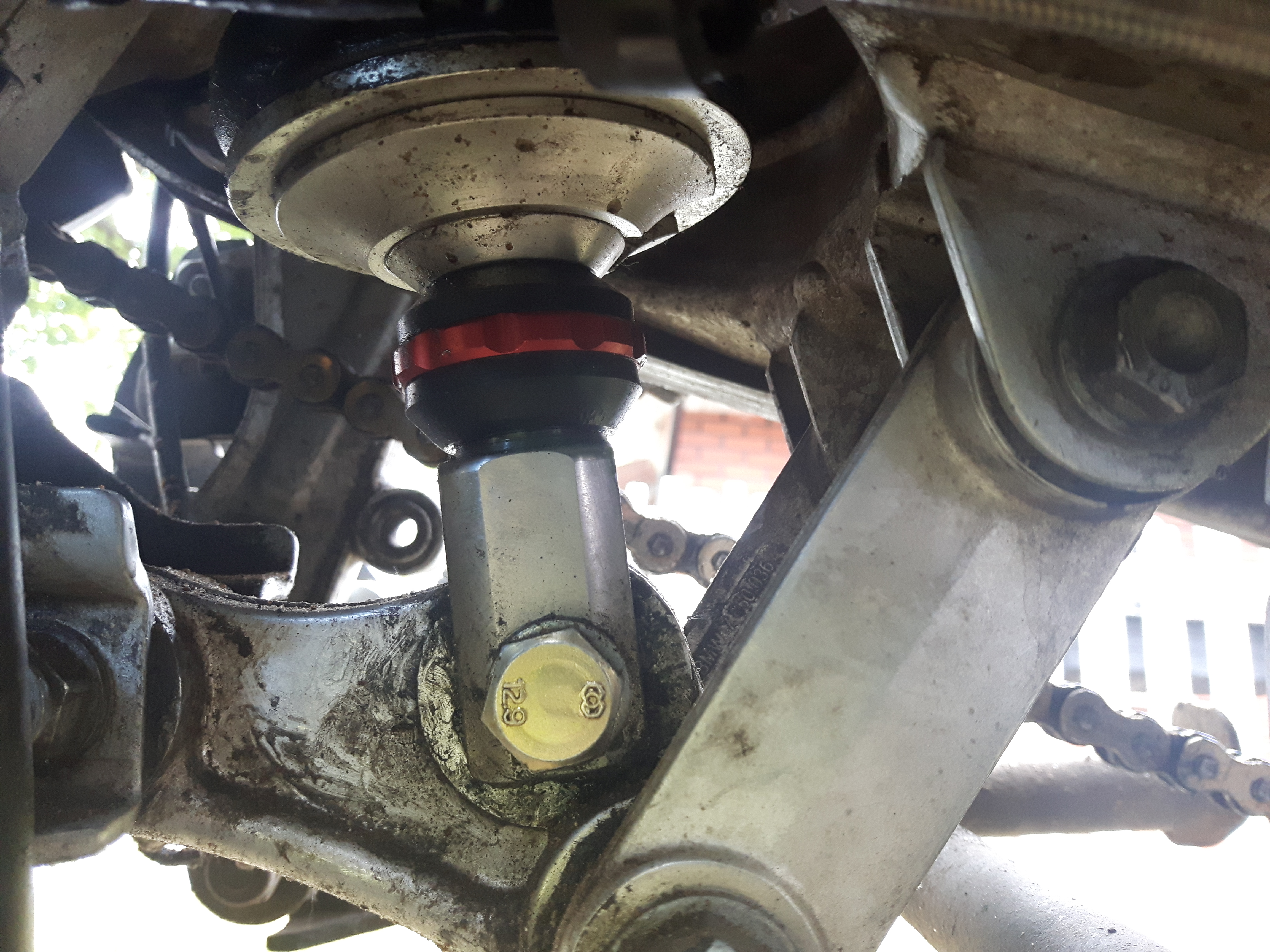
Yes, I have to loosen those ring clamps to change my oil filter, but that’s the price I will pay every 7,000 kilometres. It’s actually a pretty neat set-up. Tierry at Stadium had owned a 650GS so already had the designs for this shock on file.

Dialling In

I had three adjustments with this shock: preload, rebound, and compression.

Preload: There are a ton of videos online on how to set rider sag. Basically, you want to unweight the rear (using a centre-stand or pulling the bike onto its sidestand) and measure from the axle up to a fixed point. Then sit on the bike with your feet on the pegs (you might need to balance against a wall or, as I did, a fence) and measure again. Don’t forget to wear all your gear. The difference between your first and second measurement should be about 1/3 of the stroke. My bike has a 165mm stroke, so I was aiming for about 55mm. Stadium had chosen the perfect spring rate and it was exactly on the mark. Nice!

I generally leave the preload at Base unless my wife decides to come for a ride. I haven’t toured with the new shock, but I’ll be setting SAG again with all gear loaded before I head off.

Rebound & Compression: The way Stadium explain it, rebound is how easy or hard it is for the shock to extend; compression is how easy or hard it is for the shock to—duh!—compress. To my surprise, when I started playing around with these settings, I found rebound more significant.

20200624_183333

Rebound damping adjustment on Stadium’s shocks. CW=faster; CCW=slower

Crank up the compression setting on the remote reservoir and you feel the bumps, for sure, but crank up the rebound to its hardest setting and you feel like you have no suspension. Perhaps that’s why Stadium suggests starting with the softest setting and adjusting upwards to preference. I found that at the easiest setting, the bike was bouncy. For Montreal roads and off-roading (pretty much one and the same), I’ve landed somewhere in the mid-range.

For compression, that’s a little easier. I keep it in the mid-range except for when I go off-roading. Then I make it harder (to compress), which saves some damage to my stands and engine guard and prevents the shock from bottoming.

I still had some adjustment to do on the front too. I found the shocks still a bit stiff for rocky terrain, so I mail-ordered some Amsoil 5W oil, and based on this advice from suspension guru Dave Moss, I measured using height rather than volume. I also put a little less oil in to, as he says, ease up the middle part of the stroke to adjust for my weight. Recommended height is 120mm and I went with 130. I’ve only done one day of off-roading with this set-up but the front end is getting better and better. I might try even less oil next oil change.

The season is young and there is plenty of off-roading still to come. In the weeks and months ahead, I’ll be tweaking the suspension more, including tire pressure, which is another important setting. Do I adjust every time I go off-road or, as Jimmy Lewis does, just keep it at 28 psi for road and dirt? Of course, no expense or type of suspension can make up for crappy skills, so I’ll be tweaking them too. At least now I have a bike that I feel confident to do some serious dirt riding on.

Have you ever played around with your suspension settings? Do you know what your recommended rider SAG is? If not, the RaceTech database has the info you need. Just use the Product Search feature; you’ll be surprised at how much comes up! Before you upgrade, just make sure you are getting the most out of your current system. Devoting a little time to this will result in many hours of more enjoyable and safer riding.

Scotch_BW_web

photo credit: Ray Bourgeois

How to Survive the Off-Season

20200207_150331

As I write this, 40 cm of snow is descending on my home city of Montreal, Canada. My place of work is closed. In these parts, we call this phenomenon a Snow Day, and while you know in the back of your mind you’ll have to make up this missed work at a later time, for the moment it doesn’t matter. You have an unexpected day off!

Now what to do with your “free day”? Snow days for motorcyclists, however enjoyable, seem to accentuate what is already a painful time of the year. The bike is in storage for four months, leaving you counting the days toward spring and The Big Melt. You’ve got four months to fill and now you can’t even use work as a distraction. Well, here are some of my favourite ways to get through a snow day and the winter months.

Window Shop Online for Gear

My son likes to make fun of me because I’m always researching my next gear purchase. Gotta Get the Gear! I could walk into a store in the spring and buy everything I need for the new season, but what fun would there be in that? Half the fun is researching, and the other half is prowling for the too-good-to-be-true discontinued clearance-sale last-item deal in your size! (Fringe benefits of being abnormally slim is that the Small is often the last to go.)

Follow Someone Around the World

Can’t take the bike out for a spin? No problem. You can follow someone around the world online or in print. Currently I’m following Itchy Boots as Noraly makes her way solo up through South America towards Alaska. I’ve also recently discovered Ewen and Charlie’s YouTube channel where you can re-watch Long Way Round, Long Way Down, Race to Dakar, and By Any Means—all free. Thanks guys! But my favourite series is Races to Places with Lyndon Poskitt. Lyndon and Basil Bike tour around the world—but here’s the catch—they race in an international cross-country race on every continent. Hence Races to Places. Lyndon races in the Mongolian Rally, the Dakar, Roof of Africa, Baja 1000, and others, filming everything himself. It’s a huge commitment but he’s developed a huge online following. After 9 seasons and some 230,000 kilometres, the series has just wrapped up. You don’t have to watch all 9. Jump in anywhere; they’re all good. There are many, many more adventure riders spanning the globe and through the power of GoPro and YouTube, we can vicariously ride along. Martin Heidegger never anticipated this when he was so critical of technology. 

If old technology is more your thing, how about the book that started the adventure riding industry, Jupiter’s Travels? Or Lone Rider: the First British Woman to Motorcycle Around the World by Elspeth Beard? Also on my reading list is Motorcycle Messengers: Tales From the Road By Writers Who Ride, edited by Jeremy Kroeker. As more people today are travelling the world by motorcycle and then writing about it, a genre called motorcycle journalism is emerging. If you are shut in, a good book about riding can help pass the time.

Watch the Dakar (Again)

January means the Dakar, a 10,000 kilometre race over 12 days, the equivalent of riding from Alaska to Florida in two weeks. It’s the most difficult, gruelling, and therefore prestigious off-road race in the world. This year the race moved to Saudi Arabia and there was some criticism about that, but the racing is always good no matter where it is. Watch race summaries of each of the 12 stages or just sit back and watch the Best of Bikes compilation.

Watch Team Races to Places in the Eco Africa 2020 Rally.

One series I especially enjoyed this winter was Lyndon Poskitt’s team Races to Places compete in the Africa Eco Rally Race 2020. The race covers the same terrain as the original Paris-Dakar race, across northern Africa, ending on the west coast in Dakar. This was Lyndon’s next brain child after completing his round-the-world adventure in Races to Places. He put together a team of five riders for the race and brought along his dad and others as mechanics and support crew and a media crew as well, liberating him from doing all the filming and editing. In the first few episodes, we watch Lyndon build the bikes from the frame up (KTM 450 Rallys), introduce the team, organize the gear, and ship everything over to Africa. Then the racing begins. Every episode includes both race footage and life at the bivouac, and I find this series provides a better, more complete idea of rally racing than the professional Dakar footage. Well done Lyndon! Oh yeah, and there’s a dramatic conclusion. If you’re into rally racing, you can’t miss this 17-part series.

Learn New Skills

Sports psychologists claim that visualizing technique has the same physiological effects as actually doing it. That’s all the excuse I need to spend more time online watching motorcycle videos. But unlike the above, there are plenty of schools willing to offer rider tips and technical training for free. Clinton Smout of SMART Riding Adventures has an excellent series of instructional videos, as does Bret Tkacs at Mototrek. I also really like Brake Magazine’s Mini Tip Monday, where you can learn frivolous but impressive skills like how to do a donut, or spin turn, or get on and off your bike like pro. If those still leave you craving more instruction, why not get it from The Man himself, Graham Jarvis? Here are 5 Techniques to Improve Your Hard Enduro Skills. Even if you ride a big adventure bike like me or any other bike, these techniques will improve your riding.

Plan Your Next Adventure

Okay, leaving aside YouTube for the moment, another thing you can do during the winter months is plan your next adventure or tour. I plan to travel across Canada this summer, coming back through The United States. That’s a minimum of 10,000 kilometres, so I’d better get planning! I’m actually a pretty minimal planner, choosing to keep an open schedule and camp where convenient, but I don’t want to be riding past historic landmarks unawares. So I bought National Geographic’s National Historic Sites of Canada and am perusing it. I also have to decide if I’m going to do any of the Trans Canada Adventure Trail, Trans America Trail, or any Backcountry Discovery Routes while travelling. I’d like to, but because I’ll be solo, I need to get a sense of the difficulty of specific sections and routes. Fortunately, there is a lot of information online about these dirt options. But all trip planning begins and ends with GoogleMaps and Tripadvisor. So start getting excited about your next big trip by scouting your route, finding accommodations, restaurants, and not-to-be-missed landmarks. And if you’re not going on a big tour, you can at least scout your local area for those hidden gems.

Peruse Bike Forums

Speaking of trip planning, perhaps no better resource for adventure riders is ADVRider, including its hugely popular forum. I went looking for info on how many inmates (i.e. registered users) are on that forum and found nothing. But a list of registered users is 9342 pages long and each page contains 40 users, so that means there are 373,680 users! Wow! No doubt this reflects the popularity of the site and the ADV market. There’s a lot of good info there including forums on trip planning, ride reports, GPS & navigation, bike-specific maintenance forums, something titled Face Plant (I can only imagine what that’s about), and a personal favourite of mine, the Toolkit Thread. Everyone’s searching for that must-have, elusive tool, and it seems a matter of personal pride to many that they can whittle their entire toolkit down to fit inside a used pack of chewing gum. The other forum I practically live on during winter is f650.com. You may recognize the similarity in the name of that forum and this blog and that is not a coincidence. The Chain Gang, as it’s affectionately known, is a forum dedicated to owners of the BMW 650 bikes in their many iterations—Classic, Funduro, Dakar, and mine, the GS. Any mechanical issue I have, I go there first. Heck, sometimes I read about other people’s problems so I’m prepared for when that happens to me. Finding and reading a bike-specific forum devoted to your bike will alert you to the weaknesses of your machine and help prepare you for when you need to do that roadside repair.

Listen to Motorcycle Podcasts

Like YouTube and user forums, there’s a variety of motorcycle podcasts and you can find one that fits the kind of riding you like to do. One of my favourites is Adventure Rider Radio. Host Jim Martin and producer Elizabeth Martin do an excellent job putting together a weekly show that covers adventure stories, technical tips, industry developments, and more. But you don’t have to wait for a snow day to listen to a podcast. I use a podcast app on my phone that allows me to download the episode to my SD card and listen to it anywhere. I’ve found I can’t read on the bus after a day at work so a podcast is just the thing to zone out during my commute. 

Work on Your Bike

Of course, if you have a heated garage, you can always do some work on your bike. Heck, I don’t have a heated garage and still do work on the bike. Last weekend I spent some time in the shed removing the rear shock, replacing an engine mount, replacing the starter motor O-ring, and torquing my crankcase bolts. The temperature had risen to a balmy -8 Celsius (18 Fahrenheit) so I took the opportunity to do this work and be ready to ride come spring. I’ll be back out there as soon as my new shock is ready to install. A riding buddy repainted his entire bike last year, and another had the engine rebored and did other major mods, including repainting. If you are one of the lucky ones to have a heated garage, now is the time to do that maintenance and thumb your nose at the rest of us.

IMG_5313

Stay warm and carry on.

Write a Blog

Yes, you knew this was coming. Another way you can spend a snow day is by writing a blog post. 650thumper gives me the opportunity to revisit my motorcycle adventures, and when I heard that the college is closed, my first thought was that I’d like to spend my “free day” thinking and writing about the freedom of motorcycling.

How do you survive the off season? Let us know in the comments section below.

The Wish List, 2019

Biker Santa

It’s that time of the year again, when we reflect on the year that’s been and plan for the year ahead. This year I upgraded my training by attending two remise en formes, discovered Vermont’s wonderful dirt roads, travelled up the Gulf of the Saint Lawrence almost into Labrador, and wrote a handful of articles for northernontario.travel. I was so busy travelling, I didn’t do a lot of club riding, although I did lead two day rides: one to Ottawa for the Tulip Festival, and one to Smuggler’s Notch in Vermont.

Next year I want to start to introduce what I’m calling hybrid rides to our club. Those are rides where a group splits off from the main group and rides some dirt and then meets up with the gang later for lunch. I’ve been thinking about this for a while now but just have to figure out the logistics. I know there are some club members with ADV or ADV-style bikes who are interested in riding some easy dirt roads.

I want to do more challenging trail riding to improve my off-road skills, and it might finally be time to head across the country, completing that teenage dream of seeing Canada from a motorcycle. But more on that later. Right now I’m thinking of the goodies I’m asking Santa for to make my riding next year safer and more enjoyable. Here is the Wish List, 2019.

Stadium Suspensions PR1 Rear Shock

My rear shock now has over 90,000 kilometres on it and has never been serviced.  Imagine, that oil in there is 13 years old! Also, the stock shock on my bike is okay for road riding, but it’s too soft for any serious off-roading. The spring is also too soft; when I’m fully loaded, I’m sitting 2 cm under the recommended sag. I could try to have it serviced and replace the spring, but the combined cost would be almost as much as a new shock. I think it’s time to upgrade.

I’ve been talking with Stadium Suspensions in Beloeil, Quebec, just south of Montreal, where I live. They specialize in ATV, MX, and off-road suspensions. The nice thing about going with a company like this is that they can customize the shock to your weight and riding style. They have three models, and since I’m neither a beginner nor a pro, I’m going to buy the mid-priced unit, the PR1.

Stadium

You can see that this shock is an upgrade from my stock one because the PR1 has a remote nitrogen reservoir. On mine, the nitrogen is in the same compartment as the oil, which is fine for street riding, but once you get off road and the shock is working hard for extended periods of time, the oil heats up and mixes with the gas and froths and you start to lose your compression. Separating it is the answer; the best shocks are designed with a remote reservoir.

Other features of the shock include:

  • Spring preload adjustable
  • Rebound damping adjustable
  • Compression damping adjustable
  • Thermostatic system
  • Velocity Reaction Damping System (VRDS)
  • Bladder system reservoir
  • Length adjustable (+/- 10 mm)
  • Piggyback Reservoir, 360 degree angle adjustable
  • Magnum reservoir optional
  • Tool free compression knobs optional
  • Individually custom build for rider/application
  • Fully serviceable/repairable/convertible
  • Gold, red or blue, anodised reservoir
  • Progressive or linear springs

The other nice thing about Stadium is that they can build into the new shock my existing preload adjuster. I really like the ability to adjust the preload with the turn of a knob—no tools necessary—so I’m sold. With my new Ricor Intiminator fork valves in the front and this baby at the back, I’m going to be flying!

Protection

Speaking of which, I’m getting up to speeds now off-roading at which I really should be wearing a neck protector. A neck protector prevents your head from rotating beyond a certain degree, saving your neck in a fall. I don’t want to end up a quadriplegic, thank you very much. I don’t have a specific one chosen yet, but Leatt are a major manufacturer. Again, I don’t need the pro version (5.5) so I’ll probably go for the 3.5.

gpx_neckbraces_35__0000_leatt_neckbrace_gpx_3.5_wht_front_1020003950

In fact, I believe these are kind of a custom fit item since they are semi-restrictive, so I’ll probably just try a number of them on at a store with my helmet on and see which feels best.

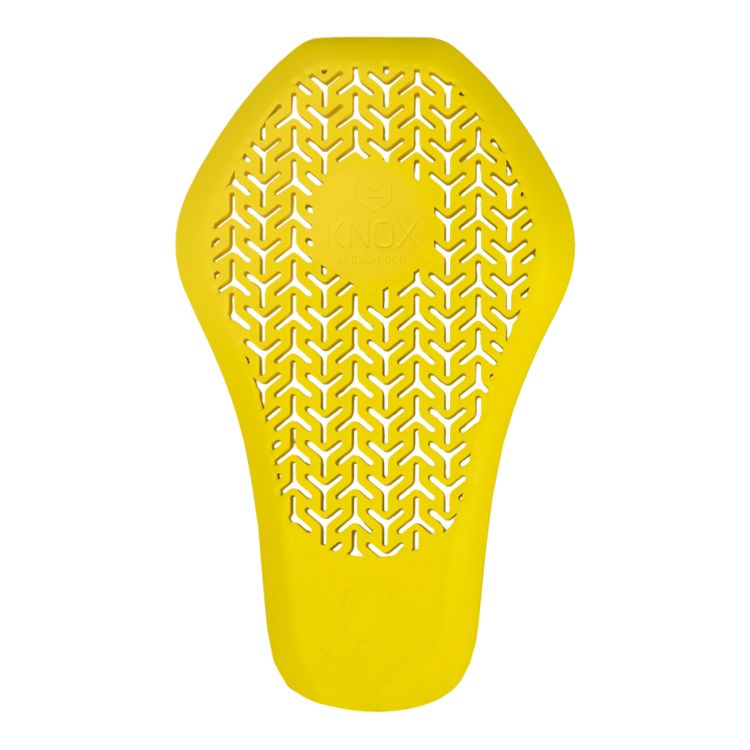
The other piece of protective gear I’ll pick up is a new back protector. I love my Knox Venture Shirt but the pack protector is cheap EPS and prevents air-flow. On those really hot days, it results in an uncomfortable wet back and has led me to not wanting to wear my protective gear. Knox have a better one which, as you can see, allows air circulation. It’s D30 so will provide better protection too. Neither do I want to be a paraplegic.

knox_microlock_back_protector_upgrade_part114_750x750

Auxiliary Lighting

I’ve been thinking of getting aux lighting for years, ever since I had a run-in with some roadkill coming home late one night from New Hampshire. Sure, you can get the cheapo made-in-China generic knockoff version at Amazon for $40, but they break easily and don’t stand up to the beating of off-roading. Everyone I know who’s bought cheap has had issues soon after. There’s also the quality of the LED light; it’s apparently not just a question of the number of lumens but the optics technology involved to reflect those lumens where you want them. If I’m going across the country, some auxiliary lighting will help get me there.

I’m pretty sure I’ve had Denali D4s on a previous wish list, but I think I’m going to go with the Cyclops Long Range Auxiliary Lights. I’m very happy with the Cyclops LED lamp I put in my headlight. In fact, it’s been one of the best upgrades I’ve ever done on the bike. It occurred to me the other day that Cyclops also make auxiliary lighting, so I’ll stay with the tried and true. Cyclops lights might be a little cheaper than Denalis and have a number of features that make them a compelling choice. I like also the smaller size on my little bike.

Cyclops

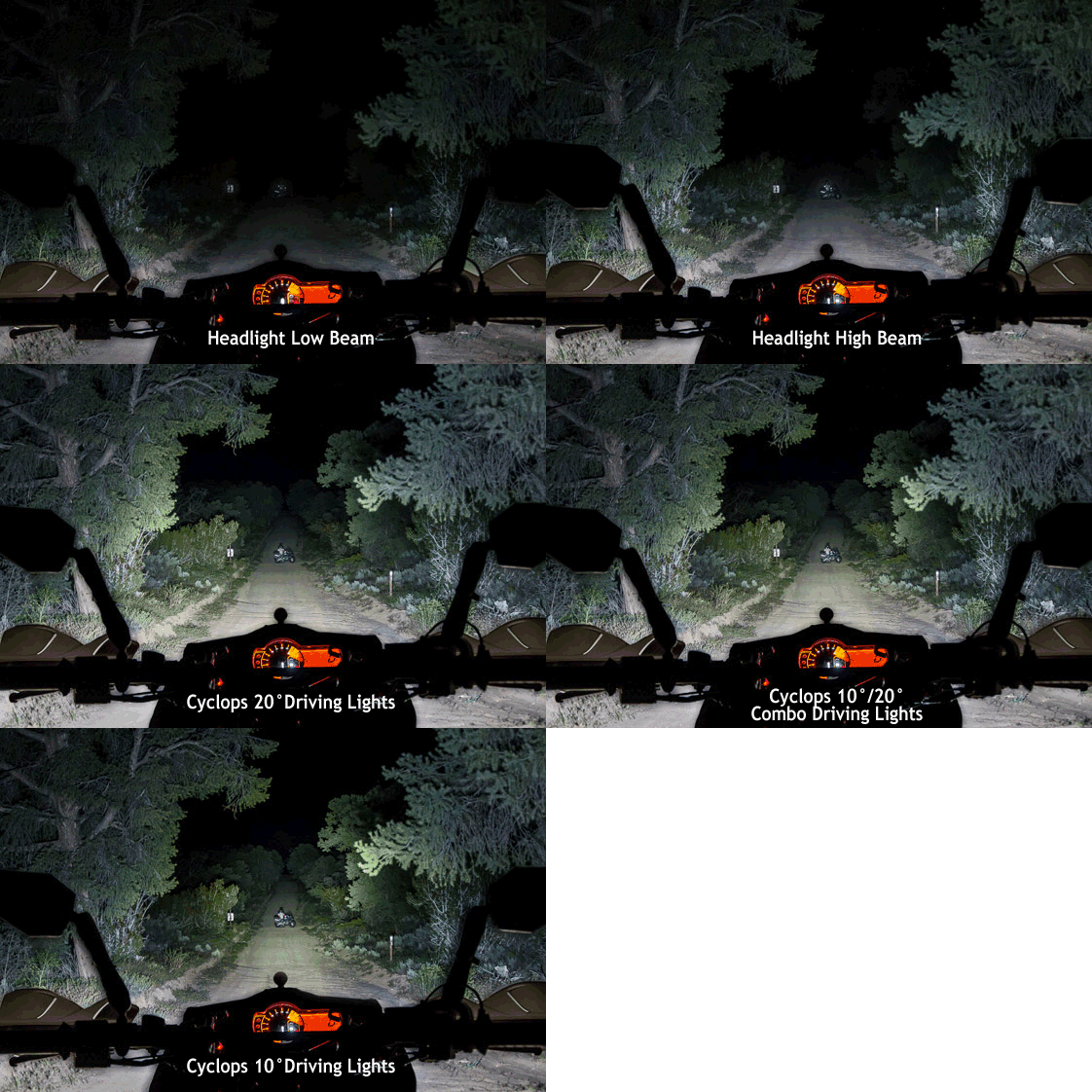
The Long Range lights stand up to their name by projecting a whopping 883 feet down the trail. They come in either a 10˚ or 20˚ arc, and a popular set-up is to put a 20˚ unit on the right and a 10˚ unit on the left. This arrangement will give good illumination of the side of the road while still penetrating those 883 down the road.

But of course it’s not just about seeing things but also being seen. Studies have shown that oncoming drivers sometimes mistake that single headlight for a double in the distance and turn in front of you. Having that triangle configuration makes you a lot more visible day and night.

One very nice feature of these lights is the ability to wire them directly into your headlight switch and program them. You set the intensity you want for low-beam driving lights so you aren’t blinding oncoming drivers. Then, when you flick on your high beams, you get full intensity. The plug-and-play wiring harness makes installation easy.

Got you curious about how good these are? Here’s a sequence of comparative photos provided by ADVPulse.

distance-sequence

Cardo Packtalk

Cardo

I’ve been of two-minds about communications systems. One of the things I like about riding is the solitude. Even when you are riding in a group, you are alone with your thoughts, as Ted Bishop aptly describes in Riding With Rilke:

When I first put on a full-face helmet, I have a moment of claustrophobia. I can hear only my own breathing and I feel like one of those old-time deep-sea divers. . . . When you hit the starter, your breath merges with the sound of the bike, and once you’re on the highway, the sound moves behind you, becoming a dull roar that merges with the wind noise, finally disappearing from consciousness altogether.

Even if you ride without a helmet, you ride in a cocoon of white noise. You get smells from the roadside, and you feel the coolness in the dips and the heat off a rock face, but you don’t get sound. On a bike, you feel both exposed and insulated. Try putting in earplugs: the world changes, you feel like a spacewalker. What I like best about motorcycle touring is that even if you have companions you can’t talk to them until the rest stop, when you’ll compare highlights of the ride. You may be right beside them, but you’re alone. It is an inward experience. Like reading.

Riding a motorcycle is one of the few occasions in my life to be in the moment. It’s just me and the sensations of the bike and the beauty of the surrounding environment. Why would I want to pollute that silence with people nattering in my ear?

Maybe I’m just anti-social. Maybe I’m a purist, or a rebel, or all three at different times. I’ve heard the argument about comm systems increasing safety, but my response is if you need to rely on others to stay safe, you shouldn’t be riding. On the big club tour I did last summer, I was the only rider without a comm device. Did I feel left out? Not really, except when I went to talk to someone at a rest or gas stop and that person gestured to say “I can’t hear you because someone else is talking to me in my helmet.” Yeah, ironically, comm systems can alienate people too.

But I’ve decided to join the club, so to speak, and get one, and I have to say it’s mostly for the ability to hear voice commands from my GPS, to hear incoming texts and send out voice-activated replies, and to answer and initiate phone calls while riding. But I’ll admit it will occasionally be nice to communicate with others in a group, especially if I’m leading. And of course there is always the option to mute the nattering when desired.

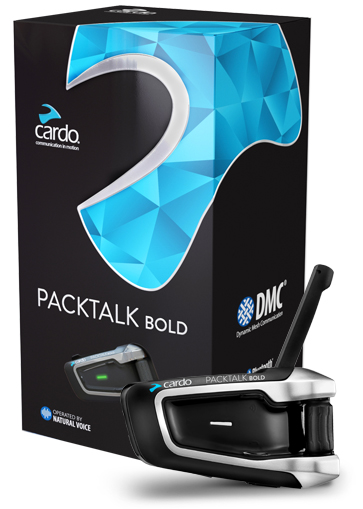
Club members are very happy with the Cardo Packtalk, mostly for its mesh technology which makes connecting (and reconnecting) large numbers of riders fairly easy. I had the opportunity to try one during a club ride and found the sound quality good. And while I didn’t have the opportunity to test the connectivity to my phone, other club members have said that the person you are talking to on the phone cannot tell you are riding a motorcycle, so the mic must work very well at cutting out ambient noise. My feeling is that this purchase is going to be the most significant change in my riding experience.

Pearly’s Possum Socks

Pearlys

Last but not least, I’m asking Santa for socks in my stocking. I heard about Pearly’s Possum Socks on Adventure Rider Radio. The host Jim Martin raves about them. Socks, you say? You want Santa to bring you socks? Well these are not just any kind of socks. They are a blend of merino wool, which I’ve raved about elsewhere, and possum fibres, which are hollow and therefore super warm since each fibre has a built-in dead-air space. (I wonder how vegan motorcyclists manage?) They are apparently also very soft. A little nylon to strengthen everything up and you have a premium sock that is warm, breathable, comfortable, durable, and anti-bacterial in a compression fit to aid circulation and to help avoid muscle fatigue.

At a premium price. With extra S&H to Canada and the currency conversion, these socks come to over $100 a pair! Gulp. I’ve balked a click away from purchasing them a few times, which is why I’m asking Santa to bring me some instead.

* * *

I always feel very First World, or is that now Developed World?, in making these lists. I’ve worked hard my entire life to achieve a certain level of material comfort, but I’m also aware of the opportunity I have here in Canada and the lack of opportunity less fortunate have elsewhere. And being year-end, I always end these lists by expressing gratitude for what can’t be bought: my health, my wife, and my son. I’m also pretty fortunate to have so many friends, a community of riders and others who help give life meaning and value.

We don’t have to look far to see those who are alone and without basic material comforts. And neither did Saint Nicholas, who gave his inheritance to the poor and became the patron saint of sailors, repentant thieves, prostitutes, children, and students, among others. His charity lives on amid the advertising and commercial hype of Christmas as long as we continue to look.

Happy holidays, and safe riding in 2020.

The BMW f650GS. It’s not just a starter bike.

P1000195

2006 BMW f650 GS twin spark. 

The BMW thumper is an iconic bike with a huge following for good reason. 

I’ve been reluctant to do a bike review of Bigby. For one, I still consider myself a novice. In fact, aside from a few bikes at my training school, Bigby is the only bike I’ve ever ridden, so I don’t have much to compare it to. Doing a review, I thought, would inevitably lead to the faulty comparison, a logical fallacy I warn my students to avoid. (i.e. “Gets your clothes cleaner!” Ugh, cleaner than what?) Second, I’m still learning about the bike. Although I’ve owned it for almost three years, I’m still finding my way around the engine and mechanics and still discovering its potential. Passing judgment now would be like bailing out of a relationship after the second date. It would be, in the literal sense of the word, prejudice.

So why have I decided to do it? Well, after watching a lot of reviews online, I’ve come to realize that most are not very good, so the bar is set pretty low. They are usually more product descriptions than reviews, and Ryan at Fort Nine has blown the whistle on the nepotism of corporate reviews, how they are always positive because the big bike companies offer a lot of treats to the reviewers, like paid vacations in exotic locations. And those reviewers ride the bike for, what, a day, a couple of days, max, so at least I can say that after three years with Bigby, I know more about this bike than they ever will. So with my concerns made explicit, let’s jump in.

* * *

The three things I like the most about the f650GS are three things I noticed within the first five minutes of riding it: ergonomics, suspension, and balance. Okay maybe you don’t need to have ridden a bike for long before you discover its essence. Let’s look at each in turn and then move on to other stuff.

Ergonomics: At the school, we’d learnt on cruisers—Suzuki Boulevards and Honda Shadows. The ergonomics of the GS are very different. Being a dual-sport bike, it’s capable of going off road, and you need the pegs beneath you in order to stand. This placement also results in your weight being distributed evenly between the seat and pegs, with knees bent at roughly 90 degrees. It’s the ideal sitting position and how every office chair should be set up, thus making the GS also a very capable touring bike. The dual-sport, according to its name, involves compromise, but there’s no compromise when it comes to ergonomics: the GS provides the perfect sitting position, and the capability to stand when you leave the asphalt.

The other thing I like about the ergonomics is that you can flat foot this bike. The standard seat height is 30.9 inches, so super low. This is confidence inspiring once you take it off road; I know I can easily dab a foot if needed. In fact, since I am rather long-legged, the seat was a bit too low; my knees were bent more than 90 degrees and I felt a bit cramped after several hours in the saddle. So when I upgraded my seat (more on this later), I went for the high version to allow a bit more room, and that has made all the difference. If you are long-limbed, you might want to look at the Dakar version, which has a 34.3 inch seat height, or swap the saddle for a taller one. Despite these issues in my lower half, I haven’t had to add bar risers, and when I stand, the grips fall perfectly to where I need them, maintaining my standing posture.

Suspension: As I rode off on my first ride, the second thing I noticed was the suspension. This bike is smoooth, at least compared to those cruisers. And what better place to test a bike’s suspension than Montreal roads! Of course it makes sense that a dual-sport bike would have very capable suspension; it’s designed to be able to handle some pretty bumpy terrain. But just before I went for my riding test, I hired a private instructor for a class. He rode behind me and commented on things he saw. Now here is someone who has a lot of experience with bikes and has seen a wide variety from behind. Ironically, the first thing he remarked when we first stopped had nothing to do with my riding but how impressed he was with the rear suspension of my bike. “I wish you could see what I see from behind,” he said. “It’s amazing!”

In fact, I’ve wondered if the suspension is a little mushy. I’ve only bottomed out a few times while off-roading, and the front end dives a bit under hard braking. I’ve considered upgrading the suspension, but frankly, at only 140 lbs, I’m actually underweight for this bike. Front suspension travel is 170 mm and rear is 165 mm.  Since ideal SAG is roughly 30% of total travel, SAG for the 650GS is 49.5 mm.. Even with the pre-load completely backed off, all of my 140 lbs is putting a little more than 45 mm on the suspension. Which brings me to another plus of this bike: the pre-load adjuster. Okay, it’s not electronically controlled like the new Beemer’s, but the ability to adjust with the turn of a knob when you are two-up or have gear on the back is a nice feature.

Balance: The thing I like most about the 650GS is its balance. This is accomplished mainly due to the gas tank being under the seat instead of high on the bike where it normally is. Where this is most noticeable is in how the bike corners. At the school, we were taught to countersteer to initiate a turn and to accelerate at the end to straighten up, and this was necessary with those cruisers. But I quickly discovered that on the GS you can manage an entire sweeping curve simply by leaning in and out. It’s hard to describe, but the bike feels like it straightens up itself with the subtlest weight shift.

The balance also shows when riding at slow speed, like in parking lots or technical sections off road. I’ll challenge anyone to a slow race any day! The bike is easy to move around by hand and to turn in tight spaces. With a little practice, I was riding figure-eights full lock. You can add all the accessories you like to a bike, but getting the balance right is something that happens at the design stage. BMW got it right on this one, which is why I was surprised to hear that they’ve moved the tank to the traditional location in the hump on the 2018 750s and 850s.

* * *

The engine is a Rotax, 652 cc single-cylinder, water-cooled, DOHC with twin spark plugs and four valves. It provides 50 HP @ 6,500 rpm and 44 lb/ft torque @ 5000 rpm. What these numbers mean is that it’s not the gutsiest engine. I’m up for a slow race but I won’t be challenging anyone to a drag soon. When I did my research, I kept hearing how this bike is a good beginner bike. There’s not a lot of power to manage, and you don’t have to worry about losing the back end by getting on the throttle too hard. On the other hand, it’s got lots of torque down low in the first two gears for hill climbs off road, and still some roll on in 5th gear at 120 km/hr. I’ve never maxed it out, but I’ve had it up to 140 km/hr and that’s fast enough for my purposes. And since we’re talking about gearing, 3rd and 4th are wide enough to enable me to navigate a twisty piece of road pretty much in one gear, depending on the type of road: roll off going into a corner, roll on coming out.

Single-cylinder engines have their advantages and disadvantages. One advantage is this wide gearing. My dad often talks about how he loved this aspect of his 350 Matchless. In heavy traffic, you can stay in 2nd and just ease the clutch back out when traffic picks up again. He once road his brother’s parallel twin and said it was horrible in stop-and-go traffic; you had to work twice as hard to prevent the engine from bogging. I suspect it’s this same quality that allows you to maintain your gear through a twisty section of road with slight variations in speed.

Another advantage of singles, I’ve recently discovered in this article in Cycle World, is that they offer a kind of traction control. As Kevin Cameron argues, “no other design produces such forgiving power delivery under conditions of compromised traction without elaborate software.” This is due to the millisecond duration of the exhaust stroke with big-bore engines, when there is relatively little power delivered to the tire, allowing it to regain traction if it begins to break loose. It’s like anti-lock brakes, the theory goes, but in reverse. Compare that to the constant power delivery of multi-cylinder engines, which makes managing power and traction more challenging.

A disadvantage of single-cylinders is the vibration. The Rotax engine is about a smooth as a single comes, I’ve heard, but it can still make your throttle hand go numb, especially if it’s cold, so you might want to invest in a throttle assist or throttle lock. I have the Kaoko and it works great. Unfortunately, the Rox Anti-Vibration Risers don’t fit my particular bike due to the configuration of the triple-clamp, but then I’ve heard those can make the steering mushy, which can be unnerving when riding off road. And it might be my imagination, but it seems that there are less vibrations when using the BMW oil. It certainly seems that the engine runs quieter and smoother, perhaps not surprising given that BMW design and test the oil specifically for their engines. Speaking of oil, the Rotax engines do not burn oil. Ever. Don’t believe me, go ask the inmates at The Chain Gang, a user forum devoted to the BMW 650s.

On the other hand, it’s a major pain in the ass to do an oil change on this bike. Because the engine uses a dry sump system, there’s an oil tank on the left side of the hump where a gas tank normally would be (an airbox is on the right side), so draining the oil involves removing the left body panel and draining that holding tank, plus draining the pan by removing the sump plug at the very bottom of the engine. If you have a bash plate, as I do, you have to remove that too, which, if it’s attached to the crash cage . . . and so on, until you’ve stripped the bike halfway down. Or you can drill a hole in your bash plate as I did, which makes that job a lot easier. You’re still going to get some oil on the plate, and you’re going to get some on the engine when you remove the oil filter due to its recessed placement, so just have plenty of shop towels on hand.

My 2006 650GS does not have rider modes and sophisticated electronics. It doesn’t even have anti-lock brakes. At first I was concerned about this and it was almost a deal-breaker for this newbie. But I spoke to a few experienced riders and they all agreed: better to learn how to control traction and perform emergency braking using proper technique than rely on electronics. Since I’m rather a purist in most things, I understand that. If you learn to emergency brake by grabbing a handful of brake lever and letting ABS do its thing, you aren’t going to develop the feel needed to control sliding in off-road situations. And not having all that sophisticated electronics makes the bike easier to maintain.

The 650GS is fuel-injected so there is an ECU. A 911 diagnostic code reader is available to help you troubleshoot the electronics, but it’s expensive. One advantage of fuel injected bikes is that there is no choke to deal with, and the ECU adjusts the fuel-air mixture according to altitude, meaning you can literally scale any mountain without having to change the jets of a carburetor or risk running your engine hot. The downside is that the throttle can be a little choppy so easy on the roll-off.

Two areas where the 650GS is lacking are the saddle and the windscreen. The saddle is hard and slopes downward, so you always feel like the boys are jammed up against the airbox. If you plan on using your GS for long day trips, you’ll want to upgrade the saddle. There are many aftermarket models available, including BMW’s own Comfort Seat, but I decided to go with Seat Concepts which, for about $250 CAF, they will send you the foam and cover and you reupholster it yourself using your original seat pan. I’ve done a blog on this job so won’t repeat myself here.

One issue with this era GS is the windscreen. The OEM screen is so small it barely covers the instrument dash. There are many aftermarket screens available, but finding the right one is a difficult matter of trial and error. The windscreen issues on this bike are well documented, and if you have sadistic leanings, just search at f650.com for aftermarket windscreens, sit back, and enjoy. The reading is almost as entertaining as a good oil thread. In my own experience, the bike came with a 19″ National Cycle touring windscreen, which was a bit high for off roading and was directing loud air buffeting directly onto my helmet. I swapped it for a 15″ but that too was loud, so I added a wind deflector and that solved the buffeting but I thought ruined the bike’s aesthetic, so I ultimately landed on a 12″ sport screen by National Cycle that protects my torso but keeps my helmet in clean air. The problem is the shape of the front cowling that the screen screws into. It angles the screen too much directly toward the rider’s helmet, instead of the recent bikes that have the screen more upright. The quietest screen on the aftermarket is the Madstad screen. It has an adjustable bracket that attaches to the cowling, allowing you to adjust the angle of the screen. It also has that crucial gap at the bottom of the screen, preventing a low pressure area that causes the buffeting developing behind the screen. Unfortunately, it’s a little pricey, but the real deal-breaker for me is that Madstad use acrylic, and acrylic screens don’t stand up to the abuse of off-road riding. National Cycle screens are polycarbonate.

Aesthetics: I love the aesthetics of this bike! Even ugly babies are adored by their parents, but sometimes I’ll look at a more modern luxury touring bike with the engine completely covered in plastic and I’m glad my bike has its guts hanging out like a proper bike. And I like that it has spoked wheels, which are stronger for off roading and have a more traditional look. Someone once said to me, “I love your old-fashioned bike.” Hmm . . . I hadn’t thought of it as old-fashioned but didn’t mind the comment. There definitely is a raw, real motorcycle quality to the bike, yet has refinements like heated grips and the quality control and reliability you’d expect from BMW. It is the ultimate hybrid dual-sport: part dirt bike, part luxury tourer.

In conclusion: The f650GS is a confidence-inspiring little bike that is perfect for not only beginners but also anyone who prefers a smaller, lighter bike. There’s a movement these days toward smaller bikes, with many people looking at the big adventure bikes with derision for their impracticality off road. I say it really depends on the type of riding you want to do and where you plan to take the bike. Due to its size and weight, the 650GS can go some places that the larger bikes can’t, but the cost is in vibration and rpms at speed on a highway. If you’ve got large areas to traverse but want the capacity to go on dirt roads when needed, then yeah, go for the big 1200GS that is so popular. But if you’ve got time and want to explore deeper into those remote areas, then the 650GS is an excellent choice. I plan on keeping mine as long as possible.

* * *

Pros:

Ergonomics for dirt and touring; smooth suspension; very well balanced; reliable Rotax engine; sufficient hp and torque for light off-roading; fuel injected intake has automatic temperature and altitude adjustment; classic aesthetics

Cons:

Cost (upfront and maintenance; even parts are expensive for DIYs); saddle is hard and uncomfortable; windscreen is useless, hard to find a good aftermarket replacement; engine can be vibey; only 5 gears

* * *

Modifications:

With the help of my son, I’ve created two walkaround videos describing the modifications I’ve done to the bike for dirt riding and street riding. 


Walkaround Mods for Dirt
Walkaround Mods for Street

How’d I do with my first review? Please comment and click the Follow button if you liked this post.