Dude, where’s my bike?!

20190908_140759I’ve been putting the kilometres on Bigby this summer. I’m now over 88,000 K and, to my knowledge (I’m 3rd owner), the rear suspension has never been serviced. I also had a small oil leak coming from the front of the engine, and I wanted to check that all the engine mounting bolts were torqued to spec. I hate doing maintenance during the riding season because I’ve lost the last month of the last two seasons waiting for parts, but I felt in this case, with three jobs needing to be done, I’d dive in.

This was the biggest job I’d ever done, as you can see from the photo above. The entire back half was removed. I mistakenly took off the fuel tank because I’d read you need to in order to reach one of the engine mounting bolts. Ha! As it turned out, that advice was referring to the 650 Classic, I believe, and in the end, it wasn’t necessary. But it also wasn’t that hard. I’d had the subframe lifted before, to get my shock off; the difference was just that all wiring had to be disconnected and the subframe bolts removed. I’d run the bike down to just a few litres of fuel, so my wife helped me lift the tank off. On this bike, the subframe remains attached and both are removed together.

With the tank off, I was able to access the suspension linkage easier. The deflection lever and tension struts (“dog bones”) came off easily enough.

20190908_110842

Rear suspension linkage

As usual, I took photos to ensure it all went back together the same way. But now the fun began. The pivot bolt that connects the swingarm to the frame was corroded inside and would not come out. It’s a big 12″ bolt that goes all the way through the bike from one side to the other. I checked the photo in my service manual; the guy is pulling it out with his fingers! Meanwhile, I whacked away with a hammer and drift but it wouldn’t budge.

I tried to get a bar clamp or C-clamp positioned to press it out, but could not get purchase with either; there was too much in the way. Finally I decided I had to lay the bike on its side, pour penetrating oil in the top end, and hope that it worked its way down to where the corrosion was.


No luck. I was beginning to feel like this guy who, after losing days trying to get his pivot bolt out, eventually cut the damn swingarm off! But I was not entirely out of options yet. I brought out the big boys: my dad’s old big ball-peen hammer and my sledgehammer. I flipped the ball-peen around to place the round end on the bolt, then, using it as a punch, hit the flat face with the sledge hammer. Slowly, slowly, the bolt surrendered, not to a higher intelligence, but a BFH!

With the swingarm off, I could see what the problem was. One of the bearings was seized. I guess this job was overdue.

20190908_141352

A picture’s worth a thousand whacks!

Of course my local BMW dealership didn’t have any of the needed parts in stock, so it was off to Vermont to pick up an order from MaxBMW. I love those guys! The parts took a week including shipping and came with their signature package of M&M’s included.

I’d never pressed bearings before and didn’t have a bearing press, but a YouTube video showed how you can use a common vice to do the job. You use two or three sockets on each end: one the same size as the bearing to press it out, and a bigger one on the receiving side to press the bearing into. You might need to add a socket on the press side to get the bearing fully out. With a little heat from a blow torch and a bar-clamp pipe as a cheater bar, it was easy. For some, I didn’t even use the heat. Just be sure to centre your press socket carefully to avoid damaging the wall of the swingarm or linkage.


I’d put the new bearings in the freezer overnight, so they had contracted and were easy to press in. A little heat helped but wasn’t necessary. Then I greased the whole thing up really well with the best waterproof grease I could find. My manual called for EP2 grease (Extreme Pressure).

20190921_153154

Out with the old, in with the new

With the new bearings in, I turned my attention to the other jobs.  A close inspection of the front of the engine indicated that the oil leak was not coming from either the starter motor O-ring or the clutch cover, as I had suspected, but the crankcase gasket. That’s the seam that runs the entire circumference of the crankcase front to back, holding the two halves together like a clamshell. My service manual indicated that the crankcase bolts are supposed to be 12 Nm, and two at the front were significantly below that spec. While I haven’t yet had the bike up to high revs, when the oil leak happens, I’m confident I’ve found the source. There were also a few other crankcase bolts further back in the engine that needed tightening.

Finally, the third job: the engine mounts. And here is where it became interesting again. I was missing one of the five bolts! Did I remove it earlier and lose it? I remember reading the specific instructions in my manual on where it is located and how it threads into the rear brake line bracket on the opposite side of the bike, but it’s not the kind of bolt one can lose; it’s M10 x 95mm. That’s a 9.5 cm long big bolt! Did I accidentally use it for one of the front engine mount bolts, which I removed to remove part of the frame? I searched the shed. I searched the workshop. I searched the grass in front of the shed. I searched my pockets, my tool bag, my car. I lost a day looking for that bolt, which had now become The Bolt and my wife was sick of hearing about it. To this day, I don’t know what happened to the 5th engine mount bolt. Fortunately, Canadian Tire had an M10 x 110 so I put that in. It’s a little long but will do the job until I get the proper one. Maybe it’s my imagination, but the bike seems less vibey, so perhaps one was missing all along??? Perhaps one day I’ll be cutting the grass and . . . gling! At any rate, I’m glad that all five engine mount bolts are in and torqued to the spec 41 Nm.

20190922_135602

Using a floor jack to position the swingarm

Finally it was time to put the bike back together: the swingarm and linkage went on nicely, including the infamous pivot bolt, which I’d cleaned up and given a liberal amount of grease, including some anti-seize on the nut. Then the rear wheel and then . . . uh! I forgot the chain, so it was either break the chain or remove the swingarm again. I felt like an idiot over that one. That’s a mistake you only make once.

So I removed the swingarm, looped the chain over it, installed it again, plus the rear wheel, the mudguard, chain guide, rear rack, etc. until Bigby was looking himself again. And just in time. I have a reservation for two nights at Mew Lake Campground in Algonquin Park this weekend. I’ll be photographing the fall foliage and writing an article for Ontario Tourism on Highway 60 that winds through the park.

Mechanical work is hard! It’s not just the physical exertion but all the troubleshooting and decision-making involved. Two nights at a campfire with my pipe and some scotch is just what I need to unwind and close the touring season.

20190923_140709

Ready for more adventures

The Wish List, 2018

Moto Santa

If I’m going to get my wish list to Santa before Christmas, I’d better send it now. This year has been a tough one for a few reasons, but mostly because my mom died in the fall. That threw everything off, including my blog writing. I just didn’t have the appetite to write, or ride, or do any of my other interests. But the midwinter holiday and the turn of the new year is as good an opportunity as any to turn the corner and start to look forward to the warmer weather and the chance to ride again. Here are a few things I’d like to get for the 2019 season.

But first, let’s take a look at what didn’t make it off my wish list last year.

  • Upper crash bars: check
  • Inline fuel filter: check
  • Flexible front flashers: check
  • Chain-breaker: check
  • Wheel lug/tire iron wrench: check
  • New front tire: check
  • Body armour: check (not Leat but Knox)

So the only two items that didn’t make it off my 2017 wish list were the Garmin Montana GPS, for the second year running, and the Sea-to-Summit mattress.

Garmin Montana 650

The GPS is a must this year; I can’t put it off anymore. As you know if you read my last post, I actually suffered a breakdown on my tour this summer from using a phone GPS. The port on the phone is just not built to withstand the demands of off-road riding—the vibrations, the moisture, the drain on the battery. I ended up jeopardizing my bike’s battery which led to the breakdown. And if you’re doing any serious off-roading, you’re often going to be outside of cell service. This is a fairly big-ticket item so I’ve been avoiding it, but fortunately, I’ve been doing some writing for Ontario Tourism and the money earned from that writing will offset the cost this year.

There is a new 680, but the 650 will be more than enough for my purposes and maybe I’ll get a deal on a discontinued model. I’m so tired of trying to use GoogleMaps to plan my rides! It works okay to get you there but you don’t have much choice in the route (just “avoid motorways,” “avoid toll roads,” and “avoid ferries.”) I’m looking forward to being able to use BaseCamp to plan rides on my computer and import tracks to the GPS. It’s also going to open up a whole new world of off-road track sharing through forums. The Montana is the most popular off-road GPS on the market, with topographical maps, the ability to geocache photos, dual map capability, a micro SD card slot, and many more features that I’ll probably never use. Best of all, it’s rugged.

A Lithium Battery

Shorai

Shorai LFX14L5-BS12

I’ve also decided it’s time to retire my old wet cell battery. I actually got two when I bought the bike. One died about a year ago, and the second is now getting weak. The battery on my bike is known to lose fluid because it’s right next to the upper oil tank, so it gets hot. Also, you have to remove all the plastics on the bike to check and to maintain the battery, so a low maintenance battery would be a huge benefit. I’ve decided to try a lithium battery. I heard about them on Adventure Rider Radio but had concerns about using a lithium battery in a cold climate like Canada’s. However, I’ve heard on forums that it shouldn’t be a problem. You just turn the electrics on for a minute or two to let the battery warm up before hitting the starter. I won’t have to worry about this one boiling dry, as my current one did outside of Mattawa, and an added huge benefit is that it’s much lighter than a wet battery. It’s the easiest way to shed several pounds up high on my bike.

Ricor Intiminator Fork Valves

Intiminators

41mm Ricor Intiminator Valves

This past year, I lost the preload adjuster on the rear shock. I think what happened was the new Holan upper crash bars install too close to the adjuster. The bars use the same mounting point, and I think the adjuster threads got strained from the tip-overs and eventually stripped. I was lucky to find a generous soul willing to swap me his adjuster for mine, but in doing some research on this item, I discovered that many riders find the suspension on my f650GS too soft, especially for off-roading. I’m not a big guy, so I don’t find the rear too soft, but the front end does dive under braking, and for the past while I’ve had a clunking noise coming from the forks on certain types of bumps. I was going to rebuild the forks this summer, replacing the bushings, so I’ve decided to install some Ricor Intiminators at the same time to firm up the front end. They don’t look like much, but these babies have something called Inertia Active Technology. Developed over a twenty year span, this technology can distinguish between chassis motion (fork dive) and wheel motion (bumps in the road). It allows the wheel to move and stay in contact with the road but doesn’t allow the forks to compress when front brake is applied. How, you ask? You’ll have to read the details of the technology at their site. The bottom line is that you get a cushy ride on the road without the fork dive under braking, and better handling off road. According to many comments on user forums, the suspension on my bike is its greatest weakness, so I’m looking forward to improving the front end.

K & N Air Filter

KandN

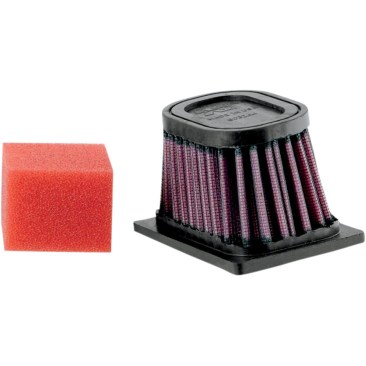
This one is kind of a no-brainer, which makes me wonder what took me so long to make the switch from paper to cloth air filters. Okay, I do remember reading up on foam filters when I first got the bike, but what I read was that the OEM paper filter protects better than foam. And that is true, partially. Dry foam filters have holes upwards of 90 microns in size, too big to stop sand, which can penetrate your engine and do nasty stuff to it. But an oiled foam filter will protect your engine just fine, and most dirt bikes and off-road bikes like KTMs use oiled foam filters. However, too much oil results in loss of power because not enough air is getting in to mix with the fuel. Recently I discovered the K & N cloth filter which protects as well as OEM but is reusable like foam. It’s also zero maintenance (no oil to administer) and is reusable; just clean in soapy water, rinse, and dry each year. Sounds like the best option for me. Goodbye disposable paper filters.

Klim Carlsbad Pants

carlsbad-pants-grey-30

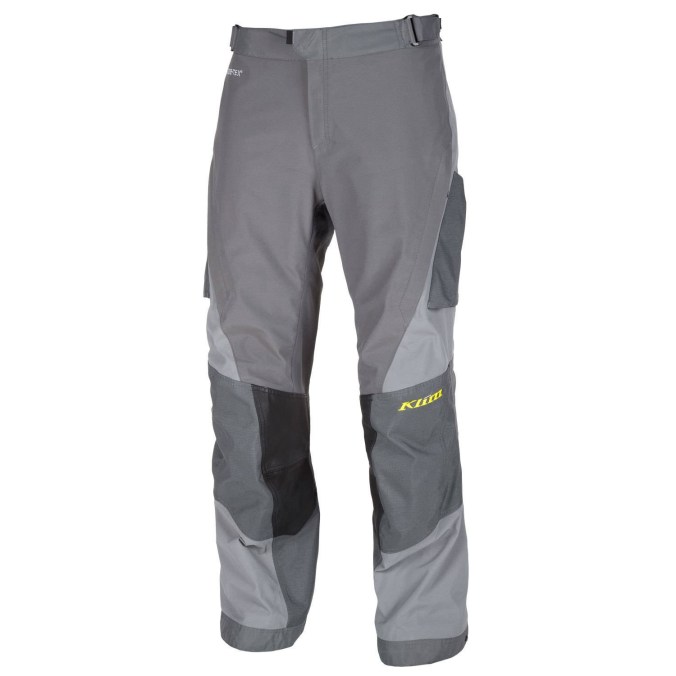
Santa came a little early this year with some Klim Carlsbad pants for me, so this one is not officially on my wish list. I love my Klim Dakar pants; nothing is more flexible and durable for off-road riding than the Dakars. But they are not waterproof. That’s just not the way they are designed. They are designed to pull through overhanging thorny brush without tearing, and to allow maximum airflow when it’s not, so not waterproof and not for adventure touring. I’ve been desiring a Gore-Tex pant that will keep me cool in the heat and dry in the storms. No stopping under bridges to pull on rain gear, no trying to anticipate weather—just ride rain or shine and remove guessing from your day. I saw these on sale 43% off their regular price about a month ago and jumped before Fort Nine sold out of my size.

Steel-Braided Brake Lines

Single Front Line

Last year I accidentally damaged my rear brake line while fixing my rear shock. I’ve decided I might as well take the opportunity to upgrade to steel lines which are better for off-roading anyway. Galfer lines are made in the USA, are model specific, and have teflon inner coating to avoid deterioration. There are even colour options for both the line and mounting hardware. I’ve already got new front and rear disc pads waiting to be installed, so I’ll be doing a complete brake rebuild in the spring.

That’s it. A suspension upgrade, a lithium battery, and (finally!) a motorcycle GPS top my wish list for this year. But like last year and every year, my main wish is continued health. A friend of mine is currently battling brain cancer and wasn’t able to ride last year. He’s recently had a setback and will be spending Christmas in the hospital. I’m thinking of him a lot and would gladly forego all these goodies and more for his health, but unfortunately there are no deals like that available in life. You have to count your blessings, and bless each day you have to live. However messed up this world is, experiencing all it has to offer is and always will be the most wonderful gift of all.

Merry Christmas and happy holidays to you and yours.

Bears, Mines, Batteries: Cochrane, Sudbury, Mattawa

Native Carving_web

Street woodcarving in Mattawa, Ontario

After playing in the dirt around Moonbeam, I decided to head over to Cochrane to check out the Cochrane Polar Bear Habitat. It’s the world’s largest and only human care facility dedicated to polar bears. They are located on 7 hectares of natural terrain and currently have three resident polar bears. I’m not a fan of zoos but these bears can’t survive in the wild and require human care; they were all either born in captivity or orphaned. The Habitat also advocates and educates towards protecting polar bears and their natural spaces.

It was an easy ride east along Highway 11 from my campground in Moonbeam to Cochrane. I stopped at Smoothy’s in Smooth Rock Falls for gas and breakfast.
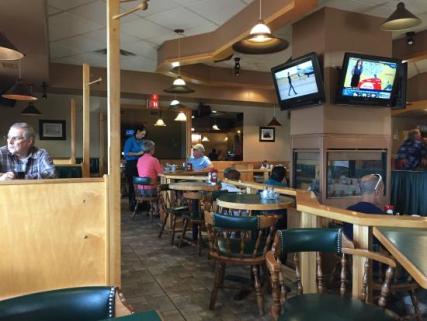
smoothy-s-restaurant

Smoothy’s Family Restaurant; Smooth Rock Falls, ON

Okay, they don’t win the award for most original name, but Smoothy’s was just what I was looking for: a classic diner where I could get an inexpensive bacon & egg breakfast with fried potatoes on the side. In the booth next to me were four retired men speaking French. In fact, pretty much all I’d heard this trip was French—in Iroquois Falls, in Moonbeam, in Kapuskasing. I’d never realized how big the Franco-Ontarian population is! A few Anglicisms had crept into their French, but I was surprised that the language and culture seems to be surviving just fine without any Bill 101 and its ridiculous sign laws or restricted access to education in English like we have in Quebec. Having said that, I must add that this past fall the new premier of Ontario decided to cut the French Commissioner position, a slap in the face of Franco-Ontarians and a sign of how vulnerable the French population is outside Quebec. Fortunately, Premier Ford reversed his decision a short time later, I don’t know whether due to pressure from Prime Minister Trudeau, public outcry, or common sense, once someone showed him the numbers and how such a decision would hurt him in the next election.

Another interesting cultural observation I had while up north was this billboard that I kept seeing.

20180726_125450

I’ve never seen anything like it around Montreal or southwestern Ontario. I’m not sure who the target population is, whether residential school survivors or men in general, but I think it’s high time we begin to discuss men’s issues, including sexual abuse.

With both bike and belly full, I pushed on to the Polar Bear Habitat in Cochrane. I arrived mid-morning and a tour had just started. “Run through to the first building and you can catch up to the group,” the lady at the entrance advised. So I did, only partway between buildings I was stopped in my tracks by the sight of two bears against the fence. They were huge! And exactly as you would expect with that distinctive long neck and pointed head, and not expect. Their fur is not so much white as golden, and their eyes and ears seem so small compared to their massive bodies, no doubt evolved to cope with blinding, blowing snow. I just stood there and watched them for a minute before heading in to catch up with the tour.

P1030294

The Habitat currently has three bears on location: Ganuk, Henry, and Inukshuk. Inukshuk, whose mother was shot when he was just four months old, is the father of Henry, bred when Inukshuk was at Zoo Sauvage in St Felicien, Quebec. Each bear has a unique personality and food favourites.

The facility is impressive, with natural and artificial areas, and a pool with a glass wall so you can see the bears swim underwater if they are in the mood. There are interactive learning stations for the kids and lots of information available on the walls and other exhibits for the studious, but really, everyone mostly just wants to look at the bears. They are magnificent!

Our guide reminded us that although they look cute and cuddly, the bears are dangerous and no one is ever alone with them on the inside of the fence which, we were told, is unbelievably more to keep people out than the bears in! They have had instances of people climbing in, I guess like the idiot videoed recently swimming nude with the sharks at Ripley’s Zoo in Toronto. Some people have the most warped sense of judgment when playing Truth or Dare after a few beers.

When the bears decided to head down to the natural pond, disappearing into the trees, I decided to step back in time a hundred years and headed over to Heritage Village. (Visitors to the Polar Bear Habitat also have access to Heritage Village and a snowmobile museum.) The village looks authentic and has been used for film sets. It includes a general store, butcher’s shop, doctor’s office, blacksmith’s shop, fire station, schoolhouse, and trapper’s cabin.

P1030303

No rollerball razors here. You can almost smell the lather and tonic.

While not the impetus of my visit, the Heritage Museum was interesting. It’s one thing to learn about history from a textbook or historical movie and another to see the physical artifacts of another era and another way of life. The buildings have been authentically decorated to assist the imagination in conjuring an ordinary day in the life of early 20th-Century citizens. When I returned to the bears, one of them was being fed strawberries through the fence.

P1030305

Staff feed the bear while children watch on.

Before leaving, I wandered into the snowmobile museum. I imagine Cochrane has quite the snowmobile culture during the winter months, and it’s a good idea to preserve some of these machines here for posterity. Each is labelled with year, model, and owner name.

P1030316

Each represents the cutting-edge technology of its day.

I started back toward camp but this time, as I passed through Smooth Rock Falls, I saw a sign for Lookout Road. Assuming it led to its namesake, I pulled off and headed up a dirt road; it was the adventure bug again. At the fork in the road, I went left and the road slowly deteriorated into a trail.
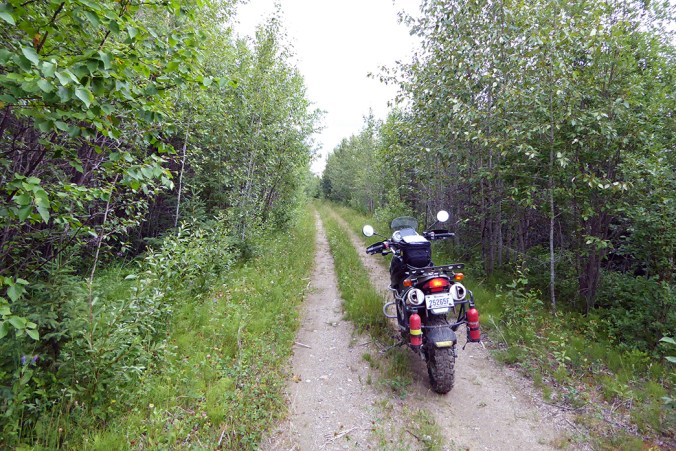
Smooth Rock Trail1_web

Another promising trail to follow. Would it lead to the lookout?

I was on my own and without a Spot device, so venturing along an unknown trail deeper into the bush was both exciting and unnerving. My worst fear was that I might find myself in a situation from which I couldn’t get back to the road, kind of like what almost happened when I had my off on the Lumberjack Trail, but hey, Lyndon Poskitt and many others are adventuring around the world solo so I figured I’d venture a little further along this trail. There were some muddy sections and some hills but my curiosity pulled me deeper, farther away from the road. The trail opened up into a meadow at one point, and then descended again into the trees, leading to this muddy puddle blocking the way.
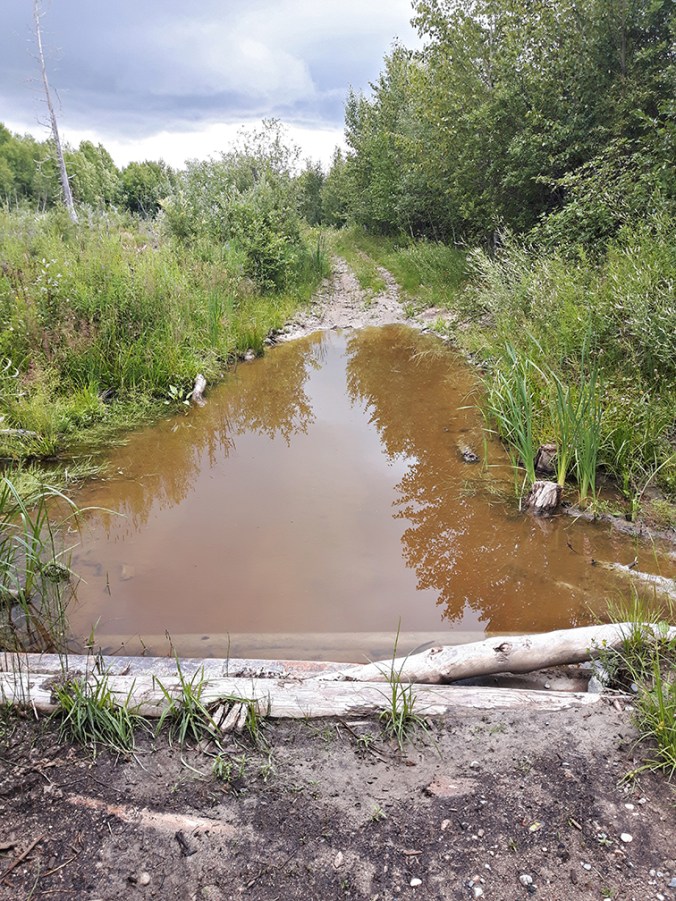
Smooth Rock Trail2_web

End of the line for this solo rider.

I wasn’t so much worried about going down those logs into the water as getting back. If I hadn’t been on my own, I would have gone for it, but since discretion is the better part of valour, I decided to turn back here.

Once I got back to the Y in the road, I realized that the lookout was just a hundred yards further along to the right. Doh!

Smooth Rock Lookout_web

The view was worth every misdirected inch to reach it.

The next day I started home. I had about 1000 km to cover in two days. I took the 11 east to the 655 south, which took me into Timmons. Traffic through Timmons was stop and go but there was no time to stop because I was trying to reach Dynamic Earth before it closed. After my experience in the coal mine at Springfield, NS, I wanted to go down into another, and Dynamic Earth offers a tour into the nickel mine there.

A little jog along the 101 at Timmons and soon I was on the 144 south. The 144 is another of Ontario’s great roads to ride. It’s a two-lane highway that cuts through precambrian rock as it descends down toward Sudbury. There’s a mixture of straight sections but the real fun is with the large sweepers. The highway is immaculately maintained with no pot-holes or tar snakes to worry you, and surrounding scenery is pure bush, so enjoy but keep your eye out for wildlife.

I stopped at the Tim’s just outside of Sudbury. It had been raining and again my phone was not charging. I gave it a quick charge at Tim’s, but I had to keep it short if I was going to catch a tour. I didn’t want to do the tour the next morning since I had a long way still to reach my home in Montreal. As I pulled out of Tim’s and cracked the throttle, the bike lurched and the tachometer suddenly read twice what the bike was revving. It was up in the red! I’d only seen this once before and didn’t know what it meant but did what I had done that first time: I hit the kill switch, let the ECU sort itself out, and restarted. Everything was fine and I got to the mine in time to catch the last tour of the day.
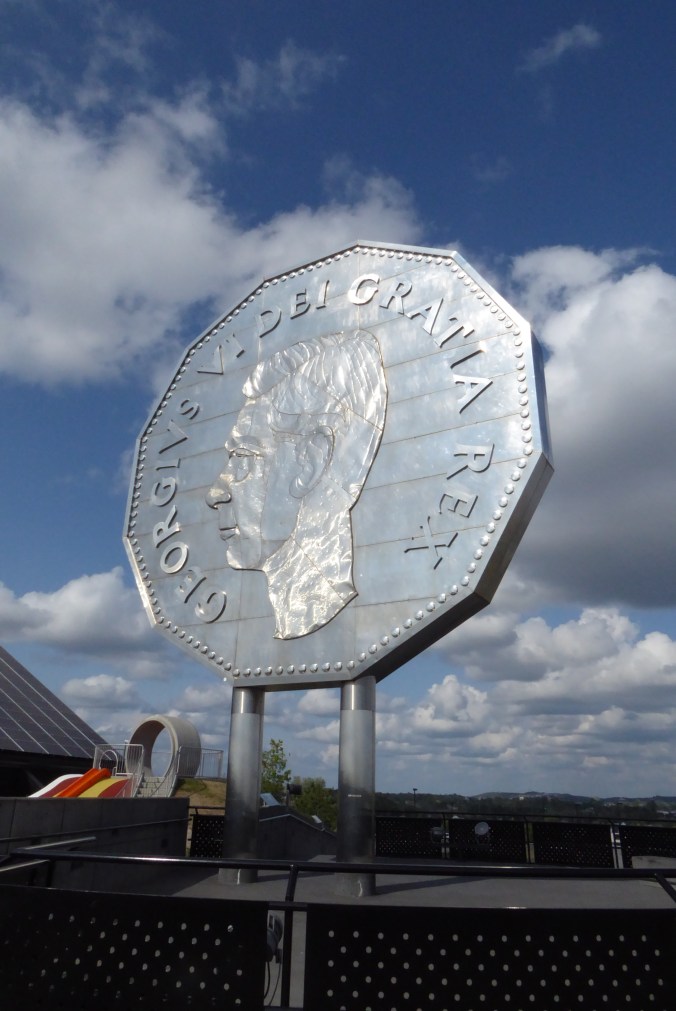
P1030390

Big Nickel at Dynamic Earth

We were given hardhats and descended 7 stories underground where the temperature is about 13C (55F). The tour takes about 1 hour and 15 minutes and shows visitors what mining was like from the earliest days at the turn of the century to today.

P1030350

In the footsteps of Sudbury’s miners.

The young guide was knowledgeable and informative, and the tour was animated with video installations and mock explosions. I could see how technology has evolved over the century to create a safer and more efficient work environment. Canada also has evolved over the century and now its economy is more diversified than before, but the country is renowned for its natural resources. It was opened by the fur trade, with forestry and mining the other big resources that followed. I’m glad I experienced this important part of Canadian history while I was at one of the country’s largest mines. The Sudbury mine has over 5,000 kilometres of tunnels; placed end to end, you could drive from Sudbury to Vancouver underground!

When we returned above, it was late in the afternoon and I was tired from the race down from Moonbeam. Although Dynamic Earth has a lot more to offer than the mine, I decided that was enough for one day and headed to a campground I’d found online. While en route my bike did that lurching tachometer thing again, and then my phone finally died. Fortunately, I’d packed a car GPS as a backup and it got me there.

The next morning I left Sudbury and headed east along the 17, the Trans Canada Highway, into North Bay. I decided that the 533, although out of my way, was just too good to pass up, so I turned north onto the 63. As I did, I saw a woman rider by the side of the road on her phone. Naturally, I stopped to see if she needed some help. The chain had come off her Kawasaki 650 Ninja. She was trying to reach the local garage but no one there was answering. She told me her male friend did all the maintenance on the bike for her and she didn’t have a clue how to tighten the chain. I’m always surprised that some riders, male or female, don’t know how to do the basics. It just seems that you would always be so vulnerable, but then again, I guess the vast majority of drivers don’t know even how to jump-start a car, so perhaps I shouldn’t be surprised.

I tightened everything up for her and headed on my way, not knowing that soon I’d be in the same situation. As I was enjoying the 533 east, the bike surged and the tach jumped to double again. This time, rather than resetting the ECU with the kill switch, as I’d done before, I decided just to let the bike run as is; I knew the engine wasn’t revving that high—the tachometer was giving a false reading—so I kept going. The 533 is the twistiest piece of road I’ve ever ridden and a lot of fun, but I soon decided to take it easy since the bike was surging and lurching more and I couldn’t trust it. As I came down into Mattawa it stalled. I restarted it and drove another hundred yards and then it died again. As I rode the main strip in Mattawa, it died on me several more times and then I couldn’t restart it so I coasted in to a spot at the side of the road beside an entrance. As I did, I noticed a BMW 1200GS on the other side of the entrance, so we were the BMW bookends of this particular drive.

No sooner had I removed my top bag and dug out my tools than I heard a voice say “You’re missing a cylinder.” It was the owner of the 1200 and he introduced himself as John. He hadn’t seen me limp into town so I explained the situation. Being an ADV rider himself, he naturally said I could crash at his place in North Bay if needed and use his tools to fix the bike. He thought it might be the regulator. I thought it was a plugged fuel filter. I stripped the bike of the plastics and pulled the cover off the fuel supply, cleaned the filter and put everything back. The bike started and idled okay. Only before setting off, I had the voice of the Jack Nicholson character in the movie Bucket List in my head, “Never pass up a bathroom,” so I killed the engine and took care of business. When I returned to the bike, it wouldn’t start. Dead battery. Completely dead. Things were going from bad to worse.

I asked John for a push to bump start the bike. We must have been a sight heading up the main drag, me on the bike, he pushing from the back. The bike started but I couldn’t keep it running. As soon as the revs dropped to idle it died. Then we couldn’t start it at all. Fortunately my spot was still vacant so I coasted back, stripped the bike again, and removed the battery. John suggested I take it to the garage on the corner and get a quick charge on it.
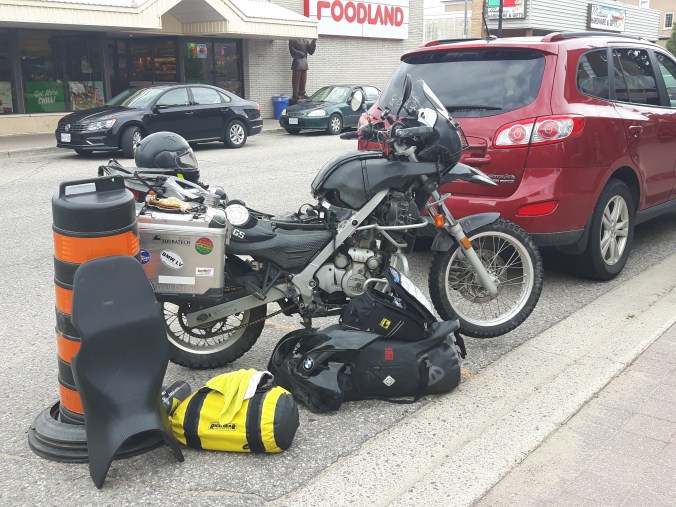
20180728_131236

Curb-side maintenance on Bigby.

Now I had an hour to kill so I grabbed some poutine from the local chip stand and watched the lumberjack races. It was Voyageur Days in Mattawa.

20180728_112555

Audience participation at Voyageur Days

I wandered up to the local Tim’s and, while walking back, saw John as he was heading back to North Bay. He repeated his offer if I couldn’t solve my problems.

When I got to the garage, the owner-mechanic was gone.

“He went to the fights,” the young lady running the gas bar said.

“The what?”

“The fights. There are fights tonight.”

I was trying to imagine what kind of fights would be in Mattawa but eventually just helped myself to my battery, which was still on the charger. It was $10 for the charge.

I got back to my bike and installed the battery, replaced all the plastics and loaded the bike again. Now was the moment of truth. I turned the key and hit the starter: the bike made a grunt. Hmm . . . I guess I’m staying in North Bay tonight. Then I hit the starter again and it fired! It idled!

I know now what the problem was. I had been charging my phone off the battery throughout the trip, sometimes even when the bike wasn’t running because I needed it. I should have known that the battery is only for starting the bike, not a portable power supply. All that charging had boiled three of the cells dry. The morning of my problems, it was cold and I had the phone charging and the hand warmers on high. The charging system couldn’t keep up and the battery got further drained. When the battery dies, the instrument panel starts doing crazy things and the ECU acts up. The single source of my problems—the surging, the weird tach readings, the eventual non-starting—was a weak battery.

I now finally started heading home. At that time, I still wasn’t sure if the regulator was acting up and if the battery would drain while riding to Montreal. I kept a constant speed and didn’t ask much of the bike. I stopped only twice. Both times I kept the bike running because I wasn’t sure it would start again. I even kept the bike idling while filling it. Who’s going to stop me?

Just outside of Ottawa, I nipped into a convenience store to use the bathroom. When I came back outside, a brown liquid was pouring from underneath the bike. Problems on top of problems! My first thought was oil leak. I dipped my fingers into the puddle; it smelt like gasoline. Perhaps I overfilled it? Did it have something to do with not turning off the bike while filling? I wasn’t sure but now had extra incentive to get home. Fortunately, when I straightened the bike up off the side stand, the flow of brown liquid stopped. If I could keep the bike relatively upright, I could get home. I’ve never had such a stressful ride!

Again, I now know what was happening. Earlier in the summer, I’d had the bike on its side for the better part of a day. Oil had drained into the air box and the brownish liquid draining from beneath the bike was from the drain tube. I’m still not sure why it smelled like gas or why it was only draining now, but it was not coming from the engine.  It was draining from the air box.

I pressed onward, ever closer to home, keeping an eye on my instrument panel, half-expecting the oil light to come on. Each kilometre, I thought, was one less kilometre my wife would have to travel with a trailer to pick me and Bigby up. I was hoping to keep a steady speed all the way, but as luck would have it, the major highway passing through Ottawa was closed! It was stop and go traffic for miles as we were rerouted through downtown Ottawa, adding hours onto my trip. What a day!

Once back on the highway, it was smooth-riding. As I approached the border into Quebec, I could see lightening flashes in the distance ahead. Riding into a thunderstorm seemed the perfect climax to a stressful day, but thankfully it opened up just as I pulled into my driveway. My guardian angel had gotten me home again—and not a moment too soon.

Riding an old bike has its disadvantages, for sure, but I have to admit that the problems of the day were more my fault than the bike’s. I depleted the battery by using it to charge my phone, and I forgot to clean the airbox after the bike had been on its side. In the end, I was super lucky that Bigby conked out where he did, in Mattawa, with a mechanic on duty and John for support and advice, not on the 533 where there isn’t even cell service.

Each time I tour, I learn a little more about the bike and about riding. I’m building my knowledge in lower-risk places close to help. And each year I venture a little further off the asphalt. I’m already planning next year’s tour that will take me deeper into the bush and into more challenging terrain. Who knows where I might end up? I don’t know where I’m headed but I almost always enjoy the ride.

Double, Double Toil and Trouble

20180502_105955

People sometimes ask me, “Where did you learn how to fix your bike?” I answer, “I didn’t. I’m still learning.” Being a DIY guy is a never-ending process. But the start is usually the same: an oil change. The first thing I did with my 650GS is change the oil and coolant, and because we live in the YouTube era, I lucked out and found a great how-to video by Kirk of the BMW Motorrad Club of Northern Illinois doing this very service on my exact bike! I love Haynes Manuals, but there’s nothing like seeing someone do it “in person.”

From there, I changed my brake pads. Brakes! you say. Don’t you want to get those done by a professional? I know, there’s an emotional component to brakes, but the fact is, they’re really not that complicated—a disc squeezed between two asbestos-lined pads.  When time came (40K) for valve adjustment, I did a bunch of research and plunged in. Each time I start a job I don’t know where I’m going but I figure it out along the way. As the American poet Theodore Roethke says, “I learn by going where I have to go.” And each time I go, I learn more about my bike.

Sometimes the journey is made longer because you don’t know what the cause of your troubles is. All you’ve got are the symptoms. In those cases, your diagnosis is easily half the work. Now if you are an experienced mechanic, you’ve seen it all and you can make an educated guess and save yourself a lot of time. Or you have a machine that costs the equivalent of my monthly wage and does the diagnosis for you. But if you’re a DIY guy on a budget, and this is the first time you’ve experienced these symptoms, you’ve only got the Fault Finding section of your service manual, the brain hive of a good user forum, and your intuition. Using these three tools in the right combination is the most useful wrench in your toolkit.

So when my bike overheated last fall after a little tip-over in sand, spewing boiling coolant out the overflow reservoir, I packed my bags and stepped out for a new journey, one that would prove to be especially long.

I don’t know how the editors of service manuals order the list of probable causes to certain problems. Do they list them in order of most probable to least, cheapest and simplest to expensive and complicated, or some combination of both? Since I’m on a tight budget, I tipped the scales toward cheapest fix first. Top of my list, then, were things like coolant level low, radiator pressure cap defective, thermostat stuck open or closed. So I started there, specifically with the thermostat. I took it out and tested it, sticking it in a pot of water on the stove with a thermometer. It opened just fine at the temp it was supposed to but didn’t close once the water cooled. Hmm . . . Could this be the problem? So off I went to BMW for a new thermostat. At $65, it’s got to be one of the cheapest parts on this bike, so I was hopeful I’d found the problem.

I put the new thermostat in and rode one block and the temp light came on. Damn!

Next I focused on the fan. Was it running when the bike overheated? I couldn’t remember so I texted my riding buddy. He couldn’t remember hearing it running either. Maybe there’s a problem with my fan, then? I connected it directly to the battery. It worked. Good, I guess. Maybe the sensor that turns on the fan is defective? My neighbours must have been wondering what I was doing with my camping stove out on the driveway beside the bike, but I had taken the sensor out of the engine block and was heating it in a pot of water, as I did with the thermostat on the stove. The fan did not turn on. So off I went to BMW for a new sensor. I was confident I’d found the problem.

I put the new sensor in, started the bike and ran it up to temp. The fan turned on. Great! Then I rode one block and the temp light came on. Damn!

Turns out the sensor works by pressure as well as temperature, so heating it alone would not trip it. On the plus side, the fan was turning on, so I knew that system at least was working properly.

The most recent time the temp light came on I noticed some coolant dripping from the bottom corner of the radiator. I surrendered to what I was dreading and denying: the radiator must be leaking. At $600 for a new one, this brings us to the point in the journey where I decide to stick the bike into winter storage early and avoid the problem, at least until spring.

It’s been a pretty brutal winter here in Montreal. Finally spring came, I bought the new rad, installed it, rode one block and the temp light came on. Damn! Double damn!

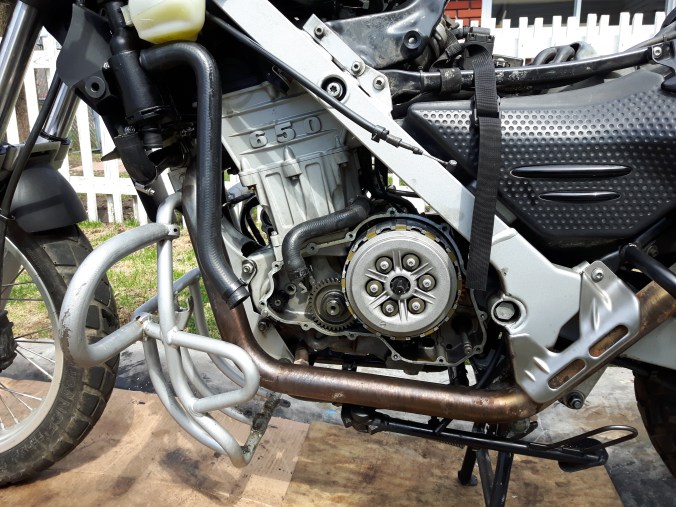
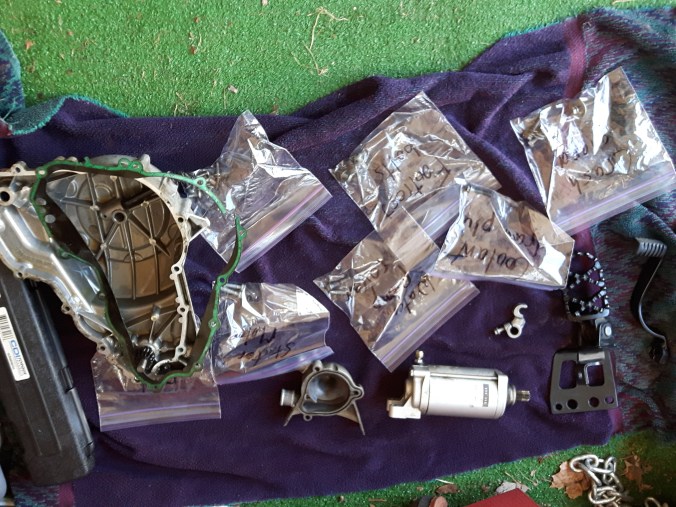
I’m not going to say the rad wasn’t broken, because I think it was. It was bent from the tip-over and clearly leaking, or so my wallet says. So my problem is . . . shall we say, multifaceted. I little sleuthing on my favourite forum uncovered that the water pump on my bike tends to go at around 50-60,000 kilometres. My bike now has 63,000. I knew this before buying the rad, but because it’s quite an involved process to get to the pump, and because the rad was leaking, I thought it was a long-shot that the pump would go at the same time as the rad. But go it did. When I finally got the pump apart, which involved taking the clutch cover off, the gear that drives the impeller was stripped.

Believe it or not, I was actually happy to see this, for at least then I knew what the cause of my problem was.

How was I to know that both the radiator and the pump were broken? And the pump issue seems to be unrelated to the tip-over. There’s been an effort on the forum to try to get to the bottom of what’s causing the stripped gears but there doesn’t seem to be any consistency. For some guys, it happens out of the blue with no apparent cause; for others, it’s after a drop. My guess is that the impeller shaft gets worn and starts to wobble. Sometimes this results in the seals leaking, sometimes the gears stripping. At any rate, it seems to be the Achilles heel of this bike. Now I know.

With the bike back together again and all fluids replaced, I rode off and the temp light did not come on. Now I’m ready for another season and my journey can be of the real kind.

I enjoy working on the bike, or any kind of manual work, actually. Okay, sometimes there are frustrations, like when I couldn’t figure out how to get the clutch cover off with the oil return line in the way. But that too is just a matter of knowledge. I struggled for a while, then went on the forum and read that some guys loosen the exhaust manifold bolts just enough to drop the exhaust pipe out of the way. I’m looking forward to the time when I know this bike so well that the troubleshooting part will be a no-brainer and I’ll know the route before starting a job. Until then, patience and persistence are my travelling companions. 20180422_145248

Blemishes or Character Marks?

“I want a poem I can grow old in,” writes Eavan Boland at the start of her essay “The Politics of Eroticism.” She goes on to explain that she wants a poetry in which she is subjected to the effects of time, not an object frozen in time. You might not think that’s very erotic, but that’s not her point. Her point is that she wants poetry that celebrates real women, creatures of time, not illusory women, sprung from the imaginations of male writers.

Why am I thinking of this now? Because my mistress has a wrinkle and I’m not sure whether I want her to get cosmetic surgery. I’m speaking of my bike, of course. Last year, as a result of a few offs in mud, one of the side panels got scratched. This was before I bought my upper crash bars. Now that I’m about to install them, I thought maybe I’d do a little bodywork first to make her good as new. I posted a query on my forum requesting tips. I’ve done bodywork on an old car with aluminum panels before but never worked with plastic. Someone replied with a lot of information for me, but someone else wrote “I kind of like my ‘character marks’  . . . makes it look like I actually use my bike in places other than Tim’s or Buckie’s.” That got me thinking. Are scratches blemishes or “character marks?”

I know a club member who sold his bike because it had a scratch and got a new one. Why he didn’t just get the scratch fixed I don’t know. Perhaps he was ready for a change anyway. But for some riders, the bike’s pristine appearance is an important part of the experience of riding. They spend hours polishing it on weekends, prepping for the club ride. I’m thinking also of the Americade parade I witnessed en route to an off-road rally last June, when all the Harley’s were lined up at the side of the road on display. I get it: the aesthetics of machines. I’ll be one of the first to admit that each bike has a personality, and a good engineer will take into consideration form and function.

On the other hand, aside from “character marks,” I’ve heard scratches referred to as “honour badges.” What’s so honourable about dropping your bike, you ask? I guess, the theory goes, that if you aren’t dropping it once in a while, you aren’t riding it hard enough. You aren’t pushing your limits. There’s growing derision for folks who buy a big 1200GS with luggage, maybe spend $2,000 on a Klim Badlands suit, but never venture off the asphalt. Posers. I’m not knocking anyone who doesn’t want to ride off-road, just those who don’t but buy an off-road bike and gear. And if you’re going to go off road, you’re going to drop the bike. Maybe not if you’re only doing dirt roads, but once you get into mud or trail riding, sooner or later, some rut or rock or lapse of concentration is going to get the better of you. And your bike. There’s just no avoiding it indefinitely.

So why not embrace it? If you ride around fearing a little mishap that might blemish your Precious, you’re not going to have much fun. And you did buy the bike to have fun, right? To ride it, take it places you can’t take other bikes, challenge yourself with a rocky hill climb or water crossing, try some single-track, where tree branches or underbrush might jut out onto the trail, slide the back end around a corner, and yes, show off your mud-splatter and scratches at the local coffee shop.

It’s the first beautiful day of the year here in Montreal. Hard to believe we had freezing rain a week ago. It feels like the unofficial start of the season. Enjoy your ride, whatever kind of ride you do.


The Mother of Invention

Last fall while practising some off road skills, I broke my radiator. I was working on power slides using two cones and riding hard in a figure eight. In a power slide, you brake slide into the corner, then at the apex crack the throttle, break the rear end loose, and slide the back end around as you accelerate out of the corner. In one attempt, I must have angled the bike too much or not cracked the throttle enough (you’re aiming for the right combination of both) because the bike just plopped down on its side. It was already at a steep angle and didn’t fall far, and onto sand, no less, so I didn’t think much of it. But a few minutes later the temperature light came on and the bike overheated. At over $600 for a new radiator and no used ones available on eBay, I decided to put the bike into storage early and deal with it in the spring.

This gave me a whole winter to think about what happened. Was it just bad luck? I decided to buy some upper crash bars to protect the faring and radiator in the future. I have lower crash bars and even some makeshift ones that I’ve had welded onto those, extending out past the pegs and which I thought would be wide enough to protect the upper part of the bike in a fall. But this happened on sand, not asphalt, so they simply sunk into the sand and didn’t stop the impact on the radiator. Ironically, if the bike had fallen on asphalt, I’d be $600 richer. So yeah, bad luck. But I also got to thinking about the Dakar riders and how they dump their bikes all the time on sand and don’t end up with busted radiators. What saves their rads on impact and not mine?

Two winters ago, I was considering a trip to Blanc Sablan, QC, which would have required riding the Trans-Labrador Highway. It’s 1,500 kilometres of gravel road, and without cell service (only satellite phones placed periodically along the highway) and logging trucks barreling past you, it’s imprudent to be without a radiator guard. One errant stone thrown or kicked up into the fragile fins of the rad and you are stranded in the middle of . . . not nowhere, but Labrador, and that’s not good. So I  installed a radiator guard.

From the beginning, I wasn’t entirely happy with it. For one, it required removal of the OEM (Original Equipment Manufacturer) shrouds to install. One look at the shrouds and you can see they’re designed to funnel air into the radiator as well as offer some protection from flying stones. In addition to concerns about adequate cooling, the guards (there are two, one for each side) are also a little flimsy. They are thin aluminum, designed to be light, but because the body panels snap into grommets on the guards (or, originally, the shrouds), they serve another important purpose in supporting the structural integrity of the bike.

Looking at the guard that came off my bike, I could see that it had buckled upon impact.

And this is after some initial straightening. My guess is that the body panel bent the guard and the weight of the bike torqued the radiator. (The leak is in a bottom corner.) It might even be that the guard was shoved into the radiator upon impact because some of the fins are damaged. The OEM shrouds, although plastic, are stronger and might have prevented the damage. Ironically, it’s quite possible that my radiator guard led to my radiator breaking! The lesson here is beware of altering OEM parts on your bike. Sometimes those German engineers know what they are doing. And these bikes, all bikes today, are thoroughly tested before going on the market. Swap out OEM parts for aftermarket ones with prudence!

So I decided to go back to using the OEM shrouds. I wasn’t completely happy because my new radiator would still be vulnerable. The only other major manufacturer of guards for my bike also requires that you remove the shrouds. I therefore had no choice but to try making my own, some that would fit inside the openings of the shrouds.

When I was a kid and was working on my bicycle (or some other project) and needed something very specific, I’d just walk around in my parents’ basement until I found it. I’d have a vague idea in mind of what I needed, and since my parents’ basement was filled with stuff of all kinds, it was just a matter of time before something that would do just the trick presented itself. Walking through a home renovation warehouse is a similar experience. You don’t know exactly where to find what you envisage or even what section it might be in, but keep walking. In my case, I found my new radiator guards in the eavestroughing section.

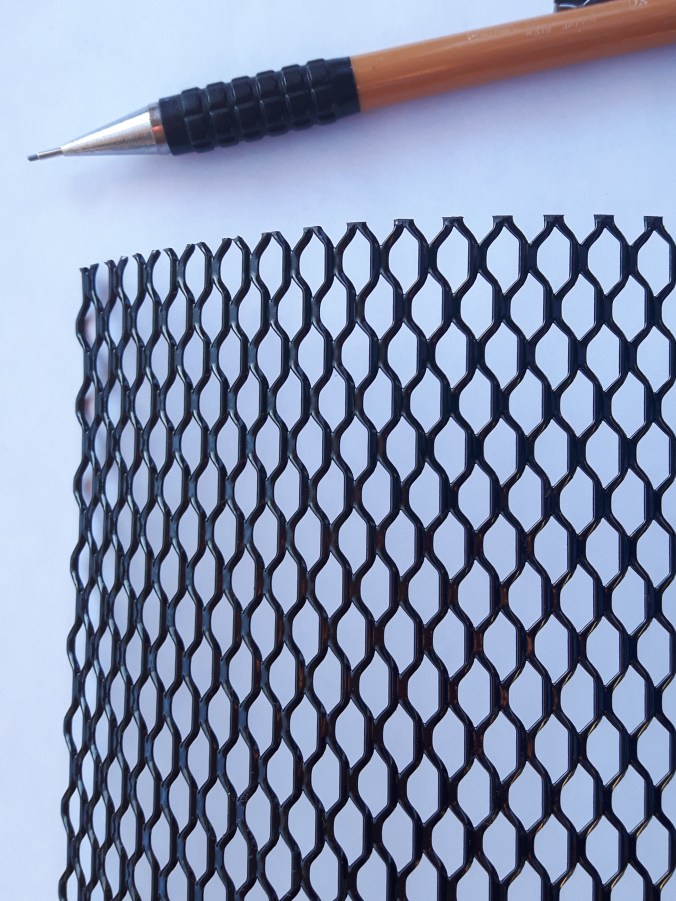
I started with some aluminium grill that goes in your gutters to keep leaves out. It was cheap and perfect width and even pre-painted black. Most importantly, the openings were the right size—not so big as to let small stones through but big enough to allow sufficient airflow. It was also strong enough to withstand the shake, rattle, and (unfortunately) roll of off-roading. stretched aluminum

Then I carefully measured the openings of the shrouds. MeasuringI used some cardboard and created templates that I could fit into the openings. They were basically squares but with the edges folded about 1/4″. I would use those edges to fix the grill to the shroud, but more on that later. I had to cut the corners so when folded they became like a box (or half a box). One opening on each side was a little tricky because one side of the square is not straight but has a jog. Carefully measuring and fiddling is necessary, but better to do this with cardboard before cutting into your grill.templates

When I had the four templates, I held each up to the grill and cut using tin-snips. CuttingThis is a little messy and you have to vacuum carefully afterwards to collect all the sharp bits of discarded metal. I then held the template against the cut metal and used my Workmate, my vice, and some blunt-nosed pliers to fold and shape the guards.Folding I offered each into its opening and tweaked. FittingThis requires patience, but if you follow your templates as a guide, which you know fit well, you’ll eventually get there. Use the tin-snips or pointed-nose pliers to trim off or bend in sharp edges that can scrape the plastic as you fit them. If you do scratch the plastic a bit, use some Back to Black or Armour All to lessen the visibility of the scratch.
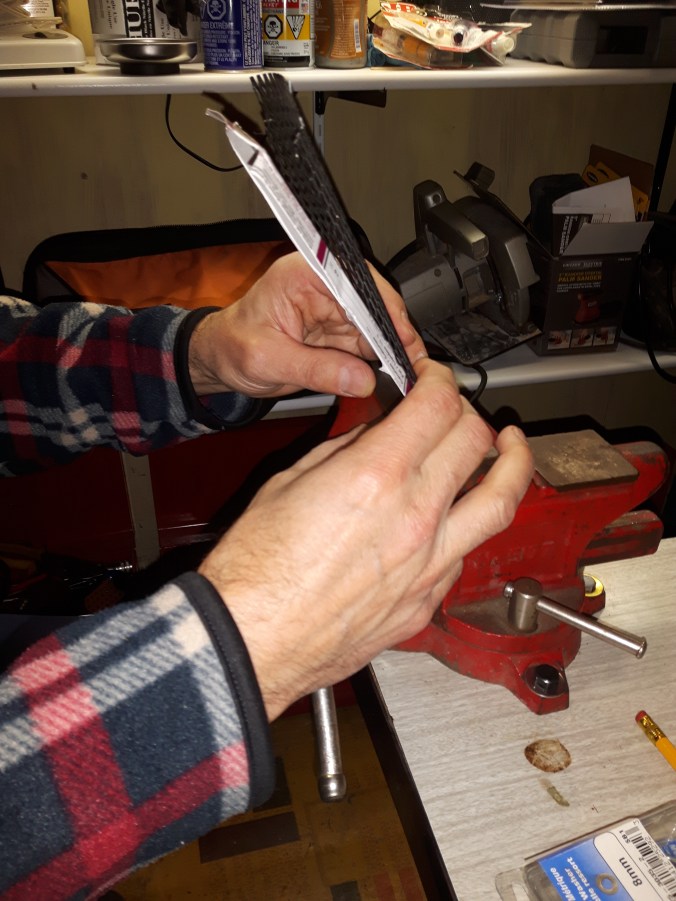
Finally, I wrapped each edge with electrical tape to give it a finished look and prevent the sharp edges from scratching with vibration. TapingFortunately, those clever German engineers had the foresight to drill two holes in the opposite side from the mounting points, probably with something like this in mind. When the guards are done, you can fix them into the shrouds using the mounting screws on the inside and either zip ties or 1/2″ 10-24 machine screws and washers on the outside. I decided to go with the screws just to be sure everything stays put.
Here’s the finished product. I’m happy that I’ll get the cooling effect of the OEM shrouds plus protection for my new (expensive!) rad.Finished covers

These guards are particular to my bike and unless you have a 650GS you’re going to be facing a different situation. Maybe there is a good guard or any other add-on for your bike on the market. But if there isn’t, or if you’re not entirely happy with the product or the price, don’t overlook the option of making it yourself. With a little ingenuity, time, and patience, you can sometimes do better and save yourself some money in the process.

Peggy’s Cove to Fundy National Park

Day 10

At 120 km/hr., Bigbea is buzzing at 5000 rpm. It’s not meant for the Autobaun but the rolling twisties of Bavarian mountain roads. So I usually avoid the freeway. Of the 12 days during my tour, I only devoted myself to the big road twice—once to get through New Brunswick, and this day, because I had somewhere to be by early afternoon.

As I said in an earlier post, I miscalculated (i.e. did not calculate) the distance of my tour so was surprised when I needed to do an oil change en route. The BMW Motorrad (motorcycle) dealership in Nova Scotia has been converted to an auto dealership and services only cars. I think it was someone at advrider.com that suggested Adriaan’s Cycle Service in Moncton, and the comment was they are nice people, willing to chat about bikes. I liked the sound of that so made an appointment for Bigbea for Friday afternoon.

The shop is named after Adriaan Van Egmond, the chief mechanic, and he works with his wife, Lorraine, in this mom and pop and son operation. Lorraine handles the phone and invoicing, and it was clear over the phone that she knows her business. “Do you have the filter?” she asked. I was puzzled, but she explained that many riders carry their preferred filter on tour for just such an occasion. When I asked if they carried synthetic oil, now she was puzzled. “You put synthetic in that bike?” She said they don’t carry any synthetic oil. I wasn’t about to launch into my rationale for synthetic over mineral but said that mineral was fine, I would change the oil again at the end of the season, and I’d be interested in hearing their argument against synthetic when there.

After I saw the lighthouse, I left Peggy’s Cove, went back to the campground, packed up, and headed off, following Googlemaps fastest route, which got me into Moncton shortly after 1:00. When I arrived at Adriaan’s, only Lorraine was there. She said she knew I was coming because the men had seen me while trailering a bike that had broken down, I guess on the road I came in on. Their workshop was a sight to behold; it was clear this is an old shop that has seen some bikes.

Adriann's

Yes, that’s an R80 on the right, restored and it looked great. Outside were a couple of other 1980’s-era bikes, which turned out to be theirs. Soon Adriann arrived and when he heard I was in Cape Breton he got out a map—I don’t know how old—and showed me the routes they had taken. They’d ridden Highland Road too, and I suspect at a time when it was even more rugged than it is today. He’s been servicing bikes for over 60 years—20 years with BMW, over 40 with Honda, and if I’m not mistaken, all from this little garage. I knew Bigbea was in good hands so headed off to find some lunch.

When I returned, the son was just putting the crash guard back on and it was time to refill her. Lorraine said synthetic would produce clutch slippage and I’d burn out my clutch. She told me about another customer who had been using synthetic and was surprised when they showed him his clutch, which was badly deteriorated and had to be replaced. Now I’d heard about clutch slippage and have discussed the synthetic versus mineral debate at length in a previous post. It’s a complex issue but Lorraine simplified it for me: synthetic is too slippery. It seems that slipperiness is not the same as viscosity, which is how thick or thin an oil is, not how well it lubricates. At any rate, they didn’t have any synthetic so mineral it would be.

I also learnt how much oil to put in. There’s a range on the dip stick with a low, a high, and a middle mark. A parts guy at Motointernational had told me to keep it on the low side, that it was better low than high, but Adriann’s son explained that if it’s low, sometimes in hard riding while off-roading, the pick-up can miss and you can get air in the oil. He likes to put an extra .2 L from the middle mark and showed me where on the dipstick. They also discovered I was half a litre low on coolant. I like to do all my own service on the bike but was glad I paid for this one because I learnt some important things about the bike from people much more experienced than me. Sometimes all the reading and research you can do won’t replace experience.

Service

With the job done and the bike reloaded, I headed off toward Fundy National Park. I immediately noticed a difference in the bike. The clutch had been slipping! Perhaps only because I had been on it all day for the past eight days, I immediately noticed a subtle increase in power, as if I’d gained a few ponies. Sure, shifting was not as silky smooth as with the synthetic, but it was more definite, and I suspected I would get less of those annoying false neutrals I sometimes get when tired late into a ride. So for Bigbea here on in, it’s a good quality regular oil every 4,000 K.

The trip down to the park was short, and when I arrived, a sign at the gate said it was full. Good thing I’d made that reservation. It’s a popular campground. My site, however, was not so great. No wonder it was one of the last available. It was narrow, all gravel, and sloping downhill, which meant I had to back the bike downhill about 30 feet to the site.

Funday Campsite

I’d picked up some Talapia and garlic butter in Moncton and it fried up great in the pan. A little rice and even a caesar salad from a bag kit made the best meal I’d had all trip.

Fundy Meal

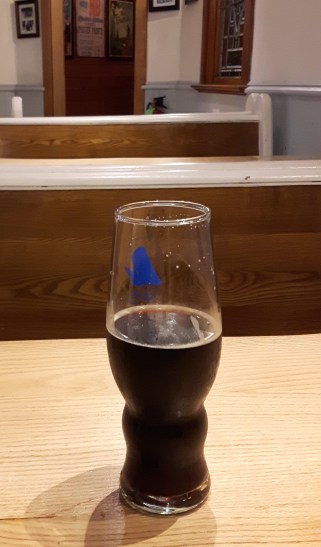
The only thing it needed was a beer, so I headed down after dinner into Alma and found The Holy Whale Brewery and this porter.

Porter

Next day, the Fundy Coastal Trail back into Maine.

Screw You!

20161127_121432

You’d think that my biggest frustration last week would have been when I accidentally broke my gas cap. It was the final fill-up before putting the bike into storage, more final than the fill-up which is part of my winterizing for storage. You see, I usually add the fuel stabilizer, then fill the tank, then go for a little ride to mix the stabilizer into the gas and work it down into the injectors, as well as heat the chain wax and oil. Then I top up again. It was on this final top up that I broke the cap. Jung would have something to say about this but I don’t, not about the breaking anyway. I’m going to write about the fixing.

Or you might think my biggest frustration would have been when I heard how much a replacement cap was going to cost. It’s a gas cap, right? How much can it cost? Okay, this is a BMW, so whatever figure you have in mind, triple it. Then triple it again. You’ll be pretty close. I wasn’t that surprised when the nice parts guy at BMW told me the amount and I said so. He missed the irony, but then maybe it was a language thing. Then he said, “You’re not surprised? Oh, then, actually it’s $ __________!” (tripled again). Big joke. (Laughing.) This time I missed the irony. Did I say he was a nice parts guy?

No, the biggest frustration of the week was in trying to remove one screw to replace this gas cap. After I had ordered it, received the call that it was in, gone and held my nose and paid for it, I figured the worst was over. But I was wrong.

The gas cap is all one unit, which is why it costs so much: the cap, the hinge, and the flange are all one piece, so while I just broke the hinge, I had to buy the whole shebang. The upside, or so I thought, was that swapping the old one out would be easy. Six screws. You undo the screws, you take the old unit off, you put the new unit on, you replace the screws. This is Motorcycle Mechanics 101. But what they don’t teach you in MM101 is that nothing, no job, never, ever, is simple.

Five screws came out like a charm. The sixth did not. At first I thought the screw must be stripped, so tried pulling up as I turned. Sometimes you can skip over the stripped thread and get the next one to catch and you are out of the woods. But I soon discovered that what the screw screws into was also spinning. Now normally when this happens, you simply get hold of the nut on the other side with another socket or wrench or, if necessary, vise-grips—whatever it takes—but you can usually stabilize one side and turn the other and, again, get out of the woods.

But what do you do when the fitting that the screw screws into is embedded in the side of your plastic gas tank and covered with a metal flange? You can’t get at what is spinning, not with a socket or a wrench or vise-grips or even pointed-nose pliers, not with a screwdriver (trying to jam it down and wedge it somehow enough for the screw to release), not with a pick, not with the bent-nose pliers you just bought hoping they might do, not with a chisel to cut off the damn thing since you are replacing it anyway, nope—not even the miracle tool advertised on late-night infomercials is going to get you out of these woods. “Are you fucking kidding me!” I bellowed at the top of my lungs, and since I was in my shed, the acoustics were such that the preschoolers across the park must have heard me. For sure my wife did, for she soon arrived, presenting herself and the dog as Cheering Party, offering tea and biscuits, and helpful advice like “Why don’t you phone Nice Parts Guy and ask if he has any ideas?” But I happen to know why Nice Parts Guy works in Parts and not Service. And I know that Service doesn’t give free advice; they say “Bring the bike in,” which in this case was not an option.

But then she said something brilliant, so brilliant that my grease-monkey brain had overlooked it. “Why don’t you take a break and look online?” Now it’s not like Siri is going to know how to remove a slipping screw from the side of the gas tank on an f650GS, but one of the “inmates” of The Chain Gang probably does! The Chain Gang—so-called because the 650 was the first chain-driven bike BMW made—is a user forum consisting of 11,493 members, all of whom own my bike or a close cousin. It is a veritable fount of knowledge on all things relating to my specific motorcycle. Whatever issue you might be having, someone else has already had it and solved it. What did people in my situation do before the internet? Oh yeah, they belonged to real user groups.

So I posted my problem and before the day was out another user replied, not with an answer but to say he’d encountered the same problem. Since his cap was merely rusted, not broken, he simply replaced the other five screws and lived with it. He said he was curious too if anyone had an answer. Then someone did. He suggested drilling off the head of the screw. My concern with this plan is that I’d still be left with now a head-less screw seized inside a still-spinning fitting, so it wouldn’t solve the problem. A little back-and-forth and soon we, yes now “we” because that’s the nature of a bike forum, had another plan: I could use a drill, not to drill the head off but burn the fitting out of its socket. With the other five screws out, I knew there was enough play to get my fingers under the ring and pull as I spun the screw and fitting. With time and patience, eventually the plastic would give and the fitting would release. Then I could grip the fitting with some pliers (or my teeth, perhaps, by that point might be preferable) and unscrew the screw, then glue the fitting back into the empty socket. That was the plan.

But first I needed this tool. All new jobs require one new tool.

20161127_132133

This allowed me to put any of my 3/8″ sockets on my cordless drill. I put the torx socket on, drilled (counter-clockwise) and pulled and in no time the fitting was out. Here is what it looks like out, next to the screws.

20161127_124347

It’s brass and the rounded end goes down into the plastic. It is “gripped” by surrounding plastic which had deteriorated and given way. The top is squared.

Here is a photo of the emptied cavity with the remaining five fittings.

20161127_124257

Yes, that is gasoline sloshing around inside.

The next part of the job was glueing the fitting back in. I decided to use epoxy glue since I’ve had good luck with it on plastic before. This is where I get to play artist, mixing the epoxy and hardener on my palette.

I’m sure others have their own methods for mixing epoxy but I use waxed paper and a nail. This particular brand fortunately ended up the exact shade of grey I needed.

20161127_175628.jpg

The first time I tried, I made the mistake of putting glue in the cavity and then trying to press the fitting back in, thinking the glue would squirt up into the vacant space at the sides and surround the fitting. But it didn’t, perhaps it was because it was 1 degree Celsius out and the epoxy was stiff, but the fitting sat too high. So I quickly cleaned the fitting and cavity before anything set and started again. The second time I put epoxy just around the “neck” of the fitting and none in the cavity. I guessed the quantity just right. The fitting bottomed out and the epoxy came just flush. I had just a little excess to clean away. Then since it was cold, I used a hairdryer to help it set. All in all, it looked pretty good.

20161127_131147

After that, it was just a “simple” matter of replacing the rubber seal, the metal flange, the new gas cap unit, and all six screws. I did not tighten the new one but will wait until the spring when I’m confident everything has set hard before completely tightening it. I’m now thinking I might put some anti-seize grease on it, just in case I have to remove it again in the future. That particular fitting seems to be especially tight.

I’m no expert but I’ve done quite a lot of mechanical work, including changing a clutch on my car this past summer. But this single screw sure had me stumped! It’s funny how sometimes the seemingly simplest jobs can be the hardest. Most jobs involve approximately 25% familiarity with tools, 25% understanding of basic mechanics, and 50% problem-solving. It’s one unforeseen snag after another, some bigger than others. You have to keep your cool, take your time, seek advice where you can, and persist. It also helps to have a partner who injects a little something foreign into the mix when needed.

Thanks to my wife Marilyn, and Phil (aka backonthesaddle) at The Chain Gang for getting me over some hurdles to the finish. The bike is now ready to ride first warm weather next spring.

20161127_141231


The Big Sleep

winterizing

It’s the saddest time of the year. The leaves are down, the birds have flown, and the bike is in storage. A part of us goes into hibernation, only to reawaken when crocuses push through the last of the melting snow.

I love living in this part of the world. The ability to experience all four seasons is actually restricted to relatively few people living in a narrow geographical band circling the earth, and I happen to be one of those lucky few. When it’s stinking hot in the summer, we long for the days of sweaters, tobogganing, outdoor ice hockey, and skiing. When the wind-chill factor makes snot freeze and there’s two feet of snow to clear from the driveway, we think of summer soccer, swimming at the cottage, and lounging with a good book in the backyard. There’s little that’s more spectacular than the natural beauty of autumn in a boreal forest (maybe the aurora borealis?), and you’d have to be a zombie not to have your heart quicken a beat in spring when everything comes back to life, including your sex life. Maybe even zombies come back to life in the spring; I’m not an expert.

I’m thinking of the seasons of the Canadian south because, as much as I like all four in their own particular ways, I wouldn’t mind being able to ride year-round. Winters in Europe, or most of Europe anyway, are like early spring here: cold, grey, drizzly. Okay, not very enjoyable but you can ride in that. And if I lived in southern United States, I could ride through the winter. In fact, some bikers migrate south for the winter, taking their tours in late fall and riding towards the heat, then shipping their bikes back in the spring. That’s not an option for a teacher so, this weekend, the bike went into storage.

Another thing I long for? A heated garage. My house is a converted summer cottage so no basement and no garage. It would be so, so nice simply to pull into a garage after the final ride and park the bike, pull down the door. Then everything I’m about to say I did with numb fingers on my driveway in the cold of late autumn I could do in a warm garage, plus more. I could putz and play, do those big maintenance jobs over the winter instead of cutting into valuable riding time during the summer.

The main purpose of winterizing the bike is to protect it from the effects of time and humidity. I change the oil so the engine is not sitting in dirty oil all winter. For my bike, which has a dry sump system, that’s a full afternoon job. I start by removing all the bodywork which allows me access to the upper oil tank, which is located where a “normal” bike’s gas tank is. There’s also a plug at the bottom of the engine on the oil pan, and that sump plug is covered by the engine guard. So the engine guard has to be removed as well as the bodywork. So I’m basically stripping down my bike just to change the oil.

But here’s where it gets interesting. I need to heat the oil before draining. Do I remove that stuff after the ride or before? I’ve become pretty quick at doing it but it still takes me long enough that I decided to remove it first, ride the bike, then drain the oil. Yeah, I could have just idled the bike on the driveway to heat the oil, and I’ve done that before, but the chain also has to be cleaned and lubed before storage, and I wanted to heat the chain too so the new lube works into the 0-ring seals. It’s these seals that must be prevented from drying and cracking, thus shortening the life of the chain. So with both the oil and the chain to be heated, I stripped the bike and went for a ride. Anyone seeing me riding along the 20 Ouest with no bodywork on the bike must have thought I had either lost my mind or my fairing.

Next I removed the battery, which cannot freeze, and brought it into my house. Then I removed a spark plug, squirted a little oil (about a tablespoon) into the cylinder, and rotated the engine a few times to coat the piston rings and cylinder lining. This prevents the rings from drying and the cylinder from rusting through the winter. Actually, I lie. I started to rotate the engine—putting the bike in top gear and rotating the back wheel by hand—but realized this way is too much work so put the battery back in and used the starter to rotate the engine. (Note to self for next year.) Since my bike has a kill-switch on the kickstand, a safety feature so I don’t ride off with it accidentally down, I used that to prevent the engine from firing.

Next I clean the engine. This year I discovered a fantastic new product called S100. Since I had the crash and engine guards off, I decided now was the time to give the underside of the bike a thorough cleaning. I was going to use an auto engine cleaner to cut through that grease and grime but was worried it might be too strong and would damage some of the components. I asked at my local shop and was told about S100. It’s amazing! You just spray it on and hose it off with a strong jet of water. For the real tough stuff, I used a soft-bristle brush, but really even that is not necessary with this product.

With the engine clean, I coated a rag with light motor oil and wiped it down, again as a rust-inhibitor. Last year I used another great product called ACF-50 that my cousin Mark told me about. It was tough to find here in Canada and I had to mail order it and didn’t get ahead of that this year, so used the light motor oil instead. ACF-50 though is much better. It stops corrosion on contact and coats and prevents future corrosion. It was designed for use in the aerospace industry and is safe for electronics, so you can spray it on indiscriminately without worry. It’s good for 12 months so I really should just apply it each year as part of my winterization. Ironically, ACF-50 is made in Canada, so you’d think it would be easier to find here. Last year as part of my effort to track some down I drove to some remote abandoned building east of Montreal on the promise that someone there had some. I tell you, it’s that good. Yes, this is like a hard drug for bikers and you have to speak easy to the right people to get some. When I got to the building I knocked and looked in the windows but no one answered the door. Then I saw the blinds in an upstairs window move and noticed bullet holes in said window and decided maybe it was best to buy online. This is the honest-to-God truth. ACF-50. It’s good stuff, man! The light motor oil pales in comparison.

I paid particular attention to the exposed steel of the front forks. I even squirted a drop of oil on the fork rings, then compressed the forks a few times to work the oil into the seals. This prevents them from drying during the winter. Next I replaced all the bodywork and gave it the full clean and wax treatment. I know, most of my panelling is plastic, but I still feel the wax helps protect against acidification and oxidation, especially since I live near an airport and it rains jet fuel around here. The last step in protecting against moisture was to spray a little WD-40 (why do all these products have some cryptic combination of letters and numbers, like an internet password?) in the exhaust pipes and cover each with a plastic bag tied off with a rubber band. I plugged the air intake ports too, preventing critters from making those cavities their winter home.

Finally I backed the bike into the shed, put it on the centre-stand, then used my new motorcycle jack to lift the front tire off the floor of the shed so both tires are suspended. This prevents flat spots from developing. I also dropped the air pressure in the tires a few pounds. I covered the bike to protect it from getting scratched should one of the garden tools fall on it. Then I hummed it a little lullaby but there was no kissing, and no tears. It’s a lot to remember, and I found this wikiHow document helpful to review so I didn’t forget something.

I won’t be posting as much through the off-season but watch for sporadic posts on book reviews, trip planning, and my current gear wish list.


Valves!

img_0476

Last autumn when my bike was having trouble starting in the cold, I took it to BMW for a check-up. It was my first experience servicing the bike. When I explained the symptoms and said the mileage was 38,000 km., the response was, “So you’ve got your 40,000 km. tune-up coming. It’s probably the valves.”

Valves. Those things that let fuel in to and exhaust out of the combustion chamber. The very word sends shivers down the spine of most. We associate valves with $. Whatever the problem is with the valves—and I had no idea at the time what could be wrong with mine—we just know it’s going to  be expensive. Just to get at the damn things you have to rip half the engine apart. When I innocently inquired what the 40,000 km. tune-up would cost, I was told $500. I gulped. My mind is not so capable in math as it once was, but I immediately recognized that sum as about 1/10 the value of my bike! So this is the infamous BMW service costs, huh? My second mathematical thought was “I’ve got 2000 km. to figure out how to do it myself.”

So I hit the internet over the winter months and relied on my trusty Chain Gang to point me in the right direction. What I discovered is that when people say “valves,” what they mean is “valve clearances.” That’s the space between the valves and the cams that open and close the valves. Over time and use, these clearances either shrink or grow, and the valves go “out of spec,” meaning they are outside a recommended range. If the intake clearance is too big, the valve might not be completely closing upon combustion, or if it’s too small, the valve might not be letting in enough air-fuel mixture. Similarly, if the exhaust valves are out of spec, the chamber might not be sealing or exhausting completely, and the engine just doesn’t run right.

You adjust clearances on my bike by swapping out tiny shims located under the “follower,” a metal cup that rests on top of the valve. It’s actually the space between the follower and the cam we are adjusting, but we adjust it by either raising or lowering the follower by adding a bigger or smaller shim underneath. We are talking hundredths of a millimetre (.05 mm) here, so you need a good set of feeler gauges. A good calliper is also handy for checking the actual size of the shim you are removing.

If you find this rather boring, all you need to know for added dramatic tension is that if you mess up this job you can do some serious damage to your engine. That’s right: you have to put your engine at TDC (top dead centre) and remove the cams to get at the valves, and if you put the cams back even slightly wrong, you’re going to hear a great gnashing of metal when you try to start the engine again, which is the sound of your valves getting destroyed. So I wanted to get this right. No wonder it’s $500 just to check them!

On my bike, there are a few things I had to remove to get to the valves:

  1. all the faring
  2. the battery
  3. the upper oil tank
  4. the air filter housing
  5. the throttle cable
  6. the throttle body
  7. the starter relay
  8. the electrical tray cover
  9. the battery tray
  10. the heat shield
  11. the ignition coils
  12. the coolant reservoir
  13. the coil holder
  14. and then, ta-da! the valve cover

Now I was able to check the clearances and, as expected, one intake and one exhaust valve (there are two of each) were out of spec. I had mixed feelings about this. Part of me was secretly hoping they were all good and I would avoid having to remove the cams, but part of me was hoping I would find the source of my problem. Now at least I knew I had to pull the cams.

Next I had to do the maths and here’s a confession: before I became an English scholar, I failed out of Maths at U of T. Okay, I didn’t really fail out; I just realized at mid-term I was not going to excel in this field so did the Honourable Disappearance. This wasn’t linear algebra, but you do have to have a head for numbers and some spacial reasoning (e.g. If my clearance is 0.16 and my shim is 2.85 mm thick, how big a shim do I need to get roughly 0.07 mm clearance? Sometimes in life, you really do need to find x!).  For my bike, the specifications for the intake valve clearance are 0.03 to 0.11 mm. So I figured the ideal clearance would be halfway between the two, or 0.07. For the exhaust, the clearance has to be between 0.25 and 0.33 mm. I sharpened a pencil and got to work.

With the calculations done, the cams off, the shims out, I headed off to BMW to get my new shims. I showed the dude the sizes I need. “C’est quoi ça?” he asked. Apparently I had used a standard calliper to measure the thickness of the shims, so was working partly in metric and partly in imperial and the whole thing didn’t make sense. Doh! Like I said: mid-terms only.

Fortunately, because I’ve spent enough of my life doubling back and forth from home to auto parts stores, I had the foresight to bring the shims and my calculations, so the nice gentleman borrowed a calliper from service and measured them for me, redid my maths, and sold me the shims. By this time it was getting late and I had to be somewhere, so I had only enough time to get home, put the new shims in, put the cams back in place, replace the cam holder, measure the new clearances, and discover that while one was perfect, the other was worse than before! The nice gentleman at BMW had mismeasured one of my shims and sold me one that made the clearance worse. So the following day I had to remove the cover, holder, and cams again and essentially do two valve jobs. I was seriously beginning to wonder if I should have spent the $500.

What is particularly stressful about this job—aside from the risk of shifting the timing and destroying your engine—is that you’ll drop a screw or shim down in the engine. My shop manual suggests stuffing a rag or paper towels in the engine to catch any of the eight cam holder screws that might do just that. The YouTube videos I’d seen had alluded to that possibility in a vague sort of way that caused me considerable concern, such as “that would not be good,” or “you really don’t want that to happen,” and while I’m still unsure of what that would mean, I imagine it would cost me a lot of either time or money. So I worked carefully and slowly, and as I started each of the eight screws, I felt like I was a child playing Operation again. It was right at the height of this stage of the procedure that my wife walked out to the shed where I was working to ask me one of those questions all husbands love, like what shall we have for dinner, or would I take this call because somebody’s doing a survey.

In one YouTube video I’d seen, someone shows how you can use zip ties to fasten the cam chain to the sprockets. This way you ensure your cams don’t shift relative to the chain, messing up your timing and damaging your valves. But when I tried this, I couldn’t get the cams back in; the chain was too tight and prevented me from putting them back in their holders. So I held my breath and cut the ties. (I held the ties too, lest they fall into the engine.) Fortunately, I’d noted, even photographed, exactly where the hashmarks on the sprockets must be at TDC. A couple of rotations of the engine ensured the timing was spot on and everything was opening and closing as it should and there was no gnashing of metal. Still, once I’d put everything back together, I was a little nervous the first time I started the bike. It made one cough and fired, then hummed, as quietly as a thumper can hum.

All this was admittedly a few months ago, before I did my New Hampshire trip. I wanted to do this work obviously before that tour. Then just the other night I saw this video by Ari Henning from MC Garage on how to do your valves. He admits that the job gives most people the heebie-jeebies and is a major pain in the butt because of the risks involved. I admit, if I’d seen this video before doing the job, my confidence might have faltered. In the end, I think I did alright! Now I don’t have to think about my valves for another 40,000 km. and can put that $500 toward a new saddle next year.

Next up, prepping the bike for winter storage.