La Classique 2025

Rain, Rides, and Ribs—the unofficial season opener La Classique never disappoints.

My students were writing a final test when I got the missed call and then message: Riley had a spot on the Awesome Players team at this year’s Classique. I wasn’t planning on doing the rally this year but jumped at the opportunity to ride with them, which is always fun. I called him back at the break, got the details, and confirmed.

I’ve done this rally once before by jumping onto an open spot with another team. The way registration works is that teams are created by team captains and each team has 10 spots. Riders on a team preregister, and if there are any open spots, they can be filled during the open registration. Participants are asked a lot of questions during registration like riding experience, type of bike, number of years off-roading, etc. to ensure that team members are compatible. You’re even asked if you prefer a relaxed or sustained pace. It’s a good system that allows lone riders to join a team and participate in the rally.

The Awesome Players have been doing this kind of riding for many years and usually enter into one of the advanced rides. Maybe they are tired of pushing heavy bikes through mud while getting roosted, or maybe they just wanted an easier ride but they decided to do the Classique Plus this time, which suited me fine. I did that ride when I participated in 2023 and it was at my level—mostly dirt roads but with a little sand, rocks, and water in the mix to keep it interesting.

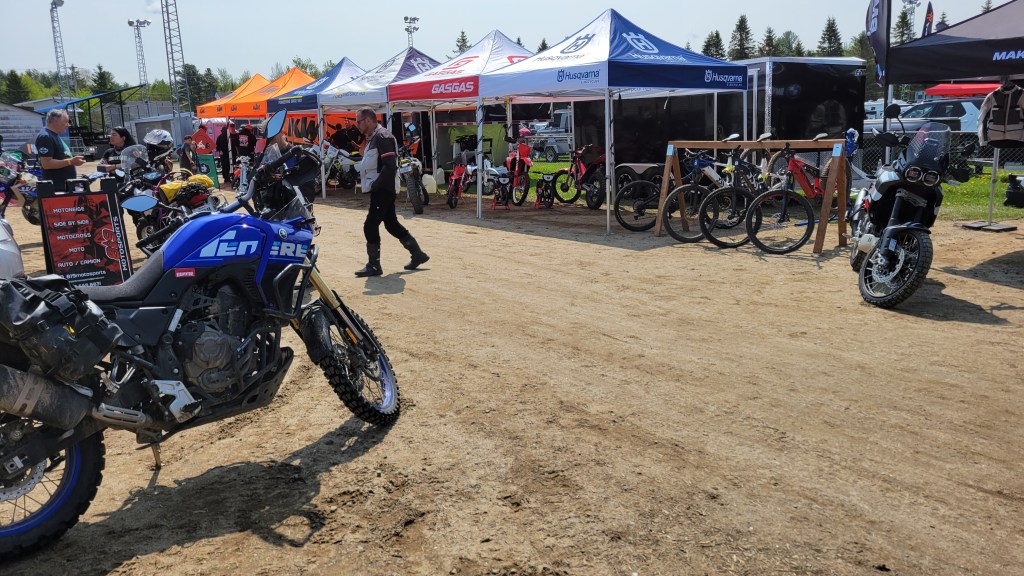
Our ride was Sunday but it’s fun to have a relaxed day at the rally to hang out and do demo rides. Many of the manufacturers were there, so I rode up Friday evening with Curtis, a fellow West Island Motorcycle Club member, who had recently bought a 2017 Tiger XCA and was going to try ADV riding. There’s camping available on site so we would camp two nights and do demo rides on the Saturday.

Demo Rides

Dealers are now reluctant to offer demos so you have to attend these events and get them straight from the manufacturers. I was lucky because I was able to demo two of my dream bikes: the Kove 450 Rally and the Aprilia Tuareg. I’m a year away from retiring so am scouting a potential new bike for the kind of riding I want to do in retirement.

Kove 450 Rally

Okay, maybe it was a little naïve of me, maybe a little romantic, but I had visions of slapping a little Mosko Moto 40L Reskless system on this bike and using it as a super-lightweight ADV bike capable of tackling anything Colorado or Utah could throw at me. One of my bucket list rides is The Continental Divide, a challenging ride technically, so what better bike to do it on than one that completed the Dakar. I also figured that if rally riders can ride it for long days on end, so could I, and with 8 gallons of fuel capacity, there would be no more fuel anxiety when remote riding.

The first thing I noticed when riding the Kove 450 is that it’s loud! I have to be careful with what hearing I have left so I’d have to change the pipe or get a baffle or something, but that’s an easy mod. The other thing I noticed is the significant head-shake I was getting at speed. I thought it might have something to do with the particular front tire on the bike, or maybe my body position, but a steering damper would take care of that too.

In the end, I think this would be a really fun bike for day rides, but the experience of riding one is so raw it would be tiring for a multi-day tour. The bike is, after all, a race bike. But it is a ton of fun to ride and when I get out into The Rockies, one might be in my garage.

Aprilia Tuareg 660
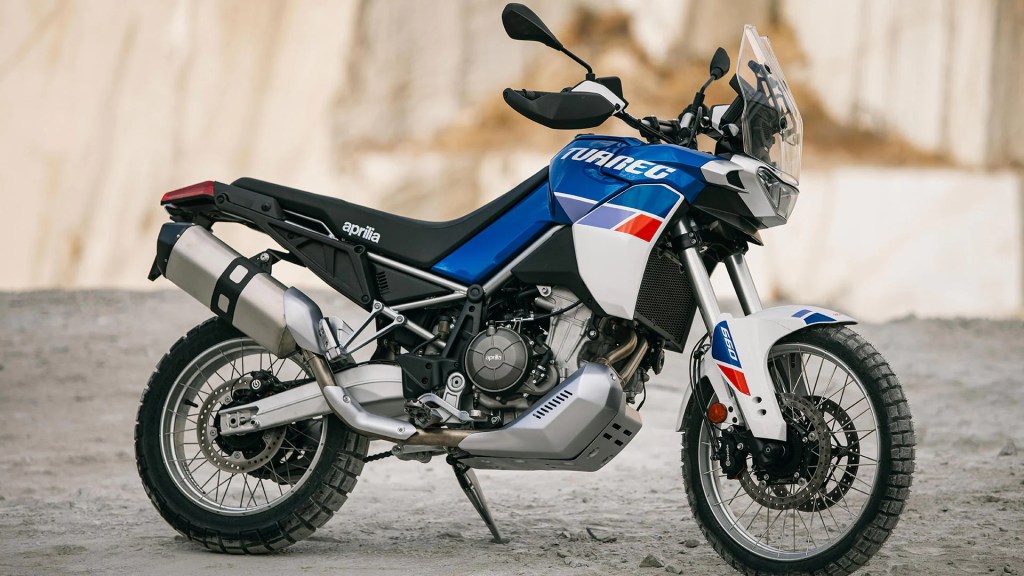
Photo credit:// https://storeusa.aprilia.com/tuareg660.aspx

This bike had just been released when I sold my BMW f650GS and decided to get something a little bigger. I didn’t give it a serious look because at only 10cc larger, I didn’t think it was different enough from the BMW. In fact, it’s closer to the Tiger 800 I have now in power than the 650, and that is why I probably won’t get one. I already have a good midsize bike for adventure touring, and if I were to get another bike, it would either be a bigger bike like a 1250 for crunching the miles 2-up across The United States and Canada or a smaller bike for playing in the mountains out West.

The Tuareg is getting excellent reviews and I’m sure it’s an excellent bike. Llel Pavey of Brake Magazine gave it a glowing review, and he’s normally very discerning in his reviews. He said everything about it—the engine, the suspension, the balance—was excellent and implied it is the perfect adventure bike. If I were in the market now for a midsize do-it-all bike, the Tuareg would be a good choice.

I wasn’t able to test this bike on anything but asphalt so I can’t judge what it’s like off-road. On road, I found a surprising amount of vibration in the handlebars and, again, it was loud. (Other reviewers have said the same about the noise.) Aprilia were clearly aiming for the off-road market and made the induction intake robust and guttural. I’m sure the Tuareg is better than the Tiger for technical riding, but on asphalt and I imagine on dirt and gravel roads, I have to say I prefer the Tiger for its smooth engine and exciting but not deafening exhaust note. It’s always nice when you walk away from a demo ride feeling that you already have the best bike for you, especially when that demo is of a dream bike.

CF Moto Ibex 450

The surprise of the demos was the CFMoto Ibex 450. Maybe it shouldn’t have been. People are saying that the Ibex is finally the unicorn bike everyone has been asking for but no one has been willing to make. It’s small and light but with plenty of power, a 270 degree crankshaft, slipper clutch, rider modes, KYB adjustable front and rear suspension, spoked tubeless wheels, a great exhaust note, radial brakes, 5″ display with Bluetooth connectivity . . . all for under $8,000! People at the rally were saying it’s going to be a KLR killer.

The fly in the ointment is that it’s Chinese made (as is Kove). Does that matter? To some it does; to others it doesn’t. CF Moto have been making bikes for KTM since 2017 and has competed in Moto 2 and has won Moto 3 and Rally Raid, so it’s not some Johnny-Come-Lately cheapo brand. In fact, the Ibex comes with a 5 year warranty. Maybe it’s time we stop generalizing to all Chinese manufacturers the stereotype about poor build quality.

Besides reliability, the other issue with buying from a Chinese company for some is that you are supporting the Chinese government and its authoritarian practises, human rights violations, and general bullying behaviour in Asian geopolitics. I can understand this. Currently there’s a “Buy Canadian” spirit happening in Canada as ordinary citizens exercise one of the few ways they have political agency—through their pocketbooks. When it comes to China, it’s especially hard to separate company from state, and many people are deciding today to purchase ethically. On the other hand, Capitalism has pulled more than 1 billion Chinese people out of extreme poverty since 1981, virtually eliminating extreme poverty in the country (World Bank Poverty and Inequality Platform (2024) – with major processing by Our World in Data). If you choose to boycott China when purchasing, are you hurting the Chinese government or the Chinese people? The ethics are not simple.

But back to bikes, unlike the Kove’s 450 single, the Ibex’s 450 twin is smooth. I also noticed that CF Moto have geared the first two or three gears with lots of torque for off-roading, with the other gear ratios spread out so that even at highway speed the little 450 is not straining. In sum, it’s a sweet little bike, and perhaps it will be an Ibex and not a Kove that I take over those Colorado mountain passes.

BMW

BMW’s luxury tourer.

Of course I had to spend some time at the BMW display. Yes, I still have a bit of sweet spot for the German brand that began my motorcycle life. I had in mind to try their flagship 1300GS, but it was fully booked. In fact, all the GS’s were booked in the remaining time slots so I tried a big K1600 GTL for a lark. This luxury tourer starts at $36,000. A demo is about the only opportunity I’ll have to ride one, so I thought, “Why not?” Marilyn would surely be riding in style and comfort on the back of one of these!

The experience was pretty interesting. I’ve ridden a Gold Wing before so am not unfamiliar with a big bike, but this big bike was something else. If the rawness of the Kove is at one end of a spectrum, the comfort of the GTL is at the other. I wouldn’t say it felt like I wasn’t riding a motorcycle, but it felt more like flying an airplane than riding a motorcycle. Quiet and smooth, it glided over the pavement and banked into turns like a jetliner on final approach. When it started to rain on the demo ride, I simply lifted the windscreen with the push of a button and stayed dry.

In the end, it was fun to demo, but even if I had that kind of money, I don’t think I’d buy a GTL. It would take all the fun out of riding, and what’s more, I couldn’t help thinking of what it would be like with Marilyn on the back and trying to navigate all the off-camber stop signs and slow speed corners of somewhere like Saint John’s, NL, on such a heavy machine. One tired touring mistake and . . . Again, the Tiger is about perfect in weight and power for touring, and I feel very comfortable navigating it at slow speed, even 2-up.

There was one last demo and it came unexpectedly. My buddy Steve was riding the 1300 GSA and when we stopped for a break halfway he offered to switch. What a great guy! He knew I wanted to try the big GS, so I rode that back to the rally while he tried the GTL. The boxer is a very distinctive engine and I had more fun on the GSA than the GTL. I also found it really nicely balanced, as all GS’s are. No wonder the GSA is one of the top 12 open-class ADV bikes of 2025, according to Cycle World.

After the demos, we all piled into a bus and headed into Lachute for dinner. It’s great that the rally organizes the shuttle because they know that most grown men don’t have the good sense not to ride after “just a few.” The dinner was a fitting rack of ribs and poutine, with door prizes and Cherry Bomb, a Joan Jett cover band for the night’s entertainment. There’s a ton of organization behind this rally!
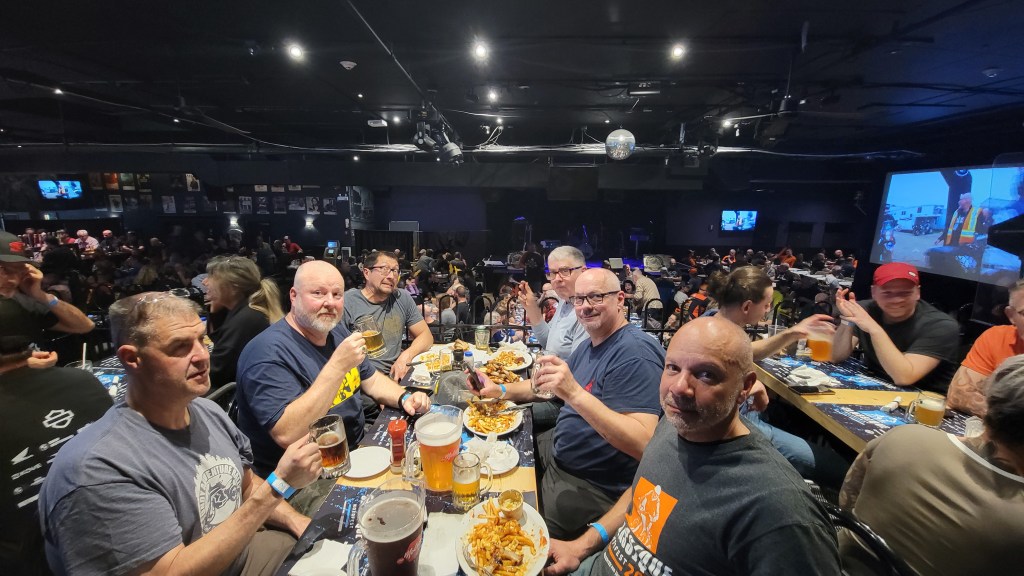
Chowing down with the boys. Clockwise: Pete, Riley, Ivan, Marc, Dave, and Curtis.

Classique Plus Ride

Sunday was our ride so I was up at 6:00 to be ready for an early start. Rally organizers provide coffee and muffins for breakfast so I didn’t even bother to bring my camp stove. I geared up and headed up to get the bike inspected, then slotted into line at the staging area. Shortly after 8:00, we headed off.

The Awesome Players use Sena and The West Island Moto Club uses Cardo. The previous evening we had overheard someone trying to connect a Sena with a Cardo and had a laugh about that. Good luck! Yeah, apparently in theory they can connect, but only if both are in Bluetooth mode and even then it’s pretty useless unless the other person is a pillion; anything further and you lose the connection. So Curtis and I could talk to each other—that is, until his battery crapped out. Maybe I’ll have to bite the bullet and get a Sena if I’m going to be riding more with these guys.

Like I said, this ride is mostly dirt and gravel roads and fairly mellow, but the road into lunch at Duhamel was a little more challenging with some mud, potholes, and rocks, but I didn’t get any video footage of it. My camera battery died early and I would need lunch to change it. After lunch, as we headed down a sandy trail, I turned on the camera just in time to catch the action.

Making a splash.

Does this look familiar? If you saw my crash in Vermont last August, it should. Again, the front end tucks but this time it’s me and not the bike that ends up off the road. I’ve watched this a dozen times and still don’t know what happened. I didn’t chop the throttle and I didn’t hit the front brake. The only thing I can think of is that I made the classic mistake of making an input on a low-traction surface with the handlebars instead of the pegs. The front tire dug in and sent me sideways. This rally is always the first ride of the season and I think I was just rusty. I was also just really surprised because so far there had been nothing in the ride that was particularly challenging or unexpected.

But the drama was not yet over. Shortly after setting off again, I had another two near falls with epic saves. I wasn’t the only one struggling in the deep sand but at the time I thought I was. On these ones, especially the second, I think my front tire gets rutted.

After the second, I started choosing my line more carefully, staying out of ruts as much as possible, and especially getting my weight back. That seemed to help. In retrospect, I realize I should have accelerated through the deep sand, but that’s the last thing you feel like doing after you’ve just fallen.

When we stopped for gas shortly thereafter, I had a moment to check my bike more thoroughly because it felt like the handlebars were not aligned. I probably torqued the front forks in the crash. The station had old-style pumps where you pay inside after filling and just as we were about to set off again I realized I’d forgotten to pay. Doh! I was a bit discombobulated.

Now it was time to ride some asphalt east of Namur on the fun Boileau Road. After the incidents in sand, I was happy to be back on asphalt where the Tiger is in its element.

Most of the ride through the afternoon was on hard-packed dirt roads snaking through pretty rural countryside, like this one.

Brookdale Rd. west of Boileau, QC.

I don’t know if it was the climax of the ride but certainly a highlight was riding Scotch Road with these guys who in no small part made that road famous and popular for off-road riders. It’s a Class 4 road north of Grenville that even Fort Nine videoed when he was still in Montreal. Unfortunately, the Bob and Margs have moved in, literally, and it’s slowly being converted to cottage country. The road is now quite graded and you can see as we pass the famous sand pit that someone has blocked off access. I’m curious to know who and if that land is owned or crown land. If you know what’s happening there, drop a comment below. Sadly, spaces for recreational off-road motorsports are disappearing, and one has to travel further and further out of the city to find them, a topic Ryan F9 addresses as he rides Chemin Scotch. (Incidentally, you can compare the road eight years ago and now, as well as the quality of the video stabilization.)

We made it back to camp wet, cold, and tired, but the weather didn’t really dampen any spirits. It had been a really fun weekend of beer, burgers, and bikes. Thanks again to Marc Chartrand and his team of volunteers for once again putting together another great rally, to Riley for being such a good host, to Ivan for setting a nice pace for us newbies, and to the rest of the boys for including me and making it so much fun.

Have you participated in La Classique in the past? Drop a comment below describing your experience or another rally you would recommend. Any thoughts on access to public lands for motorsports? Here in Quebec we have it pretty good with the FQMHR network and the TQT—more initiatives of Marc Chartrand. Any other comments?
La Classique 2023

If you like dual sport riding, you’ll love La Classique.

La Classique, organized by RidAventure.ca and with close to 1000 riders, is the largest dual sport rally in Canada. It’s so popular that I’d never managed to get in. Registration fills in about 2 days—you blink and you miss it—and always seems to fall when I’m busiest at work grading mid-terms. I almost missed it again this year but snuck onto a team last minute.

It used to be you had to organize a team, and I could never find riders willing to join me. Now RidAventure has simplified the process and you can register as a single rider and join an existing team. That’s what I did and found myself on Les Amis de la Motorcyclette, a great group of Francophone guys. RidAventure has also separated the Saturday and Sunday rides to allow wider participation in the event. That’s a great idea because even if you aren’t riding, there are vendors and test rides available for a more relaxed day of hanging about.

I registered for the Saturday Classique Plus route, which is about in the middle of the skill level of rides. You have to be comfortable riding Level 2 Trails. I felt pretty good about that but was a little concerned about my tires. Organizers are clear that you need knobbies for anything Classique Plus and up, and because of the long-distance touring I’m doing this summer, I had on Dunlop Trailmax Mission tires, a street-biased 70/30 tire. In the end, I probably should have had a more aggressive tire, but I managed.

This rally falls nicely for me right at the end of the school year. I worked hard in the weeks prior to the rally, pushing to complete all my end-of-term grading so I could ride away with a clean conscience. In fact, I did so much intensive grading toward the end that I developed a mild case of carpal tunnel syndrome in my writing hand. Thankfully, it didn’t significantly affect my use of the throttle and front brake except in the most intensive sections.

Parts arrived from Dual Sport Plus just in time, and I spent the Friday of my departure adding hand guards and folding mirrors; I was worried about breaking a lever or a mirror in a crash, which is not uncommon in dirt riding. I was also worried about breaking my bones so geared up in my Knox Adventure Shirt, neck guard, and tucked some wrist braces into my bag. (Yeah, a little tip-over can cost you the better part of the season, so I’ve started using these if there is a chance of falling.) I left unfortunately at rush hour on a Friday, so after the requisite hour to get off the island, I was on my way.

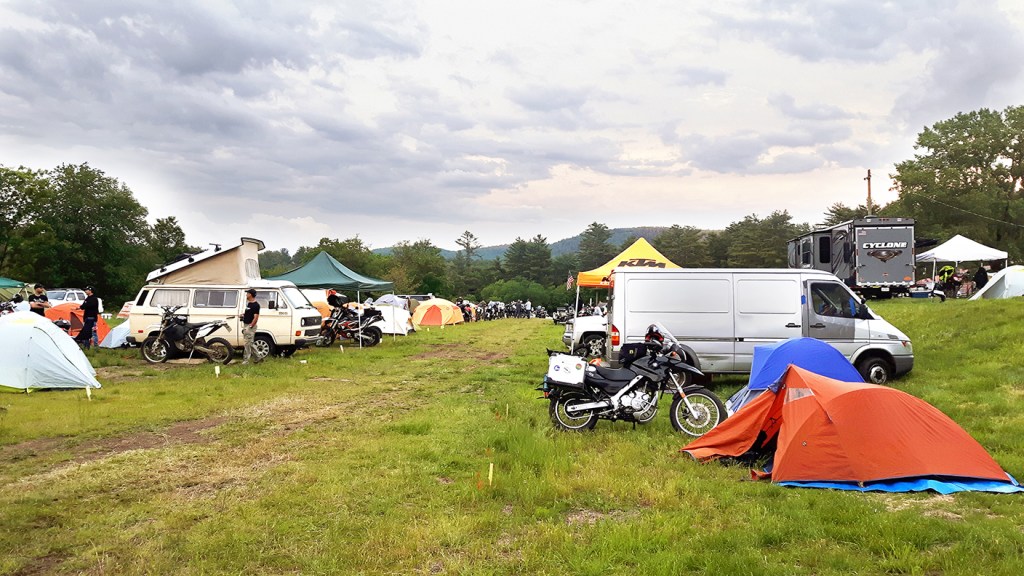
One nice thing about these rallies is that you can camp on site. The rally this year was in a new location in Saint-André-Avellin, north of Montebello, and there was a big open field for all the tents. RVs were parked in another area, and there were a lot of them!

Camping at La Classique 2023 in Saint-André-Avellin.

Now if there’s one thing I know about camping in Canada, it’s that you don’t want to do it before July. The bugs are bad! In my last minute haste, I forgot to pack bug spray (doh!), so the first order of business once I got my tent pitched was to find some. Then I checked in at registration, got my sticker and T-shirt, and spent the rest of the evening hanging with The Awesome Players at their camp. As you may remember, I did a few rides with them a while back, and they are a great bunch of welcoming guys. In fact, although I was on my own for the weekend, I never felt alone; there’s a strong sense of fellowship within the RidAventure community.

One of the things I like about these rallies is checking out all the bikes. The next morning, before forming up for my ride, I took a stroll along where the campers’ bikes were parked.

Better than the Montreal Moto Show.

Yes, that is an action camera I’m using. As I pondered in a previous post, I’ve decided to join the crowd of YouTube content creators, although I’m not a hero—as in, I didn’t get a GoPro. After much research, and heavily influenced by this video review by Dork in the Road of several action cameras, I decided to get an Insta360 One RS. I’m not interested in the 360 lens; I think that’s a gimmick that will quickly lose its appeal, and I don’t like how it makes every shot look unnatural, like through a fish-eye lens.

I got just the 4K boost lens and will be incorporating some short video footage into my posts in the future. I’m not interested in “competing” with full-on YouTube channels because that’s not my genre: I’m primarily a writer, not a videographer. I wouldn’t know my way around a massive video editing program like Final Cut Pro or Adobe Premiere, and I wouldn’t want the interruption in my rides of setting up a tripod for a ride-by shot or sending up a drone, although drones capture some amazing footage. So my footage will be minimal and serve to complement the written accounts of my rides. Anyway, we’ll start with that and see how it goes. All the videos I use will be available separately on my YouTube channel. Let me know in the comment section what you think of the new multi-media format.

Enough about that. After perusing the bikes, I had to get up to the start area and introduce myself to my adoptive team.

Marc Chartand giving the pre-ride talk.

The rally is extremely well organized. At registration check-in, your bike is inspected, you sign a waiver, then receive a wrist band and a sticker for your bike. The sticker indicates what group you are in, and there is a corresponding marker to line up with your group. Here we all are, lined-up and waiting for the signal to pull out.

500 riders waiting to start.

I was a little nervous, being my first Classique and not knowing if I’d chosen the right level. You don’t want it boring, but then you also don’t want to slow the other boys down. In the end, it was the right choice, but I faced some challenging sections. My philosophy in riding and in life is that you want to push yourself slightly out of your comfort zone once in a while; that’s when growth occurs. My French and my off-roading skills got an injection this weekend.

Finally we got the signal to start our engines and pull out. We were on our way.

Starting out on the Classique Plus ride.

Right away you can tell that my bike is different from most other dual sports. You can hear the high-pitched induction whine of the Triumph triple instead of the growl of a parallel twin. But that’s what I love about this bike: it’s a sport bike engine shoe-horned into an adventure chassis. It’s smooth with a ton of torque and loves to be revved, and it handles through the twisties like a sport bike. Okay, it doesn’t have the tractor factor of a big thumper or a parallel twin, and that’s something I have to keep in mind when off-roading. I have to remember to keep the revs up or it will stall climbing hills or working through sand and mud.

Soon we left the asphalt and were enjoying the countryside on some easy dirt roads. No doubt the route planners considered this as warm-up for what was to come. The trees closed in and then we were snaking through the forest on a twisty dirt road, and lacking knobbies, I had to remember to weight the outside peg on each corner or risk low-siding.

Sorry about the wind noise. This was my first time using the camera and I’ve since discovered the audio setting for wind noise reduction. There’s an option in the Insta360 Studio application for post production noise reduction, but for some reason, this particular noise gets “reduced” to a sound similar to fingernails being dragged down a chalkboard.

Soon we turned off this road and entered Parc Papineau-Labelle, and that’s when things became a little more “interesting.” Our entrance was a rocky hill climb, and although it wasn’t super difficult, as anyone with a GoPro knows, the action cameras flatten out all hills and the image stabilization smoothens out the ride. In fact, my suspension was working hard, and it wasn’t long before the ABS on my bike sent an error code to the ECU.

Rocky hill climb into Réserve Faunique Papineau-Labelle.

To sit or stand? There’s an excellent podcast by Adventure Rider Radio (April 15, 2022) with an aerospace physicist and Chris Birch on this topic—well worth a listen—but one thing I remember from it is the simple maxim to sit when you can and stand when you have to. Some terrain requires that you stand so you can control the bike through the footpegs, but standing all day would be tiring, so sit when you can. You can see me stand when I enter a climb or a sharp corner. You can also see me glance down a few times to check what gear I’m in. Sometimes I’m concentrating so much on the terrain I forget and want to verify.

This was fairly easy dirt riding so I decided to keep my ABS on. I thought you really only have to turn it off if you’re doing steep descents in loose terrain where you might find yourself suddenly without brakes. But one thing I learned this weekend is that my bike is not happy with ABS on in even this degree of chatter. You can see in the following clip that I have a couple of warning lights on. They would turn out to be the check engine and ABS lights, so I put two and two together and figured it was an ABS/speed sensor error. (Later back home, I confirmed this using an OBDII scanner.) I got pretty good at navigating through the set-up menu on my dash to turn ABS off since it resets every time I turn off the bike. For short stops, however, I was able to use the kill switch but keep the ignition on and it didn’t reset.

I’m not sure which caused me more concern: the warning lights or that I was losing my sticker.

At one point, we came across a moose. I could see something running up ahead in the road and thought at first it was a horse, but soon realized it was a moose. We backed off and let it run ahead until it could get off the road. In all my years of canoe camping, I’ve actually never seen one, so this was exciting.

Also exciting were the patches of sand that sent the bike snaking. You just gotta hold your nerve and let the bike sort itself out. Nobody went down that I’m aware of, although there were some close calls. Here, I’m watching the guy in front almost lose it on a sandy corner, and then when I reach up to turn off my camera (I had it on loop mode), my front slides out and I almost lose it.

Almost overcooked.

Finally, with the ABS turned off and a few hours of this, by lunchtime I was feeling more confident in the sand.

Finally feeling confident in the sand.

Unfortunately, that would be the final clip of the day. For some reason which I would only discover at lunch, my camera would not turn on and would not record anymore. When I could finally unmount the camera and have a look, it was displaying a message that an error had occurred in my last video and would I like to fix it. (I did but the above clip is missing metadata.) It had started to rain hard and I was feeling a bit stressed about keeping up and decided that perhaps this was not the best time to test and troubleshoot the new camera so I put it away. That’s unfortunate, in retrospect, because the real fun was about to begin.

Shortly after lunch we had a sandy hill to climb, and even the best riders in the group were having a hard time with it. This is where I really needed some knobbies. I was looking at the hill and thinking this isn’t going to go well, but what choice did I have? Go back to camp or go for it. So I went for it and surprised myself. It wasn’t pretty—I had to dab several times—but I got most of the way up. Having done the hard bit, the last part I did less well. Like I said, I have to keep the revs up on this bike or it will stall. But with some pushing from others, we all made it to the top and lived to ride the rest of the route.

Not me but someone else getting a push. You can see how deep the sand is. Photo credit: Jean-Charles Paquin

There were some easy water crossings but no other major obstacles and we were back at camp by 5, in time to clean up before dinner.


The next day I was going to head home early but decided to do some test rides. First up, just out of curiosity, was the new Harley Davidson Pan America. It was, shall I say, a little underwhelming. If you imagine what a Harley adventure bike might be, that’s pretty much it: a little loud and rough and brash. There was a lot of vibration up through the handlebars, which was surprising because they had street shoes on. The best part of the test ride was that the sun finally came out! It had rained hard through the afternoon and night and everything was soaked, so it was nice to see the sun and to know my tent would dry out before I had to pack it up.

Test riding the new Harley Davidson Pan America.

There’s definitely some interesting technology built into this bike. The suspension lowering feature when you stop is innovative and will open up the adventure market to those who struggle with the seat height of most adventure bikes. And hydraulic valves sound neat. I don’t know exactly how they work but the bottom line is apparently you never have to adjust the valves. There were some Pan America bikes at the rally so they are selling, but I don’t think this bike is going to cause a major splash like the Teneré 700 did or the BMW GS.

Speaking of the GS, I’ve always wanted to try the iconic bike. As followers of this blog will know, I had the single 650GS for years and loved it and always wondered what the big boxer would be like. Many said that the big cross-Canada trip I did would normally be done on the big bike, and I have to admit considering it when I decided to change my bike, but I’m nervous about taking a big bike like that off road into remote areas. It’s close to 600 lbs. and, with gear, that’s a lot to lift on your own if you dump it.

Anyway, this was my chance and so I did a test ride on a 1250GS. I have to admit, what everyone says about how it carries its weight is true. You can turn this bike easily at slow speed. But what I found most impressive—not exclusive to the GS—were the rider modes. I’ve never ridden a bike with rider modes before, and after 20 minutes in Enduro Pro mode, I was sliding this baby around corners. You can hear me making exclamations into my helmet.

Test riding a BMW 1250GS.

It’s very confidence-inspiring, but I couldn’t help thinking that I was cheating; it wasn’t me doing the powerslides but a computer. Call me a purist, call me a technophobe, call me a Luddite, or just call me poor, but I’m glad my 2013 bike doesn’t have rider modes. I know they’re the way of the future, but for now, I’m happy to have to learn throttle and clutch control and braking using manual inputs. Speaking of which, my throttle/clutch control sucks (!) and I’ll be targeting it with some practice in the coming weeks.

Upon reflecting on my ride of the day before, perhaps what I am most proud of is not that I kept up on the tires I had, but that I did it without any rider aids, including ABS. It was all me. I’m not a great rider, not yet anyway, but if I had a bike with that level of computer input, I wonder if I’d ever be. What are your feelings about rider modes? Greatest safety advancement in motorcycle technology in the recent past, or making us all lazy, unskilled riders?

Finally it was time to start heading home. I packed up and headed down the 321 to the lovely 418 East that took me into Grenville.

Heading along the beautiful 418 that hugs the north shore of the Ottawa River.

It had been a great weekend at my first Classique. The sun was out and I had the whole summer vacation ahead of me. I was feeling pretty bouyant, and since I was in an indulgent mood, there was only one more thing to do to make the moment perfect.

End of an Era

After 8 years and almost 100,000 kilometres, I pass Bigby on to new owners.

Saying good-bye to Bigby. A final chain lube and I handed over the keys.

The first night of my motorcycle training class, the teacher asked: “Okay, what do we have here? Who wants a sport bike? A cruiser? A tourer? An adventure bike?” Students put up their hands accordingly. I didn’t even know what an adventure bike was yet, but I knew I wanted something that would allow me to explore, and I didn’t want to be limited by pavement. The places I wanted to explore likely wouldn’t have any pavement.

At the end of the evening, I approached the teacher to ask about helmets. What would he recommend, full face or modular? At some point, I must have mentioned that my dream was to travel across Canada by bike. “You’re going to get a BMW, aren’t you?” he said. I guess he knew enough about ADV culture to know that is the most popular ADV brand, thanks to Ewen and Charlie, and KTM’s big mistake in doubting them. And in the end, he was right. After a little research online, I zeroed in on the f650GS as a perfect starting bike—low seat height, not too much power, well balanced, reliable, and easy to ride and maintain.

A quick search on Kijiji turned up one for sale near me on the West Island. It even had hard luggage and a touring screen, all set for cross-country touring. It seemed destined to be mine, and within a few days, it was. Getting that bike has been one of the best decisions of my adult life. It has connected me to friends, to readers, to a country, and to aspects of myself I didn’t know existed.

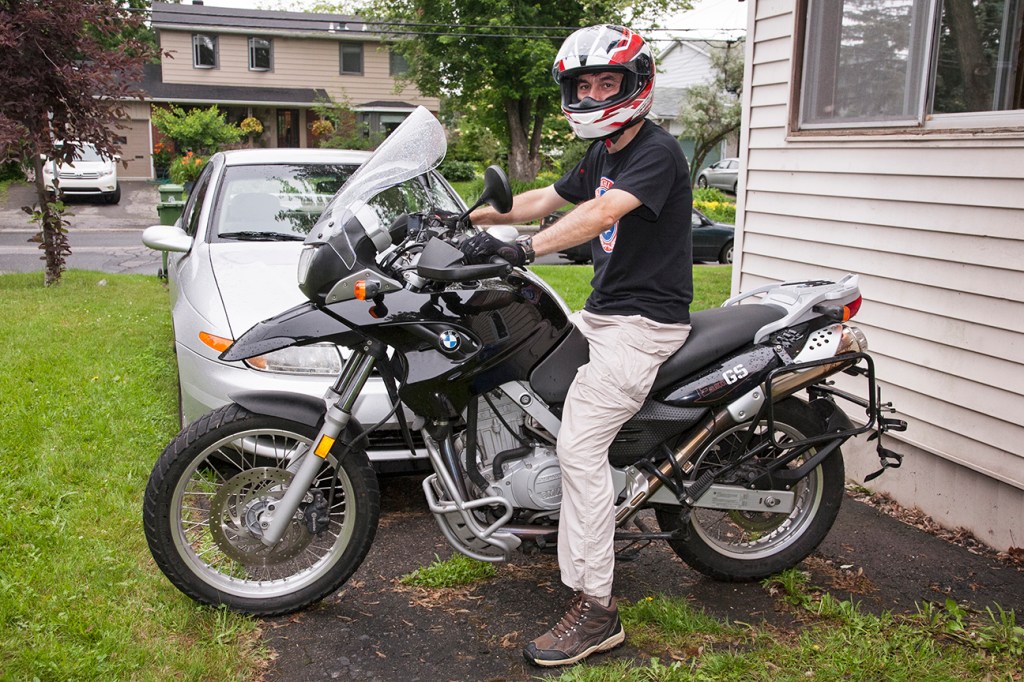
The first photo of me on the bike, June 2015. Lots of comments on Facebook about my lack of gear, but little did they know I didn’t yet have my licence.

It almost didn’t happen. The bike doesn’t have ABS, and I’ve grown accustomed to ABS in the car during winter when the roads are icy. I thought it would be essential for a new rider and not having ABS was almost a deal-breaker for me. But fortunately, the few people I consulted about my decision were not fans. One distinctly said, “You have to learn how to brake properly without it.”

So I did. I’ve heard of people who use only rear brake. Apparently, Honda mechanics discovered that the rear brake pads of Gold Wings were wearing out faster, much faster, than the front pads, which doesn’t make sense since most of the braking happens with the front. They concluded that Gold Wing riders weren’t using the front brakes, so they developed integrated braking—both front and rear come on, even if you only apply the rear. Smart. Honda engineers outsmarted the riders for their own safety.

My bike didn’t have integrated braking or ABS, so I had to learn how to brake properly. Mostly this meant squeezing the front lever, not grabbing, to load the front contact patch before pulling harder, and using just a little rear to stabilize the bike. I did this every time I stopped, even when cruising along the Lakeshore, at every stop sign and every light, front and rear in correct proportion, so it became muscle memory. Then in emergency situations, which I had, I didn’t have to think about it; the technique came “naturally” and I thankfully never tucked the front end, even once at speed in heavy rain on Heidenau tires in Northern Ontario when I rounded a corner to find someone backing up on the two lane Highway 101.

My first adventure bike rally, Dirt Daze in Lake Luzerne, NY. June 2017.

I knew I also needed to develop my off-road skills to become an ADV rider. I took a course at SMART Riding Adventures in Barrie, and another with Jimmy Lewis at the Dirt Daze adventure bike rally in New York. I joined Moto Trail Aventure mostly for the Rémise en Forme with a certified GS instructor, and the BMW Club of Québec for the same reason. (I actually planned to do rides with both clubs too but that never materialized.) This instruction set the perfect foundation for off-roading, and then it was just a matter of practice.

You don’t even need any dirt to practice off-road skills. I go up to my local church parking lot and do slow speed maneuvers. As Jimmy said, off-roading is all about balance and traction control, so I practiced the balance stuff on Bigby regularly. I also practiced the traction when I could, getting out of the city up onto the dirt roads and ATV trails in the Hawkesbury area. Bigby is a GS, which means Gelände/Straße (off-road/on-road), but I soon learned the limits of the bike. I never learned it street limits; I could lean that bike over and scrape the pedals, even with knobbies on, but I discovered its limits on the trails. The clearance was the biggest limitation, and the front suspension with the 19″ front wheel. It took some superficial damage for these lessons, but I also learnt not to lament the scratches. A fellow rider at my first Dirt Daze rally saw me brooding on my first scratch and said, “You can’t worry about that. It’s a bike.” The matter-of-fact way he put it set me straight.

I also had to learn my way around the engine. Knowing I would be riding into remote areas, I had to know the basics and how to fix problems. As I had with car mechanics, I started with an oil change, then coolant, brake pads, and brake fluid. I bought the bike with 35,000 kilometres on it, so it wasn’t long before I had to do the valves. That service was $1000 at the dealer, just to check them, so necessity was the mother of invention and with my trusty Haynes service manual, I did the valves myself in the shed. (I don’t have a garage, and my poor workspace has been the biggest obstacle to overcome. I’ve lost and found a lot of hardware on the driveway and in the grass!)

Problems at the 2018 Dirt Daze rally. A broken water pump left me stranded for much of the rally. MaxBMW shipped a new pump “overnight” which, due to the remote location, took most of the weekend to arrive, but I got home okay.

The Achilles heel on this bike is the water pump, and I’ve changed that a few times, including once at a rally because I hadn’t done it correctly the first time. (A plastic impeller gear wasn’t installed properly and rattled loose while off-roading.) That was the only time I considered selling the bike early, until I discovered the error was mine and not a fault of the bike. Once done correctly, the pump lasted another 40,000 K until I preemptively changed it before going across Canada.

The other big job was changing the swingarm bearings. That required removing the gas tank and subframe, so basically the entire back half of the bike. The pivot bolt was badly corroded and stuck, and it took two days of troubleshooting and, in the end, two hammers—a ball pane as punch, and a sledge hammer to drive—one on top the other, to get it out. But it eventually surrendered. Yes, I have cursed and praised this bike in equal measure over the years.

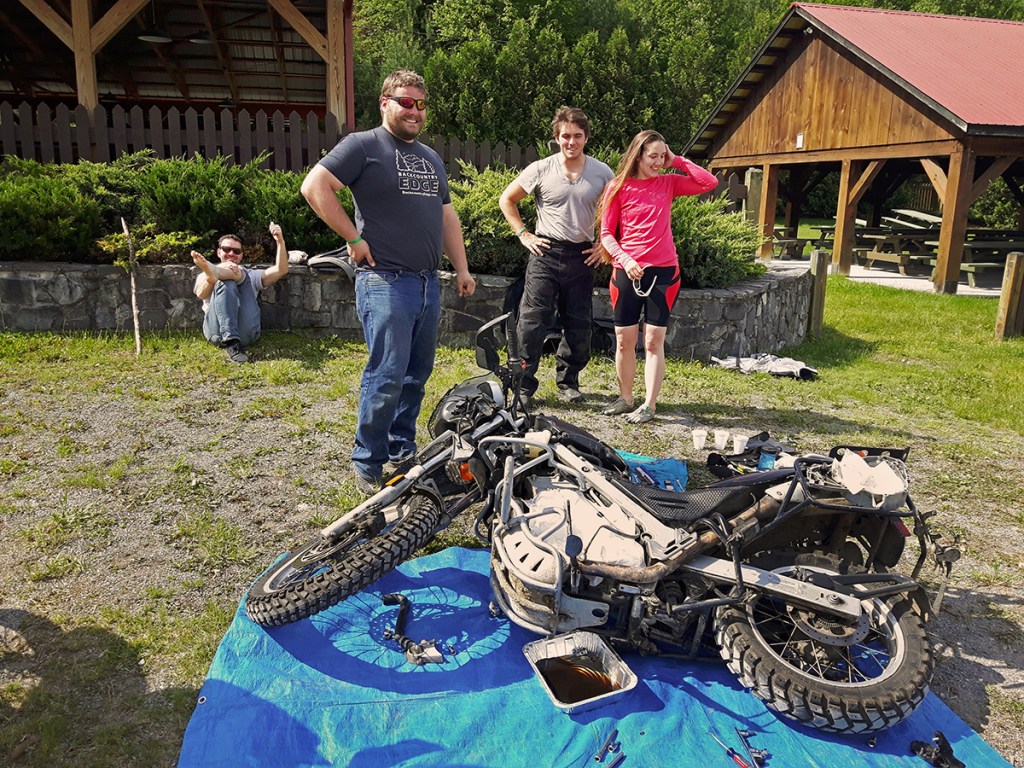
Success! Pivot bolt and swingarm removed for servicing. September 2019. Under the tarp at right is the gas tank and subframe. Headphones are for all the whacking needed to get it out.

I changed those bearings as well as all wheel bearings, clutch plates, the shock, rebuilt the forks, re-lubed the steering head bearings (which were in surprisingly good shape so didn’t need to be changed), and have had the dash assembly apart. And in the end, I restored those scratched body panels to make the bike look good as new.

My first trip on this bike was back to Ontario to show it to my dad, who used to ride. I left the day after getting my full licence. The next month I did my first moto-camp down at Loon Mountain in New Hampshire for their highland games. The following year, my first year with full licence, I went to Nova Scotia to ride the Cabot Trail, passing through Maine, Deer Island, and New Brunswick en route. I’ve also toured Northern Ontario, and these tours have led to some paid writing for northernontario.travel. So the bike has become for me more than a past-time. It has taken my writing in a new direction, and that of course refers to this blog too. I’ve made connections and friendships with people online, and met some of them in person during my travels. I hope to meet more of you in the future.

Off-Roading in Cape Breton, July 2017.

I have also met new friends locally in club riding. When I began, learners couldn’t ride without an experienced rider accompanying them, so I joined The West Island Moto Club, and some of these members have become my closest friends. I’ve done some touring with the club, but mostly I do day rides with them, and it wasn’t long before, with the right mentorship, I was leading rides.

One of the first club rides that I led. This was to Ottawa via Gatineau for the Tulip Festival. May 2018.

Some of my favourite riding on this bike has been in the northeastern states like Vermont, New York, and New Hampshire. I’ve ridden the Puppy Dog Ride on it a few times, and some of the Hamster Ride in New Hampshire, and Bayley-Hazen military road. The 650 GS is perfect for this type of light off-roading. I had a 15-tooth counter-sprocket on it for years, which gave it more low-end torque, and there’s nothing like feeling the pull of the big thumper as you climb a steep hill, or sliding out the back end as you round a corner.

Finally crossing Canada, July 2021.

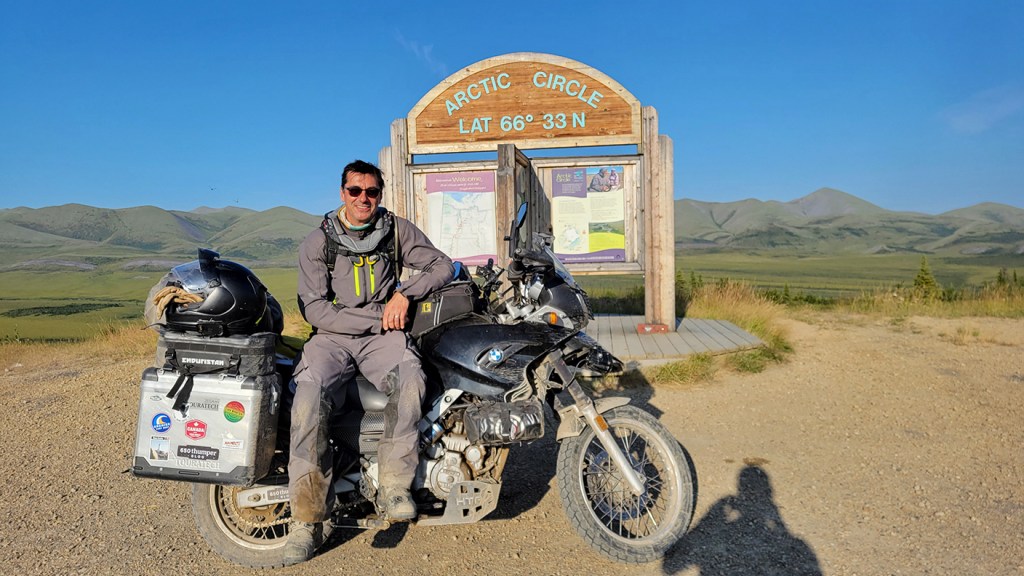
Finally, after developing these riding and mechanical skills, modifying the bike to what was perfect for me, and waiting for Covid generally to be over, I completed my dream of crossing the country, and this bike, 15 years old and with over 100,000 kilometres on it, got me there and back. Ironically, the only issue I had was with a new battery I’d just installed for the trip. But the bike, fully loaded, pulled my wife and me over The Rocky Mountains, and took me up north of the Arctic Circle into some truly remote territory. The bike fulfilled its purpose for me—to learn about motorcycling, develop the skills necessary for adventure touring, and get me over the dangerous first few years of riding. It has been the best first bike I could have had, and now it’s time to pass it on to another new rider. Like me, the new owner has bought the bike before obtaining her licence. I’m sure it will be as good a beginner bike for her as it was for me. The engine is still strong, and I wish them both many safe and happy adventures in the future.

At the Arctic Circle, August 2021

My new bike is a 2013 Triumph Tiger 800XC. The XC stands for cross country, so it’s also capable of light off-roading, and I’ll be taking it on BDRs and other adventure tours. It does has ABS, but being a 2013, it doesn’t have any rider aids, and as I read about the new bikes with throttle control, wheelie control, slipper clutches, and other traction aids, I can’t help thinking about what riders of those bikes aren’t learning. I’m happy to be learning how to control the power of this 94 HP engine properly, just as I learnt to brake properly on the GS. It’s going to take my riding skills to the next level. The blog will be keeping its URL and name in tribute to the bike that got me started and to which I owe so much.

Next season I will complete my cross-country tour by riding the East Coast. I plan to visit Gaspé, New Brunswick, Prince Edward Island, Nova Scotia and Cape Breton, Newfoundland, Labrador, and the north shore of Quebec including the Saguenay. I might try to ride solo up to Fort George on James Bay “on my way home.” This would allow me at least to set foot in Nunavut. I also plan to ride the Mid-Atlantic and North-East BDRs next summer, if I can get it all to fit. So stay tuned, my friends. The journey continues.

At the Awesome Players sandpit, Hawkesbury 2020

The Essentials

In this fourth post on gear, I talk about the essential tools I carry on the bike.

Clockwise from top left: manufacturer’s toolkit with 17mm stubby hex drive and Motion Pro 3/8″ driver adapter, patch kit, Motion Pro Trail Tool, zip ties, Leatherman Wave+, rags, pump, siphon, jumper cables, latex gloves, Motion Pro Bead Breaker and spoon lever. Centre: OBD Link LX Bluetooth adapter, spare fuses and electrical joiners, MSR tow strap, Mastercrap allen key set.

It’s a constant balancing act: having enough tools to fix most problems but keeping it light. You don’t want to be burdened carrying around stuff you never use, but neither do you want to be stuck somewhere, knowing you’ve left the essential tool or part at home. And then there’s the question of what type of ride you are doing. If I’m riding with the club, I tend to take less, knowing there will be others with some tools and why double-up? If I’m riding solo into remote territory, I take the full works: my tool roll, bag of sockets and drivers, even a container of spare parts. But let’s begin with what is always on the bike, even if I’m just commuting to work 30 minutes along the highway. That’s what is shown in the above photo.

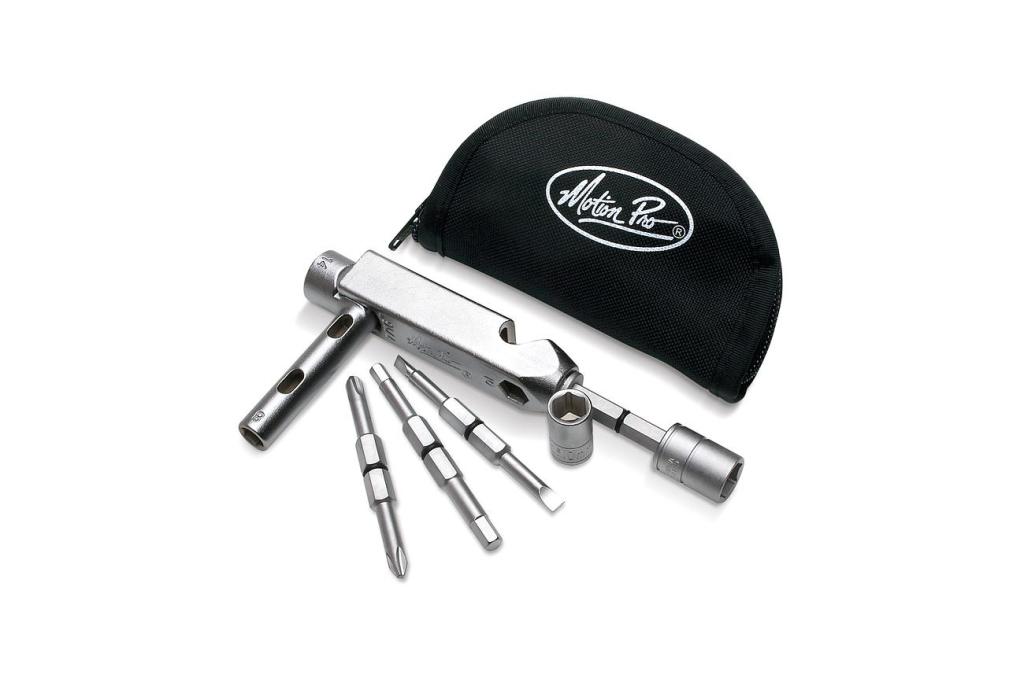
The most common problem you’re going to have is a flat tire, and with tubed tires, you have to be able to get both wheels off. So you’re going to need a big wrench of some kind. For the Beemer, I have the Motion Pro combo tire lever and 24mm socket. It’s a little small, but if you place it right on the nut so you can stand on it, you can remove even the rear lug nut at 73 ft/lbs torque. Into that I place the Motion Pro 3/8″ drive adapter, which enables the lever to drive 3/8″ sockets. For the Tiger, it’s the same set-up but Triumph have a 27mm rear lug nut. Fortunately, the manufacturer’s toolkit includes a wrench with integrated handle so I only needed to buy the corresponding drive adapter and a 19mm hex bit socket (to remove the Tiger’s front wheel).

The Tiger has a captive nut on the left side rear, but for the Beemer, you need a 19mm wrench, which is big and heavy, so I carry a crowfoot wrench for that which I can snap into a 3/8″ drive.

Apparently, the founder of Motion Pro was once asked what tool he would carry if he could only carry one, and he replied without hesitation the Trail Tool.

I carry the Motion Pro Bead Breaker and lever set. They’ve never let me down yet in breaking a bead, and double as levers. I know you can remove a tire with only two levers, but I indulge myself on this one and carry an extra, one of my favourite spoons from . . . you guessed it, Motion Pro.

As you can tell, I love Motion Pro tools. Apparently the founder of that company was once asked what tool he would carry if he could only carry one, and he replied without hesitation the Trail Tool. This thing is amazing. Best of all, it packs up so small, I tuck it under my seat. If you add a few bike specific sockets to it and eat your Wheaties, you can pretty much remove any fastener other than the wheel lug nuts.

I also carry a patch kit, of course, so I can repair the puncture once I get the tube out (Duh!).

Included in my essential toolkit is a Leatherman Wave+, just because THAT IS THE LAW if you are an ADV rider. I don’t use the saw tool to clear any trails, but it’s nice to have a good pair of pliers at all times, and the knives and screwdrivers are also handy in a pinch. I added the ratchet drive that came out a few years ago and a set of torx bits, since BMW are so crazy about torx bolts. Now that I’ve switched to the Tiger, I carry a cheap allen key set because Triumph are so crazy about hex bolts.

If a hand pump is good enough for Lyndon Poskitt to ride around the world for five years, it’s good enough for me.

Yes, that is a bicycle hand pump you see above. I owned the Stop & Go Mini Air Compressor that connects to your SAE battery lead, but it has a design flaw and broke. See RyanF9’s video about that; the nipple pulls out of the hose. Then I looked into the Cycle Pump by Best Rest Products, but at $145 US it would have been over 200 bawks with conversion and shipping! What now? For a pump?! I know it has a lifetime warranty, but at 59, I don’t have that long to live, so I go with the manual pump and muscles. If it’s good enough for Lyndon Poskitt to ride around the world for five years, it’s good enough for me. And beside the pump, you see some cut up socks that I use to protect my rims when I lever off a tire.

I carry a siphon hose, should I or someone else run out of gas, and little jumper cables. I did use these last week, as a matter of fact, on a club ride when someone had electrical problems, but honestly, the easiest way to start a bike with a dead battery is to push start it, assuming it doesn’t have a slipper clutch.

Something I’ve recently purchased is a Bluetooth ODB reader. If you are venturing into remote territory, you really should carry an ODB reader. This was never an option on the Beemer. The proprietary connector on it is round so doesn’t accept third-party readers, and the GS911 tool is something stupid like $900. But with the Tiger, I’ve bought ODB Link LX and use it with TuneECU, an app available for Windows (via USB cable) and Android. The entire kit came to about $150 and provides a lot of diagnostics, including error codes and info from all sensors. You can even use it to remap the ECU! I’ll be using it to balance my throttle body because it tells me that cylinder 3 is a little off. That might be why I was getting vibration in my throttle grip, although that has improved since replacing the air filter. Of course, I carry spare fuses and electrical connectors, and if all else fails, a tow strap.

You see everything above on a changing mat I also carry at all times. You may recognize the Cordura material from my previous post on camping gear in which I write about the bags I made. This is the leftover material and it provides a clean surface to work on while removing tires. You don’t really want to be grinding dirt into your bearings while you wrestle with the tire trailside.

With what is happening in Europe at the moment, those of us who enjoy the safety of civil society have all the more reason to be thankful.

On the Beemer, I use velcro straps to attach the levers and pump to the subframe, and the tow strap tucks in behind the ECU under the seat, with the jumpers and siphon tube on top in a Ziploc. The rest goes in the tail compartment. On the Tiger, there’s no compartment, but everything except the levers, changing mat, and rags goes under the seat. Unfortunately, try as I might, I haven’t found a way to make it all fit, so I have a small bag containing those remaining items in a side case. (Dollar Store pencil cases work well as cheap tool bags.) If I were doing any serious off-roading, which I’m not yet because I still have a road tire on the front, I’d carry those items in a knapsack and ride unencumbered without cases.

This is my set-up for day-to-day and club riding. In the next post, I’ll talk about what I carry when I tour, and then I’ll finish the series by talking about navigation apps. I know I had planned to do all in one, but this is getting long, so I’ll split the planned post up into three.

Am I missing something? How does your essential toolkit compare? Drop a comment below, and if you haven’t already, click Follow to receive word of new posts.

Here in Canada, it is Thanksgiving Monday, so I’ll wish my Canadian readers a happy Thanksgiving and everyone else happy riding and safe travels. With what is happening in Europe at the moment, those of us who enjoy the safety of civil society have all the more reason to be thankful.

Let’s Talk About Off-Road Gear

In this post, I describe the off-road gear that’s worked for me.

In an earlier post, I discussed my touring gear. In this one, I’ll cover the gear I use for off-road riding. As before, I’ll move from head to toe.

Helmet

I didn’t want to spend a lot of money on a secondary helmet I use only occasionally, so the LS2 Pioneer was in the right range at about $230. It’s also a long oval, so the right head shape for me. In fact, it might be a bit tight even for me; towards the end of a long day, I wish it were a little wider. But it has excellent ventilation, and this is the helmet I reach for on stinking hot days even for street riding. It has a large eye port that accommodates goggles, a drop-down sun visor, and most importantly, looks really cool!

LS2 Pioneer Quarterback

Upper Body

The foundation, literally, of my off-road gear is the Knox Venture Shirt. I decided to go with a soft compression suit for comfort and safety. I know many will say I should have gotten a roost protector or some hard-shell armour, but for the kind of riding I do, which is not motocross but trail riding, I thought that would be overkill.

The nice thing about the compression suit is that I can wear it under an off-road jersey on really hot days. Also, unlike a jacket, the armour stays in place when you have an off. Because I live about 45 minutes from dirt, I like to wear my jacket to the trail, then swap it for the jersey. This means I need to carry a tail bag or knapsack, but I just don’t feel entirely comfortable riding asphalt without a jacket; it’s like how I don’t feel comfortable driving without a seat belt on.

This product wasn’t available in Canada and I had to order it at Revzilla. It’s since been discontinued but you can still get a similar zip-up armoured shirt from Knox or Bohn. It uses the latest D30 (Knox calls it Microtek) technology in the armour, which is pliable when wearing and stiffens upon impact. I upgraded the back protector to the Dianese Pro G2 because I found the Knox pad did not provide enough ventilation.

Pro-Armor G2

I wear over that either an off-road jersey, as I said, or my Klim Traverse jacket.

Klim Traverse

The Traverse is just a shell, and it doesn’t come with any armour. It’s very light and comfortable, and it has big zipper vents under the arms. It’s Gore-Tex, which makes it a little hot, but I also use it for street riding when there’s risk of rain. And because it’s going to get muddy, it’s got to be black. This is my go-to does-it-all jacket, and I love it!

Lower Body

Klim Dakar Over the Boot Pants

For pants, I use the tried and true Klim Dakar pants, over the boot model. These aren’t waterproof, and the first time I toured in them I got caught in a shower and soon learned that. They just aren’t designed for that purpose. Instead, they have a dense, tough mesh that provides some airflow yet resists snags when you’re riding through brambles and thorny branches. There are also elastic accordion panels in key areas that provide a lot of stretch. Big zipper vents front and back enhance airflow, and there are the usual Klim angled zippered pockets for wallet and phone.

If you are going to be doing some serious off-roading—and that involves a lot of movement on the bike—these pants are designed for that. There are also some nice touches like the leather inseams on the lower pant leg where you are gripping the bike. A very durable, ventilated, stretchy pant for off-road riding. And of course, they come with Klim’s D30 armour in hips and knees.

If I’m going to be doing some technical riding, I pull on the Forcefield Sport Tube Knee Armour. Forcefield, like Knox, is also a company dedicated to just armour, so they do it right, and like the Knox shirt, these tubes, although a little uncomfortable, ensure that the armour stays in place when I go down.

Forcefield Sport Tube, the most comfortable knee armour I’ve found.

If I did more off-roading, I’d probably invest the big bucks in some knee braces. I’ve ridden with the Awesome Players Off-Road Club and Mark did some major damage to his knee a few years ago that got me and others thinking about that possibility. So far I’ve been lucky, but there might be knee braces in my future. For now, these knee pads are the best I’ve found. They won’t prevent torsional damage, but they will help with direct impact.

I use my SIDI Adventure 2 boots when off-roading. They are not motocross boots, but have adequate protection should you get a foot caught under the bike.

One piece of armour I’ve recently started using is wrist braces. I broke my thumb off-roading, and I’ve seen a few riding friends break their wrists recently, which got me wondering why riders don’t wear what skateboarders and snowboarders wear to prevent broken wrists. Apparently, it’s the most common snowboarding injury, for obvious reasons; it’s instinctive to put out your hand to break a fall.

Recently I started wearing EVS Wrist Braces. They are comfortable, and once I have them on, I forget I’m wearing them. Honestly. Okay, maybe you have to be off-roading to forget you have them on, but really, they do not encumber your movement on the bike, your grip on the handlebars, or your control of the levers. I had a friend break his wrist in a silly tip over when his hand hit a rock. It doesn’t take much with this fragile part of the body. They say the extremities are the most vulnerable, so if you off-road, consider picking up something like this and avoid losing six weeks of your season.

EVS Wrist Braces

Gloves

I took a tip from The Awesome Players and use a cheap pair of Mechanix gloves bought at Canadian Tire. You generally want a thin leather for the upmost feel on the controls, and mechanic’s gloves provide that dexterity, depending on the weight you choose. They also often have D30 on the back (for when that wrench slips and you were pushing instead of pulling) and are a fraction of the cost of dedicated motorcycle gloves. Go around Father’s Day and you will often see them on sale.

Mechanix Wear M-Pact Gloves. The motorcyclist in me likes these gloves; the English teacher hates the name.

Finally, the only other bit of gear that I use on but particularly off road is my Klim water bladder, or fuel cell, or hydration system, or Camelbak, or whatever you call it. It’s kind of a pain to carry water on your back. It’s heavy and hot, preventing airflow, but I’ve found that on hot days these inconveniences are worth avoiding the two-day headache I get if I don’t drink enough. When you are working hard in the heat, a sip from a water bottle every few hours during a rest stop is not enough. But if it’s cool and I can get away with it, I’ll put a Nalgene bottle of water in one of those canister holders on the back and ride unencumbered.

Klim Fuel Pak

This one is now discontinued and there are tons of others to choose from, including some with room for tools and first aid, if you want to get everything off the bike. Ryan F9 just did a good video comparing some backpacks that he particularly likes, and an upgrade might be in my future if I were to do a lot more off-roading than I currently do.

Summary

So as you can see, I’m pretty much a Klim guy. Their gear is expensive, but I’ve already said, you can get it on sale if you’re willing to watch and wait. I trust the quality of the materials and workmanship and the thought that’s gone into the design. Some will say I’m getting fooled by marketing and there is comparable gear available for a fraction of the cost, and they may be right. But with the fuel pak, for example, Klim’s is unusual in that the seams of the bladder are radio frequency sealed, so you can turn it completely inside-out to clean and dry. It’s for qualities such as that I’m willing to pay a premium price. And when the mouthpiece split and started to leak, Klim sent me a new one. Again, I am not sponsored by Klim; it’s just my go-to brand for gear.

One of the pains with dual sport riding is that you have to buy two sets of gear, one for road and one for off-road. It’s a significant investment up front, and buying all this stuff almost broke my marriage as well as the bank account. But take your time, get a little at a time, prioritizing, and look for discontinued and end-of-season sales. There are sports that are more expensive, I like to remind my wife, and there are more frivolous things to buy than protective gear.

Off-roading is not a dangerous sport. In fact, I got into it because I felt it is a way to challenge myself safely. There’s only so fast you can go on the street before it’s not safe, and the stakes there are a lot higher. Off roading does not involve high speeds—not the trail and dirt-road riding I do—but you can still get hurt playing in low-traction terrain with a 450 lb. bike. Investing in some good gear minimizes the risks and therefore increases the enjoyment of the ride.

This is what I use and have found works for me. What do you use? I’m a gear weenie so I’d love to hear what works for you. Please leave a comment or send me an email. In the next post, I’ll talk about the camping gear I use. If you are interested in moto-camping, click the Follow button and you’ll be notified of new posts.

One Bike or Two?

Has the adventure bike seen its heyday?

My dad has never understood the adventure bike. He rode in England through his youth and of course took an interest when I announced that I was getting a bike.

“It’s an adventure bike, dad.”

“What’s that?”

“One that can go anywhere, on-road or off. I can take this bike on dirt trails if I want.”

“Why not get a dirt bike?”

Aye, there’s the rub. Recently I’ve been riding with some real off-roaders, and I’m beginning to see the limitations of my bike.

It’s small by street standards. At 650cc, it’s one third the size of some bikes in my street club. But by dirt standards, it’s a pig—a 430 lb. street bike with crappy clearance. Does it really belong on an ATV trail? A snowmobile trail?

On both excursions, both I and the bike came back broken in body and spirit. (Literally, I broke my thumb in a little tip-over at the top of a hill I couldn’t quite conquer.) I seriously began to consider getting a dirt bike, or at least a smaller dual sport, like the Yamaha WR 250R or a Honda 250 Rally. Then I would get a proper touring bike for the long distances, something like the BMW 1250RT (although, in my case, it would more likely be a used 1200RT).

This would be the perfect set-up: one bike with the weight, clearance, and durability (not to mention tires) for going where no adventure bike ought to go, and one with the power, rider modes, dynamic braking, and creature comforts for touring. Maybe my dad was right all along when he said that with an adventure bike you end up with a lousy dirt bike and a lousy touring bike.

This is the direction some of my riding buddies are going. One owns an Africa Twin, another a Triumph Scrambler XC. And recently they’ve decided to get little 250s. And they ride with others who have little 250s as second bikes.

The adventure bike is the Swiss Army Knife of motorcycles.

Adventure motorcycling is the only segment of the market still growing. It’s been growing since 2004, when Ewan and Charlie showed us in Long Way Round what can be done on the BMW GS. Since then, every major manufacturer has come out with an adventure bike, including Harley-Davidson. Yes, hell froze over. In fact, most manufacturers now offer two: a large- and a middle-weight ADV bike. There are riding schools and programs to help street riders adapt to the dirt, ADV clubs, ADV rallies, ADV touring companies that lead guided tours, and organizations like Horizons Unlimited that help you plan your own. The ADV market is alive and strong, but I can’t help wondering—reflecting on my own immediate experience— if we are beginning to see a shift. Has the pendulum reached its zenith?

The ADV market has changed in recent years. There was a lot of criticism directed at Ewan and Charlie for their choice of motorcycle, with many saying they should have gone with a smaller bike. There’s a scene in the original Long Way Round when their cameraman Claudio’s bike is damaged I believe in Mongolia, and they buy a small bike locally for him to use while the GS is shipped off to be fixed. The next time they stop, he’s praising the smaller bike, saying how easy it is to ride through the tough, muddy terrain of Mongolia. Meanwhile, we watch Ewan and Charlie roost each other as they push laboriously through the Mongolian wetlands. There’s been a shift in the ADV market toward smaller displacement bikes. The recent introduction and popularity of the KTM 790 and Yamaha Ténéré 700 reflect this change, not to mention the BMW 310GS Adventure. Is the shift toward a smaller bike recognition that, unless you are Chris Birch, you really shouldn’t be taking a big adventure bike on trails?

Maybe my dad was right all along when he said that with an adventure bike you end up with a lousy dirt bike and a lousy touring bike.

While I was contemplating these questions, so were Jim Martin and Shawn Thomas in a recent episode of Adventure Rider Radio. The subject was the GS Trophy—an international off-road competition using either the BMW 850 or 1250 GS—and inevitably the conversation came round to the criticism of taking the big bikes off road.

At the 32′ mark, host Jim Martin asks Shawn, “What is it about riding the adventure bike that makes it so appealing to you . . . because we all know that we can get rid of the adventure bike and get a dual sport or a smaller bike that is going to be a lot easier to handle?”

The short answer by Shawn: “I guess it depends on where you’re riding it.”

He explains that on a recent trip to Moab, he road 65 miles an hour on the highway and then did some “intense” off-road riding “without taking [his] feet off the pegs,” the bike seamlessly taking him to places most people can’t get to except perhaps in a jeep. And it occurred to me that the answer to this dilemma is in the name. An adventure bike takes you on an adventure.

That doesn’t have to be around the world or even off the asphalt, but if it is, the ADV bike will get you there as well as anything on the market. You can ride for hours in relative comfort on the highway, and when that highway turns to dirt, and the dirt to mud, or sand, or snow, you can keep going, as far as your skills and nerve will take you.

“I guess it depends on where you’re riding it.”

Shawn Thomas

The adventure bike is the Swiss Army Knife of motorcycles. Okay, if I had to skin a rabbit, I’d rather use my hunting knife. If I had to open a tin of tuna, I’d rather use a can-opener. And when I have to loosen or tighten a screw on my bike, I reach for the appropriate driver and not a Swiss Army Knife. But if I had to take only one tool into the bush, hundreds of miles from anyone or anything, I know what I’d take.

I don’t think I’ll be selling my 650GS anytime soon. It’s a great little reliable bike that I plan to use to take me around this continent at least, and hopefully others, once this damn Covid thing is over. I can lift it when I drop it, and I can fix it when something breaks. It doesn’t have ABS or rider modes, but I know how to brake safely in an emergency, and I’m working on my throttle control. The only thing stopping me from doing more with this bike are my skills, and that is part of the appeal of adventure riding. There’s always a steeper hill to conquer, a more challenging technical section of trail to ride. The challenge and learning are endless, if you’re into that, as I am. Sometimes I have to remind myself that I’ve only been riding five years.

I have a dream of one day loading the bike and heading west, nothing but country and time ahead of me, work and responsibilities behind. I’ll have a general idea of where I’m going and I might have a specific destination in mind, but the rest I’ll decide along the way. I’ll ride as far as I want in a given day and then turn off the asphalt and look for a place to pitch my tent, open a bottle, and maybe light a fire. I’ll be in the moment with everything to discover, but one thing I’ll know for sure is that I’d rather be on no other bike than Bigby.

What are your thoughts on the matter? Let us know in the comment section below. I always like to hear from my readers.

Off-Roading with The Awesome Players

Awesome

There hasn’t been a lot to write about this summer. Covid-19 has gutted two of my major plans: to ride across Canada, and to do the Hamster Trail in New Hampshire. The most exciting thing of the season so far has been a ride with The Awesome Players.

I started watching their YouTube videos years ago. I have to admit I didn’t get it at first. Why are these guys taking their huge bikes where they’re clearly not meant to go and bashing the hell out of them? Why are they riding beyond their skill set? Then I started doing it myself. It starts with riding dirt roads and easy trails, but soon enough you arrive at a section or a hill climb that is clearly beyond your or your bike’s abilities. Do you turn around? Hell no! The challenge is too alluring and the next thing you know you’re bashing the hell out of your bike too.

I started emailing with Riley, one of The Players, a few years ago. He graciously sent me the location of their famous sandpit. Okay, it’s not “their” pit, but I would understand if he preferred to keep it a secret. These off-road spaces are becoming increasingly rare, and the more activity there is around a site, the more chance the company who owns it will close it off. So I appreciated the tip. He added, “Let me know if you’re going out there sometime and maybe I’ll tag along.” Well it has taken a few years for me to act on that invitation, but we finally rode together a few weeks ago, only it was me tagging along.

I met Riley, Marc, and Frédéric at the A & W in Hawkesbury, where most of their videos begin. We decided to head up Scotch Road and I was doing fine until we got to the water crossing. It was here that I discovered that there is very little traction left in my rear Shinko 805. I got halfway across, hit a rock, lost all momentum, and couldn’t get started again, even after hopping off the bike. With a little help from Marc, I got across and up the far bank. That was only an indication of worse to come!

These guys have been riding that area a lot longer than me and I found myself on trails I would never attempt on my own. I was up for the challenge, but was dropping my bike a lot! Fortunately, it was all captured on camera so I will eat my humble pie when that video comes out. What I was quickly discovering was that my bike really isn’t cut out for this kind of riding. In my street club, I have the little bike, but here Bigby was the heaviest at 400 lbs. (The others were on CRF 250 Rallies and a Husky 701, both about 100 lbs lighter.) The clearance on my bike is crappy at about 6 inches, partly because of the BMW engine cage that loses me an inch. But mostly it was that rear tire and my skills that were letting me down, literally. I don’t know how many times I dropped the bike.

But it wasn’t all bad. As the day progressed, we rode some easier trails and I wasn’t struggling as much. I also did a couple of pretty good rocky hill climbs to get to those trails and was proud of that. Riley gave me a little coaching on clutch control that helped. The day ended as it began, with us blasting down Scotch Road, only this time something weird was happening with the handling of the bike. When we arrived back in Hawkesbury, I saw oil under my bike and discovered that my new shock had sprung a leak. To make matters worse, my mudguard was also flopping around because it had cracked during the day.

I limped home and am in the process of repairing the bike. Stadium Suspensions have redesigned the shock, and I’ve glued the mudguard using the superglue bicarb method. I’ll be back on the road soon, and I probably mean literally the road. I’ve come to the conclusion that this old bike just isn’t cut out for hard off-roading. It’s an excellent adventure bike with light off-road capability. I love it for all the same reasons I bought it in the first place; it is a reliable bike that can take me (almost) anywhere, yet small enough to lift on my own should I drop it out in the middle of nowhere. I love how it is balanced and how it handles. It’s an excellent small adventure bike.

But if I’m serious about doing off-roading, I’m going to have to get a smaller bike and save Bigby for what he’s designed for. I guess this is the normal trajectory of an Awesome Player, since most started on big bikes and have gravitated toward smaller ones over the years. Learning skills on a small bike is easier and safer, with less damage to bike or body when things go wrong. Hopefully I’ll soon be back out with The Awesome Players but with a bike more suited for the terrain.

The Puppy Dog Route: Part 1, Greenfield, MA to Silver Lake, VT

Trail and Bike

I’m a teacher, and toward the end of term, when stress levels reached their peak, I remember saying to myself, “When this term is over, I’m going to take off on my own for two nights.” I enjoy my work and I like giving to my students, but I also need once in a while to retreat and recenter. I imagined sitting by a fire at a campground and smoking my pipe and decompressing. I decided to try to ride the complete Puppy Dog Route.

The Puppy Dog Route is a series of connected dirt roads that take you from the Massachusetts border to the Canadian border, the entire length of the state of Vermont. I don’t know why it’s called the Puppy Dog Route. It was put together by the good folks of the BMW Motorcycle Owners of Vermont and revised and updated as recently as 2018. It’s about 90% dirt with just enough asphalt to connect the dirt roads. GPX files and turn-by-turn directions are available here.

After a few delays in early June, I finally headed off and rode down to Woodford State Park on Highway 9. It’s a quiet campground—so quiet it’s self-administered on an honour system; you put your $20 in an envelope and deposit it at the front gate. Nice!

It was hot ride down, so when I arrived the first thing I did was go for a glorious swim in the lake. Those swim classes through the winter paid off. Then I walked back to my site and sat and had a glass of the local porter I’d just bought at the general store in Bennington. I could hear some kids from a camp across the lake playing in the water, some small birds in the surrounding trees, a distant woodpecker, and then some geese flew into the lake, making a racket upon landing, as they do. I wrote in my journal at the picnic table and was blissfully happy for one, perfect moment. For an introverted nature lover, it doesn’t get any better than this.

picnic table

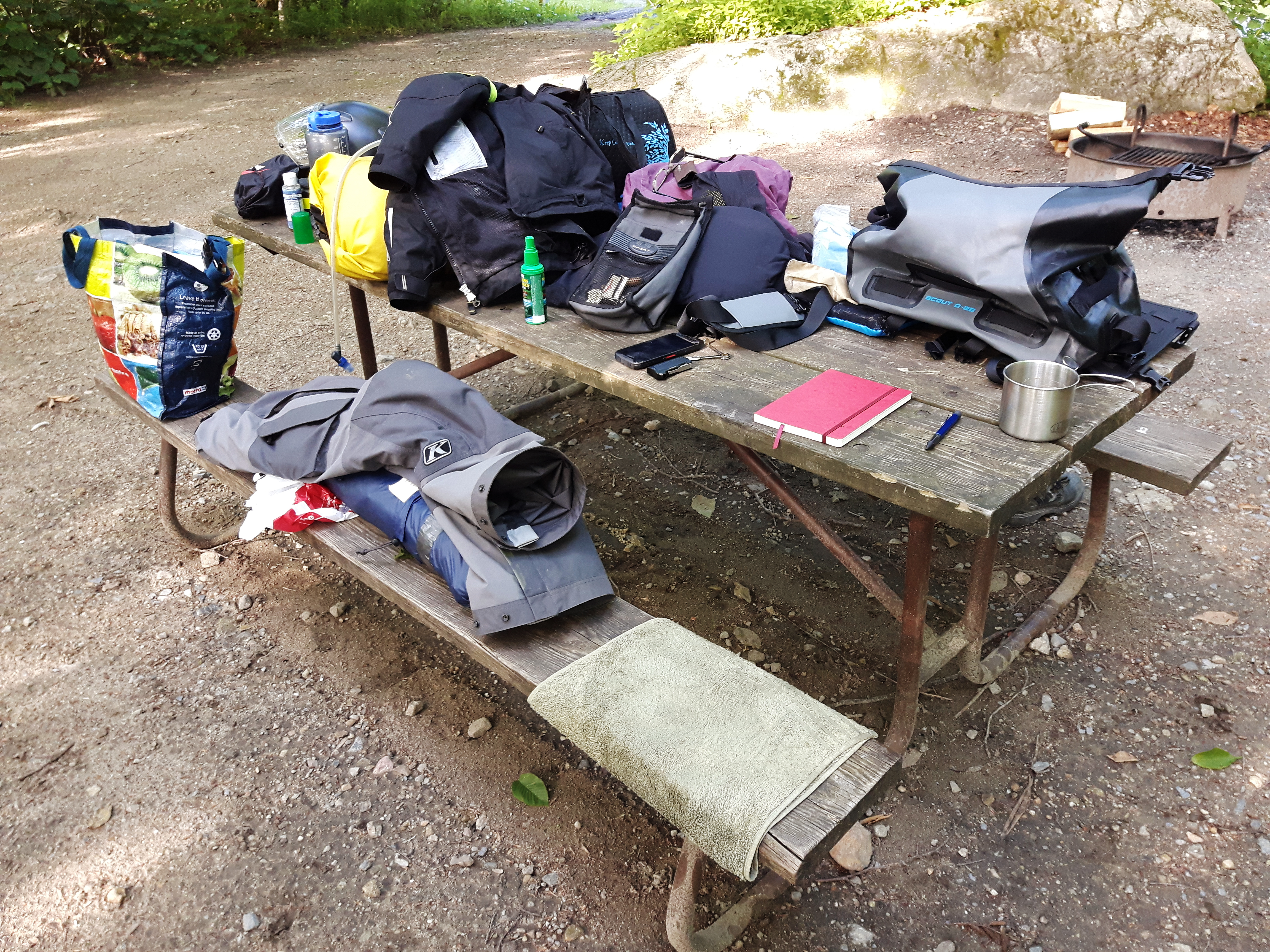
(Almost) all of a man’s needs on one picnic table.

The next morning I packed up camp and rode the rest of Highway 9 east out to Interstate 91. Highway 9 is a fantastic road that takes you through the Green Mountain National Forest, with some breathtaking views.

Green Mountains

Lookout on Highway 9 to The Green Mountains

The PDR begins in Greenfield, MA. You turn off a main road onto a residential road and in about one kilometre is turns into dirt and the fun begins.

Starting Out

Starting out in Greenfield, MA.

At the beginning, I was so enamoured I was stopping every few kilometres to take a photo. Then I realized at this pace I’d never make it back to my native country and had to be more selective. But it was beautiful! The surface was hard-packed and easy to ride on. Trees line the road with sunlight streaking through. The road follows a stream, and every once in a while there is a quintessential cedar shingle Colonial home. In my helmet, I exclaimed aloud “Oh my God,” then rounded a corner to a more beautiful view and said “OHH my God,” then rounded another corner and “ARE YOU KIDDING ME!”

I think I’ve found my ideal ride, at least at this time in my life. I like the twisties as much as the next rider, don’t get me wrong. And yeah, I like speed. I also like the challenge of a technical section of a trail, the pull of torque as you crack the throttle, feel the rear tire grab, and power up a steep hill. But I’m beginning to see the limitations of my bike for both technical terrain and speed. It doesn’t have the clearance or the suspension for serious off-roading, and it starts to buzz like its namesake (Bigby) over 110 km/hr, at 5,500 rpm.. What it seems best designed for is enjoying dirt roads where a Harley or Indian or crotch rocket fears to tread. It’s at home in either the Bavarian or Green Mountain forests.

I came to a covered bridge and decided that was a good place to take a break.

Covered BridgeSoon some more riders caught up to me with the same idea. I met Nigel and his dad and a few friends on their classic BMWs. Nigel has a 1977 R100 RS, and his dad has a 1980’s era BMW. Someone else in the group has the new Royal Enfield Himalayan.

Nigel

Nigel and his R100 RS. Just when I was beginning to think that my bike is old!

One of the things I like about riding solo is that people talk to you. Nigel is from Connecticut and this opening section of the PDR is part of their regular loop over from that state. I expressed my appreciation for these dirt roads and he said, “the state is full of them.” I wondered if I’d died back on Highway 9 and this was heaven.

I wasn’t even into Vermont yet so pressed on. Soon I was getting pretty familiar with cornering on dirt and was sliding out the back end. A whole day of riding on dirt and you understand the importance of getting your weight out over the contact patch so you don’t low-side. So when seated, that means leaning toward the opposite handle-grip of the corner (i.e. turning right? lean toward the left grip). The route just kept getting prettier.

Mass

Following the Stream

Picturesque views on the PDR

My destination for tonight was Silver Lake State Park. This is the midway point of the route and home of Cromag Campout each September. If you are doing the route over two days, as I was, I would advise to set off earlier than my 11:00 a.m. start in Greenfield because it’s a long ride. You are rarely out of 2nd gear, so although the distance isn’t far, it takes a good 8 hours. This is where perhaps the route itinerary is a bit off; I think it says 6+ hours to get to Silver Lake, but I was riding pretty hard all day with few breaks and pulled in around 8 p.m.. I had just enough time to pitch tent before the light faded. A nice neighbouring camper came over with some kindling to help me start my fire. I love campers, and I’ve never met an American who isn’t friendly.

I think the international perception of Americans is very different from the in-person reality. You have to visit to see what I mean. I pause, looking at my GPS, and an American is there, offering directions. The young sales clerk at the general store sees me staring into the beer fridge a little long and comes over to suggest his favourite local porter. I stop to eat an apple and a kid comes by on his pit bike to see if I’m okay. Even the state trooper bids me a good morning at the gas station.

Campsite

Silver Lake State Park

This belief would be confirmed in the most exciting way the next day with a chance encounter.

Remise en Forme

20190525_104322

Google translates it as “fitness.” Literally, it might be “put back in shape.” I’ve seen it translated more liberally as “Spring Refresher.” The Remise en Forme is a day of exercises to regain muscle memory of the technical elements of riding. Watching street riders, you may not easily see that riding a motorcycle is a skill, let alone athletic, but off-road riding involves a whole set of skills as well as a certain level of physical fitness. After a winter of watching Dakar reruns on the couch, it’s a good idea to remind the body by targeting specific skills with specific exercises of what it knew how to do last fall.

I belong to two clubs that offer a Remise, so I had the pleasure of refreshing myself twice, so to speak, in May—once with MotoTrail Aventure, and once with the BMW Moto Club of Quebec. I had the same BMW-certified instructor for both, and he was incredible. He has represented Canada twice in the GS Trophy contest. Say no more. He demonstrated all the exercises flawlessly without even a dab (i.e. touching a foot down), and he did it on Michelin Anakee (street) tires when we were all struggling on knobbies.

Here are some of the exercises we did, roughly in the order done:

  1. The Walk-Around. (Engines off.) Have a partner assist you by being ready to catch your bike should it begin to fall. Start by standing beside your bike and find its balance point. Now let go and move to another part of the bike. At no time should you hold the bike with more than the fingers of one hand. Move entirely around the bike, 360 degrees, releasing and catching different parts (windscreen, tail-rack, etc.), ending up back beside the bike where you started. This exercise helps remind you that all of those 500 lbs can be zero when the bike is perfectly balanced. Also to breathe when you are nervous.
  2. The Friction Point. Sit with your bike idling in first gear, clutch in. Gently ease out the lever until the bike inches slowly forward. Now stop using the rear brake while pulling in the clutch lever no more than 1/8″. Ease out again and repeat. This exercise helps you discover the friction point. Much of off-road riding occurs at the friction point with the clutch lever moving no more than 1/8″. If you pull the clutch lever in all the way when you want to slow down, you will not be ready to recover quickly enough if you need to accelerate.
  3. Circus Riding. Okay, he didn’t call this one that, but that’s what it reminded me of. We played follow the leader in a wide circle, doing what the lead rider, the instructor, did. All riding was done standing up except where indicated. He rode with one hand (throttle hand, obviously); he rode with one foot on the peg, then the other foot. Then he sat down, swung his right leg over the bike and put the right foot on the left peg and stood up again. Then he sat down, swung his legs over the seat, and stood up with his left foot on the right peg. Then he sat down and swung his left leg over the seat to straddle the bike again. Then he hopped off the bike and walked beside it a few paces. Then he hopped back on, Roy Rodgers style, like mounting a horse. All this was done at slow speed without stopping, the bikes in 1st gear. This exercise teaches you that you and the bike are independent but together you have to remain in balance. I was reminded of this exercise later in the day when we got into slippery terrain and I had to allow the bike to move around beneath me. It’s all about balance, balance, balance!
  4. Peg-Weighting. A lot of turning in off-roading is done “with the boots,” not the handlebars. You weight the peg on the side of the direction you want to turn. You have to bend your knees and stick your butt to the outside of the corner to counterbalance the bike. We slalomed through a series of cones, then looped around to start again. I was doing this okay but the assistant instructor told me to brace my outside knee against the bike and to use the knee to straighten the bike if needed. This little tip was ground-breaking for me. It gave me more control over the balance of the bike when hanging off it in tight low-speed turns. This exercise reminded us that you don’t steer in low-traction zones with the handlebars but the pegs, and you keep your weight out over the contact patch or the bike might low-side on you.
  5. Parallel Lines. A variation of the above exercise is to add a straight section where you have to ride between two lines (straps or string) about 6″ apart. This is to simulate when you have to ride between two fallen logs, or across a bridge with only 2 x 6’s running lengthwise, or along a ledge. Vision is everything. You look at your entry point but once you enter you look up at your destination. Don’t look down! Look straight ahead. This exercise teaches you how to ride along a narrow path. 
  6. The Full-Lock Turn. Place four cones about 10 meters apart in a square. You have to ride into the square and turn full lock within the cones one full circle before exiting. Again, body positioning and vision here are the keys. You have to stand up, brace your outside knee against the bike for leverage, get your butt well out to the side, and swivel your head and especially look where you want to turn. You should be looking toward the centre of your riding circle at all times except for the very end when you look toward the exit before leaving. Practice clockwise and counter-clockwise turns. It’s pretty obvious, but this exercise practices sharp turns on the trail or U-turns on single-lane gravel roads.
  7. Hill climbs and descents. The secret to both is body positioning. In one version, we had to move our weight back because it was a sandy hill and the bike needed traction to get up. In the other, it was a grassy hill and we were told to lean forward or the bike might flip going up. So it really depends on the type of terrain. For both, you coast to the top because you don’t know what is over the crest. It could be your fallen buddy or, as was the case with me in Cape Breton, a cliff! A variation is to stop halfway up the hill if your buddy in front has fallen before cresting. Then you stall the bike using the rear brake, release the clutch, let the engine hold the bike on the hill and, bit-by-bit, roll the bike back down by feathering the clutch. Don’t panic and pull in the clutch or you’ll end up on your back! Don’t forget to look behind you in case there are trees or logs to avoid. For descents, weight is always at the back and we were advised to use the rear brake.
  8. Water Crossings. Our instructor said water crossings are mostly psychological because you can’t see what you are riding over. The same principles of riding apply: look up toward your destination, feather the clutch at the friction point, and don’t squeeze the bike with your knees. The latter is important because if you hit a hidden rock the bike might be thrown sideways and you have to be ready to counterbalance.
  9. Emergency Braking. Ride about 40 km/hr into a small square of cones and brake as quickly as possible. It’s all about body positioning. Weight and butt back, arms outstretched, then stomp on rear brake, and gently squeeze the front brake lever. Contrary to what I had been taught elsewhere, this instructor said to pull in the front brake lever fully, not all at once, but gradually. Yes, the front might lock up, but with your butt back and your arms outstretched, you can “wrestle” the front end to keep the bike up and you modulate braking as needed (back off slightly when it locks). You want to be right at the point of static friction, when the tire begins to skid. Because most braking occurs with the front brake, this technique will result in faster stopping.

Finally it was time to put all these skills together on some trail riding. We played follow the leader and there was a mixture of sand, mud, rocky terrain, some rock ledges, ruts from rainfall runoff, water crossings, and single-track. It was a ton of fun! By the end of the day we were tired but ready for the season.

The take-aways for me:

  • Vision is everything. He said vision is 90% of riding. Always look to where you want to go. It sounds so obvious but when you come upon an obstacle, like even some rocky terrain, your natural reaction will be to look down at the front wheel. You must resist the urge, trust the bike will roll over anything, and look up, further down the trail.
  • Contrary to dirt-bike riding, don’t squeeze the bike with your knees. With these big bikes, you aren’t going to hold them up with your knees. Instead, bow your legs and create space between the inside of your thighs and the bike. This space allows the bike to move around beneath you as it slips and slides over low-traction terrain or is bounced over rocky terrain. Thinking of the circus act balancing practice, you will be fine if you and the bike together remain balanced over the centre-line of gravity.
  • On the same topic, body positioning is crucial. Contrary to street riding, in which you squeeze the tank with your knees and remain fairly static on the bike, off-roading requires a lot of movement on the bike. The first remise I was still feeling the effects of a pulled back and had difficulty reacting quickly enough to changing circumstances. The second I was fully mobile and did much better. Don’t be afraid to get up there on the pegs and move around—back, forth, to the sides.
  • Breathe and relax when you come to a challenging obstacle. As in all sport, tensing up is counterproductive, and breathing is the simplest way to get the body to relax.

One of the reasons I like off-roading is that it involves the development of skills and so has become yet another ambition to pursue. I love pushing myself, especially physically these days, and the Remise is a great way to brush up those skills at the start of a new season. A big thank you to Moto Trail Aventure and the BMW Club Québec, and especially the instructors who have volunteered their time and expertise.


The Lumberjack Trail

20180728_112555

Voyageur Days. Mattawa, ON

What’s your ideal ride? For some, it’s a winding road like Tail of the Dragon; for others, it’s a single-track or ATV trail cutting through dense forest. Mine is some combination of both—a winding dirt road with some technical sections that challenge, like hill-climbs, mud, even the occasional water crossing. That’s what I was looking for when I decided to do some off-roading in Northern Ontario this summer.

I enjoyed looping Georgian Bay with my wife, and I enjoyed the rest stop in Kipawa, Quebec, at a cottage. I enjoyed the ride up to Moonbeam, albeit in the rain. But what I had really been looking forward to is a full day in the dirt, and this was the day I could finally do it.

The violent rainstorm of the night before had subsided by the time I crawled out of my tent. After my breakfast of champions, porridge, I geared up and headed to the park gate. I figured the attendant would be familiar with the area and able to direct me to the trailhead of The Lumberjack Trail, a 26 km. loop from Moonbeam to Kapuskasing I’d found online at an interactive trip planner.

Lumberjack Trail

Lumberjack Kapuskasing-Moonbeam Loop

I rode down to the gate, pulled a U-turn and parked. When I entered the kiosk, the young lady was staring into her phone. Our conversation went something like this:

Me: “Good morning. Do you know where I could pick up The Lumberjack Trail?”

Teenaged attendant: (looks up from phone) “The what?”

Me: “The Lumberjack Trail. It’s an off-road trail that goes from here to Kapuskasing. I saw it online.”

Teenaged attendant: (goes back to phone) “Ok Google, what’s The Lumberjack Trail?”

Me: “You don’t know it?”

Attendant: “There’s a lot of trails around here. Basically it’s the only thing to do. Me and my friends go on them on the weekends.”

Me: “Oh, so you ride off-road too?”

Attendant: “No we go in cars. Anything.”

Me: “Well, it’s supposed to go right past here.”

Attendant: “There’s a really pretty one. It’s a . . . a pépinière. Oh, how do you call it in English? Ok Google . . .”

Me: “A nursery.”

Attendant: “Yes. There are a lot of pine trees. But I don’t know how to find it. Try the Tourist Information.”

So off I rode, back to the flying saucer, pondering whether I should ask for directions to the Lumberjack Trail, the Pépinière Trail, the Nursery Trail, or a pine grove?

Once there, I was quickly directed to the trailhead. It turns out that you follow Nursery Road and it takes you straight there.

Nursury Trailhead

This looked promising

A short ways in, the trail became sandy and I found the pine trees.

Pepiniere Trail_web

The Nursery Trail

It was open and easy, but with sand and some small hills to make it a Goldilocks level of difficulty. Unfortunately, it ended too soon. I arrived at a T-junction to a gravel road. Knowing that left leads back to the main road, I turned right and found myself on an open, flat, fairly straight dirt road. Silt Road

The surroundings were pretty enough, but the riding was not very challenging. I was a bit disappointed. It was too easy. It’s actually hard to find a trail with just the right amount of challenge for your particular skill level, and where the Nursery Trail had at least some sand, this road was dry and hard-packed. I was bombing along in third gear, not even standing, thinking “This is too easy” when I hit a section still wet from the rainstorm the previous night. Everything suddenly went sideways—literally. A truck or larger vehicle of some kind had come through before me and left tire grooves. I started to lose the back end, went sideways, got cross-rutted, whiskey throttled towards the trees, and went down high-side, hard. It was my hardest fall yet.

My first thought as I lay on the ground was, “Well, the gear worked.” I had invested earlier in the season in some excellent protection specifically for off-roading. My Knox Venture Shirt, Forcefield Limb Tubes, and Klim D30 hip pads all did their job. I got up without even a bruise. My second thought was for the bike. If there was something broken, it was going to be difficult to get it out. I noticed that the folding levers I had also invested in had done their job. The clutch lever was folded up, saving the lever from breaking off. I lifted the bike and took a look. Nothing was broken or cracked; the crash bars had done their job too. There were some new scratches on the windscreen and front cowling near the headlamp, but nothing more. Oh well, new honour badges, I thought.

My concern now was getting the bike back on the road. I was lucky: if I’d gone a few feet further I might have lost it into a ditch and then would have needed a winch to get it out.

P1030223

Once I lifted the bike, I realized it was going to be difficult to get it back onto the road.

The front end was partially into the ditch and it would take some rocking and cursing to get it back a few feet to where I could carefully walk it back onto the road, making sure the front tire didn’t slide down.

I looked back at my skid marks and played amateur accident inspector.

P1030222

You can see where it all went wrong.

I tried to ride on but the silty dirt, when wet, is like glue and gums up the tires instantly. It was like riding on ball bearings, or rather, trying to ride on ball bearings.

P1030224

Slow-going in the wet silt

The ride now certainly wasn’t too easy. I basically had to do the Harley waddle, foot by foot, hoping it would get drier. I tried riding along the edge of the road in the long grass, thinking the grass would provide some grip, but the problem then was that I couldn’t see what I was riding over or where the ditch was. I dropped the bike a second time and began to wonder how I was going to get out of there. Would it be like this all the way to Kapuskasing?!

Then I had an idea: I knew that in sand you put your weight to the back to unweight the front tire. This helps prevent the front from washing out, which is when you go down. Maybe the same technique applied to all low-traction terrain, including mud. I tried and it worked! The front tire didn’t wash out as easily, even, to my surprise, climbed up out of some small ruts when needed. I had stumbled upon a new off-road skill.

When the road dried out, I was able to sit down, but kept my butt well back, over the rear tire. It all suddenly made sense why those Dakar riders always sit so far back. Now I was able to go at a better pace. The rest of the road wasn’t as wet as that section and, although open and straight, turned out to be just challenging enough. I stopped a few times when I saw some interesting paw prints.

Bear Prints_web

Bear prints. I also saw wolf and hare tracks.

When I felt I was past the worst of it, I stopped for lunch and took in the surrounding wetlands.

Lumberjack Wetlands_web

Wetlands north of René Brunelle Provincial Park

I popped out in Kapuskasing next to the Shell station on Highway 11. Although there was a sense of incompletion in only doing one half of the loop, I decided that was enough excitement for one day and headed into town to find the LCBO and something to enjoy back at camp. I wanted to explore the town a bit and was glad I did. Kapuskasing has an iconic ring of Canadiana to it.

I had the impression that it was bigger than it is, but there isn’t much in these parts that is big. These one-industry towns in the north are built on mining or forestry and are pretty remote. I rode through the town centre, which is a roundabout, and landed at the train station, the heart of all Canadian towns.

P1030264Surrounding the station were archival photos of the town and area, and I discovered that Kapuskasing had been the site of an internment camp during WWI. Primarily Ukrainian immigrants were shamefully sent there to work in a government-run experimental farm studying the viability of farming on clay. Later in the war it was a POW camp.

Kap plaque_F

A plaque outside the train station commemorates the Kapuskasing Internment Camp, 1914-1920

I love Canada and am a proud Canadian, but every nation has its dirty little secrets hidden in untaught history classes. Currently in Quebec, some teachers have expressed serious concern that the role of minorities is overlooked in the current history curriculum. I believe that a little less Upper and Lower Canada and the harmonious relationship with Indigenous Peoples, and a little more on the Indian Residential Schools (IRS), the internment camps of law-abiding citizens during both world wars, and the not-so-quiet actions of the FLQ in the 70’s would go a long way toward real truth and reconciliation among its diverse peoples.

I left the station and rode to the City Hall, then parked and walked out to a gazebo overlooking the river and mill. I came across this plaque about the Garden City and Model Town, and it occurred to me how much promise and hope there must have been in Kapuskasing at one time.

Garden City

Maybe Kapuskasing is iconic. It could be symbolic of how the country seemed when Europeans began settling here—pristine, pure, wild—like the blank page awaiting our best intentions. But intentions are just a start. The real work happens after the first draft, when we see all our mistakes and how we can make it so much better.