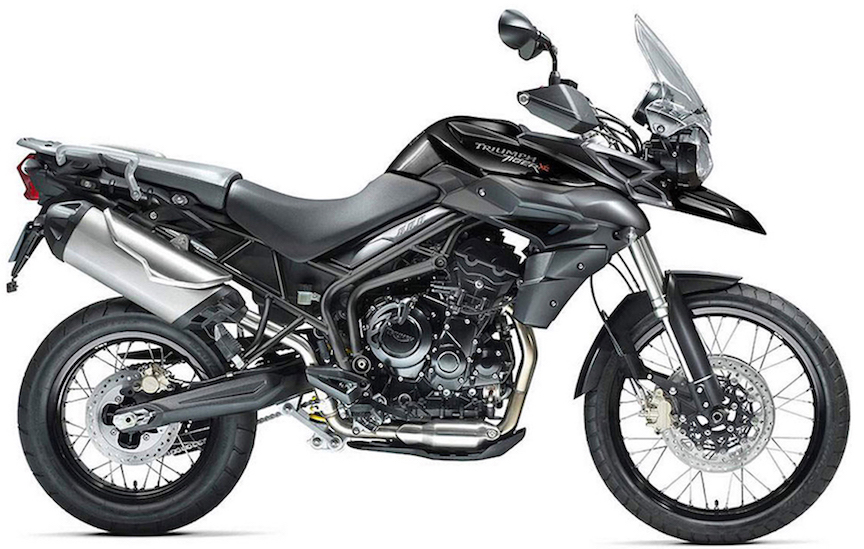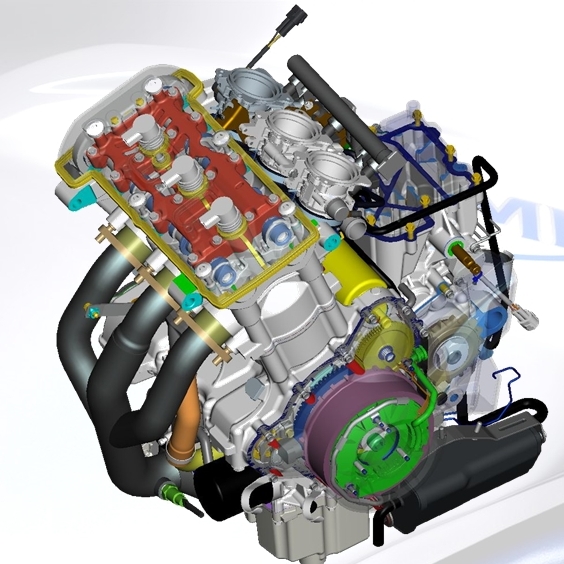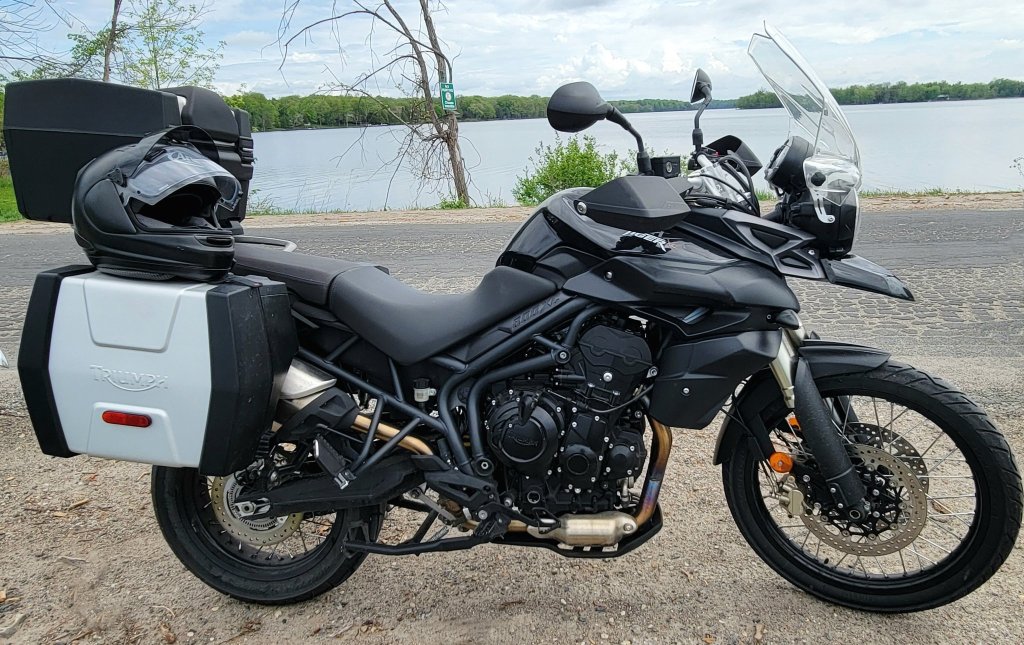
Will Seafoam stop my Tiger 800XC from burning oil?

I did a Seafoam piston soak and water treatment in an attempt to clear carbon deposits and stop oil consumption.1

This season my 2013 Tiger 800XC started burning oil. The bike now has 65,000K on it, and from what I’ve read on forums, it’s not uncommon for Tigers to start burning oil at this mileage. I met someone at the Overland Gathering in Calabogie who switched to a 900GS when his Tiger started losing oil, yet “none on the engine and none on the garage floor,” in his words. 2nd gen Tigers apparently are especially susceptible to this fault, and many owners unload them at about this time.

I spoke to the head mechanic at my dealership and he suggested I switch to Motul from the OEM-recommended Castrol. At first I switched to 7100, but in a follow-up conversation, he said they put the V300 Racing formula in all their “high revving bikes.” I hadn’t really considered my triple as high-revving, but I guess it is, or is supposed to be.

In a recent video on one of my favourite channels, Adam Reimann has decided to buy and ride a KLR across Australia. After four hard days in the upper quarter of the rev-range, the bike hasn’t lost a drop of oil. He posits that “anyone who’s been having an oil-burning issue, they’re not flogging it hard enough.” He’s talking about the KLR, a notorious oil-burner, but it got me wondering about my issue. Is it possible that I haven’t been riding in the correct rev-range? Ryan F9 has also done a video on this topic, and in it he mentions that the Italian tune-up helps clear carbon deposits from the cylinders.

I decided to give the bike a good run and headed off to Vermont a few Sundays ago with a couple of buddies. What I discovered is that at over about 6,000 rpm the bike transforms. It smoothens out and comes alive. The slight vibration coming up into the right hand-grip disappears, and all I can hear of the engine in my helmet is a whistle from the intake. According to specs, the bike hits peak torque (78 ft/lbs) at 7850 rpm, and that’s probably closer to wear I should have been riding it for the past three years! I’d been riding it like a single or a parallel twin.

I also discovered on that ride that the oil consumption was getting worse. After 450K (280 miles), the bike had burned about 250mL of oil—basically from the top of the sight glass to the bottom in one day. This was concerning, especially since I am preparing for a multi-week tour.

Compression Test and Inspection

When I got home, I decided to run a compression test and have a look in the cylinders. To do that on the Tiger, the first thing you need to do is remove the tank.

The numbering of the coils is obvious from the wiring, but I still like to tape and number them.

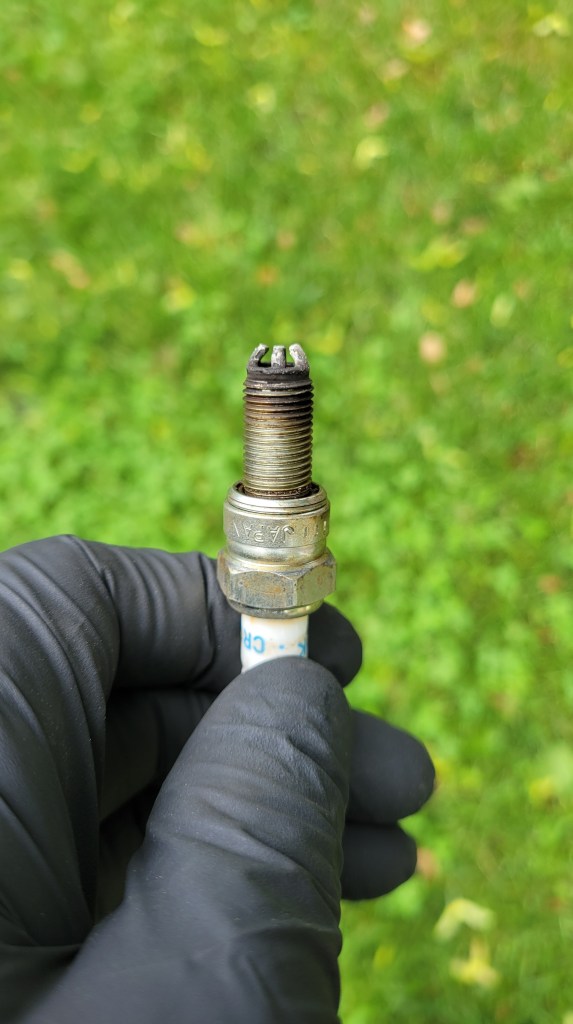
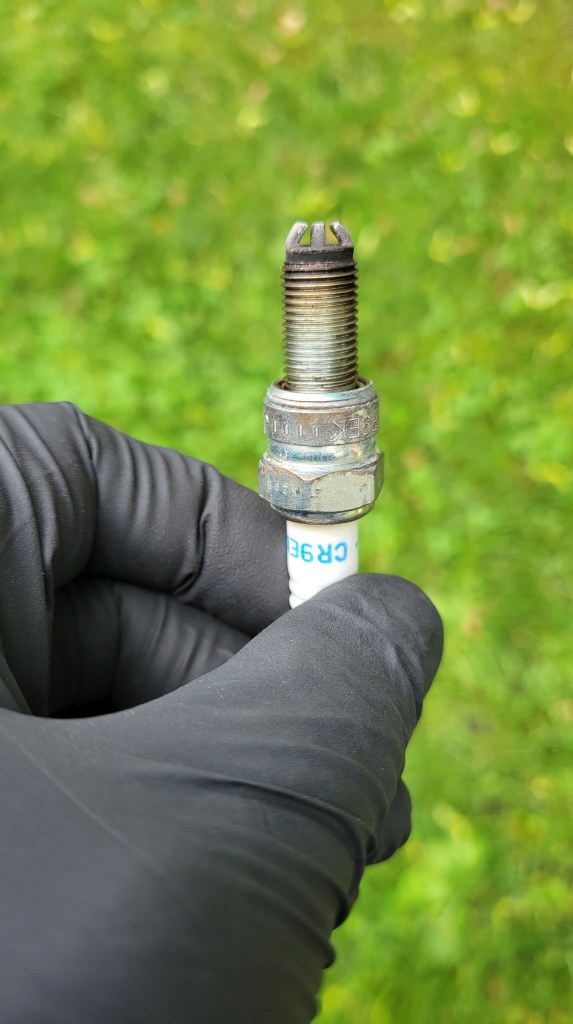
Next I removed the spark plugs and examined them. They showed some white deposits that indicated oil burnt in the chamber. There was no wet oil in the threads. That brownish colour is the copper grease I use to prevent them seizing in the block.

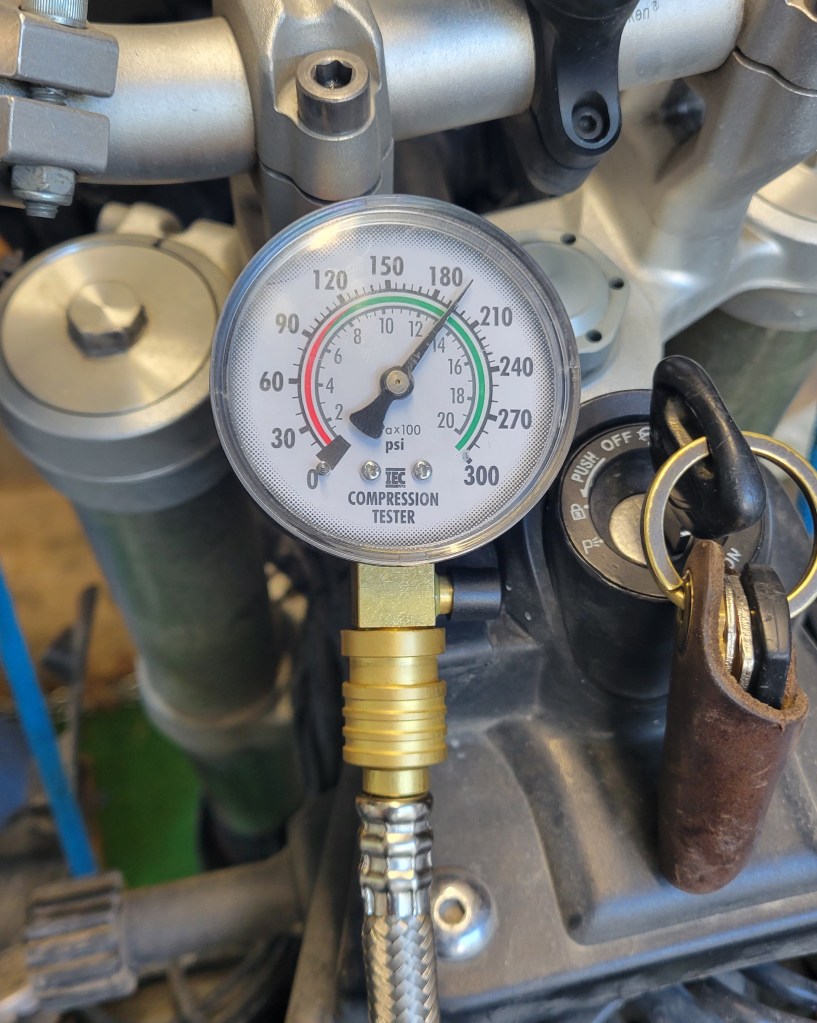
Next I ran the compression tests. Much to my relief, compression was good with all cylinders over 180 psi, so I know there’s nothing physically wrong with the cylinders (i.e. scoring, major wear).

However, a compression test does not tell you much about the state of the oil retention ring. There are two compression rings on top and they can be working fine, but the oil retention ring can be “stuck” with carbon and not doing its job. I knew my bike had carbon deposits on the top of the intake valves and had tried to clear that last fall with a Seafoam treatment. My working theory now was that running the bike at low rpm had left unburnt fuel in the system that resulted in carbon deposits gumming everything up. Perhaps I wasn’t the only one who wasn’t flogging their bike hard enough.

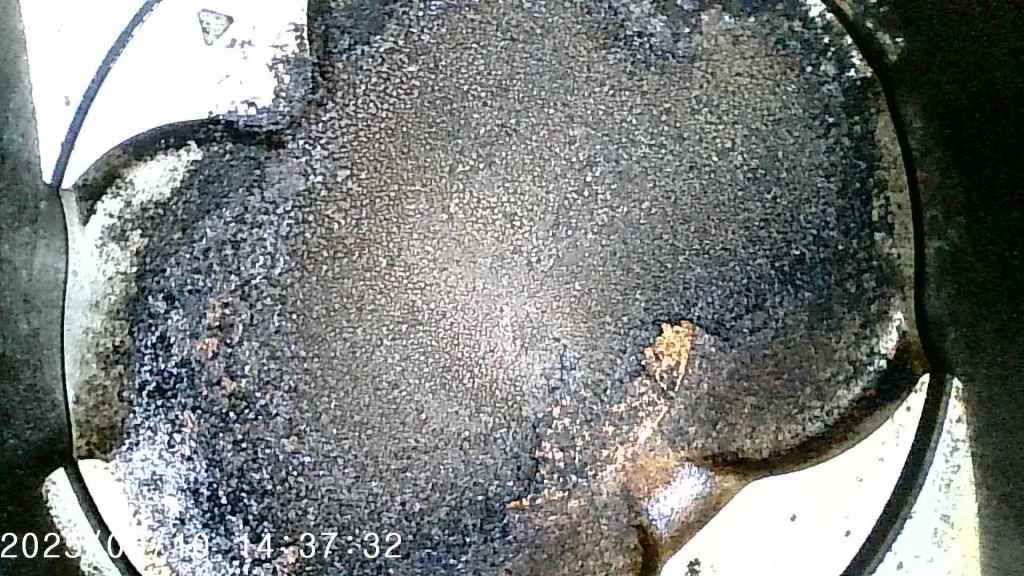
Next I got out my scope and had a look, and what I saw on top of each piston went far in confirming my theory.

Yikes! Is this normal? It certainly wasn’t on the Beemer.

L to R: Pistons 1 to 3. Click on any for a better view. Of the three, piston 1 is the best, and the compression test shows it. Piston 2 is clearly the worst. I wonder how close to my valves the carbon was getting?

The Piston Soak Treatment

This led me to watching YouTube videos on how to remove carbon with a piston soak. Basically that involves pouring a carbon cleaner into the spark plug hole and letting it sit for a while. Some people let it sit for 24 hours; others top it up after 24 hours and let it sit more. One guy soaked his pistons for about a week. You can replace the plugs finger tight to prevent evaporation, but just remember to remove them and turn the engine over several times to clear the cylinders before trying to start the engine again or you will hydrolock it and cause catastrophic damage, which would not be good.

The popular product is Berryman’s B-12 Chemtool, but it can’t be found easily in Canada and, more importantly, it’s not recommended for motorcycles with a wet clutch. (The additive will seep down past the rings into the crankcase.) I decided to go with the milder, less corrosive, tried-and-true Seafoam to help loosen the deposits. I watched another video comparing Berryman’s and Seafoam in which a guy soaks his valves for 10 days using each and the Seafoam did very well, so off to Canadian Tire I went.

Before putting the Seafoam into the cylinders, I wanted to know roughly where each was in its cycle, so I inserted a long pipe cleaner (fringe benefits of smoking a pipe) into each spark plug hole, then reconnected the battery and turned the engine over in very small increments until the cylinders were all a little ways down from TDC. (I know this will produce an error code but I can clear that later using TuneECU.) I didn’t want the Seafoam simply to leak out through one of the valves.

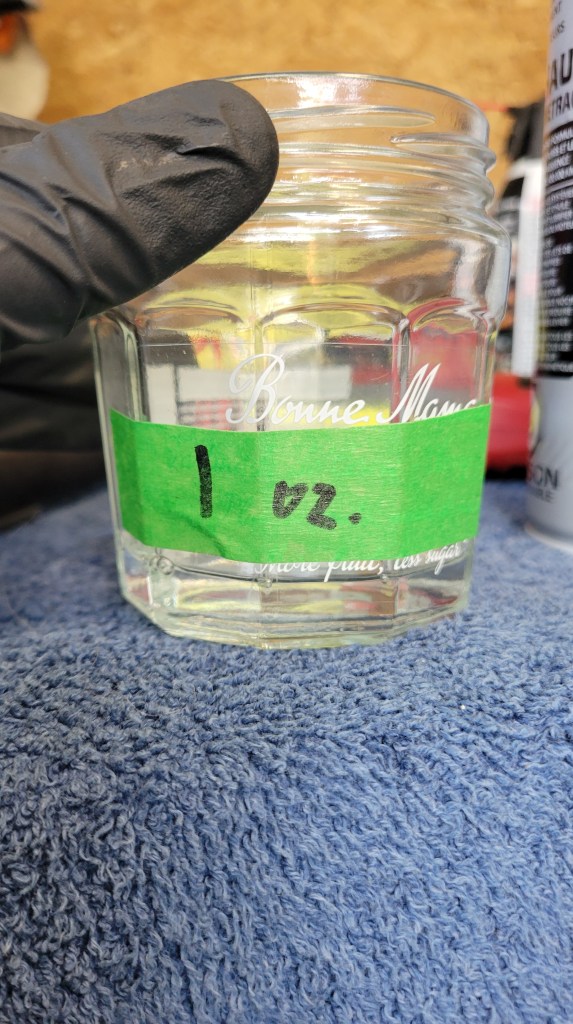
It’s pretty much impossible to get them all down when they are 120 degrees apart, so I started with cylinder 2 high and decided I would rotate the engine the following day. In the videos I’d seen, the guy would jiggle the crank to work the Seafoam (or Berryman’s) below the compression rings to where the oil ring is. Each day I added another ounce, but I really didn’t need to; by the third day, any additional Seafoam leaked out of the exhaust valve and down the front of the engine via the header.

Measuring and pouring 1 oz of Seafoam into each cylinder.

Meanwhile, I was waiting on a part for the windscreen which prevented me from riding so it was a good time to do this work. I screwed the plugs finger tight back into the block and headed off to visit family for the weekend. This is where the story gets interesting.

The Water Treatment

While passing through Whitby, I stopped at GP Bikes to pick up that bracket for the windscreen. I got to talking with the guy in the parts department about what I was doing and he said when they were young they would spray water into the engine to clean the carbon. He said he once brought a gutless oil-burner back to life using this method. And sure enough, here is Eric The Car Guy decarbonizing an engine with water. Apparently, the water instantly vapourizes and steam-cleans the carbon from the engine.

Here’s how you do it. You start the engine and let it warm up at idle to operating temperature. Then you hold the engine at around 3,000 rpm (I used my throttle lock) while injecting the water. You will hear it bog a little so adjust accordingly so it doesn’t stall. Using a spray bottle rather than a cup will prevent accidental hydrolock and, again, catastrophic damage.

By the time I got back into town, the pistons had been soaking for over a week. It was time to clear the chambers and start the engine.

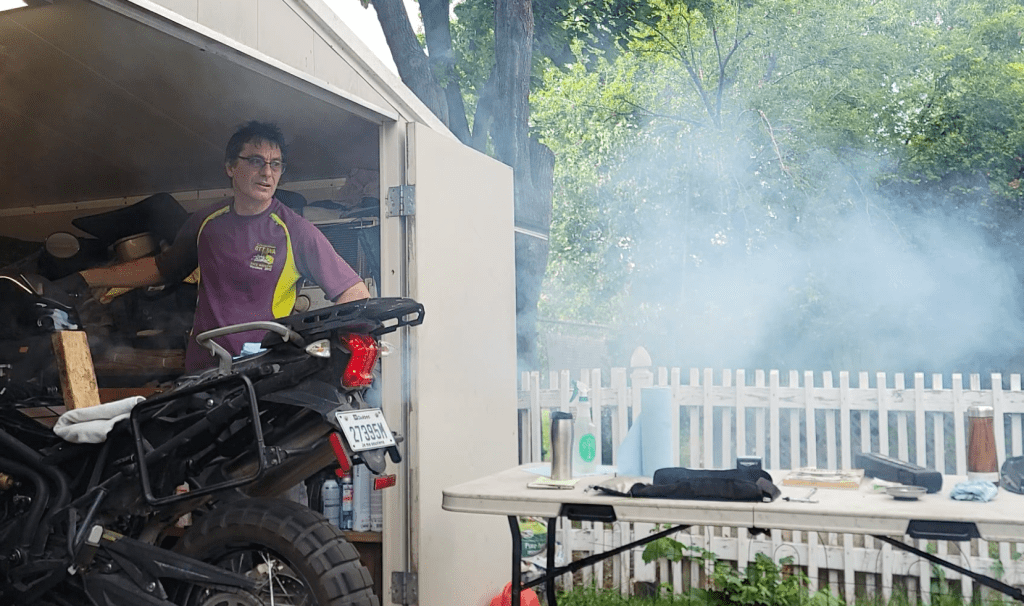
Restarting the engine after the Seafoam piston soak. Yeah, my wife and neighbours were not impressed.

Once the smoke had dissipated, I did the water treatment. I still had the airbox open so sprayed RO water directly into each throttle body.

After about 15 minutes and 150mL of water, I cut the engine and drained the oil and put in a new filter. The oil might be contaminated with water, and the filter might be full of carbon deposits.

The Results

I was very curious to take the plugs out and look at the pistons again, but my curiosity would have to wait. I was heading off on a 3-day motocamp in the Kawartha Lakes region the next day and didn’t have any more time.

I had decided to put Rotella T6 in after all this because, being a diesel oil, it has extra detergents that help clean deposits that tend to build up in diesel engines. Part of my research for this project led me to The Motor Oil Geek, a tribologist, and you can find out what a tribologist is as well as the specific properties of Rotella diesel oil here.

You really should do a double flush, just to be sure you get any water and crud out of the engine, so I decided to run the Rotella just for the trip and then swap it for a regular gasoline engine oil. I also added the remainder of the Seafoam to my fuel tank and used top-tier fuel for the next two fills to help with the cleansing.

At the end of the first day of riding (450K), I checked the oil. As I tipped the bike toward me off the sidestand, I saw the oil rise up in the sight glass all the way to the top! To my great relief, the bike hadn’t burned any oil. After 1,200K when I pulled back into my driveway, the bike still hadn’t burned any oil.

The next day, I removed the tank and spark plugs again and had a look at the pistons. They were considerably cleaner. Before images on left; after on right. Top to bottom are pistons 1 to 3.

Again, click on any image above for a larger view.

Okay, they’re not spotless, but there is considerably more metal and less carbon showing. More importantly, the bike isn’t burning any oil, so I guess carbon was preventing the oil retention ring from doing its job. I’m going to run a fuel additive for one more fill to help clean the last of those deposits out.

Just out of curiosity, I ran compression tests again. I’m now getting 10-15 psi more compression per cylinder.

Conclusion

Needless to say, I’m more than pleased with these results—I’m relieved. I love the Tiger and want to get many more years of fun out of it. As I write this, I’m prepping the bike for my summer tour. I’m going to drain the Rotella, but this time I’m not replacing it with Motul V300. One of the things I learned through researching this project is that race oils have a shorter change interval. Yes, they are the highest spec, but they are also designed to be changed after a race weekend or track day. Motul 7100 and a set of new plugs are going in this bike.

Another thing I learned is to never put any oil additive in your engine. Oils are carefully designed with a balance of friction modifiers, cleansers, and other additives in a balance engineered by tribologists. Adding something to the oil only upsets that balance. If you want to cleanse your engine, a much better approach is to use a fuel additive. They are safe and will clean injectors, intake valves, and the combustion chamber. I’ll be adding some Chevron Techton fuel additive to a tank of gas after each oil change to help prevent those deposits from building up again. If you want to know why, watch this video by The Motor Oil Geek.

I’ll also be riding the bike higher in the rev range. My fuel economy will suffer a hit, but the Tiger really is happier over 6,000 rpm.

Take-Aways

  • Ride your bike in the correct rev-range.
  • Don’t use diesel oil in your gasoline engine.
  • Don’t use oil additives.
  • Use fuel additives to help clean deposits.
  • Top-tier fuel has extra cleansers as well as higher octane.
  • Seafoam and water can clear carbon deposits from the combustion chamber and improve compression.

Questions, comments? Okay guys, there’s nothing quite like a good mid-season oil thread. What oil do you put in your engine and why?

  1. The ideas in this post are presented for information purposes only and are not given as advice. Any work you do on your engine is at your own risk. ↩︎

La Classique 2025

Rain, Rides, and Ribs—the unofficial season opener La Classique never disappoints.

My students were writing a final test when I got the missed call and then message: Riley had a spot on the Awesome Players team at this year’s Classique. I wasn’t planning on doing the rally this year but jumped at the opportunity to ride with them, which is always fun. I called him back at the break, got the details, and confirmed.

I’ve done this rally once before by jumping onto an open spot with another team. The way registration works is that teams are created by team captains and each team has 10 spots. Riders on a team preregister, and if there are any open spots, they can be filled during the open registration. Participants are asked a lot of questions during registration like riding experience, type of bike, number of years off-roading, etc. to ensure that team members are compatible. You’re even asked if you prefer a relaxed or sustained pace. It’s a good system that allows lone riders to join a team and participate in the rally.

The Awesome Players have been doing this kind of riding for many years and usually enter into one of the advanced rides. Maybe they are tired of pushing heavy bikes through mud while getting roosted, or maybe they just wanted an easier ride but they decided to do the Classique Plus this time, which suited me fine. I did that ride when I participated in 2023 and it was at my level—mostly dirt roads but with a little sand, rocks, and water in the mix to keep it interesting.

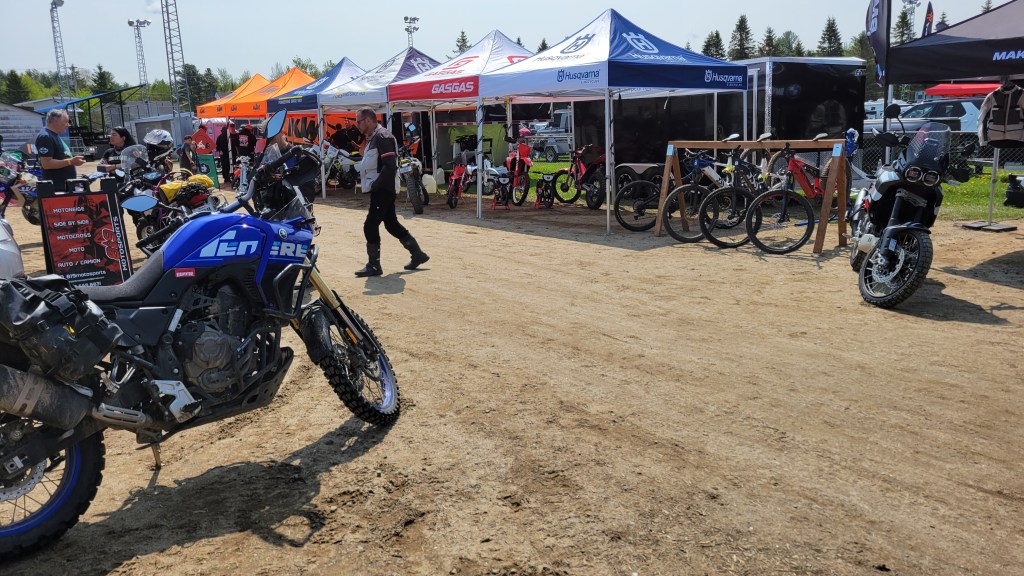
Our ride was Sunday but it’s fun to have a relaxed day at the rally to hang out and do demo rides. Many of the manufacturers were there, so I rode up Friday evening with Curtis, a fellow West Island Motorcycle Club member, who had recently bought a 2017 Tiger XCA and was going to try ADV riding. There’s camping available on site so we would camp two nights and do demo rides on the Saturday.

Demo Rides

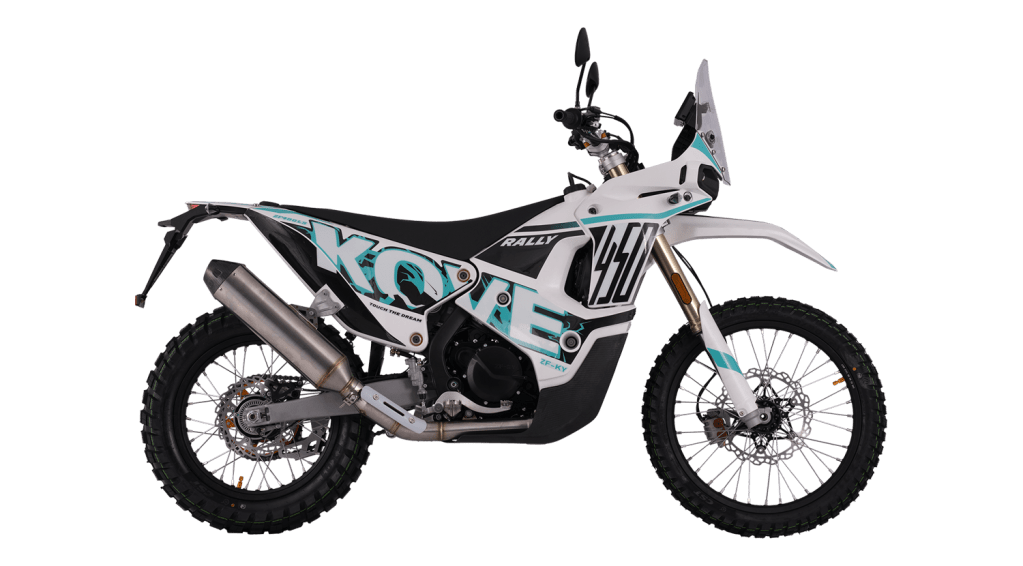
Dealers are now reluctant to offer demos so you have to attend these events and get them straight from the manufacturers. I was lucky because I was able to demo two of my dream bikes: the Kove 450 Rally and the Aprilia Tuareg. I’m a year away from retiring so am scouting a potential new bike for the kind of riding I want to do in retirement.

Kove 450 Rally

Okay, maybe it was a little naïve of me, maybe a little romantic, but I had visions of slapping a little Mosko Moto 40L Reskless system on this bike and using it as a super-lightweight ADV bike capable of tackling anything Colorado or Utah could throw at me. One of my bucket list rides is The Continental Divide, a challenging ride technically, so what better bike to do it on than one that completed the Dakar. I also figured that if rally riders can ride it for long days on end, so could I, and with 8 gallons of fuel capacity, there would be no more fuel anxiety when remote riding.

The first thing I noticed when riding the Kove 450 is that it’s loud! I have to be careful with what hearing I have left so I’d have to change the pipe or get a baffle or something, but that’s an easy mod. The other thing I noticed is the significant head-shake I was getting at speed. I thought it might have something to do with the particular front tire on the bike, or maybe my body position, but a steering damper would take care of that too.

In the end, I think this would be a really fun bike for day rides, but the experience of riding one is so raw it would be tiring for a multi-day tour. The bike is, after all, a race bike. But it is a ton of fun to ride and when I get out into The Rockies, one might be in my garage.

Aprilia Tuareg 660

Photo credit:// https://storeusa.aprilia.com/tuareg660.aspx

This bike had just been released when I sold my BMW f650GS and decided to get something a little bigger. I didn’t give it a serious look because at only 10cc larger, I didn’t think it was different enough from the BMW. In fact, it’s closer to the Tiger 800 I have now in power than the 650, and that is why I probably won’t get one. I already have a good midsize bike for adventure touring, and if I were to get another bike, it would either be a bigger bike like a 1250 for crunching the miles 2-up across The United States and Canada or a smaller bike for playing in the mountains out West.

The Tuareg is getting excellent reviews and I’m sure it’s an excellent bike. Llel Pavey of Brake Magazine gave it a glowing review, and he’s normally very discerning in his reviews. He said everything about it—the engine, the suspension, the balance—was excellent and implied it is the perfect adventure bike. If I were in the market now for a midsize do-it-all bike, the Tuareg would be a good choice.

I wasn’t able to test this bike on anything but asphalt so I can’t judge what it’s like off-road. On road, I found a surprising amount of vibration in the handlebars and, again, it was loud. (Other reviewers have said the same about the noise.) Aprilia were clearly aiming for the off-road market and made the induction intake robust and guttural. I’m sure the Tuareg is better than the Tiger for technical riding, but on asphalt and I imagine on dirt and gravel roads, I have to say I prefer the Tiger for its smooth engine and exciting but not deafening exhaust note. It’s always nice when you walk away from a demo ride feeling that you already have the best bike for you, especially when that demo is of a dream bike.

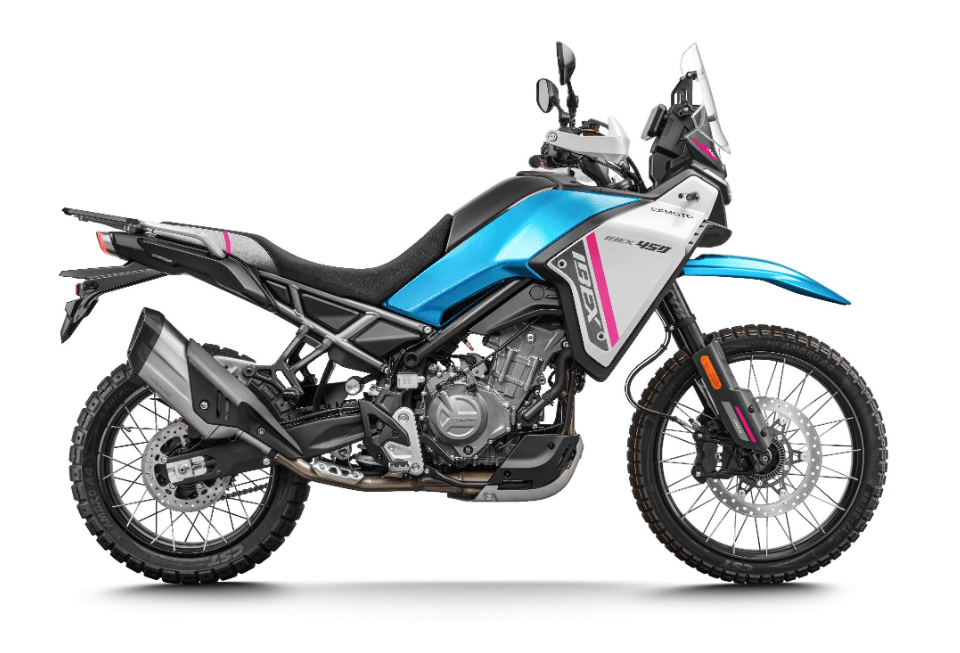
CF Moto Ibex 450

The surprise of the demos was the CFMoto Ibex 450. Maybe it shouldn’t have been. People are saying that the Ibex is finally the unicorn bike everyone has been asking for but no one has been willing to make. It’s small and light but with plenty of power, a 270 degree crankshaft, slipper clutch, rider modes, KYB adjustable front and rear suspension, spoked tubeless wheels, a great exhaust note, radial brakes, 5″ display with Bluetooth connectivity . . . all for under $8,000! People at the rally were saying it’s going to be a KLR killer.

The fly in the ointment is that it’s Chinese made (as is Kove). Does that matter? To some it does; to others it doesn’t. CF Moto have been making bikes for KTM since 2017 and has competed in Moto 2 and has won Moto 3 and Rally Raid, so it’s not some Johnny-Come-Lately cheapo brand. In fact, the Ibex comes with a 5 year warranty. Maybe it’s time we stop generalizing to all Chinese manufacturers the stereotype about poor build quality.

Besides reliability, the other issue with buying from a Chinese company for some is that you are supporting the Chinese government and its authoritarian practises, human rights violations, and general bullying behaviour in Asian geopolitics. I can understand this. Currently there’s a “Buy Canadian” spirit happening in Canada as ordinary citizens exercise one of the few ways they have political agency—through their pocketbooks. When it comes to China, it’s especially hard to separate company from state, and many people are deciding today to purchase ethically. On the other hand, Capitalism has pulled more than 1 billion Chinese people out of extreme poverty since 1981, virtually eliminating extreme poverty in the country (World Bank Poverty and Inequality Platform (2024) – with major processing by Our World in Data). If you choose to boycott China when purchasing, are you hurting the Chinese government or the Chinese people? The ethics are not simple.

But back to bikes, unlike the Kove’s 450 single, the Ibex’s 450 twin is smooth. I also noticed that CF Moto have geared the first two or three gears with lots of torque for off-roading, with the other gear ratios spread out so that even at highway speed the little 450 is not straining. In sum, it’s a sweet little bike, and perhaps it will be an Ibex and not a Kove that I take over those Colorado mountain passes.

BMW

BMW’s luxury tourer.

Of course I had to spend some time at the BMW display. Yes, I still have a bit of sweet spot for the German brand that began my motorcycle life. I had in mind to try their flagship 1300GS, but it was fully booked. In fact, all the GS’s were booked in the remaining time slots so I tried a big K1600 GTL for a lark. This luxury tourer starts at $36,000. A demo is about the only opportunity I’ll have to ride one, so I thought, “Why not?” Marilyn would surely be riding in style and comfort on the back of one of these!

The experience was pretty interesting. I’ve ridden a Gold Wing before so am not unfamiliar with a big bike, but this big bike was something else. If the rawness of the Kove is at one end of a spectrum, the comfort of the GTL is at the other. I wouldn’t say it felt like I wasn’t riding a motorcycle, but it felt more like flying an airplane than riding a motorcycle. Quiet and smooth, it glided over the pavement and banked into turns like a jetliner on final approach. When it started to rain on the demo ride, I simply lifted the windscreen with the push of a button and stayed dry.

In the end, it was fun to demo, but even if I had that kind of money, I don’t think I’d buy a GTL. It would take all the fun out of riding, and what’s more, I couldn’t help thinking of what it would be like with Marilyn on the back and trying to navigate all the off-camber stop signs and slow speed corners of somewhere like Saint John’s, NL, on such a heavy machine. One tired touring mistake and . . . Again, the Tiger is about perfect in weight and power for touring, and I feel very comfortable navigating it at slow speed, even 2-up.

There was one last demo and it came unexpectedly. My buddy Steve was riding the 1300 GSA and when we stopped for a break halfway he offered to switch. What a great guy! He knew I wanted to try the big GS, so I rode that back to the rally while he tried the GTL. The boxer is a very distinctive engine and I had more fun on the GSA than the GTL. I also found it really nicely balanced, as all GS’s are. No wonder the GSA is one of the top 12 open-class ADV bikes of 2025, according to Cycle World.

After the demos, we all piled into a bus and headed into Lachute for dinner. It’s great that the rally organizes the shuttle because they know that most grown men don’t have the good sense not to ride after “just a few.” The dinner was a fitting rack of ribs and poutine, with door prizes and Cherry Bomb, a Joan Jett cover band for the night’s entertainment. There’s a ton of organization behind this rally!

Chowing down with the boys. Clockwise: Pete, Riley, Ivan, Marc, Dave, and Curtis.

Classique Plus Ride

Sunday was our ride so I was up at 6:00 to be ready for an early start. Rally organizers provide coffee and muffins for breakfast so I didn’t even bother to bring my camp stove. I geared up and headed up to get the bike inspected, then slotted into line at the staging area. Shortly after 8:00, we headed off.

The Awesome Players use Sena and The West Island Moto Club uses Cardo. The previous evening we had overheard someone trying to connect a Sena with a Cardo and had a laugh about that. Good luck! Yeah, apparently in theory they can connect, but only if both are in Bluetooth mode and even then it’s pretty useless unless the other person is a pillion; anything further and you lose the connection. So Curtis and I could talk to each other—that is, until his battery crapped out. Maybe I’ll have to bite the bullet and get a Sena if I’m going to be riding more with these guys.

Like I said, this ride is mostly dirt and gravel roads and fairly mellow, but the road into lunch at Duhamel was a little more challenging with some mud, potholes, and rocks, but I didn’t get any video footage of it. My camera battery died early and I would need lunch to change it. After lunch, as we headed down a sandy trail, I turned on the camera just in time to catch the action.

Making a splash.

Does this look familiar? If you saw my crash in Vermont last August, it should. Again, the front end tucks but this time it’s me and not the bike that ends up off the road. I’ve watched this a dozen times and still don’t know what happened. I didn’t chop the throttle and I didn’t hit the front brake. The only thing I can think of is that I made the classic mistake of making an input on a low-traction surface with the handlebars instead of the pegs. The front tire dug in and sent me sideways. This rally is always the first ride of the season and I think I was just rusty. I was also just really surprised because so far there had been nothing in the ride that was particularly challenging or unexpected.

But the drama was not yet over. Shortly after setting off again, I had another two near falls with epic saves. I wasn’t the only one struggling in the deep sand but at the time I thought I was. On these ones, especially the second, I think my front tire gets rutted.

After the second, I started choosing my line more carefully, staying out of ruts as much as possible, and especially getting my weight back. That seemed to help. In retrospect, I realize I should have accelerated through the deep sand, but that’s the last thing you feel like doing after you’ve just fallen.

When we stopped for gas shortly thereafter, I had a moment to check my bike more thoroughly because it felt like the handlebars were not aligned. I probably torqued the front forks in the crash. The station had old-style pumps where you pay inside after filling and just as we were about to set off again I realized I’d forgotten to pay. Doh! I was a bit discombobulated.

Now it was time to ride some asphalt east of Namur on the fun Boileau Road. After the incidents in sand, I was happy to be back on asphalt where the Tiger is in its element.

Most of the ride through the afternoon was on hard-packed dirt roads snaking through pretty rural countryside, like this one.

Brookdale Rd. west of Boileau, QC.

I don’t know if it was the climax of the ride but certainly a highlight was riding Scotch Road with these guys who in no small part made that road famous and popular for off-road riders. It’s a Class 4 road north of Grenville that even Fort Nine videoed when he was still in Montreal. Unfortunately, the Bob and Margs have moved in, literally, and it’s slowly being converted to cottage country. The road is now quite graded and you can see as we pass the famous sand pit that someone has blocked off access. I’m curious to know who and if that land is owned or crown land. If you know what’s happening there, drop a comment below. Sadly, spaces for recreational off-road motorsports are disappearing, and one has to travel further and further out of the city to find them, a topic Ryan F9 addresses as he rides Chemin Scotch. (Incidentally, you can compare the road eight years ago and now, as well as the quality of the video stabilization.)

We made it back to camp wet, cold, and tired, but the weather didn’t really dampen any spirits. It had been a really fun weekend of beer, burgers, and bikes. Thanks again to Marc Chartrand and his team of volunteers for once again putting together another great rally, to Riley for being such a good host, to Ivan for setting a nice pace for us newbies, and to the rest of the boys for including me and making it so much fun.

Have you participated in La Classique in the past? Drop a comment below describing your experience or another rally you would recommend. Any thoughts on access to public lands for motorsports? Here in Quebec we have it pretty good with the FQMHR network and the TQT—more initiatives of Marc Chartrand. Any other comments?

2013 Triumph Tiger 800XC Long Term Review

Spirited on road, capable off road, the Tiger 800XC is a great all-round middle-weight bike.

My review of the 650GS has been the most viewed page on this blog for years, so I thought I’d write one on the Tiger, which I’ve had now for three full seasons and over 45,000K. These are both old bikes, so I know most people reading the reviews already own the bike and want to see if they’ve made a mistake. You have not. Well, as always, it depends on the type of riding you do. But if you’re looking for a long-distance ADV touring bike, the Triumph Tiger 800XC is a good choice.

But I’m getting ahead of myself. As I did before, I’ll break down the review into components.

Engine

The heart of any bike is the engine and the Tiger’s is a gem. When I pulled into my driveway on the GS at the end of my 2021 cross-country trip, I knew I wanted a smoother bike. The big thumper got me to the Pacific Ocean and the Arctic Circle and back, but it wasn’t very comfortable, especially on those highway miles. When I test rode the Tiger, I knew I would buy it even before I was around the block; I couldn’t believe what I was feeling. This engine is SMOOOTH! I’d go as far as to say it’s the bike’s defining characteristic. This is the 800, so before Triumph moved to the T-plane crank and off-set firing order, so it’s about as smooth as a triple can be. If you’re coming from the nuts-numbing world of a big thumper, the inline triple with a 120 degree crank is a world apart and exactly what I was looking for.

Aside from being smooth, this engine has a ton of character. It has comparable torque to its rival, the BMW F800 GS (58 ft.lb @ 7850 rpm vs. 59 ft.lb @ 5750 respectively), but gets that torque much higher in the rev range. And it likes to rev! It spins up fast, so even pulling away from a stop light you find yourself pulled involuntarily into The Giggle Zone. Yet despite that high peak rpm, the torque on the Tiger is incredibly linear.

photo credit:// ADVMoto. 1st Gen Tiger 800 dyno results. Note the linear (flat) torque “curve” above 3000 rpm.

The gearbox is also smooth, both upshifting and downshifting. It’s so smooth, someone I swapped bikes with once asked if it has a slipper clutch. The high-revs, the smoothness of both engine and gearbox, combined with a wonderfully guttural exhaust note make the Tiger 800 a really fun bike to ride. It feels like Triumph has shoe-horned a sport bike engine into an adventure chassis, which I guess they have since the engine comes from the 660 Sport. I’m not afraid of the dirt but, to be honest, most of my adventure touring is on asphalt, and the Tiger makes crunching those miles enjoyable.

Where the engine does come up short is in slow-speed technical riding, a downside the T-plane crank of its successor, the Tiger 900, attempts to address. The 800 is happy when revved, but is prone to stalling at slow speed, especially in sticky mud or over obstacles—anything that requires careful clutch work in 1st gear. It has no tractor-factor, so if you like ATV and snowmobile trails, single-track and getting out into the woods, the Tiger is probably not for you. It can do it, but you have to keep the revs up and feather the clutch a lot, which can be tiring on your hand and the clutch.

Handling

The XC model I have has a 21″ front and a 17″ rear wheel—an unusual combination in the ADV world where an 18″ rear is the norm. Perhaps Triumph did that to compensate for the nose-heavy geometry of the big triple compared to a parallel twin. (It still has a stink bug stance.) They’ve also increased the rake on the front forks beyond the competitors’ to 23.9˚ (compare with 26˚ for the BMW 800). What this weird-ass geometry does is make the 21″ front wheel surprisingly easy to turn in yet planted through corners. For an ADV bike, the Tiger is surprisingly agile and confidence-inspiring through the twisties. That’s when it’s in its element, whether on asphalt, gravel, or dirt.

Lanark County Trail System on 70/30 tires.

The cost is a tendency for the front end to tuck in mud or sand, especially if you forget to steer with the pegs. My crash this past August was a direct result of that happening on a muddy downhill corner, although I think balance of the bike front to back was also a factor. (I was under sag.)

Front-end tuck on the Bailey-Hazen hero section.

The Tiger is also a little top heavy, despite its flat horseshoe-shaped gas tank. That’s probably a result of the tall and wide engine. (To get the 660cc Sport engine to 800, Triumph lengthened rather than widened the bore.) You don’t feel it once the bike is rolling, but again, it’s another characteristic that makes the Tiger a challenge off-roading at slow speed. What all this means is that if you want to ride hero sections on the Tiger, you’d better have skills.

Triumph says that the Tiger is for “light off-roading” and they don’t lie. The engine and balance of this bike are designed for 2nd gear and up. But the biggest indicator that this bike is not for serious off-roading is the placement of the spark plugs and air filter, both of which are under the tank. If you’re doing water crossings—and what serious off-roader isn’t—you’d better not swamp the bike or you’re going to be removing bodywork and lifting the tank trailside. Been there, done that. It’s not much fun. To lift the tank, you need first to remove the beak, radiator side panels, indicator panels, and trim. I’ve done this perhaps a dozen times now and have the whole process down to about 20 minutes. Needless to say, for an ADV bike, this is a major design flaw, or at least a serious limitation.

Suspension

The Showa suspension on the XC is a step up from the XR version. Rear travel is 215mm and front is 240mm. That’s more than what I’ll need because I’m not blasting down rocky trails as much as trying to thread my way through them. (The 650GS, for comparison, has 165mm rear and 170 front.) With the Outback Motortek skidplate, ground clearance on mine is about 9 1/4″ or 235mm. The shock has hydraulic preload and rebound adjustment. The forks are a beefy 45mm but with no adjustment. That’s a fairly basic system, but again, sufficient for ADV touring.

Like most ADV bikes off the production line, the Tiger 800 is set up for road use. The suspension is soft and cushy, making a plush ride around town (and during test rides, I should add). But if you want to use this bike for how it’s intended—ADV touring (the XC stands for cross country)—you’re going to have to stiffen the suspension.

The OEM shock has a spring rate of 9.7 kg/mm which, surprisingly, gives me a static sag of 18% (40mm). This means that under its own weight on the OEM spring, the bike is under sag. Rider sag for me is 35%, even with preload fully wound. (Note to newbies: static sag is unloaded with no rider and should be 10%; rider sag is loaded with rider and should be 30%.) At 150 lbs (177 in all my gear), I’m not a big guy, and with about 66 lbs of luggage (56 on the back, 10 on the front), I don’t think I’m overloaded, although I’ll be working over the off season to reduce that weight. Nevertheless, it’s clear to me that the OEM spring on the shock is too soft for anything but solo street riding.

I recently upgraded the suspension and will publish a separate post on that topic, so click Follow if you’re interested in what I’ve done.

Ergonomics and Comfort

The ergonomics on the Tiger are generally comfortable whether you are seated or standing. The wide handlebars are what you’d expect and want on a bike designed for the dirt, yet they don’t feel like ape-hangers when seated either. I haven’t added any bar risers because the bar mounts are already high, and when I stand the bars fall to the right place when I’m in the correct body position with hips slightly bent. (Most people who add risers are seeking comfort while standing erect.)

One unusual feature of the bike’s ergos is the distinct sensation of the fuel tank between your, uh, thighs. It was something I immediately noticed on that brief test ride and something others have commented on when we’ve swapped bikes. The tank is wide, and it forces your knees apart. (No bad jokes here). I find it actually reminds me to squeeze the bike, which is good practice whether riding on and especially off road.

The seat is generally comfortable for long days, although when touring I add a sheepskin pad to improve comfort and airflow. Triumph sell a comfort seat for this bike but I haven’t needed it. Similarly, Marilyn hasn’t complained about the seat on the back. The 1st generation Tigers do not have a heated seat option but subsequent ones do.

My knees sometimes complain over long days but I’m pretty long-legged, so they are bent slightly more than 90˚. I put my Fastway pegs in the low position and the adjustable seat in the high position and this set-up has been pretty good. With the bike now sitting even higher, I’m anticipating improved comfort for my ageing knees. In the raised position, seat height is 34.5″ or 885mm, which is comparable to its BMW competitor.

My biggest complaint about comfort is in the area of wind management. I’ll be doing a separate post on my search for a solution, but let me say here that the OEM windscreens for the Tiger suck! The stock screen is notorious, and the touring screen is little better. Maybe it’s too much to ask of a screen to allow airflow at slow speed when off-roading and a quiet ride at speed on the highway. The best solution I’ve found is the touring screen with a cheap clip-on wind deflector, which helps with the wind but ruins both the lines of the bike and video footage from my chin-mounted camera. Oh well.

Aesthetics

Canadian poet Robert Bringhurst has a collection titled The Beauty of the Weapons and I think the Tiger is a beautiful weapon, especially the all black model. I get a lot of compliments on the bike, even from other riders. You can see in the neoclassic bikes like the new Bonnevilles that Triumph pays a lot of attention to how a bike looks, and they’ve done a great job with the Tiger. Okay, you may say they’ve copied their competitor with the beak, but I think a bike without one looks weird. There are a lot of complimentary parallel angular lines on the bike that thankfully Outback Motortek has followed. Aesthetics is something not everyone is into, but I want a bike that makes me turn around and look at it as I walk away in the parking lot, and the Tiger does that.

Reliability

There are a few known issues with this bike, not surprising given that it’s a first generation model. The shifting mechanism is known to fail, and mine did, but not in the expected way of the return spring or the pin for the return spring breaking. No, it was the selector arm that failed at about 45,000K, so while I was in there behind the clutch, I decided to replace not only the selector arm but also the problematic spindle, the return spring, and the detent wheel, all of which have been redesigned. You can read about that work here. The bike also let me down once in the bush during a water crossing when somehow about 3-4L of water got in the tank. I still think the only viable theory is that water got sucked up through the tank breather tube and I’ve since redesigned the tube to avoid this happening again.

The other known issue with this bike is the starter motor. There are many accounts of it failing to restart the bike when the engine is hot. It was fine for me the first two years but then started to act up and got progressively worse. I’ll be doing a separate blog post on that too, but I’ll let the cat out of the bag here and say the problem was, at least in part, a dirty main ground on top of the engine block that was causing a voltage drop. If you have the dreaded starter motor issue on your Tiger, clean the main ground and contacts on the starter relay before changing the starter or battery.

That’s it. Clutch, stator, voltage rectifier, water pump, oil pump—all good—and no issues with any of the electronics. That’s not bad, in my opinion, for a bike with over 60,000K on it.

I adjusted the exhaust valves at 45,000K; the intakes were perfect but all the exhausts were tight. There are some reports of the engines, particularly on the 2nd gen Tigers, to start burning significant oil at about that mileage, but thankfully that has not been the case with mine. It burns a little oil now, particularly at high-revs on the highway, but nothing significant. I’ll come back from a tour of a few thousand kilometers and top up maybe 200mL. I’ve been using Castrol Power 1 4T and, more recently, Motul 7100, but when I mentioned my oil consumption to my dealer, he said they put Motul 300V in all the “high-revving bikes.” I thought it was only for racing bikes, but henceforth that’s what will be going in this bike.

I like that the 2011-14 Tigers are still relatively simple and easy to service on my own. There’s no ride-by-wire and rider modes or complicated electronics that require a computer to diagnose and repair, although I wish turning off ABS were easier than navigating menus. The 1st Gen Tigers that ran 2011-14 are at the tail end of an era before things got pretty complicated electronically. Build quality and fit-and-finish are excellent, and the bike is looking as good as new with no rust or corrosion on it anywhere, despite its age.

Summary

Pros

  • Fun, spirited engine
  • Smooth gearbox
  • Agile and planted through corners
  • Comfortable seat and ergonomics
  • Good looks
  • Aside from a few early-model issues, generally reliable
  • Relatively easy to service

Cons

  • No tractor-factor; stalls easily in 1st gear
  • A little top heavy
  • A tendency for the front end to tuck in low-traction terrain
  • Poor wind management
  • Shifting mechanism weak
  • Some reports of starter issues with OEM starter
  • Plugs and airbox under the tank
  • Vulnerability in water if the tank is rapidly cooled

Looking at the length of those two lists, you’d think I’m not happy with the bike, but I am. That’s because the main elements of the bike are good—the engine, the handling, the reliability. The bike has a few issues, like any bike, but they are overshadowed but just how much fun it is to ride, and isn’t that the main thing we want in a bike?

Conclusion

When I participated in La Classique Moto Fest here in Quebec a few years ago, I saw my bike in a long line of other bikes there for the rally. Maybe it was my subjective perspective, but it seemed slightly out of place. It occurred to me that most of the bikes there were set up for off-road riding whereas the Tiger, at least my Tiger, is more an adventure bike, and I was reminded of a comment made years ago on the ARR Raw podcast about this distinction. (I’ll link to the podcast but can’t remember the specific episode.) They were talking about tire choice, if I remember correctly, and one of the guests made the distinction between what they do as RTW riders and what weekend warriors do. He said he’d never attempt half the stuff some guys do off road because, when you’re touring halfway around the world, you can’t afford to break something on your bike and wait weeks, perhaps longer, for parts to arrive. In other words, they ride more conservatively, and that was reflected in his tire choice. I’ll add that it’s also reflected in your bike choice.

Off-road versus adventure bikes. An arbitrary distinction?

As we all know, the adventure bike is the ultimate compromise. It has to be good on road and off road, capable of crunching out miles on the highway as well as getting you down a logging road. It has to be quiet and comfortable for long days in the saddle, powerful enough to climb mountains and carry camping gear, maybe a pillion, yet small and light enough to pick up on your own in the middle of so-called nowhere. It has to be reliable, and simple enough to fix yourself, trailside if necessary, if something does break. With these considerations in mind, the middleweight Triumph Tiger 800XC is a great all-rounder and an excellent choice as a long-distance ADV touring bike. It has its drawbacks, for sure, and may be master of none, but it’s the best Jack of all trades I’ve been able to find.

Walkaround of the mods I’ve done on the bike.

Review: Dunlop Trailmax Mission Tires

Photo credit: https://www.dunlopmotorcycletires.com/tire-line/mission/

A great long distance adventure touring tire with one major flaw.

When Dunlop decided to design a new ADV tire, they smartly asked adventure riders what they wanted. Of course, we all want a tire that does everything well—excellent street performance with no compromises off-road. That’s not physically possible, but Dunlop claims to have come pretty close with the Trailmax Mission, saying it offers “knobby-like performance” off-road and “great ride quality” and “impressive grip” on the road. I ran the tire for 20,000 kilometres and it was a very good tire on the road but had limitations off-road. Aside from these limitations, I would hesitate to buy it again because of one major drawback.

On Road

Dunlop claims that the Trailmax Mission is a 60/40 tire. I’m glad they revised those numbers, because when the tire was launched they were calling it a 50/50. I think it’s more like a 70/30. You can see at a glance that it’s designed primarily for the street, with a rounded profile and not blocks but deep grooves. That results in a very comfortable street ride with easy turn in and relatively little vibration coming up into the handlebars.

One specific request many ADV riders had was longevity; we’re simply tired of having to change our tires every 5-6K. The Trailmax Mission tires have a very hard compound and you can expect to get 20,000K out of a set. I put a set of these on at the beginning of last season and rode them out to Newfoundland and back 2-up fully loaded. After 20,000K, there was plenty of tread left in the front and some left in the rear.

So apparently if you can see all of Lincoln’s head the tire is finished. The rear is pretty close to done, although I’m not quite down to the wear marks. The front has some life but wear is uneven (probably my fault with under-inflation). Despite that hardness, I never had any problems with the tire skidding in the rain, an issue some riders have reported with the Heidenau K60 Scout that has similar longevity.

So if you are going on a long tour that will be primarily asphalt, the Trailmax Mission would be a good choice.

Off Road

I used this tire in the Classique Plus ride on Class 2 roads. It handles well in hard-packed dirt, gravel, and even shallow sand. I also had it on my 650GS before I sold it for a final tour through the New England states that involved some fairly deep gravel, and I have to say, I was having an easier time than my riding buddies on Shinko 705s, a similar 70/30 tire. Yes, it slides out from time to time, but predictably, which actually makes it a fun tire to run on dirt and gravel if you’re into powersliding.

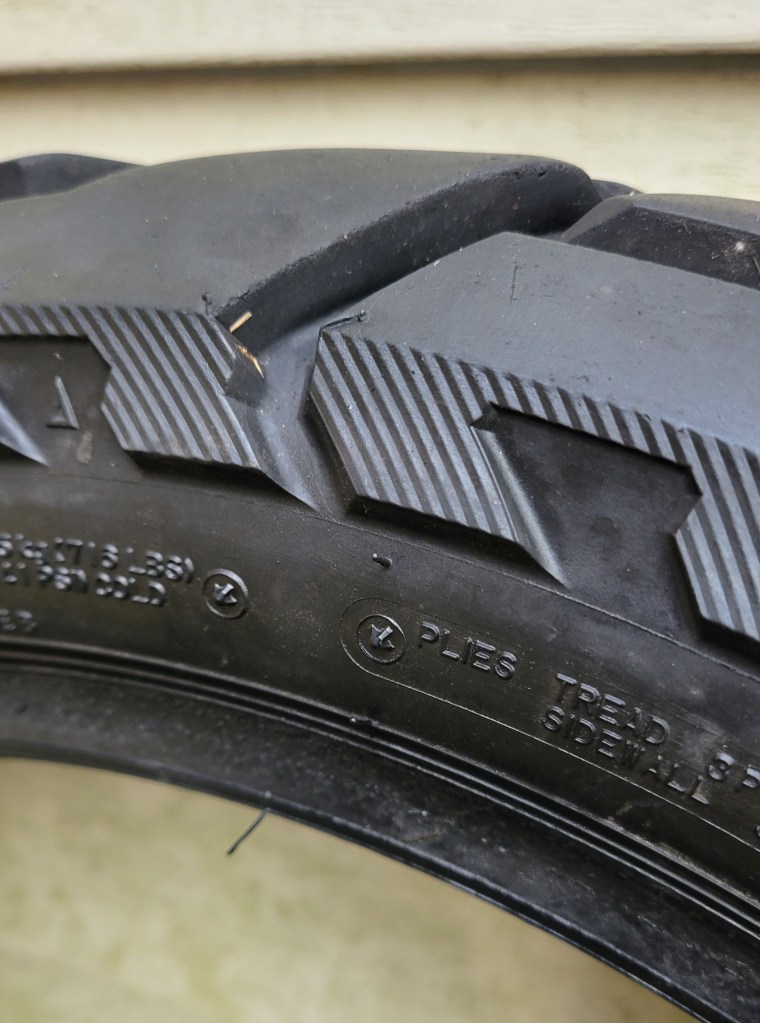
There are a couple of features of the Trailmax Mission that make it especially good in dirt, despite its round profile. One is the sidewall lugs, a technology borrowed from ATV tires that allows the tire to bite when sunk into deep sand or mud. Yes, it does surprisingly well. Dunlop also claim the lugs help prevent sidewall punctures from sharp rocks.

You wouldn’t think these little ridges do much to pull a 500 pound bike through deep mud, but they do.

Another feature is the Staggered Step design. I can’t really say if these did anything but Dunlop claims they add rigidity in the contact patch for improved stability. The idea is that as one step wears down, there’s another ready to take over.

Staggered Step System

Obviously we are talking about stability on the sidewalls as you are leaning through a corner. I guess this is Dunlop’s attempt to reduce the “wandering” sensation some tires have when on the side blocks. Perhaps a Physicist reader will explain it to us because I’m a bit at a loss as to how these cut-outs are going to improve stability. That said, I never noticed the tire wandering, which is something I now feel on the Anakee Wilds I just put on.

“Knobby-like performance”?

Not really, although good enough for even deep sand if you are suicidal or mud if you are masochistic. It’s here where the tire has its limits. I found myself going through mud on the Rideau Trail north of Merrickville, and while the tires got me through the first few puddles, they soon caked up.

Impressive initial performance for a 70/30.

The problem is that, unlike a knobby, the mud does not evacuate from the grooves of the Trailmax Mission. You can spin the rear to clear it, but it’s the front that you need planted, and once it’s caked, you might as well be riding on ball bearings.

Yes, you can blame me for taking a tire like this into mud. It’s not meant for that. I’ve seen GS instructors take their 1200GS’s through a mud bath on Anakee 3s!, but I’m no GS instructor. So for the average rider, either stay out of the mud on these or put on a more aggressive tire.

Riders in the Quebec area will be familiar with Marc Chartrand. He is the founder of RidAventure.ca forum, La Classique Rally, and lead planner of the Trans Quebec Trail. Basically he’s The Man in Quebec and probably has more off-road experience exploring Quebec trails than anyone around here, so when he gives advice, I listen. I once read a reply of his to the ubiquitous question of “What tire should I put on my motorcycle?” His answer (I’m paraphrasing and translating) was basically that if you get, say, 6,000K out of a tire and “only” do about 10% off-road, that’s still 600K in the dirt. And that’s a lot of kilometres to be crapping your pants if you have on a street-biased tire. That’s why, he said, experienced ADV riders always put on aggressive tires.

I’m thinking of this advice in relation to the Trailmax Mission tire. If you are riding hard packed dirt, gravel, even some loose rock and shallow sand, these tires are great. But if you are going anywhere near deep sand or mud, you’re on the wrong tire.

The Major Flaw

Regardless of the tire’s off-road limitations, I’m not sure I’ll be putting these on my bike again. That’s because I do remote and long-distance riding and need to be able to change tires by hand. These tires are so tough it’s nearly impossible, and that’s not an option when you’re running tubes. Maybe some people can, but I couldn’t, and that’s what counts. Those 20,000K are the product of very tough rubber used in the manufacturing.

Now before you start saying “It’s all a matter of technique,” let me say that I’ve been spooning tires on and off my bikes for years. I’ve made it a matter of principle, thinking the more I struggle through the process the easier it will become when I have a puncture in the field. I’ve changed many different types of tires, including Metzler Tourance, Shinko 705 and 805, Pirelli Scorpion Trail II, Anakee Adventure, Kenda Big Blocks, and even the dreaded Heidenau K60 Scouts. But I could not change the Trailmax Mission tire.

Getting the tire on was not the problem; it was getting it off. I could get both beads off the rim, but couldn’t get the wheel out of the tire. Usually I put the big 15″ lever through and lever it off the same side, using my knee to press it the rest of the way off. You can watch Ari Henning do that here. But the tire he is changing has a minuscule sidewall, making it easy. The Trailmax Mission has a deep and very tough sidewall. There was no way it was coming off.

I eventually called in the support . . . but my wife was no help. I then texted my buddy Riley from Awesome Players Off-Road MC. He suggested another method of getting the tire off. Instead of same side, remove the other bead on the other side and drop the wheel down into the tire. For example, you can see this method done here. I tried this and got the wheel down into the tire just fine, but no matter how much I struggled with the tire fully lubed up and in the heat, I could not then get the wheel out of the tire. After much cursing, and sweat, and some blood, I got it half off, which is to say, I threw in the towel with the wheel stuck 45˚ relative to the tire. I took it to a shop which charged me $15 to get it off.

I’m not sure the Trailmax Missions are designed to be changed by hand, and I don’t blame Dunlop for abandoning those of us who still do this work. The vast majority of riders take their bikes to a shop for a tire change, and the vast majority of adventure riders aren’t going off-road and aren’t running tubes. Even the latest bikes with off-set spoked wheels don’t run tubes, so you can fix a flat using a plug. To compete in the longevity game, manufacturers are using tougher and tougher rubber. The industry is slowly abandoning those of us who still ride with tubes and need to remove our tires by hand.

I’ll admit, you can get a tube out to patch it without removing the tire, although even that will be difficult with a sidewall this tough. So I’ll step down from my soapbox now by just saying that the difficulty of changing the Trailmax Mission by hand is a consideration.

The Beast. That bruised thumb is the product of a tire lever in trying to get it off. I would suggest also wearing eye or maybe face protection because I had a lever fly out with force.

Conclusion

Dunlop has swung for the fence with the Trailmax Mission tire. It’s a premium tire at a premium price, with a 150/70 18″ (a common rear size) running for about $320 CAN and $250 USF. They listened to riders and studied the market, then came up with a tire capable of going long distances on the large adventure bikes of today. Apparently something like 80% of BMW 1200 (now 1250 and 1300) GS’s never see dirt, and that’s clearly the market Dunlop were aiming for with this tire. If that’s the type of riding you do, the Trailmax Mission is definitely worth a try. Like I said, I used it to ride out to Newfoundland, a tour which was primarily asphalt, but it was nice to know if the asphalt ran out (and it did a few times), we would not be in trouble. Overall, I was very happy with how the tire rode and how long it lasted, even fully loaded with a passenger through the heat of midsummer.

If you are looking for something beefier, capable of mud and sand, consider the Trailmax Raid, a 40/60 tire in the Dunlop line.

La Classique 2023

If you like dual sport riding, you’ll love La Classique.

La Classique, organized by RidAventure.ca and with close to 1000 riders, is the largest dual sport rally in Canada. It’s so popular that I’d never managed to get in. Registration fills in about 2 days—you blink and you miss it—and always seems to fall when I’m busiest at work grading mid-terms. I almost missed it again this year but snuck onto a team last minute.

It used to be you had to organize a team, and I could never find riders willing to join me. Now RidAventure has simplified the process and you can register as a single rider and join an existing team. That’s what I did and found myself on Les Amis de la Motorcyclette, a great group of Francophone guys. RidAventure has also separated the Saturday and Sunday rides to allow wider participation in the event. That’s a great idea because even if you aren’t riding, there are vendors and test rides available for a more relaxed day of hanging about.

I registered for the Saturday Classique Plus route, which is about in the middle of the skill level of rides. You have to be comfortable riding Level 2 Trails. I felt pretty good about that but was a little concerned about my tires. Organizers are clear that you need knobbies for anything Classique Plus and up, and because of the long-distance touring I’m doing this summer, I had on Dunlop Trailmax Mission tires, a street-biased 70/30 tire. In the end, I probably should have had a more aggressive tire, but I managed.

This rally falls nicely for me right at the end of the school year. I worked hard in the weeks prior to the rally, pushing to complete all my end-of-term grading so I could ride away with a clean conscience. In fact, I did so much intensive grading toward the end that I developed a mild case of carpal tunnel syndrome in my writing hand. Thankfully, it didn’t significantly affect my use of the throttle and front brake except in the most intensive sections.

Parts arrived from Dual Sport Plus just in time, and I spent the Friday of my departure adding hand guards and folding mirrors; I was worried about breaking a lever or a mirror in a crash, which is not uncommon in dirt riding. I was also worried about breaking my bones so geared up in my Knox Adventure Shirt, neck guard, and tucked some wrist braces into my bag. (Yeah, a little tip-over can cost you the better part of the season, so I’ve started using these if there is a chance of falling.) I left unfortunately at rush hour on a Friday, so after the requisite hour to get off the island, I was on my way.

One nice thing about these rallies is that you can camp on site. The rally this year was in a new location in Saint-André-Avellin, north of Montebello, and there was a big open field for all the tents. RVs were parked in another area, and there were a lot of them!

Camping at La Classique 2023 in Saint-André-Avellin.

Now if there’s one thing I know about camping in Canada, it’s that you don’t want to do it before July. The bugs are bad! In my last minute haste, I forgot to pack bug spray (doh!), so the first order of business once I got my tent pitched was to find some. Then I checked in at registration, got my sticker and T-shirt, and spent the rest of the evening hanging with The Awesome Players at their camp. As you may remember, I did a few rides with them a while back, and they are a great bunch of welcoming guys. In fact, although I was on my own for the weekend, I never felt alone; there’s a strong sense of fellowship within the RidAventure community.

One of the things I like about these rallies is checking out all the bikes. The next morning, before forming up for my ride, I took a stroll along where the campers’ bikes were parked.

Better than the Montreal Moto Show.

Yes, that is an action camera I’m using. As I pondered in a previous post, I’ve decided to join the crowd of YouTube content creators, although I’m not a hero—as in, I didn’t get a GoPro. After much research, and heavily influenced by this video review by Dork in the Road of several action cameras, I decided to get an Insta360 One RS. I’m not interested in the 360 lens; I think that’s a gimmick that will quickly lose its appeal, and I don’t like how it makes every shot look unnatural, like through a fish-eye lens.

I got just the 4K boost lens and will be incorporating some short video footage into my posts in the future. I’m not interested in “competing” with full-on YouTube channels because that’s not my genre: I’m primarily a writer, not a videographer. I wouldn’t know my way around a massive video editing program like Final Cut Pro or Adobe Premiere, and I wouldn’t want the interruption in my rides of setting up a tripod for a ride-by shot or sending up a drone, although drones capture some amazing footage. So my footage will be minimal and serve to complement the written accounts of my rides. Anyway, we’ll start with that and see how it goes. All the videos I use will be available separately on my YouTube channel. Let me know in the comment section what you think of the new multi-media format.

Enough about that. After perusing the bikes, I had to get up to the start area and introduce myself to my adoptive team.

Marc Chartand giving the pre-ride talk.

The rally is extremely well organized. At registration check-in, your bike is inspected, you sign a waiver, then receive a wrist band and a sticker for your bike. The sticker indicates what group you are in, and there is a corresponding marker to line up with your group. Here we all are, lined-up and waiting for the signal to pull out.

500 riders waiting to start.

I was a little nervous, being my first Classique and not knowing if I’d chosen the right level. You don’t want it boring, but then you also don’t want to slow the other boys down. In the end, it was the right choice, but I faced some challenging sections. My philosophy in riding and in life is that you want to push yourself slightly out of your comfort zone once in a while; that’s when growth occurs. My French and my off-roading skills got an injection this weekend.

Finally we got the signal to start our engines and pull out. We were on our way.

Starting out on the Classique Plus ride.

Right away you can tell that my bike is different from most other dual sports. You can hear the high-pitched induction whine of the Triumph triple instead of the growl of a parallel twin. But that’s what I love about this bike: it’s a sport bike engine shoe-horned into an adventure chassis. It’s smooth with a ton of torque and loves to be revved, and it handles through the twisties like a sport bike. Okay, it doesn’t have the tractor factor of a big thumper or a parallel twin, and that’s something I have to keep in mind when off-roading. I have to remember to keep the revs up or it will stall climbing hills or working through sand and mud.

Soon we left the asphalt and were enjoying the countryside on some easy dirt roads. No doubt the route planners considered this as warm-up for what was to come. The trees closed in and then we were snaking through the forest on a twisty dirt road, and lacking knobbies, I had to remember to weight the outside peg on each corner or risk low-siding.

Sorry about the wind noise. This was my first time using the camera and I’ve since discovered the audio setting for wind noise reduction. There’s an option in the Insta360 Studio application for post production noise reduction, but for some reason, this particular noise gets “reduced” to a sound similar to fingernails being dragged down a chalkboard.

Soon we turned off this road and entered Parc Papineau-Labelle, and that’s when things became a little more “interesting.” Our entrance was a rocky hill climb, and although it wasn’t super difficult, as anyone with a GoPro knows, the action cameras flatten out all hills and the image stabilization smoothens out the ride. In fact, my suspension was working hard, and it wasn’t long before the ABS on my bike sent an error code to the ECU.

Rocky hill climb into Réserve Faunique Papineau-Labelle.

To sit or stand? There’s an excellent podcast by Adventure Rider Radio (April 15, 2022) with an aerospace physicist and Chris Birch on this topic—well worth a listen—but one thing I remember from it is the simple maxim to sit when you can and stand when you have to. Some terrain requires that you stand so you can control the bike through the footpegs, but standing all day would be tiring, so sit when you can. You can see me stand when I enter a climb or a sharp corner. You can also see me glance down a few times to check what gear I’m in. Sometimes I’m concentrating so much on the terrain I forget and want to verify.

This was fairly easy dirt riding so I decided to keep my ABS on. I thought you really only have to turn it off if you’re doing steep descents in loose terrain where you might find yourself suddenly without brakes. But one thing I learned this weekend is that my bike is not happy with ABS on in even this degree of chatter. You can see in the following clip that I have a couple of warning lights on. They would turn out to be the check engine and ABS lights, so I put two and two together and figured it was an ABS/speed sensor error. (Later back home, I confirmed this using an OBDII scanner.) I got pretty good at navigating through the set-up menu on my dash to turn ABS off since it resets every time I turn off the bike. For short stops, however, I was able to use the kill switch but keep the ignition on and it didn’t reset.

I’m not sure which caused me more concern: the warning lights or that I was losing my sticker.

At one point, we came across a moose. I could see something running up ahead in the road and thought at first it was a horse, but soon realized it was a moose. We backed off and let it run ahead until it could get off the road. In all my years of canoe camping, I’ve actually never seen one, so this was exciting.

Also exciting were the patches of sand that sent the bike snaking. You just gotta hold your nerve and let the bike sort itself out. Nobody went down that I’m aware of, although there were some close calls. Here, I’m watching the guy in front almost lose it on a sandy corner, and then when I reach up to turn off my camera (I had it on loop mode), my front slides out and I almost lose it.

Almost overcooked.

Finally, with the ABS turned off and a few hours of this, by lunchtime I was feeling more confident in the sand.

Finally feeling confident in the sand.

Unfortunately, that would be the final clip of the day. For some reason which I would only discover at lunch, my camera would not turn on and would not record anymore. When I could finally unmount the camera and have a look, it was displaying a message that an error had occurred in my last video and would I like to fix it. (I did but the above clip is missing metadata.) It had started to rain hard and I was feeling a bit stressed about keeping up and decided that perhaps this was not the best time to test and troubleshoot the new camera so I put it away. That’s unfortunate, in retrospect, because the real fun was about to begin.

Shortly after lunch we had a sandy hill to climb, and even the best riders in the group were having a hard time with it. This is where I really needed some knobbies. I was looking at the hill and thinking this isn’t going to go well, but what choice did I have? Go back to camp or go for it. So I went for it and surprised myself. It wasn’t pretty—I had to dab several times—but I got most of the way up. Having done the hard bit, the last part I did less well. Like I said, I have to keep the revs up on this bike or it will stall. But with some pushing from others, we all made it to the top and lived to ride the rest of the route.

Not me but someone else getting a push. You can see how deep the sand is. Photo credit: Jean-Charles Paquin

There were some easy water crossings but no other major obstacles and we were back at camp by 5, in time to clean up before dinner.


The next day I was going to head home early but decided to do some test rides. First up, just out of curiosity, was the new Harley Davidson Pan America. It was, shall I say, a little underwhelming. If you imagine what a Harley adventure bike might be, that’s pretty much it: a little loud and rough and brash. There was a lot of vibration up through the handlebars, which was surprising because they had street shoes on. The best part of the test ride was that the sun finally came out! It had rained hard through the afternoon and night and everything was soaked, so it was nice to see the sun and to know my tent would dry out before I had to pack it up.

Test riding the new Harley Davidson Pan America.

There’s definitely some interesting technology built into this bike. The suspension lowering feature when you stop is innovative and will open up the adventure market to those who struggle with the seat height of most adventure bikes. And hydraulic valves sound neat. I don’t know exactly how they work but the bottom line is apparently you never have to adjust the valves. There were some Pan America bikes at the rally so they are selling, but I don’t think this bike is going to cause a major splash like the Teneré 700 did or the BMW GS.

Speaking of the GS, I’ve always wanted to try the iconic bike. As followers of this blog will know, I had the single 650GS for years and loved it and always wondered what the big boxer would be like. Many said that the big cross-Canada trip I did would normally be done on the big bike, and I have to admit considering it when I decided to change my bike, but I’m nervous about taking a big bike like that off road into remote areas. It’s close to 600 lbs. and, with gear, that’s a lot to lift on your own if you dump it.

Anyway, this was my chance and so I did a test ride on a 1250GS. I have to admit, what everyone says about how it carries its weight is true. You can turn this bike easily at slow speed. But what I found most impressive—not exclusive to the GS—were the rider modes. I’ve never ridden a bike with rider modes before, and after 20 minutes in Enduro Pro mode, I was sliding this baby around corners. You can hear me making exclamations into my helmet.

Test riding a BMW 1250GS.

It’s very confidence-inspiring, but I couldn’t help thinking that I was cheating; it wasn’t me doing the powerslides but a computer. Call me a purist, call me a technophobe, call me a Luddite, or just call me poor, but I’m glad my 2013 bike doesn’t have rider modes. I know they’re the way of the future, but for now, I’m happy to have to learn throttle and clutch control and braking using manual inputs. Speaking of which, my throttle/clutch control sucks (!) and I’ll be targeting it with some practice in the coming weeks.

Upon reflecting on my ride of the day before, perhaps what I am most proud of is not that I kept up on the tires I had, but that I did it without any rider aids, including ABS. It was all me. I’m not a great rider, not yet anyway, but if I had a bike with that level of computer input, I wonder if I’d ever be. What are your feelings about rider modes? Greatest safety advancement in motorcycle technology in the recent past, or making us all lazy, unskilled riders?

Finally it was time to start heading home. I packed up and headed down the 321 to the lovely 418 East that took me into Grenville.

Heading along the beautiful 418 that hugs the north shore of the Ottawa River.

It had been a great weekend at my first Classique. The sun was out and I had the whole summer vacation ahead of me. I was feeling pretty bouyant, and since I was in an indulgent mood, there was only one more thing to do to make the moment perfect.

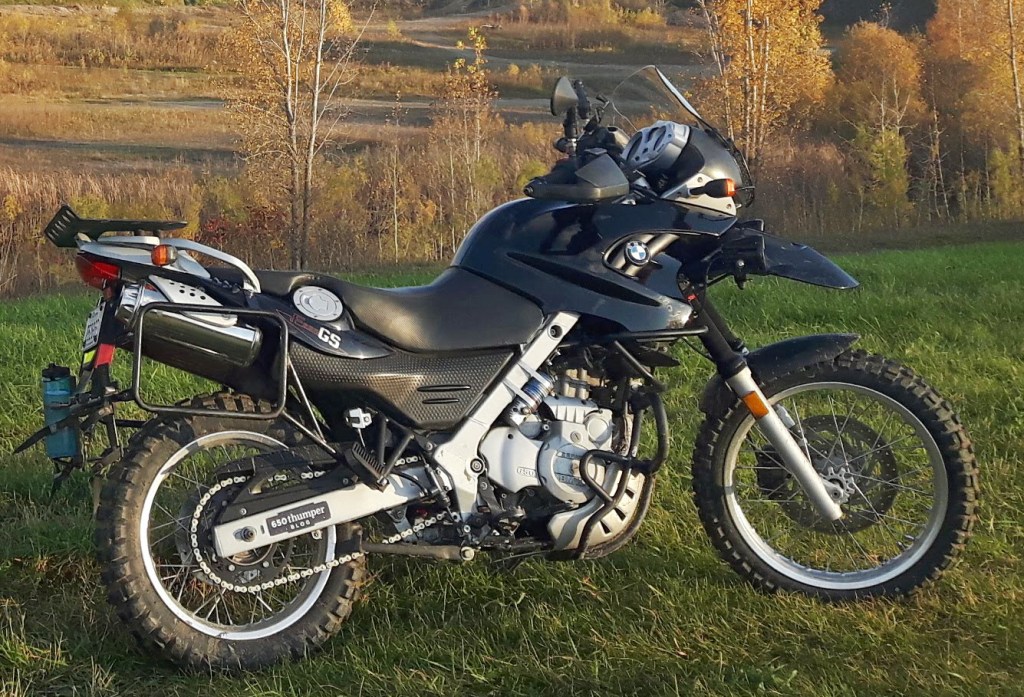
BMW f650 GS and Triumph Tiger 800 XC Head to Head

Two popular adventure bikes. How do they compare?

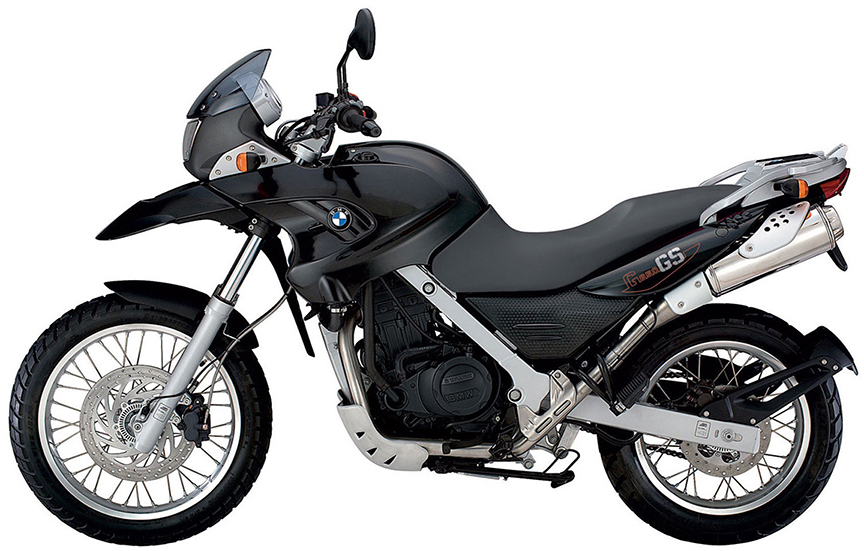
I’ve had the Tiger for a full season now and a reader asked me to do a comparison of the two bikes, so here goes. I won’t say it’s like comparing apples and oranges because both of these bikes are peaches, but one is definitely older than the other, so the comparison is a little unfair. I didn’t sell the Beemer until the end of the season so had the rare opportunity to ride both bikes alternatingly, and the experience revealed their differences. This is how I see they line up.

Ergonomics

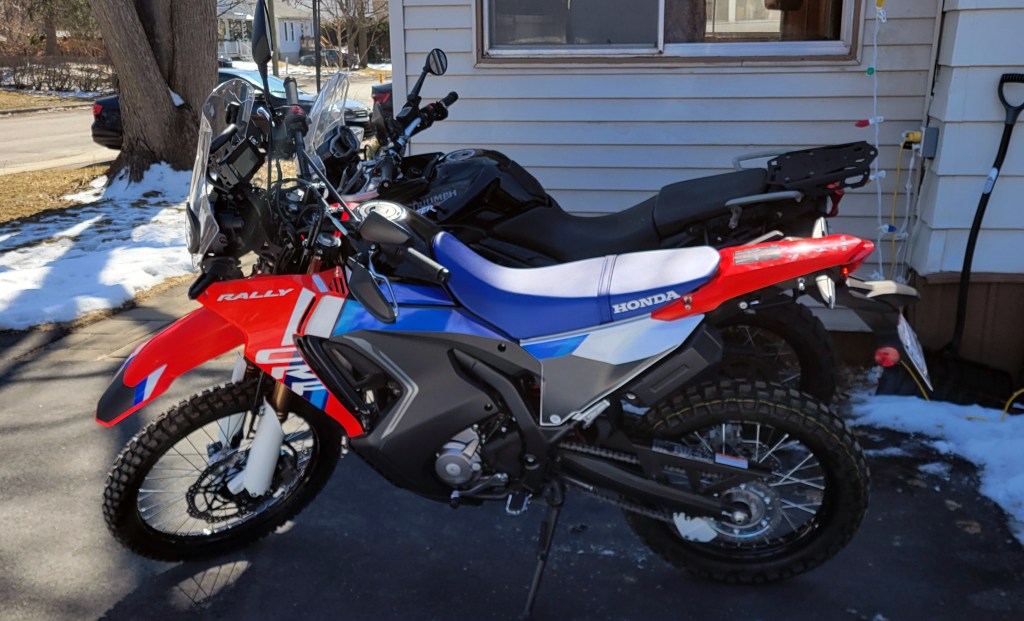
Looking at the two bikes above, you’d think the ergonomics would be quite similar. In fact, that is not the case. The first time I climbed on the Tiger for a test ride, I felt like I had to reach for the bars, and the dash seemed distant. This took some getting used to. There’s a lot more space around the triple clamp with the Tiger. Conversely, after riding the Tiger for while, when I climbed onto the BMW, the cockpit seemed cramped. This is really a preference thing; you get used to whatever your ride. But I would have liked a bit more room on the BMW. That tight triple-tree led to cracked plastics when the buckle of my tank bag got pinched between the centre panel and the fork tube when the bike was at full lock.

This sense of being a bit cramped was exacerbated by the height and design of the saddle. As I said in my original review, the OEM seat made me feel like I was sliding down into the tank, and while raising the seat when I did the Seat Concepts upgrade solved the sliding problem, I could have used a bit more leg room. On long days, I often found myself stretching out with my legs up on the Giant Loop Possibles Pouches I had strapped to the engine guards. The BMW is a great bike for someone who wants to get into adventure riding but doesn’t have long legs; it’s not the best for people like me, whom my mother nicknamed “Long Shanks.”

Power

The Tiger’s engine displacement is only 150 cc more than the BMW’s, but the triple cylinder engine puts out an extra 44 bhp, almost twice that of the BMW’s (94 bhp vs. 50 bhp). This is noticeable. You get used to what you ride, and the BMW, fully loaded, pulled Marilyn and me over The Rocky Mountains, so it’s got plenty of power for adventure touring. But I have to say, after riding the Tiger, the BMW seems a little, uh . . . gutless. Sorry BMW folks! You can have a spirited ride on the Beemer, for sure, and I’ve kept up with much bigger and faster bikes on it, but nothing replaces the thrill of torque. The BMW has 44 ft/lb of torque, whereas the Tiger delivers 58 ft/lb.

However, the BMW delivers reliable, linear power throughout its rpm and gear range and for that reason, it’s probably the better engine for off-roading. As I’ve written, the single cylinder engine hooks up both on acceleration and engine braking, providing a sort of mechanical traction control and ABS. (It has something to do with large gaps between the power strokes.) The Tiger, on the other hand, is an inline triple without even the T-crank of the new models that offsets the firing by 270 degrees. My 1st Gen model fires 120 degrees apart, so there’s constant power delivery to the rear wheel.

Vibration

Okay, another big difference, as you might expect when comparing a single with a triple. To be honest, the main reason I decided to upgrade was for a smoother ride. The BMW is as smooth as you get with a thumper, but upon returning from a 20,000 kilometre tour across Canada and back, I decided I wanted something that would be more comfortable, particularly at highway speeds. And I couldn’t have chosen a smoother bike than the 1st Gen Tiger (except for maybe a boxer, but didn’t want the weight). I’m glad it doesn’t have the T-crank. As I’ve been reading on user forums, why would you unbalance an engine primarily for the exhaust note? Yes, the T-crank has some of the properties like I mentioned above with regard to traction and braking, but those characteristics are better handled by electronic rider aids on today’s bikes. I love the high pitched whine of the silky smooth triple and would only go back to a single on a trail bike.

While I’m on this subject, when I was researching the upgrade, I considered the f800 GS, which would have been the natural upgrade from the 650. But isn’t a parallel twin just another single but with the piston cut in half? I don’t understand why manufacturers don’t make inline twins; it seems they would be smoother, especially if the firing was 180 degrees apart, making the pistons counterbalance each other. I read that even the f800 GS can be a little vibey at highway speeds, and since smooth power was my top priority, I went with the Tiger. The only vibration one can get apparently is from a little rotational movement after the third cylinder fires, but it’s nominal. I can see from using TuneECU that my throttle body is a little off, so I’ll be balancing it first thing in the spring and that should make an already smooth engine even smoother.

Electronics

Electronics? What electronics? Both bikes are from an era before ride by wire, rider modes, CAN bus, and rider aids. The Triumph, however, at least has ABS whereas its an option on the GS (mine did not), and it’s nice to have a fuel gauge instead of just a fuel lamp. (The BMW’s fuel light comes on when there is 4L left in the tank, good for about another 100K if you’re careful.) Both have robust stators that put out more than enough power to charge your phone and farkles. The BMW puts out 400W and the Tiger a whopping 645W. The display on the BMW is pretty bare bones—just lamps, dial instruments, and a clock. The Triumph has a little more: 2 trip meters that show live and trip fuel efficiency, estimated remaining mileage in the tank, and other data that may or may not be of interest to you. The interface is a bit clunky, or I’m getting old; an entire season with the bike and I still don’t feel comfortable navigating through it. Turning off the ABS requires several inputs, and unfortunately, converts back to ABS when the bike is keyed off.

Off-Roading

Both bikes are designed for “light off-roading,” according to their manufacturers. They both have a 17″ rear wheel but the BMW has a 19″ front to the Tiger’s 21.” I discovered the first time I strayed off the tarmac with the Tiger that this is a bigger deal than what you’d think. Those extra 2 inches make a big difference. I found myself rolling over obstacles on the trail that would have jolted the BMW and had me losing balance and momentum. The difference might be related to suspension as well. The forks on the BMW are pretty poor for off-roading, a weakness that couldn’t be corrected entirely by adding Ricor valves. The BMW has 41mm diameter forks and the Tiger 45mm. Again, that small difference in size is significant in performance. (That’s what she said.)

The smaller front wheel would lead you to think that the BMW would be better on the road than the Tiger, but I haven’t noticed much of a difference in how both bikes tip into corners. Despite the 21″ wheel, the Tiger is surprisingly good in the twisties. Perhaps that’s because it’s based on the sporty Street Triple Daytona but tuned and geared for off-roading. And while we’re talking about gearing, the Tiger has 6 to the BMW’s 5. The gearbox of the Tiger is silky compared to the clunky box of the BMW.

Fit and Finish

By this point, my BMW readers must be feeling annoyed. As I said, it’s a rather unfair comparison between bikes 7 years apart in age. But bear with me: there are some shortcomings to the Tiger. They are not, however, in the fit and finish. The Triumph is remarkably polished and refined in look and feel and has an excellent reputation for reliability, surprising given the British company’s reputation for unreliability in its old bikes. If Triumph couldn’t compete with the Japanese in manufacturing and quality control during the 1970s and early 80s, they certainly can now. In fact, they can compete with the Germans too. Triumph have developed a solid reputation in user forums for reliability, and while I can’t attest to that personally, the fit and finish of my Tiger is excellent, equal to the renown German-engineered BMW.

Balance

Yes, this is where the BMW shines. Putting the gas tank under the seat produces a very low centre of gravity. To my knowledge, there really aren’t better balanced bikes than the 650, 700, and 800 GS’s with the low gas tank, except for maybe the larger BMW boxers. The Tiger, by contrast, is a little top heavy, so I have to be careful moving it around by hand. (Thankfully, the top-heaviness disappears once you’re rolling.) The Tiger is also heavier overall—an extra 50 pounds (473 vs. 423 wet, respectively).

The other shortcoming of the Tiger is its tendency to stall from stopped. There was a problem with the fuel mapping of the earliest models, but I’m not talking about that. I’m talking about how unforgiving the engine is off the line. This is a known issue that Triumph have tried to correct in its latest iteration of the bike (3rd Gen), with apparently limited success. I think it has something to do with the tiny pistons, but I’m not sure. At any rate, between the tall centre of gravity and the tendency to stall, I have to be more cognizant than ever of throttle and clutch control when riding, especially two-up.

And along the same lines, I’d say the BMW is more agile and maneuverable than the Triumph. I am more confident on it thus far than on the Triumph, although I’m hoping to get more confident once I do more slow-speed practice. Parking lots, tight spaces, single track—I can turn the BMW on a dime. It really is a very, very good bike for a beginner learning the basic skills of counter-balancing and clutch control, or someone maybe looking to downsize from a heavier bike.

Other Annoyances of the Tiger

Whoever at the Hinckley plant designed the side and centre stands should be fired. The side stand is so tall I have to be careful parking the bike; if the lot or driveway has a slight camber and the bike isn’t oriented accordingly, that can be enough for the bike to fall. Once I stopped at the side of a road to deal with a problem and as I stepped off the bike, it almost fell over. (Thankfully I caught it in time.) Another time I parked it okay, but I removed the left side case first, and before I could say “Bob’s your Uncle” the bike was on its side. I never had to think about this on the Beemer. In fact, it has quite a low side stand, and the bike listed quite a bit.

Similarly, compared to the BMW, it’s very difficult to get the Triumph onto the centre stand. I can’t have any cases on the back when I try, and if I do, I have to park the bike with enough aft-slope to help me pull the bike onto its stand. Even without the cases, if there’s a slight forward slope to the road or lot, it’s not going on. Both the side stand and centre stand heights are known frustrations for many owners, based on comments on user forums.

Conclusion

Overall, however, I’m very happy with the Tiger, as I was very happy with the GS. Which is better? It really depends on where you’re at in your riding and what kind of riding you want to do. The BMW was a great starter bike, but I kept it long after I was a beginner because it was a fun, reliable, capable bike. And the experience of riding a big thumper is unique; what I traded for smoothness was the raw, tactile, visceral sensation of the GS. Now that I’ve discovered the joy of long-distance adventure touring, the Tiger is the better bike for me. With its smooth and spirited engine, it’s going to be a blast touring on this bike, and as a pillion, the wife prefers the comforts of the Tiger, especially with the hard case as backrest. We’ll be taking this bike through the Maritimes, and then I’ll change the tires and do a solo trip down to the Outer Banks, including some off-roading on BDRs. As much as I love it now, I suspect I will truly bond with the bike during that planned US tour. Anyway, that’s my hope. Stay tuned.

As always, feel free to drop a comment below, especially if you have one of these bikes. In the meantime, my Canadian friends, we are less than two months away from the start of the new season. How are you keeping busy in the off season? Are you upgrading too, doing any mods? I’m always happy to hear from readers.
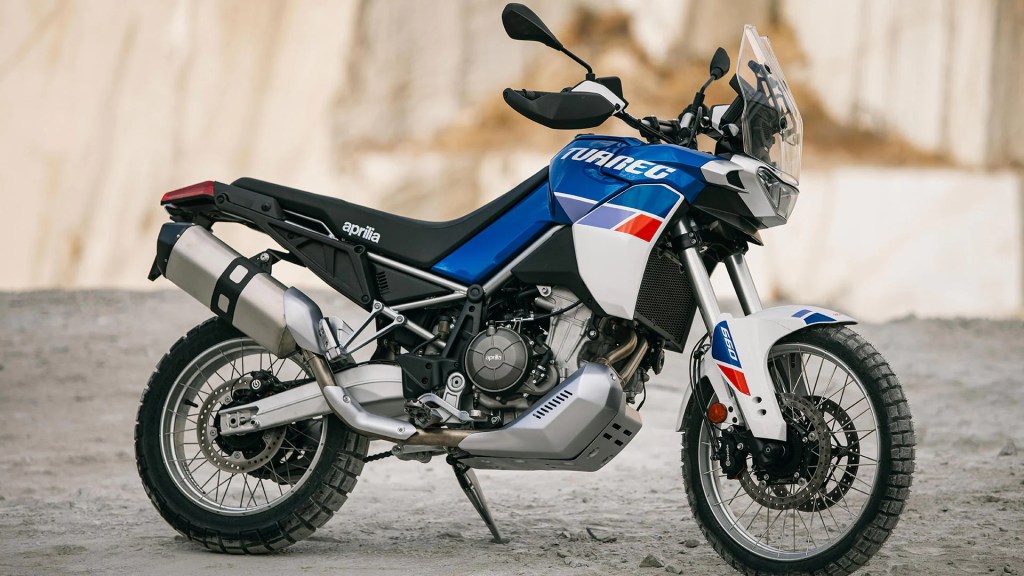
The BMW f650GS. It’s not just a starter bike.

P1000195

2006 BMW f650 GS twin spark. 

The BMW thumper is an iconic bike with a huge following for good reason. 

I’ve been reluctant to do a bike review of Bigby. For one, I still consider myself a novice. In fact, aside from a few bikes at my training school, Bigby is the only bike I’ve ever ridden, so I don’t have much to compare it to. Doing a review, I thought, would inevitably lead to the faulty comparison, a logical fallacy I warn my students to avoid. (i.e. “Gets your clothes cleaner!” Ugh, cleaner than what?) Second, I’m still learning about the bike. Although I’ve owned it for almost three years, I’m still finding my way around the engine and mechanics and still discovering its potential. Passing judgment now would be like bailing out of a relationship after the second date. It would be, in the literal sense of the word, prejudice.

So why have I decided to do it? Well, after watching a lot of reviews online, I’ve come to realize that most are not very good, so the bar is set pretty low. They are usually more product descriptions than reviews, and Ryan at Fort Nine has blown the whistle on the nepotism of corporate reviews, how they are always positive because the big bike companies offer a lot of treats to the reviewers, like paid vacations in exotic locations. And those reviewers ride the bike for, what, a day, a couple of days, max, so at least I can say that after three years with Bigby, I know more about this bike than they ever will. So with my concerns made explicit, let’s jump in.

* * *

The three things I like the most about the f650GS are three things I noticed within the first five minutes of riding it: ergonomics, suspension, and balance. Okay maybe you don’t need to have ridden a bike for long before you discover its essence. Let’s look at each in turn and then move on to other stuff.

Ergonomics: At the school, we’d learnt on cruisers—Suzuki Boulevards and Honda Shadows. The ergonomics of the GS are very different. Being a dual-sport bike, it’s capable of going off road, and you need the pegs beneath you in order to stand. This placement also results in your weight being distributed evenly between the seat and pegs, with knees bent at roughly 90 degrees. It’s the ideal sitting position and how every office chair should be set up, thus making the GS also a very capable touring bike. The dual-sport, according to its name, involves compromise, but there’s no compromise when it comes to ergonomics: the GS provides the perfect sitting position, and the capability to stand when you leave the asphalt.

The other thing I like about the ergonomics is that you can flat foot this bike. The standard seat height is 30.9 inches, so super low. This is confidence inspiring once you take it off road; I know I can easily dab a foot if needed. In fact, since I am rather long-legged, the seat was a bit too low; my knees were bent more than 90 degrees and I felt a bit cramped after several hours in the saddle. So when I upgraded my seat (more on this later), I went for the high version to allow a bit more room, and that has made all the difference. If you are long-limbed, you might want to look at the Dakar version, which has a 34.3 inch seat height, or swap the saddle for a taller one. Despite these issues in my lower half, I haven’t had to add bar risers, and when I stand, the grips fall perfectly to where I need them, maintaining my standing posture.

Suspension: As I rode off on my first ride, the second thing I noticed was the suspension. This bike is smoooth, at least compared to those cruisers. And what better place to test a bike’s suspension than Montreal roads! Of course it makes sense that a dual-sport bike would have very capable suspension; it’s designed to be able to handle some pretty bumpy terrain. But just before I went for my riding test, I hired a private instructor for a class. He rode behind me and commented on things he saw. Now here is someone who has a lot of experience with bikes and has seen a wide variety from behind. Ironically, the first thing he remarked when we first stopped had nothing to do with my riding but how impressed he was with the rear suspension of my bike. “I wish you could see what I see from behind,” he said. “It’s amazing!”

In fact, I’ve wondered if the suspension is a little mushy. I’ve only bottomed out a few times while off-roading, and the front end dives a bit under hard braking. I’ve considered upgrading the suspension, but frankly, at only 140 lbs, I’m actually underweight for this bike. Front suspension travel is 170 mm and rear is 165 mm.  Since ideal SAG is roughly 30% of total travel, SAG for the 650GS is 49.5 mm.. Even with the pre-load completely backed off, all of my 140 lbs is putting a little more than 45 mm on the suspension. Which brings me to another plus of this bike: the pre-load adjuster. Okay, it’s not electronically controlled like the new Beemer’s, but the ability to adjust with the turn of a knob when you are two-up or have gear on the back is a nice feature.

Balance: The thing I like most about the 650GS is its balance. This is accomplished mainly due to the gas tank being under the seat instead of high on the bike where it normally is. Where this is most noticeable is in how the bike corners. At the school, we were taught to countersteer to initiate a turn and to accelerate at the end to straighten up, and this was necessary with those cruisers. But I quickly discovered that on the GS you can manage an entire sweeping curve simply by leaning in and out. It’s hard to describe, but the bike feels like it straightens up itself with the subtlest weight shift.
The balance also shows when riding at slow speed, like in parking lots or technical sections off road. I’ll challenge anyone to a slow race any day! The bike is easy to move around by hand and to turn in tight spaces. With a little practice, I was riding figure-eights full lock. You can add all the accessories you like to a bike, but getting the balance right is something that happens at the design stage. BMW got it right on this one, which is why I was surprised to hear that they’ve moved the tank to the traditional location in the hump on the 2018 750s and 850s.

* * *

The engine is a Rotax, 652 cc single-cylinder, water-cooled, DOHC with twin spark plugs and four valves. It provides 50 HP @ 6,500 rpm and 44 lb/ft torque @ 5000 rpm. What these numbers mean is that it’s not the gutsiest engine. I’m up for a slow race but I won’t be challenging anyone to a drag soon. When I did my research, I kept hearing how this bike is a good beginner bike. There’s not a lot of power to manage, and you don’t have to worry about losing the back end by getting on the throttle too hard. On the other hand, it’s got lots of torque down low in the first two gears for hill climbs off road, and still some roll on in 5th gear at 120 km/hr. I’ve never maxed it out, but I’ve had it up to 140 km/hr and that’s fast enough for my purposes. And since we’re talking about gearing, 3rd and 4th are wide enough to enable me to navigate a twisty piece of road pretty much in one gear, depending on the type of road: roll off going into a corner, roll on coming out.

Single-cylinder engines have their advantages and disadvantages. One advantage is this wide gearing. My dad often talks about how he loved this aspect of his 350 Matchless. In heavy traffic, you can stay in 2nd and just ease the clutch back out when traffic picks up again. He once road his brother’s parallel twin and said it was horrible in stop-and-go traffic; you had to work twice as hard to prevent the engine from bogging. I suspect it’s this same quality that allows you to maintain your gear through a twisty section of road with slight variations in speed.

Another advantage of singles, I’ve recently discovered in this article in Cycle World, is that they offer a kind of traction control. As Kevin Cameron argues, “no other design produces such forgiving power delivery under conditions of compromised traction without elaborate software.” This is due to the millisecond duration of the exhaust stroke with big-bore engines, when there is relatively little power delivered to the tire, allowing it to regain traction if it begins to break loose. It’s like anti-lock brakes, the theory goes, but in reverse. Compare that to the constant power delivery of multi-cylinder engines, which makes managing power and traction more challenging.

A disadvantage of single-cylinders is the vibration. The Rotax engine is about a smooth as a single comes, I’ve heard, but it can still make your throttle hand go numb, especially if it’s cold, so you might want to invest in a throttle assist or throttle lock. I have the Kaoko and it works great. Unfortunately, the Rox Anti-Vibration Risers don’t fit my particular bike due to the configuration of the triple-clamp, but then I’ve heard those can make the steering mushy, which can be unnerving when riding off road. And it might be my imagination, but it seems that there are less vibrations when using the BMW oil. It certainly seems that the engine runs quieter and smoother, perhaps not surprising given that BMW design and test the oil specifically for their engines. Speaking of oil, the Rotax engines do not burn oil. Ever. Don’t believe me, go ask the inmates at The Chain Gang, a user forum devoted to the BMW 650s.

On the other hand, it’s a major pain in the ass to do an oil change on this bike. Because the engine uses a dry sump system, there’s an oil tank on the left side of the hump where a gas tank normally would be (an airbox is on the right side), so draining the oil involves removing the left body panel and draining that holding tank, plus draining the pan by removing the sump plug at the very bottom of the engine. If you have a bash plate, as I do, you have to remove that too, which, if it’s attached to the crash cage . . . and so on, until you’ve stripped the bike halfway down. Or you can drill a hole in your bash plate as I did, which makes that job a lot easier. You’re still going to get some oil on the plate, and you’re going to get some on the engine when you remove the oil filter due to its recessed placement, so just have plenty of shop towels on hand.

My 2006 650GS does not have rider modes and sophisticated electronics. It doesn’t even have anti-lock brakes. At first I was concerned about this and it was almost a deal-breaker for this newbie. But I spoke to a few experienced riders and they all agreed: better to learn how to control traction and perform emergency braking using proper technique than rely on electronics. Since I’m rather a purist in most things, I understand that. If you learn to emergency brake by grabbing a handful of brake lever and letting ABS do its thing, you aren’t going to develop the feel needed to control sliding in off-road situations. And not having all that sophisticated electronics makes the bike easier to maintain.

The 650GS is fuel-injected so there is an ECU. A 911 diagnostic code reader is available to help you troubleshoot the electronics, but it’s expensive. One advantage of fuel injected bikes is that there is no choke to deal with, and the ECU adjusts the fuel-air mixture according to altitude, meaning you can literally scale any mountain without having to change the jets of a carburetor or risk running your engine hot. The downside is that the throttle can be a little choppy so easy on the roll-off.

Two areas where the 650GS is lacking are the saddle and the windscreen. The saddle is hard and slopes downward, so you always feel like the boys are jammed up against the airbox. If you plan on using your GS for long day trips, you’ll want to upgrade the saddle. There are many aftermarket models available, including BMW’s own Comfort Seat, but I decided to go with Seat Concepts which, for about $250 CAF, they will send you the foam and cover and you reupholster it yourself using your original seat pan. I’ve done a blog on this job so won’t repeat myself here.

One issue with this era GS is the windscreen. The OEM screen is so small it barely covers the instrument dash. There are many aftermarket screens available, but finding the right one is a difficult matter of trial and error. The windscreen issues on this bike are well documented, and if you have sadistic leanings, just search at f650.com for aftermarket windscreens, sit back, and enjoy. The reading is almost as entertaining as a good oil thread. In my own experience, the bike came with a 19″ National Cycle touring windscreen, which was a bit high for off roading and was directing loud air buffeting directly onto my helmet. I swapped it for a 15″ but that too was loud, so I added a wind deflector and that solved the buffeting but I thought ruined the bike’s aesthetic, so I ultimately landed on a 12″ sport screen by National Cycle that protects my torso but keeps my helmet in clean air. The problem is the shape of the front cowling that the screen screws into. It angles the screen too much directly toward the rider’s helmet, instead of the recent bikes that have the screen more upright. The quietest screen on the aftermarket is the Madstad screen. It has an adjustable bracket that attaches to the cowling, allowing you to adjust the angle of the screen. It also has that crucial gap at the bottom of the screen, preventing a low pressure area that causes the buffeting developing behind the screen. Unfortunately, it’s a little pricey, but the real deal-breaker for me is that Madstad use acrylic, and acrylic screens don’t stand up to the abuse of off-road riding. National Cycle screens are polycarbonate.

Aesthetics: I love the aesthetics of this bike! Even ugly babies are adored by their parents, but sometimes I’ll look at a more modern luxury touring bike with the engine completely covered in plastic and I’m glad my bike has its guts hanging out like a proper bike. And I like that it has spoked wheels, which are stronger for off roading and have a more traditional look. Someone once said to me, “I love your old-fashioned bike.” Hmm . . . I hadn’t thought of it as old-fashioned but didn’t mind the comment. There definitely is a raw, real motorcycle quality to the bike, yet has refinements like heated grips and the quality control and reliability you’d expect from BMW. It is the ultimate hybrid dual-sport: part dirt bike, part luxury tourer.

In conclusion: The f650GS is a confidence-inspiring little bike that is perfect for not only beginners but also anyone who prefers a smaller, lighter bike. There’s a movement these days toward smaller bikes, with many people looking at the big adventure bikes with derision for their impracticality off road. I say it really depends on the type of riding you want to do and where you plan to take the bike. Due to its size and weight, the 650GS can go some places that the larger bikes can’t, but the cost is in vibration and rpms at speed on a highway. If you’ve got large areas to traverse but want the capacity to go on dirt roads when needed, then yeah, go for the big 1200GS that is so popular. But if you’ve got time and want to explore deeper into those remote areas, then the 650GS is an excellent choice. I plan on keeping mine as long as possible.

* * *

Pros:

Ergonomics for dirt and touring; smooth suspension; very well balanced; reliable Rotax engine; sufficient hp and torque for light off-roading; fuel injected intake has automatic temperature and altitude adjustment; classic aesthetics

Cons:

Cost (upfront and maintenance; even parts are expensive for DIYs); saddle is hard and uncomfortable; windscreen is useless, hard to find a good aftermarket replacement; engine can be vibey; only 5 gears

* * *

Modifications:

With the help of my son, I’ve created two walkaround videos describing the modifications I’ve done to the bike for dirt riding and street riding. 


Walkaround Mods for Dirt
Walkaround Mods for Street

How’d I do with my first review? Please comment and click the Follow button if you liked this post.