The Northern Peninsulas

We see caribou at Port au Choix, icebergs at Twillingate, and puffins at Elliston en route to Saint John’s.

We’d reached the northern tip of Newfoundland and now it was time to start making our way back south and across the island to Saint John’s, and not a moment too soon. The bugs were bad! Like the night before, no one wanted to cook, so we headed into Raleigh again in search of food. Unfortunately, the restaurant we had in mind didn’t open until 11:00, but we were referred to an RV park that did an early greasy breakfast for a song. By this time it was late morning and we were no further south with no reservation for the night.

When things look bleak, it’s never a bad idea to go to the local Tim Horton’s. There, you can get a coffee for $2 and free WIFI to sort yourself out. I found a B & B about halfway down the coast, made an executive decision, phoned, and made a reservation for the night. I knew we were essentially losing a day from our tentative schedule, but sometimes you just have to adjust your schedule to fit your circumstances.

Jeannie’s Sunrise B & B turned out to be a real treat. The room we got actually did have a view out over the ocean to the east, so we would wake to the sunrise (and get an earlier start). Jeannie also suggested we take a ride after dinner over to the lighthouse. We said we were nervous about riding after dark but she reassured us the ride across the cape is open with excellent visibility and she was right. On our way to the lighthouse, I spotted two caribou grazing a short distance from the road.

It doesn’t get any better than this. Seriously, I think it was the highlight of the entire tour for me. Marilyn was eager to get over to the lighthouse in the hope of seeing a moose if not another ocean sunset, but I couldn’t help doubling back for a second look.

I don’t know why I was so taken by them. Maybe it’s because they are so elusive, like the singular chaste girl at college who was the object of every guy’s wet dream, or the rare motorbike or book you’ve been searching for your entire life. I know I’ll be in trouble for those comparisons but the point I’m trying to make is that rarity increases value and desire. In this case, you have to get pretty far north to have a hope of seeing caribou, and then you have to be lucky to be there at a certain time of the year and a certain time of the day. When all these factors align, you just hope their expert skills of camouflage don’t lead to you driving right past, which most people did. And it’s in the hope of capturing something of that rarity that leads us to making the mistake of reaching for our phones or cameras instead of soaking in the encounter with every drop of attention we have, so it can plant and root in memory, maybe grow into a poem, or some other art. I’m thinking here of Canadian poet Don McKay’s term poetic attention, “a sort of readiness, a species of longing which is without desire to possess” (“Baler Twine,” Vis à Vis, Gaspereau Press).


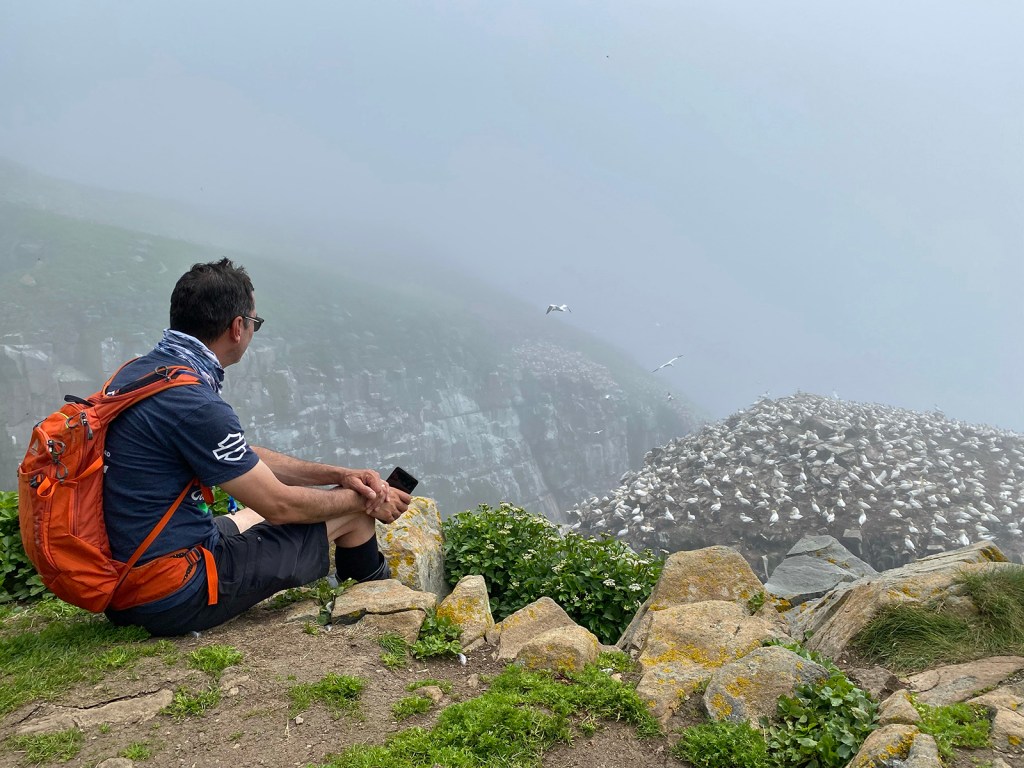
Motionless, they move just beyond the ridge-line, half hidden, as if wading knee deep in rocky scrub land. In the fading light, it’s a wonder I saw them at all, 100 meters off the road, but there’s definitely something there, two figures, one clearly larger and leading the other. I grab the monocular and see through the lens now how expert they are at camouflage. Their tawny hides are a shade darker than shadow, and the mottled white of their underbellies looks just like lichen. Even the antlers, antennas receiving the last of the light, could be sun-bleached branches scattered on the ground. Heads down, they don’t see us, tourists to their world of wilderness. I should have known this moment cannot be captured except in memory but want more—a shot, a boast, a post. I take the camera and step forward, but when I lift it to my eye I see that now we are the ones observed, strange creatures standing at the edge of their attention.

Copyright © 2023 by Kevin Bushell


The next day we went in search of icebergs. We’d heard that Twillingate was the place to see them, but since it was July, we didn’t hold out much hope. We got an early start and rode the rest of the west coast back down through Rocky Harbour to Deer Lake, picked up the Trans Canada Highway, rode that all the way to the 340 east of Grand Falls Windsor, then headed north as far as we could, which turned out to be a place called Dildo Run Provincial Park just east of Virgin Arm. The comments section below is open for your worst jokes.

After dinner, I wandered up to the gate with a pipe in search of a pannier sticker, which they gave for free to anyone who completed a survey. Today you can’t take a piss in a public washroom without being asked to complete a survey and as a rule I do not do surveys, ever. I know that they are just an underhanded way to get your contact info so someone can target market to you, all in the guise of providing “helpful advertising.” I don’t need any help with my shopping, thank you very much; if anything, I need help not shopping. But in this case, with a pannier sticker as the prize, I plugged my nose and did it. As a secondary prize, I struck up a conversation with two local staff members, and talking with locals is always interesting. I learned that one had grown up at Jane and Finch in Toronto, perhaps the most dangerous neighbourhood in Canada. When I asked how he survived the gang violence, he said, “See these shoes?” and modelled his gleaming white runners. “I learned to run fast.”
I heard how both had left Newfoundland earlier in their lives to make an income, first to Toronto to build the Gardiner Expressway and the CN Tower, then to Fort McMurray during the oil boom, splitting their time between two provinces thousands of miles apart. I’m more familiar with the diaspora of my second-generation immigrant students, so it was interesting to hear of their experiences living in two cultures created by national migration. If I remember correctly, one said he would fly back and forth every six weeks to see family. It reminded me of a movie I’d seen recently set in Belfast about a similar sacrifice made by one family whose father was forced to seek work in England. I suppose the conflict between living where you want to and where you have to is nothing new, especially here in Canada where the rural areas are beautiful and the urban ones so . . . not beautiful. I just didn’t think people split their lives in half like this, or that it was even feasible, but that they either stuck it out at an economic cost, or made the difficult move at an emotional one. I was happy that both my acquaintances, later in life, had managed to find employment with ParksNL.

The next day we rode up into Twillingate, the unofficial capital of Iceberg Alley, and beyond onto North Twillingate Island, which is picturesque and worth visiting just to see the colourful clapboard buildings and to climb up to the lighthouse and look out over the ocean. It’s here that icebergs that have broken off of glaciers in Greenland drift by, drawn by sea currents. The best time to view them is April and May so we were late but still able to see some bergy bits (that’s a real term) and growlers. If their size wasn’t super impressive, their colour certainly was.

Looking east from Long Point Lighthouse, Twillingate.

After a night at Terra Nova National Park, we were within a day’s ride from Saint John’s but decided to head up to Elliston on the Bonavista peninsula. We’d been told by a birder friend that it’s the best place to view Puffins. I have to admit that I don’t quite get the appeal of puffins, despite what I just said above about rarity. Maybe it’s because they are such crappy flyers, struggling into the air by flapping their hearts out (up to 400 times per minute), or maybe it’s their creepy faces, giving them the nickname “clowns of the sea.”

But we went, because we were in Newfoundland, and it’s the unwritten law to see puffins when here, like how you have to see a production of The Nutcracker at Christmas and the movie The Sound of Music at least once a year to maintain marital bliss. In the end, however, I’m glad we did. Bonavista literally means “beautiful view” and the ride around the peninsula was special. The puffins were pretty neat too.

Elliston has another claim to fame. It is also the root cellar capital of the world, according to NL tourism. I didn’t know there was a root cellar capital or who decides such things, but I found the little structures quaint in a Hobbit-like way and the idea interesting. These cold storage facilities keep vegetables cool in the summer and prevent freezing in the winter, so essentially the earth regulates the temperature. I can’t keep mice out of my back porch so am curious how half of the produce doesn’t get spoiled by vermin. The doors, stonework, and sky make for some picturesque photos.

Feeling like I’m in a tourism commercial.

Our treasure hunt across the northern peninsulas was coming to a close, yet ironically, although we were not searching for it, the best discovery was yet to come. Earlier in the day, during a rest stop at a coffee shop, I overheard a staff member say she liked a place called Trinity. I figured if a local likes it, it must be good, so despite Marilyn’s concerns about the time and getting into Saint John’s late, I made another executive decision and pulled off the 230 when I saw signs for Trinity. The ride in from the highway was pretty and the village even better. We stopped at the Dock Marina Restaurant and Gallery. Now Marilyn was no longer complaining about the time but wondering aloud how we might be able to retire here. We ended up buying some artwork as a souvenir and shipping it home.

The beautiful quilts had me thinking of my late mom whose passion was quilting.

It was getting late and we still had a three-hour ride to our hotel in Saint John’s. Yes, we were splurging on a hotel this night. I could say that we were enjoying ourselves so much that we decided to loosen the purse-strings, but the truth is that we misjudged accommodations in Saint John’s. We’d made reservations all up the east coast, thinking that the remoteness might make it difficult to secure campsites, and deduced that there would be no shortage of cheap accommodations in the city. In fact, Saint John’s is very busy during the tourist months of summer. We would “have to” take a night at the exquisite Alt Hotel on Water Street. I didn’t mind. It had been a lot of riding and we’d be getting in after dark. The room, with its electric blinds and view of the harbour, was a welcome treat, and the staff didn’t seem to mind us tromping through the lobby in our muddy gear.

A ride through beautiful Trinity, NL, as we headed out.

In the next post, we hit the town, meet up with friends, and ride the southern peninsulas.

The Wish List, 2023

I interrupt the journey across Newfoundland for the annual holiday wish list.

It’s become a tradition on this blog—the annual Christmas wish list. It’s probably one of the least favourite posts of the year for readers, but it sure is fun to write. The season has recently come to an end, the long winter months still lay ahead, and all we have to propel us out of bed in the mornings are thoughts of spring and planned journeys. And part of that planning is dreaming of the mods we will do and the gear we will buy to help prepare for the adventures to come.

This year’s list is pretty short. Yes, inflation is hurting everyone, and we find ourselves buying the cheap tomatoes instead of the fancy vine ones (and regretting it later). Marilyn is paying tribute to her late father by scanning the grocery store flyers and clipping coupons. Even the dog has sacrificed his Greenies (and his breath is the price we all have to pay).

But honestly, the bike is pretty much done. It’s got the auxiliary lights on it now, the crash protection, skid plate, pannier racks, hand guards, off-road pegs, and tail rack. I got soft panniers last year and they have been great. So it’s pretty modded out. What the bike needed most was some maintenance, so I spent a chunk of time before I put it into storage doing the valves and servicing the starter motor, which was acting up. By the way, I’m now advocating checking your valves on the recommended service interval. I waited until the bike had 45,000K and all my exhaust valves were tight, some significantly.

Shorty Levers

The only thing it could use are some new levers. The stock levers are okay, but they are long and I’ve already bent the brake lever once. Actually twice, since I bent it back. I think I’m the only one in my club who rides two-fingered and I asked myself the other day why on earth haven’t I ever had shorty levers?

I looked at all the options and am undecided between Vortex and Pazzo. Both are top-quality levers that fit well without any slop, which is often the case with cheap Chinese aftermarket levers. At about $200, they are comparable in price.

Vortex V3 levers

The Pazzo levers have quite a swooped design to them, which brings the lever down close to the grip. I know there’s some adjustment but this still makes me nervous because I like to have a short clutch that completely disengages before the lever hits my knuckles of the remaining fingers wrapped around the hand grip. For this reason, I’m leaning towards the Vortex design. Is it just perception, or do they look straighter? My ideal lever would be a Pro Taper, but I don’t think they make one for the Tiger.

Pazzo also gives the option of a folding lever, but I don’t think I need that since I have the Barkbuster guards. It would have to be a very unfortunate fall for a rock to come up inside the guard and break a shorty lever. But I guess it could happen. My sense, however, is that folding levers are for true dirt bikes that have wimpy, folding hand guards. If you have any experience or thoughts on this, drop a comment below. I won’t be getting anything until the spring so I have some time to decide.

A new helmet

Honestly, that’s about it for the bike (my wife will be happy to know). But wait! My current lid is at least five years old, so I probably should get a new one soon, despite what Bret Tkacs has recently said about that 5-year limit being bogus. If I were forced to, I’d probably go with the Arai Tour-X5 or maybe find a deal on the now discontinued X4.

No, I’m not trying to emulate Itchy Boots. This would go well with my touring jacket that is grey with matching hi-viz accents.

I’ve been very happy with my Arai Signet-Q helmet. The brand speaks for itself and the shape fits my intermediate- to long-oval noggin well. This time, however, I’d go with the Tour X because I want a peak. There have been many times while riding into the sun when I wanted a peak. Sometimes I have to shade my eyes with my clutch hand, it can get that bad, even with the Pro Shade system.

Knee braces

To be honest, I’ll probably forego the helmet for another big-ticket item. I plan to do some pretty serious dirt riding next year, and the only thing that scares me about that is the potential to damage a knee if the bike falls on one. I’ve somehow managed to play 15 years of beer league soccer without any major damage to a knee, and I’d like to keep it that way so I can enjoy my retirement with full mobility. I therefore am adding to my wish list a pair of Pod knee braces.

Anyone who is serious about dirt riding should be wearing knee braces. I know, they are uncomfortable, but so is tearing tendons and surgery. I’ve heard The Awesome Players advocate the use of braces, and recently a video by Riemann convinced me I should just bite the bullet on a pair.

At $750 a set, these babies aren’t cheap, but money well spent if it prevents a serious knee injury, especially if you are riding solo as I do.

Dirt Gloves

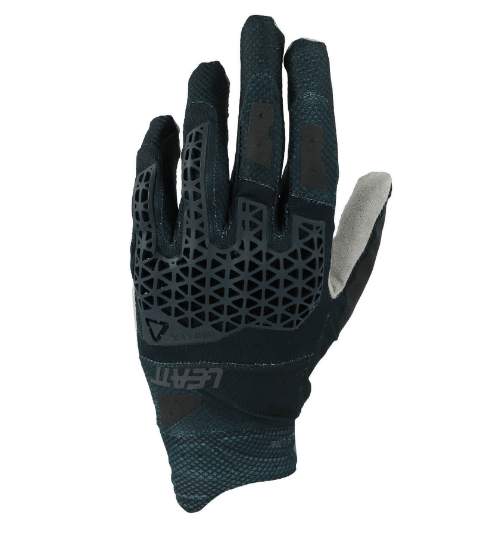
There’s one more piece of off-road gear I’d like before attempting the BDRs next summer. That’s a pair of light MX or rally gloves. I have a pair but Marilyn has appropriated them, so I’m in the market for another pair. When riding dirt, it’s important to have maximum feel on the levers so you can modulate both clutch and brake. It’s similar to how football (i.e. soccer) players are always looking for a boot that provides the most feel on the ball, for example one with kangaroo leather instead of cow hide.

That might be something like the Leatt Moto 4.5, a popular choice or, going even lighter, the 100 Percent Airmatic.

DOUBLETrak Multitool

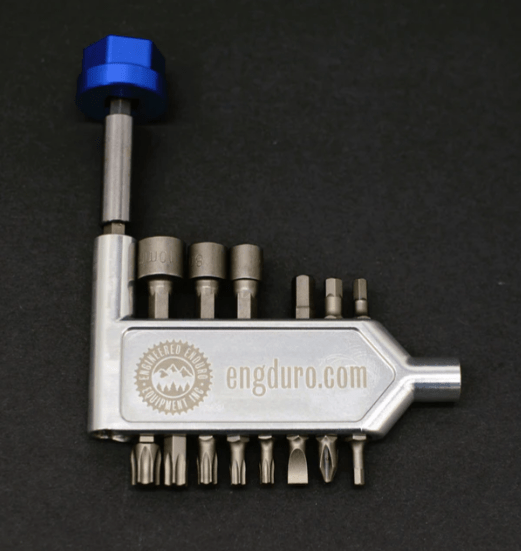
Finally, what wish list would be complete without a tool of some kind on it? I came across a great little multitool in a video by Chris Birch on his favourite tools.

The DOUBLETrak multitool by engduro here in Canada consists of several hex, torx, Phillips, and flat head drivers, and 6, 8, and 10mm socket drives that fit into the handle itself and stay there by magnetic force until needed. There’s also a 1/4″ hex to 1/4″ square drive adapter. If you want a comprehensive review of this tool, check out this video in which Dude does an oil change using only the DOUBLETrak. Okay, I’m not going to be doing trailside oil changes, and this will not replace tools that are in my tool roll, as he suggests, but it’s a convenient tool to keep at hand for small adjustments or tightening something on your or someone else’s bike. Best of all, for a few dollars more, you can get a vanity engraving on it and tell yourself it’s to prevent theft.

That’s it. Like I said, a small list this year. That’s okay because we’re still paying off expenses from the Newfoundland trip last summer and I’ve got more ambitious plans for next summer. This time it will involve dirt and I’m both a little nervous and excited about taking the Tiger off road . . . like, really off road, not just gravel and dirt roads but trails and Class 4 roads, water crossings, mud, sand, rocky hill climbs . . . the works. It’s known as primarily a street bike that is capable of doing “light off-roading,” so I’ll be pushing it beyond its intended limits as I do the MABDR and NEBDR back to back. I’ll either die or bond with this bike in ways I haven’t yet.

What are your plans for next season? I’d love to hear them because the best wishing is not the accessories or gear we want to buy but the places we’d like to visit on our bikes, or even the roads we want to ride. We can’t all be Itchy Boots, but we can explore a little piece of paradise close to home, whatever your paradise might be. I wish you happy holidays, and happy dreaming of another season doing what makes our souls sing.

The Viking Trail

Marilyn and I begin our tour of Newfoundland by riding the west coast to L’Anse aux Meadows.

Newfoundland bound.

You know you’re headed to Newfoundland when the ferry staff call you “Hun.” In my profession (teaching), that’s tantamount to sexual harassment, but here it’s the term of endearment it’s clearly meant to be. We were directed to the front and side and found the tie-down straps. I hate ratcheting straps. I’ve been using them for years and still haven’t figured out how to work the damn things. There are YouTube videos and probably PhD programs as well on how the mechanism works, but using them for me usually ends up with cursing and a pinched finger. Thankfully, the tie-downs provided by the ferry were a simple single folding mechanism that even English teachers can operate.

It’s always a little unnerving leaving your bike and gear for a prolonged period of time, but only staff are allowed down in the hold once the ferry leaves port. Still, I locked the panniers and the helmets, and you can see in the photo above I’ve used a cable to secure the duffle bag as best as one can. I made this from materials purchased at Canadian Tire, the big-box hardware store here in . . . you guessed it, Canada. I bought a length of plastic-coated cable and made loops at both ends by crimping cable sleeves, then attached a simple brass waterproof lock. It’s not super secure but prevents the grab and run. My faith in a good samaritan reporting someone using cable cutters outweighs my cynicism toward thieves. I trust no one wants my smelly boots.

Catching up on sleep.

Once upstairs, we settled in and I promptly fell asleep. I’m an expert napper, even in public places, and use every opportunity to dig myself out of the sleep deficit I accumulate when adventure touring. Then we had dinner which, I have to say, was surprisingly good. I guess I was expecting airline food, but the fish & chips and cloth placemats and real utensils not to mention the Newfoundland friendly service was a treat. Marine Atlantic ferries gets a five star rating from me. It was nice just to sit at the window and look out over the mesmerizing water and watch a seagull follow us for miles, skimming the waves.

Marilyn in her naval attire.

We took the midday ferry because all the cabins for night crossing sell out early. We made our reservation mid-March (for an early July crossing) and they were already sold out. This meant that we lost a day of riding, but I’ve learned that rest days are required at my “advanced age,” so it was all for the best. It just meant that we needed to find accommodations close to Port-aux-Basques, where the ferry shores at 7:15 p.m., because we didn’t want to ride in the dark. Everyone—and I mean everyone—had warned us about the moose in Newfoundland. I suspect this is somewhat like the bear warnings tourists to Canada receive. I have to say, in all our travels across the island, we saw only two moose, midday at the side of the highway, but it’s still a good idea to get off the road at sundown, especially if you’re on a motorcycle.

We therefore had a reservation at JT Cheeseman Provincial Park, about 13 kilometers from the docks. It was a short stay as we were eager to get up into Gros Morne National Park, a bucket list destination for both of us. Our first impressions of The Rock were lovely, with low-hanging clouds above a shallow mountain range on the horizon, and a fog horn sounding in the distance throughout the night, reminding us we were not far from the sea.

My best Pee-Wee Herman hairdo.

The next day we rode north on the Trans Canada Highway through Corner Brook, then split off at Deer Lake onto the 430 and then the 431. As we pulled off at the lookout at Woody Point, I went to turn sharply to park the bike, only the handlebars locked partway and we lost our balance. Thankfully we were going very slowly and I just put my foot down to prevent a tip-over. Marilyn climbed off and I started inspecting the bike. The handlebars would definitely not go full lock but were blocked by something hard. It felt like metal on metal. Eventually, I saw the culprit: a screw from my wind deflector had come out and fallen down into the triple-T and was blocking the handlebar movement. What were the odds! We got lucky on several counts there, not only that I didn’t lose the screw but also that it didn’t obstruct a turn at a higher speed. I got out the tools and replaced the errant hardware, this time using thread locker.

Readers will be pleased to know that I’ve since removed the obnoxious wind deflector. I’ll pay the price of some buffeting for video footage with an unobstructed view.

We got a site at Trout River Campground, which was chosen for its proximity to The Tablelands, a rare phenomenon and one of only a few places in the world where the earth’s mantle is exposed. The peridotite rock turns orange as it oxidizes, resulting in a geography that appears like the surface of Mars, not that I have any direct experience with that. In truth, the geology is more like the centre of the earth than a distant planet. Jules Verne modelled his book Journey to the Centre of the Earth after Iceland’s geology, but he could have equally used The Tablelands as his inspiration.

Hiking The Tablelands.

We hiked up in the afternoon heat, and I was happy to have added a hydration backpack (I’m not calling it a bladder because that’s disgusting) to my kit. It meant that we could easily carry water on and off the bike as well as a few other items, like snacks and a selfie stick.

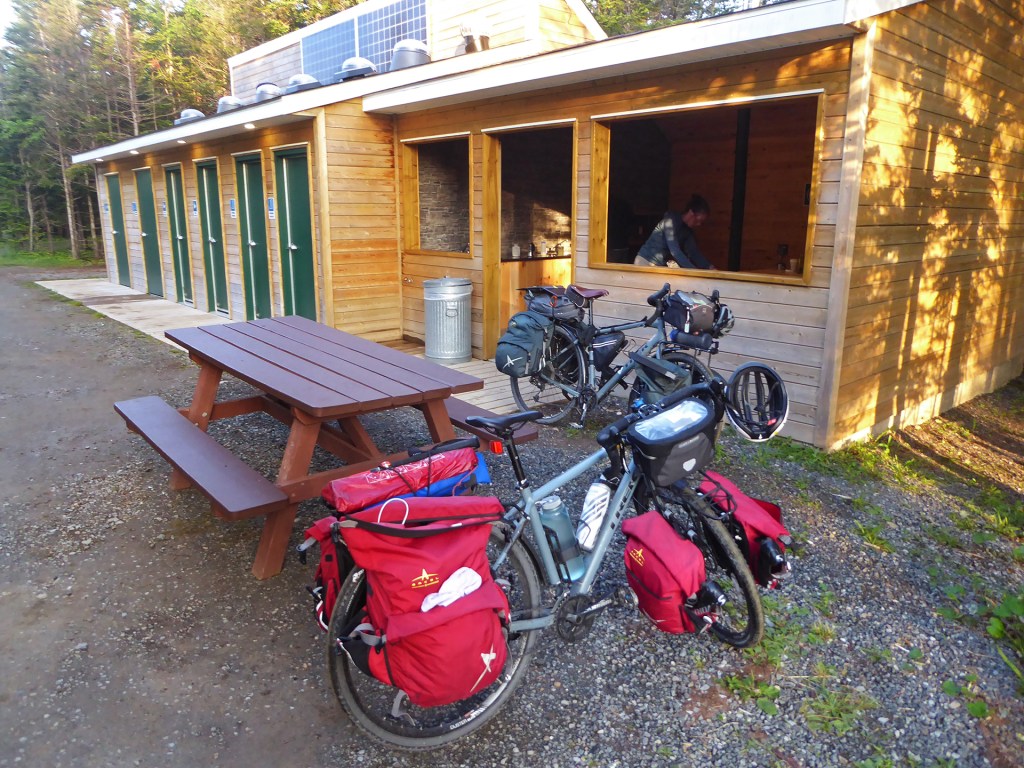
On our way out the next morning, we met some touring cyclists at “the facilities.” They were cooking their breakfast under the shelter there before hitting the road. Just when you start feeling pretty good about managing to fit everything on the motorcycle, you run into cyclists who are doing the same but on bicycles. Hard core. I wonder if bicyclists feel a similar sense of humility when they cross paths with backpackers, who have managed not only to fit everything into one bag but also to carry it to where they are going. At some point, such minimalism must have diminishing returns on investment and become more a penance for sins done, like the story of Cheryl Strayed in the movie Wild (directed by the late Jean-Marc Vallée and played by Reese Witherspoon), who clearly had a heavy burden to bear, so to speak. This line of thought leads me to the ultimate minimalist traveller, the migrant, who is fleeing on foot with little more than the clothes he or she is wearing, and that’s where my imagination has its limit. I can’t imagine doing such a thing, not unless my life depended on it, which I guess for many migrants, it does.

Travelling light.

I also chatted with another camper while waiting for Marilyn. He took an interest in my bike because it was a Triumph and he is English, or English-Canadian. He said he used to ride a Triumph in England and before that an AJS Matchless, which is the exact bike my dad rode before he immigrated, so we had a nostalgic chat and I gave the bike a few gratuitous revs as we parted so he could hear the sweet exhaust note of the Triumph triple. When I rode a BMW, Germans would approach me with their memories; now that I ride a Triumph, Brits chat me up. Once while doing some slow-speed exercises in a neighbourhood church parking lot, I struck up a conversation with the priest, who used to ride a Yamaha 250 in India. Everyone seems to have a story about their motorcycling days, and it occurs to me that motorcycles hold a special place in one’s identity, even if one has long since given up riding. I suspect they remind us of the freest years of our lives, which can be in youth, or in my case, at the age of 60. The motorcycle is the symbol of the best years of our lives, whenever that may be.

We headed back out to the 430 and then turned north. It was a special day because we had reservations for the Western Brook Pond boat tour just north of Rocky Harbour. The highway through Rocky Harbour is spectacular and led to one of only a few disagreements we had during the tour. I say “and” not “but” because it was the spectacular nature of the road that led to the disagreement. It’s twisty and undulating with fantastic views out over the ocean. I wanted to enjoy riding this section “at pace,” but Marilyn wanted me to slow down so she could photograph from the back. (She is by profession and vocation a photographer and carries her iPhone on a lanyard for this purpose.) We had a conflict of interests: my passion for riding versus her passion for photography.

Riding the 431 just south of Rocky Harbour.

I did what any smart husband would do: I acquiesced. Only as I write this she says “I overrided her,” so I guess we have differing memories of that part of the trip. I do remember trying to come to some sort of agreement later whereby if the views were good we would ride at her pace, but if the road were good (but nothing special about the view), we would ride at my pace. In the end, however, I never rode anywhere near the limits of the bike or my abilities. You have to ride to the comfort level of your pillion, especially if she is your wife. The answer, I’ve come to realize, is to separate the interests and have some tours 2-up and some solo. At least that’s the plan moving forward. It’s not really a compromise because it leads to double the riding.

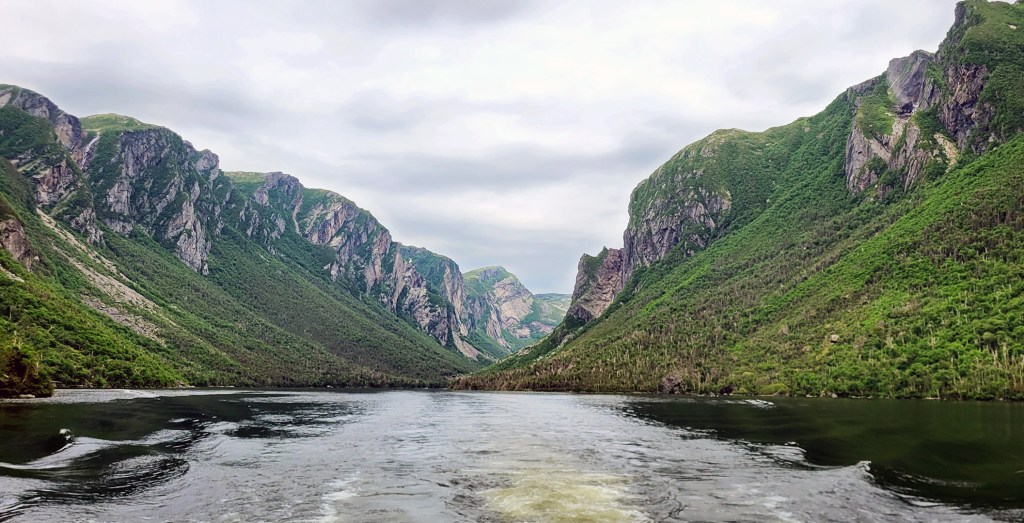
We arrived at the parking lot in plenty of time to hike the required 3 kilometres out to the boat. Western Brook Pond is actually an inland freshwater lake inaccessible by car. It looks like a fjord with steep cliffs on both sides carved by receeding glaciers, but is technically a gorge since, we were told, fjords are saltwater and gorges are freshwater. At one time it was a fjord, connected to the sea, but over time has become closed off and is now freshwater. At any rate, there was some water and some dramatic cliffs producing some stunning views. In fact, one of the views is the iconic shot used by Newfoundland tourism.

When we docked, Marilyn and I shared some clam chowder at the cafe, then hiked back to the bike, which was thankfully untouched. That night we stayed at Shallow Bay Campground near Cow Head. There are several campgrounds in Gros Morne and they are all different. Where Trout River was inland and wooded, Shallow Bay is on the ocean with a long, sandy beach. It’s a real treat, so be sure to stop there if you are passing through.

The next day was our trip up the remainder of the west coast to L’Anse aux Meadows, a National Historic and UNESCO World Heritage Site, where there are the remains of an 11th-century Viking settlement. It’s a long way to go to see some sod houses, but I like history and wanted to stand at the place where early human migration spreading west (Norse) and east (Indigenous) first met. That’s a pretty significant moment in the history of human civilization. I suspect both must have crapped their respective pants, or whatever 11th-century garment they were wearing at the time, upon seeing the other. The monument at L’Anse aux Meadows commemorating the encounter conveys the crapping quite well, I think.

Meeting of Two Worlds. Not a fan of modern representative sculpture.

According to the old Norse sagas, Newfoundland was discovered accidentally when Vikings from Greenland were blown off course in a violent storm. They saw the Labrador shoreline but didn’t dare land. However, after word spread about this mysterious land, a second group of explorers did shore and, during one excursion southward, happened upon a small band of Indigenous men. The Vikings, of course, did what Vikings do, and promptly slaughtered the lot, all except one, who either escaped or was spared in order to go spread the word about the badass Vikings. If the latter is the case, he did his job very well, for shortly afterward, a large war party returned and kicked the Vikings’ dirty butts back to Greenland. Thus is the first encounter of Europeans and Native Americans. A third Viking expedition did manage to settle for a time in L’Anse aux Meadows, but suspicion and distrust between the parties remained, and sometimes I swear we haven’t gotten any further than that.

Our camp that night was at Pistolet Bay Provincial Park at the very tip of the northern peninsula. The bugs were so bad that neither of us was willing to prepare food while being eaten, so we headed into Raleigh for dinner at the Burnt Cape Cafe. Someone there is clearly a hockey fan, and I enjoyed looking at the signed jerseys of Darryl Sittler, Bobby Hull, Sidney Crosby, and others that adorned the walls. Oh yeah, the food was pretty good too.

After dinner we went for a little ride along the shore. I wanted to get over to the lighthouse for the sunset, but the road through the ecological reserve is not maintained and the riding got quite “interesting.” Just when I felt I was finally doing some real adventure riding, the Tiger XC in its element, Marilyn got nervous so we turned around and went over to the other side of the bay. The payoff was that there we got our first glimpse of icebergs. They were in the distance but nevertheless had us giddy as schoolchildren. Little did we know what was to come.

If you want to follow us across The Rock to Saint John’s, click Follow.

Prince Edward Island

Marilyn and I do a quick loop of PEI en route to Newfoundland

On the ferry to PEI, circa 1968.

The last time I visited Prince Edward Island, my hair was cut straight (or almost straight) across my forehead and I had patches on my knees. Oh yeah, and there wasn’t a bridge; the only way to get there was by ferry. I don’t remember much about that childhood vacation, so this visit would essentially be my first. Marilyn had visited PEI as a teen in grade 11 on an exchange organized by her favourite English teacher, but it was based out of Moncton so her experience of the island was limited. This time we went in search of the iconic red cliffs and pastoral views.

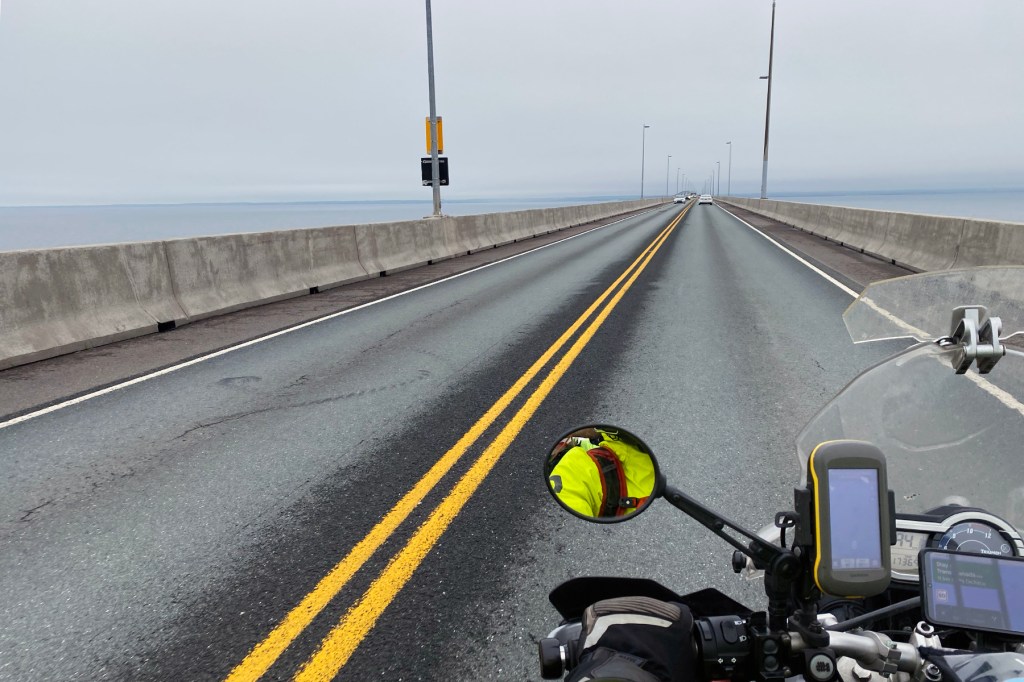
Marilyn and I left Miramichi, NB, and took the 11 south to Shediac, then the 15 east and soon we were seeing signs for the Confederation Bridge. The clever islanders don’t charge anything to get on the island, so tourists become like lobsters wandering into the trap. Once you discover what you’ve done, it’s too late, and you feel like you’re in John Carpenter’s Escape From New York: anyone who goes on the island never comes off. In fact, the fee for motorcycles was only $20.

Marilyn wasn’t too impressed with the bridge. She asked me to write that. She thought the barriers at the sides were not very high, or not high enough. I don’t know what she was expecting for her 20 bucks, and I showed her some videos of shaky rope bridges in Nepal and Itchy Boots going over that abandoned railway bridge in Columbia but she still didn’t feel it was safe. Then I reminded her of the île-aux-Tourtes bridge we take every time we leave the Island of Montreal to the northwest and how Transport Quebec closes the outside lane to trucks because, well, I guess it can’t handle their weight, and then she felt reassured. Everything is relative.

Crossing the Confederation Bridge

It’s unfortunate that the first thing you see upon entering the island is a commercial complex at the base of the bridge, but it had a Tourist Info Centre and, more importantly, a liquor store. While I was stocking up on campsite refreshments, Marilyn was talking to the nice young lady at the Info Centre and discovering that my plan to ride the perimeter of the island in one day was a bit . . . ambitious. I’d read in our travel guide that it’s a 350 km. loop, but apparently that is just the central region. We abandoned our plan to get over to Cedar Dunes Provincial Park on the western tip of the island for sunset and, instead, camp at Cavendish Campground in Prince Edward Island National Park on the northern shore. That seemed more doable and left us time to explore some of the shoreline in search of those red clay cliffs.

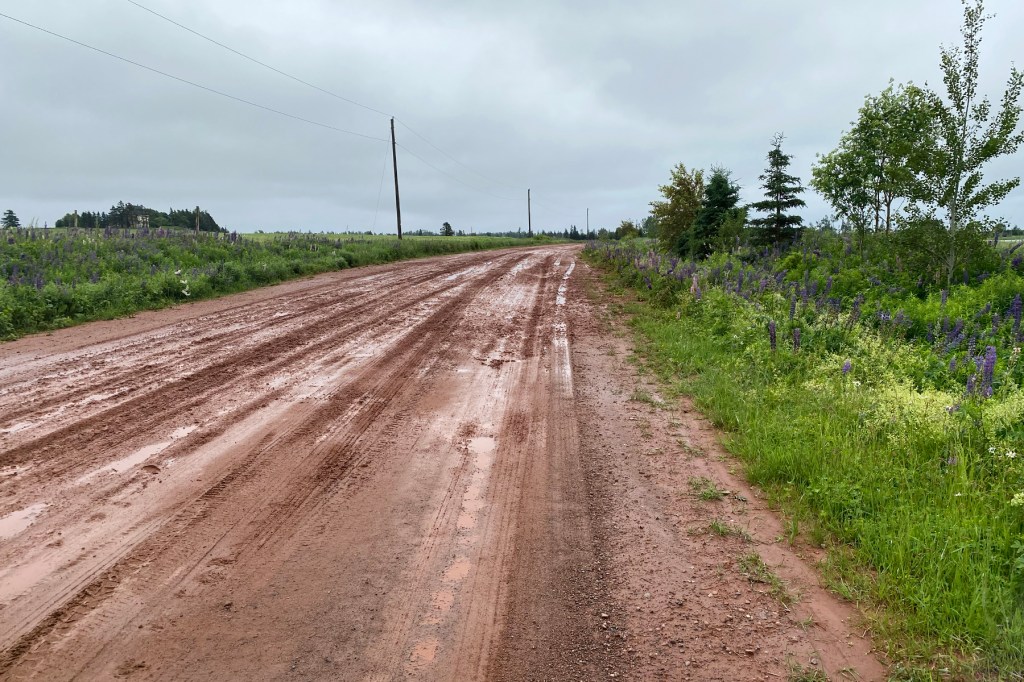
I looked at a map and discovered Highway 10 running fairly close to the shore, so we started our tour there. We noticed we were on the Coast Trail and its road-sign icon was of red cliffs, so we knew we were on the right track, or trail, that is. I wanted to venture off the asphalt, but with the rain of the night before, the road got a little too slick for our liking. Even male bravado sometimes takes a back seat to better judgment, so we decided to play it safe, pull a U-turn, and head back to the asphalt.

No problem with knobby tires, but Dunlop Trailmax Mission tires cake up fast in this clay.

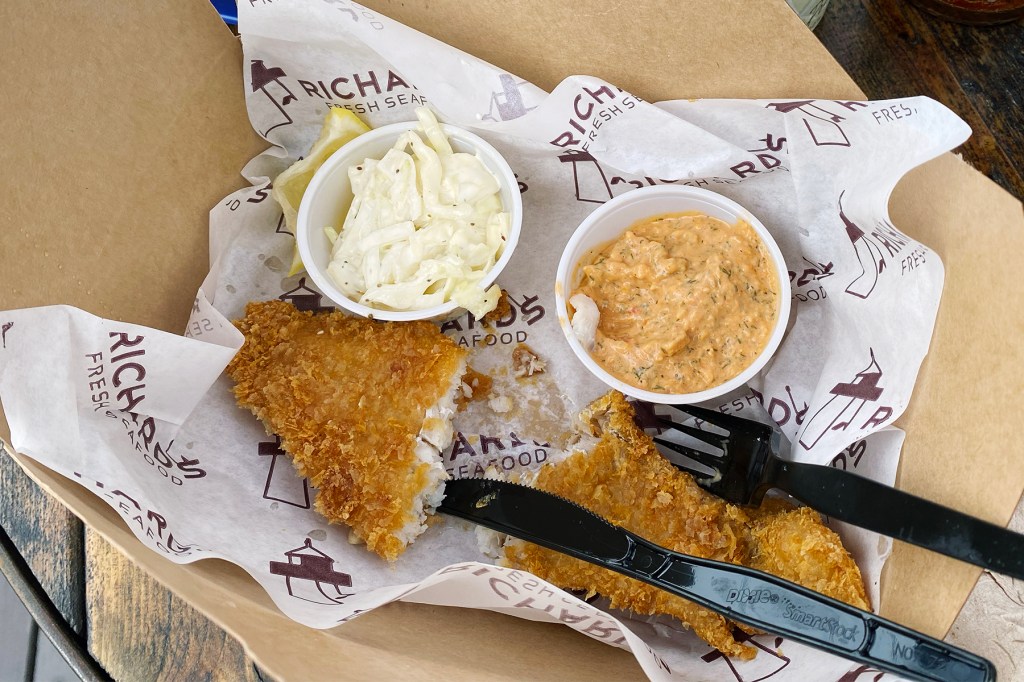
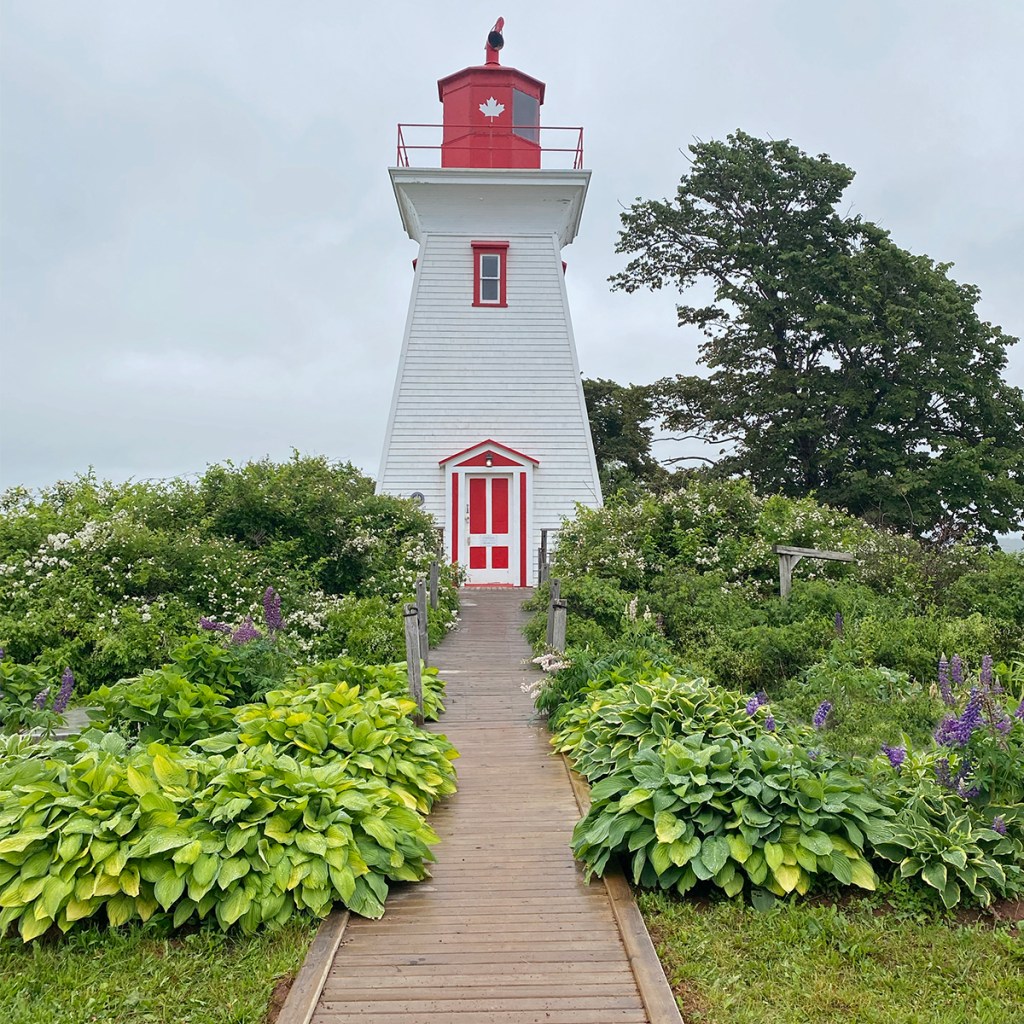
Soon we entered the picturesque village of Victoria. It had a lighthouse, a wharf, and gourmet fish & chips, so our search for the red cliffs would have to wait.

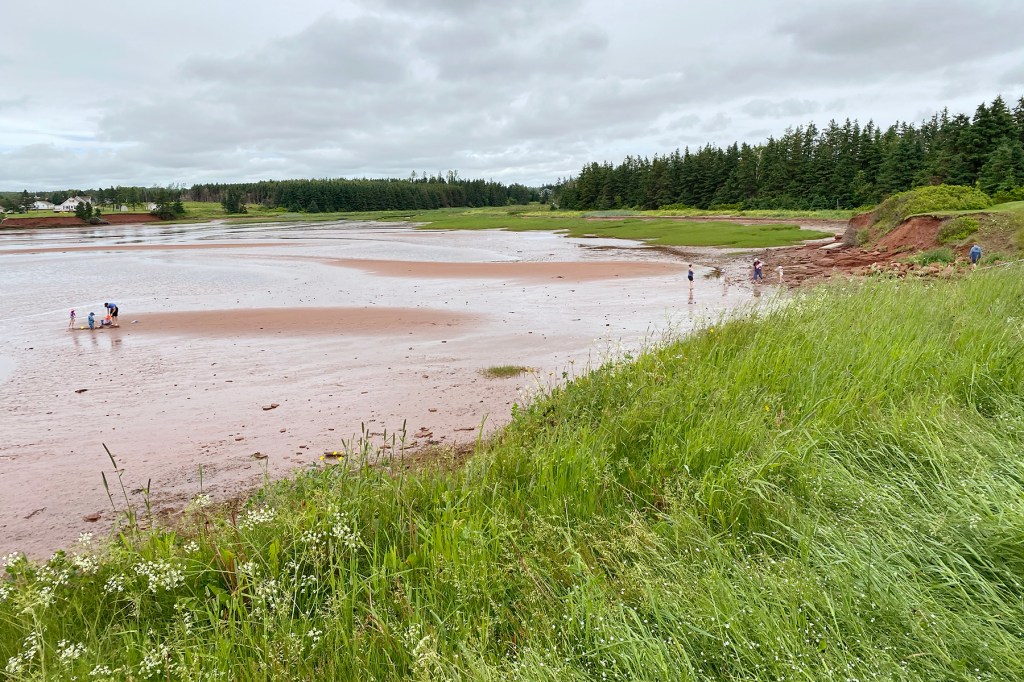
After lunch, we continued along Highway 1 then turned right onto Highway 19 that went along the shore. We saw a sign for Argyle Provincial Park and pulled off to explore. Success!

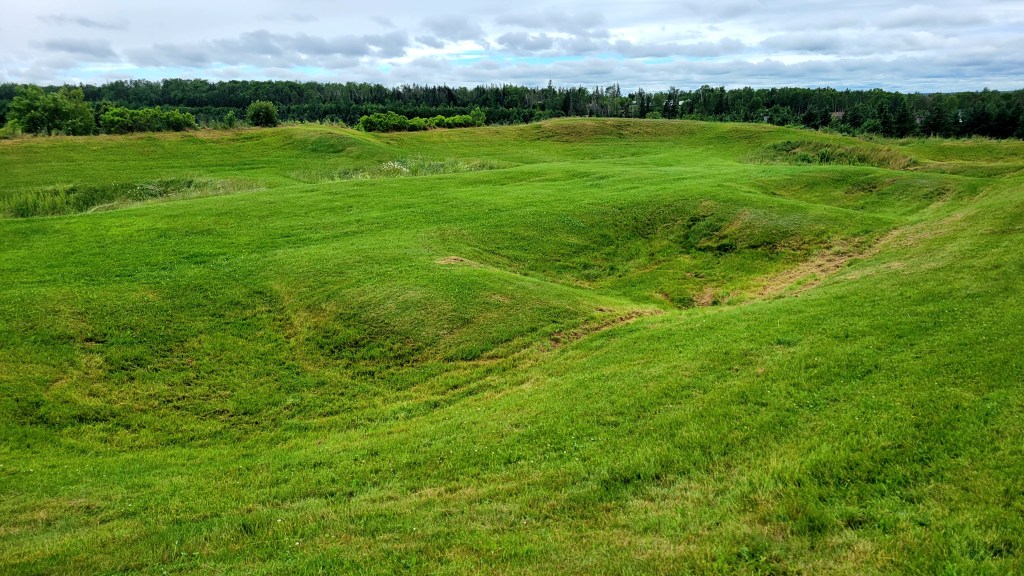
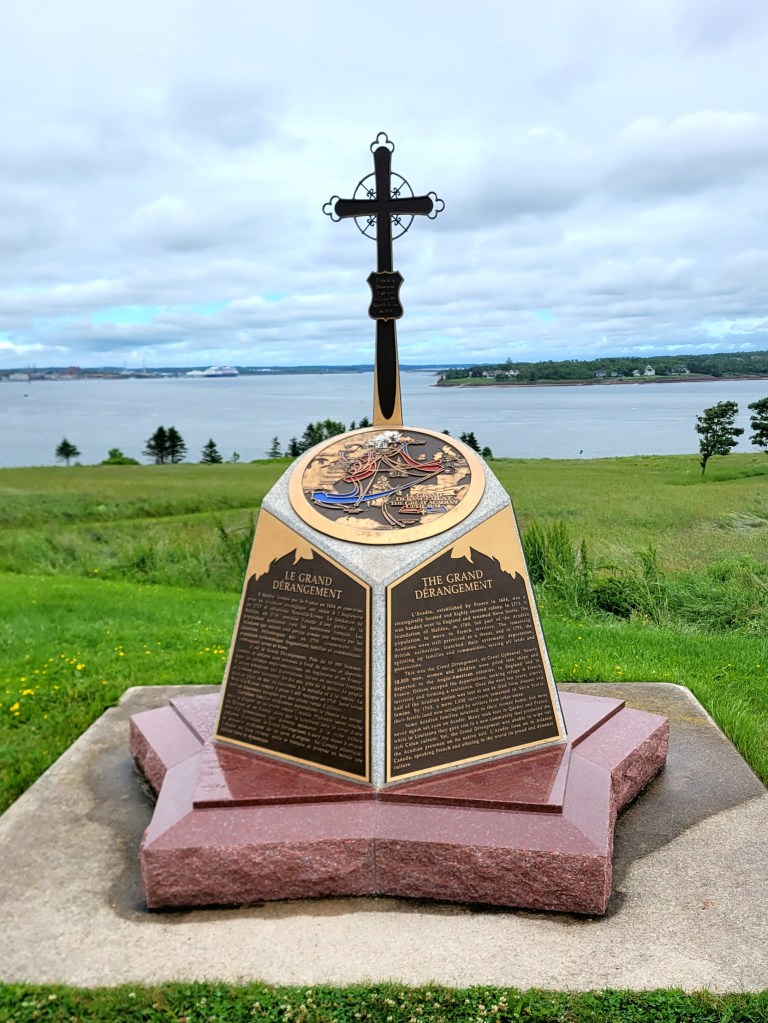
A little more exploring as we headed north brought us to Skmaqn–Port-la-Joye–Fort Amherst National Historic Site, which tries to recognize in its name every group that has once laid claim to it: the Indigenous Peoples, the French, and the English. Today it’s occupied by Canadians, and specifically, me. I walked the trail while Marilyn took a break up at the welcome centre. You can see the ruins of two forts, the older being the French; the newer, the English, and a monument describing The Grand Dérangement.

As the monument states, in 1755, after the English took possession of L’Acadie, nearly 10,000 Acadians were deported to Anglo-American colonies, to England, and to France. (The Cajun culture of Louisiana derives from its Acadian history.) Over the next ten years, about half died to disease and famine. A mere 1,600 remained by avoiding deportation, but their lands were now occupied by other settlers. Yes, Canadian history, like all history, is a story of war and conquest, with winners and losers in a primordial dynamic that continues today.

I think much of the thought surrounding “privilege,” “victim status,” “inter-generational trauma,” and “reparations” on university campuses and political discourse today stems from a sense of guilt or shame about these histories in an attempt to somehow right the wrongs of the past. My personal belief is that you can’t change the past, as much as we’d all like to, either in our personal lives or in the history of a country. Trying to do so is impossibly messy, hundreds of years after the events, and results in things like white children being told in school to apologize formally to black and indigenous children for things they never did (I’m not making this up). Rather, I think the time would be better spent learning history so we don’t repeat those mistakes, but I’ve found my students to be quite historically ignorant. It’s not their fault. Many educators are more interested in teaching values than history, and here in Quebec, the government dictates a rather selective view of its history. Meanwhile, wars and ethnic cleansing continue throughout the world, and the language wars continue here in Quebec.

Back at the building, I met up with Marilyn and we continued our journey northward, avoiding Charlottetown and zig-zagging toward our destination for the night. There are no direct roads across the island, but we were happy to take our time as we rode through those pastoral rolling hills that were the second goal of our visit. We’d been warned that Prince Edward Island National Park had been devastated by Hurricane Fiona in September 2022 and that the campground had been stripped bare of much of its old growth trees, but it’s one thing to hear this and another to see it.

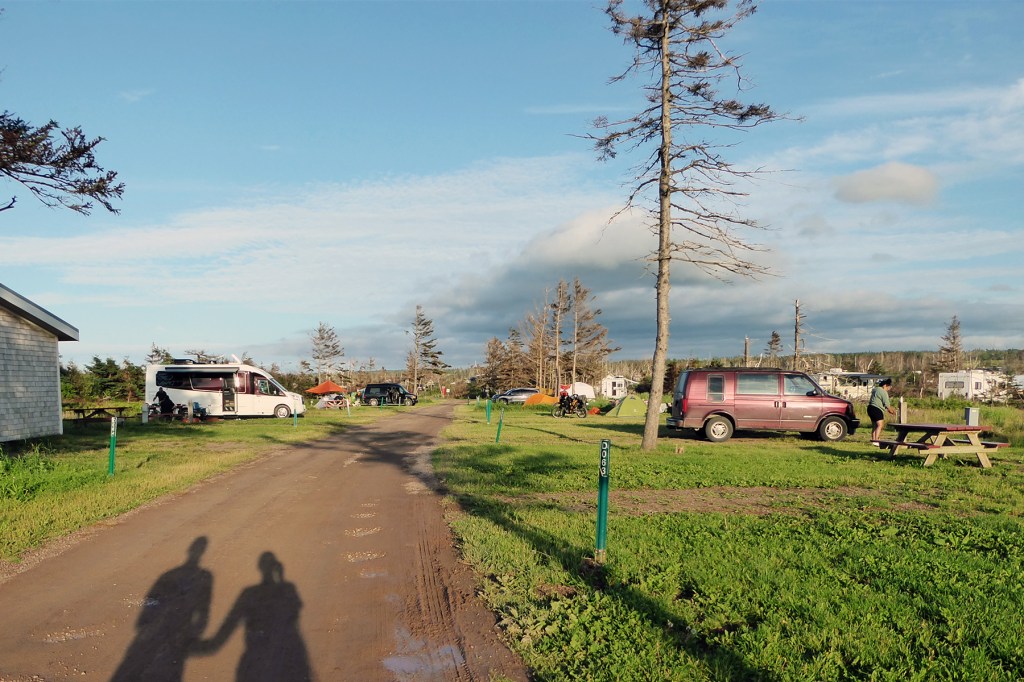
We set up camp and then decided to take a little ride along the shoreline.

We returned to camp in time for Marilyn’s favourite activity, sunset viewing, and there’s no better place to view a sunset than on a beach.

We only had one day on the island, but I’m glad we went. Like all islands, it definitely has a different energy and a slower pace to mainland life. The ferry that could take us across to the north shore of Nova Scotia was out of service, so we traversed the island again, this time taking a more direct, central route down Highway 13. You can’t speed much on these roads, but I did my best.

Soon we were crossing the bridge again and saying good-bye to Prince Edward Island. We loved it and were sad to leave, but we were now less than a day away from boarding our ferry to another island and the true destination of our summer tour.

Gaspé

We continue our tour of the east coast through the iconic Gaspésie region.

When I first started teaching, I taught ESL (English as a Second Language) to adults at a French college. For one mid-term oral exam, to evaluate my students’ use of the past tense, I asked them to tell me about a previous holiday they had taken. Almost all of them talked about Gaspé. It was even more popular than Disney World, a distant second favourite, so I figured it must be good.

Gaspé. The name to an anglophone suggests breath-taking, and it is, but in fact, according to one account, the name comes from the Mi’kmaq word Gespeg, meaning Land’s End. That would make sense since the region is the tip of the southern shore of the Gulf of St. Lawrence. I had toured it decades ago in a car but never on a motorcycle, and Marilyn had never been there at all, so instead of bombing along the Trans Can to Newfoundland, we decided to take a few extra days to get there by following the coast around the peninsula and making a quick loop of PEI before heading to Sydney and the ferry terminal. 

The challenge, as always in Canada, were the distances we had to cover and finding the right balance between covering distance and enjoying the places we were riding through. We wanted to spend as much time as possible in Newfoundland since neither of us had been there before, yet Marilyn had less than three weeks vacation. We allotted ourselves five days to get to Baddeck, Nova Scotia, with our ferry crossing reserved for noon on July 6th. In the end, this was a challenging schedule of approximately 500 kilometres a day with camping and cooking in the daily mix.

Our planned ride from Reford Gardens to Petit-Gaspé Campground in Forillon National Park was only four hours long, but my love of pastries and coffee, not to mention Marilyn’s love of flowers, already had us off schedule. We indulged ourselves with a snack at the Gardens’ café and left early afternoon; our schedule was so tight that it really didn’t allow for even these kinds of delays. The price was that looming sense of urgency throughout the afternoon as we continued east along the 132. 

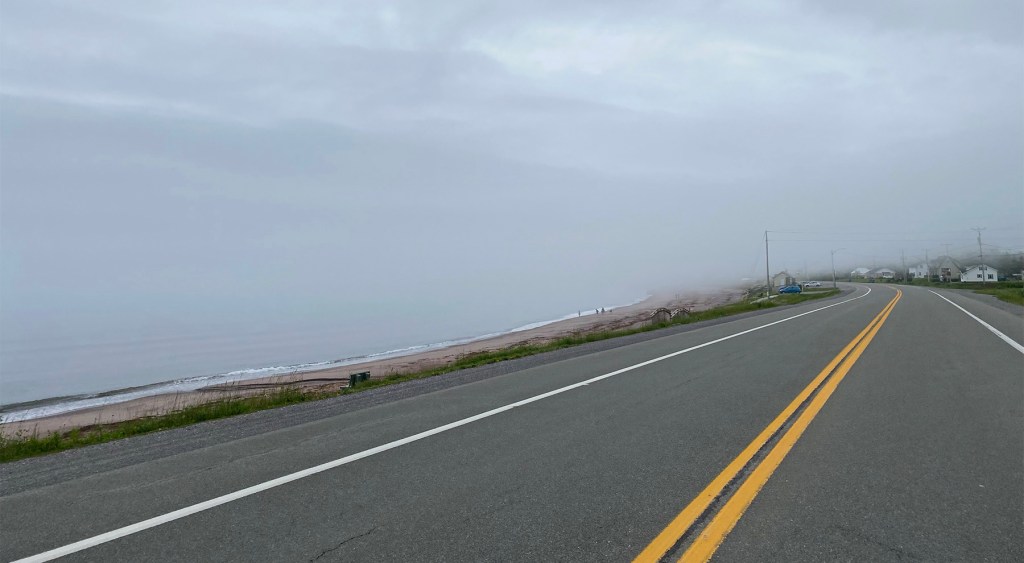
The 132 is like this for miles and miles. Sorry about the bug deflector.

Despite that, the coastal ride was everything we were hoping it would be. The 132 hugs the shoreline for hundreds of kilometres along the peninsula. After Matane, it gets spectacular, with mountains on the other side of the road rising sharply up, especially around Sainte-Anne-des-Monts, where in my previous visit I’d watched hang-gliders leap from the towering cliffs out over the gulf. The best riding in the region is when the 132 drifts inland and rises through a mountain range, with twists and turns, constant changes in elevation, and hairpin turns that reminded me of the some of the mountain ranges in The Rocky Mountains we’d ridden out west. Yes, it was that good. There are parts where the guard rail is small and the drop-off great, and when we pulled into a gas station in Grand-Vallée and I turned off the bike, Marilyn said “That was thrilling!” There’s nothing like the proximity of death to bring a woman closer.

Route 132 gets quite hilly and twisty when it strays inland from the coast.
More hills and thrills on the 132. Messed up that right-hander. Keep in mind I’m fully loaded and with a pillion so wasn’t pushing it. Love the sound of that Triumph triple!

Because we were behind schedule, we decided to grab dinner on the road instead of cook it at camp. A hamburger and chicken burger with fries and salad from essentially a chip truck set us back $45 and had me remembering the inflated prices of the region from the last time I visited. Yes, the tourist season is short, and the locals reap what they can when the going’s good. We’d also been warned that sometimes the “local seafood” comes out of a box.

I wasn’t smiling after paying the bill.

We tried to put that price tag behind us and chalked it up to the cost of travel. It meant that when we arrived at the campground, there was time after setting up camp to go for an evening stroll out to the ocean and catch the sunset.  

We walked down with our morning coffees too.

Our second night of camping was a lot better than our first! We love National Parks and had purchased Discovery Passes for the trip. National parks are always immaculately maintained with clean facilities and hot showers! The Petit-Gaspé’s park seemed to have a brand new building with a campers’ lounge including a hot stove. Even though it was July, they had it lit, which was nice because we could lay out some clothing to dry. 

A sneak peak into the women’s washroom. Clean and modern washrooms at Canadian National Parks.

The next day took us through into Percé and past the famous pierced rock. Unfortunately, there was so much fog we couldn’t get a good look at it. The fog, however, made for some dramatic photos from the lookout at Cap Mont Joli. (See banner photo above.)

While waiting to see if the fog would lift, we killed time with one of my favourite pastimes.

We couldn’t afford to stay long in Percé. After picking up my pannier sticker, we continued on. The coastline now heading back west is sandy beaches with a smattering of homes along the road. Marilyn was surprised that the area is so populated, but geography determines a lot, and here fishing boats can safely land compared to the rocky shore of the gulf coastline. Instead of the adrenaline of the twisty, undulating road earlier, I was happy to cruise the Baie-de-Chaleurs, past the small fishing villages of Grand-Rivière, Chandler, Port-Daniel, Paspébiac, and Bonaventure. By the time we reached New Carlisle and New Richmond, the place-names indicated we were approaching New Brunswick.

Heading west along the Baie-de-Chaleurs. Now sandy beaches instead of rocky coastline.

When you ride these popular routes, you often bump into the same people repeatedly as they ride the same route. We passed three women on Harleys parked at the side of the road, and then they must have passed us at some point, and you do this leap-frogging for sometimes several days. In this case, we finally met them at a Tim Horton’s somewhere in New Brunswick. They are members of Motor Maids and were headed to Cape Breton to ride The Cabot Trail before heading to Massachusetts for the club’s annual convention. By the time we bumped into them again, days later, at the Nova Scotia Tourist Info Centre, they were four, and we saw them again on The Sunrise Trail. The last time we saw them was in Cape Breton. This time we were parked, figuring out what we would do for dinner, when we saw them cruise past, heading for their hotel in Baddeck, living the dream.

We crossed the bridge into New Brunswick at Cambellton and picked up Highway 11 which took us to Highway 8, then turned right, and headed straight south, inland on an open multi-lane highway, as fast as we dared, keeping our eyes out for cops and moose. (Thankfully, much of the highway through the drive-through province is fenced.) We knew this would be a long day. We didn’t have a reservation anywhere for this night but thought we’d push on as close to the PEI bridge as humanly possible before stopping. It was hot, and we’d been on the road since early morning. Finally in Miramichi, NB, as we crossed the river, Marilyn said enough was enough, and I know better than to go against the wishes of my better half.

We stopped at the tourist info in Miramichi to ask about accommodations and restaurants. I noticed that it has both Scottish and Irish Festivals on separate weekends in August and calls itself The Irish Capital of Canada. It was clear that we were no longer in Quebec.

A slug with good taste.

Kamouraska

Marilyn and I begin our east coast tour on Canada Day, 2023.

New bike, new tour.

Have you ever noticed how, just before setting off on a major holiday, strange things start happening to obstruct you? Things start breaking or go missing, or the dog gets sick, or you get audited, or the secretary for the specialist you’ve been trying to see for months phones to offer you an appointment next week. Well, according to Swiss psychologist Carl Jung, that’s your unconscious saying “Not so fast! Where do you think you’re going? Get back here, young man!” (or woman, as the case may be).

Jung’s theory is that the unconscious likes the status quo. It doesn’t like change, negative or positive. You’ve survived life so far, it deduces, so more of the same must be good, safe. This applies to all aspects of life, including planned and unplanned positive change, like going on a major holiday or experiencing a leap of personal growth. It’s as if you have to push through the obstacles the psyche in all its guile throws up in front of you before you can reap the rewards of progress.

We’d been planning this trip for close to two years. The original plan was to go summer of 2022, but with the addition of a new dog to our family, we postponed a year to allow him to settle (Obstacle #1). I’d been thinking about the trip through the dark months of the previous winter and had been planning the route, modifying the bike, and boosting my fitness to be fully prepared. Now with less than a week before departure day, all hell was breaking loose, right on time and as expected.

For one, a family member had a major medical event that left us wondering if we could go at all (Obstacle #2). Then I received a call from the car dealership: the vehicle we were expecting to take delivery of in August arrived early. Could we come complete the paperwork and pick it up before July 1? (Obstacle #3) The day prior to our leaving, when I was supposed to be full-on packing, CTV News phoned asking for an interview about an op-ed article I’d published (Obstacle #4). In the meantime, an article for my paying gig, northernontario.travel, about a club ride I did to Prince Edward County was due. (Obstacle #5) That ride was our shakedown ride during which I discovered that we were significantly under SAG, so I had to get the rear shock off and to Stadium Suspensions in Beloeil to be re-sprung (Obstacle #6). I also changed the oil, coolant, brake fluid, and rear brake pads, and tweaked a bunch of little things. I was busy.

Finally, however, on Saturday, July 1st, we were packed and ready to roll. All adversity had been overcome. The departure date, Canada Day, was symbolic and the same as it was in 2021 when I set off to discover western Canada. This eastern tour of the Maritimes and Newfoundland would be the companion trip to that one. We said good-bye to our furry friend, climbed on the bike, noted the odometer reading, and pulled away from the house.

The first task when living in Montreal is always to get out of the city. This is not always easy, but leaving after the morning rush hour on a national holiday meant a relatively quick exit. We crossed over the Champlain Bridge to the south shore and continued on Highway 20, the Trans Canada Highway, until east of Quebec City before dropping onto Route 132, the highway that would take us right the way around the Gaspé Peninsula.

First glimpse of la mer

Highway 132 is an incredible road. It’s the longest highway in Quebec, stretching from New York State in the west to the New Brunswick border in the east, and it’s one of Quebec’s oldest highways, passing through many historic towns and villages that date back to the 17th Century or earlier, when Europeans began to arrive. It’s also arguably Quebec’s most scenic highway, hugging for long sections the shoreline of the Gulf of Saint Lawrence on one side with mountains rising sharply up on the other.

When I first came to Quebec as a student on an immersion program, I lived in La Pocatière, in the Kamouraska region. No wonder I fell in love with Quebec and decided to move here. Kamouraska is one of the province’s major tourist regions. The Gulf of Saint Lawrence has opened up enough for inns (or gites, as they’re known here) to advertise “sur la mer” (on the sea), which is a bit self-aggrandizing because it’s still the river but, okay, brackish with a small tide. But the river starts to smell like the sea and look like the sea and you can imagine it being the sea, even swim in it, if you want. We decided instead to get some lunch at one of our favourite spots. The lobster bisque is worth all 400 kilometres and the $17.

When Marilyn and I toured out west, the compromise was that we did no camping; she would ride pillion as long as there was a bed waiting for her at the end of the day. Fortunately, we had friends and family across Alberta and British Columbia that welcomed us into their homes, and we took a hotel room when needed. But the remoteness of some of the regions of this trip would require some camping. How do you experience Gros Morne National Park without camping?

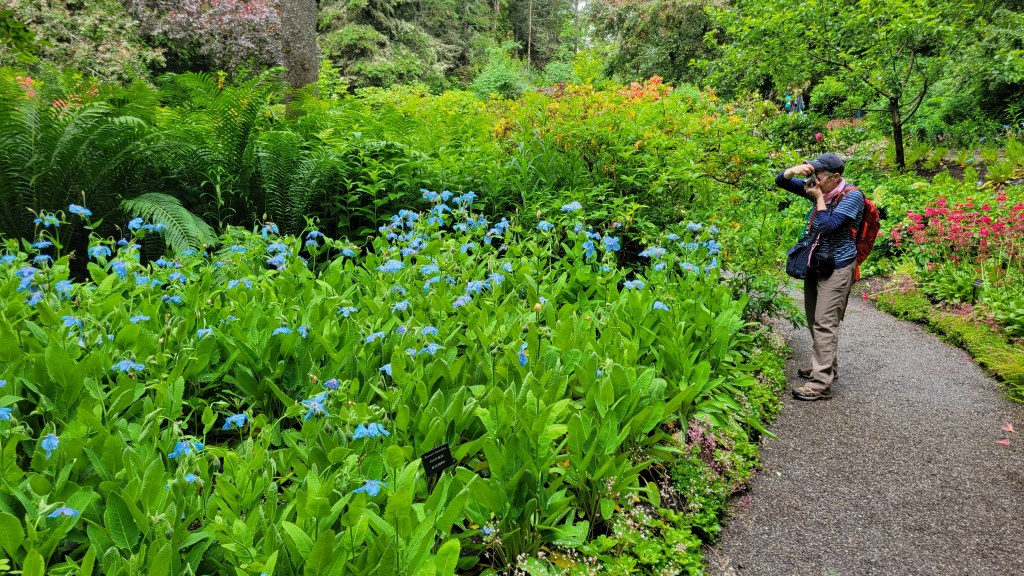
With that in mind, I planned strategically. Our destination for Night 1 was close to Reford Gardens – Jardins de Métis, where we would spend the next morning before continuing along the 132. The Reford Gardens is another famous garden like Butchart Gardens we visited in Victoria. Similarly, it was a labour of love by one woman, in this case Elsie Reford. By enlisting the help of local farmers and fishing guides, she was able to turn a spruce forest into a lavish garden which included the very rare Tibetan Blue Poppies. If you have to ask your wife to do anything really unpleasant, like camp in the rain, just remember the diplomatic power of flowers.

The first night was the toughest. To ensure we would have time to see the gardens, I reserved a site at Parc Régional de la rivière Mitis [sic. that’s not a typo; I don’t know why there are two spellings], barely a stone’s throw from the gardens’ entrance. I saw when making the reservation that these are walk-in sites, but only about 230 meters from the parking lot, so how bad could it be, right? Well, the sites are on a trail network and the trail was muddy and hilly. When we arrived, it started to rain, and it kept raining, all night and through breakfast the next morning. Marilyn, who is a light sleeper, heard the neighbouring campers’ music and conversation, the Canada Day fireworks at 10, the neighbouring campers’ sex, the heavy rain and thunder and, through it all, my light snoring. She got about one hour of sleep. Oh yeah, and then there were the bugs.

Not a happy camper.

As if to punctuate the state of affairs, the next morning, while I was preparing the coffee, animal excrement of some kind slid out of the tree above and landed with a splat! on the water bladder. It was going to be that kind of a day.

What the hell?

But after a porridge breakfast and a top-up of coffee, the rain stopped and the sun came out. Yes, the absence of pain is pleasure, and the sun that day was all the more enjoyable, especially while at the gardens.

It was all uphill from here. We had survived the worst of it with our marriage intact. After a quick snack at the cafe in the gardens, we were back on the bike and headed for Forillon National Park on the tip of the Gaspé Peninsula.

We are bound for Newfoundland. If you want to follow along, click Follow.

Ready to Ride

What is your preseason prep?

Here in Montreal, the 2023 motorcycle season has officially begun. As of March 15th, we can legally be back on the road. The reality, however, is that no one is stupid enough to do so. I saw—or rather, heard—a scooter on the road yesterday, but I wouldn’t want to take a bigger bike out yet. In fact, I can’t get my bike out yet; there’s still several feet of snow blocking the doors to my shed.

Nevertheless, the air is filled with anticipation as it won’t be long now. Motorcyclists are scurrying about like squirrels uncovering nuts, or birds building nests. I’ve seen a few Facebook posts about preseason maintenance and, for the Harley riders, preseason cleaning and polishing. T. S. Eliot wrote that April is the cruelest month, but for motorcyclists in northern climates, it’s these last few weeks of March during The Big Melt (aka dog shit season) that are the most painful. To ease the pain, we undergo a ritual process of preparation for the season to come. Here is what I do to get ready to ride.

Bike Prep

The first thing I do is undo everything I did last fall to prepare the bike for storage. That involves removing whatever I’ve used to block the intake and exhaust ports, removing the wax I left on the bike to protect it through the cold winter months, replacing the battery and saddle, lowering the bike off the jack-stand, and topping up the tires. The bike is now ready to run, and I might start it up, just to hear its familiar exhaust note and reassure myself that all is well in the world.

Depending on the mileage, I change most of the fluids on the first warm day of spring. (I don’t have the luxury of a heated garage, so all maintenance is done outside.) I changed the oil before putting it into storage, but apparently oil ages even if unused, so I’ll do an early oil change, maybe not right away but soon. For this reason, some people put a cheap oil in the bike in the fall just for storage purposes, then change to the good stuff in the spring. I think that’s a little over-kill, so I put the same top quality synthetic oil in before and soon after storage. And no, I’m not going to start an oil thread by revealing what I use, as much as I always enjoy a good oil thread.

I change the coolant and brake fluid every two years or 20,000 kilometres, whichever comes first. I also remove the brake pads, clean them up with a wire brush, and clean and lube the callipers, paying special attention to the calliper pins. The brake cleaning might be over-kill too, but I like to know the pins are moving freely and generally to keep the brakes free of grit and grime. They’re just one of those essential moving parts that is exposed to road debris. If you’ve never done your brakes before, it really isn’t difficult.

I’m fortunate to have MuddySump’s channel to follow for routine maintenance. He’s an excellent mechanic and has the same bike as me.

I change the air filter, or in my case, because I use a K&N, clean and re-oil it. This year I’ll be adding a Uni pre-filter to my bike. On my Tiger 800XC, the OEM filter is under the tank, so adding a pre-filter will not only help protect the engine but also significantly cut down on the service intervals for the filter in the air box.

Then the fun begins: I add all the mods I’ve bought through the winter.

Gear Prep

If you didn’t launder your gear and wash your helmet liner in the fall, now might be a good time to do it. I also get out the leather conditioner and go a little crazy with it. First I do my leather jacket, then my gloves. Then while the rag is damp I do my satchel, my shoes, my wallet, my fountain pen cases, my belt . . . like I said, I go a little crazy. I do this once in the fall when I put my jackets away and once in the spring. We have baseboard heaters which pull all the moisture out of the air in the house, so I do this at least twice a year.

My favourite brand of leather conditioner? This might start a thread as long as an oil thread, but I’ll say that someone who works at the high-end store in Montreal where I bought my satchel once graciously confided that Armor All Leather Care Gel is just as good as the expensive stuff they sell. That was my brand until Canadian Tire stopped selling it. Then I switched to Simoniz, which I didn’t like as much, and lately it’s been Chemical Guys, although this year I’ve noticed that it’s leaving a white film on the leather once it dries. So after doing a little research, I’m going to try Cobbler’s Choice. Like I said, I’m a little obsessive about moisturizing my leather goods. The best moisturizer, however, is good ol’ beeswax, although it leaves the jacket sticky for a few days.

So with every leather item in my house sufficiently moisturized, my gear is almost ready for the season. I squirt a little WD40 on the buckles of my ADV boots, some Pledge on my helmet, wipe some silicone onto the rubber that seals the visor, and polish my visor with Plexus. Yeah, this stuff costs a lot, but Ryan F9 has done a video showing that it’s the best. If the visor is old and too badly scratched to restore, this is when I get a new one; there’s no sacrificing when it comes to vision on the bike.

I also get out my camping gear and give it some love. Last fall, I treated the tent with Kiwi Camp Dry Heavy Duty Waterproofing Spray. I like this stuff because it’s non-toxic and doesn’t leave an after-smell. I also clean my stove and make sure anything that needs replacing is replaced, because there’s nothing worse than a temperamental stove when on tour. The one that I use runs on liquid fuel and requires maintenance from time to time.

Body Prep

Touring for weeks on end and crawling in and out of tents, as I’ll be doing this summer, requires some fitness and flexibility. The long days in the saddle are easier if you have some cardio fitness, so I’ve been running fairly regularly. I do a 5K loop with the dog 2-3 times a week, and when I’m inspired, I run a little longer. Now that the warmer weather is almost here, I’ll be bumping that up and doing some 10K and even longer runs. Running has always been easy for me and it’s my go-to exercise for body and mind.

With all that running, I need to do stretching or my legs get tight and my back becomes prone to injury. This year I invested in some athletic therapy which gave me a set of stretches to do, and as Robert Frost said, that has made all the difference. I used to pull my back a few times a year, often at the worst possible time, laying me up for a week, but with this stretching, I haven’t had an incident in a while. I think I’ve found the answer to my back issues.

In addition to the cardio and stretching, I work on strengthening my core, so some Pilates, yoga, and generally, abdominal work. Sitting on the bike all day is like sitting on a stool with no backrest, so you need a strong core. When you start doing any off-roading, there are even bigger demands on your muscles. I’ve already done a blog about fitness and strengthening, so if you’re interested in the specific exercises I do, check that out. One thing I’ve added since making that post is to work on balance. You can do that with a wobble board, but a simple way to improve your balance skills is to stand on one foot . . . with your eyes closed. Try it. This develops all those nerves in the foot that are essential to good balance, and according to Jimmy Lewis, off road riding is all about balance.

This year, to account for the extra weight of the top-heavy Tiger, I started doing some strength training with kettle bells. I may be a natural runner, but I’ve always had the upper body of Pee-wee Herman. I really like kettle bells and I think they will become a regular part of taking care of myself. The main reason I like them is that you get cardio, strengthening, and core work all in the same workout. Because kettle bells are asymmetrical (unlike barbells), you’re always working your core, and if you string reps together EVOM (Every Minute On the Minute), you also get your cardio workout. Best of all, you really only need a couple of kettlebells to get started and can do it in a small space in the house. I’ve been doing kettlebelling for the past month or so and am loving it! I’m following Mark Wildman’s YouTube channel. He’s excellent and has a series of videos specifically for people like me just starting out.

If that sounds like a lot, it kind of is, and I’m trying to figure out how to fit it all in. At my age, recovery time is not what it used to be, if you know what I mean. At first, I tried staggering running and strengthening on alternating days, but that didn’t leave me any days off to recover. Currently I do a run after my long days at work to run off the stress, then a double workout of kettlebelling followed by a light run when I can, which wipes me out but then I take a full day off with just some stretching. In other words, I listen to my body and adjust accordingly, keeping in mind that you need to do an activity 3-4 times a week to see benefits.

Finally, the only other muscle I exercise is . . . eh, hem . . . not what you’re thinking but my clutch hand. I keep one of those spring grip devices on my desk all winter and pick it up from time to time. Works better than a stress ball and helps avoid arm pump when off roading.

One hand on the mouse, one hand on the grip strengthener.

Eye on the Prize

It was the best of times, it was the worst of times . . . it was the spring of hope, it was the winter of despair. Charles Dickens wasn’t a motorcyclist, but in describing the Victorian era he caught something of the spirit of this intermediary period. As I come to the end of my March Break and head back to work tomorrow, I keep in mind that at least I’ll soon be able to commute by bike, and before I know it, the semester will be drawing to a close and we’ll be getting ready to leave for Newfoundland. Marilyn and I booked our ferry crossing the other night so that trip is a go! 18 days together on the bike camping through Gaspé, Gros Morne, and across The Rock. It’s going to be epic.

Keep your eye on the prize, folks, whatever that may be for you. Have a safe and enjoyable season.

2023 NE USA Tour: Preliminary Plans

The second tour of the coming season will be down memory lane.

Jumping waves on the Outer Banks, NC, circa 1970.

When I was a boy, my parents used to take us down to Cape Hatteras on the Outer Banks of North Carolina for our family vacations. I was the physical barrier separating my two older sisters in the backseat of our Pontiac Strato-Chief. My dad had installed seat belts in our favourite colours according to this arrangement: red, blue, green. Or was it green, blue, red? I can’t remember, but I remember quite a lot about those vacations. They were among my happiest memories growing up, despite the backseat shenanigans.

Not my dad’s Strato-Chief but similar.

We went with another family, and apparently those vacations left an impression on them too, for one of the children named her future child after me. En route, we camped at Shenandoah National Park in the Blue Ridge Mountains. I still remember the nature hikes led by a ranger (who taught us to recognize a particular birdsong by its resemblance to “Drink your teeeeeea!”), the nighttime slide shows at the amphitheatre, walking back to our campsite afterwards, the fog so low you could bounce your flashlight off the underside of a cloud, and the rainstorms. The rainstorms! To this day, I love a good rainstorm from inside a good tent.

Since getting my licence in 2016, I’ve wanted to return and ride the Blue Ridge Parkway, and this summer I finally will.

We would drive much of the Blue Ridge Parkway before spending a day in Williamsburg, then head over to the coast and camp along the Outer Banks. The campground was so close to the ocean you only had to walk along a boardwalk over the dunes to the beach. I wasn’t a strong swimmer and the sea always frightened me, but I enjoyed playing along the shoreline. One year, we went to The Wright Brothers Memorial at Kitty Hawk, and I think my first ever book was a staple-bound biography of The Wright Brothers I purchased from the gift shop there with the few dollars we were given for “spending money.” That seed of interest later sprouted into a dream of being a pilot when I grew up, and although my career ultimately went in a different direction, it has combined with another interest of mine—poetry—to produce a collection of poems that explores the theme of flight. I might not be a pilot, but I can imagine being one; the opening section is in the voice of Wilbur Wright.

A postcard of this famous photo of the first flight sat on my desk and served as inspiration.

The last time I went down there I was 14. My sisters by this point were already doing their own thing and didn’t go, so I had the backseat all to myself and Supertramp playing on my cassette recorder. During one rest stop on the Blue Ridge Parkway, we came out just in time to watch three motorcyclists start up their bikes and roar off down the parkway. One was a woman on a BMW. I’d never heard of that manufacturer but my dad clearly had. “Did you see that young woman take off on that BMW?” he remarked to my mom.

Perhaps another seed was planted on that holiday because, since getting my licence in 2016, I’ve wanted to return and ride the Blue Ridge Parkway, and this summer I finally will on my Triumph Tiger 800 named Jet.

The trip so far is pretty sketchy, but that’s generally how I like to tour when I’m on my own. In the earlier trip planned for this coming summer, my wife and I are going to visit Newfoundland, and much of that trip has been scheduled. For this one, however, all I know so far is that I’ll ride The Blue Ridge Parkway and Skyline Drive at some point, camping at Shenandoah National Park. I also know that I’ll ride some dirt in the MABDR and NEBDR (Mid-Atlantic and North East Backcountry Discovery Routes respectively). The MABDR and Blue Ridge Parkway plus Skyline Drive cover similar geography, so it makes sense to do one down and one back. One is asphalt, the other primarily dirt.

I’m thinking I’d also like to get out to the Outer Banks and ride them too if I have the time. They are less than a day’s ride from the Blue Ridge Mountains. Lea of Got2Go recently rode them and titled her YouTube video “The BEST road trip of the USA East Coast?”

Got2Go Rides the Outer Banks

At the time of this writing, there are lots of unknowns. Will I be touring solo or with a few friends? I’m good either way, but it would be nice to ride the technical sections of at least the NEBDR with a few buddies, and I’ve put a few feelers out. If I get some takers, will they do the whole tour with me or only one or both of the BDRs? If they can only do the dirt with me, I might change the order of things and ride the BDRs down and the asphalt back, to accommodate them.

I also don’t have a precise route mapped out yet from the Canadian border to the top of Skyline Drive. I’ve got Google Maps, Kurviger, and Rever open in separate tabs of my browser with the “Avoid Highways” option selected and am studying their suggested routes. Depending on which router I’m looking at, it’s between 1000 and 1100 kilometres from my house to where the scenic drives begin. This is prime Civil War geography through Pennsylvania and I’ll be tempted to stop often at historic landmarks.

Will I ride Tail of the Dragon while I’m down there? I’ve heard from several people that it’s not worth it and, in fact, is a little dangerous with superbike and sports car idiots treating it like a track instead of a public road. There are apparently many roads in that area just as good or better and less populated. Do you have any suggestions? Let me know.

So there’s a lot still to decide about this one but one thing I do know is that I’ll be leaving sometime in the fourth week of July and will have a little under three weeks before I have to be back for work mid-August. That’s not a lot of time but my parents did it in three weeks, if memory serves me well, and they had three kids in tow.

I know a lot will have changed and I can’t expect everything to be as I nostalgically remember it. You can’t go back in time or relive your childhood, nor would I want to. But I suspect the mountains and the ocean won’t have changed much since I saw them last, and that’s what I’m going there to see. And this time, instead of being stuck between two sisters in the back seat of a car, I’ll be riding my Tiger 800XC, putting it through the full range of its abilities as I carve new memories through the Appalachian, Blue Ridge, and Great Smokey Mountain ranges.

2023 East Coast Tour: Preliminary Plans

Sketching out the next big adventure

As I write this, we’re having yet another major snowfall in Montreal. It’s been a particularly snowy winter and after a few mild days, some of us got lured into thinking spring is just around the corner. But as I sit looking out the window of my 2nd-storey study, it’s hard to imagine that the Montreal Motorcycle Show is next weekend and we can legally be back on the road in less than a month.

My favourite way to avoid shoveling: write a blog post!

Still, I must continue making travel plans in a kind of blind faith in the power of nature. If I put on my cheap Dollar Store shades, all that white outside becomes a shade of green, and I can almost imagine it being June and setting off. With this trip, there are some reservations that have to be made, like booking the ferry on and off Newfoundland, so I have started to map out a rough outline of our planned exploration of the Canadian east coast. This will be the book-end tour of the west coast trip of 2021.

Learn from your mistakes

I’m trying to keep in mind what I learnt from that last one, specifically, sometimes less is more. That’s what I keep telling my students, anyway, who think they are clarifying their thesis statements by adding clause after clause. The last trip was spent too much on the Superslab in my need to cover distance in the time I had. I don’t want to make the same mistake so am trying to be realistic in what we can see in the time we have away from the dog and our jobs. Marilyn, the domestic accountant, likes to remind me about our budget too.

My first route planned included The Cabot Trail. It seems sacrilegious not to “do” The Cabot Trail if you are anywhere within 150 kilometres of it on a motorbike, and we will be passing through Cape Breton en route to Sydney, NS, where one catches the ferry to get to Newfoundland. But my practical wife reminded me that we have been to Nova Scotia several times and both ridden (at least, I did) and driven The Cabot Trail and maybe we should devote that time to Newfoundland and perhaps Prince Edward Island, which we haven’t visited. This is a classic case of idealism (i.e. “we can do it all”) versus realism (“we are only human”) so we’ll see in the coming months which ideology wins.

The Cabot Trail: an iconic ride

Gaspésie, PEI, Nova Scotia, Newfoundland

What we do agree on is that we’d like to ride the coast of the Gaspé Peninsula, or as they like to call it here in Québec, La Gaspésie. I’ve driven that before and it’s spectacular. Marilyn hasn’t seen the Roche Percé, and like the Butchart Gardens we visited on Vancouver Island, we will make a stop at the Reford Gardens in Matane, QC. Forillon National Park at the tip of the peninsula is pretty special too.

Another decision we have is whether or not to visit Prince Edward Island. Our Insight Guides book suggests a three-day 250-kilometre road trip that includes Charlottetown, Argyle Shore Provincial Park, Brackley Beach, and the West Point Lighthouse near Cedar Dunes Provincial Park. Hopefully, those provincial parks offer camping. Technically, I’ve been to PEI, but I was too young to remember much. If we can’t work it in this summer, we will definitely get out there next. Aside from NWT and Nunavut, PEI and Newfoundland are the only provinces or territories I haven’t visited, so I’m hoping we can devote a few days to get a taste of the island.

Should we take the day or night ferry to Newfoundland? There are pros and cons of each, as I see it. A day crossing might be time wasted, just looking out for 7+ hours over endless water. I know there might be the opportunity to do some whale watching, but I’m sure we’ll be doing some of that once on the island. A night crossing is more expensive if you buy a cabin and try to get some sleep. On the other hand, the cabin isn’t any more expensive than a motel room, which we’d have to get soon after landing from a day passage. I’m leaning toward a night crossing. I’ve never experienced sleeping on a boat like my parents did when they immigrated on the Queen Elizabeth II and I think it would be novel. If we cross during the day, we will camp at a favourite campground in Baddeck in order to get to the ferry in the morning; if we cross at night, there might be time to ride The Cabot Trail or stay at Meat Cove, which is an amazing campground off The Cabot Trail right at the eastern tip of Cape Breton Island.

If you’ve visited Newfoundland, what did you do and why? I’m open to advice. There is a growing sense of urgency to decide, especially if we want a cabin as they sell out early, so decisions have to be made soon.

Neither Marilyn nor I has visited Newfoundland before, so this is going to be a treat. Again, we can’t do it all, and we’ve decided to focus on the west coast. Gros Morne National Park is a bucket list item. Then we will continue up the coast on what’s called The Viking Trail because I like history and am interested in seeing the Viking settlement at L’Anse aux Meadows. Then we will cross the island to Saint John’s because, well, you can’t visit Newfoundland without strolling around Saint John’s, including “hydrating” at a pub on Water Street before climbing Signal Hill. I’ve heard and read about these places and look forward to exploring them in person.

Finally, we have to decide whether we have time to ride The Irish Loop, a 325 kilometre loop along the coastline south of Saint John’s. The name is intriguing since we both have some Irish blood. And anything along a shoreline is bound to please me on the bike. Our guidebook suggests 2-3 days for this, so it really depends on if we can fit it all in.

Maine, New Hampshire, Vermont

Currently, the plan is for Marilyn to fly out of Saint John’s back to Montreal like she did from Vancouver when we were out west, and I’ll continue on solo. And I’m pretty sure I’ll come back via The United States instead of my initial plan to return via Labrador and the north shore. Like the caribou during their migration, I’m detouring to avoid bugs. Besides, the riding through Maine and New Hampshire will be more interesting than through Labrador. I recently purchased a subscription to Rever, which classifies roads on a colour coding system, and there’s a cluster of G1 (Best) roads in the White Mountains of NH that is calling my name.

G1 Best roads to ride are in yellow. That cluster in the White Mountains looks interesting.

I might saunter my way back along the coast, checking out Bar Harbour and a few other places before cutting diagonally north-west through the White Mountains. Without the deadline of ferry crossings, this will be the unplanned, unscheduled segment of the trip, which is generally how I like to tour. Maybe I’ll stay an extra night in New Hampshire so I can ride those primo roads unladen with gear.

This trip is going to take me about three weeks—two weeks with Marilyn, and about a week solo to get back. After a short rest in which I’ll service the bike and change my tires to something more dirt-oriented, I’ll head off again, this time to ride some BDRs. It’s going to be a full and exciting summer on a new bike, and I’ll have lots to write about so click Follow if you want to follow along.

To Vlog or Not to Vlog

Do we need another hero? I ponder the question.

Even before I had my 6A licence I was watching motorcycle vlogs. A weekly series called Weekly Rides with Reuben was my introduction to the world of motorcycling. That was in 2015 and Reuben was ahead of the curve. Today, it seems everyone has a helmet cam.

Recently, a video came up in my YouTube feed—you know the ones that seem to be generated by AI (or at least the narrative voice is) made by an unknown source just for clicks and YouTube revenue? Okay maybe you don’t but that’s the kind of stuff I end up watching in the off season. It was comparing the popularity of Itchy Boots and another female vlogger, and they estimated Noraly’s net worth at over $7M. I don’t know how they estimate these things or if it’s at all accurate but I thought to myself, “I’m in the wrong genre.”

My day job is as an English teacher at a college, and one of my colleagues has been saying recently that we are in a post-literary culture. By that he means that no one reads anymore. And while it’s always dangerous to generalize, we English teachers do see everyday the effects of a general decline in leisure reading. In fact, I don’t even have to look at my students; I can look at my own behaviour. It’s after dinner at the end of a long day of work and I have a choice: read or watch TV? I almost always choose the latter. And the more I watch, the more tiring reading becomes in a vicious cycle that I struggle to prevent.

Source: Association of American Universities

This blog has been a joy over the past eight years and it’s not dying anytime soon. Believe it or not, even after over 100 posts, I’ve still got lots to say. But I have been wondering if I should expand the blog to include video footage of some of the trips I do. They say a photo is worth a thousand words, and while I’d counter that the right word is worth a thousand images, sometimes a few minutes of video footage is irreplaceable in words. Perhaps it’s like the old adage about the book versus the movie: it’s not which is better but what the movie offers that the book can’t and vice versa.

Of course this is not the first time I’ve considered starting a vlog, or at least getting a helmet cam and recording some footage. My hesitancy so far has been out of concern that the filming would interrupt and detract from the enjoyment of riding. I find already that when I’m riding, I’m in the moment and even stopping to take a photo is an annoyance I force myself to do for posterity. I can’t imagine interrupting the ride for 15 minutes while I set up a tripod for a ride-by shot.

I’m reminded of what someone once said to me years ago when I was back-packing through Europe: “Some people go on vacation to take photos, and some people take photos while on vacation.” I’d hate to have the filming eclipse the ride.

And then there’s the investment in equipment. Hands up if you’re tired of the 30-minute helmet cam footage. It seems that like all art forms, it’s all or nothing; you’re either all in with multiple camera perspectives (front-facing, rider-facing, maybe a side mount and, of course, the drone footage). There’s music to buy, and the pretty steep learning curve of editing software. Oh yeah, and then I’d probably need a new computer, a laptop, I guess, and some way to carry it safely on tour in all types of conditions. Sigh! That’s why I’ve been avoiding jumping in.

Motovlogger wildLensByAbrar’s vlogging gear. Hmm . . . that’s a lot of weight.

Wouldn’t the best of both worlds be ideal, at least for me? I don’t think I can jump into the full YouTube channel thing, but perhaps adding some helmet cam footage to my ride reports would be nice. I know that when I rode up the Stewart-Cassiar Highway, for example, I stopped at the side of the road to take a photo of what I was seeing, but as good as the photo is, it doesn’t capture the ride.

This was the best I could do to capture the amazing Stewart-Cassiar Highway in Northern BC.

So part of my off season has been spent researching action cameras, and it looks like the DJI Action 3 has surpassed GoPro in a number of ways. Apparently a lot of people are jumping the GoPro ship because GoPros have had an ongoing problem of reliability. They freeze and you lose footage, and the only way to fix them is to remove the battery and replace it again. The DJI Action 3 has a longer battery life, handles heat better, has a touchscreen on the front and back of the camera, a more convenient magnetic mounting system, and is $150 cheaper, although as I write this I see GoPro currently have a sale on their Hero 11 to match DJI’s pricing. GoPro has the better image quality because it films in 5K and DJI currently only goes to 4K, but they will be coming out with a 5K camera in the fall, albeit too late for my planned trip this summer. Decisions, decisions. Feel free to drop some advice below in the comment section.

Anyway, this post is a bit incoherent but that’s the nature of pondering. These are just some thoughts I’ve been having. I’ve reactivated my Instagram account and renamed it to match this blog, and the same for my YouTube channel, which currently has a whopping 50 subscribers. I’m enlisting the help of my talented wife to create a logo and will get some stickers and patches made and generally aim toward maybe, maybe, turning my rides into a small retirement income in a few years if I can find a way to do it which adds to rather than detracts from both the ride and this blog. I can’t see myself rocking a selfie stick anytime soon, but you never know, and stranger things have happened. If you don’t dream it, it’s not going to happen.

Any thoughts or advice for me as I ponder these developments? Drop a comment below.