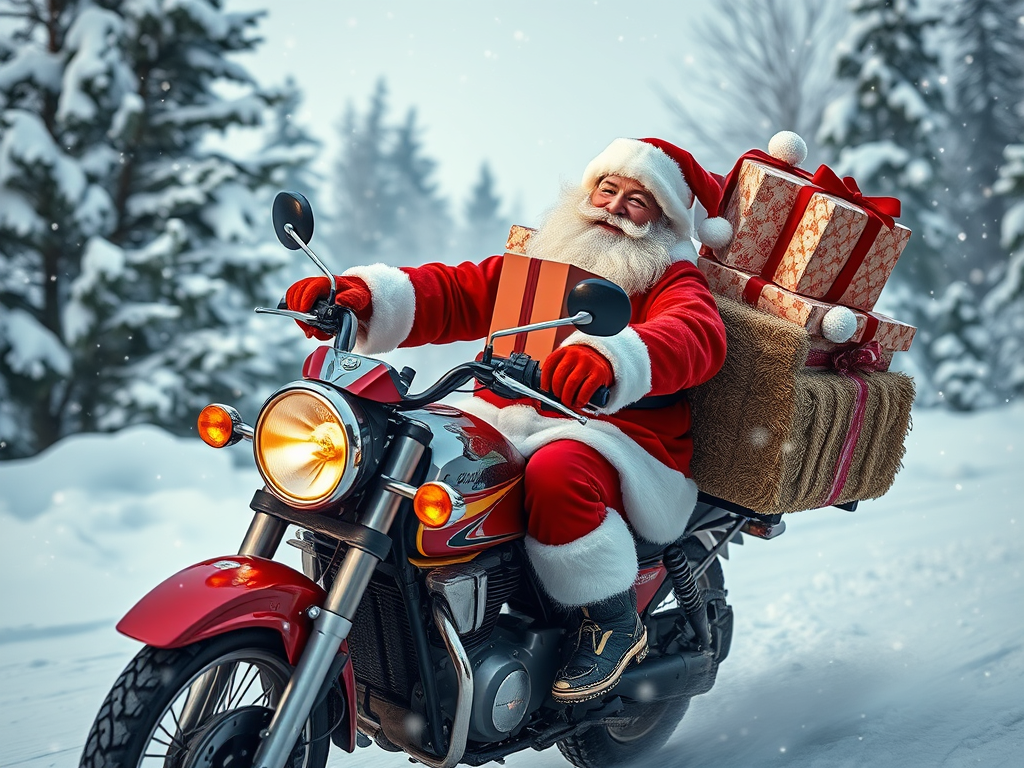
The Wish List, 2024

As I tell my students, sometimes less is more.

This Christmas I ask for only one thing: that my students stop cheating using AI. It gobbles up my time preparing for the meetings and zaps my morale when they deny it all the way through the appeal process.

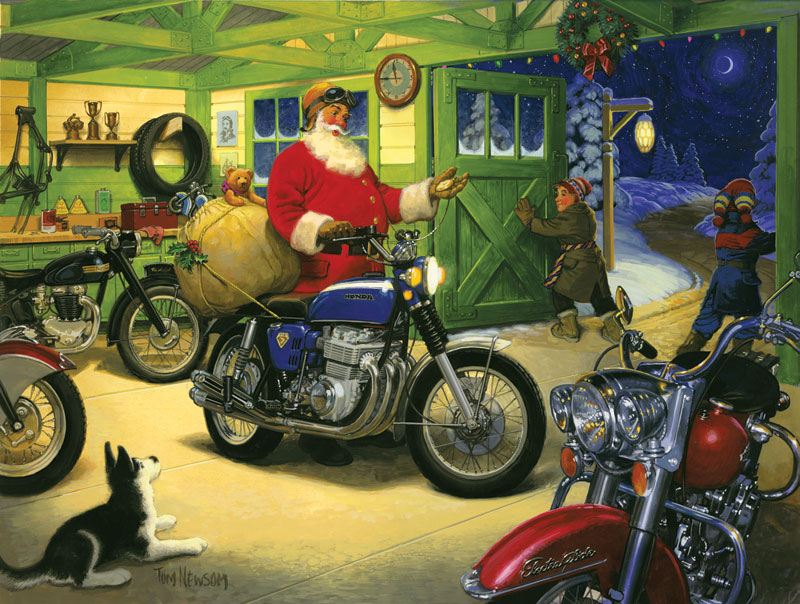
Accordingly, I’ve begun this post with an AI-generated image. Whatever generator WordPress uses apparently doesn’t know what an adventure motorcycle is, just as ChatGPT doesn’t really know how to write an insightful analysis of a short story. In both cases—looking at the photo and the essay—it’s pretty obvious they’re fake. What is that square thing on Santa’s lap? Is it supposed to be a present, and if so, why is it on his lap when he’s got all that room on the . . . hay bale? And somebody needs to tell Santa that Sorels don’t provide much foot protection when he lowsides in the snow.

We live in a world where the real and the natural occupy an increasingly small part of our lives. That’s one of the things I love about adventure riding—its ability to help us get away from civilization and screens and the news (and students) and take in, as the saying goes, The Great Outdoors. This year my wish list does not contain mods and accessories for the bike but mostly camping gear. I want to downsize my gear and be more comfortable around camp.

Cookware

If you read my post on motocamping gear, you’ll know that I use an MSR Dragonfly stove and a Zebra 3L stainless steel Billy pot as my motocamping kitchen. This is the same gear I use canoe-camping, but now I’m ready to go even smaller. When I’m canoe-camping, it’s usually with my son and, uh, we’re in a canoe, where there’s lots of space, and weight is only an issue on the portages, but when I’m adventure touring, I’m usually on my own and less is more, so to speak. Space in the panniers is at a premium, and I feel every extra pound on the bike.

For this reason, I’ve decided to get the 9-piece Odoland Camping Cookware set.

No affiliate links, no sponsorship.

I came upon this little unit via Adam Riemann’s video on his gear. I’ll probably leave the cup and fold-out base at home, and I’ll probably substitute the folding cutlery for real stuff. I’m not that minimalist. (While I’m trying to reduce weight, I won’t be cutting my toothbrush in half anytime soon.) This kit will cut down my cooking gear considerably.

It means switching from liquid fuel to butane, which I never thought I’d do. Liquid fuel has a lot going for it: no canisters to buy or dispose of, the ability to refill at any gas station, and as an emergency supply for the bike. But the Dragonfly is loud and slow. You can get a Dragon Tamer by BernieDawg, but at 82€, that’s almost the price of the stove, and it doesn’t seem to speed it up, just silence it. An 8 oz cylinder fits nicely inside the Odoland pot with room for the burner on top, so it’s very compact. I like Adam’s suggestion of wrapping the canister in a goggle bag to provide some padding. The entire kit is, incredibly, only $38 Canadian, so I hope at that price it isn’t, in the immortal words of my late mom, “cheap and nasty.” ADV touring is hard on gear, so it has to be tough.

Whether I take a separate frypan and plate remains to be decided. Maybe I’ll go hardcore and try to get by just with this.

Ditch the Tent and Mattress

Speaking of hardcore, I’m seriously thinking of switching to a hammock system for sleeping. I was talking to my brother-in-law about a canoe camp he did north of Lake Superior—5 nights using a hammock—and he swears by it now. He strung up a tarp overhead, just in case of rain.

This would allow me to leave behind my tent and mattress, which together weigh 7 lbs. More importantly, my tent doesn’t fit in a side bag, so I have to strap it on top lengthwise or across my tail rack in a duffle bag. I’d love, I say love, to be able to do without a duffle bag up high on the back. (BTW, I’m ditching the tank bag too.) With weight down low in the panniers and only a few small bags with tools and tubes up front, the bike would be a lean mean machine, helping me to do the kind of riding I want to do, especially now that the Tiger’s suspension’s been upgraded. It’s not quite a rackless system, but something resembling it.

I’ve slept in a hammock before and froze my butt off. Okay, it was at Yukon River Campground, so not the best place to try. One of the issues with hammock camping is that the down in your sleeping back gets compressed underneath you, and you don’t have the insulation of a mattress to keep you warm. You can get a hammock quilt and string that up underneath, but they are heavy and bulky, so you lose any savings gained in weight and space.
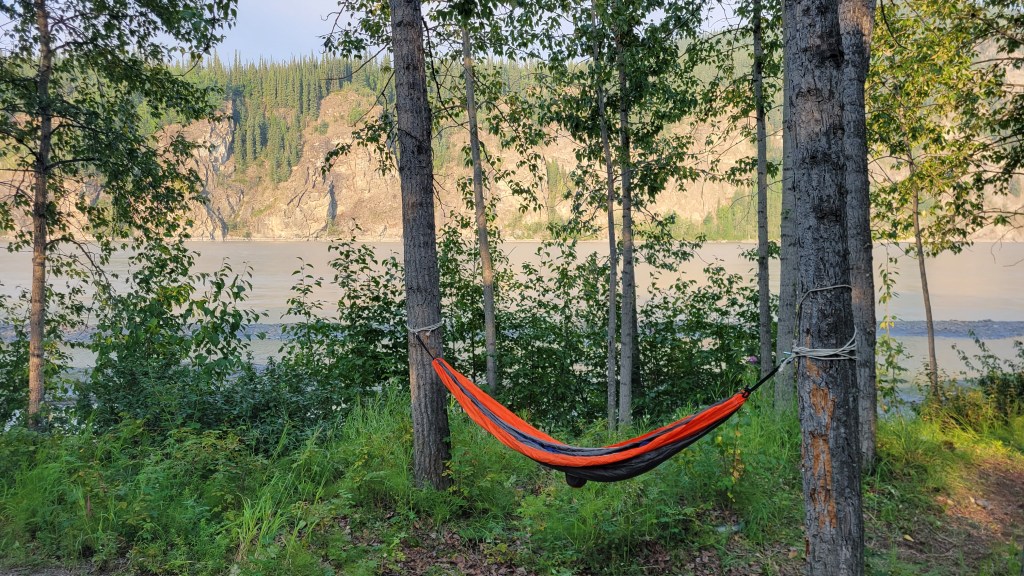
Yukon River Campground

My other concern is that there may not always be two trees to string the hammock. I’ve been at sites before where this was the case, and I’m imagining, say, being out at a campground on the Outer Banks— basically a sand bar on the eastern seaboard of North Carolina—where they’re aren’t any trees. Would I be able to sleep on the ground and string a tarp off the bike in case it rains? What about bugs? Night visits? Privacy? You don’t see any RTW riders using a hammock.

Well, there’s only one way to find out. After some initial research, the SunYear hammock is on my wish list.
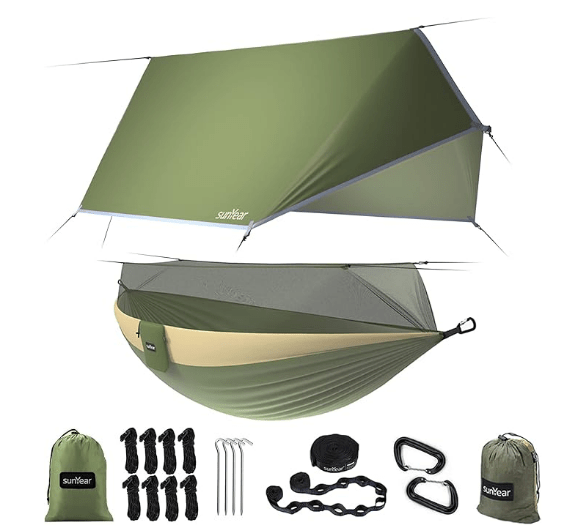
The SunYear is made of parachute nylon, and if someone is trusting it from ten thousand feet, I’ll trust it from 2 or 3. As you can see, it comes complete with a bug net and a tarp. A nice feature is the triangular shape of the tarp for some privacy, not that I care.

But before I go investing in a new set-up that costs about the same as a new tent, I’ll try a shorter trip using my existing hammock and see how it works. Alternatively, I could just buy a separate bug net and tarp if that works out. And for stringing it, I’m thinking I’ll carry a couple of ratcheting straps for bike recovery (a lesson learned from my last trip to Vermont) and they will work just fine to anchor the hammock without damaging the trees.

What do you think? Am I crazy? Have you tried hammock camping? How did you find it? Great recent development in camping gear or latest fad? Leave a comment below.

Shelter

Without a tent, a reliable tarp is all the more essential for rainy days around camp. When Riley and I had rain in Vermont last August, we strung his tarp up over the picnic table and were happy.

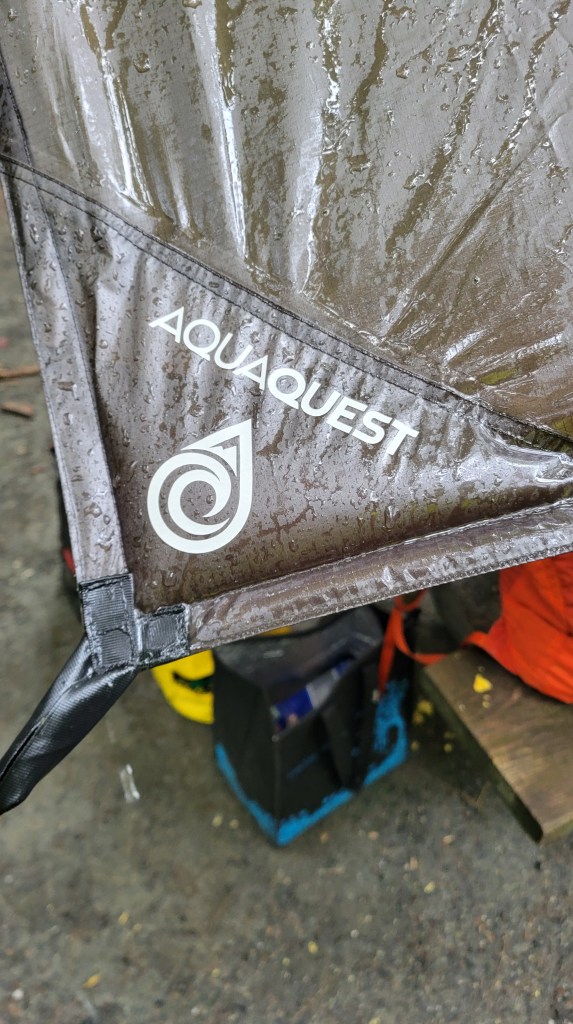
I was so impressed with his tarp that I took a picture of the logo. I later looked it up online and nearly shit my pants. I didn’t know that a tarp can cost $260. I usually get mine from the dollar store. Okay, they smell of plastic off-gassing and are as loud as my Dragonfly stove, so I’m ready to upgrade. When it’s your home away from home, a reliable tarp is worth its weight in gold. A good one will also pack up small.

I haven’t decided on the size yet, but I’ll want something big enough to shelter from driving rain. The only question is: Aquaquest or cheap Chinese rip-off?
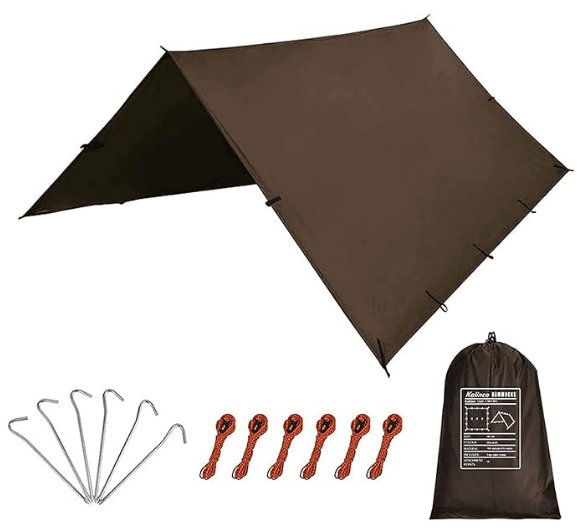
$200 for the Aquaquest 10’x13′ or $53.99 for the best-selling Kalinco 10’x15′?

A new lid

Two items that never made it off my wish list last year are a new helmet and shorty levers. I’ve had the same Arai Signet-Q since I started riding in 2015. Don’t tell the cops. You’re supposed to change it every 5 years by law. That means I really should either get a new one or move to New Hampshire.

Last year, I was looking at the Arai Tour-X5. Arai make arguably the safest helmets on the market, but as every Harley rider in a skid lid will tell you, safety is over-rated. More importantly, there’s fashion. But seriously, other factors include comfort, weight, ventilation, and a big one for me, wind noise.

The Arai Tour-X5. Sadly, still on The Wish List.

Recently I was intrigued by what Chris (Chap in a Cap) at MotoLegends was saying about flip helmets. He argues that modular helmets should be considered the true adventure helmet, and the only reason most ADV riders have a helmet with a peak is for fashion. “Get over yourself,” he says elsewhere.

One thing I didn’t know is that, according to Chris, a flip helmet is the quietest type of helmet, even quieter than a full face. I thought that the hinge system created some wind noise, but perhaps that was just the case with the early modular helmets. It’s not just the absence of the peak that makes it quiet but also because the neck opening is smaller. With a flip helmet, you naturally lift the chin bar to put it on, so the neck opening can be smaller and less wind enters the helmet from underneath.

I’m sold. I have to admit, I’m interested in the idea of having the quietest helmet possible. As some of my readers know, I’m completely deaf in one ear so have to protect what’s left of the other one, and even with earplugs, which I always wear, the wind noise can be loud on the highway with a bad helmet like my LS2 Pioneer.

Champion Helmets, who do the most comprehensive and reliable testing in the industry, in my opinion, put the HJC RPHA-91 not only as the quietest helmet on the market but also the best overall modular helmet of 2025. The Shoei Neotec 3 was a close second. Schuberth helmets don’t fit my intermediate oval noggin, and Arai, well, Michio Arai doesn’t believe in flip helmets. So I think either the HJC RPHA-91 or the Shoei Neotec 3 is in my future.

The HJC is about half the price of the Shoei, but honestly, for something as important as the helmet, it will probably come down to which has the best graphics.

Back to Levers

The other item that never made it off my 2023 Wish List are shorty levers. What I did instead was move the levers perch inward on the handlebar as per another of Reimann’s suggestions, so I was pulling with two fingers but on the end of the OEM levers. This seemed to be the best of both worlds: I could use two fingers but still had the leverage of a full-length lever.

The downside to this set-up, I discovered, is that the front brake master cylinder is part of the lever assembly, and now it’s so far in it’s slightly tipped because the bracket is on the slope of the handlebar. The mirrors are also part of the same unit, so their position is affected. I can see okay, but all things considered, maybe it’s just easier to get shorty levers.

Last year I had the Vortex levers on the wish list. This year, it’s ASV, but don’t be surprised if they, at over $400 a set, are on next year’s list too.
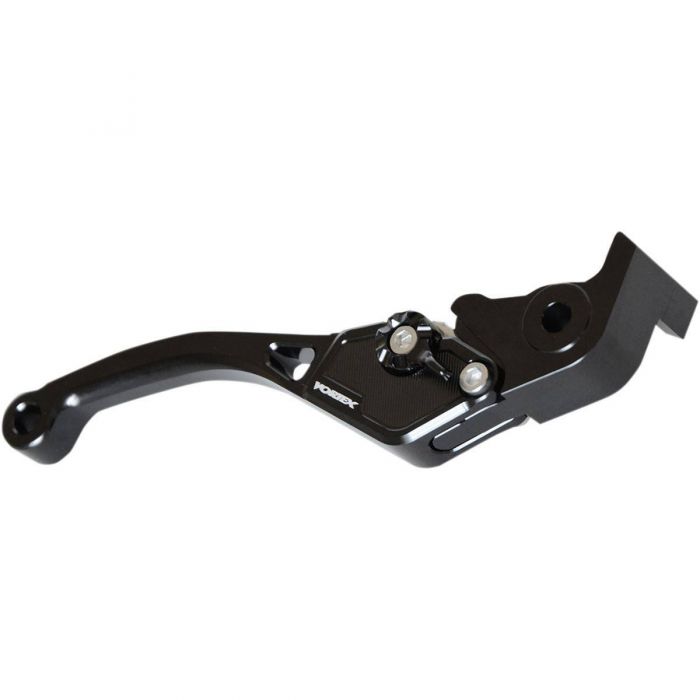
So if you didn’t think I’m crazy for giving up my tent, you probably do now. What can make someone pay that kind of money for levers, especially when you can get cheap Chinese ones on Amazon or eBay for $35? Probably the same thing that would compel someone to pay $260 for a tarp. It’s the quality of the product, and in this world, you usually get what you pay for, despite proclamations of cheapos to the contrary.

Aside from being unbreakable with an unconditional 5-year crash damage guarantee, the ASV levers apparently have excellent feel, if you believe comments on forums. That’s a result of the pivot that has precision-sealed bearings, the only lever on the market for my bike with a bearing pivot. ASV also have a micro-indexing adjuster with 180 increments, so you can literally dial in each lever to your exact preference. The C-series have a matte finish and cost a little more than the polished finish of the F-series.

I really don’t know if I’ll get these, but it’s nice to dream. Isn’t that the purpose of a wish list?

One More Thing

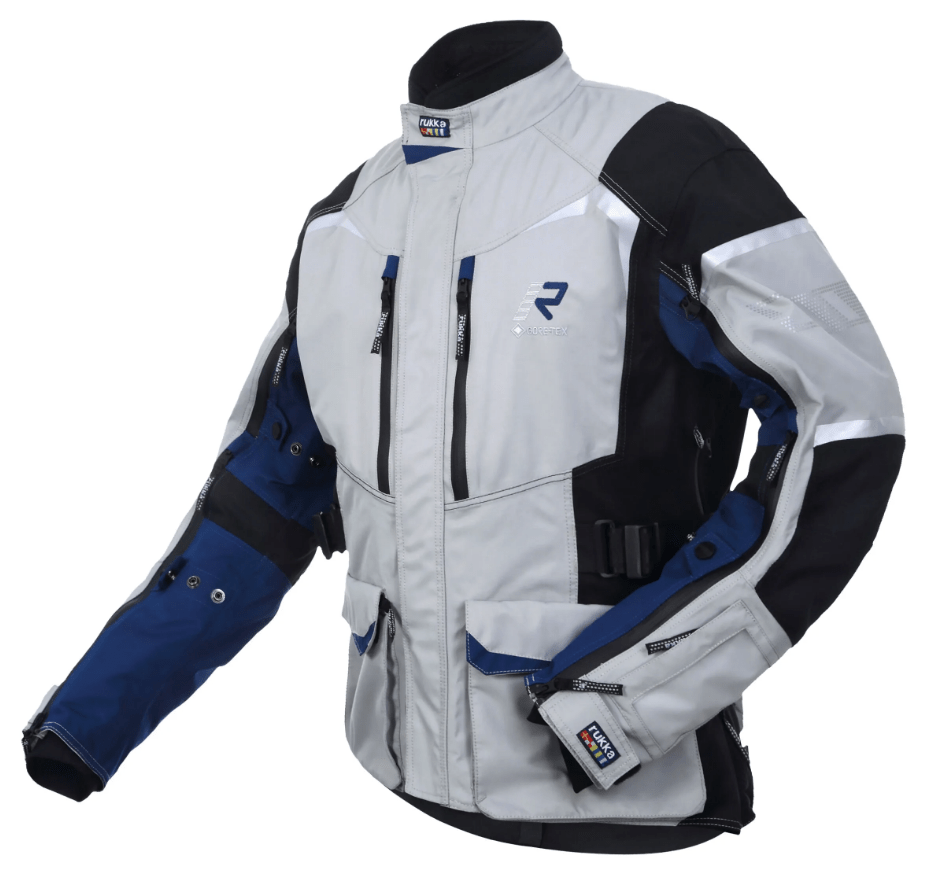
“Oh yeah, one more thing.” That’s what Steve Jobs used to say to introduce the most exciting new Apple product at the very end of his keynotes. I’d love to get a new jacket, one made for cold weather. I’d love to get a Rukka jacket, any Rukka jacket, but preferably one with a down-filled liner. I’m tired of freezing on early- and late-season rides.

My warmest jacket is the one I bought off eBay for $55 US when I started riding. It’s a Joe Rocket with textile front and back and leather arms and shoulders. It’s my warmest jacket because it has a quilted liner. My other two jackets are hot weather: the Klim Marrakesh, which is mesh, and the Traverse, which is a Gore-Tex liner.

Again, the option here is premium or budget-friendly. I’ve been hearing a lot about the MSR Xplorer jacket from Rocky Mountain ADV and it might work with some good heated gear inside.
One of the most viewed posts on this blog is the one on how to make your own heated jacket for under $50, and it’s a good option for commuting. However, the cheap Chinese controller is fragile and doesn’t hold up to the demands of adventure riding. I’ve already broken and fixed it a few times. The other thing I don’t like about the jacket is that it’s a rather thick, puffy jacket, that doesn’t pack well, so it’s either the homemade heated jacket or a wool sweater, but not both, and for around the fire, I’ll take wool any day.

My friend Riley of The Awesome Players posted a video of a late-season ride he did on which he was wearing a Warm and Safe Heated Jacket. He later texted me that he also has the baselayer, and so I looked into it.
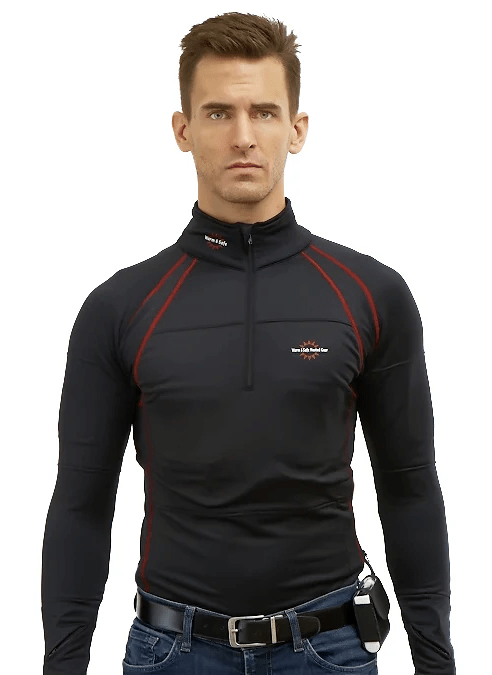
Warm and Safe Heat Layer Shirt

I like the idea of a base layer. It just makes sense to have the heat next to your skin instead of having to penetrate layers of thermal clothing first. Other people like the flexibility of having a light heated layer that you can easily remove if it warms up.

The company has over 25 years of experience and R&D. Each product connects to a heat troller that controls the heat. Instead of just three settings like with the controller on the Chinese-made pads, the W&S troller has a dial, so there’s a lot more variability. Okay, Warm and Safe don’t win the award for the most imaginative naming, but some of their gear also make it onto The List.

Conclusion

Well that list ended up being longer than I anticipated. As the instructor of my motorcycle course said first night, “This sport is harder on your wallet than an ex-wife.” Thankfully, my marriage is still strong, although would be considerably weaker if Santa fulfilled all my wishes.

And as I usually do at the end of these fun Christmas-themed blogs, I have mixed feelings about being so materialistic when wars are continuing in other parts of the world and some people lack heat, food, shelter—the basic materials of life. I don’t feel I can do much or anything about that, but I can help those closer at home in need. This year, Marilyn and I have decided to give a significant donation to a food bank. It will be a drop in the bucket, but it will be our drop, and I hope it provides a little relief to someone in greater need than me. With inflation and current food prices, the need is greater than ever.

The Wish List posts come at the perfect time of year, just after the bike is pulled off the road for four months by law here in Quebec. They help me though the transition to no riding by thinking of the rides being planned for next season and the gear that will make them all the more enjoyable. I’m still planning to do the tour that has been postponed now for two seasons—down the Blue Ridge Parkway into West Virginia, maybe over to the The Outer Banks, and back up via the MABDR and NEBDR.

What are your plans for next season? Drop a comment below and don’t feel they have to be anything as ambitious as mine. I’m always interested in hearing from my readers.

Merry Christmas and Happy Hanukkah to all my readers, and safe riding in 2025.

2013 Triumph Tiger 800XC Long Term Review

Spirited on road, capable off road, the Tiger 800XC is a great all-round middle-weight bike.

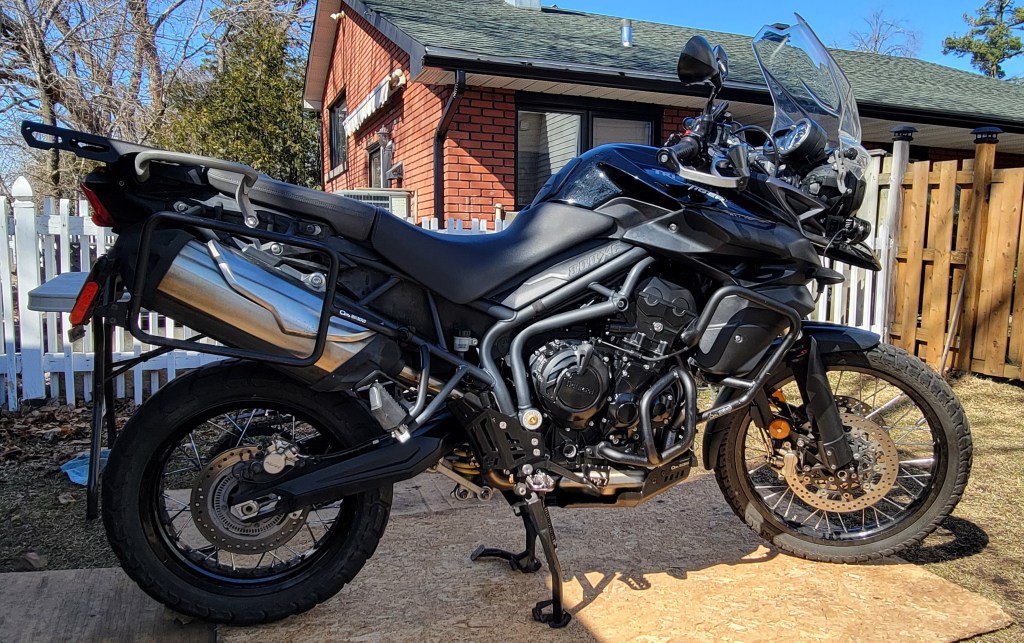
My review of the 650GS has been the most viewed page on this blog for years, so I thought I’d write one on the Tiger, which I’ve had now for three full seasons and over 45,000K. These are both old bikes, so I know most people reading the reviews already own the bike and want to see if they’ve made a mistake. You have not. Well, as always, it depends on the type of riding you do. But if you’re looking for a long-distance ADV touring bike, the Triumph Tiger 800XC is a good choice.

But I’m getting ahead of myself. As I did before, I’ll break down the review into components.

Engine

The heart of any bike is the engine and the Tiger’s is a gem. When I pulled into my driveway on the GS at the end of my 2021 cross-country trip, I knew I wanted a smoother bike. The big thumper got me to the Pacific Ocean and the Arctic Circle and back, but it wasn’t very comfortable, especially on those highway miles. When I test rode the Tiger, I knew I would buy it even before I was around the block; I couldn’t believe what I was feeling. This engine is SMOOOTH! I’d go as far as to say it’s the bike’s defining characteristic. This is the 800, so before Triumph moved to the T-plane crank and off-set firing order, so it’s about as smooth as a triple can be. If you’re coming from the nuts-numbing world of a big thumper, the inline triple with a 120 degree crank is a world apart and exactly what I was looking for.

Aside from being smooth, this engine has a ton of character. It has comparable torque to its rival, the BMW F800 GS (58 ft.lb @ 7850 rpm vs. 59 ft.lb @ 5750 respectively), but gets that torque much higher in the rev range. And it likes to rev! It spins up fast, so even pulling away from a stop light you find yourself pulled involuntarily into The Giggle Zone. Yet despite that high peak rpm, the torque on the Tiger is incredibly linear.

photo credit:// ADVMoto. 1st Gen Tiger 800 dyno results. Note the linear (flat) torque “curve” above 3000 rpm.

The gearbox is also smooth, both upshifting and downshifting. It’s so smooth, someone I swapped bikes with once asked if it has a slipper clutch. The high-revs, the smoothness of both engine and gearbox, combined with a wonderfully guttural exhaust note make the Tiger 800 a really fun bike to ride. It feels like Triumph has shoe-horned a sport bike engine into an adventure chassis, which I guess they have since the engine comes from the 660 Sport. I’m not afraid of the dirt but, to be honest, most of my adventure touring is on asphalt, and the Tiger makes crunching those miles enjoyable.

Where the engine does come up short is in slow-speed technical riding, a downside the T-plane crank of its successor, the Tiger 900, attempts to address. The 800 is happy when revved, but is prone to stalling at slow speed, especially in sticky mud or over obstacles—anything that requires careful clutch work in 1st gear. It has no tractor-factor, so if you like ATV and snowmobile trails, single-track and getting out into the woods, the Tiger is probably not for you. It can do it, but you have to keep the revs up and feather the clutch a lot, which can be tiring on your hand and the clutch.

Handling

The XC model I have has a 21″ front and a 17″ rear wheel—an unusual combination in the ADV world where an 18″ rear is the norm. Perhaps Triumph did that to compensate for the nose-heavy geometry of the big triple compared to a parallel twin. (It still has a stink bug stance.) They’ve also increased the rake on the front forks beyond the competitors’ to 23.9˚ (compare with 26˚ for the BMW 800). What this weird-ass geometry does is make the 21″ front wheel surprisingly easy to turn in yet planted through corners. For an ADV bike, the Tiger is surprisingly agile and confidence-inspiring through the twisties. That’s when it’s in its element, whether on asphalt, gravel, or dirt.

Lanark County Trail System on 70/30 tires.

The cost is a tendency for the front end to tuck in mud or sand, especially if you forget to steer with the pegs. My crash this past August was a direct result of that happening on a muddy downhill corner, although I think balance of the bike front to back was also a factor. (I was under sag.)

Front-end tuck on the Bailey-Hazen hero section.

The Tiger is also a little top heavy, despite its flat horseshoe-shaped gas tank. That’s probably a result of the tall and wide engine. (To get the 660cc Sport engine to 800, Triumph lengthened rather than widened the bore.) You don’t feel it once the bike is rolling, but again, it’s another characteristic that makes the Tiger a challenge off-roading at slow speed. What all this means is that if you want to ride hero sections on the Tiger, you’d better have skills.

Triumph says that the Tiger is for “light off-roading” and they don’t lie. The engine and balance of this bike are designed for 2nd gear and up. But the biggest indicator that this bike is not for serious off-roading is the placement of the spark plugs and air filter, both of which are under the tank. If you’re doing water crossings—and what serious off-roader isn’t—you’d better not swamp the bike or you’re going to be removing bodywork and lifting the tank trailside. Been there, done that. It’s not much fun. To lift the tank, you need first to remove the beak, radiator side panels, indicator panels, and trim. I’ve done this perhaps a dozen times now and have the whole process down to about 20 minutes. Needless to say, for an ADV bike, this is a major design flaw, or at least a serious limitation.

Suspension

The Showa suspension on the XC is a step up from the XR version. Rear travel is 215mm and front is 240mm. That’s more than what I’ll need because I’m not blasting down rocky trails as much as trying to thread my way through them. (The 650GS, for comparison, has 165mm rear and 170 front.) With the Outback Motortek skidplate, ground clearance on mine is about 9 1/4″ or 235mm. The shock has hydraulic preload and rebound adjustment. The forks are a beefy 45mm but with no adjustment. That’s a fairly basic system, but again, sufficient for ADV touring.

Like most ADV bikes off the production line, the Tiger 800 is set up for road use. The suspension is soft and cushy, making a plush ride around town (and during test rides, I should add). But if you want to use this bike for how it’s intended—ADV touring (the XC stands for cross country)—you’re going to have to stiffen the suspension.

The OEM shock has a spring rate of 9.7 kg/mm which, surprisingly, gives me a static sag of 18% (40mm). This means that under its own weight on the OEM spring, the bike is under sag. Rider sag for me is 35%, even with preload fully wound. (Note to newbies: static sag is unloaded with no rider and should be 10%; rider sag is loaded with rider and should be 30%.) At 150 lbs (177 in all my gear), I’m not a big guy, and with about 66 lbs of luggage (56 on the back, 10 on the front), I don’t think I’m overloaded, although I’ll be working over the off season to reduce that weight. Nevertheless, it’s clear to me that the OEM spring on the shock is too soft for anything but solo street riding.

I recently upgraded the suspension and will publish a separate post on that topic, so click Follow if you’re interested in what I’ve done.

Ergonomics and Comfort

The ergonomics on the Tiger are generally comfortable whether you are seated or standing. The wide handlebars are what you’d expect and want on a bike designed for the dirt, yet they don’t feel like ape-hangers when seated either. I haven’t added any bar risers because the bar mounts are already high, and when I stand the bars fall to the right place when I’m in the correct body position with hips slightly bent. (Most people who add risers are seeking comfort while standing erect.)

One unusual feature of the bike’s ergos is the distinct sensation of the fuel tank between your, uh, thighs. It was something I immediately noticed on that brief test ride and something others have commented on when we’ve swapped bikes. The tank is wide, and it forces your knees apart. (No bad jokes here). I find it actually reminds me to squeeze the bike, which is good practice whether riding on and especially off road.

The seat is generally comfortable for long days, although when touring I add a sheepskin pad to improve comfort and airflow. Triumph sell a comfort seat for this bike but I haven’t needed it. Similarly, Marilyn hasn’t complained about the seat on the back. The 1st generation Tigers do not have a heated seat option but subsequent ones do.

My knees sometimes complain over long days but I’m pretty long-legged, so they are bent slightly more than 90˚. I put my Fastway pegs in the low position and the adjustable seat in the high position and this set-up has been pretty good. With the bike now sitting even higher, I’m anticipating improved comfort for my ageing knees. In the raised position, seat height is 34.5″ or 885mm, which is comparable to its BMW competitor.

My biggest complaint about comfort is in the area of wind management. I’ll be doing a separate post on my search for a solution, but let me say here that the OEM windscreens for the Tiger suck! The stock screen is notorious, and the touring screen is little better. Maybe it’s too much to ask of a screen to allow airflow at slow speed when off-roading and a quiet ride at speed on the highway. The best solution I’ve found is the touring screen with a cheap clip-on wind deflector, which helps with the wind but ruins both the lines of the bike and video footage from my chin-mounted camera. Oh well.

Aesthetics

Canadian poet Robert Bringhurst has a collection titled The Beauty of the Weapons and I think the Tiger is a beautiful weapon, especially the all black model. I get a lot of compliments on the bike, even from other riders. You can see in the neoclassic bikes like the new Bonnevilles that Triumph pays a lot of attention to how a bike looks, and they’ve done a great job with the Tiger. Okay, you may say they’ve copied their competitor with the beak, but I think a bike without one looks weird. There are a lot of complimentary parallel angular lines on the bike that thankfully Outback Motortek has followed. Aesthetics is something not everyone is into, but I want a bike that makes me turn around and look at it as I walk away in the parking lot, and the Tiger does that.

Reliability

There are a few known issues with this bike, not surprising given that it’s a first generation model. The shifting mechanism is known to fail, and mine did, but not in the expected way of the return spring or the pin for the return spring breaking. No, it was the selector arm that failed at about 45,000K, so while I was in there behind the clutch, I decided to replace not only the selector arm but also the problematic spindle, the return spring, and the detent wheel, all of which have been redesigned. You can read about that work here. The bike also let me down once in the bush during a water crossing when somehow about 3-4L of water got in the tank. I still think the only viable theory is that water got sucked up through the tank breather tube and I’ve since redesigned the tube to avoid this happening again.

The other known issue with this bike is the starter motor. There are many accounts of it failing to restart the bike when the engine is hot. It was fine for me the first two years but then started to act up and got progressively worse. I’ll be doing a separate blog post on that too, but I’ll let the cat out of the bag here and say the problem was, at least in part, a dirty main ground on top of the engine block that was causing a voltage drop. If you have the dreaded starter motor issue on your Tiger, clean the main ground and contacts on the starter relay before changing the starter or battery.

That’s it. Clutch, stator, voltage rectifier, water pump, oil pump—all good—and no issues with any of the electronics. That’s not bad, in my opinion, for a bike with over 60,000K on it.

I adjusted the exhaust valves at 45,000K; the intakes were perfect but all the exhausts were tight. There are some reports of the engines, particularly on the 2nd gen Tigers, to start burning significant oil at about that mileage, but thankfully that has not been the case with mine. It burns a little oil now, particularly at high-revs on the highway, but nothing significant. I’ll come back from a tour of a few thousand kilometers and top up maybe 200mL. I’ve been using Castrol Power 1 4T and, more recently, Motul 7100, but when I mentioned my oil consumption to my dealer, he said they put Motul 300V in all the “high-revving bikes.” I thought it was only for racing bikes, but henceforth that’s what will be going in this bike.

I like that the 2011-14 Tigers are still relatively simple and easy to service on my own. There’s no ride-by-wire and rider modes or complicated electronics that require a computer to diagnose and repair, although I wish turning off ABS were easier than navigating menus. The 1st Gen Tigers that ran 2011-14 are at the tail end of an era before things got pretty complicated electronically. Build quality and fit-and-finish are excellent, and the bike is looking as good as new with no rust or corrosion on it anywhere, despite its age.

Summary

Pros

  • Fun, spirited engine
  • Smooth gearbox
  • Agile and planted through corners
  • Comfortable seat and ergonomics
  • Good looks
  • Aside from a few early-model issues, generally reliable
  • Relatively easy to service

Cons

  • No tractor-factor; stalls easily in 1st gear
  • A little top heavy
  • A tendency for the front end to tuck in low-traction terrain
  • Poor wind management
  • Shifting mechanism weak
  • Some reports of starter issues with OEM starter
  • Plugs and airbox under the tank
  • Vulnerability in water if the tank is rapidly cooled

Looking at the length of those two lists, you’d think I’m not happy with the bike, but I am. That’s because the main elements of the bike are good—the engine, the handling, the reliability. The bike has a few issues, like any bike, but they are overshadowed but just how much fun it is to ride, and isn’t that the main thing we want in a bike?

Conclusion

When I participated in La Classique Moto Fest here in Quebec a few years ago, I saw my bike in a long line of other bikes there for the rally. Maybe it was my subjective perspective, but it seemed slightly out of place. It occurred to me that most of the bikes there were set up for off-road riding whereas the Tiger, at least my Tiger, is more an adventure bike, and I was reminded of a comment made years ago on the ARR Raw podcast about this distinction. (I’ll link to the podcast but can’t remember the specific episode.) They were talking about tire choice, if I remember correctly, and one of the guests made the distinction between what they do as RTW riders and what weekend warriors do. He said he’d never attempt half the stuff some guys do off road because, when you’re touring halfway around the world, you can’t afford to break something on your bike and wait weeks, perhaps longer, for parts to arrive. In other words, they ride more conservatively, and that was reflected in his tire choice. I’ll add that it’s also reflected in your bike choice.

Off-road versus adventure bikes. An arbitrary distinction?

As we all know, the adventure bike is the ultimate compromise. It has to be good on road and off road, capable of crunching out miles on the highway as well as getting you down a logging road. It has to be quiet and comfortable for long days in the saddle, powerful enough to climb mountains and carry camping gear, maybe a pillion, yet small and light enough to pick up on your own in the middle of so-called nowhere. It has to be reliable, and simple enough to fix yourself, trailside if necessary, if something does break. With these considerations in mind, the middleweight Triumph Tiger 800XC is a great all-rounder and an excellent choice as a long-distance ADV touring bike. It has its drawbacks, for sure, and may be master of none, but it’s the best Jack of all trades I’ve been able to find.

Walkaround of the mods I’ve done on the bike.

The Major Service

Getting ready for the new season this year meant a little more than adding a few farkles.

When I bought my 2013 Triumph Tiger 800XC in May 2022, it had only 14,500 kilometres on it, despite being nine years old. In the following two years, I’ve put another 34,000 on it. I’ve done basic service during that time, like changing the oil, coolant, brake fluid, and cleaning the air filter. I’ve also changed the plugs. But it was time for some major service.

Last fall I did the dreaded valves, swingarm and rear suspension bearings, and cleaned the starter motor. This spring I’ve fixed a problem with the shifting mechanism, cleaned and lubed the steering head bearings, overhauled the front forks, and made a few mods to get it ready for the BDRs. It’s been a long process, but it’s finally ready for the new season.

Valves

It’s the job everyone loves to avoid, and I did too. In fact, when I bought the bike, the dealer said they no longer recommend checking the valves at the manufacturer’s recommended 20,000K because, more often than not, when they get in there at that mileage, the valves are fine. I guess if you’re paying the dealer $1000+ to check them, it’s bittersweet when they don’t find anything out of spec. I was happy to wait. My buddy who rides a Triumph Scramber 1200 XE has never checked his and he’s got I think now over 78,000K on it. “If they’re slappy, they’re happy,” he said, although I always thought you don’t want to hear the valves. At any rate, with now over 48,000 kilometres on the Tiger, it was time to get in there and see how happy they are.

All the intakes were fine, but all the exhausts were tight, some significantly. Here are my calculations. Sorry about the grease.

Highlighted is the amount out of spec. I’m using metric.

As you can see, all the intakes were spot on at 0.15 (specs are 0.10 – 0.20). The exhaust specs are 0.325 – 0.375, so ideally you want them at 0.35. Some of mine were 0.20, so .15mm out of spec. I’m glad I didn’t wait any longer or I might have started causing damage to the valve seat. Live and learn: sometimes there’s reason behind the manufacturer’s recommendations.
An egg carton works well for keeping all the buckets and shims organized.

You want the same bucket to go back on the original valve, so keep any happy dogs with long tails out of your workspace. Nobody likes removing the cams, but just make sure you’ve got it locked at top dead centre and turn the engine over several times by hand once you get it back together to make sure you didn’t slip a tooth on the timing gear. I almost did because I didn’t put enough tension on the timing chain while torquing down the holder. (You have to remove the tensioner.) So you have to find a suitable wedge of some kind to manually tension the chain while tightening. The first two (2!) times I torqued down the holder the chain climbed a tooth.

Timing marks should line up parallel to the crankcase on the inside.

Thanks to MuddySump for his excellent videos. I was following my Haynes manual, but it’s always good to watch someone else do it first, especially when that person has the same bike as you and is a licensed Triumph mechanic! Once I got everything buttoned back up, I checked the valves again and they are now all spot on.

It’s always a little unnerving starting the bike back up again afterward, but it fired right up. I’m hoping the bike will run a little easier now with less tendency to stall.

Starter Motor

A known issue with the Tiger 800, at least the first gens, is a weak starter motor. There is a tendency when the engine is hot for the starter to fail. I’ve had it happen to me a few times. You stall the bike and the starter is reluctant. I’ve managed to fix it by keying off and on, but it was getting worse. Many guys swap out the starter with Rick’s and I considered it, but since I was already down to the throttle bodies, I figured I’d lift them to access the starter and give it a good clean.

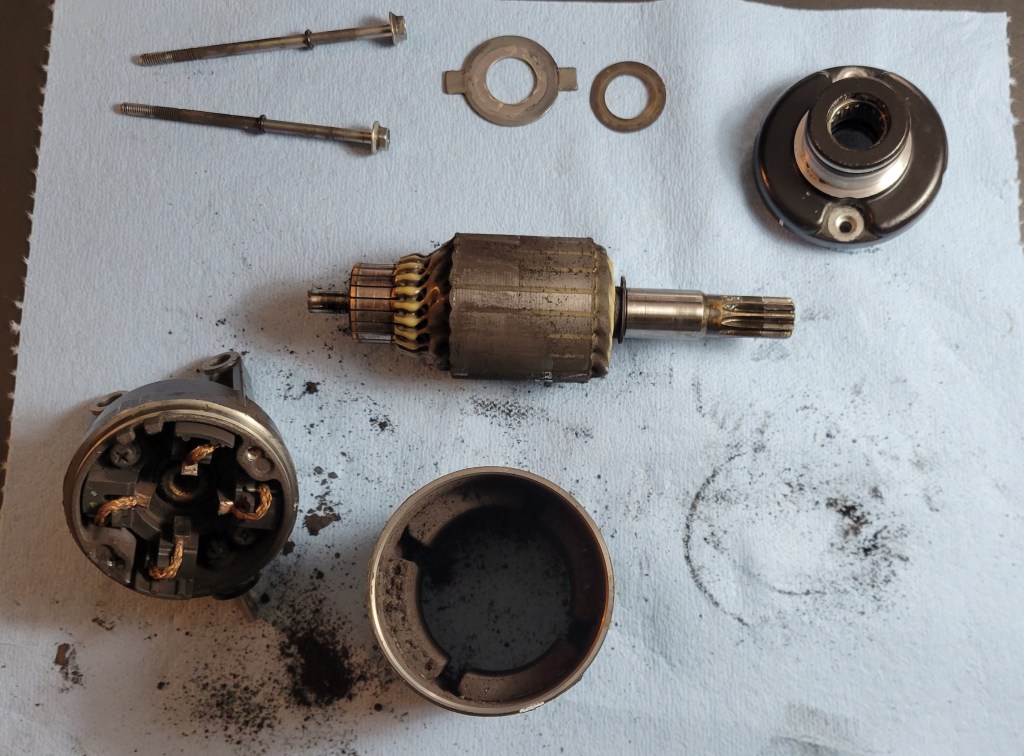
I took it apart and there was a lot of carbon dust in there, and some discolouration on the armature. Some 1000 grit emery paper cleaned everything up, including the shoes. The bearing was fine, and I’m hoping I’ve breathed another few years at least of life back into the OEM starter.

Swingarm and Suspension Linkage

The swingarm bearings take a lot of abuse down there right in front of the rear wheel. Even if you aren’t doing water crossings, they’re going to get water and grit and grime thrown up at them. And when there’s crud or corrosion, you won’t feel it as you will with steering head bearings. I remember when I finally did this job on the 650GS, one of the bearings was in very bad shape and I had a bugger of a time getting the pivot bolt out due to the corrosion. This is one you want to do on the recommended interval, and it’s one of the easier ones so why not? You aren’t opening up the engine, just taking the rear wheel off, unclipping all the wiring from the swingarm, then removing the pivot bolt.

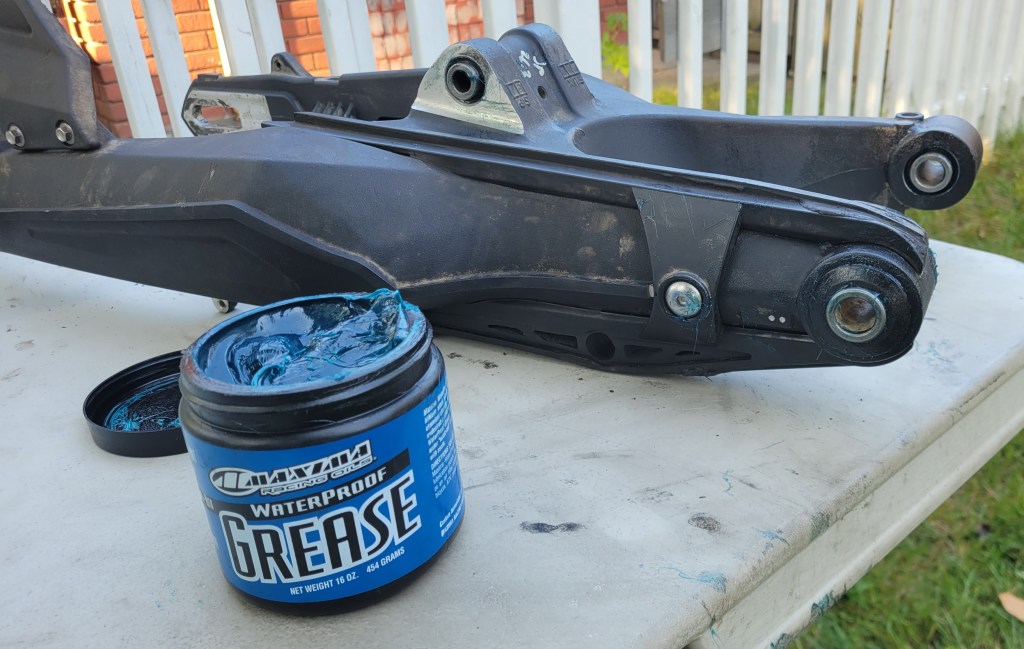
Thankfully, it wasn’t that bad this time, but I still left it a little too long. There was some discolouration on the bushings, but the bearings looked fine, albeit missing some grease. I cleaned everything up as best I could using 1000 grit emery paper and repacked the bearings with waterproof grease.

It’s always a good feeling when you restore these crucial components.

Shifting Mechanism

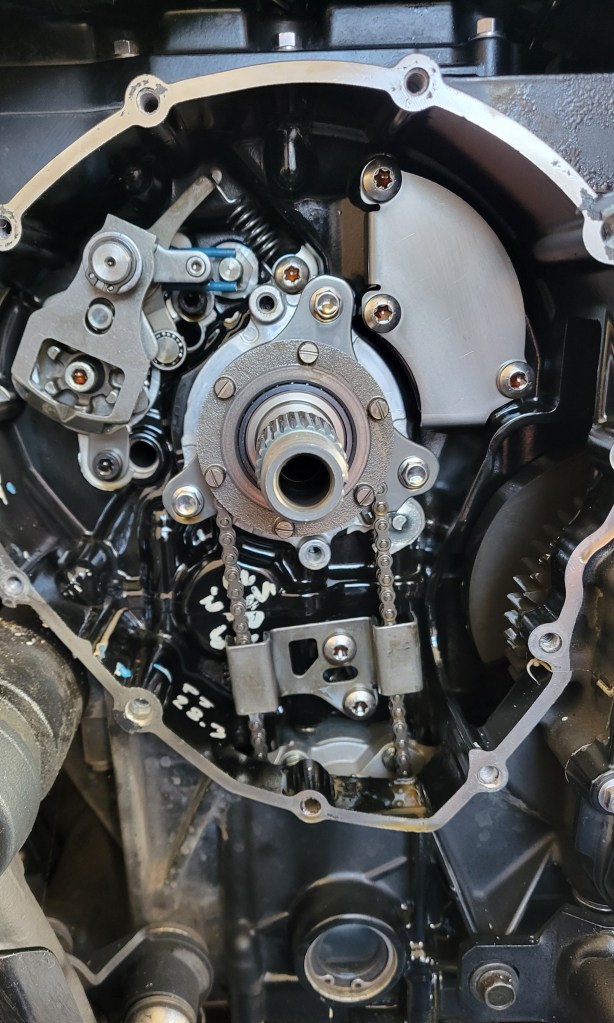
Problematic selector arm is top left. Centralizing spring is blue, indicating it’s been upgraded.

On the last ride of the season last year, the Tiger started being reluctant to downshift. I noticed it as I pulled away from the house and came to the first stop sign. I was heading to Vermont and would have turned around, except I was leading a club ride and there were people counting on me, so I continued.

My first thought was that the clutch cable needed adjustment. It’s normal for those to stretch over time and need to be tightened. But adjustment didn’t help, and as the day continued, the problem got worse. I somehow managed to finish the day, but coming up through Smuggler’s Notch wasn’t much fun and I was happy to get home. That was the final ride of the season. I decided I’d use the remaining nice weather to do maintenance but before I could get to this job the snow arrived, so it had to wait.

I store my bike in an unheated shed, so working on it over the winter wasn’t an option. As you can imagine, my curiosity nagged at me all winter. Was it the clutch, the shifting mechanism, the gearbox? Some research online revealed that there are some known issues with the shifting mechanism on this bike. There’s a pin on the shifter spindle that holds the centralizing spring and it’s known to break. When that happens, the shift lever doesn’t return to centre, ready for the next downshift, but flops down. You can still shift the bike, but you have to lift the lever first with your foot.

That didn’t appear to be my problem because, while there was a little play in the lever, it wasn’t flopping down. But I wondered if it was starting to break. Also, there was a recall to upgrade the centralizing spring, which is known to fail, and I didn’t know if my bike had the old or new spring. I also wondered if the problem was as simple as a worn clutch.

At the first warm day, I finally got in there to see what is happening. To get to the shifting mechanism, you need to remove the clutch. That was fairly straightforward, and the plates looked good. In fact, the stack measures 42.25mm and the tolerances are 41.54 to 42.54, so I’ve only burned .29mm of my clutch over 48,000 kilometres. I’m happy about that.

I had some trouble removing the bushing and bearing but with a friend’s help, we got them and the basket out. What we noticed is that on a downshift, the shifter arm slips off the pins of the detent wheel. A close inspection of the arm revealed wear on the respective pawl.

Wear in the corner of the pawl where it engages with the detent wheel pins. This arm is under tension from a spring (behind, out of view) and it’s also possible that the spring was fatigued.

There has been a redesign on this part as well as the detent wheel that engages with it. I decided to change the whole spindle because Triumph has also redesigned the problematic pin for the centralizing spring. Here are comparisons of the crucial parts, old (on top) versus new.

Dear reader, do you care? If you are a mechanical engineer or just a mechanical nerd like me, maybe you do. If you have a 1st gen Tiger 800, you should. These are the wrinkles that were ironed out sometime during production. I’m glad to have the stronger parts in my bike, and it’s shifting great again. Here in Canada, the spindle unit is under $200 and the detent wheel and selector arm come as a kit for under $100, so the hit wasn’t too bad.

Forks Overhaul

I don’t think the fork oil or seals have ever been changed on this bike. I’d never done inverted forks before. They are a little more difficult and require a seal driver. (You can’t use plumbing ABS pipe to drive the seals because the outer tube is in the way.) Figuring this would not be my last bike, I went with the adjustable kind that will work on a variety of bikes but are a little more trouble to use.

Everything came apart easily enough, once I bought a set of thin spanners. (Every job requires at least one trip to Canadian Tire.) There isn’t much room between the spacer tube and the top cap, and you have to get a wrench in there to hold the lock nut while you remove the cap. That was the only snag on the disassembly.

Laying everything out in the order it came off.

The bushings were discoloured with wear, but I didn’t want to wait for new parts so cleaned them up as best I could with fine grit emery paper. For the new seals, I decided to go with SKF because I’d read good things about them. Thanks to Triple Clamp in Toronto for stocking these. A neat trick I learnt from Tusk is, when using those tricky adjustable fork seal drivers, use safety wire to avoid driving your fingers instead of the seal. Nice!

The only weirdness of this job was that the amount of oil listed in my manual was way off. It said 619mL for the XC and 107mm from the top of the tube, but I had to pour out about 100mL to get the correct height. Yes, I drained all the old oil, and yes, I pumped the damper rod several times to dispel all the air when adding the new. I asked my dealer about this and he said they only use the height measurement. When I tipped the old oil into a measuring beaker, it was about 1L for the two forks, so with loss, 519mL sounds about right. Anyway, fresh oil, seals, and socks will help the front end this summer.

Steering Head Bearings

This one too had never been done. You can see in the image above that there isn’t much of the factory grease left in there. For this one, I didn’t use the waterproof general lithium grease but bearing grease. The only difficult aspect of this job was avoiding paying for the Triumph tool for accessing the head-stock. Instead, I used a C-spanner and Ryan F9’s tip on using a luggage scale to get the correct torque. The initial preload once you get everything back together is 40Nm, then you back it off and tighten the bearings to 10Nm, which is a little over 7ft/lbs. My C-spanner is about a foot long with a hole at the end of the handle, so all I had to do is convert Nm to ft/lbs.

After having the forks and triple-T out, I needed to align everything again. Thankfully, Delboy’s Garage just put out a video on how to do that.

Fuel Tank Breather Tube Fix

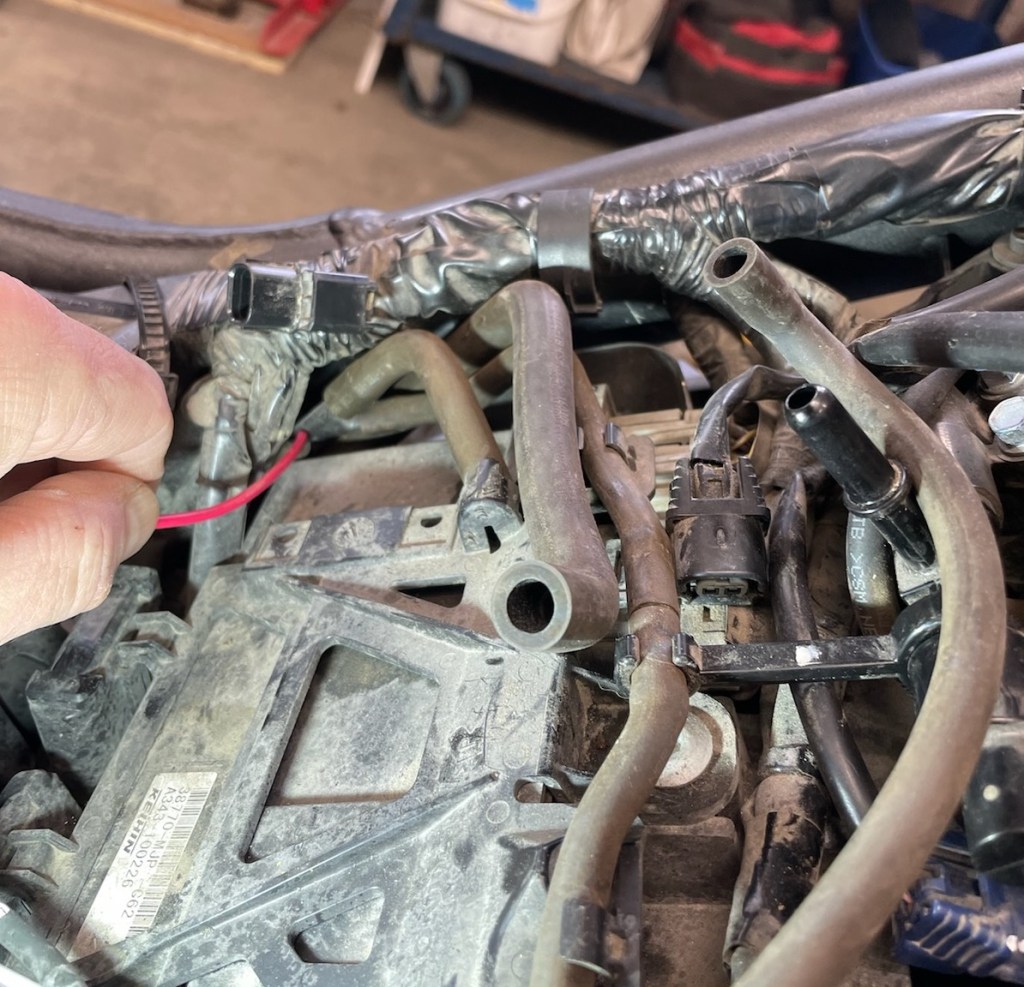
In my last post, I talked about how I ended up with about 3 litres of water in my fuel tank after a failed water crossing. In the post, I presented the theory that the water was sucked up from the tank breather hose when the tank had negative pressure. I considered rerouting the breather tube to keep it out of potential water, but my friend Mike came up with a better solution. While servicing his Africa Twin, he noticed that the tank breather on that bike has a Y-fitting with a length of hose staying high on the bike and the other draining down.

My buddy Mike’s Africa Twin. He’s pointing to the Y-joint with the piece of red wire. The short tube fits into that little cup, presumably to keep it clean. That’s the battery area.

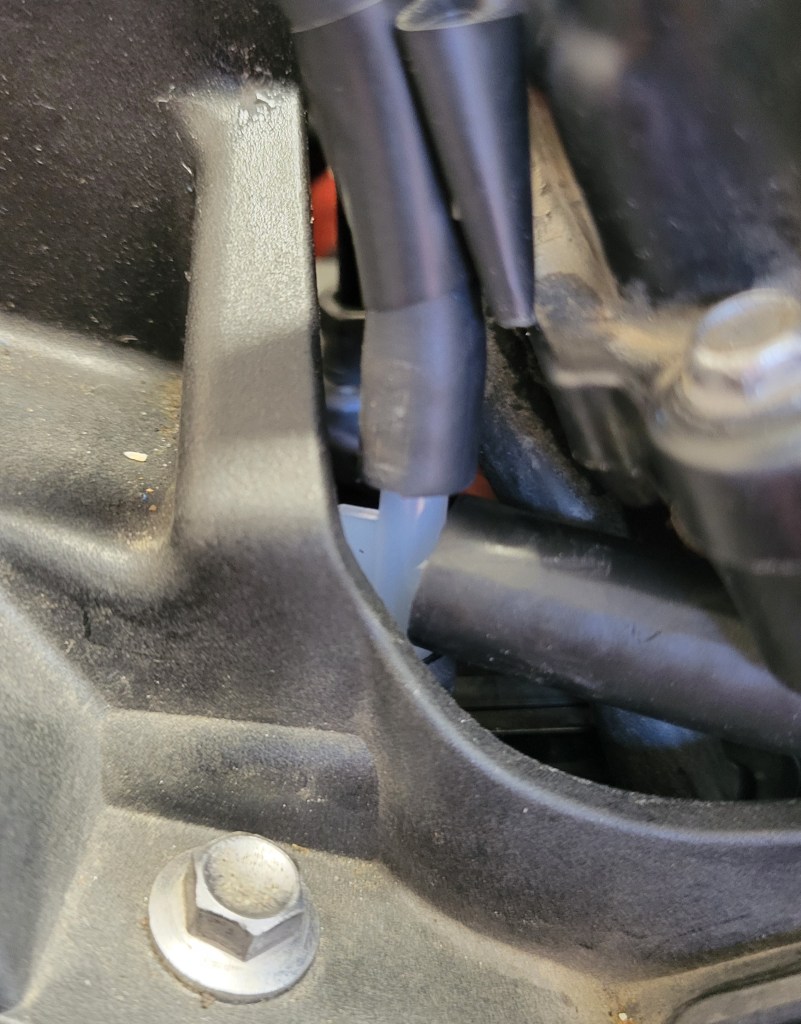
So I picked up a set of assorted vacuum T-connectors and a length of rubber tubing at Canadian Tire and did the same on the Tiger. I cut the tank breather tube and inserted the T-connector, then added the extra tubing. I haven’t decided yet where it will terminate but for now it comes up the siderail and loops across under the fuel tank and is tucked in the other siderail. I think I will shorten it and add a loose end cap like on the AT.

If you have a Tiger and want to do this mod, just be sure to cut the right hose. There are two leading out of the tank. One is the drain tube and one is the breather. The drain tube has a check valve on it so doesn’t allow water to come up. The breather tube is the larger of the two where they attach to the tank.

A Few Mods for Dirt

Fender Extender

I saw MotoBob add a front fender extender to his Triumph Tiger and thought it would be a good modification, given the dirt I plan to ride this summer. It keeps a lot of mud off the front header pipes and radiator, not to mention rain water off your pants. He used the Pyramid Plastics version, but my dealer, Montreal Moto, actually had a Triumph one in stock so I snapped it up.

Some extenders come with sticky pads, but I was advised to use silicone. I decided to make things easy for myself and remove the fender. Sounds reasonable, right? I could have done this mod just by removing the front wheel, but I decided to give myself some extra room and removed the fender. It was three bolts on each fork, so how hard can it be, right?

Little did I know that someone had used red threadlocker on the bolts, and one snapped off in the fork. Perhaps someone at Triumph can explain to me how a front fender is a permanent install?

So I lost a day there. I drilled it out and was retapping it when I got distracted and broke the tap inside the old bolt. Ugh! What a mess, going from bad to worse. I bought some carboy drill bits (after some research on what the hardest, sharpest drill type is), but even a carboy bit wouldn’t touch the tap. Fortunately, my friend Mike, whom I’ve already mentioned a few times, came to my rescue. (He was the guy who refinished the bodywork of my old GS.) He has a proper workbench on a cement floor and drove the tap out with a punch, and then we could re-tap. The thread was a little loose from the abuse it had taken, but he showed me a trick to strengthen it with some 5 minute epoxy. Apply the epoxy like threadlocker but coat the bolt in WD40 so it doesn’t glue inside. Thread it in and after a few minutes remove the bolt and let the epoxy harden to the old threads. Neat! When I reinstalled the fender, I used blue threadlocker.

Lowering Footpegs

My Fastway Adventure footpegs give you the option to mount them standard or lowered. I mounted them standard so I wouldn’t have to adjust my foot levers, but with the dirt coming up, I thought I’d swap to the lowered position. Fortunately, Fastway provide a tool to use to press the pin out. Then you simply press it back in from the other side—from the top of the peg.

Unlike the fender extender and most other jobs, this one went smoothly and I had the pegs back in again in no time. It was easy to adjust the height of my brake lever; just undo the lock nut and screw the adjuster into the master cylinder. Because I was screwing in, I didn’t even need to bleed the brake. And when I put the shift lever back on, I rotated it slightly from its previous position. This set-up lowers my pegs 8-10mm, which may not sound like much, but I suspect will be significant for knee comfort on long days and lowering centre of gravity when off-roading. The downside is that the pegs are a little closer to the road, but I don’t think I’ll be dragging them anytime soon. Or so we’ll see.

Before I reattached the brake lever.

Sidestand Extender

Another mod for the dirt. I’ve always gotten by without one of these, although it’s sometimes a pain to find a stone or stick to use instead when you are forced to stop in mud or soft grass. I went as far as to install a Touratech one on the GS once, but it lasted all of one ride. I got hung up on some rocks and when I got home I noticed I had an extender no more . . .

Needless to say, I was skeptical about buying another from Touratech, but different bike, different design. Besides, I got this one half price. One of the benefits of riding a discontinued bike is that if you keep your eye out you can sometimes snag accessories at discontinued prices. We’ll see how long this one lasts.

Now I remember what I don’t like about sidestand extenders: they interfere with the centre stand. Oh well, I’ll just have to put the sidestand down first before using the centre stand. No big deal, and maybe it will help stop my centre stand from rattling so much. Or maybe now there will be two stands rattling together. Anyway, I’m not wedded to this accessory and we’ll see how long it lasts.

Oil Filter Guard

The Outback Motortek skidplate for the Tiger 800 does not protect the oil filter. Some would say that’s a design flaw, but I suspect OM did it that way so you can change the oil without removing the guard. (They put a cutout in the guard for the sump plug.) But it does leave the oil filter a little vulnerable at the front of your engine. Triumph make a push on metal guard. It’s a simple design with indents that engage with the filter for an interference fit. Easy to remove when it’s time to change the filter, which I will do after running the bike a bit this spring. The engine’s been open for some time as I worked on everything, but with oil being so damn expensive (it costs me now over $80 for an oil change), I will just change the filter. Anything that might have strayed in will be captured in the filter.

It’s been a long haul but I think I’m ready now for another season and another 50,000K. I took the Tiger for a test ride yesterday and it’s shifting smooth again and the clutch feels great. The engine is running well, and I’m happy to be back on the road.

Here in Montreal, it’s Easter Monday and I think I can safely say we’ve had our last snowfall. Crocuses are pushing up and there are buds on the trees. Geese are returning and everywhere the signs of spring are upon us, including the sound of motorcycles back on the roads. For Canadian riders, it’s the best time of year. I wish everyone, wherever you are, a safe and enjoyable 2024 season.

Please leave below any comments you have and consider following. What mods and maintenance did you do in the off season? What are your plans for the coming season? I love hearing from readers, so drop me a line.

The Wish List, 2023

I interrupt the journey across Newfoundland for the annual holiday wish list.

It’s become a tradition on this blog—the annual Christmas wish list. It’s probably one of the least favourite posts of the year for readers, but it sure is fun to write. The season has recently come to an end, the long winter months still lay ahead, and all we have to propel us out of bed in the mornings are thoughts of spring and planned journeys. And part of that planning is dreaming of the mods we will do and the gear we will buy to help prepare for the adventures to come.

This year’s list is pretty short. Yes, inflation is hurting everyone, and we find ourselves buying the cheap tomatoes instead of the fancy vine ones (and regretting it later). Marilyn is paying tribute to her late father by scanning the grocery store flyers and clipping coupons. Even the dog has sacrificed his Greenies (and his breath is the price we all have to pay).

But honestly, the bike is pretty much done. It’s got the auxiliary lights on it now, the crash protection, skid plate, pannier racks, hand guards, off-road pegs, and tail rack. I got soft panniers last year and they have been great. So it’s pretty modded out. What the bike needed most was some maintenance, so I spent a chunk of time before I put it into storage doing the valves and servicing the starter motor, which was acting up. By the way, I’m now advocating checking your valves on the recommended service interval. I waited until the bike had 45,000K and all my exhaust valves were tight, some significantly.

Shorty Levers

The only thing it could use are some new levers. The stock levers are okay, but they are long and I’ve already bent the brake lever once. Actually twice, since I bent it back. I think I’m the only one in my club who rides two-fingered and I asked myself the other day why on earth haven’t I ever had shorty levers?

I looked at all the options and am undecided between Vortex and Pazzo. Both are top-quality levers that fit well without any slop, which is often the case with cheap Chinese aftermarket levers. At about $200, they are comparable in price.

Vortex V3 levers

The Pazzo levers have quite a swooped design to them, which brings the lever down close to the grip. I know there’s some adjustment but this still makes me nervous because I like to have a short clutch that completely disengages before the lever hits my knuckles of the remaining fingers wrapped around the hand grip. For this reason, I’m leaning towards the Vortex design. Is it just perception, or do they look straighter? My ideal lever would be a Pro Taper, but I don’t think they make one for the Tiger.

Pazzo also gives the option of a folding lever, but I don’t think I need that since I have the Barkbuster guards. It would have to be a very unfortunate fall for a rock to come up inside the guard and break a shorty lever. But I guess it could happen. My sense, however, is that folding levers are for true dirt bikes that have wimpy, folding hand guards. If you have any experience or thoughts on this, drop a comment below. I won’t be getting anything until the spring so I have some time to decide.

A new helmet

Honestly, that’s about it for the bike (my wife will be happy to know). But wait! My current lid is at least five years old, so I probably should get a new one soon, despite what Bret Tkacs has recently said about that 5-year limit being bogus. If I were forced to, I’d probably go with the Arai Tour-X5 or maybe find a deal on the now discontinued X4.

No, I’m not trying to emulate Itchy Boots. This would go well with my touring jacket that is grey with matching hi-viz accents.

I’ve been very happy with my Arai Signet-Q helmet. The brand speaks for itself and the shape fits my intermediate- to long-oval noggin well. This time, however, I’d go with the Tour X because I want a peak. There have been many times while riding into the sun when I wanted a peak. Sometimes I have to shade my eyes with my clutch hand, it can get that bad, even with the Pro Shade system.

Knee braces

To be honest, I’ll probably forego the helmet for another big-ticket item. I plan to do some pretty serious dirt riding next year, and the only thing that scares me about that is the potential to damage a knee if the bike falls on one. I’ve somehow managed to play 15 years of beer league soccer without any major damage to a knee, and I’d like to keep it that way so I can enjoy my retirement with full mobility. I therefore am adding to my wish list a pair of Pod knee braces.

Anyone who is serious about dirt riding should be wearing knee braces. I know, they are uncomfortable, but so is tearing tendons and surgery. I’ve heard The Awesome Players advocate the use of braces, and recently a video by Riemann convinced me I should just bite the bullet on a pair.

At $750 a set, these babies aren’t cheap, but money well spent if it prevents a serious knee injury, especially if you are riding solo as I do.

Dirt Gloves

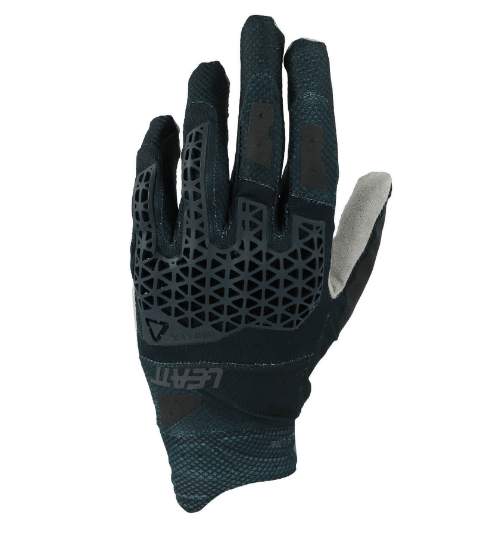
There’s one more piece of off-road gear I’d like before attempting the BDRs next summer. That’s a pair of light MX or rally gloves. I have a pair but Marilyn has appropriated them, so I’m in the market for another pair. When riding dirt, it’s important to have maximum feel on the levers so you can modulate both clutch and brake. It’s similar to how football (i.e. soccer) players are always looking for a boot that provides the most feel on the ball, for example one with kangaroo leather instead of cow hide.

That might be something like the Leatt Moto 4.5, a popular choice or, going even lighter, the 100 Percent Airmatic.

DOUBLETrak Multitool

Finally, what wish list would be complete without a tool of some kind on it? I came across a great little multitool in a video by Chris Birch on his favourite tools.

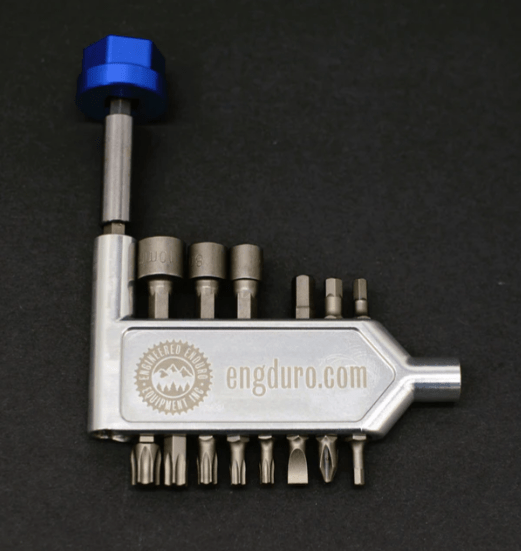
The DOUBLETrak multitool by engduro here in Canada consists of several hex, torx, Phillips, and flat head drivers, and 6, 8, and 10mm socket drives that fit into the handle itself and stay there by magnetic force until needed. There’s also a 1/4″ hex to 1/4″ square drive adapter. If you want a comprehensive review of this tool, check out this video in which Dude does an oil change using only the DOUBLETrak. Okay, I’m not going to be doing trailside oil changes, and this will not replace tools that are in my tool roll, as he suggests, but it’s a convenient tool to keep at hand for small adjustments or tightening something on your or someone else’s bike. Best of all, for a few dollars more, you can get a vanity engraving on it and tell yourself it’s to prevent theft.

That’s it. Like I said, a small list this year. That’s okay because we’re still paying off expenses from the Newfoundland trip last summer and I’ve got more ambitious plans for next summer. This time it will involve dirt and I’m both a little nervous and excited about taking the Tiger off road . . . like, really off road, not just gravel and dirt roads but trails and Class 4 roads, water crossings, mud, sand, rocky hill climbs . . . the works. It’s known as primarily a street bike that is capable of doing “light off-roading,” so I’ll be pushing it beyond its intended limits as I do the MABDR and NEBDR back to back. I’ll either die or bond with this bike in ways I haven’t yet.

What are your plans for next season? I’d love to hear them because the best wishing is not the accessories or gear we want to buy but the places we’d like to visit on our bikes, or even the roads we want to ride. We can’t all be Itchy Boots, but we can explore a little piece of paradise close to home, whatever your paradise might be. I wish you happy holidays, and happy dreaming of another season doing what makes our souls sing.

To Vlog or Not to Vlog

Do we need another hero? I ponder the question.

Even before I had my 6A licence I was watching motorcycle vlogs. A weekly series called Weekly Rides with Reuben was my introduction to the world of motorcycling. That was in 2015 and Reuben was ahead of the curve. Today, it seems everyone has a helmet cam.

Recently, a video came up in my YouTube feed—you know the ones that seem to be generated by AI (or at least the narrative voice is) made by an unknown source just for clicks and YouTube revenue? Okay maybe you don’t but that’s the kind of stuff I end up watching in the off season. It was comparing the popularity of Itchy Boots and another female vlogger, and they estimated Noraly’s net worth at over $7M. I don’t know how they estimate these things or if it’s at all accurate but I thought to myself, “I’m in the wrong genre.”

My day job is as an English teacher at a college, and one of my colleagues has been saying recently that we are in a post-literary culture. By that he means that no one reads anymore. And while it’s always dangerous to generalize, we English teachers do see everyday the effects of a general decline in leisure reading. In fact, I don’t even have to look at my students; I can look at my own behaviour. It’s after dinner at the end of a long day of work and I have a choice: read or watch TV? I almost always choose the latter. And the more I watch, the more tiring reading becomes in a vicious cycle that I struggle to prevent.

Source: Association of American Universities

This blog has been a joy over the past eight years and it’s not dying anytime soon. Believe it or not, even after over 100 posts, I’ve still got lots to say. But I have been wondering if I should expand the blog to include video footage of some of the trips I do. They say a photo is worth a thousand words, and while I’d counter that the right word is worth a thousand images, sometimes a few minutes of video footage is irreplaceable in words. Perhaps it’s like the old adage about the book versus the movie: it’s not which is better but what the movie offers that the book can’t and vice versa.

Of course this is not the first time I’ve considered starting a vlog, or at least getting a helmet cam and recording some footage. My hesitancy so far has been out of concern that the filming would interrupt and detract from the enjoyment of riding. I find already that when I’m riding, I’m in the moment and even stopping to take a photo is an annoyance I force myself to do for posterity. I can’t imagine interrupting the ride for 15 minutes while I set up a tripod for a ride-by shot.

I’m reminded of what someone once said to me years ago when I was back-packing through Europe: “Some people go on vacation to take photos, and some people take photos while on vacation.” I’d hate to have the filming eclipse the ride.

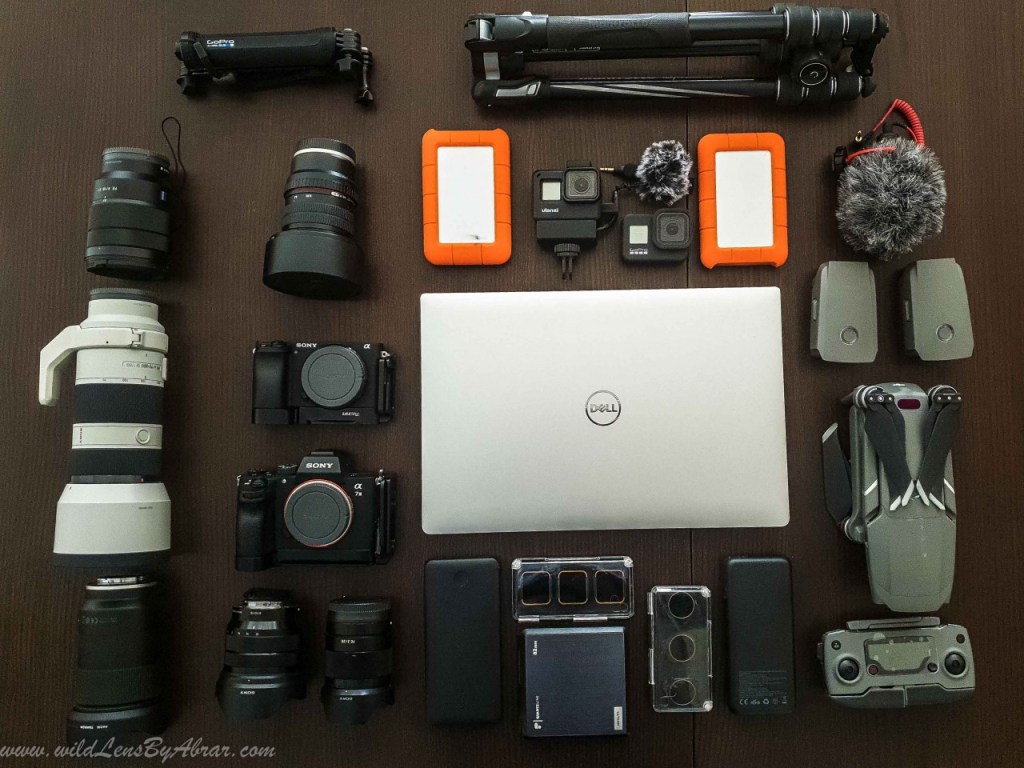
And then there’s the investment in equipment. Hands up if you’re tired of the 30-minute helmet cam footage. It seems that like all art forms, it’s all or nothing; you’re either all in with multiple camera perspectives (front-facing, rider-facing, maybe a side mount and, of course, the drone footage). There’s music to buy, and the pretty steep learning curve of editing software. Oh yeah, and then I’d probably need a new computer, a laptop, I guess, and some way to carry it safely on tour in all types of conditions. Sigh! That’s why I’ve been avoiding jumping in.

Motovlogger wildLensByAbrar’s vlogging gear. Hmm . . . that’s a lot of weight.

Wouldn’t the best of both worlds be ideal, at least for me? I don’t think I can jump into the full YouTube channel thing, but perhaps adding some helmet cam footage to my ride reports would be nice. I know that when I rode up the Stewart-Cassiar Highway, for example, I stopped at the side of the road to take a photo of what I was seeing, but as good as the photo is, it doesn’t capture the ride.

This was the best I could do to capture the amazing Stewart-Cassiar Highway in Northern BC.

So part of my off season has been spent researching action cameras, and it looks like the DJI Action 3 has surpassed GoPro in a number of ways. Apparently a lot of people are jumping the GoPro ship because GoPros have had an ongoing problem of reliability. They freeze and you lose footage, and the only way to fix them is to remove the battery and replace it again. The DJI Action 3 has a longer battery life, handles heat better, has a touchscreen on the front and back of the camera, a more convenient magnetic mounting system, and is $150 cheaper, although as I write this I see GoPro currently have a sale on their Hero 11 to match DJI’s pricing. GoPro has the better image quality because it films in 5K and DJI currently only goes to 4K, but they will be coming out with a 5K camera in the fall, albeit too late for my planned trip this summer. Decisions, decisions. Feel free to drop some advice below in the comment section.

Anyway, this post is a bit incoherent but that’s the nature of pondering. These are just some thoughts I’ve been having. I’ve reactivated my Instagram account and renamed it to match this blog, and the same for my YouTube channel, which currently has a whopping 50 subscribers. I’m enlisting the help of my talented wife to create a logo and will get some stickers and patches made and generally aim toward maybe, maybe, turning my rides into a small retirement income in a few years if I can find a way to do it which adds to rather than detracts from both the ride and this blog. I can’t see myself rocking a selfie stick anytime soon, but you never know, and stranger things have happened. If you don’t dream it, it’s not going to happen.

Any thoughts or advice for me as I ponder these developments? Drop a comment below.

The Wish List, 2022

It’s time to modify the Tiger for dirt.

There’s a balance between customizing a bike and over-modifying it. I remember an episode of Adventure Rider Radio in which Jim Martin talks with Warren Milner, who worked at Honda for 30 years in product planning and R & D. Warren warns against rashly modifying your bike, especially based on advice given on internet forums. For example, at one point in the interview, he talks about the exhaust system, describing how manufacturers spend hundreds of hours developing and testing it before the bike goes into production. That’s because today’s bikes use back-pressure from the exhaust as an integral part of the combustion process to optimize fuel efficiency and emissions, yet one of the first mods owners often do is to slap on an aftermarket exhaust. One can almost hear the collective groan of the engineers as they do.

At the same time, every bike that rolls off the assembly line is built for the average rider—average build, average riding (whatever that is), average skills, average goals. That’s why it’s important to customize it for your specific needs. Tall rider? You might want a taller windscreen to avoid buffeting, or add a wind-deflector. Long legged? You might want to lower your pegs or raise your seat. Or the opposite: you might want a lowering kit so you can flat-foot. Going off-road? You’ll need different tires, etc.. There are a lot of considerations, and fortunately, a lot of options available. The industry is healthy with aftermarket products.

I decided to ride the Tiger for a season pretty much as I bought it. I wanted to get a feel for it stock before making changes. I still have the stock front tire on that came with the bike. The only changes I made were in the realm of protection: crash guards and a beefier skid plate. I’d learned my lesson with the BMW, waiting to buy some upper protection and ending up buying a new radiator along with the guards when I eventually did. After studying the market, I went with Outback Motortek. The guards and plate set me back a cool Grand, but I think they’re the best on the market. The only other mods I’ve done to the Tiger so far were to add an AltRider rear brake extender and a wind deflector.

But with two big tours planned for 2023, it’s time to ask Santa for some items to get the bike ready. Here’s what’s on my wish list for 2023.

Panniers

The Tiger came with Triumph racks and cases. The system is fine for commuting and light touring, but those side-opening cases aren’t practical for moto-camping.

I deliberated (read, “agonized”) over this decision for a long time. I love my Touratech hard cases, but the Tiger has a high exhaust on the right side so I really should go with an asymmetrical system. When I had the 650GS on the market, I had offers just for the racks and cases, but I was reluctant to separate them from the sale of the bike. The new owner wanted to buy them too, but in the end, I decided I couldn’t separate from them either.

They are great cases and contain a ton of memories with all the stickers from where I’ve been. They are the original puck system, which you can’t get anymore, and I like that you can lock them. I’ll probably use these when I tour the East Coast with Marilyn because they are big and we need the space and I won’t be doing much dirt on that tour anyway. We’ll just have to pack them so the bike stays reasonably balanced.

However, I also plan to ride the NEBDR and MABDR next summer, and from what I’ve seen on YouTube, there are some challenging dirt sections of the NEBDR in particular for which I’ll need a smaller, soft-pannier system. (Soft panniers are generally considered safer for off-roading; there is less chance of breaking a leg.) I know everyone is getting the Mosko bags these days, and they are beautiful bags, but I decided to go with the Enduristan Monsoon Evo 34L/24L system.

I’m using the past tense because Santa took advantage of a Black Friday sale and got these 20% off. I picked up at the same time the matching bottle holster (for my stove fuel) and a can holster (for water, chain lube, or bear spray). One of the nice things about this system is that it’s modular, and I’ll probably be adding more to it as I figure out my needs.

Marilyn and I used the Enduristan pannier topper through the West Coast and loved it. Enduristan products are completely waterproof and designed by ADV riders to withstand the abuse of adventure touring. But the main reason I went with this system is the weight; they are the lightest panniers on the market, with no backing or mounting plates to worry about. This also means that the bags and cases will be easily interchangeable.

Racks

It’s Outback Motortek all the way. They put a lot of R & D into their products and back them up with some brave testing, dragging expensive bikes along the ground. Even though the bars do not come up as high as Heed’s and others, they are sufficient to keep the plastics and vital parts off the ground and protected. The bars look like crap afterward but have done their job and can be re-powder coated.

The rear racks offer protection for the silencer and rear of the bike, in addition to carrying the panniers, so again, I went with the strongest. These are a full 18mm + with the powder coating. In fact, they are industry leading in their size, so big that Dual Sport Plus, where I bought the Enduristan bags, includes a workaround kit of washers so the bags fit these bars.

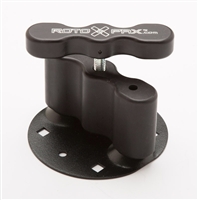
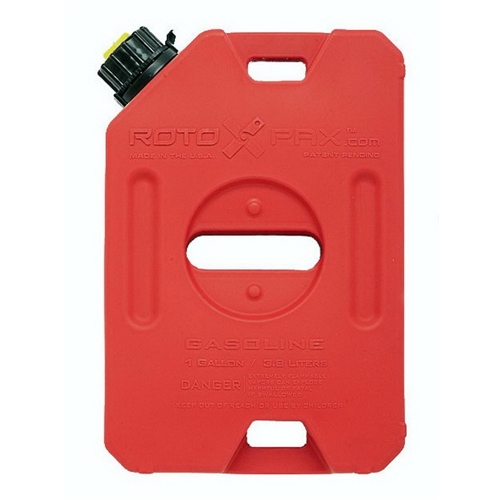
To these bars, I’m going to add on the left side an X-frame plate so I can mount a RotoPax 1G fuel container inside the bars. This will increase my range when remote riding and help balance the bike, especially when using the symmetrical TT cases. Clint at Dual Sport Plus has my exact planned set-up—racks, panniers, and RotoPax—seen here.

Hand and Lever Protection

The final bit of protection I’ll need before attempting those gnarly sections of the NEBDR is some protection for the levers. I considered going again with foldable levers but that would still leave the front brake reservoir and my hands unprotected. After looking at all my options, I decided to go with Barkbusters. They have a model that is made for my specific bike so the install is straightforward. And if I had any lingering doubts, they were quashed when I saw that BB make a plastic with my bike’s name on it. I know the Jet plastics don’t provide as much wind protection as the Storm and other plastics, but I think they suit the styling of the Tiger, and sometimes you just have to sacrifice a little practicality for vanity . . . I mean, aesthetics.

I’m not going to change my mirrors for now. I’m really not fond of the look of the double-take mirrors and am hoping the crash guards will sufficiently protect the OEM ones. And if they don’t, well, the decision will have been made for me.

Foot Pegs

What’s the most important part of the bike when off-roading? Given that I’ve posed this question in the subsection titled Foot Pegs, you’ve probably guessed correctly. If your body position while off-roading is correct, you really shouldn’t have much weight on the bars; you should be pretty much balanced on the pegs and steering the bike with your feet (i.e. peg-weighting). Of the four contact points with the bike (hands and feet), the pegs are the most important, so a good set of foot pegs is a must if you are going to do any technical riding.

The Triumph pegs aren’t small but they aren’t large either. I’ve heard that a large foot peg can make a big difference (sorry, bad pun), changing the entire feel of the bike and inspiring confidence. They will also save you resoling your boots quite as often. I looked at IMS, but they don’t make pegs for the Tiger. When I found that Fastway did and that there was a Canadian distributer, I jumped, Black Friday sale or not.

As you can see, at 2.25″ x 4.75,” these pegs are huge. They have adjustment for height and camber, and come with two lengths of cleats: 10mm and 12mm. I’ll probably start with the 10mm since my adventure boots already have a tread. They are expensive, but you only have to buy them once; Fastway sell bike-specific fit kits for mounting, so I will hold onto these babies when the time comes to sell the Tiger.

Honestly, I never thought I’d pay $300 for foot pegs, but I’ve been watching YouTube videos of guys doing, or trying to do, the Class 4 roads on the NEBDR and thought, “I’m going to need all the help I can get.”

Tail Plate

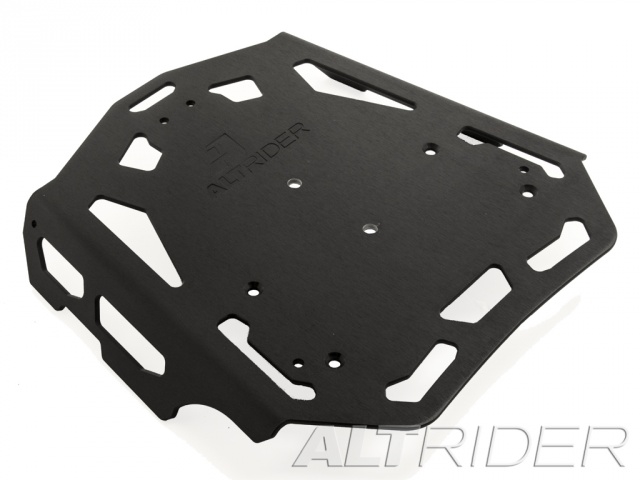
The OEM tail plate is too small for a duffle and has no good strapping points. It also shifts side to side as part of that Triumph system that shifts as you corner. I really like the AltRider tail plate, but at $260 for a piece of metal, I’m considering other options. You can get an eBay Special from China for 1/3 of that price, but will it be the same? Will the cut-outs be bevelled so they don’t cut into your straps? Will the powder coating begin to wear off after a season or two, as happened on my Kildala rack? AltRider make good stuff, and I like how this one projects out the back of the bike so there’s still plenty of room for Marilyn behind me. I might just watch and wait for this item to go on clearance somewhere, but I’ll definitely need a new tail rack before I tour.

Tires

I’ve had the Dunlop Trailmax Mission tire on the rear of the Tiger, and I had them on the GS when I took it to Vermont last summer. This 70/30 tire is a good choice if you are doing a lot of street with some dirt or gravel roads. That’s what I expect when Marilyn and I go through Gaspé, PEI, New Brunswick, Nova Scotia, and Newfoundland. So I’m going to put the matching tire on the front first thing in the spring before we head off.

For the tour in the US, that’s a little different and more complicated. I plan to start out on some BDRs (Backcountry Discovery Routes) that will take me from the Quebec border down to Pennsylvania, then I’ll be riding principally asphalt as I make my way over to the Outer Banks, including The Blue Ridge Parkway—a bucket list ride for me—and, why not, Tail of the Dragon while I’m in the area.

What do you do when faced with such diverse riding, everything from Class 4 (i.e. unmaintained) roads to the most renown section of twisties in The U.S.? Well, based on my experience, you have to go with the most aggressive tire required for your off-roading needs. You can ride a knobby on asphalt but if you try to take a street tire into mud and gnarly stuff, you can get yourself in trouble. Of course I could by-pass the gnarly stuff, but where’s the fun in that, and besides, I like a challenge!

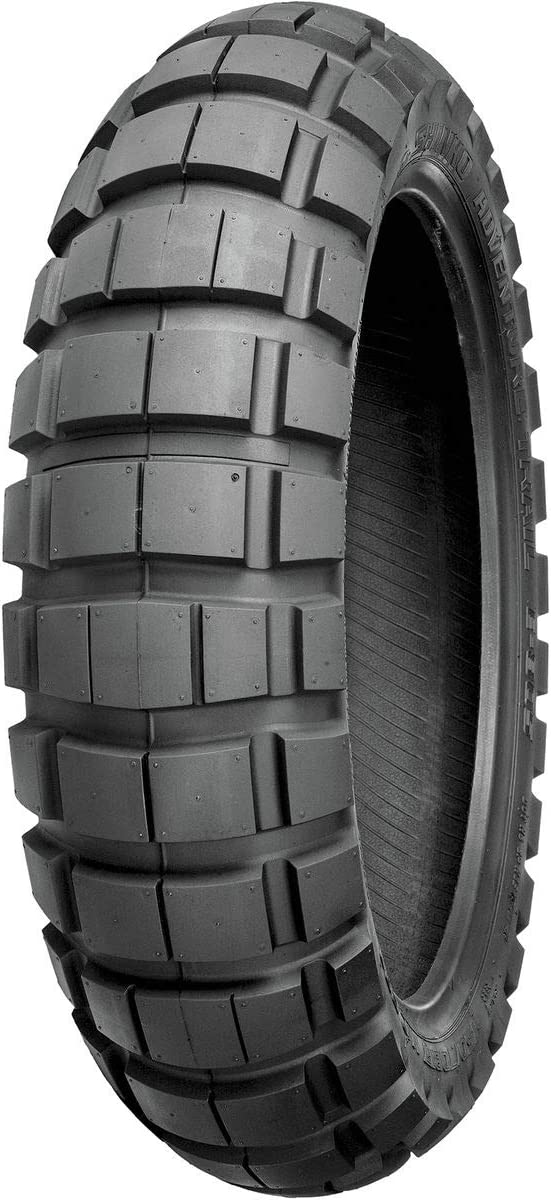
I’m currently deliberating between Shinko 804/805s and Michelin Anakee Wilds. I know the Shinkos are surprisingly quiet and smooth on the road, despite being a 40/60 road/off-road tire. However, they aren’t great with lateral stability. The Wilds are listed as a 50/50, but I have a sense they might be better in the dirt but louder on asphalt. (I’ve never ridden a set of these before.) I also like that the Anakees are a radial tire, so they will run cooler in the heat at speed. And for what it’s worth, Lyndon Poskitt just put a set of these on his Norden 901 for his tour of Iceland where he’ll be doing similar riding.

The Shinkos are about half the price of the Anakees, but for a tour like this, having the right tire is more important to me than a few hundred dollars. I have run the Shinkos before and they were great . . . until they weren’t. From one day to the next, they started skidding and sliding out on me.

What do you think? Anyone tried either of these tires?

Tools, More Tools . . .

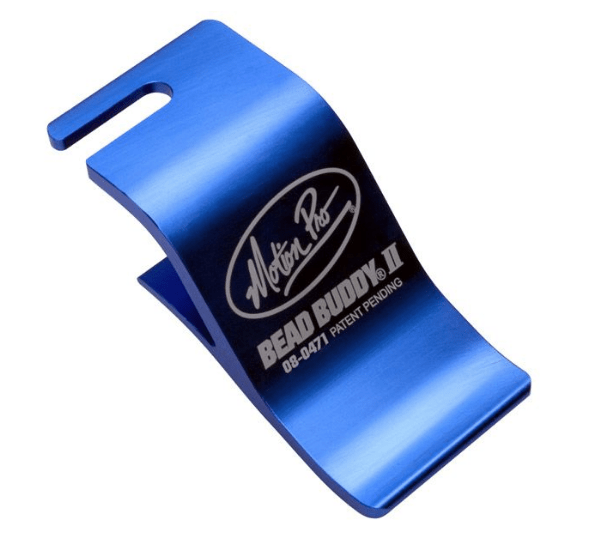
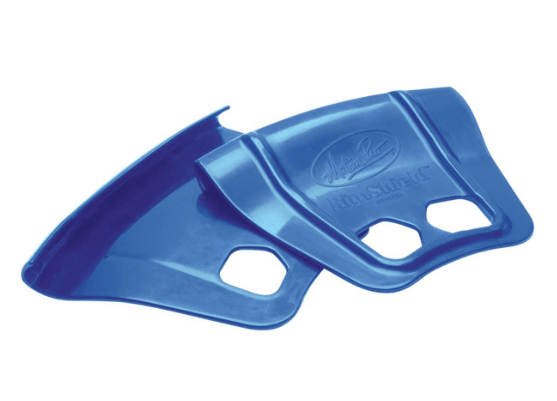
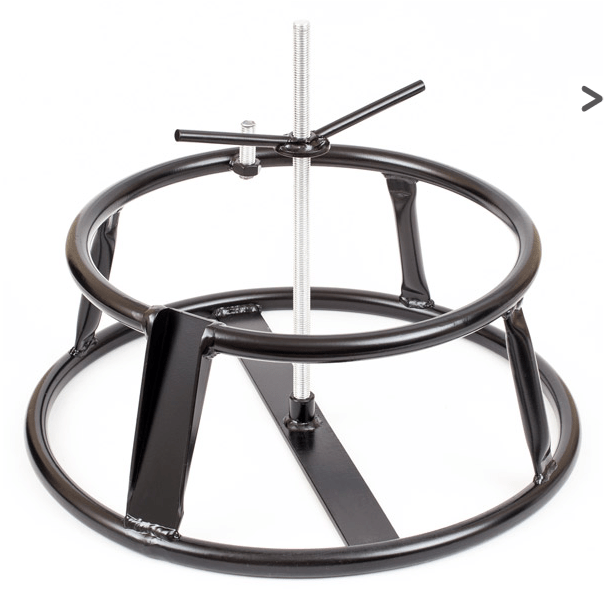
Finally on my wish list are some tools for helping me with these tire changes. I’ve always worked off the grass, but it’s not ideal; you’re grinding dirt into your bearings as you wrestle with the tire, and it’s hard to stabilize the wheel while levering. I think I’m going to ask Santa to get me a tire changing stand and some Motion Pro tools to facilitate this work and protect my rims.

The Tiger is basically a sport bike in adventure clothing; it rips, and I love how it handles through twisties. But I’ve yet to really test it off-road in technical terrain. Fully protected, with an aggressive knobby and soft panniers, Jet will be ready to hit the dirt and I’ll be eager to get back to exploring. Gros Morne National Park is a bucket list item for Marilyn and me, and I’m hoping we’ll be able to get deep into the park on the bike.

In the meantime, we’ve just received here in Montreal the first big snowfall of the winter. I’ve been shovelling the driveway for the past 24 hours, but I really don’t mind. It will be nice to have a white Christmas. I’ve just finished all my grading in my teaching work, and we are sufficiently stocked with holiday sweets and treats.

I was just remarking to Marilyn that, in many ways, I prefer the midwinter holiday to the summer one. While I can’t ride, being a bit house-bound provides an opportunity to step back from everyday life and reflect—a sort of retreat. And what comes to me this year as I do that is how incredibly blessed I am in so many ways. I and my loved ones are healthy, we have enough money, I have a fulfilling job . . . I could go on, but I’m thinking mostly of the people in Ukraine and other parts of the world who are less fortunate. In the immortal words of Ron MacLean, “count your blessings, not your presents.” It’s nice to dream and plan to buy stuff for what we are passionate about, but the most precious gifts cannot be bought.

I wish you and yours a healthy, happy holiday, and safe riding and travelling in 2023.

You Can’t Get There From Here: Navigation Apps

In this final post in a series on gear, I discuss the navigation apps I use when touring.

Old-School Navigation. I still like to tour with a map on my tank bag.

“I learn by going where I have to go,” Theodore Roethke says in the refrain of his famous villanelle “The Waking.” That may be a good philosophy in life, but when motorcycle touring, it’s downright dangerous. There’s nothing worse than not knowing where you’re going and fumbling with a GPS in traffic while riding. Yeah, I’m all for exploration and adventure when you don’t have to be somewhere, but when the light is fading and you still don’t know where you are pitching camp, or when your fuel gauge is on one bar and you don’t know where the next gas station is, that’s a problem.

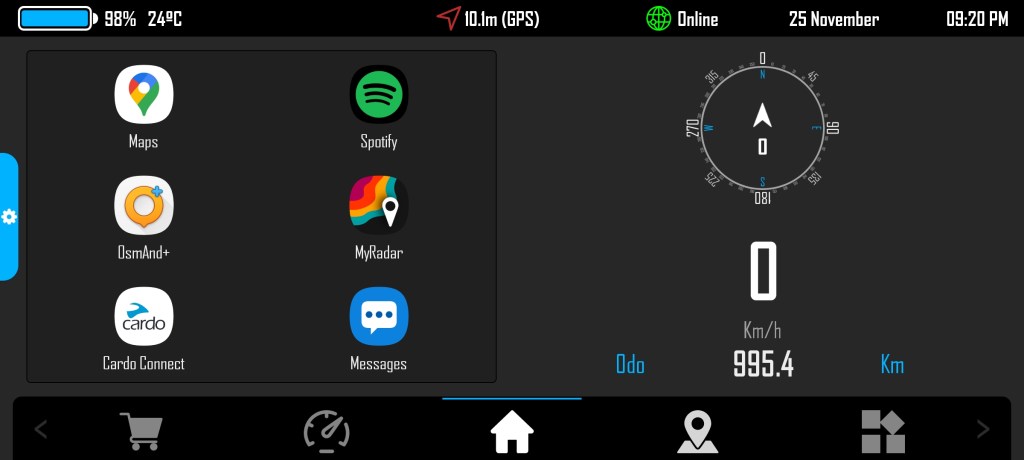
Charging

I learnt early in my touring experience that navigation is huge, maybe because I had so many problems keeping my phone charged. If the USB port detects moisture, the phone stops charging, and it doesn’t take long for a GPS app to drain your battery. And then there’s the cord. If your phone isn’t charging and the port isn’t wet, it’s probably the cord. They make them so cheap these days that the internal wires break. I once had to ride from the Cabot Trail over to the Best Buy in Sydney, NS, just to buy a new cord to get me home. What a pain!

So let me say at outset that if you don’t yet have wireless charging on your bike, you should. It’s a game changer. It avoids 90% of the issues you are going to face on tour. For years I worked around the charging problem by using the type of cord that has magnetic adapters. I siliconed the appropriate adapter into the port of my phone, then just attached the USB cord via the magnet to charge the battery. Rain didn’t affect the charging. The cord was still liable to break, but they are cheap and you can buy, like, a 4-pack on Amazon for $20 so can carry several.

The problem with this set-up is that the magnetic adapters are fine for charging, but most can’t transfer data, so now your phone is limited off the bike. Maybe you don’t want to silicone an adapter into your $1,100 iPhone 14. I worked around this by buying off eBay a cheap, used, military grade phone that I dedicated for bike navigation. It didn’t have a SIM card in it and was locked, but it didn’t matter: I used it in Flight Mode. That’s right, I don’t have a huge data plan and I ride in places that often don’t have cell service, so I download all my maps before leaving.

Navigation

The main app I use to navigate is OsmAnd+ because it is open source and includes free maps to be used offline. This is also great when I travel in The States because I don’t get hit with roaming charges. Last I looked, OsmAnd+ was about $20. I bought the Plus (paid) version because it imports GPX tracks, which I need for leading club rides, but the free version works perfectly well for navigation, if that’s all you need. OsmAnd also includes contour lines and hillshades layers. When I venture off-road, it’s nice to know how steep the mountain is going to be. There is also a Points of Interest (POI) layer so I can see gas stations, restaurants, healthcare, parking, and convenience stores and supermarkets on the map (configurable), and a Wikipedia layer, so I can see what significant landmarks I’m riding past or near. It’s a great little app, available for both Android and iOS.

OsmAnd Screenshots

I’ve tried maps.me, Gaia, Locus Map (Pro and Classic), Scenic, Eat Sleep Ride, and others, but I always come back to OsmAnd. It’s easy to use yet full-featured, a rare combination. It does what I need it to do and no more. Do I really need to know how far over I leaned the bike on my latest ride? Do I really need crash detection? Does my wife prefer to hear that I’ve crashed from an app or a person? But the main reason I like OsmAnd is for the free maps. I started using Locus Map Pro but maps are $1 per country. That sounds cheap—$1 for all of Canada—but for some reason they consider each state in the US a country, so that can add up fast. I still have these other apps on my phone as back-ups but I don’t really use them.

The other main app I use to navigate is Google Maps, now called just Maps. (I guess Google figures it’s so ubiquitous we no longer need the brand name.) Maps handles addresses better than any other app, thanks to Google’s AI. Need to know where a specific place is but you don’t know the address? Just Google it, then press the navigation arrow icon and it loads in Maps and guides you there. Easy peasy. As much as I like OsmAnd, you need a specific address for it to find your destination. (You can, however, press and hold on the map to choose a specific point of destination.)

You can use Maps also offline, but like OsmAnd, you have to download offline maps before leaving home. (The search feature, however, does require cell service.) In the upper right hand corner, press your identity icon, then select Offline Maps from the menu. Press “Select Your Own Map,” zoom and position the frame using two fingers to select the area you want, then press Download. I name each map so I can keep track of them. They will expire if left unused for a certain amount of time, but you can update them all quickly and easily every once in a while when you are in a Wi-Fi zone. I downloaded maps for all the provinces I planned to tour before heading across the country. I didn’t need the northern part of most provinces, but I grabbed everything where I thought I might be riding. This was important since I was often not in a region with cell service.

The only other navigation app I use is Waze, and I only ever use it around town, frankly. That’s because it shows where the cops are. Nice! (Not that I ever speed.)

Route Planning

For route planning, I use the web-based Kurviger. Forget BaseCamp. Kurviger is intuitive and full-featured. I choose the type of route (highway, straight, curvy, very curvy; one-way or round trip), the origin and destination, and Kurviger comes up with an interesting route. I then drop in shaping and waypoints to shape the route exactly how I want it, flipping back and forth between Kurviger and Maps in street view to check the quality of the road. (Drag the little yellow man, ur, person, icon onto the map to see a street view.) When I’ve got the route exactly how I want it, I export it to a gpx file. Kurviger can generate a QR code for the file or hyperlink to share, or send it directly to Scenic, if that’s your preferred navigation app. I usually email the gpx file to myself then open it on my phone, which knows to open gpx files in OsmAnd.

Screenshot of the web-based Kurviger route planning app.

I have Kurviger Pro on my phone as well, and it uses BRouter to do the routing. BRouter takes some setting up; like the offline maps in Googe Maps, you have to download in sections the areas you need first, but the upside is that you can use Kurviger Pro in the field. For example, say you’re riding with some friends and you’re looking for a good route to a specific place but nobody wants to pour over a map to make those decisions. Just open Kurviger Pro on your phone (it will load a map at your current location), press and hold on your destination, and it will generate a route—again, to the degree of curviness you want. You can even share the route with your friends.

Screenshot of Kurviger Pro. All roads lead to Lachute.

Non-Navigation Apps

There are some other apps I use, not for navigation, strictly speaking, although they can be used for that. If you’ve followed Itchy Boots as she makes her way across the Americas, you will have heard of iOverlander. Noraly uses it to find her accommodations. I’m rarely sleeping with a roof over my head when I tour, but iOverlander is equally useful for finding campgrounds and even wild camping locations (i.e. places on crown land where you can camp for free). The app is user-based, and users submit descriptions and photos of the sites they’ve stayed at. This is helpful because there are a lot of people boondocking with campers and vans, and their needs are different than those who are tenting. So a safe gravel parking lot might be good if you have an RV, but not so nice if you are tenting. I wish iOverlander made this distinction, perhaps using a different symbol for each type of wild camping.

iOverlander screenshot. Tent icons are campgrounds; crescent moon icons are wild camping spots. Clicking on the icon brings up a window with user-based descriptions and photos.

Last spring, a friend and I planned to camp at a state campground in Vermont, only when we got there it was closed. In fact, we were too early and all the state campgrounds were still closed for the off-season. (Doh!) So I opened iOverlander and it showed a wild camping spot a short distance away. We ended up at lovely site next to a river with a few other campers nearby for security and even a drop toilet to boot!

I also use weather and radar apps, of course, to monitor the weather. They are pretty straightforward so I won’t spend any time on them. But for the record, my preferred apps in this department are WeatherCAN and MyRadar. I like WeatherCAN because it’s generated by Environment Canada. I reluctantly open Weather Network only when I need a 14-day forecast, steeling myself for the clickbait.

The Best Riding App on my Phone

I’ve saved the best for last. There is one app that I have come to love, to love I say, so much so that it’s become almost indispensable. It’s an app like no other since it is an overlay on the Android system and replaces the usual interface. It’s called Drive Mode Dashboard, by Thork Racing.

This is what I see when I launch DMD. (This is Version 2.0.) Instead of my usual desktop and app icons and widgets, I see this. It’s fully configurable but this is how I’ve set mine up—with a set of most-commonly-used apps on the left and a compass, digital speedometer, and odometer on the right. There’s more info along the top, as you can see. Along the bottom are icons for a map, my full list of apps, settings, even a digital rally book. Pretty cool.

Rally Book Mode. Ready for the Dakar.

But where this app really comes to life is in conjunction with Carpe Iter Controller, a bluetooth controller that mounts to my handlebar. With this controller and DMD, I can navigate throughout my phone—open any app, open and control media in Spotify, change the volume in my helmet, the brightness of my screen, and more. Where I use it most is to zoom in and out and pan around in maps. I think I could even tune my ECU while riding if I wanted to. About the only thing it can’t do is stop Microsoft Office Update from reminding me to check for updates every time I open Word! (Can Bill Gates avoid this?)

I see Thork Racing have a new unit out now with three buttons and a toggle and it can connect directly to 12V. My 1st generation controller has a rechargeable battery that lasts about a week with full-time use. There wasn’t room on the Beemer’s handlebar to mount it vertically so I made up a bracket and mounted it horizontally on the mirror stem. I have it mounted vertically on the Tiger, and yes, you configure the orientation in the driver software so the toggle switch pans your maps accordingly. Needless to say, with this set-up, if my eyes are not always on the road, at least my hands are on the handlebars. The controller is a little pricey but it’s a very nice modification.

Final Words

Despite finally getting my phone set up to be my primary means of navigation, I ended up buying a used Garmin Montana 600 for the big trip. I was nervous after having so many tours tainted by navigation issues and wanted a reliable back-up. The Montana has a WAAS-enabled GPS receiver and HotFix® satellite prediction. No, that’s not a dating service but the latest technology to ensure your connection to satellites is never dropped. The Rugged Mount is waterproof and robust enough for off-roading, and while I’m not positive, I think the Montana has a more comprehensive off-road mapping system than the phone apps. The Google Car made all the way up to Tuktoyaktuk, apparently, but it can’t go on single track or some of the ATV trails I do.

When all electronic devices fail, I rely on that thing called a paper map. No batteries needed! My Wolfman tank bag has a nice big clear plastic sleeve on top for them. It’s easy to lose sight of the big picture, so to speak, after staring into a 6″ x 3″ screen all day. I’ve recently discovered Butler maps, made for motorcyclists, and they are not only water resistant but also contain routes suggested by other motorcyclists and a ton of other information on the flip-side. I bought the one for The Maritimes and it currently hangs in my upstairs hallway outside my study, as did the one of North America I used to plan my cross-Canada trip. So a paper map serves multiple purposes: it’s great in the field, but it also serves to navigate me through the dark winter months of the off-season.

Ready for my sticky dots.

What are your preferred navigation apps and devices? Are there some I haven’t mentioned? Drop a comment below. I always like to hear from readers.

Trip Planning: Final Prep

I’m down to just a few days before departure and not feeling very prepared. By the time I was free and clear of work, I had only two weeks to prepare the bike. That’s a lot, but not when parts take two weeks to arrive from Germany. So I’ve done what I can, as you can see from the list above. Today I remove the clutch cover to change the water pump and clutch plates. I actually have the pump—I’ve had it for a few years because you never know when it will fail on this bike—and I have the cork replacement plates for the clutch. What I don’t yet have are clutch springs and, if required, a replacement clutch cover gasket—that large paper one. These items and a few more were supposed to arrive last week, but it seems Covid is trying its best to sabotage the tour this year as well as last. Today is a holiday in Quebec so if the parts don’t arrive on Friday, I’ll have to make do. That might mean re-using old clutch springs or shimming them if they are out of spec. And hopefully I can get that clutch cover off without damaging the existing gasket. I only ordered a new one in case I can’t.

The good news is that the bike has all new wheel bearings, including the cush drive bearings, and new rubber. I did end up going with the Anakee Adventures in the end, mostly for their smoothness on asphalt. I don’t anticipate doing much off-roading on this tour, and they will be really nice through the twisties in The Rocky Mountains. I tried my best to balance the wheels using jack stands but I think I will get them checked professionally. The pros have computerized equipment that is more precise, and I thought I felt a bounce in the front. I also changed the front sprocket back to the stock 16-tooth, among other mods. My son helped me shoot a few videos of the mods I’ve made on the bike both for dirt and converting it back to street.

My wife, Marilyn, and I did a test ride last Saturday and the bike is running great. I remember now how that stock gearing is so much better on the highway; you have roll on at 120 km/hr.! And at 110 km/hr, which is a comfortable cruising speed for me on the highway, the revs sit right on the sweet spot of this bike at 4600 rpm. Even at 120 km/hr the revs aren’t over 5000. I’m glad I made that change, even though I know you’re not supposed to change a sprocket without changing the chain. Well, the chain has only 7K on it so it will be fine, and I’ll change everything when I’m back.

With all the attention on the bike, I have only just started laying out items to pack. Marilyn is having kittens about this because she can’t imagine starting so late for such a big trip, but I’ve done it before many times and I pretty much know what I’m taking. The only difference this time is that I have to consider two set-ups: one for when I’m solo, and one for when Marilyn is riding pillion. This means that I’ll have an empty pannier when alone. I will fill it with booze and tobacco until she joins me in Calgary.

The only tricky part of packing actually is deciding what spare parts to bring. I’ve done everything possible to prevent an issue on the road and I don’t have room to carry spare engine parts, but I’ll take an assortment of hardware, spare clutch cable and perhaps levers, gasket maker, JB Weld, self-fusing tape—that sort of thing. I’ll try to anticipate any issue that I might have, within reason.

I haven’t been able to research as well as I’d like, unfortunately. The book on Canadian geography I took out from the library sits unopened on my coffee table. I’ll have to do my research on the fly, so to speak. I’m pretty familiar with Ontario from previous travels and from writing a few articles for northernontario.travel, and I found a great video of tourist destinations in southwestern Saskatchewan, so I’m good for the first two provinces, I think. Marilyn is pretty familiar with Alberta, having lived there for 20 years, and we will explore BC together, so I’m not going to beat myself up for not getting more reading done. It’s not like I’ve been idle.

We have a few reservations booked on Vancouver Island and will stay with different friends as we make our way through the BC mainland. I am mostly concerned about when I’m alone and camping, since I’ve heard that campgrounds are all full. I’ll be using iOverlander to find wild camping spots and will have to wing it. This will be a first for me and I anticipate a few nights of searching for a suitable safe spot, but having watched Lyndon Poskitt wing it all over the world, I know it can be done.

The Yukon has dropped the requirement for travelers to self-isolate upon entering, but only if you are fully vaccinated, so I’ll be looking to get my second dose on the road somewhere so my planned trip up north is still on. Unfortunately, since I got the fist one after May 1st, I’m not eligible for the second until after I leave. Like so much about this tour, I will figure that out on route.

It hasn’t sunk in yet that I’m finally doing this. Perhaps I will grow into it, or it will hit me once I leave my first destination in Ontario. I’ll be staying with my sister for a few days and visiting my dad, so the trip proper begins July 1st, Canada Day, which seems appropriate. I won’t be posting while on the road so don’t expect any action on the blog until I’m back. I wish you all a safe and enjoyable summer!

Planned full trip. Am I crazy?

The Wish List, 2019

Biker Santa

It’s that time of the year again, when we reflect on the year that’s been and plan for the year ahead. This year I upgraded my training by attending two remise en formes, discovered Vermont’s wonderful dirt roads, travelled up the Gulf of the Saint Lawrence almost into Labrador, and wrote a handful of articles for northernontario.travel. I was so busy travelling, I didn’t do a lot of club riding, although I did lead two day rides: one to Ottawa for the Tulip Festival, and one to Smuggler’s Notch in Vermont.

Next year I want to start to introduce what I’m calling hybrid rides to our club. Those are rides where a group splits off from the main group and rides some dirt and then meets up with the gang later for lunch. I’ve been thinking about this for a while now but just have to figure out the logistics. I know there are some club members with ADV or ADV-style bikes who are interested in riding some easy dirt roads.

I want to do more challenging trail riding to improve my off-road skills, and it might finally be time to head across the country, completing that teenage dream of seeing Canada from a motorcycle. But more on that later. Right now I’m thinking of the goodies I’m asking Santa for to make my riding next year safer and more enjoyable. Here is the Wish List, 2019.

Stadium Suspensions PR1 Rear Shock

My rear shock now has over 90,000 kilometres on it and has never been serviced.  Imagine, that oil in there is 13 years old! Also, the stock shock on my bike is okay for road riding, but it’s too soft for any serious off-roading. The spring is also too soft; when I’m fully loaded, I’m sitting 2 cm under the recommended sag. I could try to have it serviced and replace the spring, but the combined cost would be almost as much as a new shock. I think it’s time to upgrade.

I’ve been talking with Stadium Suspensions in Beloeil, Quebec, just south of Montreal, where I live. They specialize in ATV, MX, and off-road suspensions. The nice thing about going with a company like this is that they can customize the shock to your weight and riding style. They have three models, and since I’m neither a beginner nor a pro, I’m going to buy the mid-priced unit, the PR1.

Stadium

You can see that this shock is an upgrade from my stock one because the PR1 has a remote nitrogen reservoir. On mine, the nitrogen is in the same compartment as the oil, which is fine for street riding, but once you get off road and the shock is working hard for extended periods of time, the oil heats up and mixes with the gas and froths and you start to lose your compression. Separating it is the answer; the best shocks are designed with a remote reservoir.

Other features of the shock include:

  • Spring preload adjustable
  • Rebound damping adjustable
  • Compression damping adjustable
  • Thermostatic system
  • Velocity Reaction Damping System (VRDS)
  • Bladder system reservoir
  • Length adjustable (+/- 10 mm)
  • Piggyback Reservoir, 360 degree angle adjustable
  • Magnum reservoir optional
  • Tool free compression knobs optional
  • Individually custom build for rider/application
  • Fully serviceable/repairable/convertible
  • Gold, red or blue, anodised reservoir
  • Progressive or linear springs

The other nice thing about Stadium is that they can build into the new shock my existing preload adjuster. I really like the ability to adjust the preload with the turn of a knob—no tools necessary—so I’m sold. With my new Ricor Intiminator fork valves in the front and this baby at the back, I’m going to be flying!

Protection

Speaking of which, I’m getting up to speeds now off-roading at which I really should be wearing a neck protector. A neck protector prevents your head from rotating beyond a certain degree, saving your neck in a fall. I don’t want to end up a quadriplegic, thank you very much. I don’t have a specific one chosen yet, but Leatt are a major manufacturer. Again, I don’t need the pro version (5.5) so I’ll probably go for the 3.5.

gpx_neckbraces_35__0000_leatt_neckbrace_gpx_3.5_wht_front_1020003950

In fact, I believe these are kind of a custom fit item since they are semi-restrictive, so I’ll probably just try a number of them on at a store with my helmet on and see which feels best.

The other piece of protective gear I’ll pick up is a new back protector. I love my Knox Venture Shirt but the pack protector is cheap EPS and prevents air-flow. On those really hot days, it results in an uncomfortable wet back and has led me to not wanting to wear my protective gear. Knox have a better one which, as you can see, allows air circulation. It’s D30 so will provide better protection too. Neither do I want to be a paraplegic.

knox_microlock_back_protector_upgrade_part114_750x750

Auxiliary Lighting

I’ve been thinking of getting aux lighting for years, ever since I had a run-in with some roadkill coming home late one night from New Hampshire. Sure, you can get the cheapo made-in-China generic knockoff version at Amazon for $40, but they break easily and don’t stand up to the beating of off-roading. Everyone I know who’s bought cheap has had issues soon after. There’s also the quality of the LED light; it’s apparently not just a question of the number of lumens but the optics technology involved to reflect those lumens where you want them. If I’m going across the country, some auxiliary lighting will help get me there.

I’m pretty sure I’ve had Denali D4s on a previous wish list, but I think I’m going to go with the Cyclops Long Range Auxiliary Lights. I’m very happy with the Cyclops LED lamp I put in my headlight. In fact, it’s been one of the best upgrades I’ve ever done on the bike. It occurred to me the other day that Cyclops also make auxiliary lighting, so I’ll stay with the tried and true. Cyclops lights might be a little cheaper than Denalis and have a number of features that make them a compelling choice. I like also the smaller size on my little bike.

Cyclops

The Long Range lights stand up to their name by projecting a whopping 883 feet down the trail. They come in either a 10˚ or 20˚ arc, and a popular set-up is to put a 20˚ unit on the right and a 10˚ unit on the left. This arrangement will give good illumination of the side of the road while still penetrating those 883 down the road.

But of course it’s not just about seeing things but also being seen. Studies have shown that oncoming drivers sometimes mistake that single headlight for a double in the distance and turn in front of you. Having that triangle configuration makes you a lot more visible day and night.

One very nice feature of these lights is the ability to wire them directly into your headlight switch and program them. You set the intensity you want for low-beam driving lights so you aren’t blinding oncoming drivers. Then, when you flick on your high beams, you get full intensity. The plug-and-play wiring harness makes installation easy.

Got you curious about how good these are? Here’s a sequence of comparative photos provided by ADVPulse.

distance-sequence

Cardo Packtalk

Cardo

I’ve been of two-minds about communications systems. One of the things I like about riding is the solitude. Even when you are riding in a group, you are alone with your thoughts, as Ted Bishop aptly describes in Riding With Rilke:

When I first put on a full-face helmet, I have a moment of claustrophobia. I can hear only my own breathing and I feel like one of those old-time deep-sea divers. . . . When you hit the starter, your breath merges with the sound of the bike, and once you’re on the highway, the sound moves behind you, becoming a dull roar that merges with the wind noise, finally disappearing from consciousness altogether.

Even if you ride without a helmet, you ride in a cocoon of white noise. You get smells from the roadside, and you feel the coolness in the dips and the heat off a rock face, but you don’t get sound. On a bike, you feel both exposed and insulated. Try putting in earplugs: the world changes, you feel like a spacewalker. What I like best about motorcycle touring is that even if you have companions you can’t talk to them until the rest stop, when you’ll compare highlights of the ride. You may be right beside them, but you’re alone. It is an inward experience. Like reading.

Riding a motorcycle is one of the few occasions in my life to be in the moment. It’s just me and the sensations of the bike and the beauty of the surrounding environment. Why would I want to pollute that silence with people nattering in my ear?

Maybe I’m just anti-social. Maybe I’m a purist, or a rebel, or all three at different times. I’ve heard the argument about comm systems increasing safety, but my response is if you need to rely on others to stay safe, you shouldn’t be riding. On the big club tour I did last summer, I was the only rider without a comm device. Did I feel left out? Not really, except when I went to talk to someone at a rest or gas stop and that person gestured to say “I can’t hear you because someone else is talking to me in my helmet.” Yeah, ironically, comm systems can alienate people too.

But I’ve decided to join the club, so to speak, and get one, and I have to say it’s mostly for the ability to hear voice commands from my GPS, to hear incoming texts and send out voice-activated replies, and to answer and initiate phone calls while riding. But I’ll admit it will occasionally be nice to communicate with others in a group, especially if I’m leading. And of course there is always the option to mute the nattering when desired.

Club members are very happy with the Cardo Packtalk, mostly for its mesh technology which makes connecting (and reconnecting) large numbers of riders fairly easy. I had the opportunity to try one during a club ride and found the sound quality good. And while I didn’t have the opportunity to test the connectivity to my phone, other club members have said that the person you are talking to on the phone cannot tell you are riding a motorcycle, so the mic must work very well at cutting out ambient noise. My feeling is that this purchase is going to be the most significant change in my riding experience.

Pearly’s Possum Socks

Pearlys

Last but not least, I’m asking Santa for socks in my stocking. I heard about Pearly’s Possum Socks on Adventure Rider Radio. The host Jim Martin raves about them. Socks, you say? You want Santa to bring you socks? Well these are not just any kind of socks. They are a blend of merino wool, which I’ve raved about elsewhere, and possum fibres, which are hollow and therefore super warm since each fibre has a built-in dead-air space. (I wonder how vegan motorcyclists manage?) They are apparently also very soft. A little nylon to strengthen everything up and you have a premium sock that is warm, breathable, comfortable, durable, and anti-bacterial in a compression fit to aid circulation and to help avoid muscle fatigue.

At a premium price. With extra S&H to Canada and the currency conversion, these socks come to over $100 a pair! Gulp. I’ve balked a click away from purchasing them a few times, which is why I’m asking Santa to bring me some instead.

* * *

I always feel very First World, or is that now Developed World?, in making these lists. I’ve worked hard my entire life to achieve a certain level of material comfort, but I’m also aware of the opportunity I have here in Canada and the lack of opportunity less fortunate have elsewhere. And being year-end, I always end these lists by expressing gratitude for what can’t be bought: my health, my wife, and my son. I’m also pretty fortunate to have so many friends, a community of riders and others who help give life meaning and value.

We don’t have to look far to see those who are alone and without basic material comforts. And neither did Saint Nicholas, who gave his inheritance to the poor and became the patron saint of sailors, repentant thieves, prostitutes, children, and students, among others. His charity lives on amid the advertising and commercial hype of Christmas as long as we continue to look.

Happy holidays, and safe riding in 2020.

The Wish List, 2018

Moto Santa

If I’m going to get my wish list to Santa before Christmas, I’d better send it now. This year has been a tough one for a few reasons, but mostly because my mom died in the fall. That threw everything off, including my blog writing. I just didn’t have the appetite to write, or ride, or do any of my other interests. But the midwinter holiday and the turn of the new year is as good an opportunity as any to turn the corner and start to look forward to the warmer weather and the chance to ride again. Here are a few things I’d like to get for the 2019 season.

But first, let’s take a look at what didn’t make it off my wish list last year.

  • Upper crash bars: check
  • Inline fuel filter: check
  • Flexible front flashers: check
  • Chain-breaker: check
  • Wheel lug/tire iron wrench: check
  • New front tire: check
  • Body armour: check (not Leat but Knox)

So the only two items that didn’t make it off my 2017 wish list were the Garmin Montana GPS, for the second year running, and the Sea-to-Summit mattress.

Garmin Montana 650

The GPS is a must this year; I can’t put it off anymore. As you know if you read my last post, I actually suffered a breakdown on my tour this summer from using a phone GPS. The port on the phone is just not built to withstand the demands of off-road riding—the vibrations, the moisture, the drain on the battery. I ended up jeopardizing my bike’s battery which led to the breakdown. And if you’re doing any serious off-roading, you’re often going to be outside of cell service. This is a fairly big-ticket item so I’ve been avoiding it, but fortunately, I’ve been doing some writing for Ontario Tourism and the money earned from that writing will offset the cost this year.

There is a new 680, but the 650 will be more than enough for my purposes and maybe I’ll get a deal on a discontinued model. I’m so tired of trying to use GoogleMaps to plan my rides! It works okay to get you there but you don’t have much choice in the route (just “avoid motorways,” “avoid toll roads,” and “avoid ferries.”) I’m looking forward to being able to use BaseCamp to plan rides on my computer and import tracks to the GPS. It’s also going to open up a whole new world of off-road track sharing through forums. The Montana is the most popular off-road GPS on the market, with topographical maps, the ability to geocache photos, dual map capability, a micro SD card slot, and many more features that I’ll probably never use. Best of all, it’s rugged.

A Lithium Battery

Shorai

Shorai LFX14L5-BS12

I’ve also decided it’s time to retire my old wet cell battery. I actually got two when I bought the bike. One died about a year ago, and the second is now getting weak. The battery on my bike is known to lose fluid because it’s right next to the upper oil tank, so it gets hot. Also, you have to remove all the plastics on the bike to check and to maintain the battery, so a low maintenance battery would be a huge benefit. I’ve decided to try a lithium battery. I heard about them on Adventure Rider Radio but had concerns about using a lithium battery in a cold climate like Canada’s. However, I’ve heard on forums that it shouldn’t be a problem. You just turn the electrics on for a minute or two to let the battery warm up before hitting the starter. I won’t have to worry about this one boiling dry, as my current one did outside of Mattawa, and an added huge benefit is that it’s much lighter than a wet battery. It’s the easiest way to shed several pounds up high on my bike.

Ricor Intiminator Fork Valves

Intiminators

41mm Ricor Intiminator Valves

This past year, I lost the preload adjuster on the rear shock. I think what happened was the new Holan upper crash bars install too close to the adjuster. The bars use the same mounting point, and I think the adjuster threads got strained from the tip-overs and eventually stripped. I was lucky to find a generous soul willing to swap me his adjuster for mine, but in doing some research on this item, I discovered that many riders find the suspension on my f650GS too soft, especially for off-roading. I’m not a big guy, so I don’t find the rear too soft, but the front end does dive under braking, and for the past while I’ve had a clunking noise coming from the forks on certain types of bumps. I was going to rebuild the forks this summer, replacing the bushings, so I’ve decided to install some Ricor Intiminators at the same time to firm up the front end. They don’t look like much, but these babies have something called Inertia Active Technology. Developed over a twenty year span, this technology can distinguish between chassis motion (fork dive) and wheel motion (bumps in the road). It allows the wheel to move and stay in contact with the road but doesn’t allow the forks to compress when front brake is applied. How, you ask? You’ll have to read the details of the technology at their site. The bottom line is that you get a cushy ride on the road without the fork dive under braking, and better handling off road. According to many comments on user forums, the suspension on my bike is its greatest weakness, so I’m looking forward to improving the front end.

K & N Air Filter

KandN

This one is kind of a no-brainer, which makes me wonder what took me so long to make the switch from paper to cloth air filters. Okay, I do remember reading up on foam filters when I first got the bike, but what I read was that the OEM paper filter protects better than foam. And that is true, partially. Dry foam filters have holes upwards of 90 microns in size, too big to stop sand, which can penetrate your engine and do nasty stuff to it. But an oiled foam filter will protect your engine just fine, and most dirt bikes and off-road bikes like KTMs use oiled foam filters. However, too much oil results in loss of power because not enough air is getting in to mix with the fuel. Recently I discovered the K & N cloth filter which protects as well as OEM but is reusable like foam. It’s also zero maintenance (no oil to administer) and is reusable; just clean in soapy water, rinse, and dry each year. Sounds like the best option for me. Goodbye disposable paper filters.

Klim Carlsbad Pants

carlsbad-pants-grey-30

Santa came a little early this year with some Klim Carlsbad pants for me, so this one is not officially on my wish list. I love my Klim Dakar pants; nothing is more flexible and durable for off-road riding than the Dakars. But they are not waterproof. That’s just not the way they are designed. They are designed to pull through overhanging thorny brush without tearing, and to allow maximum airflow when it’s not, so not waterproof and not for adventure touring. I’ve been desiring a Gore-Tex pant that will keep me cool in the heat and dry in the storms. No stopping under bridges to pull on rain gear, no trying to anticipate weather—just ride rain or shine and remove guessing from your day. I saw these on sale 43% off their regular price about a month ago and jumped before Fort Nine sold out of my size.

Steel-Braided Brake Lines

Single Front Line

Last year I accidentally damaged my rear brake line while fixing my rear shock. I’ve decided I might as well take the opportunity to upgrade to steel lines which are better for off-roading anyway. Galfer lines are made in the USA, are model specific, and have teflon inner coating to avoid deterioration. There are even colour options for both the line and mounting hardware. I’ve already got new front and rear disc pads waiting to be installed, so I’ll be doing a complete brake rebuild in the spring.

That’s it. A suspension upgrade, a lithium battery, and (finally!) a motorcycle GPS top my wish list for this year. But like last year and every year, my main wish is continued health. A friend of mine is currently battling brain cancer and wasn’t able to ride last year. He’s recently had a setback and will be spending Christmas in the hospital. I’m thinking of him a lot and would gladly forego all these goodies and more for his health, but unfortunately there are no deals like that available in life. You have to count your blessings, and bless each day you have to live. However messed up this world is, experiencing all it has to offer is and always will be the most wonderful gift of all.

Merry Christmas and happy holidays to you and yours.