5 Drills to Improve Your ADV Skills

Improve your street and off-road skills with these simple drills. No dirt needed.

The first instruction in off-road skills I received came from none other than Jimmy Lewis, the Dakar podium finisher in the 90’s who now runs an off-road school in his home state of Nevada. He was visiting the Dirt Daze Rally in NY and offering little 3 hour clinics to ADV riders. He began by stating that the coaching at his school focuses on two things: balance and traction. I think the traction skills come a little later, maybe in intermediate classes—how to find and break traction when needed. But I learnt a lot about balance, throttle, and clutch control from that short clinic, and I’ve added to it with some instruction at SMART Riding Adventures, Clinton Smout’s school in Barrie, Ontario, and a couple of Spring Refresher days with GS instructors at some clubs here in Quebec.

I’ve cobbled together five drills that I try to practice when I have an hour or so to spare. I recently heard Chris Birch say in an interview on Adventure Rider Radio that really what you learn at his weekend courses are exercises that everyone should then go out and practice after the weekend. No one is going to learn how to ride off road well in a weekend, but if you practice, like in any sport, you’ll improve.

These are five exercises I do to improve my skills.

Static Balance

Everything starts with balance, and the best exercise to dial in the neutral point when the bike is in perfect balance is static balance. Jimmy had us attempting this without any assistance and it was hard. No one could really balance for more than a second or two. I think the better way to do it is how the dirt bike guys do it, full lock and your front brake on. You can also move the tire side to side a bit to dig a little rut into the dirt for support. Alternatively, you can lower your front tire pressure or get the bike on a hill pointed down so the front suspension is compressed a bit, which makes it easier.

Okay, it’s not an asphalt but you can do it at the top of your driveway on the grass if your partner doesn’t mind the groove permanently dug into the lawn.

Touch and Go

This one I got from Brett Tkacs’ video on his asphalt drills. It teaches fine braking, clutch, throttle control, and balance. You simply come to a complete stop at each obstacle and touch it with your foot or hand. You can use anything available such as parking blocks, lamp standards, garbage cans, etc. All these drills are simple but not easy. This one is a particular challenge for me on the Tiger.

Sorry about the crappy framing at the beginning.

Figure 8

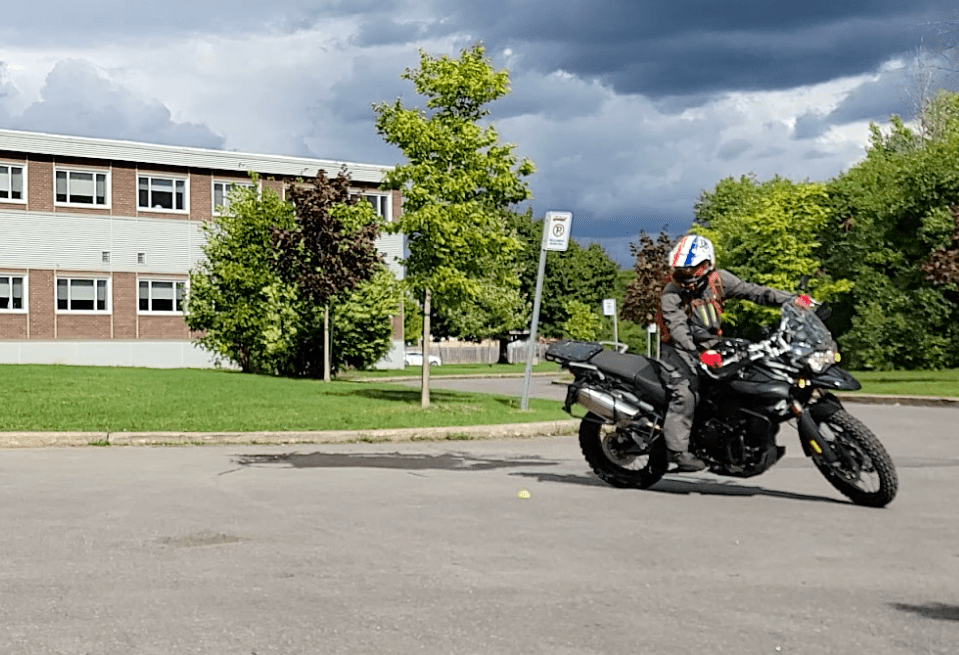
This one teaches counterbalancing in tight turns both seated and standing. It’s important be able to turn both ways so the figure 8 ensures this. Just place two markers about 6 meters apart as your centre-point of each turn. (A tennis ball cut in half works best.)

For seated turns, you want to shift your butt off the seat—the one cheek sneak—to shift your weight. It’s not enough to move your upper body; you have to move your hips, where most of your weight is, even if you are diminutive like me.

For standing turns, I concentrate on gripping the bike with my legs. For a left turn, for example, I hold myself from falling off the bike when leaning by planting my left calf and thigh against the engine and my right knee against the other side, just under the tank. Using leverage in this way, I’m “locked in.”

For both seated and standing turns, vision is crucial. You want to put your chin on your shoulder and look to where you want to be, the next cone, not the one you are turning around. Keep your revs up so you have power on hand should you feel the bike falling and can clutch out without stalling. The goal is full-lock turns both ways.

Circus Act

This exercise teaches you to move independently of the bike but stay in balance. Begin by standing and riding with one hand, both sides, then lifting a leg off each peg. Once you’re comfortable doing that, swing a leg over your seat and sit side-saddle long enough to place the opposite foot on the peg, so put the right leg on the left peg, and stand up. Then sit back down side-saddle, get your left foot back on the left foot-peg, swing both legs over so you are sitting side-saddle the other way and put your left foot on the ride foot-peg. You’ll find the bike wants to tip to the side all your weight is on so be ready and compensate by tipping the bike away from you. As long as both you and the bike together are in balance, you won’t fall.

I find this exercise helpful for when you get into sand and mud and rocks and the bike starts moving around underneath you. Your muscle memory will remember and you’ll shift your weight to the opposite side to compensate. Off-road riding requires a lot of movement side-to-side with your upper body to compensate when the bike becomes unbalanced.

Finally, I get back to normal seating and then dismount the bike while it’s still rolling. (This teaches clutch and throttle control again.) Walk beside the bike for a few meters then put your left foot on the left foot-peg and do a rolling mount. You’ll have to transfer you weight quickly over the centre line of the bike to avoid it falling toward you. It’s a bit of a step of faith (not quite a leap) so commit and keep the revs up and the bike rolling. Do the same on the other side. The rolling mount is good practice for fine clutch, throttle, and balance, but can be handy in some situations on the trail.

Friction Point Practice

Find a hill or incline (a loading ramp will do) and point your bike uphill. Slowly roll the bike up and back using only the throttle and clutch, no brakes. Try holding the bike stationary for a few seconds only using the throttle and clutch, then roll back and stop the roll, again, only using the throttle and clutch.

I learnt this skill from the IRC Tire guy and he says it teaches you to break the habit of trying to hold the bike on an unsuccessful hill climb with the front brake. Instead, you have to develop muscle memory to use the engine to brake when rolling back on a hill. It also dials you into the friction point of your clutch and helps develop traction on hill climbs. You don’t want to spin the rear tire and lose traction.

All these drills look simple and easy but they are far from easy. I like them though for their simplicity, allowing you to practice them anytime you have a few minutes or even at the start of each ride.

I’m no expert, so feel free to offer advice in the comments section; I won’t be offended. I’m always eager to learn.

Do you have some exercises you do regularly? Drop them in the comments section too. I’ve kept this to 5 so they can be done quickly, but I know there are a ton of excellent exercises out there, so pass on your favourite(s).

Where has the summer gone, 2025 version.

Port Joli Beach at Thomas Raddall Provincial Park, Nova Scotia

The annual wistful synopsis of the summer.

Here we are, at the beginning of autumn. There’s still plenty of good riding left in the season, but the days of summer vacation and touring are already behind us. As usual, I haven’t posted much over the summer since I’ve been busy riding, reading, travelling, troubleshooting, and generally staying away from sitting at a computer, the occupational hazard of my job.

This summer I tried to balance travelling and resting, my two favourite activities. Okay, resting isn’t really an activity, but napping is. In the past, I did a little too much of the former and not enough of the latter and ended up going back to work in the fall not feeling rested. This year, I did a smattering of shorter trips, one longer trip, and a whole lot of resting. I’m a year away from retirement so consider this good practice for the future.

My eldest sister, Susan, and my dad, 96 years young!

The summer began, as it usually does, with La Classique Moto Fest, the big ADV rally here in Quebec held each year over the May long weekend. If you missed my write-up about that event, you can find it here. Then when I was free and clear of all work duties, I made a trip back to Ontario to visit family, and in particular my dad for his birthday. He’s now 96 years old, so I like to get back to see him at least a few times a year. That was followed by my annual literary pilgrimage with my writer friend, Harold. We usually visit the gravesite or home of a famous writer, and this year we planned to get to Orillia and Stephen Leacock’s house. We stopped in Kawartha Lakes, Ontario, in Lanark County at Silent Lake Provincial Park and never made it much further. The historic residence of the author of the enduring Canadian classic Sunshine Sketches of a Little Town will have to wait another year.

While I was there, I scouted the campground for a return trip with some riding buddies the following week. We stayed two nights and rode most of The Timber Trail. I did that Highlands loop solo last fall and, although a few of the boys were on street bikes this time, I knew most of the dirt and gravel roads would not pose them any problems. Yes, even an R1200RT and a Honda ST can do much of this loop, albeit slowly and when dry. It’s not only big bike but also street bike friendly.

That was the shakedown ride for my summer tour and a good time to find out that I had some intermittent starting issues. After stopping for a short break, my bike wouldn’t crank. At first I thought it was a switch (sidestand, clutch, starter?), then a relay. Once home, I changed the starter relay under the battery, then the battery. I ended up doing my tour without incident but had more starting issues once back home. After more troubleshooting, I think I’ve traced the problem to a loose wire into the fuel pump relay. Perhaps it was the relay itself, and I’m still not 100% sure I’ve solved it, but for now the bike is starting fine. You gotta love intermittent electrical issues.

Looking for a short in the wiring harness.

I’ll be writing about my tour over the winter months when I’m off the road, but suffice to say it was one week of the Trans Quebec Trail from Magog to Rimouski, and one week doing The Lighthouse Route that follows the southern and western shores of Nova Scotia. Watch for those posts soon and click Follow if you want notification when they’re posted.

Crossing the Laurentian Mountains on the TQT south of Quebec City.

The summer was capped by another short trip with the boys to the Calabogie, Ontario, area to ride The Pickaxe Loop. I don’t take many photos on these group trips because who wants to ask four guys to stop while you snap a few photos, but here’s one from our final night at Black Donald Tent and Trailer Park, cooking under a tarp in the rain.

L to R: Danny (Triumph Scrambler 1200XE), Steve (Honda ST), Mike (BMW 1250GS), and Riley (Norden 901).

Amid it all, I’ve been dealing with an oil consumption issue with the Tiger. If you read my post on the piston soak, you will know that I had a lot of carbon in the cylinders and I think the oil retention ring was stuck. I used Seafoam and a water treatment to clear a lot of it out in June and the bike seemed fixed. But as the summer progressed, it started to burn oil again—not as much as before, but still about 400 mL over 1,200K (745 miles) on the Pickaxe trip.

The moral of the story is don’t mess with OEM set-up on the engine!

Just the other day I was doing some research on what causes carbon build-up and something caught my attention: “When it comes to the mechanical operation of the engine, air to fuel ratio inconsistencies also plays [sic] a key part in the development of carbon buildup.” Just the mention of air to fuel ratios got me thinking about my Unifilter prefilter that was an early mod I did on the bike. The OEM air filter is under the fuel tank and so kind of a PITA to access. The prefilter replaces the snorkel under the seat and not only reportedly catches 95% of the dirt but is easy to remove and service.

I remember having a nagging concern when I installed this. Don’t I now have two air filters, and what might that do to the air-fuel ratio? But it’s a popular mod and so I dismissed the concern, reassuring myself that the ECU would adjust, as it does for temperature and altitude. Now I was returning to that mod and suspicious it was the cause of my carbon build-up. Isn’t running the prefilter essentially like running a dirty main filter? A quick Google search indicated that, indeed, running a dirty air filter can lead to carbon build-up!

So last weekend I removed the prefilter and reinstalled the original snorkel. The bike seems to start faster, idle smoother, run better, and have more power. I now think the bike was choked all this time! The moral of the story is don’t mess with OEM set-up on the engine! I’m now completely stock with a Triumph air filter and a Triumph oil filter. I’ll be doing another piston soak and engine clean toward the end of the season, and in the meantime I’m adding Seafoam as a fuel additive to start the cleansing. I want to start next season with a clean engine in the hope that it will stay clean.

With the bike running great, I’m looking forward all the more to the fall riding. If there’s a silver lining to the end of summer, it’s the cool, beautiful riding of the autumn, especially here in Canada when the leaves begin to turn colour. I’ll be leading a club ride down through the Eastern Townships at the end of September during the height of the fall colours, and the following week I’ll be participating in the appropriately-named Fall Colours Ride in Barry’s Bay, hosted by Rally Connex. 10 guys in the same cabin is surely going to be an adventure in itself.

How did you spend your summer? Drop a comment below, or at least tell us your favourite destination. What was your best moto moment? Unfortunately, I don’t think WordPress permits photos, but you can always try, or post a link to your own online photo host.

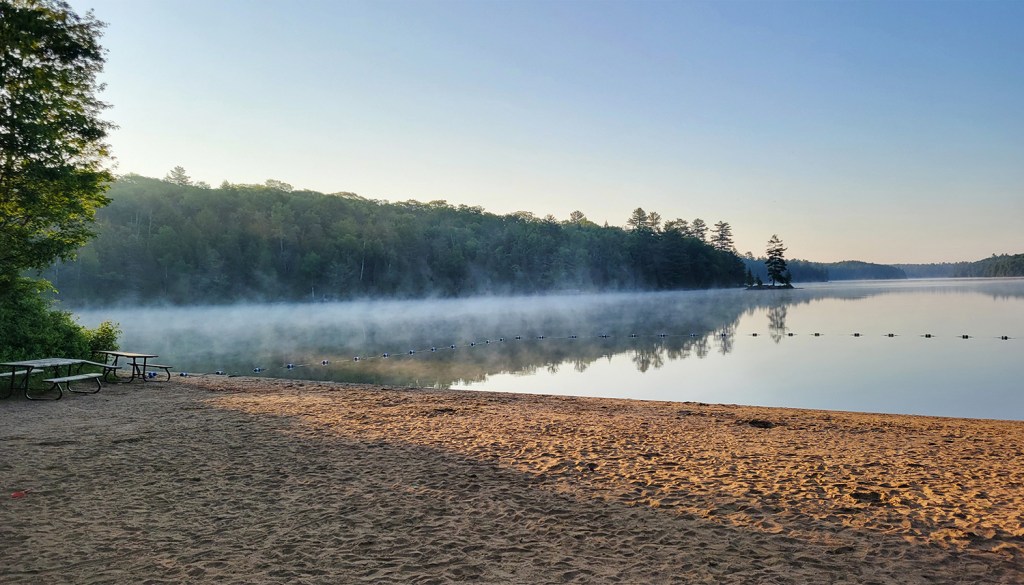
Silent Lake at dawn

Lots more to come in the months ahead, but for now, let’s get out there and enjoy the autumn riding while we still can.